Published 26 Oct 2026
Do Pigeons Mate for Life? Pairs, Courtship and Mating
By the Birdfact teamChecked by Nathan Cope
Feral pigeons pair for life, and a bird that loses its mate finds a new one, within a month according to a classic paper. Extra-pair matings are rare, about 1% of nestings in Kansas. Pairs choose mates of a similar size, court with the bow-coo and billing, and share the incubation and the feeding of their young.
On this page11 sections
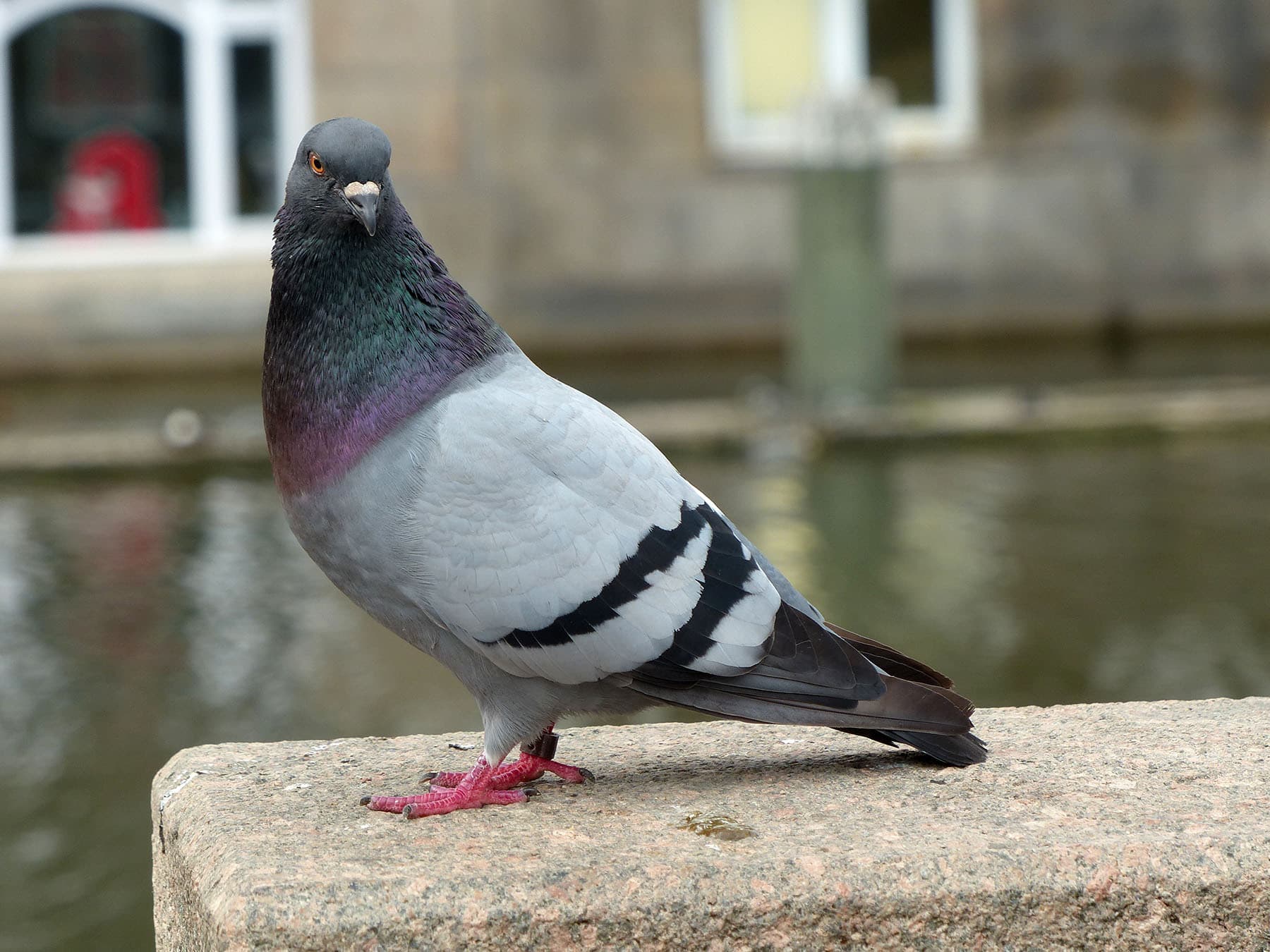
How feral pigeons pair up, court, mate and raise their young together, and what the studies say about how faithful they are. The town pigeon has its own page: feral pigeon (Rock Dove).
Do pigeons mate for life?
Yes, as a rule. Pigeons are monogamous and pair for life.1 A classic paper on pigeon mate choice, based on captive birds bred from wild-caught town pigeons, describes pairs that stay together for life and share the work of incubating, brooding, feeding and defending the young.2 Geneticists studying a colony near Paris describe the species as socially monogamous,3 and other accounts agree that pigeons may mate for life.4
"For life" is not usually very long for a pigeon. A feral pigeon that reaches breeding age lives about three years on average,5 so for most pigeons "for life" means a few years. More: how long pigeons live.
When a pigeon loses its mate
It finds another. According to the same paper, a pigeon whose mate dies or is removed pairs again within a month.2 In the wild, the male keeps the nest site: a female that loses her mate moves and pairs with a male that holds a territory, while males rarely move, some keeping the same site for about 5 years. Pairs often reuse the same nest.1 In a feral population in Słupsk, Poland, adult breeders were strongly faithful to their sites, only 0-0.8% moving in a year, and even a failed nest did not make a pair move.6
Faithful, mostly
Pigeons rarely mate outside the pair. In Kansas, extra-pair matings were judged to account for about 1% of all nestings, from the plumages of the parents and their squabs; they seem uncommon, by chance and unforced.1 A genetic study of captive pigeons, using DNA fingerprinting, found no young fathered outside the pair among 25 chicks from new pairings, and at most 2 of 43 among established pairs, whose bonds held through the two-year study.7
Males guard their mates closely. When other birds crowd the pair while the female is ready to mate, the male follows her closely and pushes her along, a chasing called driving, probably to keep her away from other males.1 In one study, females started most matings, and those that solicited more were guarded more closely. When the guarding male was removed, other males harassed the fertile females, which then fed less; the females did not seek matings with the other males.8 Pigeon researchers note that driving and mate guarding are always done by the male.9
How pigeons choose a mate
Pigeons are choosy, the females more than the males. In choice tests with the captive birds bred from town pigeons, females preferred chequered males to bar-winged ones, and both sexes preferred blue mates to ash-red.2 Age, breeding experience and dominance count too.10
Free-living pigeons on a Kansas campus paired with mates of a similar size (a modest tendency: a correlation of 0.37 across 32 pairs) and, more often than chance would predict, with a mate of a different wing pattern: in 1983 the authors found 2 pairs with matching patterns where they expected 11, and 35 mixed pairs where they expected 26. They put this down probably to the females' choice.11 Feral pigeons at Salford Docks, Greater Manchester, also preferred mates of a different pattern.12
In the colony near Paris, a dovecote where the birds were fed, mates were more closely related than non-mates, with an average relatedness of 0.065, about half that expected between first cousins, even though closely related pairs were less likely to raise two young. The authors think this probably comes from active choice.3
Courtship
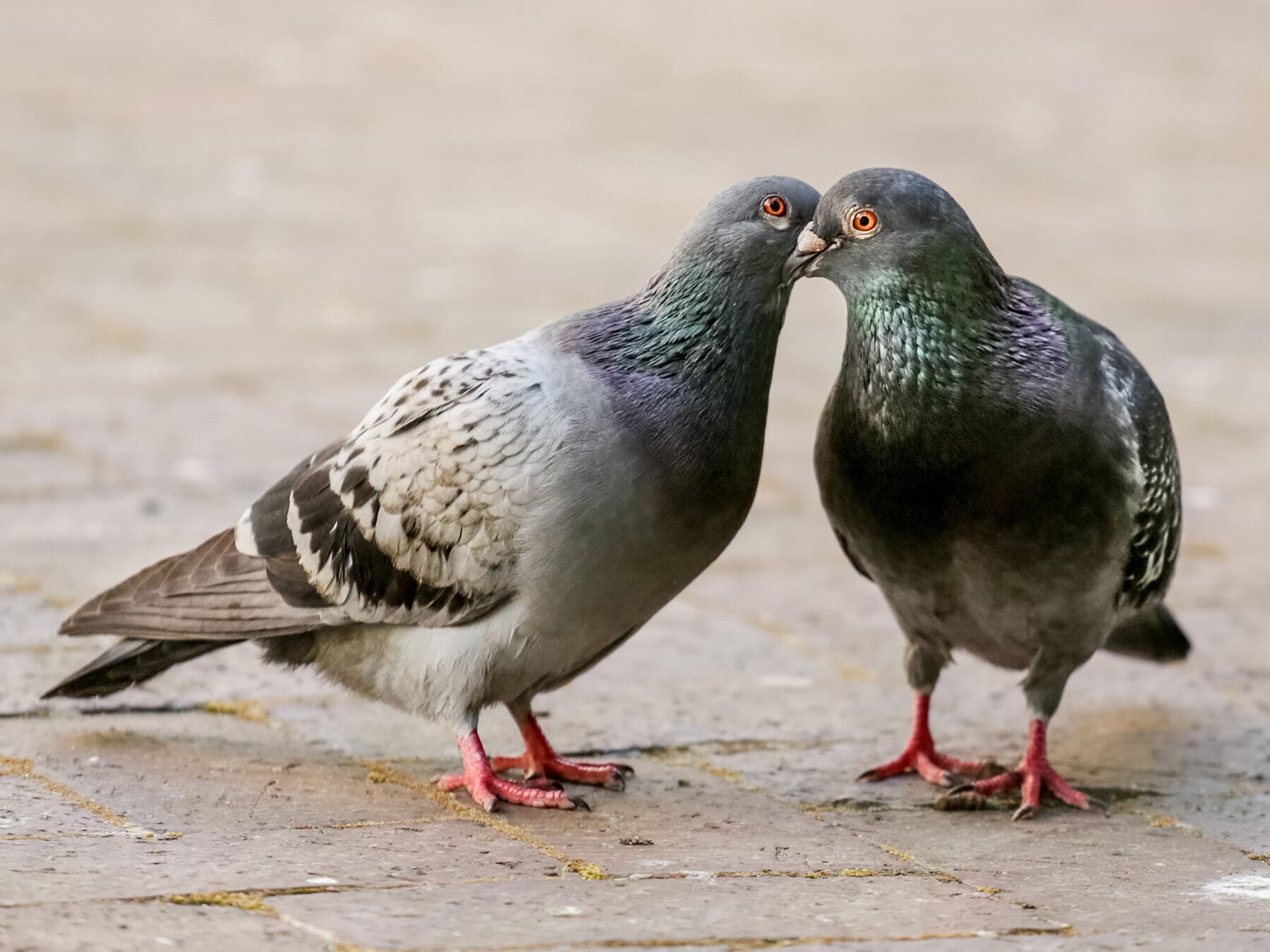
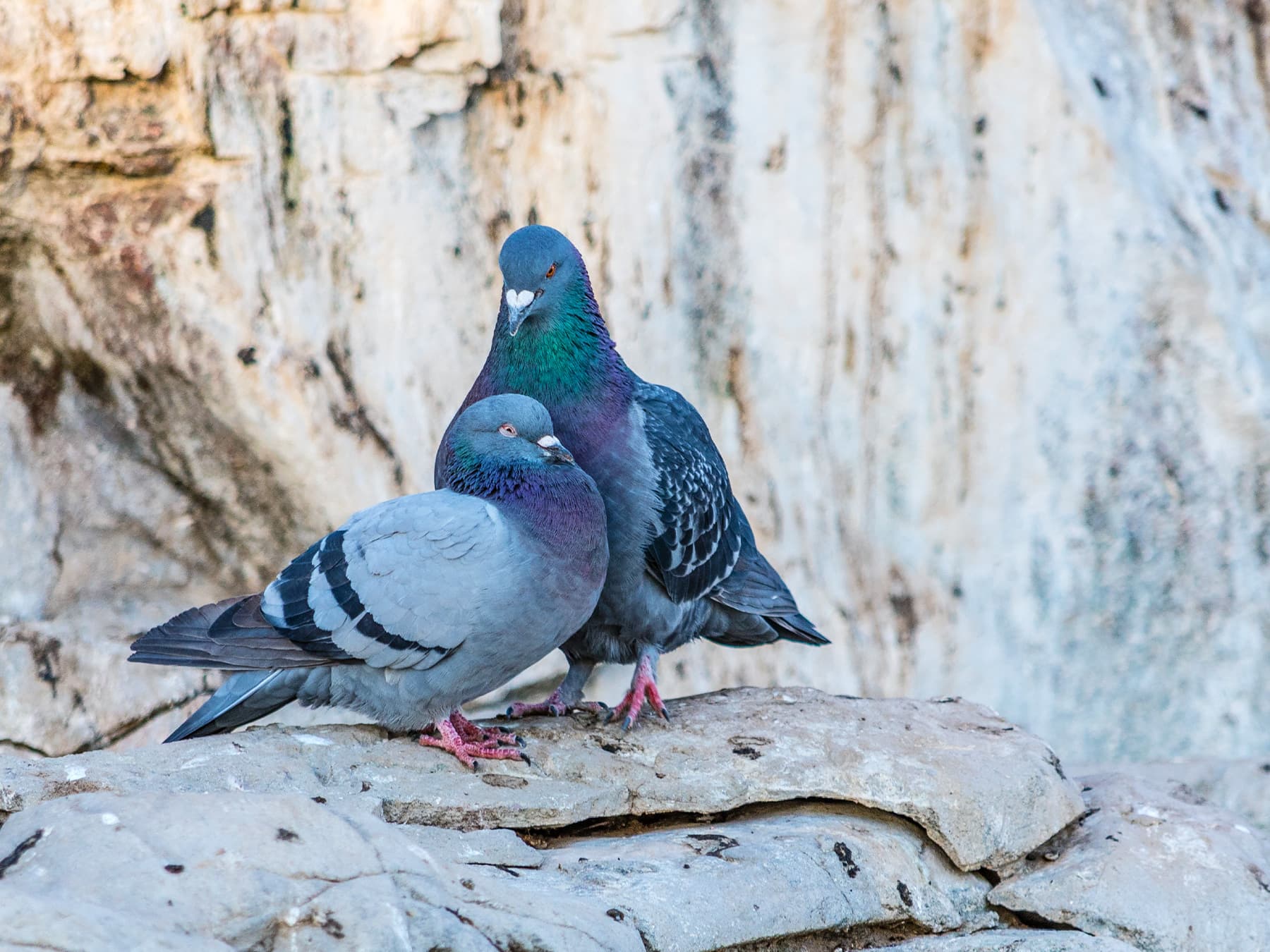
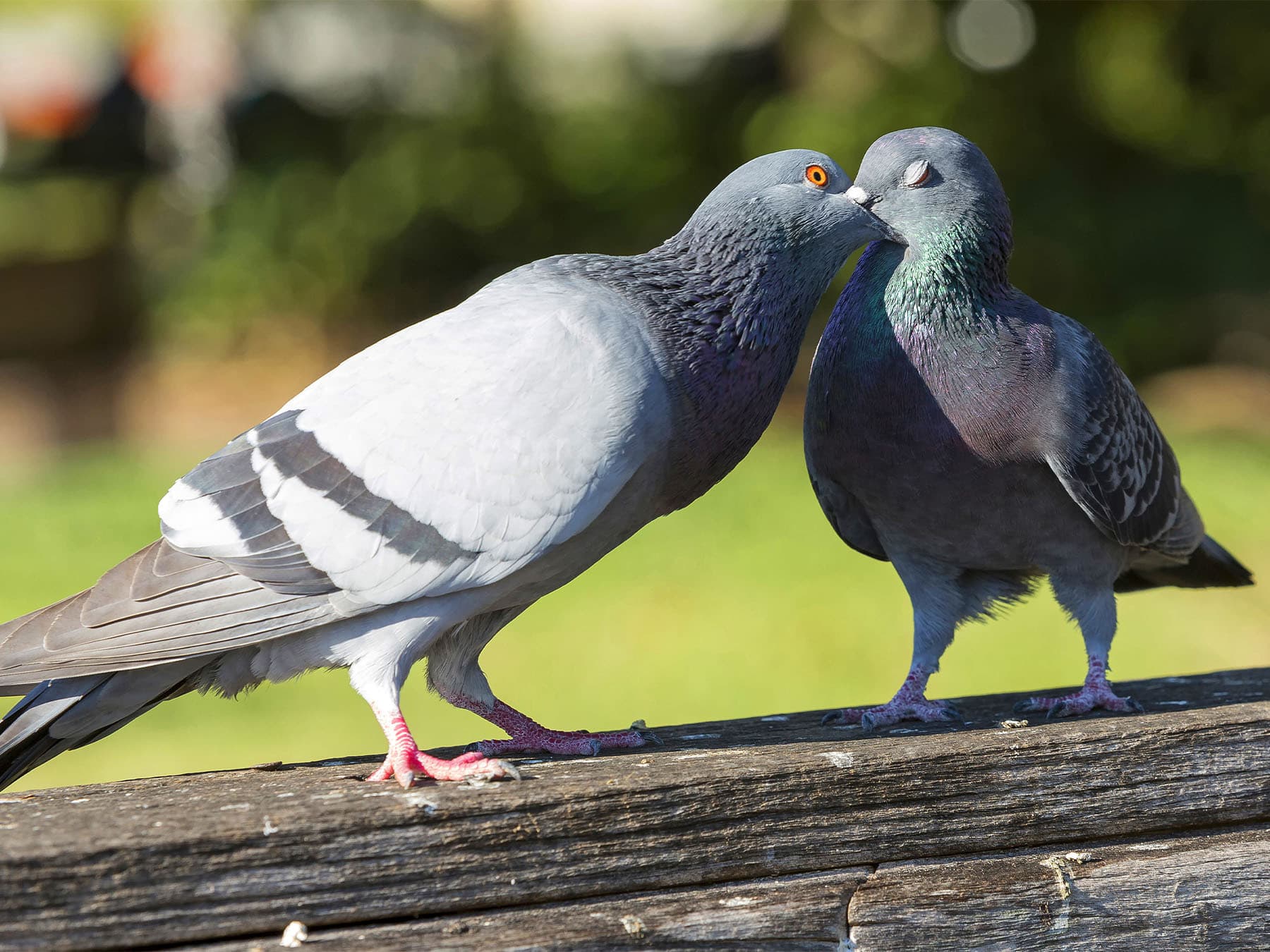
Courtship starts with the bow-coo. The male stands tall, swells his throat, fans his tail and struts in circles around the female, bowing his head and neck as he coos. Then the pair preen each other, the male first. The female begs, and the male passes her food from his crop.1 This "billing" looks like kissing: the female puts her bill into the male's open mouth and he brings up food for her.13 More: pigeon sounds.
A laboratory study of captive pairs found that bowing, driving and attacks peak at the start of a breeding cycle, and that billing and preening lead to mating. Courtship does not follow a fixed script; showing the female the nest site leads instead to collecting nest material.14 Either sex may start courting.2
How do pigeons mate?
When she is ready, the female crouches with her wings half raised and the male mounts her; their vents touch for 1-2 seconds. Afterwards he often makes a display flight, clapping his wings on an exaggerated upstroke for 3-5 beats, flying 40-80 m (130-260 ft) to another perch and gliding with his wings held in a V. The courtship is repeated, over a few minutes, before each mating.1
Building a home together
The male picks the nest site and sits on it, giving the nest call to attract a mate.1 Then he brings twigs and stems one at a time and the female, sitting on the site, tucks them around herself to build a loose platform.1, 15 More: pigeon nests.

Raising young as a pair
Both parents incubate: the male usually from mid-morning to late afternoon, the female the rest of the day and the night.1 Both feed the squabs on crop milk.1 Pigeons often start a new clutch before the last brood has left. Then, the authors of one colony study note, the female sits on the new eggs about 80% of the time while the male feeds the fledglings of the brood before, and once the new eggs hatch both parents feed the young. The authors judge the male's share of care about equal to the female's.9
A busy pair raises several broods a year. In Słupsk, marked feral pairs averaged 4.4 broods and 3.6 fledged young a season;16 in Kansas, pairs averaged 6.5 nests a year.1 More: baby pigeons.

Same-sex pairs
When researchers removed males from captive colonies of pigeons bred from feral stock, some females paired with each other: 5 female pairs formed, alongside 20 male-female pairs and 14 single females. The female pairs incubated as long as mixed pairs, and their chicks grew as well; their eggs were fertilised by other males. They did have fewer broods, 3.8 against 5.3 for mixed pairs. Single females took longer to hatch their eggs, 21.1 days against 18.9, and raised fewer young. Male pairs, formed when females were scarce, lasted only weeks.9
When pigeons pair up
Any time of year. In Kansas, pairs form in every month, mostly from February to September, with no peak.1 Pigeons can breed in their first year, though in many populations a shortage of nest sites keeps most young birds from breeding.1, 5
Other pigeons and doves: do Woodpigeons mate for life? and do Mourning Doves mate for life? More about the family: pigeons vs doves.
Sources
- Lowther, P. E., Johnston, R. F. (2020). Rock Pigeon (Columba livia), version 1.0. Birds of the World (S. M. Billerman, editor). Cornell Lab of Ornithology. doi:10.2173/bow.rocpig.01
- Burley, N. (1977). Parental investment, mate choice, and mate quality. Proceedings of the National Academy of Sciences 74(8): 3476-3479. doi:10.1073/pnas.74.8.3476
- Jacob, G., Prévot, A.-C., Baudry, E. (2016). Feral pigeons (Columba livia) prefer genetically similar mates despite inbreeding depression. PLoS ONE 11(9): e0162451. doi:10.1371/journal.pone.0162451
- National Audubon Society. Rock Pigeon. Audubon Guide to North American Birds (text adapted from Kaufman, Lives of North American Birds, 1996). Accessed 26 October 2026. Source
- BTO. Rock Dove (Columba livia). BTO BirdFacts. Accessed 26 October 2026. Source
- Hetmański, T. (2007). Dispersion asymmetry within a feral pigeon Columba livia population. Acta Ornithologica 42(1): 23-31. doi:10.3161/068.042.0109
- Patel, K. K., Siegel, C. (2005). Genetic monogamy in captive pigeons (Columba livia) assessed by DNA fingerprinting. BIOS 76(2): 97-101. doi:10.1893/0005-3155(2005)076[0097:RAGMIC]2.0.CO;2
- Lovell-Mansbridge, C., Birkhead, T. R. (1998). Do female pigeons trade pair copulations for protection? Animal Behaviour 56(1): 235-241. doi:10.1006/anbe.1998.0774
- Jankowiak, Ł., Tryjanowski, P., Hetmański, T., Skórka, P. (2018). Experimentally evoked same-sex sexual behaviour in pigeons: better to be in a female-female pair than alone. Scientific Reports 8: 1654. doi:10.1038/s41598-018-20128-3
- Burley, N. (1981). Mate choice by multiple criteria in a monogamous species. American Naturalist 117(4): 515-528. doi:10.1086/283732
- Johnston, R. F., Johnson, S. G. (1989). Nonrandom mating in feral pigeons. The Condor 91(1): 23-29. doi:10.2307/1368144
- Murton, R. K., Thearle, R. J. P., Coombs, C. F. B. (1974). Ecological studies of the feral pigeon Columba livia var. III. Reproduction and plumage polymorphism. Journal of Applied Ecology 11(3): 841-854. doi:10.2307/2401748
- Spiteri, N. J. (1975). Social, especially agonistic, behaviour in the pigeon. MSc thesis, Department of Psychology, Durham University. Accessed 26 October 2026. Source
- Fabricius, E., Jansson, A.-M. (1963). Laboratory observations on the reproductive behaviour of the pigeon (Columba livia) during the pre-incubation phase of the breeding cycle. Animal Behaviour 11(4): 534-547. doi:10.1016/0003-3472(63)90276-8
- Cornell Lab of Ornithology. Rock Pigeon overview and life history. All About Birds. Accessed 26 October 2026. Source
- Hetmański, T., Barkowska, M. (2008). Breeding parameters and recruitment in feral pigeons Columba livia f. domestica. Acta Ornithologica 43(2): 159-166. doi:10.3161/000164508X395270