Published 8 Oct 2026
Coal Tit Song and Calls: What a Coal Tit Sounds Like
By the Birdfact teamChecked by Nathan Cope
A Coal Tit's song is a short phrase of two or three notes, repeated several times, a little like a Great Tit's but higher and faster. Listen to songs recorded in Britain, see them drawn as spectrograms, and find out why one bird sings many versions.
On this page10 sections
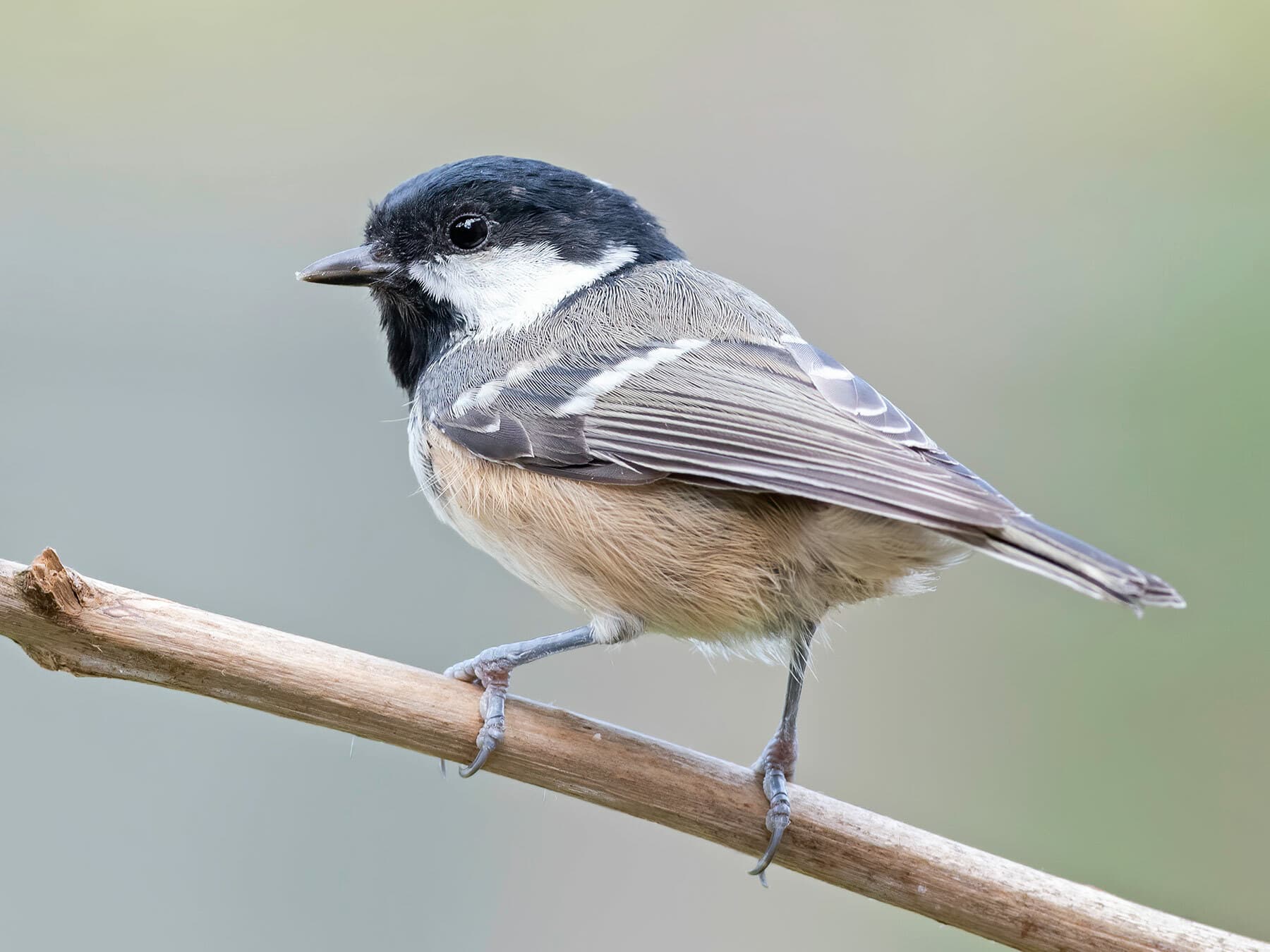
What a Coal Tit sounds like, with songs recorded in Britain and drawn as spectrograms: the song and how to tell it from a Great Tit's, why one Coal Tit sings many versions, what the songs are for, and the calls. For the bird itself, see Coal Tit identification, song and facts.
What does a Coal Tit sound like?
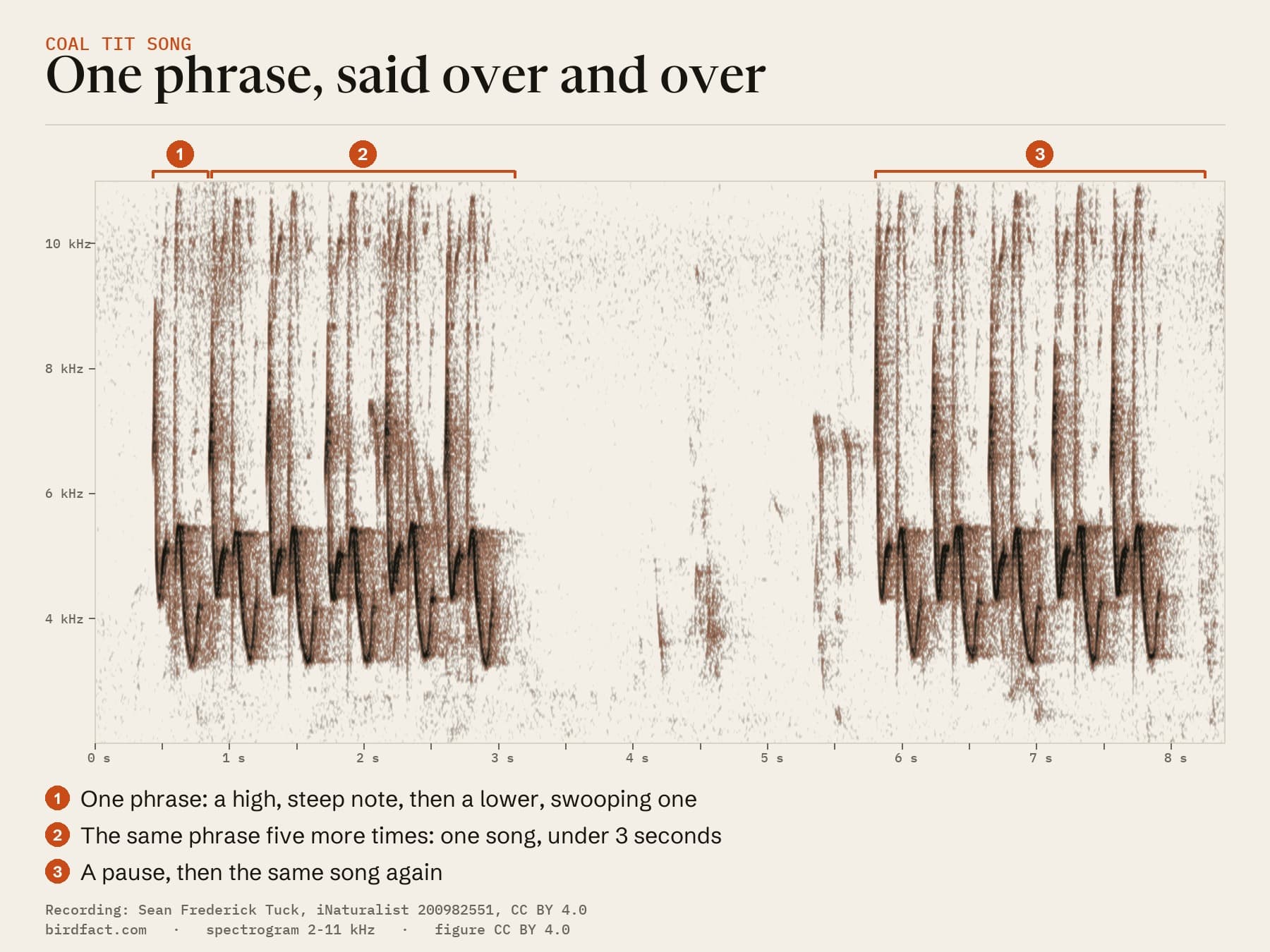
A short phrase of two or three notes, repeated several times at varying speed: something like "peechoo-peechoo-peechoo".1 Each song lasts only a few seconds. The bird pauses, then sings again: in the recording below, it sings the same song twice.
Coal Tit or Great Tit?
The songs are easy to confuse. Both birds repeat a short phrase over and over, but the RSPB describes the Coal Tit's as like a Great Tit's two syllables, only higher, faster and more fluid.2 Listen to the two recordings one after the other.
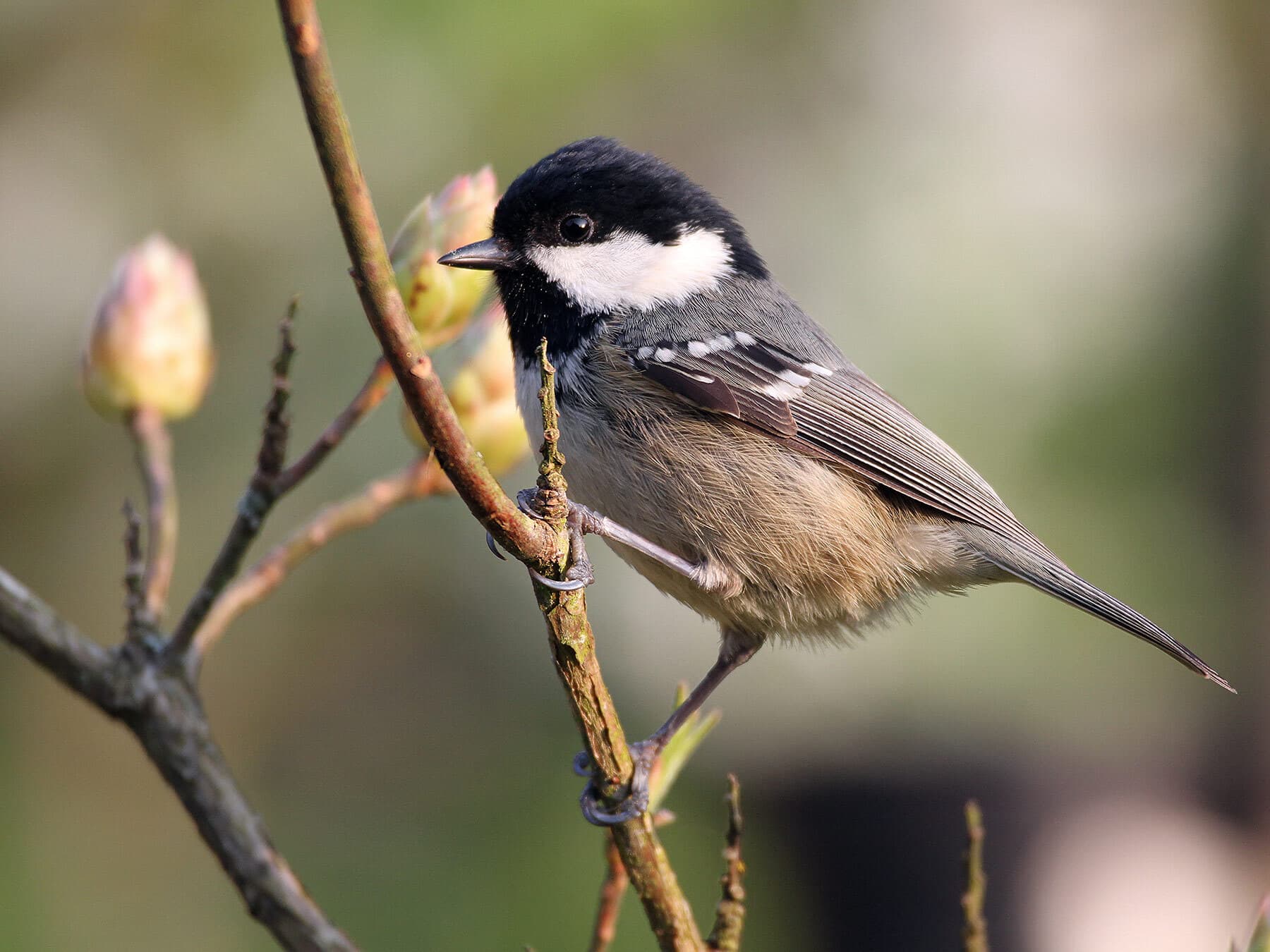
If you can see the singer, the plumage settles it: a Great Tit is bigger and yellow below, with a black stripe down the breast, while a British adult Coal Tit shows no yellow and has a large white patch on the back of its head. More: Coal Tit or Great Tit? and Great Tit song and calls.
One bird, many songs
A Coal Tit does not have just one song. Each bird has a set of different versions, called song types. In a 1987 study individual birds sang up to 16 song types,3 and in one population in central Norway at least 44 song types were recorded, with up to 14 from a single male.4 The figure below sets the songs of three British birds side by side: the Vale of Glamorgan bird from the recording above, and the two recordings that follow. Each sings a different song.
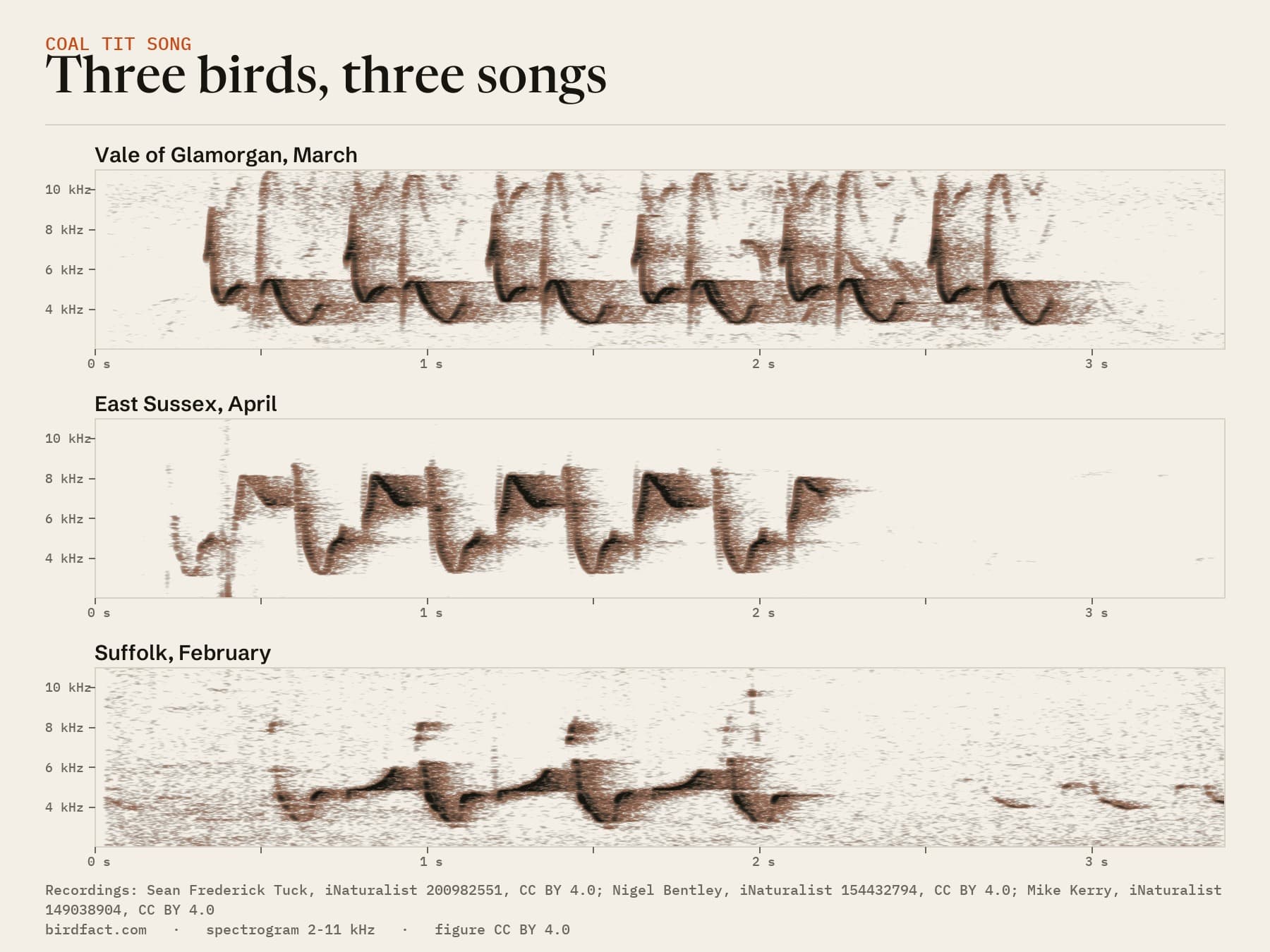
Neighbouring males share some of their song types, and the same types turn up at places far apart.5 Why have so many? One idea, the "Beau Geste" hypothesis, is that a male switches songs as he moves from perch to perch, to sound like several birds. Haftorn's Norwegian data did not support it: males were no more likely to switch song type when they moved to a new song post, or when the posts were further apart.4
Long songs, short songs
Song matters in disputes between males, and its length carries a message. In the 1987 study, songs were stretched to as much as five times their usual length in fierce territorial disputes, and were shorter when a bird sang at its nest hole. Song pitch changed through the breeding season too: the birds sang lowest around the time the eggs were laid, with shifts of up to 1,000 Hz.3
Coal Tits also know their neighbours' songs. In north-west China, where one population had 19 song types, males reacted more strongly to a stranger's song than to a neighbour's, a pattern known as the "dear enemy" effect.6
When Coal Tits sing
Learning the song
Coal Tits learn their songs. Young birds hand-reared where they could not hear wild Coal Tits developed songs that all differed, more or less, from wild ones, and wild males responded little or not at all to most of them. The one that drew a full response resembled both a wild song type and the alarm calls.5 Thielcke suggested that learning is what keeps the song so similar across the bird's huge range.
The song across Europe and Asia
That similarity is striking. A study of 1,497 songs from 216 males in ten populations found Coal Tit song much the same across continental Europe, Corsica and Sardinia; only the birds of north-west Africa and Cyprus sang lower.7 In playback tests near Dresden in eastern Germany and just across the border in the Czech Republic, territorial males responded strongly to songs recorded in Latvia, the Russian Far East and Japan, up to 10,000 km away, much as they did to a local song. Yet they did not react to songs from north-west Africa, Cyprus, or even Corsica and Sardinia, whose songs had measured much like their own: a result the authors found surprising.
In an earlier experiment, south German Coal Tits responded to the song of the black-crested Coal Tit of the Himalayas, long treated as a separate species but now counted as a Coal Tit, almost exactly as to their own.8 A 2011 study found that Central European males recognised songs from China and the Himalayas as Coal Tit songs, but answered them less aggressively than local songs.9
Calls
When alarmed, Coal Tits give a run of sharp "pwee" notes. At the nest, the adults, usually the female, and the feathered young give a long hiss when a predator comes near.1
About these recordings
The three songs were recorded in Britain and shared on iNaturalist under a Creative Commons licence; each was checked on a spectrogram before use. The East Sussex bird was seen singing; the other two were identified from the recording by the recordist and other iNaturalist users. The calls were recorded in France, from birds the recordist could see.
Sources
- Gosler, A., Clement, P. (2023). Coal Tit (Periparus ater), version 1.1. Birds of the World (B. K. Keeney and S. M. Billerman, editors). Cornell Lab of Ornithology. doi:10.2173/bow.coatit2.01.1
- RSPB. Sounds of... Parks and Gardens: Tits and Finches. RSPB. Accessed 8 October 2026. Source
- Goller, F. (1987). Der Gesang der Tannenmeise (Parus ater): Beschreibung und kommunikative Funktion. Journal für Ornithologie 128: 291-310. doi:10.1007/BF01640299
- Haftorn, S. (1995). Coal Tit Parus ater song repertoires and the Beau Geste hypothesis. Journal für Ornithologie 136: 279-283. doi:10.1007/BF01651295
- Thielcke, G. (1973). Uniformierung des Gesangs der Tannenmeise (Parus ater) durch Lernen. Journal für Ornithologie 114: 443-454. doi:10.1007/BF01641521
- Zhao, L., Zhang, F., Liu, J., Liang, W. (2026). Vocal complexity constrains the dear enemy effect: a comparative study of coal tits and green-backed tits. Ecology and Evolution 16(1): e72918. doi:10.1002/ece3.72918
- Pentzold, S., Förschler, M. I., Tietze, D. T., Randler, C., Martens, J., Päckert, M. (2016). Geographic variation in coal tit song across continents and reduced species recognition between Central European and Mediterranean populations. Vertebrate Zoology 66(2): 191-199. doi:10.3897/vz.66.e31548
- Thielcke, G. (1969). Die Reaktion von Tannen- und Kohlmeise (Parus ater, P. major) auf den Gesang nahverwandter Formen. Journal für Ornithologie 110: 148-157. doi:10.1007/BF01670777
- Tietze, D. T., Martens, J., Sun, Y.-H., Severinghaus, L. L., Päckert, M. (2011). Song evolution in the coal tit Parus ater. Journal of Avian Biology 42: 214-230. doi:10.1111/j.1600-048X.2010.05283.x
- RSPB. Coal tit. RSPB Birds A-Z. Accessed 8 October 2026. Source
- RSPB. Great tit. RSPB Birds A-Z. Accessed 6 October 2026. Source
- iNaturalist and xeno-canto contributors. Recordings of Coal Tits used on the song page. iNaturalist; xeno-canto. Accessed 8 October 2026. Source