


Published 1 Nov 2026
Brown Thrasher Sounds: Song, Calls and How to Recognize Them
By the Birdfact teamChecked by Nathan Cope
The male Brown Thrasher sings a long, loud run of phrases, many of them given twice, from a treetop in spring; he has more than 1,100 song types but mimics other birds only now and then. The common call is a harsh smack. Hear them, see the song on a spectrogram, and learn to tell a thrasher from a mockingbird or catbird by counting the repeats.
On this page11 sections
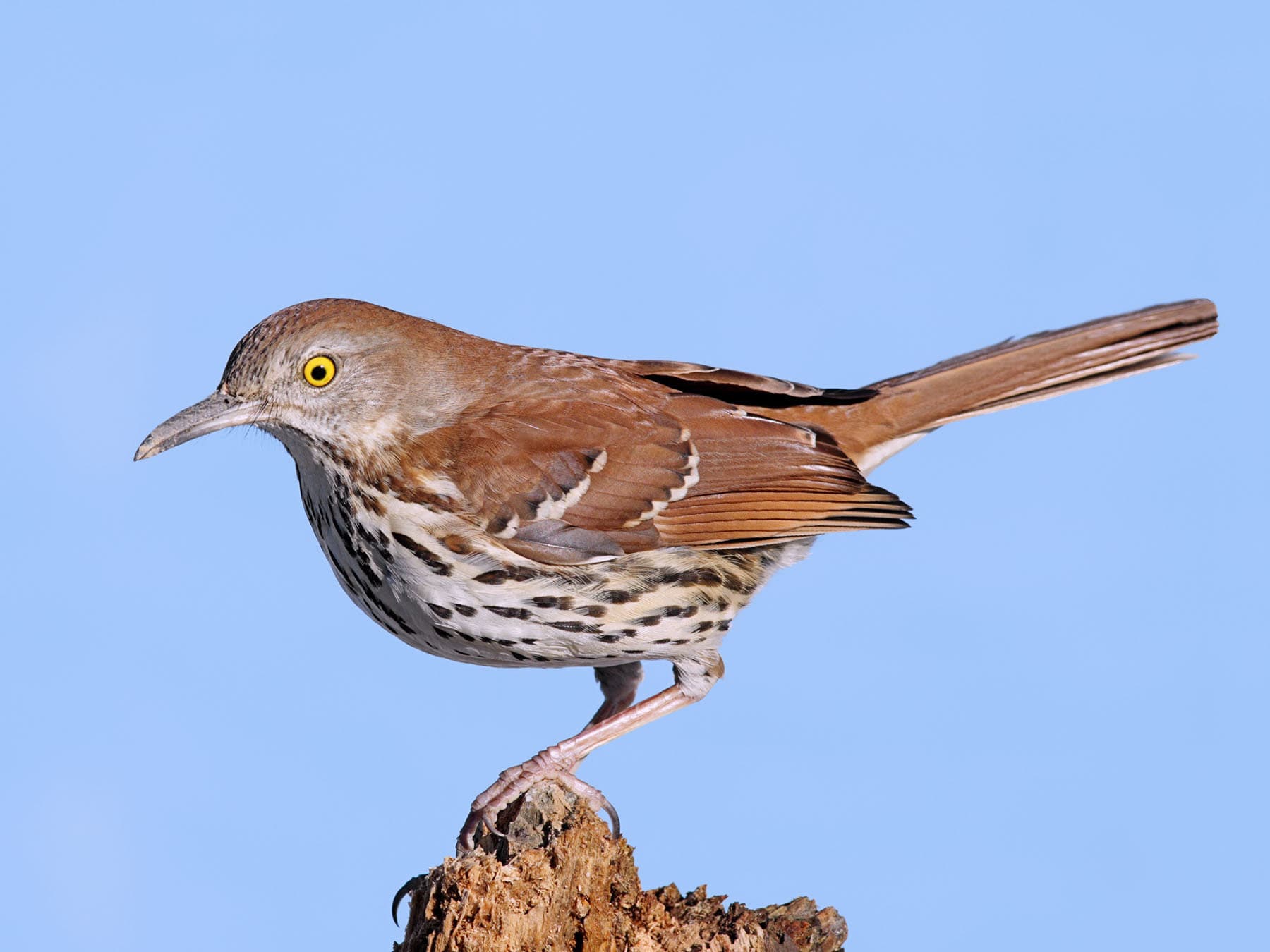
Few North American songbirds have a bigger song repertoire than the Brown Thrasher. In spring a male sings a long, loud run of phrases from a treetop, many of them given twice, and the bird has a loud, smacking call. This page plays both, shows what the song looks like, and explains how to tell it from a mockingbird or a catbird. For the bird itself, see the Brown Thrasher guide.
What does a Brown Thrasher sound like?
In spring, a male sings a long, loud, rich series of short phrases, often given twice, with short pauses in between, on and on with no clear beginning or end. The call is quite different: a single loud, harsh smack, like a smacking kiss, often given again and again at a slow pace, at any time of day.1
The song
The song is made of short phrases, with a clear pause of roughly half a second to a second after each. The pace speeds up and slows down, yet the delivery keeps a clear beat, and the song carries farther through woodland than the songs of warblers.1
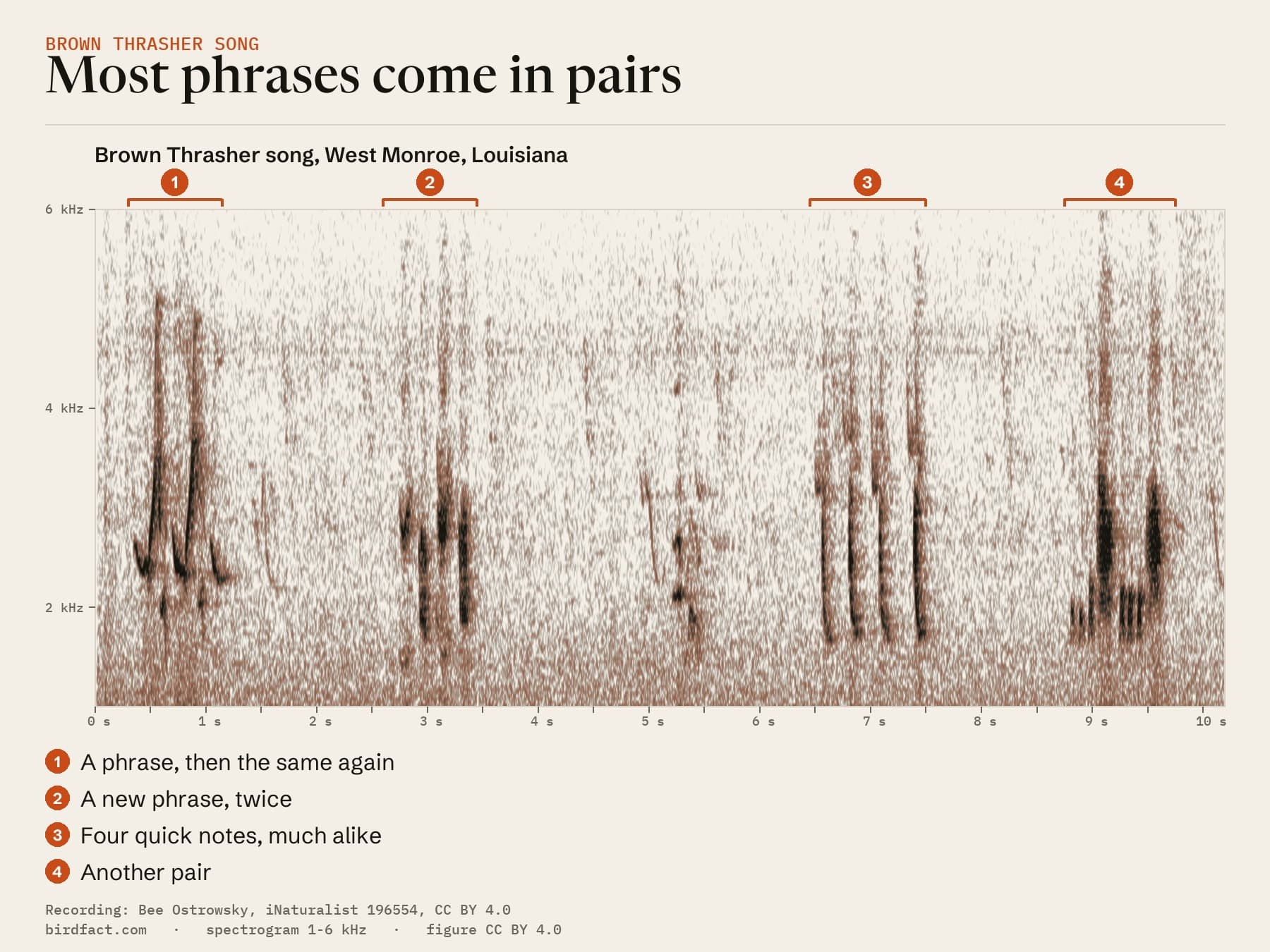
The pairs are the thing to listen for. Field guides give the paired phrases as the rule of thumb, but they are a tendency, not a rule: in one study each phrase was sung 1.5 times on average, so some come once and some three or more times. The bird can even sing two notes at once, each at a different volume.1
In our recordings, a Louisiana bird gave one phrase twice, then a new phrase twice, then, after a fainter phrase, four quick notes much alike, then another pair, with a gap of a second or more between groups.2
How many songs does a Brown Thrasher know?
Mimicry
Brown Thrashers copy other birds only now and then, and the copies tend to be rough. Imitations noted include the Northern Cardinal, Wood Thrush, Tufted Titmouse, White-eyed Vireo, Northern Flicker and Chuck-will's-widow.1 Most of the song is the thrasher's own. Its relative the Northern Mockingbird is the regular copier, often working other birds' songs into its own,5 and the Gray Catbird sometimes seems to mimic too.6

When and where they sing
The loud song is short-lived. Males start about 10 days after they arrive in spring,7 sing a lot while they claim a territory and look for a mate, then sing very little once they are paired and nesting.4 In Georgia, song runs from February to July; in central Massachusetts, it starts in the last week of April and ends by early July. They sing most at dawn and in the hours after, and again before dusk. After the nesting season they usually go quiet and are hard to find, though one bird arriving in Florida in October was in full song.1
Neighbors sing back and forth early in spring, and the short season suggests the song is for winning a territory or a mate more than for holding one. A singing male picks a high, open perch, usually the top of a tree or tall shrub, with his tail hanging straight down, well above where he feeds and nests. In northeastern Kansas, singers picked the crowns of big elms, cottonwoods, hawthorns and red cedars. The loud song is not known to come from the ground, and is rarely given in flight.1
Females apparently do not give the loud song,7 though one incubating female was heard singing, after which her mate took over the eggs.1 More on the sexes: male vs female Brown Thrasher.
Soft song and whisper song
Not all thrasher song is loud. Close to his mate before nesting, a male sings a much quieter version of the full song. There is also a whisper song, a low warble that sometimes includes phrases from the spring song but cannot be heard from more than a few feet away. It is given in spring and fall, sometimes while a bird looks over nest sites. A young bird 44 days old was heard singing a very soft song.1 In a Texas winter study, whisper song became more frequent from January to March.8
Calls
The commonest call is the smack (or tchuck) described above. It also works as an alarm: parents give it when a snake comes near the nest. Other calls include a whistled teeola; harsh, slurred teea notes in a series that climbs in pitch and loudness; a low hissing note; a quick kek; and soft chirrups.1
At a nest they disturb, people may hear the smack, teeola, teea and hissing calls together. When researchers put a snake, real or model, under the nest, the parents called mostly from a perch above it, with smack and kek notes and a soft churr.9 Young birds give adult-like alarm notes 13 to 17 days after leaving the nest.7
In winter listen for a soft, low verr, the same as the Long-billed Thrasher's. In a southern Texas study, birds gave it from trees for 10 to 15 minutes at dawn and dusk, and after chases between neighbors, probably to mark a winter territory.1
Thrasher, mockingbird or catbird?
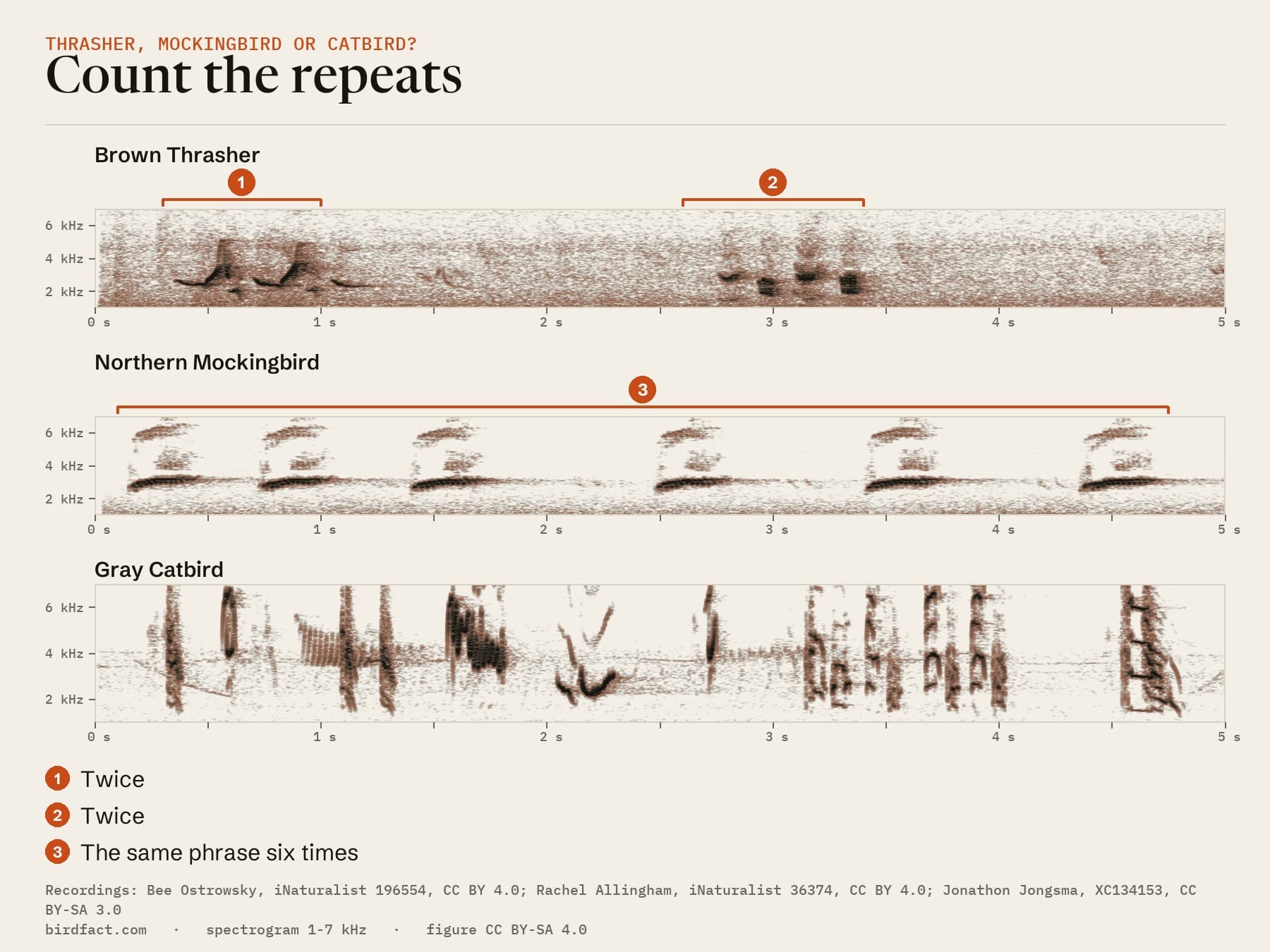
Three members of the same family sing long runs of varied phrases in the same yards and thickets: the Brown Thrasher, the Northern Mockingbird and the Gray Catbird. The standard field-guide clue is the number of repeats: the thrasher tends to give each phrase twice, the mockingbird three times or more, and the catbird mostly once.1, 5 Mockingbirds themselves tell thrasher song from their own by its repetition pattern and perhaps its pitch range.10 Thrashers seem less choosy: in one playback study they responded equally to mockingbird and thrasher song.1
Tone helps too. The thrasher's song is lower-pitched than a mockingbird's, and more liquid and mellow than a catbird's, whose song runs on unevenly through musical and mechanical-sounding notes.1, 6 A mockingbird often sings in flight, where a thrasher seldom does,1 and it regularly sings after dark.5
In our recordings, the thrasher gave each of two phrases twice in five seconds,2 while a California mockingbird gave one phrase six times in the same span.11
Where the two meet in winter, in south Texas, the Long-billed Thrasher's song is much like this one, but the Brown Thrasher repeats its phrases more.1 For the mockingbird's song, its copies and its night singing, see mockingbird sounds.
Questions
Do female Brown Thrashers sing?
Not the loud song, as far as is known: the singer in a treetop is almost certainly a male.7 Both parents give the smack when a snake comes near the nest.9
Does the Brown Thrasher song have words?
No, but listeners fit words to its paired phrases to remember it, such as "plant-a-seed, plant-a-seed."1, 12
About the recordings
All the recordings on this page are from iNaturalist and xeno-canto, used under their Creative Commons licenses, and we checked each one by ear and on a spectrogram. The Illinois singer and the North Carolina caller were photographed.13, 14 The Louisiana bird was not seen; the recordist and two other users identified it from the sound, one noting that most of its phrases are doubled.2 The mockingbird was recorded singing near midnight and was not seen; three users identified it.11 The catbird was seen; its recording has another bird calling in the background.15
Sources
- Cavitt, J. F., Haas, C. A. (2020). Brown Thrasher (Toxostoma rufum), version 1.0. Birds of the World (A. F. Poole, editor). Cornell Lab of Ornithology. doi:10.2173/bow.brnthr.01
- Bee Ostrowsky (2021). Brown Thrasher song, West Monroe, Louisiana, 27 April 2021 (iNaturalist sound 196554). iNaturalist. Accessed 1 November 2026. Source
- Boughey, M. J., Thompson, N. S. (1981). Song variety in the Brown Thrasher (Toxostoma rufum). Zeitschrift für Tierpsychologie 56: 47-58. Accessed 1 November 2026.
- Kroodsma, D. E., Parker, L. D. (1977). Vocal virtuosity in the Brown Thrasher. The Auk 94: 783-785. doi:10.2307/4085282
- National Audubon Society. Northern Mockingbird. Guide to North American Birds. Accessed 1 November 2026. Source
- National Audubon Society. Gray Catbird. Guide to North American Birds. Accessed 1 November 2026. Source
- Erwin, W. G. (1935). Some nesting habits of the Brown Thrasher. Journal of the Tennessee Academy of Science 10: 179-204. Accessed 1 November 2026.
- Fischer, D. H. (1981). Winter time budgets of Brown Thrashers. Journal of Field Ornithology 52: 304-308. Accessed 1 November 2026.
- Cavitt, J. F. (1998). The role of food supply and nest predation in limiting reproductive success of Brown Thrashers (Toxostoma rufum). PhD thesis, Kansas State University, Manhattan. Accessed 1 November 2026.
- Reichard, D. G., Price, J. J. (2008). Species recognition in a vocal mimic: repetition pattern not the only cue used by Northern Mockingbirds in discriminating songs of conspecifics and Brown Thrashers. Wilson Journal of Ornithology 120. Accessed 1 November 2026.
- Rachel Allingham (2019). Northern Mockingbird song, Casa de Oro-Mount Helix, California, 28 April 2019 (iNaturalist sound 36374). iNaturalist. Accessed 1 November 2026. Source
- Cornell Lab of Ornithology. Brown Thrasher. All About Birds. Accessed 1 November 2026. Source
- Chris Stahl (2025). Brown Thrasher song, Ava, Illinois, 21 March 2025 (iNaturalist sound 1343374). iNaturalist. Accessed 1 November 2026. Source
- Seb H (2025). Brown Thrasher smack calls, Wilmington, North Carolina, 4 May 2025 (iNaturalist sound 1440262). iNaturalist. Accessed 1 November 2026. Source
- Jonathon Jongsma (2013). Gray Catbird song, Richardson Nature Center, Minnesota, 19 May 2013 (XC134153). xeno-canto. Accessed 1 November 2026. Source