Published 23 Oct 2026
Blackbird Song and Calls: What They Sound Like and Mean
By the Birdfact teamChecked by Nathan Cope
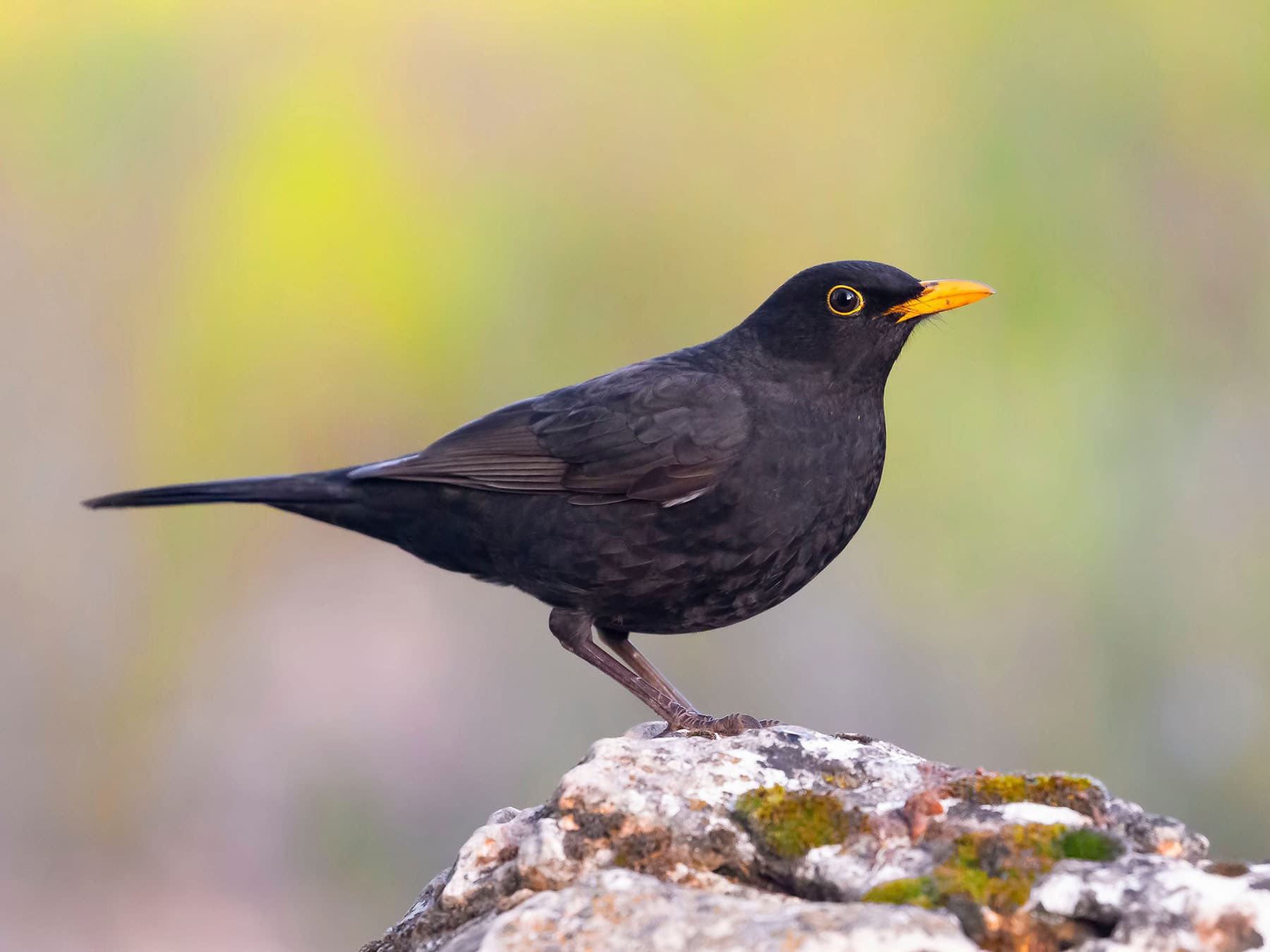
A male Blackbird sings slow, mellow, whistled phrases, each usually ending in a short, scratchy twitter, most regularly from March to June and richest at dawn. Its calls include a loud chink, a low chook that speeds up into an alarm rattle, and a thin seee at hawks. In towns, traffic noise and street lights can push song into the night.
On this page15 sections
- What does a Blackbird sound like?
- How a song is built
- Why two parts?
- Learning from the neighbours
- The singing year
- Dawn and dusk
- Why do Blackbirds sing at night?
- City Blackbirds sound different
- Do female Blackbirds sing?
- Calls and what they mean
- What does a Blackbird's alarm call mean?
- Calls on autumn nights
- Telling it from a Song Thrush
- About the recordings
- Sources
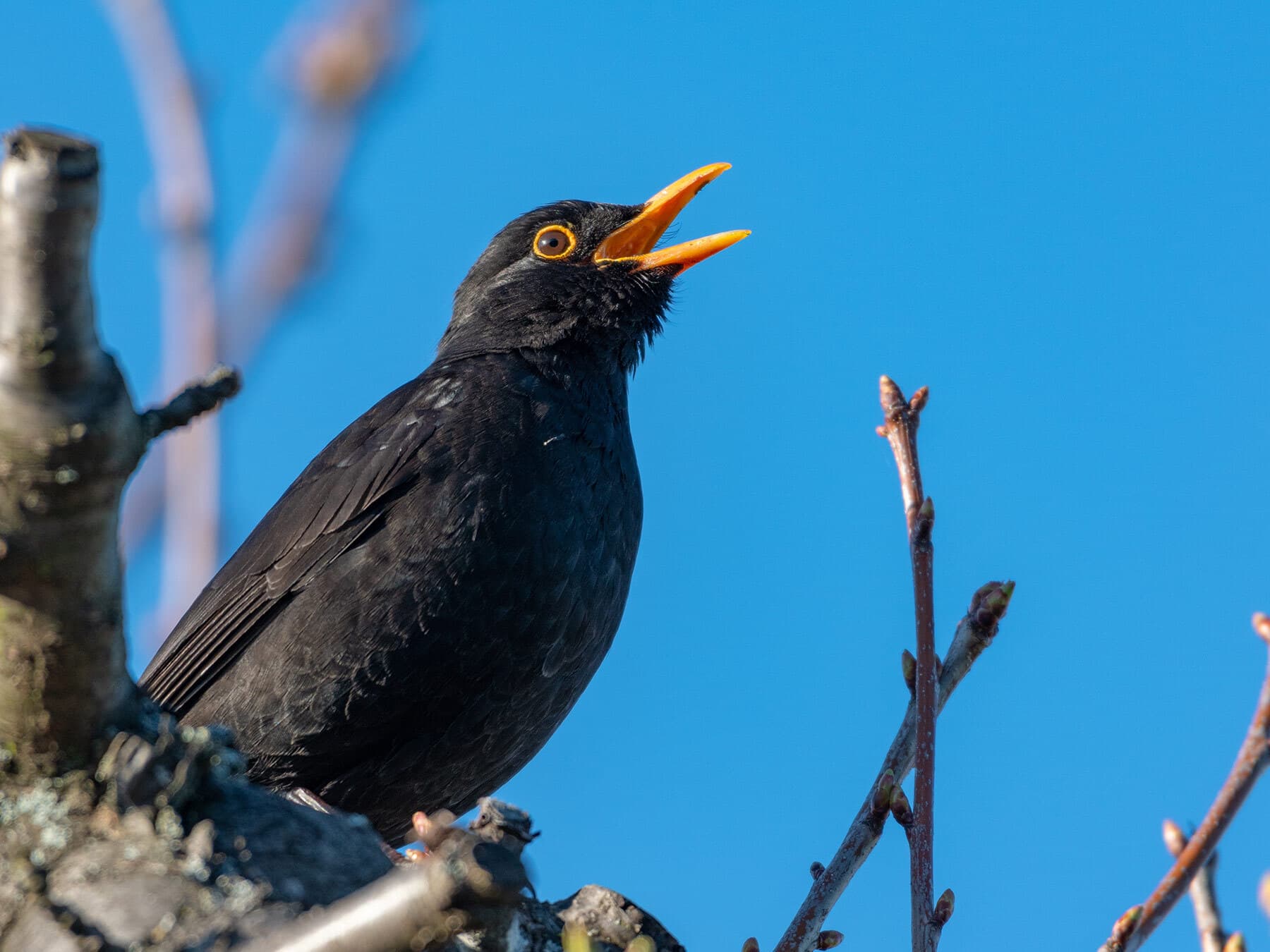
What a Blackbird sounds like, with recordings made in Britain and drawn as spectrograms: how the song is built, when Blackbirds sing and why some sing at night, how city birds sound different, and what their calls mean. For the bird itself, see Blackbird identification, song and facts.
What does a Blackbird sound like?
A male Blackbird sings slow, mellow, whistled phrases from a high perch, each usually ending in a short, scratchy twitter. The phrases are slurred and fluting, and not repeated: unlike a Song Thrush, a Blackbird does not normally sing a phrase twice in a row.1, 2 The RSPB calls it a leading voice of the dawn chorus, and it often starts the evening chorus too.3
Its calls are just as familiar: a loud, repeated chink, a low chook that can speed up into a rattling alarm, and a thin, high seee. They are described further down.
How a song is built
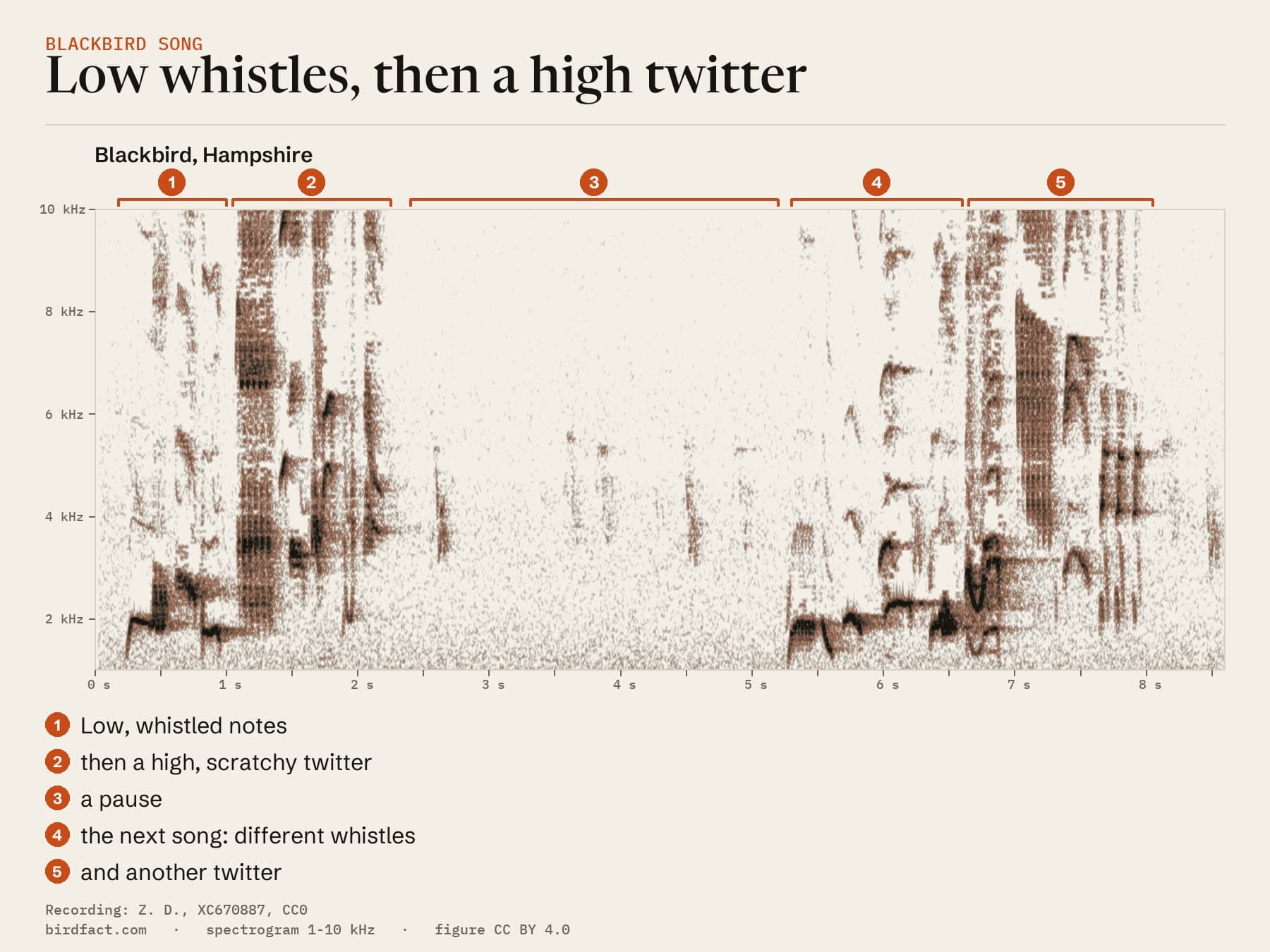
Each song has two parts. It opens with a few low, pure, whistled notes, which researchers call the motif, and ends with the twitter, a burst of higher and more complex notes.4 Then comes a pause before the next song, which usually opens with different whistles.1
The figure below draws two songs from a recording made in Hampshire as a spectrogram: pitch up the side, time along the bottom, each dark mark a note. The whistles sit at about 1.5 to 3.5 kHz; the twitter climbs to about 8 to 10 kHz. In this recording the pauses between songs last about 3 to 7 seconds.
Why two parts?
The two parts seem to do different jobs. In playback experiments, territorial males apparently did not treat a song with the whistles cut out as a Blackbird's song; with the twitter cut out they still did, and the change only altered what the song said about how worked up the singer was.5
The low whistles also carry further. When song was played and re-recorded in a leafless wood, the twitter blurred and faded over distance faster than the whistles, and the results suggested the song could still be detected across more than four territories. The authors suggest that a male sings from a high perch mainly to hear replies better, rather than to be heard further away.6
Learning from the neighbours
A Blackbird does not have one fixed tune. A male followed through the 1957 season in south Oxfordshire began with 26 phrases and kept reworking them all season: joining phrases or parts of them, adding new notes, repeating notes, adding flourishes at the end and dropping notes. He also picked up the scolding churr of a Blue Tit and kept it as the end of a phrase.7
An observer who listened to Blackbirds over three seasons found that birds in neighbouring territories very often copied each other's notes, and heard some phrases from the same spot year after year, from 1939 to 1942, though the birds were not ringed. Repertoires varied a lot: many birds had a large number of phrases, but one bird sang only a single phrase and others no more than four or five.8
A repertoire may say something about the singer: in a study of male Blackbirds, those with longer wings, bills and legs had larger repertoires of song notes.9 Birds of the World notes that mimicry sometimes turns up in the twitter; beyond the Blue Tit's churr, we found no other documented example in the studies we read.
The singing year
Mostly from late winter to midsummer. In the BTO's volunteer song inquiry of 1937 to 1939, full song from a few birds was first recorded on 16 schedules in January, 53 in February and 33 in March. The birds seemed to take several weeks to work up to general song, which began in March on most schedules. General song ended in June on most, the last full song in July, and a few birds sang on into August.10
From August to the end of the year most observers heard no Blackbird song at all, and the scraps and quiet subsong some did hear in autumn seemed to belong to particular birds rather than particular places.10 Birds of the World describes a male's autumn and winter subsong as a subdued, sustained warbling, with the odd alarm note. Today the RSPB says Blackbirds can be heard singing in any month, most regularly from March to June.
A number of the inquiry's observers heard much more song in July 1939, a wet month in several of their reports, than in the dry July of 1938, and the report put it down to the weather: Blackbirds seemed "particularly prone to sing in showery or damp weather". Its author gave no firm reason why song stops in summer, and wondered whether scraps of song in early August came from birds late with their nesting or their moult.10 For why gardens go quiet in late summer, see where Blackbirds go in late summer.
In a study of a garden population, almost all spring song came from young males claiming a territory, and the song played no essential part in pairing up.11
Dawn and dusk
The dawn song is the fullest: Birds of the World calls it the most complete, rich and complex, with daytime song less sustained. In the evening, before going to roost, males often sing shorter, broken-off phrases, sometimes from several perches around the territory, as a way of marking it.
Woodland Blackbirds start before sunrise. In an urban forest in Leipzig, Germany, they began on average about an hour before sunrise, around the start of civil twilight, and cold, overcast mornings held them back.12
Why do Blackbirds sing at night?
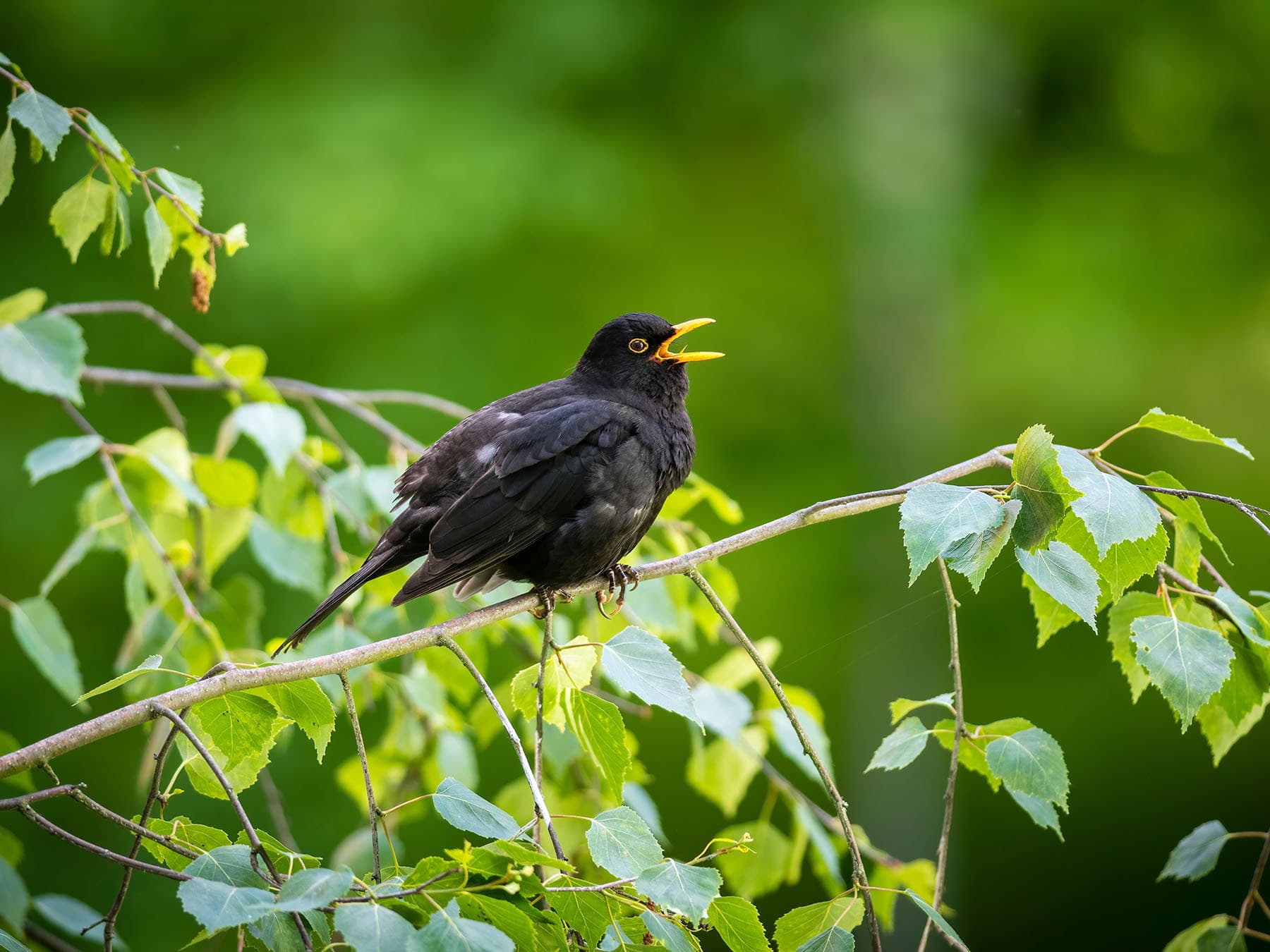
In towns, mostly because of noise and light. In Leipzig, Blackbirds were never heard singing in true night where there were no street lights or traffic noise. But the brighter and noisier the site, the earlier they started: males beside the ring road began up to five and a half hours before the latest birds in the forest. Traffic noise had about twice the effect of street lighting, and the two together pushed song earlier still, though the study could not fully separate them.12
Other studies point the same way. Around Saint-Nazaire in France, Blackbirds sang earlier, and for less time, where traffic was louder.13 When researchers lit up naturally dark woods at night, Blackbirds started singing earlier at once, though the effect was strongest in Robins and relatively small in Blackbirds.14 Away from towns, night song seems rare: a survey of 54 sites in open country and forest in eastern Poland found 24 species singing at night, but not the Blackbird, whose contact calls were heard instead.15
The BTO lists the Blackbird among the four birds most often heard singing after dark, with the Robin, Song Thrush and Nightingale.16 The two recordings below were made in the dark, one before dawn in March, the other on a December evening.
City Blackbirds sound different
In two studies, city Blackbirds sang higher. In Leiden, in the Netherlands, males in the city sang higher-pitched whistles and twitters than males in the wooded dunes of Meijendel, about 10 km away, gave a bigger share of each song to the twitter, and left longer pauses.17 In Vienna, forest males used notes of 1.8 to 1.9 kHz most often and city males notes of 2.2 to 2.3 kHz.18
The obvious explanation is that city birds sing above the low rumble of traffic, but the evidence is mixed. Recordings of hand-raised males showed that, up to about 2.2 kHz, a Blackbird's higher whistles are also its louder ones; from this the authors estimated that the Vienna city birds' choice of notes makes their songs about 2.5 decibels louder on average, and suggest the birds may choose high notes because they can sing them loudly.18 A model of how song carries in city noise found that singing higher gained a Blackbird very little range, and singing louder far more.19 In Leiden, a male's song did not track the noise at his own territory.17 And beside a large airport near Madrid, Blackbirds did not sing higher at all: they more often left out the twitter, started earlier, and spent more time singing while their dawn chorus overlapped the flights.20

Do female Blackbirds sing?
Not the full song, which is the male's. Birds of the World records only a subsong from the female, given in response during courtship. We found no published record of a female Blackbird singing a full song. For more about females, see female Blackbirds.
Calls and what they mean
Blackbirds have a call for most situations. These are the ones Birds of the World describes.
| Call | What it sounds like | When you hear it |
|---|---|---|
| Chink | A loud, nasal note repeated over and over | In disputes over territory, before going to roost, and at a cat in the territory |
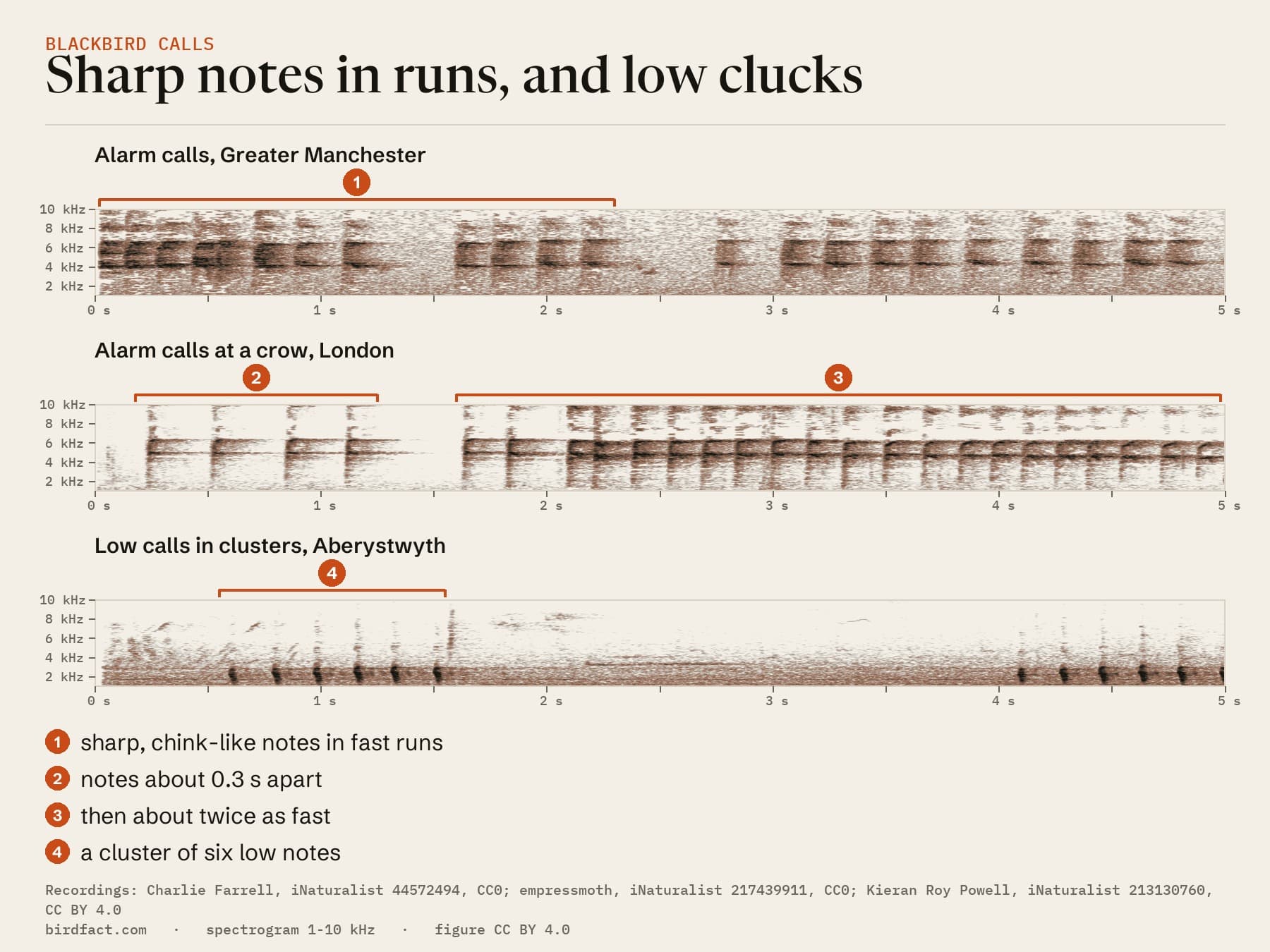
| Chook | A low, slow cluck, usually in clusters | Mild alarm; it often speeds up into the alarm rattle |
| Alarm rattle and whinny | A fast rattle; a whinny that rises then falls | Alarm |
| Seee | Very high, thin and drawn out, falling slightly | A hawk or other predator overhead, or a predator on the ground near the nest; often repeated in the breeding season |
| Ready-to-fight call | Lower and softer than the seee, rising at first, then level | A territorial male ready to fight |
| Warning to the young | A short, single note | Warns chicks in the nest of a predator on the ground |
| Contact and flight calls | A short, high, thin note; a longer trilled version | Keeping in touch, perched and in flight; the trill in flight |
The chink is the call most people know. In autumn and winter it rings out in the late afternoon, as Blackbirds stake out their territories before going to roost.21 Some calls carry more than alarm: males give rattle calls both at a rival's song played in their territory and when a person approached them, and the rattles differ from bird to bird enough that individuals could in principle be told apart by them.22 In experiments with playback, the researcher read the high seee as the alarm of a bird ready to escape.23
The figure below draws three of the recordings on this page.
What does a Blackbird's alarm call mean?
That something is wrong, and other birds listen. Experiments with mobbing Blackbirds found that mobbing alerts other Blackbirds, gives away where the predator is, and grow stronger when the predator moves.24 Other species eavesdrop: at sites near Tübingen in Germany, Jays came in to recordings of Blackbird mobbing calls.25 And in captivity, Blackbirds learned to treat a harmless, unfamiliar bird as an enemy after seeing it while another Blackbird was mobbing, and the lesson was passed on along a chain of at least six Blackbirds.26
Birds of the World names a cat in the territory as one trigger for the chink, and a hawk overhead for the high seee. Two of the recordings above were made, their recordists thought, at a Magpie near a nest and at a crow.
Calls on autumn nights
Blackbirds migrating over Britain in autumn call as they fly at night. In a BTO study with recorders in gardens across Cambridge in autumn 2019, night flight calls of thrushes, Blackbirds among them, were up to five times more frequent over the brightest parts of the city than over dark villages.27 The flight call is thin and high: in an analysis of 346 calls from the Russian Baltic coast it lasted about a tenth of a second to just over a third, at 5.1 to 9.9 kHz, and its length and pitch did not differ significantly between night and day flights.28 For where these birds come from, see do Blackbirds migrate?
Telling it from a Song Thrush
Listen for repeats. A Song Thrush sings each short phrase two or three times before moving on. A Blackbird's phrases are not repeated1; a handbook of 1920 put it as a mellow fluting, lacking the Song Thrush's variety and ending in a discordant squeak.29 See Song Thrush song, where the songs of the Song Thrush, Blackbird and Mistle Thrush are drawn side by side.
About the recordings
Every recording on this page was made in Britain, is shared under the licence named in its credit, and was checked on a spectrogram before use. We found no licence-clean British recording of the high seee alarm call, so it is described rather than played.
Sources
- Collar, N., Christie, D. A. (2020). Eurasian Blackbird (Turdus merula), version 1.0. Birds of the World (J. del Hoyo, A. Elliott, J. Sargatal, D. A. Christie and E. de Juana, editors). Cornell Lab of Ornithology. doi:10.2173/bow.eurbla.01
- RSPB. Song Thrush. RSPB Birds A-Z. Accessed 6 October 2026. Source
- RSPB. Blackbird. RSPB Birds A-Z. Accessed 6 October 2026. Source
- Ripmeester, E. A. P., De Vries, A. M., Slabbekoorn, H. (2007). Do Blackbirds signal motivation to fight with their song? Ethology 113(11): 1021-1028. doi:10.1111/j.1439-0310.2007.01398.x
- Dabelsteen, T., Pedersen, S. B. (1985). Correspondence between messages in the full song of the Blackbird Turdus merula and meanings to territorial males, as inferred from responses to computerized modifications of natural song. Zeitschrift für Tierpsychologie 69(2): 149-165. doi:10.1111/j.1439-0310.1985.tb00142.x
- Dabelsteen, T., Larsen, O. N., Pedersen, S. B. (1993). Habitat-induced degradation of sound signals: quantifying the effects of communication sounds and bird location on blur ratio, excess attenuation, and signal-to-noise ratio in blackbird song. Journal of the Acoustical Society of America 93(4): 2206-2220. doi:10.1121/1.406682
- Hall-Craggs, J. (1962). The development of song in the Blackbird Turdus merula. Ibis 104(3): 277-300. doi:10.1111/j.1474-919X.1962.tb08659.x
- Brooks-King, M. (1942). Song form in the thrush family. British Birds 36: 82-86. Accessed 23 October 2026. Source
- Hesler, N., Mundry, R., Sacher, T., Coppack, T., Bairlein, F., Dabelsteen, T. (2012). Song repertoire size correlates with measures of body size in Eurasian blackbirds. Behaviour 149(6): 645-665. doi:10.1163/156853912X649920
- Alexander, H. G. (1942). Report on the bird-song inquiry organized by the British Trust for Ornithology. British Birds 36: 65-72, 86-93. Accessed 23 October 2026. Source
- Snow, D. W. (1956). Territory in the Blackbird Turdus merula. Ibis 98(3): 438-447. doi:10.1111/j.1474-919X.1956.tb01428.x
- Nordt, A., Klenke, R. (2013). Sleepless in town: drivers of the temporal shift in dawn song in urban European blackbirds. PLoS ONE 8(8): e71476. doi:10.1371/journal.pone.0071476
- Godet, L., Prampart, A., Benhamadi, Y., Lostanlen, V., Aumond, P. (2025). Temporal shift in Eurasian Blackbird Turdus merula and European Robin Erithacus rubecula song under urban pressures. Bird Study 72(4): 346-358. doi:10.1080/00063657.2025.2513543
- Da Silva, A., Valcu, M., Kempenaers, B. (2016). Behavioural plasticity in the onset of dawn song under intermittent experimental night lighting. Animal Behaviour 117: 155-165. doi:10.1016/j.anbehav.2016.05.001
- Kułaga, K., Budka, M. (2020). Nocturnal singing by diurnal birds in a temperate region of central Europe. Journal of Ornithology 161(4): 1143-1152. doi:10.1007/s10336-020-01794-5
- BTO. Nightingale and other night singers. BTO, Bird ID videos. Accessed 23 October 2026. Source
- Ripmeester, E. A. P., Kok, J. S., van Rijssel, J. C., Slabbekoorn, H. (2010). Habitat-related birdsong divergence: a multi-level study on the influence of territory density and ambient noise in European blackbirds. Behavioral Ecology and Sociobiology 64(3): 409-418. doi:10.1007/s00265-009-0857-8
- Nemeth, E., Pieretti, N., Zollinger, S. A., Geberzahn, N., Partecke, J., Miranda, A. C., Brumm, H. (2013). Bird song and anthropogenic noise: vocal constraints may explain why birds sing higher-frequency songs in cities. Proceedings of the Royal Society B 280(1754): 20122798. doi:10.1098/rspb.2012.2798
- Nemeth, E., Brumm, H. (2010). Birds and anthropogenic noise: are urban songs adaptive? The American Naturalist 176(4): 465-475. doi:10.1086/656275
- Sierro, J., Schloesing, E., Pavón, I., Gil, D. (2017). European blackbirds exposed to aircraft noise advance their chorus, modify their song and spend more time singing. Frontiers in Ecology and Evolution 5: 68. doi:10.3389/fevo.2017.00068
- Toms, M. (2013). Blackbird: species focus. Bird Table (BTO Garden BirdWatch magazine) 76: 18-20. Accessed 6 October 2026. Source
- Couchoux, C., Dabelsteen, T. (2015). Acoustic cues to individual identity in the rattle calls of common blackbirds: a potential for individual recognition through multi-syllabic vocalisations emitted in both territorial and alarm contexts. Behaviour 152(1): 57-82. doi:10.1163/1568539X-00003232
- Dabelsteen, T. (1984). Variation in the response of freeliving Blackbirds Turdus merula to playback of song. Zeitschrift für Tierpsychologie 65(3): 215-227. doi:10.1111/j.1439-0310.1984.tb00100.x
- Frankenberg, E. (1981). The adaptive significance of avian mobbing. IV. Zeitschrift für Tierpsychologie 55(2): 97-118. doi:10.1111/j.1439-0310.1981.tb01262.x
- Randler, C. (2022). Heterospecific eavesdropping of jays (Garrulus glandarius) on blackbird (Turdus merula) mobbing calls. acta ethologica 25(2): 101-106. doi:10.1007/s10211-022-00391-4
- Curio, E., Ernst, U., Vieth, W. (1978). Cultural transmission of enemy recognition: one function of mobbing. Science 202(4370): 899-901. doi:10.1126/science.202.4370.899
- Gillings, S., Scott, C. (2021). Nocturnal flight calling behaviour of thrushes in relation to artificial light at night. Ibis 163(4): 1379-1393. doi:10.1111/ibi.12955
- Bolshakov, C. V., Evstigneeva, M. D., Bulyuk, V. N. (2018). Species-specific attraction call of the blackbird (Turdus merula) in the periods of seasonal migration and breeding. Proceedings of the Zoological Institute RAS 322(2): 129-143. doi:10.31610/trudyzin/2018.322.2.129
- Witherby, H. F. et al. (1920). A Practical Handbook of British Birds, vol. 1. Witherby & Co., London. Accessed 8 October 2026. Source