Published 8 Oct 2026
Song Thrush Song and Calls: What They Sound Like and When They Sing
By the Birdfact teamChecked by Nathan Cope
A Song Thrush sings loud, whistled phrases and repeats each one, usually two or three times and sometimes many more, before moving on. A bird normally has well over 100 phrase types. In Britain it sings from January to July and often again in autumn and early winter, early in the morning and into the evening.
On this page12 sections
What a Song Thrush sounds like, with recordings made in Britain and drawn as spectrograms: how its song is built, how many phrases one bird knows, when and why it sings, how to tell it from a Blackbird or a Mistle Thrush, and its calls. For the bird itself, see Song Thrush identification and facts.
What does a Song Thrush sound like?
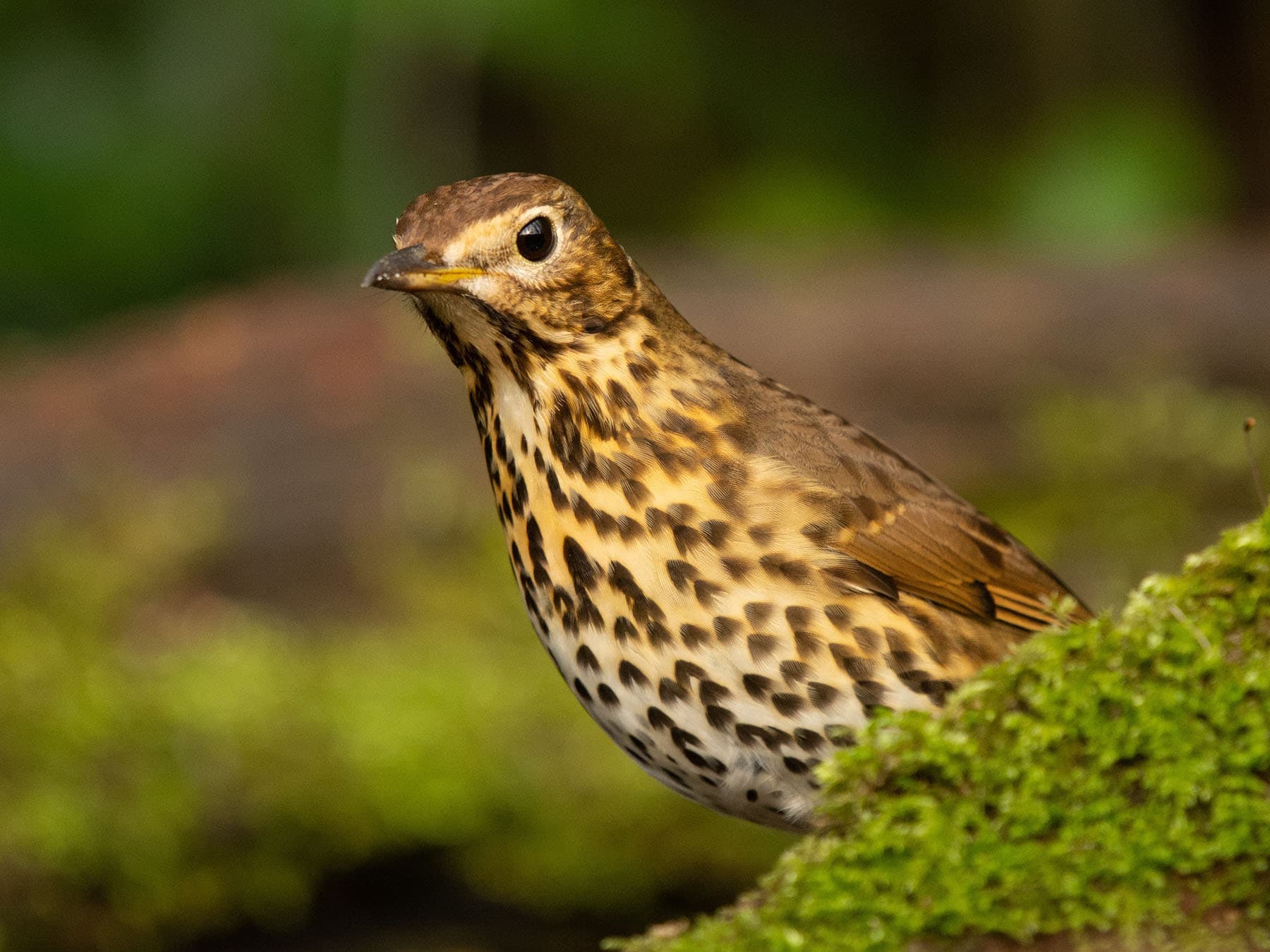
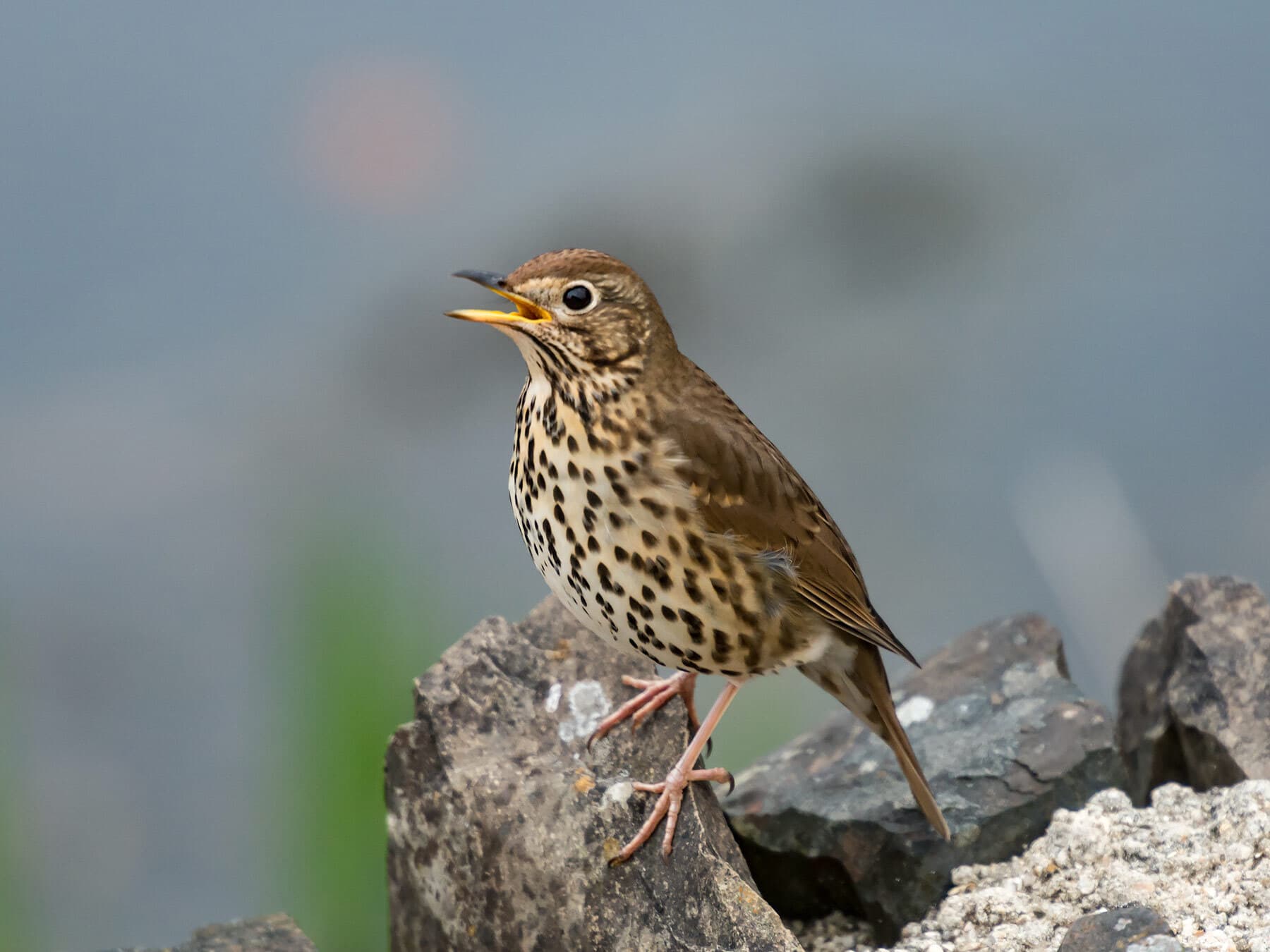
A loud, clear song made of short phrases, each sung two or three times, sometimes more, before the bird moves on to the next. The notes are richly whistled, higher and shriller than a Blackbird's.1 The repeats are the giveaway: the RSPB says they set it apart from a singing Blackbird.2
In the recording below, made early on an April morning in York, the recordist took the singer to be a male in full territorial voice, perched high in a tree; along his running route he found Song Thrushes singing about every mile.3
Each phrase, again and again
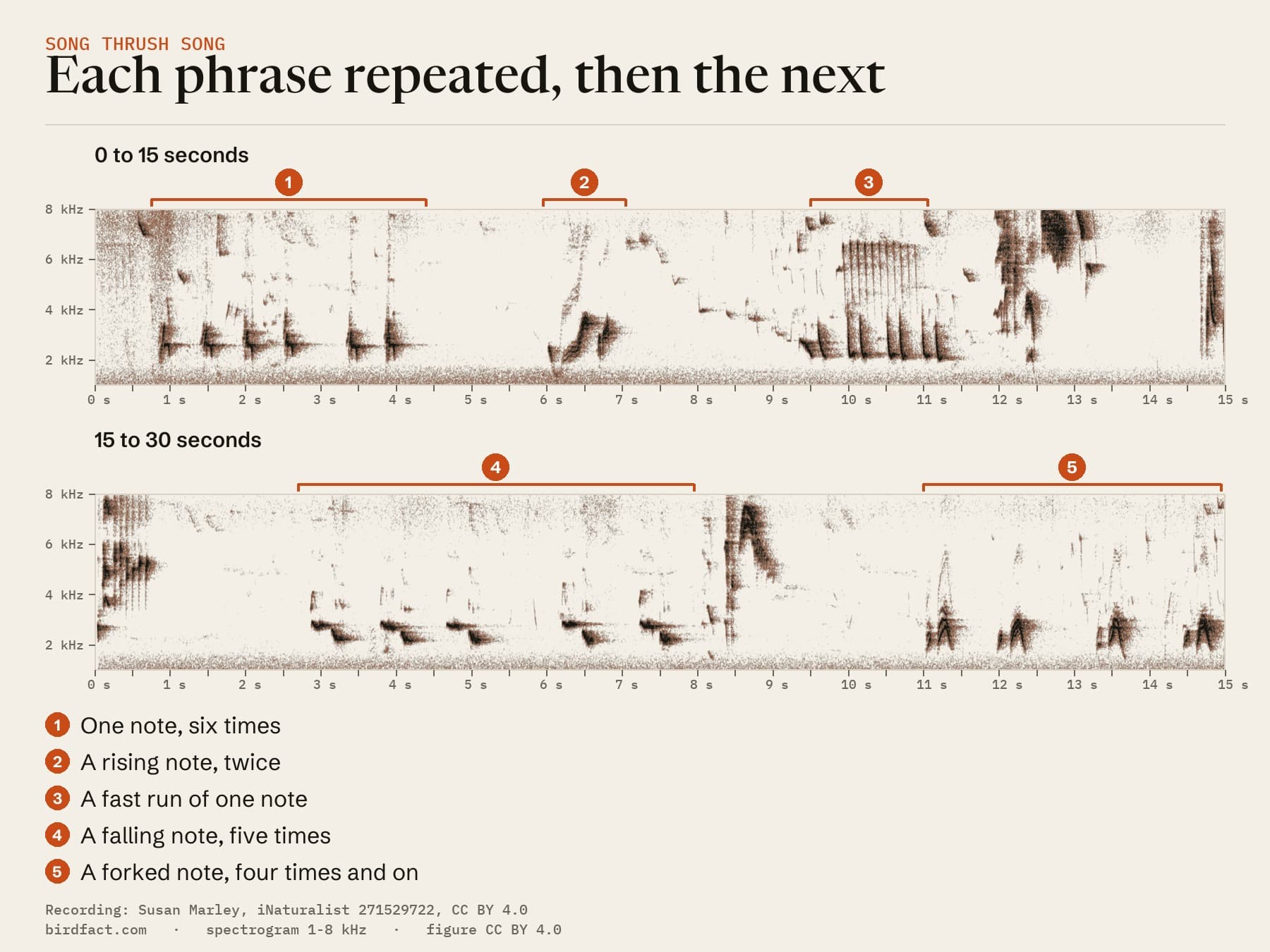
The figure below draws 30 seconds of another bird, recorded in a Liverpool park, as a spectrogram: pitch up the side, time along the bottom, each dark mark a note. The repeats are plain to see. One note is sung six times, then a rising note twice, then a fast run of a single note; later in the song comes a falling note five times and a forked note four times and on, with other, unrepeated notes in between.
That is more repeats than the usual description. Birds of the World gives two or three, Witherby's handbook of 1920 three or four,4 and in a study of 58 males in Poland a note was sung anything from 2 to 19 times in a row.5
A huge repertoire
A Song Thrush does not just repeat itself; it has a great deal to repeat. A 1985 study comparing the songs of 14 kinds of thrush gives the Song Thrush, normally, well over 100 phrase types, against a single phrase in the Redwing.6
Counting the smallest units of song gives bigger numbers still. In the Polish study (around Poznań, 2012 to 2015), each male's song was sampled for 1,000 notes. The average number of different kinds was estimated at roughly 280 to 340 for males in forest and 340 to 420 for males in woods inside the city, and the city birds repeated themselves more. The song is built from two sorts of sound: loud, almost pure whistles at about 2.3 to 3.1 kHz, and quieter, scratchy twitters around 5 to 5.5 kHz.5
It is also, for its size, a powerful singer: in a 1979 study of the sound power songbirds produce, the Song Thrush topped the range at 870 milliwatts per kilogram of body weight, against 10 for a Linnet or Whitethroat.7
When they sing
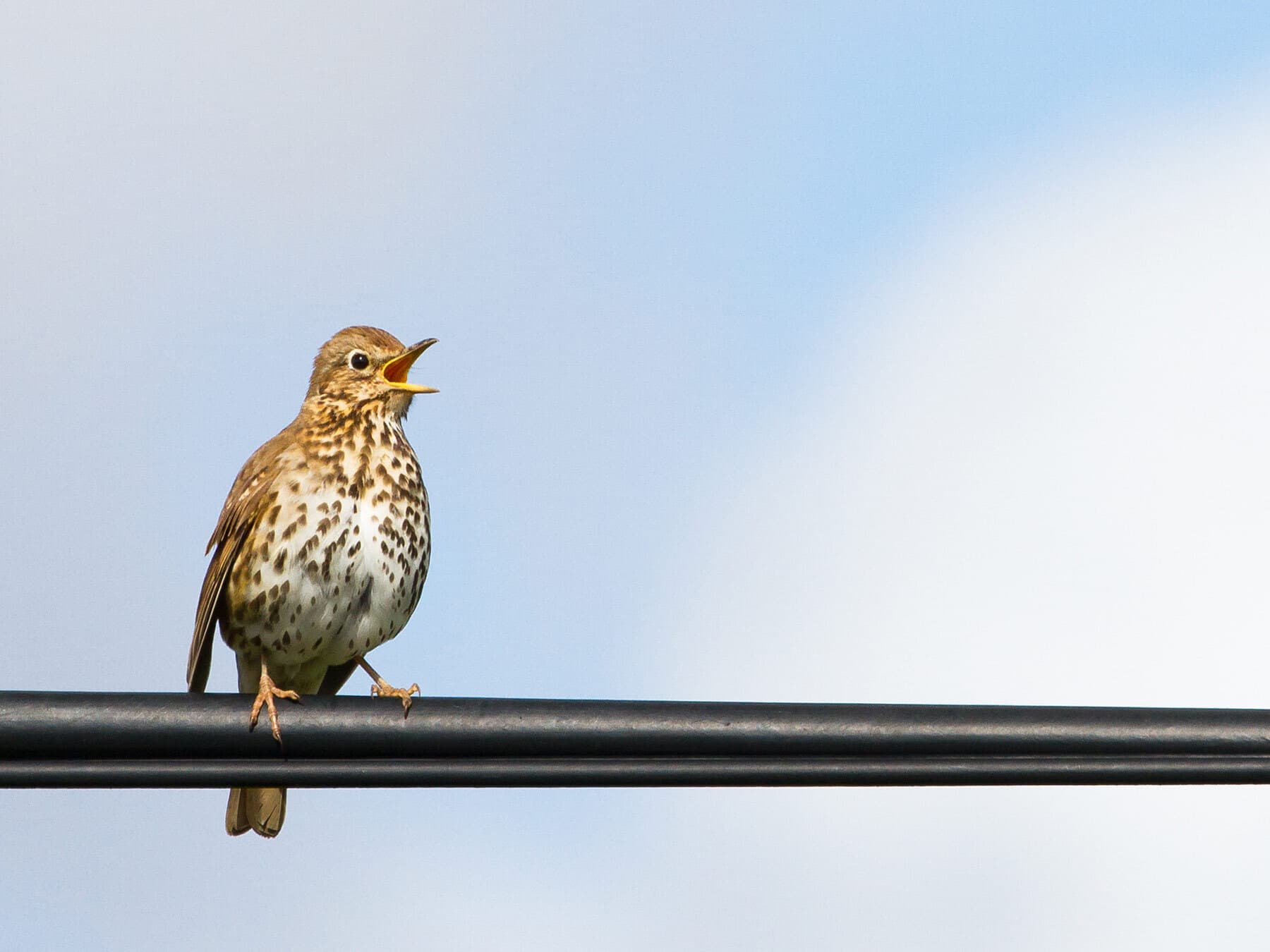
Most of the year. A chart of bird song published in 1935, drawn from one observer's 30 years of notes in southern and Midland England, gave the Song Thrush regular song from January to June, tailing off in July, silence in August, scraps from mid-September, irregular but frequent song in October and November, and regular song again in December.8 A BTO inquiry run by volunteers from 1937 to 1940 found the same shape: in most places song ended in June or July, and general song started again anywhere from November to March, most often in January.9
In a wood near Zurich, counted from 1989 to 1995, song peaked twice: when the birds arrived in spring, and again from mid-May to early July, at the end of breeding. The researchers suggest, without testing it, that fathers may be teaching their young the song, or claiming next year's territory.10
Do Song Thrushes sing in winter?
Often, though it varies from year to year and place to place. The BTO inquiry of 1937 to 1940 found many districts heard Song Thrushes in good song in November, usually dying away in late November or early December, and some places had a second spell in mid-December; some country observers heard no autumn song at all. In the same inquiry Blackbirds very rarely sang between early August and early January.
Weather matters. Hard frost and snow seemed to silence them within days: in the freeze of January 1940 Song Thrushes fell quiet across Britain and Ireland, and 23 observers heard song again on or soon after 19 February, as the thaw came. One Surrey observer found that wind quickly stopped them too.9
Dawn, dusk and after dark
Song Thrushes sing early and late. At woodland sites in Bavaria, recorded from January to April 2012, their dawn song began on average about 49 minutes before sunrise, and they seemed to put more into the evening chorus than five other common songbirds studied there.11 In an earlier study by the same team, street lighting brought their dawn song forward by about 10 minutes.12
The BTO counts the Song Thrush among the four birds most often heard singing after dark, with the Robin, Blackbird and Nightingale.13 In the recording below, made at nearly ten o'clock on a late-May evening in a Glasgow park, three Song Thrushes sing against one another at once.
Why they sing
The full song is the male's. It grows louder and more intense when a rival sings back, and a quieter, twittering subsong is used when males meet and in courting a female.
Why such a large and varied repertoire? The 1985 comparison of thrushes suggests that continuous, varied songs evolved mainly to attract females, and simpler, separate songs for dealings between males. And why the repeats? The Polish study predicted that repeating a note helps the song carry through noise, and found, as predicted, that males in the noisier city woods repeated their notes more often.5
Song Thrush, Blackbird or Mistle Thrush?
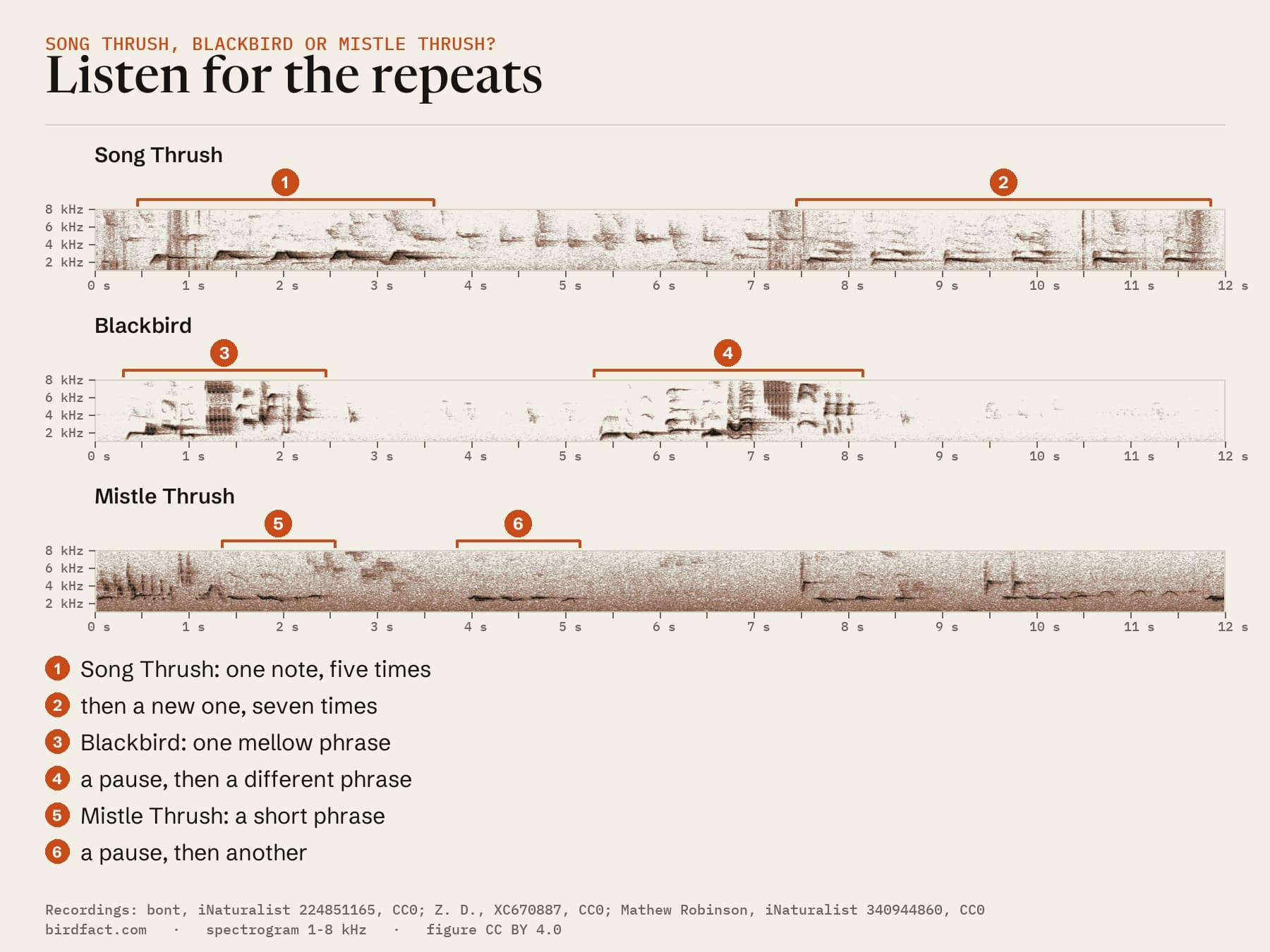
Listen for the repeats. The figure below sets the three side by side on one time scale.
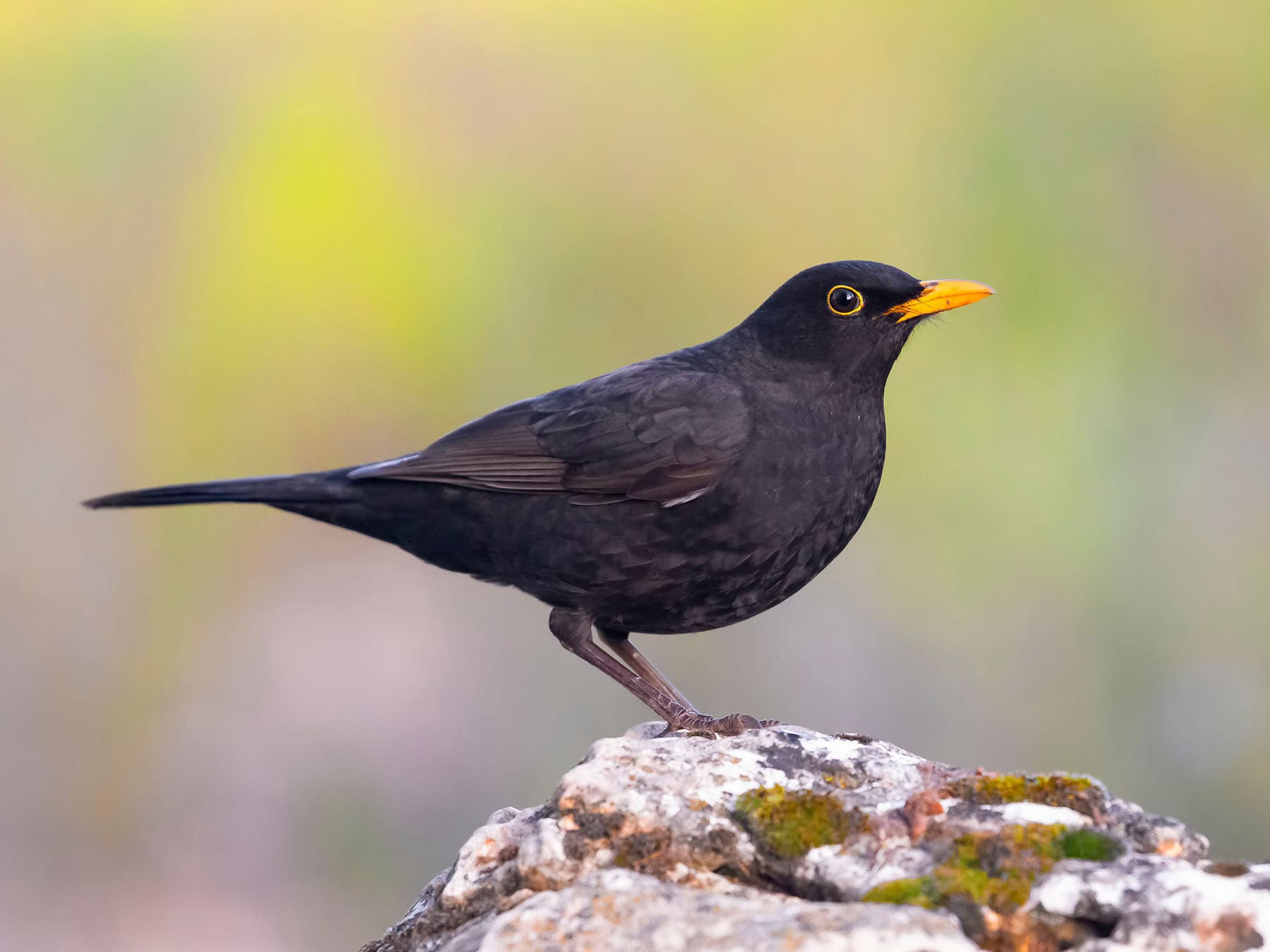
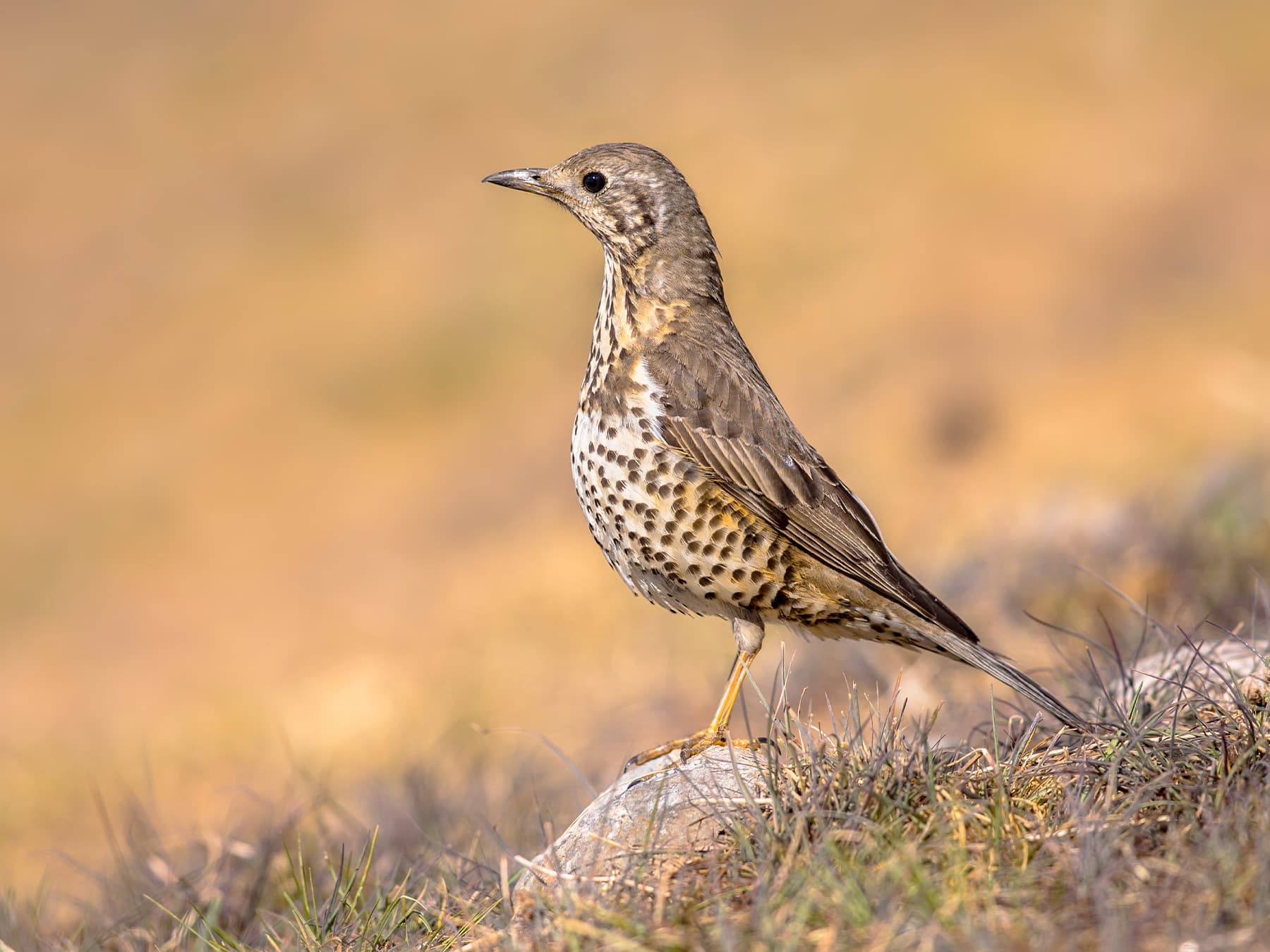
A Blackbird's song is a mellow fluting, ending in a discordant squeak, and lacks the Song Thrush's variety. A Mistle Thrush sings short, loud, mellow phrases separated by clear pauses, rather monotonous, often in poor weather14; the RSPB likens it to a cross between a Blackbird and a Song Thrush.15 Its call is a loud rattle.16
For telling the birds apart by sight, see Mistle Thrush or Song Thrush?
Calls
The common call is a short "tsip", often given as a bird flies up; the RSPB writes it "tsit". A high, thin "siih" warns of a predator in the air, a dry "stuk-stuk" shows mild excitement, and an explosive chattering marks high alarm or anger in the breeding season. Witherby's 1920 handbook gives the alarm as "ptick" and describes a harsh, chattering scream when the nest is threatened.
On autumn nights, migrating Song Thrushes call as they fly over. In a BTO study using recorders in gardens across Cambridge in the autumn of 2019, thrush flight calls were up to five times more frequent over the brightest parts of the city than over dark villages.17
Do Song Thrushes copy other birds?
Sometimes. One introduced Song Thrush in Victoria, Australia, was heard copying eight other species with great accuracy, and the same report reviews earlier records of copying in Australia and New Zealand and quotes the 1938 Handbook of British Birds calling imitation in the song "not uncommon" in Britain.18 Birds of the World does not mention it.
The thrush in poetry
The repeats have long caught writers' ears. In "Home-Thoughts, from Abroad" (1845), Robert Browning wrote of "the wise thrush; he sings each song twice over", a habit that fits the Song Thrush, though the poem does not name the species.19 Wordsworth's "The Tables Turned" (1798) begins a stanza "And hark! how blithe the throstle sings!",20 throstle being an old name for the Song Thrush in the north of England, the Midlands and Ireland.21
Thomas Hardy's "The Darkling Thrush", dated December 1900, has "an aged thrush" singing into the winter dusk.22 Hardy does not say which thrush; Song and Mistle Thrushes both sing in December in Britain.9
Sources
- Collar, N. (2020). Song Thrush (Turdus philomelos), version 1.0. Birds of the World (J. del Hoyo, A. Elliott, J. Sargatal, D. A. Christie and E. de Juana, editors). Cornell Lab of Ornithology. doi:10.2173/bow.sonthr1.01
- RSPB. Song Thrush. RSPB Birds A-Z. Accessed 8 October 2026. Source
- iNaturalist and xeno-canto contributors. Recordings of Song Thrush, Blackbird and Mistle Thrush used on the song page. iNaturalist; xeno-canto. Accessed 8 October 2026. Source
- Witherby, H. F. et al. (1920). A Practical Handbook of British Birds, vol. 1. Witherby & Co., London. Accessed 8 October 2026. Source
- Deoniziak, K., Osiejuk, T. S. (2019). Habitat-related differences in song structure and complexity in a songbird with a large repertoire. BMC Ecology 19: 40. doi:10.1186/s12898-019-0255-7
- Ince, S. A., Slater, P. J. B. (1985). Versatility and continuity in the songs of thrushes Turdus spp. Ibis 127(3): 355-364. doi:10.1111/j.1474-919X.1985.tb05077.x
- Brackenbury, J. H. (1979). Power capabilities of the avian sound-producing system. Journal of Experimental Biology 78(1): 163-166. doi:10.1242/jeb.78.1.163
- Alexander, H. G. (1935). A chart of bird song. British Birds 29: 190-198. Accessed 8 October 2026. Source
- Alexander, H. G. (1942). Report on the bird-song inquiry. British Birds 36: 65-73. Accessed 8 October 2026. Source
- Hegelbach, J., Spaar, R. (2000). Saisonaler Verlauf der Gesangsaktivität der Singdrossel (Turdus philomelos), mit Anmerkungen zum nachbrutzeitlichen Gesangsschub. Journal für Ornithologie 141(4): 425-434. doi:10.1007/BF01651572
- Da Silva, A., Valcu, M., Kempenaers, B. (2015). Light pollution alters the phenology of dawn and dusk singing in common European songbirds. Philosophical Transactions of the Royal Society B 370: 20140126. doi:10.1098/rstb.2014.0126
- Da Silva, A., Samplonius, J. M., Schlicht, E., Valcu, M., Kempenaers, B. (2014). Artificial night lighting rather than traffic noise affects the daily timing of dawn and dusk singing in common European songbirds. Behavioral Ecology 25(5): 1037-1047. doi:10.1093/beheco/aru103
- BTO. Nightingale and other night singers. BTO, Bird ID videos. Accessed 8 October 2026. Source
- Collar, N. (2020). Mistle Thrush (Turdus viscivorus), version 1.0. Birds of the World (J. del Hoyo, A. Elliott, J. Sargatal, D. A. Christie and E. de Juana, editors). Cornell Lab of Ornithology. doi:10.2173/bow.misthr1.01
- RSPB. How to identify the UK's thrushes, including two special winter visitors. RSPB, Identifying birds. Accessed 8 October 2026. Source
- RSPB. Mistle Thrush. RSPB Birds A-Z. Accessed 8 October 2026. Source
- Gillings, S., Scott, C. (2021). Nocturnal flight calling behaviour of thrushes in relation to artificial light at night. Ibis 163(4): 1379-1393. doi:10.1111/ibi.12955
- Peter, J. M. (1993). Vocal mimicry of native species by a Song Thrush Turdus philomelos. Australian Bird Watcher 15(2): 92-93. Accessed 8 October 2026. Source
- Browning, R. (1845). Home-Thoughts, from Abroad (Dramatic Romances and Lyrics, Bells and Pomegranates No. VII). London. Accessed 8 October 2026. Source
- Wordsworth, W. (1798). The Tables Turned (Lyrical Ballads). J. & A. Arch, London. Accessed 8 October 2026. Source
- Swainson, C. (1885). Provincial Names and Folk Lore of British Birds. Trübner, for the English Dialect Society, London. Accessed 8 October 2026. Source
- Hardy, T. (1919). The Darkling Thrush (dated December 1900), in Poems of the Past and the Present. Macmillan, London (the printing read; first published 1901). Accessed 8 October 2026. Source