Facts · Updated 8 Oct 2026
Starling Murmurations: When, Where and Why
By the Birdfact teamChecked by Nathan Cope
Murmurations are the winter displays of Starlings swirling over their roost at dusk, mainly from November to February. Here is when and where to see one in the UK, why Starlings do it, and how thousands of birds move as one.
On this page11 sections
This page covers Starling murmurations: what they are, when and where to see one in the UK, why Starlings do it, and how thousands of birds turn together without colliding. For the bird itself, see Starling identification and facts.
What is a murmuration?
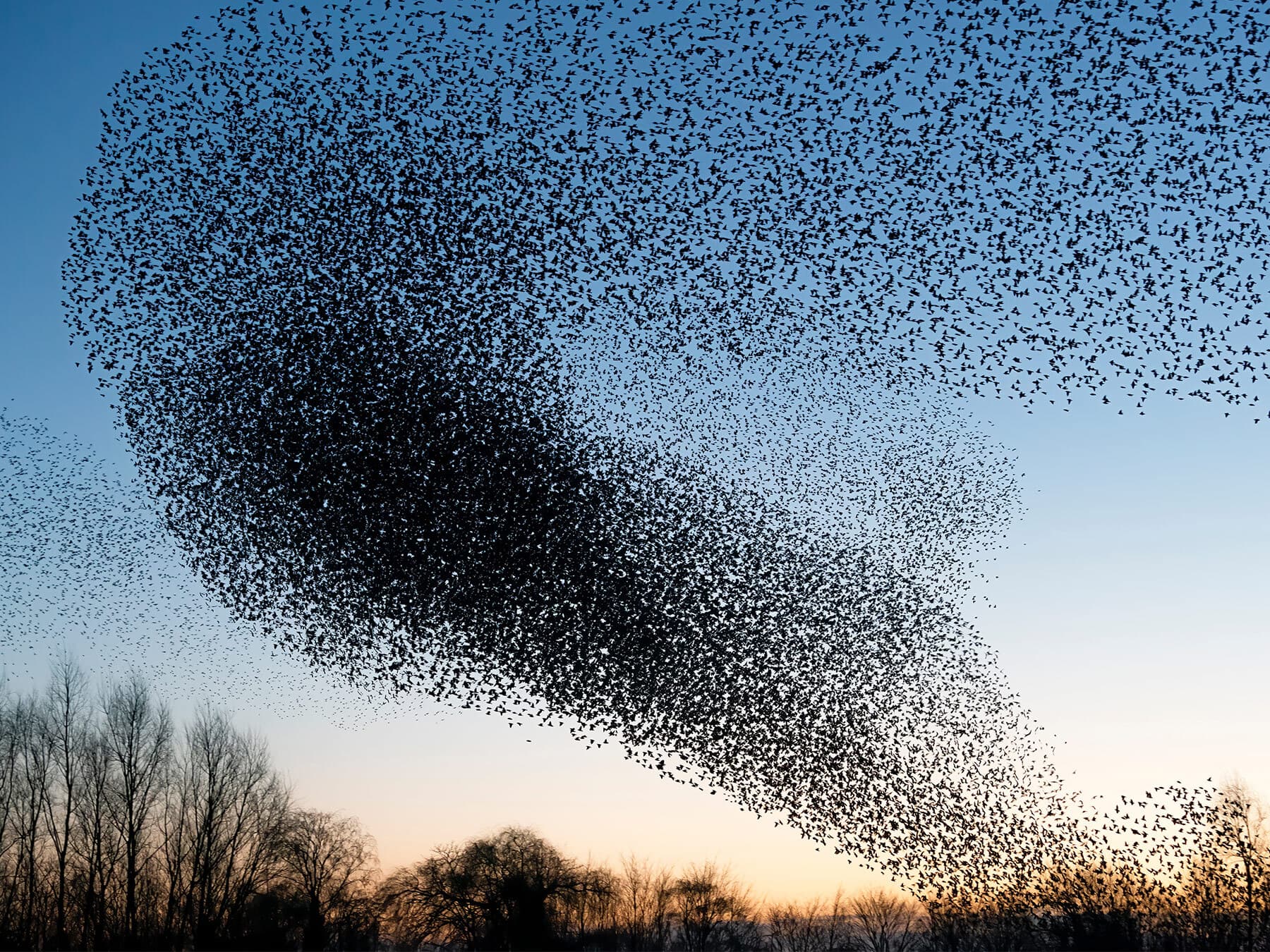
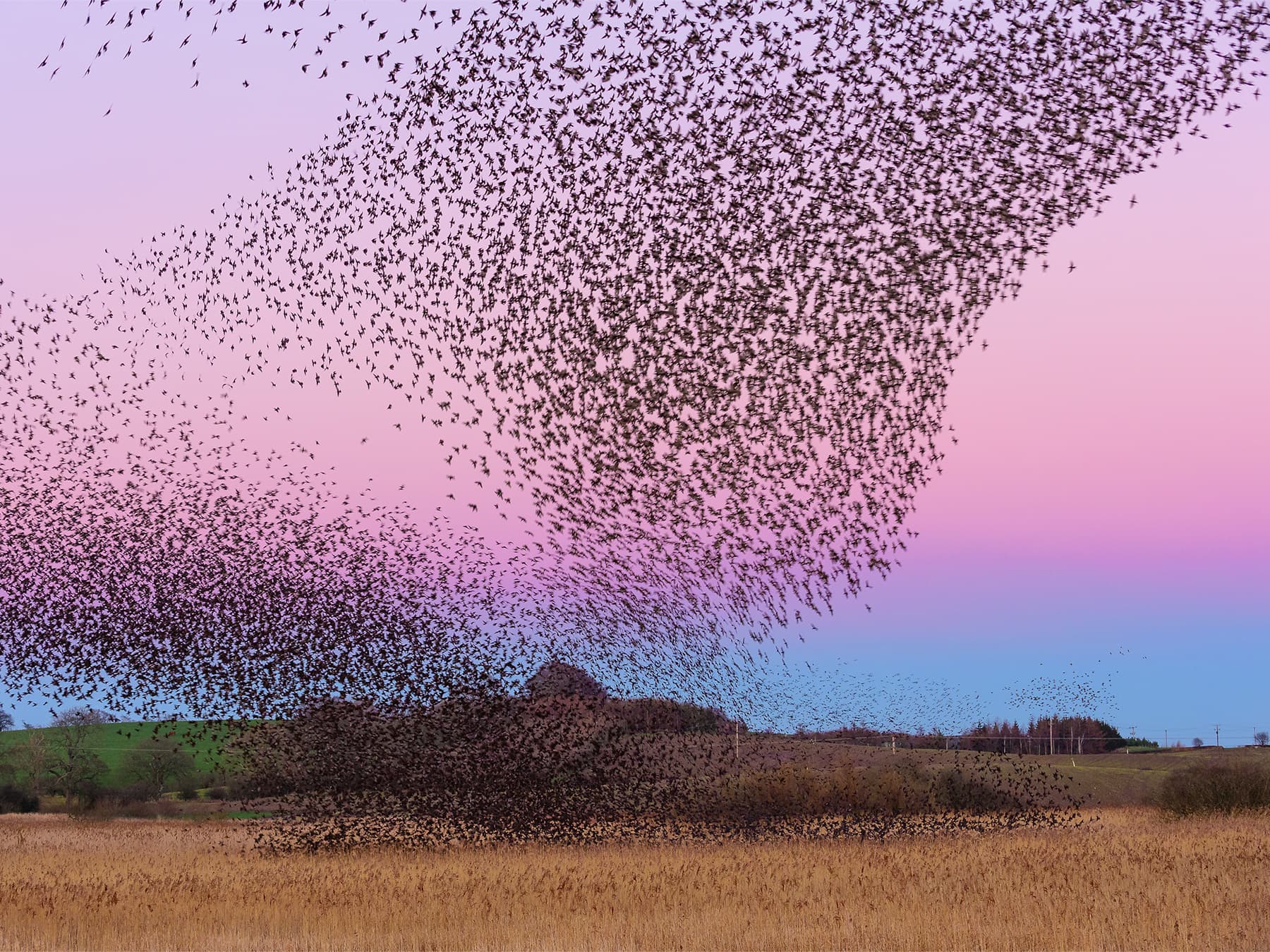
A murmuration is a flock of Starlings swirling and swooping over its night-time roost at dusk, the birds turning together so that the whole flock bends, stretches and darkens like smoke. Murmuration is also the collective name for a group of Starlings.
A display usually ends with the birds pouring down into the roost together. In the largest study of murmurations at the time, a citizen-science survey of more than 3,000 of them in 2014-2016, mostly in the UK, the average murmuration held about 30,000 Starlings and the largest an estimated 750,000. In the UK a display lasted 26 minutes on average.1
When do Starlings murmurate?
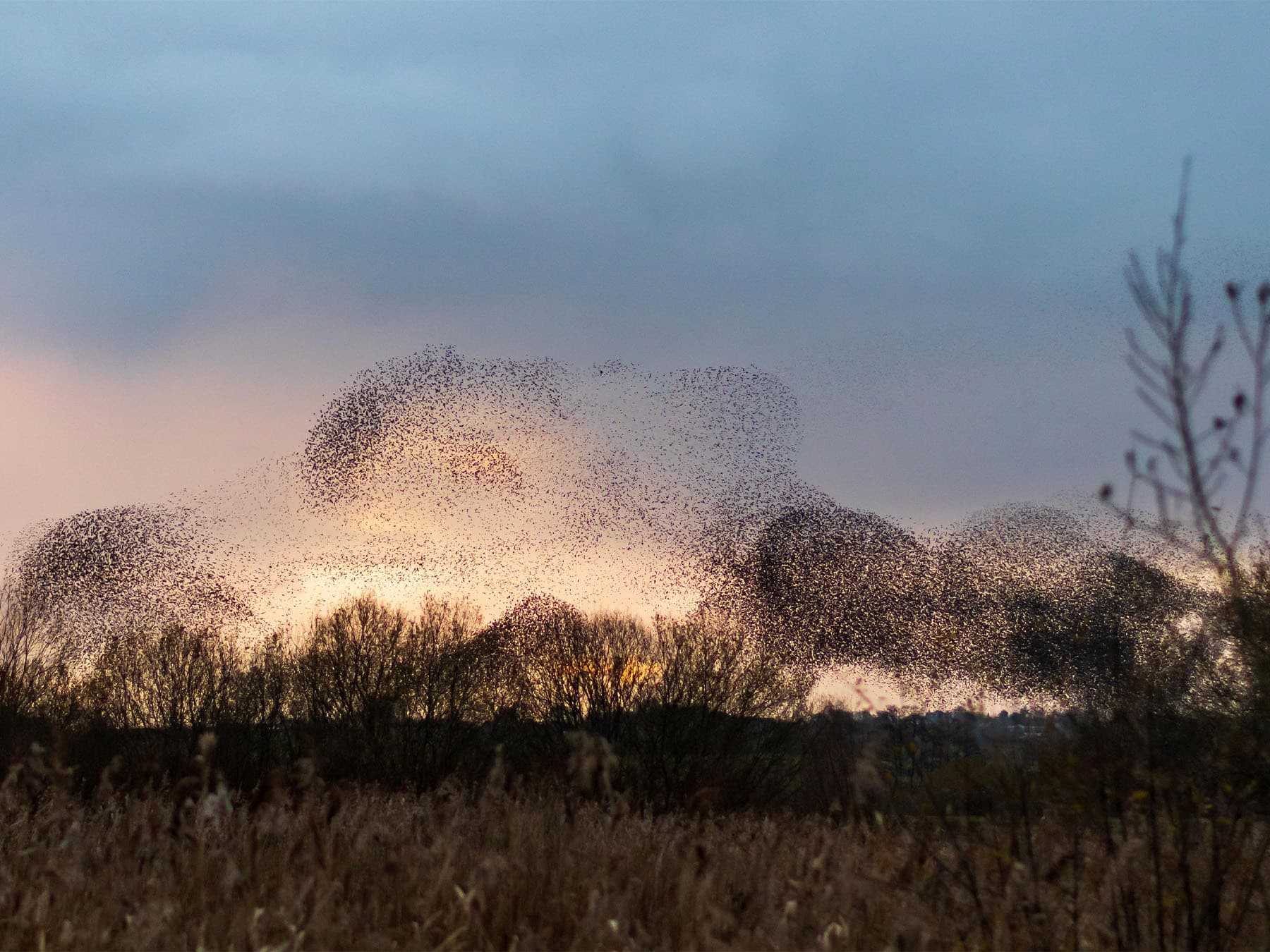
In autumn and winter, at dusk. The RSPB's murmuration season runs from November to February, while winter visitors from Scandinavia are here; after that the migrants go back and the resident birds disperse to breed.2 The citizen-science survey collected records from October to the end of March: murmurations grew through the season to a peak in early February, and lasted longest early and late in the season, when the days were longer.
Most murmurations happen around sunset. Over a city-centre roost in Rome, flocks came back about an hour before sunset3, so aim to be in place well before the sun goes down.
Where to see a murmuration in the UK
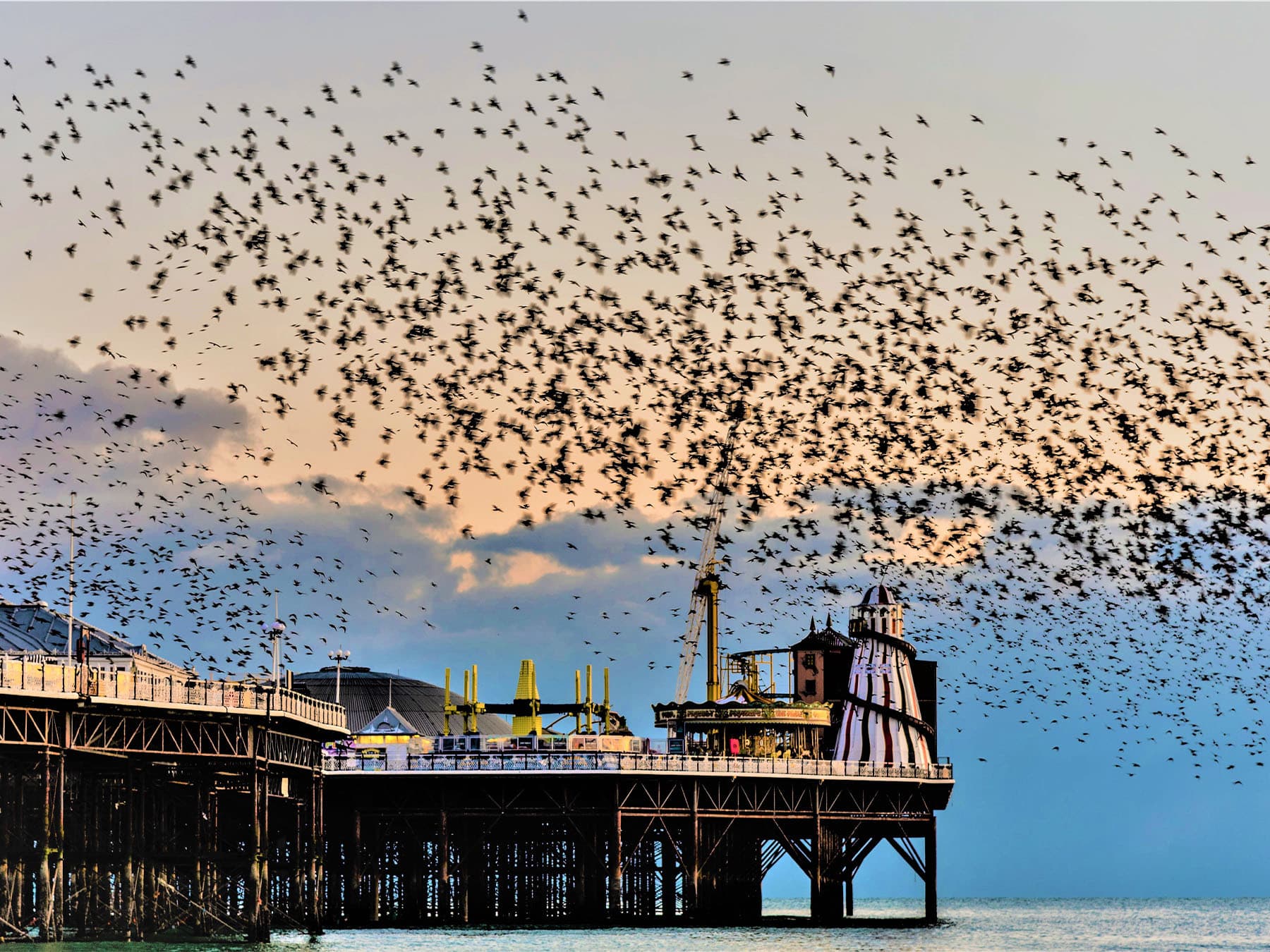
Wherever Starlings roost in numbers: reedbeds and marshes, conifers and hedgerows, and man-made perches such as piers and building ledges. In the citizen-science survey, 61% of UK murmurations were over the countryside, and a fifth each over suburbs and towns.
Well-known places include:
- Brighton, over the piers, and Aberystwyth pier: with Gretna Green, popular hotspots in the survey.
- Gretna Green, on the border of England and Scotland.
- The Somerset Levels (the Avalon Marshes), where murmurations were among the largest in the survey.
- RSPB Leighton Moss in Lancashire, and Blackpool.
- Large murmurations were also reported near Berwick-upon-Tweed and on Anglesey.
Roosts can change, so check recent sightings before you set off.
Why do Starlings murmurate?
Two main ideas have been put forward. "Safer together": in a big, swirling flock each bird is less likely to be the one caught, more eyes watch for danger, and a hawk or falcon struggles to single out a target. "Warmer together": a display draws in more birds, making a bigger, warmer roost for the night.
The evidence points to safety. Birds of prey were seen at 29.6% of murmurations in the citizen-science survey, most often Sparrowhawks, then Buzzards, Marsh and Hen Harriers and Peregrines. Where they were about, murmurations were bigger and lasted longer, and the flock was more likely to drop into the roost all at once; with no predator, the birds more often drifted away. The authors concluded that murmurations are mainly an anti-predator behaviour.1
The roost itself also gives the birds shelter and safety in numbers. Some Starlings gather to a winter roost from more than 50 km away, then return each morning to their usual feeding grounds.4
How they avoid crashing
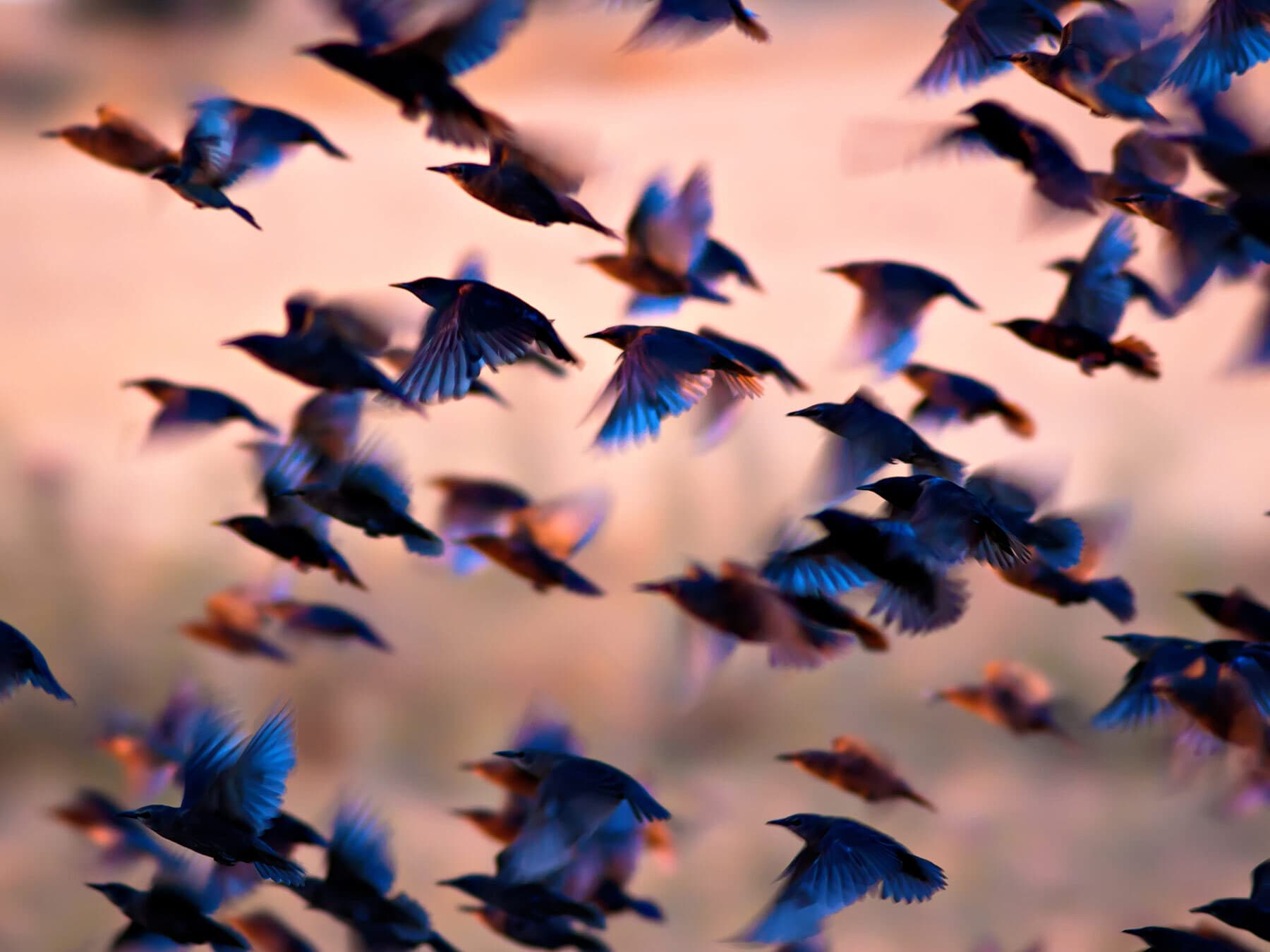
Each bird watches its nearest neighbours. Reconstructing flocks of a few thousand Starlings over Rome in three dimensions from photographs, Italian physicists found that each bird keeps track of a fixed number of neighbours, six or seven, however near or far they are, rather than every bird within a set distance.5 That fixed number keeps the flock together as it stretches and squeezes.
Six or seven turns out to be the best trade-off between keeping the group together and the effort each bird must make.6 And measuring how the birds' movements are linked, the Rome team found that a change in one bird's flight is felt across the whole flock, however big it is.3 People once thought Starlings must read each other's minds; the answer is fast reactions to their neighbours.
When a falcon attacks
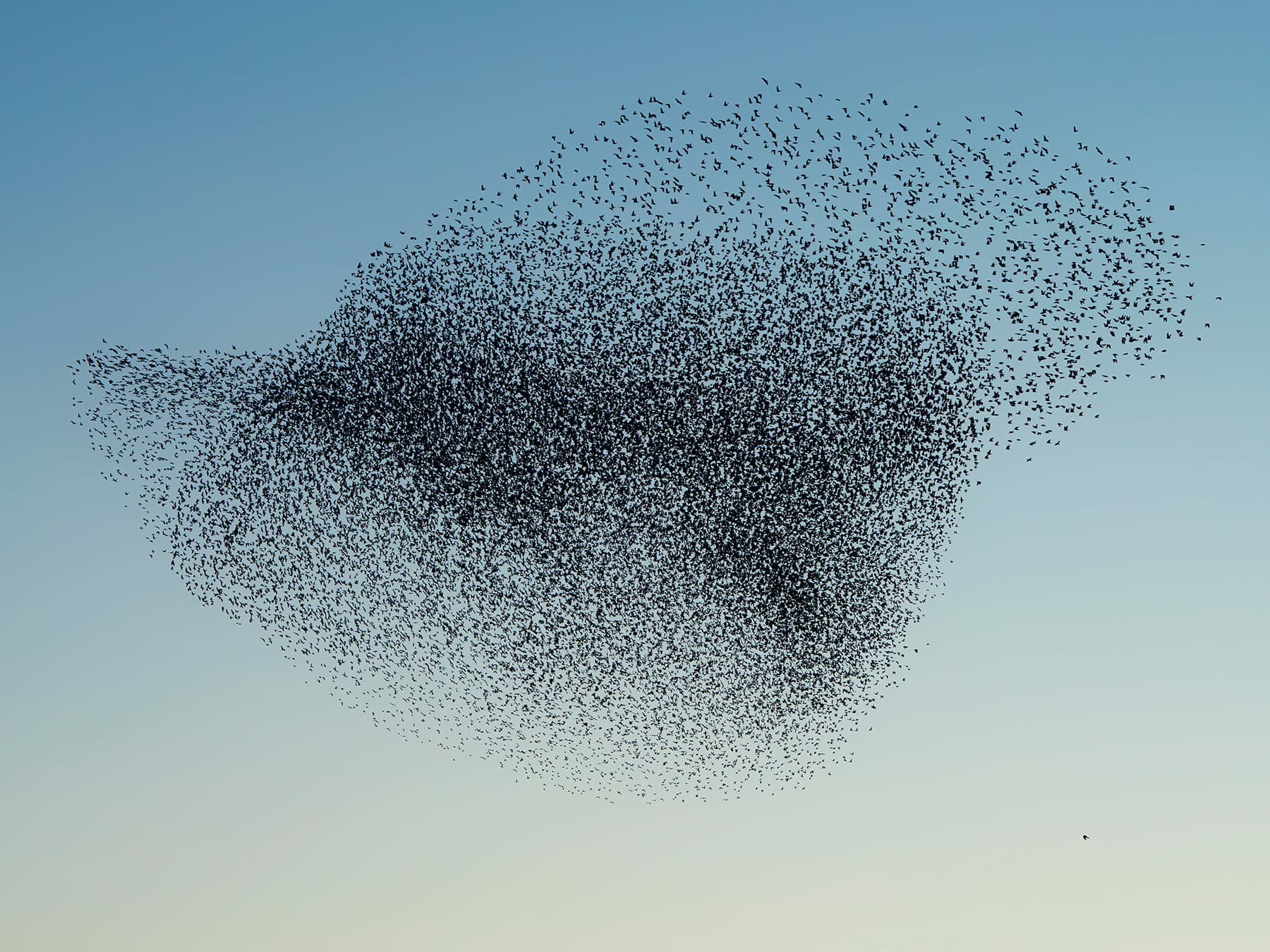
The flock's shape changes with the threat. Analysing 182 hunting sequences by Peregrine Falcons near two winter roosts in Rome, researchers distinguished several kinds of collective escape. The commonest was blackening, a part of the flock suddenly turning darker (36% of escape events); others included waves rippling through the flock, splits into smaller flocks, and the rarer flash expansion (8%), when the flock bursts outwards. Flash expansion was more likely after fast attacks from above, and was often followed by a split, though many flocks held together.7
Tips for watching a murmuration
Get there well before sunset, as flocks start arriving early. Stay until the end: watch for the moment the whole flock funnels down into the reeds or trees, and listen for the rush of wings, which the RSPB likens to crashing waves.
Look out for a Sparrowhawk or Peregrine: murmurations are bigger and last longer when birds of prey are about, and their attacks set off the most dramatic shapes.
Murmurations in North America
Introduced Starlings murmurate in North America too, and displays there are similar in size to those in the UK. But they are shorter: about 16 minutes in the USA and Canada, against 26 minutes in the UK. For the Starling's American story, see where Starlings live.
Murmurations and Starling numbers
Murmurations can hold tens of thousands of birds, many of them winter visitors from northern Europe, but the Starling is Red-listed in the UK: the breeding population fell by 61% between 1995 and 2024.8 See why Starlings have declined, and how a nest box can help.
Questions
What is a group of Starlings called?
A murmuration, especially when the birds are flying together over a roost.
What time do murmurations start?
Around sunset; birds start gathering an hour or so before. See when.
What month is best for murmurations?
November to February (RSPB). In the survey, murmurations were biggest in early February.
How many Starlings are in a murmuration?
About 30,000 on average in the UK survey, from a few hundred to an estimated 750,000.
Do Starlings murmurate in summer?
Murmurations belong to autumn and winter. Starlings roost together all year, but roosts are smallest in spring.
Sources
- Goodenough, A. E., Little, N., Carpenter, W. S., Hart, A. G. (2017). Birds of a feather flock together: Insights into starling murmuration behaviour revealed using citizen science. PLoS ONE 12(6): e0179277. doi:10.1371/journal.pone.0179277
- RSPB. Starling murmurations: explore one of nature's winter wonders. Accessed 6 October 2026. Source
- Cavagna, A., Cimarelli, A., Giardina, I. et al. (2010). Scale-free correlations in starling flocks. Proceedings of the National Academy of Sciences 107(26): 11865-11870. doi:10.1073/pnas.1005766107
- Cabe, P. R. (2020). European Starling (Sturnus vulgaris), version 1.0. Birds of the World (S. M. Billerman, Editor). Cornell Lab of Ornithology. doi:10.2173/bow.eursta.01
- Ballerini, M., Cabibbo, N., Candelier, R. et al. (2008). Interaction ruling animal collective behavior depends on topological rather than metric distance: evidence from a field study. Proceedings of the National Academy of Sciences 105(4): 1232-1237. doi:10.1073/pnas.0711437105
- Young, G. F., Scardovi, L., Cavagna, A., Giardina, I., Leonard, N. E. (2013). Starling flock networks manage uncertainty in consensus at low cost. PLoS Computational Biology 9(1): e1002894. doi:10.1371/journal.pcbi.1002894
- Storms, R. F., Carere, C., Zoratto, F., Hemelrijk, C. K. (2019). Complex patterns of collective escape in starling flocks under predation. Behavioral Ecology and Sociobiology 73: 10. doi:10.1007/s00265-018-2609-0
- BTO. Starling (Sturnus vulgaris). BTO BirdFacts. Accessed 6 October 2026. Source
- RSPB. Starling. Accessed 6 October 2026. Source