


Orchard Oriole
Icterus spurius
By the Birdfact teamChecked by Nathan Cope
On this page14 sections
How to recognise it
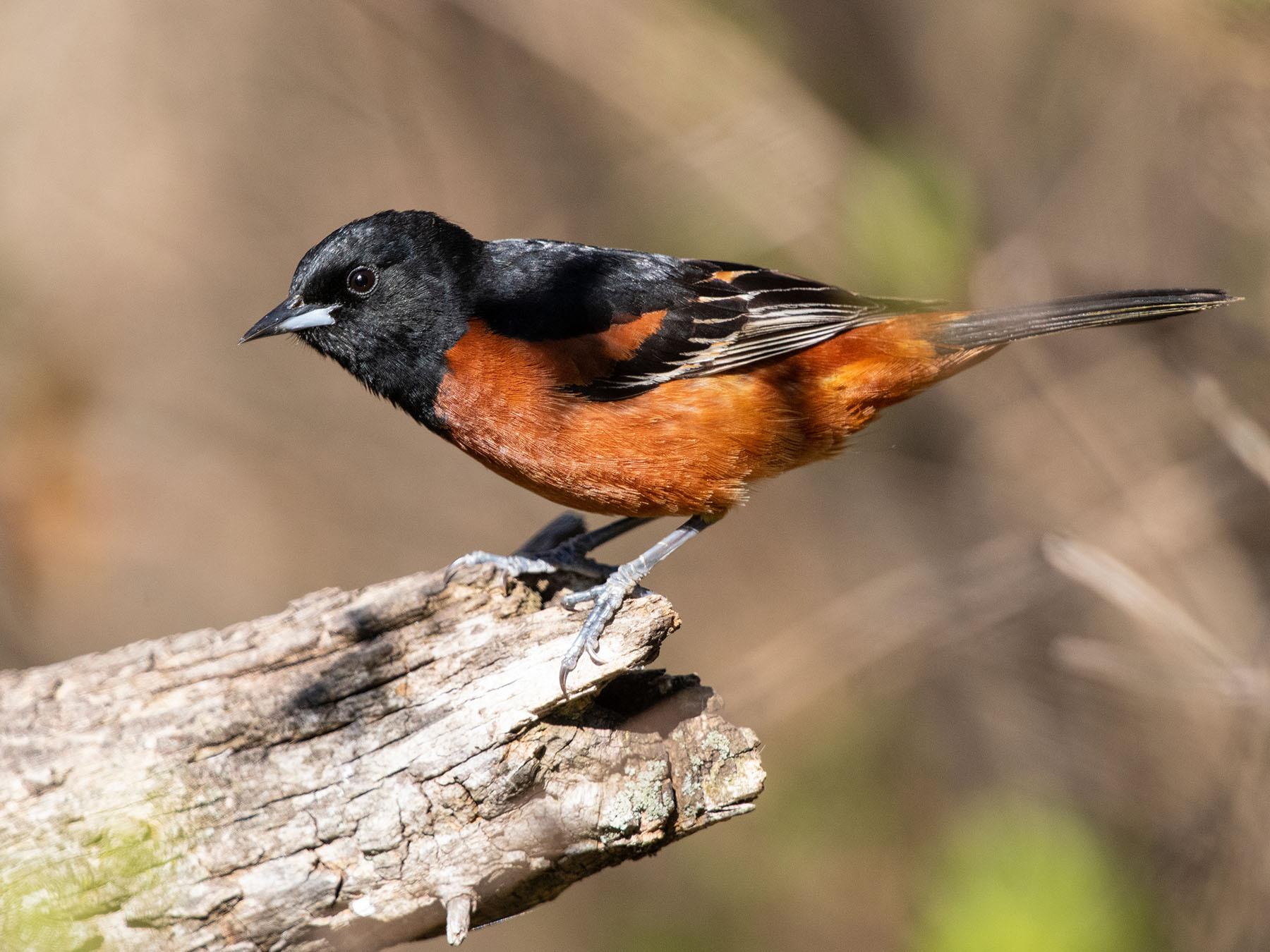
The Orchard Oriole is a small, slim oriole with a short tail and a short, sharply pointed bill. The adult male is black and deep chestnut: black on the head, back, wings and tail, with a chestnut breast, belly and rump. His chestnut is dark and never orange. The female is plain olive above and greenish yellow below, with two whitish wing bars, and a young male in his first year looks like her but has a black throat. So there are three looks to learn, and the black-throated young male, singing alone at the top of a tree, can be hard to place.
Size and weight
An Orchard Oriole is 5.9–7.1 in (15–18 cm) long, with a wingspan of about 9.4–11 in (24–28 cm), and weighs 0.6–1.0 oz (16–28 g). It is bigger than a Yellow Warbler and smaller than a Baltimore Oriole, and short in the tail and bill for an oriole. Size changes from north to south, mostly in the length of the wing: northern birds are larger, and those of southern Texas and northeastern Mexico smaller.
Adult males and females differ little in weight. In birds mist-netted in Nebraska from May to August, adult males averaged 0.73 oz (20.7 g) and females 0.68 oz (19.4 g), with first-year males in between, though the adult males' wings were longer, 3.1 in (78.7 mm) on average against 2.9 in (73.6 mm).1
Male, female and young birds
The adult male's black covers the head, throat and upper back and runs a little onto the upper breast; it also covers the scapulars, the feathers along the top of the wing where it joins the back. The lower back, rump, breast and belly are deep chestnut, often paler in the middle of the belly, and the small feathers at the bend of the wing are chestnut too. The wings are mostly black, with one narrow white bar and white edges to the flight feathers, widest on the innermost ones, and the tail is black. From October to March his fresh feathers have pale grayish-olive or buff tips that can almost hide the black, and the chestnut looks duller.
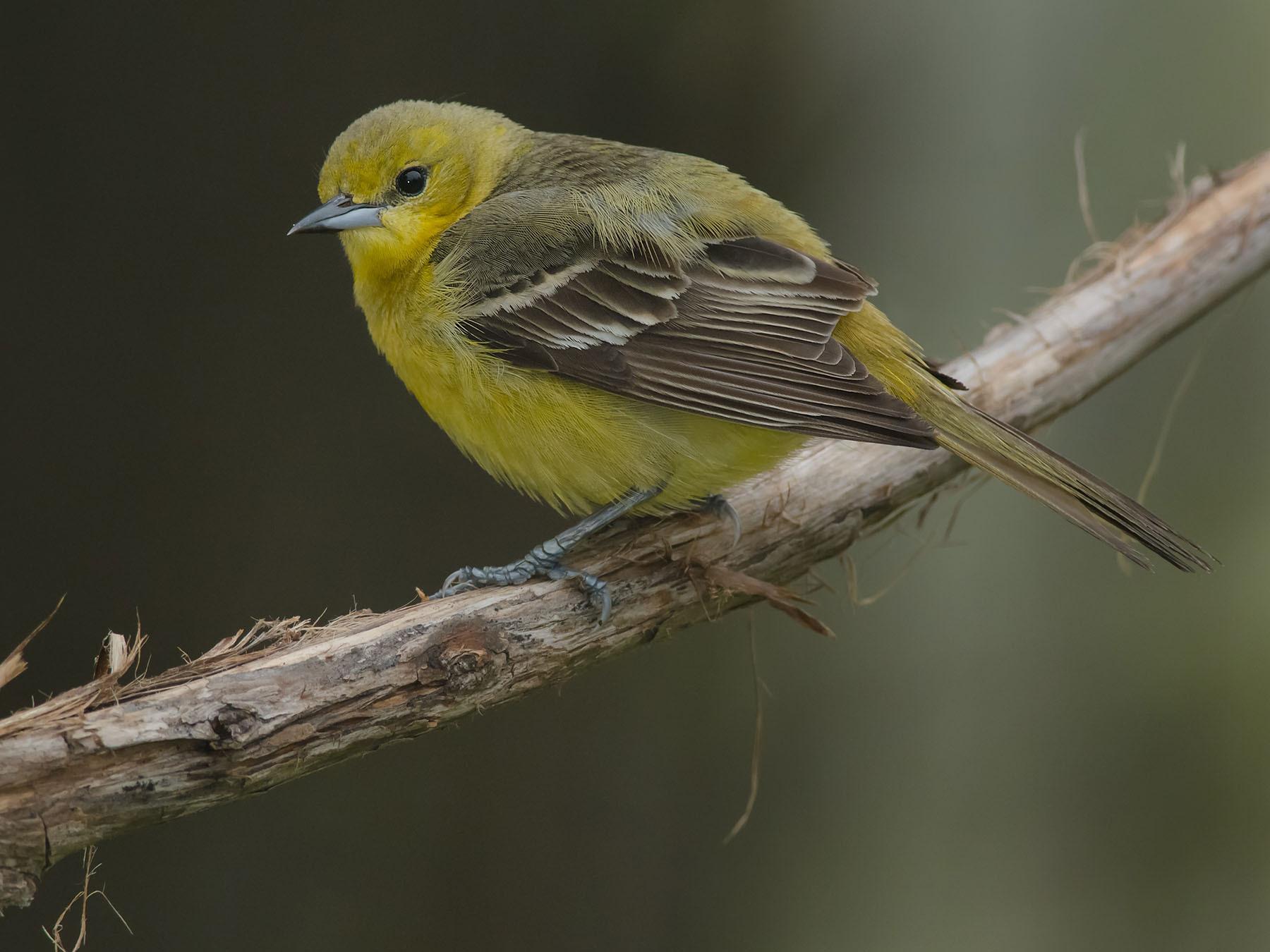
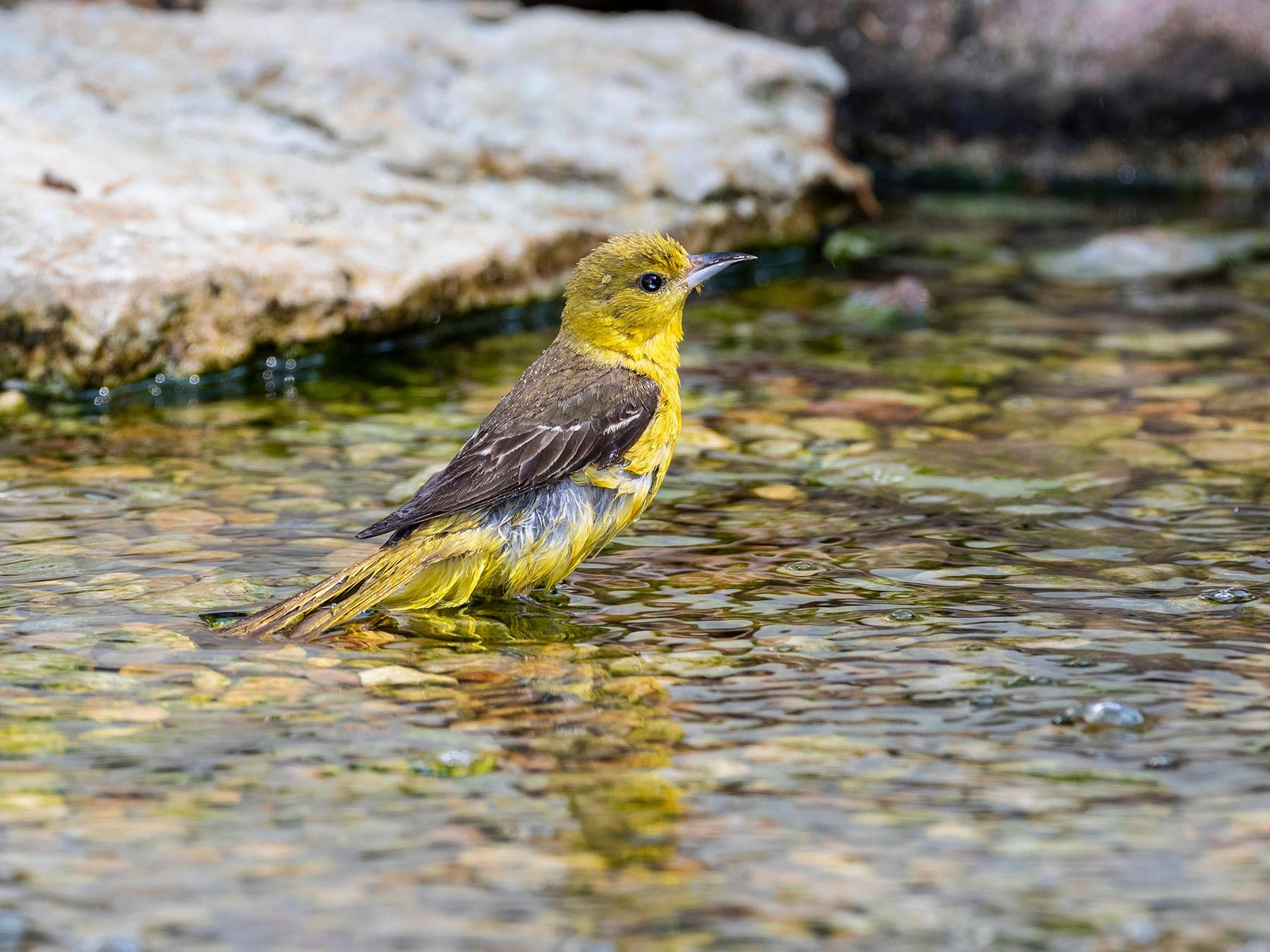
The female is grayish olive above, brighter yellowish olive on the rump, and a soft olive yellow below, brightest on the chin, the throat and under the tail. She has two whitish wing bars on brownish wings, a thin yellowish eyebrow and dark gray lores, and shows no orange tone and no black on the throat.
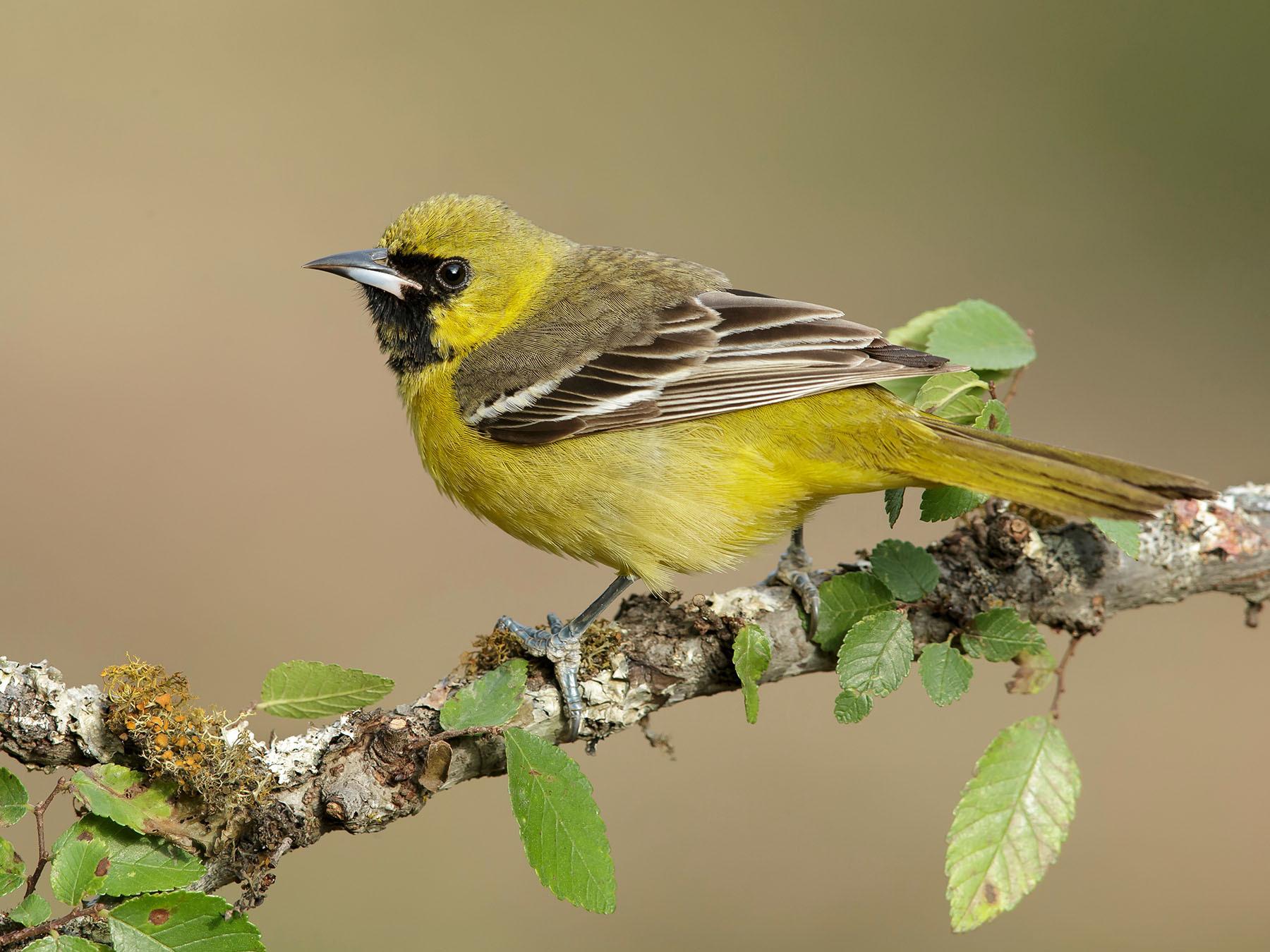
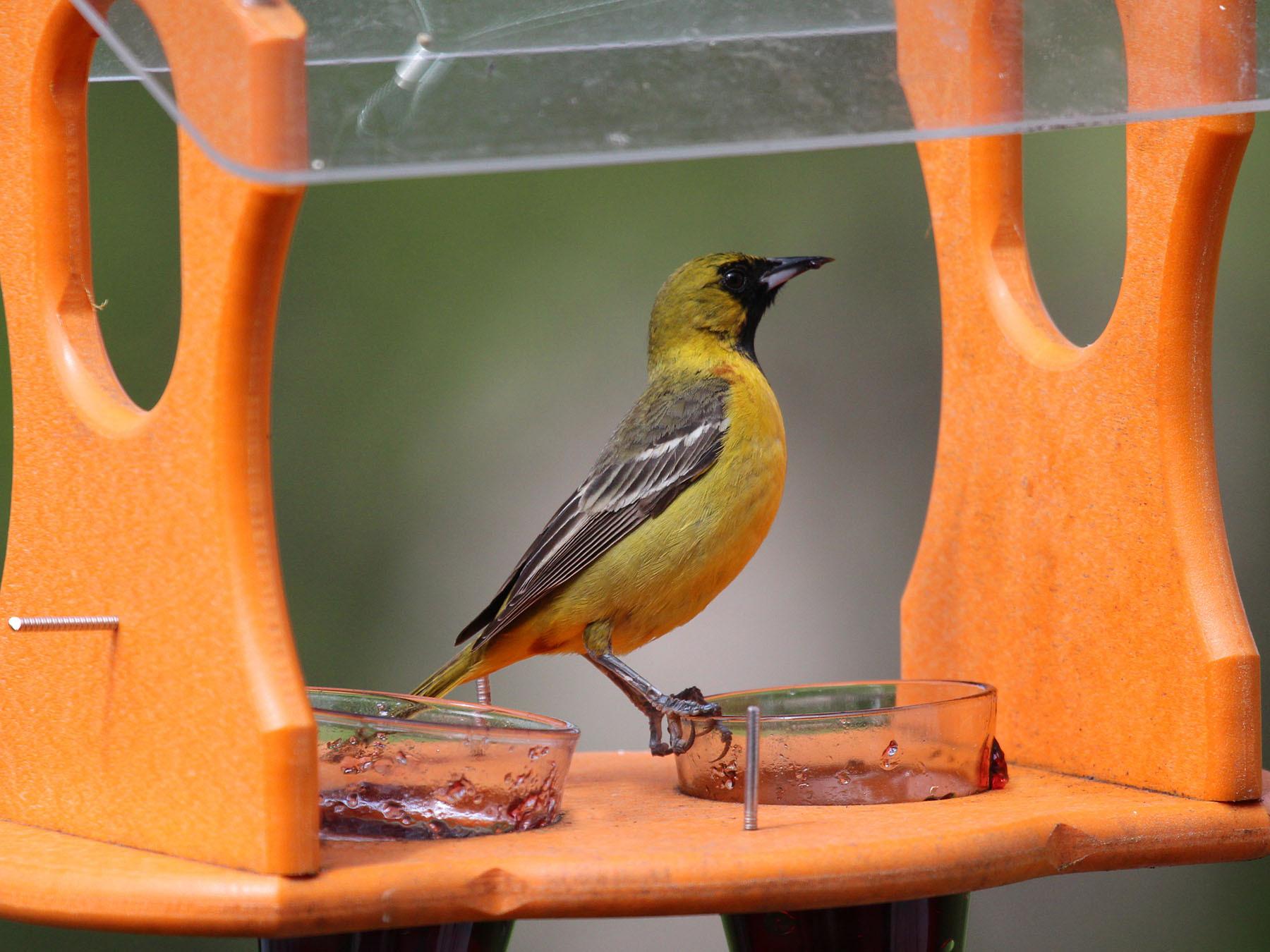
The first-year male, seen from his first fall to his second summer, has the female's greenish-yellow body with black between the eye and the bill and on the chin, throat and top of the breast, often flecked with green. The black varies from bird to bird, patchy in some and solid down into the breast in others. His olive tail is often washed dusky, and advanced birds show a few black back feathers or small patches of chestnut. He keeps this look through his first breeding season, which ornithologists call delayed plumage maturation, and gains the adult black and chestnut only at his second prebasic molt, in his second fall and winter, mostly on the wintering grounds.
First-year males do breed, usually nesting alone in poorer habitat. Females prefer older males in adult plumage, which puts the young males at a disadvantage, though some do nest successfully.1 Some males stay unmated all season, particularly first-year males.2
A juvenile, seen from June to October, looks like an adult female but cleaner: a purer olive above and a clearer yellow below, with a dirty buff wash on the rump and two faint buffy wing bars on pale brown wings. Young males and females look alike. From June to August a juvenile is told from a worn first-year bird by its much fresher feathers, and from a first-year male also by its lack of a black throat.
Identification: similar birds
An adult male is simple once you see the chestnut: a male Baltimore Oriole is larger, with an all-black head and orange underparts. Females and young birds take more care. A brighter female or young Baltimore shows orange in the face and underparts, where an Orchard is yellow or yellow-green. A duller young Baltimore, or a female or young Bullock's Oriole, is stockier and larger, with longer wings, a whitish belly and flanks, a grayer back and a busier face, with a darker line behind the eye and a darker crown. The Orchard's head, by contrast, is a plain, dull olive green.
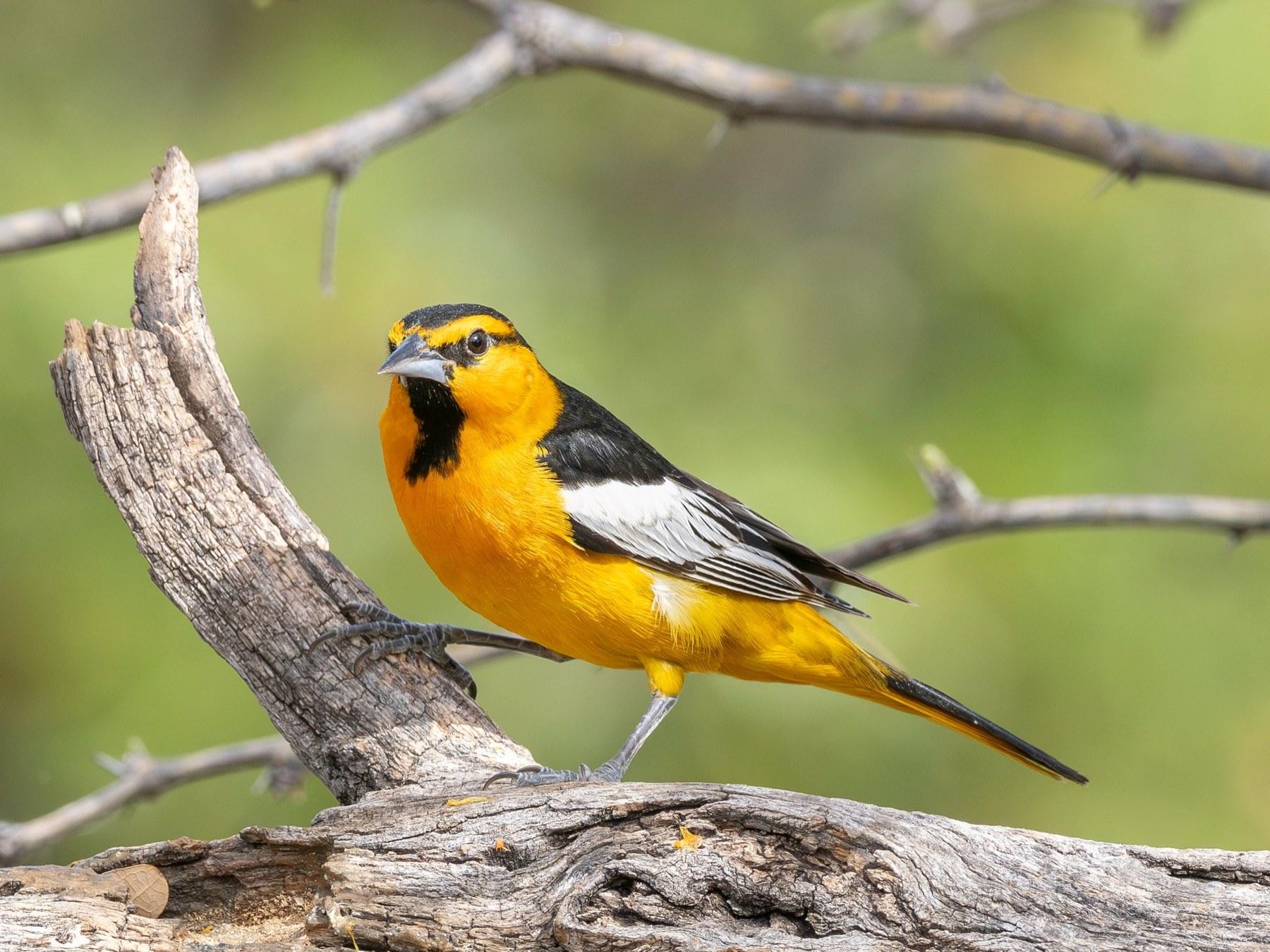
A Hooded Oriole is larger than an Orchard, with a much longer, rounded tail and a usually longer, more curved bill. Female Hooded Orioles are usually brighter yellow below and greener above, and first-year males show more black around the face. The Hooded's typical call is a whistle, not the Orchard's chuk, though some young Hooded Orioles give a chuk too. A female or young Scott's Oriole is larger and darker, with dusky streaks on the back and a longer, straighter bill.
At a glance an adult male can recall an American Robin or an Eastern Towhee. The female can be taken for one of the many greenish-yellow songbirds, such as warblers, vireos, female tanagers and American Goldfinches; size and shape sort them out.
Not sure it’s a Orchard Oriole? Check your photo: Birdfact names the bird and shows the look-alike side by side.
Its size
Adults- Length
- 15–18 cm
- Wingspan
- 24–28 cm
- Weight
- 16–28 g
Its song and calls
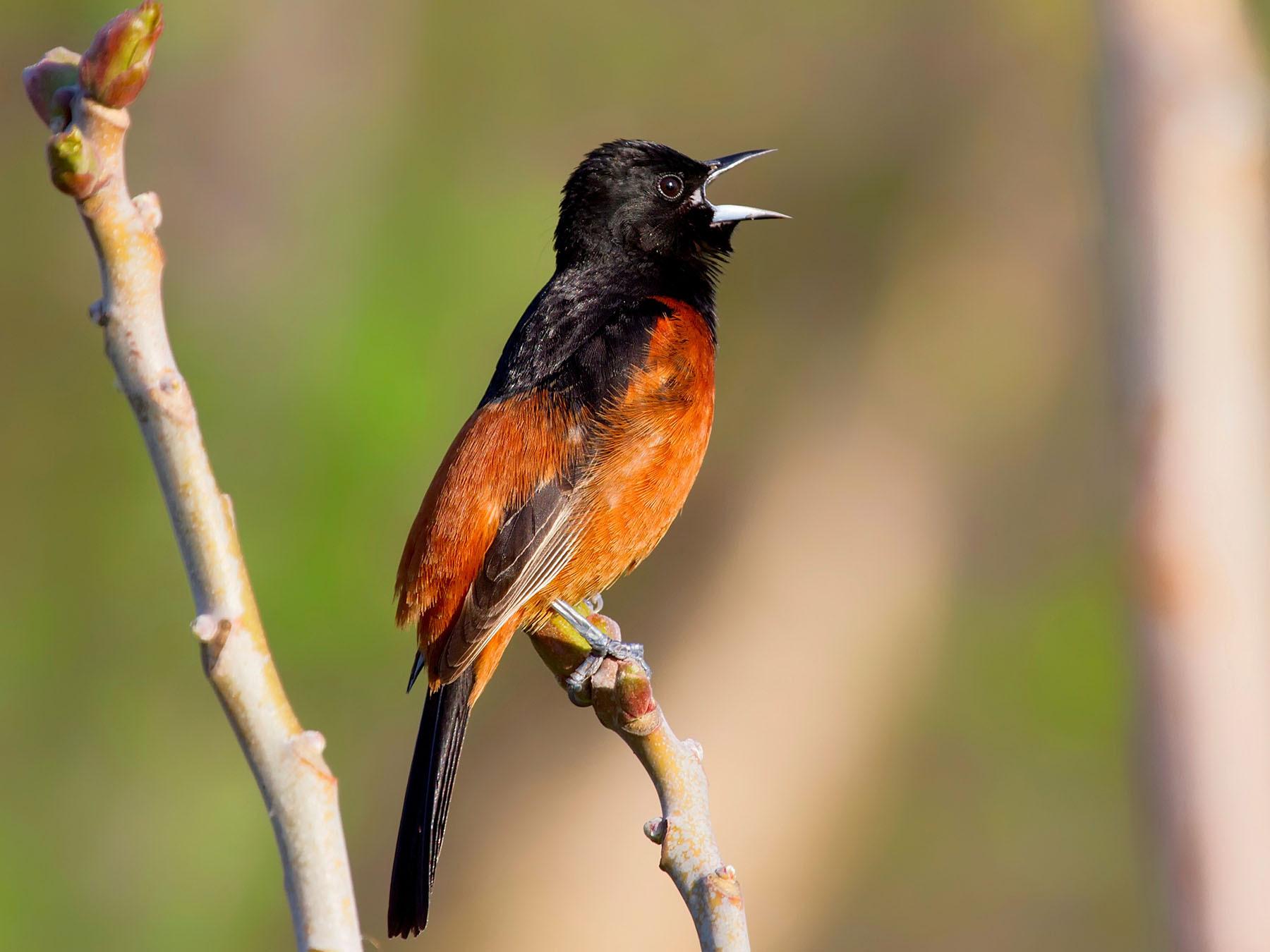
The male's song is a fast, varied burst of loud, clear whistles mixed with harsher notes, a little higher and quicker than a Baltimore Oriole's. It often opens with two or three high notes, and it often ends with a quick run of notes on one pitch and a final note that slurs down. In Nebraska, males of all ages sing from the day they arrive until late June.1 Males sometimes sing in flight, and they sing on the wintering grounds too.
The usual call is a "chuk" or "jeet", given in alarm and, mostly by males, between bouts of song in disputes. There is also a rapid chatter. From mid-July to mid-August, after the males have left, females and fledglings give a whistle on one note.
Females sing too, regularly but far less than males. In central Maryland in 2020 and 2021, males averaged 2.35 songs a minute and females 0.14, and 16 of the 27 females watched were seen singing. Female songs were shorter, lower and narrower in pitch and more variable, differing in five of eight measures, and the researchers call them easy to tell from male songs by ear. They suggest that earlier observers may have put female song down to young males they did not see well.3 In a later study, individual males sang about twice as many syllable types as females, 42.7 against 22.6, and the authors suggest female song may be under relaxed selection.4
Each song is built from whistled syllables drawn from a repertoire. In recordings of 17 males in Maryland and Delaware in 2008 and 2009, songs held about 12 syllable types each, and about a third of the types (84 of 246) were shared between birds; sharing fell off with distance between populations.5
- Song0:00 / 0:40
Recorded in Springer's Point Preserve, United States · May 2025
- Short song phrase0:00 / 0:03
Recorded in Virginia, United States · May 2025
- Chatter calls0:00 / 0:40
Recorded in Grey Cloud Dunes SNA, United States · June 2012
Heard one and not sure? Let the bird song identifier listen.
When and where to see it
The Orchard Oriole is a summer bird of eastern and central North America. It breeds from extreme southeastern Saskatchewan, southwestern Manitoba and southernmost Ontario, and from Minnesota, Wisconsin, Michigan, New York, Vermont, southern New Hampshire and southern Maine, south to northern Florida, the Gulf Coast and southeastern Texas. To the west it reaches eastern Montana, Wyoming and Colorado, western Texas and eastern New Mexico, and it breeds on into Mexico. West of the Rocky Mountains it is only a casual visitor in the breeding season.
Look for it in open country with scattered trees: orchards, shade trees and tree rows on farms and in suburbs, woodland edges, trees along streams and lakeshores, and marshes. It usually avoids unbroken forest. In Nebraska it chose shorter, thinner and more closely spaced nest trees than Baltimore or Bullock's Orioles, and Wisconsin's 2006 breeding atlas found it favoring wooded urban areas, where its numbers had grown most.1
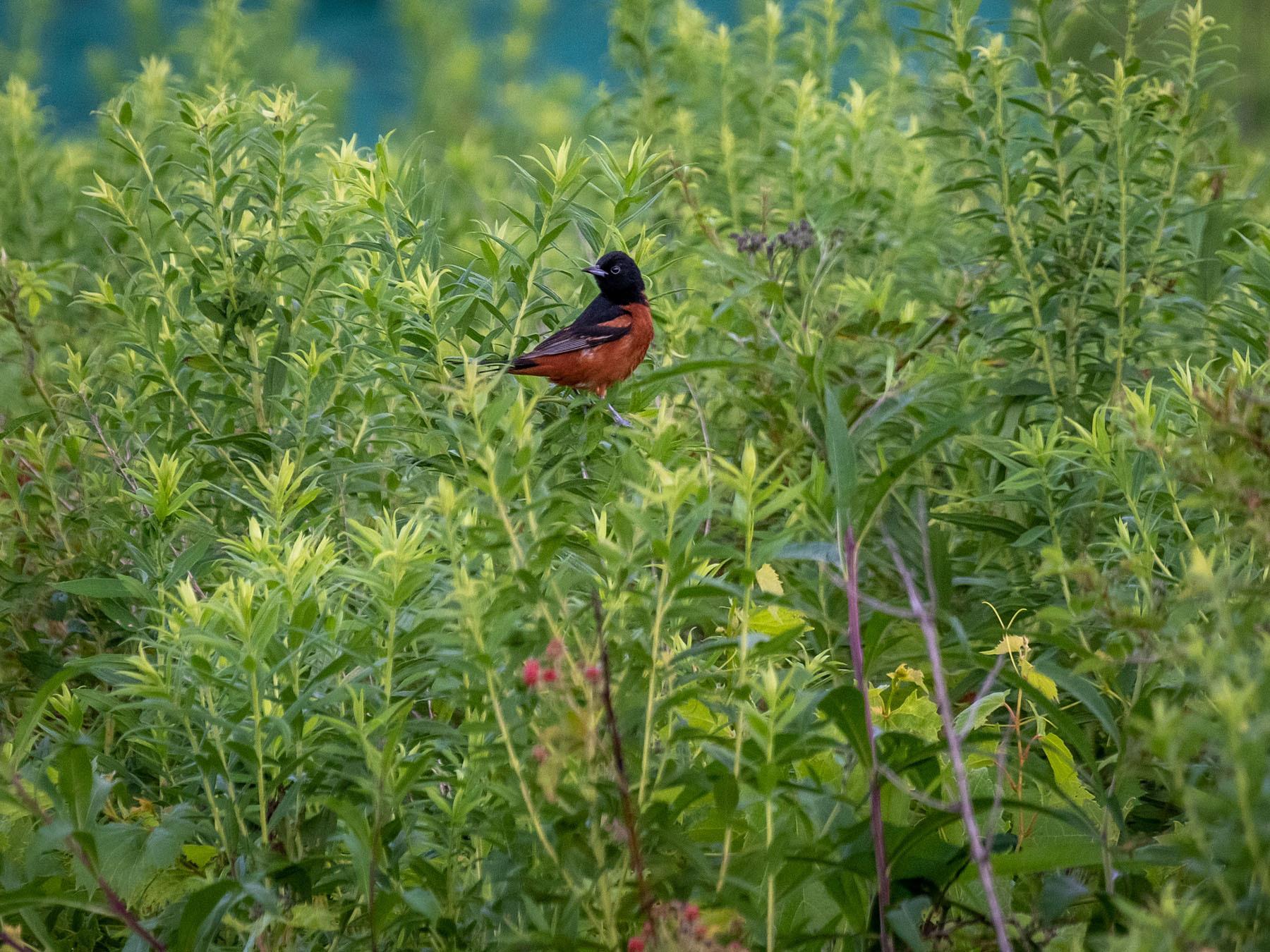
Its range has moved over time. In Ohio, New York, Pennsylvania, New Jersey and Maryland it was more widespread and common in the late 1800s and early 1900s than in the mid-1900s. That fall may have been linked to land-use changes such as lost orchards, and numbers rose again as suburbs grew in the late 1900s. Birds of the World's 2022 account says its breeding range has spread west over the past 50 years, and south in Florida since about 1960.1 In Wisconsin the number of atlas blocks where it was found rose by 235% between the first atlas (1995–2000) and the second (2015–2019), and its northern edge moved 35.7 mi (57.4 km) north.6
In northwestern Mexico, museum specimens suggest it has become a common breeder around irrigated farmland in coastal Sinaloa and southern Sonora, where it was not thought to breed before; the authors cannot say whether these birds account for declines farther north.7
Migration and winter
The Orchard Oriole is a complete migrant. Birds leave the wintering grounds in March and April and reach their breeding areas from late April to late May, depending on latitude, tending to arrive later than other orioles. They reach southern Missouri in the third week of April, Wisconsin about 10–15 May and South Dakota in the second half of May. Adult and first-year males arrive together.
It leaves early. In Nebraska, adult and first-year males usually leave their breeding sites in mid to late July, though in some years they stay into August.1 Females and juveniles stay on for another 4–6 weeks, in flocks of up to 25–30. It stands out among the songbirds of eastern North America for starting fall migration as early as mid-July.8 Before it goes it fattens on fruit. It migrates mostly at night, in flocks, through Mexico and Central America and across the Gulf of Mexico, and adults replace all their feathers on the wintering grounds or at stopovers, from September to January.
It winters from central Mexico, from central Sinaloa on the Pacific side and southern Veracruz on the Atlantic, and the northern Yucatán through Central America to Panama, uncommonly in northwestern Colombia and rarely in northwestern Venezuela. A few winter in coastal California, southern Arizona, southern Texas and the Gulf states. In winter it uses shrubby second growth, open woodland, forest edges and farmland, and gathers at flowering trees such as Erythrina.
Some birds come back to the same places. In 13 years of banding in Nebraska, 123 of 975 first-year and adult birds (12.6%) were caught again near where they were banded, against 22 of 682 juveniles, and in a four-year Maryland study the return rate was 35%.1, 9 Wintering birds return too: in southeastern Belize, 108 of 4,476 banded over five years were caught again in a later winter.1
Tips for seeing it
What it eats
In spring and summer the Orchard Oriole eats mainly insects and spiders, which it gleans from leaves, rarely feeding on the ground. Once its young have fledged it turns to ripe fruit (in southwestern Nebraska, from the third week of July), with chokecherries, wild grapes and mulberries among its favorites, and it takes nectar whenever it can. In migration and winter it lives on fruit, nectar and insects.
In western Nebraska it fed low, spending over 60% of its foraging time 2–4 ft (0.6–1.2 m) up while building the nest, and 55% while incubating, lower than Baltimore and Bullock's Orioles.1 In southwestern Nebraska, between 31 May and 9 August, stomach samples from 116 birds held about 90% arthropods and 10% fruit by fragment count, with grasshoppers and crickets 30%, spiders 20% and beetles 19%, and juveniles ate far more fruit than older birds.1 Stomachs generally show less fruit than watching the birds would suggest.
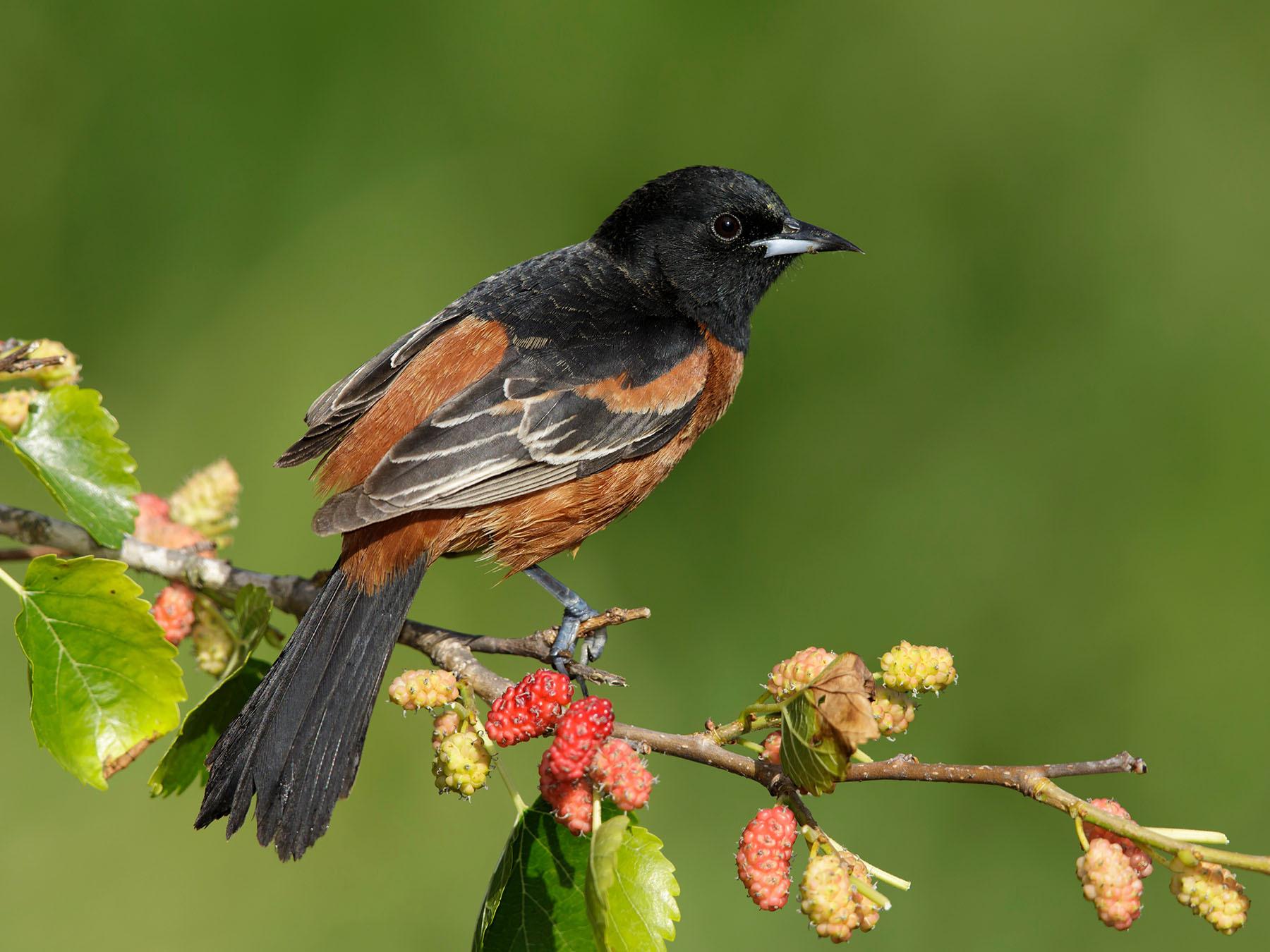
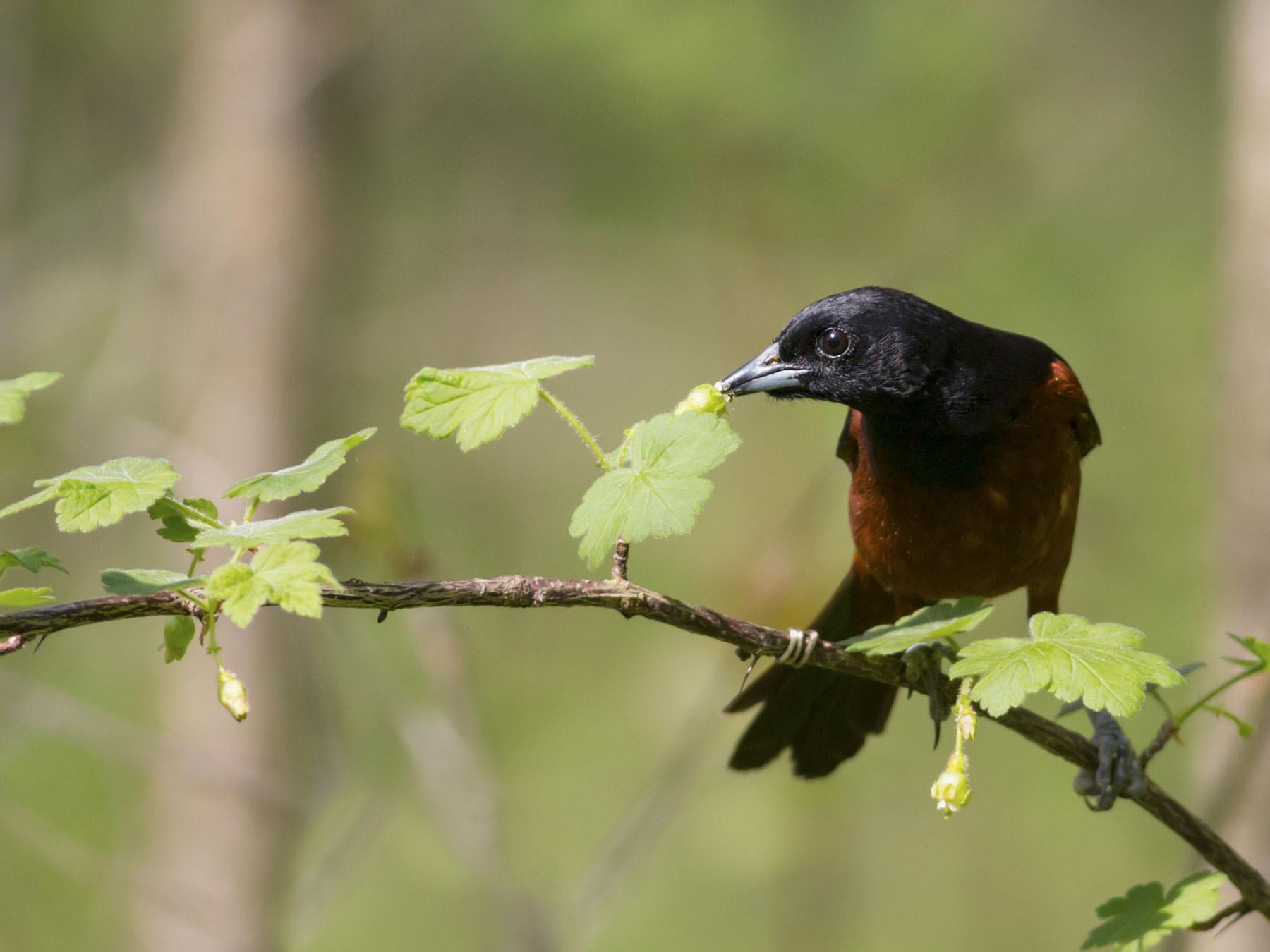
It also takes nectar by the back door, piercing the base of a flower. At one arbor in Arkansas, unmarked orioles pierced 93% of open trumpet-creeper flowers in 2020 and 92% in 2021, never going in through the mouth of the flower. No fruit set until they had left, and the author suggests the theft may disrupt the plant's local reproduction.8 On the wintering grounds it feeds at Erythrina, Gliricidia, Inga, banana and other flowers, and is reportedly a main pollinator of Erythrina fusca.1 A study of gut enzymes across many bird species found it unusually good at digesting sucrose for a bird that is not a nectar specialist.10
Feeders and your garden
Orchard Orioles do not visit seed feeders, but they may come for fruit jelly, especially grape jelly, for sugar water in a hummingbird feeder, or for orange slices and other fruit.11, 1 Offer jelly only in small amounts.11 During fall migration, fruiting mulberries and chokecherries also draw them in.
Nesting and breeding
Pairs usually form anew each year. In good habitat Orchard Orioles nest in loose colonies, several pairs to a tree, and in poorer habitat they nest alone. A 1946 report from Arkansas counted 20 nests in one tree; there were 4–8 to a tree in Nebraska, and 114 nests on 7.4 acres (3 ha) at one Louisiana site.1, 12 Where pairs nest closest together they defend little around the nest, but adult males defend feeding territories, chasing females and young males.
It often nests near Eastern Kingbirds, sometimes in the same tree, and in a seven-year Kansas study its numbers rose and fell with theirs; one suggestion is that the orioles gain from the kingbirds' attacks on predators and cowbirds.1
The nest
The female does most of the building, in about six days. The nest is a shallow basket woven from long blades of grass and hung from a forked twig near the end of a branch. It is so loosely woven at the bottom that you can see through it, and it is lined with fine grass, plant down, wool or feathers. It is about 4 in (10 cm) across and 3 in (7.6 cm) deep outside, and unlike the deep pouches of some orioles it is usually wider than it is deep.
It is commonly 10–20 ft (3–6 m) up, but anywhere from 3 to 70 ft (about 1–21 m). In Manitoba nests were mostly in maples, green ash and cottonwoods, about 29 ft (8.8 m) up on average, and in Louisiana 80 of 114 nests were in oaks; some birds nest in Spanish moss, or even in reeds.1
Eggs and young
A clutch is usually 4 or 5 eggs, sometimes 3 to 7. The eggs are pale blue to grayish white, with dark purplish-brown blotches, spots and lines toward the large end. The female incubates alone for 12–14 days, and the male often feeds her. The young leave the nest at 11–14 days with stubby tails and spend about a week hidden in thick cover nearby. Both parents feed them, and pairs seem to divide the brood between them. First-year males have been seen helping at nests.
Egg dates run from late April in Florida to early July in Pennsylvania; in Maryland, incubation of first clutches began on 22 May on average, and in Nebraska first eggs come on 15–19 June.1 In the north it raises one brood, and it was long thought to raise only one anywhere. But in a Maryland study 8 of 24 pairs nested twice; of the 16 pairs whose first brood fledged, 7 succeeded with a second, and double brooding may be commoner in the south than is known.1
Cowbirds and nest success
The Orchard Oriole is a common host of the Brown-headed Cowbird over most of its range, and it does not throw out cowbird eggs. At Delta Marsh, Manitoba, it accepted every cowbird egg, real or model, at the 26 nests followed, and 9 of 34 nests there (26.5%) were parasitized from 1976 to 2003.13 Across earlier studies about a fifth of nests were parasitized (94 of 471), and in the five studies of more than 25 nests the rate ran from about 2% in Texas to 31% in Ontario.13 In Kansas, parasitized nests fledged 1.5 young on average against 3.0 in nests without cowbirds, from small samples of 8 and 7 nests.1
Nest success is hard to measure because the nests hang high at branch tips. In Manitoba 10 of 14 first nests succeeded, in Maryland 16 of 24, and in Oklahoma 21 nests fledged 2.95 young on average.1
Behaviour
Orchard Orioles are sociable all year. Before migration, fledglings gather in small flocks of 5–12 that travel with adults, and in winter the birds gather in groups at flowering trees and roost together.1
In courtship the female bows, seesaws and begs with fluttering wings and a high trill, and the male adds a flight display; adult males also hover on fluttering wings and finish with a short upward flight near the mate or the nest.1 Groups of fledglings and adults gather at rain puddles to drink, and on hot afternoons the birds pant.
Lifespan and predators
The oldest Orchard Oriole on record was at least 11 years old: a male banded as an adult in Maryland on 4 May 2003 and caught and released there again on 4 June 2012.14 Earlier banding records include a male of 10 years 11 months from Nebraska (banded 1994) and a bird of 8 years 4 months from South Dakota, found dead in 1940.14
We found no source that gives a typical lifespan or a yearly survival rate. Return rates to banding sites, such as the 35% in Maryland, count the birds that came back and were caught, not the birds that survived.
Predators and dangers
Common Grackles often take eggs and young from nests in western Nebraska, and a Greater Roadrunner was seen catching an adult in California. The male perches away from the nest, perhaps keeping watch. On migration, birds die at tall towers: a 25-year study at one tower in Leon County, Florida, logged 12 kills in fall and 64 in spring.1
Conservation
The Orchard Oriole is not rare. The IUCN Red List rates it Least Concern (2025).15 Partners in Flight estimates about 12 million birds, for a population year around 2010, 11 million of them in the United States and Canada, and does not put it on its Watch List.16 Canada holds about 91,000, under 1% of the world population.17
Over the long term its numbers have fallen. The North American Breeding Bird Survey shows a decline of 0.88% a year from 1966 to 2025 (95% credible interval -1.09 to -0.70), and the survey's index for 2025 is about 41% below 1966.18 Most of the fall came early, -2.35% a year from 1966 to 1995. Since then numbers have risen, +0.56% a year from 1995 to 2025, and the last ten years (2015–2025) show no clear change.18
The trend differs between south and north. Over the survey's long-term series, counts fell in Texas and Oklahoma (-2.79% a year each), Florida, Arkansas and other southern states, and rose in North Dakota (+3.56% a year), Minnesota, Manitoba, Pennsylvania, Iowa, Nebraska and South Dakota.18 The State of Canada's Birds rates the Canadian trend a "Large Increase": a steady rise from the late 1970s to about 2010, then stability or a slight decline, with the downturn only in the Prairies while southern Ontario keeps rising.17
Its threats include grazing that destroys shrubs, the removal of shade trees from coffee farms in Chiapas, Mexico, and, in a 1974 report from Texas, the spraying of orchards; loss of streamside habitat is a possible problem that needs more study. As of Birds of the World's 2022 account, no management was aimed directly at the species. Heavy parasitism by two cowbird species may have played a part in declines in the lower Rio Grande Valley of Texas.1
Legal status
In the United States the Orchard Oriole is on the federal list of birds protected under the Migratory Bird Treaty Act.19 The Fish and Wildlife Service's species database lists it as a "Species of Concern" with the status category "Not Listed", so it is not listed under the Endangered Species Act.20 It is named on the list Canada publishes of the birds its Migratory Birds Convention Act, 1994 protects.21 Mexico's 2010 list of species at risk (NOM-059-SEMARNAT-2010) names only the subspecies fuertesi, as endemic and subject to special protection; the Orchard Oriole of the US and Canada is not on it.22
Names and subspecies
Linnaeus described the bird in 1766 as Oriolus spurius. It is now Icterus spurius, a New World oriole in the blackbird family, Icteridae. Spurius is Latin for "of illegitimate birth". According to Bent, following Wilson, the name came from a mix-up in which a female Baltimore Oriole was taken for the male of this species, so it was once called the spurious Baltimore oriole, a name Bent thought it did not deserve.23 Bent took the English name at its word: in his day it clearly favored orchards of apples, pears or peaches near rural homes.
There are two subspecies: spurius, the bird of the US and Canada, and fuertesi of eastern Mexico, sometimes called the Ochre or Fuertes's Oriole, whose adult male is ochre where spurius is chestnut. Females and first-year males of the two can hardly be told apart. Checklists have differed on whether fuertesi is a species of its own. AviList, the global checklist our identification service follows, treats it as a subspecies, citing differences in call and plumage against minor song differences and low mitochondrial divergence.24 Fuertes's Oriole has three records in Cameron County, in southernmost Texas.1
Similar birds
Often mistaken for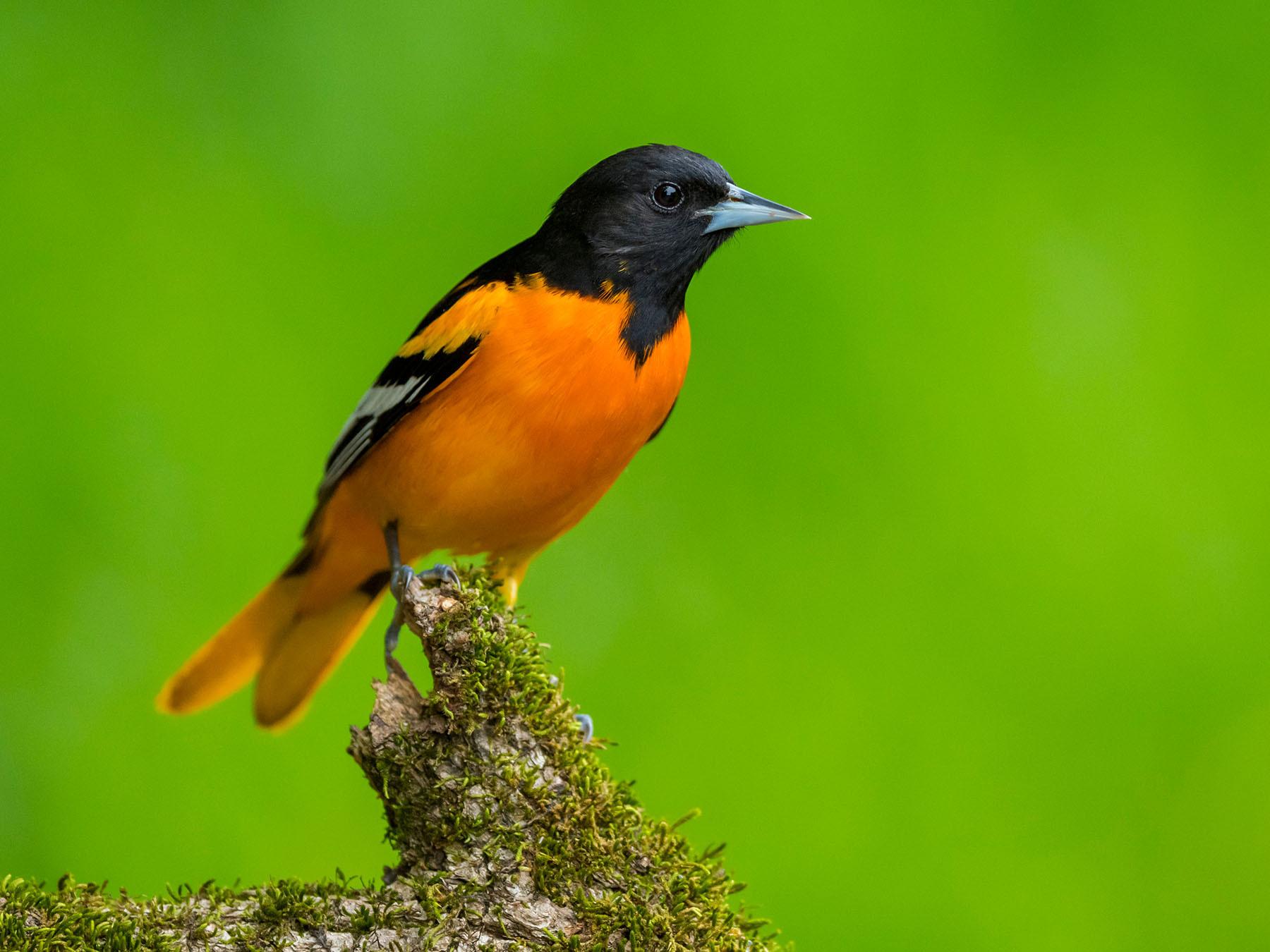
Quick facts
- Length
- 15–18 cm
- Wingspan
- 24–28 cm
- Weight
- 16–28 g
- Lifespan
- oldest recorded 11 years 0 months
- Family
- New World Blackbirds
- Migration
- Long-distance Migrant
- Global status (IUCN)
- Least Concern
- World population
- About 12 million (Partners in Flight, around 2010)
- Population trend
- Down 0.88% a year in Breeding Bird Survey results since 1966, about 41% lower by the survey's index: a steep fall to the mid-1990s, a rise to about 2015 and no clear change since. Over the long term it has risen in Canada and the northern Plains.
- Scientific name
- Icterus spurius
Questions
3Are Orchard Orioles rare?
No. Partners in Flight put the population at about 12 million around 2010, and though Breeding Bird Survey results show a long-term fall since 1966, numbers have risen since the mid-1990s. See Conservation status.
Do female Orchard Orioles sing?
Yes, regularly, though far less often than males, and their songs are shorter, lower and more variable. See Song and calls.
How do you tell a female Orchard Oriole from a female Baltimore?
Look for orange: a brighter female Baltimore shows orange in the face and underparts, which a female Orchard lacks. A duller young Baltimore is stockier and longer-winged, with a whitish belly and a grayer back. See Identification: similar birds.
Sources
29- 1Scharf, W. C. and Kren, J. (2022). Orchard Oriole (Icterus spurius), version 2.0. Birds of the World (P. G. Rodewald, editor). Cornell Lab of Ornithology. doi:10.2173/bow.orcori.02 (opens in a new tab)
- 2Moyer, M. et al. (2024). Sex-specific responses to simulated territorial intrusions provide evidence for relaxed selection pressure on female song in Orchard Orioles. Journal of Field Ornithology 95(3): art. 7. doi:10.5751/jfo-00499-950307 (opens in a new tab)
- 3Moyer, M. J. et al. (2022). Female song is structurally different from male song in Orchard Orioles, a temperate-breeding songbird with delayed plumage maturation. Journal of Field Ornithology 93(1): art. 3. doi:10.5751/jfo-00073-930103 (opens in a new tab)
- 4Moreland, D. A. et al. (2025). Lack of sex-specific syllables and high female song variability support relaxed selection on female song in Orchard Orioles (Icterus spurius). The Wilson Journal of Ornithology 137(3): 299-311. doi:10.1080/15594491.2025.2512650 (opens in a new tab)
- 5Hagemeyer, N. D. G., Sturge, R. J., Omland, K. E. and Price, J. J. (2012). Incomplete song divergence between recently diverged taxa: syllable sharing by Orchard and Fuertes' orioles. Journal of Field Ornithology 83(4): 362-371. doi:10.1111/j.1557-9263.2012.00386.x (opens in a new tab)
- 6Stallworth, D. T., Anich, N. M. and Zuckerberg, B. (2025). Poleward range shifts of breeding birds in Wisconsin. Ecology and Evolution 15(8): e71796. doi:10.1002/ece3.71796 (opens in a new tab)
- 7Rohwer, S., Grason, E. and Navarro-Sigüenza, A. G. (2015). Irrigation and avifaunal change in coastal Northwest Mexico: has irrigated habitat attracted threatened migratory species?. PeerJ 3: e1187. doi:10.7717/peerj.1187 (opens in a new tab)
- 8Graves, G. R. (2022). The Campsis-Icterus association as a model system for avian nectar-robbery studies. Scientific Reports 12: 11936. doi:10.1038/s41598-022-16237-9 (opens in a new tab)
- 9Dowling, J. L. and Omland, K. E. (2009). Return rates in two temperate breeding orioles (Icterus). The Wilson Journal of Ornithology 121(1): 190-193. doi:10.1676/08-019.1 (opens in a new tab)
- 10McWhorter, T. J. et al. (2021). Sucrose digestion capacity in birds shows convergent coevolution with nectar composition across continents. iScience 24(7): 102717. doi:10.1016/j.isci.2021.102717 (opens in a new tab)
- 11Cornell Lab of Ornithology. Orchard Oriole. All About Birds. Accessed 20 November 2026. Source (opens in a new tab)
- 12NatureServe (2026). Icterus spurius: Orchard Oriole. NatureServe Explorer. Accessed 20 November 2026. Source (opens in a new tab)
- 13Sealy, S. G. and Underwood, T. J. (2004). Accepters and rejecters of cowbird parasitism in the New World orioles (Icterus spp.). Ornitología Neotropical 15 (suppl.): 331-347. Accessed 20 November 2026. Source (opens in a new tab)
- 14USGS Bird Banding Laboratory. Longevity records of North American birds: Orchard Oriole (AOU 5060). Bird Banding Laboratory, Bander Portal longevity tables. Accessed 20 November 2026. Source (opens in a new tab)
- 15BirdLife International (2025). Icterus spurius. The IUCN Red List of Threatened Species 2025. doi:10.2305/IUCN.UK.2025-2.RLTS.T103793298A138345225.en (opens in a new tab)
- 16Partners in Flight (2024). Avian Conservation Assessment Database, version 2024.05.23 (global). Partners in Flight. Accessed 20 November 2026. Source (opens in a new tab)
- 17Environment and Climate Change Canada and Birds Canada (2024). The State of Canada's Birds: Orchard Oriole. NatureCounts. doi:10.71842/9m26-y122 (opens in a new tab)
- 18Hostetler, J. A. et al. (2026). The North American Breeding Bird Survey, Analysis Results 1966-2025. U.S. Geological Survey data release. doi:10.5066/P1OSNSFC (opens in a new tab)
- 19U.S. Fish and Wildlife Service (2026). 50 CFR 10.13: List of Birds Protected by the Migratory Bird Treaty Act. Electronic Code of Federal Regulations. Accessed 20 November 2026. Source (opens in a new tab)
- 20U.S. Fish and Wildlife Service. Environmental Conservation Online System: Orchard Oriole (species 9457). ECOS. Accessed 20 November 2026. Source (opens in a new tab)
- 21Environment and Climate Change Canada (2026). Birds protected in Canada under the Migratory Birds Convention Act, 1994. Government of Canada. Accessed 20 November 2026. Source (opens in a new tab)
- 22SEMARNAT (2010). NOM-059-SEMARNAT-2010 (species-at-risk list). Diario Oficial de la Federacion, 30 December 2010. Accessed 20 November 2026. Source (opens in a new tab)
- 23Bent, A. C. (1958). Life Histories of North American Blackbirds, Orioles, Tanagers, and Allies: Orchard Oriole. U.S. National Museum Bulletin 211. doi:10.5479/si.03629236.211.1 (opens in a new tab)
- 24AviList Core Team (2026). AviList: The Global Avian Checklist, v2025b. AviList. doi:10.2173/avilist.v2025b (opens in a new tab)
- 25National Audubon Society. Orchard Oriole. Guide to North American Birds. Accessed 20 November 2026. Source (opens in a new tab)
- 26Missouri Department of Conservation. Orchard Oriole. MDC Field Guide. Accessed 20 November 2026. Source (opens in a new tab)
- 27Rising, J. D. and Flood, N. J. (2020). Baltimore Oriole (Icterus galbula), version 1.0: Identification. Birds of the World (P. G. Rodewald, editor). Cornell Lab of Ornithology. doi:10.2173/bow.balori.01 (opens in a new tab)
- 28Pleasants, B. Y. and Albano, D. J. (2026). Hooded Oriole (Icterus cucullatus), version 1.1: Identification. Birds of the World (A. F. Poole and F. B. Gill, editors). Cornell Lab of Ornithology. doi:10.2173/bow.hooori.01.1 (opens in a new tab)
- 29Perseus Digital Library, Tufts University. Latin Word Study Tool: spurius. Perseus. Accessed 20 November 2026. Source (opens in a new tab)

Checked by
Nathan Cope, founder and editor
Nathan founded Birdfact and leads its writers and contributors in the UK, the US and Canada. He has watched and studied birds for more than ten years, and checks every article and species guide before it’s published.