


Bullock's Oriole
Northern Oriole (1973-1995, with the Baltimore Oriole) · Icterus bullockiorum
By the Birdfact teamChecked by Nathan Cope
On this page15 sections
How to recognise it
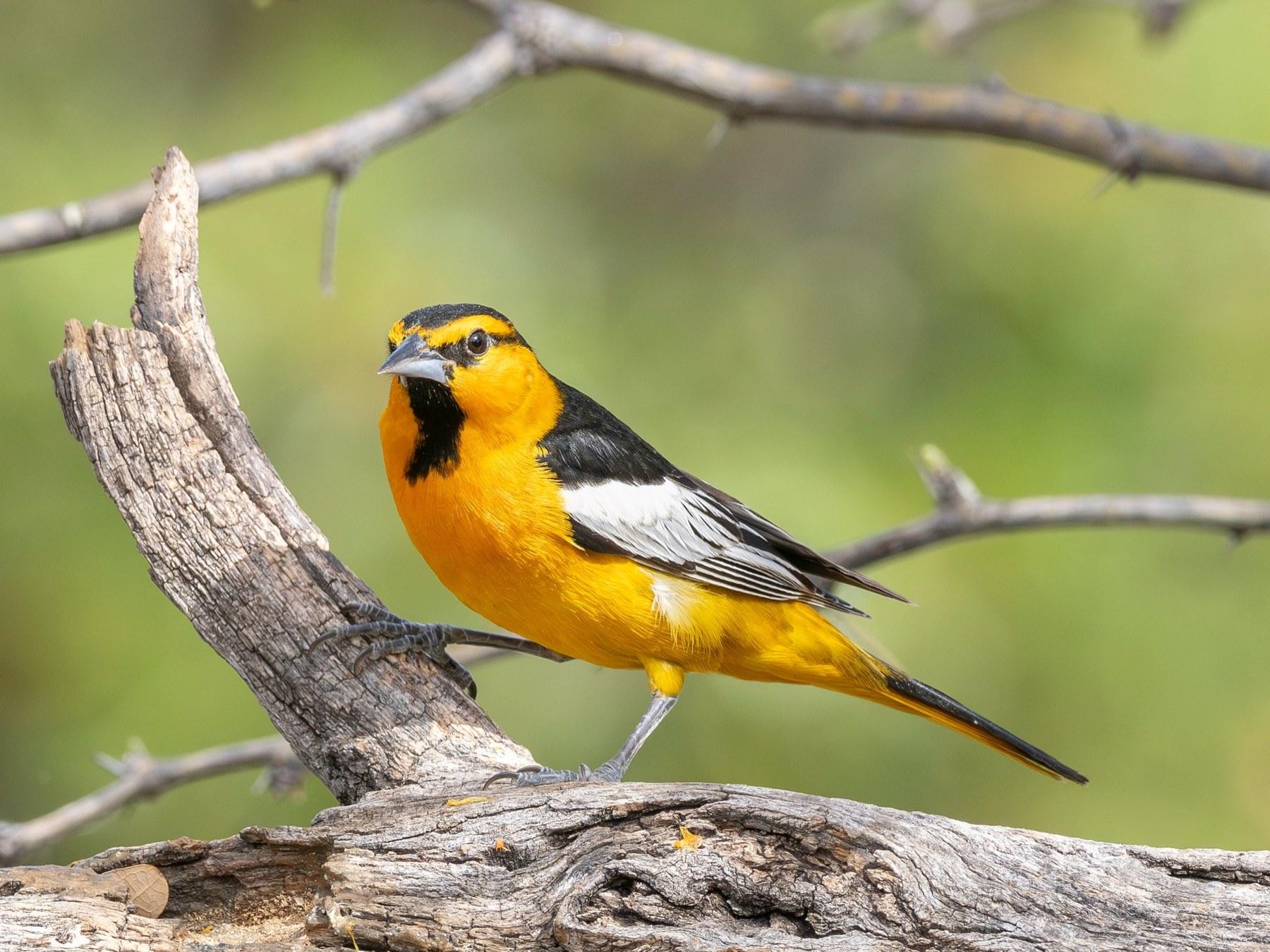
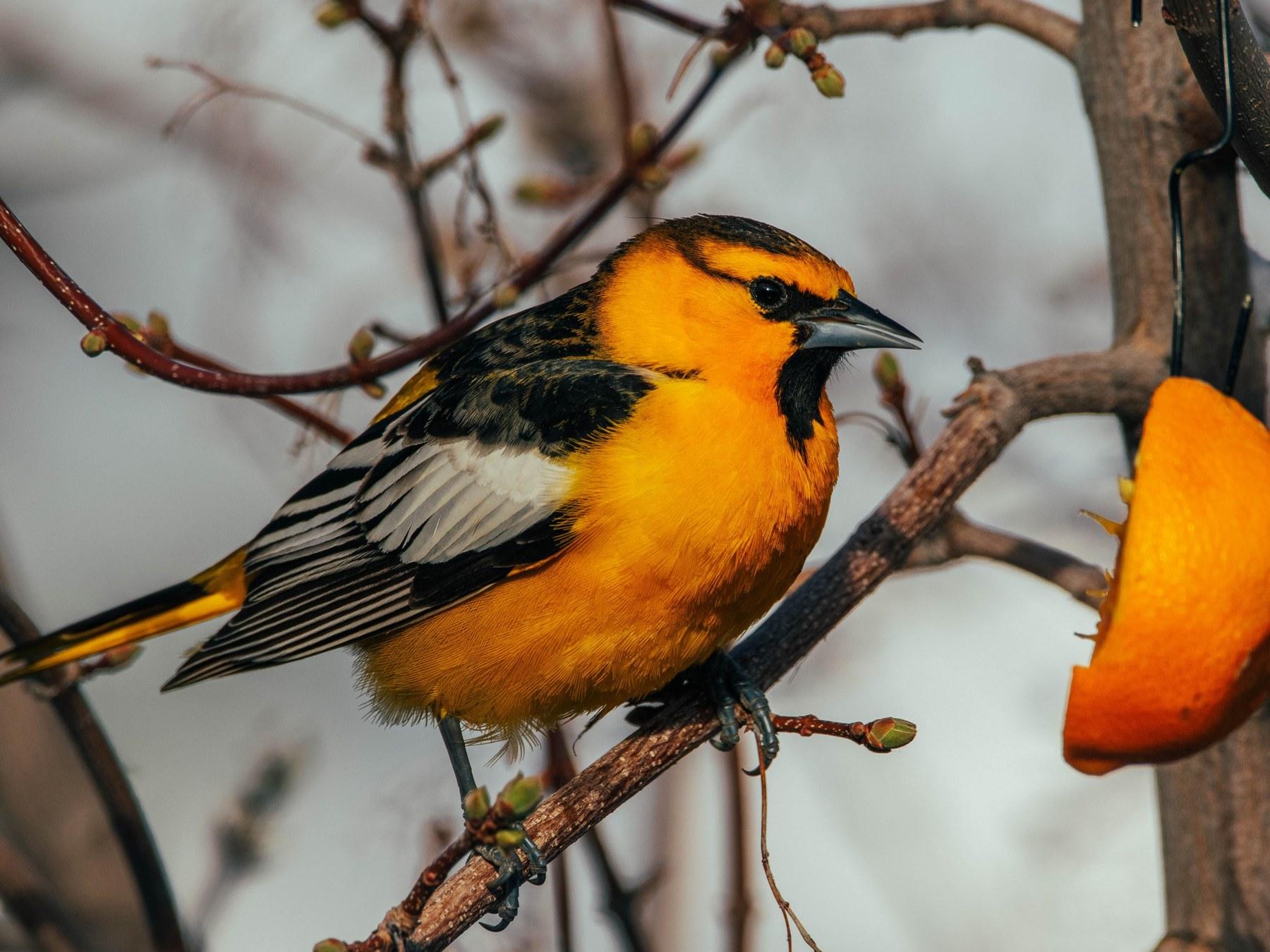
The Bullock's Oriole is the western counterpart of the Baltimore Oriole, a slim, sturdy songbird of cottonwood groves, river woods and open country with big trees. It has a tail of medium length and a sharp, pointed bill, black above and bluish gray below. The adult male is orange, black and white: an orange face crossed by a black line through the eye, a black crown, nape and back, a black chin and a black stripe down the throat, orange underparts and rump, and a large white patch on each black wing. Often a narrow yellow band separates the black crown from the bill, and the tail is black in the middle and yellow at the sides. The female is a softer bird, yellow on the head and breast, gray-brown above and whitish on the belly, with white wing bars. The male's color runs from lemon yellow to bright orange, partly with diet, because the orange comes from pigments in the food.
Size and weight
A Bullock's Oriole is about 6.7–7.5 in (17–19 cm) long, with a wingspan of roughly 11.8–13.4 in (30–34 cm) and a weight of 1.0–1.5 oz (29–43 g). Males run a little larger than females in bill and leg, but weights overlap and shift with place and breeding stage: California birds were lighter on average, about 1.2 oz (33.6 g) in one sample of 33, while breeding males and females at Kamloops, British Columbia, averaged about 1.3 oz (37.8 g) and 1.4 oz (38.5 g), and females are heavier when laying.1
Male, female and young birds
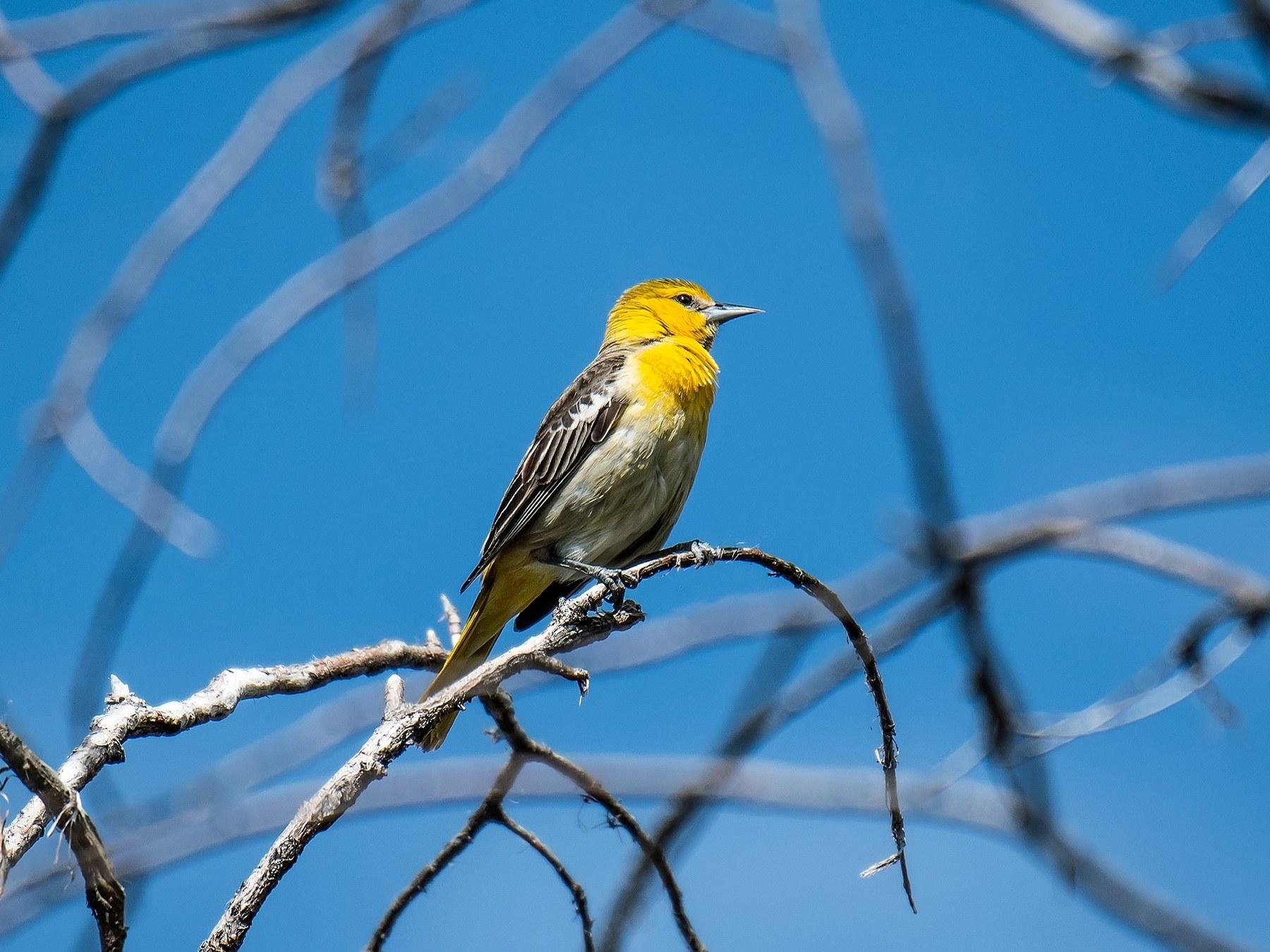
The adult female has a yellow head and breast, pale gray-brown or yellowish upperparts with faint dark streaks, and a whitish belly and flanks, with one or two indistinct white wing bars and a plain olive-gray tail. Her throat is black, yellowish or a mixture: some females show black there, which is thought to mark older birds, though the ages of most birds examined were not known.1
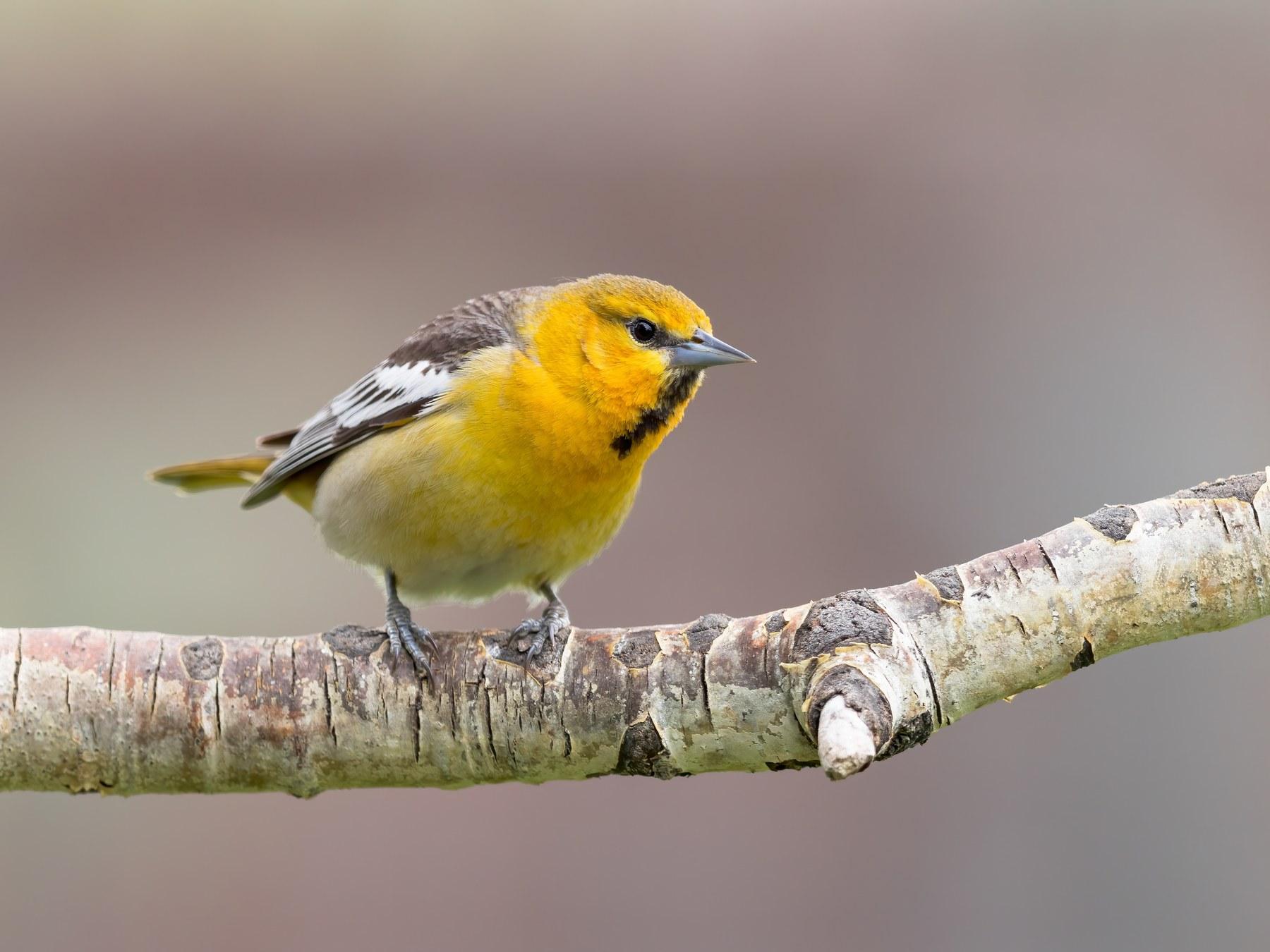
A first-year male looks like a female with extra markings. His head and throat are brighter and more orange than a juvenile's, the feathers of his back have darker centers, and he has black on the lores and chin and a narrow black stripe down the throat, sometimes only mottled. He wears this plumage through his first breeding season and gets the full black-and-orange dress at his next complete molt, in his second fall. Yearling males do breed, but older males do better: in a California DNA study, annual reproductive success averaged 4.2 young for adult males against 1.9 for yearlings, because older males lose less paternity at home and sire more young in other males' nests.2, 1 A first-year female is duller than he is, with a pale yellowish to whitish throat and no black.
A juvenile, seen from about June to October, looks like a duller adult female: pale gray-brown or grayish olive above, with a pale yellow face and eyebrow, a pale yellow to whitish throat, a yellow breast or one washed with olive, a yellowish-white to grayish belly and two wing bars from white-tipped and pale-fringed wing coverts. Young males and females look alike, though a young male is often brighter yellow below than an adult female and an occasional one shows a few blackish throat feathers.
Identification: telling it from lookalikes
An adult male needs little checking: a male Bullock's has an orange face, a black line through the eye and a large white wing patch, and a male Baltimore Oriole has neither the orange face nor as much white in the wing.3 Females and young birds are harder. A young female Baltimore is dull brownish green above and yellowish below, with a darker face against a yellow throat. A Bullock's of the same age is grayer above and whitish on the lower breast and belly, with a broad yellow cheek and eyebrow that stand out against a dark eye-line and a dark crown. The Bullock's also tends to show a serrated upper edge to its wing bars, from white tips deeply cut by black, and wing bars joined by pale-edged coverts into a pale panel, where a Baltimore's are separate and squared off, and many have gray, not yellowish, undertail coverts.1 Hybrids between the two, and with the Black-backed Oriole of Mexico, may complicate identification.
A female Hooded Oriole looks much like a female Bullock's but is greenish where the Bullock's is yellowish or grayish yellow, slimmer in body and bill, and a little smaller, about 6.9–7.3 in (17.5–18.5 cm). The Streak-backed Oriole of western Mexico has a yellow crown, black streaks down the back and an all-black tail, and is a little bigger at 7.3–8.1 in (18.5–20.6 cm); its females show black spots on the back, which can be hard to see in young birds. The Black-backed Oriole of north-central Mexico is black on the rump, the feathers above the tail, the flanks and the face, with yellow-orange spectacles.
Not sure it’s a Bullock's Oriole? Check your photo: Birdfact names the bird and shows the look-alike side by side.
Its size
Adults- Length
- 17–19 cm
- Wingspan
- 30–34 cm
- Weight
- 29–43 g
Its song and calls
The song is a musical, warbled run of whistled and chuckling notes, often opened by gruff, scratchy ones; the last note is sharp and clear, and the song often ends in a tumble. Both sexes sing, and they sing different songs: the female's is much like the male's in rhythm, pitch and quality, but her last notes are a little harsher, step through smaller pitch intervals and run in a different rhythm. Females sing regularly early in nesting and while building, perhaps more than males, and may sing over and over from the ground, while males sing from trees, often from an inconspicuous perch. Males sing through the day but, unlike Baltimore Orioles, rather seldom.1
Where the two breed side by side in northeastern Colorado, Bullock's songs ran longer than the Baltimore's, 2.0 seconds against 1.3, with 14.1 notes against 7.6 and a wider range of pitch, and nearly all held "chuck" and "ilip" notes that Baltimore songs lack.1 In a 2024 study of eight eastern and western songbird pairs, using recordings of 65 Bullock's and 69 Baltimore songs, the songs of these two orioles differed less than those of most of the pairs, and the Bullock's songs fell into two equally common variants with no pattern across its range.4
Both sexes give a mildly harsh, chattering rattle in alarm, mobbing and scolding, often in flight; it seems to serve as both an alarm and a contact call, and the chatter as a bird flies off can help you find it. Other calls are a sharp "skip" or a clear "kleek", short "chuck" and "ilip" notes in territory defense and mate attraction, and a female's low begging call to the male. The player on this page has a male's song phrase recorded in Eddy County, New Mexico, and a chatter call recorded in Golden Gate Park, San Francisco.
- Song0:00 / 0:06
Recorded in New Mexico, United States · July 2021
- Chatter call0:00 / 0:30
Recorded in California, United States · April 2021
Heard one and not sure? Let the bird song identifier listen.
When and where to see it
November
Mostly absent
The year across North America
Choose a place on the map to see its year, or find yours.
Most recorded in November
Up to 1.3% of a place’s bird records that monthHere in other months
How this map is made
Each county, state or province is shaded by the Bullock's Oriole’s share of all the bird records there that month: the darker, the larger the share. A place with only a trace of records in a month is left unshaded. Shades compare places on this map with each other, not one bird with another. Records: GBIF eBird Observation Dataset, 2019–2024. Map: Natural Earth; place centres © OpenStreetMap contributors.
How often the Bullock's Oriole turns up in the United States and Canada through the year, from birdwatchers' records.
United States
Summer visitor · regularly Mar–Sep · most records in June
Canada
Summer visitor · regularly May–Dec · most records in June
Show as a table
| Month | United States | Canada |
|---|---|---|
| January | 0.006% | 0.002% |
| February | 0.004% | 0.007% |
| March | 0.014% (regular) | 0.007% |
| April | 0.081% (regular) | <0.001% |
| May | 0.18% (regular) | 0.034% (regular) |
| June | 0.20% (regular) | 0.068% (regular) |
| July | 0.13% (regular) | 0.039% (regular) |
| August | 0.070% (regular) | 0.010% (regular) |
| September | 0.019% (regular) | <0.001% |
| October | 0.003% | <0.001% |
| November | 0.003% | <0.001% |
| December | 0.005% | 0.004% (regular) |
Worldwide: recorded regularly in 5 countries
Countries where it was recorded in at least 3 of the 6 years 2019–2024. Linked countries have their own bird list.
North America (5)
Data: EOD – eBird Observation Dataset (Cornell Lab of Ornithology), accessed via GBIF.org, CC BY 4.0. Records from 2019–2024, aggregated and filtered by Birdfact. How these lists are made
It breeds from southernmost British Columbia and southern Alberta through the western United States to northern Mexico, and east to the western Great Plains: Montana, the western Dakotas, western Nebraska and Kansas, the Oklahoma Panhandle and the western two-thirds of Texas. In the Pacific states it is a bird of the interior valleys, east of the Cascades and in Oregon's valleys west of them, with some around Puget Sound, and absent from the Oregon coast, and it breeds almost everywhere in California except the high mountains and eastern deserts. In Arizona it is commonest in the southeast and sparse in the north, and in Mexico it breeds from northern Baja California and northeastern Sonora to Chihuahua, Nuevo León and Durango.
Look for it in streamside woodland with big cottonwoods, willows or sycamores, in open oak or mesquite woods where the trees are well spaced, and in orchards, ranches, parks and towns with large trees. It prefers bigger trees than the Orchard Oriole and avoids deserts, high mountains, continuous forest and the middle of big cities. Planted trees have helped it: settlers' plantings spread its habitat on the Great Plains, and hardwoods planted around homes raised its numbers in western Washington. In British Columbia it spread west and north between 1950 and 1970 and kept expanding afterward.1
Migration and winter
It is a short- to medium-distance migrant that travels at night in small, loose flocks, usually fewer than ten, and is not known to call much on the way. Males arrive first, older males ahead of second-year males, and females follow. Arrival dates depend on the place: birds leave Mexico in March and reach southern Arizona from mid-March through April, California from mid-March (about two weeks later in the north), Texas from late March to mid-May, western Oregon valleys in mid- to late April and eastern Oregon in early May, British Columbia from mid-April, Colorado in early to mid-May and Saskatchewan in late May.1 They leave from late July: most are gone from dry Washington by the end of July, most Arizona breeders go in late July, Texas birds start moving in late July and most are gone by late September, and California birds leave from late July to early September, with stragglers in October.1
Molt migration
Many Bullock's Orioles do not fly straight to their winter homes. After nesting, adults and first-year birds from the north make a molt migration in July to September to the Mexican monsoon region, which takes in Arizona, Sonora, Sinaloa and southern Baja California, presumably to make use of a rich food supply. They replace their feathers there before moving on to the wintering grounds in September to November. The stopover can last up to 70–80 days, birds scatter widely across the region, and where a bird molts is not tightly tied to where it bred.1 In 20 adults molting at a stopover, the molt took 47 days on average, from 22 July to 7 September.1
Three kinds of study tell this story. A 1990 study of museum specimens reasoned that the species "almost certainly" goes to the Southwest before its fall molts, a move probably favored by the dry late summer across most of its breeding range and the food flush of the monsoon rains, and that, unlike the Baltimore Oriole, it almost entirely lacks a spring molt.5 Geolocators on two birds from Kamloops, British Columbia, at the northern edge of the range, both appeared to make a long fall stopover in the monsoon region, and feather isotopes placed the molt between the breeding and wintering grounds.6, 1 In 27 adult males from Kamloops, the diet and habitat signals in their feathers went with differences in color, which the authors read as conditions on the stopover shaping the plumage.7
Most winter in Mexico, from Sinaloa and from southern San Luis Potosí south to central Chiapas and the highlands of Guatemala, rarely to El Salvador and Costa Rica, in almost any wooded habitat, and join other birds at flowering trees, fruiting plants and army ant swarms. Small numbers, rare to very uncommon but regular, winter on the southern California coast from Santa Barbara County to San Diego County and in the Florida panhandle, and rare birds linger through winter across much of the breeding range; wintering there is probably helped by feeders and planted exotic trees, and California winterers take nectar from eucalyptus flowers.1 It is also a rare but regular stray in the East.
Tips for seeing it
What it eats
In the breeding season it is mostly an insect-eater, picking caterpillars and the pupae of moths and butterflies from leaves and twigs, along with grasshoppers and crickets, beetles, winged ants, bees and wasps, true bugs such as scale insects and stinkbugs, and spiders. Nectar and fruit are its main plant foods: ripe mulberries, serviceberries, brambles, cherries and figs, and nectar from agaves, eucalyptus and other flowers. Adults feed their young much the same foods, and nestlings also get crickets, cicadas, earwigs, crane flies and even pebbles and eggshells. It forages at the tips of twigs, often hanging upside down, and feeds mostly in the trees, though it drops to the ground for insects at times. To get at juice it "gapes": it pushes its closed bill into a ripe fruit, or into a tough caterpillar, and pries the bill open so its brush-tipped tongue can lap the juice. It sometimes skins caterpillars by beating them on a branch, and it drops a honeybee's stinger before it eats the bee.
How much fruit does it take? A 1910 federal study of 162 stomachs collected in California from April to August found about 79% animal food, with the caterpillars, pupae and adults of moths averaging over 41% of the food; black olive scale was in 45 stomachs and codling-moth pupae and larvae in 23.8 Fruit made up a little over 9% of the season's food but nearly 40% in July, with cherries and figs the fruits named most often; the author judged that the harmful insects the birds destroy probably pay for the fruit they take, and called fruit-eating their one economic fault.8
Smaller studies add to the picture. In Texas cotton fields in August and September, about 27% of the Bullock's Orioles examined held boll weevils in a 1907 federal study, 133 weevils in 40 birds, and in a Utah study all seven stomachs examined held alfalfa weevils.9, 10 In a study of small organic apple orchards in western Colorado, 21 bird species were seen foraging in apple trees and only five were seen damaging fruit; a Bullock's Oriole was seen doing so on only four occasions, and the authors judged the birds' effect on fruit minor.11
Nectar has long been noted. Bent, writing in 1958, quotes an Arizona observer who watched an oriole drink at dawn from the flowers of a bird-of-paradise shrub and later from ocotillo, and an account of 1904 of orioles at eucalyptus flowers, one so full of honey that it leaked from its mouth.12
Feeders and your garden
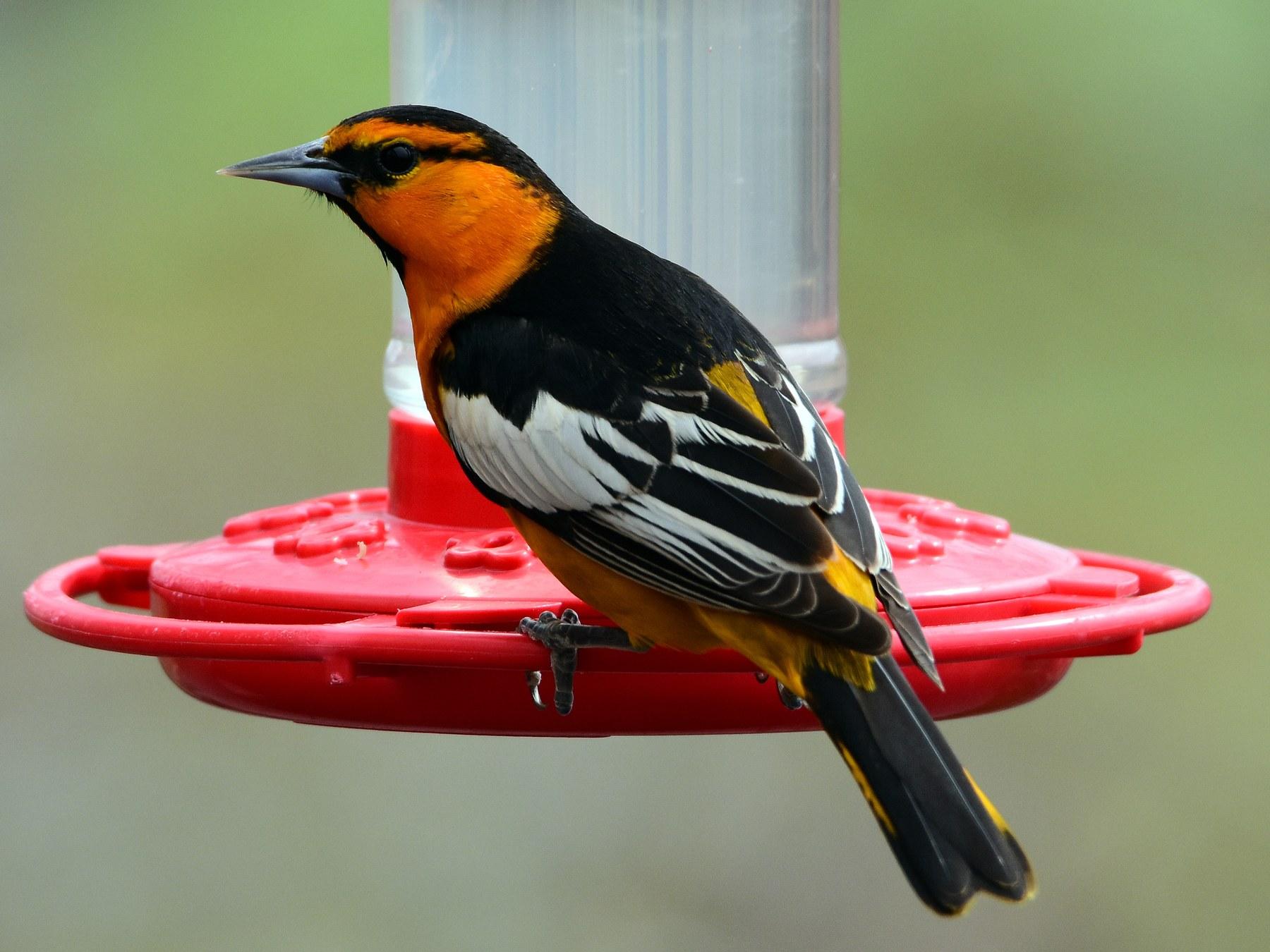
Bullock's Orioles do not use seed feeders, but they look for sugary food as they finish spring migration, so put food out before the first birds arrive or they will move on. In towns they take jelly and orange halves in the breeding season and on migration, and the few that winter in the US come to suet and hummingbird feeders. An equal mix of water and grape jelly, stirred to a thin syrup in a small shallow container, may draw them in as breeding starts. Hummingbird feeders work if they have perches, and an oriole feeder for sugar water works too. Offer orange halves in a shallow dish of water, which keeps ants off, and change the fruit every day. Once the birds are nesting, mealworms replace the sweet foods.13, 1
Nesting and breeding
Males arrive first and hold a patch of trees with song, face-offs and chases, sometimes grappling until they fall and let go. Pairs form fast: a female generally pairs on the morning she arrives, and her choice seems to decide it. Bullock's Orioles are socially monogamous, with only 2 of 96 males followed at one California site having two mates, but mating outside the pair is fairly common: in one DNA study 22 of 48 broods (46%) held young sired by another male, as did 65 of 202 nestlings (32%), more at high nest density, and females seek older males, particularly when paired with a yearling.1 The pair bond usually lasts one season: in a three-year study both birds of 11 banded pairs returned, and only 3 of those pairs got back together.1
The nest
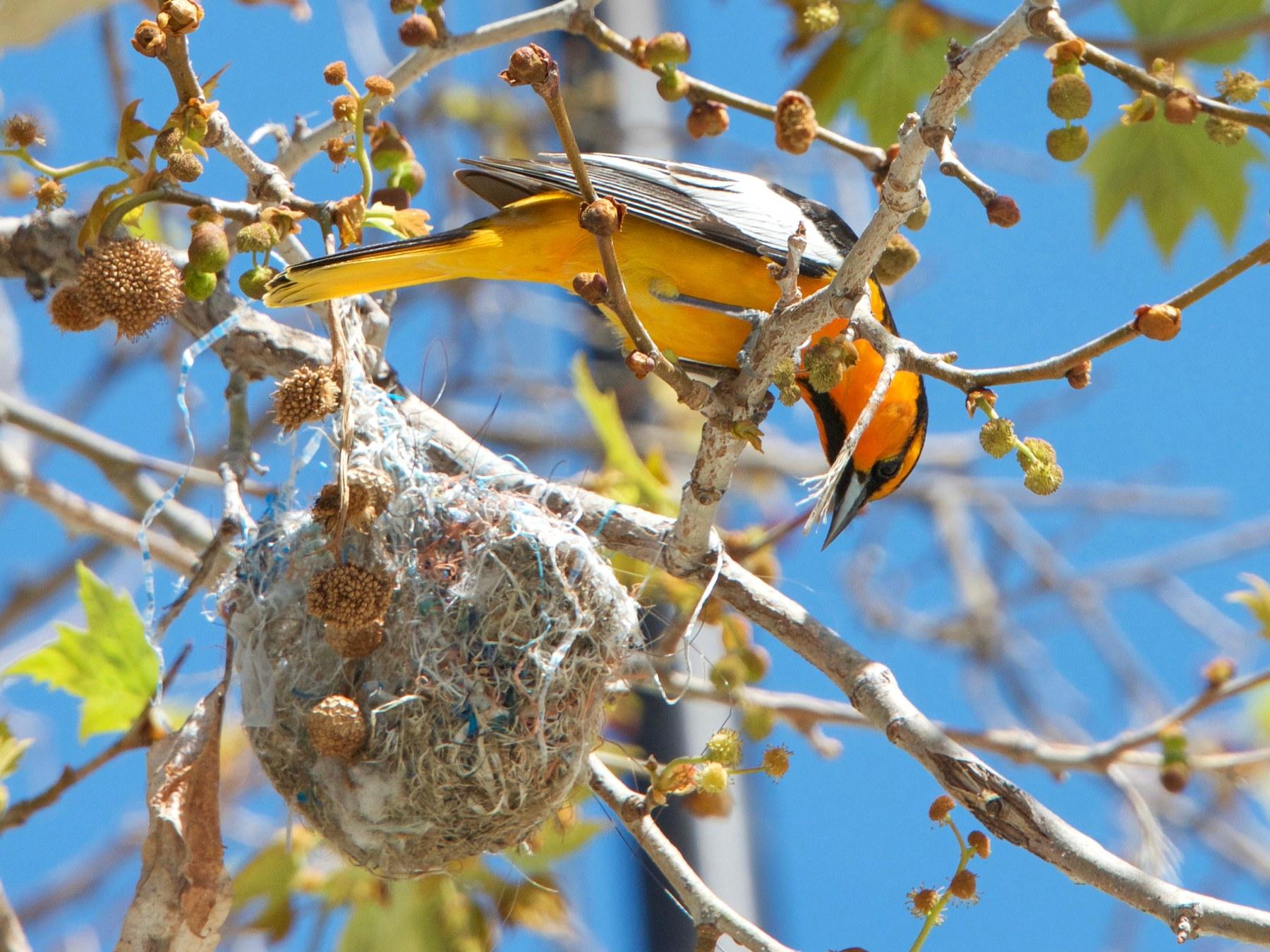
The nest is a hanging pouch, woven mostly by the female, though the male may help, one bird working inside and the other outside and passing material. It is neat and soft, of hair (especially horsehair), grasses and wool and shreds of leaves or bark; the lining is soft cottonwood or willow cotton, with wool or feathers, and twine, string or even fishing line often go in. It can take up to 15 days to build. It hangs from the thin tips of branches, rarely sits in a fork, and is usually 10–25 ft (3–7.5 m) up, and nests have been found as high as 49 ft (15 m). On the Plains the tree is usually a cottonwood, in western Texas honey mesquite, and in California and Oregon cottonwood, oak or eucalyptus. Nests are up to 15 in (38 cm) deep and average just under 4 in (10 cm) on the Great Plains, deeper and wider than a Baltimore's, with a smaller opening.1
Old accounts add some quirks. Bendire, writing in 1895 and quoted by Bent, said that in southern Arizona and western Texas the nest is often built in bunches of mistletoe on cottonwoods and mesquites, and an Arizona atlas found several in mistletoe clumps.12, 1 Bullock's Orioles sometimes nest in the same tree as Western Kingbirds in Arizona and Texas, and with Eastern Kingbirds and Scissor-tailed Flycatchers in Texas, an association reported only anecdotally; in California, orioles nesting near Yellow-billed Magpie nests lost fewer to predators, mainly California Scrub-Jays, probably because the magpies mob them.1
Eggs and young
The eggs are pale bluish or grayish white, sometimes tinged purplish, and marked with fine purplish-brown lines and scrolls that thicken toward the big end. A clutch is usually four or five eggs and can be three to seven; the average was 5.0 in 220 California nests, and at one California reserve clutches fell from 5.54 eggs early in the season to 4.29 late.1 Laying depends on the place: most eggs in California are laid in mid-May, in Arizona and Nevada mostly in June, and in northeastern Colorado from mid-June into early July.1
Only the female incubates and broods, while the male stays close. The young hatch helpless, with scanty white down, and both parents feed them at about equal rates and carry off their droppings. At one California reserve incubation took 11 days and the young left the nest at 14 days.1 Families may linger in the nest tree for several days, and young from several nests sometimes gather in creches fed by parents from different nests, moving off in groups of up to 100 birds.1 There is generally one brood, though a pair whose first nest fails early may build another.
Cowbirds seldom succeed here. Birds of the World says the Bullock's is an ejector: it punctures a cowbird egg and carries it out on its bill, whether a Brown-headed Cowbird's or a Bronzed Cowbird's, though it also reports 12 of 90 nests parasitized in Washington, so the low rates elsewhere may be an artifact.1 Ejecting can chip the oriole's own eggs, because cowbird shells are unusually thick, but it costs less than raising cowbird young when four or more oriole young share the nest.1 A 1963 count of the literature found only a handful of dated records of a Brown-headed Cowbird laying in a Bullock's nest, in Oklahoma, Texas and California between 1911 and 1952.14
Behaviour
Where the two species breed in the same place, males of each drive off males of the other as well as their own, and neither type seems to be the more aggressive.1 Both partners guard the nest and mob crows, ravens, jays, magpies and squirrels; in one California study the orioles chased or mobbed Yellow-billed Magpies 26 times, American Crows 9 and California Scrub-Jays 7, and small non-predatory birds that came within 6.5 ft (2 m) of the nest 38 times.1
It is usually seen in pairs while breeding, in loose flocks of fewer than ten on migration, and in mixed groups at rich nectar sources, fruiting plants and army ant swarms in winter. It copes with heat better than a Baltimore Oriole, a difference that may help set where each can live.1 It pants when stressed by heat, bathes in water and drinks from troughs, though not daily.
Lifespan and predators
The oldest on the US banding list was a male at least 8 years 11 months old, banded as an adult in Colorado on 20 May 2000 and recaptured and released alive there on 21 May 2007; the lab's table of earlier records also lists a Utah female of 7 years, a male recaptured in Mexico at 6 years 7 months and an Oregon male found dead at 6 years 1 month.15 Typical lives are shorter, and few birds can be followed: in a three-year study in California and Washington, 54% of 93 banded adults returned to breed the next year, and at Kamloops, British Columbia, 13 of 45 came back to the same study area; fewer than 5% of young return to breed near where they hatched, so how many survive their first year is not known.1
Predators and dangers
Eggs and young are eaten by Cooper's Hawks, American Crows, gopher snakes, king snakes (seen at nests as high as 39 ft (12 m)) and California Scrub-Jays, and in British Columbia red squirrels, American Kestrels and Steller's Jays are recorded or suspected, while a garter snake ate recently fledged young; about 19% of nests at one California reserve were lost to predators, and storms are thought to have killed whole broods.1
Conservation
The IUCN Red List (2025) rates the Bullock's Oriole Least Concern, and NatureServe ranks it G5 globally, with a provincial conservation rank of S2B in Alberta, at the edge of its range.16, 17 Partners in Flight puts the population at about 7.4 million birds around 2010, 6.9 million of them in the United States and Canada, and does not put it on its Watch List.18 In Canada there are about 260,000, 4% of the global population.19
The Breeding Bird Survey shows a long decline: -0.54% a year from 1967 to 2025, with a 95% credible interval from -0.96 to -0.22, across 1,197 routes and with the survey's top credibility rating, and an annual index that fell from 2.56 in 1967 to 1.87 in 2025, about 27% lower.20 The fall is still credible from 2005 to 2025, -0.60% a year (-1.08 to -0.12), but the last ten years show no clear change: +0.14% a year from 2015 to 2025 (-0.72 to +1.00).20 Regions differ: California (-1.45% a year) and Texas (-1.44) fall over the long term, the Great Basin rises (+0.76), and British Columbia, Canada's only series in this survey, also rises (+1.32), on 53 routes and a lower credibility rating.20 Canada's own national analysis finds a moderate increase: a steady rise from the 1970s to around 2010, then a decline back to about 2000 levels, still nearly double the early 1970s; it finds the recent decline most marked in the Great Basin region.19 Partners in Flight's long-term trend, -0.53% a year for 1970 to 2021, is calculated from the same survey over a different span and agrees.18
Habitat is the main concern. The handbook account warns that pumping groundwater for irrigation was destroying the riparian woods it nests in across western Kansas and eastern Colorado, in a way that may reduce oriole numbers; urbanization has reduced its numbers in places (it is absent from Tucson and Phoenix despite their shade trees), and pesticides may harm it, directly and by killing its food. Planted shelterbelts and woodlots have probably helped it on the Great Plains, and the control of prairie fires has added riparian woods, and no continental action is thought necessary, though protecting its molt stopover sites has been proposed.1, 13
Legal status
The Bullock's Oriole is on the federal list of species covered by the Migratory Bird Treaty Act, so it is unlawful to take, possess, transport, sell or buy the bird, its parts, nests or eggs except under a permit or as the regulations allow.21, 22 Someone who finds a sick, injured or orphaned bird can pick it up without a permit and take it straight to a permitted rehabilitator or a licensed veterinarian.23 The US Fish and Wildlife Service's species database carries it as a "Species of Concern" in the category "Not Listed", so it is not listed under the Endangered Species Act.24 Canada's list under the Migratory Birds Convention Act, 1994 names it, and Mexico's 2010 list of species at risk (NOM-059-SEMARNAT-2010) does not.25, 26
Names and history
William Swainson named the bird in 1827 for William Bullock and his son, also William. The elder Bullock owned the Egyptian Hall, a museum in Piccadilly, London, and the two traveled in Mexico in 1822 and 1823; the younger stayed on to manage a silver mine and collect.27 Swainson called the oriole "the most beautiful of the group" found in Mexico.28
Its scientific name is now Icterus bullockiorum. Swainson wrote bullockii, a singular form, though he made clear it honored two Bullocks, and ornithologists have since argued over the ending: Chesser proposed a correction in 2013 and corrected his own form to bullockiorum in 2015, and AviList, the global checklist our identification service follows, uses it in its 2026 edition, as do the IUCN and NatureServe.29, 30, 16, 17 Many lists still print bullockii, including Birds of the World, the Breeding Bird Survey, the US federal list of protected birds and the American Ornithological Society's checklist, which also still lists two subspecies; AviList recognizes none.31, 1, 20, 21, 30
Hybrids and the Northern Oriole
Where the Bullock's range meets the Baltimore's on the Great Plains the two hybridize, along riparian corridors such as the Platte River in Nebraska and Colorado and the Cimarron and Arkansas Rivers in Kansas; mixed pairs and hybrids occasionally turn up in Arizona and California. Most of the interbreeding is on the Plains, and even there many birds still look like one parent or the other.1 From 1973 to 1995 the American Ornithologists' Union treated the two as one species, the Northern Oriole, because of the Plains hybrids.32, 1 In 1995 the Union split them again, judging the hybrid zone apparently stable, and listing differences in plumage, voice, heat tolerance, genes, molt, molt migration, nest sites and size.33
Studies since have put numbers on the zone, each on one stretch of river. In western Kansas, birds collected in 1976 and 1978 showed no shift in the male plumage step from the mid-1960s, and Bullock's-type females had reached farther east along the Cimarron River.34 Along the Platte River in Nebraska, DNA from the toe pads of 701 birds collected about 50 years earlier showed a mitochondrial cline 204 mi (328 km) wide that matched the plumage cline; the authors call it relatively narrow and read it as selection against hybrids.35 A 2020 study of 297 orioles at 3,067 genetic markers found hybridization still prevalent, with 41% of the birds in the zone recent-generation hybrids, and more support for a westward shift of the zone's center since the 1950s that had slowed or stopped by the 1970s.36 Whole-genome work found genome-wide divergence (FST) of 0.19 between the two species away from the zone, and introgression trailing farther into the Baltimore Orioles to the east, which the authors take as a sign of the zone moving west; earlier studies they summarize put the shift at 25–45 mi (41–73 km) over 60 years.37 In 136 birds from across the zone whose nuclear ancestry had been measured, 83% of the putative first-generation hybrids carried Baltimore-type mitochondria, a pattern the authors say may help explain why gene flow runs more one way than the other.38 Gut worms show no sign of selecting against hybrids: of 139 male orioles sampled across the zone, 43 carried them, and hybrids were infected no more often than their parents.39
Males of the Bullock's inside the zone have changed: breast feathers from 20 adult males collected in 2016 to 2018 were more orange than those of 20 collected on the same stretch in 1955 to 1957, and now resemble Baltimore colors, while males from outside the zone show no change; the authors suggest introgression from the Baltimore, favored by female choice, but cannot separate it from selection on variation already present.40 In northern Durango, Mexico, the Bullock's has also hybridized with the Black-backed Oriole, though a genetic analysis of the three species, which calls that zone alleged, found no gene flow between those two.1, 41
Similar birds
Often mistaken for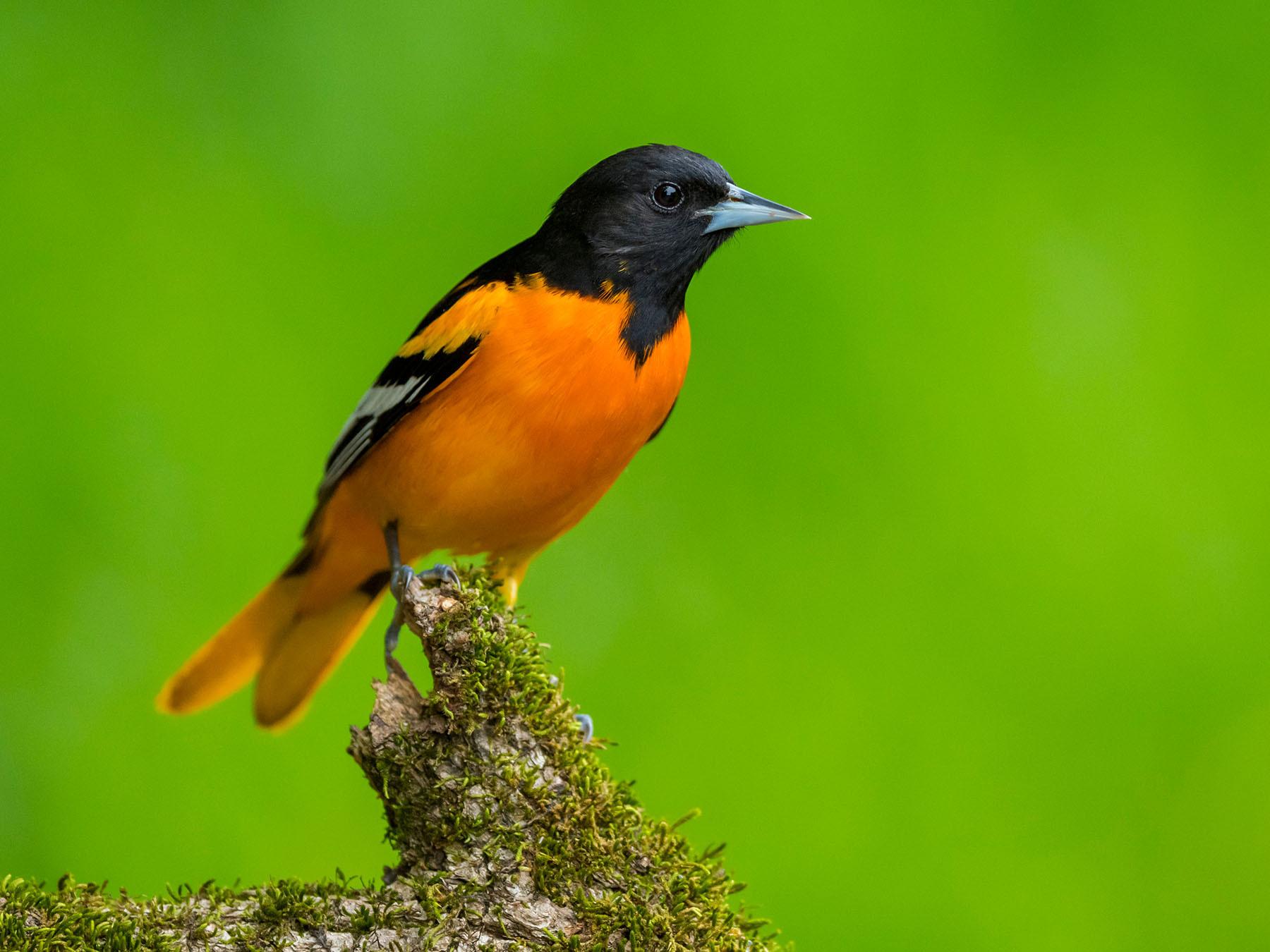
Quick facts
- Length
- 17–19 cm
- Wingspan
- 30–34 cm
- Weight
- 29–43 g
- Lifespan
- oldest recorded 8 years 11 months
- Family
- New World Blackbirds
- Migration
- Full migrant
- Global status (IUCN)
- Least Concern
- World population
- About 7.4 million (Partners in Flight, around 2010)
- Population trend
- Down 0.54% a year in Breeding Bird Survey counts since 1967, about 27% lower overall; no clear change over the last ten years
- Also called
- Northern Oriole (1973-1995, with the Baltimore Oriole)
- Scientific name
- Icterus bullockiorum
Questions
3Are Bullock's Orioles rare?
No. The bird is widespread and common in suitable habitat across the West, though counts have fallen over the long term, most clearly in California and Texas.
Is the Bullock's Oriole the same bird as the Baltimore Oriole?
Not any more. The two were treated as one species, the Northern Oriole, for a time, and they still hybridize on the Great Plains, but they differ in plumage, song, molt and migration, and are separate species.
How do I tell a female Bullock's from a female Hooded Oriole?
Look at the color and build. The Bullock's is yellowish or grayish yellow, and the Hooded is greenish, slimmer in body and bill, and a little smaller.
Sources
41- 1Flood, N. J. et al. (2026). Bullock's Oriole (Icterus bullockii), version 1.1. Birds of the World (P. G. Rodewald, editor). Cornell Lab of Ornithology. doi:10.2173/bow.bulori.01.1 (opens in a new tab)
- 2Richardson, D. S. and Burke, T. (1999). Extra-pair paternity in relation to male age in Bullock's orioles. Molecular Ecology 8(12): 2115-2126. doi:10.1046/j.1365-294x.1999.00832.x (opens in a new tab)
- 3National Audubon Society. Bullock's Oriole. Guide to North American Birds. Accessed 17 November 2026. Source (opens in a new tab)
- 4Phung, L.-N. and Toews, D. P. L. (2024). Comparative bioacoustics of multiple eastern versus western songbird pairs in North America reveals a gradient of song divergence. PLOS ONE 19(12): e0312706. doi:10.1371/journal.pone.0312706 (opens in a new tab)
- 5Rohwer, S. and Manning, J. (1990). Differences in timing and number of molts for Baltimore and Bullock's Orioles: implications to hybrid fitness and theories of delayed plumage maturation. The Condor 92(1): 125-140. doi:10.2307/1368391 (opens in a new tab)
- 6Pillar, A. G., Marra, P. P., Flood, N. J. and Reudink, M. W. (2016). Moult migration in Bullock's orioles (Icterus bullockii) confirmed by geolocators and stable isotope analysis. Journal of Ornithology 157(1): 265-275. doi:10.1007/s10336-015-1275-5 (opens in a new tab)
- 7Sparrow, K. L. et al. (2017). Conditions on the Mexican moulting grounds influence feather colour and carotenoids in Bullock's orioles (Icterus bullockii). Ecology and Evolution 7(8): 2643-2651. doi:10.1002/ece3.2836 (opens in a new tab)
- 8Beal, F. E. L. (1910). Birds of California in relation to the fruit industry, Part II: Bullock oriole. U.S. Department of Agriculture, Biological Survey Bulletin 34. Accessed 17 November 2026. Source (opens in a new tab)
- 9Howell, A. H. (1907). The relation of birds to the cotton boll weevil. U.S. Department of Agriculture, Biological Survey Bulletin 29. doi:10.5962/bhl.title.62941 (opens in a new tab)
- 10Kalmbach, E. R. (1914). Birds in relation to the alfalfa weevil. U.S. Department of Agriculture Bulletin 107. Accessed 17 November 2026. Source (opens in a new tab)
- 11Mangan, A. M., Pejchar, L. and Werner, S. J. (2017). Bird use of organic apple orchards: frugivory, pest control and implications for production. PLOS ONE 12(9): e0183405. doi:10.1371/journal.pone.0183405 (opens in a new tab)
- 12Bent, A. C. (1958). Life Histories of North American Blackbirds, Orioles, Tanagers, and Allies: Bullock's Oriole. U.S. National Museum Bulletin 211. Accessed 17 November 2026. Source (opens in a new tab)
- 13Cornell Lab of Ornithology. Bullock's Oriole. All About Birds. Accessed 17 November 2026. Source (opens in a new tab)
- 14Friedmann, H. (1963). Host relations of the parasitic cowbirds. U.S. National Museum Bulletin 233. doi:10.5479/si.03629236.233 (opens in a new tab)
- 15USGS Bird Banding Laboratory. Longevity records of North American birds: Bullock's Oriole (AOU 5080). Bird Banding Laboratory, Bander Portal longevity tables. Accessed 17 November 2026. Source (opens in a new tab)
- 16BirdLife International (2025). Icterus bullockiorum. The IUCN Red List of Threatened Species 2025: e.T22729123A136762026. doi:10.2305/IUCN.UK.2025-2.RLTS.T22729123A136762026.en (opens in a new tab)
- 17NatureServe. Icterus bullockiorum: Bullock's Oriole. NatureServe Explorer. Accessed 17 November 2026. Source (opens in a new tab)
- 18Partners in Flight (2024). Avian Conservation Assessment Database, version 2024.05.23 (global). Partners in Flight. Accessed 17 November 2026. Source (opens in a new tab)
- 19Environment and Climate Change Canada and Birds Canada (2024). The State of Canada's Birds: Bullock's Oriole. NatureCounts. doi:10.71842/qaj1-wh67 (opens in a new tab)
- 20Hostetler, J. A. et al. (2026). The North American Breeding Bird Survey, Analysis Results 1966-2025. U.S. Geological Survey data release. doi:10.5066/P1OSNSFC (opens in a new tab)
- 21U.S. Fish and Wildlife Service (2026). 50 CFR 10.13: List of Birds Protected by the Migratory Bird Treaty Act. Electronic Code of Federal Regulations. Accessed 17 November 2026. Source (opens in a new tab)
- 22U.S. Fish and Wildlife Service (2026). 50 CFR 21.10: General permit requirements. Electronic Code of Federal Regulations. Accessed 17 November 2026. Source (opens in a new tab)
- 23U.S. Fish and Wildlife Service (2026). 50 CFR 21.76: Rehabilitation permits. Electronic Code of Federal Regulations. Accessed 17 November 2026. Source (opens in a new tab)
- 24U.S. Fish and Wildlife Service. Environmental Conservation Online System: Bullock's Oriole (species 9458). ECOS. Accessed 17 November 2026. Source (opens in a new tab)
- 25Environment and Climate Change Canada. Birds protected in Canada under the Migratory Birds Convention Act, 1994. Government of Canada. Accessed 17 November 2026. Source (opens in a new tab)
- 26Secretaria de Medio Ambiente y Recursos Naturales (2010). NOM-059-SEMARNAT-2010: Proteccion ambiental, especies nativas de Mexico de flora y fauna silvestres, categorias de riesgo. Diario Oficial de la Federacion, 30 December 2010. Accessed 17 November 2026. Source (opens in a new tab)
- 27Chesser, R. T. (2013). On the correct name of Icterus bullockii (Passeriformes: Icteridae). Zootaxa 3718(3): 295-296. doi:10.11646/zootaxa.3718.3.6 (opens in a new tab)
- 28Swainson, W. (1827). A synopsis of the birds discovered in Mexico by W. Bullock, F.L.S. and H.S., and Mr. William Bullock, jun.. The Philosophical Magazine, new series 1: 433-442. Accessed 17 November 2026. Source (opens in a new tab)
- 29Chesser, R. T. (2015). A further note on the scientific name of Bullocks' Oriole. Zootaxa 3956(3): 444. doi:10.11646/zootaxa.3956.3.9 (opens in a new tab)
- 30AviList Core Team (2026). AviList: The Global Avian Checklist, v2025b. AviList. doi:10.2173/avilist.v2025b (opens in a new tab)
- 31American Ornithological Society (2026). Check-list of North and Middle American Birds: Icterus bullockii. AOS Check-list (through the 67th supplement). Accessed 17 November 2026. Source (opens in a new tab)
- 32American Ornithologists' Union (1973). Thirty-second supplement to the American Ornithologists' Union Check-list of North American Birds. The Auk 90(2): 411-419. Accessed 17 November 2026. Source (opens in a new tab)
- 33American Ornithologists' Union (1995). Fortieth supplement to the American Ornithologists' Union Check-list of North American Birds. The Auk 112(3): 819-830. Accessed 17 November 2026. Source (opens in a new tab)
- 34Rising, J. D. (1983). The progress of oriole hybridization in Kansas. The Auk 100(4): 885-897. doi:10.1093/auk/100.4.885 (opens in a new tab)
- 35Carling, M. D., Serene, L. G. and Lovette, I. J. (2011). Using historical DNA to characterize hybridization between Baltimore Orioles (Icterus galbula) and Bullock's Orioles (I. bullockii). The Auk 128(1): 61-68. doi:10.1525/auk.2010.10164 (opens in a new tab)
- 36Walsh, J. et al. (2020). Genomic and plumage variation across the controversial Baltimore and Bullock's oriole hybrid zone. The Auk 137(4): ukaa044. doi:10.1093/auk/ukaa044 (opens in a new tab)
- 37Walsh, J. et al. (2023). A complex genomic architecture underlies reproductive isolation in a North American oriole hybrid zone. Communications Biology 6: 154. doi:10.1038/s42003-023-04532-8 (opens in a new tab)
- 38Goch, L. P. et al. (2026). Evidence of putative mitonuclear incompatibilities in the Bullock's and Baltimore oriole hybrid zone. Molecular Ecology 35(21): e70654. doi:10.1111/mec.70654 (opens in a new tab)
- 39Rohwer, V. G., Callan, L. M., Kinsella, J. M. and Ligon, R. A. (2022). No evidence that endohelminth parasites cause selection against hybrid orioles across the Baltimore-Bullock's Oriole hybrid zone. Ornithology 139(4): ukac044. doi:10.1093/ornithology/ukac044 (opens in a new tab)
- 40Suh, Y. H., Ligon, R. A. and Rohwer, V. G. (2022). Revisiting the Baltimore-Bullock's Oriole hybrid zone reveals changing plumage colour in Bullock's Orioles. Royal Society Open Science 9(12): 221211. doi:10.1098/rsos.221211 (opens in a new tab)
- 41Jacobsen, F. and Omland, K. E. (2012). Extensive introgressive hybridization within the northern oriole group (genus Icterus) revealed by three-species isolation with migration analysis. Ecology and Evolution 2(10): 2413-2429. doi:10.1002/ece3.365 (opens in a new tab)

Checked by
Nathan Cope, founder and editor
Nathan founded Birdfact and leads its writers and contributors in the UK, the US and Canada. He has watched and studied birds for more than ten years, and checks every article and species guide before it’s published.