


Northern Nutcracker
Nutcracker, Spotted Nutcracker, Eurasian Nutcracker · Nucifraga caryocatactes
By the Birdfact teamChecked by Nathan Cope
On this page14 sections
How to recognise it
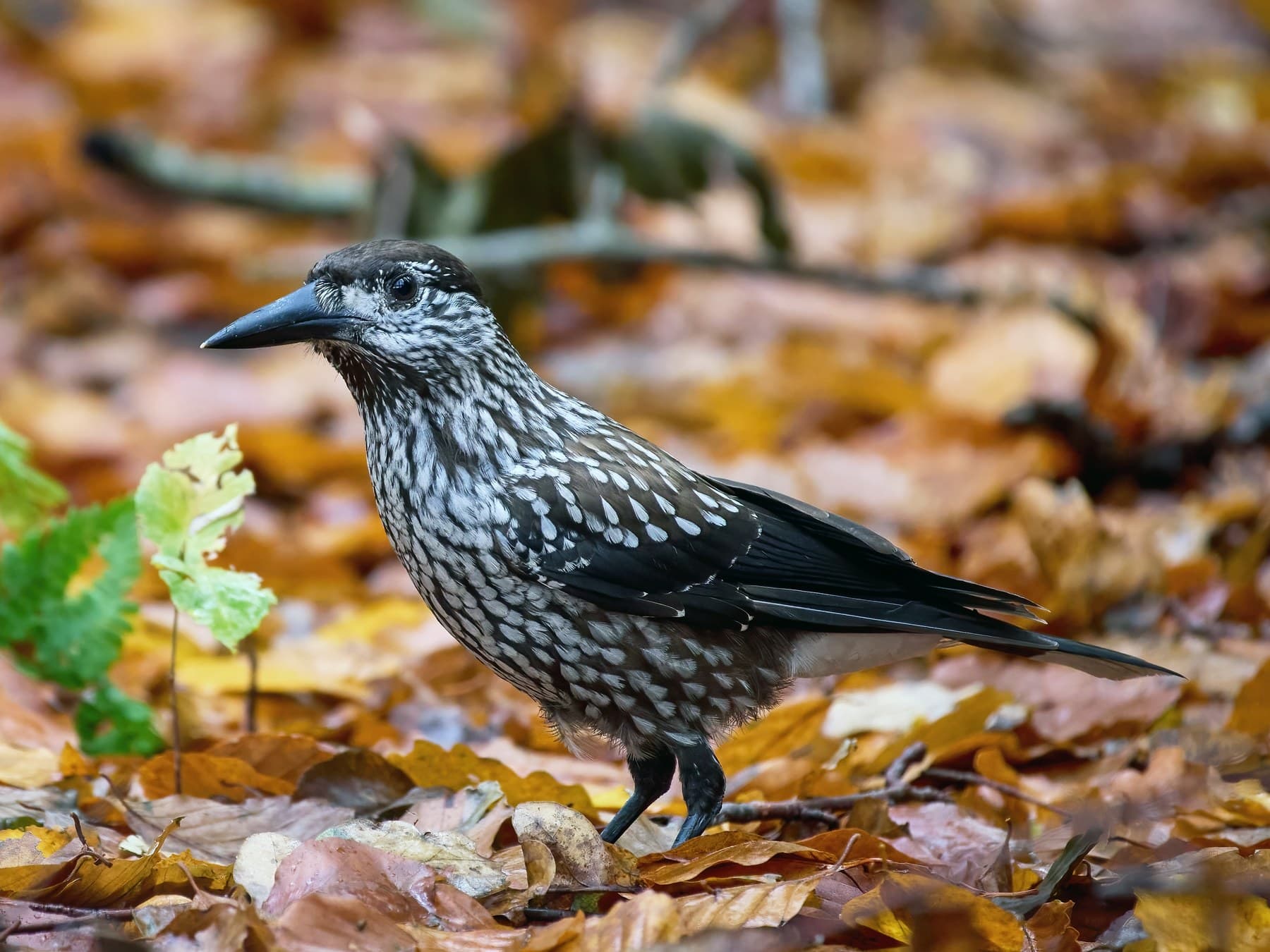
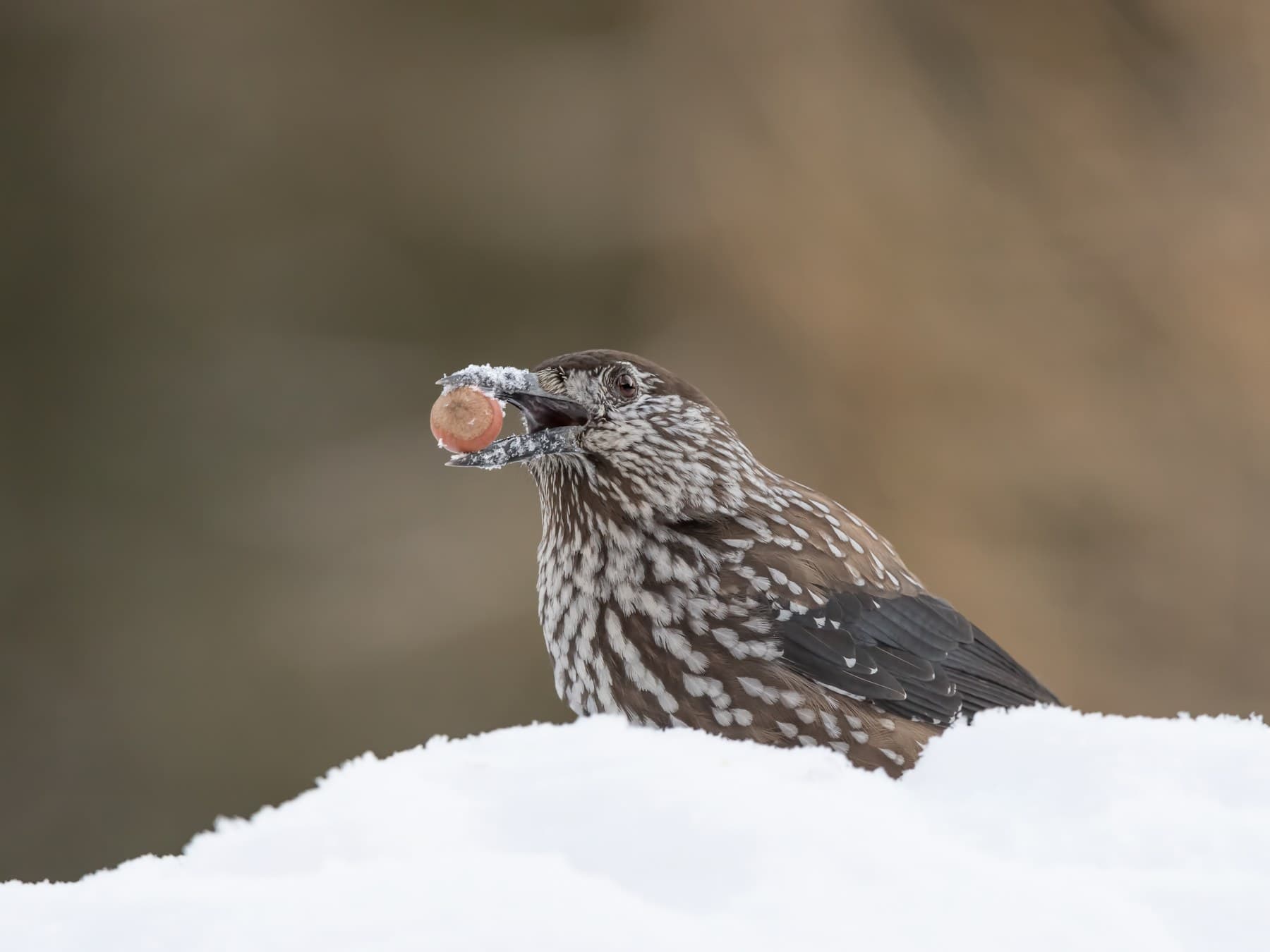
The Northern Nutcracker, often just called the Nutcracker and also known as the Spotted Nutcracker, is a crow-family bird of the northern forests. It is about the size of a Jay, but its tail is shorter and its bill longer.1 At a distance it can look plain and dark; closer, the body is dark chocolate-brown, heavily spotted and streaked with white, most densely on the face.
Three things clinch it. The cap is plain and dark, the bill is long, dark and pointed, and the feathers under the tail are white, with white tips to the dark tail that are widest on the outer feathers. The wings are glossy blackish. Males and females look alike.1, 2 Young birds are paler and duller, with the spots less sharp.
Size and shape in flight
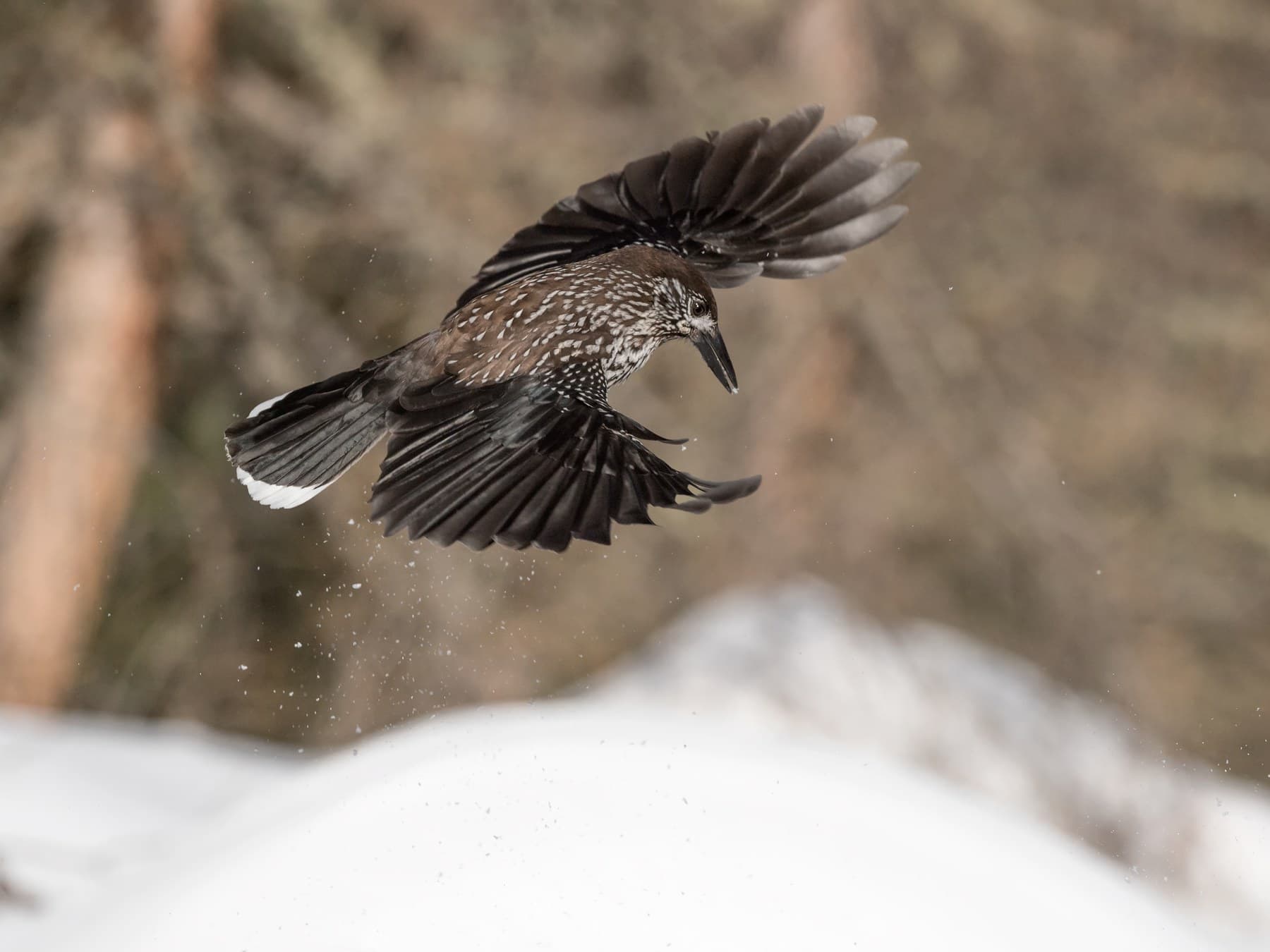
A Nutcracker is 30-34 cm long, with a wingspan of 52-58 cm, and weighs 124-220 g.1 In the air it looks broad-winged, short-tailed and heavy at the front. As it flies away, look for the dark rump: a Jay shows a white one. From below, the white under the tail, the white tail corners and white tips across the dark underwing stand out.
Identification: the Slender-billed form
Four forms of the Nutcracker are recognised. The ones that reach Britain come from Siberia, the form known as the Slender-billed Nutcracker (macrorhynchos). It has the longest, slimmest bill of all, a broader white band at the tip of the tail and slightly shorter legs than the Thick-billed Nutcrackers of Europe, though the tail band overlaps between the two.1 Of the British birds in 1968, every one found dead and eight of the nine examined in the hand were Slender-billed.3
Two birds of Asia were once treated as the same species: the Southern Nutcracker, which has far fewer white spots, and the Kashmir Nutcracker, which has so many large spots that it looks mostly white. A study of their whole genomes found three clearly separate lineages.1 The genus has a fourth species, the Clark's Nutcracker of North America.
Identification: similar birds
Jay. A similar size, but pinkish-brown with a blue patch on the wing, and a white rump in flight.4 A Nutcracker is dark brown and spotted all over, with a dark rump and white tips to the tail.
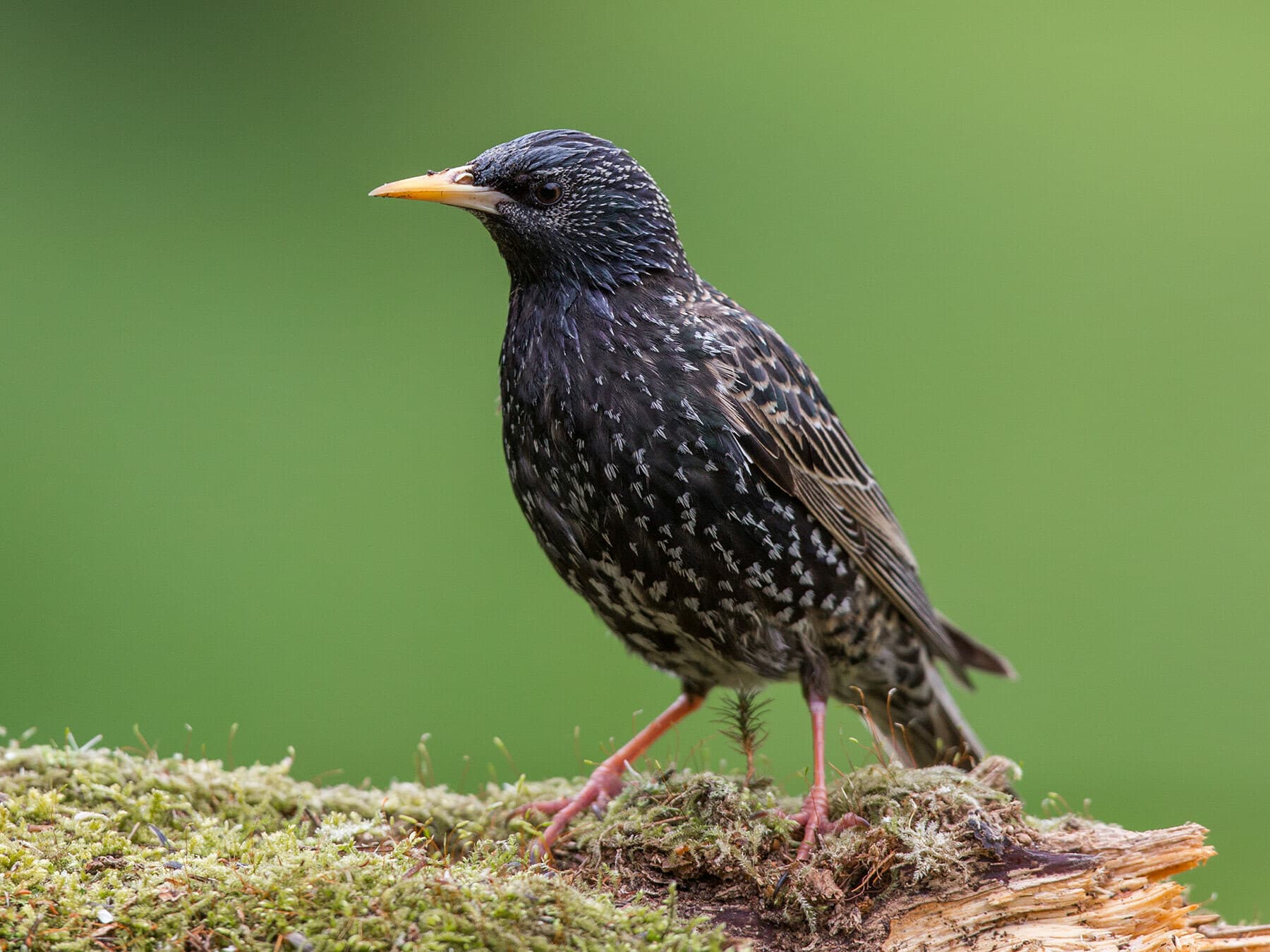
Starling. In winter a Starling is also covered in pale spots, but it is much smaller, at about 21 cm, with a short tail and a pointed head.5 A Nutcracker is Jay-sized, with a long dark bill and white under the tail.
Not sure it’s a Northern Nutcracker? Check your photo: Birdfact names the bird and shows the look-alike side by side.
Its size
Adults- Length
- 30–34 cm
- Wingspan
- 52–58 cm
- Weight
- 124–220 g
Its song and calls
The call most often heard is a loud, harsh, grating "kraak", given singly or in short series, often from the top of a conifer; it can carry up to 1 km. Alarmed birds give a long, rattling churr, and family parties keep in touch with a quiet, descending, nasal mew.1 The song is rarely heard: a quiet, rambling run of piping, rattling and mewing notes, with some mimicry, given by males early in the breeding season and heard only at close range.
Vagrants are often silent. Of the hundreds of Nutcrackers seen in Britain in 1968, only 9 were reported calling, and many of the tamest birds made no sound at all.3 The recordings on this page were made in the Chelyabinsk region and Bashkortostan, in Russia.
- Calls0:00 / 0:20
Recorded in Chelyabinsk Oblast, Russia · February 2024
- Calls from a small flock0:00 / 0:13
Recorded in Bashkortostan, Russia · January 2021
Heard one and not sure? Let the bird song identifier listen.
When and where to see it
Nutcrackers live in conifer forests across Europe and northern Asia, from Scandinavia across the Siberian taiga to Kamchatka and Japan, from the lowlands up to the tree line. In continental Europe they are mostly mountain birds, up to about 2,300 m in the Alps, in forests of Norway spruce and Arolla pine, and of other conifers where hazel grows; in Siberia they favour Siberian pine.1
Most Nutcrackers are resident. In a study in Sweden, pairs kept the same territory for life, using it all year to store food.1
Irruptions and migration
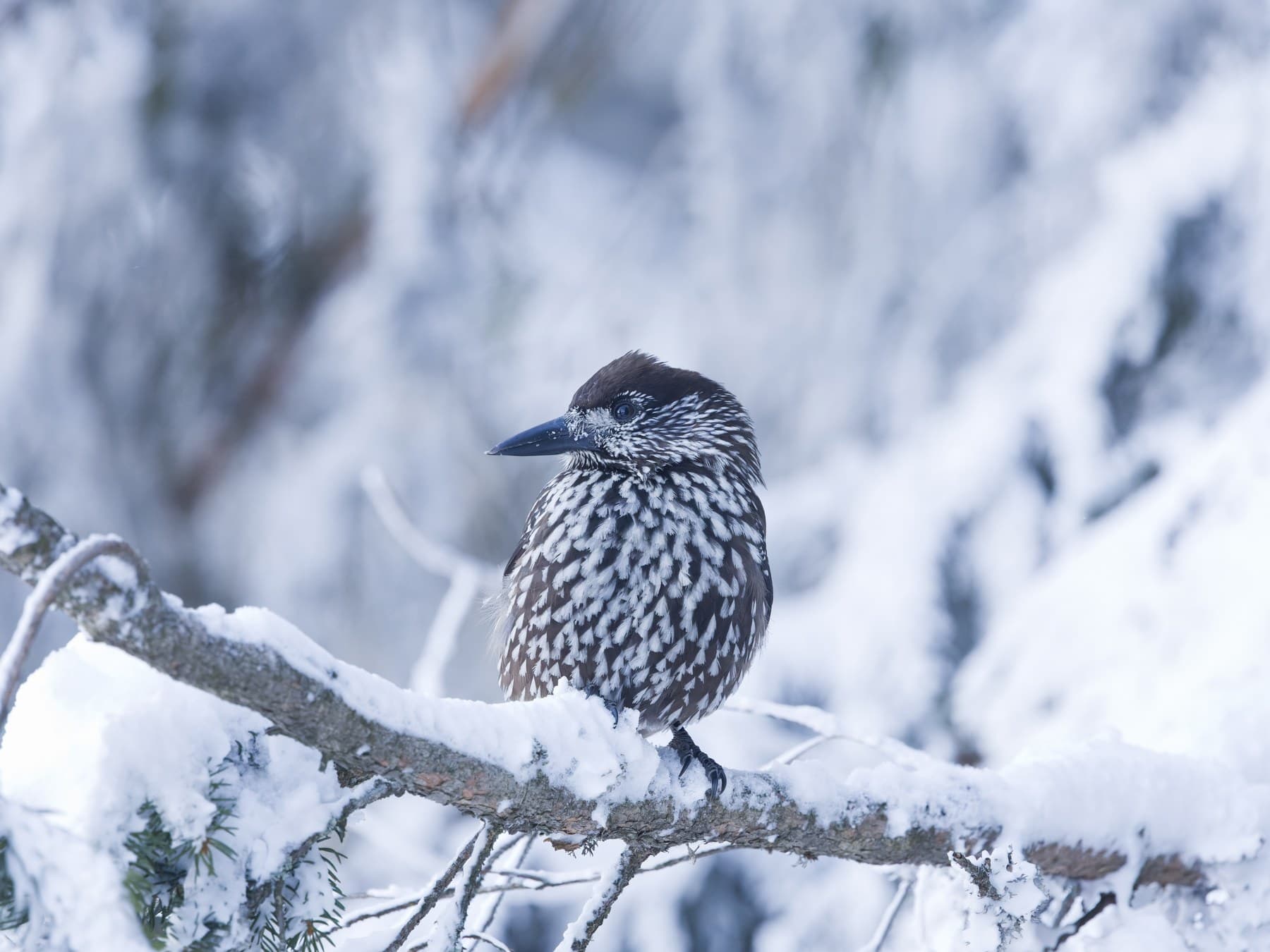
Nutcrackers are not true migrants, but every so often the Siberian birds pour west. A run of good pine seed crops lets their numbers grow; when a poor crop follows, large numbers leave in search of food. There have been about 25 such irruptions into Europe since the first was reported in 1753. They travel by day, often along coasts, and hungry birds can be remarkably tame.1
The biggest on record came in 1968. That summer, 10,800 passed through north-east Germany in early August, about 800 were recorded in Belgium and some 6,000 records came from the Netherlands; one was caught in Portugal and another reached North Africa.1, 3 About 315 were reported in Britain, about five times as many as in all the years before; the first two, on 6 August, were at Trunch and Ditchingham in Norfolk.3 Norfolk alone had at least 104, against 8 county records before 1968.6
When to see one in Britain
Rarely. The Nutcracker is a very rare vagrant to the UK, with no regular season.7 The first British record was a bird shot at Mostyn, Flintshire, in October 1753.8 Since 1968 there have been only a handful: the last bird that stayed long enough for many people to see was in 1991, one at Kingsdown, Kent, on 6-7 September 1998 was seen by a few quick birders, and one in Caithness in November 2021 was seen by a single observer.7, 9
In autumn 2026 another irruption reached western Scandinavia, and on 23 October one was found in a garden at Mundesley, Norfolk. It was seen there daily until 28 October, and one flew south-west over Hempstead on 29 October.9, 10 It was Norfolk's first since a one-day bird at Itteringham on 23 September 1979.11 More: Nutcracker in Norfolk: the 2026 Mundesley bird.
Tips for seeing it
What it eats
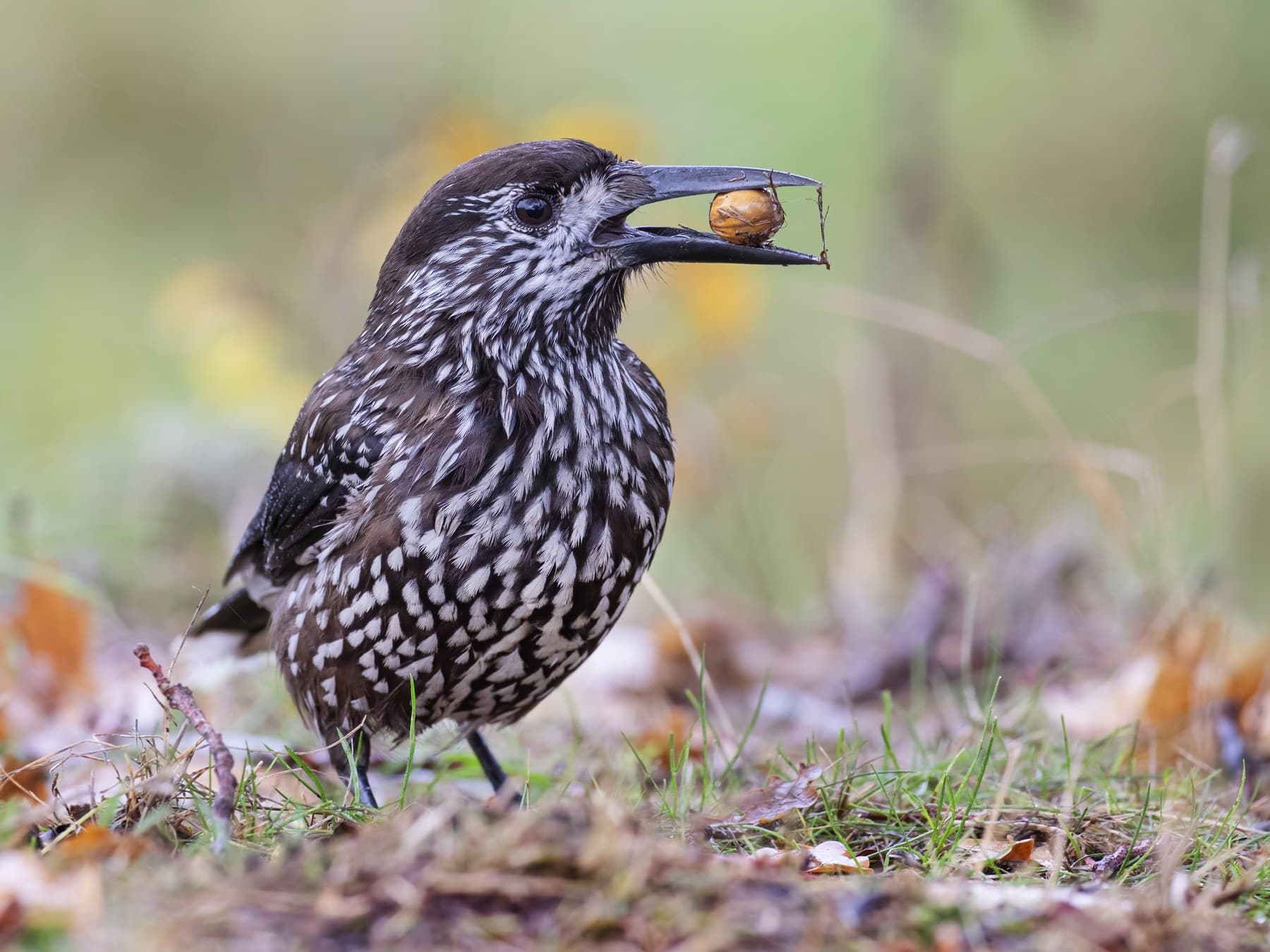
Nutcrackers live mainly on pine seeds all year, above all those of Arolla pine and Siberian pine, and on hazelnuts. Siberian pine seeds are rich food, with more energy for their weight than Scots pine or larch seeds. A hard, nail-like tip to the tongue helps the bird lever seeds out of their shells, and it holds a cone or nut under one foot to hammer it. It also takes insects and their larvae, spiders, earthworms, small rodents and sometimes small birds, which it catches by surprise.1
Vagrants have to make do. In 1968 British birds dug for grubs in the ground and along roadside verges, opened wasp and ant nests, ate blackberries, acorns and elderberries, took peanuts and nuts from bird tables and ate bread and household fat, and ate mice and rats; some caught live rodents, wedging them in a fork of a tree and hammering them like a woodpecker. Some arrived weak, and many probably died for want of suitable food.3
Storing food for winter
In autumn Nutcrackers gather seeds and nuts and hide them, a few at a time, in the ground, under moss and lichen and in crevices, then live on them through the winter and feed their young on them in spring. In Sweden, birds were watched digging their stores out from under as much as 45 cm of snow, and of 351 holes they dug through the snow, 86% had seed husks beside them.12, 13 Experiments there suggested smell plays no part, and most researchers think they remember where each store is.
A Nutcracker stores far more than it needs. Even if it recovers only a quarter of its stores, it must still find more than a thousand in a year. Studies have found rodents raiding many of the rest.12
Nesting and breeding
Nutcrackers nest very early, in March and April, often with snow still on the ground, living on the seeds they stored the autumn before. Both birds build a nest of twigs with a deep, well-insulated cup, usually about 6 m up and close to the trunk of a conifer.1, 14 The female lays 2-5 eggs, usually 3 or 4, pale blue to greenish-blue with fine olive-brown and grey speckles.
She does most of the incubating, and all of it at night, for 17.5-18.5 days. Both parents feed the young, which leave the nest at 23-28 days and stay with their parents for up to 119 days after that. Pairs usually raise one brood a year.1
Behaviour
On the ground a Nutcracker hops, with sideways jumps and bounds. It drops from a perch to the ground like a shrike and clings to trunks to dig in the bark like a woodpecker, and it has been seen hovering to pick hazelnuts. Its flight is like a Jay's, but steadier.1
Nutcrackers are usually seen alone or in pairs, gathering in small groups in autumn while they collect seeds. Away from home they can be extraordinarily tame: in 1968, 48 of the British birds let people come within 2 m.3
Lifespan and predators
Conservation
The Nutcracker is of Least Concern worldwide. BirdLife International gives a very preliminary estimate of 2.98-6.1 million adult birds, with 298,000-608,000 pairs in Europe, where numbers have been stable; it suspects a decline worldwide as forests are lost.14 In the UK it is a vagrant, too rare for its numbers to be monitored.7
Similar birds
Often mistaken for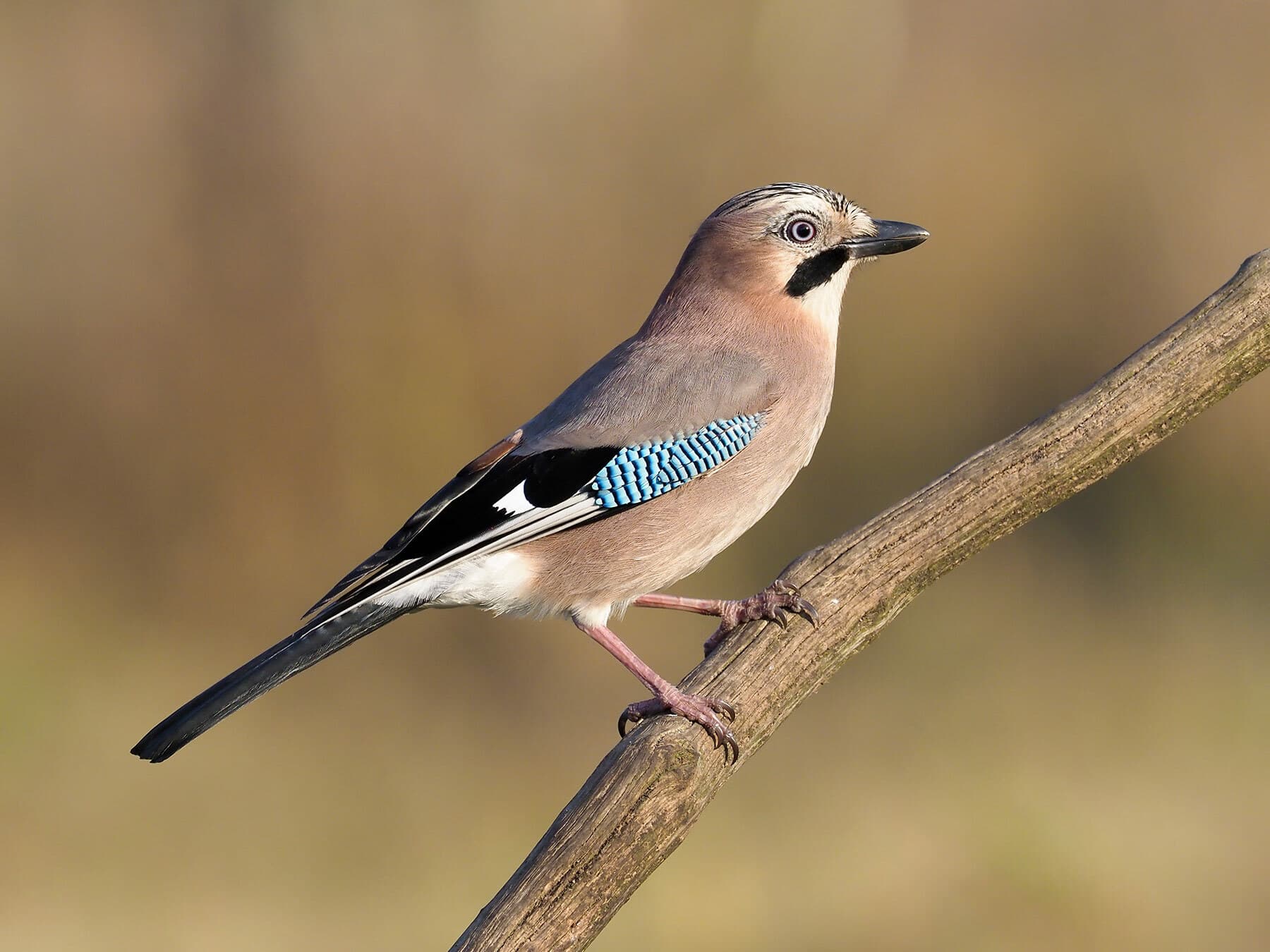
Northern Nutcracker guides
1 guidesQuick facts
- Length
- 30–34 cm
- Wingspan
- 52–58 cm
- Weight
- 124–220 g
- Lifespan
- oldest recorded 22.5 years
- Family
- Crows & Jays
- World population
- 2,980,000 - 6,100,000 mature individuals (BirdLife 2024, very preliminary)
- Population trend
- Europe stable; worldwide decline suspected from forest loss (BirdLife 2024)
- Also called
- Nutcracker, Spotted Nutcracker, Eurasian Nutcracker
- Scientific name
- Nucifraga caryocatactes
Questions
3Are Nutcrackers rare in the UK?
Why do Nutcrackers come to Britain?
Almost always when Siberian Nutcrackers irrupt west after a poor pine seed crop. Most stop on the Continent, where many die; a few cross the North Sea. In 1968 most made landfall on England's east coast, from Kent to the Wash.
Is the Nutcracker related to the Jay?
Both belong to the crow family, and the two are a similar size. Some studies suggest the nutcrackers may be closer to the crows than to the Jay.1
Sources
15- 1Kirwan, G. M. et al. (2024). Northern Nutcracker (Nucifraga caryocatactes), version 1.0. Birds of the World (G. M. Kirwan, B. K. Keeney and M. G. Smith, editors). Cornell Lab of Ornithology. doi:10.2173/bow.eurnut3.01 (opens in a new tab)
- 2RSPB (2026). Influx of Nutcrackers a sweet treat for UK birdwatchers. Accessed 30 October 2026. Source (opens in a new tab)
- 3Hollyer, J. N. (1970). The invasion of Nutcrackers in autumn 1968. British Birds 63(9): 353-373. Accessed 30 October 2026. Source (opens in a new tab)
- 4RSPB. Jay. Accessed 30 October 2026. Source (opens in a new tab)
- 5RSPB. Starling. Accessed 6 October 2026. Source (opens in a new tab)
- 6Seago, M. J. (editor) (1983). Norfolk Bird Report 1982. Transactions of the Norfolk & Norwich Naturalists' Society 26(4). Accessed 30 October 2026. Source (opens in a new tab)
- 7BTO. Nutcracker (Nucifraga caryocatactes). BTO BirdFacts. Accessed 30 October 2026. Source (opens in a new tab)
- 8Historical Rare Birds. Northern Nutcracker (records to 1957). Accessed 30 October 2026. Source (opens in a new tab)
- 9BirdGuides (2026). Nutcracker arrives in Norfolk sparking huge twitch. Accessed 30 October 2026. Source (opens in a new tab)
- 10Birds of Norfolk (2026). Norfolk birding news, October 2026. Accessed 30 October 2026. Source (opens in a new tab)
- 11Norfolk & Norwich Naturalists' Society (1981). Norfolk Bird Report 1980. Transactions of the Norfolk & Norwich Naturalists' Society 25(5). Accessed 30 October 2026. Source (opens in a new tab)
- 12Tomback, D. F. (1980). How nutcrackers find their seed stores. The Condor 82: 10-19. doi:10.2307/1367279 (opens in a new tab)
- 13Swanberg, P. O. (1951). Food storage, territory and song in the Thick-billed Nutcracker. Proceedings of the Xth International Ornithological Congress, Uppsala 1950. Accessed 30 October 2026.
- 14BirdLife International (2024). Species factsheet: Northern Nutcracker Nucifraga caryocatactes. BirdLife DataZone. Accessed 30 October 2026. Source (opens in a new tab)
- 15Fransson, T., Kolehmainen, T., Moss, D. and Robinson, R. (2023). EURING list of longevity records for European birds. Accessed 30 October 2026. Source (opens in a new tab)

Checked by
Nathan Cope, founder and editor
Nathan founded Birdfact and leads its writers and contributors in the UK, the US and Canada. He has watched and studied birds for more than ten years, and checks every article and species guide before it’s published.