


Common Murre
Common Guillemot, Guillemot · Uria aalge
By the Birdfact teamChecked by Nathan Cope
On this page13 sections
How to recognise it
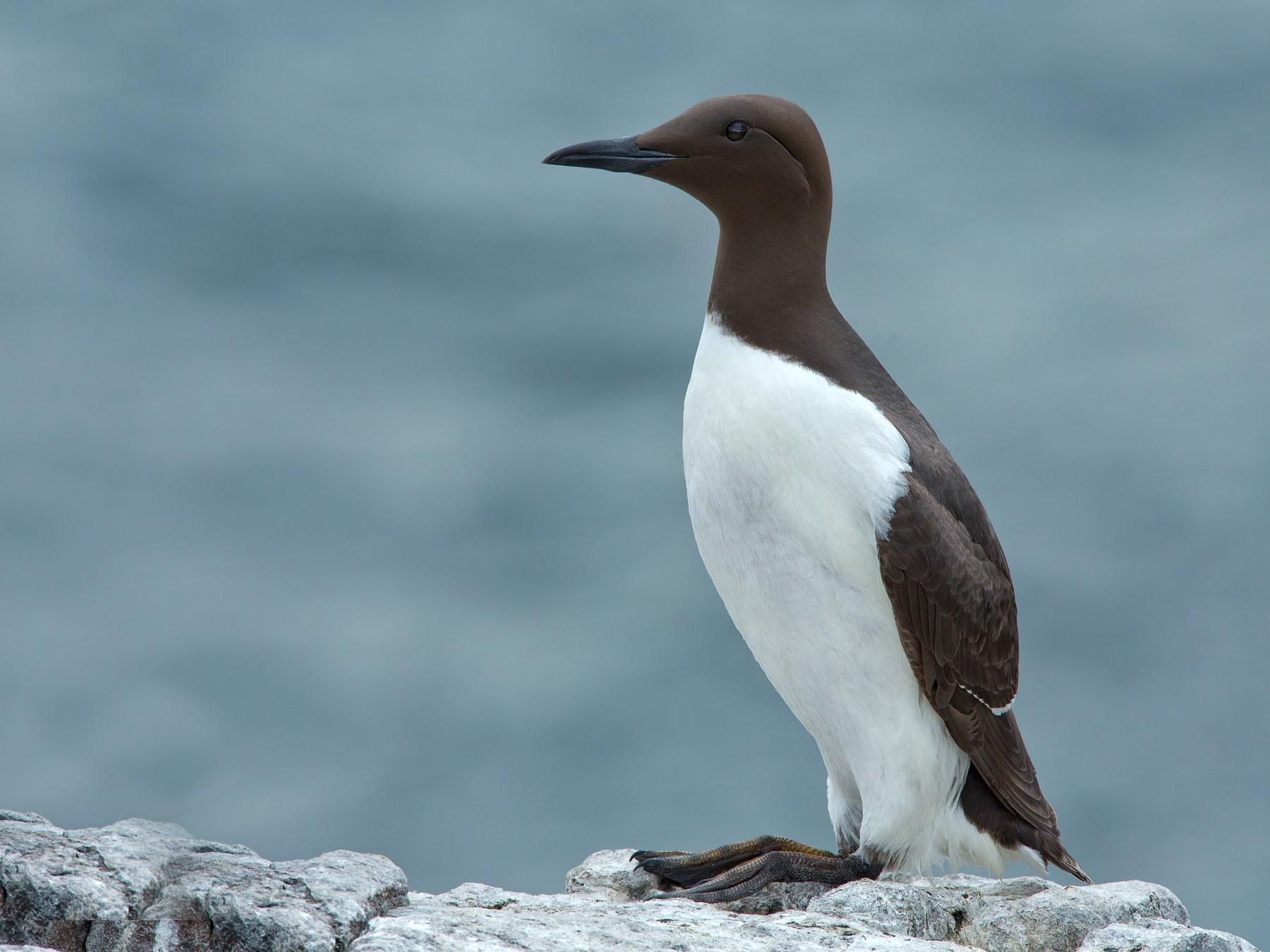
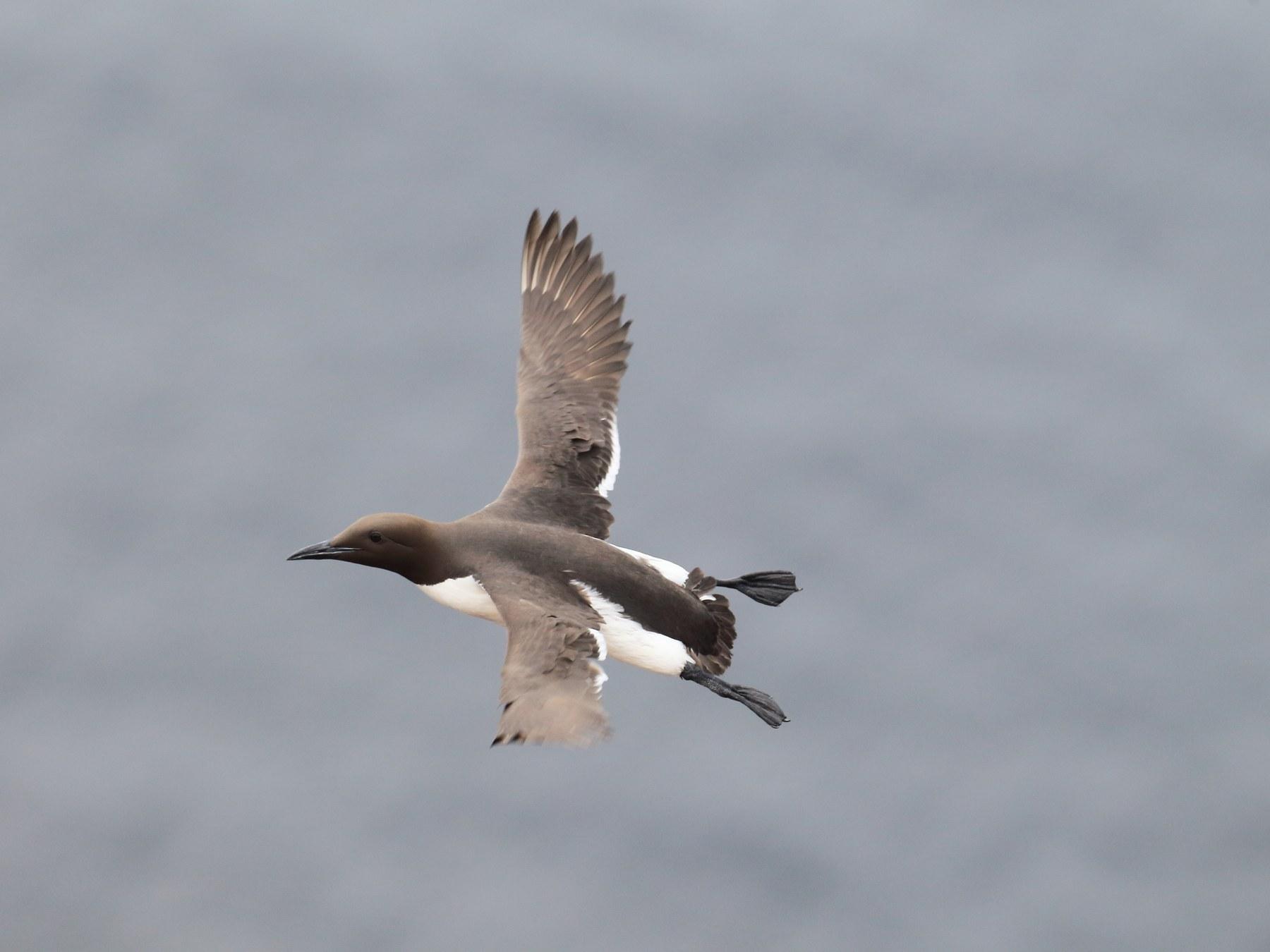
Look for a heavy-bodied seabird shaped like a small, short-necked loon, with a long, pointed black bill, a short tail and narrow, pointed wings.
In breeding plumage the head, neck and upperparts are dark chocolate brown, which can look black at a distance. The underparts are white, with brown streaks along the flanks, and the dark throat meets the white breast in a straight or rounded line. A thin white trailing edge shows on the closed wing.
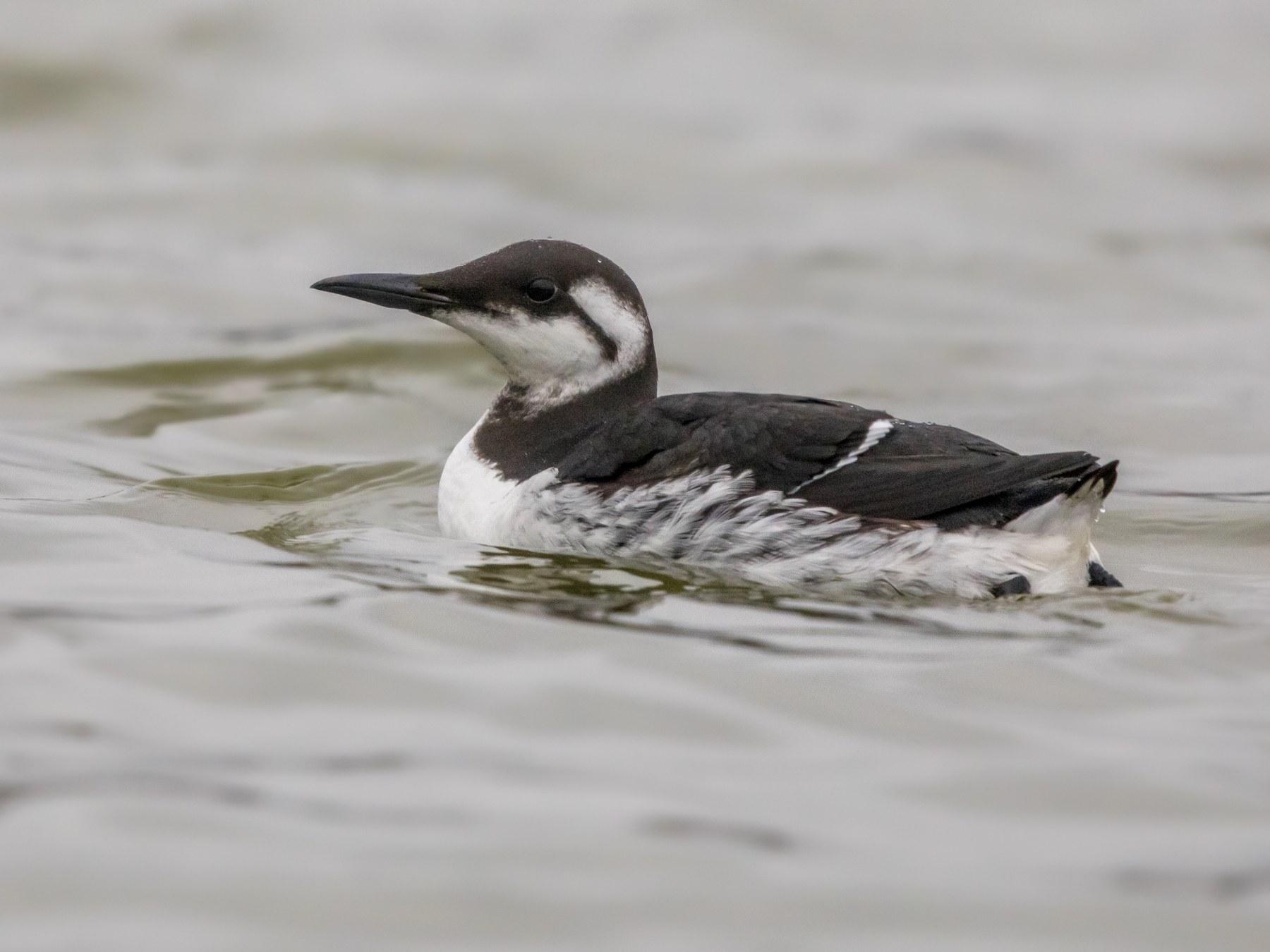
In winter plumage the chin, throat, cheeks and front of the neck turn white, and a thin dark line runs back from the eye across the white cheek. The crown, hindneck and back stay plain dark brown, with a partial dark collar at the base of the white neck.
AviList recognizes five subspecies.1 The two Pacific forms are larger than the Atlantic subspecies aalge, especially in wing length, and in Britain and Ireland the southern subspecies albionis is smaller and browner-backed than aalge, with fainter streaks on the sides.
Identification: the bridled form
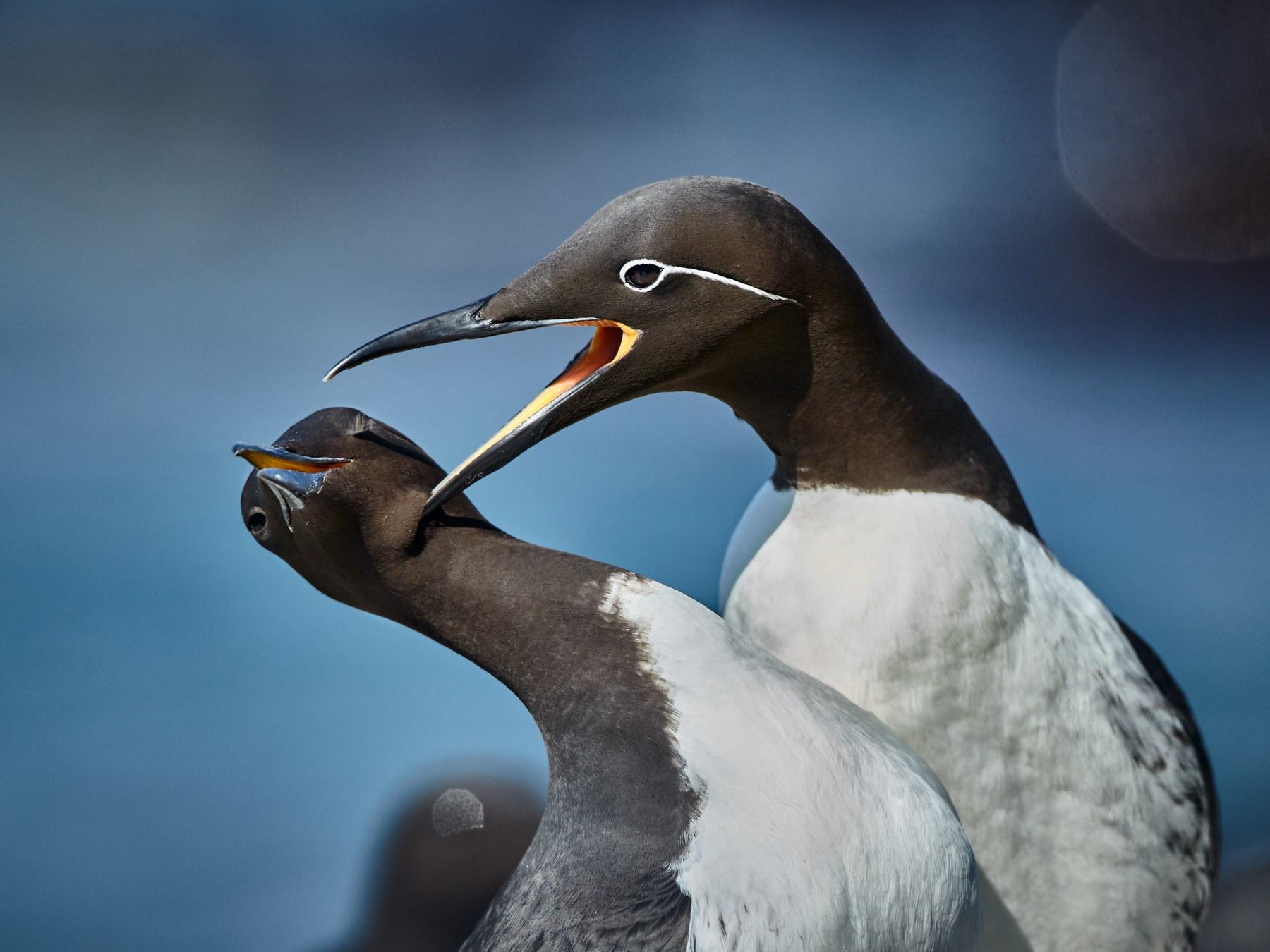
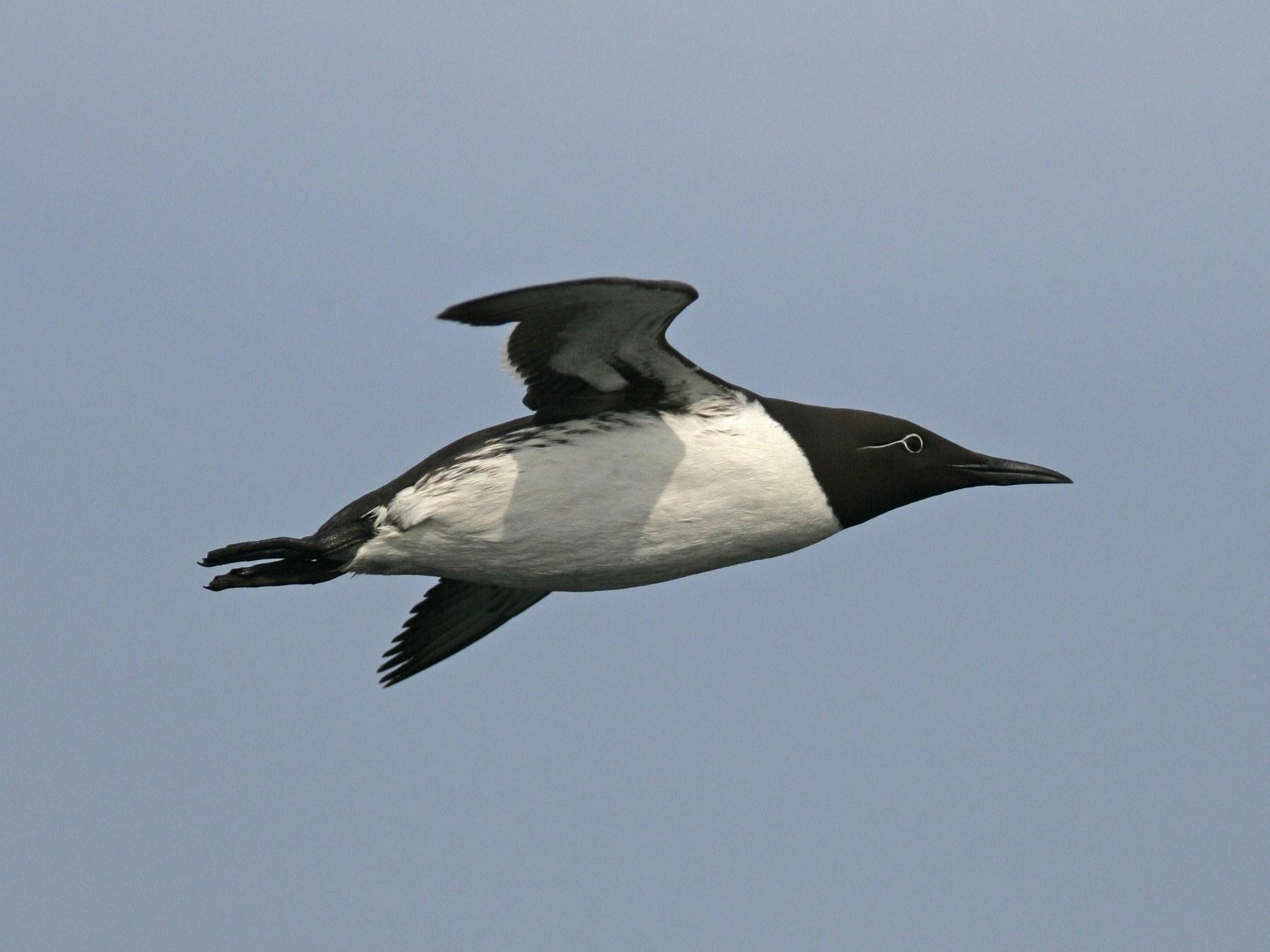
Some Atlantic birds are “bridled”, with a neat white eye-ring and a thin white line running back from the eye along a groove in the feathers. This is a color form, or morph, of the adult, most obvious in breeding plumage; otherwise bridled birds look like any other.
Bridled birds get commoner farther north. In surveys in the late 1970s and early 1980s they made up 0-2% of birds from France to Portugal, 1-30% at British colonies and 36-50% from western Russia to Svalbard. Only one has been recorded in the Pacific, on the Farallon Islands, California. The pattern suggests bridled birds may tolerate cold better.2 On the Isle of May, Scotland, their share rose from 3.5% in 1946 to 5.9% in 2000, close to the 5.04% counted there in 1936.3
Size
The Common Murre is about 15-17 in (38-43 cm) long, with a wingspan of about 25-28 in (64-71 cm), and weighs about 28-40 oz (800-1,125 g). That makes it one of the largest living auks, though its close relative the Thick-billed Murre is larger still. Live adults weighed in Britain and Ireland averaged about 31 oz (891 g) across 994 birds.4
Male, female and young
Males and females look alike in every plumage. Males average slightly larger in bill and leg measurements, and females are perhaps slightly longer in the wing.
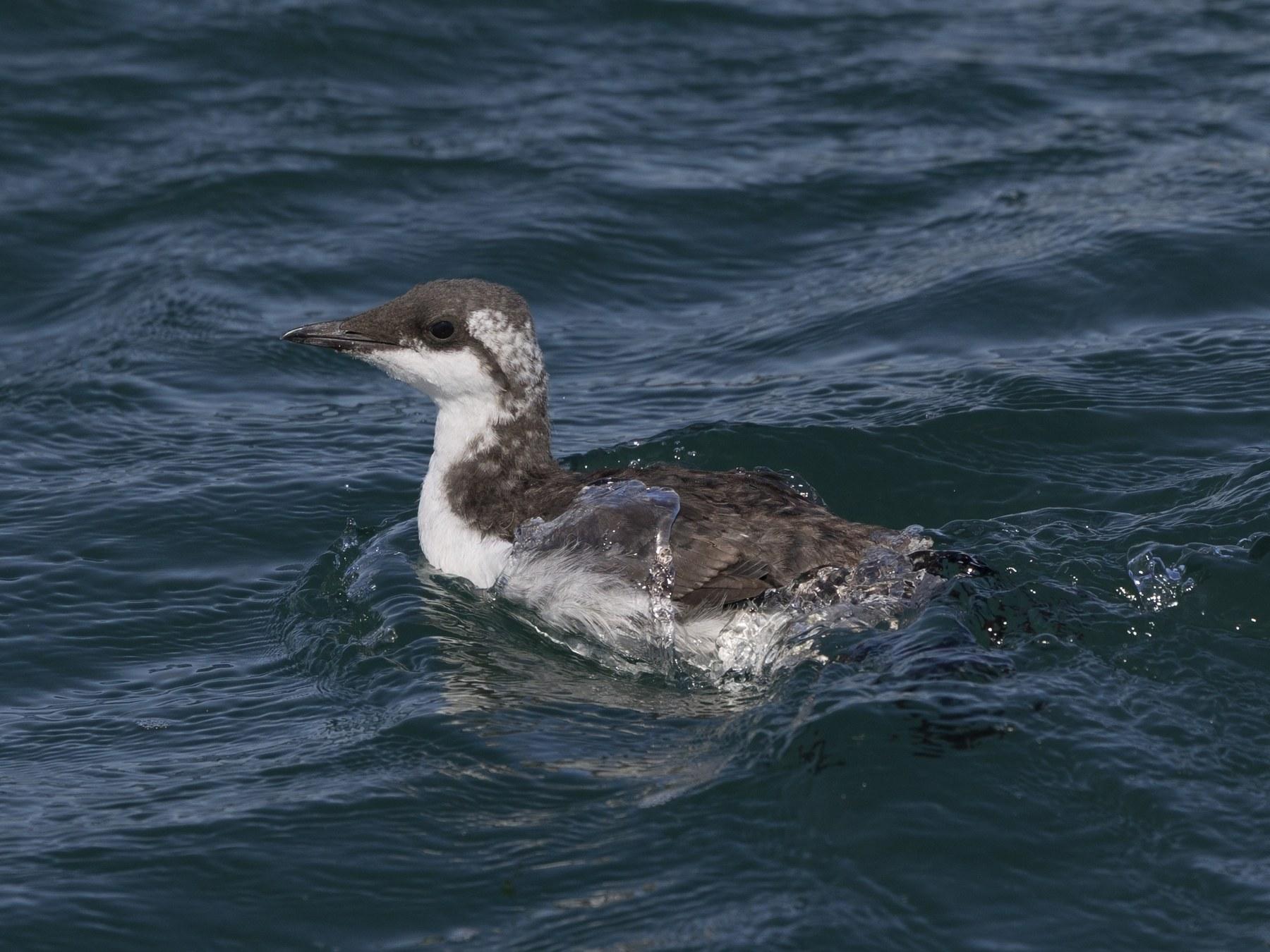
Juveniles, seen mainly from July to September, look like small winter adults, with loose, fluffy feathering. The chin, throat and cheeks are white, the white streak behind the eye may or may not show, and a faint gray collar on the lower neck varies from bird to bird. In late summer they swim at sea beside a male.
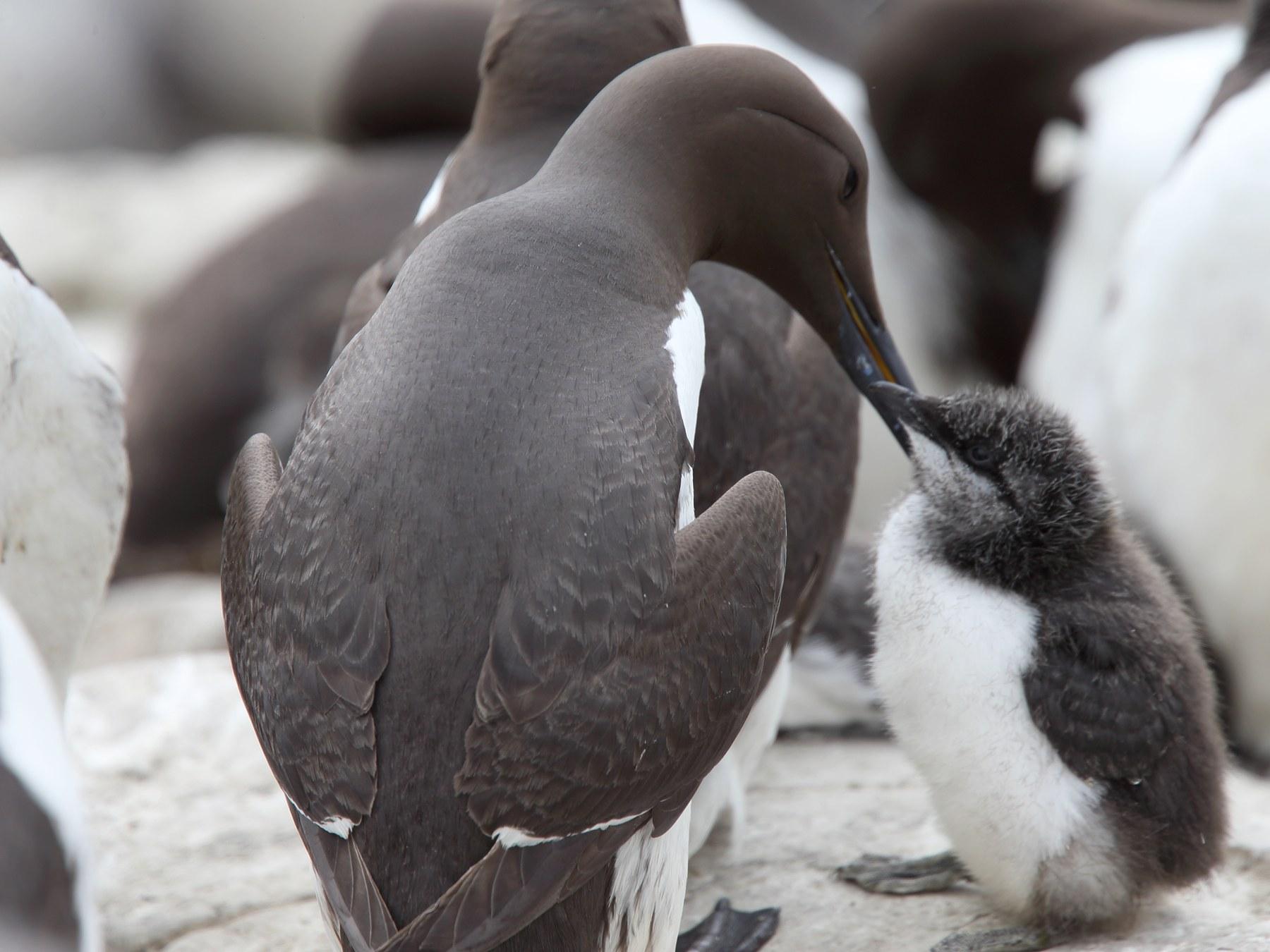
Chicks on the ledge are covered in medium gray down, paler below. By about two weeks old they show a facial pattern: a dark gray mask, with white on the throat and cheeks and a thin white stripe behind the eye.
Identification: similar birds
A Razorbill is blacker and more front-heavy, with a deep, blunt bill marked with white lines in summer and a longer, pointed tail that it often cocks up. A Common Murre is browner, with streaked flanks and a slim, pointed bill.
A Thick-billed Murre has a thicker bill with a white line along its cutting edge and blacker upperparts. Its white breast rises to a sharp point on the throat, and in winter its dark cap reaches below the eye, with no white patch behind it.
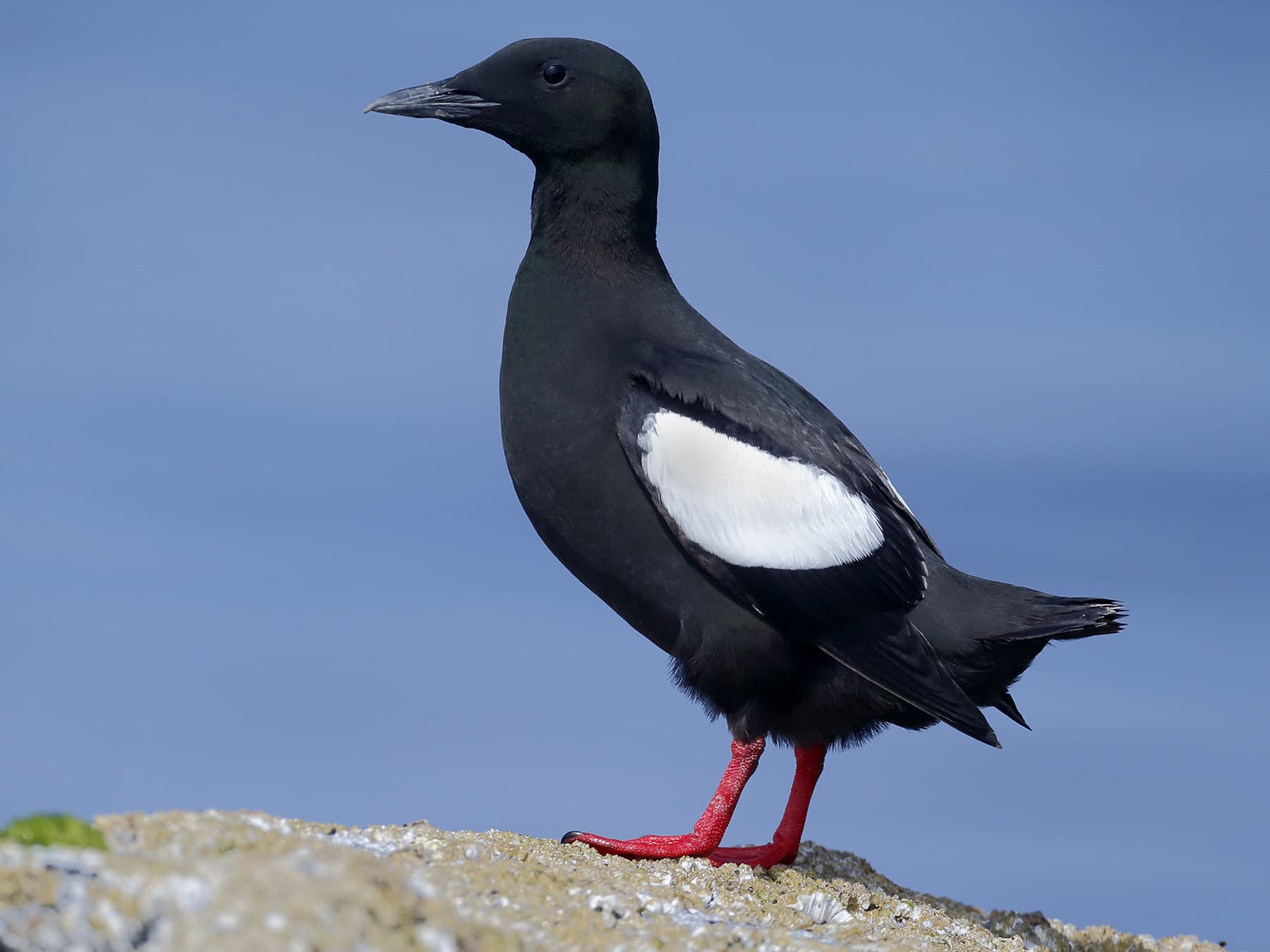
A Black Guillemot is much smaller and in summer is all black, with a large white wing patch and bright red legs and feet. A Pigeon Guillemot, on the Pacific coast, is also smaller and blackish-brown in summer, with a white wing patch crossed by a dark wedge and bright red legs. A Common Murre is white below and has no wing patch. Despite their names, these two are not murres: they belong to a different genus, Cepphus.
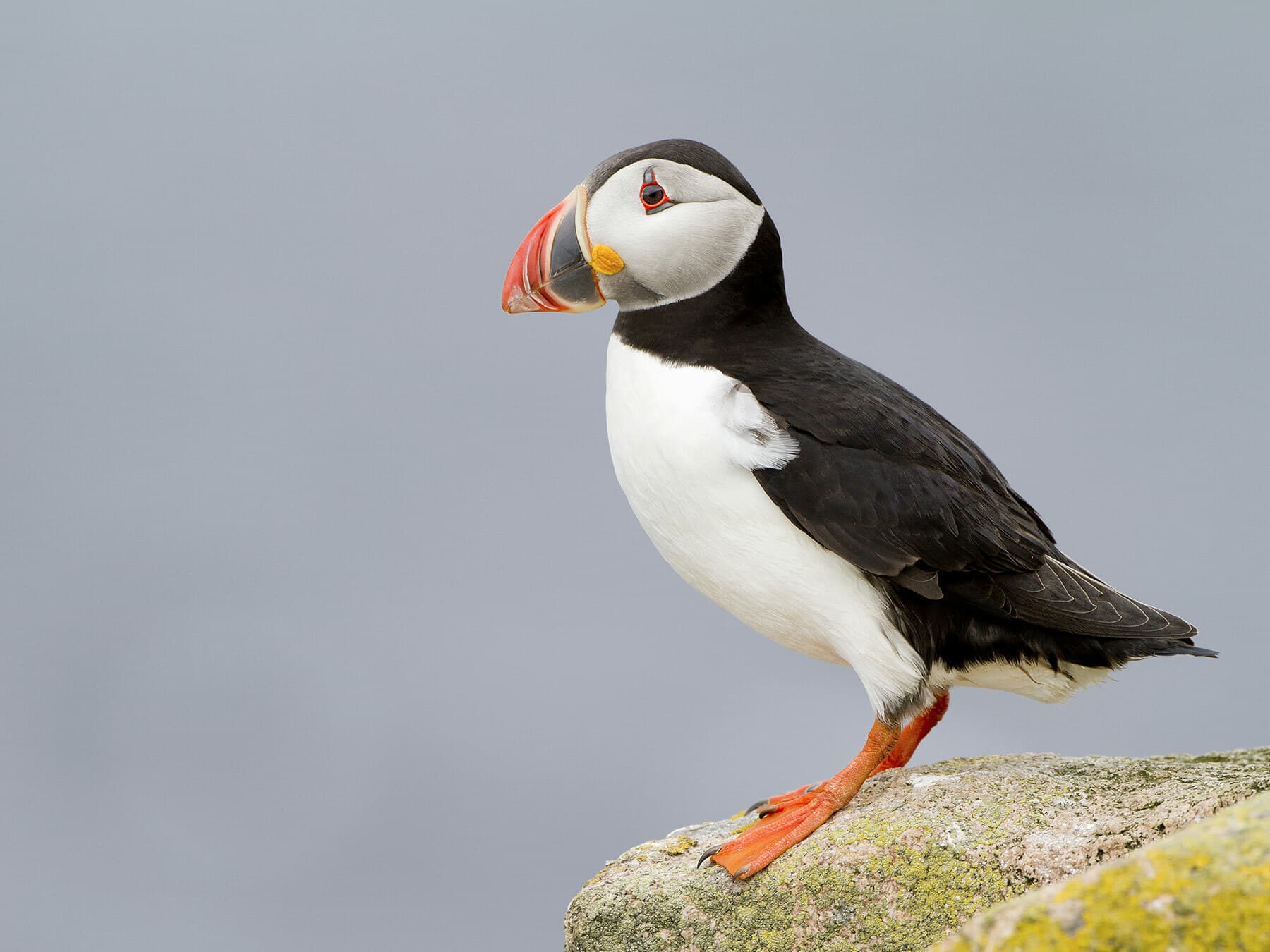
An Atlantic Puffin is much smaller, with a large, triangular, brightly colored bill in summer, a pale gray-white face and orange legs.
Not sure it’s a Common Murre? Check your photo: Birdfact names the bird and shows the look-alike side by side.
Its size
Adults- Length
- 38–43 cm
- Wingspan
- 64–71 cm
- Weight
- 800–1125 g
Its song and calls
Murres have no song in the usual sense, but a colony is very noisy, full of low growls and purrs.
Both sexes give a growling ARR-ahh in disputes and when mates change over at the egg. Males also give a drawn-out, laughing series of notes that fades away, in pair greetings and around mating, and females give a short two-note call around mating. A sitting bird may give a long, low growl.
Calls tie parents and chicks together. The chick calls to its parents even before it hatches. When it leaves the ledge, the male gives a soft luring call and the chick a loud departure call, which presumably help the pair find each other on the water, and parents and chicks know each other's voices.2
- Call0:00 / 0:03
Recorded in California, United States · September 2020
- Colony calls0:00 / 1:24
Recorded in Pembrokeshire, Wales · June 1965
Lawrence Shove / The British Library Board · Wikimedia Commons · CC BY-SA 4.0
Heard one and not sure? Let the bird song identifier listen.
When and where to see it
Common Murres live in cool waters of the North Pacific and North Atlantic, from the low Arctic south to southern California and to Portugal and New England, mostly over the continental shelf. They nest on sea cliffs and rocky islands and feed at sea where currents and fronts gather fish. Where both murres occur, the Common Murre feeds in shallower water nearer shore.
In North America they breed from the Chukchi and Bering Seas and the Aleutians down the Pacific coast to central California and the northern Channel Islands, and in the east from Labrador and Quebec to Newfoundland, Nova Scotia and Maine, where the colonies are small. On the West Coast they are present all year. On the East Coast they are mainly a winter visitor, regular south to Cape Cod, uncommon to Long Island and very rare to New Jersey and Maryland. Storms sometimes carry birds inland, to lakes in Ontario and Quebec, and there are records as far south as Florida.
Do they migrate?
Only partly. Common Murres are not long-distance migrants: high-Arctic birds move south ahead of the sea ice, mid-latitude populations are partly migratory and southern ones stay near their colonies. After breeding, males travel with their chicks mainly by swimming, while females and immature birds from earlier years mostly fly.
Central California birds winter within a few hundred kilometers of their colonies.2 Of 12 murres tagged at sea near the mouth of the Columbia River in May 2012, five flew north to Canada and one flew south to California.5
Birds come back to the colony long before they lay. In the south they return about six months ahead in normal years, from October at the Farallon Islands, but in the Arctic only about two months ahead, in early May at Cape Thompson, Alaska, while the sea is still mostly frozen.2 In milder regions they also visit the ledges in winter. On the Isle of May, Scotland, sites were first occupied around October 27 on average in 2017-2020, and the best sites were occupied earliest and most often.6
Where to see them in Britain and Ireland
In Britain and Ireland, where the bird is the Guillemot, it breeds on cliffs around much of the coast, but not between Flamborough Head, Yorkshire, and Durlston Head, Dorset, where suitable cliffs are lacking. In winter it is widespread in coastal waters, most numerous off western coasts and in the North Sea off southeast Scotland and northeast England. Reserves where it can be watched include Bempton Cliffs, Fowlsheugh, South Stack, Sumburgh Head, Rathlin Island, Troup Head and Ramsey Island.
Birds in Scotland and northern England belong to the subspecies aalge; those in the rest of England, Wales and Ireland belong to albionis, which also breeds south to Iberia.
Most stay fairly close to home in winter. Isle of May birds tracked with loggers stayed mainly in the North Sea, some reaching the English Channel and Irish Sea, and Skomer birds winter off southern Ireland and England and south to Brittany and the Bay of Biscay.7, 2 Birds banded in Britain and Ireland have been found abroad mainly in France (1,386 reports) and Norway (1,195), followed by the Netherlands, Denmark and Sweden.8
Tips for seeing it
What it eats
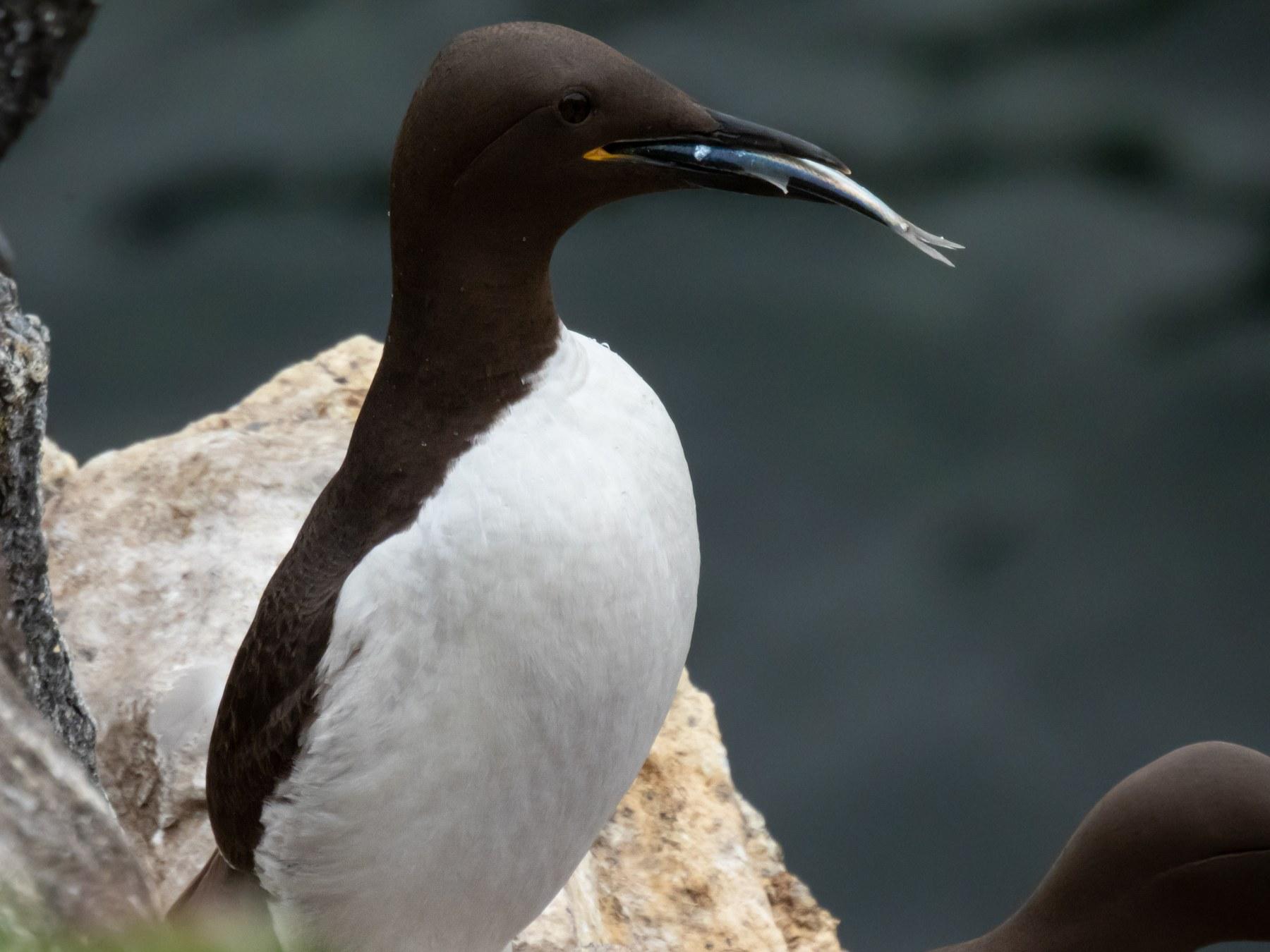
Common Murres eat mainly small schooling fish, mostly 2.4-4 in (6-10 cm) long, plus krill, large copepods and squid. Fish dominate in summer, especially when they are feeding chicks, and krill and other crustaceans matter more outside the breeding season.
The main prey differ by region: capelin, herring, juvenile pollock and sand lance in the Gulf of Alaska; juvenile rockfish, anchovy and smelt off California; capelin and sand lance off Newfoundland; sandeels (sand lance), herring and sprat around Britain; and sprat in the Baltic. In some winter studies crustaceans made up 70% or more of the diet off eastern Newfoundland (1984-1998) and over 90% at Kodiak Island, Alaska, and the Farallon Islands, though good winter data for adults are lacking.2
A murre grips a fish against small spiky projections on the roof of its mouth until it can swallow it, head first. An adult eats an estimated 10-30% of its body weight in food a day.9
Diving for food
Murres chase their prey underwater, swimming with their wings. They usually feed 66-164 ft (20-50 m) down, often dive to about 230 ft (70 m) and occasionally reach about 590 ft (180 m). Breeding adults usually find food within about 37-43 miles (60-70 km) of the colony, though trips range from under a mile to more than 60 miles (1-100 km) depending on prey. They feed mainly by day and at dawn and dusk, but also dive at night, more shallowly.2, 10
Nesting and breeding
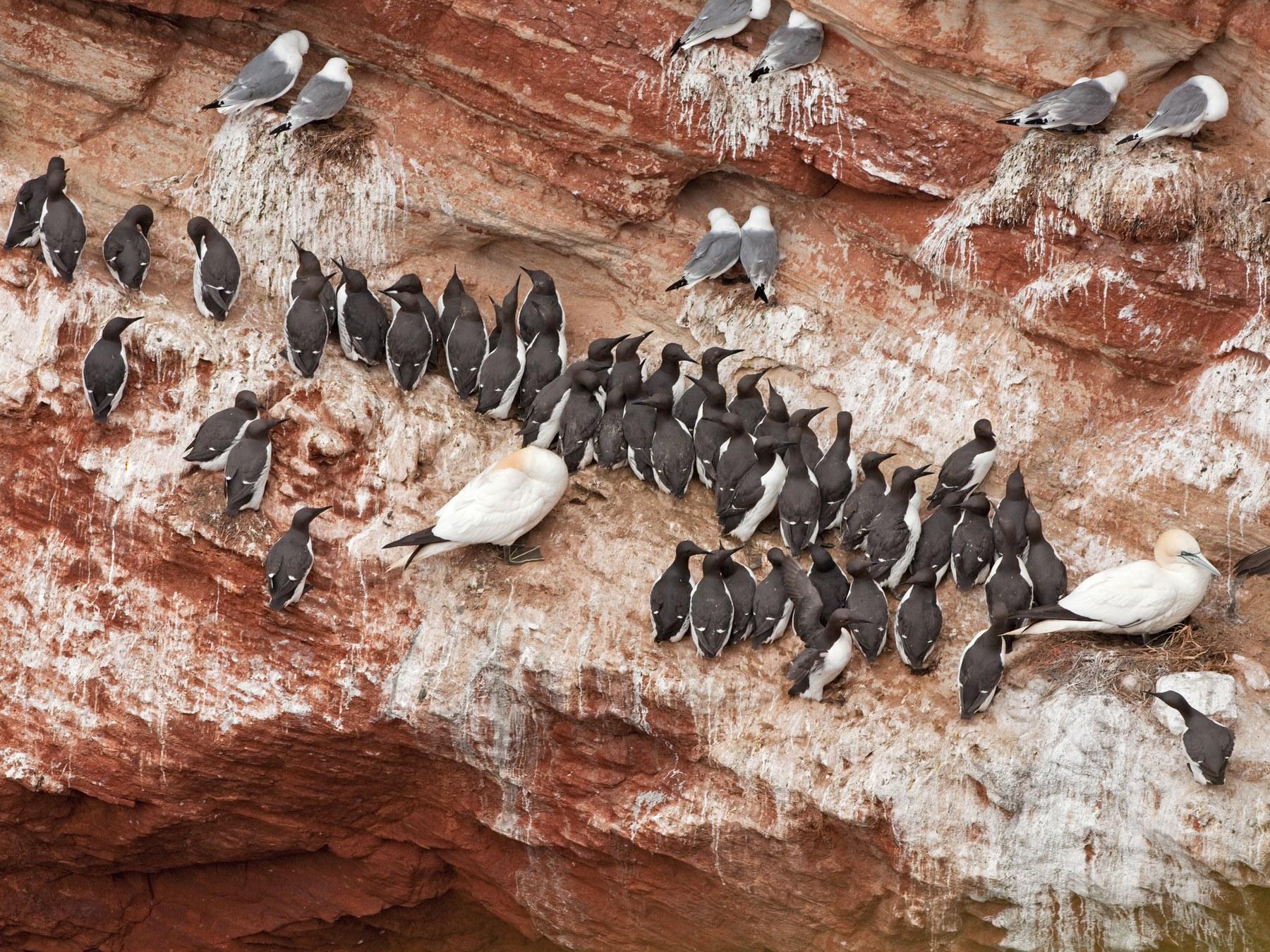
Common Murres build no nest. Each pair's single egg is laid on bare rock, on a cliff ledge, a sloping island top or a flat rocky area with a view of the sea, sometimes among a few pebbles that become cemented in place by droppings. On islands free of predators they may also nest among boulders or on open ground.
They breed packed shoulder to shoulder, at up to about 20 pairs per square meter (about 2 per square foot) on broad, flat areas.10 Crowding protects the eggs and chicks: where murres are spread out, large gulls take eggs and chicks and steal food, and breeding success is higher at denser, mid-cliff sites.
Most birds return to the same spot each year. On the Isle of May, 85.7% of breeders were back at the same site the next season (470 color-banded birds, 1982-1993), and most that moved shifted less than about 7 ft (2 m).11
Average laying dates fall in May at colonies studied in California, Newfoundland and Scotland, and in mid to late June at one in Labrador, and laying within a colony is tightly synchronized. There is one brood a year, but a female that loses her egg may lay a replacement about 15 days later. Both parents incubate, standing upright over the egg, for about 32-33 days.

Eggs
The egg is large, about 9-11.5% of the adult's weight; a typical egg measures about 3.2 by 2 in (82 by 50 mm) and weighs about 3.8 oz (108 g). Its color varies enormously, from dark green, blue-green or turquoise to tan, pinkish or white, usually with black spots and scrawls, and roughly half are dark and half light.
Parents use the colors and markings to recognize their own egg and usually pick it when offered a choice with a foreign egg. Each female lays eggs with the same pattern, and the variety is thought to be an adaptation to breeding so close together.2, 12
The egg is sharply pointed at one end. The old explanation, that it rolls in a tight circle and so stays on the ledge, is now questioned. A 2017 study tested the idea that bigger eggs need to be more pointed. It found that egg volume explained under 3% of the variation in egg shape, and that Thick-billed Murre eggs were less pointed than Common Murre eggs of the same mass, and it called rolling into question as the main reason for the shape.13 The pointed shape gives the egg greater stability on the ledge, but researchers disagree over whether the needs of flight or of incubation shaped it.2
Eggs soon get dirty on the ledge, and dirt can block the pores in the shell. Laboratory tests found that the shells do not clean themselves, but a coating on the shell largely stops the pores from clogging.14
Young birds leaving the ledge
The chick hatches covered in down and can stand within a day. Both parents brood it and both feed it, bringing one fish at a time in the bill. Chicks are fed mainly one kind of energy-rich fish where it is available. On Skomer, Wales, the chick diet stayed mainly herring and sprat from 1973 to 2017, with more lower-quality gadids in recent years.15
At about three weeks old, long before it can fly, the chick leaves the ledge. Chicks leave almost always after sunset but before full dark, and most of a colony's chicks go within about a week. The chick jumps or tumbles from the ledge, fluttering its part-grown wings to slow the fall, while it and the male call to each other, and the male joins it on the water. Some chicks die if they hit rocks.
At this point the chick is only about a quarter grown, roughly 6-10 oz (170-290 g), with its body feathered but its flight feathers not yet grown. The father guards it at sea, leads it to good feeding areas and feeds it, for what is believed to be at least one to two months, while the female keeps visiting the colony for some weeks. The chick probably becomes independent two to three months after leaving the ledge.2
Why leave so early? One explanation is a trade-off: carrying the chick to its food may be cheaper than ferrying fish back to the ledge, and the adults' heavy wing-loading limits how big an egg and chick they can raise, with predation also playing a part.2
A pair raises at most one chick a year; across UK colonies the 2024 average was 0.51 chicks per pair.10 Young birds first come back to the colony at two to seven years old, and the usual age of first breeding was six years on the Isle of May and seven on Canna, Scotland.2
Behaviour
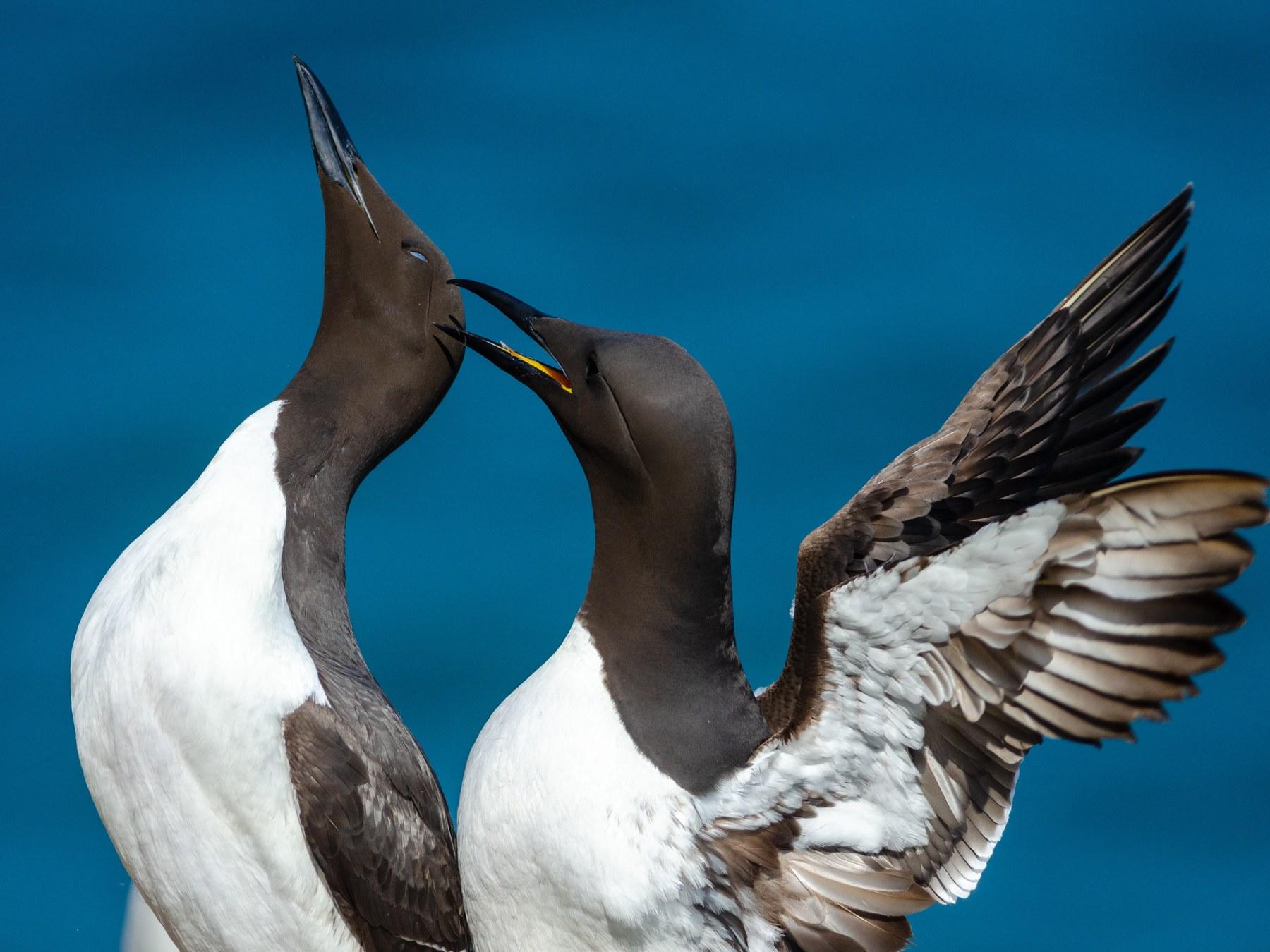
Ledge life is crowded. Neighbors fight often over space and mates, sometimes for hours, and preening a neighbor is one of the gestures they use to calm a dispute. Mates preen each other often.
Pairs are socially monogamous and often stay together for several years. On the Isle of May, pairs stayed together for three to four years on average. Each year about 8% of pairs split up at Great Island, Newfoundland, and about 10% on the Isle of May. Extra-pair mating attempts are frequent, but two studies found extra-pair chicks in only 6 of 77 families (7.8%) on Skomer, Wales, and 2 of 64 (3.1%) at Great Island, Newfoundland.2
On land a murre shuffles on its lower legs and climbs readily, using its claws and flapping its wings. At sea it rests in large rafts and often feeds in flocks, sometimes alongside shearwaters, gulls, other auks and whales.
Flight
A murre flies fast, with rapid wingbeats. Older studies measured single birds at about 37-48 mph (60-78 km/h), and one study of ground speeds found as little as about 31 mph (50 km/h) into a strong headwind and up to about 56 mph (90 km/h) with a strong tailwind.2
After breeding, adults replace all their flight feathers almost at once and cannot fly for a while in late summer and early fall. Males taking chicks to sea are already effectively flightless, because they swim with the chick.
Lifespan and predators
Common Murres can live for decades. The oldest on the US Bird Banding Laboratory's longevity list was 40 years 6 months old: banded as a chick in Newfoundland and Labrador in August 1981, it was recovered there in February 2022.16 The British and Irish record is 40 years 11 months 23 days, a bird banded as a chick on Canna, Scotland, in July 1978 and caught alive there by a bander in June 2019.17 EURING's European list (2023) holds two Swedish birds found dead at minimum ages of 49 years 0 months and 48 years 11 months, by EURING's count.18
Adults survive well from year to year. The BTO gives a typical life expectancy of 23 years for a bird that reaches breeding age, with adult survival of 0.946 a year and first-year survival of 0.56.4
Predators
Adults are taken by Bald Eagles, falcons and other raptors, and by foxes and polar bears. Large gulls, ravens, crows and foxes take eggs and chicks.
Eagles also cause losses by flushing murres off their ledges, so that gulls can take the exposed eggs. At Gull Island, Alaska, in 2016-2020, Bald Eagle disturbance led to complete breeding failures in some years.19 At a Baltic colony in 2020, when no tourists came, White-tailed Eagles were present seven times more often and productivity was 26% below average, although the eagles did not kill murres.20
Conservation
The Common Murre is listed as Least Concern on the IUCN Red List.21 It is one of the most numerous seabirds in the Northern Hemisphere. Birds of the World's 2021 account estimates more than 8.3 million breeding pairs, or about 16.6 million breeding birds, compiled from colony counts of different years, and says no valid global trend can be given, because numbers rise and fall with ocean climate cycles.2 Partners in Flight estimates a global breeding population of about 12 million individuals, about 7.4 million of them breeding in the US and Canada.22 Many of the colony counts behind these totals were made before the losses in Alaska described below.
The 2014-2016 northeast Pacific marine heatwave killed about half of Alaska's Common Murres, an estimated 4 million birds. Numbers at 13 colonies fell 52-78% between 2008-2014 and 2016-2022, and no recovery had been seen; the authors call it the largest documented wildlife mortality event of the modern era.23
Elsewhere, numbers have recovered from past losses. Farallon Islands murres fell from an estimated 500,000-1.5 million pairs in the early 1800s to under 17,000 pairs by 1911, through commercial egg collecting and disturbance made worse by a long spell of warm ocean conditions, and were nearly gone by the 1930s. After a partial recovery, central California numbers fell again by 9.9% a year in 1979-1989, and they have risen steadily since, from 60,000-90,000 birds in the early 1990s to more than 460,000 by 2015. In eastern Canada, Funk Island, Newfoundland, the largest colony, grew from about 10,000 pairs in 1936 to about 470,000 pairs counted in 2009, an increase likely owed to release from egg collecting and hunting.2
Conservation status in Britain and Ireland
The Seabirds Count census (2015-2021) found 1,449,589 birds at colonies across Britain and Ireland, including the Isle of Man and the Channel Islands, 8% fewer than in Seabird 2000 (1998-2002). For the UK alone the census report gives an 11% decrease and calls it a stable population. Britain and Ireland hold about 8% of the world population.10 Numbers fell in the north, especially in the far north of Scotland, and rose in the south, a fall that contrasts with a marked increase since the late 1960s census.4 Across Scotland as a whole they were down 31%.10
The Guillemot is the most numerous breeding seabird in Britain and Ireland. In the UK it is Amber-listed (Birds of Conservation Concern 5, confirmed in a 2024 seabird update), because more than half the UK population nests at ten or fewer sites and 20% or more of the European population is in the UK. On the 2024 Great Britain Red List its breeding population is assessed as Vulnerable (criterion A4b).24, 25 In Ireland it is Amber-listed as a breeding bird (2020-2026), and on BirdLife's 2017 European assessment it is a species of European conservation concern, SPEC 3.26 A later European assessment, in 2021, found it Least Concern and increasing, with an estimated 2.99-4.43 million mature individuals.27
Conservation pressures: oil, warming seas and nets
Murres are among the seabirds worst affected by oil, because they spend so much time on the water in dense groups near shipping lanes. Oiled birds die mainly of cold and starvation once their feathers stop insulating. The Exxon Valdez spill in Alaska in March 1989 killed an estimated 185,000 murres, the largest murre kill from an oil spill on record, and the Erika (1999, Bay of Biscay) and Prestige (2002, Galicia) spills killed an estimated 60,000-120,000 and 26,000-80,000 Common Murres respectively.2 Common Murres were the most numerous birds among those affected by California's oil spills of 1995-2019.28
Food shortages linked to warmer seas cut breeding success and survival. In one long-term study, chicks got less energy in warm springs even though their parents worked harder, and chick growth, fledging success and adult survival all fell.29 In the UK, low breeding success at some northern colonies in 2003-2007 coincided with fewer sandeels, and in the mid-2000s some birds switched to the nutritionally poor snake pipefish, with lower breeding success in those years.4 A 25-year study of the northwestern North Sea found no evidence that the sandeel fishery harmed guillemot breeding success, nor that its closure helped.30
Many drown in fishing nets: salmon gill nets in British Columbia kill an estimated 2,846 murres a year, a conservative estimate for 2001-2016.31 Offshore wind farms can displace murres: in the German North Sea, fall densities were lower within 12 miles (19.5 km) of operating wind farms, while a ten-year study at the Robin Rigg wind farm in the UK found no significant displacement.32, 33 Murres are also sensitive to disturbance: low aircraft, especially helicopters, and close approaches by people on land or in boats can set off panic flights that leave eggs and chicks exposed.
Legal status
In the US the Common Murre is protected under the Migratory Bird Treaty Act and is on the list in 50 CFR 10.13.34 In Canada it is covered by the Migratory Birds Convention Act, and the Migratory Birds Regulations, 2022 group murres with migratory game birds and set murre seasons in Newfoundland and Labrador for residents of that province only.2, 35
In Great Britain it is protected as a wild bird under the Wildlife and Countryside Act 1981, though it is not on Schedule 1. In Northern Ireland it is protected under the Wildlife (Northern Ireland) Order 1985, and in the Republic of Ireland under the Wildlife Act 1976.36, 37, 38
Similar birds
Often mistaken for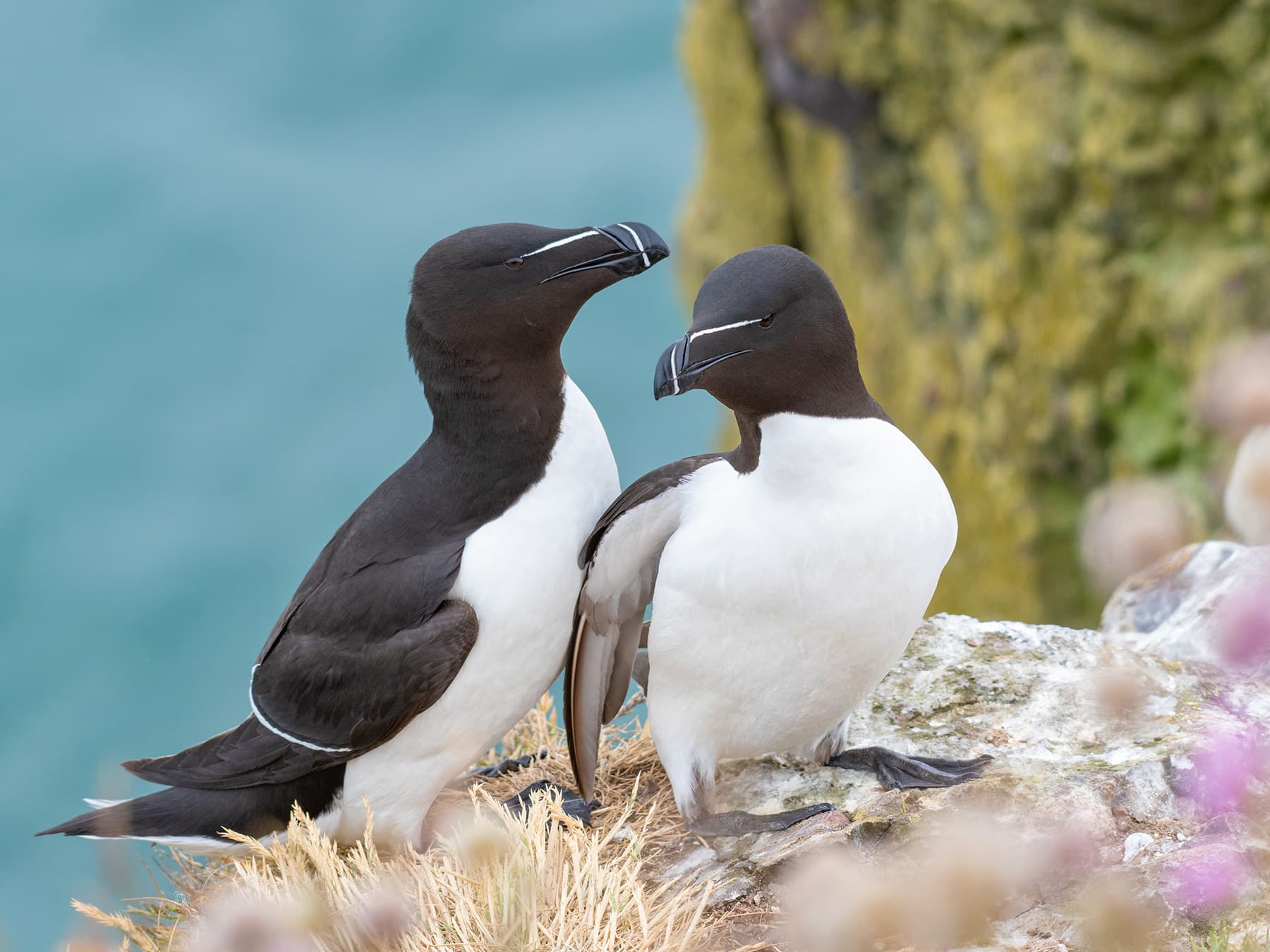
Quick facts
- Length
- 38–43 cm
- Wingspan
- 64–71 cm
- Weight
- 800–1125 g
- Lifespan
- oldest recorded 40 years 6 months · UK record 40 years 11 months
- Family
- Auks & Puffins
- Migration
- Partial migrant
- Global status (IUCN)
- Least Concern
- World population
- More than 8.3 million breeding pairs (Birds of the World, 2021)
- Population trend
- No reliable global trend: numbers have risen in some regions and fallen in others, most recently with the loss of about half of Alaska's Common Murres after the 2014-2016 Pacific marine heatwave
- Also called
- Common Guillemot, Guillemot
- Scientific name
- Uria aalge
Questions
3Is a murre a penguin?
No. Murres are auks, in the family Alcidae, and unlike penguins they fly, with very fast wingbeats. “Flying penguin” is only a nickname.
Why does it have two names?
Common Murre is the North American name and the one used by the AviList world checklist; in Britain and Ireland the same bird is the Common Guillemot, usually just the Guillemot.1 An older North American name is Thin-billed Murre, and one field guide links the name “murre” to the bird's purring or murmuring calls.39
Are guillemots related to puffins?
Yes. Both belong to the same family, the Alcidae, which AviList calls the auks, puffins and murres. The Common Murre's closest relative is the Thick-billed Murre, and the two murres, the Razorbill and the Dovekie (Little Auk) form one group, whose lineages appear to have split in a rapid burst of evolution.1, 2
Sources
47- 1AviList Core Team (2025). AviList: The Global Avian Checklist, v2025b. AviList. Accessed 22 November 2026.
- 2Ainley, D. G., Nettleship, D. N. and Storey, A. E. (2021). Common Murre (Uria aalge). Birds of the World (S. M. Billerman, P. G. Rodewald, and B. K. Keeney, Editors). Cornell Lab of Ornithology, Ithaca, NY, USA. doi:10.2173/bow.commur.02 (opens in a new tab)
- 3Harris, M. P., Rothery, P. and Wanless, S. (2002). Increase in frequency of the bridled morph of the Common Guillemot Uria aalge on the Isle of May, 1946–2000: a return to former levels?. Ibis 145: 22-29. doi:10.1046/j.1474-919x.2003.00118.x (opens in a new tab)
- 4BTO. Guillemot (Uria aalge). BTO BirdFacts. Accessed 22 November 2026. Source (opens in a new tab)
- 5Phillips, Elizabeth M. et al. (2019). Does perspective matter? A case study comparing Eulerian and Lagrangian estimates of common murre (Uria aalge) distributions. Ecology and Evolution 9: 4805-4819. doi:10.1002/ece3.5083 (opens in a new tab)
- 6Bennett, Sophie et al. (2022). Earlier and more frequent occupation of breeding sites during the non‐breeding season increases breeding success in a colonial seabird. Ecology and Evolution 12: e9213. doi:10.1002/ece3.9213 (opens in a new tab)
- 7Dunn, Ruth E. et al. (2020). A year in the life of a North Atlantic seabird: behavioural and energetic adjustments during the annual cycle. Scientific Reports 10: 5993. doi:10.1038/s41598-020-62842-x (opens in a new tab)
- 8Robinson, R. A., Leech, D. I. and Clark, J. A. (2026). The Online Demography Report: Bird ringing and nest recording in Britain & Ireland in 2025 (Guillemot recoveries, EURING 6340). BTO, Thetford. Accessed 22 November 2026. Source (opens in a new tab)
- 9U.S. Fish & Wildlife Service, Alaska (2006). Common Murre (Alaska Seabird Information Series). U.S. Fish & Wildlife Service. Accessed 22 November 2026. Source (opens in a new tab)
- 10Harris, S. J. et al. (2026). Seabird Population Trends and Causes of Change: 1986-2024. The annual report of the Seabird Monitoring Programme. BTO Research Report 795, BTO, Thetford. Accessed 22 November 2026.
- 11HARRIS, M. P., WANLESS, S. and BARTON, T. R. (1996). Site use and fidelity in the Common Guillemot Uria aalge. Ibis 138: 399-404. doi:10.1111/j.1474-919x.1996.tb08057.x (opens in a new tab)
- 12Ducay, Rebecca L., Luro, Alec B., Hansen, Erpur S. and Hauber, Mark E. (2021). Multicomponent shell traits are consistent with an individual recognition function of the appearance of common murre (Uria aalge) eggs: A biological replication study. Ecology and Evolution 11: 2402-2409. doi:10.1002/ece3.7264 (opens in a new tab)
- 13Birkhead, Tim R., Thompson, Jamie E. and Biggins, John D. (2017). Egg shape in the Common Guillemot Uria aalge and Brunnich’s Guillemot U. lomvia: not a rolling matter?. Journal of Ornithology 158: 679-685. doi:10.1007/s10336-017-1437-8 (opens in a new tab)
- 14Jackson, Duncan, Thompson, Jamie E., Hemmings, Nicola and Birkhead, Timothy R. (2018). Common guillemot (Uria aalge) eggs are not self-cleaning. Journal of Experimental Biology: jeb.188466. doi:10.1242/jeb.188466 (opens in a new tab)
- 15Riordan, Julie and Birkhead, Tim (2018). Changes in the diet composition of Common GuillemotUria aalgechicks on Skomer Island, Wales, between 1973 and 2017. Ibis 160: 470-474. doi:10.1111/ibi.12570 (opens in a new tab)
- 16USGS Bird Banding Laboratory. Longevity records of North American birds: Common Murre (AOU 0300). USGS Bird Banding Laboratory. Accessed 22 November 2026. Source (opens in a new tab)
- 17BTO (2026). Longevity records for Britain & Ireland in 2025. BTO Online Ringing and Nest Recording Report. Accessed 22 November 2026. Source (opens in a new tab)
- 18Fransson, T., Kolehmainen, T., Moss, D. and Robinson, R. (2023). EURING list of longevity records for European birds (list dated 2023-09-01). EURING. Accessed 22 November 2026.
- 19Marsteller, Caitlin E. et al. (2024). Predator Disturbance Contributed to Common Murre <i>Uria aalge</i> breeding failures in Cook Inlet, Alaska following the 2014–2016 Pacific Marine Heatwave. Marine Ornithology 52. doi:10.5038/2074-1235.52.1.1572 (opens in a new tab)
- 20Hentati-Sundberg, Jonas, Berglund, Per-Arvid, Hejdström, Aron and Olsson, Olof (2021). COVID-19 lockdown reveals tourists as seabird guardians. Biological Conservation 254: 108950. doi:10.1016/j.biocon.2021.108950 (opens in a new tab)
- 21IUCN (via GBIF IUCN Red List checklist). Uria aalge (Pontoppidan, 1763), IUCN Red List category. GBIF dataset 19491596-35ae-4a91-9a98-85cf505f1bd3. Accessed 22 November 2026. Source (opens in a new tab)
- 22Cornell Lab of Ornithology. Common Murre: overview, identification, life history. All About Birds. Accessed 22 November 2026. Source (opens in a new tab)
- 23Renner, Heather M. et al. (2024). Catastrophic and persistent loss of common murres after a marine heatwave. Science 386: 1272-1276. doi:10.1126/science.adq4330 (opens in a new tab)
- 24Stanbury, A. et al. (2021). The status of our bird populations: the fifth Birds of Conservation Concern in the United Kingdom, Channel Islands and Isle of Man and second IUCN Red List assessment of extinction risk for Great Britain. British Birds 114: 723-747. Accessed 22 November 2026.
- 25Stanbury, A. et al. (2024). The status of the UK's breeding seabirds: an addendum to the fifth Birds of Conservation Concern in the United Kingdom, Channel Islands and Isle of Man and second IUCN Red List assessment of extinction risk for Great Britain. British Birds 117: 471-487. Accessed 22 November 2026.
- 26Gilbert, G., Stanbury, A. and Lewis, L. (2021). Birds of Conservation Concern in Ireland 4: 2020-2026. Irish Birds 43: 1-22. Accessed 22 November 2026. Source (opens in a new tab)
- 27BirdLife International (2021). European Red List of Birds 2021. Publications Office of the European Union. Accessed 22 November 2026.
- 28Henkel, Laird A. and Ziccardi, Michael H. (2026). Impacts to birds from marine oil spills in California, 1995–2019. Marine Pollution Bulletin 222: 118868. doi:10.1016/j.marpolbul.2025.118868 (opens in a new tab)
- 29Wanless, Sarah et al. (2023). Increased parental effort fails to buffer the cascading effects of warmer seas on common guillemot demographic rates. Journal of Animal Ecology 92: 1622-1638. doi:10.1111/1365-2656.13944 (opens in a new tab)
- 30Searle, Kate R. et al. (2023). Effects of a fishery closure and prey abundance on seabird diet and breeding success: Implications for strategic fisheries management and seabird conservation. Biological Conservation 281: 109990. doi:10.1016/j.biocon.2023.109990 (opens in a new tab)
- 31Bertram, Douglas F. et al. (2021). Modelling entanglement rates to estimate mortality of marine birds in British Columbia commercial salmon gillnet fisheries. Marine Environmental Research 166: 105268. doi:10.1016/j.marenvres.2021.105268 (opens in a new tab)
- 32Peschko, Verena et al. (2024). Cumulative effects of offshore wind farms on common guillemots (Uria aalge) in the southern North Sea - climate versus biodiversity?. Biodiversity and Conservation 33: 949-970. doi:10.1007/s10531-023-02759-9 (opens in a new tab)
- 33Vallejo, Gillian C. et al. (2017). Responses of two marine top predators to an offshore wind farm. Ecology and Evolution 7: 8698-8708. doi:10.1002/ece3.3389 (opens in a new tab)
- 34US Government. 50 CFR 10.13 List of Birds Protected by the Migratory Bird Treaty Act (eCFR, issue date 2026-11-19). eCFR. Accessed 22 November 2026. Source (opens in a new tab)
- 35Government of Canada. Migratory Birds Regulations, 2022 (SOR/2022-105), current to 2026-10-29. Justice Laws Website. Accessed 22 November 2026. Source (opens in a new tab)
- 36UK Government. Wildlife and Countryside Act 1981, section 1 and Schedules 1, 1A, A1, ZA1 and 2. legislation.gov.uk. Accessed 22 November 2026. Source (opens in a new tab)
- 37UK Government. Wildlife (Northern Ireland) Order 1985, article 4 and Schedules 1-3. legislation.gov.uk. Accessed 22 November 2026. Source (opens in a new tab)
- 38Law Reform Commission (Ireland). Wildlife Act 1976 (revised), section 22. Law Reform Commission. Accessed 22 November 2026. Source (opens in a new tab)
- 39National Audubon Society. Common Murre (Guide to North American Birds). Audubon Field Guide. Accessed 22 November 2026. Source (opens in a new tab)
- 40RSPB. Guillemot (Uria aalge). RSPB Birds and wildlife. Accessed 22 November 2026. Source (opens in a new tab)
- 41Hickey, H. (2024). Surveys show full scale of massive die-off of common murres following the 'warm blob' in the Pacific Ocean. University of Washington News. Accessed 22 November 2026. Source (opens in a new tab)
- 42Hauber, Mark E. et al. (2019). The chemical basis of a signal of individual identity: shell pigment concentrations track the unique appearance of Common Murre eggs. Journal of The Royal Society Interface 16: 20190115. doi:10.1098/rsif.2019.0115 (opens in a new tab)
- 43Lavers, J., Hipfner, J. M. and Chapdelaine, G. (2020). Razorbill (Alca torda). Birds of the World (S. M. Billerman, Editor). Cornell Lab of Ornithology, Ithaca, NY, USA. doi:10.2173/bow.razorb.01 (opens in a new tab)
- 44Gaston, A. J. and Hipfner, J. M. (2020). Thick-billed Murre (Uria lomvia). Birds of the World (S. M. Billerman, Editor). Cornell Lab of Ornithology, Ithaca, NY, USA. doi:10.2173/bow.thbmur.01 (opens in a new tab)
- 45Butler, R. G. et al. (2020). Black Guillemot (Cepphus grylle). Birds of the World (S. M. Billerman, Editor). Cornell Lab of Ornithology, Ithaca, NY, USA. doi:10.2173/bow.blkgui.01 (opens in a new tab)
- 46Ewins, P. J. (2020). Pigeon Guillemot (Cepphus columba). Birds of the World (A. F. Poole and F. B. Gill, Editors). Cornell Lab of Ornithology, Ithaca, NY, USA. doi:10.2173/bow.piggui.01 (opens in a new tab)
- 47Lowther, P. E. et al. (2020). Atlantic Puffin (Fratercula arctica). Birds of the World (S. M. Billerman, Editor). Cornell Lab of Ornithology, Ithaca, NY, USA. doi:10.2173/bow.atlpuf.01 (opens in a new tab)

Checked by
Nathan Cope, founder and editor
Nathan founded Birdfact and leads its writers and contributors in the UK, the US and Canada. He has watched and studied birds for more than ten years, and checks every article and species guide before it’s published.