


Black Guillemot
Tystie · Cepphus grylle
By the Birdfact teamChecked by Nathan Cope
On this page13 sections
How to recognise it
What do Black Guillemots look like?
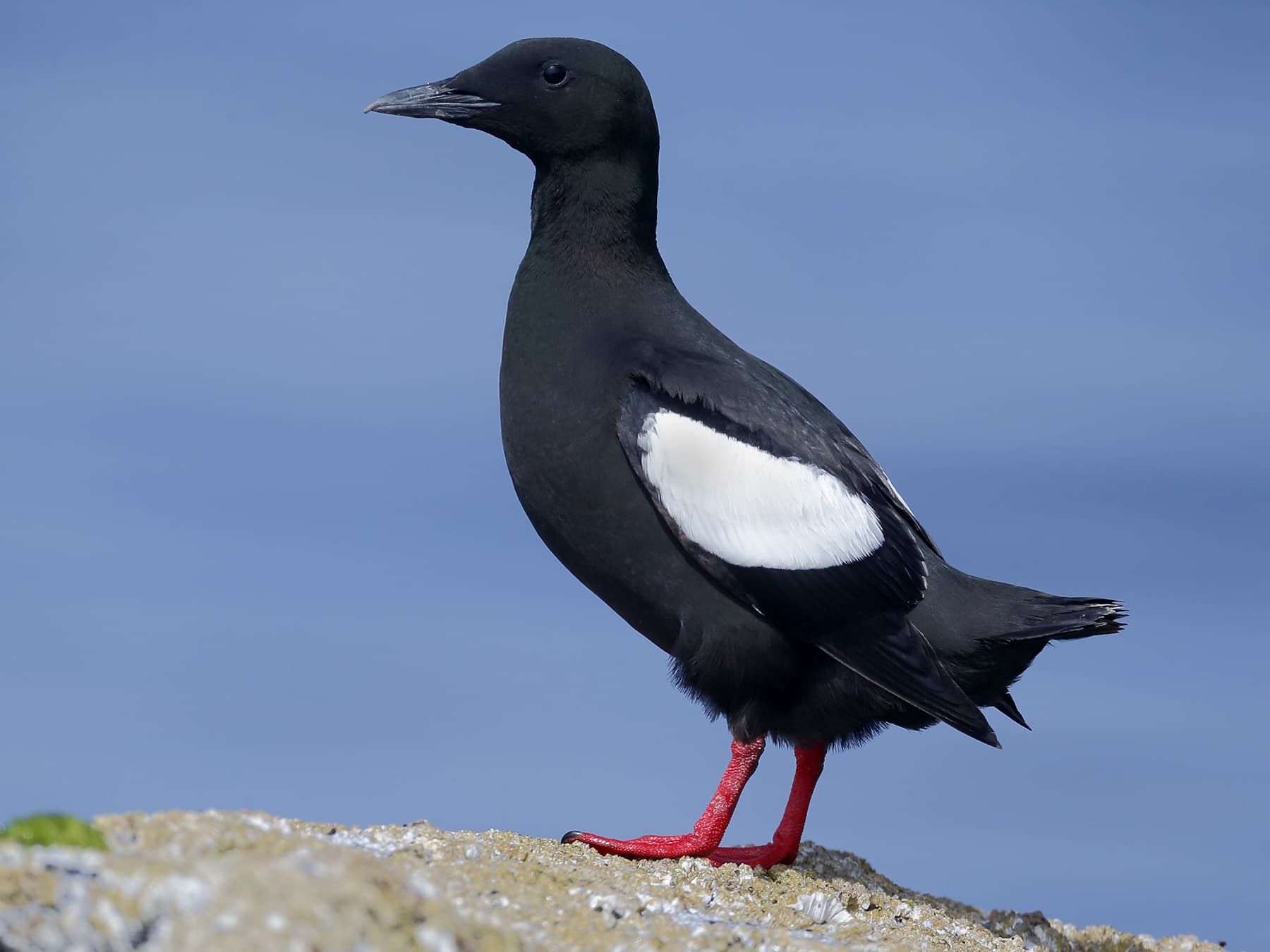
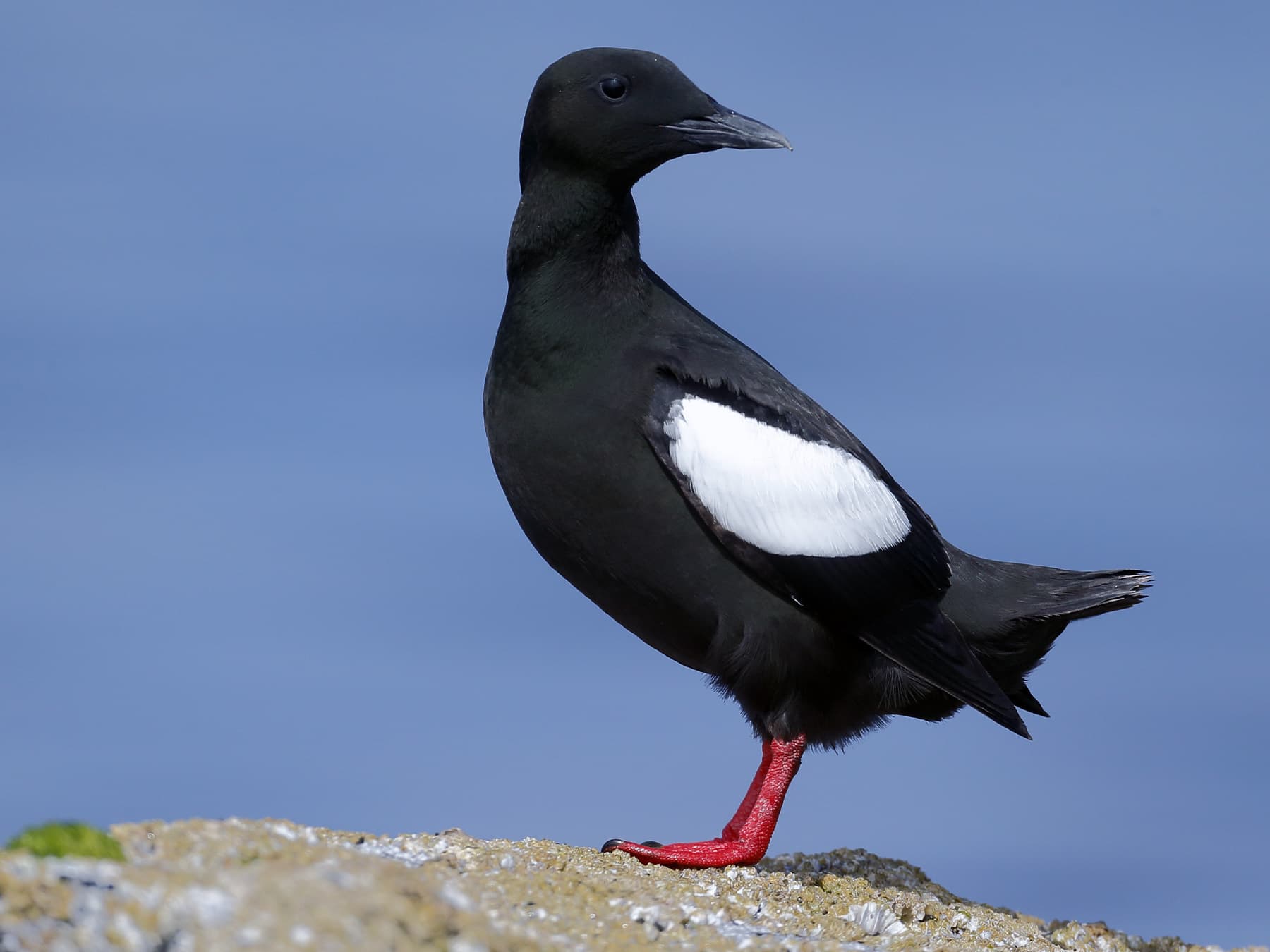
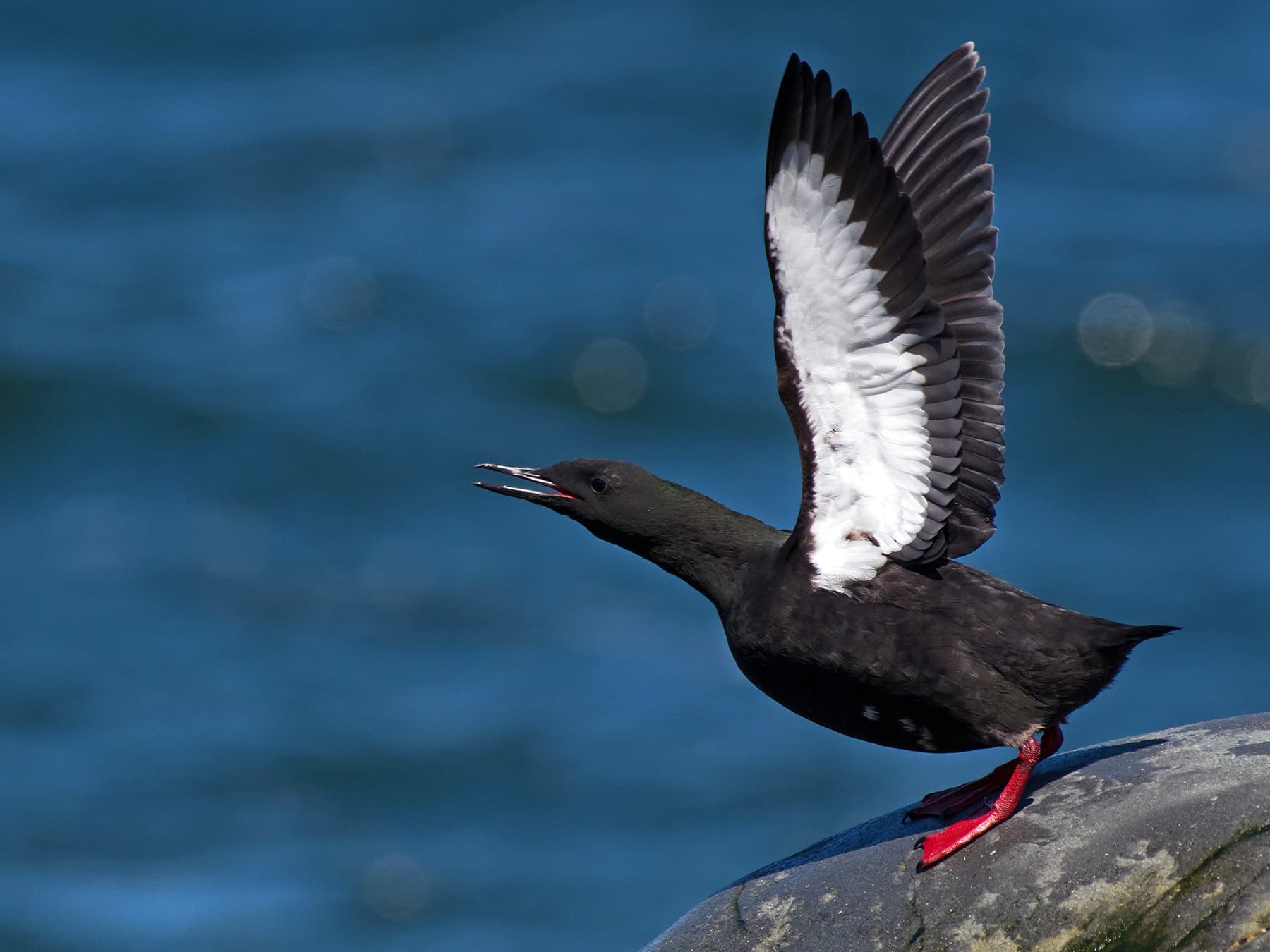
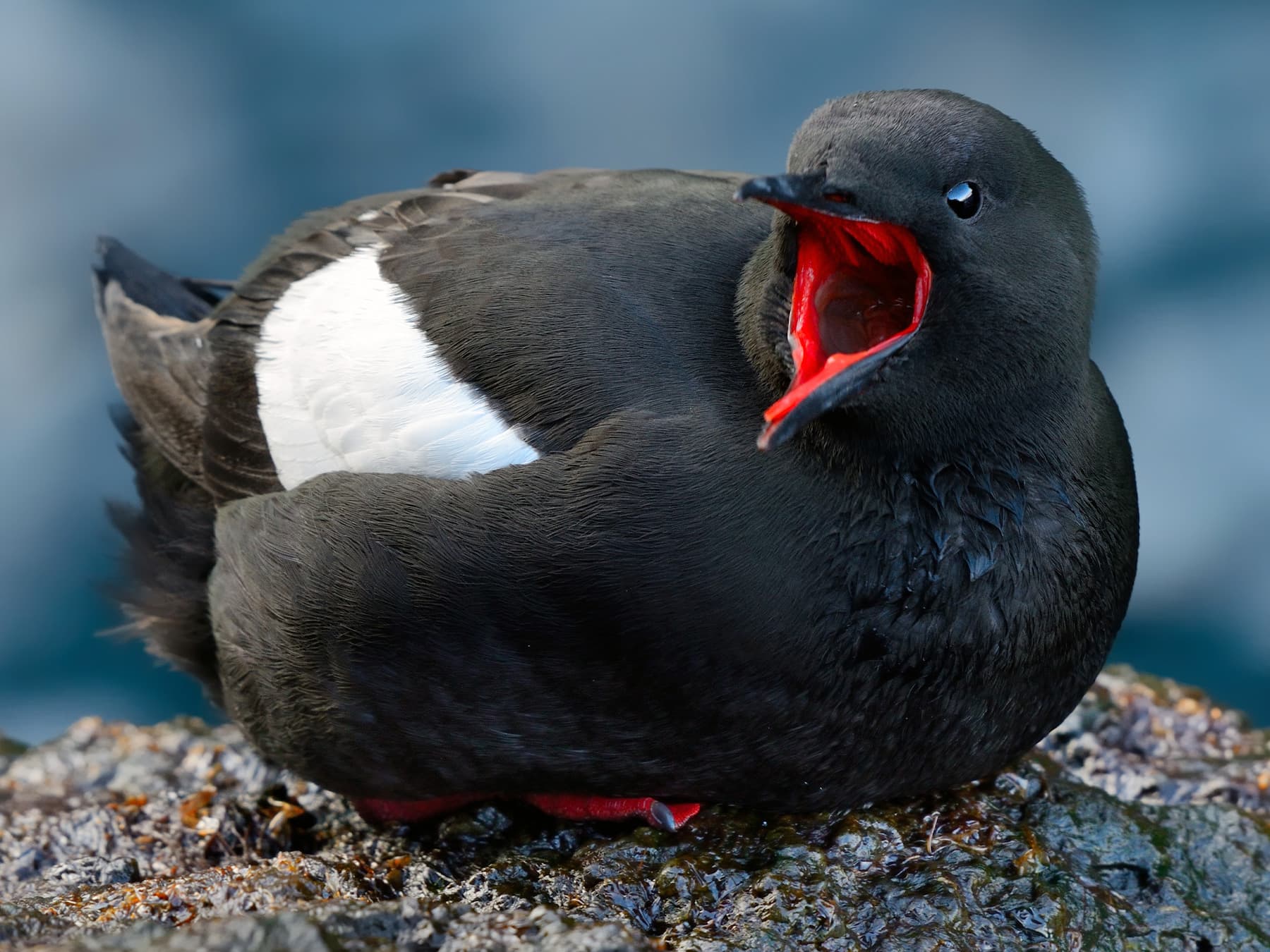
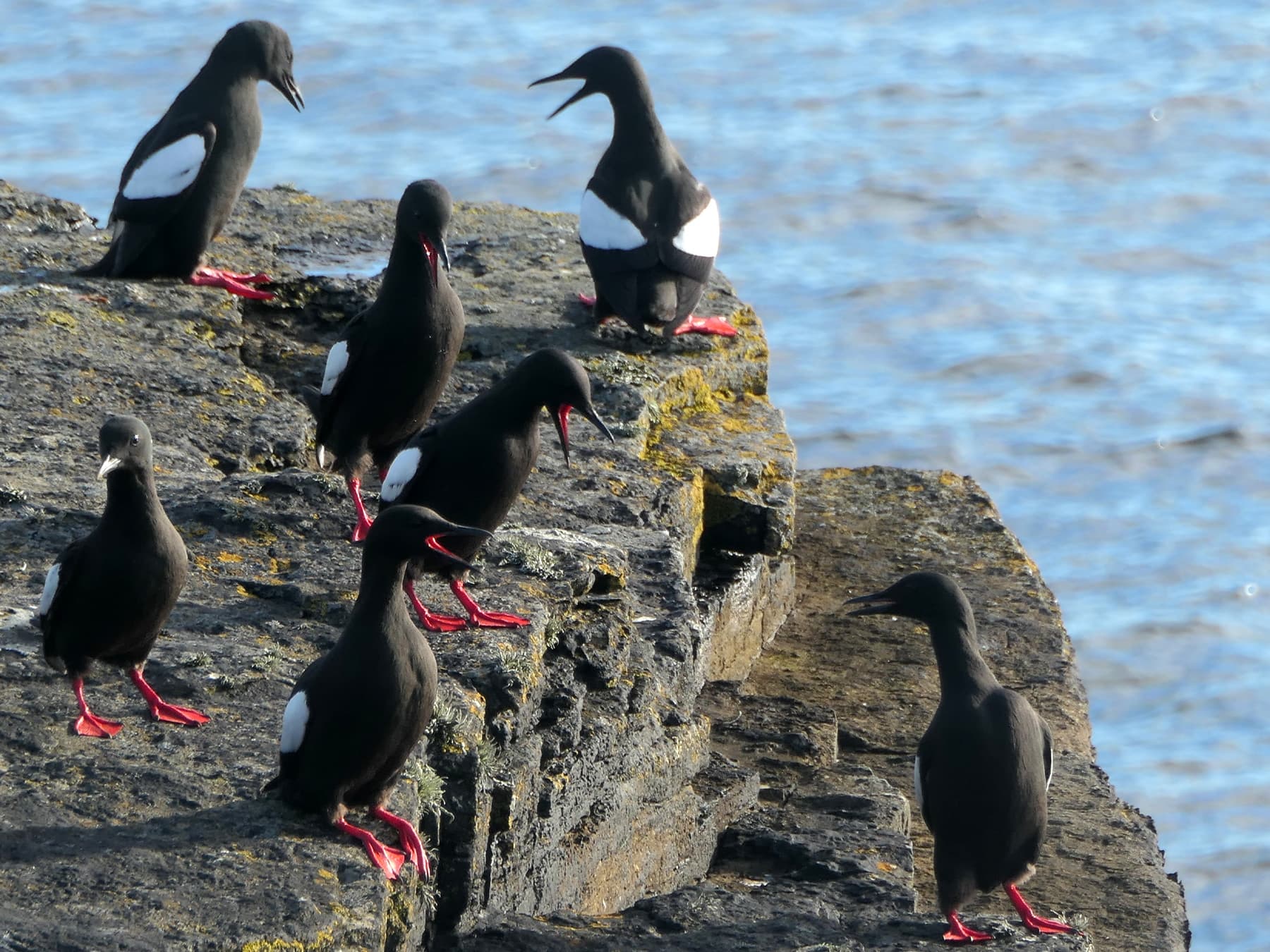
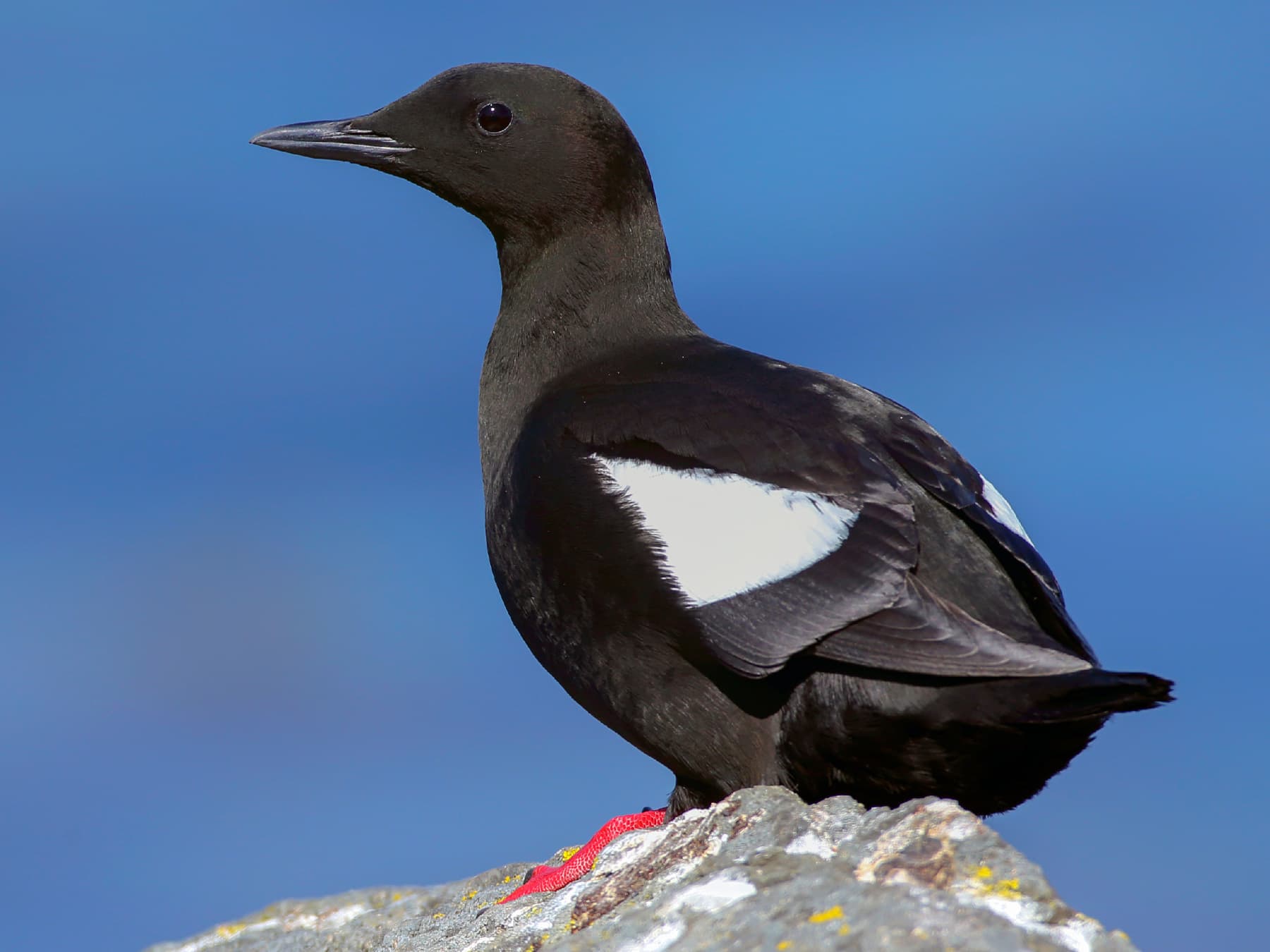
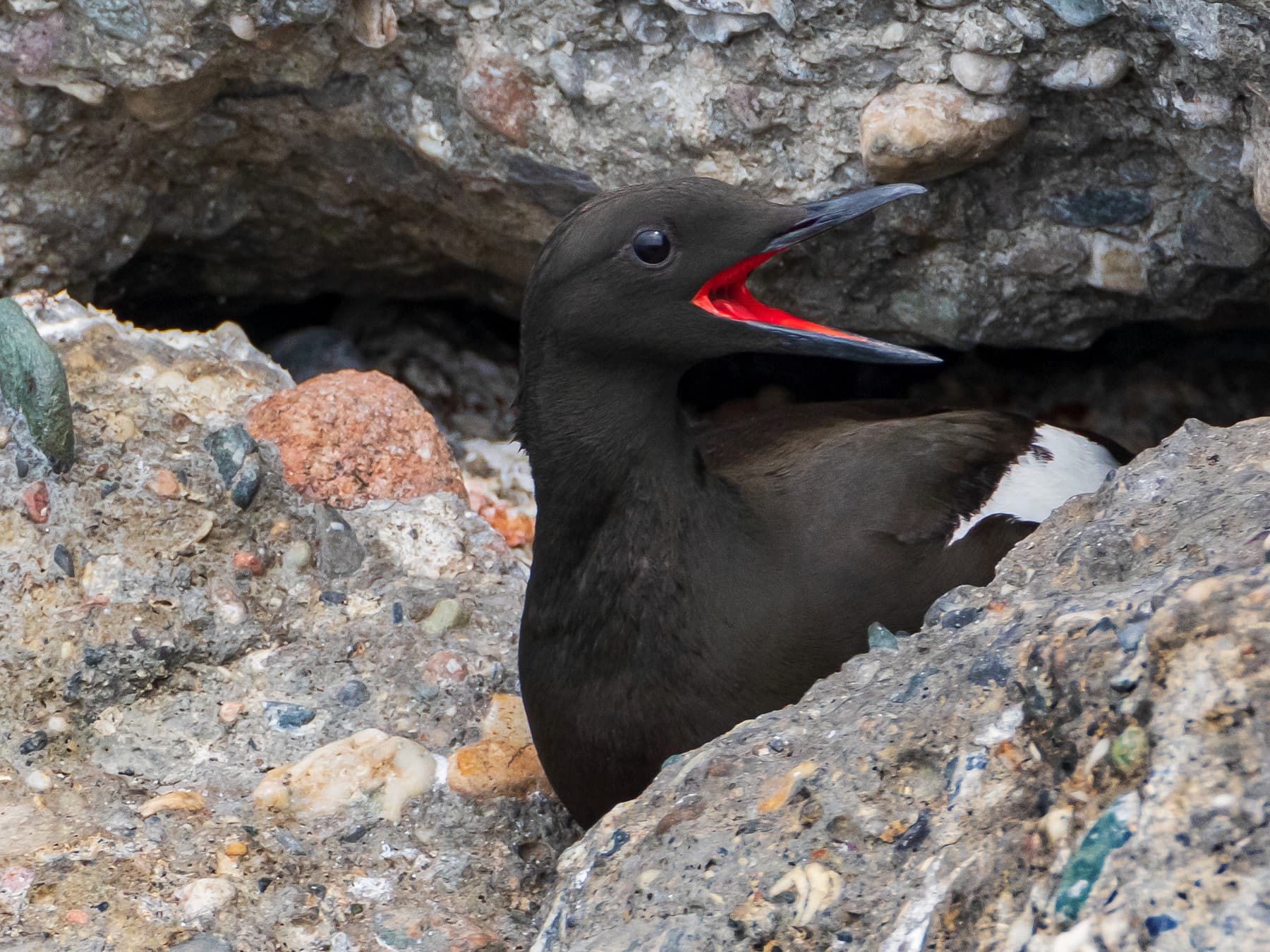
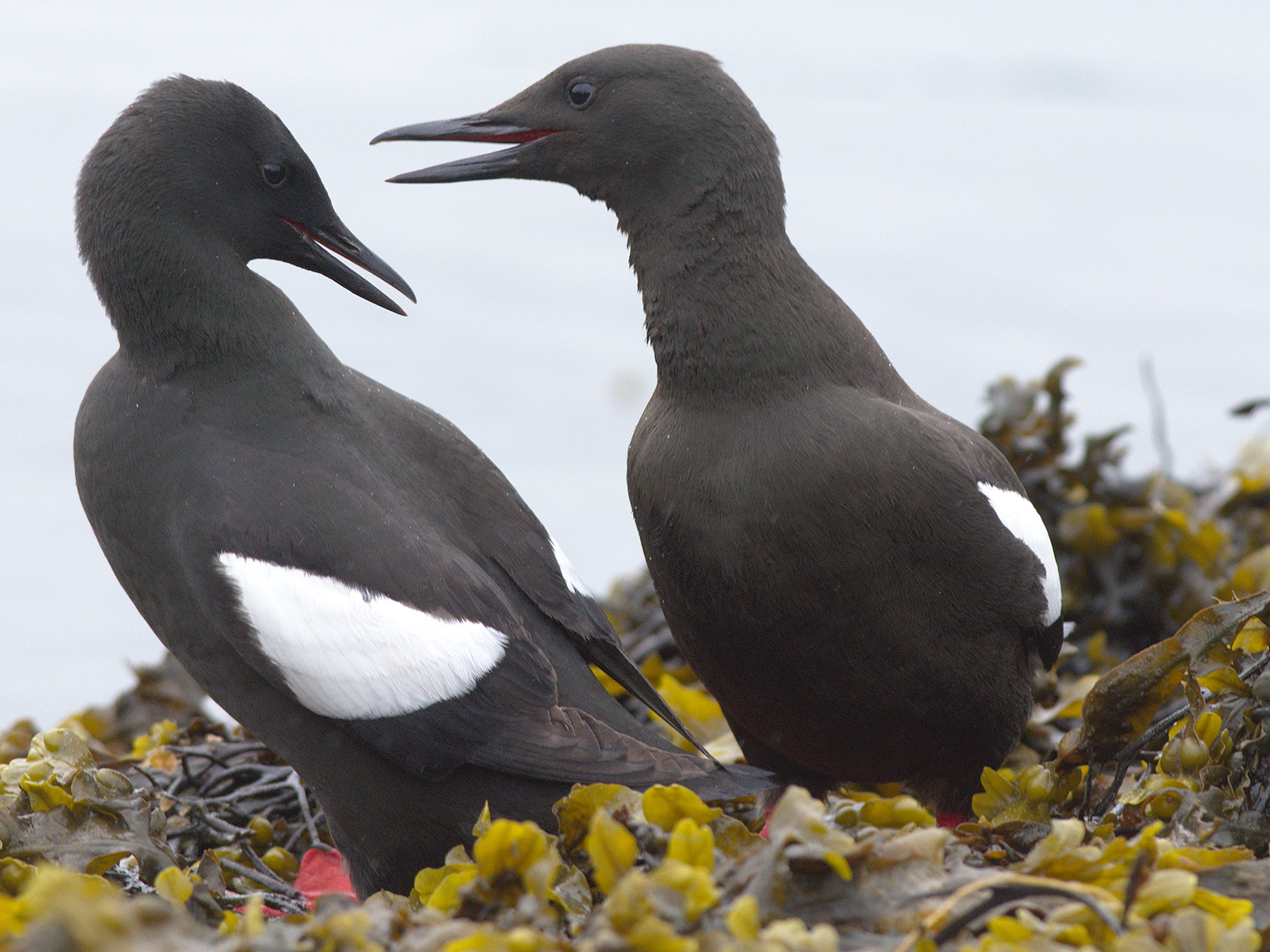
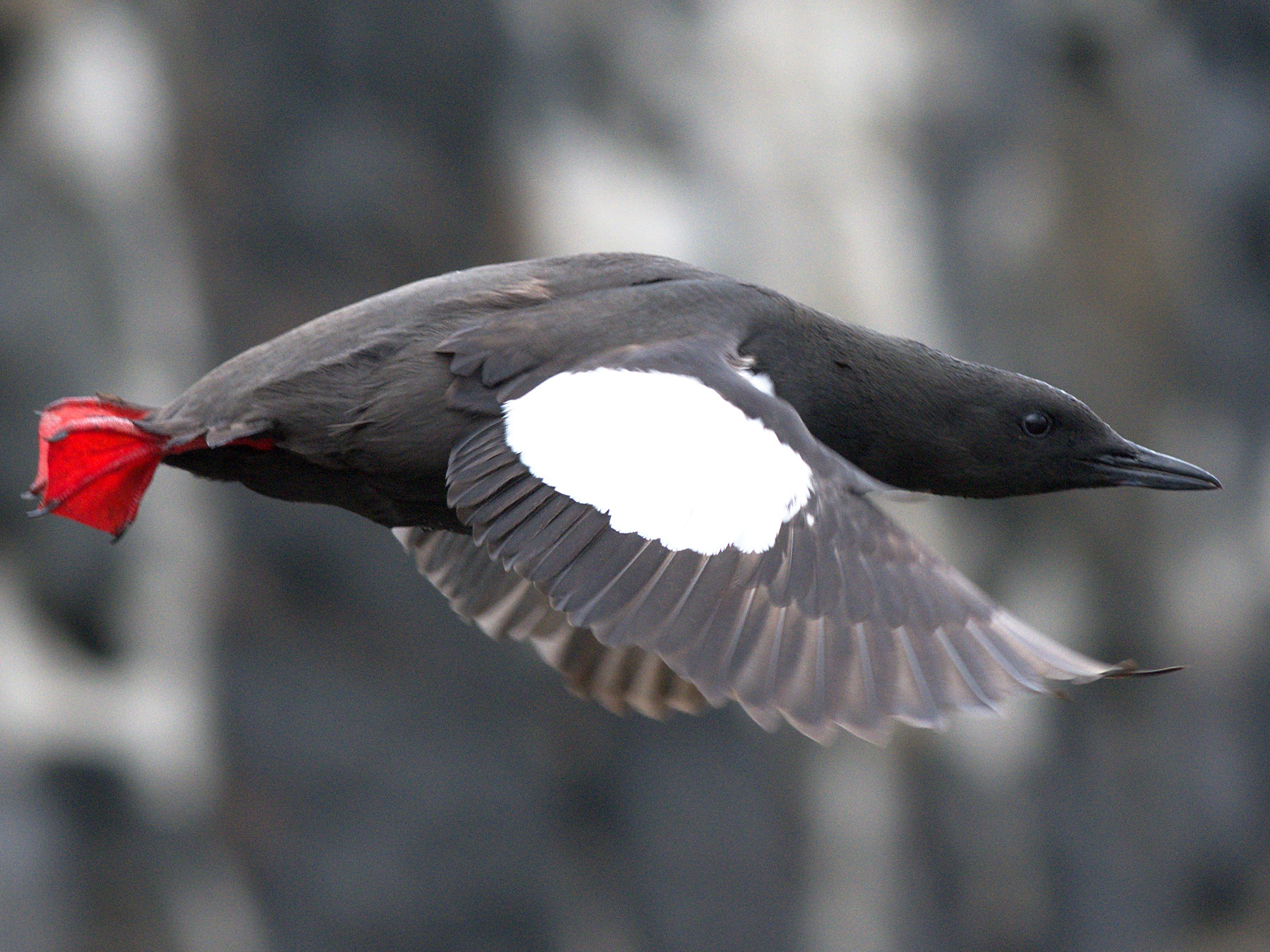
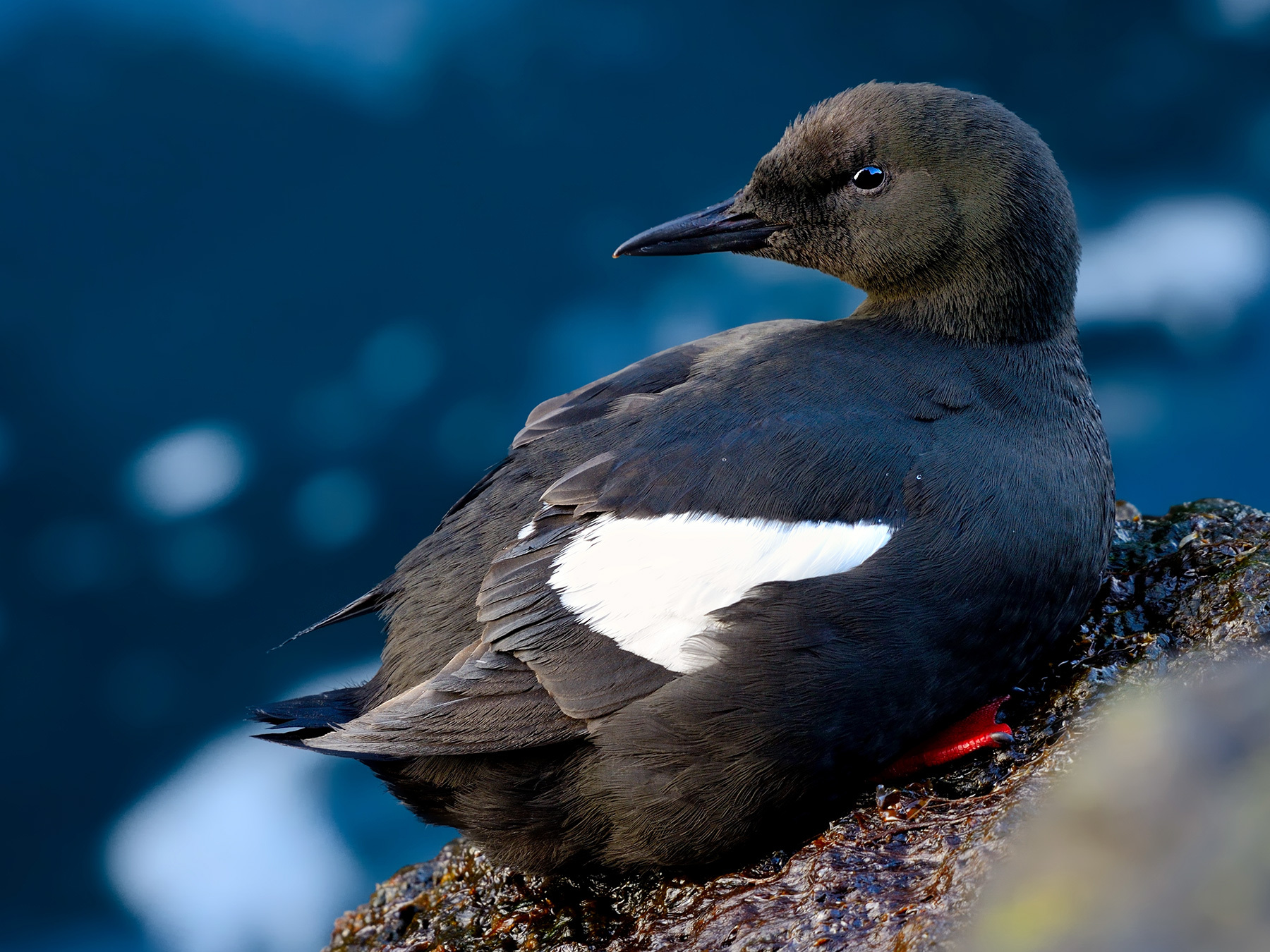
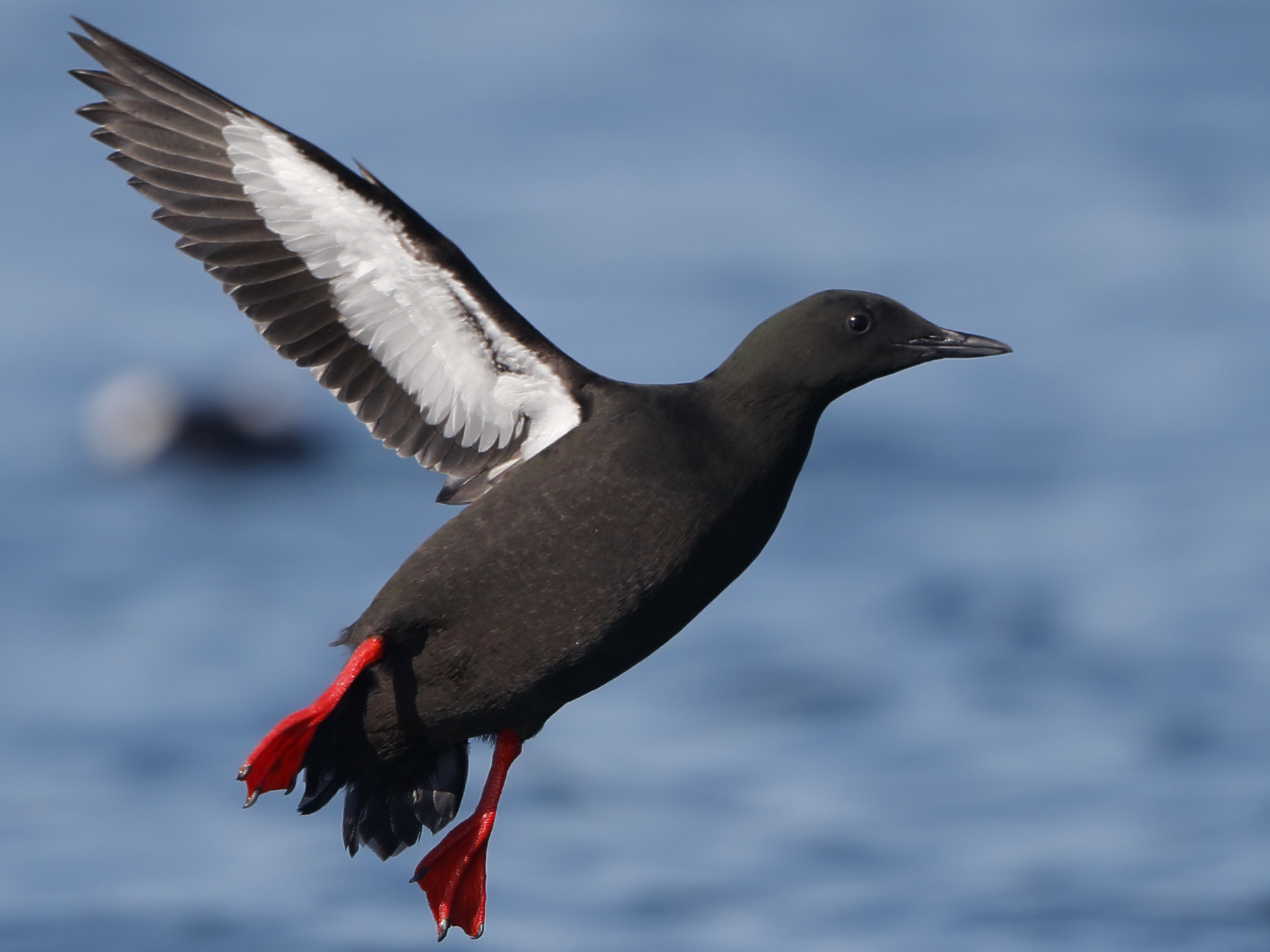
Black Guillemots are medium-sized black and white seabirds with short, pointed tails and long, thick necks. Their sharp, straight bills have a red inner lining, and their plumage has a satin-like quality. Their legs and large webbed feet are bright scarlet and stand out in flight or when perched.
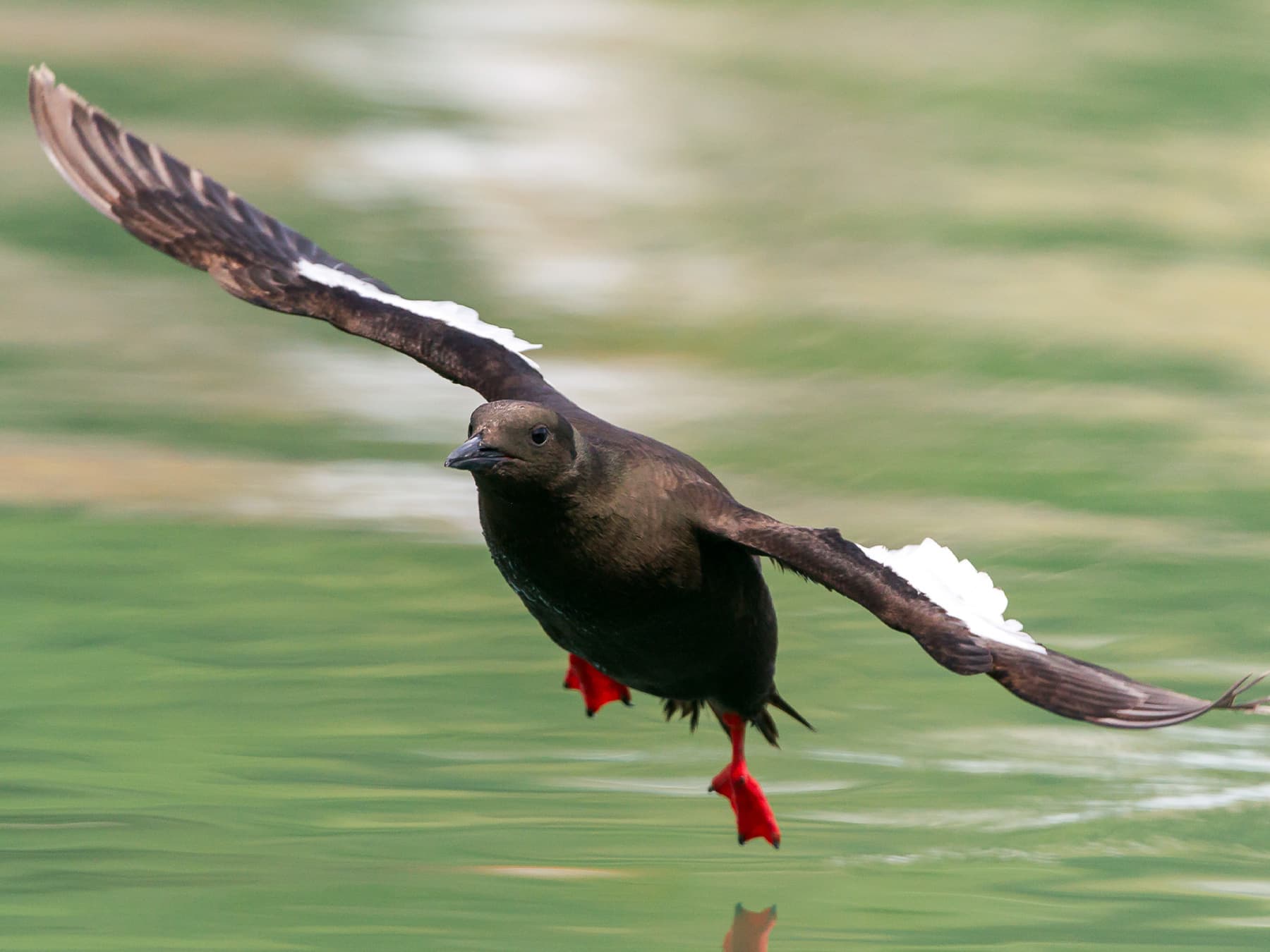
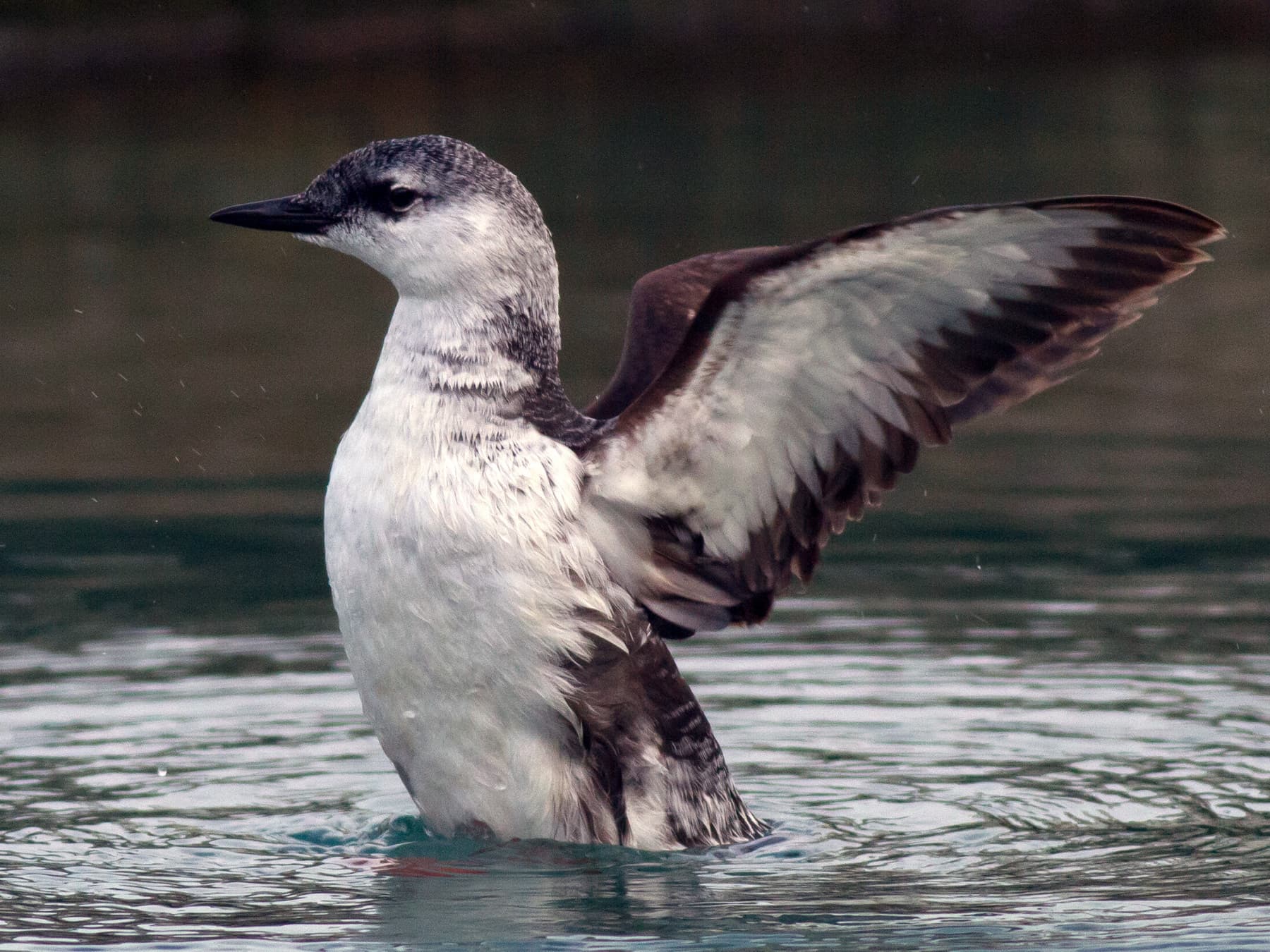
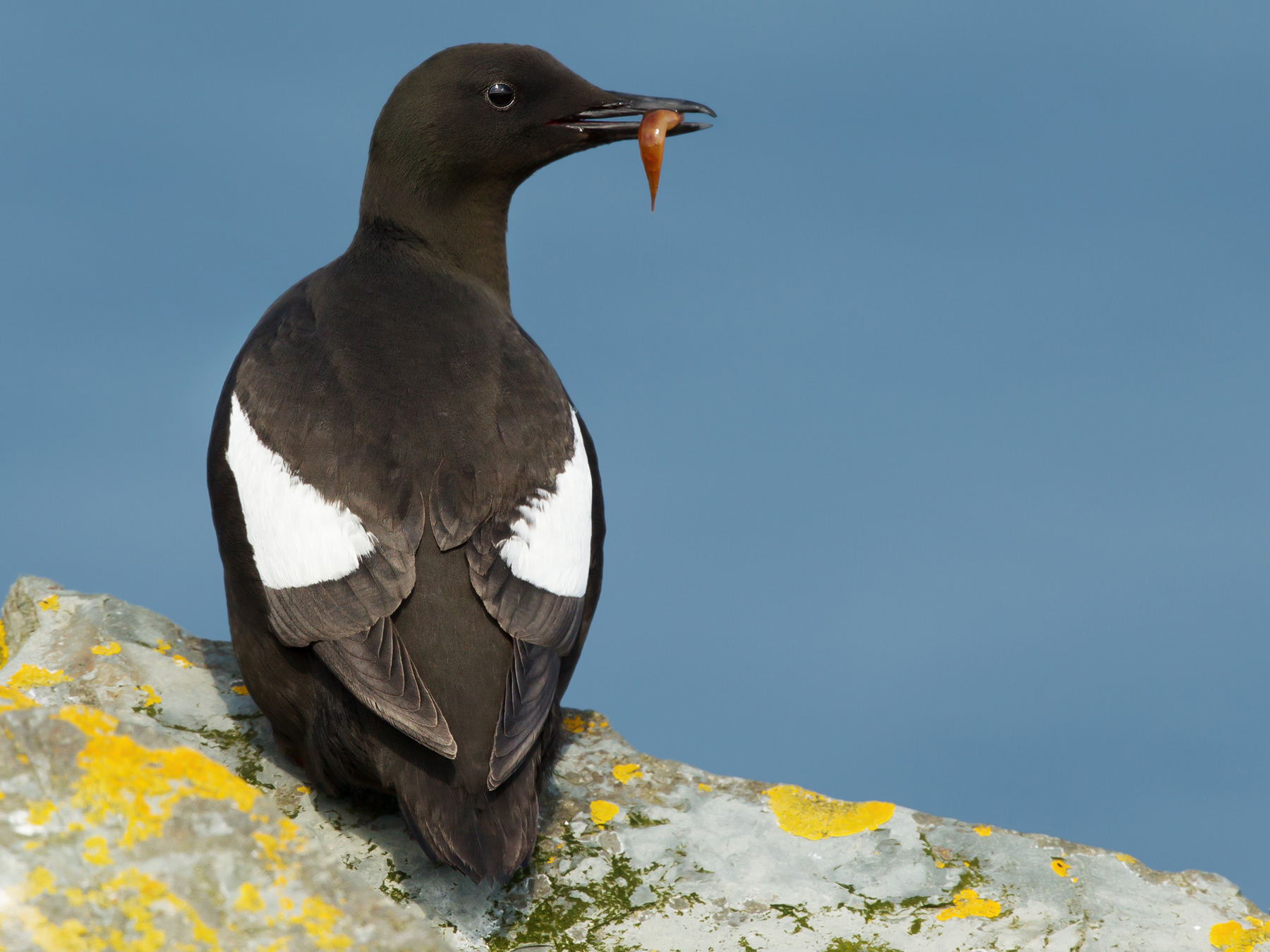
These birds have distinct summer and winter plumages. In the warmer months, they are mostly jet black with large white wing patches. Their winter plumage is much paler, appearing grayish above and white below. They fly low to the water, displaying pure white plumage under their wings.
Males and females are similarly sized and have the same plumage in all seasons. Juveniles resemble non-breeding adults but have spots or bars on their white wing patches and gray feathers around the sides and head.
How big are Black Guillemots?
Black Guillemots are medium-sized seabirds about the size of a pigeon.
Length
Black Guillemots have a body length of 30 to 32 centimeters or about 12 inches.
Weight
These stocky birds weigh 320 to 485 grams or about 11 to 17 ounces. Females are heaviest before egg laying, and both sexes lose significant mass while feeding their chicks.
Wingspan
The Black Guillemot has a relatively short wingspan of 52 to 58 centimeters or 20 to 23 inches.
Its size
Adults- Length
- 30–32 cm
- Wingspan
- 52–58 cm
- Weight
- 300–460 g
Its song and calls
What sound does a Black Guillemot make?
Black Guillemots produce a variety of thin, high-pitched songs and calls, particularly in the early nesting season when birds are actively displaying and courting. They also utter a drawn-out whistle when disturbed by humans or other potential predators.
- Song and calls0:00 / 3:51
Recorded in Nova Scotia, Canada · July 2023
When and where to see it
OctoberIn season
Most recorded in October
- 1. Shetland Islands1.2%
- 2. Orkney Islands0.99%
- 3. Argyll and Bute0.68%
- 4. North Ayrshire0.51%
- 5. Donegal0.51%
Each dot is a county, state or province: the bigger and darker, the larger the bird’s share of that place’s bird records that month. Grey dots: no regular records. The ringed point is the centre of the bird’s records this month; the arrow shows how it moved since last month, and the dashed loop its path through the year. “Arrivals” colours places where it becomes regular this month (orange) or is in its last regular month (grey). GBIF eBird Observation Dataset, 2019–2024. Map data: Natural Earth, US Census Bureau; place centres © OpenStreetMap contributors.
In your area
See when the Black Guillemot is recorded in your county, state or province.
How often the Black Guillemot turns up in the UK, Ireland, the United States and Canada through the year, from birdwatchers' records.
United Kingdom
Summer visitor · all year · most records in June
Ireland
Resident · all year · most records in July
United States
Resident · all year · most records in June
Canada
Resident · all year · most records in January
Show as a table
| Month | United Kingdom | Ireland | United States | Canada |
|---|---|---|---|---|
| January | 0.022% (regular) | 0.43% (regular) | 0.012% (regular) | 0.13% (regular) |
| February | 0.032% (regular) | 0.50% (regular) | 0.008% (regular) | 0.089% (regular) |
| March | 0.034% (regular) | 0.49% (regular) | 0.004% (regular) | 0.059% (regular) |
| April | 0.036% (regular) | 0.39% (regular) | 0.002% (regular) | 0.039% (regular) |
| May | 0.073% (regular) | 0.47% (regular) | 0.007% (regular) | 0.030% (regular) |
| June | 0.11% (regular) | 0.54% (regular) | 0.026% (regular) | 0.066% (regular) |
| July | 0.095% (regular) | 0.62% (regular) | 0.020% (regular) | 0.097% (regular) |
| August | 0.059% (regular) | 0.26% (regular) | 0.017% (regular) | 0.12% (regular) |
| September | 0.045% (regular) | 0.19% (regular) | 0.013% (regular) | 0.11% (regular) |
| October | 0.054% (regular) | 0.26% (regular) | 0.008% (regular) | 0.098% (regular) |
| November | 0.026% (regular) | 0.27% (regular) | 0.006% (regular) | 0.11% (regular) |
| December | 0.019% (regular) | 0.31% (regular) | 0.008% (regular) | 0.12% (regular) |
Recorded regularly in
Worldwide: recorded regularly in 21 countries
Countries where it was recorded in at least 3 of the 6 years 2019–2024. Linked countries have their own bird list.
Europe (17)
- Åland Islands
- Denmark
- Estonia
- Faroe Islands
- Finland
- France
- Germany
- Iceland
- Ireland
- Isle of Man
- Netherlands
- Norway
- Poland
- Russia
- Svalbard & Jan Mayen
- Sweden
- United Kingdom
North America (4)
Data: EOD – eBird Observation Dataset (Cornell Lab of Ornithology), accessed via GBIF.org, CC BY 4.0. Records from 2019–2024, aggregated and filtered by Birdfact. How these lists are made
What is the habitat of a Black Guillemot?
Black Guillemots are marine birds that live along rocky shores. They generally hunt in the intertidal zone and waters up to about 100 feet (30m) deep, although Arctic breeders also forage far from the shore in holes and cracks in the ice.
What is the range of a Black Guillemot?
The Black Guillemot is widespread in temperate and Arctic seas of the Northern Hemisphere with a virtually circumpolar distribution. In the Old World, they live off the coasts of Iceland, the United Kingdom, Northern Europe, and Russia. North American populations live off the shores of Alaska, Greenland, Canada, and the Northeast of the United States.
Where do Black Guillemots live?
Black Guillemots generally forage close to the shore, especially during the nesting season. Many remain in shallow coastal waters throughout the year, although they may be forced to travel far out to sea with advancing ice sheets at high latitudes.
How rare are Black Guillemots?
The total population of Black Guillemots is unknown, although a 1980s estimate put the number at about 200,000 - 350,000 pairs, and the IUCN estimates the world population at anything from 400,000 to 1,499,999 individuals. They are not rare, although the population is spread out over a wide geographic area.
Where can you see Black Guillemots in North America?
The Maine coastline is the best place to look for Black Guillemots in the United States. Further north, they are widespread along the coast of Eastern Canada, including the Hudson Bay, and occur in a few isolated areas of Northern and Western Alaska.
Where can you see Black Guillemots in the UK?
The Shetland and Orkney islands and Scotland’s North and West Coasts offer the best chance of seeing Black Guillemots in the United Kingdom. However, birders can look for them further south around Cumbria, Anglesey, and the Isle of Man. They are also widespread along the Northern Ireland and Republic of Ireland Coastline.
Migration
Do Black Guillemots migrate?
Black Guillemots from the south of their range tend to remain near their nesting areas throughout the year, although populations from the high Arctic must migrate to find open waters in the winter.
Are Black Guillemots native to North America?
Black Guillemots are native to North America. These birds have not been introduced outside of their natural range.
Are Black Guillemots native to the UK?
Black Guillemots are native to the United Kingdom.
Tips for seeing it
- Look for their distinctive white wing patches when in flight
- Search rocky coastlines and offshore islands, especially in northern regions
- Listen for their high-pitched, whistling call near nesting sites
- Observe their diving behavior from coastal vantage points
What it eats
What do Black Guillemots eat?
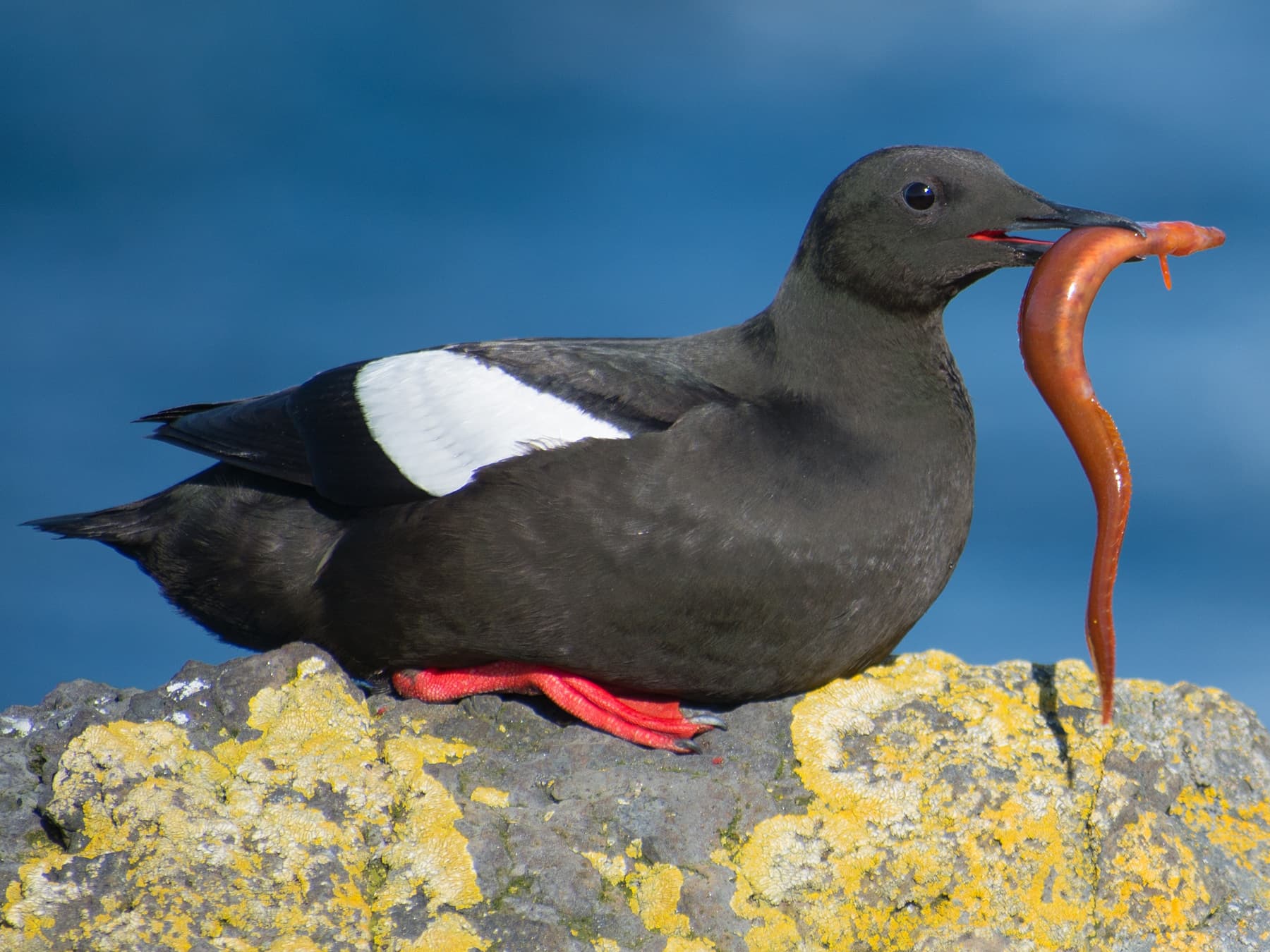
Black Guillemots are primarily piscivorous (fish eaters) and feed on many species, from schooling fish like herrings to blennies and other bottom-dwellers. They eat a variety of other sea creatures, such as squid, crustaceans, worms, and mollusks.
Short wings come in handy when hunting their prey. These diving birds ‘fly’ through the water and can reach depths of at least 160 feet (50m) and stay submerged for as long as two minutes while searching the seabed.
What do Black Guillemot chicks eat?
Black Guillemot chicks eat small fish. Both parents feed their chicks every day from the day they hatch to the day they fledge the nest.
Nesting and breeding
Where do Black Guillemots nest?
Black Guillemots nest in crevices on rocky cliffs and islands. They may build a crude nest from materials like seaweed and shells, although many pairs lay their eggs directly on the rocks. They may nest in large colonies of thousands of pairs in some areas but more often nest singly.
When do Black Guillemots nest?
Black Guillemot pairs begin courtship in the spring and lay their eggs in May and June. The eggs hatch after about 29 days, and the chicks leave the nest about five weeks later.
What do Black Guillemot eggs look like?
Black Guillemots lay two boldly spotted eggs that measure approximately 59 millimeters long and 40 millimeters at their widest. They have a whitish or greenish ground color and are marked most heavily toward the blunt end.
Do Black Guillemots mate for life?
Black Guillemots are monogamous birds that first breed at the age of four. Pair bonds last several years, and they generally return to the same area or even nest site year after year.
Behaviour
Are Black Guillemots aggressive?
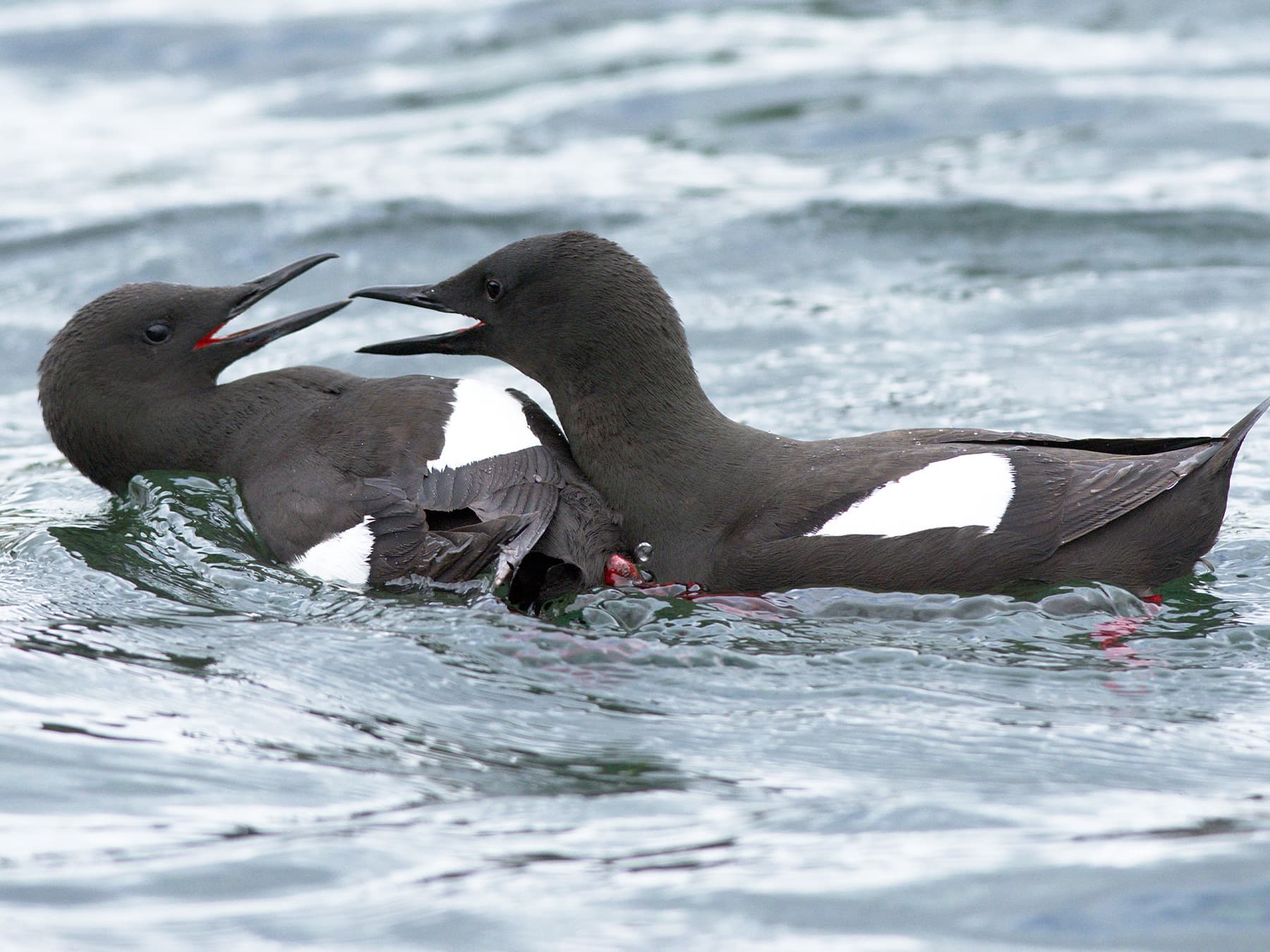
Black Guillemots may act aggressively toward each other at communal roosts and nest colonies. They will chase and lunge at each other and vocalize before engaging in physical conflict but may ultimately bite, peck, claw, or strike each other with their wings.
Where do Black Guillemots sleep at night?
Black Guillemots sleep on perch rocks near the shore or on the nest when incubating. They may also roost on the water near the nest site.
Lifespan and predators
How long do Black Guillemots live?
Black Guillemots are relatively long-lived birds. They can live for at least 27 years, although they have an average life expectancy of about 11 years.
What are the predators of Black Guillemots?
Black Guillemots are vulnerable to a variety of avian and mammalian predators at each stage of their life cycle. Typical predators include:
- Peregrine Falcons
- Great Skuas
- Great Black-backed Gulls
- Snowy Owls
- Mink
- Otters
- Rats
- Raccoons
Are Black Guillemots protected?
Black Guillemots are protected in the United Kingdom by the Wildlife and Countryside Act 1981 and in North America by the Migratory Bird Treaty Act 1918.
Are Black Guillemots endangered?
Black Guillemots are not endangered. The species has an amber conservation status in the United Kingdom and is ranked a ‘Least Concern’ species on the IUCN Red List.
Conservation
While currently listed as Least Concern, Black Guillemots face threats from oil spills, marine pollution, and climate change. Rising sea temperatures may affect their prey availability, potentially impacting breeding success.
Conservation efforts focus on protecting breeding habitats and reducing marine pollution.
More photos
6 photos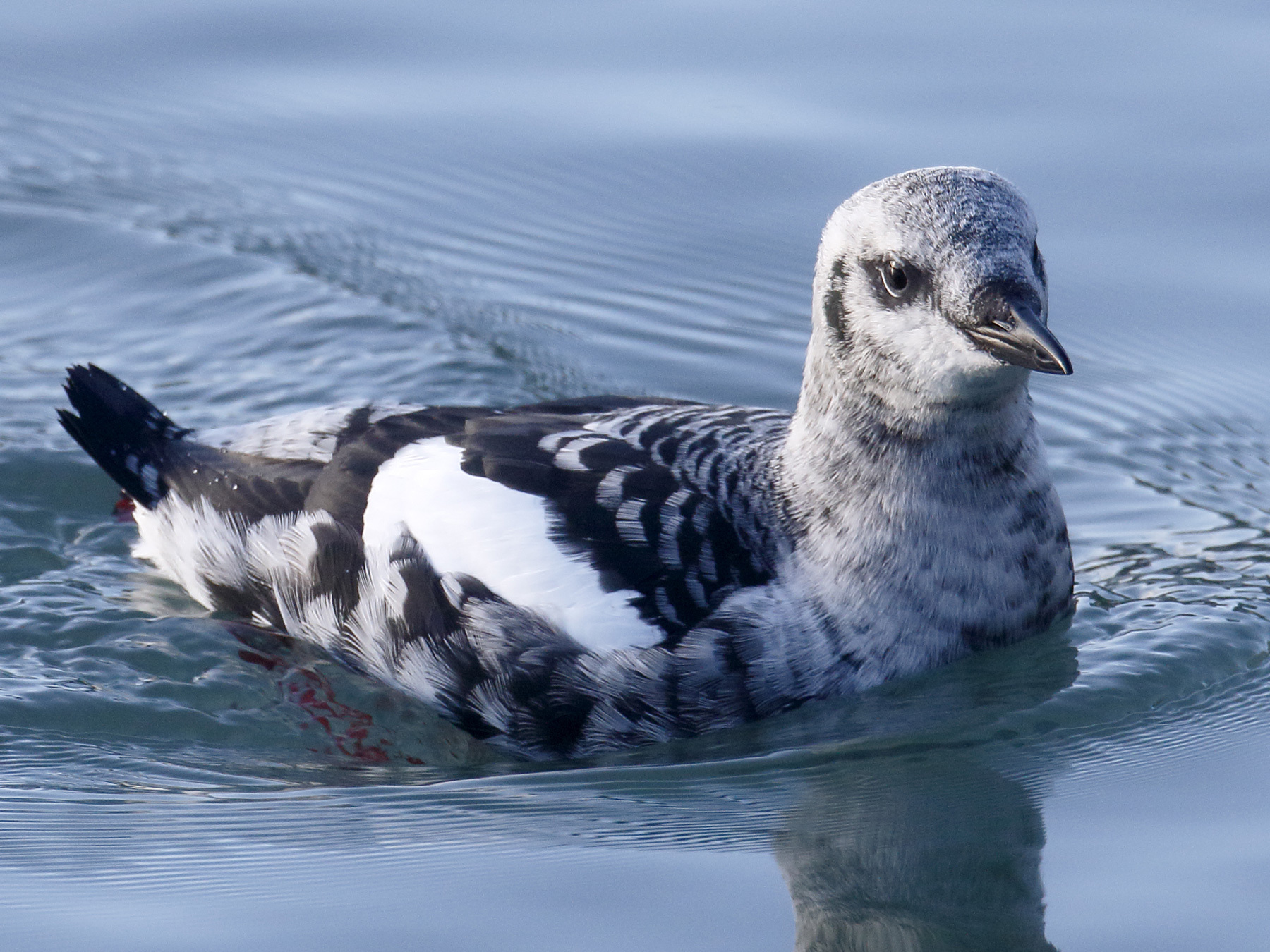
Quick facts
- Length
- 30–32 cm
- Wingspan
- 52–58 cm
- Weight
- 300–460 g
- Lifespan
- 11 years · oldest recorded 29.9 years
- Family
- Auks & Puffins
- Migration
- Partial migrant
- Global status (IUCN)
- Least Concern
- World population
- 410,000 - 1,484,000 mature individuals
- Population trend
- Unknown
- Also called
- Tystie
- Scientific name
- Cepphus grylle
Questions
1What is the difference between a Black Guillemot and a Pigeon Guillemot?
The Pigeon Guillemot (Cepphus columba) appears very similar to the Black Guillemot (C. grylle) but can be distinguished by the black wedge within its white wing marking and the gray plumage of the underwing. The two species overlap only in the Bering Sea off Western Alaska.
Sources
4- 1BirdLife International. 2018. Cepphus grylle. The IUCN Red List of Threatened Species 2018: e.T22694861A132577878. Source (opens in a new tab)
- 2BirdLife International. 2018. Cepphus grylle. The IUCN Red List of Threatened Species 2018: e.T22694861A132577878. Source (opens in a new tab)
- 3BirdLife International. 2018. Cepphus grylle. The IUCN Red List of Threatened Species 2018: e.T22694861A132577878. Source (opens in a new tab)
- 4Fransson et al., EURING list of longevity records for European birds (2010) Source (opens in a new tab)

Checked by
Nathan Cope, founder and editor
Nathan founded Birdfact and leads its writers and contributors in the UK, the US and Canada. He has watched and studied birds for more than ten years, and checks every article and species guide before it’s published.