


Common Gallinule
Florida Gallinule, American Moorhen · Gallinula galeata
By the Birdfact teamChecked by Nathan Cope
On this page13 sections
How to recognise it
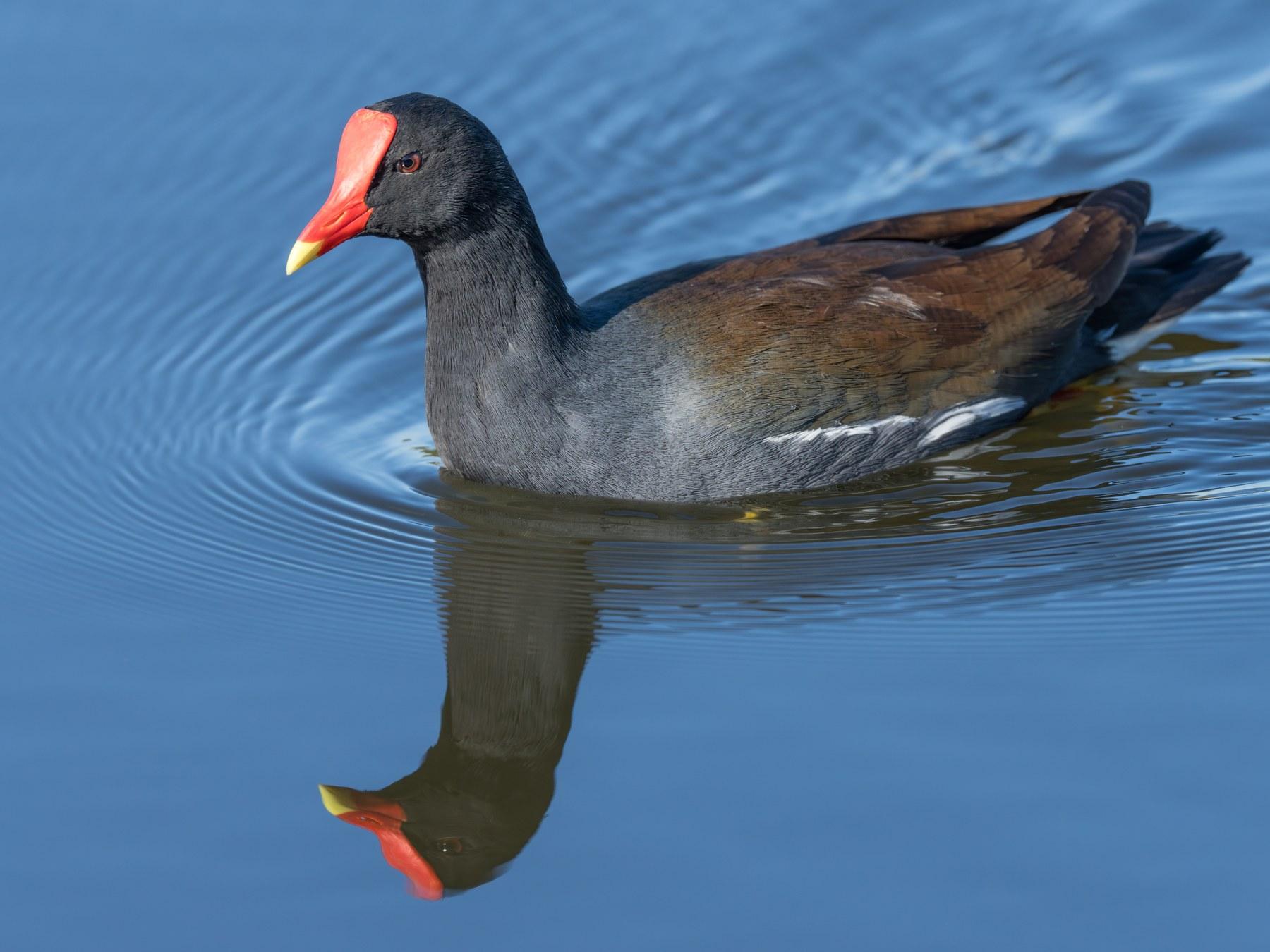
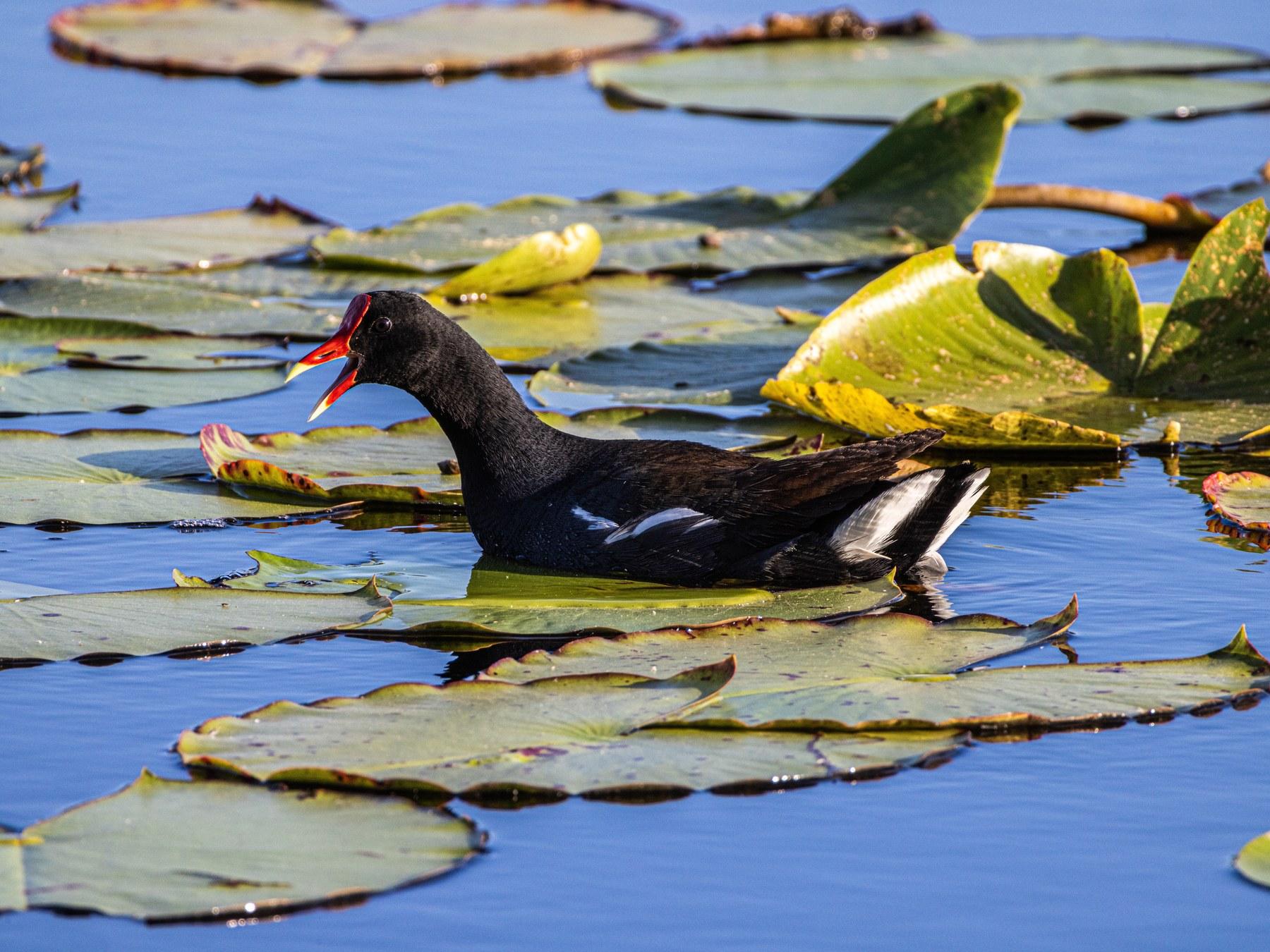
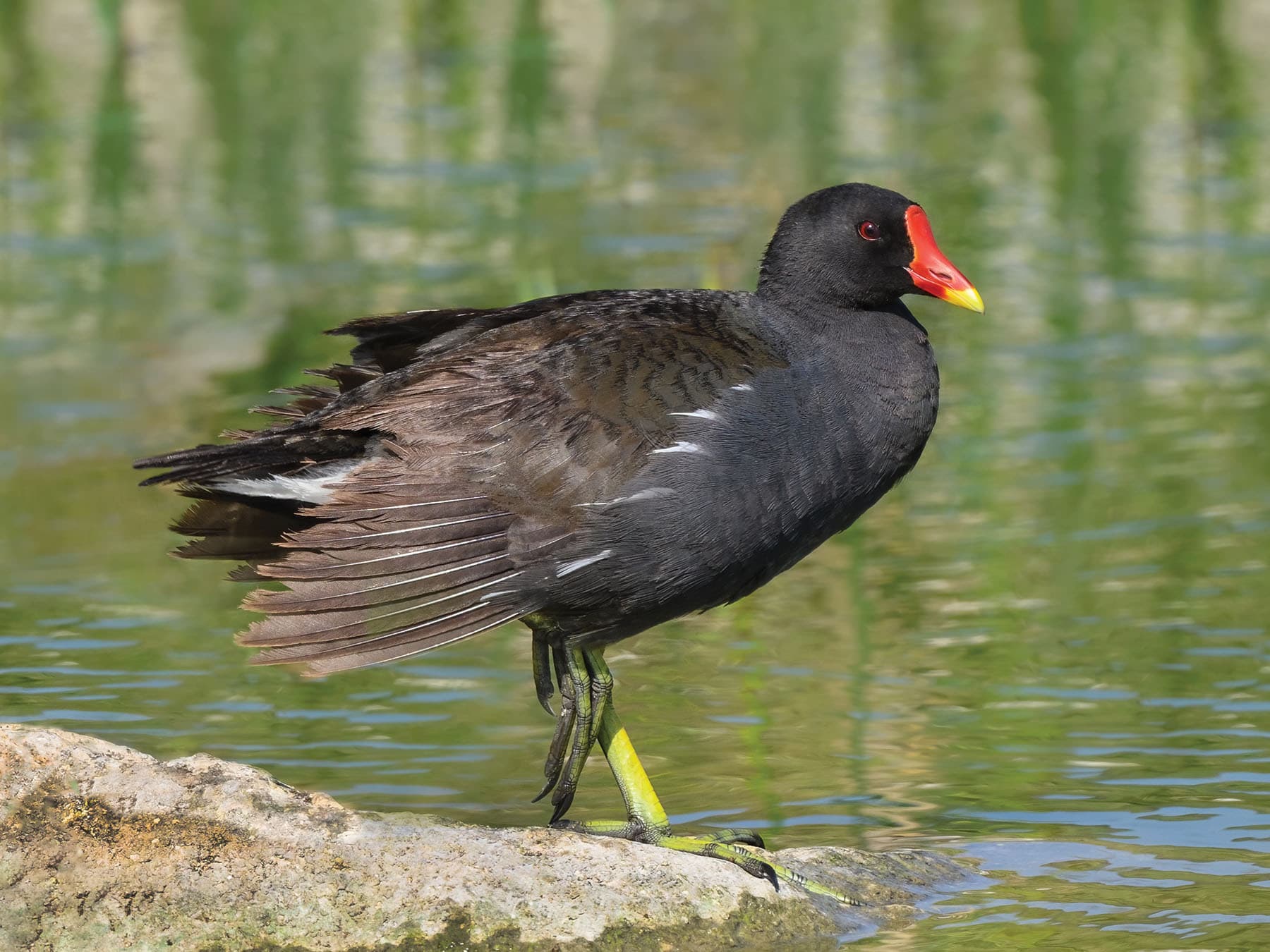
Picture a dark bird the size of a small duck, swimming along the edge of a cattail marsh, pumping its head back and forth as it goes and flicking up a tail edged with white. Up close, the bright red shield on its forehead and the red, yellow-tipped bill give it away. It is a rail, not a duck, and a cousin of the coots.
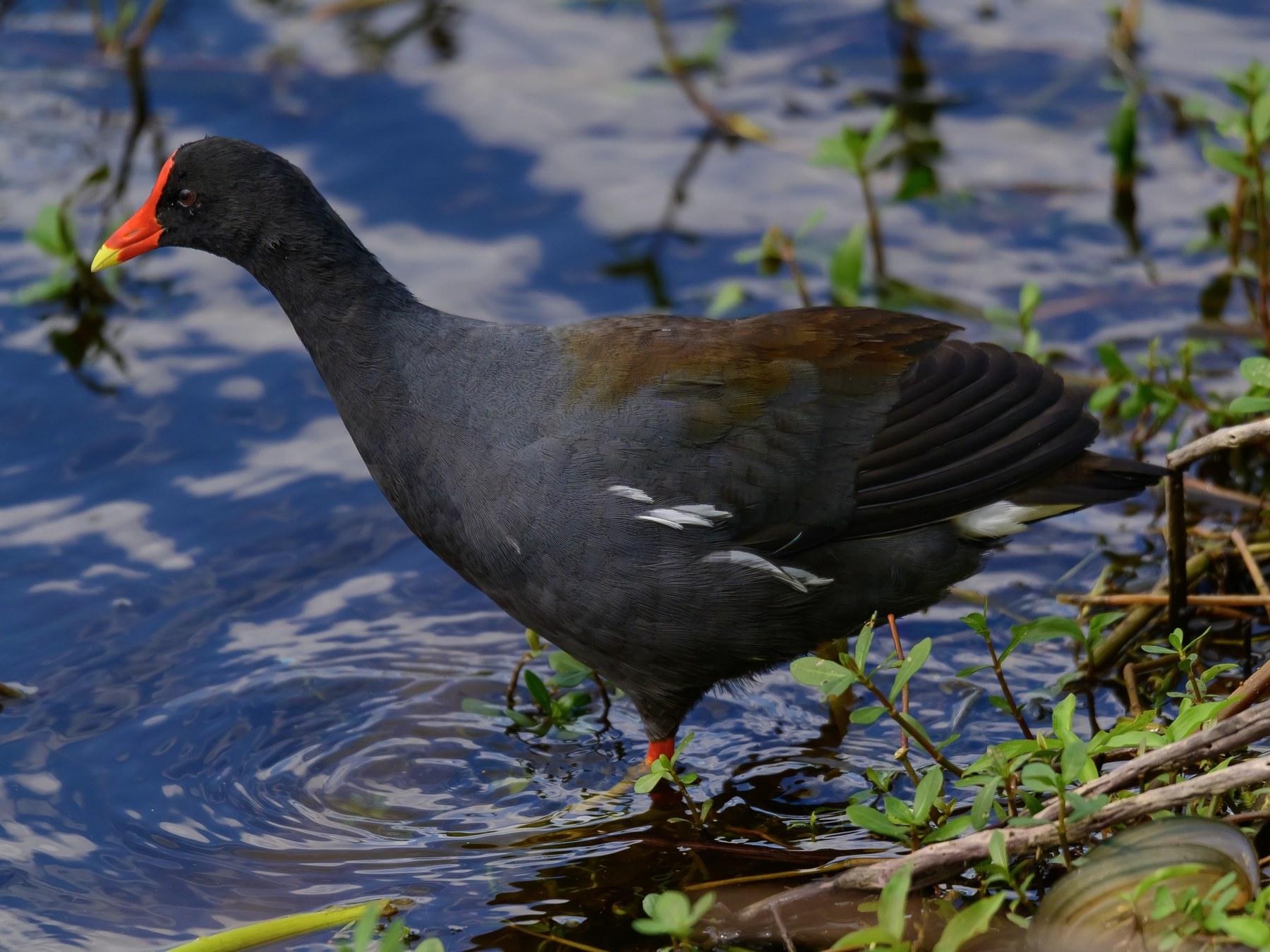
Adults are blackish on the head and neck, dark gray on the sides and olive-brown on the back and wings. A white stripe runs along the upper flank. Under the tail, two white patches are split by a black center, and they flash each time the tail jerks up. In North America the red shield reaches just over the front of the eye and is usually cut straight across at the back.
Outside the breeding season the chin, throat and underparts turn a paler gray, and the bill and shield go duller, the shield also shrinking.
Size
The Common Gallinule is 12.6-13.8 in (32-35 cm) long, with a wingspan of 21.3-24.4 in (54-62 cm), and weighs 10.9-16.1 oz (310-456 g). It is larger than a Sora, smaller than a Mallard, and smaller than an American Coot.
Feet and legs: identification
The toes are very long, with no lobes and no webbing between them, unlike the broad lobes on a coot's toes. Even so, the gallinule swims well, and its long toes let it walk across floating plants and soft mud.
The legs are yellowish, from bright yellow to olive-yellow. Look for a small red band, or garter, just below the thigh feathers; it is hard to see.
Male, female and young
Males and females look alike. The male is almost always heavier, though: in one measured sample, males averaged 14.6 oz (415 g) and females 12.3 oz (349 g), and the difference can sometimes be noticed in the field.1
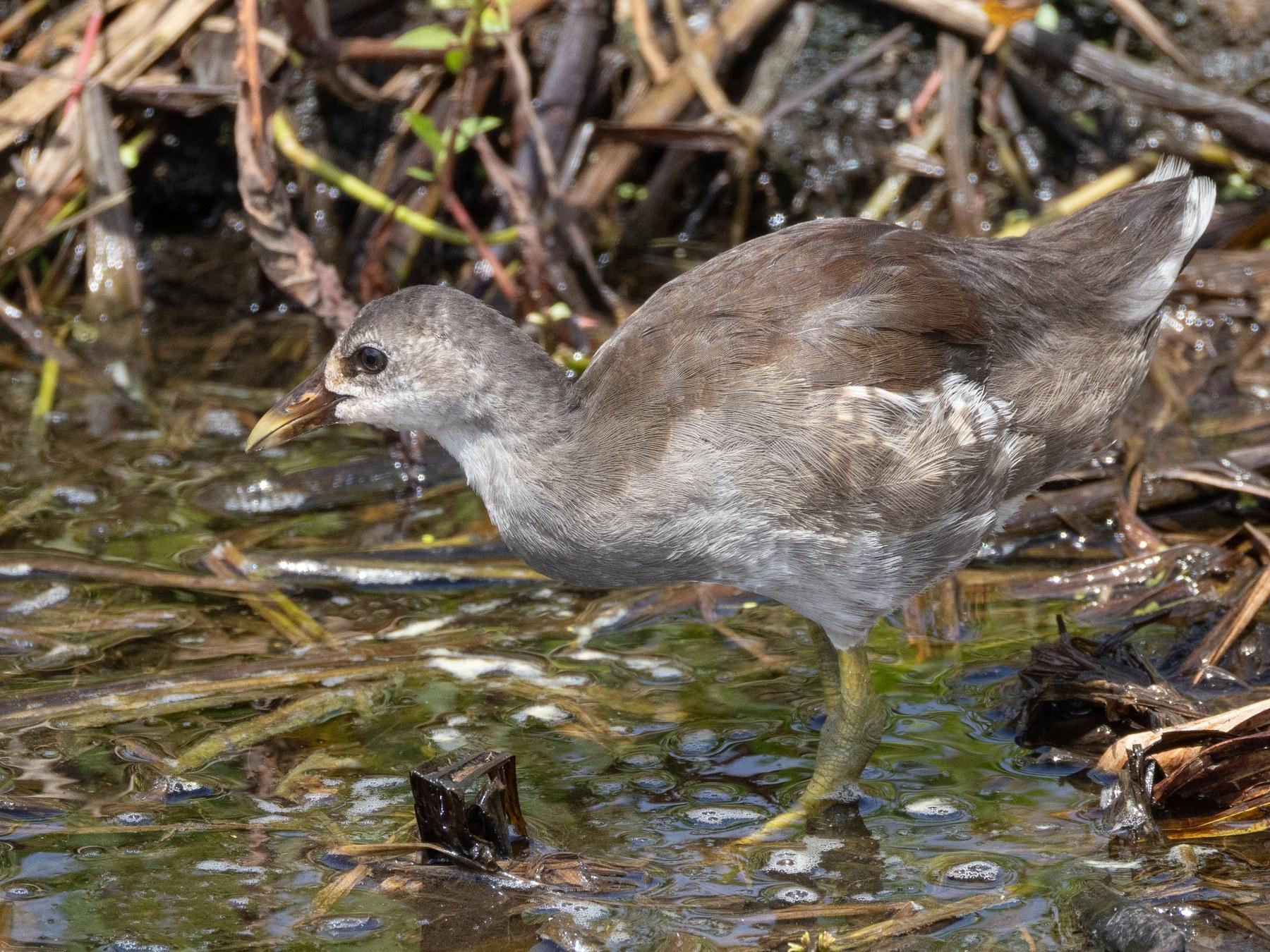
Juveniles are brownish gray, paler below and whitish on the belly, with a pale buff line above the lores, between the eye and the bill. They already have the adult's white flank stripe and white undertail sides, but the bill and small shield are dull greenish brown, not the adult's bright red, and the legs are a dull olive-gray. Older young are dark gray below and dark brown above, still without the red bill and shield, which stays small into their first breeding plumage.
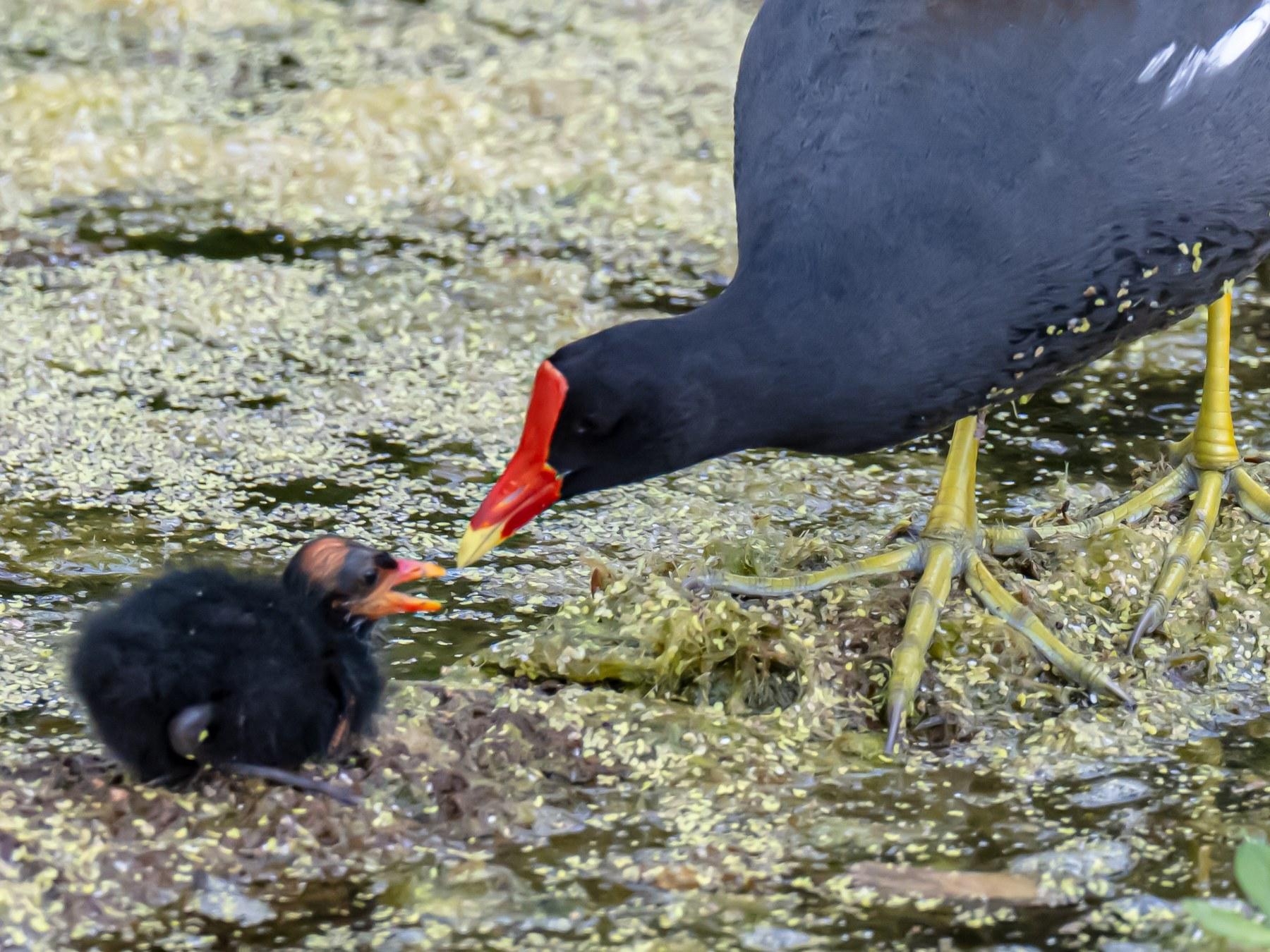
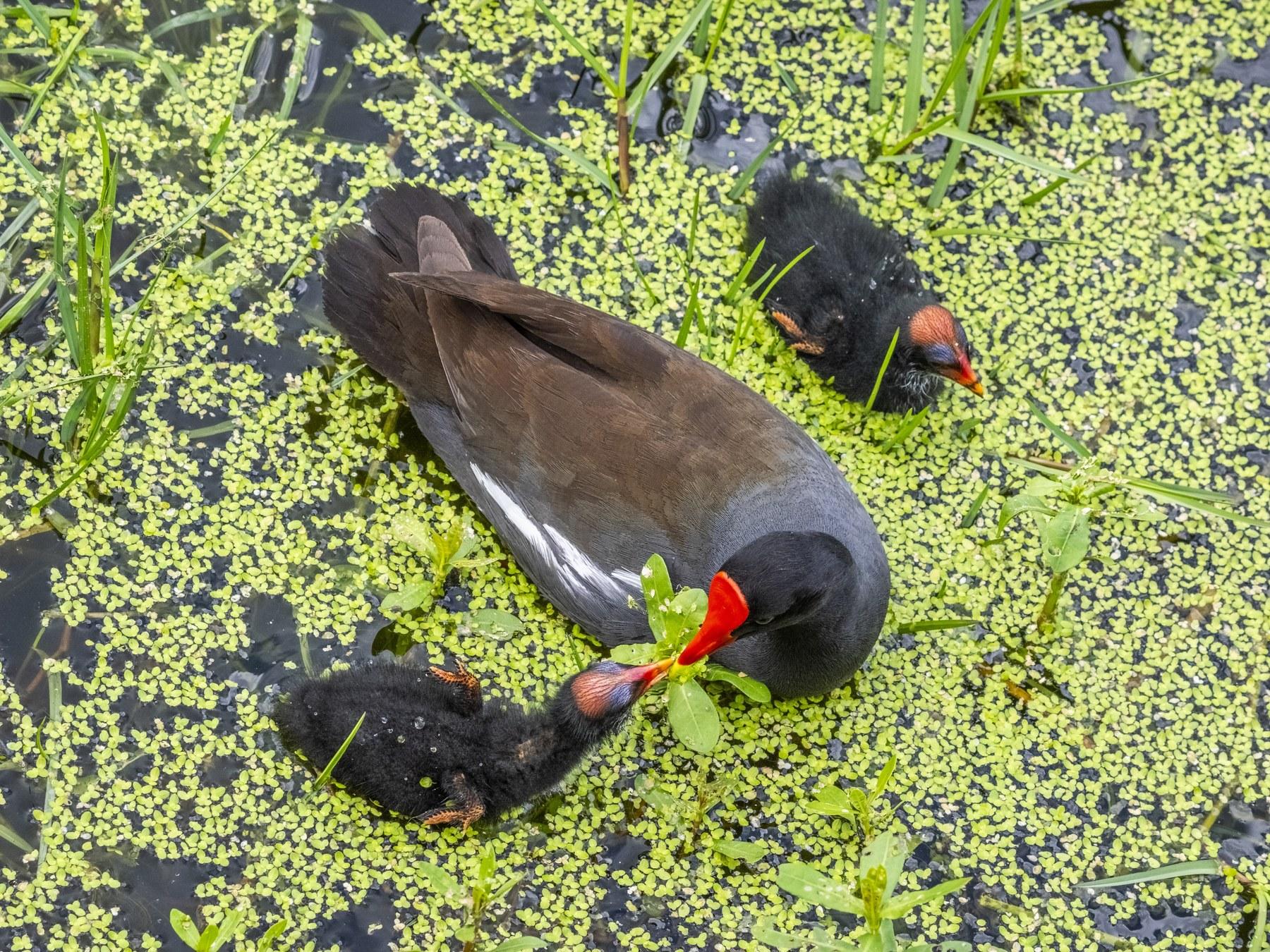
Downy chicks are blackish, with bare skin on the head, wings and legs. The bill and shield are scarlet with an orange-yellow tip, the bare crown is reddish, and there is blue skin above the eye. Each wing carries a tiny claw-like spur that helps the chick grab plants.
Identification: coots and other lookalikes
The American Coot shares many of the same marshes. It is larger and stockier, with a white bill, no white stripe along the side and broad lobes on its toes. A swimming gallinule keeps its tail level and often holds its wings up, so the tips stick up over its back.
Hybrids between coot and gallinule are rare. A 2020 paper described two photographed hybrids, from California and Baja California, adding to three earlier reports.2
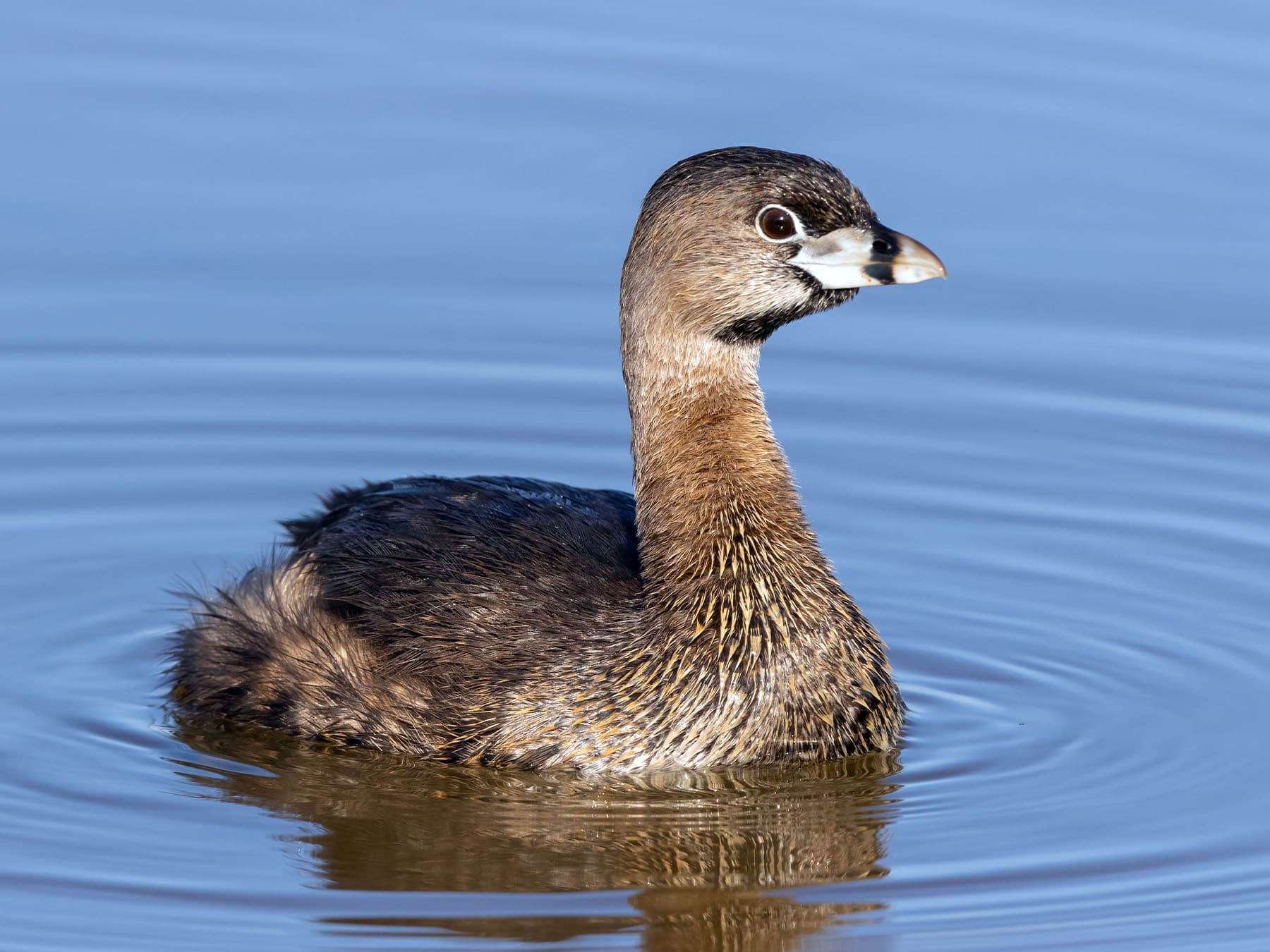
In the Southeast, the Purple Gallinule is glossy purple on the head and underparts and olive-green above, with a pale blue shield, an all-white undertail and no side stripe; it is slimmer, with a longer neck and legs. The Pied-billed Grebe of the same ponds is brown rather than blackish, with a short, thick, pale bill that has a black band in the breeding season, and it has no red shield or side stripe.
Names and identification: the split from the moorhen
Until 2011 this bird and the Eurasian Moorhen of the Old World were treated as one species. In July 2011 the American Ornithologists' Union, in its 52nd Supplement to the Check-list, separated them on differences in their calls, in the shape of the bill and shield, and in mitochondrial DNA.3
The bird has changed names more than once. In North America it was long called the Florida Gallinule. Common Gallinule became its official name in 1957, switched to Common Moorhen in 1983 and came back with the 2011 split.1 The Old World bird is now the Common or Eurasian Moorhen, depending on the checklist. You may also see this one called the American Moorhen.
The two look almost the same. The American bird's laughing call is highly distinctive, and it has a slightly higher, more squared-off shield and a somewhat less yellow lower mandible.4
The Eurasian Moorhen is a rare stray to North America. A juvenile male collected on Shemya Island in the Aleutians, Alaska, on 14 October 2010 was the first North American record confirmed by molecular analysis.5
Not sure it’s a Common Gallinule? Check your photo: Birdfact names the bird and shows the look-alike side by side.
Its size
Adults- Length
- 32–35 cm
- Wingspan
- 54–62 cm
- Weight
- 310–456 g
Its song and calls
Like many marsh birds, the Common Gallinule is more often heard than seen. Its loud, harsh calls are mostly hen-like, and they carry through dense cattails.
It has no song in the songbird sense. Its main calls include the cackle, a harsh run of notes in which the first few rise slightly and the rest fall and slow down; it is believed to be the males' territorial call. The squawk is an explosive, raspy note on one pitch, and what it is for is unknown. The yelp, a sharp, high pip, is an alarm call.
Softer, lower clucks, given singly or in runs, may be contact calls; both parents give them while leading their young. After the eggs hatch, both sexes also give a whinny, usually when they are with young. The male's voice is lower-pitched than the female's.
At one tidal marsh on the Hudson River in 1972, calling began at the end of April, was intense through May and fell away sharply in June. It was most intense at dawn, then at dusk, and rarely heard at night.1
- Calls (heard, not seen)0:00 / 0:17
Recorded in Florida, United States · February 2026
- Paired calls (heard, not seen)0:00 / 0:12
Recorded in Florida, United States · February 2026
Heard one and not sure? Let the bird song identifier listen.
When and where to see it
Common Gallinules breed locally across much of the eastern and central US, most of all around the Great Lakes, in the Gulf Coast states, throughout Florida and along the Atlantic Coast. In the West they breed only in scattered places in California, Nevada, Utah, Arizona and New Mexico. They are largely absent from the Piedmont and the southern Appalachians.
Canada is the northern limit. There it breeds in southern Ontario and southwestern Quebec, and smaller numbers breed in eastern New Brunswick and western Nova Scotia. Farther south it breeds through Mexico, Central America, the West Indies and Bermuda, and over most of South America to northern Chile and northern Argentina, including the Galapagos.
The range appears to have spread north in eastern North America during the 20th century. The species was first recorded breeding in southeastern Pennsylvania in 1904; in the Maritime Provinces it was first reported in 1960 and first bred in 1976.1
Habitat
Look in freshwater and slightly brackish marshes, ponds, lakes, canals, ditches and rice fields, wherever open water with floating or underwater plants meets tall cattails or other plants along the shore. Outside the Deep South the species is commonly associated with cattail-dominated marshes.
Man-made wetlands suit it too: stormwater ponds in towns, sewage lagoons, zoo ponds, constructed wetlands, waterfowl impoundments, phosphate-mine settling ponds, and rice, lotus and taro fields. In Florida it uses urban habitats all year, and numbers can be high at urban or artificial sites.
In southwestern Lake Erie marshes, breeding densities peaked where about half the marsh, or a little more, was open water and the rest emergent plants.1
Do they migrate?
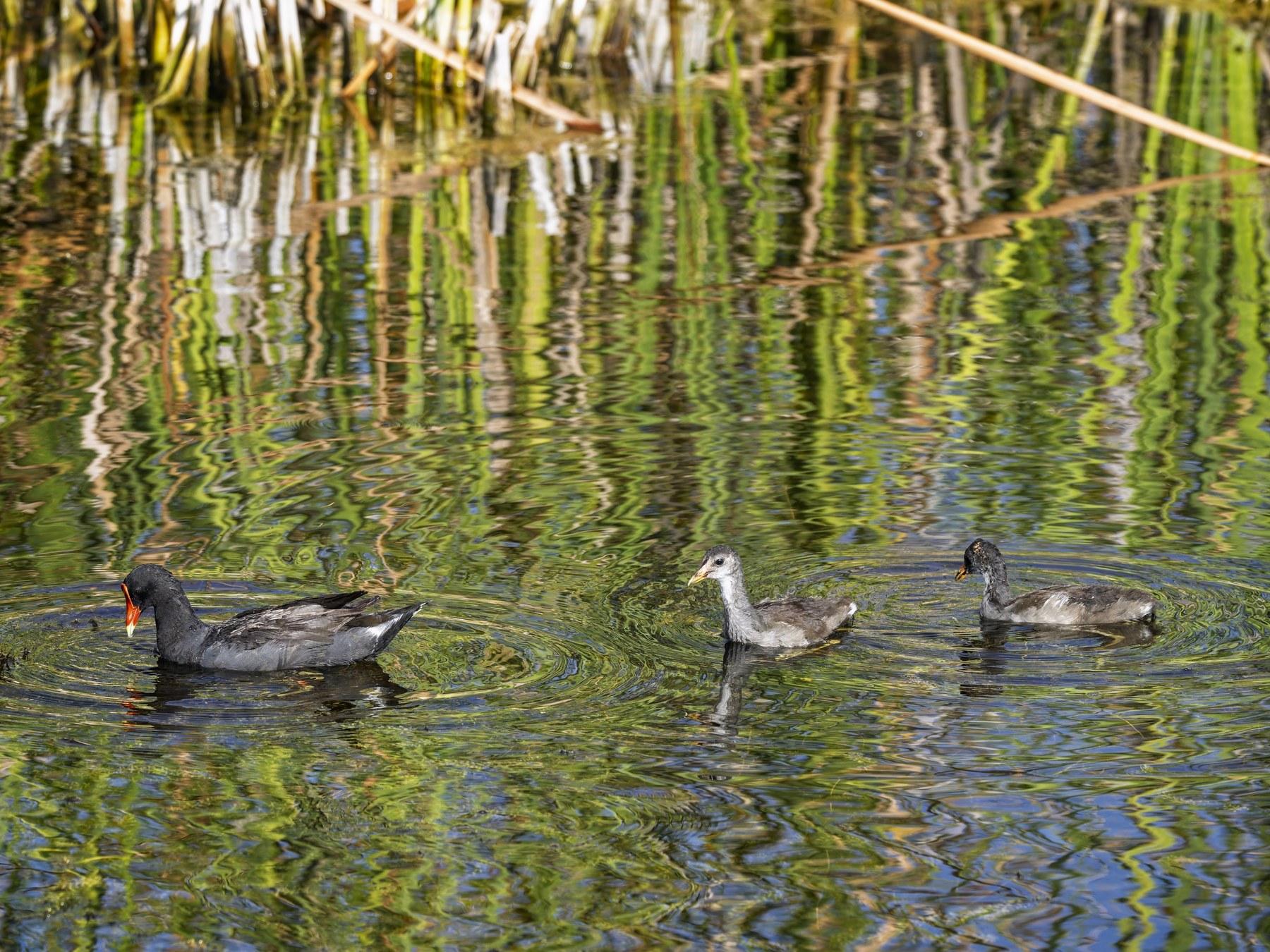
In the north, yes. The Common Gallinule is a partial migrant over short to medium distances. Birds leave the northern parts of the range where wetlands freeze, especially in the East, while many western birds stay all year, even as far north as the marshes of Utah's Great Salt Lake. They migrate at night.
In the northern states, fall departure runs from about early September to mid-October, with stragglers into November, and spring birds arrive from mid-April into May. In New York they generally reach the breeding marshes in April or May, nest from mid-May to mid-August, and begin leaving in September, though some stay into October after a late season.6
Eastern birds winter mainly on the Gulf and Atlantic coastal plains from Texas to southeastern Virginia, most of them in Florida. Small numbers winter irregularly farther north, and some go on to Central America and the West Indies. In winter they use marshes, swamps, canals, ponds and lakes; where they meet coots and Purple Gallinules, the coots use more open water and the Purple Gallinules more cover, with much overlap.
Birds banded as far away as New York, Ontario, Iowa and Missouri have been recovered in Florida, which suggests that eastern populations funnel there for the winter. Three banded birds have turned up beyond mainland North America: one from Delaware in Haiti, one from Michigan in Cuba and one from Ontario in Bermuda.1
'Alae 'ula: the Hawaiian race and its range
Hawaii has its own race of the Common Gallinule, sandvicensis, the 'alae 'ula or Hawaiian Gallinule. It has been federally listed as Endangered since 11 March 1967, and the State of Hawaii also lists it as Endangered.7, 8 The US Fish and Wildlife Service's five-year review of August 2026 recommended no change to its status.9
It once lived on all the main islands except Lana'i and Kaho'olawe. It is now confirmed only on Kaua'i and O'ahu, with unconfirmed reports from Maui and Hawai'i island, generally in wetlands below about 410 ft (125 m).8 The review put the 2019-2023 average at 712 birds (573-876), down from about 927 in 2012-2016: about 485 on Kaua'i and 230 on O'ahu.9 Recent counts indicate a reversal of a 38-year increase, with declines from 2013 to 2023, especially on Kaua'i, and the review says the counts likely underestimate the true number. The threats named for the race include loss of wetlands, introduced predators such as cats, dogs, rats and mongooses, invasive plants, altered water flows, disease such as botulism, and climate change.9, 8 Before 1939, hunting was considered a major limiting factor.1
Hawaiian birds have a long scarlet or orange patch down the front of the leg; mainland birds, at least in Florida, lack it or show only a diffuse patch.1 A study of more than 200 live birds and more than 100 specimens found them slightly shorter in the wing but larger-billed, longer-legged and about 4% heavier than published values for mainland birds.10 They do not migrate, and the birds on each island are strongly separated genetically, with little recent gene flow.11
They nest in managed wetlands and taro fields, and can nest in any month. In a 2024 study, clutches averaged about 4.8 eggs, and the study estimated a 90% chance that a brood survived its first month after hatching (82% on Kaua'i, 98% on O'ahu).12
Tips for seeing it
What it eats
Common Gallinules eat both plants and small animals. Snails and the seeds of sedges and grasses are the main foods. Plants generally make up most of the diet, and the share of animal food rises in spring and summer.
Other plant foods include duckweeds, pondweeds, smartweed seeds and parts of water lilies. Animal foods include snails, spiders, beetles, flies, ants and wasps, true bugs, dragonflies and damselflies, crustaceans and leeches. Fish and amphibian larvae are rarely eaten.
They feed while swimming or walking on floating plants, picking food from the surface and from leaves, dipping the head or tipping up, and only now and then diving. They flip floating leaves over to reach animals on the underside, and often feed on lawns, fields and golf courses next to the water.
In 96 digestive tracts collected across the US range between 1886 and 1939, about 41% of the contents by volume was animal matter and 59% plant, and snails turned up in 80 of the 96 birds. In four studies in Florida, Tennessee and Puerto Rico, plants made up 80-97% of the diet, but only 32-50% on one lake in north-central Florida.1
Nesting and breeding
The nest is a platform of coarse stems with a cup on top, usually built among sturdy plants standing in water, especially cattails. Where the water is deeper than about 8 in (20 cm), it often has a ramp of plants leading up to it. Both birds build: in a Wisconsin study, the male gathered most of the material and the female arranged it.1
Of 183 nest records, 97 (53%) were in cattail. Other nests sat on floating mats, logs, stumps or the old nests of other birds, and not every nest is over water.1 Pairs also build platforms that are not for eggs, for display and for brooding the chicks.
The nesting season runs about 5.5-6.5 weeks longer in the southern states than in the North. Ohio nests were started between May 2 and July 10, and Louisiana nests from early April to early August. In Florida and Hawaii gallinules nest year-round.1, 8
Average clutches in five older studies in North America and Hawaii, each of more than 41 nests, ranged from 5.6 to 9.1 eggs, and in Louisiana clutches were larger in rice fields (8.8) than in marshes.1 The eggs are drab or smoky gray, blotched, spotted and speckled, and about 1.7 x 1.2 in (44 x 31 mm). Both parents incubate, for about 19-22 days.
At least one egg hatched in 55-80% of nests across studies in Texas, Hawaii, Ohio and Louisiana. Both extremes came from one Louisiana study: 55% in marshes and 80% in rice fields.1 Predators cause most failures, and flooding is next.
Chicks and young
Chicks hatch with their eyes open and can swim within a day. Both parents feed them at first. By about three weeks old they find most of their own food, though the parents still feed them now and then after six weeks.
In a Louisiana study, young first flew at about 7 weeks.1 They first breed in the year after they hatch. Two broods a season are reported from Pennsylvania and Michigan.
The adult's red and yellow bill seems to matter to the chicks. In laboratory experiments, captive-hatched moorhen chicks pecked at red, orange and yellow more than at other colors, and Common Gallinule chicks taken from nests at first took food from forceps only when they were covered in red and yellow tape, like an adult's bill.1
Behaviour
In the breeding season Common Gallinules are territorial, and both sexes defend the territory and the nest. They squabble with American Coots and Purple Gallinules. At one Louisiana refuge, feeding Common Gallinules dominated Purple Gallinules: the two faced off with their shields about 6.6 ft (2 m) apart before the Purple Gallinule left.1
In winter they are more sociable and forage in small groups, often with coots and ducks.
The tail-flicking has been interpreted as a signal to predators that the bird has seen them, rather than a warning to other gallinules.1
Walking, swimming and flight
A gallinule walks with its body low, jerking its tail up to show the white beneath, and its long toes carry it over floating leaves. On the water it pumps its head back and forth with its tail held level.
It is seldom seen flying. A flushed bird makes a short, labored flight with its legs dangling, but on migration and between ponds it flies directly and fairly fast.
After breeding it is presumed to drop all its flight feathers at once, as the Eurasian Moorhen does, but this molt has not been described for the Common Gallinule.
Lifespan and predators
The US Bird Banding Laboratory's longevity list holds a single Common Gallinule. It was banded in Louisiana in February 1931, at an unknown age, and caught and released by banders there in December 1940, when it was at least 9 years 10 months old.13 With only one record, that is a minimum age, not a known maximum for the species.
Little is known about survival. Birds of the World's account, written in 2002, says there are no data on survival after fledging, and no source we read gives adult survival rates for mainland birds. Banding records suggest strong loyalty to a site in all seasons, though the same account had no figures on how many birds return each year.
Predators
Few attacks have been seen directly. Raccoons were the commonest nest predator in Ohio, especially when water was low. A river otter killed an adult in Florida, largemouth bass in Louisiana had eaten chicks, and alligators there often tried to take young and adults, without success. Chick losses can be heavy. At Lacassine refuge in Louisiana, up to 40% of chicks may die within 10 days of hatching, and a further 30% between 10 and 25 days.1
Conservation
The Common Gallinule is listed as Least Concern on the IUCN Red List.14 Partners in Flight estimates about 5.1 million birds worldwide, about 500,000 of them in the US and Canada, in estimates centered on 2010.15
The North American Breeding Bird Survey shows no significant change from 1966 to 2025: +0.16% a year across the survey area (95% credible interval -1.15 to +1.62) and +0.22% a year in the US.16 There was no significant change over 2015-2025 either, and the survey index peaked in 1983 and was lowest in 2009.16 Partners in Flight's older analysis of the survey data for 1970-2021 gives -0.99% a year, also not significant.15
Canada is different. The State of Canada's Birds puts the population there 92% lower than in the 1970s, at an estimated 3,600 birds, very likely under 1% of the world total.17 The survey's Canadian trend is a significant -3.73% a year since 1966, but it rests on only 27 routes.16 The survey runs along roadsides, which is not ideal for wetland birds, and it records gallinules at well under one bird per route.17, 16
How changes to habitat affect the species is not clear. Loss of natural wetlands has been reported to cause declines, though man-made wetlands have also extended the range, and pollution and other changes to wetlands are potential threats.1 Illinois lists the species as state endangered.18
Legal status
In the US the Common Gallinule is protected under the Migratory Bird Treaty Act and named on the federal list of protected birds.19, 20 It belongs to the rail family, which federal rules define as migratory game birds.21 States may set a gallinule hunting season within yearly federal frameworks. For 2025-26 these allowed gallinule seasons in the Atlantic, Mississippi and Central Flyways; in the Pacific Flyway the gallinule season is set together with the duck, merganser and coot seasons.22
Little was known in 2002 about how hunting affects gallinule numbers, and as of the mid-1990s, federal and many state harvest records did not separate Common and Purple Gallinules.1 In Canada, gallinules are migratory game birds under the Migratory Birds Convention Act, 1994.23 The Hawaiian race is federally Endangered (see above).
Similar birds
Often mistaken for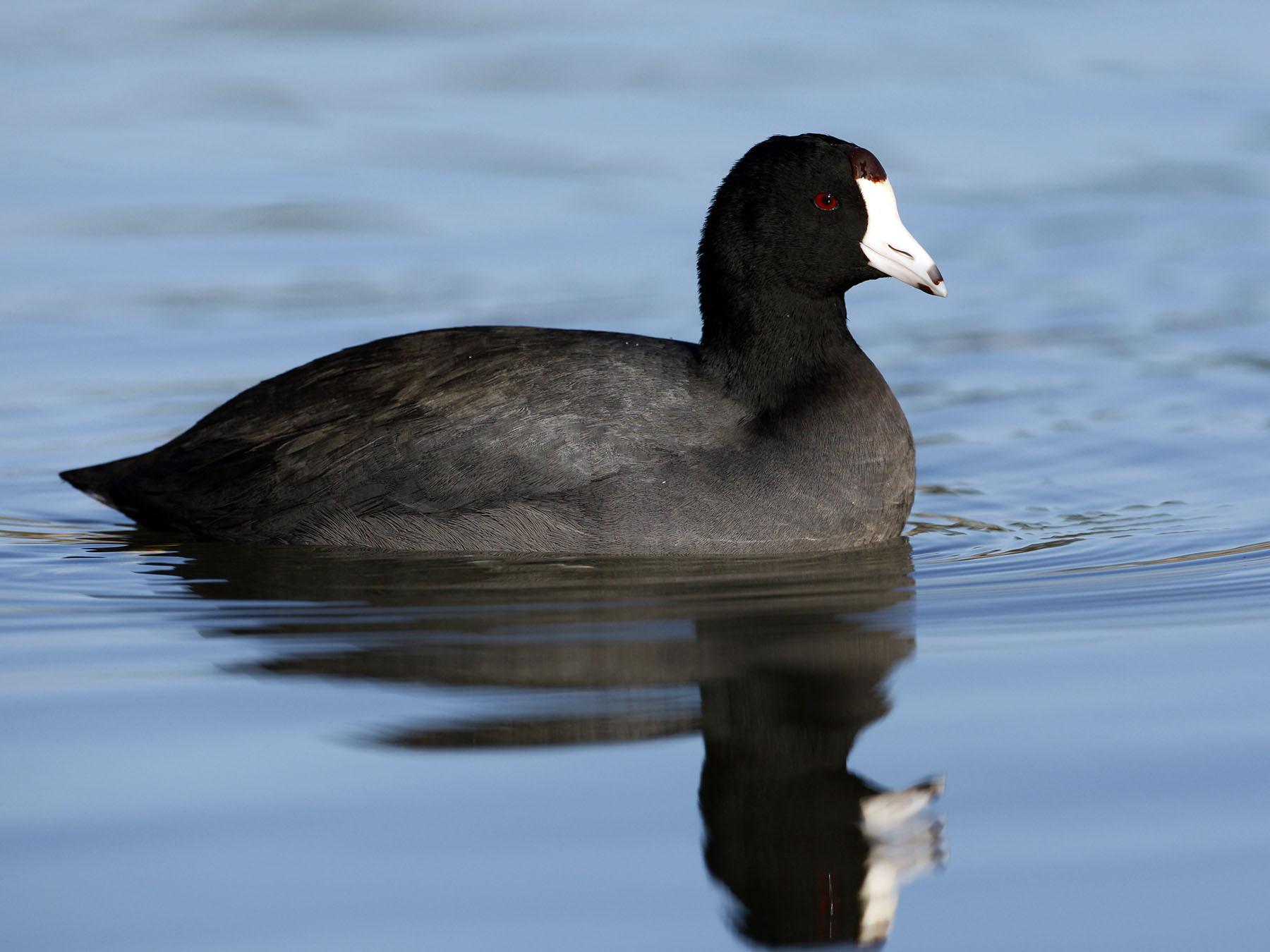
Quick facts
- Length
- 32–35 cm
- Wingspan
- 54–62 cm
- Weight
- 310–456 g
- Lifespan
- oldest recorded 9 years 10 months
- Family
- Rails & Coots
- Migration
- Partial migrant
- Global status (IUCN)
- Least Concern
- World population
- About 5.1 million (Partners in Flight, 2010 estimate)
- Population trend
- No significant change in the US Breeding Bird Survey since 1966, though it has fallen steeply in Canada
- Also called
- Florida Gallinule, American Moorhen
- Scientific name
- Gallinula galeata
Questions
2Is a gallinule a duck?
No. It swims like a duck and is about the size of a small one, but it is a rail, in the same family as the coots. Its red shield and long toes with no webs set it apart from any duck; see Appearance and identification.
Are Common Gallinules rare?
Not across most of their range, with about 5.1 million birds worldwide. They are scarce in Canada, where numbers have fallen steeply, Illinois lists them as state endangered, and the Hawaiian race is endangered; see Population and conservation status.
Sources
36- 1Bannor, B. K. and Kiviat, E. (2020). Common Gallinule (Gallinula galeata), version 1.0. Birds of the World (A. F. Poole and F. B. Gill, editors). Cornell Lab of Ornithology. doi:10.2173/bow.comgal1.01 (opens in a new tab)
- 2Erickson, R. A. and Rottenborn, S. C. (2020). Two photographed American Coot x Common Gallinule hybrids. Western Birds 51(2): 150-156. doi:10.21199/wb51.2.7 (opens in a new tab)
- 3Chesser, R. T. et al. (2011). Fifty-Second Supplement to the American Ornithologists' Union Check-list of North American Birds. The Auk 128(3): 600-613. doi:10.1525/auk.2011.128.3.600 (opens in a new tab)
- 4Kirwan, G. M., Taylor, B., Christie, D. A. and Perlman, Y. (2025). Eurasian Moorhen (Gallinula chloropus), version 1.1. Birds of the World (J. del Hoyo, A. Elliott, J. Sargatal, D. A. Christie, E. de Juana and G. M. Kirwan, editors). Cornell Lab of Ornithology. doi:10.2173/bow.commoo3.01.1 (opens in a new tab)
- 5Withrow, J. J. and Schwitters, M. T. (2012). First North American record of the Common Moorhen (Gallinula chloropus) confirmed by molecular analysis. Western Birds 43(4): 259-265. doi:10.21199/wb43.4.7 (opens in a new tab)
- 6New York Breeding Bird Atlas (eBird Atlas NY). Species Spotlight - Common Gallinule. eBird Atlas NY. Accessed 20 November 2026. Source (opens in a new tab)
- 7U.S. Fish and Wildlife Service (2026). 50 CFR 17.11, Endangered and threatened wildlife. Electronic Code of Federal Regulations (as of 18 Nov 2026). Accessed 20 November 2026. Source (opens in a new tab)
- 8Hawaii Department of Land and Natural Resources, Division of Forestry and Wildlife. 'Alae 'ula (Hawaiian gallinule). DLNR. Accessed 20 November 2026. Source (opens in a new tab)
- 9U.S. Fish and Wildlife Service, Pacific Islands Fish and Wildlife Office (2026). 5-Year Review Short Form Summary: 'Alae 'ula (Hawaiian gallinule; Gallinula galeata sandvicensis). USFWS (signed 27 Aug 2026). Accessed 20 November 2026. Source (opens in a new tab)
- 10van Rees, C. B., Muñoz, M. A., Cooke, S. C. and Reed, J. M. (2021). Morphological Differences in the Island-Endemic Hawaiian Subspecies of the Common Gallinule Gallinula galeata. Pacific Science 74(4): 345-364. doi:10.2984/74.4.3 (opens in a new tab)
- 11Sonsthagen, S. A., Wilson, R. E. and Underwood, J. G. (2018). Interisland genetic structure of two endangered Hawaiian waterbirds: The Hawaiian Coot and Hawaiian Gallinule. The Condor 120(4): 863-873. doi:10.1650/condor-18-98.1 (opens in a new tab)
- 12van Rees, C. B. et al. (2024). Updated vital rate estimates for the endangered Hawaiian Common Gallinule (Gallinula galeata sandvicensis). Wilson Journal of Ornithology 136(1): 106-113. doi:10.1676/23-00036 (opens in a new tab)
- 13USGS Bird Banding Laboratory. Longevity records of North American birds: Common Gallinule (AOU 2190). USGS Eastern Ecological Science Center. Accessed 20 November 2026. Source (opens in a new tab)
- 14BirdLife International (2025). Gallinula galeata. The IUCN Red List of Threatened Species 2025 (via the GBIF IUCN Red List checklist, version 2026-1). GBIF dataset 19491596-35ae-4a91-9a98-85cf505f1bd3. doi:10.2305/IUCN.UK.2025-2.RLTS.T62120280A281849066.en (opens in a new tab)
- 15Partners in Flight (2024). Avian Conservation Assessment Database, version 2024.05.23 (global). Bird Conservancy of the Rockies. Accessed 20 November 2026. Source (opens in a new tab)
- 16Hostetler, J. A. et al. (2026). The North American Breeding Bird Survey, Analysis Results 1966 - 2025. U.S. Geological Survey. doi:10.5066/P1OSNSFC (opens in a new tab)
- 17Environment and Climate Change Canada and Birds Canada. Common Gallinule. State of Canada's Birds (NatureCounts). Accessed 20 November 2026. Source (opens in a new tab)
- 18Illinois Department of Natural Resources. Wild About Birds: common gallinule. Illinois DNR. Accessed 20 November 2026. Source (opens in a new tab)
- 19United States Congress (1918). Migratory Bird Treaty Act, 16 U.S.C. 703. United States Code (GovInfo, 2023 edition). Accessed 20 November 2026. Source (opens in a new tab)
- 20U.S. Fish and Wildlife Service (2023). 50 CFR 10.13, List of Birds Protected by the Migratory Bird Treaty Act. Electronic Code of Federal Regulations (as of 18 Nov 2026). Accessed 20 November 2026. Source (opens in a new tab)
- 21U.S. Fish and Wildlife Service (2026). 50 CFR 20.11, What terms do I need to understand?. Electronic Code of Federal Regulations (as of 18 Nov 2026). Accessed 20 November 2026. Source (opens in a new tab)
- 22U.S. Fish and Wildlife Service (2025). Migratory Bird Hunting; Final 2025-26 Frameworks for Migratory Bird Hunting Regulations. Federal Register 90 FR 40178 (18 Aug 2025), FR Doc. 2025-15703. Accessed 20 November 2026. Source (opens in a new tab)
- 23Parliament of Canada (1994). Migratory Birds Convention Act, 1994 (S.C. 1994, c. 22), Schedule. Justice Laws Website (current to 2026-10-19). Accessed 20 November 2026. Source (opens in a new tab)
- 24Cornell Lab of Ornithology. Common Gallinule: overview, identification and life history. All About Birds. Accessed 20 November 2026. Source (opens in a new tab)
- 25National Audubon Society. Common Gallinule. Guide to North American Birds (text adapted from Kaufman, Lives of North American Birds, 1996). Accessed 20 November 2026. Source (opens in a new tab)
- 26Brisbin Jr., I. L. and Mowbray, T. B. (2020). American Coot (Fulica americana), version 1.0. Birds of the World (A. F. Poole and F. B. Gill, editors). Cornell Lab of Ornithology. doi:10.2173/bow.y00475.01 (opens in a new tab)
- 27West, R. L. and Hess, G. K. (2020). Purple Gallinule (Porphyrio martinica), version 1.0. Birds of the World (A. F. Poole and F. B. Gill, editors). Cornell Lab of Ornithology. doi:10.2173/bow.purgal2.01 (opens in a new tab)
- 28Muller, M. J. and Storer, R. W. (2020). Pied-billed Grebe (Podilymbus podiceps), version 1.0. Birds of the World (A. F. Poole and F. B. Gill, editors). Cornell Lab of Ornithology. doi:10.2173/bow.pibgre.01 (opens in a new tab)
- 29American Ornithological Society. Check-list of North and Middle American Birds (online), Rallidae. AOS Check-list. Accessed 20 November 2026. Source (opens in a new tab)
- 30AviList Core Team (2025). AviList: The Global Avian Checklist, v2025b. AviList. doi:10.2173/avilist.v2025b (opens in a new tab)
- 31Sangster, G., Garcia-R, J. C. and Trewick, S. A. (2015). A new genus for the Lesser Moorhen Gallinula angulata Sundevall, 1850 (Aves, Rallidae). European Journal of Taxonomy 153. doi:10.5852/ejt.2015.153 (opens in a new tab)
- 32Cornell Lab of Ornithology (2025). eBird Status and Trends, data version 2023, released 2025 (season windows shown on the BOW Distribution page). Cornell Lab of Ornithology. Accessed 20 November 2026.
- 33U.S. Fish and Wildlife Service. Hawaiian common gallinule (Gallinula galeata sandvicensis), species profile 6612. ECOS. Accessed 20 November 2026. Source (opens in a new tab)
- 34Webber, B. M., Dugger, B. D. and Uyehara, K. J. (2025). No Evidence that Camera Monitoring Affects Nest Survival of Hawaiian Gallinule. Waterbirds 47(3). doi:10.1675/063.047.0306 (opens in a new tab)
- 35State of Hawaii. Hawaiian Gallinule. Hawaii Birding Trails. Accessed 20 November 2026. Source (opens in a new tab)
- 36Government of Canada (2022). Migratory Birds Regulations, 2022 (SOR/2022-105), Schedule 3. Justice Laws Website (current to 2026-10-19). Accessed 20 November 2026. Source (opens in a new tab)

Checked by
Nathan Cope, founder and editor
Nathan founded Birdfact and leads its writers and contributors in the UK, the US and Canada. He has watched and studied birds for more than ten years, and checks every article and species guide before it’s published.