


Moorhen
Common Moorhen, Waterhen · Gallinula chloropus
By the Birdfact teamChecked by Nathan Cope
On this page15 sections
How to recognise it
The Moorhen is a distinctive waterbird, easily identified by its bright markings. Read this section for more Moorhen identification tips.
What do Moorhens look like?
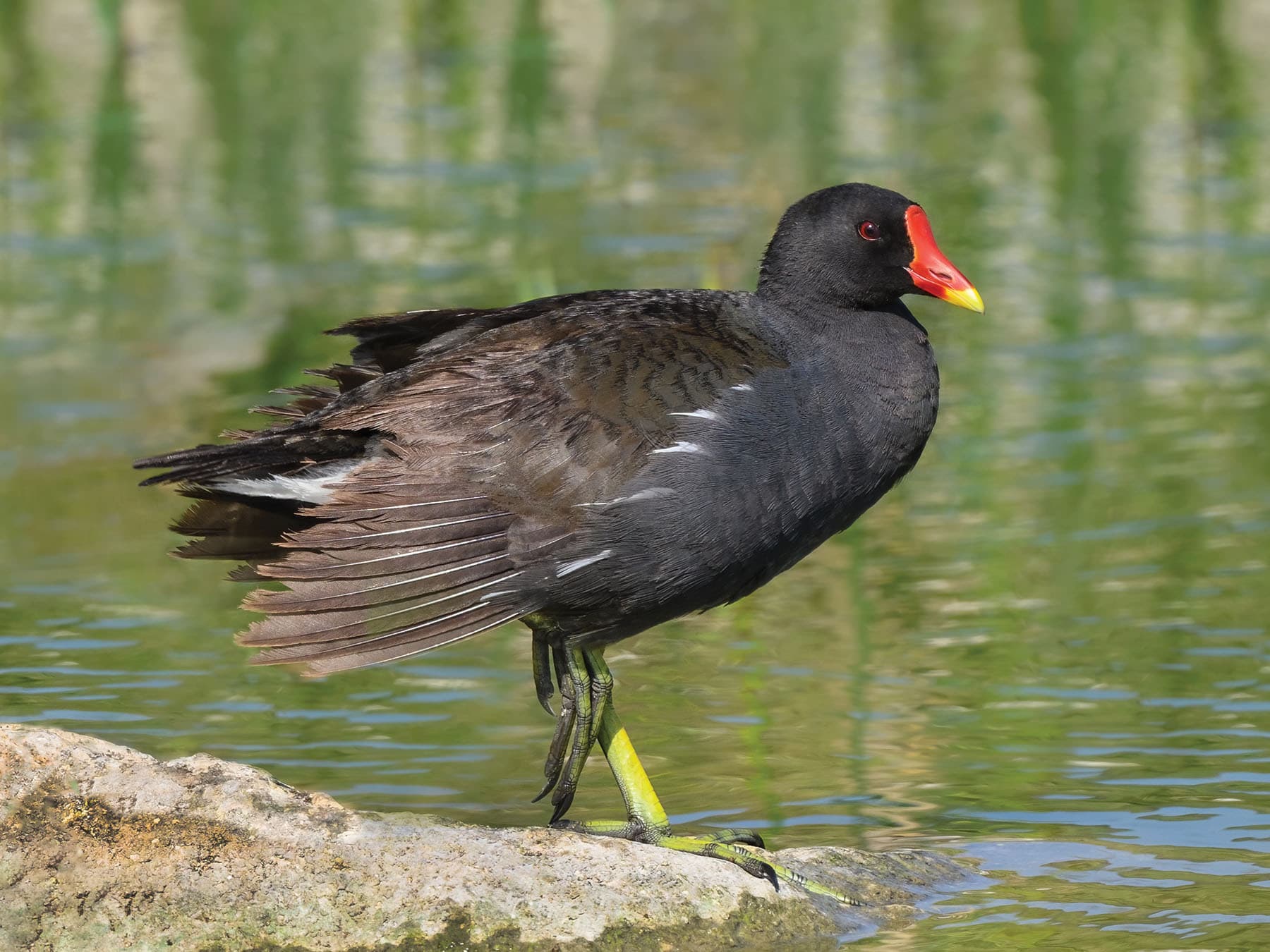
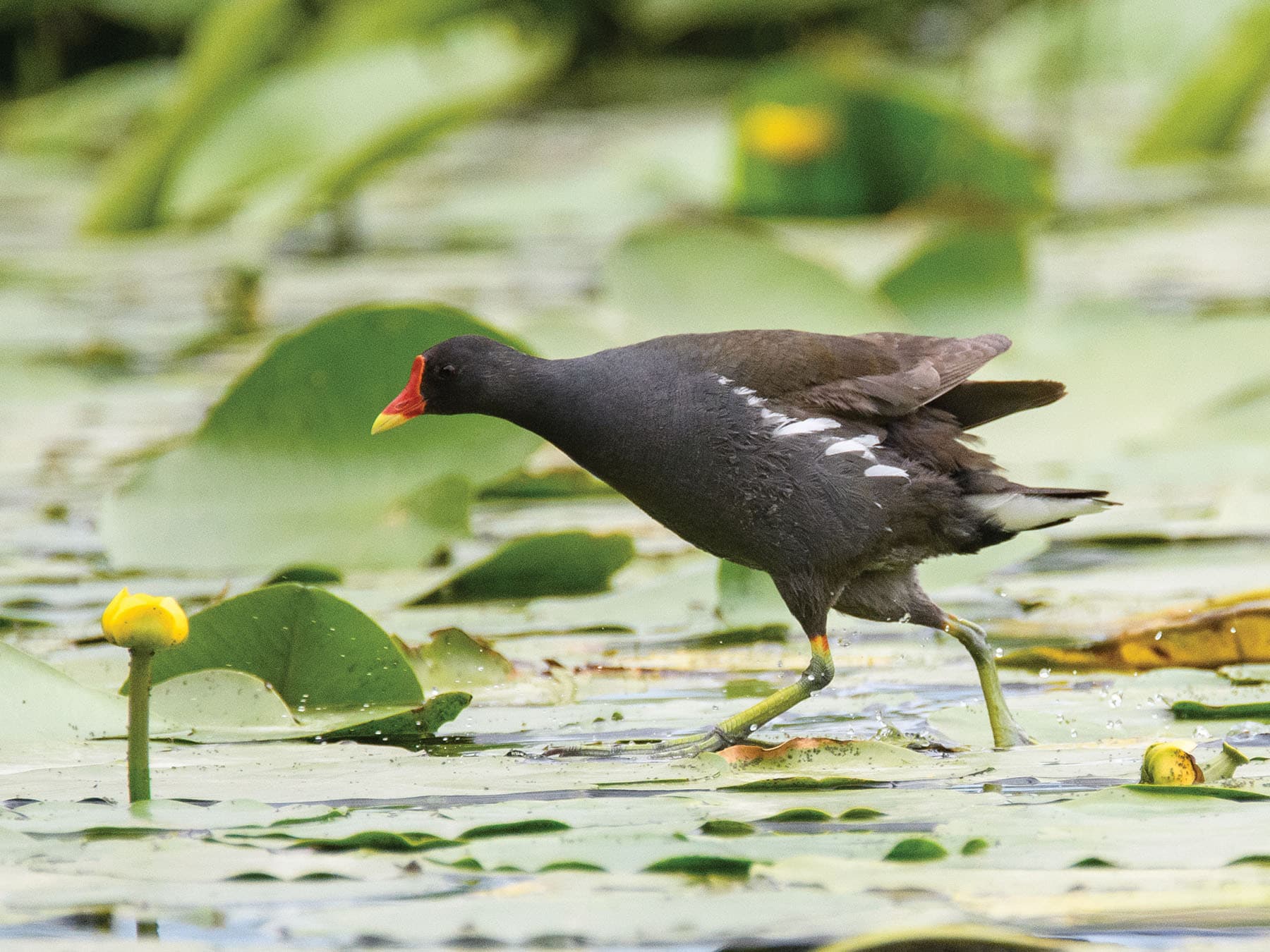
Moorhens are dark, chicken-like waterbirds often seen swimming or walking about on seemingly oversized legs and feet.
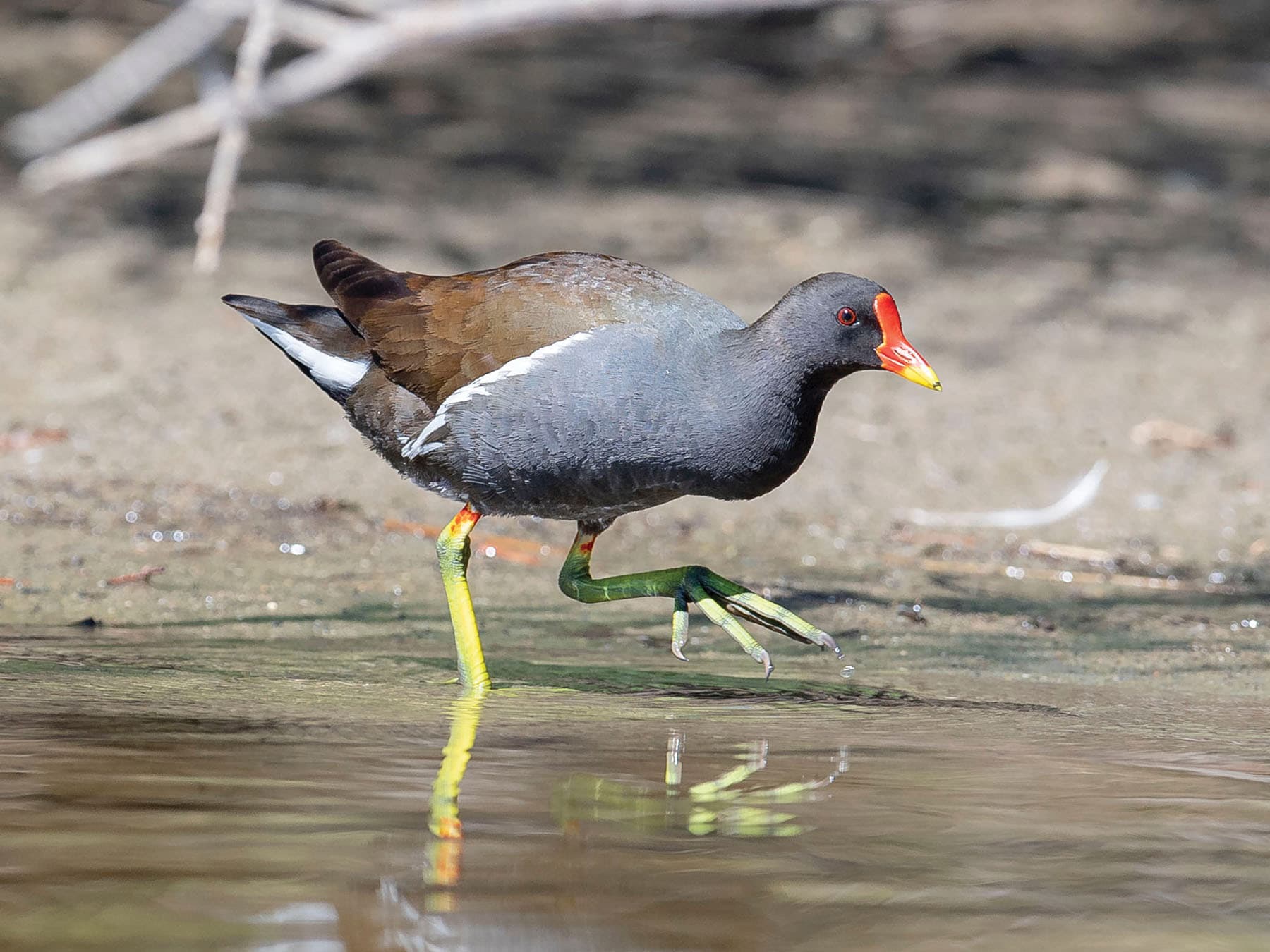
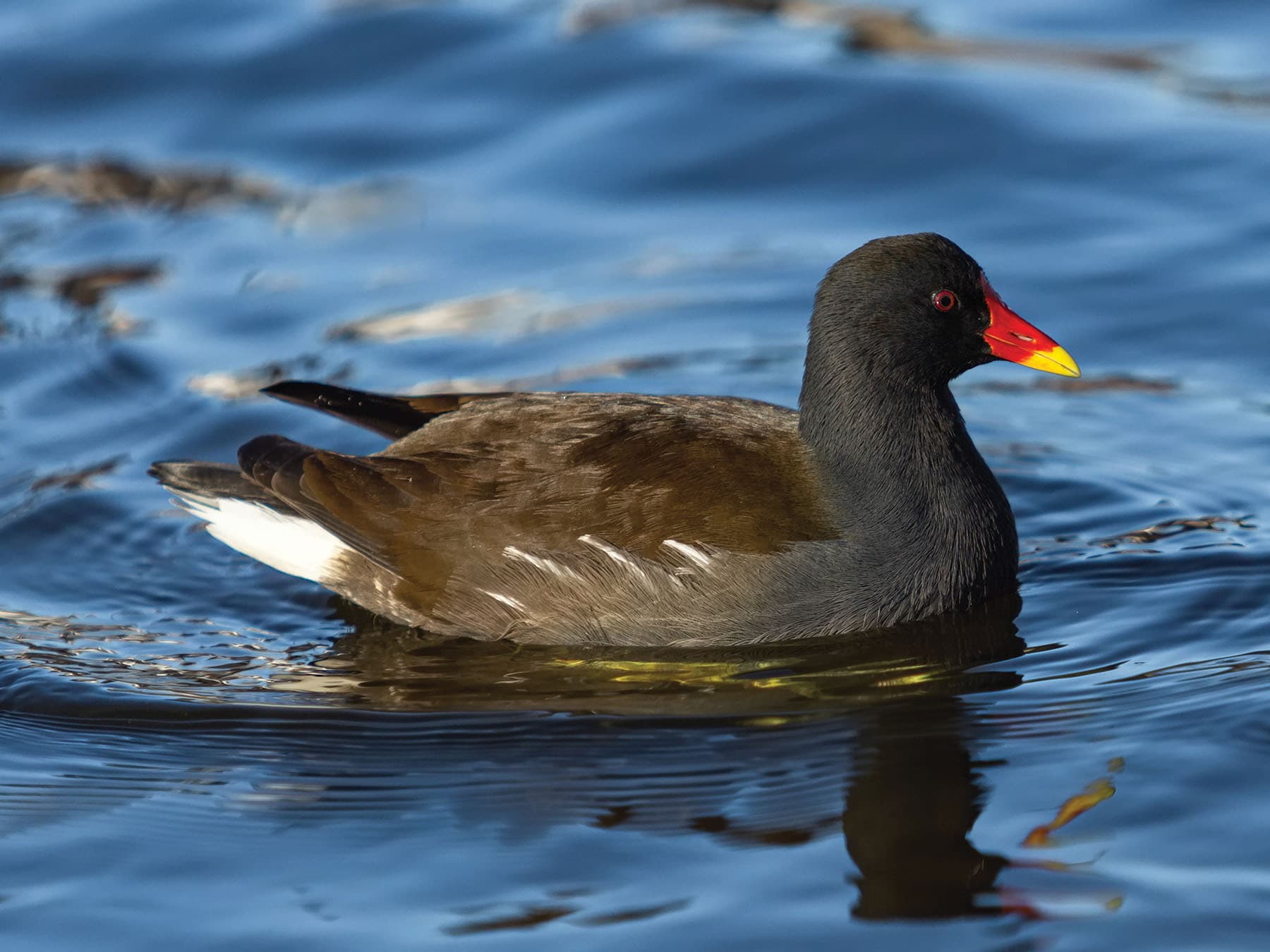
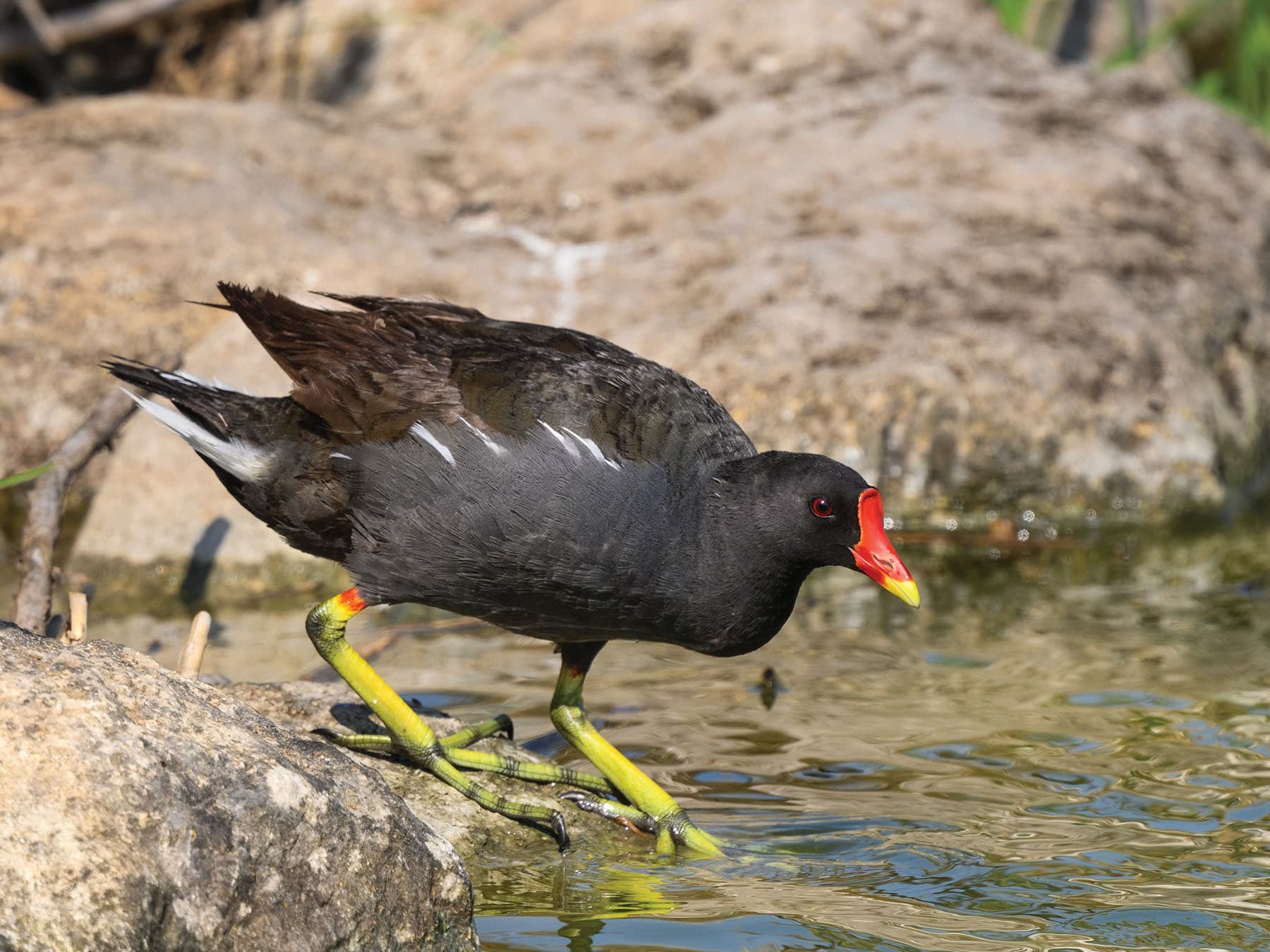
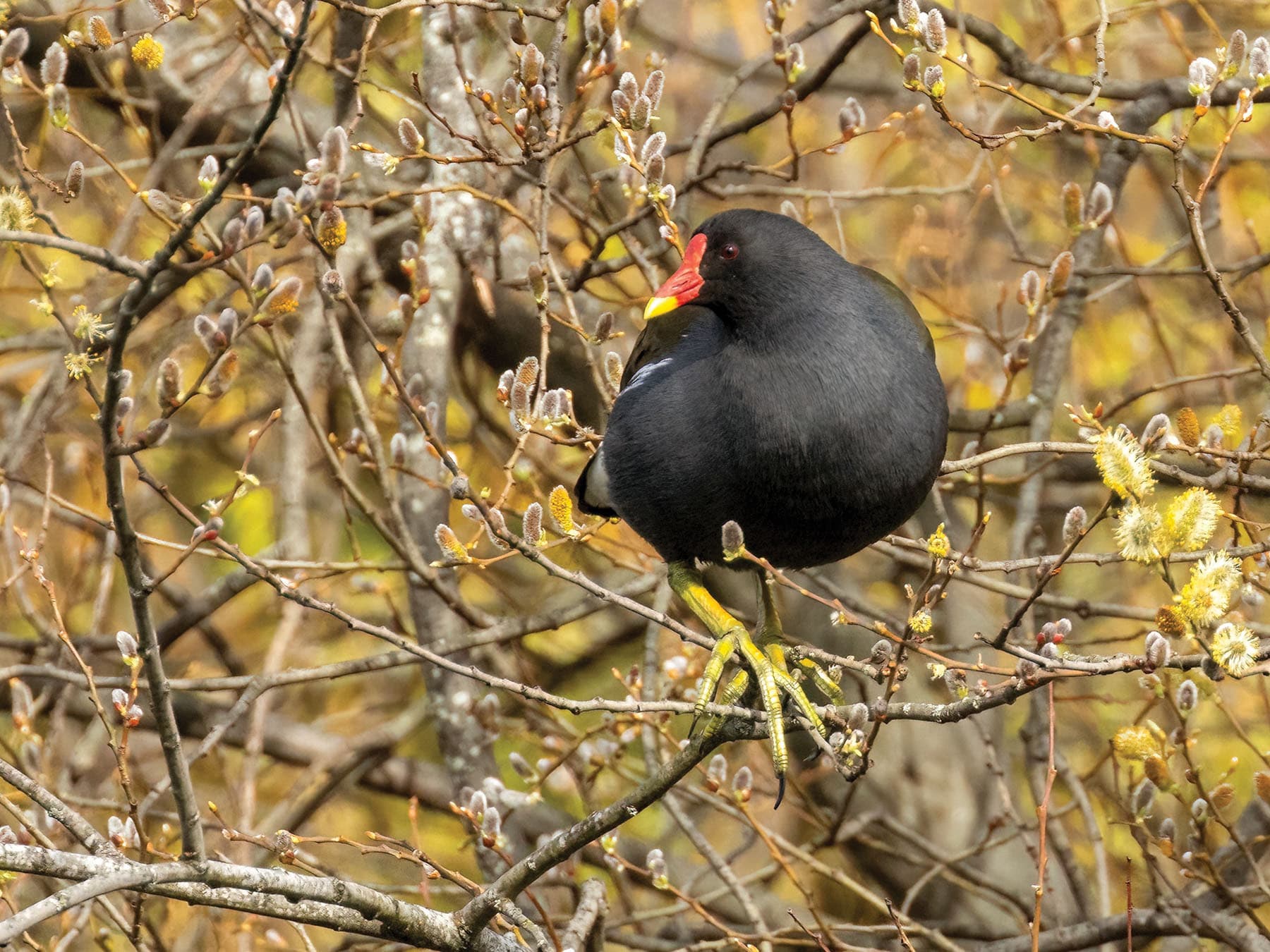
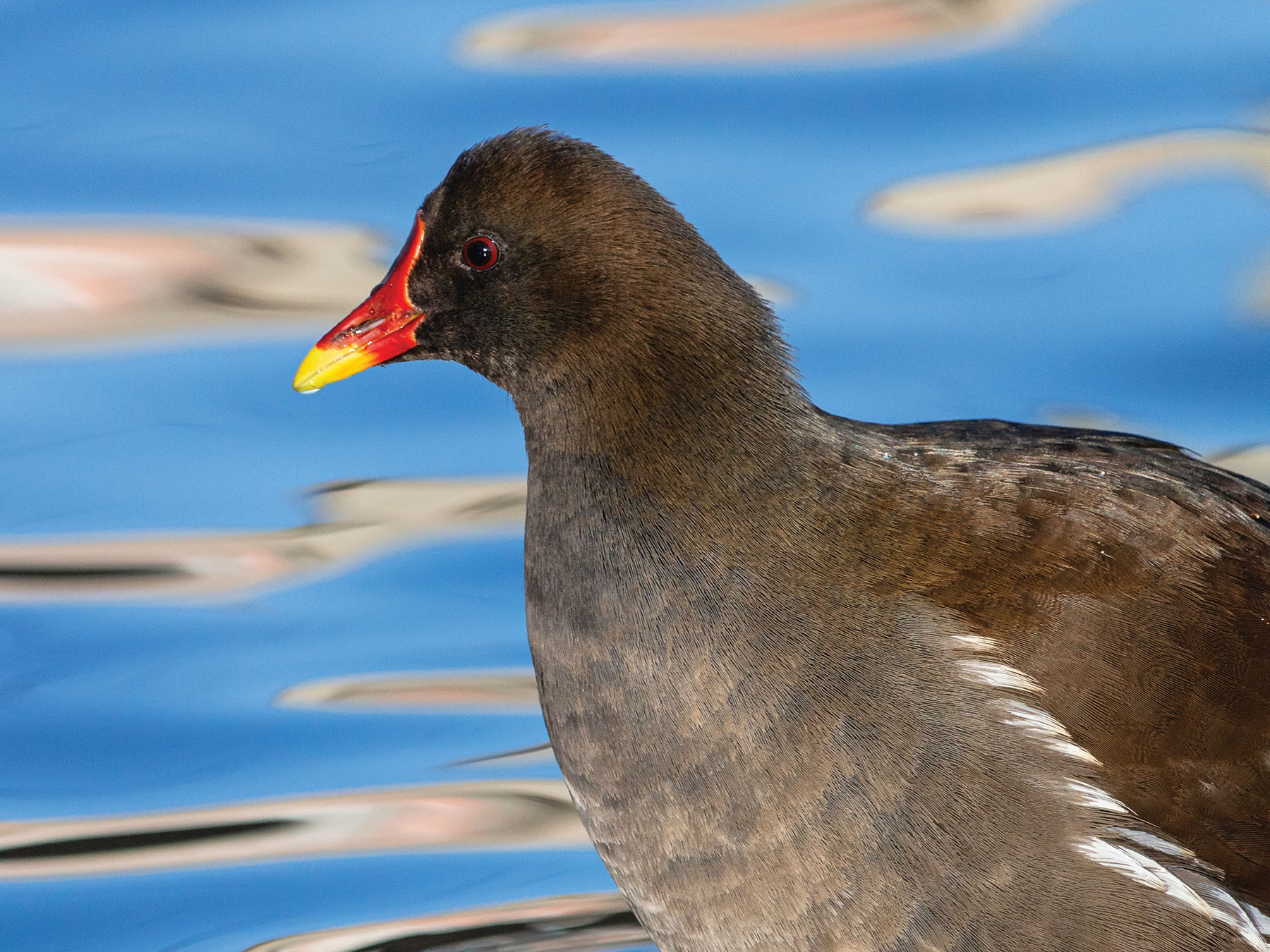
Moorhens appear black with a dark brown shade on the back and wings. They have a prominent white bar across each wing, and the lower tail feathers are white. Their yellow legs and unwebbed feet are very large. Their bill has a yellow tip and a bright red base, and they have reddish eyes.
Female Moorhens look very much like males, and distinguishing the two on looks alone can be virtually impossible. However, females are generally smaller, and the difference may be visible when pairs are seen together.
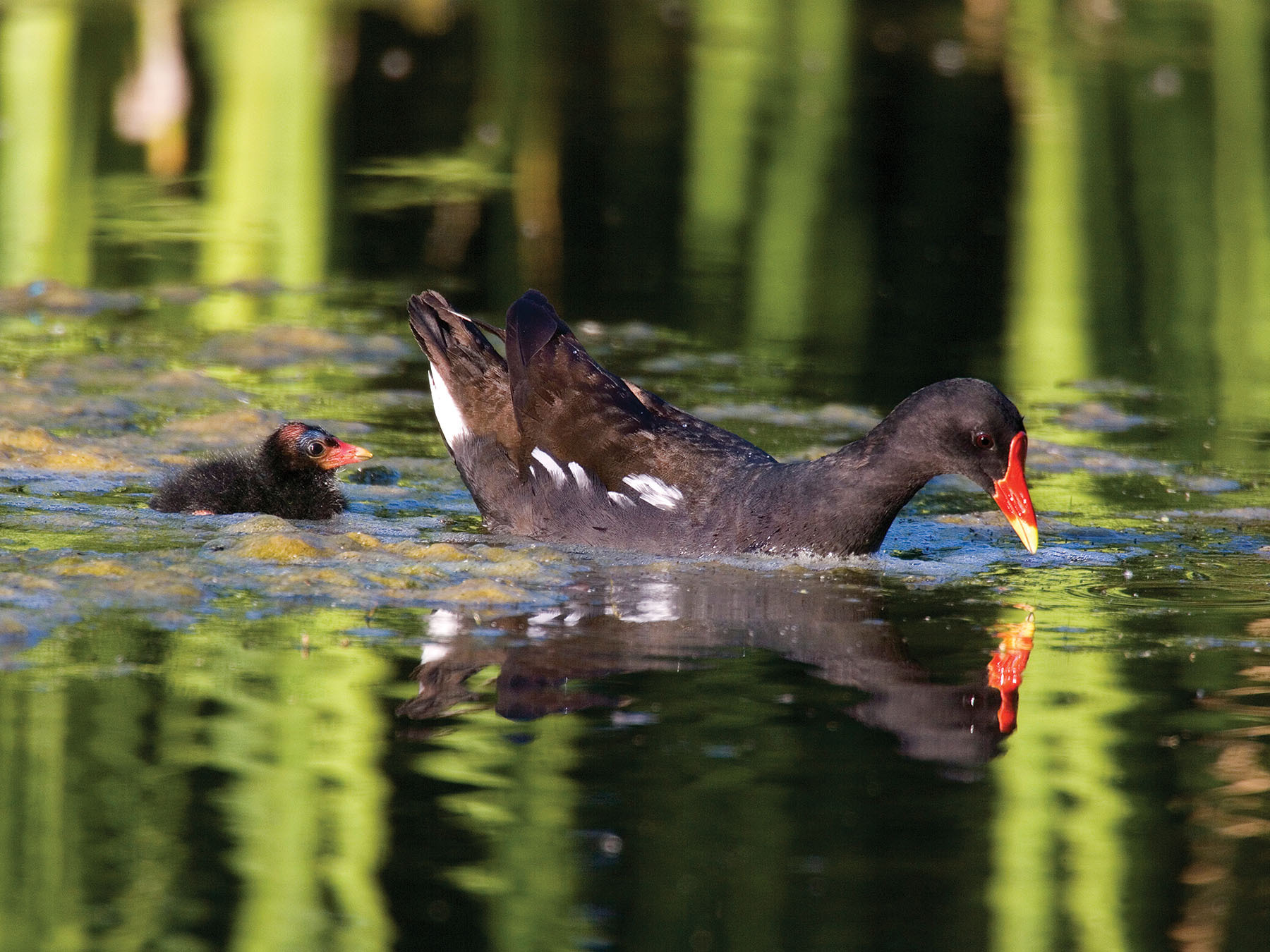
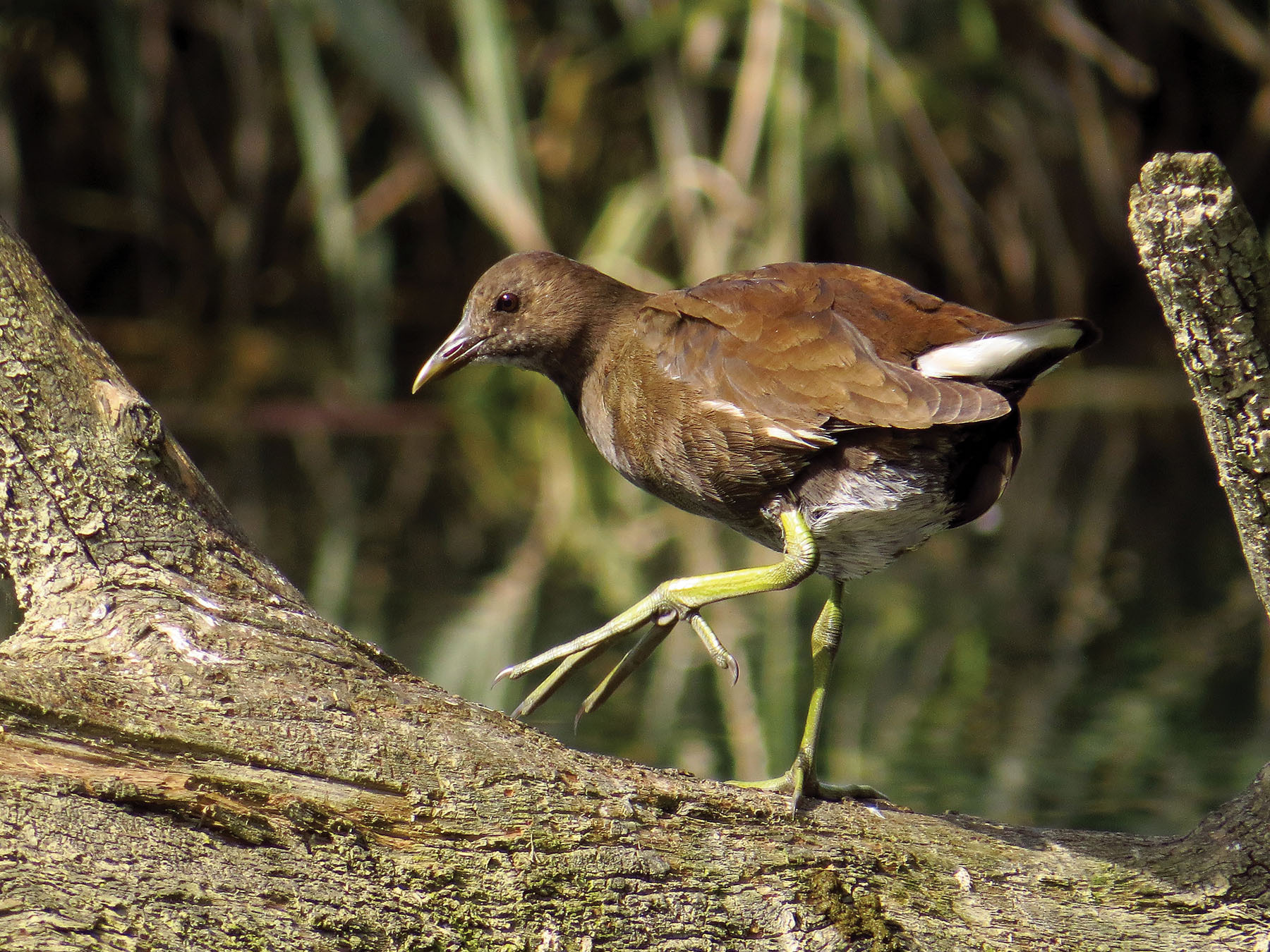
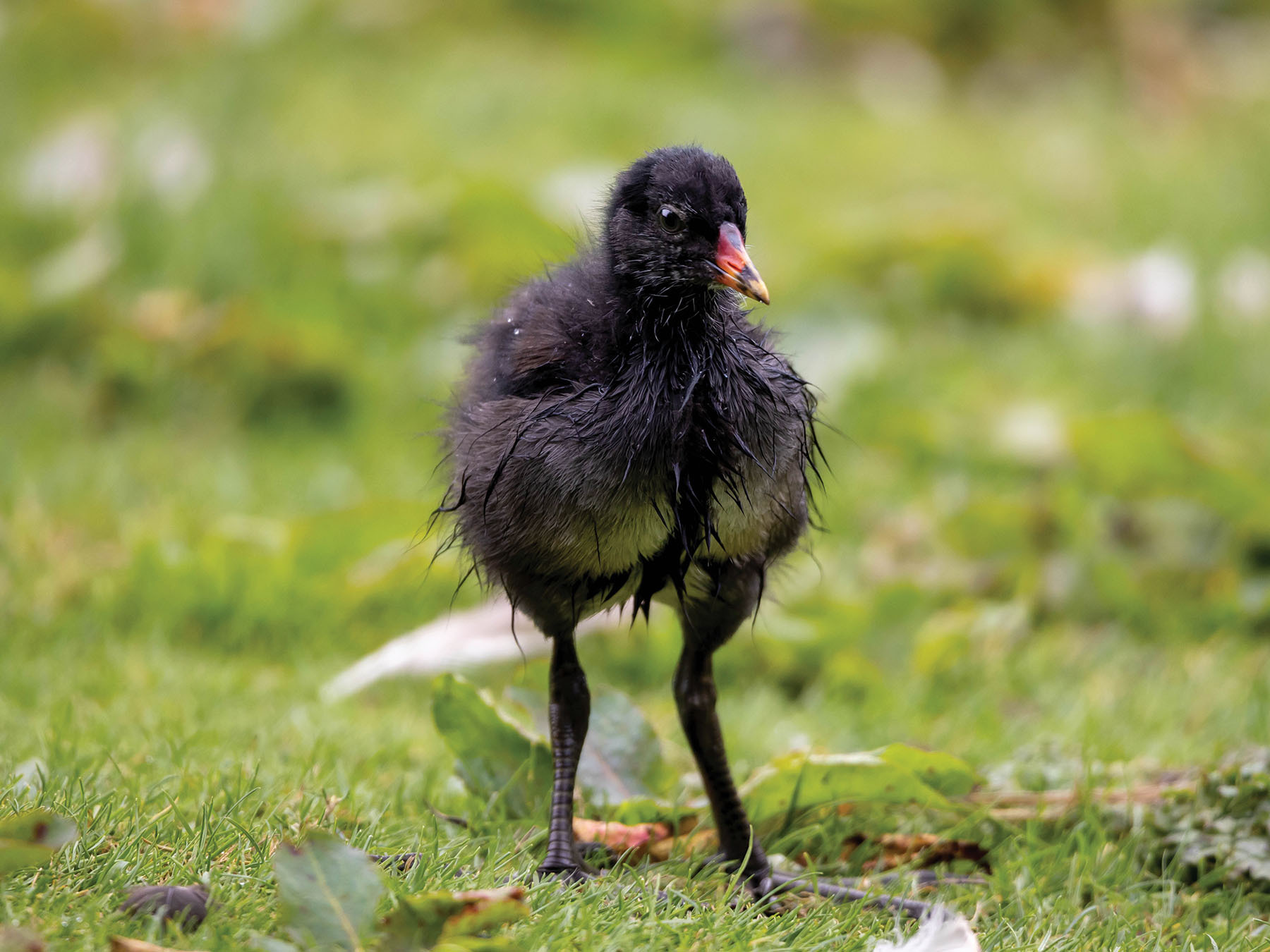
Moorhen chicks begin to follow their parents very early in life. At first, they are all black, with a red and yellow bill and a blueish shade above their eyes. As they grow older, they begin to resemble their adults but have grey-brown plumage with dark beaks and duller legs.
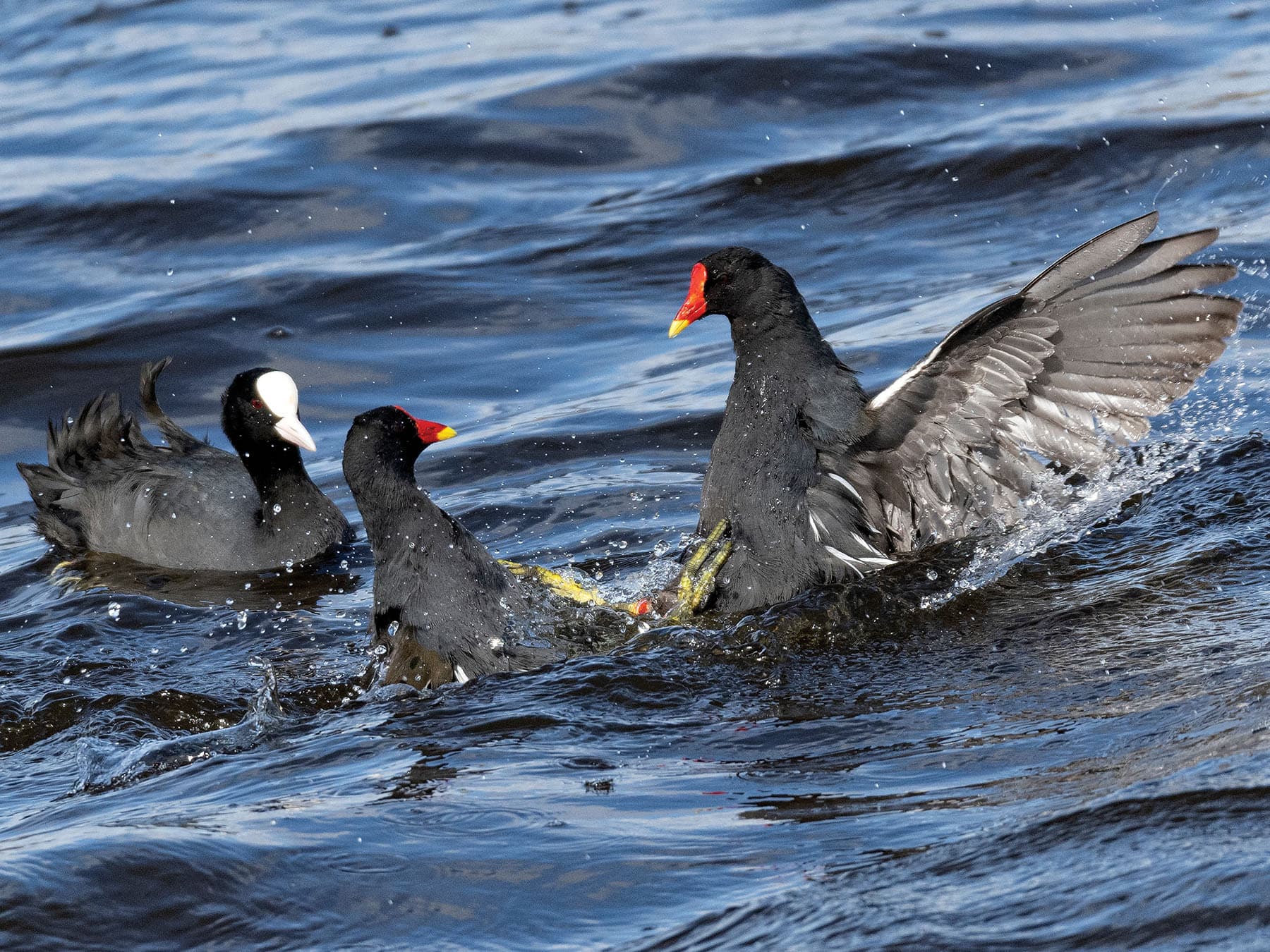
The Moorhen most closely resembles the Eurasian Coot, although Coots are larger and have plain black plumage and white bills.
How big are Moorhens?
The Moorhen is a stocky bird, intermediate in size between a Feral Pigeon and a Woodpigeon.
Length
Adult Moorhens vary between 30 and 38 centimetres in length. They have stout, compact bodies and very large legs.
Weight
Adult Moorhens have a wide weight range from under 200 grams to nearly 500 grams. Females are generally lighter, averaging about 271 grams. The heavier males average about 339 grams.
Wingspan
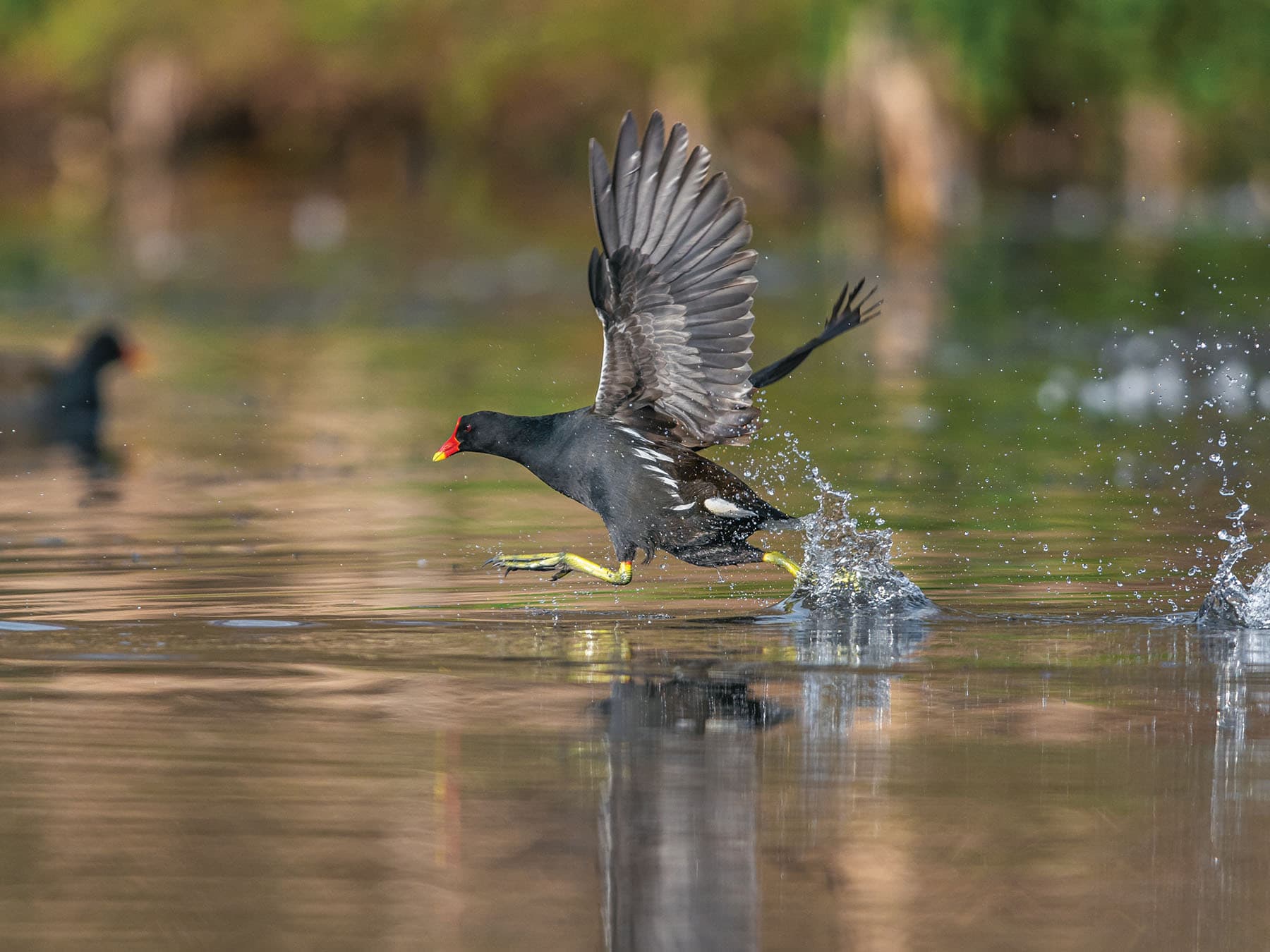
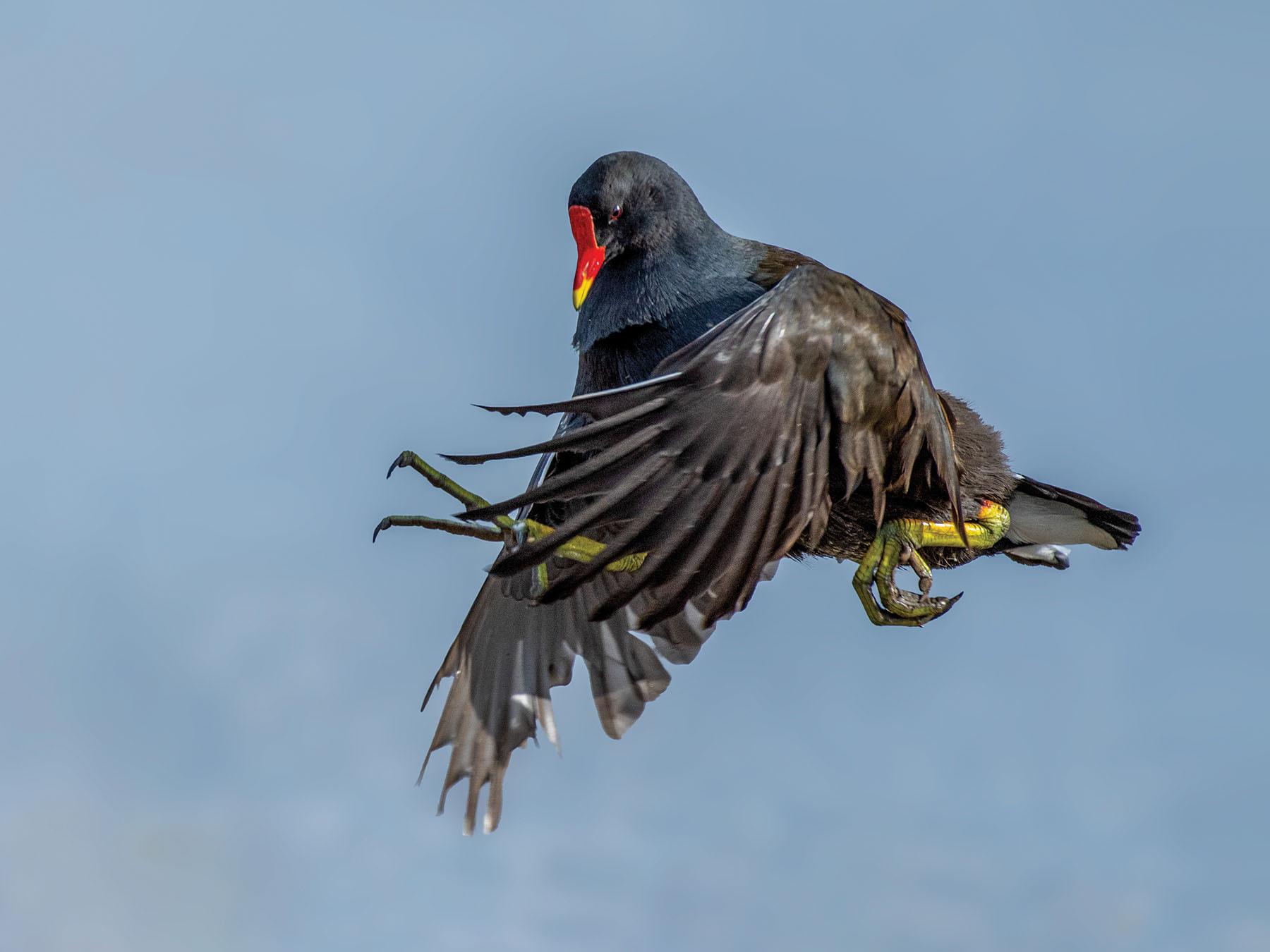
Moorhens are rarely seen in flight. They have a wingspan of 50 to 55 centimetres.
Its size
Adults- Length
- 30–38 cm
- Wingspan
- 50–62 cm
- Weight
- 192–500 g
Its song and calls
The Moorhen’s call is a characteristic sound of quiet, well-vegetated waters.
What sound does a Moorhen make?
Moorhens produce a variety of calls, but the most frequently heard is a sharp ‘Kruk’ or Ku-rik’ call.
- Flight call0:00 / 0:09
Recorded in Gelderland, Netherlands · September 2018
When and where to see it
OctoberHere all year
Most recorded in October
- 1. Blaenau Gwent2.8%
- 2. West Lothian2.6%
- 3. Stockton-on-Tees2.5%
- 4. Glasgow2.4%
- 5. Wrexham2.3%
Each dot is a county, state or province: the bigger and darker, the larger the bird’s share of that place’s bird records that month. Grey dots: no regular records. The ringed point is the centre of the bird’s records this month; the arrow shows how it moved since last month, and the dashed loop its path through the year. “Arrivals” colours places where it becomes regular this month (orange) or is in its last regular month (grey). GBIF eBird Observation Dataset, 2019–2024. Map data: Natural Earth, US Census Bureau; place centres © OpenStreetMap contributors.
In your area
See when the Moorhen is recorded in your county, state or province.
How often the Moorhen turns up in the UK and Ireland through the year, from birdwatchers' records.
United Kingdom
Resident · all year · most records in February
Ireland
Resident · all year · most records in January
Show as a table
| Month | United Kingdom | Ireland |
|---|---|---|
| January | 1.5% (regular) | 1.1% (regular) |
| February | 1.5% (regular) | 0.98% (regular) |
| March | 1.5% (regular) | 1.1% (regular) |
| April | 1.3% (regular) | 0.88% (regular) |
| May | 1.1% (regular) | 0.74% (regular) |
| June | 1.1% (regular) | 0.84% (regular) |
| July | 1.3% (regular) | 0.87% (regular) |
| August | 1.4% (regular) | 0.81% (regular) |
| September | 1.4% (regular) | 0.83% (regular) |
| October | 1.3% (regular) | 0.92% (regular) |
| November | 1.4% (regular) | 1.0% (regular) |
| December | 1.5% (regular) | 1.0% (regular) |
Recorded regularly in
Worldwide: recorded regularly in 134 countries
Countries where it was recorded in at least 3 of the 6 years 2019–2024. Linked countries have their own bird list.
Europe (45)
- Albania
- Austria
- Belarus
- Belgium
- Bosnia & Herzegovina
- Bulgaria
- Croatia
- Czechia
- Denmark
- Estonia
- Faroe Islands
- Finland
- France
- Germany
- Greece
- Guernsey
- Hungary
- Iceland
- Ireland
- Isle of Man
- Italy
- Jersey
- Kosovo
- Latvia
- Liechtenstein
- Lithuania
- Luxembourg
- Malta
- Moldova
- Montenegro
- Netherlands
- North Macedonia
- Norway
- Poland
- Portugal
- Romania
- Russia
- Serbia
- Slovakia
- Slovenia
- Spain
- Sweden
- Switzerland
- Ukraine
- United Kingdom
Africa (40)
- Algeria
- Angola
- Botswana
- Cameroon
- Cape Verde
- Chad
- Comoros
- Côte d’Ivoire
- Egypt
- Eswatini
- Ethiopia
- Gabon
- Gambia
- Ghana
- Guinea-Bissau
- Kenya
- Liberia
- Libya
- Madagascar
- Malawi
- Mauritania
- Mauritius
- Mayotte
- Morocco
- Mozambique
- Namibia
- Nigeria
- Réunion
- Rwanda
- São Tomé & Príncipe
- Senegal
- Seychelles
- South Africa
- Tanzania
- Togo
- Tunisia
- Uganda
- Western Sahara
- Zambia
- Zimbabwe
Asia (46)
- Armenia
- Azerbaijan
- Bahrain
- Bangladesh
- Bhutan
- British Indian Ocean Territory
- Cambodia
- China
- Cyprus
- Georgia
- Hong Kong SAR China
- India
- Indonesia
- Iran
- Iraq
- Israel
- Japan
- Jordan
- Kazakhstan
- Kuwait
- Kyrgyzstan
- Laos
- Lebanon
- Macao SAR China
- Malaysia
- Mongolia
- Myanmar (Burma)
- Nepal
- Oman
- Pakistan
- Palestinian Territories
- Philippines
- Qatar
- Saudi Arabia
- Singapore
- South Korea
- Sri Lanka
- Taiwan
- Tajikistan
- Thailand
- Timor-Leste
- Turkey
- United Arab Emirates
- Uzbekistan
- Vietnam
- Yemen
Oceania (3)
- Guam
- Northern Mariana Islands
- Palau
Data: EOD – eBird Observation Dataset (Cornell Lab of Ornithology), accessed via GBIF.org, CC BY 4.0. Records from 2019–2024, aggregated and filtered by Birdfact. How these lists are made
What is the habitat of a Moorhen?
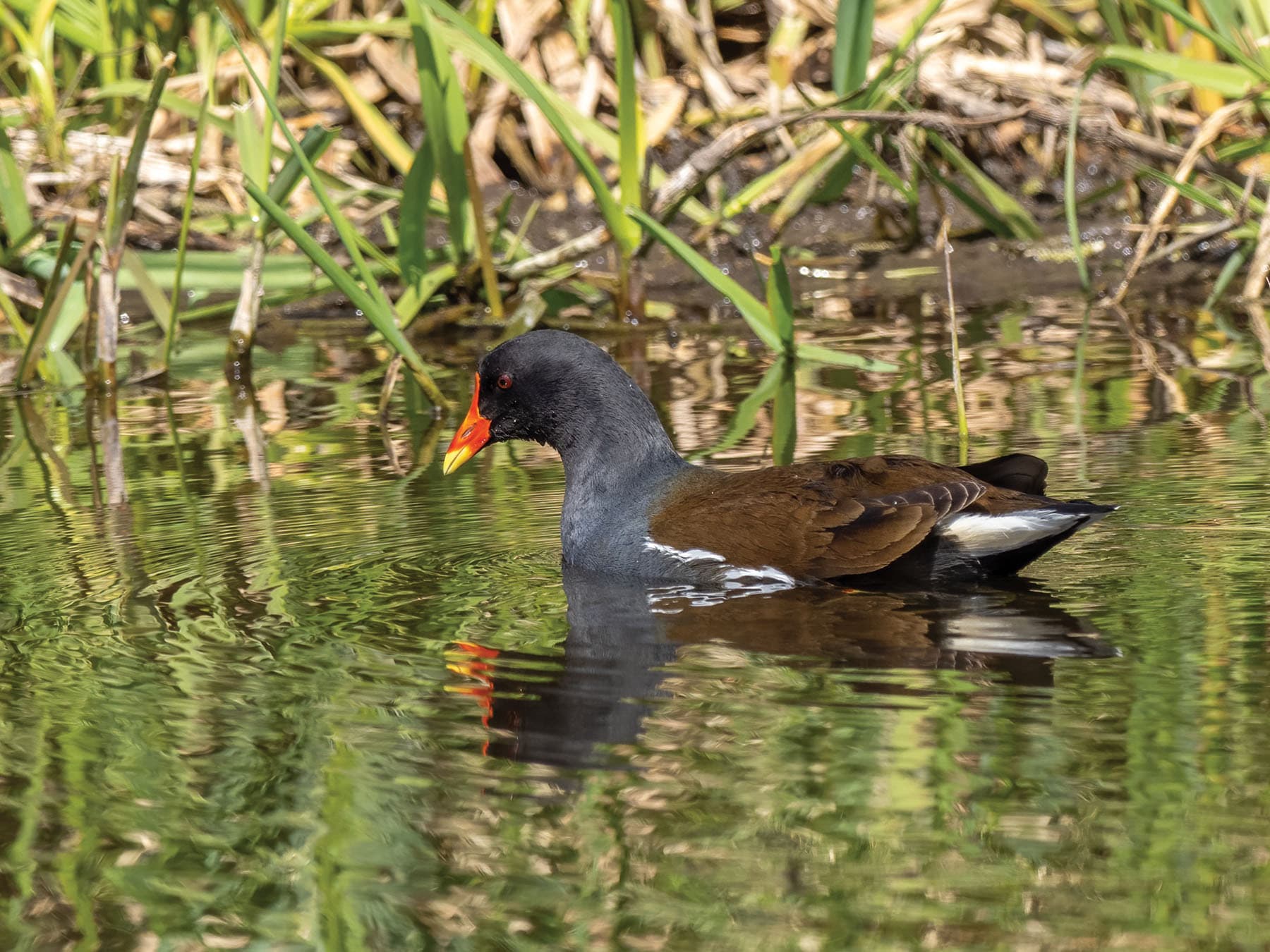
Moorhens inhabit a variety of freshwater environments, from ponds to larger rivers and even ditches. They prefer still or slow-flowing water, especially with abundant aquatic vegetation.
What is the range of a Moorhen?
Moorhens are widespread in the United Kingdom and are especially common in lowland areas. They are scarce or absent from high-lying parts of Scotland, Northern England and Wales.
Where do Moorhens live?
Moorhens spend most of their lives on and around the water. They are comfortable swimmers but equally agile when wading and walking on dry land. These birds spend little time flying and only occasionally land high above the ground in bankside trees.
How rare are Moorhens?
Moorhens are common birds in suitable habitats. Their population has remained stable in the long term but may fluctuate in response to cold winters and good breeding seasons.
Where can you see Moorhens in the UK?
Moorhens can be seen in virtually any marsh, pond, or other vegetated freshwater body. They are even at home in city parks, so birdwatchers rarely need to travel far to see these water birds.
Migration
Do Moorhens migrate?
Moorhens are resident breeding birds in the United Kingdom, although they may be partial or complete migrants elsewhere in their range. Many Moorhens from Continental Europe visit the UK each winter to weather the relatively mild winter.
Are Moorhens native to the UK?
Moorhens are a native species in the United Kingdom.
Tips for seeing it
- Look for Moorhens along the edges of ponds, lakes, and slow-moving rivers
- The Moorhen most closely resembles the Eurasian Coot, although Coots are larger and have plain black plumage and white bills
- Listen for their distinctive 'kurr-uk' call, especially during early mornings and evenings
- Observe their jerky swimming motion and tail-flicking behaviour
- In the UK, visit wetland reserves or urban parks with water features for reliable sightings
What it eats
The Moorhen is an opportunistic feeder with a varied diet.
What do Moorhens eat?
Moorhens are omnivorous birds, feeding on various aquatic and terrestrial plants, worms, insects, and small fish. They will also feed on berries, carrion, and occasionally bird eggs.
They find their food under the water, on the surface, on aquatic vegetation, or on land near water.
What do Moorhen chicks eat?
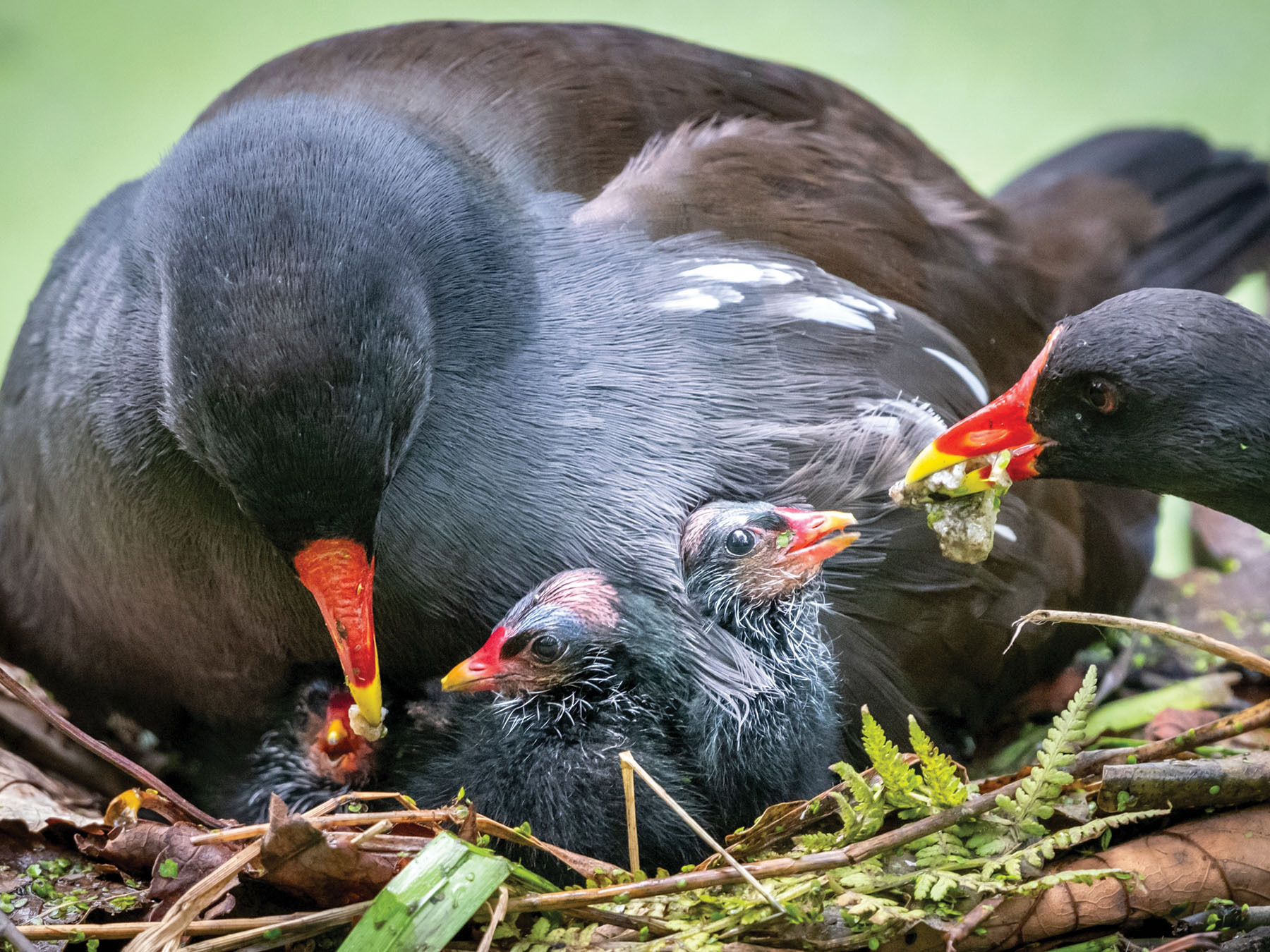
Baby Moorhens leave the nest within a day or two of hatching and are fed by both parents and even older siblings from previous broods. They eat insects and various other morsels.
Nesting and breeding
Moorhens begin breeding in the UK each spring, raising two or even three broods of chicks.
Where do Moorhens nest?
Moorhens nest on the water or up to about a meter above it in a large nest built of reeds, twigs and other plant material. The nest may be floating, built on an existing platform of vegetation, or sometimes on land near the water’s edge.
What do Moorhen eggs look like?
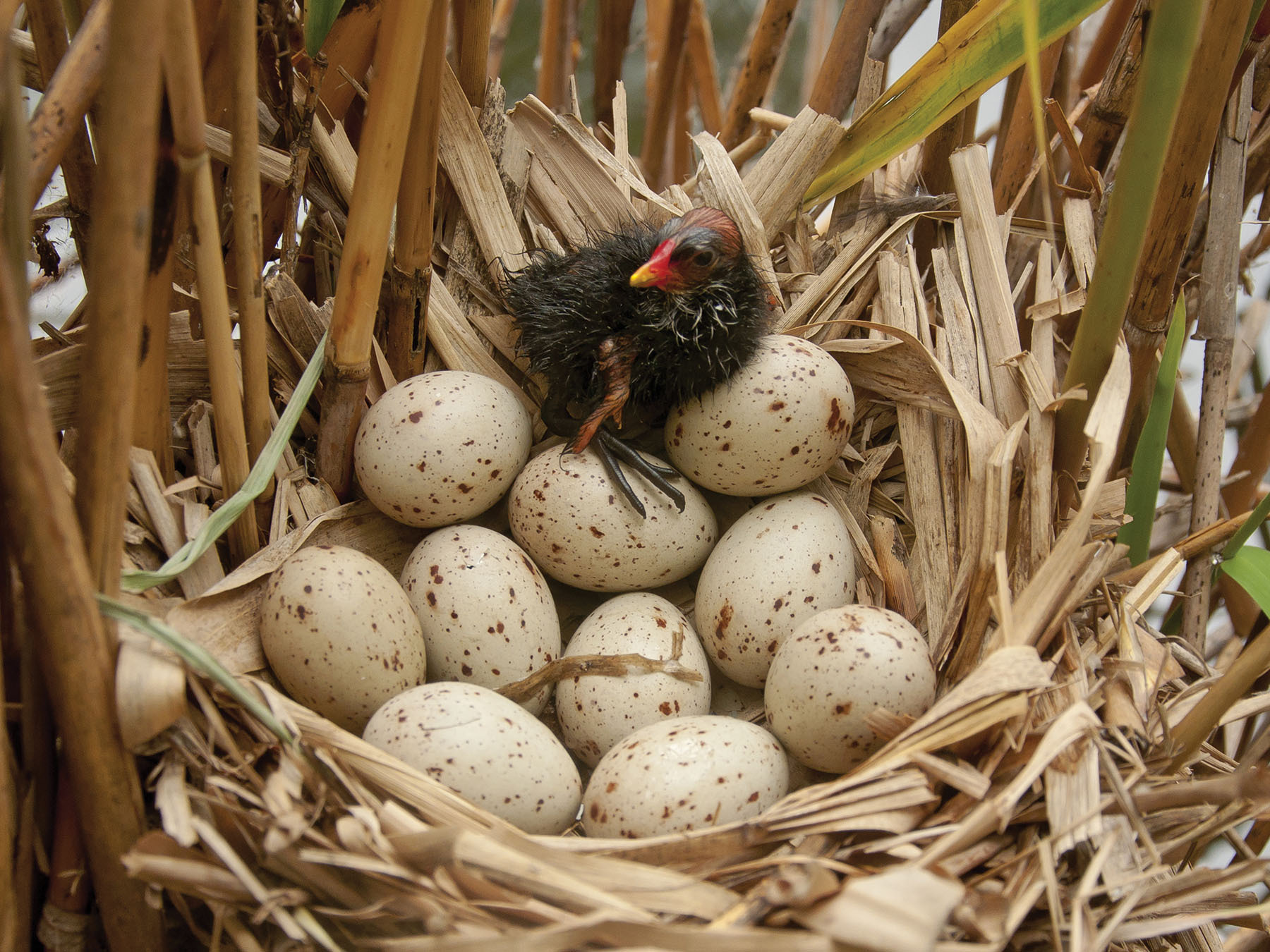
Moorhens usually lay five to nine eggs per clutch, each measuring about 43 millimetres long and 31 millimetres wide. Their eggs are a cream-white shade with brown blotches.
Do Moorhens mate for life?
Moorhens are usually monogamous, although they may form trios with two males or two females. Some pairs may remain together for several years, and those birds may indeed mate for life.
Behaviour
Moorhens are active waterbirds, often seen flicking their tails as they move about.
Are Moorhens aggressive?
Moorhens are territorial birds and may engage in fighting with competitors. They may fight in the water or on land, each bird facing the other and striking out with its feet.
Adult Moorhens may also act aggressively toward their own chicks when encouraging them to fend for themselves.
Where do Moorhens sleep at night?
Moorhens often sleep on their old nests at night or in low vegetation along the margins of water bodies.
Lifespan and predators
How long do Moorhens live?
Moorhens have an average lifespan of about three years, although can live as long as 18 years.
What are the predators of Moorhens?
Moorhens could fall prey to foxes, mink, cats, and Marsh Harrier. Their eggs are vulnerable to weasels, rats, Magpies and Crows.
Are Moorhens protected?
Moorhens are protected by the Wildlife and Countryside Act 1981.
Are Moorhens endangered?
Moorhens are not an endangered species. Despite being on the amber list, they remain common in the United Kingdom. Globally, they are ranked as a ‘Least Concern’ species on the IUCN Red List.
Conservation
While Moorhens are currently listed as Least Concern, they face threats from habitat loss and degradation of wetlands.
Conservation efforts focus on protecting and restoring wetland habitats, particularly in urban areas where these birds have adapted to live.
Similar birds
Often mistaken for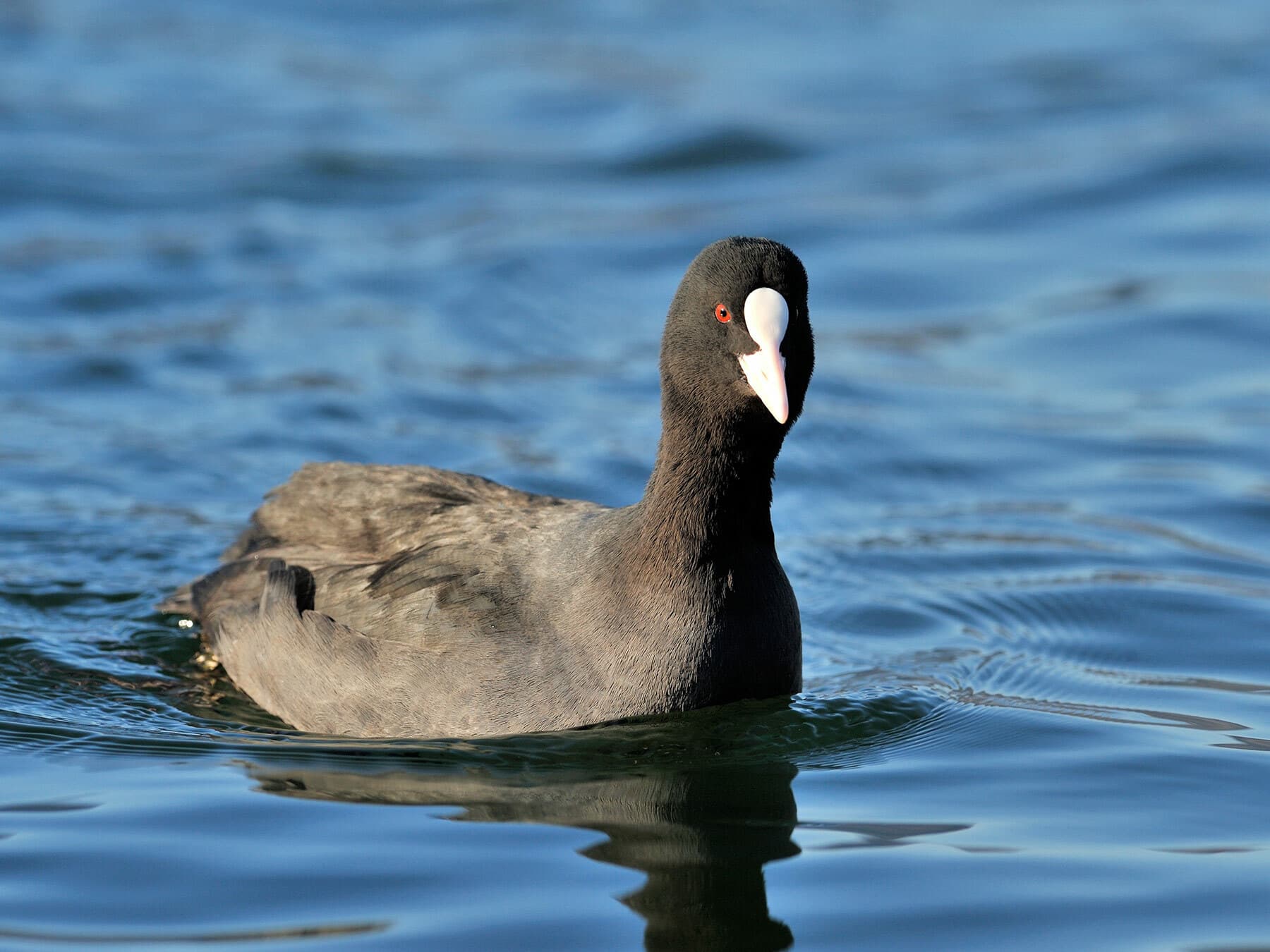
More photos
7 photos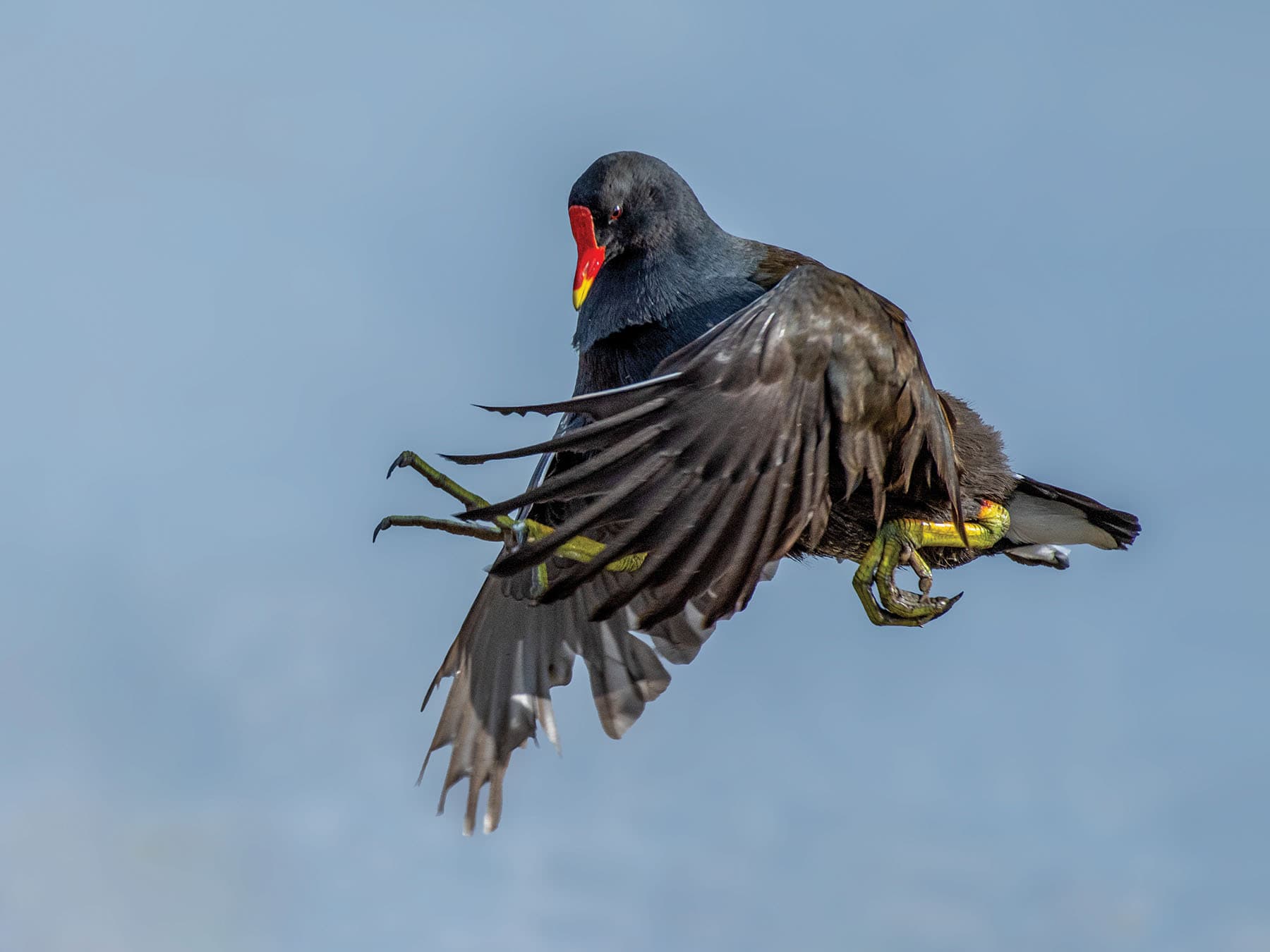 Moorhen in flight - they're not the most gracious in flight
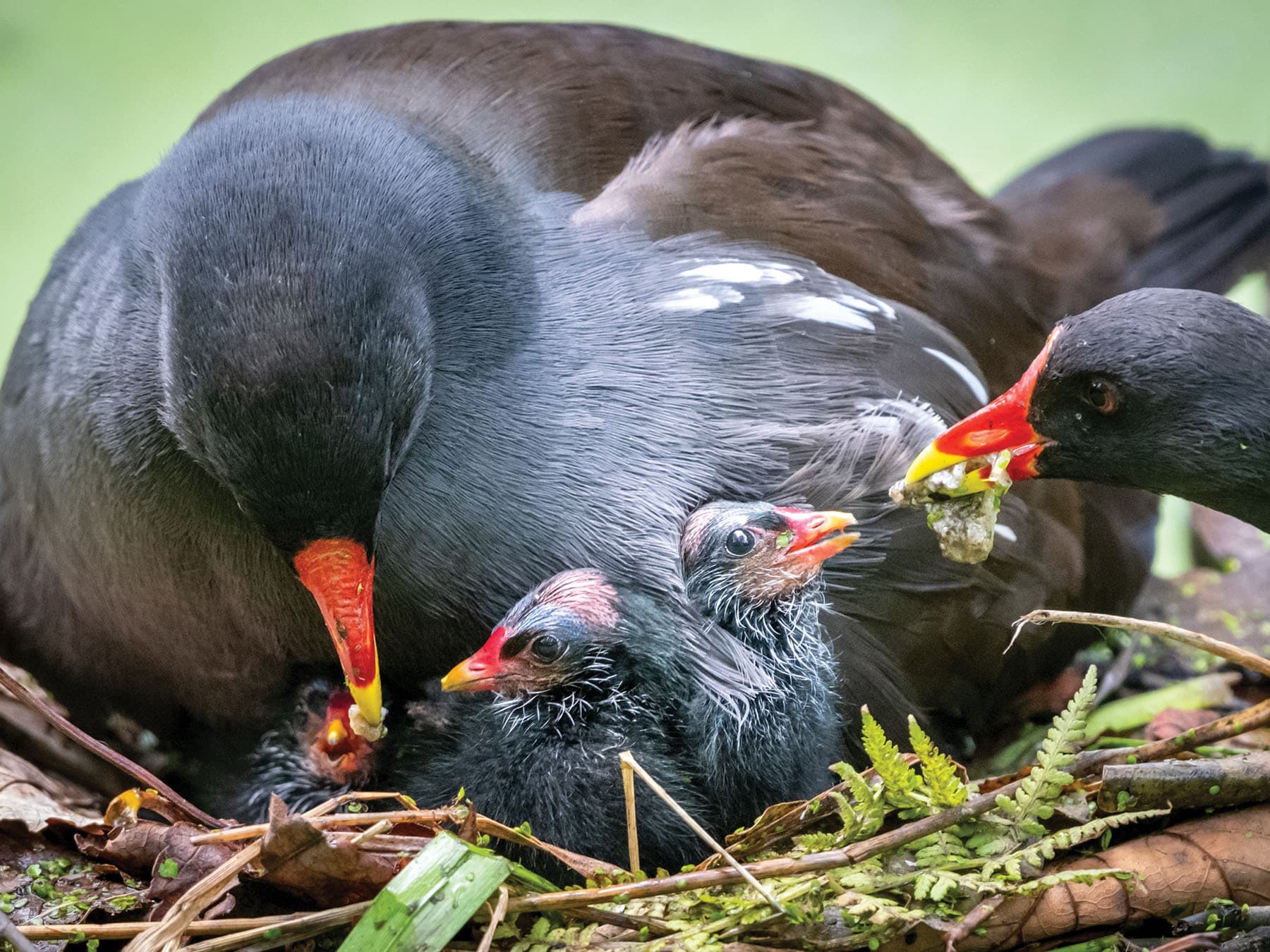 Breeding pair of Moorhens feeding their young chicks in the nest
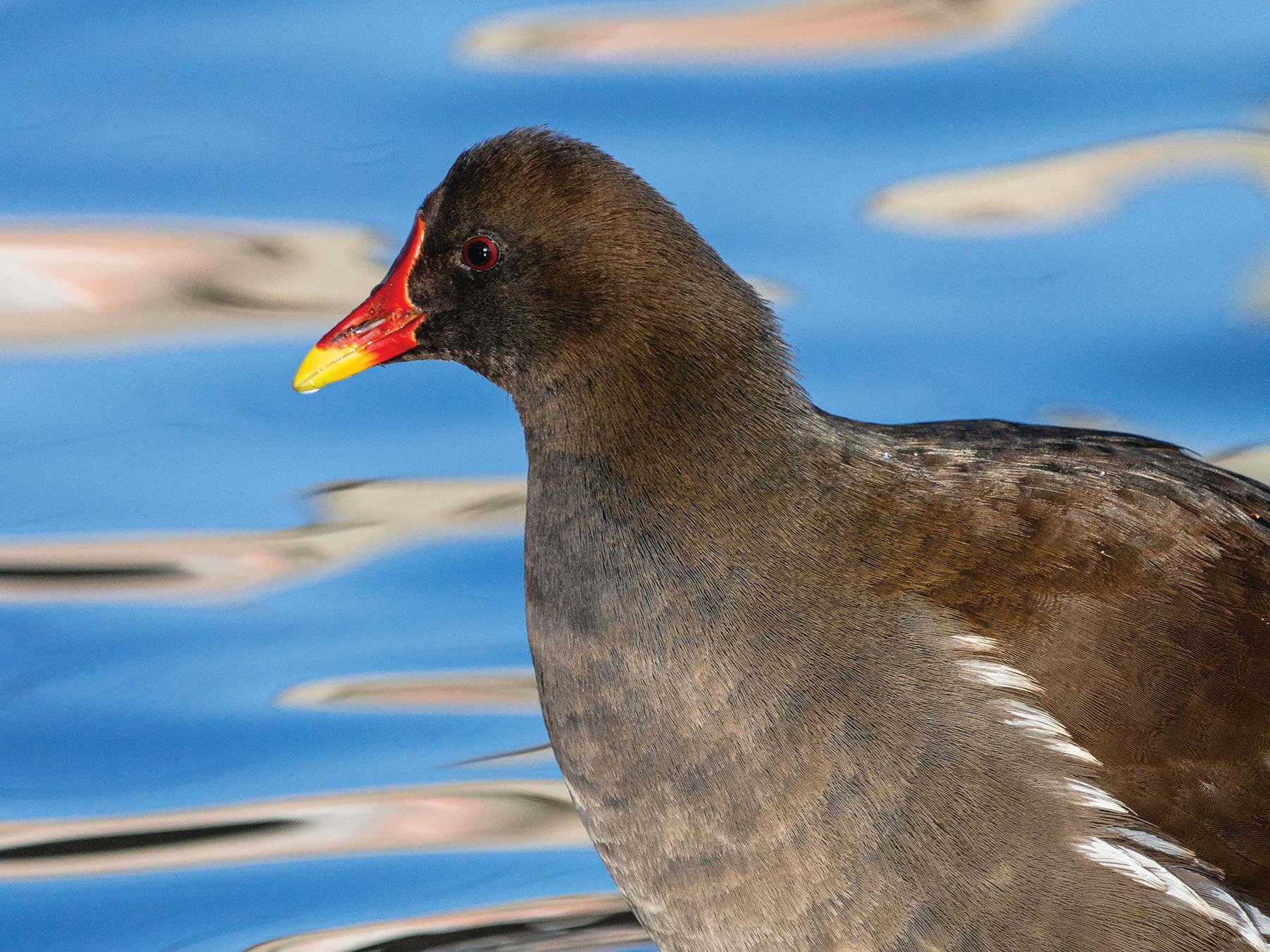 Close up portrait of a Moorhen
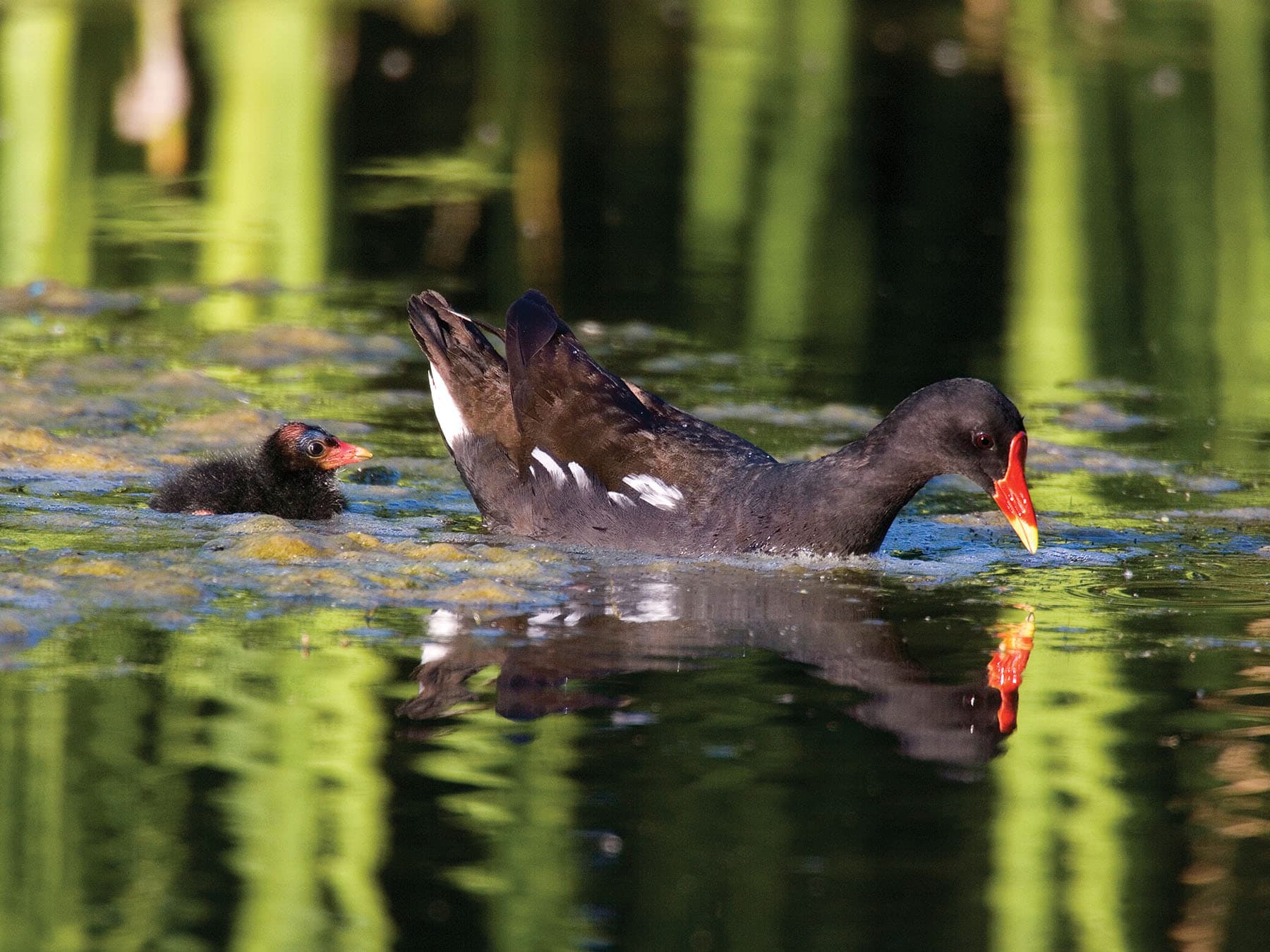 Moorhen chick swimming closely behind one of their parents
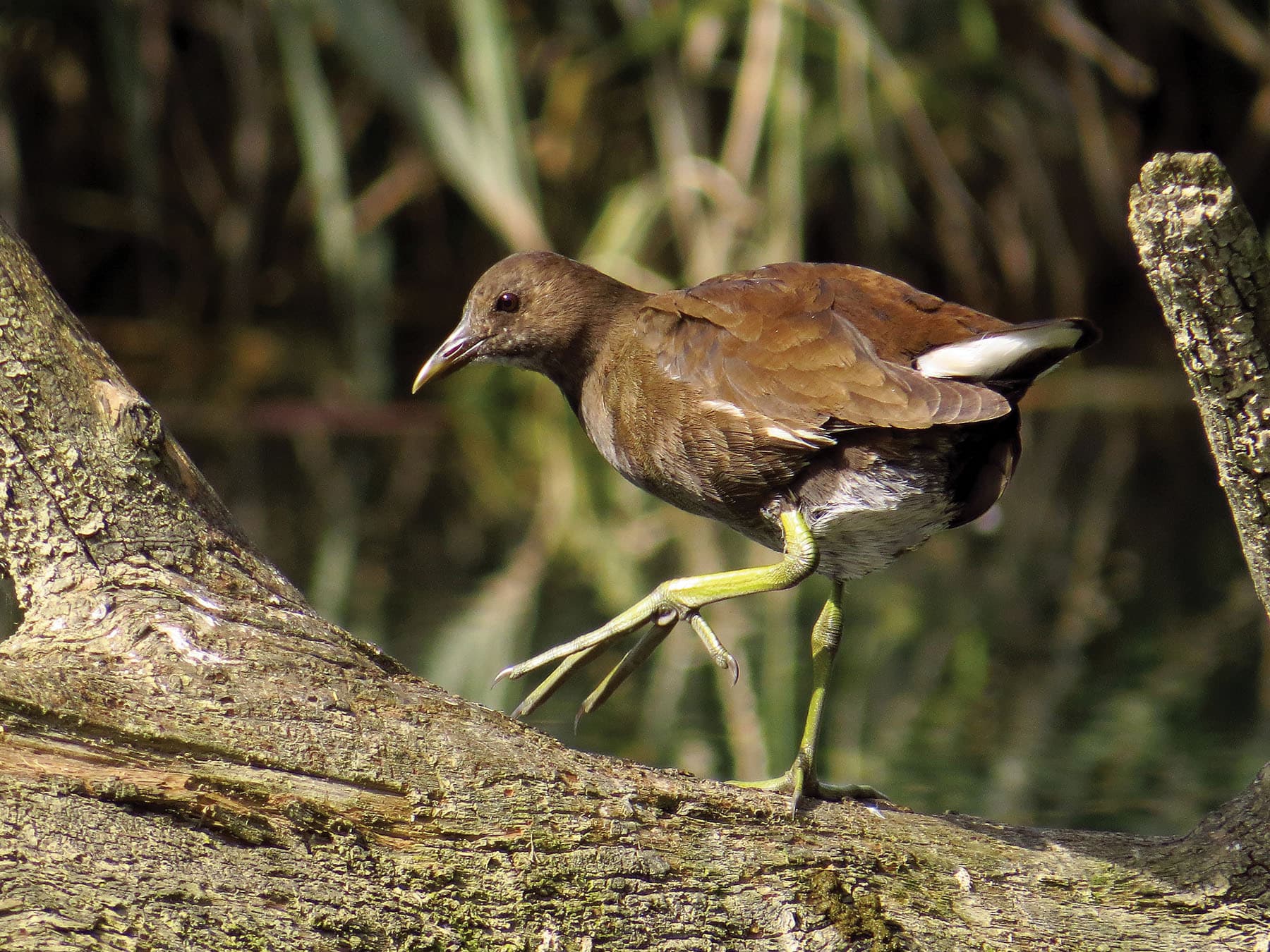 Juvenile Moorhen
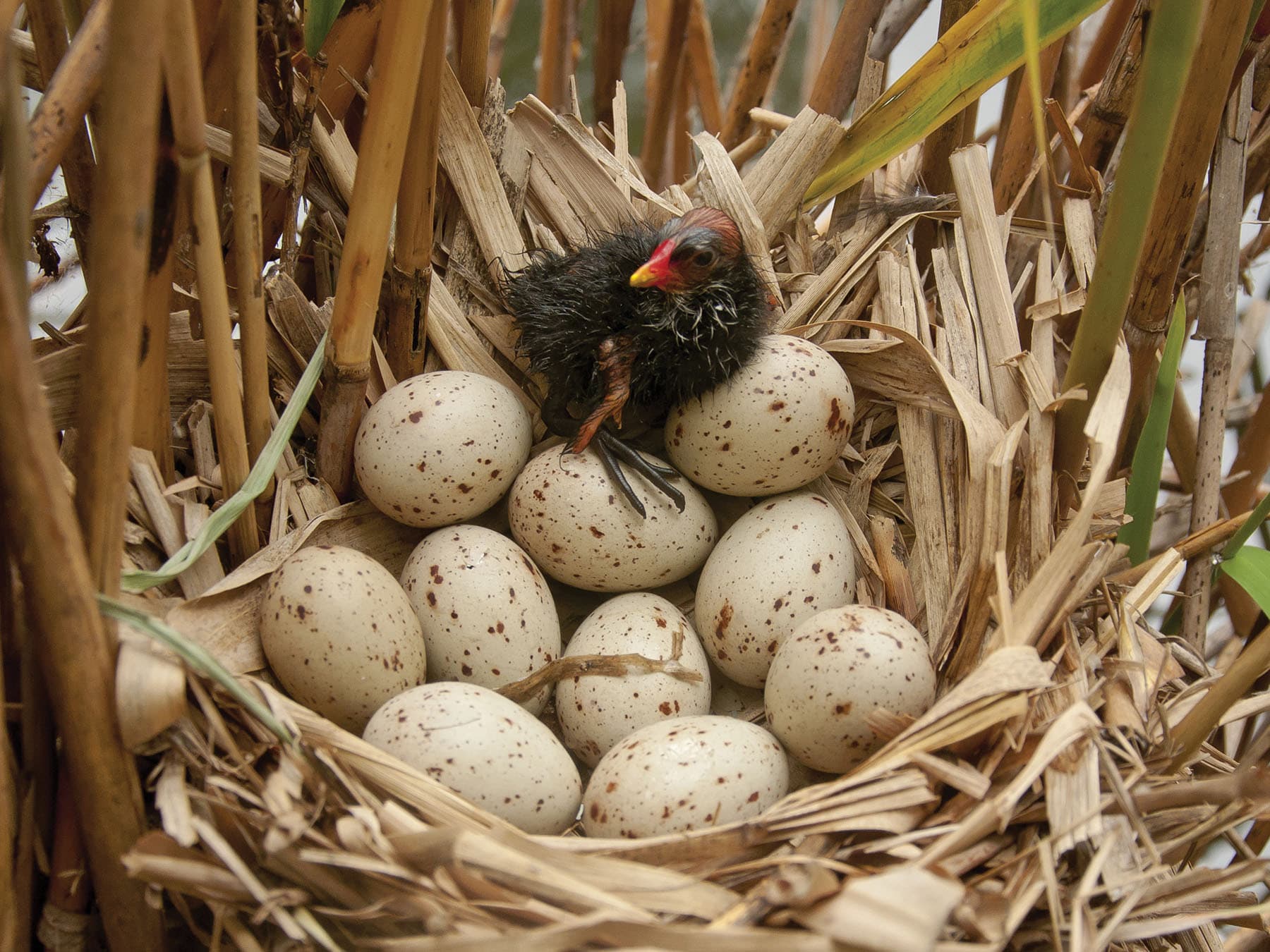 The nest of a Moorhen with eggs inside and a recently hatched chick
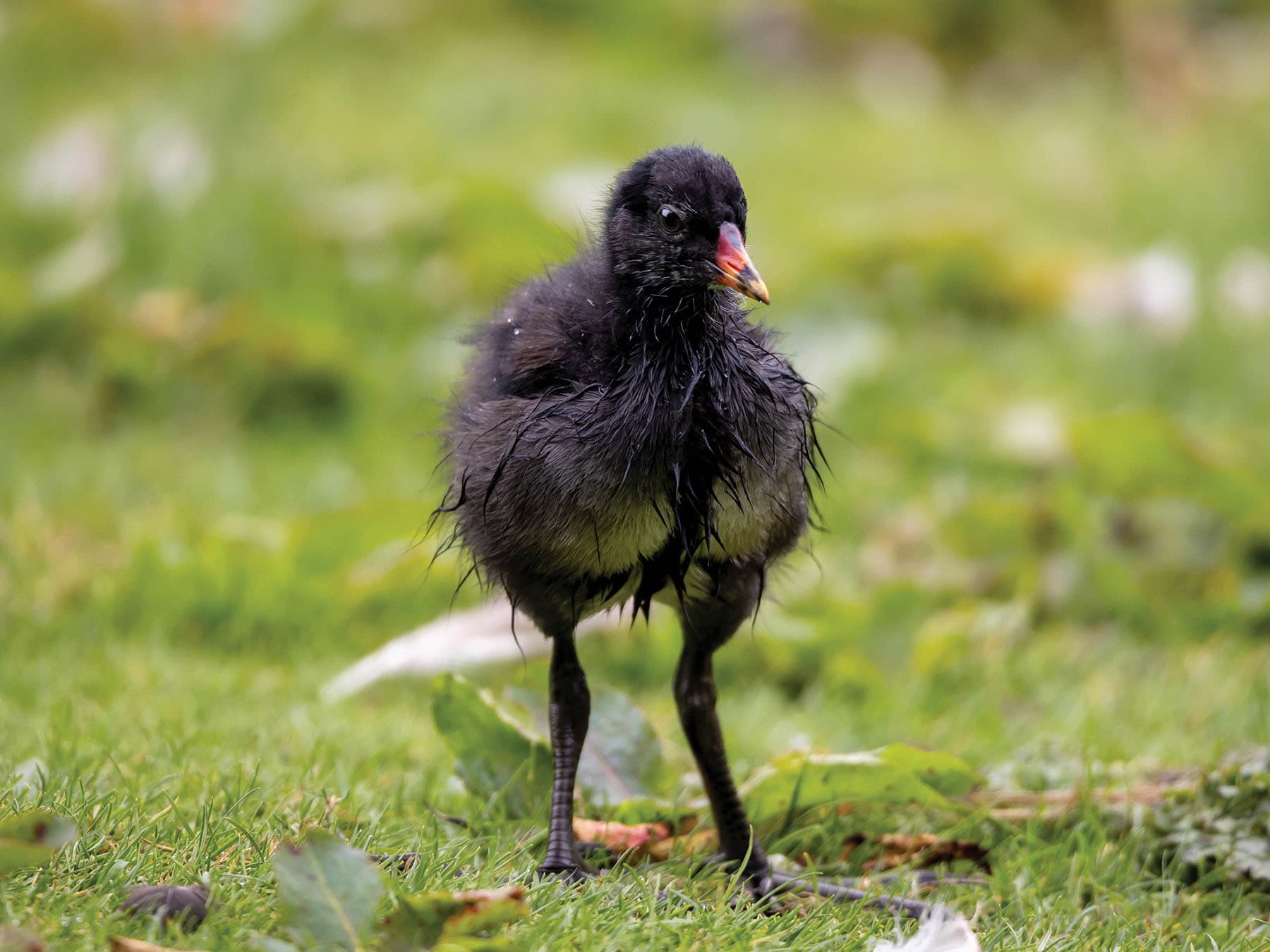 Young baby Moorhen chick out of the water, standing on the grass
Moorhen guides
2 guidesQuick facts
- Length
- 30–38 cm
- Wingspan
- 50–62 cm
- Weight
- 192–500 g
- Lifespan
- 3–15 years
- Family
- Rails & Coots
- Migration
- Partial migrant
- Global status (IUCN)
- Least Concern
- World population
- 5,000,000 - 9,999,999 individuals
- Population trend
- Stable
- Also called
- Common Moorhen, Waterhen
- Scientific name
- Gallinula chloropus
Questions
6Can Moorhens fly?
Moorhens can fly, although they are not the most graceful birds out there and prefer to fly longer distances at night.
Is a Moorhen a duck or a bird?
Moorhens are not ducks, although they certainly are birds. Moorhens are members of the Rallidae family, a group that contains other water birds like crakes, rails, and gallinules. Ducks are from the Anatidae family, which includes ducks, geese, and swans.
What do you call a baby Moorhen?
A baby Moorhen is called a chick.
Why do Moorhens squeak?
Moorhens generally call to communicate with other members of their species. Common scenarios include territory defence or when they are alarmed. Their commonly heard ‘squeak’ call is used for various displays.
Do Moorhens visit gardens?
Moorhens occasionally visit gardens, and some even feed from bird feeders. However, these colourful waterbirds are not common garden birds and are most likely to frequent properties near ponds and other suitable habitats.
How to attract Moorhen
Moorhens are most at home around the water, and this habitat requirement makes them a difficult species to attract for most people. However, if you live up against a river or pond, sprinkling mealworms, wheat, and corn may attract them to feed.
Sources
3- 1BirdLife International. 2019. Gallinula chloropus (amended version of 2016 assessment). The IUCN Red List of Threatened Species 2019: e.T62120190A155506651. Source (opens in a new tab)
- 2Wetlands International (2014)
- 3BirdLife International. 2019. Gallinula chloropus (amended version of 2016 assessment). The IUCN Red List of Threatened Species 2019: e.T62120190A155506651. Source (opens in a new tab)

Checked by
Nathan Cope, founder and editor
Nathan founded Birdfact and leads its writers and contributors in the UK, the US and Canada. He has watched and studied birds for more than ten years, and checks every article and species guide before it’s published.