


Coot
Eurasian Coot, Common Coot · Fulica atra
By the Birdfact teamChecked by Nathan Cope
On this page15 sections
How to recognise it
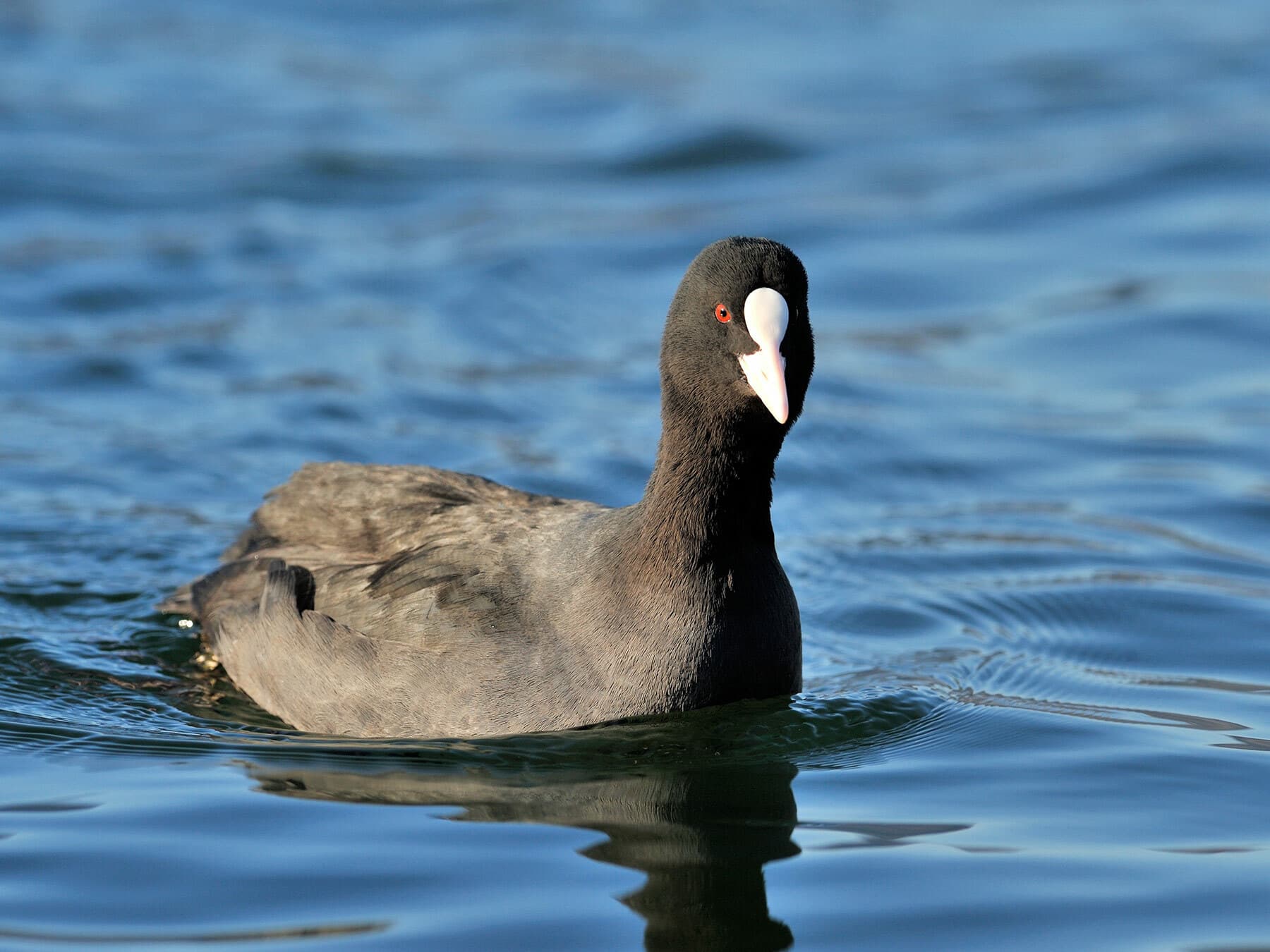
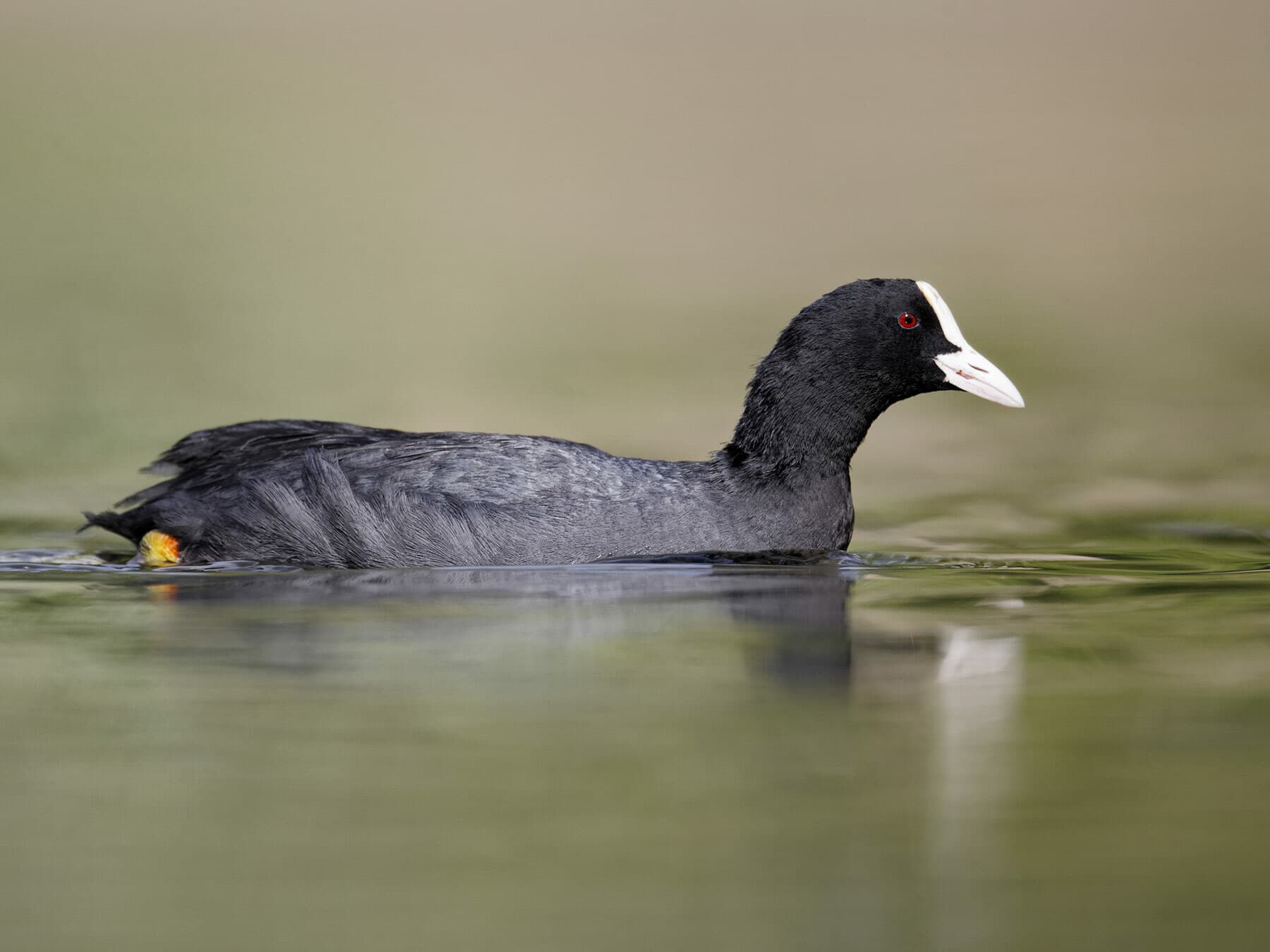
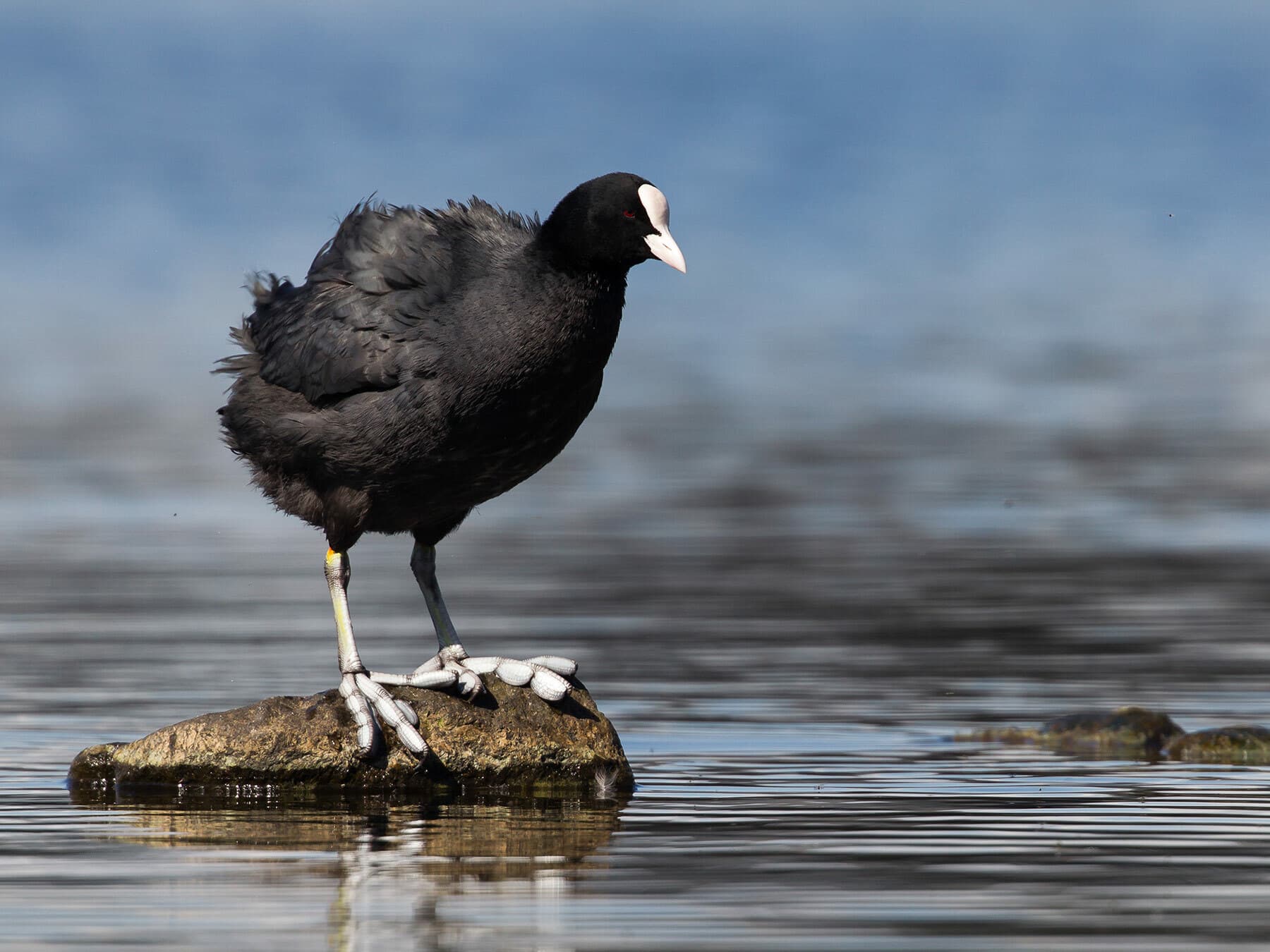
The Coot is predominantly black with a slight bluish sheen, contrasting sharply with its white bill and frontal shield. Its body is rounded and plump, with a short tail and lobed feet adapted for swimming. The eyes are distinctive, with a bright red iris.
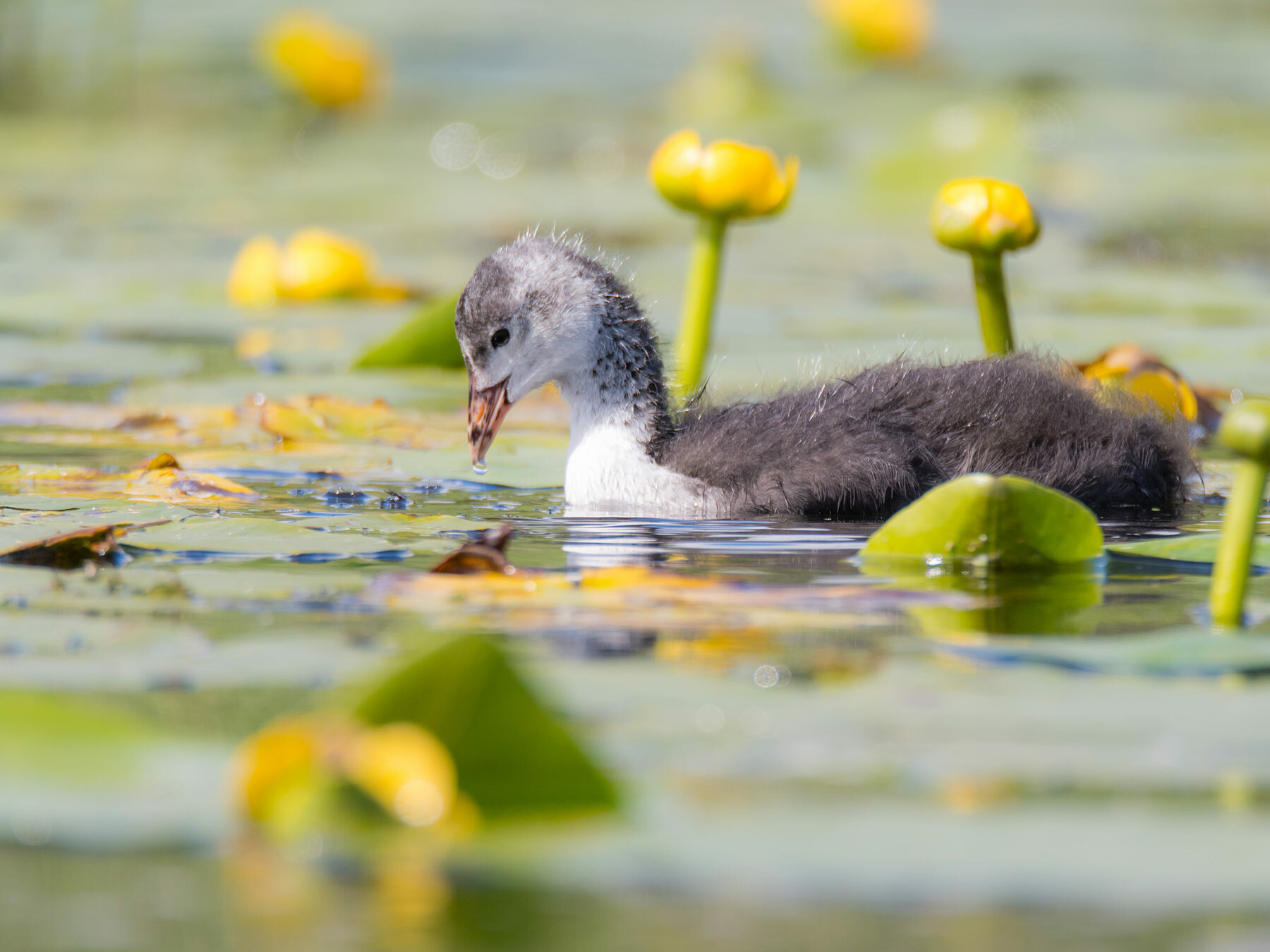
Juveniles have a duller plumage, often appearing dark grey or brown, with a paler throat and breast. They lack the bright white bill of adults, instead having a darker bill that gradually lightens with age.
Its size
Adults- Length
- 36–42 cm
- Wingspan
- 70–80 cm
- Weight
- 600–1000 g
Its song and calls
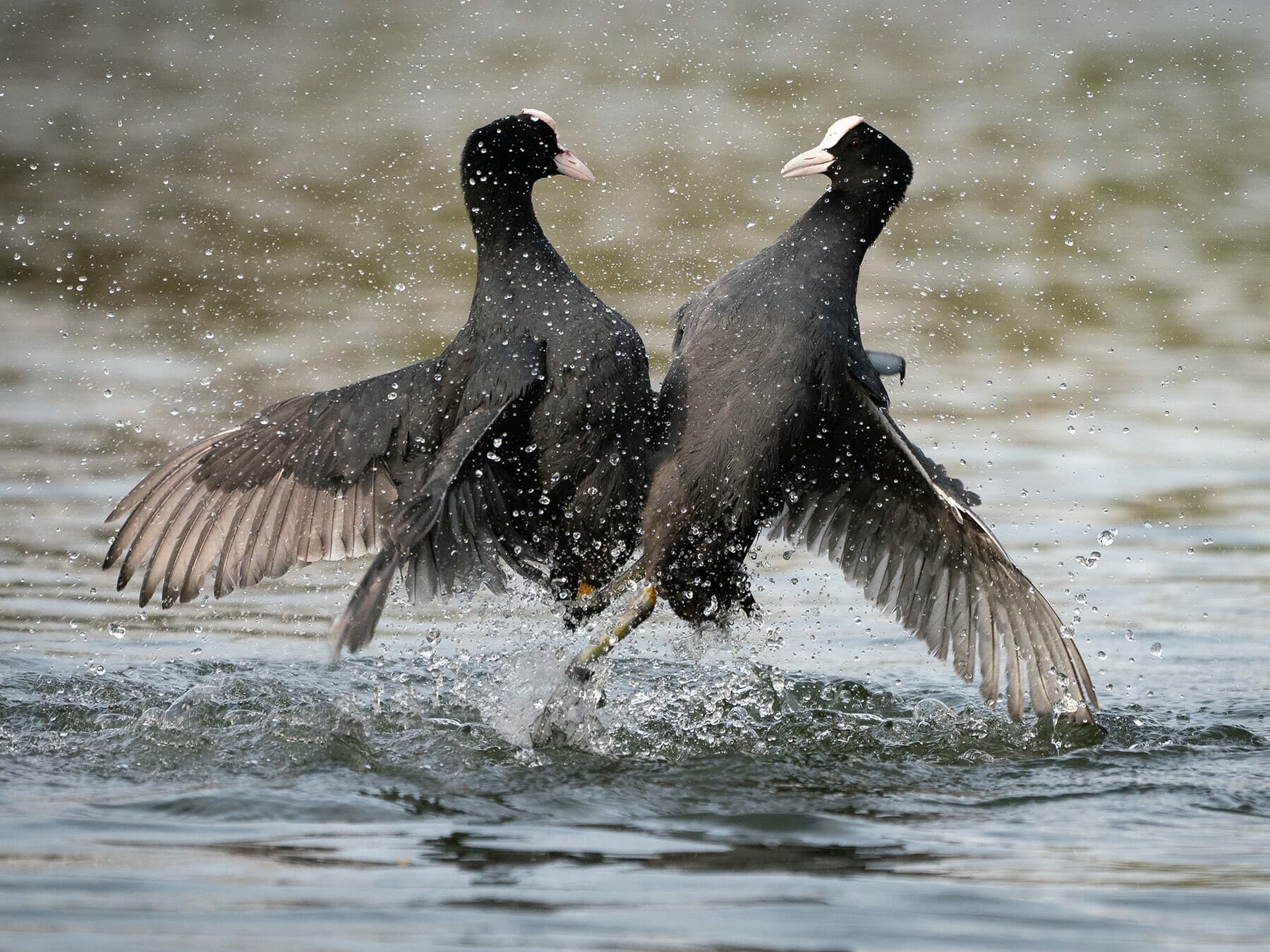
Coots can appear quarrelsome and combative and males will often call with a sharp metallic click of a sound sometimes repeated with a noise similar to ‘kick’ or ‘kick – kick’.
- Call0:00 / 0:31
Recorded in Gelderland, Netherlands · September 2018
When and where to see it
OctoberHere all year
Most recorded in October
- 1. Blaenau Gwent4.4%
- 2. Stockton-on-Tees2.2%
- 3. London2.2%
- 4. Wrexham2.0%
- 5. Cheshire1.9%
Each dot is a county, state or province: the bigger and darker, the larger the bird’s share of that place’s bird records that month. Grey dots: no regular records. The ringed point is the centre of the bird’s records this month; the arrow shows how it moved since last month, and the dashed loop its path through the year. “Arrivals” colours places where it becomes regular this month (orange) or is in its last regular month (grey). GBIF eBird Observation Dataset, 2019–2024. Map data: Natural Earth, US Census Bureau; place centres © OpenStreetMap contributors.
In your area
See when the Coot is recorded in your county, state or province.
How often the Coot turns up in the UK and Ireland through the year, from birdwatchers' records.
United Kingdom
Resident · all year · most records in March
Ireland
Resident · all year · most records in January
Show as a table
| Month | United Kingdom | Ireland |
|---|---|---|
| January | 1.2% (regular) | 0.48% (regular) |
| February | 1.3% (regular) | 0.45% (regular) |
| March | 1.3% (regular) | 0.42% (regular) |
| April | 1.2% (regular) | 0.34% (regular) |
| May | 1.1% (regular) | 0.29% (regular) |
| June | 1.0% (regular) | 0.31% (regular) |
| July | 1.1% (regular) | 0.31% (regular) |
| August | 1.1% (regular) | 0.35% (regular) |
| September | 1.0% (regular) | 0.35% (regular) |
| October | 0.91% (regular) | 0.33% (regular) |
| November | 1.1% (regular) | 0.48% (regular) |
| December | 1.2% (regular) | 0.47% (regular) |
Recorded regularly in
Worldwide: recorded regularly in 99 countries
Countries where it was recorded in at least 3 of the 6 years 2019–2024. Linked countries have their own bird list.
Europe (46)
- Åland Islands
- Albania
- Austria
- Belarus
- Belgium
- Bosnia & Herzegovina
- Bulgaria
- Croatia
- Czechia
- Denmark
- Estonia
- Faroe Islands
- Finland
- France
- Germany
- Greece
- Guernsey
- Hungary
- Iceland
- Ireland
- Isle of Man
- Italy
- Jersey
- Kosovo
- Latvia
- Liechtenstein
- Lithuania
- Luxembourg
- Malta
- Moldova
- Montenegro
- Netherlands
- North Macedonia
- Norway
- Poland
- Portugal
- Romania
- Russia
- Serbia
- Slovakia
- Slovenia
- Spain
- Sweden
- Switzerland
- Ukraine
- United Kingdom
Africa (8)
- Algeria
- Egypt
- Libya
- Mauritania
- Morocco
- Senegal
- Tunisia
- Western Sahara
Asia (42)
- Armenia
- Azerbaijan
- Bahrain
- Bangladesh
- Bhutan
- Cambodia
- China
- Cyprus
- Georgia
- Hong Kong SAR China
- India
- Indonesia
- Iran
- Iraq
- Israel
- Japan
- Jordan
- Kazakhstan
- Kuwait
- Kyrgyzstan
- Laos
- Lebanon
- Macao SAR China
- Malaysia
- Mongolia
- Myanmar (Burma)
- Nepal
- Oman
- Pakistan
- Palestinian Territories
- Philippines
- Qatar
- Saudi Arabia
- South Korea
- Sri Lanka
- Taiwan
- Tajikistan
- Thailand
- Turkey
- United Arab Emirates
- Uzbekistan
- Vietnam
Oceania (3)
Data: EOD – eBird Observation Dataset (Cornell Lab of Ornithology), accessed via GBIF.org, CC BY 4.0. Records from 2019–2024, aggregated and filtered by Birdfact. How these lists are made
Eurasian Coots are widespread throughout Europe and can be found extending eastwards into India, Sri Lanka and central Asia, Indonesia, New Guinea, New Zealand, Tasmania and Australia. They are also found in the north Atlantic islands of the Azores and the Canaries and along the coast of North Africa. Whilst many Eurasian coots are resident all year, those found in northern and eastern Europe migrate during the winter months to sub-Saharan Africa and South East Asia.
Signs and Spotting tips
The Eurasian coot is mainly a fresh water wading bird that prefers relatively shallow large open lakes, reservoirs, ponds and gravel pits with static or slow moving water. Out of the breeding season in the winter they will also choose salt water estuaries and inshore seawater. As well as foraging for food at the bottom of lakes and ponds coots can also be found grazing on grasses along nearby shores. The white bill and facial shield are a unique reference for identification in addition to some fairly unusual feet and loud short vocalisations.
What it eats
Tadpoles, snails and other small aquatic creatures are eaten but more commonly the coot has a predominantly vegetarian diet of aquatic plants, algae and grasses taken from the waters surface or adjacent land. The bird dives easily to forage at the bottom of fresh water lakes or reservoirs bobbing back up to the surface to eat its catch.
Nesting and breeding
Nests are built by the male and female and constructed of reeds, leaves, roots and twigs and normally built in water from the ground upwards close to surrounding vegetation or overhanging tree branches. Less common are floating nests. One brood, occasionally two, consisting of between 6 – 10 eggs is produced, dependent upon location in the northern hemisphere between March to September (apart from India where the season is November to December) and between August to February in the southern hemisphere. Eggs are incubated by both parents for twenty one to twenty six days and fledging occurs an average of fifty five to sixty days after hatching.
Behaviour
Coots are highly social birds, often seen in large flocks on open water. They are excellent swimmers and divers, using their lobed feet to propel themselves underwater when foraging.
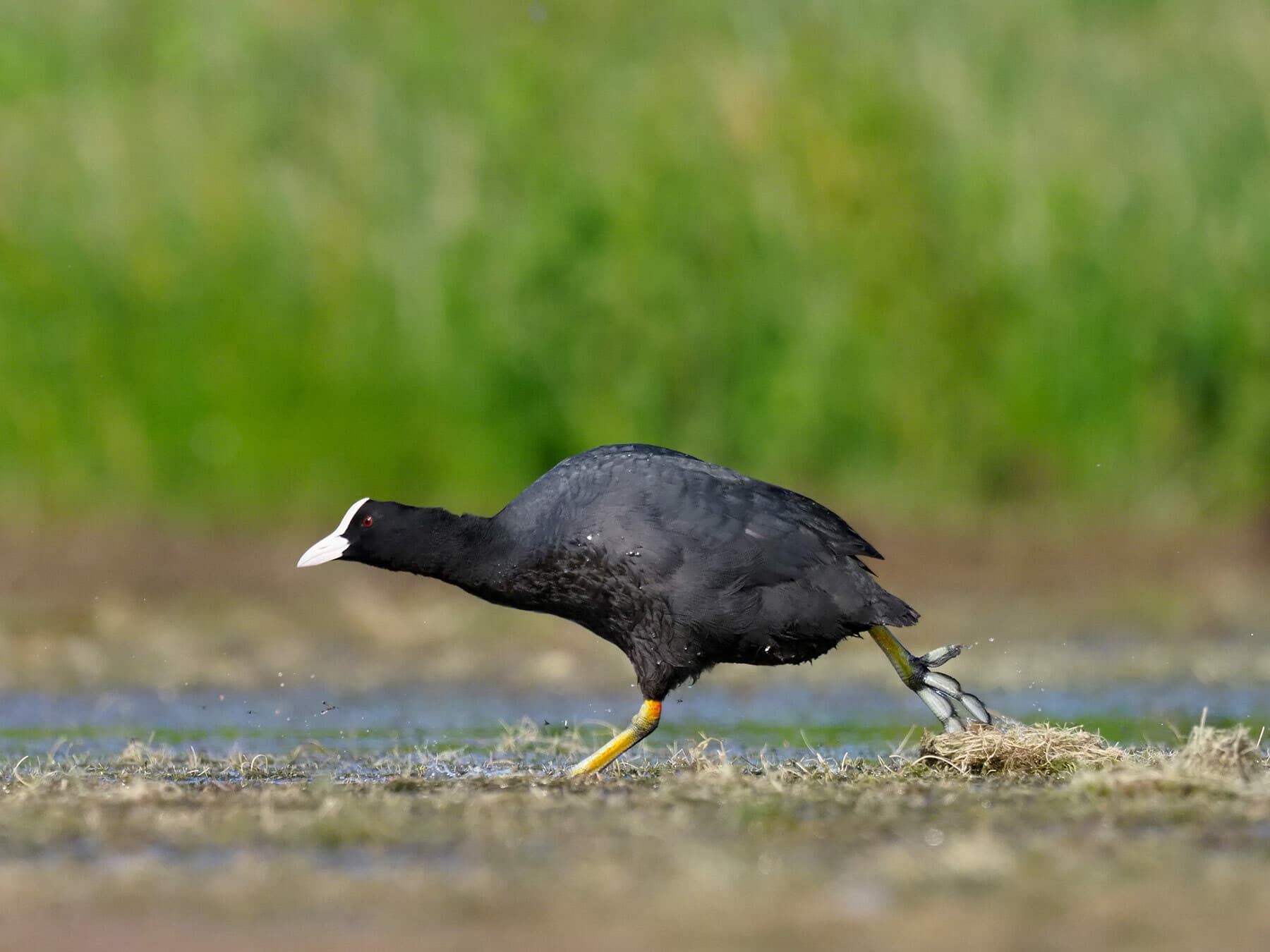
On land, they walk with a distinctive bobbing gait, and when threatened, they can run across the water's surface, flapping their wings to gain speed.
Lifespan and predators
Life expectancy for a Eurasian coot is up to fifteen years.
Conservation
While the Coot is currently listed as Least Concern due to its wide distribution and large population, it faces localised threats from habitat loss and degradation. Conservation efforts focus on protecting and restoring wetland habitats, which benefit Coots and many other waterbird species.
What does a Eurasian Coot look like?
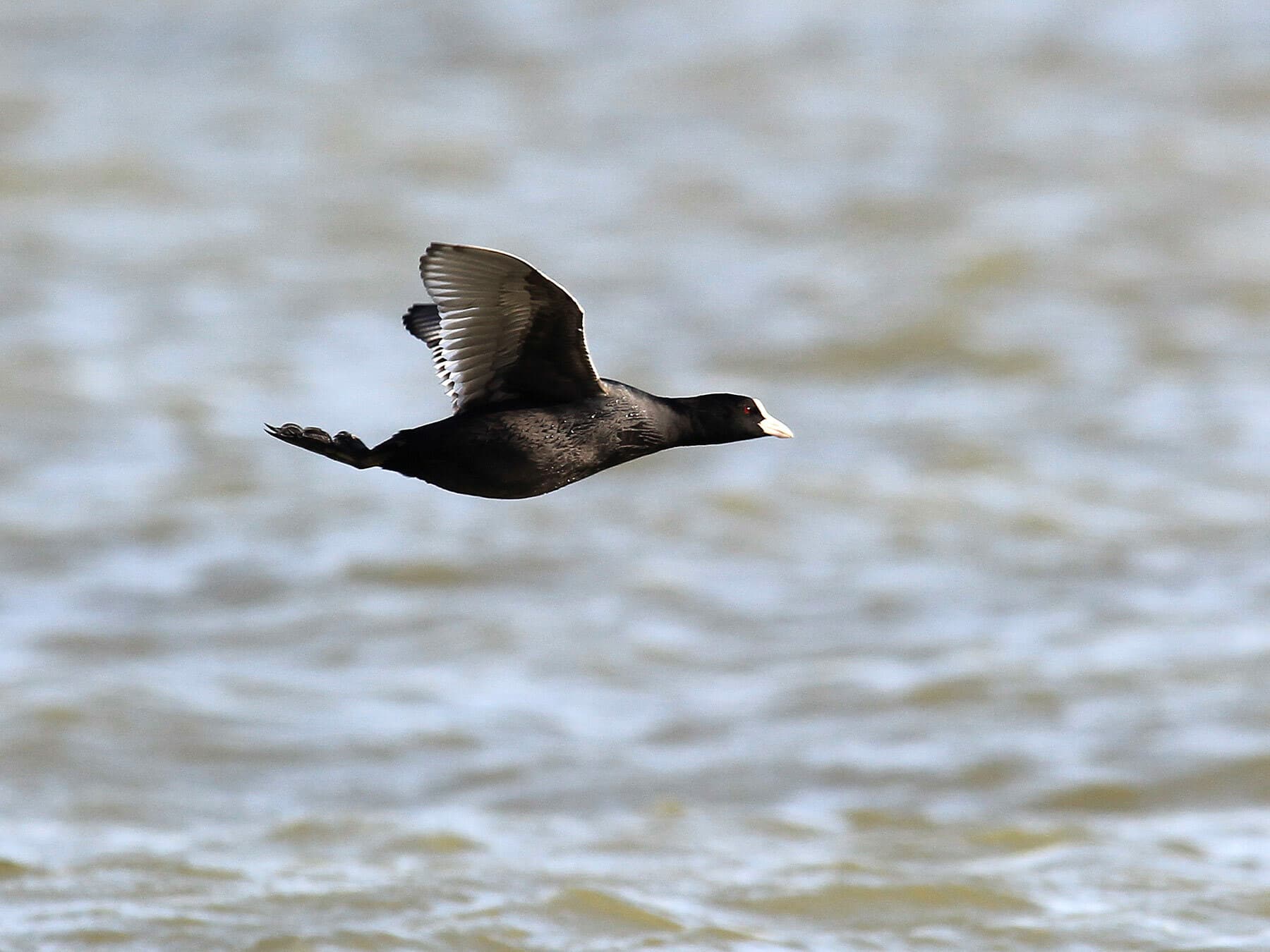
The adult male Eurasian coot has a deep black coloured head and neck with a paler dark grey body. The secondary flight feathers have white tips giving a pale back edge to the inner wing easily visible during flight. The eye is a prominent deep red in colour and the bill is white and extends from the base of the upper mandible into a white facial shield between the eyes and on to the forehead. This is similar in style to the red face shield of the smaller Common Moorhen, also known as a Eurasian Moorhen. The coot’s legs are yellow and grey and its feet are large and pale grey with toes which are almost bulbous and are technically known as being ‘lobate’. The adult female is similar to the male but generally marginally smaller although both are relatively heavily built in comparison to their overall size. Juveniles are more of a brownish grey hue overall with a greyish white throat and underparts and a yellowy bill.
Similar birds
Often mistaken for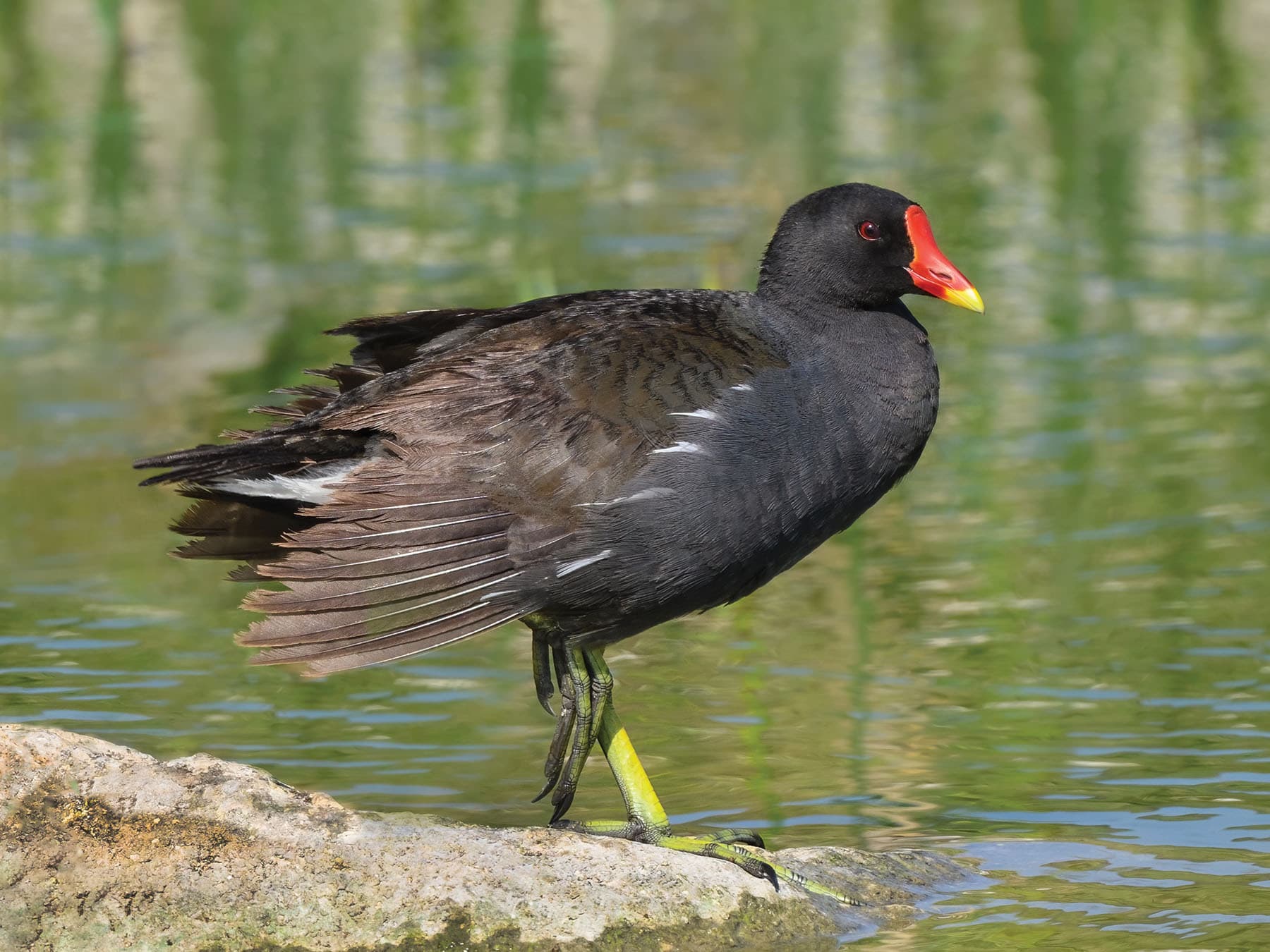
More photos
2 photos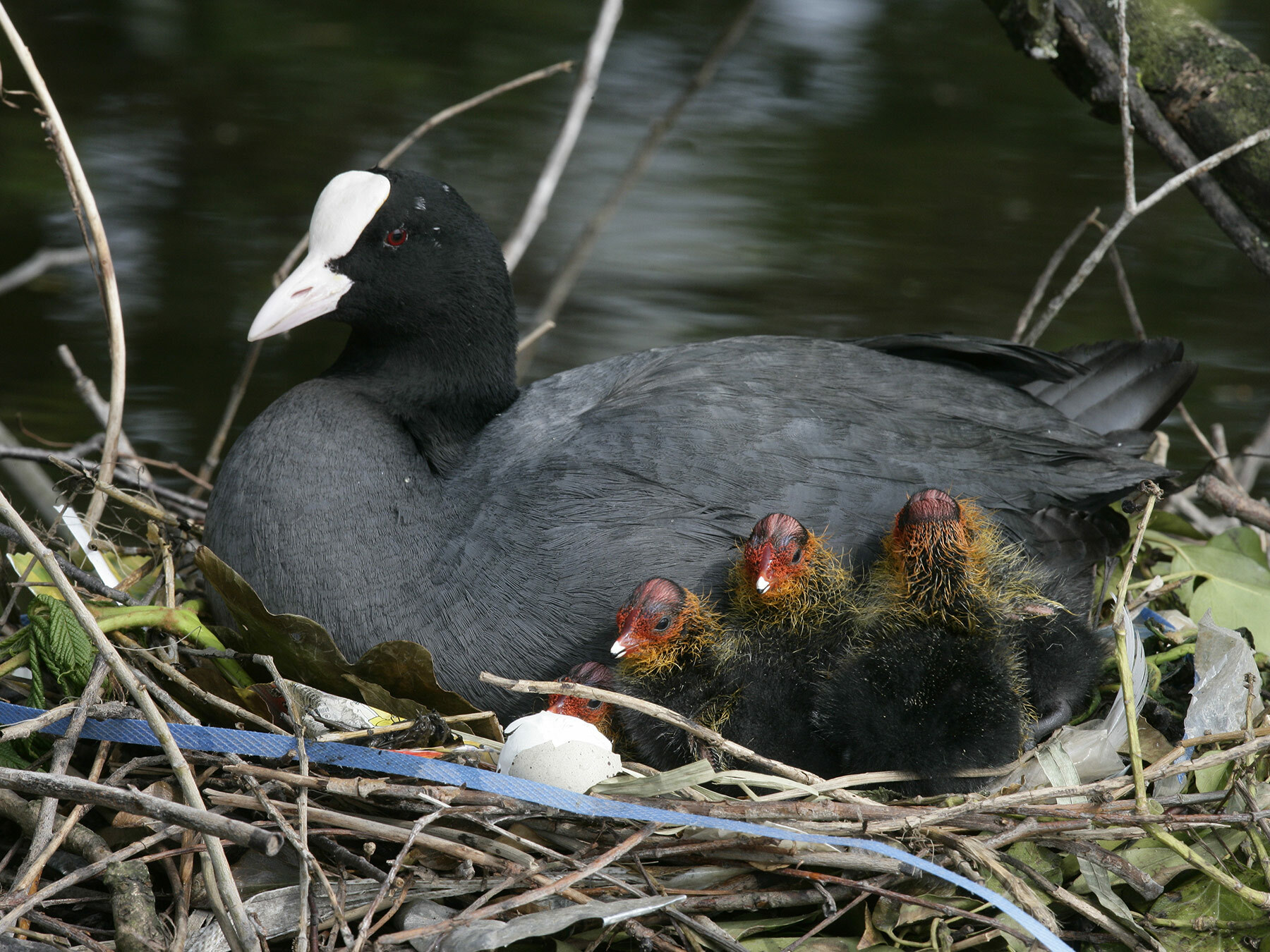
Coot guides
1 guidesQuick facts
- Length
- 36–42 cm
- Wingspan
- 70–80 cm
- Weight
- 600–1000 g
- Lifespan
- 10–15 years · oldest recorded 15.2 years
- Family
- Rails & Coots
- Migration
- Partial migrant
- Global status (IUCN)
- Least Concern
- World population
- 7,950,000 - 9,750,000 individuals
- Population trend
- Increasing
- Also called
- Eurasian Coot, Common Coot
- Scientific name
- Fulica atra
Sources
4- 1BirdLife International. 2019. Fulica atra. The IUCN Red List of Threatened Species 2019: e.T22692913A154269531. Source (opens in a new tab)
- 2Wetlands International (2016)
- 3Wetlands International (2016)
- 4BTO longevity records: maximum age from a ringed bird, 15 years, 3 months, 13 days (set in 1978), BirdFacts: Coot (1978) Source (opens in a new tab)

Checked by
Nathan Cope, founder and editor
Nathan founded Birdfact and leads its writers and contributors in the UK, the US and Canada. He has watched and studied birds for more than ten years, and checks every article and species guide before it’s published.