


American Coot
Fulica americana
By the Birdfact teamChecked by Nathan Cope
See it in 3D
3 plumages
An adult American Coot is 13–17 in (33–43 cm) long, bill to tail.
Adult
© 2026 NC Digital Limited (Birdfact). All rights reserved. This 3D model may be viewed on this page and shared by link only. Downloading, extracting, copying or reusing it, or using it to train machine-learning models, is not permitted without our written permission. Using our models
On this page15 sections
How to recognise it
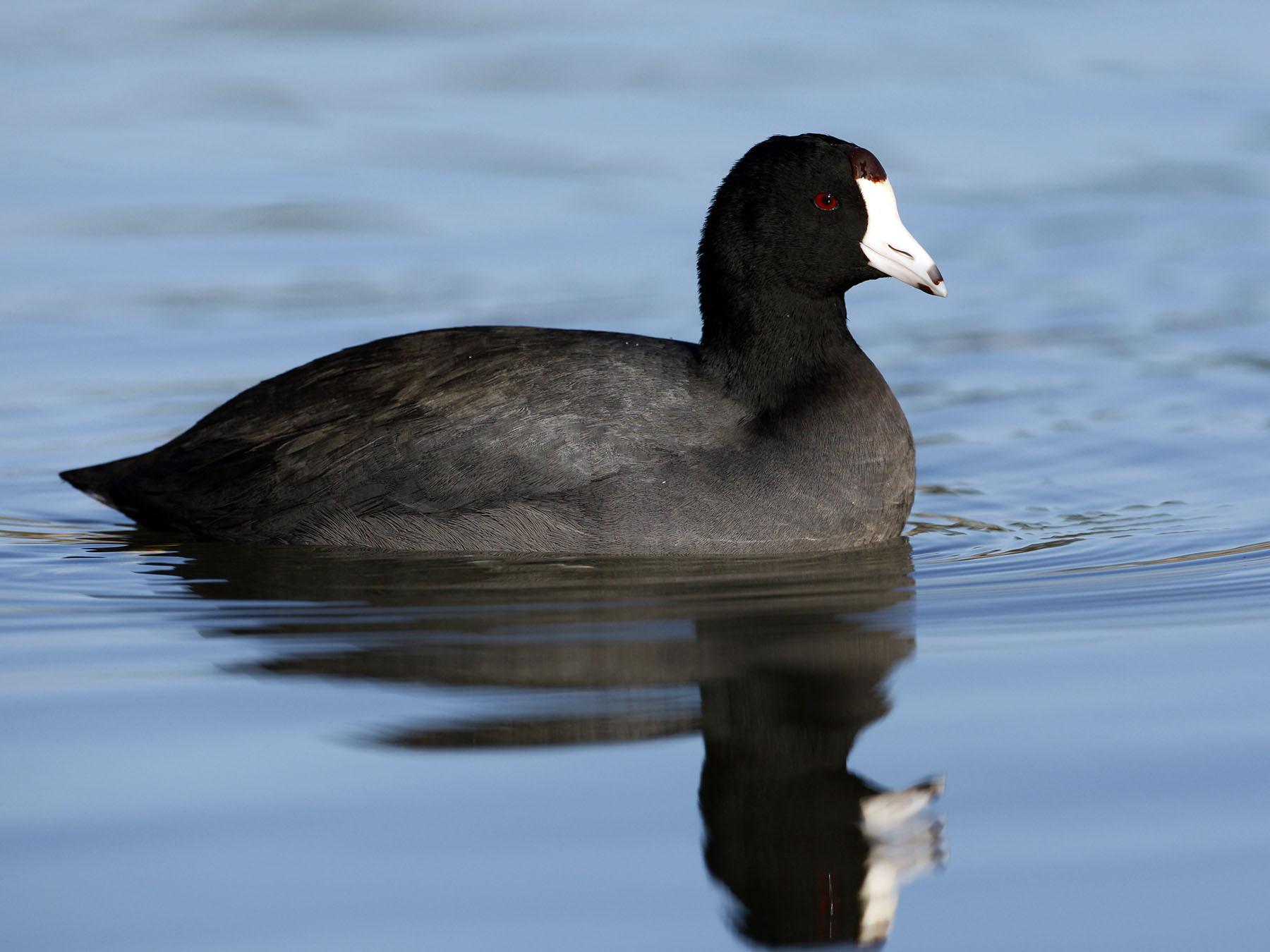
The American Coot is the plump, slate-gray waterbird with a black head and a bright white bill that turns up on ponds, lakes and marshes across North America, from city parks to prairie sloughs. It swims like a duck, but it is not one: it belongs to the rail family, with the gallinules, and it is the most aquatic rail on the continent and one of the most common.1
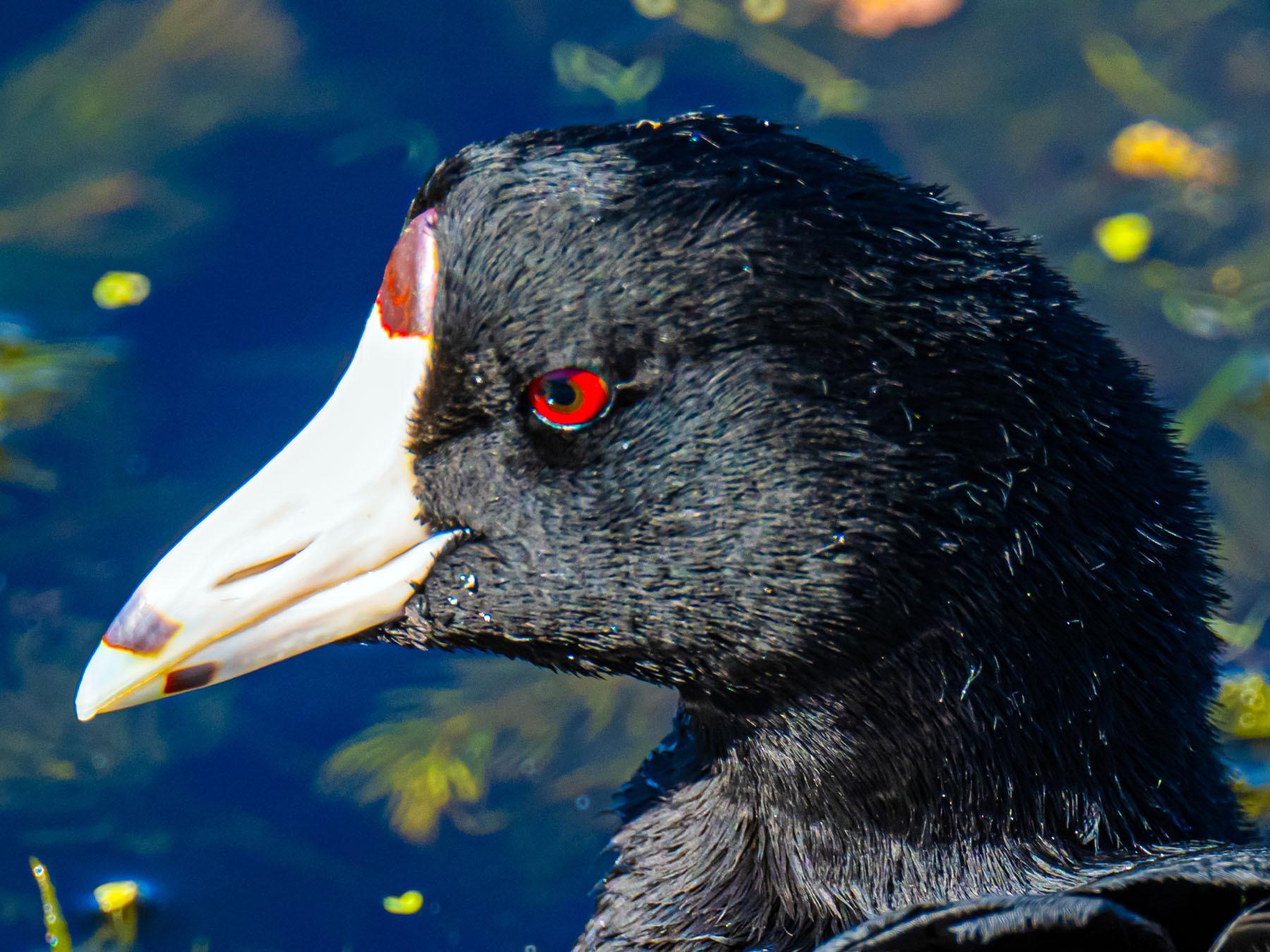
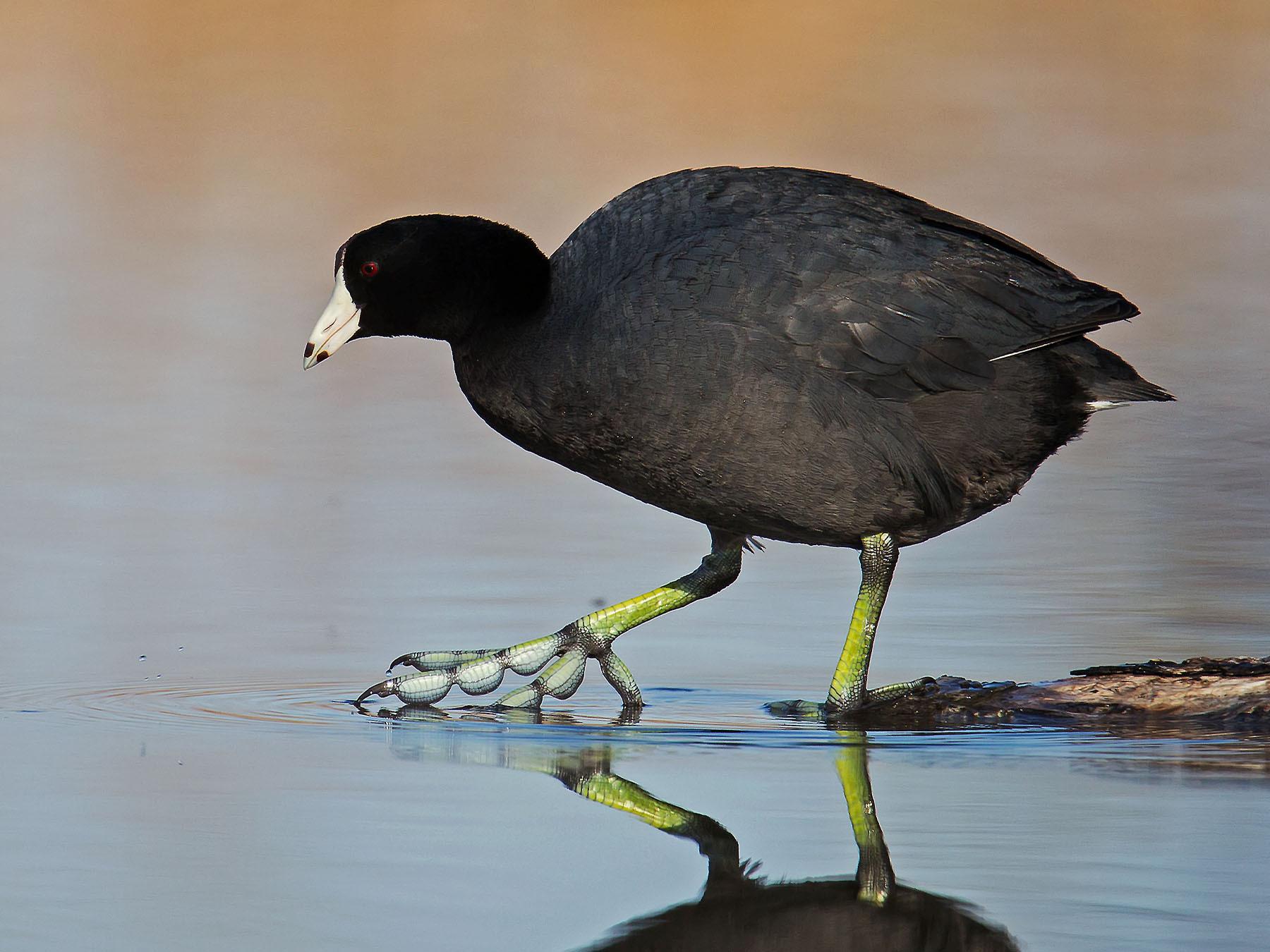
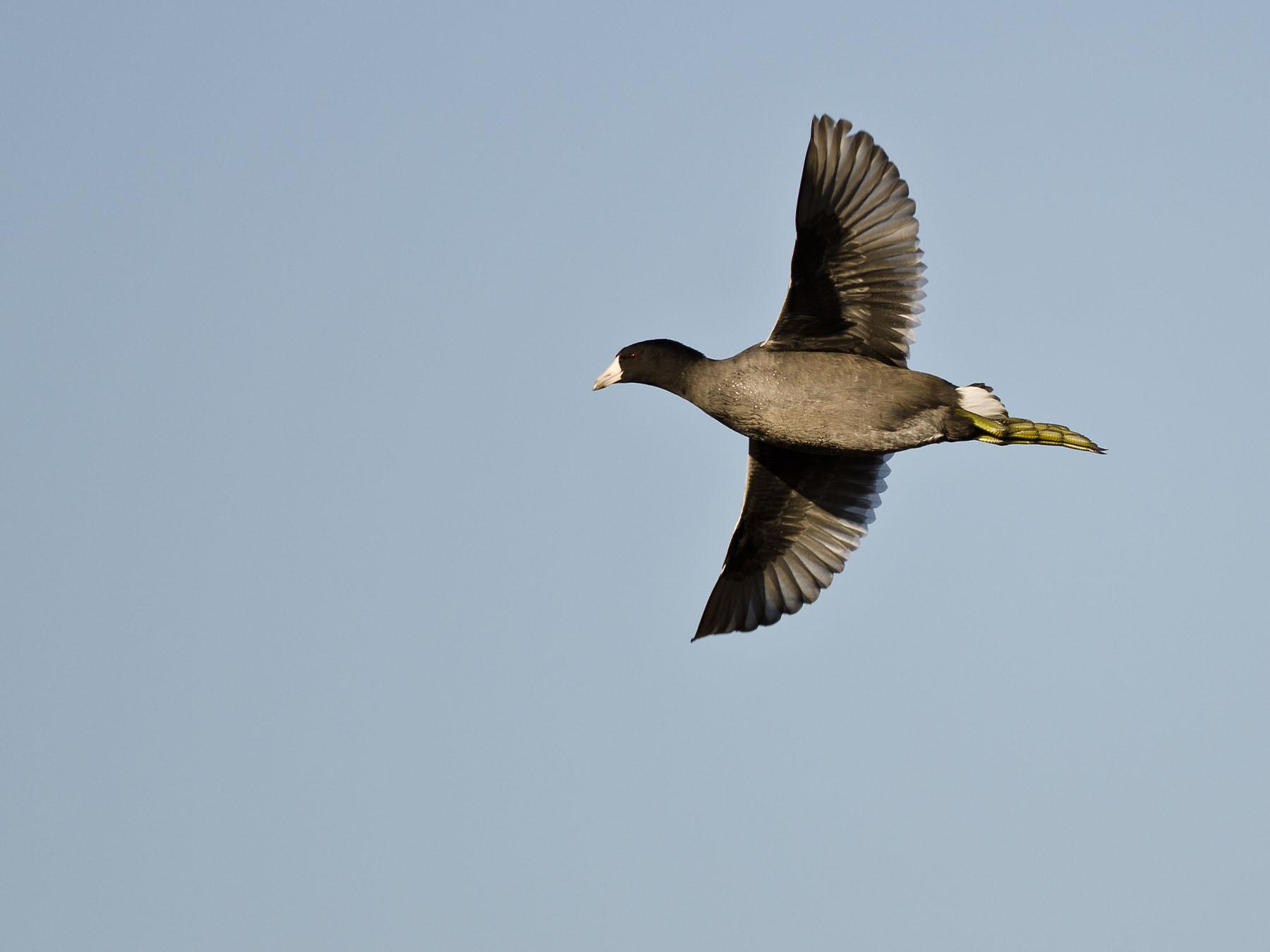
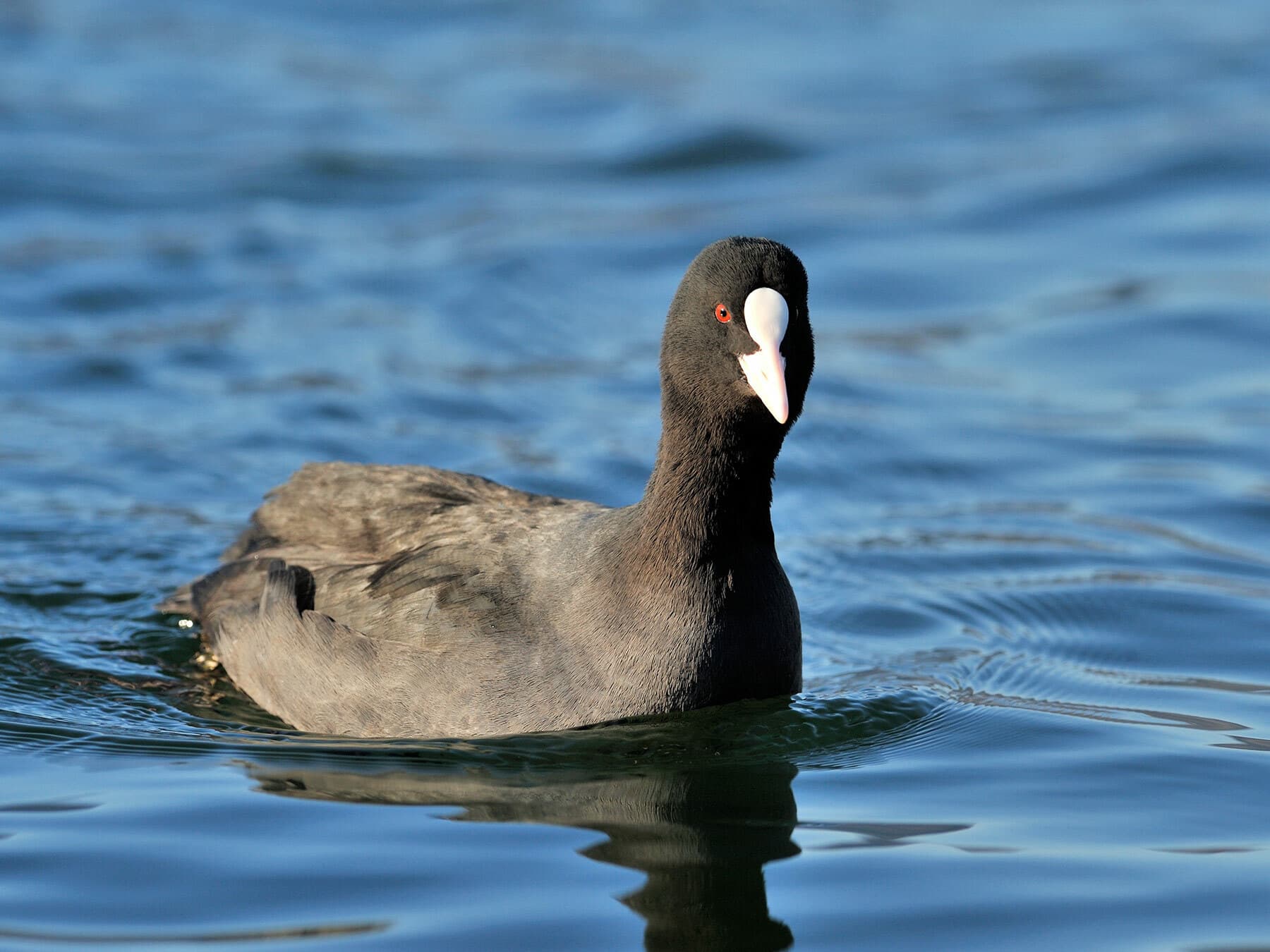
Up close, look for the white bill with a dark ring near the tip, a small white shield on the forehead topped by a dark red-brown spot, and a red eye. White feathers show at each side under the short tail. The legs are yellow-green, and the long toes carry scalloped lobes instead of webs. In flight a thin white edge shows along the back of the wing. On the water a coot nods its head in time with its feet, and on land it walks rather than waddles.
Size
The American Coot is 13-17 in (32-43 cm) long and weighs 15-30 oz (427-848 g), roughly two-thirds of a Mallard's size. Males average larger: in a published compilation of weights, males averaged 25.5 oz (724 g) and females 19.8 oz (560 g).1
Lobed toes instead of webbed feet: identification
A coot's feet are its oddest feature, and the reason so many people look it up. There is no web between the toes. Instead each long toe has a row of broad, scalloped lobes of skin that help the bird kick through the water. The lobes fold back as the foot is lifted, so they do not get in the way on land, and they spread the bird's weight on soft mud. Lobes push less water than full webbing, but the coot is still a strong swimmer and a frequent diver.
Leg color changes with age. Biologists who aged coots by the tarsus found it blue-green or grayish in juveniles, green at one year, yellow-green at two, yellow at three, and yellow-orange to red-orange with brighter spots in older birds, though the colors fade in fall and winter.1
Male, female and young
Males and females look alike. Males average about 7% larger, but the difference shows only when a pair is side by side, and the clearest difference is the voice: the female's calls have a nasal quality and are usually a little lower, while the male's are clear.2 In spring the shield of a territorial bird swells.
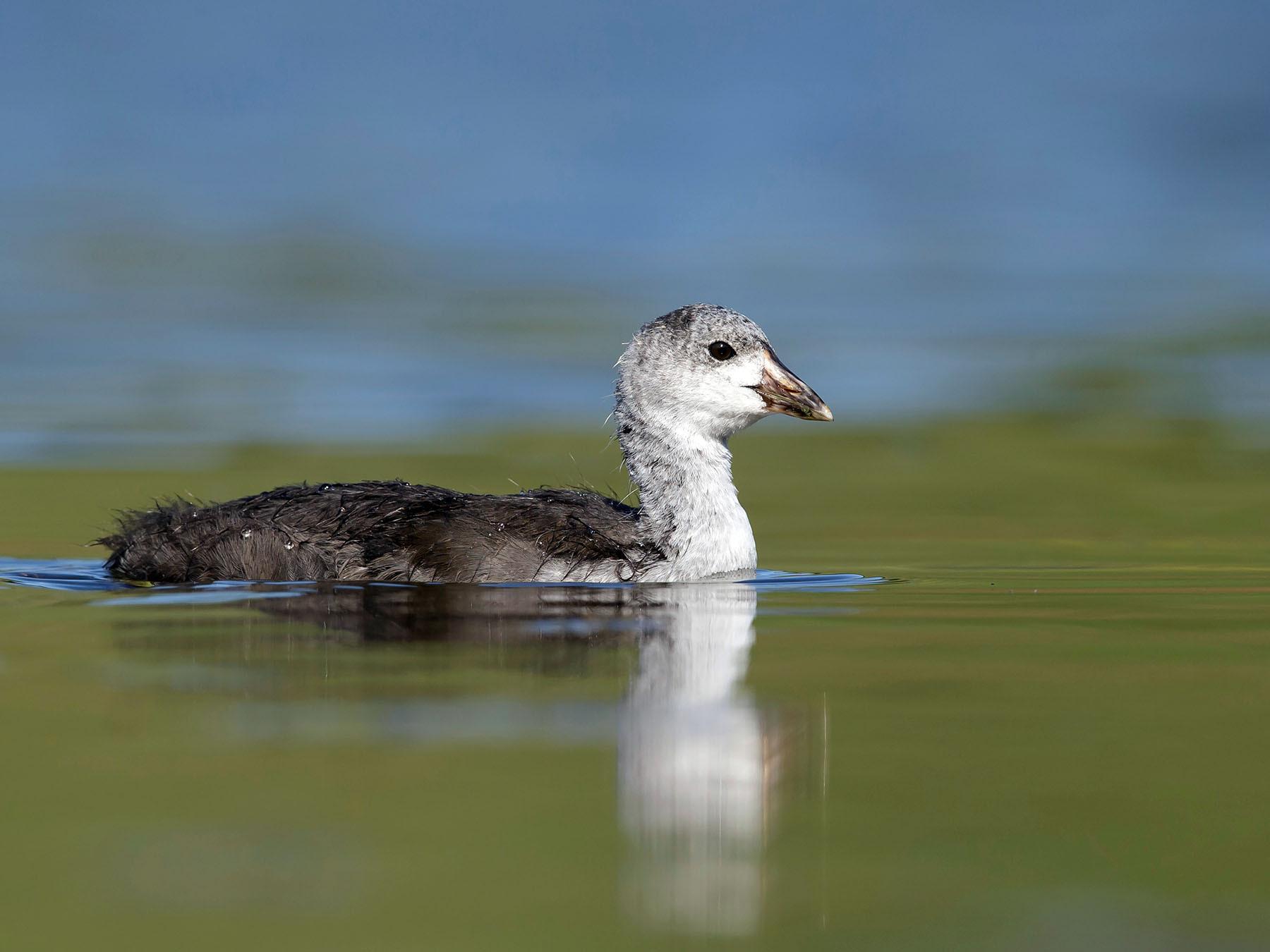
Juveniles are paler than adults, gray-brown above and grayer below, with a whitish throat and foreneck and a dull grayish bill with no dark spot on the shield, or only a small, pale one. By about 80 days old a young coot looks much like an adult apart from its bill and legs.
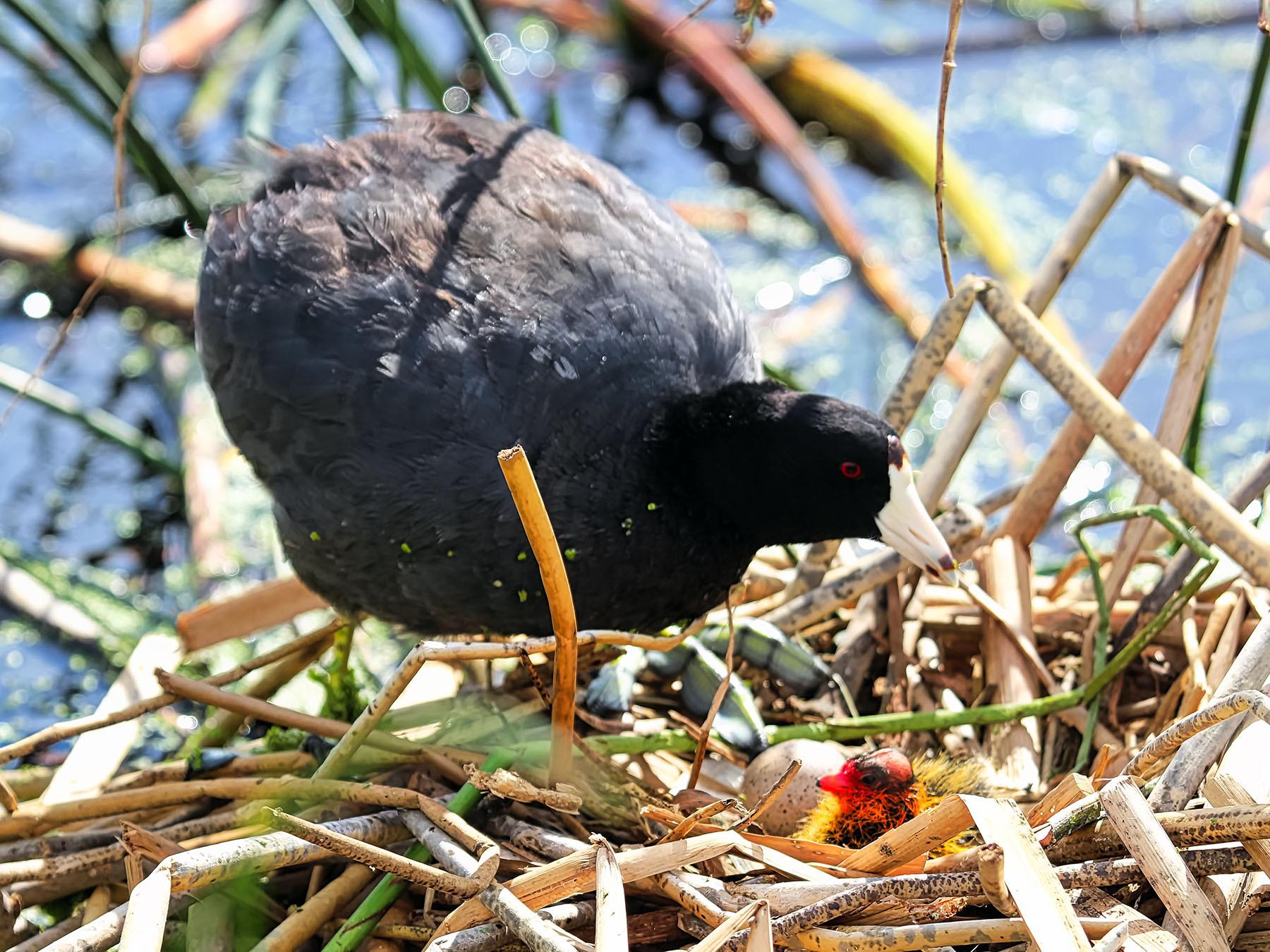
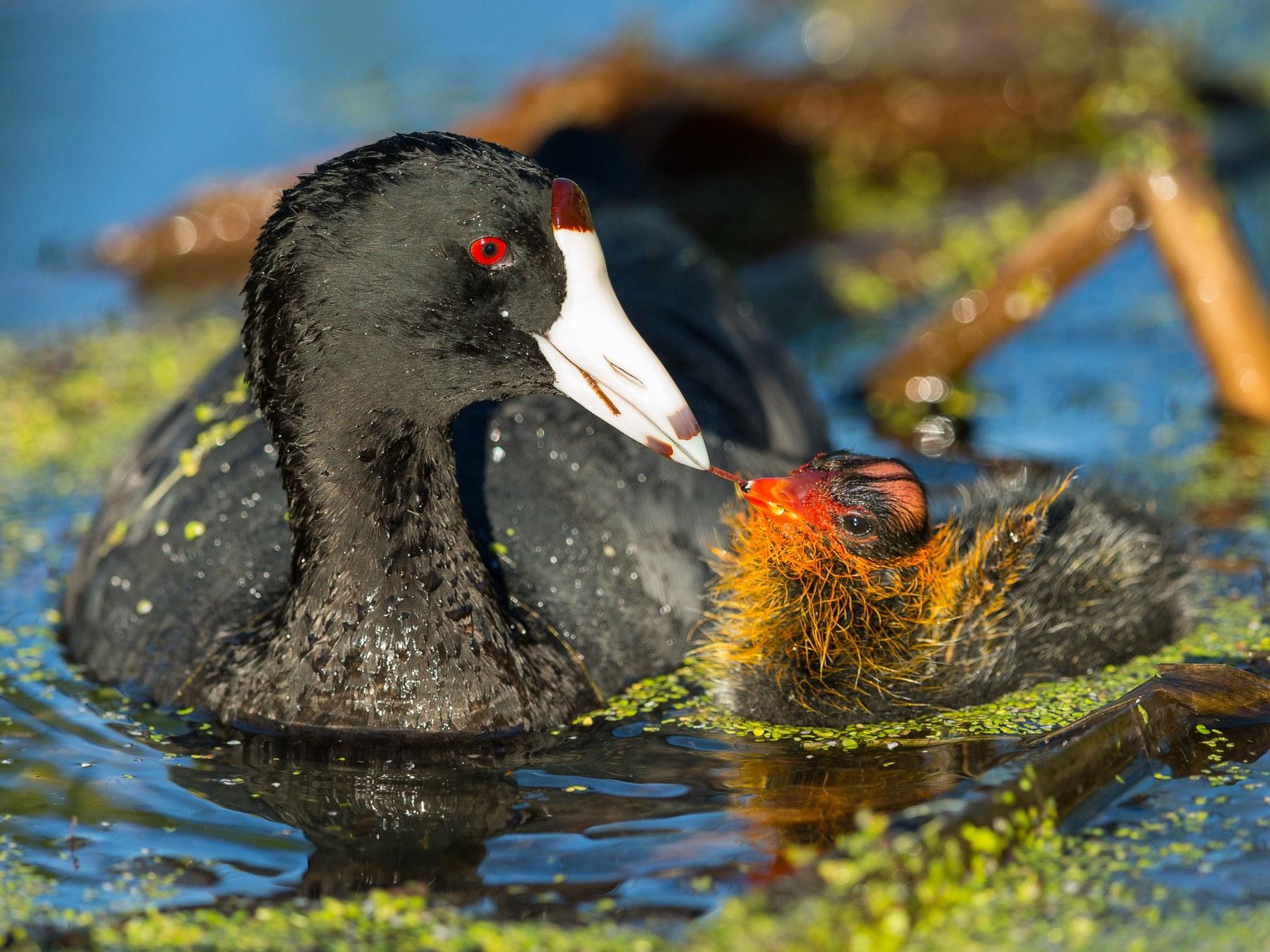
Newly hatched chicks look nothing like their parents: black down with stiff, curly orange and yellow plumes on the head and neck, a scarlet bill with a black tip, and a nearly bald red crown with blue skin above the eyes (see Chicks and young, below).
Identification: gallinules, grebes and other coots
The Common Gallinule shares many marshes with the coot but is smaller, with a red-and-yellow bill and shield and a white stripe along its side, and it keeps closer to cover. The Purple Gallinule of the Southeast is purple and green, with a pale blue shield and bright yellow legs. The Pied-billed Grebe is a little smaller and brown, with a thick bill that carries a black ring only in the breeding season, and it is seldom seen flying.
A few American Coots have an all-white shield with no red-brown spot. White-shielded birds are the usual type in the eastern Caribbean and were once treated as a separate species, the Caribbean Coot; red- and white-shielded birds pair with each other where they meet, and the checklist committee now treats them as one species.1 The Eurasian Coot, an Old World bird, is black under the tail with no white, and is only a rare stray to North America. In Hawaii the resident coot is the Hawaiian Coot, a separate species with a large, bulbous white shield.
Not sure it’s a American Coot? Check your photo: Birdfact names the bird and shows the look-alike side by side.
Its size
Adults- Length
- 32–43 cm
- Wingspan
- 58–64 cm
- Weight
- 427–848 g
Its song and calls
Coots have no true song, but they are very noisy birds: a run of clucks, cackles, grunts, croaks and squawks, often from out of sight in the cattails, by day and by night. Wintering flocks are loudest at dusk and after dark as they settle into their roosts, and migrants call to each other at night in spring.
A 1952 study of coots around San Francisco Bay sorted the adults' calls into six kinds, from the short notes mates use to keep in touch to alarm calls and the crowing challenge a male gives at the edge of his territory.3 The male's version of each call is clear and the female's nasal, which is the easiest way to tell the sexes apart.
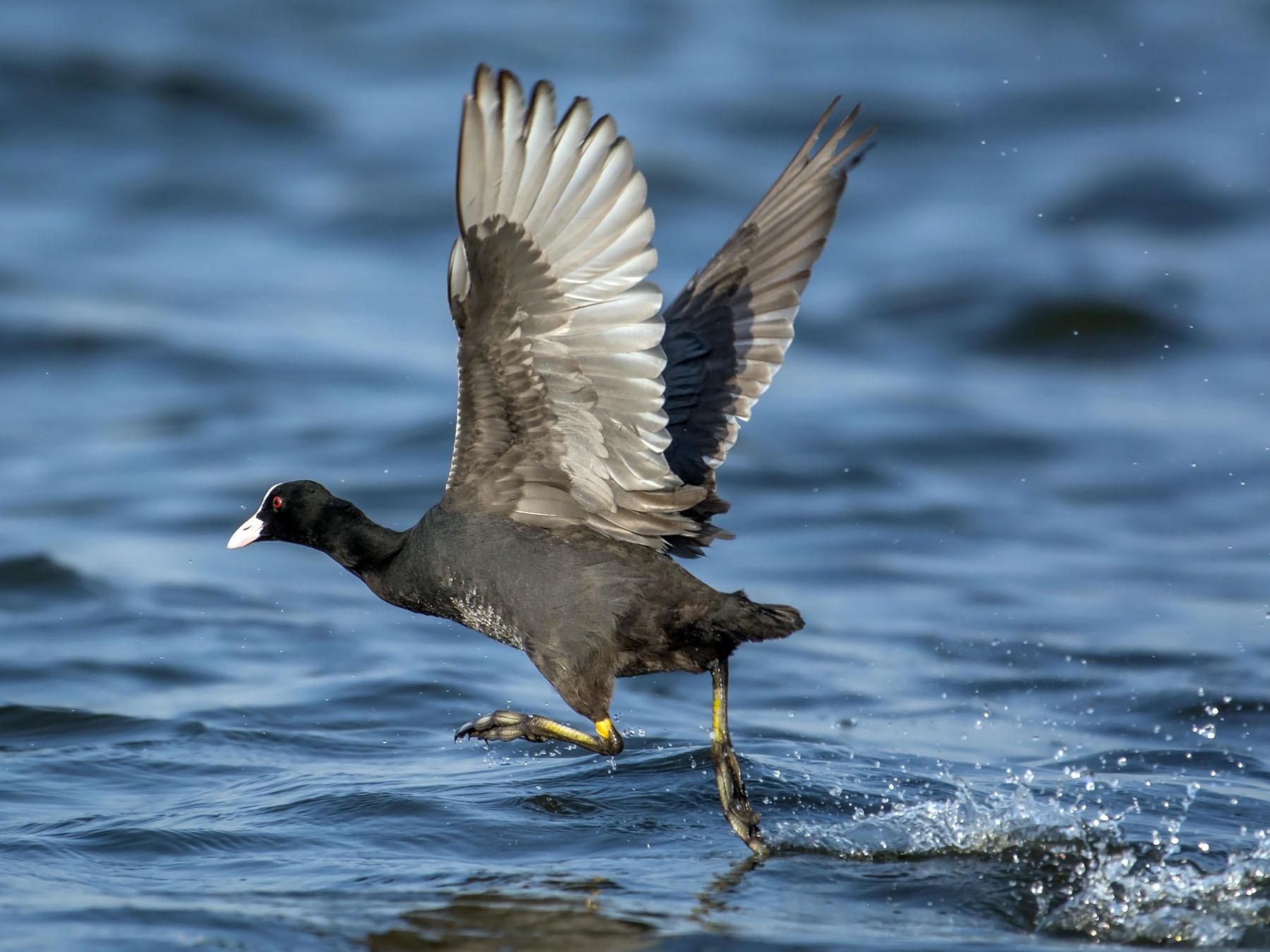
Not every coot sound is a call. A coot running across the water to take off, or charging an intruder near its nest, slaps the surface noisily with its feet.
- Calls0:00 / 0:03
Recorded in California, United States · November 2022
- Calls0:00 / 0:07
Recorded in North Carolina, United States · January 2022
Heard one and not sure? Let the bird song identifier listen.
When and where to see it
American Coots breed across most of North America, from southern Alaska and southern Canada south to Mexico and Central America, and are missing only from the Arctic and the far north. The biggest numbers nest in the prairie pothole marshes of the Dakotas and the Canadian prairie provinces; in the East they breed only in scattered places. They need fresh water with tall cattails or bulrushes standing in it and open water close by.
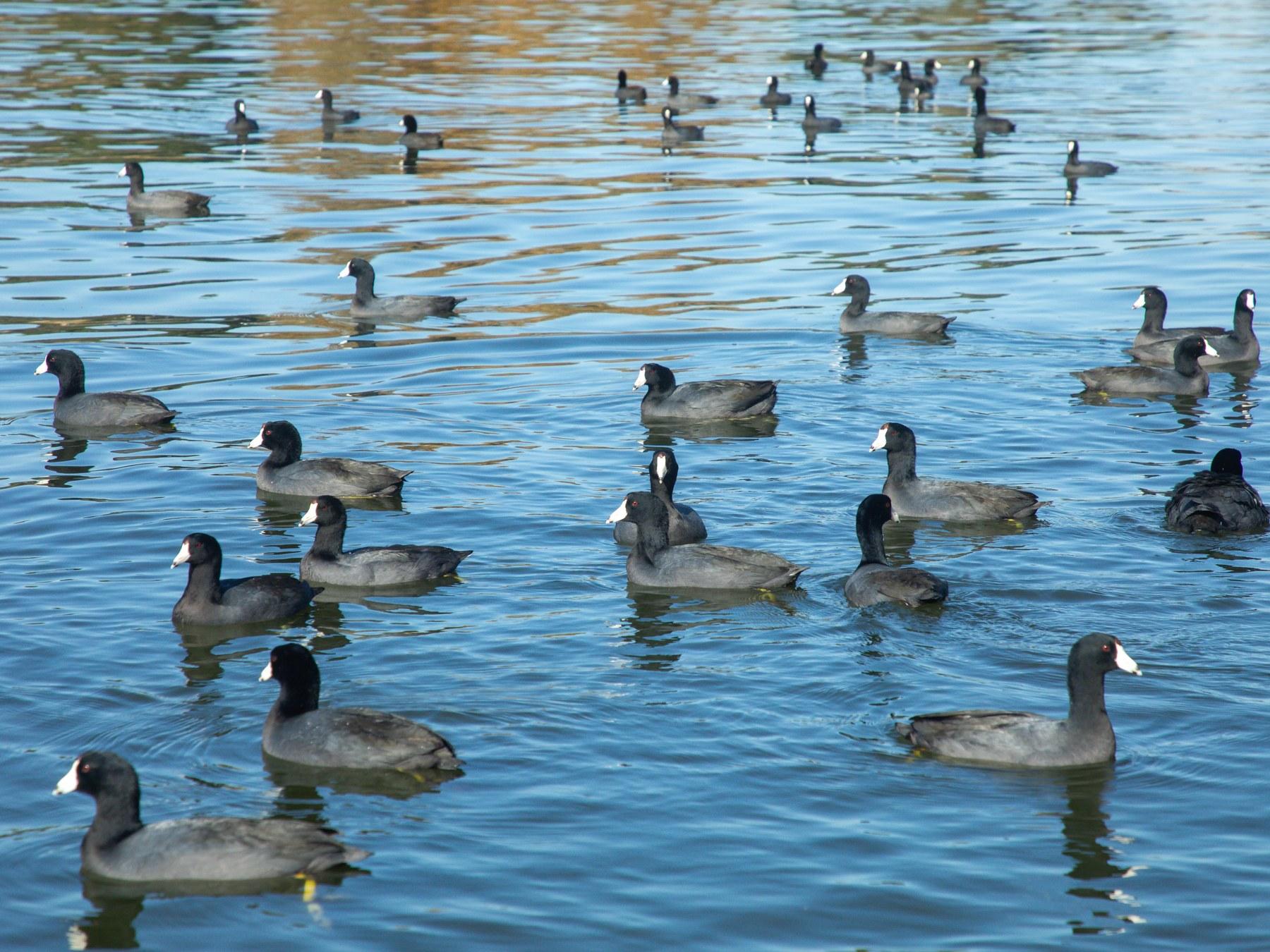
In winter they gather wherever water stays open, with the largest numbers along the Atlantic coast south of Virginia, the lower Mississippi valley, the Gulf Coast of Louisiana and Texas and the valleys of California, and on south through Mexico and Central America to Panama and the Caribbean. This is when most people see them: in flocks on reservoirs, park ponds and sewage lagoons, on brackish bays, and grazing on lawns and golf courses near the water.
Do they migrate?
Yes, in the north. Coots from the prairies and Canada head south in fall, from late August into December, and come back in spring, reaching prairie breeding marshes in late April and May. Many birds in the South and along the Pacific Coast stay all year. They seem to travel almost entirely at night, alone or in loose flocks, and use all four of North America's flyways.
Banding shows how widely one population spreads. Coots banded in Manitoba were recovered as far apart as California (1% of recoveries), central Mexico (11%), Florida (4%) and New England (1%).1 In central British Columbia, adults seldom returned to the same breeding marsh. A few stray to Greenland, and across the Atlantic to Iceland, the Faroes and Ireland.
Tips for seeing it
What it eats
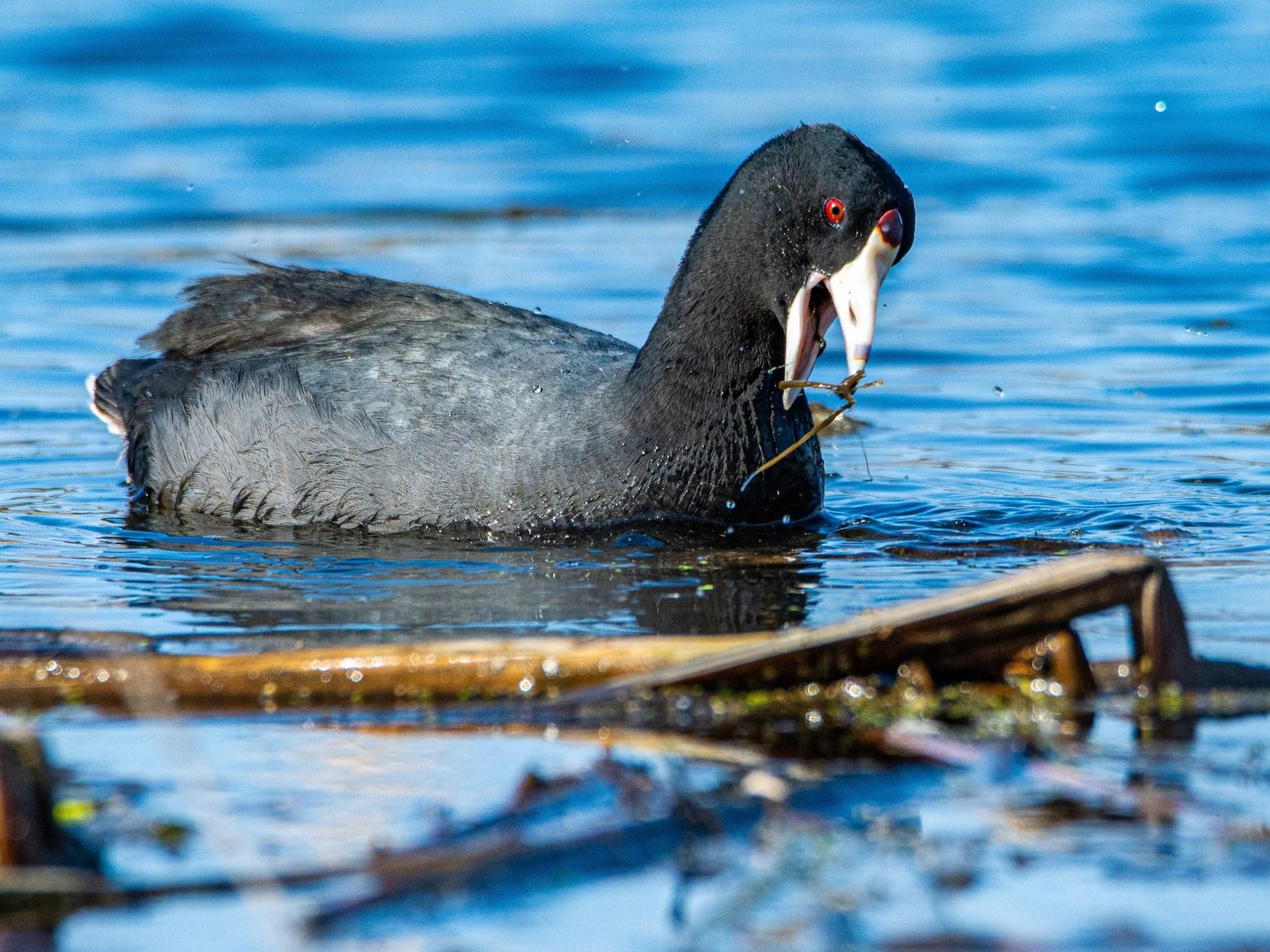
Coots are mainly vegetarian. They eat the leaves, stems, roots and seeds of water plants, especially pondweeds, sedges and algae, and graze on grass, grain and young crops on land. They also take water insects, snails, crayfish, tadpoles and small fish, and now and then the eggs of other birds.
A continent-wide diet study of 792 coot stomachs, from every season, found 89.4% plant food and 10.6% animal food by volume, with pondweeds alone 40.6%, and the animal share changed with the season, from almost none in January to 44.1% in June, when coots are raising young.1 In an Iowa study, chicks in their first week were fed large amounts of water insects.4
Coots feed by pecking at the surface, dabbling, tipping up and diving, and they bring nearly everything to the surface to eat it. They also steal: a coot will take plants from diving ducks, and ducks and gallinules steal from coots in turn. Feeding beside Canvasbacks, which stir up the bottom, one coot study found surface pecking nearly doubled, from 16.7 to 31.9 pecks a minute.1 In the South coots graze heavily on hydrilla, an invasive water plant, and in Florida they picked it out in preference to other plants.1
Nesting and breeding
The nest is a floating platform of dead cattail, bulrush and other stems, woven into a basket with a finer-lined cup and anchored to standing plants over the water. Both birds build, the female doing most of it. A pair builds several platforms: some for courtship displays, one for the eggs and others where the young are brooded at night. In a California study, pairs that laid two or more clutches built nine structures each.5 A typical nest there was about 12 in (30 cm) across, with a ramp of stems 12-15 in (30-38 cm) long leading up from the water.5 Because the nest slowly sinks as it soaks, the birds keep adding material throughout incubation.
Most eggs in the US are laid from April to June, with eggs found into August. In the south breeding can start in winter: one central California nest held eggs on 23 January 1936.1
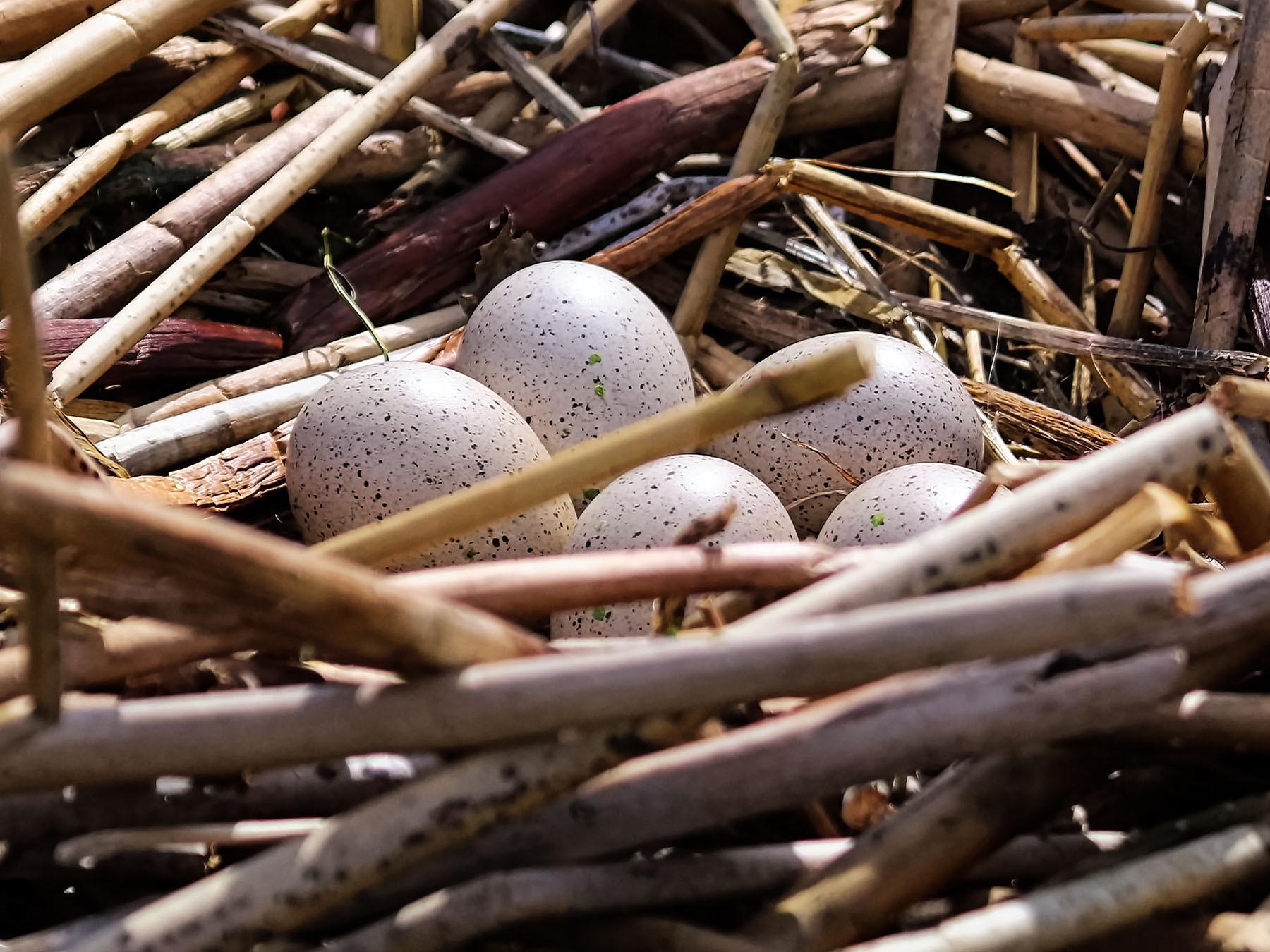
A clutch is usually about 6-12 eggs, buff and finely speckled with dark brown. Study averages include 9.03 eggs from 281 Iowa nests4 and 9.24 from 294 Manitoba nests1; older females lay more, and late and repeat clutches fewer. Very large clutches of 16-22 eggs probably come from more than one female, or from one female's clutches run together.
Both parents incubate, for about 21-25 days. In Gullion's California study the male probably did the larger share: he was on the nest all night in 23 of 26 night observations.5 Incubation starts before the clutch is finished, so the eggs hatch in roughly the order they were laid, over several days.6 One parent leads the first chicks away while the other keeps sitting. Coots renest readily: in Manitoba they replaced 68% of 281 destroyed clutches.1 Some pairs raise two broods.
Chicks and young
Coot chicks can swim within hours of hatching and leave the nest within a day or two. For the first weeks the parents feed them, and the chicks' gaudy heads are part of the reason. In field experiments that altered some chicks' ornamental plumes, parents fed the ornamented chicks more than the plain ones, and those chicks grew faster and survived better; the parents' preference was relative, not absolute, favoring the most ornamented chicks in a brood.7
Later work found that chicks from later-laid eggs are redder, and that redder chicks were more likely to become the favored chicks that parents feed most once they take control of who gets food, perhaps because the color signals a chick's size or age.8
The young feed themselves to a large extent by about 16-20 days, can fly at about 75 days, and are driven off the territory by their parents at about 80 days old.
Eggs laid in other coots' nests
Coots often lay eggs in other coots' nests. In a 4-year study in central British Columbia, 13% of all eggs were laid this way and more than 40% of nests received such eggs, most of them laid by females that were nesting themselves.1
Hosts fight back. They recognize and reject many strange eggs, which halves the cost of being parasitized; some push strange eggs to the outer edge of the nest, and females count only their own eggs when deciding how many to lay.9 They also learn what their own chicks look like from the first ones to hatch, and reject later-hatching strangers; given the wrong first chicks in experiments, parents turned against their own.10
Behaviour
In the breeding season coots are fiercely territorial. A pair defends its patch of marsh against other coots and many other waterbirds, and once the eggs hatch, for a short time, it will attack most animals its own size or smaller that come into its territory. Rival males charge with their heads low, then rear back on the water, propped on wings and tail, and strike with their feet; several birds can join a fight, and fights sometimes carry on underwater.
Many disputes are settled by display instead. A coot raises the feathers of its neck into a ruff, arches its wings, spreads the white feathers under its tail and points its white shield at the rival. In the San Francisco Bay area, breeding territories averaged about 1.06 acres (0.43 ha).11
Outside the breeding season coots live in flocks, often mixed with ducks, and roost together in cattails or packed on open water. An alarmed coot lifts its tail to show the white beneath, and a tight flock will churn the water into spray when a Bald Eagle passes overhead.
Flight and swimming
A coot needs a long, splashing run across the water to get airborne, flapping hard as its feet patter on the surface. Once up it flies strongly, usually low over the water with its legs trailing, but it would rather swim or dive away from danger than fly. Coots make their long flights on migration, at night.
It floats higher than a duck and dives readily; foraging dives in Louisiana lasted 1.3-3.5 seconds on average.1 After breeding a coot drops all its flight feathers at once and is probably flightless for about four weeks.
Lifespan and predators
The oldest American Coot on the US Bird Banding Laboratory's longevity list was at least 22 years 4 months old: a female banded as an adult in Alberta in July 1961 and shot in Idaho in October 1982.12 It is the only coot on the list, and because she was already full-grown when banded, her true age may have been higher.
Most coots live far shorter lives. Band recoveries from western North America gave annual survival of about 49% for adults and 44% for young birds.1
Predators and disease
Crows and magpies take eggs in the West. Adults and young are taken by Bald and Golden Eagles, Northern Harriers, Great Horned Owls and large gulls, and in Florida by alligators. Bald Eagles hunt coots heavily in winter: in one eastern North Carolina study, coots, caught or stolen from gulls, made up more than 82% of the eagles' prey items.1
Coots are also at the center of a disease story. Avian vacuolar myelinopathy, which damages the brain and spinal cord and leaves birds uncoordinated and struggling to fly or swim, was first recognized in Bald Eagles dying at DeGray Lake, Arkansas, in the winter of 1994-95; coots on the lake showed the same loss of coordination during the eagle die-offs.13, 14 The disease passes up the food chain, so eagles that eat affected coots and other waterbirds can die too, and in 2021 researchers identified the cause: a toxin they named aetokthonotoxin, made by a cyanobacterium that grows on hydrilla, an invasive water plant, in man-made lakes of the Southeast; making the toxin needs bromide, which hydrilla concentrates from the water and may supply to the cyanobacterium.15
Coots are also particularly prone to avian cholera, perhaps because they gather in big flocks and graze.1
Conservation
The American Coot is listed as Least Concern on the IUCN Red List. Partners in Flight estimates about 7.1 million birds worldwide, 5.5 million of them in the US and Canada, and gives it a Continental Concern Score of 10 out of 20; it is not on their Watch List.16
Breeding Bird Survey counts swing widely from year to year, with a long-term fall in the US. Across the survey area the trend from 1966 to 2025 was -1.46% a year, not statistically significant (95% credible interval -4.23 to 0.14), but in the US alone it was a significant fall of 2.13% a year; the index peaked in 2012 and hit its low in 2022, and over 2015-2025, a period that starts near a high point, the survey-wide, US and Canadian trends all show significant falls.17 Coot numbers rise and fall with how wet the prairie breeding grounds are.1
Coots were once among North America's most abundant waterbirds. They declined from the late 1800s as marshes were drained and hunting was heavy, especially in the East. Wetland loss and drought still cut breeding numbers, but coots move quickly into new and restored marshes.
Legal status
In the US the American Coot is protected under the Migratory Bird Treaty Act18, 19 and is also a federal migratory game bird.20 States can open a hunting season within federal limits; for the 2025-26 season those limits allowed 15 coots a day in the Atlantic, Mississippi and Central Flyways and 25 coots and gallinules combined in the Pacific Flyway.21 In Canada coots are migratory game birds under the Migratory Birds Convention Act, 1994.22
Similar birds
Often mistaken for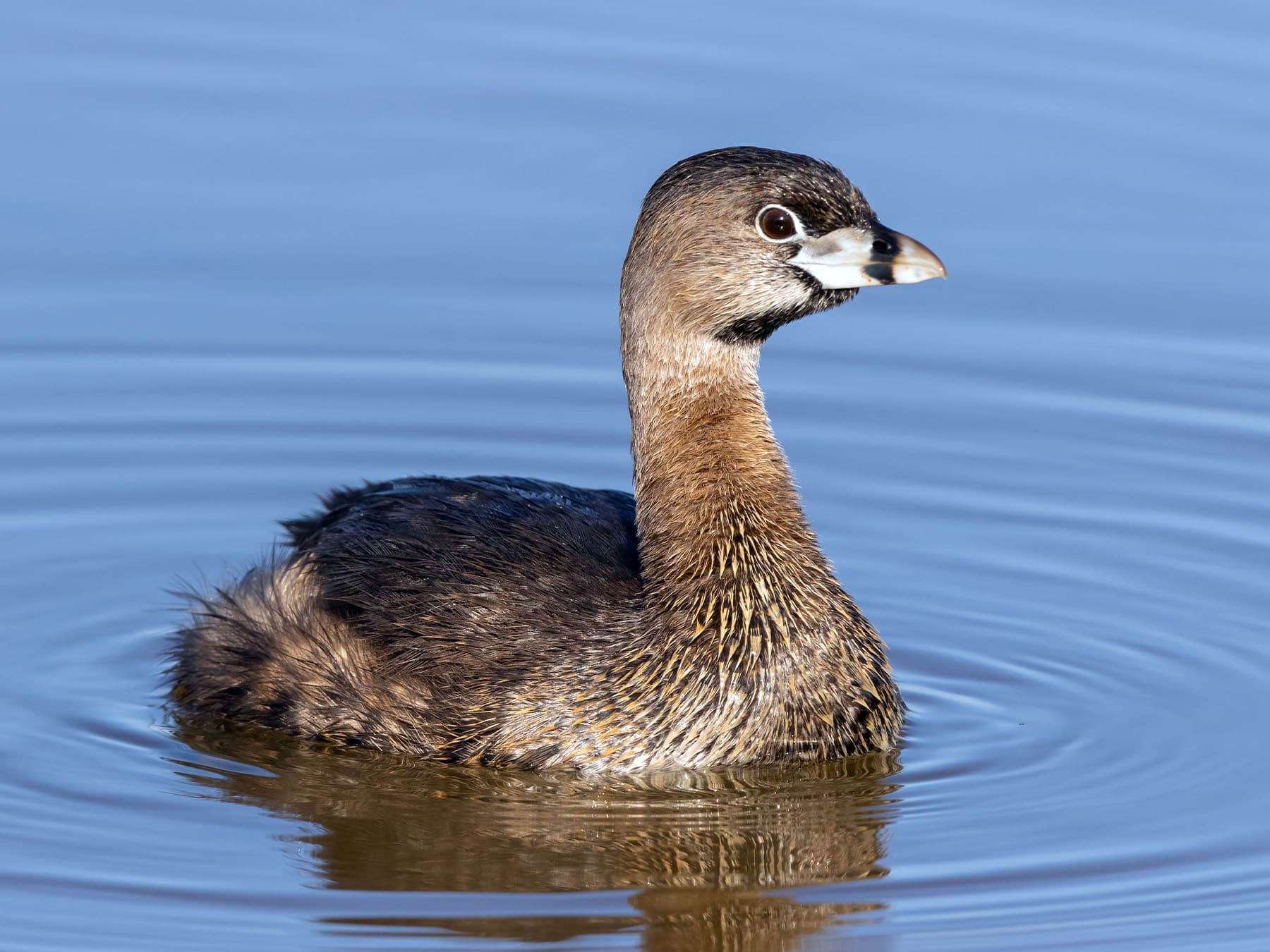
More photos
1 photos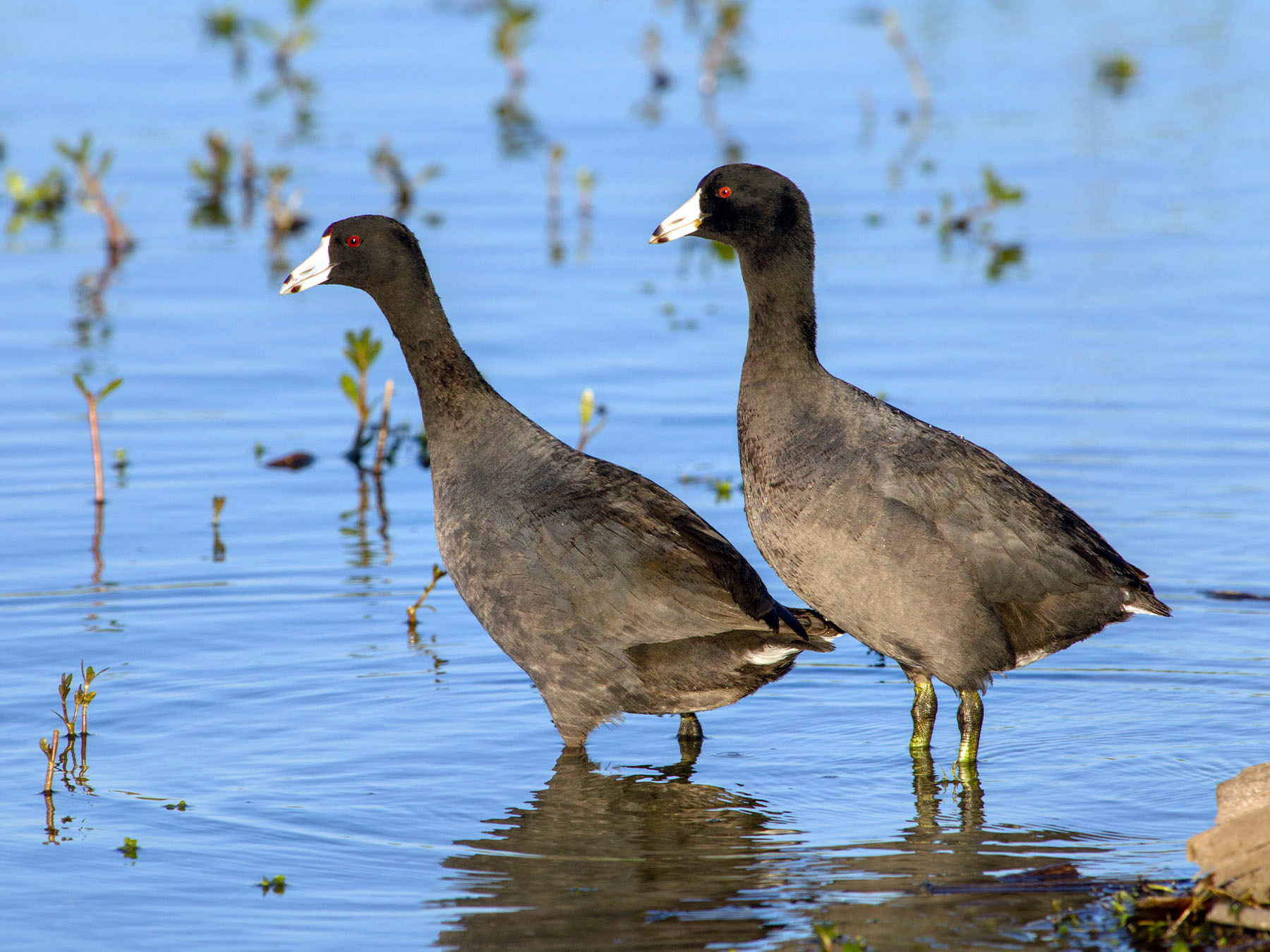
Quick facts
- Length
- 32–43 cm
- Wingspan
- 58–64 cm
- Weight
- 427–848 g
- Lifespan
- oldest recorded 22 years 4 months
- Family
- Rails & Coots
- Migration
- Partial migrant
- Global status (IUCN)
- Least Concern
- World population
- 7,100,000 (Partners in Flight, about 2010)
- Population trend
- Common and widespread; numbers swing with prairie wetness, and the US count has fallen
- Scientific name
- Fulica americana
Questions
2Is an American Coot a duck?
No. It swims and dives like a duck, but it is a rail, in the same family as the gallinules. Its pointed white bill and lobed toes set it apart from any duck.
Are American Coots rare?
No. They are common across North America, with millions of birds, although the US breeding population has fallen; see Population and conservation status.
Sources
31- 1Brisbin Jr., I. L. and Mowbray, T. B. (2020). American Coot (Fulica americana), version 1.0. Birds of the World (A. F. Poole and F. B. Gill, editors). Cornell Lab of Ornithology. doi:10.2173/bow.y00475.01 (opens in a new tab)
- 2Gullion, G. W. (1950). Voice differences between sexes in the American Coot. The Condor 52(6): 272-273. doi:10.2307/1364520 (opens in a new tab)
- 3Gullion, G. W. (1952). The displays and calls of the American Coot. The Wilson Bulletin 64(2): 83-97. Accessed 10 November 2026. Source (opens in a new tab)
- 4Fredrickson, L. H. (1970). Breeding biology of American Coots in Iowa. The Wilson Bulletin 82(4): 445-457. Accessed 10 November 2026. Source (opens in a new tab)
- 5Gullion, G. W. (1954). The reproductive cycle of American Coots in California. The Auk 71(4): 366-412. doi:10.2307/4081536 (opens in a new tab)
- 6Arnold, T. W. (2011). Onset of incubation and patterns of hatching in the American Coot. The Condor 113(1): 107-118. doi:10.1525/cond.2011.100001 (opens in a new tab)
- 7Lyon, B. E., Eadie, J. M. and Hamilton, L. D. (1994). Parental choice selects for ornamental plumage in American coot chicks. Nature 371(6494): 240-243. doi:10.1038/371240a0 (opens in a new tab)
- 8Lyon, B. E. and Shizuka, D. (2020). Extreme offspring ornamentation in American coots is favored by selection within families, not benefits to conspecific brood parasites. Proceedings of the National Academy of Sciences 117(4): 2056-2064. doi:10.1073/pnas.1913615117 (opens in a new tab)
- 9Lyon, B. E. (2003). Egg recognition and counting reduce costs of avian conspecific brood parasitism. Nature 422(6931): 495-499. doi:10.1038/nature01505 (opens in a new tab)
- 10Shizuka, D. and Lyon, B. E. (2010). Coots use hatch order to learn to recognize and reject conspecific brood parasitic chicks. Nature 463(7278): 223-226. doi:10.1038/nature08655 (opens in a new tab)
- 11Gullion, G. W. (1953). Territorial behavior of the American Coot. The Condor 55(4): 169-186. doi:10.2307/1364765 (opens in a new tab)
- 12USGS Bird Banding Laboratory. Longevity records of North American birds: American Coot. USGS Patuxent Wildlife Research Center. Accessed 10 November 2026. Source (opens in a new tab)
- 13Thomas, N. J., Meteyer, C. U. and Sileo, L. (1998). Epizootic vacuolar myelinopathy of the central nervous system of Bald Eagles (Haliaeetus leucocephalus) and American Coots (Fulica americana). Veterinary Pathology 35(6): 479-487. doi:10.1177/030098589803500602 (opens in a new tab)
- 14USGS National Wildlife Health Center (2016). Avian Vacuolar Myelinopathy. USGS National Wildlife Health Center (page last modified 19 May 2016; Wayback copy of 13 May 2017). Accessed 10 November 2026. Source (opens in a new tab)
- 15Breinlinger, S., Phillips, T. J., Haram, B. N., Mareš, J., Martínez Yerena, J. A., Hrouzek, P. et al. (2021). Hunting the eagle killer: A cyanobacterial neurotoxin causes vacuolar myelinopathy. Science 371(6536): eaax9050. doi:10.1126/science.aax9050 (opens in a new tab)
- 16Partners in Flight (2024). Avian Conservation Assessment Database, version 2024.05.23 (global). Bird Conservancy of the Rockies. Accessed 10 November 2026. Source (opens in a new tab)
- 17Hostetler, J. A. et al. (2026). The North American Breeding Bird Survey, Analysis Results 1966 - 2025. U.S. Geological Survey. doi:10.5066/P1OSNSFC (opens in a new tab)
- 18United States Congress (1918). Migratory Bird Treaty Act, 16 U.S.C. 703. United States Code (govinfo, 2023 edition). Accessed 10 November 2026. Source (opens in a new tab)
- 19U.S. Fish and Wildlife Service (2023). 50 CFR 10.13, List of Birds Protected by the Migratory Bird Treaty Act. Electronic Code of Federal Regulations. Accessed 10 November 2026. Source (opens in a new tab)
- 20U.S. Fish and Wildlife Service (2026). 50 CFR 20.11, What terms do I need to understand?. Electronic Code of Federal Regulations. Accessed 10 November 2026. Source (opens in a new tab)
- 21U.S. Fish and Wildlife Service (2025). Migratory Bird Hunting; Final 2025-26 Frameworks for Migratory Bird Hunting Regulations. Federal Register 90 FR 40178 (18 Aug 2025), FR Doc. 2025-15703. Accessed 10 November 2026. Source (opens in a new tab)
- 22Parliament of Canada (1994). Migratory Birds Convention Act, 1994 (S.C. 1994, c. 22), Schedule. Justice Laws Website (current to 2026-10-19). Accessed 10 November 2026. Source (opens in a new tab)
- 23Cornell Lab of Ornithology. American Coot: overview, identification and life history. All About Birds. Accessed 10 November 2026. Source (opens in a new tab)
- 24National Audubon Society. American Coot. Guide to North American Birds (text adapted from Kaufman 1996). Accessed 10 November 2026. Source (opens in a new tab)
- 25National Audubon Society. Common Gallinule. Guide to North American Birds (text adapted from Kaufman 1996). Accessed 10 November 2026. Source (opens in a new tab)
- 26National Audubon Society. Purple Gallinule. Guide to North American Birds (text adapted from Kaufman 1996). Accessed 10 November 2026. Source (opens in a new tab)
- 27National Audubon Society. Pied-billed Grebe. Guide to North American Birds (text adapted from Kaufman 1996). Accessed 10 November 2026. Source (opens in a new tab)
- 28Chesser, R. T. et al. (2016). Fifty-seventh supplement to the American Ornithologists' Union Check-list of North American Birds. The Auk 133(3): 544-560. doi:10.1642/AUK-16-77.1 (opens in a new tab)
- 29Fink, D., Auer, T., Johnston, A. et al. (2024). eBird Status and Trends, Data Version: 2023; Released: 2025. Cornell Lab of Ornithology. doi:10.2173/WZTW8903 (opens in a new tab)
- 30Wilde, S. B. et al. (2014). Aetokthonos hydrillicola gen. et sp. nov.: Epiphytic cyanobacteria on invasive aquatic plants implicated in Avian Vacuolar Myelinopathy. Phytotaxa 181(5): 243-260. doi:10.11646/phytotaxa.181.5.1 (opens in a new tab)
- 31AviList Core Team (2025). AviList: The Global Avian Checklist, v2025b. AviList. doi:10.2173/avilist.v2025b (opens in a new tab)

Checked by
Nathan Cope, founder and editor
Nathan founded Birdfact and leads its writers and contributors in the UK, the US and Canada. He has watched and studied birds for more than ten years, and checks every article and species guide before it’s published.