


Bufflehead
Bucephala albeola
By the Birdfact teamChecked by Nathan Cope
On this page15 sections
How to recognise it
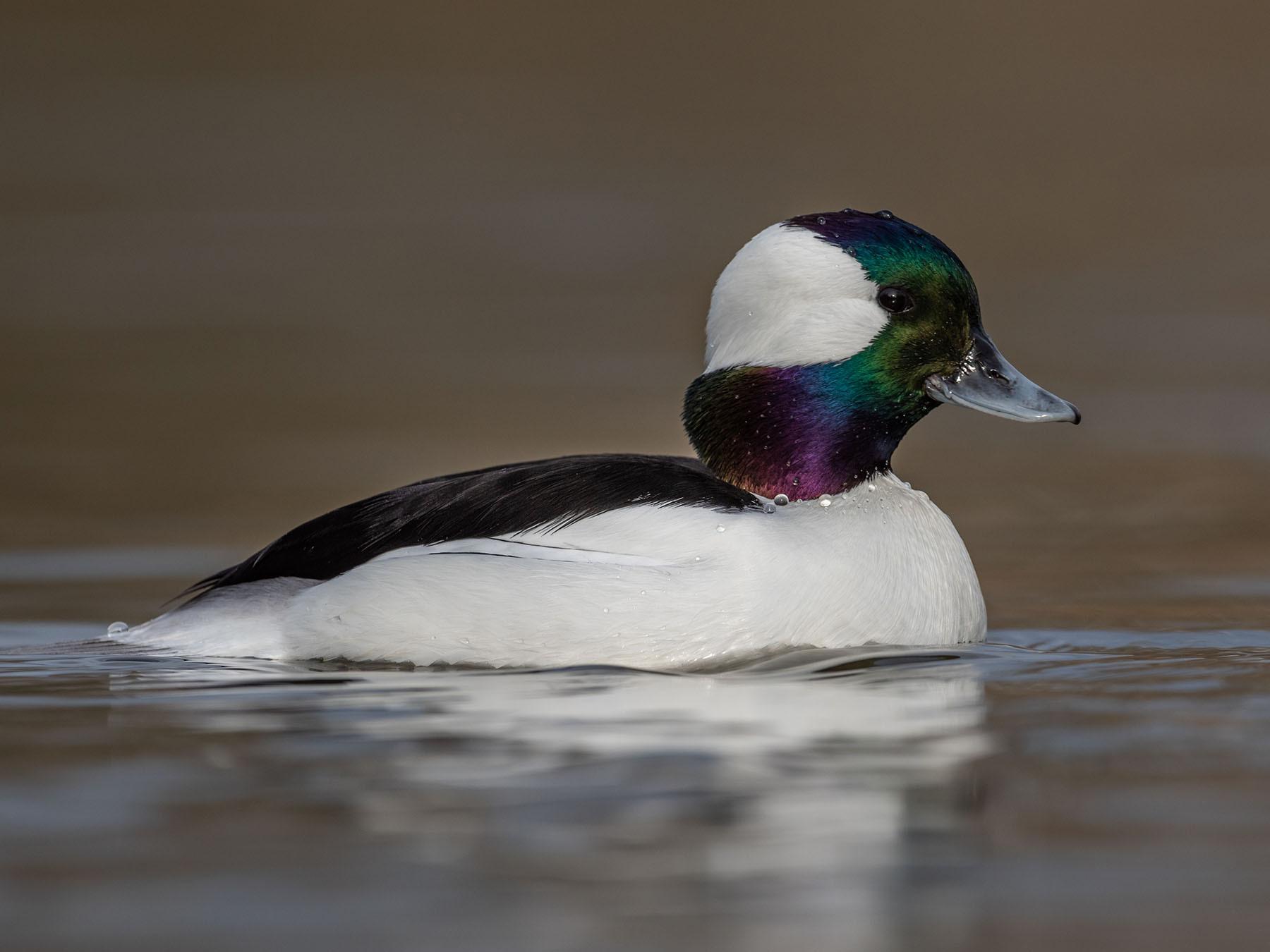
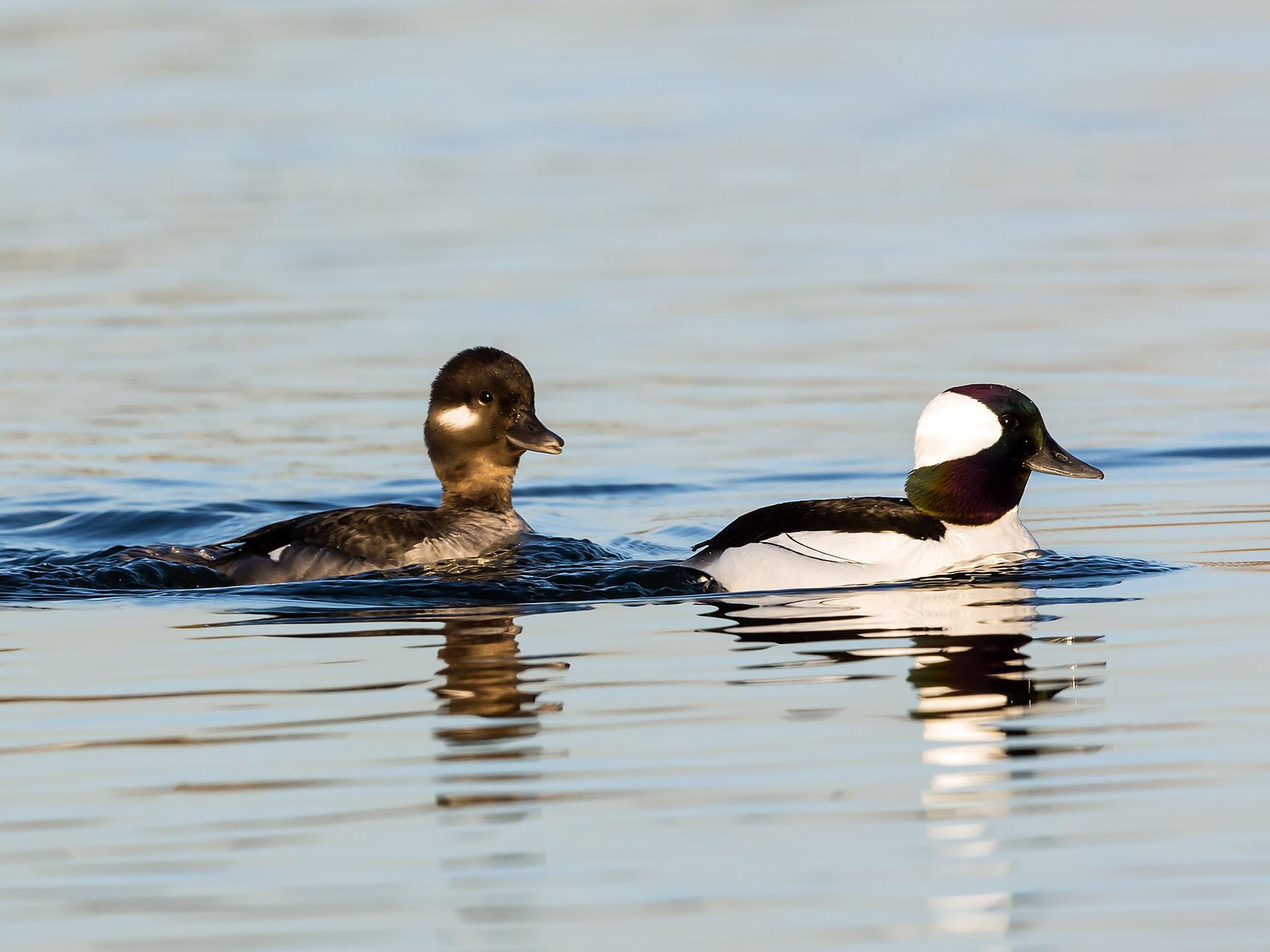
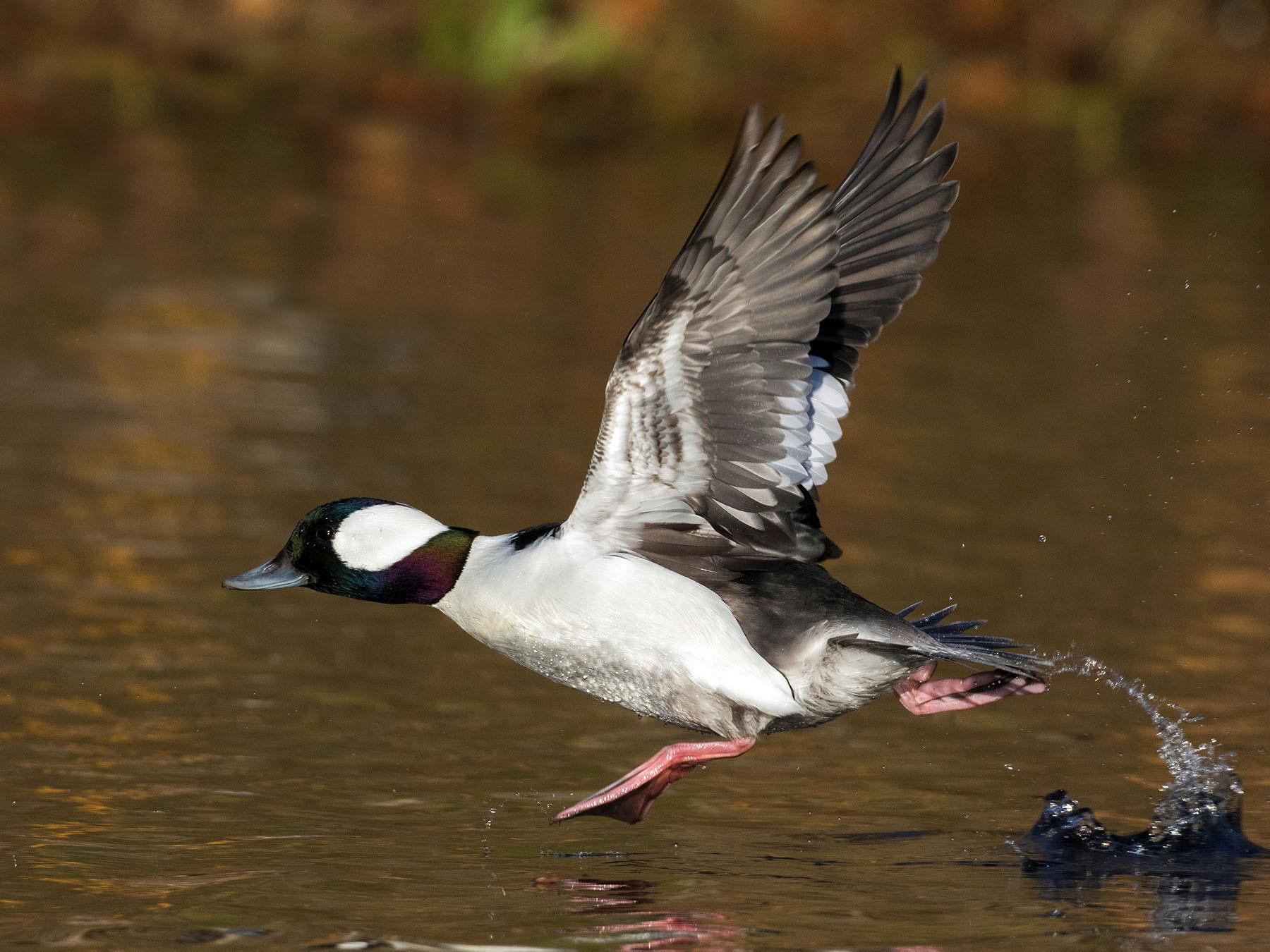
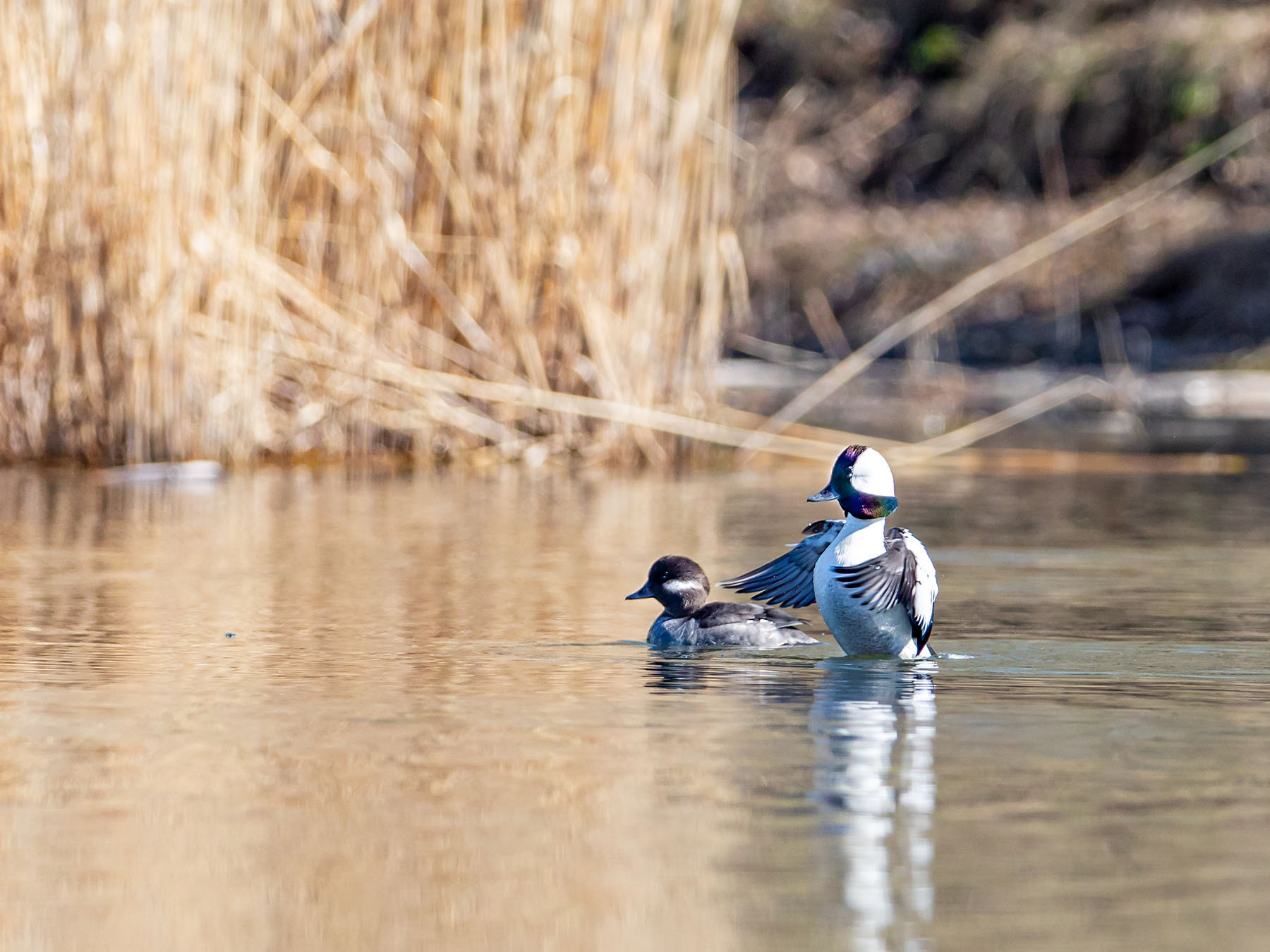
The Bufflehead is a small, compact duck with a short neck, a large rounded head and a short bill. The adult male is mostly white below with a black back, and his black head carries a big white patch that runs from behind the eye over the back of the head. Up close, the black of the head shines green and purple.
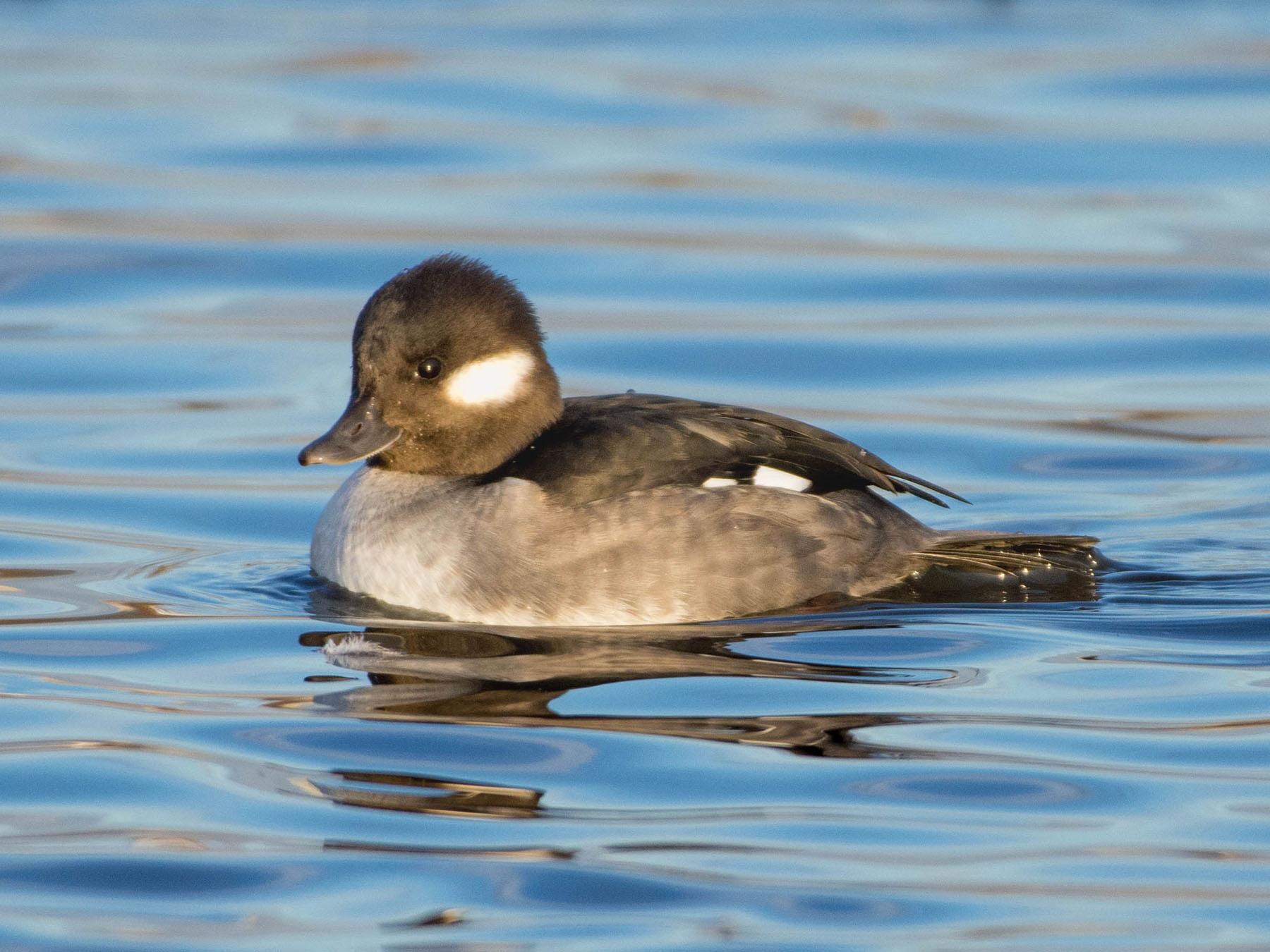
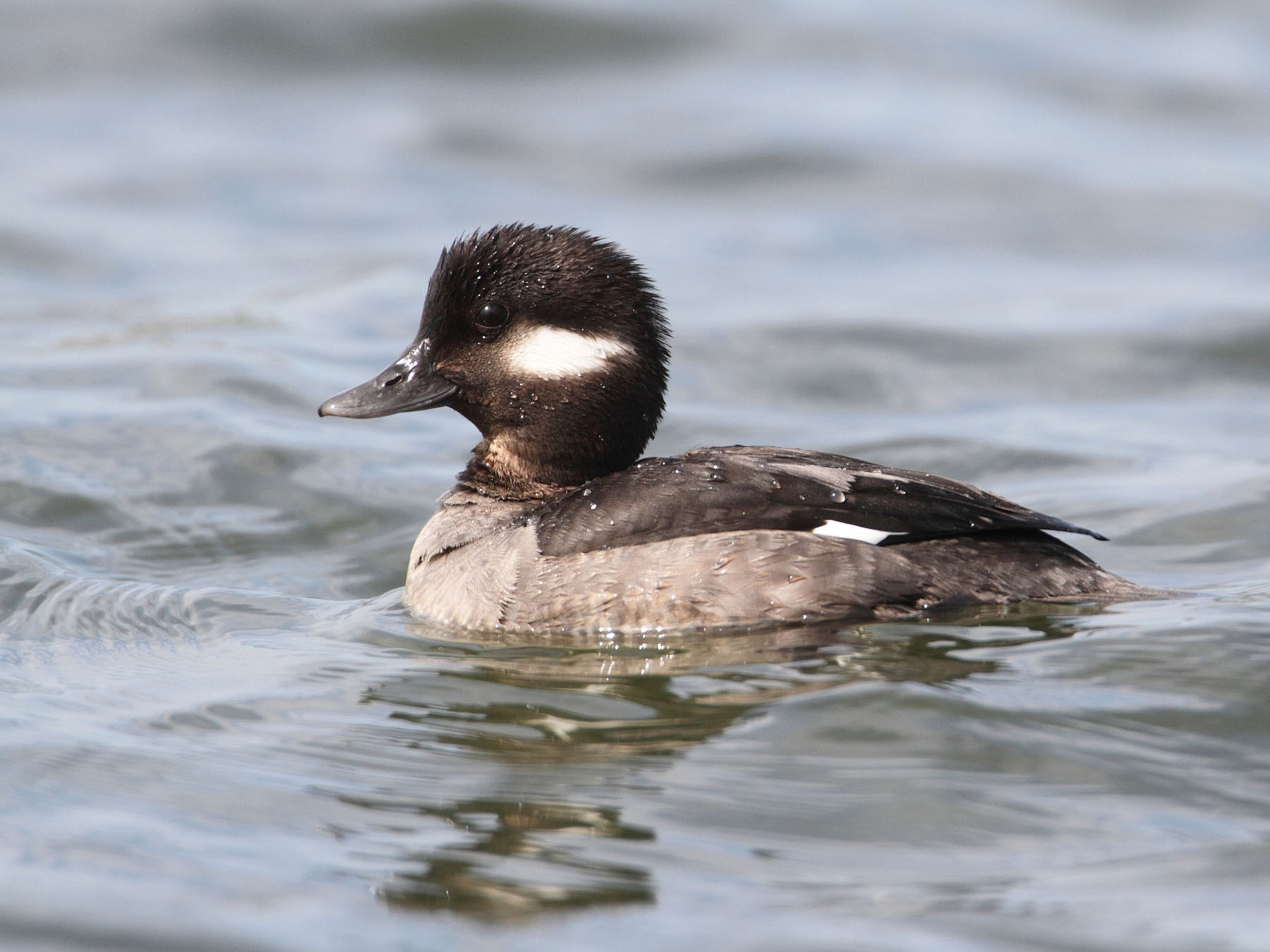
The female is dark brown above, with a dark brown head and a neat white patch that starts below the eye and runs back across the cheek. Her underparts are pale gray. In flight the male shows a large white patch across most of the inner wing, while the female's patch is smaller. The male's bill is blue-gray and the female's dark gray to black. Both have dark brown eyes, and the male's legs and feet are pink; the female's are a darker pink with brownish webs.
Birds in the hand have their own test: this is the only diving duck that combines a lobed hind toe with an adult folded wing of 7.1 in (180 mm) or less and a tail under 3.15 in (80 mm).1
Size
Males are about 14-16 in (35-40 cm) long and females about 12.5-14 in (32-35 cm), so it is smaller than a Common Goldeneye and larger than a Pied-billed Grebe. Field guides print a wingspan of about 21.6 in (55 cm) for both sexes, and a weight range of 9.6-22.4 oz (272-635 g) for both sexes together, with no sample stated.
Averaged over the year, adult males weighed about 1 lb (465 g) and females about 12 oz (337 g), in figures calculated from a 1972 monograph; immature males averaged about 15.8 oz (449 g). Weight swings through the year. Males are heaviest in December and lightest from May to August. Females are heaviest in March to May and in November, and lightest at the end of incubation in June: incubating females in British Columbia averaged 9.5-10.3 oz (270-292 g) in 1982-1986.1
Male, female and young
Males and females are easy to tell apart, and males are clearly the bigger of the two. Our guide to female Buffleheads covers the differences in more detail.
Young males cause most of the confusion. First-winter males look partly like females: through winter and spring the head becomes a mix of glossy black and white, but it still looks like a cheek patch rather than the adult's full white rear head, and the breast is mottled with white. Their white head patch is bigger than a female's. Males usually reach full adult plumage in their second winter, and some second-winter males can still be told by a dusky throat and less white on the wing.
So many female-looking birds in winter are really young males. In February counts in British Columbia's Strait of Georgia, adult males made up about half the birds in 2004 (451 of 895) and 40% in 2014 (457 of 1,145), with first-year males counted among the “females”.2
In summer and early fall, while they replace their flight feathers, males wear an eclipse plumage that looks much like the female's. An eclipse male has a darker head with a few glossy purple feathers, a larger white face patch and more white in the wing. Juveniles, seen in July and August, have a blackish-brown head with a faint, elongated whitish cheek patch, dark brownish-gray breast and flanks and a whitish belly; males and females look alike except for the amount of white in the wing.
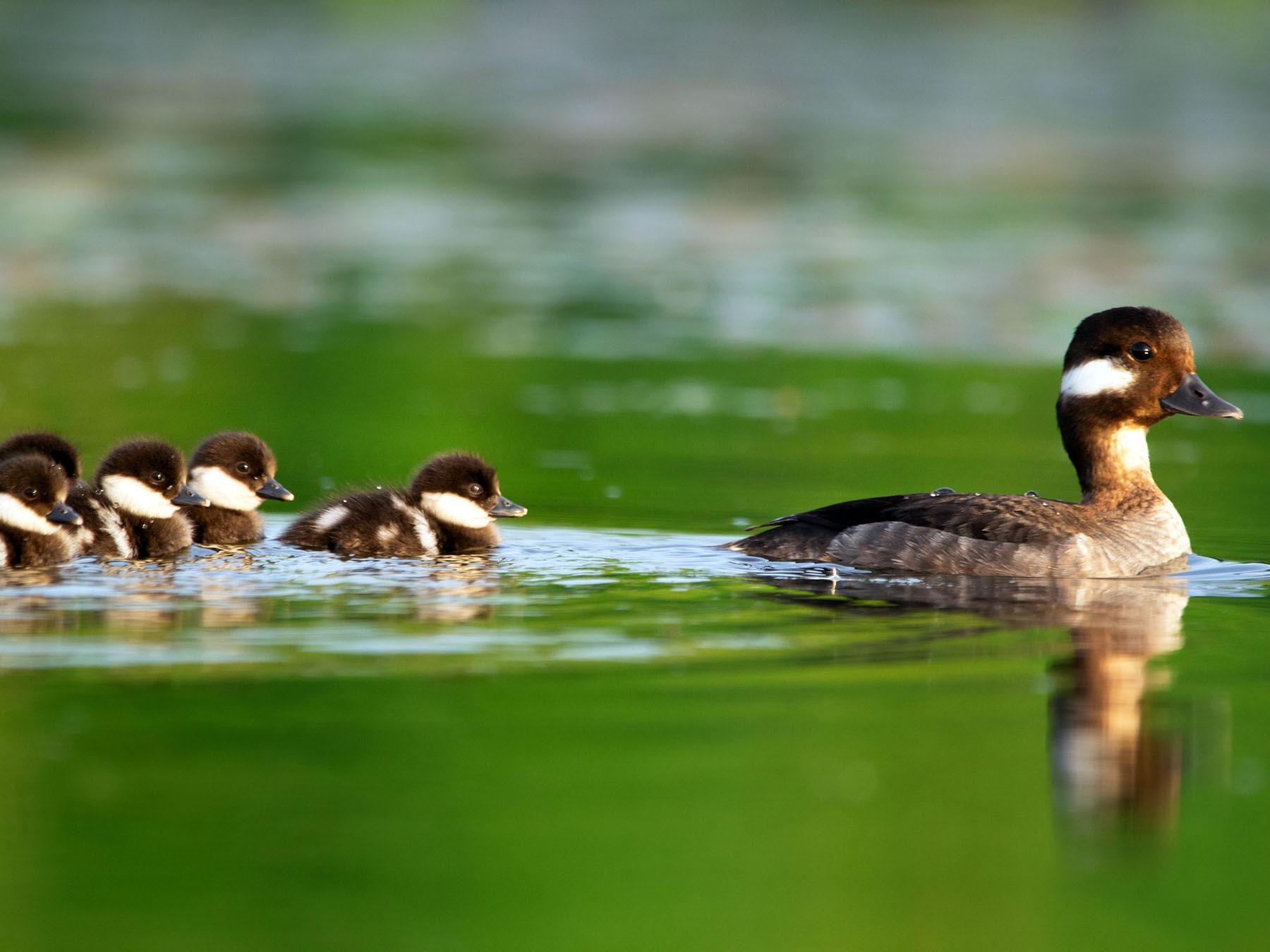
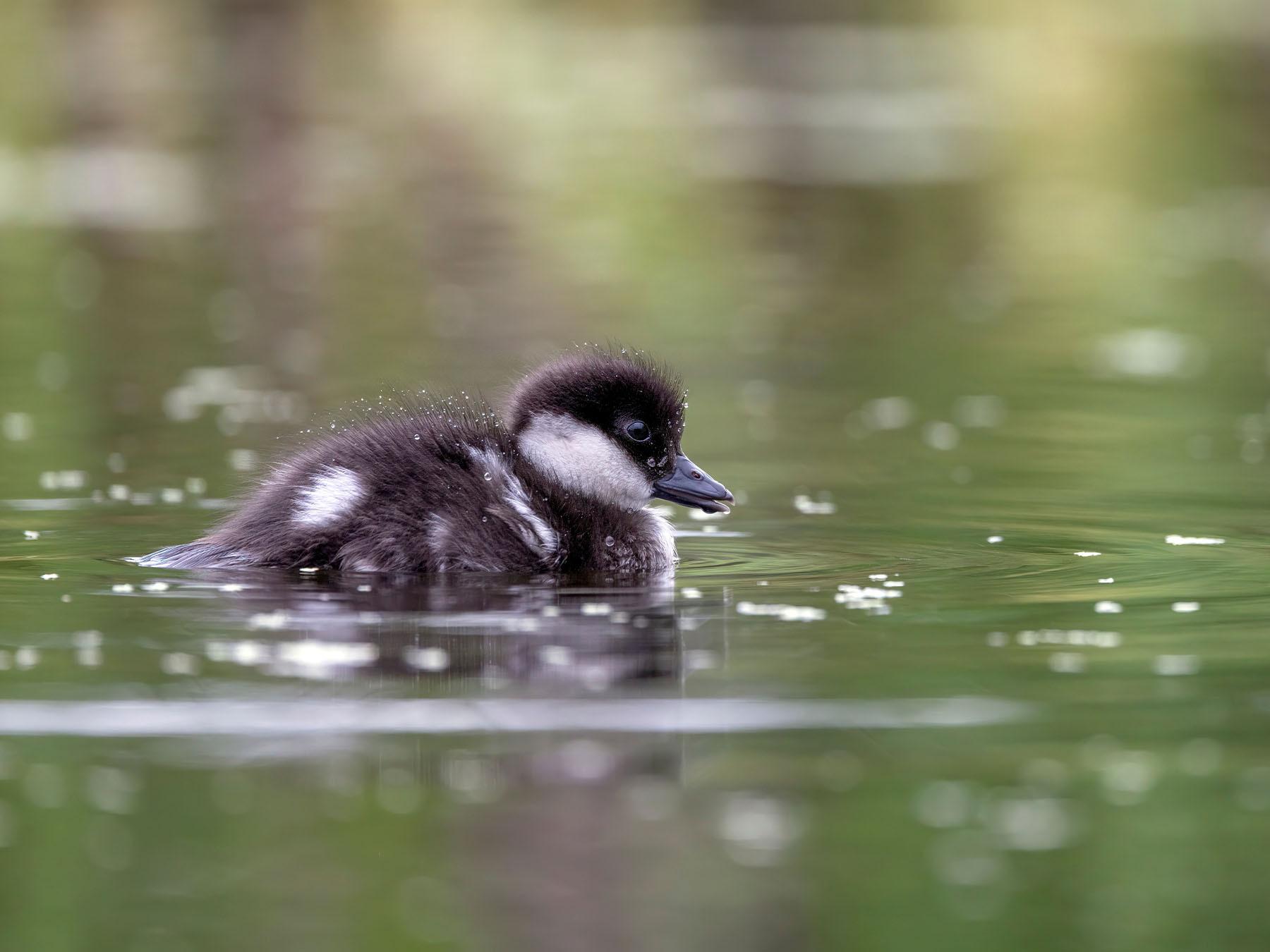
Ducklings are blackish above, with a broad white cheek patch that reaches under the chin, white spots on the back and wings, and white underparts. The sexes separate early: by 40 days old, male ducklings are already 25% larger than females.
Identification: similar birds
A male Hooded Merganser also has a big white head patch, but it is a fan-shaped crest edged with black. His sides are buffy with black and white stripes, and he has a long, thin, serrated bill. A Bufflehead is smaller, with a short gray bill and white sides.
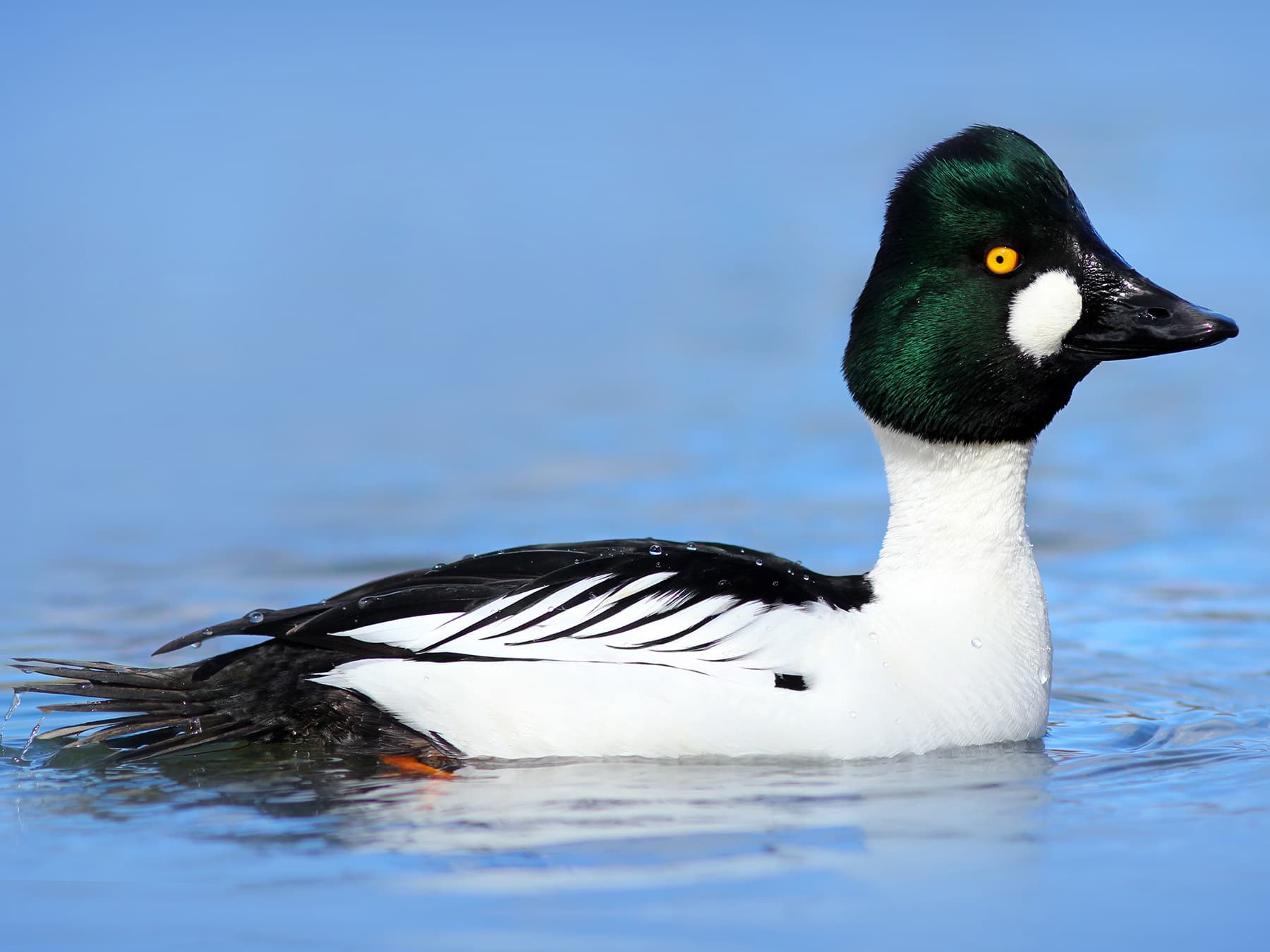
A Common Goldeneye is much larger. The male's white spot sits between the bill and the eye rather than behind the eye, the female has no white face patch, and goldeneye wings whistle in flight, which a Bufflehead's do not. A Barrow's Goldeneye is also much larger, and the male has a white crescent between the bill and the eye instead of a big patch behind it.
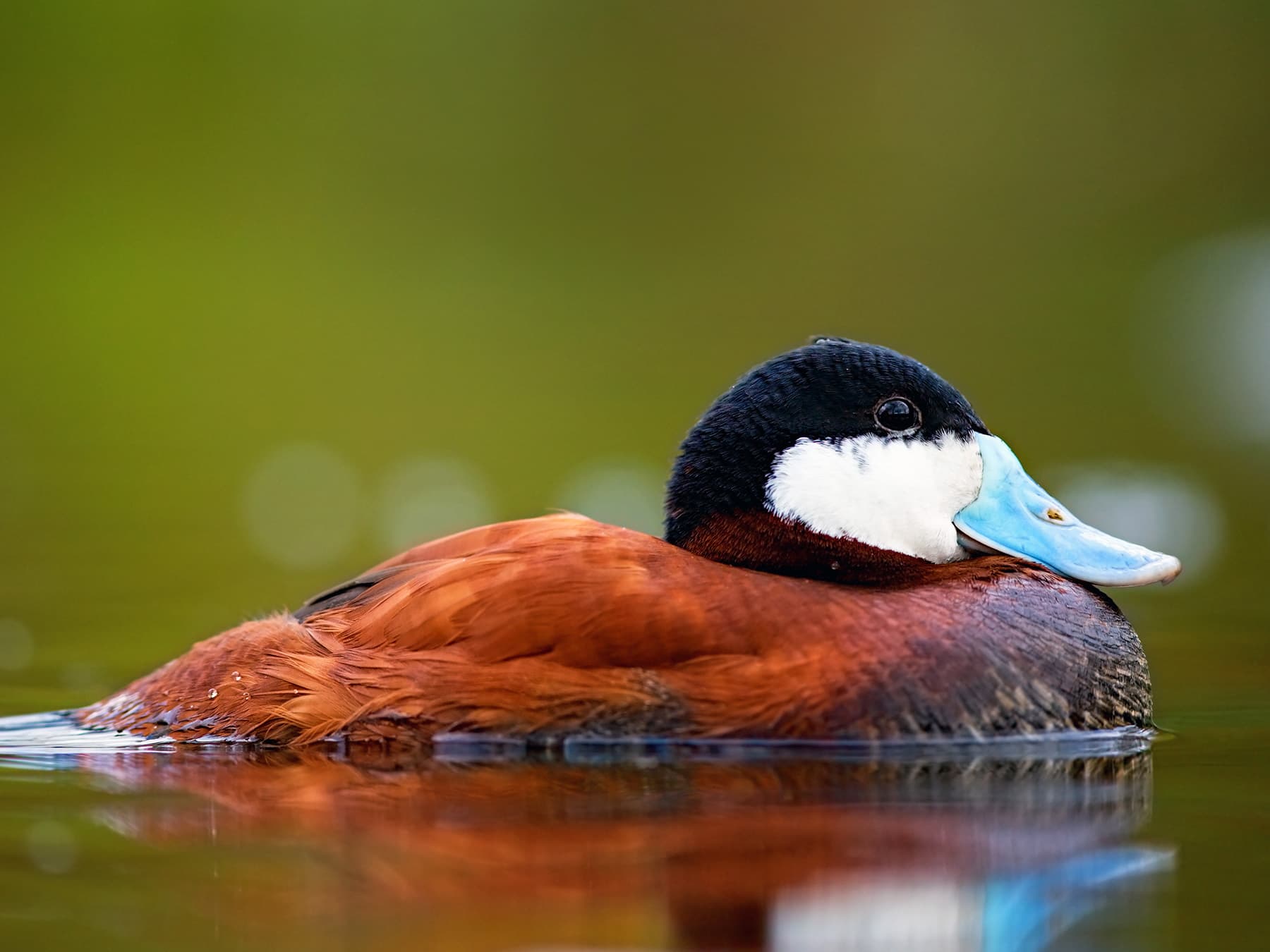
A female Harlequin Duck can look like a female Bufflehead, but she has a brown breast, a white patch in front of the eye and no white wing patch. A female Ruddy Duck also has a pale cheek, but it is usually crossed by a dark stripe, and she has the fan-shaped tail of stiff, pointed feathers that all Ruddy Ducks have.
Hybrids also turn up. A 2010 note found at least 10 unofficial internet records of Bufflehead and Common Goldeneye crosses since 1999, plus 6 records of hybrids with Hooded Mergansers, and warned that the internet amplifies how common rare events look.3 In those records, where it could be seen, the goldeneye crosses had gold eyes and pink feet and kept company with goldeneyes.3 At least two such males were seen in California's Central Valley in 2022-2025.4

Not sure it’s a Bufflehead? Check your photo: Birdfact names the bird and shows the look-alike side by side.
Its size
Adults- Length
- 32–40 cm
- Wingspan
- 55 cm
- Weight
- 272–635 g
Its song and calls
Buffleheads are quiet ducks, the least vocal of the three ducks in their genus, and their calls have not been studied in detail.1 There is no song in the songbird sense, and their wings make no whistle in flight.
Displaying males make a loud grating or chattering noise, loudest when several call together, and in late winter and spring males sometimes give a low squeal or growl. Females have several calls. A female following a displaying male gives a loud, rapid, guttural series of notes, and she calls her ducklings with a low, buzzy “cuc-cuc-cuc”, louder when she is disturbed at the nest or separated from the brood, presumably as an alarm. In summer, females circling possible nest holes give a loud, rapid call of their own.
One sound is made with the wings: when a male flies at a female in display, he often finishes by flapping his wings, with one slapping sound.
Heard one and not sure? Let the bird song identifier listen.
When and where to see it
Buffleheads breed in the boreal forest and aspen parkland of western and central Canada and Alaska, and winter on coasts, lakes and rivers across much of the US and south into Mexico. In winter, look for them on sheltered salt water, such as coves, harbors, estuaries and bays, rather than open coastlines, and inland on ponds, lakes, reservoirs and slow rivers.
The winter range runs along the Pacific coast from the Aleutians to Baja California, and on the Atlantic side from New Brunswick south to Florida and west along the Gulf Coast. Inland they winter on lakes, reservoirs and rivers, especially the Great Lakes, south to central Mexico. The densest winter numbers are on the Pacific coast from southern British Columbia to California, probably densest around southern Vancouver Island, and on the Atlantic coast from New Jersey to North Carolina.
To breed they need small, permanent ponds and lakes with little fringing vegetation, close to aspen, poplar or mixed woods with nest holes. Breeding is densest in central British Columbia, central and northern Alberta, northwest Saskatchewan, the southwest Northwest Territories and central Alaska, and they are absent from high mountains. Small, isolated breeding groups occur in the western US (Washington, Oregon, California, Idaho, Montana, Nevada and Wyoming), with newer records in Minnesota, Wisconsin, the Dakotas and Colorado. East of Manitoba they breed only thinly. In Quebec, a 1996 account of the province's breeding birds described them as newly confirmed, rare and local breeders, mainly in the southwest and the James Bay region.
Breeding has spread in places. Minnesota's first brood was recorded in 1978, and pair and brood records at Agassiz National Wildlife Refuge rose from 1990 to 2014.5 In California, breeding was found far south of the old range from 1996, including a brood at the Salton Sea in 1999.6 Old breeding records from New Brunswick, Maine and the northern US prairies suggest they once bred further east and south, and the loss was probably due to forest clearing.
Buffleheads wander rarely to Hawaii and the Caribbean, and to Japan, Kamchatka, Greenland, Iceland, Britain and several other European countries, though some European records may be escapes. A bird on St. John in 2021-2022 was the first for the US Virgin Islands.7

Do they migrate?
Yes. All populations migrate. They leave late in fall, mostly from late October, and reach the wintering grounds in November and December. In spring they leave early, in February to April, and reach the breeding grounds from early April in the south to early May in Alaska and the Northwest Territories. They travel at night, often in flocks, and migrating birds were estimated in 1972 to fly at about 40 mph (65 km/h).1
In June and July males leave the breeding areas to molt, often far away, and are flightless for 3 weeks or more. Band recoveries from 1939 to 1992 show that birds breeding west of the Rockies winter on the Pacific coast, birds from Saskatchewan, Manitoba, Ontario and the Northwest Territories mostly go east or south, and Alberta birds split between both coasts and the Gulf.1
Arrival can be very regular. At one Vancouver Island sanctuary, the first fall birds arrived on 15 October on average over 10 years, and the date varied by only a few days from year to year (standard deviation 2.3 days).8
Tips for seeing it
What it eats
Buffleheads eat mainly small water animals, such as insects, crustaceans and mollusks, with some seeds. Apart from young ducklings, which sometimes dabble at the surface, they catch all of it by diving and swallow it underwater.
On fresh water in summer they eat mostly insect larvae, such as damselfly, dragonfly and midge larvae, and water boatmen, plus amphipods. Snails dominate on fresh water in winter, and seeds of pondweeds and bulrushes matter more in fall and winter. On salt water in winter they take mainly shrimps, crabs, amphipods, isopods, small clams and snails, and occasionally fish, and on the Pacific coast they sometimes join flocks feeding on herring eggs.
In the gizzards of 200 birds from salt water in winter, bivalves made up 26% of the food by volume, fish 17%, decapods 12% and snails 10%, though hard-bodied animals and seeds may be over-represented, because such analyses rest mostly on gizzard contents.1 On the Great Lakes, Buffleheads mostly avoided introduced mussels at northeastern Lake Ontario, but zebra mussels made up about a quarter (23.5%) of their winter diet in western Lake Erie.1 Ducklings choose their food: in the western Canadian boreal they picked out larvae of predaceous diving beetles (46% of their food by weight) and damselflies (14%).9
Diving and feeding
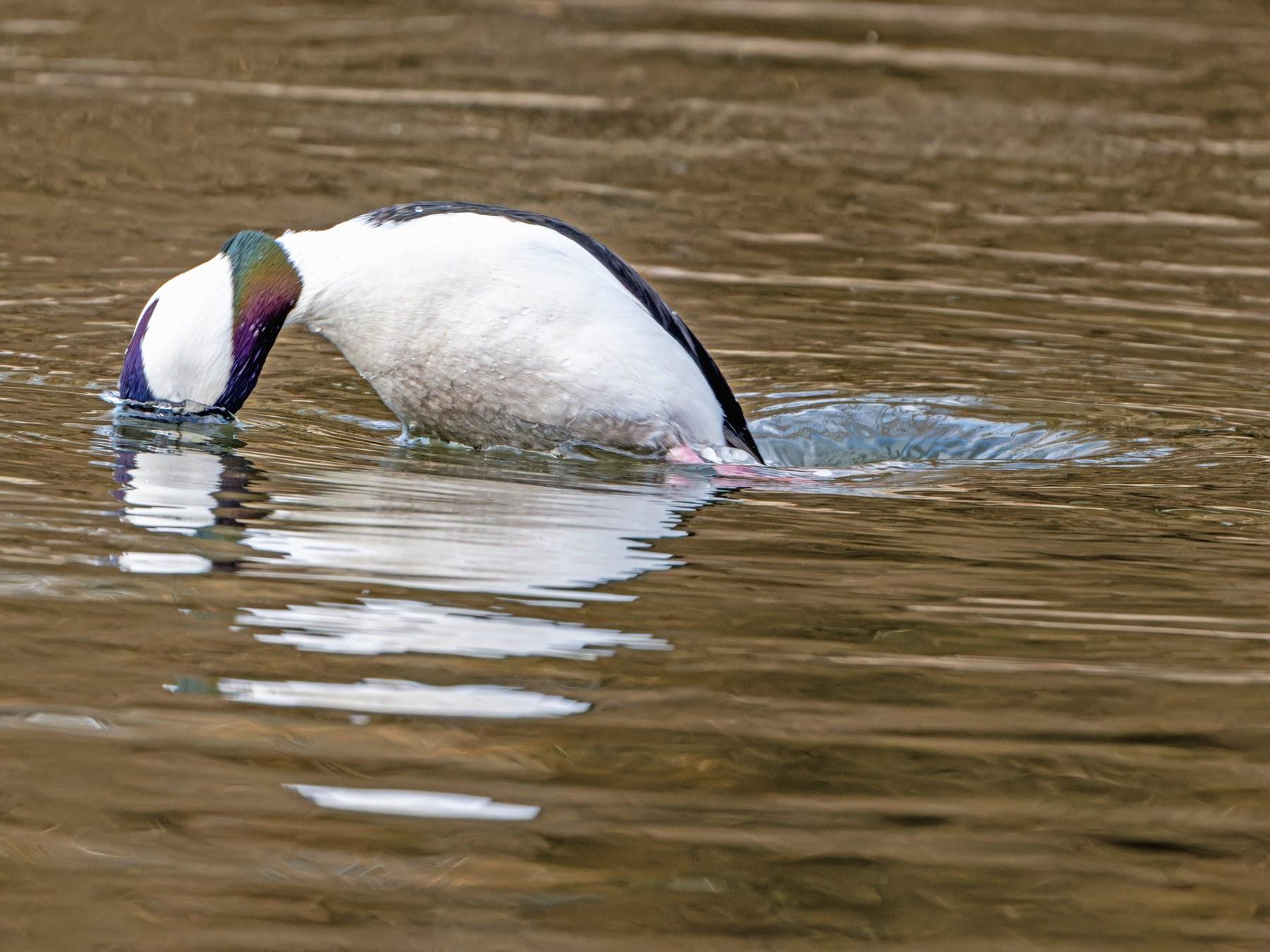
A Bufflehead dives with a little forward leap, swims underwater with its wings held close and only its feet for power, and often bobs back up like a cork. It feeds in open, shallow water, mostly under about 10 ft (3 m) deep, and never dives through tall emergent plants or dense underwater vegetation.
On the breeding grounds dives last about 12.5 seconds on average, with 96% under 25 seconds, and the pauses between dives are about as long; dives are longer in deeper water.1 Winter days are busy: one study at Lake Ontario found Buffleheads foraging on average for at least 69% of daylight hours, and birds also feed at night in winter.1
Nesting and breeding
Buffleheads nest in holes. They use only cavities, mostly old Northern Flicker holes in trees and occasionally Pileated Woodpecker holes, and they readily use nest boxes. There is one report of a nest on the ground, apparently in a ground squirrel burrow. Their small size lets them use flicker holes that have not been enlarged, which are too small for goldeneyes, and their breeding range is limited by woodland and by the flicker's range.
Nest holes are mostly in aspen or poplar, though pines are common in California, and they sit 2-46 ft (0.6-14 m) up; in British Columbia's parkland most are close to water. The female adds no nest material: the eggs lie on the bare floor or old material, and she adds down as she lays. Holes are reused, sometimes for up to 6 years in a row, by the same or a different female. Other hole-nesters compete for them, including Mountain Bluebirds, Tree Swallows, Northern Flickers and European Starlings, the most serious competitor.
In central British Columbia the earliest eggs were laid on 18 April and the median laying date was the first week of May (1957-1962 and 1982-1986), and cold weather can delay laying by up to two weeks.1 They raise one brood a year, and there is no evidence that they re-nest after losing a complete clutch. Both sexes first breed at 2 years old.
Eggs and ducklings
A clutch usually holds 6-11 eggs; clutches of 4-17 are known, and those over 12 probably come from more than one female. The eggs are creamy white to pale olive-buff, about 2 by 1.4 in (50.5 by 36.3 mm). The female lays slowly for a duck, usually one egg every 1-3 days, and she alone incubates them for about 30 days (28-33). In British Columbia, a full clutch weighed about as much as the female herself.
The ducklings stay in the hole for 24-36 hours after hatching. Then, usually in the morning, they climb up inside the cavity and jump out one after another, and the female leads them to the nearest water. She broods and defends them but never feeds them: they find their own food, dabbling at first and diving within a few days. She leaves them at about 5-6 weeks, before they can fly, and the young first fly at about 50-55 days old (in Alaska possibly from 45 days).
In British Columbia in 1980-1984, about 45% of ducklings survived from hatching to 50 days, and rain and cold raise losses.1 Broods often mix: in one dense British Columbia area a third of broods (34%) swapped young at least once,1 and one study reads this as an accident of territorial fights rather than cooperation.10 Females are faithful to their breeding area. In British Columbia 44-50% returned to within 3 mi (5 km), and most returning females reused the same nest site, especially after a successful nest.1
Nest boxes
Buffleheads take readily to nest boxes. In experiments in British Columbia they preferred small boxes, about 6 by 6 by 16 in (15 by 15 by 40 cm), to larger ones. They also strongly preferred a small entrance of about 2.6 in (6.5 cm) to a larger one, presumably to avoid competition with goldeneyes.1
One published plan has a 3-inch entrance, a floor of 10 by 11 3/4 inches and a 14-inch inside depth, with wood shavings in the bottom. Mount the box 5-10 feet up near water, facing the water, and put it in conifer-dominated woods rather than open areas to reduce competition from starlings.11 A Canadian waterfowl box guide uses an oval entrance of 2.5 by 3 inches.12 The first plan's floor is roomier than any of the boxes Buffleheads were offered in the experiments, and its 3-inch hole is wider than the 2.6-inch one they chose.
Boxes can make a local difference. In one central Alberta study, 37-58% of Bufflehead boxes were occupied after five years, and closing the boxes for one summer (2004) cut Bufflehead broods and brood sizes about threefold without changing the number of pairs.13 A study comparing nests in boxes and natural holes found few differences for Buffleheads, so box studies of this species are more likely than those of Barrow's Goldeneye to reflect natural nests.14
Behaviour
Buffleheads are seldom seen on land; females walk only to lead their ducklings from the nest to water or overland to another pond. They sleep on the water with no fixed roost, occasionally resting on a log, stump or shore. Winter flocks usually hold 5-10 birds and rarely more than 50, though molting flocks can reach 200 in summer and fall migrants 500.
They fly with rapid wingbeats, low over water and higher over land. A Bufflehead needs a running take-off across the water, but a shorter one than other diving ducks, because its wings carry relatively little weight.
On Vancouver Island in winter, Buffleheads leave their coastal feeding areas shortly after dusk begins, a timing one author suggests may have evolved to avoid Peregrine Falcons.15
Courtship and pairing behavior
Buffleheads are almost always monogamous. A few cases of one male with two females are known from Alberta and British Columbia, and no extra-pair matings were seen in the studies reviewed by Birds of the World. They are among the few ducks in which pairs often stay together for more than one year, though the direct evidence is thin: of 3 breeding pairs marked in one study, one stayed together for 2 years and one for 3. The bond lapses each summer, when males leave during incubation to molt, and old mates may reunite in winter.1
When pairs form is not well known. Many are already paired by early March: at Klamath Basin, California, half the female-plumaged birds and 60% of males were paired then, which fits pair formation in winter.1 Courtship goes on through most of the year, except during molt and early fall. The commonest display is head-bobbing. A male can raise his crown feathers into a broad, rounded crest, so the white patch looks nearly twice its normal size. He may also fly low over a female and “ski” to a landing with his crest raised, showing his black-and-white back and bright pink feet.
In the breeding season a paired male defends a patch of water near the shore, about 1.4 acres (0.56 ha) in British Columbia, and after hatching the female defends a brood territory; no territory defense has been recorded outside the breeding season. Buffleheads chase rivals across the surface, underwater or in flight. Territorial Buffleheads give way to territorial goldeneyes but dominate goldeneyes without territories, despite their size.1
Lifespan and predators
On average, Buffleheads live only a few years: among birds banded as adults, the mean lifespan was 2.5 years for males and 2.3 years for females.1 The oldest on record was a wild male at least 18 years 8 months old: banded in New York in February 1975 as a second-year bird, he was caught and released by a bander there in February 1993.16
Annual survival of adults banded in winter in New York in 1969-1973 was about 64-67%, a figure to read with caution because the samples were small.1
Predators and other dangers
Predators reported include the Peregrine Falcon, Snowy Owl and Bald Eagle, and possibly the Great Horned Owl and Cooper's Hawk. Nesting females may be killed by mammals, probably weasels or mink, and by Barrow's Goldeneyes, and squirrels, starlings and flickers destroy eggs. In parts of the north, northern pike may be a major predator of ducklings.1
Conservation
The Bufflehead is listed as Least Concern on the IUCN Red List (BirdLife International, 2022).17 Partners in Flight estimates about 1.3 million birds, from the North American Waterfowl Management Plan of 2018, and scores it 8 out of 20 for continental concern.18 An older estimate put the whole population at about 1.39 million in 1992, assuming that about 75% of birds bred inside the surveyed area.1
Numbers are rising. The North American Breeding Bird Survey shows a significant increase of about 2.7% a year from 1967 to 2025 (95% credible interval 1.9 to 3.5% a year, 310 routes).19 Over 2015-2025 the rise was about 3.2% a year, and the index is at its highest in the latest year.19 Local counts have risen too: numbers in Rhode Island's Narragansett Bay edged up in 2004-201120, and wintering numbers on northeastern Lake Ontario rose in 1990-2000.1
The species has recovered before. Overshooting had severely reduced numbers by about 1900, and they recovered under the US-Canada Migratory Birds Convention. Waterfowl surveys showed an increase from 1955 to 1992, which may be partly due to reduced hunting, especially in Canada.1
On the breeding grounds, clear-cut logging of boreal forest and clearing of aspen parkland for farming remove nest trees,1 and deforestation is counted among the primary threats to the species.21 In winter, at six coastal sites in the northeastern US, fewer Buffleheads wintered at urban sites than a food-energy model predicted, 43.7% fewer on average, a gap the authors say may have natural or human causes.22
Legal status
In the US the Bufflehead is protected as a migratory bird under the Migratory Bird Treaty Act, listed in 50 CFR 10.13, and in Canada under the Migratory Birds Convention Act.23, 24 Like other ducks, it is a migratory game bird in both countries, which may be hunted only within the limits set under federal rules for ducks.25, 26
Similar birds
Often mistaken for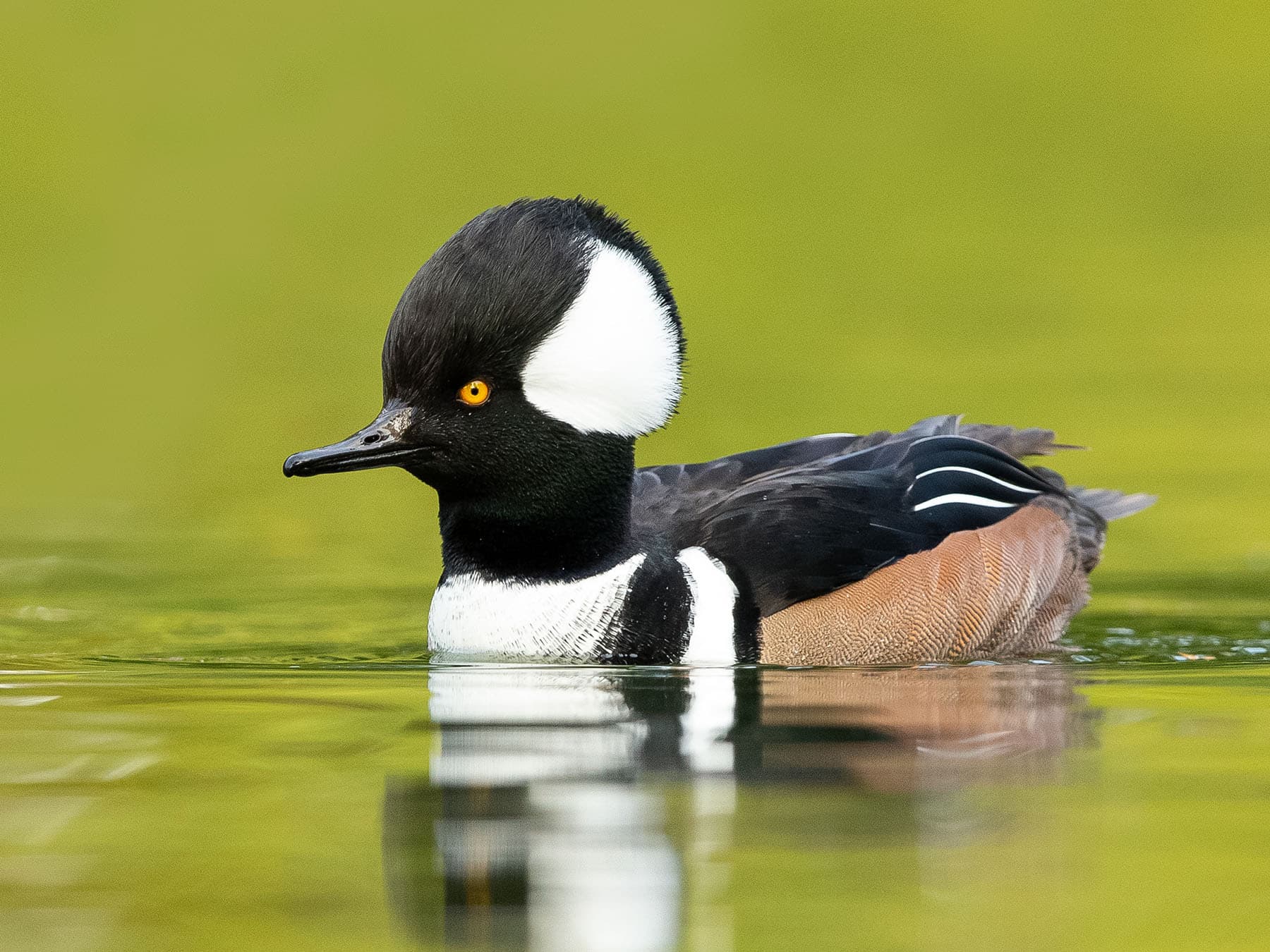
More photos
3 photos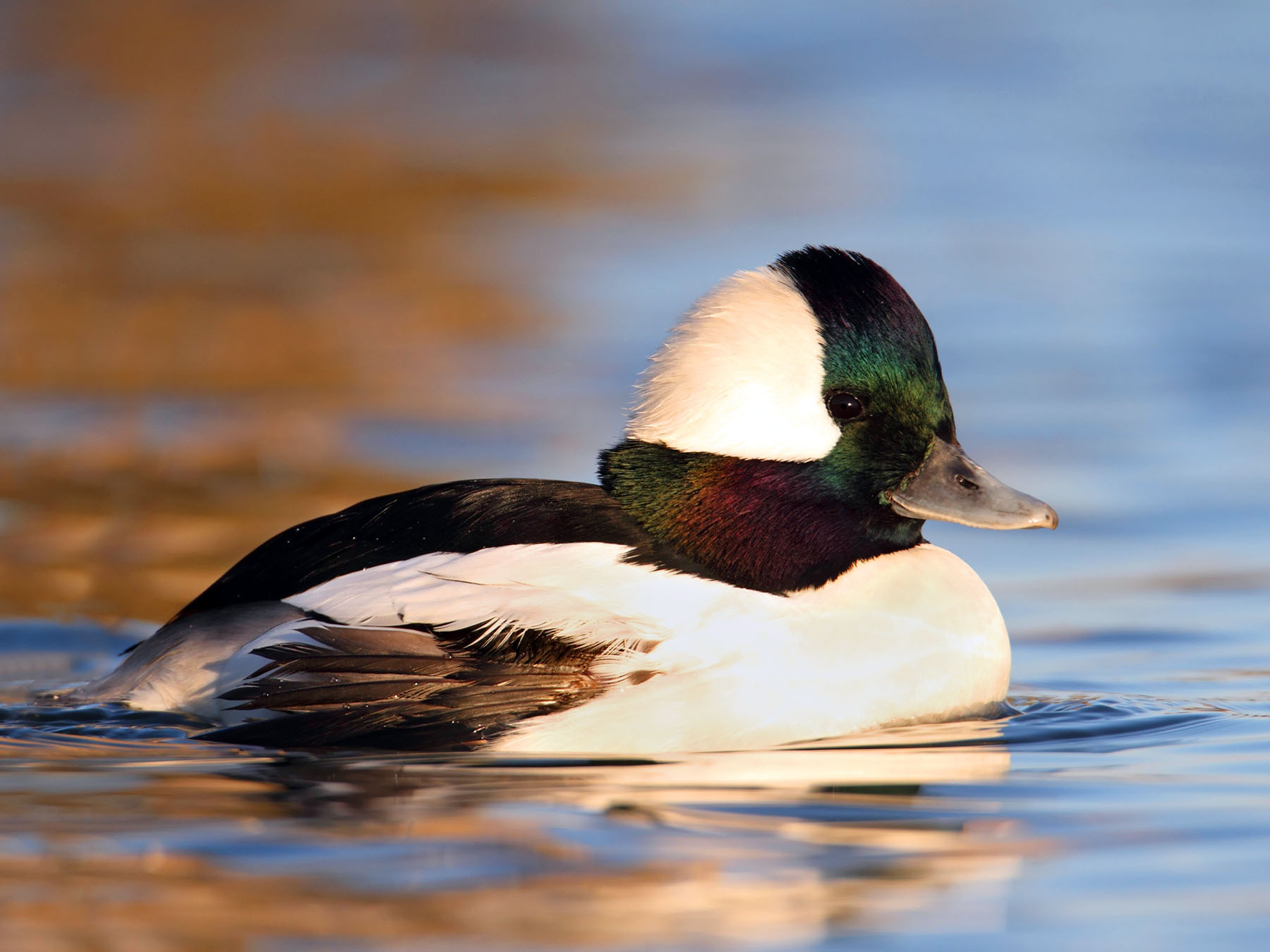
Bufflehead guides
1 guidesQuick facts
- Length
- 32–40 cm
- Wingspan
- 55 cm
- Weight
- 272–635 g
- Lifespan
- oldest recorded 18 years 8 months
- Family
- Ducks, Geese & Swans
- Migration
- Partial migrant
- Global status (IUCN)
- Least Concern
- World population
- About 1.3 million birds (Partners in Flight, from the North American Waterfowl Management Plan 2018)
- Population trend
- Increasing: the Breeding Bird Survey shows a significant rise of about 2.7% a year since 1967 (credible interval 1.9 to 3.5%) and about 3.2% a year over the last decade
- Scientific name
- Bucephala albeola
Questions
2Why is it called a Bufflehead?
The name grew out of “buffalo-head”, a nod to the puffed-up look of the male's big head. When he raises his crown feathers in display, the head looks bigger still.
Is a Bufflehead a merganser?
No. It is one of only three species in the genus Bucephala, with the Common and Barrow's Goldeneyes, and the most distinctive of the three. DNA work places the genus close to the mergansers, eiders and scoters. Linnaeus described it in 1758 as Anas albeola, from Edwards's account of a bird from America; the type locality is taken to be Newfoundland. No subspecies have been described.27
Sources
43- 1Gauthier, G. (2020). Bufflehead (Bucephala albeola), version 1.0. Birds of the World (A. F. Poole, Editor). Cornell Lab of Ornithology. doi:10.2173/bow.buffle.01 (opens in a new tab)
- 2Rodway, M. S., Regehr, H. M., Boyd, W. S. and Iverson, S. A. (2015). Age and sex ratios of sea ducks wintering in the Strait of Georgia, British Columbia: Implications for monitoring. Marine Ornithology 43: 141-150. doi:10.5038/2074-1235.43.2.1123 (opens in a new tab)
- 3Finley, J. K. and Huot, S. (2010). Interspecific mate choice and hybridism in the Bufflehead, Bucephala albeola. The Canadian Field-Naturalist 124(1): 28. doi:10.22621/cfn.v124i1.1026 (opens in a new tab)
- 4Severson, F. et al. (2025). New observations show that multiple Bufflehead x Common Goldeneye males were present in the Central Valley, California. Central Valley Birds 28(1): 5-9. doi:10.64555/dg8my796 (opens in a new tab)
- 5Ellis-Felege, S. N., Skaggs, C. G. and Knutsen, G. A. (2018). Increased Bufflehead (Bucephala albeola) breeding activity in Minnesota. The Canadian Field-Naturalist 131(4): 338-343. doi:10.22621/cfn.v131i4.1963 (opens in a new tab)
- 6Richardson, T. W. (2004). Notes: Expansion of the breeding range of the Bufflehead in California. Western Birds 35(3): 168-172. doi:10.21199/wb35.3.4 (opens in a new tab)
- 7Beasley, V. M. (2025). First record of Bucephala albeola (Bufflehead) for the U.S. Virgin Islands. Journal of Caribbean Ornithology 38: 67-69. doi:10.55431/jco.2025.38.67-69 (opens in a new tab)
- 8Finley, J. K. (2007). The punctual Bufflehead, Bucephala albeola: autumn arrivals in Shoal Harbour Sanctuary, Vancouver Island, in relation to freeze-up. The Canadian Field-Naturalist 121(4): 370. doi:10.22621/cfn.v121i4.507 (opens in a new tab)
- 9Hornung, J. P. and Foote, A. L. (2007). Comparing dietary preferences of Bufflehead ducklings in Western Canada through gut content and stable isotope analysis. Aquatic Ecology 42(1): 61-70. doi:10.1007/s10452-007-9079-1 (opens in a new tab)
- 10Savard, J.-P. L. (1987). Causes and functions of brood amalgamation in Barrow's Goldeneye and Bufflehead. Canadian Journal of Zoology 65(6): 1548-1553. doi:10.1139/z87-239 (opens in a new tab)
- 11Cornell Lab of Ornithology. Bufflehead: Right Bird, Right House. NestWatch. Accessed 20 November 2026. Source (opens in a new tab)
- 12Ducks Unlimited Canada (2008). Nest Box Guide for Waterfowl. Ducks Unlimited Canada. Accessed 20 November 2026. Source (opens in a new tab)
- 13Corrigan, R. M., Scrimgeour, G. J. and Paszkowski, C. (2011). Nest boxes facilitate local-scale conservation of Common Goldeneye (Bucephala clangula) and Bufflehead (Bucephala albeola) in Alberta, Canada. Avian Conservation and Ecology 6(1): 1. doi:10.5751/ace-00435-060101 (opens in a new tab)
- 14Evans, M. R., Lank, D. B., Boyd, W. S. and Cooke, F. (2002). A comparison of the characteristics and fate of Barrow's Goldeneye and Bufflehead nests in nest boxes and natural cavities. The Condor 104(3): 610-619. doi:10.1093/condor/104.3.610 (opens in a new tab)
- 15Finley, J. K. (2007). Offshore flight of Buffleheads, Bucephala albeola, after twilight in winter: an anti-predation tactic?. The Canadian Field-Naturalist 121(4): 375. doi:10.22621/cfn.v121i4.508 (opens in a new tab)
- 16U.S. Geological Survey Bird Banding Laboratory (2026). Longevity records of North American birds: Bufflehead (AOU 1530). USGS Patuxent Wildlife Research Center, Bird Banding Laboratory. Accessed 20 November 2026. Source (opens in a new tab)
- 17BirdLife International (2022). Bucephala albeola. The IUCN Red List of Threatened Species 2022. IUCN Red List, via GBIF checklist record 176609024. Accessed 20 November 2026. Source (opens in a new tab)
- 18Partners in Flight (2024). Avian Conservation Assessment Database, global file. Partners in Flight. Accessed 20 November 2026. Source (opens in a new tab)
- 19Hostetler, J. A. et al. (2026). The North American Breeding Bird Survey, Analysis Results 1966 - 2025. U.S. Geological Survey. Accessed 20 November 2026. Source (opens in a new tab)
- 20Kreakie, B. J., Winiarski, K. and McKinney, R. (2015). Developing a wintering waterfowl community baseline for environmental monitoring of Narragansett Bay, Rhode Island. F1000Research. doi:10.12688/f1000research.6080.3 (opens in a new tab)
- 21Ducks Unlimited. Bufflehead Identification: Field Marks and Calls (Waterfowl ID). Ducks Unlimited. Accessed 20 November 2026. Source (opens in a new tab)
- 22McKinney, R. A. and McWilliams, S. R. (2012). Energy-based carrying capacities of Bufflehead Bucephala albeola wintering habitats. The Open Ornithology Journal 5(1): 5-17. doi:10.2174/1874453201205010005 (opens in a new tab)
- 23U.S. Fish and Wildlife Service (2026). 50 CFR 10.13, List of Migratory Birds. Electronic Code of Federal Regulations. Accessed 20 November 2026. Source (opens in a new tab)
- 24Environment and Climate Change Canada (2026). Birds protected in Canada under the Migratory Birds Convention Act, 1994. Government of Canada (Wayback copy of 4 Oct 2026). Accessed 20 November 2026. Source (opens in a new tab)
- 25U.S. Fish and Wildlife Service (2026). 50 CFR 20.11, What terms do I need to understand? (migratory game birds). Electronic Code of Federal Regulations. Accessed 20 November 2026. Source (opens in a new tab)
- 26Government of Canada (1994). Migratory Birds Convention Act, 1994 (S.C. 1994, c. 22). Justice Laws Website. Accessed 20 November 2026.
- 27AviList Core Team (2026). AviList: The Global Avian Checklist, v2025b. AviList. doi:10.2173/avilist.v2025b (opens in a new tab)
- 28Savard, J.-P. L. (1982). Intra- and inter-specific competition between Barrow's goldeneye (Bucephala islandica) and bufflehead (Bucephala albeola). Canadian Journal of Zoology 60(12): 3439-3446. doi:10.1139/z82-433 (opens in a new tab)
- 29Cornell Lab of Ornithology. Bufflehead: Overview, Identification and Life History. All About Birds. Accessed 20 November 2026. Source (opens in a new tab)
- 30Kaufman, K. (1996). Bufflehead, Audubon Field Guide (text adapted from Lives of North American Birds, 1996). National Audubon Society. Accessed 20 November 2026. Source (opens in a new tab)
- 31Ellis-Felege lab, University of North Dakota. Buffleheads: Potential Range Expansion of Buffleheads. University of North Dakota. Accessed 20 November 2026. Source (opens in a new tab)
- 32Herzog, M. P. et al. (2024). Body mass changes of dabbling and diving ducks wintering in California. The Journal of Wildlife Management 88(8). doi:10.1002/jwmg.22650 (opens in a new tab)
- 33Gladden, B. W. and Canaris, A. G. (2009). Helminth parasites of the bufflehead duck, Bucephala albeola, wintering in the Chihuahua Desert with a checklist of helminth parasites reported from this host. Journal of Parasitology: 129-136. doi:10.1645/ge-1472.1 (opens in a new tab)
- 34Clipp, H. L., Peters, M. L. and Anderson, J. T. (2017). Winter waterbird community composition and use at created wetlands in West Virginia, USA. Scientifica (Cairo) 2017: 1730130. doi:10.1155/2017/1730130 (opens in a new tab)
- 35Messmer, D. J. et al. (2026). Divergent demographic responses of boreal-breeding ducks to growing season variability. Oecologia 208(2). doi:10.1007/s00442-026-05865-x (opens in a new tab)
- 36Myhrvold, N. P. et al. (2015). An amniote life-history database to perform comparative analyses with birds, mammals, and reptiles. Ecology 96: 3109. Accessed 20 November 2026. Source (opens in a new tab)
- 37Tobias, J. A. et al. (2022). AVONET: morphological, ecological and geographical data for all birds. Ecology Letters 25: 581-597. Accessed 20 November 2026. Source (opens in a new tab)
- 38GBIF Secretariat (2026). GBIF Backbone Taxonomy: Bucephala albeola (usageKey 2498329). GBIF. Accessed 20 November 2026. Source (opens in a new tab)
- 39Dugger, B. D., Dugger, K. M. and Fredrickson, L. H. (2020). Hooded Merganser (Lophodytes cucullatus), version 1.0. Birds of the World (A. F. Poole, Editor). Cornell Lab of Ornithology. doi:10.2173/bow.hoomer.01 (opens in a new tab)
- 40Eadie, J. M., Mallory, M. L. and Lumsden, H. G. (2020). Common Goldeneye (Bucephala clangula), version 1.0. Birds of the World (S. M. Billerman, Editor). Cornell Lab of Ornithology. doi:10.2173/bow.comgol.01 (opens in a new tab)
- 41Eadie, J. M., Savard, J.-P. L. and Mallory, M. L. (2020). Barrow's Goldeneye (Bucephala islandica), version 1.0. Birds of the World (A. F. Poole and F. B. Gill, Editors). Cornell Lab of Ornithology. doi:10.2173/bow.bargol.01 (opens in a new tab)
- 42Robertson, G. J. and Goudie, R. I. (2020). Harlequin Duck (Histrionicus histrionicus), version 1.0. Birds of the World (S. M. Billerman, Editor). Cornell Lab of Ornithology. doi:10.2173/bow.harduc.01 (opens in a new tab)
- 43Brua, R. B. (2020). Ruddy Duck (Oxyura jamaicensis), version 1.0. Birds of the World (P. G. Rodewald, Editor). Cornell Lab of Ornithology. doi:10.2173/bow.rudduc.01 (opens in a new tab)

Checked by
Nathan Cope, founder and editor
Nathan founded Birdfact and leads its writers and contributors in the UK, the US and Canada. He has watched and studied birds for more than ten years, and checks every article and species guide before it’s published.