
Black-chinned Hummingbird
Archilochus alexandri
By the Birdfact teamChecked by Nathan Cope
On this page13 sections
How to recognise it
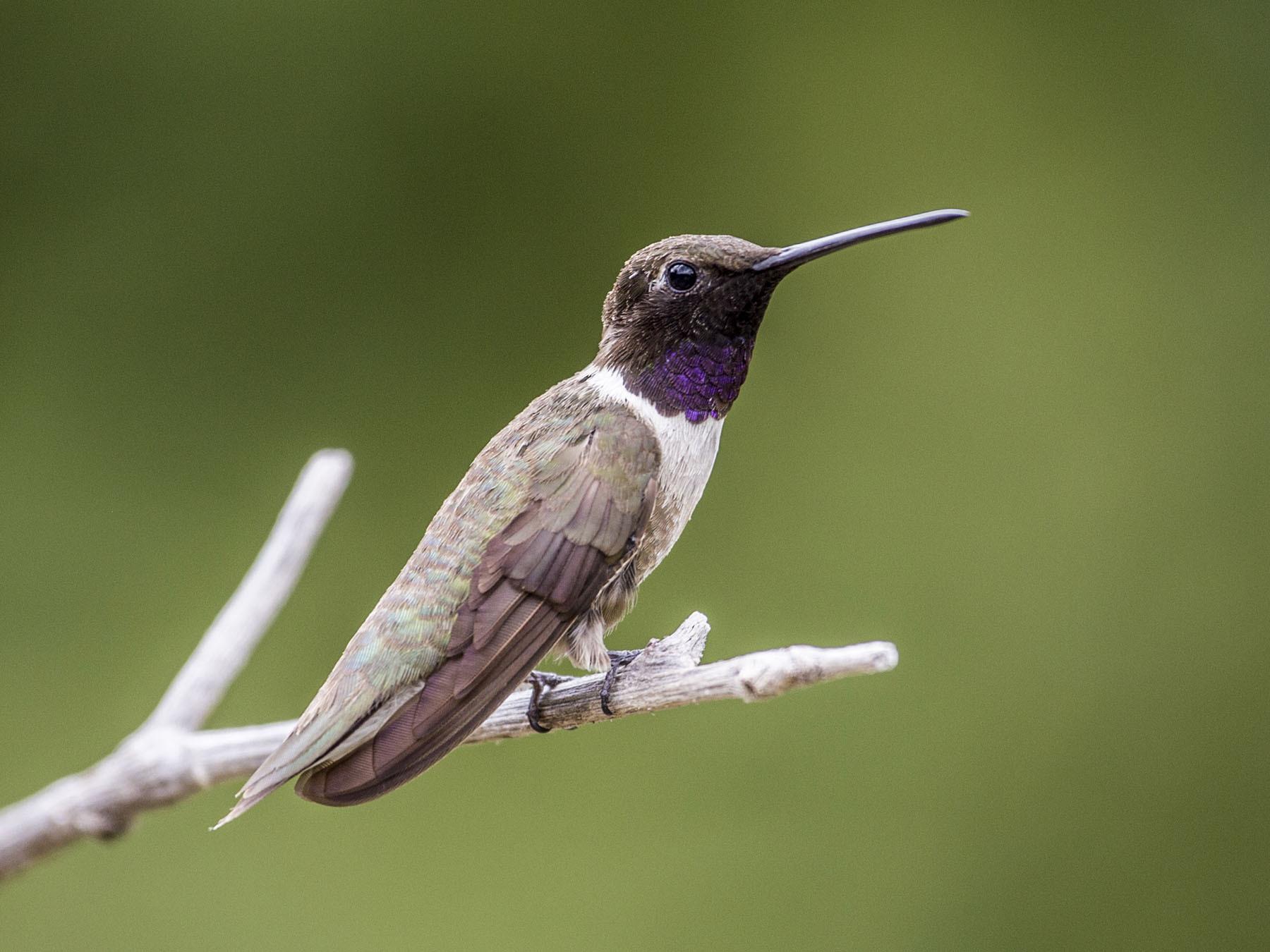
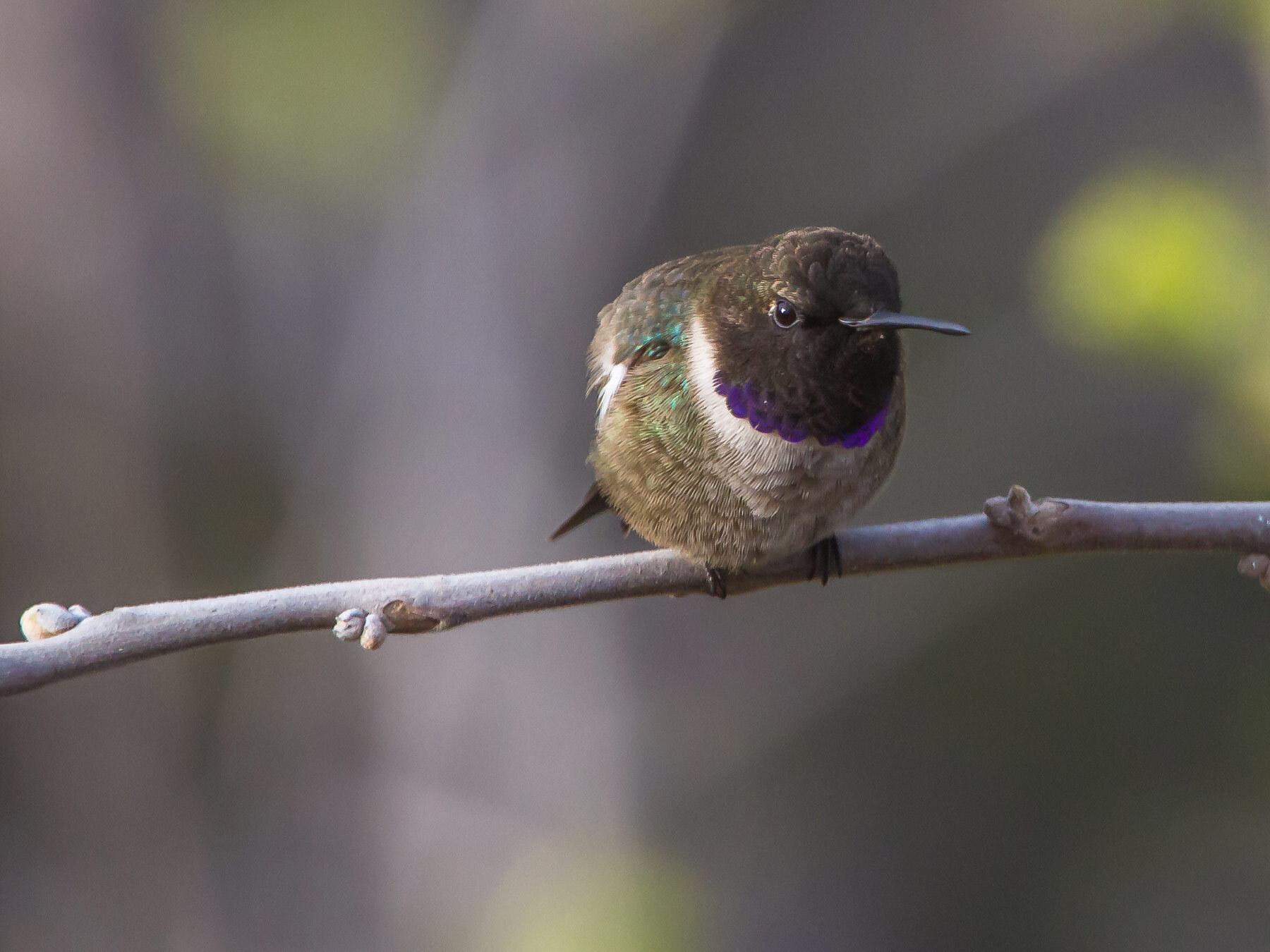
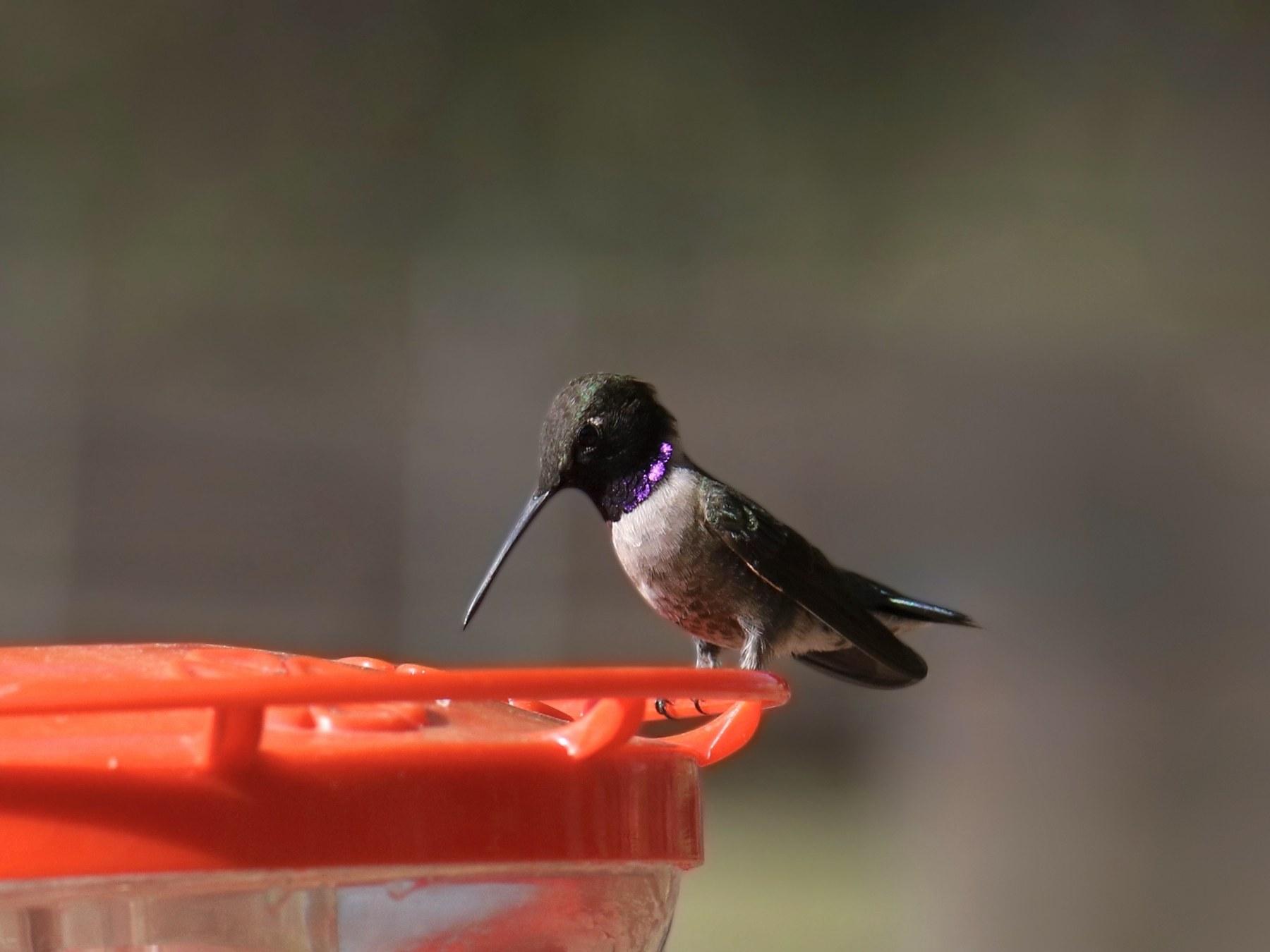
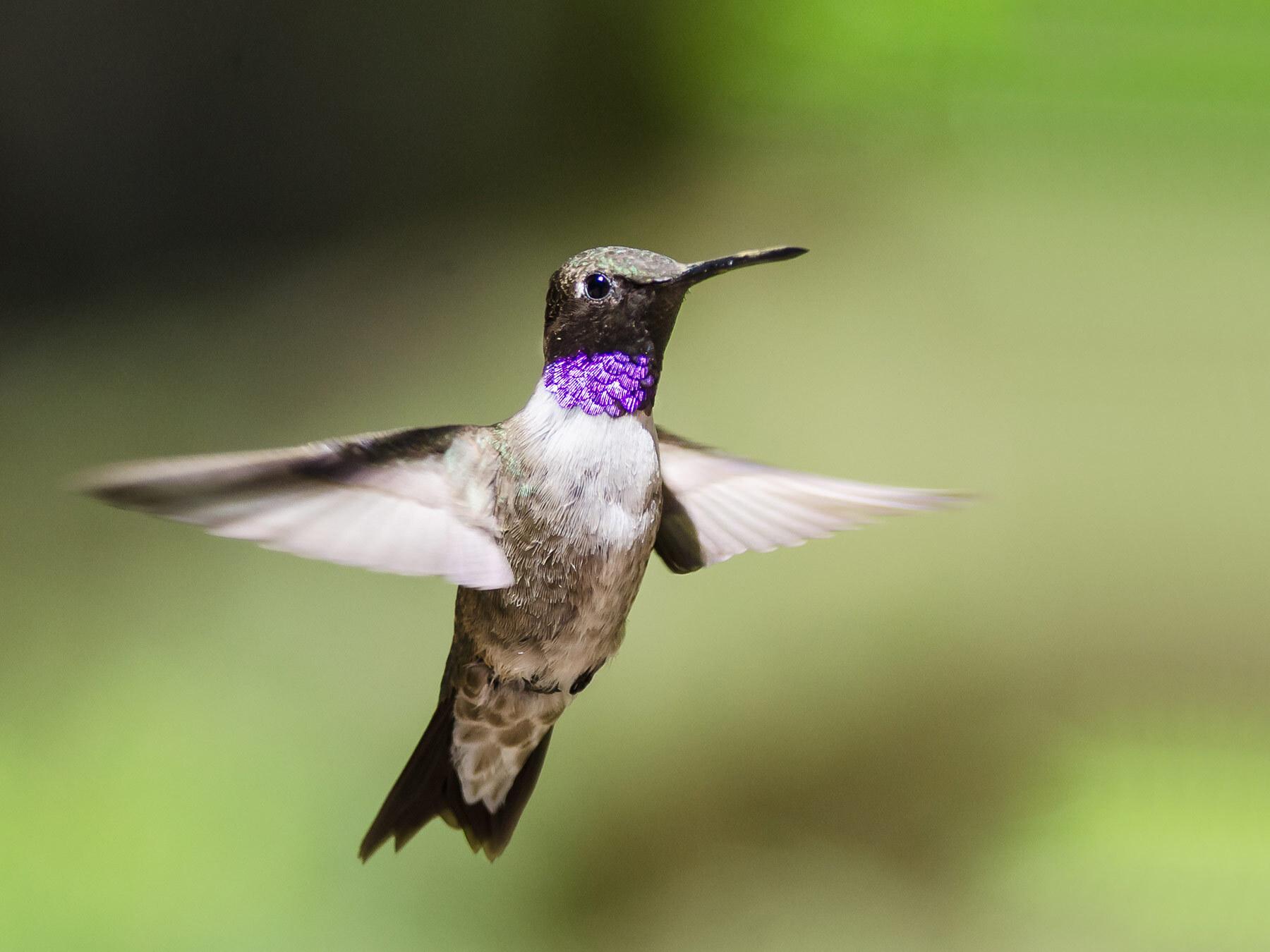
A small, slender hummingbird with a long, slightly down-curved black bill. The adult male has a velvety black chin and upper throat with a thin band of violet below, which shows only when the light catches it; otherwise the whole throat looks black. Females and young are green above and pale below.
On an adult male, the white collar under the throat is often easier to see than the violet. He is dull metallic bronze-green above and dull grayish-white below, with darker, bronze-green sides and flanks; the central tail feathers are green and the rest black. At any age, watch the tail: while hovering at flowers or feeders it flips and spreads it almost constantly.
There is no separate winter or breeding plumage. It molts once a year, mainly on the wintering grounds: adults start by September and finish by mid-March, and young birds reach adult plumage by mid-April, occasionally early May. One bird takes about four months to replace its wing and tail feathers, while across the population the molt runs 7-8 months.1
Size and weight
It is about 3.5 in (9 cm) long, with a wingspan of about 4.3 in (11 cm), and weighs about 0.1 oz (3.0-3.5 g), the females a little more. It is about the same size as a Ruby-throated Hummingbird.
Females are the larger sex. Among banded adults in southern Arizona, females' wings averaged 46.1 mm against 42.0 mm in males (763 and 1,032 birds), and females weighed more, 3.61 g on average against 3.25 g. Young males averaged slightly heavier than adult males, while young females in Arizona and New Mexico were lighter than adult females, and females' bills average a little longer.1 A 2010 study that measured bill shape with landmark-based methods found no significant difference between the sexes, unlike in the Ruby-throated.2
Male, female and young
Adult females are bronze-green above with a duller, grayish-brown crown. The throat is creamy, often streaked or sometimes spotted with dusky, with no violet, and the underparts are dull white with a faint brownish wash on the sides. The tail is greenish or blackish, and the three outer pairs of feathers are broadly tipped white.
Young birds look like adult females, but the feathers of the head and back have buffy edges that wear off. Young males usually show moderate to heavy throat streaks, and often one or two black or violet throat feathers soon after leaving the nest. They add more from November to February and have the full gorget only in late winter or spring. So a young bird with no dark throat feathers is not necessarily a female. Close up or in the hand, young birds also show fine grooves on the upper bill.
A dark throat is not proof of a male either. A nesting bird in Salt Lake City, Utah, in 2021 had a mostly dark, male-like throat; the authors suggest it was a female with male-like plumage, something reported in about a quarter of hummingbird species but not before in this one.3
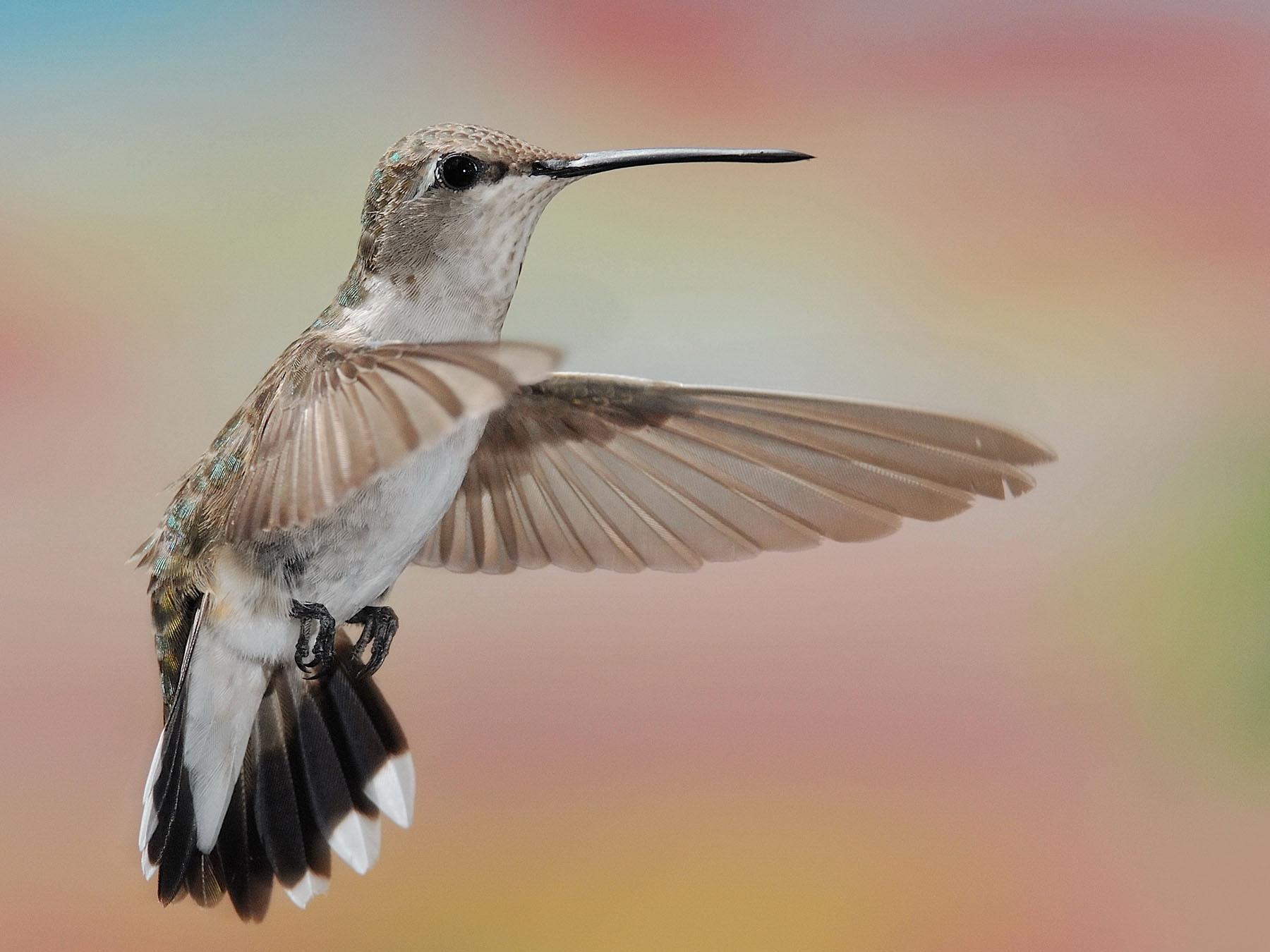
Identification: Ruby-throated and other lookalikes
The adult male is likely to be mistaken for a male Ruby-throated only in poor light; in good light the Ruby-throated's gorget is a brilliant red across the whole throat. Females and young are the real problem: telling them apart can be difficult and occasionally impossible.
Separate a female or young Ruby-throated only with caution. It tends to have a brighter green crown and back, where the Black-chinned's crown is often grayish green. It also tends to show a darker mask across the face, setting off a crisper white spot behind the eye, and brighter cinnamon on the lower flanks, where a Black-chinned shows dull grayish orange. The best mark is the shape of the outermost wing feathers, the primaries: their tips are broad and blunt in a Black-chinned, slimmer and more pointed in a Ruby-throated. Measurements were long used to separate them, but a smaller-bodied population in southern Texas and much of Mexico overlaps Ruby-throated entirely; this size difference went unnoticed for a long time because museum specimens of its females and young were cataloged as Ruby-throated.
The two breeding ranges meet only narrowly, in central Texas and central and southern Oklahoma, and hybrids are known: a 2016 paper documented two male hybrid specimens, one from Grayson County, Texas, the other from East Baton Rouge Parish, Louisiana.4 A 2020 genome paper, citing earlier work, puts first-generation hybrids at an estimated 9.3% of adult males in southwestern Oklahoma.5
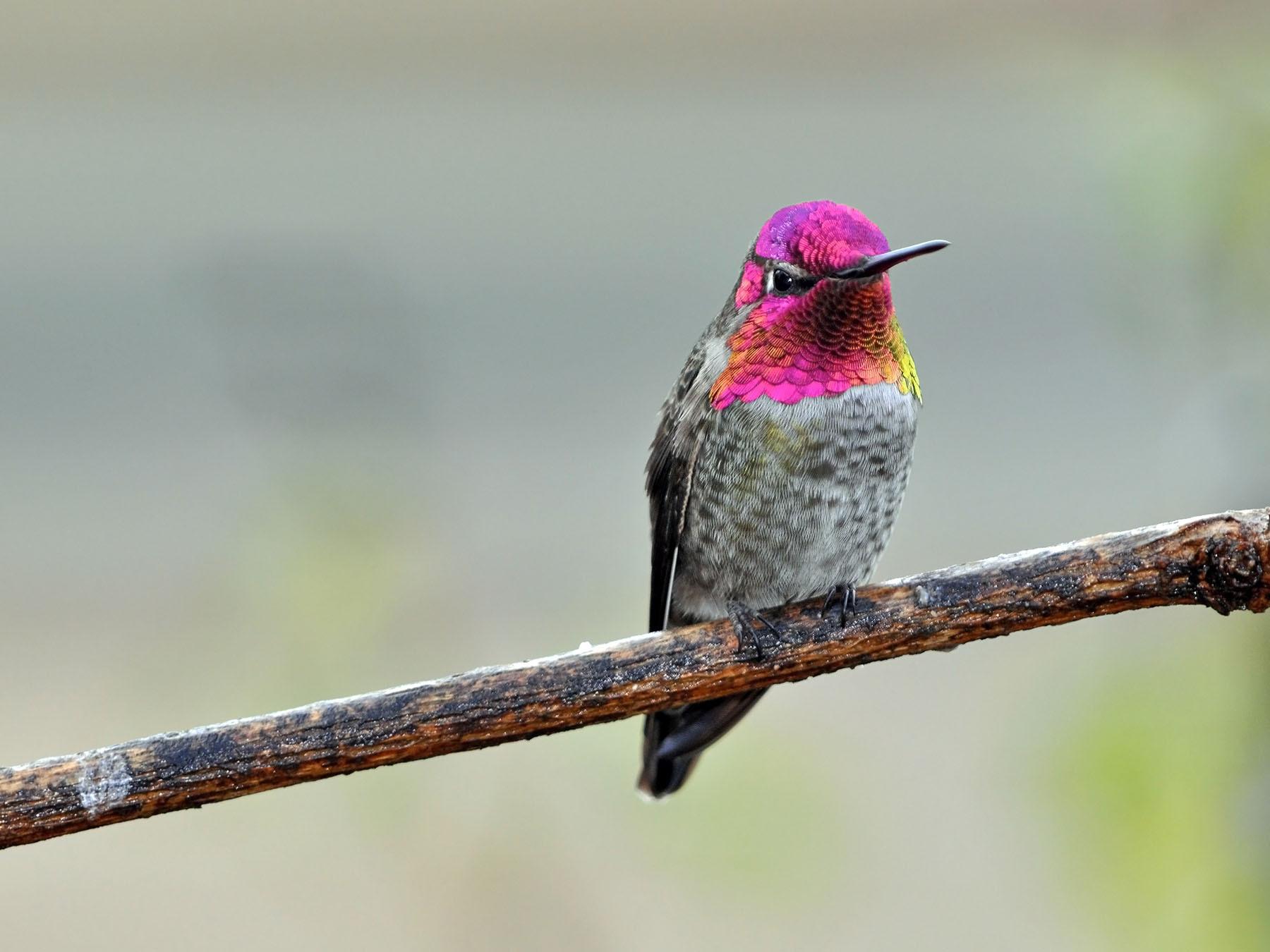
Other lookalikes are easier. An Anna's Hummingbird is bigger, stockier and grayer below; the male's rose color covers his crown as well as his throat, and the female often has a few rose feathers in the center of her throat. A male Costa's Hummingbird has a purple crown and a purple gorget that flares out at the sides; the female has a shorter bill, and nearly half of females show a small violet throat patch. A Lucifer Hummingbird usually has a longer, more strongly down-curved bill, and the female is buff on the throat and breast with a dark ear patch. In the hand, a Black-chinned's inner primaries are much narrower than its outer four, while in Anna's and Costa's they are about as wide.1, 6
Not sure it’s a Black-chinned Hummingbird? Check your photo: Birdfact names the bird and shows the look-alike side by side.
Its size
Adults- Length
- 9 cm
- Wingspan
- 11 cm
- Weight
- 2.3–5.3 g
Its song and calls
It almost never sings. What you hear is mostly chips and buzzes in squabbles at flowers and feeders, and the hum of its wings.
A lone bird gives a high-pitched chip. Either sex may call in disputes at any time of year or day, mixing in lower, buzzy and trilled notes. At feeders, a study found calls of 1 to 18 notes, 7.7 on average, drawn from as many as five note types and ordered non-randomly.1, 7 Males and females give the same call types, though one buzzy note turns up more often in males' calls.7 Other accounts describe a low tup, or a soft, slurred, low tew rarely strung into a series.8, 6
Its wings beat about 50 times a second, making a hum of about 2-2.5 kHz. In one study, hovering birds beat their wings 58-67 times a second, faster in display dives, at about 74.1 At the bottom of each display dive the male adds a sound with a trill and a pure tone. A 2010 study showed the tone comes from the fluttering tip of the outermost tail feather, while the trills, timed with the wingbeats, are probably made by the wings.9
Song is known from only two accounts, both near Austin, Texas, one describing a sweet, very high-pitched warble; what it is for is unknown. Nestlings seem to stay mostly silent in the nest, and once out, dependent young give a high, thin seet that helps the female find them.1
- Male display sounds0:00 / 0:13
Recorded in New Mexico, United States · April 2023
- Male display flight0:00 / 0:15
Recorded in New Mexico, United States · April 2020
Heard one and not sure? Let the bird song identifier listen.
When and where to see it
November
Mostly absent
The year across North America
Choose a place on the map to see its year, or find yours.
Most recorded in November
Up to 2.1% of a place’s bird records that monthHere in other months
How this map is made
Each county, state or province is shaded by the Black-chinned Hummingbird’s share of all the bird records there that month: the darker, the larger the share. A place with only a trace of records in a month is left unshaded. Shades compare places on this map with each other, not one bird with another. Records: GBIF eBird Observation Dataset, 2019–2024. Map: Natural Earth; place centres © OpenStreetMap contributors.
How often the Black-chinned Hummingbird turns up in the United States and Canada through the year, from birdwatchers' records.
United States
Summer visitor · regularly Mar–Oct · most records in August
Canada
Summer visitor · regularly May–Sep · most records in July
Show as a table
| Month | United States | Canada |
|---|---|---|
| January | 0.007% | – |
| February | 0.007% | – |
| March | 0.044% (regular) | – |
| April | 0.13% (regular) | <0.001% |
| May | 0.14% (regular) | 0.007% (regular) |
| June | 0.17% (regular) | 0.015% (regular) |
| July | 0.21% (regular) | 0.018% (regular) |
| August | 0.25% (regular) | 0.014% (regular) |
| September | 0.12% (regular) | 0.001% (regular) |
| October | 0.017% (regular) | <0.001% |
| November | 0.008% | – |
| December | 0.007% | – |
Worldwide: recorded regularly in 3 countries
Countries where it was recorded in at least 3 of the 6 years 2019–2024. Linked countries have their own bird list.
North America (3)
Data: EOD – eBird Observation Dataset (Cornell Lab of Ornithology), accessed via GBIF.org, CC BY 4.0. Records from 2019–2024, aggregated and filtered by Birdfact. How these lists are made
It breeds across much of the West: from interior southern British Columbia south through Washington, Oregon, Idaho, northwestern Montana, Nevada, Utah, western and southern Colorado, Arizona, New Mexico and much of California into northern Mexico, and east through central and southern Texas to Dallas. Most winter in west-central Mexico.
It is a generalist, found from lush towns to dry desert washes, and from below sea level to above 8,200 ft (2,500 m). In the dry West it nests mainly in canyon and floodplain woods along streams, among cottonwood, sycamore, willow, salt-cedar, sugarberry and oak, while adult males often sit on the drier slopes nearby. It also uses pinyon-juniper and oak shrubland in western Colorado, and orchards. It has adapted well to towns and suburbs with tall trees and plenty of flowering shrubs and vines. In Canada it breeds only in the valleys of the southern interior of British Columbia, in riverside woods and gardens.
It is most common in the south of its range, above all by rivers in the south of Arizona and New Mexico, where nests may be about 330 ft (100 m) apart. In irrigated Tempe and Phoenix, Arizona, a study published in 1987 found it four times as dense as Anna's Hummingbird, though it was scarce in Tucson.1
After nesting, many California birds move up into the mountains for flowers, where they may become abundant at about 6,200-8,200 ft (1,900-2,500 m), and as wild flowers fade many birds move into towns, where gardens and feeders provide food.
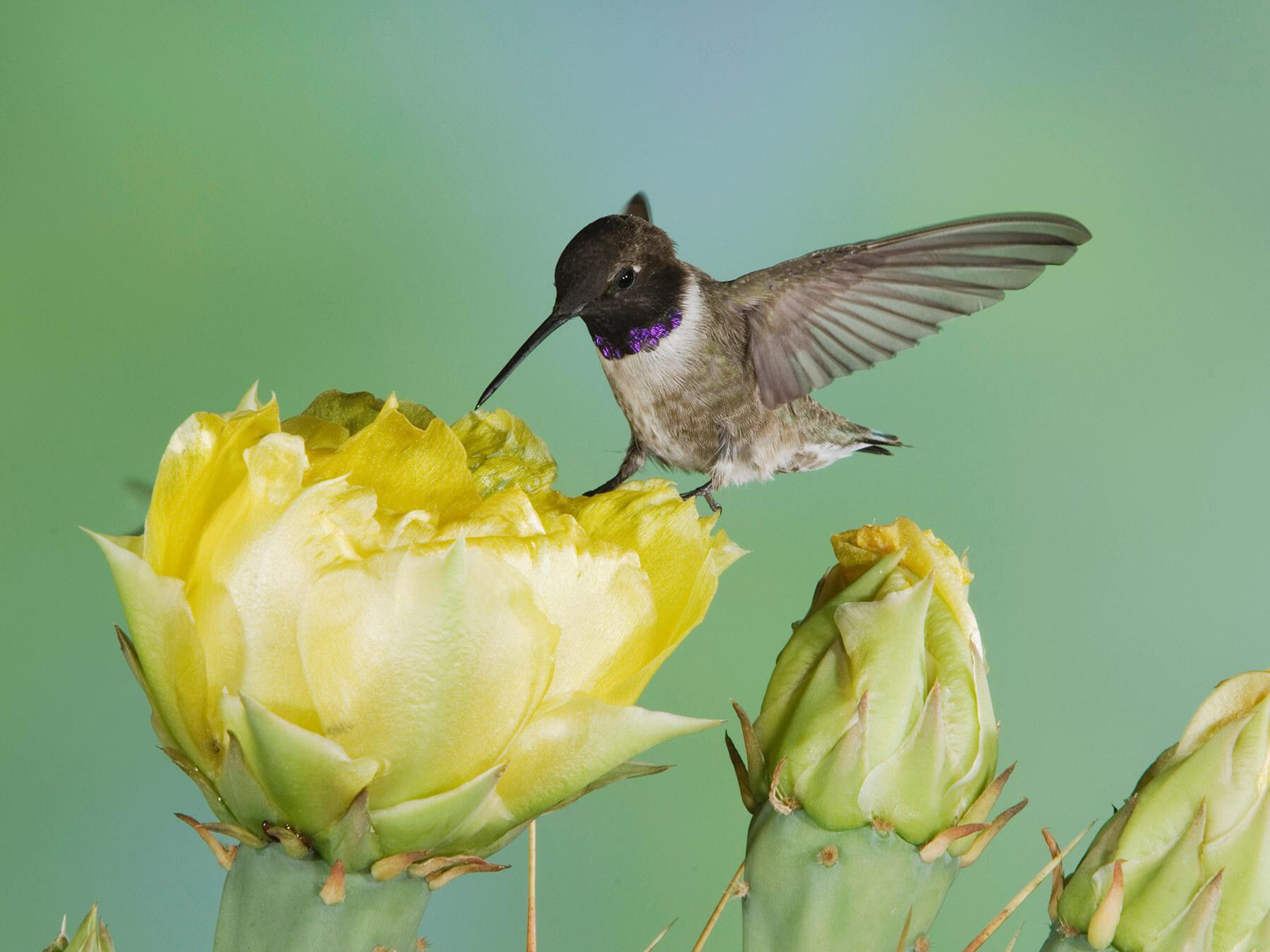
Spotting tips
In spring and summer, look along streams with cottonwoods and sycamores, and watch the bare twigs at the tops of trees, where it often sits watching its territory. In late July and August, feeders in southern Utah, western Colorado and Arizona can draw hundreds. A hovering hummingbird that keeps flipping and spreading its tail is worth a second look.
Do they migrate?
Most do. It is a short- to medium-distance partial migrant: most birds leave the breeding range for Mexico, while the small southern population is basically sedentary.
Adult males come first in spring, in British Columbia one to two weeks ahead of females. The first reach the lower Colorado River in late February and the Texas coast in early March. In much of California the males are back by mid-April, and birds reach British Columbia in the second half of May, the first in late April.
They leave early too. Males leave British Columbia from mid-June, and most birds are gone by mid-August. California birds leave their breeding areas by the end of July, and most leave the state in September, some staying into October. In Texas they depart from mid-July to October.
Migrants seldom stay at one feeder longer than a day, even where flowers are scarce, and fall birds caught in southeastern Arizona seldom carry heavy fat, though September migrants there are about 10% heavier than earlier ones. At one site in southeastern Arizona, hundreds a day passed through for about a month from mid-August, peaking about 1 September.1
Many follow the same route year after year. Banding in southern Arizona found that at least one male in ten, and 8% of females, came back as migrants in later falls. An adult male banded there on 6 July 1988 was caught on its winter grounds near Chamela, Jalisco, on 21 April 1991.1
Winter range and spread
Most birds winter in west-central Mexico, with specimens from Colima, Jalisco, Michoacán, Morelos, Nayarit and Guanajuato. Little is known of its winter habitat: in western Mexico it has been found in thorn scrub, mangroves, and dry and riverside forest.
Small numbers winter in the US Southeast, where they like the shade of oaks. By the late 1990s it was recorded every winter along the Gulf Coast and inland, mainly from November to January, most often in Louisiana, Alabama and coastal Mississippi, also in Georgia and once in Tennessee; regular wintering in northwest Florida was not fully proven. In Louisiana, 184 were banded from 1979 to April 1999. In the early years about five wintering Black-chinned were seen there for every Ruby-throated, and by winter 1998-1999 the two were about equal.1
Why it spread east was not understood in 1999. Birds may have gone undetected before, or the change may come from altered habitat or from healthy, growing populations, helped by garden plantings and sugar-water feeders. By then vagrants had reached southern Alberta, Saskatchewan, Ontario and Nova Scotia, and in the US from the Florida Keys north to Massachusetts and New York.
The breeding range may have grown as well: by 1999 data suggested it had spread and grown commoner in the Pacific Northwest, where only two British Columbia records were cited before 1947.1 Two Colorado breeding bird atlases suggest its breeding range there spread between 1987-1995 and 2007-2012.10
What it eats
Flower nectar, small insects and spiders, and sugar water at feeders. It feeds mostly while hovering and rarely perches to feed, except sometimes at feeders. It catches insects in the air and picks them from leaves, spider webs and crevices.
It is not choosy, and has been recorded at at least 90 kinds of plants, among them penstemons, agaves, desert-honeysuckle, larkspurs, paintbrushes, sages, skyrockets, thistles, ocotillo and flowering vines. It is an important pollinator, in many places the only bird pollinator, and it is probably not a significant insect-eater, though data on its insect diet are few. Insects probably matter most when females are forming eggs and feeding young, and in late summer and fall most migrants in southeastern Arizona seem to feed mainly on insects.
Its fuel needs are steep. Worked out from its energy budget, a 3.6-g bird needing 29 kJ a day would have to drink about 6.4 ml of 25% nectar, 1.8 times its own weight, and up to three times its weight when cold or very active. Males in the Chiricahua Mountains, Arizona, took 0.61 ml in a single meal on average. It gets most of its water from nectar, though it has been seen drinking from a spring and taking dew from leaves.1
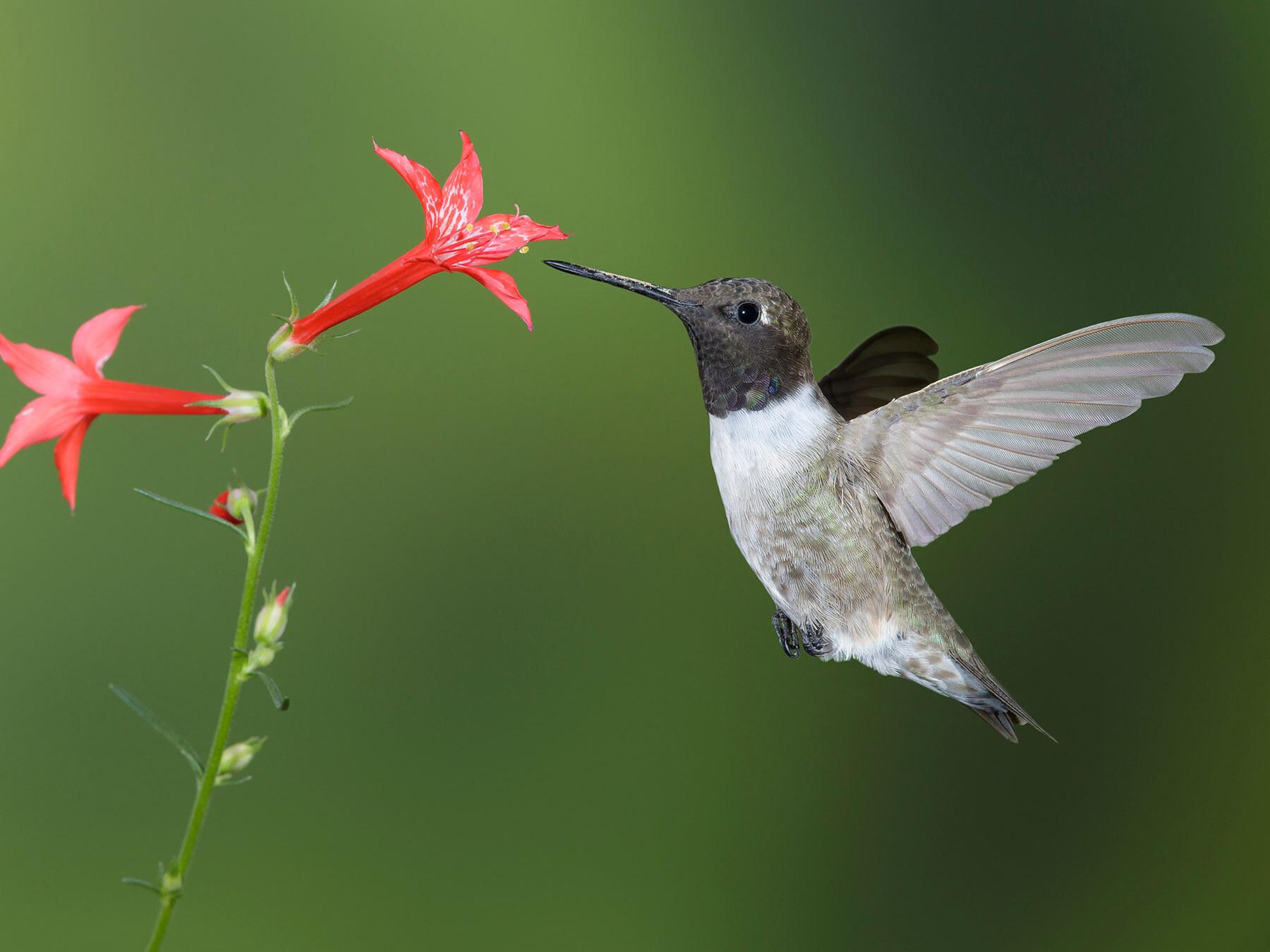
Feeding hummingbirds in your yard
It comes readily to feeders and garden plantings. Mix about one-quarter cup of table sugar into each cup of water, add no food coloring, and change it before it turns cloudy; in hot weather sugar water ferments fast, so change it every day or two.11
Plain table sugar is right: it prefers sucrose to other sugars and ignores feeders holding only artificial sweeteners. Red matters less than you might think, since once a feeder is in use its location, not its color, is the cue. Young birds start using feeders only once they can forage on flowers and insects. Flowers and insects still count: hummingbirds cannot live on sugar water alone, though they can manage for a few days, and in one test Anna's Hummingbirds kept on sugar water alone for 10 days lost weight.1
Feeders and exotic garden plants have significantly affected this and other hummingbirds, raising their numbers in towns and suburbs.
Nesting and breeding
The female does it all. There is no pair bond: males and females come together only to mate, and both are presumed to mate with more than one partner. She builds the nest, incubates the eggs and raises the young alone. It probably breeds in its first spring or summer.
Egg dates in Texas run from 4 April to 21 July. In Grand Canyon nests the earliest egg was laid on 22 March, with most nests active in May, and near Santa Barbara, California, nesting runs from 15 April to 30 June, peaking 5-10 May. Nesting starts earlier in northeastern Mexico, where a female was found on a finished nest in Nuevo León on 10 March.1
The nest
The nest sits on a thin branch, often an exposed dead twig well below the canopy of a tree or shrub, and often along a canyon or stream. It is a small cup made mainly of plant down, often from the undersides of sycamore leaves, bound with spider silk and insect cocoon fibers, sometimes with lichens attached outside. The cup stretches as the young grow, becoming wider and shallower. The female shapes it by pressing and twirling against its sides, and she may build a new nest on top of an old one.
Trees and heights vary by place. Of 299 museum egg sets, 95% of them from California, 26% were in sycamore, 26% in willow and 15% in oak, and museum nests averaged about 7 ft (2.1 m) up, though collectors probably took the lower ones. Nests measured about 1.6 in (41 mm) across outside and about 0.8 in (20 mm) deep inside.1 In Arizona's Chiricahua Mountains, 65% of 412 nests were in alligator juniper, at an average height of about 19 ft (5.7 m).12
Some sites are stranger. Inside a hardware store near El Paso, Texas, at least 12 nesting attempts from 2015 to 2020 all but one fledged young, and one female raised four broods in 2020; the authors credit the lack of predators and bad weather indoors.13
Eggs and young
The clutch is generally 2 white, unmarked eggs, about 12.7 x 8.3 mm; none of 329 museum egg sets held three. The female incubates for about 12-14 days in the wild, from small samples, while four captive birds took 16 days.1
The chicks hatch naked apart from two rows of down along the back, with their eyes closed. She feeds them by regurgitation, and they are fully feathered by about day 10. They leave the nest at about 21 days, and she goes on feeding them for at least a week. In a southeastern Arizona study, chicks left at 20-22 days, reaching a peak of 4.16 g just before, roughly 126% of the adults' weight in that study.14
There are often two broods a season, and a female may begin a second nest before the large young in her first have left it. In Sonoran Desert riverside woods, and at higher sites with no feeders, there may be only one.1
Nest success
Success varies widely by place and year. In southeastern Arizona and southwestern New Mexico, 34.4% of 157 nests succeeded, predators causing 78% of failures, for about 1.1 young per female a season.1 Nest survival was 52% along the Middle Rio Grande in New Mexico, against 23% on the Gila River,15 and in southwestern Colorado 10 of 24 nests succeeded.10
In a canyon system in southeastern Arizona, nests clustered around nesting Cooper's Hawks and Northern Goshawks. Nests in study plots with an active hawk nest did much better than those in plots where the hawk nest was inactive: predicted success 31% against 6% (274 and 68 nests). The nest robbers there were Mexican Jays, which foraged higher near hawk nests, though the authors do not rule out other causes.16
Behaviour
It is not a social bird. It feeds and migrates alone and does not flock, though hundreds or even thousands may gather at feeders on migration. In the nesting season the sexes keep apart: in southeastern Arizona and southwestern New Mexico, males hold territories on drier hillsides and rarely enter the canyon bottoms where females nest.
It bathes by splashing in shallow pools, or by fluttering among dew-wet willow leaves at dawn.
In a 2017 study in southeastern Arizona, hummingbirds including this one lost the ability to shed heat passively through the eye area, shoulders and feet once the air reached about 97-104°F (36-40°C), the smaller species holding out to higher temperatures.17 In a wind tunnel, wild-caught birds from Riverside, California, reached top speeds averaging about 36 mph (16.0 m/s) in males and about 34 mph (15.1 m/s) in females, from 53 birds.18
Territorial behavior and aggression
It is aggressive on its territory to almost any intruder, from other hummingbirds to carpenter bees, butterflies and a green anole. In fights two birds hover face to face, 1-2 cm apart, sometimes for over a minute, but they are rarely hurt.
Adult males may hold breeding and feeding territories, open areas about 50-100 ft (15-30 m) across in southern California. In southern Texas, males after the breeding season defended feeding territories holding one to four flowering agaves.1, 19 In Texas males stopped defending food at busy feeders with eight or more birds. In winter in Jalisco, Mexico, birds fed along routes rather than holding territories.
Among hummingbirds it ranks in the middle. In Guadalupe Canyon, on the Arizona-New Mexico border, Violet-crowned, Rufous, Broad-billed and Broad-tailed Hummingbirds ranked above it and Costa's below. In southern California, in meetings between adult males at undefended food, Anna's won 34 of 46 against it, and it won 15 of 24 against Costa's.1
Courtship flight and display
The male's dive display is a series of swooping dives, used in defending a territory and thought to be part of courtship as well. Each dive traces the lower part of an ellipse: he climbs to 66-98 ft (20-30 m) up, then swoops down, the bottom of each dive within about 3 ft (1 m) of the bird he is displaying to, often a female. One display had six dives, then nine more. He also aims it at other birds, at insects and, once, at a horse. Close to a perched female he also flies a shuttle display, swinging back and forth in a flat arc about 16 in (40 cm) to each side with a droning wing noise, 1.9 times a second.1, 20
Behavior on cold nights
On cold nights or when short of energy it can drop into torpor, a deep, energy-saving sleep. Torpor seems to be a response to an energy shortage, not used by birds with enough reserves; one captive male became torpid at midnight and woke about four hours later.1 In a laboratory study, Black-chinned Hummingbirds, which built up less fat by day than the territorial Blue-throated Hummingbird, used torpor 92% of the time; birds of every species tested became torpid once their fat fell below a threshold.21
In restrained laboratory birds the heart beat 480 times a minute at 90°F (32°C), 1,020 at 34°F (1°C) and 45-180 in torpor. Preliminary data from 10 birds suggest it may have the largest heart for its body size ever measured in a bird, about 3.2% of its weight.1
Lifespan and predators
The oldest known Black-chinned Hummingbird was at least 12 years 1 month old: a female banded as an adult in Idaho on 8 August 2008 and caught again alive in Idaho in July 2019, then released.22 The Bird Banding Laboratory's older list topped out at 11 years 2 months, a female in Texas (1998-2008).22
We found no measured typical lifespan or survival rate. In a southeastern Arizona banding study reported in 1999, one female was still alive at 7 years, several birds of both sexes reached 6, and many live at least 5.1
Predators
Adults are rarely recorded as prey. Single reports include a Greater Roadrunner that leapt from a roof to catch one at a feeder in southeastern Arizona, Brown-crested Flycatchers catching them in flight, and a band found in a Northern Pygmy-Owl nest. Nest predators recorded include Mexican Jays, Greater Roadrunners taking nestlings in New Mexico and Bullock's Orioles taking eggs.1 At one Idaho nest, yellowjackets, most likely Western Yellowjackets, preyed on the two nestlings.23
One female was found dead in the web of the spider Nephila clavipes in San Luis Potosí, Mexico, in October 2011; the authors judged the capture accidental.24
Conservation
It is common and widespread, with about 8.8 million birds (Partners in Flight, data from about 2010), 8.2 million of them in the US and Canada and about 200,000 in Canada.25 Partners in Flight's 2024 assessment scores its continental concern at 10 of 20 and gives it no Watch List category.26
On the North American Breeding Bird Survey it shows no clear change across its range from 1967 to 2025: -0.02% a year (95% credible interval -0.55 to +0.49; 493 routes). Over the last ten years, 2015-2025, it fell by 1.74% a year (interval -3.37 to -0.18), a significant decline. Of the states and provinces whose survey results we read, only Arizona shows a clear long-term fall, 1.18% a year from 1968 to 2025. The survey counts few of them, about 0.2 birds per route, so its figures are imprecise.27
Older analyses of the same survey over other windows found a long-term rise: Partners in Flight gives +0.64% a year for 1970-2021.26 A 2021 paper found +52% from 1970 to 2019, with the 2009-2019 decade relatively stable, though the authors saw signs of moderate declines across most of the range.28 A 2024 study of four western hummingbirds names it among migrants whose numbers have decreased, with falling juvenile survival the main driver for the migrants as a group.29
Conservation status
The IUCN Red List rates it Least Concern.30, 31 NatureServe ranks it secure worldwide (G5, reviewed 2016), citing its large range and population, its use of natural and altered habitats and no known major threats; Wyoming and Oklahoma rank it S2B.31 It is not listed under the US Endangered Species Act.32 Canada's archived 2014 status page rated it Secure.33
The 1999 Birds of the World account saw no need for special management across much of the US if natural riverside habitats are protected.1 Along the lower Colorado River, a study published in 1987 found it nesting almost only in introduced salt-cedar (tamarisk) or near houses, and removing salt-cedar may harm it where no other nest trees are available.1, 31 In New Mexico riverside forest, fuel-reduction work reduced nest sites; the authors say it can lower nest survival, though in their study it did not immediately do so.34
Legal status and protection
In the United States it is on the federal list of birds protected under the Migratory Bird Treaty Act, which makes it illegal to take, capture, kill, possess or sell one, or to take its nest, eggs or feathers, unless a permit allows it.35, 36 Someone who finds a sick, injured or orphaned bird may take it without a permit only to carry it straight to a permitted rehabilitator or a licensed vet.37
In Canada it is protected under the Migratory Birds Convention Act, 1994, appearing on the government's list of covered birds, and provincial rules may also apply.38 It is not on Mexico's 2010 list of species at risk (NOM-059-SEMARNAT-2010); we did not read the 2019 update.39 International trade is regulated through CITES Appendix II, which lists the whole hummingbird family.40
Similar birds
Often mistaken for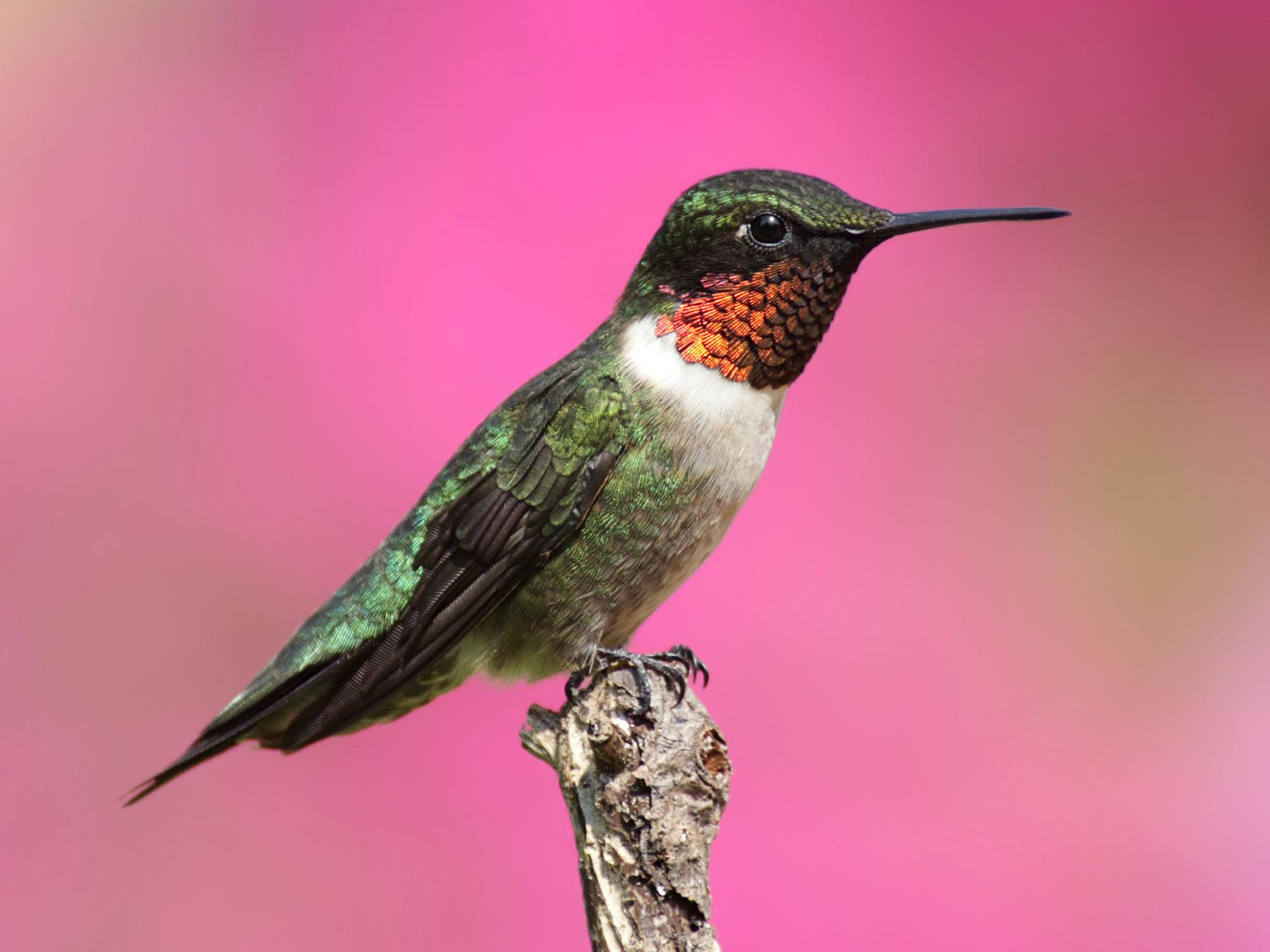
Quick facts
- Length
- 9 cm
- Wingspan
- 11 cm
- Weight
- 2.3–5.3 g
- Lifespan
- oldest recorded 12 years 1 month
- Family
- Hummingbirds
- Migration
- Partial migrant
- Global status (IUCN)
- Least Concern
- World population
- About 8.8 million birds (Partners in Flight, data from about 2010)
- Population trend
- Stable over the long term, with a decline over the last ten years: no clear change since 1967, but down about 1.7% a year since 2015
- Scientific name
- Archilochus alexandri
Questions
2Are Black-chinned Hummingbirds rare?
Not in the West: with about 8.8 million birds it is common there, and rated Least Concern, though the survey shows a decline over the last ten years (see Conservation). In the East it is scarce, with small numbers wintering on the Gulf Coast and vagrants farther afield.
Do Black-chinned Hummingbirds return to the same place each year?
Banding suggests some do, though conclusive proof is lacking. Of 1,131 birds banded in Texas, 10.5% were caught again at the study site in later years, and in southeastern Arizona 11% of more than 2,300 birds banded over three years were recaptured at the study site.1 Migrants also return along the same route (see Where and when).
Sources
45- 1Baltosser, W. H. and Russell, S. M. (2020). Black-chinned Hummingbird (Archilochus alexandri), version 1.0. Birds of the World (A. F. Poole and F. B. Gill, editors). Cornell Lab of Ornithology. doi:10.2173/bow.bkchum.01 (opens in a new tab)
- 2Berns, C. M. and Adams, D. C. (2010). Bill Shape and Sexual Shape Dimorphism between two Species of Temperate Hummingbirds: Black-Chinned and Ruby-Throated. The Auk 127(3): 626-635. doi:10.1525/auk.2010.09213 (opens in a new tab)
- 3Farr, C. M. and Middleton, J. (2023). Nest Success by a Female Black-Chinned Hummingbird (Archilochus alexandri) with Male-Like Plumage. Western North American Naturalist 83(2): 264-268. doi:10.3398/064.083.0211 (opens in a new tab)
- 4Graves, G. R., Dittmann, D. L. and Cardiff, S. W. (2016). Diagnoses of hybrid hummingbirds (Aves: Trochilidae). 17. Documentation of the intrageneric hybrid (Archilochus colubris x Archilochus alexandri). Proceedings of the Biological Society of Washington 129(1): 1-9. doi:10.2988/0006-324x-129.q1.1 (opens in a new tab)
- 5Henderson, E. C. and Brelsford, A. (2020). Genomic differentiation across the speciation continuum in three hummingbird species pairs. BMC Evolutionary Biology 20: 113. doi:10.1186/s12862-020-01674-9 (opens in a new tab)
- 6Baltosser, W. H. and Scott, P. E. (2020). Costa's Hummingbird (Calypte costae), version 1.0. Birds of the World. Cornell Lab of Ornithology. doi:10.2173/bow.coshum.01 (opens in a new tab)
- 7Rusch, K. M., Pytte, C. L. and Ficken, M. S. (1996). Organization of Agonistic Vocalizations in Black-Chinned Hummingbirds. The Condor 98(3): 557-566. doi:10.2307/1369568 (opens in a new tab)
- 8Kaufman, K.. Black-chinned Hummingbird. Audubon Guide to North American Birds. Accessed 28 November 2026. Source (opens in a new tab)
- 9Feo, T. J. and Clark, C. J. (2010). The Displays and Sonations of the Black-Chinned Hummingbird (Trochilidae: Archilochus alexandri). The Auk 127(4): 787-796. doi:10.1525/auk.2010.09263 (opens in a new tab)
- 10Ortega, J. C. and Ortega, C. P. (2024). Factors influencing survival of Black-chinned Hummingbird nests in southwest Colorado. Western Birds 55(1): 51-58. doi:10.21199/wb55.1.4 (opens in a new tab)
- 11Cornell Lab of Ornithology. Black-chinned Hummingbird: Overview, Identification and Life History. All About Birds. Accessed 28 November 2026. Source (opens in a new tab)
- 12Greeney, H. F. et al. (2015). Nest-site selection of the Black-chinned Hummingbird in southeast Arizona. Western Birds 46(4): 326-330. doi:10.21199/wb46.4.4 (opens in a new tab)
- 13Ward, J. et al. (2020). Ace is the place: Black-chinned Hummingbirds (Archilochus alexandri) have high nesting success and productivity inside a hardware store. The Wilson Journal of Ornithology 132(4): 1053-1058. doi:10.1676/1559-4491-132.4.1053 (opens in a new tab)
- 14Greeney, H. F., Hough, E. R., Hamilton, C. E. and Wethington, S. M.. Crecimiento de polluelos y desarrollo del plumaje del colibrí barba negra (Archilochus alexandri) en el sureste de Arizona. Huitzil Revista Mexicana de Ornitología 9(2): 35-42. doi:10.28947/hrmo.2008.9.2.78 (opens in a new tab)
- 15Smith, D. M., Finch, D. M. and Stoleson, S. H. (2014). Nest-location and nest-survival of black-chinned hummingbirds in New Mexico: a comparison between rivers with differing levels of regulation and invasion of nonnative plants. The Southwestern Naturalist 59(2): 193-198. doi:10.1894/f06-tel-02.1 (opens in a new tab)
- 16Greeney, H. F. et al. (2015). Trait-mediated trophic cascade creates enemy-free space for nesting hummingbirds. Science Advances 1(8). doi:10.1126/sciadv.1500310 (opens in a new tab)
- 17Powers, D. R. et al. (2017). Hovering in the heat: effects of environmental temperature on heat regulation in foraging hummingbirds. Royal Society Open Science 4(12): 171056. doi:10.1098/rsos.171056 (opens in a new tab)
- 18Najar, N. A., Wilcox, S. C., Fernandez, L. R. and Clark, C. J. (2026). Effects of wingbeat kinematics and muscle size on maximum flight speed in hummingbirds. Journal of Experimental Biology 229(16): jeb251012. doi:10.1242/jeb.251012 (opens in a new tab)
- 19Kuban, J. F., Lawley, J. and Neill, R. L. (1983). The Partitioning of Flowering Century Plants by Black-Chinned and Lucifer Hummingbirds. The Southwestern Naturalist 28(2): 143. doi:10.2307/3671382 (opens in a new tab)
- 20Feo, T. J. and Clark, C. J. (2011). Correction: The Displays and Sonations of the Black-Chinned Hummingbird. The Auk 128(2): 439. doi:10.1525/auk.2011.128.2.439 (opens in a new tab)
- 21Powers, D. R., Brown, A. R. and Van Hook, J. A. (2003). Influence of Normal Daytime Fat Deposition on Laboratory Measurements of Torpor Use in Territorial versus Nonterritorial Hummingbirds. Physiological and Biochemical Zoology 76(3): 389-397. doi:10.1086/374286 (opens in a new tab)
- 22USGS Bird Banding Laboratory. Longevity records of North American birds: Black-chinned Hummingbird (AOU 4290), current and historical tables. Patuxent Wildlife Research Center. Accessed 28 November 2026. Source (opens in a new tab)
- 23Lyons, K. (2018). Depredation of Black-chinned Hummingbird nestlings by yellowjackets. Western Birds 49(4): 282-284. doi:10.21199/wb49.4.6 (opens in a new tab)
- 24Torres-Jimenez, J. G., Almazan-Nunez, R. C. and Estrada-Ramirez, A. (2017). Black-chinned Hummingbird captured in web of the spider Nephila clavipes in Mexico. Western Birds 48(1): 58-59. doi:10.21199/wb48.1.5 (opens in a new tab)
- 25Partners in Flight (2020). Population Estimates Database, version 2020.04.29. Partners in Flight / Bird Conservancy of the Rockies. Accessed 28 November 2026. Source (opens in a new tab)
- 26Partners in Flight (2024). Avian Conservation Assessment Database, version 2024.05.23 (global). Partners in Flight / Bird Conservancy of the Rockies. Accessed 28 November 2026. Source (opens in a new tab)
- 27Hostetler, J. A. et al. (2026). The North American Breeding Bird Survey, Analysis Results 1966 - 2025. U.S. Geological Survey. doi:10.5066/P1OSNSFC (opens in a new tab)
- 28English, S. G., Bishop, C. A., Wilson, S. and Smith, A. C. (2021). Current contrasting population trends among North American hummingbirds. Scientific Reports 11: 18369. doi:10.1038/s41598-021-97889-x (opens in a new tab)
- 29English, S. G. et al. (2024). Demographic mechanisms and anthropogenic drivers of contrasting population dynamics of hummingbirds. Biological Conservation 289. doi:10.1016/j.biocon.2023.110415 (opens in a new tab)
- 30AviList Core Team (2025). AviList: The Global Avian Checklist, v2025b. AviList. doi:10.2173/avilist.v2025b (opens in a new tab)
- 31NatureServe and Hammerson, G.. Archilochus alexandri, Black-chinned Hummingbird. NatureServe Explorer. Accessed 28 November 2026. Source (opens in a new tab)
- 32U.S. Fish and Wildlife Service (2026). 50 CFR Part 17, Endangered and Threatened Wildlife and Plants (searched for Archilochus). Electronic Code of Federal Regulations (eCFR). Accessed 28 November 2026.
- 33Environment and Climate Change Canada. Status of Birds in Canada 2014 [Archived]: Black-chinned Hummingbird. Government of Canada. Accessed 28 November 2026. Source (opens in a new tab)
- 34Smith, D. M., Finch, D. M. and Hawksworth, D. L. (2009). Black-Chinned Hummingbird Nest-Site Selection and Nest Survival in Response to Fuel Reduction in a Southwestern Riparian Forest. The Condor 111(4): 641-652. doi:10.1525/cond.2009.090089 (opens in a new tab)
- 35U.S. Fish and Wildlife Service (2026). 50 CFR 10.13, List of Migratory Birds. Electronic Code of Federal Regulations, up to date as of 2026-11-25. Accessed 28 November 2026. Source (opens in a new tab)
- 36U.S. Congress (2023). 16 U.S.C. 703 and 707 (Migratory Bird Treaty Act). United States Code, 2023 edition (GovInfo). Accessed 28 November 2026.
- 37U.S. Fish and Wildlife Service (2026). 50 CFR Part 21 (21.14, 21.76). Electronic Code of Federal Regulations, up to date as of 2026-11-25. Accessed 28 November 2026.
- 38Environment and Climate Change Canada (2025). Birds protected in Canada (Migratory Birds Convention Act, 1994). Government of Canada (Wayback capture 7 Dec 2025). Accessed 28 November 2026. Source (opens in a new tab)
- 39SEMARNAT (2010). NOM-059-SEMARNAT-2010 (Diario Oficial de la Federación, 30 Dec 2010). Profepa PDF copy. Accessed 28 November 2026. Source (opens in a new tab)
- 40UNEP-WCMC and CITES Secretariat (2026). Species+ taxon concept 7922 (Archilochus alexandri). Species+. Accessed 28 November 2026.
- 41Weidensaul, S. et al. (2020). Ruby-throated Hummingbird (Archilochus colubris), version 1.0. Birds of the World. Cornell Lab of Ornithology. doi:10.2173/bow.rthhum.01 (opens in a new tab)
- 42Clark, C. J. and Russell, S. M. (2020). Anna's Hummingbird (Calypte anna), version 1.0. Birds of the World. Cornell Lab of Ornithology. doi:10.2173/bow.annhum.01 (opens in a new tab)
- 43Scott, P. E. (2020). Lucifer Hummingbird (Calothorax lucifer), version 1.0. Birds of the World. Cornell Lab of Ornithology. doi:10.2173/bow.luchum.01 (opens in a new tab)
- 44Baltosser, W. H. (1995). Annual Molt in Ruby-Throated and Black-Chinned Hummingbirds. The Condor 97(2): 484-491. doi:10.2307/1369034 (opens in a new tab)
- 45Greeney, H. F. and Wethington, S. M. (2009). Proximity to Active Accipiter Nests Reduces Nest Predation of Black-Chinned Hummingbirds. The Wilson Journal of Ornithology 121(4): 809-812. doi:10.1676/08-174.1 (opens in a new tab)

Checked by
Nathan Cope, founder and editor
Nathan founded Birdfact and leads its writers and contributors in the UK, the US and Canada. He has watched and studied birds for more than ten years, and checks every article and species guide before it’s published.