


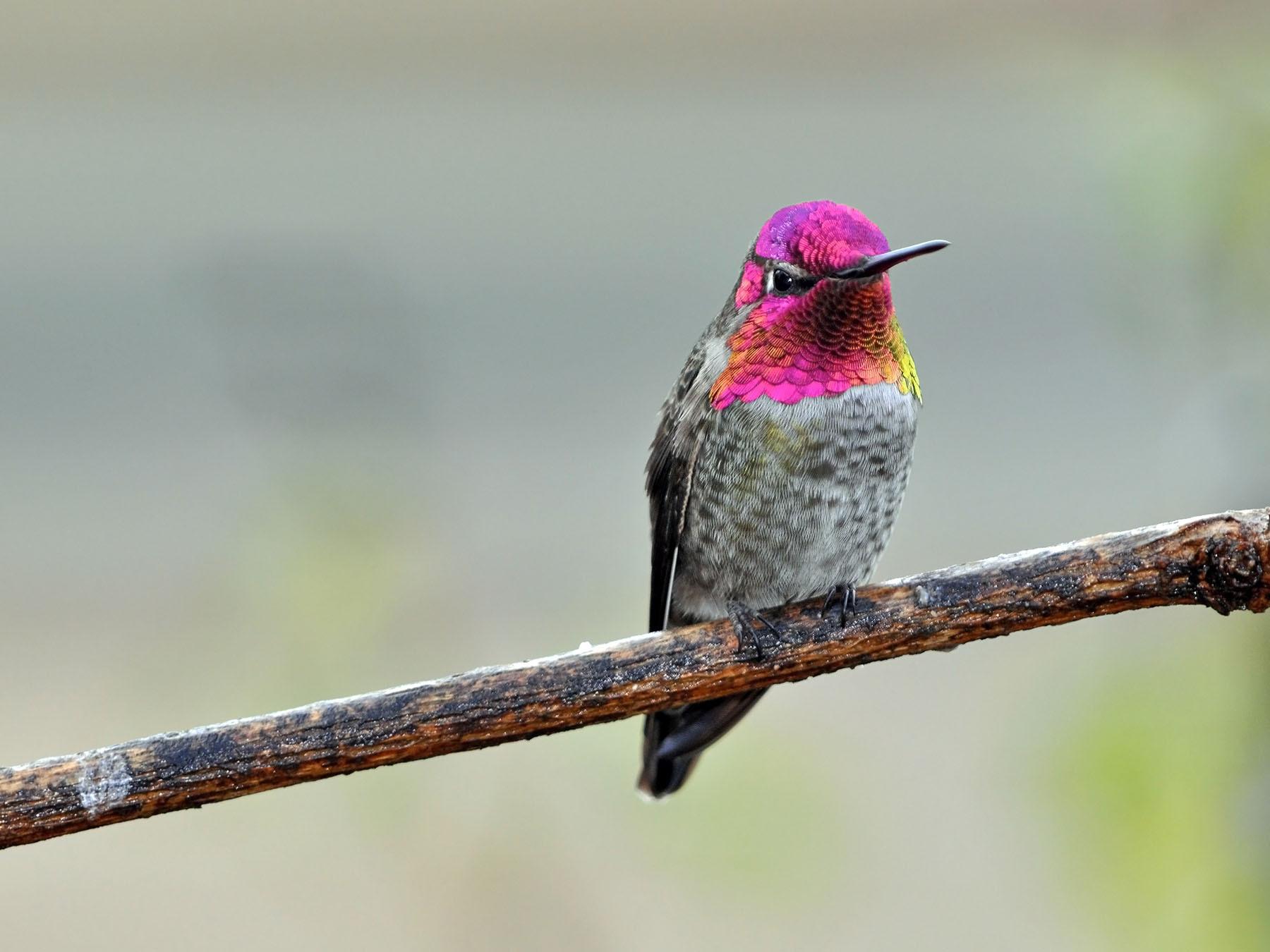
Anna's Hummingbird
Calypte anna
By the Birdfact teamChecked by Nathan Cope
See it in 3D
4 plumages
An Anna's Hummingbird (Adult male) is 3.5–4 in (9–10 cm) long, bill to tail.
Adult male
© 2026 NC Digital Limited (Birdfact). All rights reserved. This 3D model may be viewed on this page and shared by link only. Downloading, extracting, copying or reusing it, or using it to train machine-learning models, is not permitted without our written permission. Using our models
On this page14 sections
How to recognise it
Anna's Hummingbird is the stocky, green-and-gray hummingbird of the Pacific Coast, and the one most likely to be at a West Coast feeder in the middle of winter. The adult male is unmistakable when the light catches him: his whole crown and throat glow rose-magenta. In shade or harsh sun the same feathers can look almost black.
Look for a straight, medium-length bill, a fairly broad tail that reaches past the wingtips when the bird perches, a small white spot behind the eye, and grayish underparts with a mottled wash of green. Anna's Hummingbird shows no rufous or orange anywhere, in any plumage, which separates it from the Rufous and Allen's Hummingbirds that share its range.
Size
Anna's Hummingbird is about 4 in (10 cm) long, with a wingspan of about 4.7 in (12 cm), and weighs 0.1-0.2 oz (3-6 g). That is large and solid for a hummingbird: bigger than Costa's, Black-chinned and Ruby-throated Hummingbirds and slightly bigger than a Rufous. Among migrants banded in southeastern Arizona, adult males averaged 4.5 g and adult females 4.0 g.1
Male, female and young
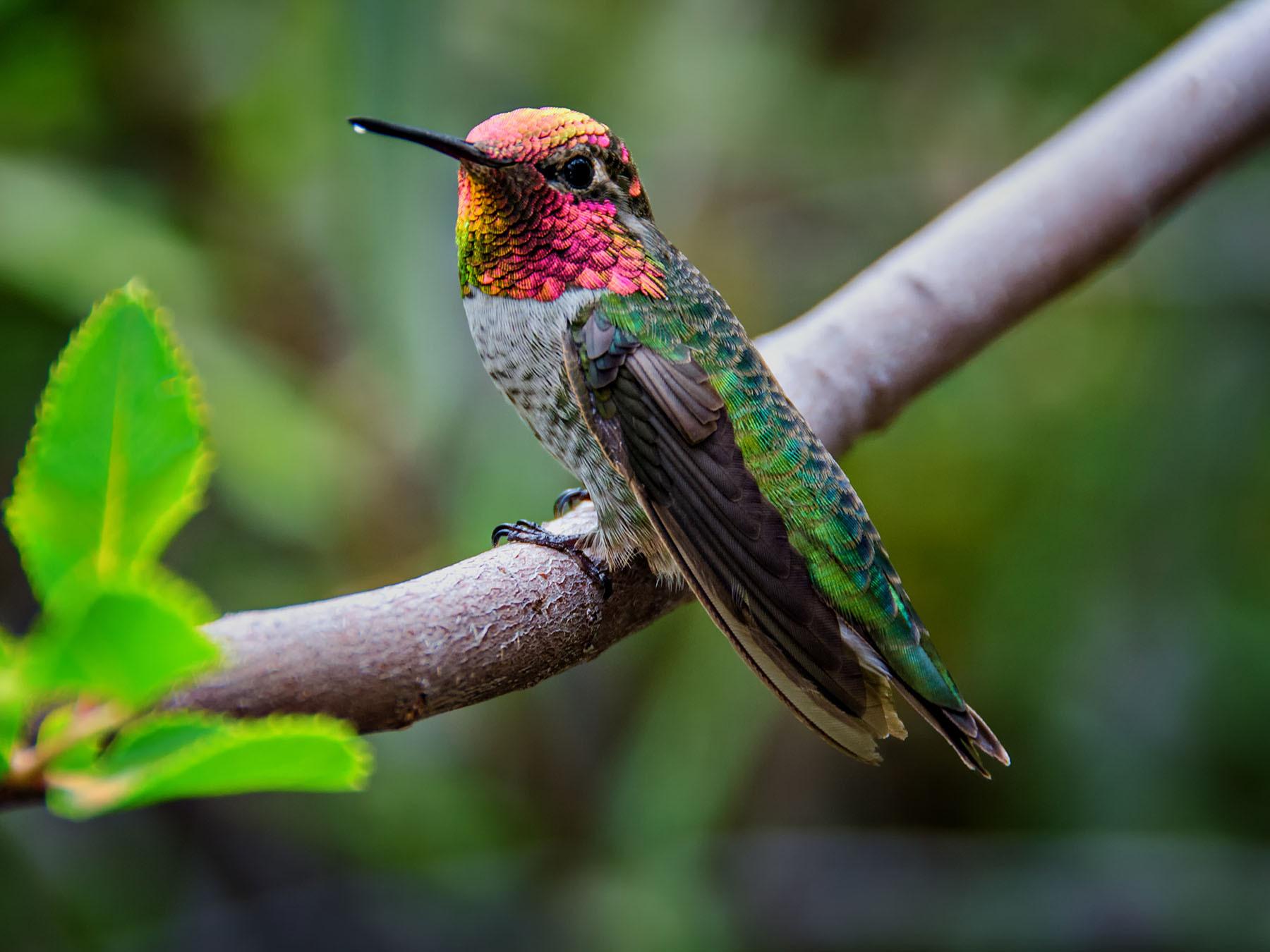
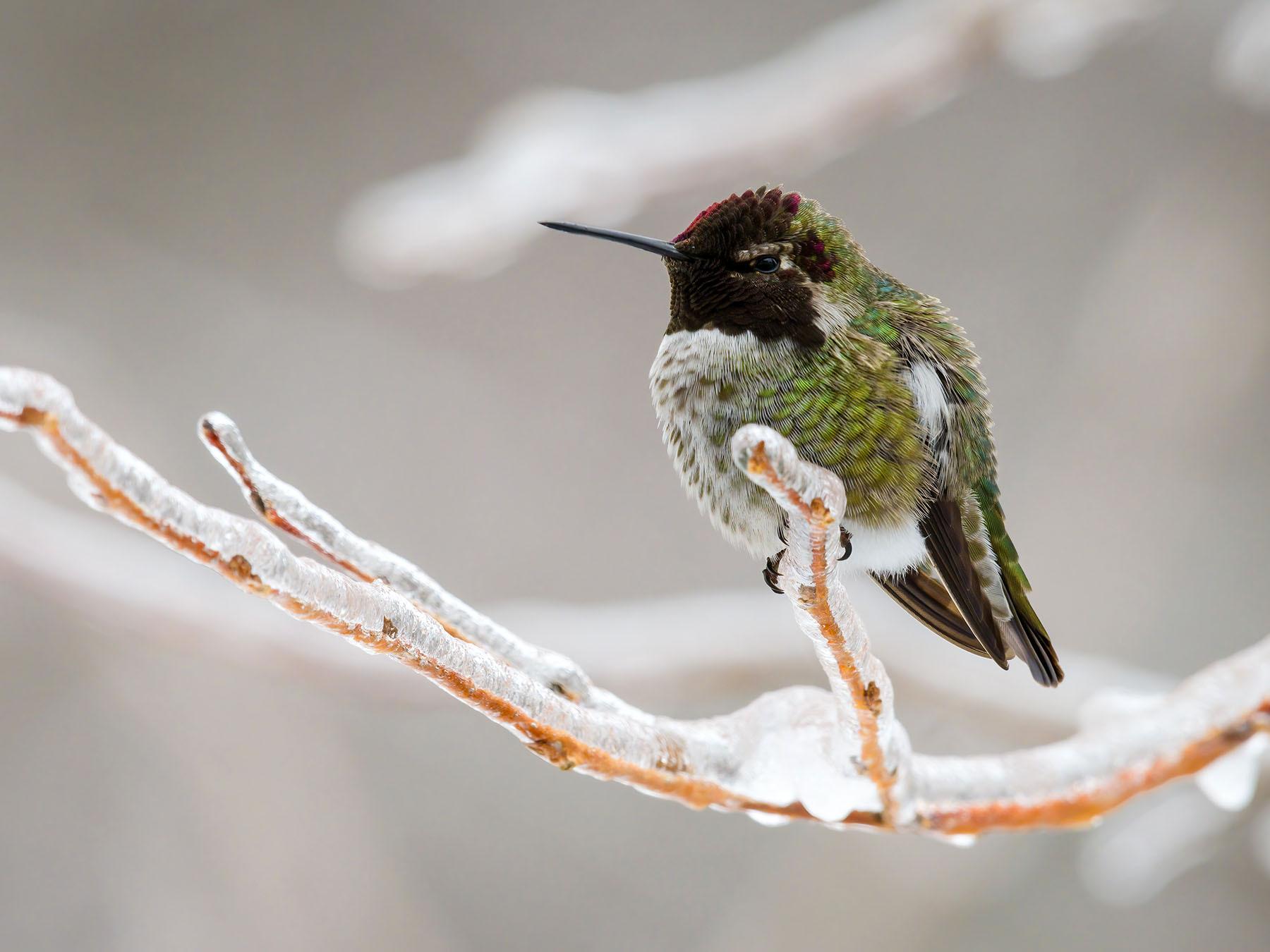
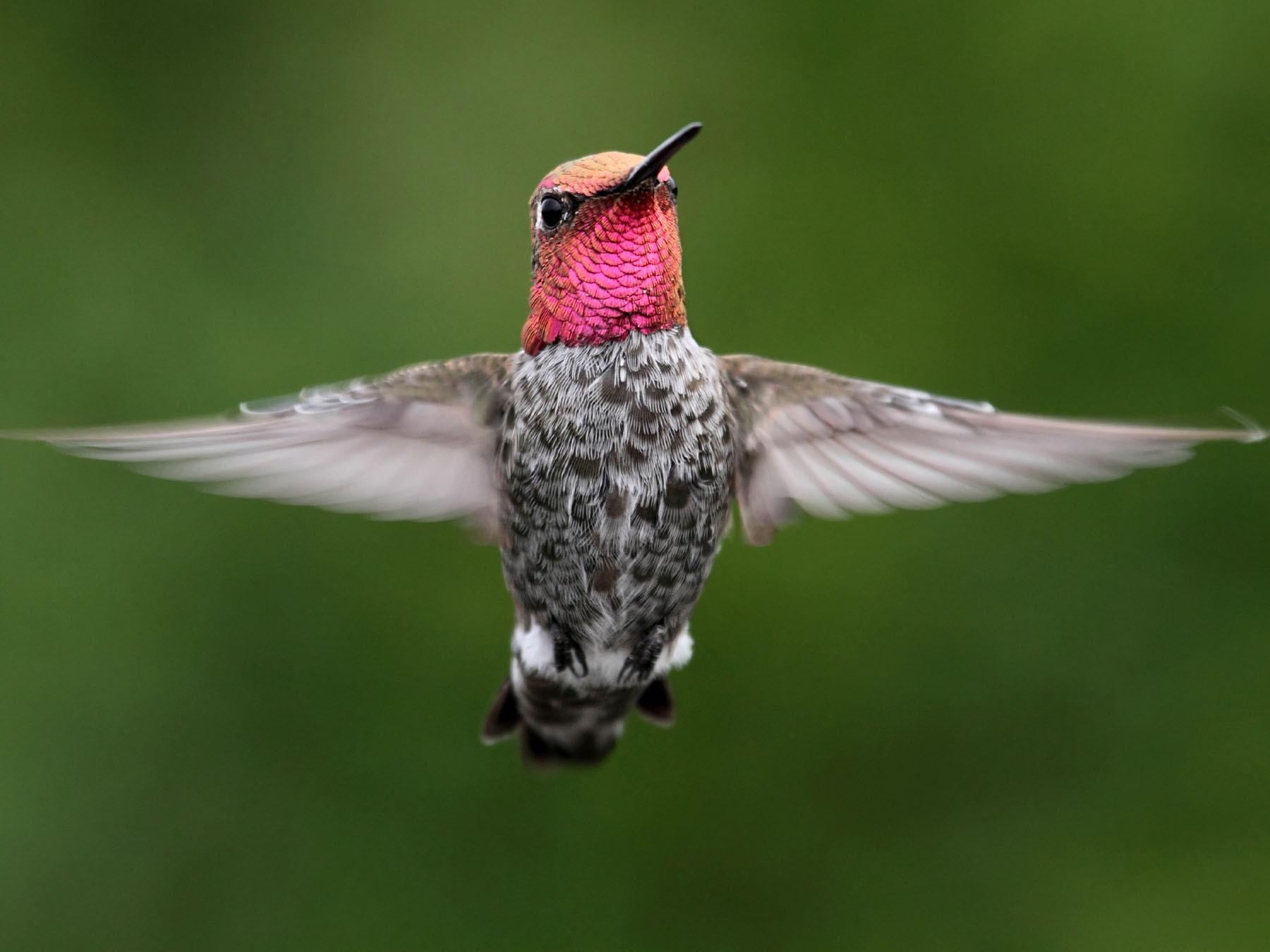
The adult male has the whole head except the back and cheeks covered in rose-magenta feathers, and the throat patch, or gorget, flares out at the sides. The color shifts as he turns his head, from glowing pink to gold or dark brown. No other North American hummingbird has both a rose crown and a rose throat.
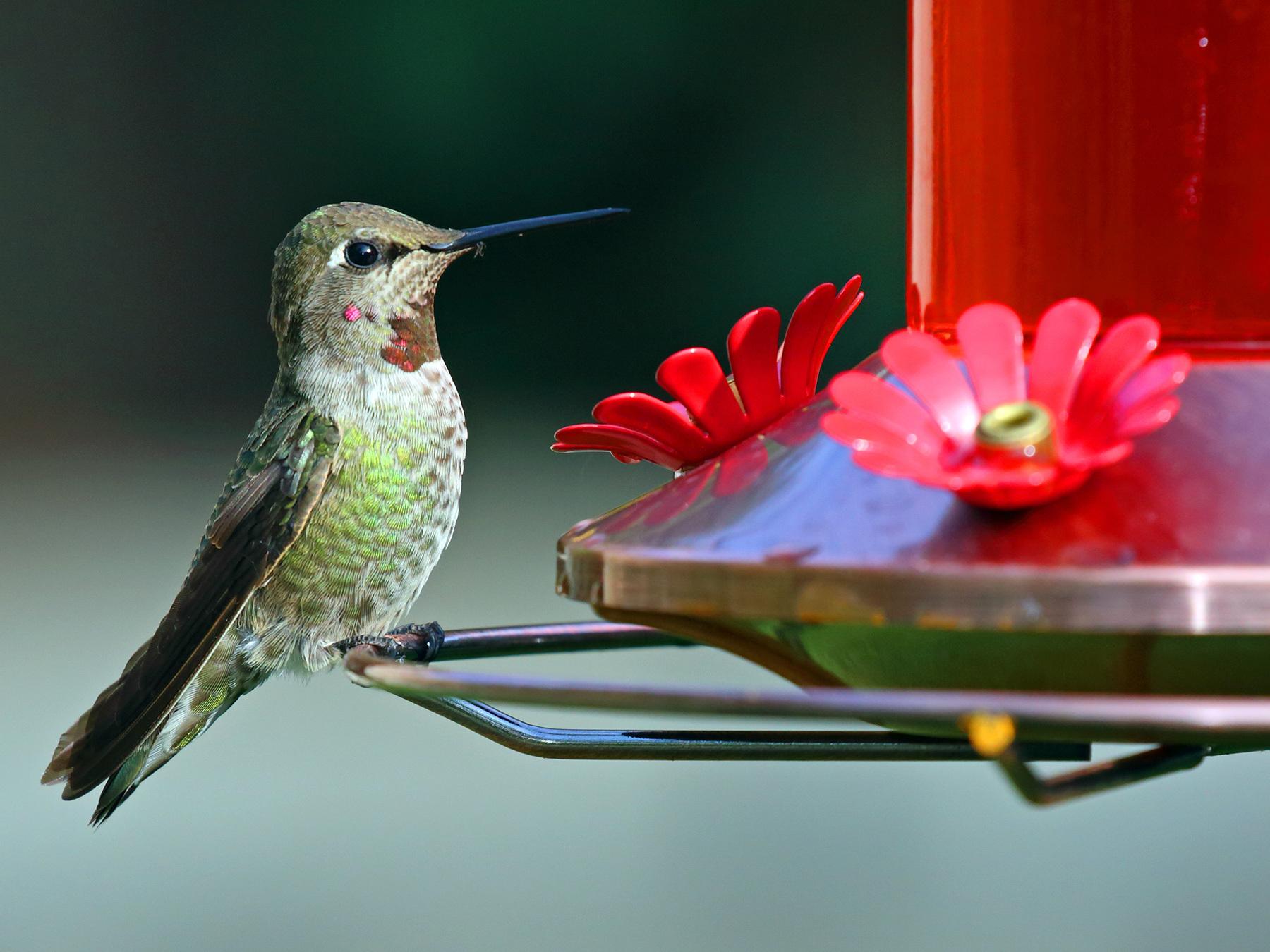
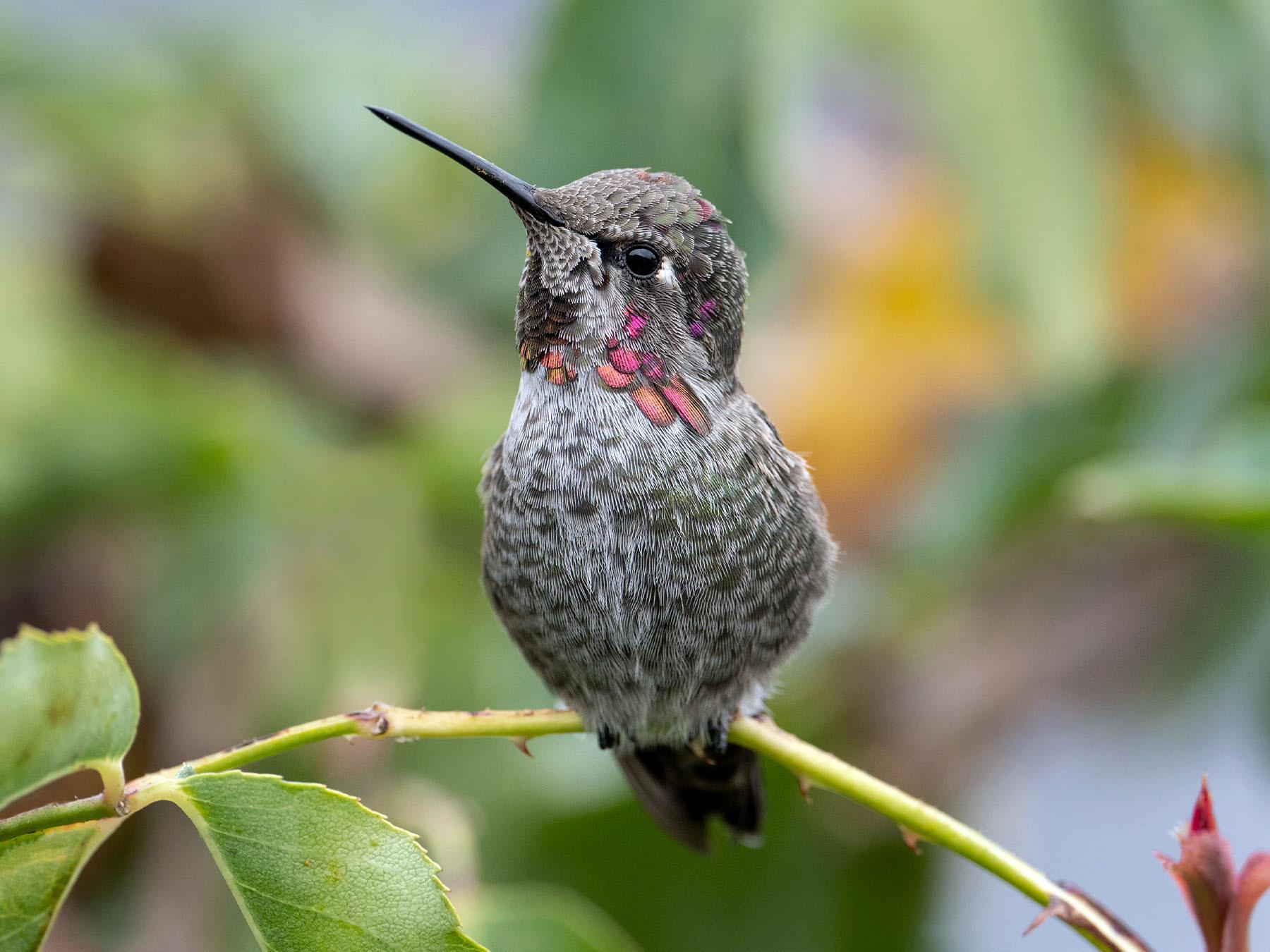
The female is green above and dull gray below. Most females have a small spot or a few flecks of rose in the middle of the throat, something females of most hummingbirds lack, and the outer tail feathers have a black band and grayish-white tips. Females only very rarely show rose on the crown.
Young birds out of the nest look like females, with pale fringes to the feathers above when fresh. Young males start to grow scattered rose feathers on the throat and crown in their first spring and summer, so a female-like bird with a blotchy pink face is often a young male, though some females show a few too.
The male's iridescent colors
The male's pink is not a pigment color. Each gorget and crown feather holds stacks of tiny melanin granules in thin layers, which reflect light strongly in some directions and hardly at all in others, so the color appears and vanishes as he moves.2 The magenta mixes a red reflection with a smaller blue one; a 2026 study found that a previously unknown layer of medium-sized granules, just under the surface layer, is needed to make the blue.3
Identification: other western hummingbirds
Costa's Hummingbird is smaller, and the male's crown and gorget are purple, not rose, with the gorget drawn out to a point at each side; the female is paler below. The male Black-chinned Hummingbird has a black chin with a thin purple band and a white collar, and Black-chinneds wag and spread the tail while hovering, where an Anna's tends to hold its tail still. Rufous and Allen's Hummingbirds are smaller and show plenty of rufous: the males on the body, the females and young on the sides and at the base of the tail.
In the East the common hummingbird is the Ruby-throated Hummingbird. Its male has a red throat but no color on the crown, and the female is whiter below than a female Anna's.
Not sure it’s a Anna's Hummingbird? Check your photo: Birdfact names the bird and shows the look-alike side by side.
Its size
Adults- Length
- 10 cm
- Wingspan
- 12 cm
- Weight
- 3–6 g
Its song and calls
No North American hummingbird sings more conspicuously than the male Anna's. His song is a thin, scratchy jumble of buzzes, squeaks and sharp notes, given from an exposed perch as he swings his head from side to side and flashes the gorget. Males can sing in any month. Territorial males sing from about November to April or May, and summer and fall song seems to come mostly from young males practicing.
The song is learned, which is rare in birds other than songbirds. Young males copy the males around them; in hand-rearing experiments, a male raised alone sang only highly variable syllables.4 Neighbors share song elements, and songs change over the years: 29 birds recorded in Golden Gate Park, San Francisco, in 2021 sang 25 kinds of syllable in eleven song types, and the study found a high turnover of syllable types since recordings made in the 1980s.5
Females are not known to sing. Both sexes give a sharp, dry chip, the call you hear most, and run chips together into twitters; in chases they give a harsh, buzzy chatter. The hum comes from the wings: a male's beat about 40 times a second in ordinary flight.1
The dive sound
The loud chirp at the bottom of the male's courtship dive comes from his tail, not his voice. In a study of wild males in Albany, California, high-speed video showed the male spreading his tail for a fraction of a second at the bottom of the dive while the trailing edge of the outermost tail feathers fluttered in the rushing air. Untouched males made the chirp in 97% of 402 dives; males that had that feather or its trailing vane removed never made it. The chirp is far louder than the song.6
The dive chirp sounds much like part of the song, and one study suggests the dive sound may have come first in evolution, with the song evolving to match it.7
- Song0:00 / 0:34
Recorded in California, United States · December 2021
- Chip calls0:00 / 0:20
Recorded in California, United States · January 2022
Heard one and not sure? Let the bird song identifier listen.
When and where to see it
Anna's Hummingbirds live along the Pacific side of North America, from southern British Columbia and Vancouver Island through Washington, Oregon and California to northwestern Baja California, and east across southern Arizona. Look for them in gardens, parks and suburbs, chaparral and coastal sage scrub, open oak and streamside woods, and eucalyptus groves. Away from chaparral they are closely tied to places people have changed, and in British Columbia they were long found almost only around people.
In fall and winter some wander east to New Mexico, west and central Texas and, rarely, Louisiana, and north along the coast into southeast Alaska from late summer; strays have turned up across the US, all of them in fall or early winter.
Do they migrate?
Not in the usual way. Unlike the other hummingbirds that breed north of Mexico, Anna's makes no regular north-south migration, and in much of its range you can see it all year. After nesting, many birds move up into the mountains, others head southeast to Arizona and beyond, some move north along the coast, and others stay put. These moves peak from June to October and seem to follow flowers and insects. Where Anna's is present all year, it is rarely known whether the same birds stay or others replace them.
How the range spread
Until the middle of the 20th century, Anna's Hummingbird was thought to nest only in chaparral, in California's southern two-thirds and the north of Baja California. It then spread north and east: it reached Oregon and Washington in 1964, Vancouver Island in the 1960s, nested in Arizona for the first time in 1964, and was first recorded in Alaska in 1971.1 Christmas Bird Counts show numbers growing in California since the early 1900s, and Pacific Northwest populations grew exponentially after birds arrived in the 1960s and 1970s.8
People played a large part. Blue gum eucalyptus and tree tobacco, planted and now widely naturalized, bloom in winter when few native flowers do, and gardens and sugar-water feeders add more.1 The winter range has moved more than 435 miles (700 km) north in about two decades. A study of Project FeederWatch counts from 1997 to 2013 found that birds settled colder places over time and were more likely to settle where housing was denser, and in the new range more people put out feeders. The researchers say the birds and the feeders probably drove each other.9
Canada shows the change best: one analysis put growth at the Canadian edge of the range at about 20% a year, and a bird that was rare in southern British Columbia in the late 2000s is now an abundant year-round resident around the Strait of Georgia.10 The spread goes on: a 2021 paper documented the first successful nesting in Idaho.11
Winter at the northern edge of the range
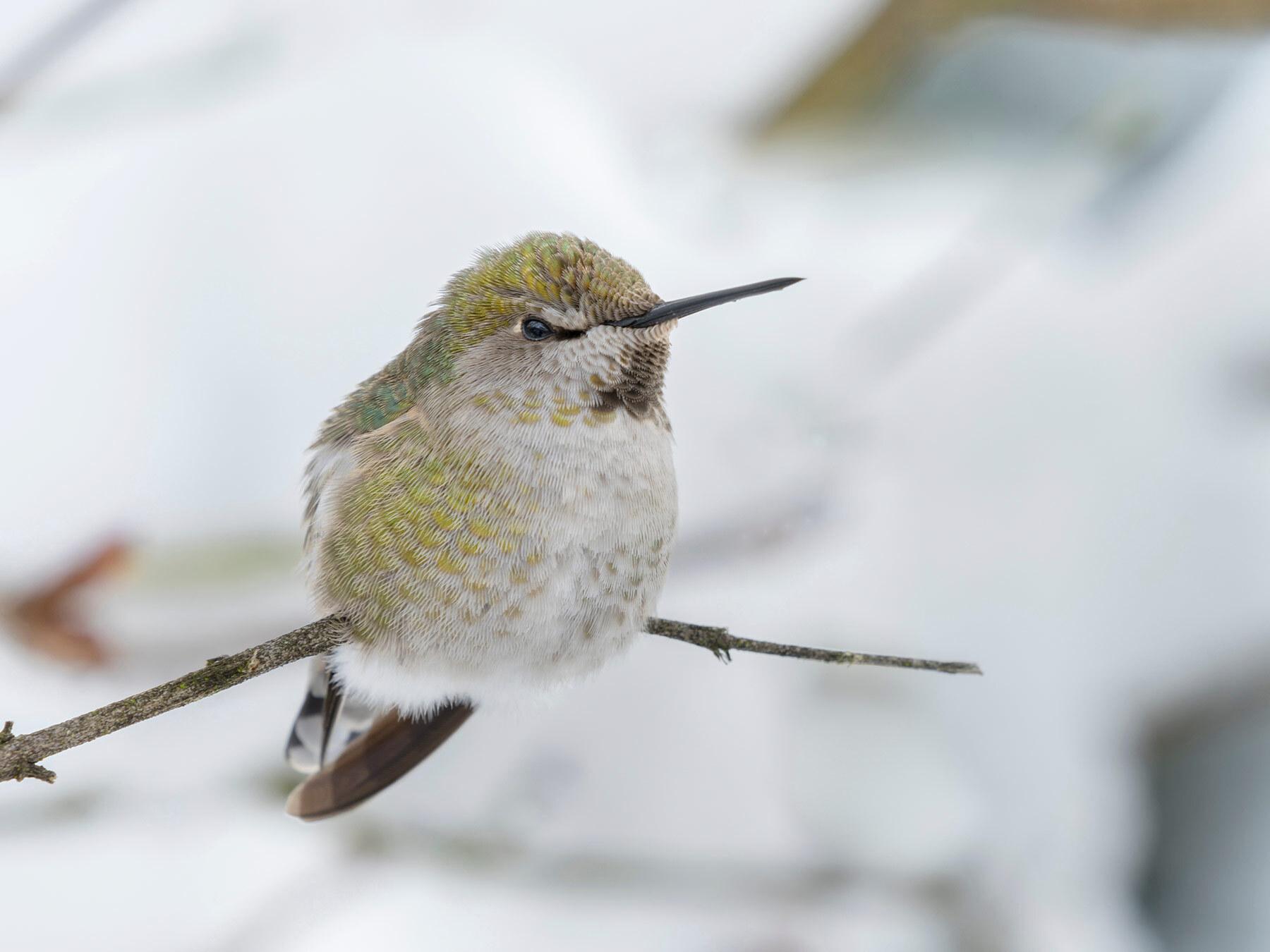
Anna's Hummingbirds now spend the winter where snow and ice are common. In Seattle and British Columbia, storms can keep temperatures below freezing for up to a week, with only about eight hours of daylight.1 At a feeder in Portland, Oregon, birds kept feeding through four December days when the temperature fell to 12 F (-11.1 C).1 They can survive cold like this only if they find food every day.
Tips for seeing it
What it eats
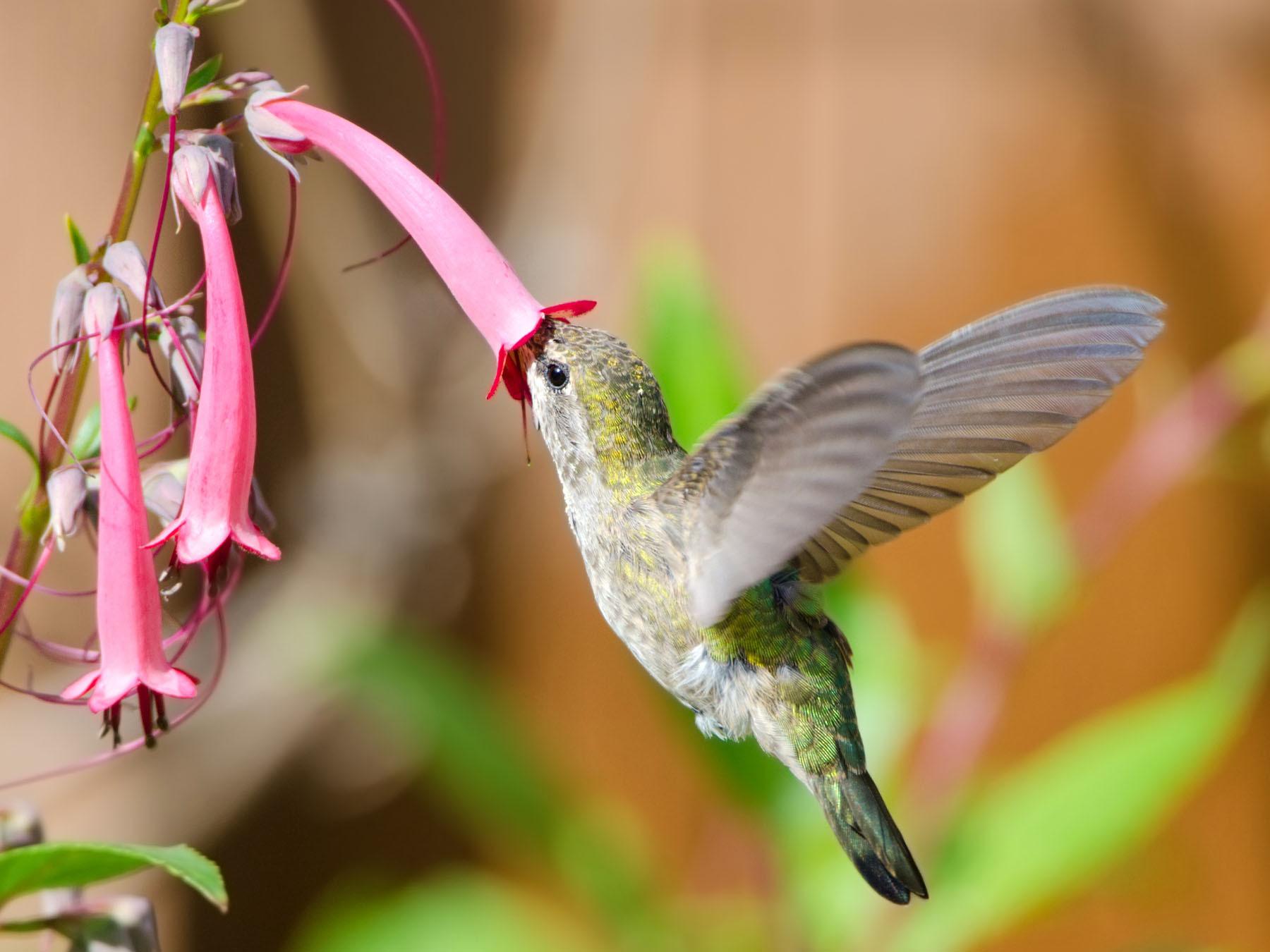
Nectar and small insects. Anna's Hummingbirds hover at flowers and lap nectar with a long tongue, many licks a second. In the Santa Monica Mountains of California, native currants and gooseberries are probably the key winter flowers, with manzanita in the colder months, then monkeyflowers, sages and California fuchsias later in the year. In towns they use a long list of garden plants, and blue gum eucalyptus and tree tobacco matter most of all.1
For protein they catch tiny insects in the air and pick them from leaves and spider webs; they also feed at sapsucker holes, probably on the sap and the insects it traps. In 111 stomachs studied early in the 20th century, small flies and gnats made up 45.2% of the contents, wasps and their relatives 35.0%, true bugs 17.3% and spiders 2%, though it is not clear whether those shares are by volume, weight or how often each item turned up.1 They seldom drink, because nectar gives them all the water they need, and they fill their crop with nectar late in the day to carry them through the night.
Feeding hummingbirds in your yard
Anna's Hummingbirds come readily to sugar-water feeders and garden flowers. Audubon's recipe is one part refined white sugar to four parts water (1/4 cup of sugar to 1 cup of water), boiled and cooled. Do not use honey, brown sugar or artificial sweeteners, and do not add red food coloring.12, 13
Keep the feeder clean: empty and clean it every day or two in hot weather, every three days in mild weather and about twice a week when it is cool, and straight away if the sugar water turns cloudy or moldy.13, 14 Where Anna's live all year it is fine to feed them all year; cold sugar water does not appear to harm them, but keep the feeder from freezing on hard frosty nights.13
Given the choice, they usually prefer flowers to feeders and use feeders more when flowers are scarce. Feeders may have changed the birds themselves: in museum specimens, bills became longer and more tapered as feeders spread, and males' bills more pointed, perhaps helping in fights at feeders.15
Nesting and breeding
Anna's Hummingbirds nest in winter. In California the season follows the winter rains: males take up breeding territories as chaparral currant starts to bloom in November or December, and nesting runs from about December to May. The main study of the species in the California chaparral judged that being able to live on both nectar and insects is what lets it breed in winter, and nesting early avoids competition with other hummingbirds. In Arizona some birds have laid eggs as early as October, and in Seattle and British Columbia the earliest nests in recent years were found from mid-January to mid-February.1 In the north, nesting now begins 16 or more days later than in the bird's original range.8
Males and females do not form pairs. They meet only to mate, and the female builds the nest, incubates the eggs and raises the young alone.
The nest and eggs
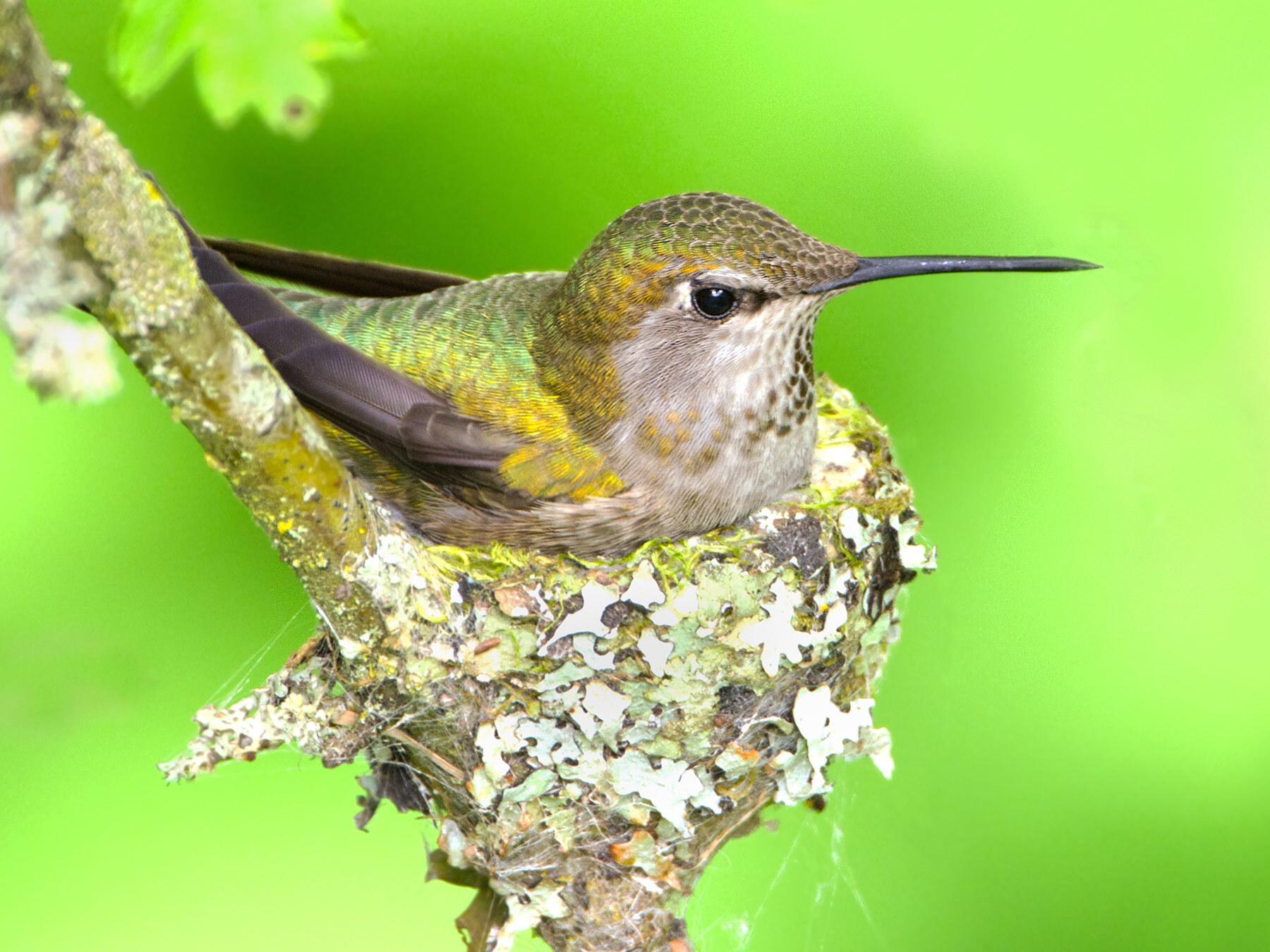
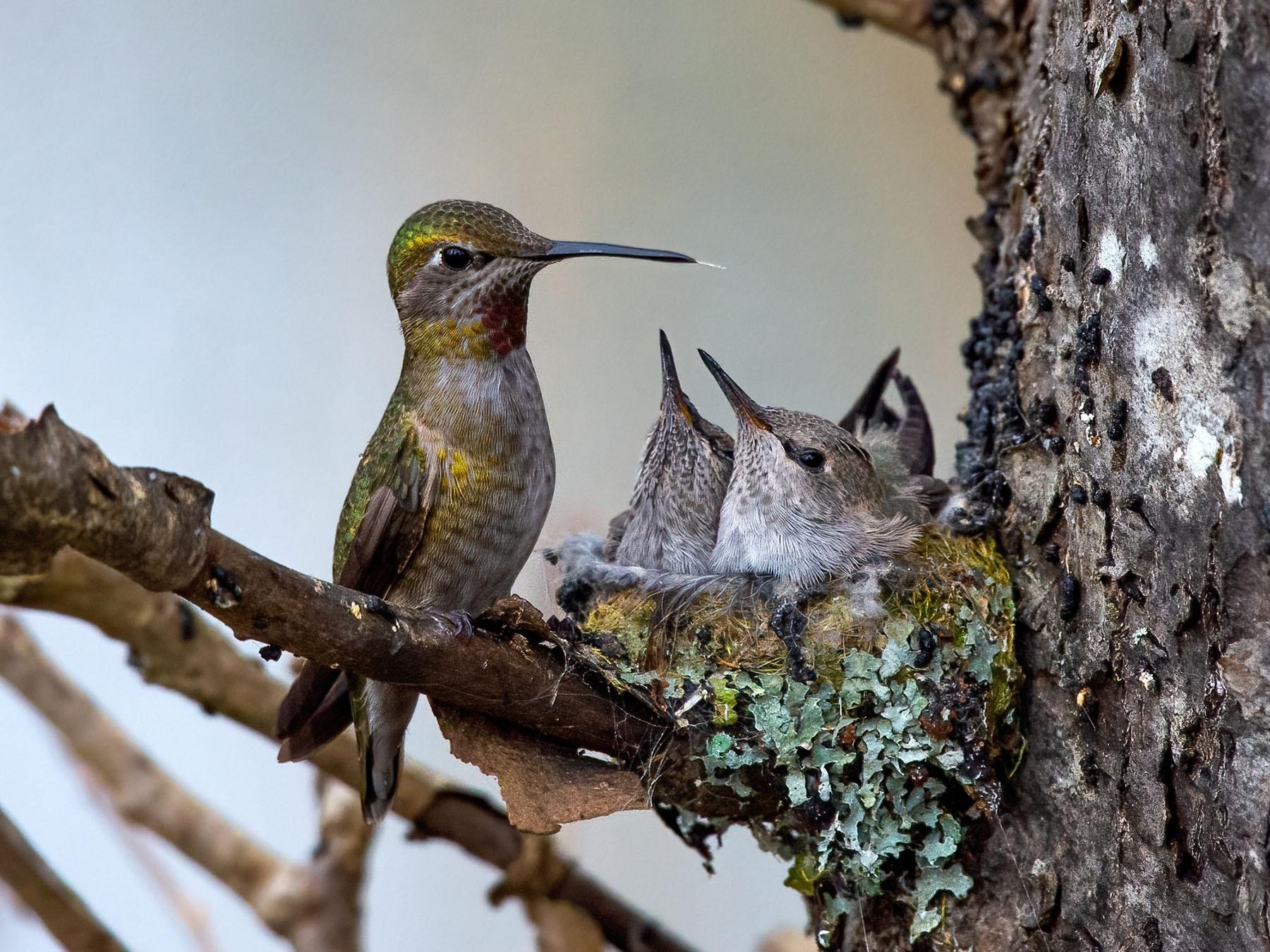
The nest is a tiny cup of plant down bound with spider silk, often covered outside with flakes of lichen, moss or bits of leaf. It usually sits on a horizontal branch of a tree or shrub, about 4-25 ft (1.2-7.6 m) up, and sometimes on a vine, a wire or porch fittings. In one museum collection of 236 egg sets, 34% came from nests in oaks and 10% from eucalyptus, with conifers rarely used.1 Building takes about a week. In California each nest is used only once, though females often reuse or steal the material.
She lays two white eggs, each about the size of a jelly bean, and incubates them for 14-19 days, 16 on average in a California study.1 In one well-watched nest in an Alameda, California garden, started on January 4, 1954, the eggs were laid two days apart, hatched after 16 days, and the young left at 25-26 days.16
Young birds
The female feeds her chicks by pushing her bill deep into their mouths and bringing up nectar and tiny insects. The young leave the nest at about 18-23 days, 20 on average in the same California study, though other nests took 23-26 days.1 After leaving, they depend on their mother for about one to two weeks and catch insects before they learn to feed on nectar.
Two broods a season are usual, and a female can start her next nest while still feeding the young from the last. Most females first breed at a year old, but a few early-hatched females may breed the same year.
Behaviour
In his display dive the male hovers near a female, climbs almost straight up to about 115 ft (35 m), then plunges in a J-shaped dive that passes just over her, ending in a loud chirp made by his tail. Each dive takes about 12 seconds, and a male may repeat it many times. On sunny days he aims the dive so the sun lights his crown and gorget toward her.1
Filmed dives in Albany, California, peaked at an average of about 61 mph (98 km/h), or 385 of the bird's own body lengths a second, which the study called the fastest speed relative to body length known for any vertebrate. Pulling out of the dive, the males experienced accelerations of nearly nine times gravity.17
The dive is not only courtship. Males dive at rival males, other hummingbirds, other birds on their territory and even people. Courtship proper ends, at least in some areas, with a short side-to-side shuttle flight above the perched female and intense song, just before mating.18
Behavior and territories
Anna's Hummingbirds are highly aggressive, and most meetings between two of them are hostile. Both sexes defend patches of flowers or feeders, and in winter and spring males defend breeding territories. A male's territory need not hold any food. It is a display ground that females visit, a system best described as an exploded lek, with the males widely spread out.
They sleep fluffed up with the bill pointing up and never tuck the head under a wing. They bathe in dew and water drops on leaves, in shallow water and under garden sprinklers. Their tiny legs are for perching: they barely walk and do not hop.
Behavior on cold nights
When it runs short of energy, an Anna's Hummingbird can drop into torpor, letting its body temperature fall far below normal to save fuel. Captive birds cooled from about 97 F (36 C) to around 63 F (17 C), the lowest recorded 48 F (8.8 C), and woke within minutes.1
Lifespan and predators
Little is known about how long wild Anna's Hummingbirds usually survive. The oldest Anna's Hummingbird on the USGS Bird Banding Laboratory's longevity list was a male first banded in Arizona as a young bird in June 1993 and recaptured, still alive, in the same state in August 2001, at least 8 years 2 months old. The next oldest on the list was at least 6 years 4 months old, a bird banded in California in 1976 and recaught there in 1982.19
Predators and other dangers
Predators have seldom been seen taking adults: a Sharp-shinned Hawk once took a male in Berkeley, and house cats sometimes catch them. In northern California scrub-jays regularly take nestlings and probably eggs, and now and then a hummingbird is caught in a large spider web or ends up with a bee or wasp stuck on its bill. Starvation is thought to be the main cause of death, though no one has studied it. Feeders can bring risks of their own: cats, window strikes and the chance of spreading disease, though disease seems uncommon.
Conservation
Anna's Hummingbird is listed as Least Concern.20 Partners in Flight estimates about 9.6 million birds (around 2010), of which about 91% breed in Canada and the US, and gives it a low conservation concern score.21, 22
On the North American Breeding Bird Survey it rose by about 1.6% a year from 1968 to 2025 (95% credible interval 1.07 to 2.29), roughly 2.5 times as many birds on the survey's routes, with the steepest rises in British Columbia, Washington and Oregon. Over the last ten years, 2015-2025, the survey-wide trend is flat and not statistically significant. The survey marks its survey-wide estimate for this species as having a deficiency.23 With fewer than one bird counted per route on average, low numbers are the likely reason.23
Status and the law
In the US, Anna's Hummingbird is protected under the Migratory Bird Treaty Act, which makes it illegal to take, kill or possess the bird, its nest or its eggs without a permit; it is on the federal list of protected species.24, 25 If you find a sick, injured or orphaned hummingbird, the rules let you take it straight to a permitted wildlife rehabilitator or a licensed vet, but caring for it yourself needs a rehabilitation permit.26 Canada's Migratory Birds Convention Act, 1994 protects it too, since hummingbirds are among the bird families its convention names.27
Similar birds
Often mistaken for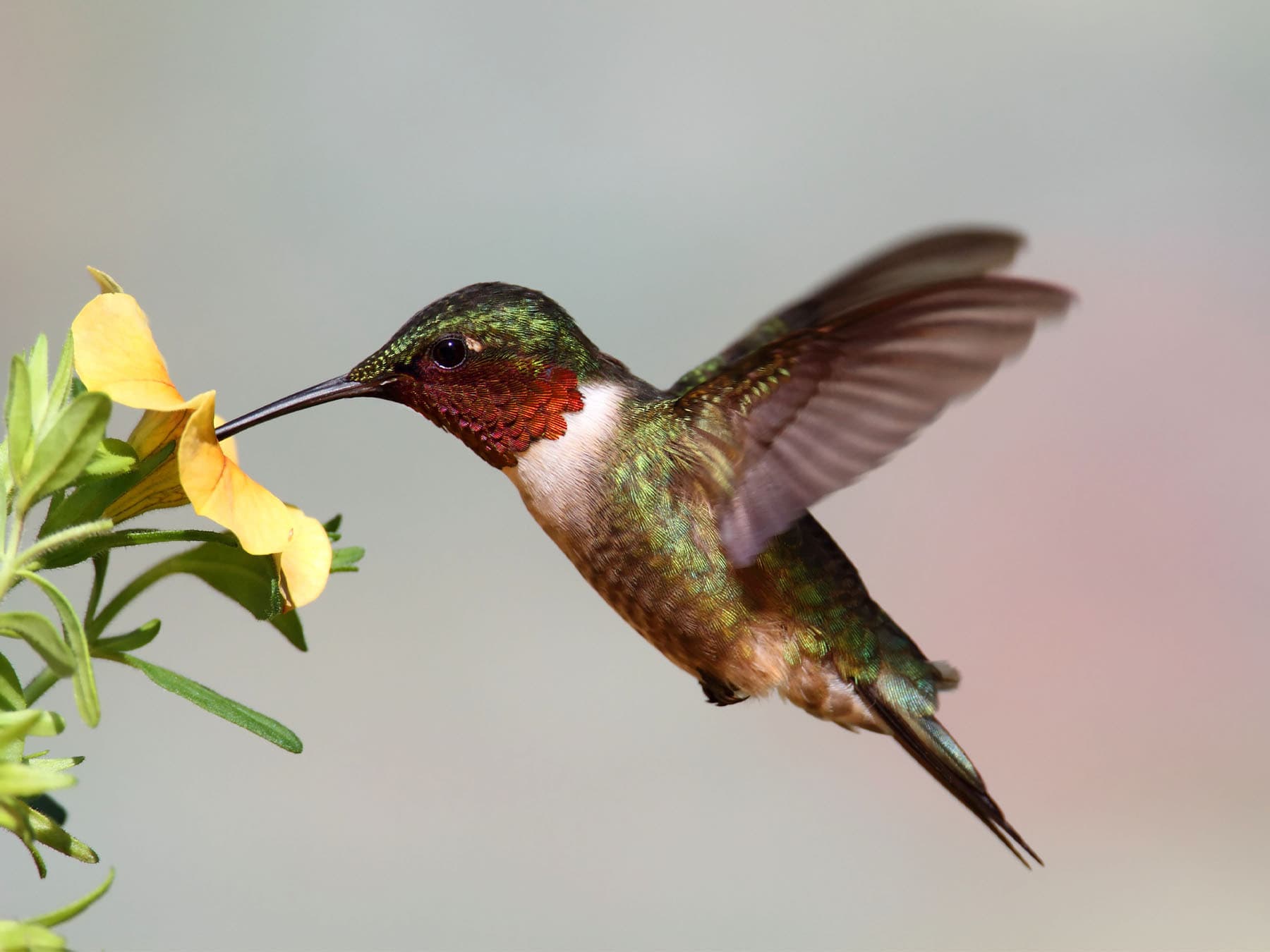
Quick facts
- Length
- 10 cm
- Wingspan
- 12 cm
- Weight
- 3–6 g
- Lifespan
- oldest recorded 8 years 2 months
- Family
- Hummingbirds
- Migration
- Partial migrant
- Global status (IUCN)
- Least Concern
- World population
- 9,600,000 (Partners in Flight, about 2010)
- Population trend
- Increasing over the long term (1968-2025), about 2.5 times as many on the survey's routes; flat over the last ten years
- Scientific name
- Calypte anna
Questions
3Why is it called Anna's Hummingbird?
R. P. Lesson described it in 1829 from specimens owned by the Duke and Duchess of Rivoli, and named it after the duchess, Anna de Belle Masséna.1
Do Anna's Hummingbirds mate for life?
No. Males and females do not form pairs at all; they meet only to mate, and the female raises the young alone.
Do Anna's Hummingbirds reuse their nests?
Not in California, where each nest serves for one brood only, though females often take material from old nests to build new ones. Reuse of old nests has been reported in British Columbia.1
Sources
34- 1Clark, C. J. and Russell, S. M. (2020). Anna's Hummingbird (Calypte anna), version 1.0. Birds of the World (A. F. Poole, editor). Cornell Lab of Ornithology. doi:10.2173/bow.annhum.01 (opens in a new tab)
- 2Giraldo, M. A., Parra, J. L. and Stavenga, D. G. (2018). Iridescent colouration of male Anna's hummingbird (Calypte anna) caused by multilayered barbules. Journal of Comparative Physiology A 204(12): 965-975. doi:10.1007/s00359-018-1295-8 (opens in a new tab)
- 3Kim, S. et al. (2026). Multi-periodic photonic mechanism for non-spectral magenta coloration in Anna's hummingbird (Calypte anna) feathers. Journal of the Royal Society Interface 23(243): 20260601. doi:10.1098/rsif.2026.0601 (opens in a new tab)
- 4Baptista, L. F. and Schuchmann, K.-L. (1990). Song learning in the Anna Hummingbird (Calypte anna). Ethology 84(1): 15-26. doi:10.1111/j.1439-0310.1990.tb00781.x (opens in a new tab)
- 5Berger, A. N. et al. (2026). Song variation across space and time in Anna's Hummingbird (Calypte anna). Journal of Ornithology. doi:10.1007/s10336-026-02433-1 (opens in a new tab)
- 6Clark, C. J. and Feo, T. J. (2008). The Anna's hummingbird chirps with its tail: a new mechanism of sonation in birds. Proceedings of the Royal Society B 275(1637): 955-962. doi:10.1098/rspb.2007.1619 (opens in a new tab)
- 7Clark, C. J. and Feo, T. J. (2010). Why do Calypte hummingbirds "sing" with both their tail and their syrinx? An apparent example of sexual sensory bias. The American Naturalist 175(1): 27-37. doi:10.1086/648560 (opens in a new tab)
- 8Battey, C. J. (2019). Ecological release of the Anna's Hummingbird during a northern range expansion. The American Naturalist 194(3): 306-315. doi:10.1086/704249 (opens in a new tab)
- 9Greig, E. I., Wood, E. M. and Bonter, D. N. (2017). Winter range expansion of a hummingbird is associated with urbanization and supplementary feeding. Proceedings of the Royal Society B 284(1852): 20170256. doi:10.1098/rspb.2017.0256 (opens in a new tab)
- 10English, S. G., Bishop, C. A., Wilson, S. and Smith, A. C. (2021). Current contrasting population trends among North American hummingbirds. Scientific Reports 11: 18369. doi:10.1038/s41598-021-97889-x (opens in a new tab)
- 11Robinson, B. W. et al. (2021). First documentation of successful breeding for the Anna's Hummingbird in Idaho. Western Birds 52(1): 76-79. doi:10.21199/wb52.1.6 (opens in a new tab)
- 12National Audubon Society (2019). How to Make Hummingbird Nectar. Audubon (published 15 Mar 2019). Accessed 10 November 2026. Source (opens in a new tab)
- 13National Audubon Society (2017). Hummingbird Feeding FAQs. Audubon magazine (published 27 Nov 2017). Accessed 10 November 2026. Source (opens in a new tab)
- 14Project FeederWatch, Cornell Lab of Ornithology (2026). How To Clean Your Feeders. Project FeederWatch (2026). Accessed 10 November 2026. Source (opens in a new tab)
- 15Alexandre, N. M., Romero, F. G., English, S. G. et al. (2025). Supplemental feeding as a driver of population expansion and morphological change in Anna's Hummingbirds. Global Change Biology 31(5): e70237. doi:10.1111/gcb.70237 (opens in a new tab)
- 16Kelly, J. W. (1955). History of the nesting of an Anna Hummingbird. The Condor 57(6): 347-353. doi:10.2307/1364792 (opens in a new tab)
- 17Clark, C. J. (2009). Courtship dives of Anna's hummingbird offer insights into flight performance limits. Proceedings of the Royal Society B 276(1670): 3047-3052. doi:10.1098/rspb.2009.0508 (opens in a new tab)
- 18Stiles, F. G. (1982). Aggressive and courtship displays of the male Anna's Hummingbird. The Condor 84(2): 208-225. doi:10.2307/1367674 (opens in a new tab)
- 19USGS Bird Banding Laboratory. Longevity records of North American birds: Anna's Hummingbird. USGS Patuxent Wildlife Research Center. Accessed 10 November 2026. Source (opens in a new tab)
- 20AviList Core Team (2025). AviList: The Global Avian Checklist, v2025b. AviList. doi:10.2173/avilist.v2025b (opens in a new tab)
- 21Partners in Flight (2024). Avian Conservation Assessment Database, version 2024.05.23 (global). Bird Conservancy of the Rockies. Accessed 10 November 2026. Source (opens in a new tab)
- 22Partners in Flight (2020). Population Estimates Database, version 2020.04.29 (global). Bird Conservancy of the Rockies. Accessed 10 November 2026. Source (opens in a new tab)
- 23Hostetler, J. A. et al. (2026). The North American Breeding Bird Survey, Analysis Results 1966 - 2025. U.S. Geological Survey. doi:10.5066/P1OSNSFC (opens in a new tab)
- 24United States Congress (1918). Migratory Bird Treaty Act, 16 U.S.C. 703. United States Code (govinfo, 2023 edition). Accessed 10 November 2026. Source (opens in a new tab)
- 25U.S. Fish and Wildlife Service (2023). 50 CFR 10.13, List of Birds Protected by the Migratory Bird Treaty Act. Electronic Code of Federal Regulations. Accessed 10 November 2026. Source (opens in a new tab)
- 26U.S. Fish and Wildlife Service (2024). 50 CFR 21.76, Rehabilitation permits. Electronic Code of Federal Regulations. Accessed 10 November 2026. Source (opens in a new tab)
- 27Environment and Climate Change Canada. Birds protected in Canada. Government of Canada (page modified 10 Feb 2025). Accessed 10 November 2026. Source (opens in a new tab)
- 28Cornell Lab of Ornithology. Anna's Hummingbird: overview, identification and life history. All About Birds. Accessed 10 November 2026. Source (opens in a new tab)
- 29National Audubon Society. Anna's Hummingbird. Guide to North American Birds (text adapted from Kaufman 1996). Accessed 10 November 2026. Source (opens in a new tab)
- 30National Audubon Society. Costa's Hummingbird. Guide to North American Birds (text adapted from Kaufman 1996). Accessed 10 November 2026. Source (opens in a new tab)
- 31National Audubon Society. Black-chinned Hummingbird. Guide to North American Birds (text adapted from Kaufman 1996). Accessed 10 November 2026. Source (opens in a new tab)
- 32National Audubon Society. Rufous Hummingbird. Guide to North American Birds (text adapted from Kaufman 1996). Accessed 10 November 2026. Source (opens in a new tab)
- 33National Audubon Society. Allen's Hummingbird. Guide to North American Birds (text adapted from Kaufman 1996). Accessed 10 November 2026. Source (opens in a new tab)
- 34National Audubon Society. Ruby-throated Hummingbird. Guide to North American Birds (text adapted from Kaufman 1996). Accessed 10 November 2026. Source (opens in a new tab)

Checked by
Nathan Cope, founder and editor
Nathan founded Birdfact and leads its writers and contributors in the UK, the US and Canada. He has watched and studied birds for more than ten years, and checks every article and species guide before it’s published.