
Rufous Hummingbird
Selasphorus rufus
By the Birdfact teamChecked by Nathan Cope
On this page13 sections
How to recognise it
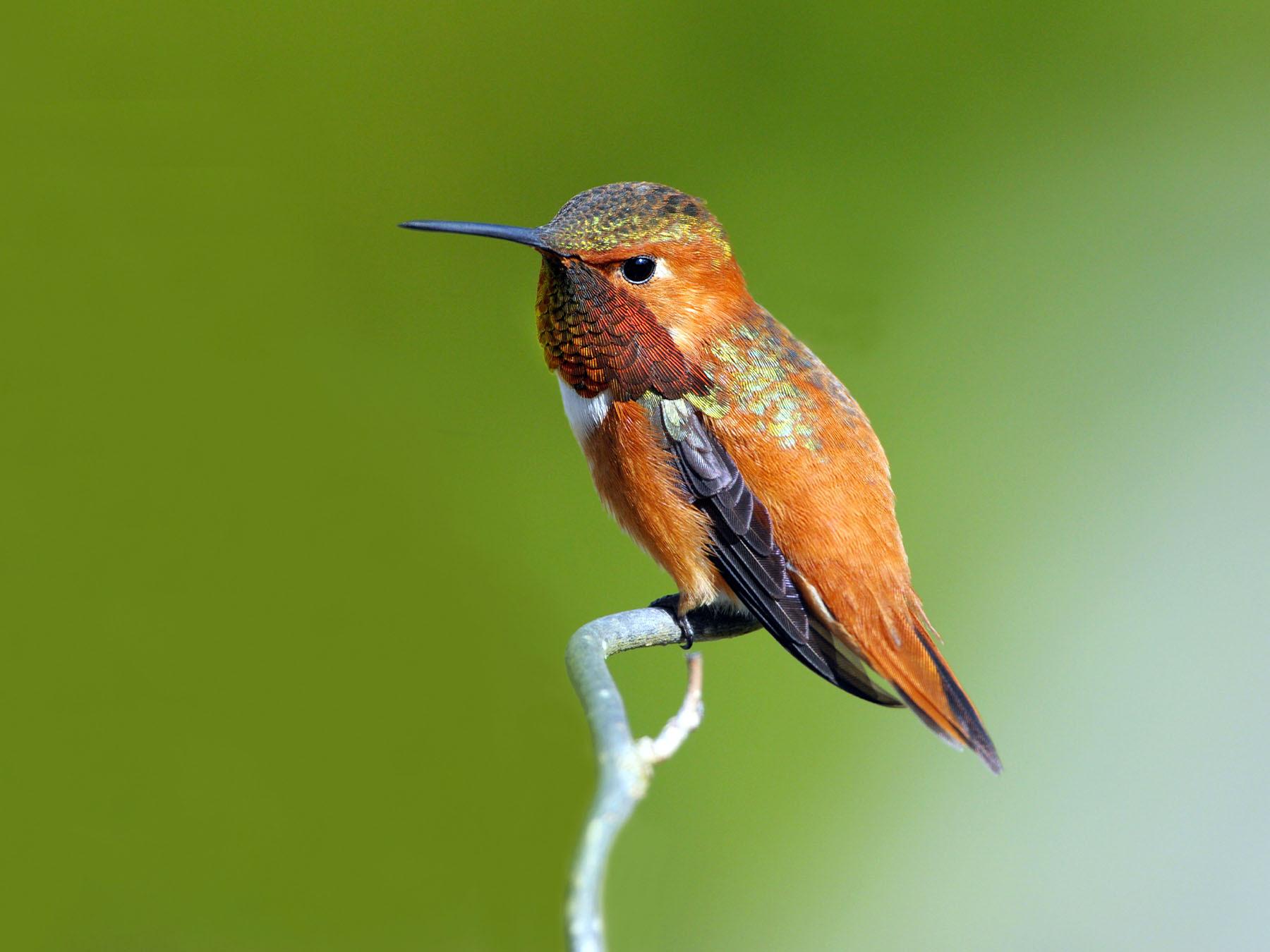
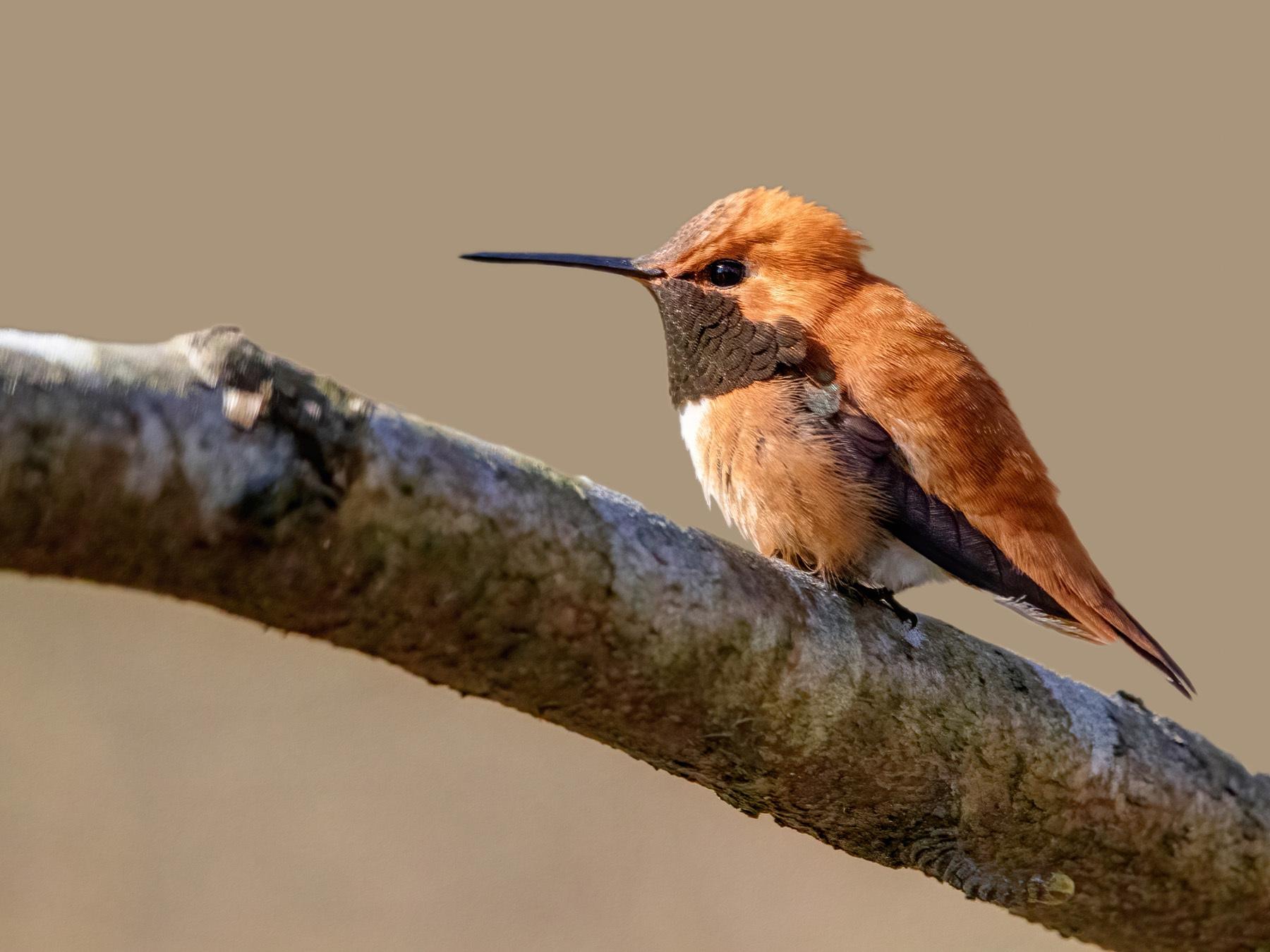
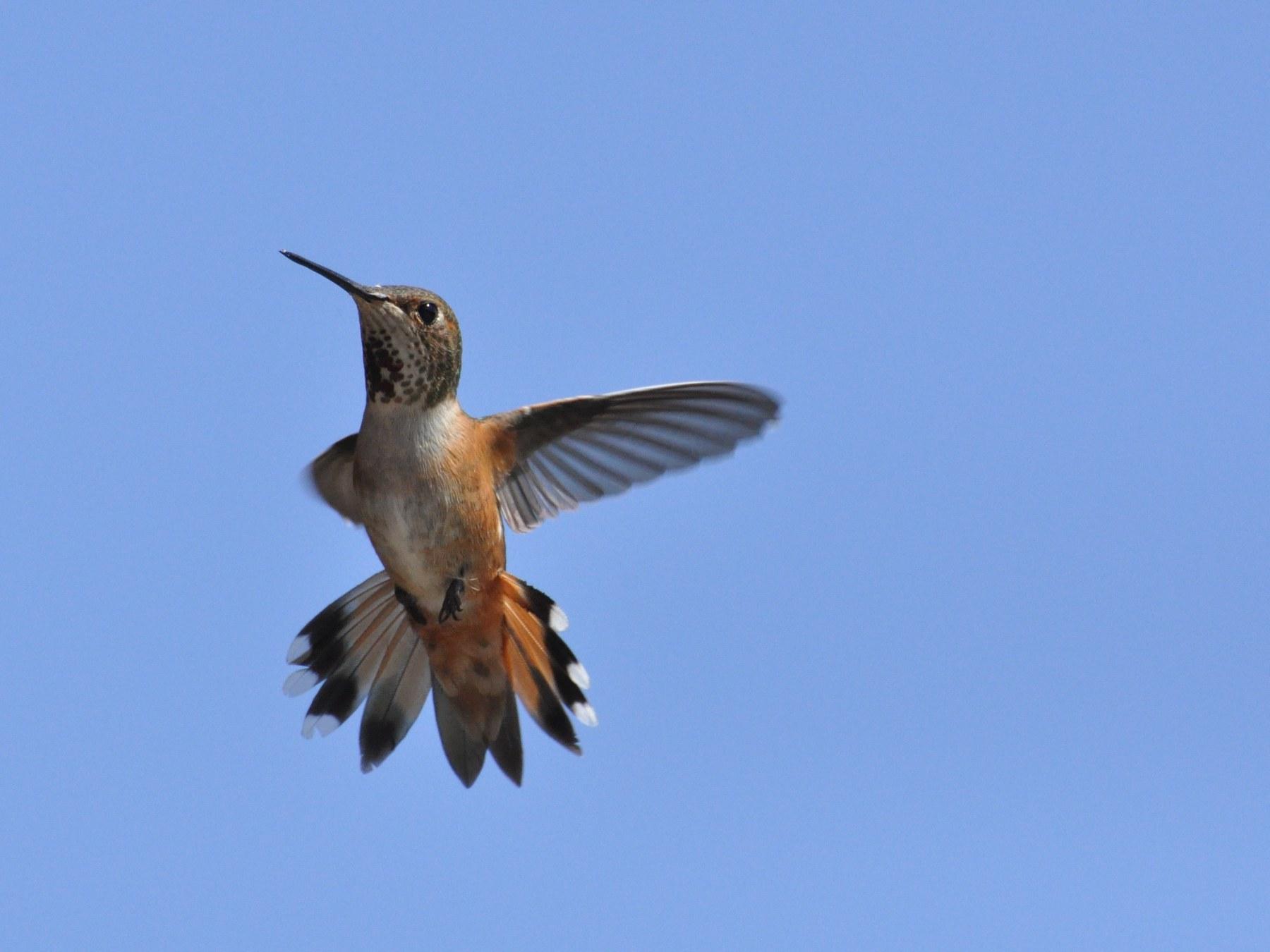
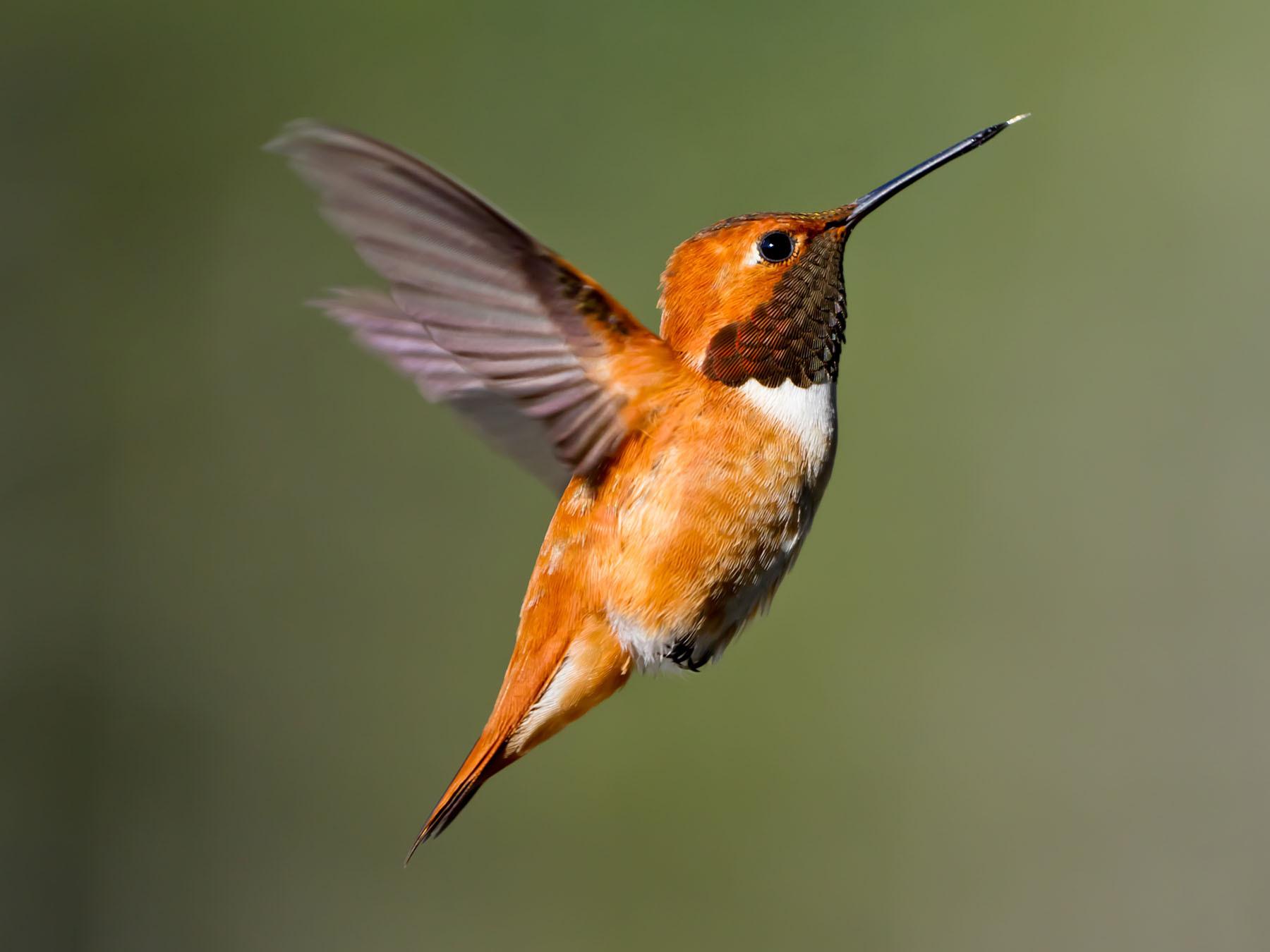
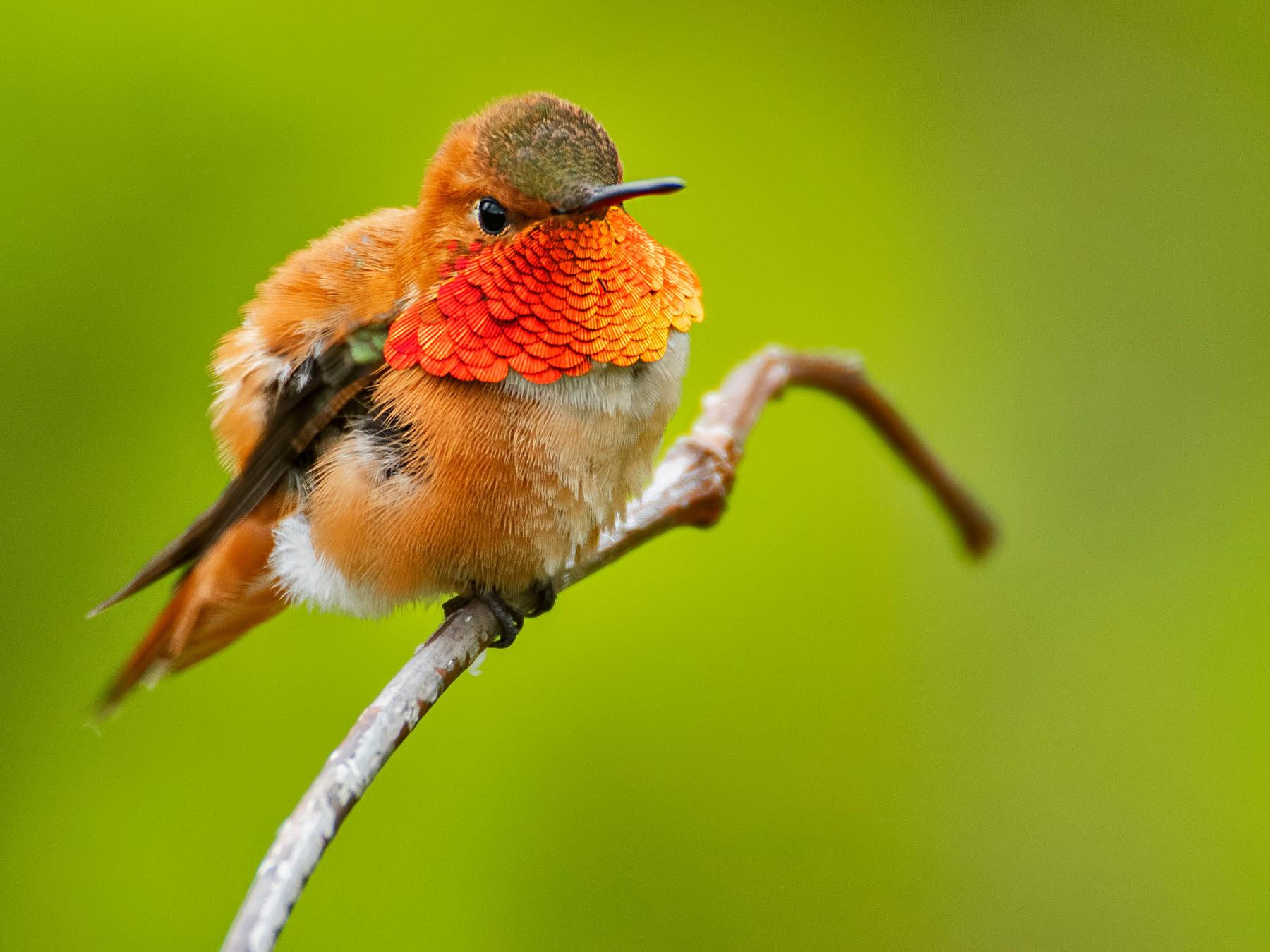
The adult male is mostly rufous, a bright orange-brown, with a glittering orange-red throat above a broad whitish collar. Females and young are green above, with rufous flanks and rufous at the base of the tail.
On an adult male the back and cheeks are plain rufous and the crown is rufous or partly green, with a green forehead and a small white spot behind the eye; the underparts are rufous too, and the rufous tail feathers have dark tips. The throat patch, or gorget, shifts with the light through red, orange and yellow to lime green. Most adult males have a wholly rufous back, but a small share carry green there, from a few feathers to, in a few birds, the whole back.
When it perches, its fairly short wings stop short of the tail tip. The bill is nearly straight, and the folded tail tapers to a point.
Size and weight
It is 2.8-3.5 in (7-9 cm) long, with a wingspan of about 4.3 in (11 cm), and weighs 0.1-0.2 oz (2-5 g), close in size to a Ruby-throated Hummingbird. Females are slightly larger, with longer wings. Birds weighed in the breeding season in Washington and Montana in 1992 averaged 3.34 g for males (46 birds) and 3.58 g for females (83 birds, some of them carrying eggs).1
Male, female and young
Adult females are bronze-green on the back and crown, with a whitish spot behind the eye. The whitish throat is streaked with rows of dark spots and a scatter of shining orange-red feathers, sometimes a large central patch. The sides and flanks are rufous, fading to a whitish breast, and the outer tail feathers are rufous at the base, then blackish, with white tips.
Females tend to gain red throat feathers as they age. Of 161 banded adult females caught again in later years, 107 had gained red feathers, 26 were unchanged and 28 had fewer, an average gain of 1.4 feathers a year, though age explained only 4% of the differences.1
Juveniles, in their first plumage from June to November, look like females. Young males show more rufous on the rump and at the base of the central tail feathers, while young females' central tail feathers are mostly green with no rufous at the base. Their crown feathers have cinnamon edges, and young males grow a few orange-red throat feathers and look messy as adult feathers come in.
The green on some males' backs appears to be juvenile plumage that is lost with age. Of 38 banded males caught again a year or more later, 32 had less green and 6 were unchanged, though whether this is maturing or aging is not yet clear. The complete molt happens mainly on the wintering grounds, with the gorget feathers replaced last; the 2006 handbook account gives adults August to February and first-year birds September to March.1 A 2018 study of 346 museum specimens puts the complete molt in February and March, and found evidence of a smaller body molt that appears to happen, at least partly, at migration stops in California and Mexico's monsoon region, mainly late June to October.2
Identification: Allen's and other hummingbirds
The real problem is Allen's Hummingbird, its closest relative. Female and young Allen's can almost never be told from a Rufous in the field: Birds of the World calls them identifiable only in the hand. Current evidence suggests an adult male with an all-rufous back and head can be named as a Rufous, but the adult male Allen's has a green back, so a green-backed male could be either. The surest marks are in the tail: on most adult male Rufous the outer tail feathers are broad and the second feather from the center has a notched tip, which Allen's lacks. Checking that takes a very close view, and for females and young a bird in the hand.
The two also interbreed. Their hybrid zone lies on the coast of southern Oregon and northern California, centered between Bandon and Port Orford, Oregon, with contact from Florence, Oregon, to Arcata, California, and sporadic sampling suggests it reaches at least 58 miles (94 km) inland.3 A genome study found their genes flowing well beyond the zone.4 Apparent hybrids with Ruby-throated Hummingbirds have also been photographed in Alberta and British Columbia, at least four birds, and the authors say such hybrids, especially females and young, are likely often overlooked.5
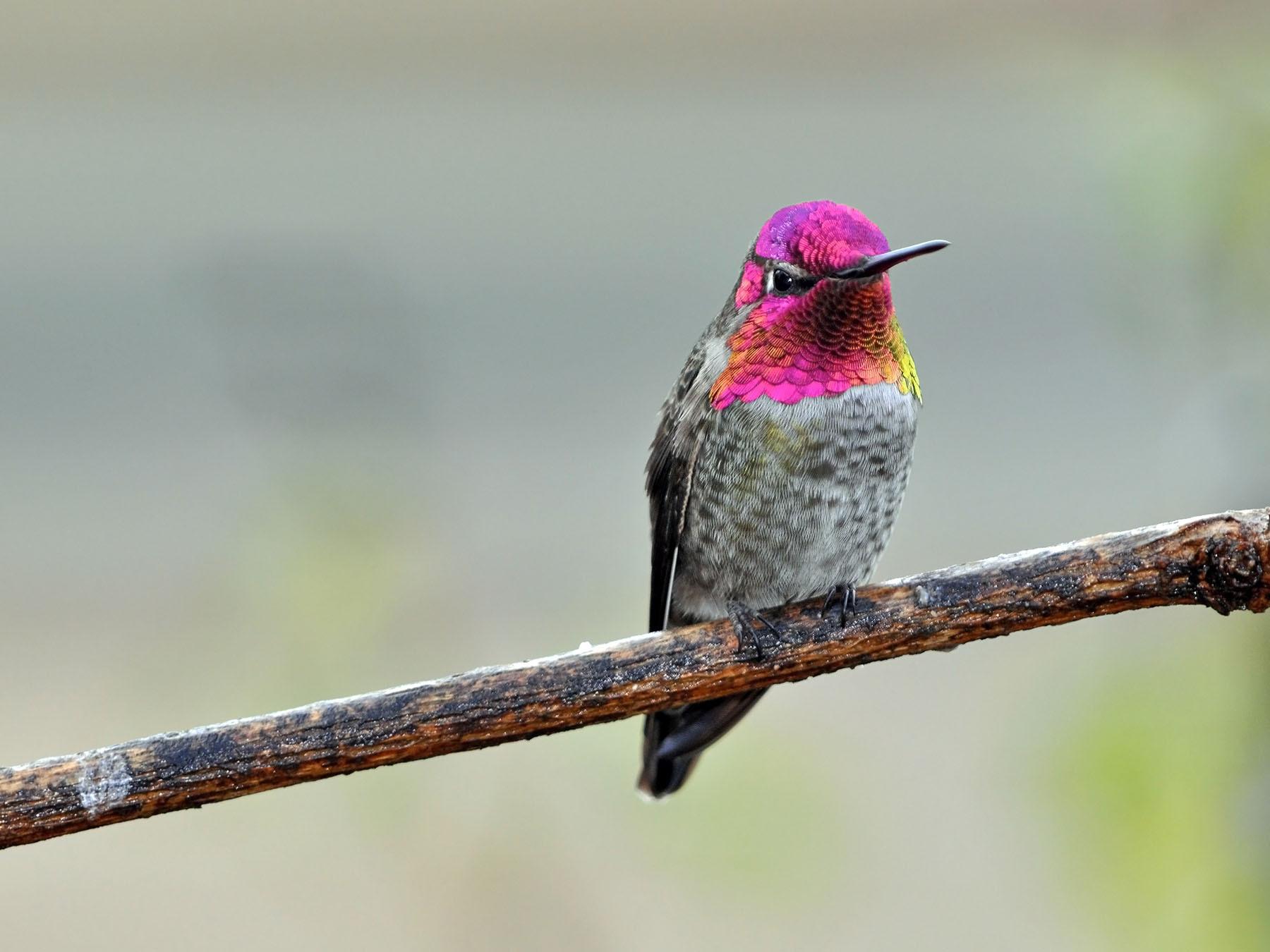
Other lookalikes are easier. A Broad-tailed Hummingbird is longer-bodied and longer-tailed; the male's throat is rose-magenta, and the female usually shows a colder gray face, a white eye-ring and paler flanks. A female or young Calliope Hummingbird has a shorter bill, a short tail that does not reach its wingtips when perched, very little rufous in the tail and a pale buff wash across the breast. An Anna's Hummingbird shows no rufous in the tail and is grayish below, and the male's rose color covers his crown. A Ruby-throated Hummingbird has no rufous on the back, and the female's tail is blackish with white tips, with no rufous at the base.
Not sure it’s a Rufous Hummingbird? Check your photo: Birdfact names the bird and shows the look-alike side by side.
Its size
Adults- Length
- 7–9 cm
- Wingspan
- 11 cm
- Weight
- 2–5 g
Its song and calls
It has no song, unlike the Anna's and Costa's hummingbirds, and most of its calls are given in fights. Either sex gives a warning chip, chip, chip at a feeder or territory, and if an intruder stays put, the owner answers with a raspy eeech or a rapid run of notes, eeeee didayer didayer didayer. Other notes include an abrupt, high zeee and thin squeals.
Listen for the wings too. In flight an adult male's wings make a metallic whine, which he can make louder or softer; the high trill, at 8-10 kHz, comes from air rushing over his two modified outer flight feathers. Both sexes' wings hum at about 35-100 Hz.1
In his courtship dive the male calls chu-chu-chu at the bottom, and a study in Alberta heard a rattle in the side-to-side flight that follows.1 Across the genus, males also make courtship sounds with fluttering tail feathers; the Rufous keeps the ancestral form, in which an inner tail feather flutters below 1 kHz.6
Heard one and not sure? Let the bird song identifier listen.
When and where to see it
November
In season
The year across North America
Choose a place on the map to see its year, or find yours.
Most recorded in November
Up to 0.97% of a place’s bird records that monthHere in other monthsThe way its records moved since last month
How this map is made
Each county, state or province is shaded by the Rufous Hummingbird’s share of all the bird records there that month: the darker, the larger the share. A place with only a trace of records in a month is left unshaded. The arrow follows the middle of the bird’s records from last month to this one, and the faint line its path through the year: it shows where the records move, not any one bird’s route. Shades compare places on this map with each other, not one bird with another. Records: GBIF eBird Observation Dataset, 2019–2024. Map: Natural Earth; place centres © OpenStreetMap contributors.
How often the Rufous Hummingbird turns up in the United States and Canada through the year, from birdwatchers' records.
United States
Summer visitor · all year · most records in August
Canada
Summer visitor · regularly Mar–Sep · most records in June
Show as a table
| Month | United States | Canada |
|---|---|---|
| January | 0.019% (regular) | <0.001% |
| February | 0.019% (regular) | – |
| March | 0.057% (regular) | 0.049% (regular) |
| April | 0.077% (regular) | 0.20% (regular) |
| May | 0.049% (regular) | 0.17% (regular) |
| June | 0.074% (regular) | 0.22% (regular) |
| July | 0.16% (regular) | 0.18% (regular) |
| August | 0.20% (regular) | 0.11% (regular) |
| September | 0.077% (regular) | 0.013% (regular) |
| October | 0.020% (regular) | 0.001% |
| November | 0.020% (regular) | 0.007% |
| December | 0.021% (regular) | <0.001% |
Worldwide: recorded regularly in 3 countries
Countries where it was recorded in at least 3 of the 6 years 2019–2024. Linked countries have their own bird list.
North America (3)
Data: EOD – eBird Observation Dataset (Cornell Lab of Ornithology), accessed via GBIF.org, CC BY 4.0. Records from 2019–2024, aggregated and filtered by Birdfact. How these lists are made
In summer it breeds in the Northwest, from coastal southeast Alaska to Prince William Sound and the southern Yukon, through most of British Columbia, western Alberta, Washington and Oregon to northern Idaho, western Montana and northwestern California. It nests farther north than any other hummingbird, to about 61 degrees N, and in southeast and south-central Alaska it is the only hummingbird commonly seen. Most winter in Mexico.
Breeding birds use many habitats, mainly openings and regrowth after logging or fire, but also mature forest, parks, yards and gardens, from sea level to about 6,000 ft (1,830 m) in British Columbia. On migration they feed in mountain meadows full of paintbrush, columbine and fireweed, as high as 12,600 ft (3,840 m) in the Sierra Nevada.
In California its breeding status is uncertain because of confusion with Allen's; it appears to breed mainly in the far northwest. Summer birds in Wyoming, Colorado and New Mexico were once thought to breed there, but they are early southbound migrants holding territories at refueling stops.
The breeding range may be shifting too. British Columbia's 2022 status report says it has apparently spread north since 1990, to the Yukon border and into the northeast of the province.7 A banding study north of 55°N east of the Rockies in 2011-2014 did not confirm it breeding there.8 A 2026 study of eBird records from 2023 found breeding birds tied to colder climates and places with little urban cover, where Anna's Hummingbird favors warmer, built-up land.9
Spotting tips
In the West, look at flowers and feeders near the coast in spring, and in mountain meadows from July. In the Southeast, a hummingbird at a feeder in late fall or winter may well be this one.
Do they migrate?
Yes, and the route is a loop. Birds fly north up the Pacific Coast and lowlands in late winter and spring, then head south through the mountains, the Rockies, Sierra Nevada and Cascades, from as early as July. The loop was first worked out from the dates of museum specimens, and banding had begun to confirm it by 2006.
The first birds reach Washington as early as late February or early March, while others are still in Jalisco, Mexico. Males arrive about a week before females on Vancouver Island, and birds reach Alaska in late April and early May.
They leave early too. Adult males go first, from late June and July, then adult females, then the young. A study of 28,948 banding captures in the falls of 1998-2013 suggests each group runs about two weeks behind the last. It found no difference in speed between the groups, which averaged about 24 miles (38.5 km) a day, and found young birds taking a more westerly route than adults, through California.10 Along the way migrants stop to refuel for a week or two.
Two banded or tagged birds show how far they go. In 2025 an adult male carrying a solar tag of about 0.06 g was released at Lillian, Alabama, on 27 March. It was last detected in Juneau, Alaska, on 3 May, after about 4,055 miles (6,526 km) of track over what the researchers call a 38-day period, the longest hummingbird track on record.11 In 2010 a female banded in Tallahassee, Florida, on 13 January was caught again breeding at Chenega Bay, Alaska, on 28 June, about 3,500 miles (5,632 km) away.11 For its size, its migration is one of the longest of any bird: a one-way trip of roughly 3,900 miles from Alaska to Mexico comes to about 78 million body lengths.12
Winter range
Most winter in the highlands of Mexico south to Oaxaca, in pine-oak and juniper woodland at 7,500-10,000 ft (2,300-3,000 m), shrubby openings and thorn forest. Small numbers winter regularly along the Gulf Coast from southeast Texas to western Florida, and rarely in coastal southern California.
It is the western hummingbird seen most often in eastern North America. Late-fall and winter records in the Southeast and even the Northeast rose in the decades before 2006, many of them at feeders, and the 2006 handbook account left open whether that was a real change or more birders and feeders.1 A 2025 study says no hypothesis yet explains these eastward movements.13 In winter banding in southern Alabama and northern Florida from November 1998 to March 2008, Rufous made up 51.6% of 1,598 hummingbirds of 10 species, the commonest of them, and females showed the strongest return to the same sites.14
What it eats
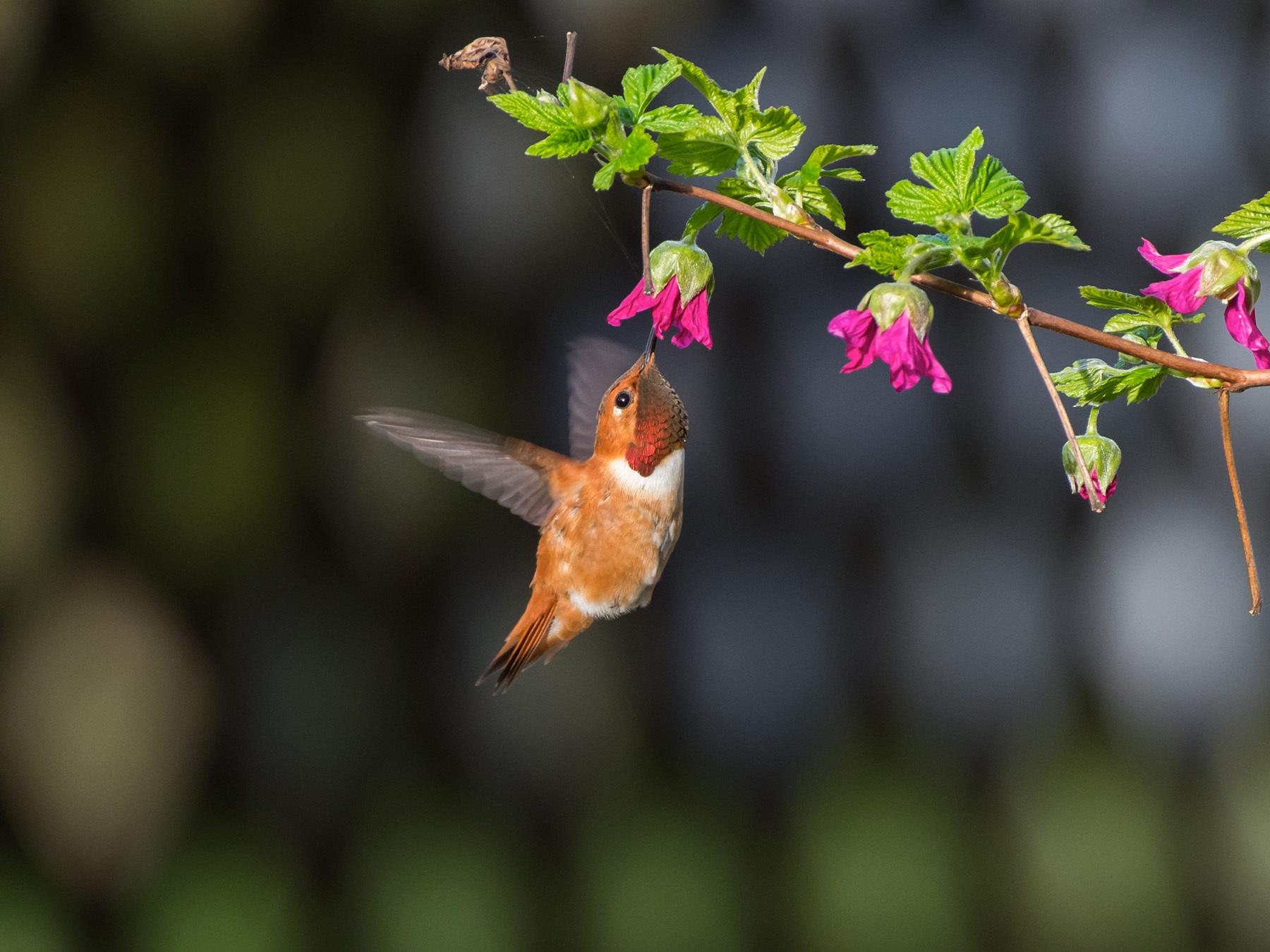
Flower nectar and small insects. It hovers at red columbine, scarlet gilia, penstemons, paintbrushes, sages, mints, larkspurs, honeysuckles, red-flowering currant, salmonberry and fireweed, and in Mexico and the Southwest at introduced tree tobacco. Gnats, midges, aphids and whiteflies are caught in the air or picked from leaves, and insects may make up more of the diet in the breeding season. It also takes insects from spider webs, and sometimes spiders.
Early in the breeding season, when few flowers are open, it often feeds at the wells Red-naped Sapsuckers drill in willow and alder bark, taking the sap and the insects caught in it.
It shows no sign of an inborn preference for red flowers: birds learn which colors pay and switch when the reward moves. Nectar alone cannot replace the salts it loses, and on southbound migration in Colorado it supplied about half, so insects must matter for fat, protein and salts.1 Nestlings eat a wide range of small arthropods: DNA in droppings from 10 nests on southern Vancouver Island (2017-2018) came from 48 families, mostly soft-bodied flies.15
Feeding hummingbirds in your yard
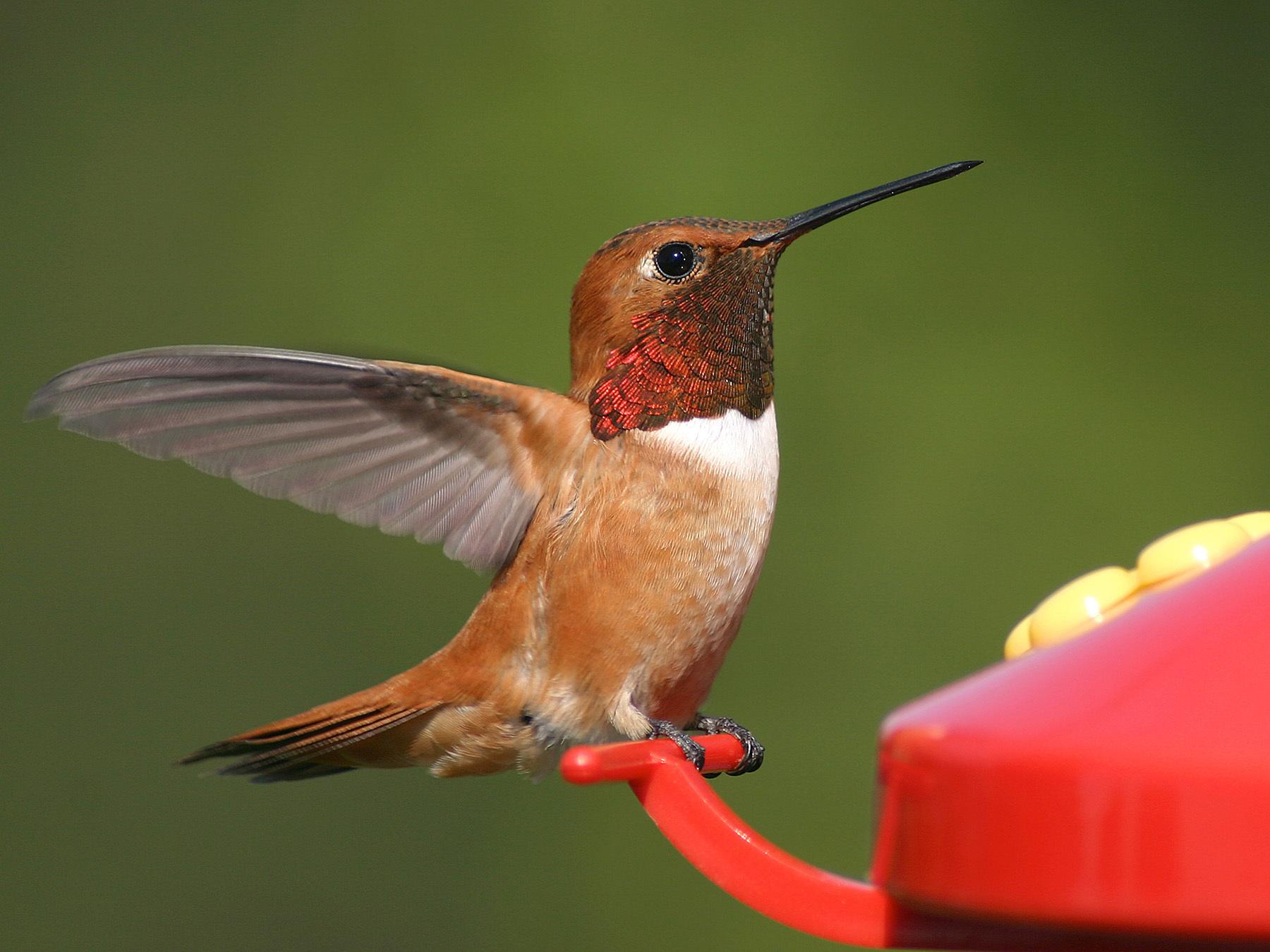
It often comes to hummingbird feeders and may settle in a yard for a while, chasing other hummingbirds away; migrants usually move on after a week or two. Mix about one-quarter cup of table sugar into each cup of water, add no food coloring, and change it before it turns cloudy, since sugar water ferments fast in hot weather.12
In the Southeast, feeders likely help winter birds survive and come back. Feeders may also raise numbers above natural levels, at least locally, though that had not been fully studied when the older accounts were written.1, 16
Nesting and breeding
The female does all the work: she starts within 2-3 days of arriving, builds the nest alone, incubates the eggs and feeds the young. The species is apparently polygynous, a male mating with more than one female, though that needs study, and mating usually happens on the ground. Young birds presumably breed in their first year, as Broad-tailed Hummingbirds do, but the 2006 handbook account had no proof of it from banded Rufous.
The nest
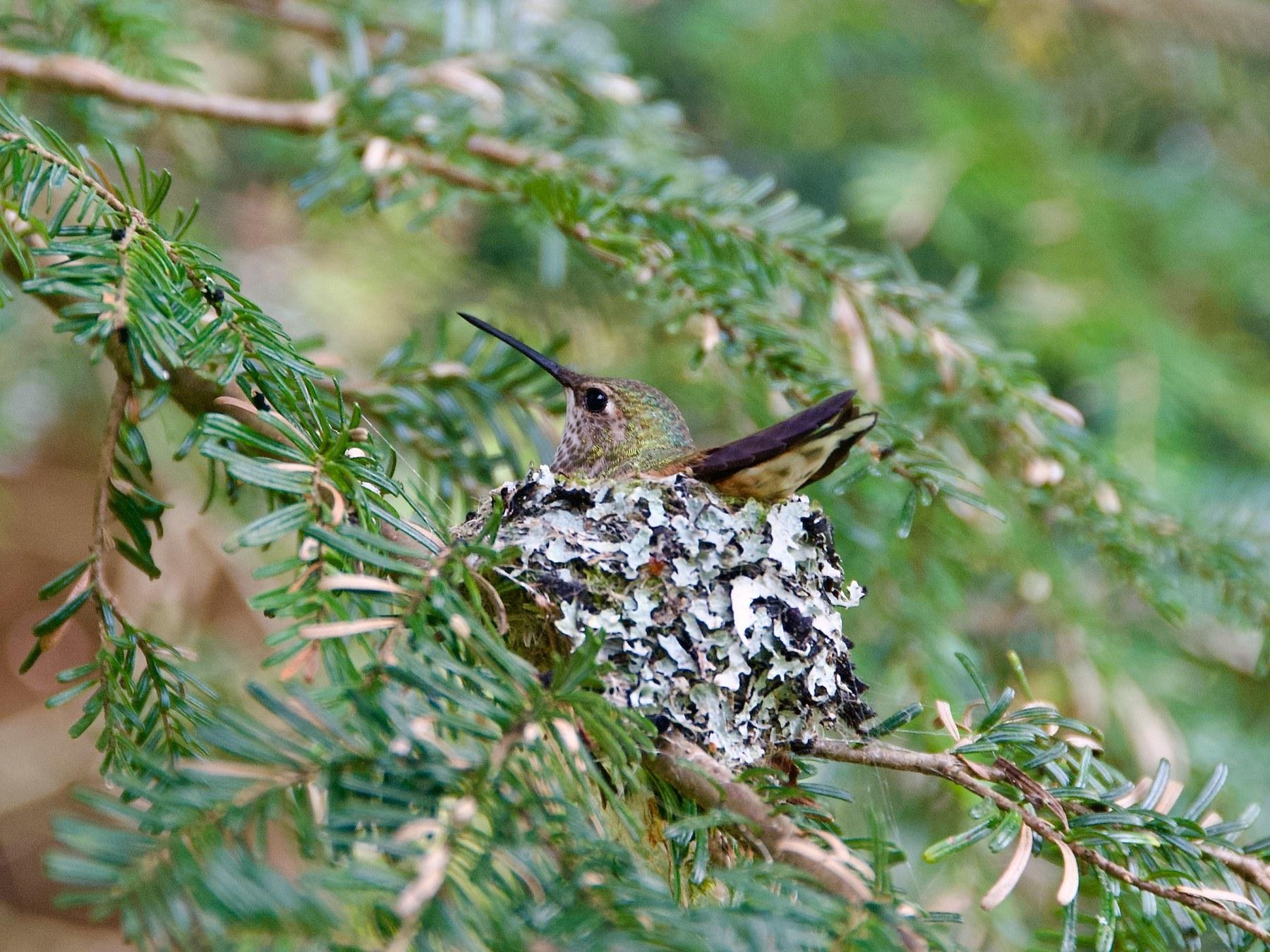
The nest is well hidden in shrubs or the drooping lower branches of conifers and oaks; in British Columbia 76% of 235 nests were in conifers.1 In Alaska nests are also built in ferns and vines over banks, and one was found on a wind chime on a fourth-floor balcony. In Washington nests were 6-30 ft (1.8-9.1 m) up, mostly under 15 ft (4.5 m); in British Columbia, early nests sat low in cedars and later ones higher in hardwoods.
It is a tiny cup of soft plant down bound with spider silk and covered outside with lichen, moss or flakes of bark, about 1.8 in (4.6 cm) across. Nests may be used again for two or more years, not always by the same female. It does not nest in colonies, but up to 20 nests have been reported a few yards apart in Washington.
Eggs and young
The clutch is usually 2 white eggs, about 13 x 9 mm; in British Columbia, 137 of 150 clutches held 2. Eggs have been found from 22 April to 7 June in Washington and 27 April to 29 June in Oregon; in British Columbia they run from 30 March to 10 July, about half from mid-May to mid-June.
The female incubates for 15-17 days. The chicks hatch naked except for two lines of gray down, open their eyes at 9-12 days, and are fed by regurgitation every 30-45 minutes. They first fly at about 20-21 days; in 15 British Columbia nests the nestling period was 21-26 days.1 There is one brood a year, though a few females lay again if the first clutch is lost.
Behaviour
It is a loner, a highly unsociable bird that migrates on its own. In the breeding season males do not let females share a feeder, though females have been seen sharing in severe cold snaps. Its feet are small and no good for walking or hopping.
Territorial behavior and aggression
It is aggressively territorial wherever it feeds, defending flowers or a feeder on the breeding grounds, at migration stops and, presumably, in winter. It chases off any other hummingbird and takes on even the Southwest's big species, up to twice its weight, though it does not always win.
On migration it dominates Black-chinned, Violet-crowned, Broad-billed and Broad-tailed Hummingbirds, though there is some evidence that male Broad-taileds can hold their territories against them, and in the Mojave Desert it outcompetes resident Costa's. In winter in Jalisco it ranks in the middle, giving way to larger resident species.
At a feeder, both sexes face an intruder in a move called the cobra, changing their wingbeat, and with it the pitch of the hum, and turning the body toward the rival. Females and young fan the tail to flash its rufous, black and white.
At a migration stop in eastern Arizona, territories ranged 100-fold in size and 5-fold in the number of flowers;17 in a later study, four of five closely watched birds settled on the territory size that gave them the fastest weight gain.18
Courtship flight and display
The male's display dive is an oval, described in Alberta as a J-shape on the way up and down.1 If the female perches low, he switches to buzzing figure-eights from side to side. Throat flashes and tail-flaring are nearly always aimed at other males.
Behavior at flowers: memory and timing
It remembers where a flower is rather than its color.1 In field experiments, wild birds returned to the exact spot of a reward when flowers were more than 16 in (40 cm) apart,19 and used nearby landmarks to find it.20 They also timed their visits to refill schedules of 10 or 20 minutes, which the researchers called the first time this degree of timing had been shown in wild animals.21 Wild males in Alberta could even tell apart rewarded arrays of seven and six flowers (nine birds).22 Some birds have been seen coming back in spring to look for a feeder where it hung the year before.
Behavior on cold nights
On cold nights it can drop into torpor, letting its body cool to save energy, which also helps it store fat for migration. From lab measurements, its body temperature can fall to about 54°F (12°C), held when the air drops below 50°F (10°C), at about 7% of its normal energy use;1 a lab study measured a minimum of about 55°F (13°C).23
Long days help too. In coastal Alaska it feeds from first light and can be active for up to 19.3 hours of a 20.3-hour day.1
Lifespan and predators
The oldest known Rufous Hummingbird was at least 8 years 11 months old. It is the only one on the USGS Bird Banding Laboratory's longevity list: a female banded in British Columbia on 17 June 1996, already at least a year old, and caught again alive there on 16 May 2004, then released.24 At least four banded birds older than 7 years have been recorded in British Columbia.1
We found no measured typical lifespan: the Birds of the World account, written in 2006, gives no survival figures. Of birds banded as adults in Montana in 1987-1990, 3.5% of males and 11.7% of females were caught again the next year, a count of returns, not of survival.1 In British Columbia, adult survival showed no trend over 20 years (1998-2017), so researchers look to young birds joining the population to explain the decline.25
Predators
Predation appears rare. Reported predators include a Brown-crested Flycatcher and a frog, and predators probably play little part in adult deaths. The 2006 handbook account had no data on nest predation, though females are known to chase chipmunks away from the nest.
Conservation
It is still common, with about 22 million birds (Partners in Flight, data from about 2010), about 12 million of them breeding in Canada and 9.3 million in the US.26 But it is falling steeply, and Partners in Flight puts it on its Watch List as a 'Tipping Point' species.27
On the North American Breeding Bird Survey it declined by 2.34% a year across the survey area from 1968 to 2025 (95% credible interval -2.83 to -1.82), by 2.95% a year in the lower 48 states and 2.04% a year in Canada. The index fell from 2.51 to 0.65 birds per route, about 74%, and the 2015-2025 rate was much the same, -2.35% a year. The steepest regional fall is in Oregon, at 4.08% a year, and no region shows a significant increase. The survey flags the survey-wide and US results for a data deficiency.28
A 2021 analysis of the same survey data over a different window found a 65% fall from 1970 to 2019, the rate nearly doubling to -4.1% a year in 2009-2019 and steepest on the Pacific Coast, and no sign that survey timing caused it.29
Conservation: why numbers are falling
The causes are not settled. Breeding habitat modeled as suitable shrank on the wet Pacific coast, by 34% in the Northern Pacific Rainforest between 1985-1990 and 2016-2021, and grew inland, and survey routes with the biggest modeled habitat loss had the steepest declines in 2006-2021.30 One model linked Rufous survival to human population density.31 British Columbia's 2022 status report calls the declines 'not entirely understood' and names climate change and pesticides among the likely factors.7
It could be especially vulnerable to climate change,32 and the US Fish and Wildlife Service lists fire and heavy grazing that reduce flowers along the fall route as possible threats.33
Conservation status
The IUCN Red List rates it Near Threatened.34, 35 Older texts, including the 2006 Birds of the World account and Canada's archived 2014 page, list it as Least Concern.1, 36 British Columbia rates it apparently secure as a breeder (S4?B) on its Yellow list,16 with a short-term decline of 10-50%, and its 2022 report says COSEWIC is evaluating it as a candidate.7 It is not listed under the US Endangered Species Act; the Fish and Wildlife Service labels it a Species of Concern, which is not a listing.33
Legal status and protection
In the United States it is on the federal list of birds protected under the Migratory Bird Treaty Act, which makes it illegal to take, capture, kill, possess or sell one, or to take its nest, eggs or feathers, unless a permit allows it.37, 38 Someone who finds a sick, injured or orphaned bird may pick it up without a permit only to take it straight to a permitted rehabilitator or a licensed vet.39
In Canada it is protected under the Migratory Birds Convention Act, 1994, appearing on the government's list of covered birds, and provincial rules may also apply.40 International trade is regulated through CITES Appendix II, which lists the whole hummingbird family.41
Similar birds
Often mistaken for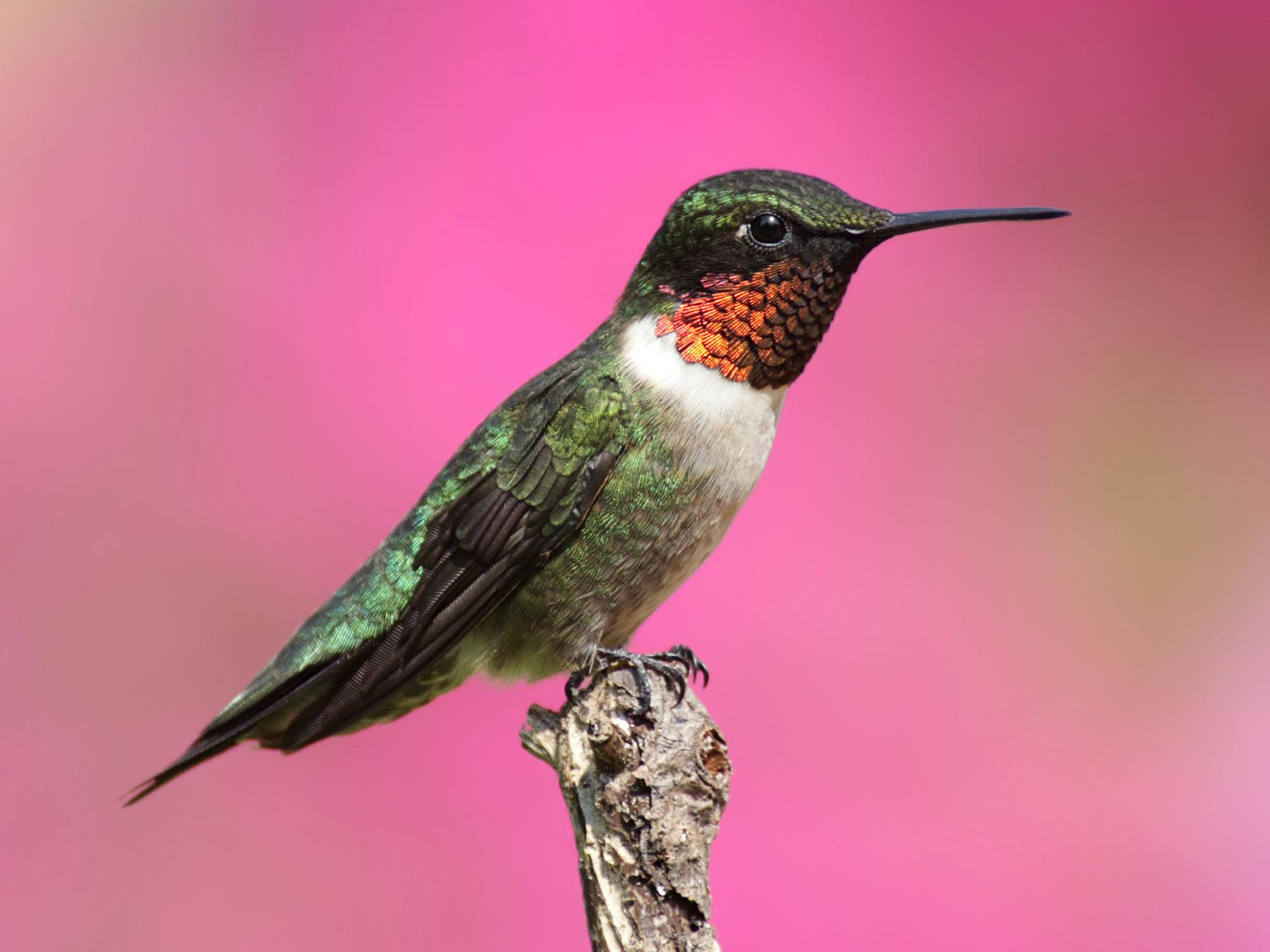
Quick facts
- Length
- 7–9 cm
- Wingspan
- 11 cm
- Weight
- 2–5 g
- Lifespan
- oldest recorded 8 years 11 months
- Family
- Hummingbirds
- Migration
- Long-distance Migrant
- Global status (IUCN)
- Near Threatened
- World population
- About 22 million birds (Partners in Flight, data from about 2010)
- Population trend
- Declining steeply: the Breeding Bird Survey index has fallen about 2.3% a year since 1968, roughly 74% in all
- Scientific name
- Selasphorus rufus
Questions
2Is the Rufous Hummingbird rare?
Not in the West in summer: with about 22 million birds it is still common there. But the survey index has fallen about 74% since 1968, and it is rated Near Threatened (see Conservation). In the East it is scarce: small numbers winter regularly on the Gulf Coast, many of them at feeders.
Do Rufous Hummingbirds return to the same place each year?
Many do. Fidelity to breeding areas is high: in Montana's Swan Valley in 1991-1992, 48.3% of the females and 19.6% of the males caught had been banded there in earlier years.1 Winter banding in Alabama and Florida found birds returning to the same sites, females most strongly,14 and recaptures suggest a winter bird settles in one place rather than wandering.1 Some have even been seen checking the spot where a feeder hung the year before.
Sources
52- 1Healy, S. and Calder, W. A. (2020). Rufous Hummingbird (Selasphorus rufus), version 1.0. Birds of the World (A. F. Poole, editor). Cornell Lab of Ornithology. doi:10.2173/bow.rufhum.01 (opens in a new tab)
- 2Sieburth, D. and Pyle, P. (2018). Evidence for a prealternate molt-migration in the Rufous Hummingbird and its implications for the evolution of molts in Apodiformes. The Auk 135: 495-505. doi:10.1642/auk-17-231.1 (opens in a new tab)
- 3Myers, B. M., Rankin, D. T., Burns, K. J. and Clark, C. J. (2019). Behavioral and morphological evidence of an Allen's x Rufous hummingbird (Selasphorus sasin x S. rufus) hybrid zone in southern Oregon and northern California. The Auk 136(4): ukz049. doi:10.1093/auk/ukz049 (opens in a new tab)
- 4Myers, B. M., Burns, K. J., Clark, C. J. and Brelsford, A. (2023). Sampling affects population genetic inference: A case study of the Allen's (Selasphorus sasin) and rufous hummingbird (Selasphorus rufus). Journal of Heredity 114: 625-636. doi:10.1093/jhered/esad044 (opens in a new tab)
- 5Williamson, S. L., Scott, D. R. and Hudon, J. (2024). Apparent hybrid Ruby-throated x Rufous hummingbirds in western Canada. Western Birds 55: 216-222. doi:10.21199/wb55.3.4 (opens in a new tab)
- 6Clark, C. J. (2014). Harmonic Hopping, and Both Punctuated and Gradual Evolution of Acoustic Characters in Selasphorus Hummingbird Tail-Feathers. PLoS ONE 9: e93829. doi:10.1371/journal.pone.0093829 (opens in a new tab)
- 7B.C. Conservation Data Centre (2022). Conservation Status Report: Selasphorus rufus (id 16675). BC Species and Ecosystems Explorer. Accessed 28 November 2026. Source (opens in a new tab)
- 8Cubie, D. and Bassett, F. (2017). Extreme hummingbirds: three species north of the 55th parallel. Western Birds 48: 60-64. doi:10.21199/wb48.1.6 (opens in a new tab)
- 9Scridel, D., Martin, K., Kennedy, T. and Wilson, S. (2026). Climate, habitat, and socioeconomic gradients shape divergent occupancy and co-occurence patterns between two hummingbirds in western North America. Scientific Reports 16: 27960. doi:10.1038/s41598-026-68184-4 (opens in a new tab)
- 10Rousseau, J. S., Alexander, J. D. and Betts, M. G. (2020). Using continental-scale bird banding data to estimate demographic migratory patterns for Rufous Hummingbird (Selasphorus rufus). Avian Conservation and Ecology 15(2): 2. doi:10.5751/ACE-01612-150202 (opens in a new tab)
- 11Rhodes, E. M. et al. (2026). Ultralight Solar Transmitter Enables Fine-Scale Movement Ecology in North American Hummingbird Migration. Ecology and Evolution 16(11): e74624. doi:10.1002/ece3.74624 (opens in a new tab)
- 12Cornell Lab of Ornithology. Rufous Hummingbird: overview, identification and life history. All About Birds. Accessed 28 November 2026. Source (opens in a new tab)
- 13Alvarez-Alvarez, E. A. et al. (2025). Seasonal climatic niche-switching migration in the Nearctic-Neotropical Rufous Hummingbird (Selasphorus rufus). PLOS One 20(12): e0334958. doi:10.1371/journal.pone.0334958 (opens in a new tab)
- 14Bassett, F. and Cubie, D. (2009). Wintering hummingbirds in Alabama and Florida: species diversity, sex and age ratios, and site fidelity. Journal of Field Ornithology 80: 154-162. doi:10.1111/j.1557-9263.2009.00217.x (opens in a new tab)
- 15Moran, A. J., Prosser, S. W. J. and Moran, J. A. (2019). DNA metabarcoding allows non-invasive identification of arthropod prey provisioned to nestling Rufous hummingbirds (Selasphorus rufus). PeerJ 7: e6596. doi:10.7717/peerj.6596 (opens in a new tab)
- 16B.C. Conservation Data Centre (global text: Hammerson, G., NatureServe) (2015). Species Summary: Selasphorus rufus (id 16675). BC Species and Ecosystems Explorer. Accessed 28 November 2026. Source (opens in a new tab)
- 17Kodric-Brown, A. and Brown, J. H. (1978). Influence of Economics, Interspecific Competition, and Sexual Dimorphism on Territoriality of Migrant Rufous Hummingbirds. Ecology 59: 285-296. doi:10.2307/1936374 (opens in a new tab)
- 18Carpenter, F. L., Paton, D. C. and Hixon, M. A. (1983). Weight gain and adjustment of feeding territory size in migrant hummingbirds. PNAS 80: 7259-7263. doi:10.1073/pnas.80.23.7259 (opens in a new tab)
- 19Healy, S. D. and Hurly, T. A. (1998). Rufous hummingbirds' (Selasphorus rufus) memory for flowers: Patterns or actual spatial locations?. Journal of Experimental Psychology: Animal Behavior Processes 24: 396-404. doi:10.1037/0097-7403.24.4.396 (opens in a new tab)
- 20Pritchard, D. J., Scott, R. D., Healy, S. D. and Hurly, T. A. (2016). Wild rufous hummingbirds use local landmarks to return to rewarded locations. Behavioural Processes 122: 59-66. doi:10.1016/j.beproc.2015.11.004 (opens in a new tab)
- 21Henderson, J., Hurly, T. A., Bateson, M. and Healy, S. D. (2006). Timing in Free-Living Rufous Hummingbirds, Selasphorus rufus. Current Biology 16: 512-515. doi:10.1016/j.cub.2006.01.054 (opens in a new tab)
- 22Corliss, M. et al. (2021). Estimating on the fly: The approximate number system in rufous hummingbirds (Selasphorus rufus). Learning & Behavior 49: 67-75. doi:10.3758/s13420-020-00448-z (opens in a new tab)
- 23Hiebert, S. M. (1990). Energy Costs and Temporal Organization of Torpor in the Rufous Hummingbird (Selasphorus rufus). Physiological Zoology 63: 1082-1097. doi:10.1086/physzool.63.6.30152634 (opens in a new tab)
- 24USGS Bird Banding Laboratory (2026). Longevity records of North American birds: Rufous Hummingbird (AOU 4330). USGS Eastern Ecological Science Center. Accessed 28 November 2026. Source (opens in a new tab)
- 25Drake, A., Bishop, C. A., Moran, A. J. and Wilson, S. (2022). Geographic and Temporal Variation in Annual Survival of a Declining Neotropical Migrant Hummingbird (Selasphorus rufus) Under Varying Fire, Snowpack, and Climatic Conditions. Frontiers in Ecology and Evolution 10: 825026. doi:10.3389/fevo.2022.825026 (opens in a new tab)
- 26Partners in Flight (2020). Population Estimates Database, version 2020.04.29. Bird Conservancy of the Rockies. Accessed 28 November 2026. Source (opens in a new tab)
- 27Partners in Flight (2024). Avian Conservation Assessment Database, version 2024.05.23 (global). Bird Conservancy of the Rockies. Accessed 28 November 2026. Source (opens in a new tab)
- 28Hostetler, J. A. et al. (2026). The North American Breeding Bird Survey, Analysis Results 1966 - 2025. U.S. Geological Survey. doi:10.5066/P1OSNSFC (opens in a new tab)
- 29English, S. G., Bishop, C. A., Wilson, S. and Smith, A. C. (2021). Current contrasting population trends among North American hummingbirds. Scientific Reports 11: 18369. doi:10.1038/s41598-021-97889-x (opens in a new tab)
- 30Jefferys, K. M. et al. (2024). Breeding habitat loss linked to declines in Rufous Hummingbirds. Avian Conservation and Ecology 19(2): 2. doi:10.5751/ACE-02681-190202 (opens in a new tab)
- 31English, S. G. et al. (2024). Demographic mechanisms and anthropogenic drivers of contrasting population dynamics of hummingbirds. Biological Conservation 289: 110415. doi:10.1016/j.biocon.2023.110415 (opens in a new tab)
- 32National Audubon Society. Rufous Hummingbird (Selasphorus rufus). Guide to North American Birds. Accessed 28 November 2026. Source (opens in a new tab)
- 33U.S. Fish and Wildlife Service (2015). Rufous Hummingbird (Selasphorus rufus): species profile (id 8002). ECOS (Environmental Conservation Online System). Accessed 28 November 2026. Source (opens in a new tab)
- 34BirdLife International (IUCN Red List, via GBIF's IUCN checklist). Selasphorus rufus. The IUCN Red List of Threatened Species. GBIF (IUCN Red List checklist dataset, taxon 22688296). Accessed 28 November 2026. Source (opens in a new tab)
- 35AviList Core Team (2025). AviList: The Global Avian Checklist, v2025b. AviList. doi:10.2173/avilist.v2025b (opens in a new tab)
- 36Environment and Climate Change Canada (2014). Status of Birds in Canada: Rufous Hummingbird (archived). Government of Canada. Accessed 28 November 2026. Source (opens in a new tab)
- 37U.S. Fish and Wildlife Service (2026). 50 CFR 10.13, List of Migratory Birds. Electronic Code of Federal Regulations (as of 25 Nov 2026). Accessed 28 November 2026. Source (opens in a new tab)
- 38United States Congress (1918). Migratory Bird Treaty Act, 16 U.S.C. 703. United States Code (GovInfo, 2023 edition). Accessed 28 November 2026. Source (opens in a new tab)
- 39U.S. Fish and Wildlife Service (2026). 50 CFR part 21 (21.14 birds in buildings; 21.76 rehabilitation). Electronic Code of Federal Regulations (as of 25 Nov 2026). Accessed 28 November 2026. Source (opens in a new tab)
- 40Environment and Climate Change Canada. Birds protected under the Migratory Birds Convention Act, 1994. Government of Canada. Accessed 28 November 2026. Source (opens in a new tab)
- 41UNEP-WCMC. Species+: Selasphorus rufus (taxon concept 10411). Species+ (CITES and EU listings). Accessed 28 November 2026. Source (opens in a new tab)
- 42Gass, C. L., Angehr, G. and Centa, J. (1976). Regulation of food supply by feeding territoriality in the rufous hummingbird. Canadian Journal of Zoology 54: 2046-2054. doi:10.1139/z76-238 (opens in a new tab)
- 43Pritchard, D. J., Hurly, T. A., Photopoulou, T. and Healy, S. D. (2025). Applying movement ecology models to comparative cognition experiments: a field test in hummingbirds. Proceedings of the Royal Society B 292: 20250717. doi:10.1098/rspb.2025.0717 (opens in a new tab)
- 44Hiebert, S. M., Salvante, K. G., Ramenofsky, M. and Wingfield, J. C. (2000). Corticosterone and Nocturnal Torpor in the Rufous Hummingbird (Selasphorus rufus). General and Comparative Endocrinology 120: 220-234. doi:10.1006/gcen.2000.7555 (opens in a new tab)
- 45Halter, S. R., Wolf, B. O. and Martinez del Rio, C. (2025). The hummingbird's adipostat: can a simple rule explain torpor frequency and duration in hummingbirds?. Proceedings of the Royal Society B 292: 20242489. doi:10.1098/rspb.2024.2489 (opens in a new tab)
- 46Alaska Department of Fish and Game. Alaska's Backyard Birds: Rufous Hummingbird. ADF&G. Accessed 28 November 2026. Source (opens in a new tab)
- 47Buchmann, S. (Pollinator Partnership). Pollinator of the Month: The Rufous Hummingbird. USDA Forest Service, Celebrating Wildflowers. Accessed 28 November 2026. Source (opens in a new tab)
- 48Clark, C. J. and Mitchell, D. E. (2020). Allen's Hummingbird (Selasphorus sasin), version 1.0. Birds of the World. Cornell Lab of Ornithology. Accessed 28 November 2026. Source (opens in a new tab)
- 49Camfield, A. F., Calder, W. A. and Calder, L. L. (2020). Broad-tailed Hummingbird (Selasphorus platycercus), version 1.0. Birds of the World. Cornell Lab of Ornithology. Accessed 28 November 2026. Source (opens in a new tab)
- 50Calder, W. A. and Calder, L. L. (2020). Calliope Hummingbird (Selasphorus calliope), version 1.0. Birds of the World. Cornell Lab of Ornithology. Accessed 28 November 2026. Source (opens in a new tab)
- 51Clark, C. J. and Russell, S. M. (2020). Anna's Hummingbird (Calypte anna), version 1.0. Birds of the World. Cornell Lab of Ornithology. Accessed 28 November 2026. Source (opens in a new tab)
- 52Weidensaul, S. et al. (2020). Ruby-throated Hummingbird (Archilochus colubris), version 1.0. Birds of the World. Cornell Lab of Ornithology. Accessed 28 November 2026. Source (opens in a new tab)

Checked by
Nathan Cope, founder and editor
Nathan founded Birdfact and leads its writers and contributors in the UK, the US and Canada. He has watched and studied birds for more than ten years, and checks every article and species guide before it’s published.