


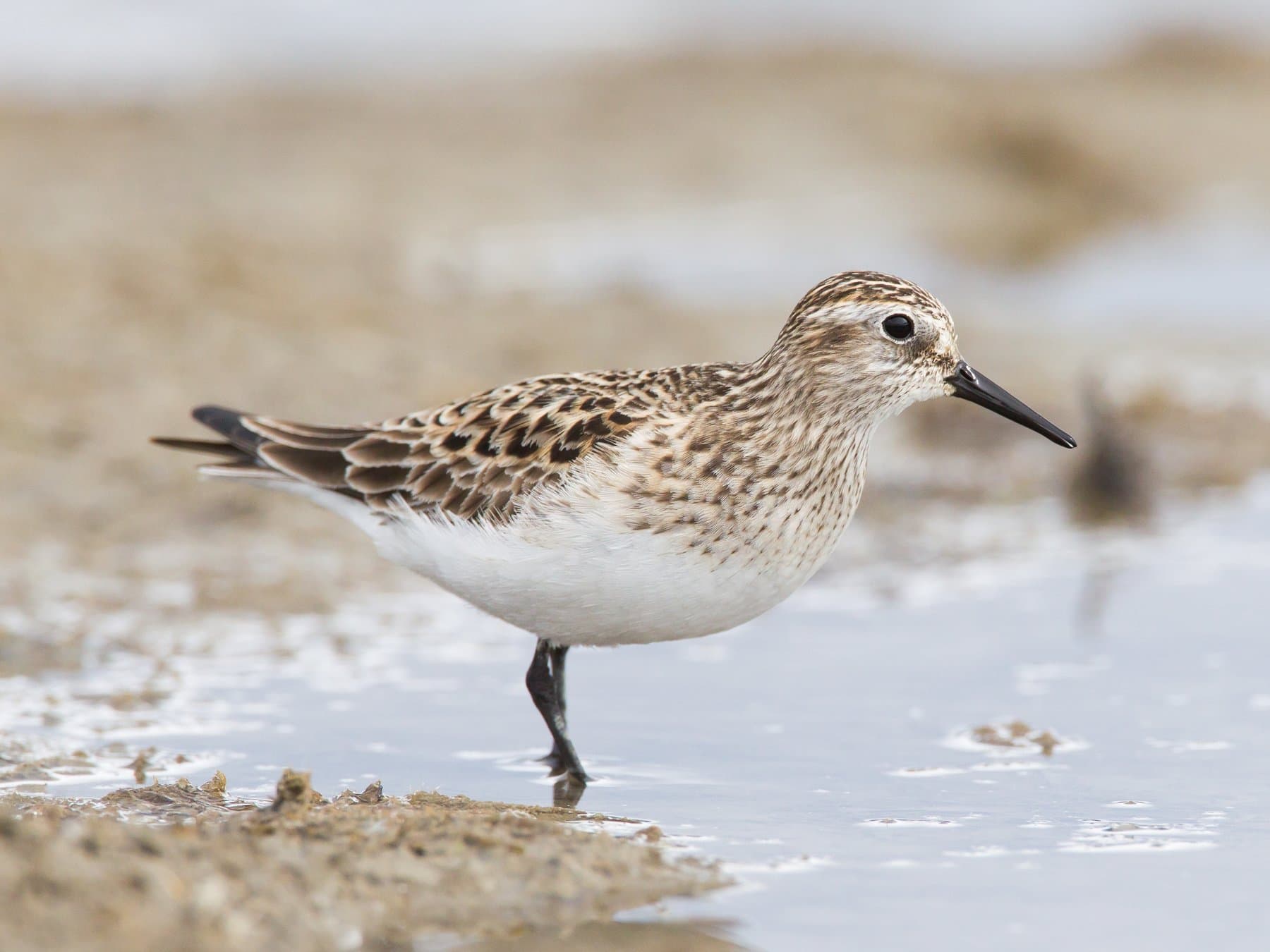
Baird's Sandpiper
Calidris bairdii
By the Birdfact teamChecked by Nathan Cope
Baird's Sandpiper makes one of the fastest long-distance migrations of any bird on Earth — covering 15,000 km from the high Arctic to Tierra del Fuego in as few as five weeks, with individuals flying over 6,000 km non-stop across the eastern Pacific. Slender, flat-backed, and unmistakable once you know what to look for, this small shorebird's wingtips project so far beyond its tail that no other similarly sized "peep" quite matches its elongated silhouette.
On this page13 sections
How to recognise it
The most reliable feature of Baird's Sandpiper is structural, not colourful: the wingtips project conspicuously beyond the tail tip when the bird is at rest, giving it a uniquely elongated, flat-backed silhouette. Among similarly sized Calidris sandpipers — the so-called "peeps" — only the White-rumped Sandpiper shares this long-winged profile. Seen head-on, the body presents a distinctive flattened oval shape. The bill is short, straight, thin, and entirely black, with a very slightly drooping tip. Legs and feet are also black.
In breeding plumage, the upperparts are dark brown to black-brown on the crown, nape, mantle, and scapulars, with large dark feather centres and pale fringes creating a mottled, scaly appearance. The head and breast are light brown with dark streaks, while the belly, flanks, and undertail coverts are clean white. A short, diffuse buff supercilium is present, and the dark lores give the face a rather blank, "beady-eyed" expression. Crucially, the rump and uppertail coverts are dark — not white — which immediately separates it from the White-rumped Sandpiper in the field.
Juvenile plumage is arguably the most striking: neat pale buff or buff-white fringes to dark-centred feathers create a bold scalloped or scaled effect across the upperparts, reminiscent of a miniature juvenile Curlew Sandpiper. The head and breast are washed warm buff with fine brown streaks, the belly and flanks are clean white, and a narrow white eye-ring is visible at close range. This is the plumage most British and Irish birders will encounter, as the overwhelming majority of UK records involve juveniles in autumn.
Non-breeding (winter) plumage is paler brownish-grey with less contrasting markings — but this is rarely seen by birders in western Europe, as most birds have departed their wintering grounds before European observers encounter them. Both sexes are similar in appearance, with no significant sexual dimorphism in plumage.
Not sure it’s a Baird's Sandpiper? Check your photo: Birdfact names the bird and shows the look-alike side by side.
Its size
Adults- Length
- 14–17 cm
- Wingspan
- 35–40 cm
- Weight
- 27–63 g
Its song and calls
Baird's Sandpiper is not a particularly vocal species away from the breeding grounds, but its flight call is distinctive enough to be a useful identification aid. The most commonly heard call — given in flight and as a contact note — is a low, trilled "kreep," "kriiip," or "krrt," sometimes rendered as "preep." BirdGuides describes it as "a rolled, or trilled, pair-r-r-reet or krreep." The Audubon Field Guide calls it "a soft krrrrt." The quality is often likened to a police whistle — a short, buzzy trill with a slightly rough edge. It is pitched higher than the call of Pectoral Sandpiper but lower than those of Least or Western Sandpipers, which can help narrow down an identification when a bird is heard before it is seen.
The breeding song is given by males during aerial display flights and is considerably more complex. It combines a purring trill with rising "twoowee" calls, closing with a chattering trill. The overall effect is guttural and rolling. Males also give trilling calls during ground courtship displays, and a "broken-wing" distraction display near the nest is accompanied by alarm calls. Flock contact calls are given during migration, though these are less frequently noted than the flight call.
Outside the breeding season, the species calls mainly when flushed or in flight between feeding areas. A bird disturbed from a pool edge will typically give one or two short trilled notes as it departs. Juveniles on autumn migration in the UK are generally quiet compared to some other vagrant shorebirds, which can make detection harder in mixed wader flocks. Listening for the distinctive trilled quality — rather than the sharp "weet" of a Dunlin or the liquid whistle of a Little Stint — is the best approach.
- Call0:00 / 0:06
Recorded in MB, Canada · June 2010
Heard one and not sure? Let the bird song identifier listen.
When and where to see it
OctoberLeaving
Most recorded in October
- 1. Argyll and Buteunder 0.1%
- 2. Nottinghamshireunder 0.1%
- 3. Wexfordunder 0.1%
- 4. South Yorkshireunder 0.1%
- 5. Somersetunder 0.1%
Each dot is a county, state or province: the bigger and darker, the larger the bird’s share of that place’s bird records that month. Grey dots: no regular records. The ringed point is the centre of the bird’s records this month; the arrow shows how it moved since last month, and the dashed loop its path through the year. “Arrivals” colours places where it becomes regular this month (orange) or is in its last regular month (grey). GBIF eBird Observation Dataset, 2019–2024. Map data: Natural Earth, US Census Bureau; place centres © OpenStreetMap contributors.
In your area
See when the Baird's Sandpiper is recorded in your county, state or province.
How often the Baird's Sandpiper turns up in the UK, Ireland, the United States and Canada through the year, from birdwatchers' records.
United Kingdom
Passage migrant · regularly Sep–Oct · most records in August
Ireland
Passage migrant · regularly Sep · most records in September
United States
Passage migrant · regularly Apr–Oct · most records in August
Canada
Summer visitor · regularly May–Oct · most records in August
Show as a table
| Month | United Kingdom | Ireland | United States | Canada |
|---|---|---|---|---|
| January | – | – | <0.001% | – |
| February | – | – | <0.001% | – |
| March | – | – | 0.004% | – |
| April | – | – | 0.025% (regular) | <0.001% |
| May | <0.001% | – | 0.012% (regular) | 0.013% (regular) |
| June | <0.001% | – | 0.003% | 0.007% (regular) |
| July | – | – | 0.015% (regular) | 0.025% (regular) |
| August | 0.003% | <0.001% | 0.10% (regular) | 0.14% (regular) |
| September | 0.002% (regular) | 0.005% (regular) | 0.064% (regular) | 0.089% (regular) |
| October | 0.001% (regular) | 0.004% | 0.009% (regular) | 0.008% (regular) |
| November | <0.001% | 0.001% | 0.001% | <0.001% |
| December | – | – | <0.001% | <0.001% |
Recorded regularly in
Worldwide: recorded regularly in 26 countries
Countries where it was recorded in at least 3 of the 6 years 2019–2024. Linked countries have their own bird list.
Europe (5)
Africa (1)
North America (10)
Data: EOD – eBird Observation Dataset (Cornell Lab of Ornithology), accessed via GBIF.org, CC BY 4.0. Records from 2019–2024, aggregated and filtered by Birdfact. How these lists are made
Tips for seeing it
In the UK and Ireland, Baird's Sandpiper is a genuine rarity — but a findable one for those who look in the right places at the right time. Late August to early October is the prime window, with juveniles making up the overwhelming majority of records. Southwest England is the most productive region: Cornwall, the Isles of Scilly, and the coasts of Devon and Dorset all have strong track records. In Ireland, coastal counties in the south and west are the most reliable areas. Checking freshwater pools, coastal lagoons, and flooded fields after Atlantic depressions is the classic approach — these weather systems are responsible for most transatlantic vagrancy.
The key identification feature is structural: look for a small sandpiper with an unusually elongated, flat-backed profile and wingtips that project clearly beyond the tail. This long-winged silhouette is visible even at distance and is the single most reliable feature. The bill is short, straight, and entirely black; the legs are black. In juvenile plumage (the most likely UK encounter), the scalloped, buff-fringed upperparts are distinctive — neater and more contrasting than most other autumn peeps.
The most likely confusion species is the White-rumped Sandpiper, which shares the long-winged profile. The key distinction is the rump: Baird's has a dark rump with white sides, while White-rumped shows a clean white rump patch in flight. On the ground, Baird's tends to look warmer buff-brown and more scaly; White-rumped is greyer and more streaked on the breast.
In North America, the Great Plains states — particularly South Dakota, Nebraska, and Kansas — offer the best migration viewing in August and September. Look on drying lake margins, sod farms, and short-grass fields rather than in the water itself. The species consistently occupies the drier edges of mixed shorebird flocks.
What it eats
Insects form the backbone of Baird's Sandpiper's diet throughout the year. On the Arctic breeding grounds, the species feeds mainly on flies (including cranefly and midge larvae), beetles and their larvae, and spiders. During migration, it continues to take insects heavily — caterpillars, butterflies, moths, and the adults and larvae of beetles (Coleoptera) and flies (Diptera) all feature. Small crustaceans such as amphipods and tiny pond invertebrates are also taken, particularly near water.
The foraging method is almost entirely surface-picking: the bird walks briskly and pecks at the ground, low vegetation, or the water's edge to take prey. Unlike many shorebirds, it rarely probes into soft substrate. This technique suits the drier, grassier microhabitats the species prefers — shortgrass edges, drying lake beds, grazed pastures, and harvested agricultural fields — where surface invertebrates are accessible without the need for deep probing.
During autumn migration, birds also forage among beach debris and wrack lines. In the mountains, individuals have been recorded feeding on snowbanks, presumably picking off invertebrates blown onto the snow surface. On the South American wintering grounds, the diet shifts to whatever invertebrates are available in puna grasslands and Andean lakeshores at elevations up to 4,700 m — a habitat where food availability is highly seasonal and often sparse.
The species is not known to cache food or to show strong dietary specialisation beyond its general insectivory. Its preference for drier foraging habitat means it occupies a slightly different ecological niche from the wading, probing peeps it often accompanies on migration — reducing direct competition for food even when the species share the same general area.
Nesting and breeding
Males arrive on the high-Arctic breeding grounds from late May, often when snow still covers much of the tundra, and begin establishing territories as the snow melts. Courtship involves elaborate aerial display flights: the male climbs steeply to over 30 m, then descends while singing, alternating bouts of exaggeratedly slow "butterfly" wingbeats with hovering on trembling wings and gliding with wings held in a pronounced V above the back. He typically lands in this dramatic V-wing posture while giving doubled "twoowee" calls. Ground displays include rushing at the female with bill angled down, back feathers raised, and tail sometimes spread and cocked, accompanied by trilling calls.
The nest is a shallow scrape on the ground, placed in dry tundra — often next to a rock or tucked under a grass clump for concealment. Both male and female excavate the scrape with feet and breast, then line it with nearby plant material: birch, willow, and blueberry leaves, lichens, reindeer moss, mountain avens, and arctic white heather. Some nests are left unlined. The interior cup averages approximately 6.4 cm across and 5 cm deep.
The clutch consists of four eggs, coloured pale grey to brownish tan, reddish, or deep olive, with extensive dark blotching. Eggs are laid at one-day intervals. Both parents share incubation, which lasts 19–22 days. Chicks are precocial, covered in down at hatching, and leave the nest shortly after the last egg hatches. Both parents initially tend the young, but the female typically departs before the young fledge, leaving the male to complete chick-rearing. Young fledge at approximately 16–20 days of age.
One of the most extraordinary facts in shorebird biology involves the female's egg-laying investment: the full clutch weighs up to 120% of the female's own body mass, and she produces it in just four days, shortly after arriving in the Arctic with essentially no stored fat reserves. This is among the largest investments in egg production known for any bird species.
Behaviour
In flight, Baird's Sandpiper shows a weak but visible whitish wing stripe running along the upperwing, and a dark central stripe running from the lower back to the centre of the tail, with white on either side of the rump — a pattern that immediately separates it from the White-rumped Sandpiper, which shows a clean white rump patch. The underwing coverts are whitish. The overall flight impression is of a long, narrow, pointed-winged bird — the elongated body and projecting wingtips give it a more attenuated silhouette than most other small waders.
Flight style is direct and swift, with rapid, shallow wingbeats typical of the Calidris sandpipers. On short flights between feeding areas, birds tend to fly low over the ground or water surface before dropping back in. On longer migratory flights, the species is capable of extraordinary sustained effort: the non-stop transoceanic crossing from North American staging areas to northern South America — over 6,000 km across open ocean — is one of the most demanding migratory feats performed by any small bird.
When flushed, Baird's Sandpiper typically rises quickly and calls once or twice before either circling back or departing in a direct line. It does not usually perform the erratic, twisting escape flights of some other small waders. The long wings are particularly apparent when the bird banks or turns, and the flat-backed profile is maintained even in flight, giving the bird a horizontal, almost "plank-like" appearance compared to the more rounded profiles of Dunlin or Little Stint.
Lifespan and predators
Baird's Sandpiper typically lives for four to seven years in the wild, though individuals can survive longer. Precise maximum longevity data are limited by the remoteness of the breeding grounds and the challenges of recapturing ringed birds across a migration route that spans two continents and crosses open ocean. Survival rates are not well documented compared to more accessible shorebird species.
As with most small shorebirds, the first year of life carries the highest mortality risk. Juvenile birds must complete their first southward migration — a journey of up to 15,000 km — without the benefit of prior experience, and many are lost to exhaustion, predation, or adverse weather. The transoceanic non-stop flight over the eastern Pacific is a particular bottleneck: birds that fail to accumulate sufficient fuel reserves before departure do not survive the crossing.
Adult survival rates are likely higher than those of juveniles, as experienced birds know the route, the staging areas, and the wintering grounds. However, the species faces cumulative pressures from climate change on the breeding grounds, habitat degradation on staging areas, and the physical demands of one of the longest and fastest migrations undertaken by any shorebird. Compared to the closely related Dunlin, which can live for over 20 years in exceptional cases, Baird's Sandpiper's typical lifespan appears modest — though the two species face very different ecological pressures across their annual cycles.
Conservation
Baird's Sandpiper is listed as Least Concern on the IUCN Red List. Population estimates vary considerably by methodology: BirdLife International and the IUCN (2018) estimate at least 1,200,000–1,400,000 mature individuals in Arctic Canada alone, while Partners in Flight's global breeding population estimate is approximately 300,000 birds — a lower figure reflecting a different counting approach. The European breeding population, restricted to northwest Greenland, is estimated at just 500–1,000 pairs.
The population trend is currently listed as unknown or stable. Assessing trends is genuinely difficult: the species breeds in some of the most remote and inaccessible tundra on Earth, and low numbers recorded during migration surveys make statistical trend detection unreliable. No confirmed continuing decline has been detected, but the absence of evidence is not evidence of absence in this case.
Climate change is considered the primary long-term threat. The species' dependence on high-Arctic tundra for breeding makes it particularly vulnerable to warming temperatures, permafrost thaw, and vegetation change — all of which are already measurable across the Arctic. Habitat loss on the South American wintering grounds (Andean puna grasslands and Patagonian lowlands) and degradation of Great Plains staging areas through wetland drainage and agricultural intensification are additional concerns. The species' use of the Arctic National Wildlife Refuge and other remote areas further complicates monitoring efforts.
As with many Arctic-breeding shorebirds, Baird's Sandpiper currently meets no IUCN threshold for a threatened category, but its dependence on a rapidly changing biome means its long-term status warrants continued attention. No species-specific conservation programmes are currently in place, though it benefits from broader Arctic and wetland habitat protections.
Similar Species
Baird's Sandpiper belongs to the "peep" group of small Calidris sandpipers, and separating it from its relatives requires attention to structure as much as plumage. The single most important feature is the long-winged profile: the wingtips project clearly beyond the tail tip at rest, a feature shared among similarly sized peeps only by the White-rumped Sandpiper. Any small sandpiper showing this elongated silhouette should be examined carefully for both species.
White-rumped Sandpiper is the most likely confusion species. In flight, the distinction is straightforward: White-rumped shows a clean white rump patch, while Baird's has a dark rump with white sides. On the ground, Baird's tends to look warmer and buffer, with a more scaly appearance (especially in juvenile plumage), while White-rumped is greyer and more heavily streaked on the breast. Baird's bill is also slightly shorter and straighter.
Dunlin in non-breeding plumage can superficially resemble Baird's, but Dunlin has a longer, drooped bill tip, pinkish-based legs, and lacks the projecting wingtips. Little Stint is smaller, shorter-winged, and shows a split supercilium and white "V" on the mantle in juvenile plumage. Pectoral Sandpiper is larger, with a sharply demarcated breast band, yellowish-green legs, and a different call. In North America, Semipalmated and Western Sandpipers are smaller and shorter-winged, with different bill shapes and leg colours. The flat-backed posture, black legs, short straight bill, and projecting wingtips together form a combination unique to Baird's among the peeps most likely to be encountered in the field.
Courtship & Display
Baird's Sandpiper's courtship behaviour is among the most elaborate of any small Calidris sandpiper, and includes an unusual social dimension rarely seen in monogamous shorebirds. Early in the breeding season, before territories are fully established, males aggregate in loose clusters on the tundra and display near one another in a manner that resembles lekking — the communal display system associated with species such as the Ruff. As the snow melts and more tundra becomes available, these clusters dissolve and males disperse to individual nesting territories.
The aerial display flight is the centrepiece of courtship. The male climbs steeply to over 30 m above the tundra, then descends while singing, alternating bouts of exaggeratedly slow "butterfly" flight — with deep, deliberate wingbeats — with hovering on trembling wings and gliding with wings held in a pronounced V above the back. He typically lands in this V-wing posture, giving doubled "twoowee" calls as he touches down. The combination of the V-wing glide and the landing call is highly distinctive and unlike the display of any other small sandpiper.
Ground displays are equally energetic. The male rushes at the female with his bill angled downward, back feathers raised, and tail sometimes spread and cocked, giving trilling calls throughout. He may then stand erect and raise one wing — a posture that shows off the wing pattern and body shape. Both sexes participate in scrape-making before the final nest site is chosen, with the pair excavating several trial scrapes before settling on one. The intensity of display activity peaks in June, shortly after the birds arrive on the breeding grounds.
Quick facts
- Length
- 14–17 cm
- Wingspan
- 35–40 cm
- Weight
- 27–63 g
- Lifespan
- 4–7 years
- Family
- Sandpipers & Snipes
- Migration
- Long-distance Migrant
- Global status (IUCN)
- Least Concern
- World population
- 1,200,000–1,400,000 mature individuals (Arctic Canada); c. 300,000 globally (Partners in Flight estimate)
- Population trend
- Unknown/Stable — no confirmed continuing decline detected, but population trend data are limited due to the remoteness of breeding and wintering areas
- Scientific name
- Calidris bairdii
Sources
12- 1Baird's sandpiper - Wikipedia Source (opens in a new tab)
- 2Baird's Sandpiper Calidris bairdii Species Factsheet | BirdLife DataZone (2018) Source (opens in a new tab)
- 3Baird's Sandpiper - eBird, Cornell Lab of Ornithology Source (opens in a new tab)
- 4Baird's Sandpiper Life History - All About Birds, Cornell Lab of Ornithology Source (opens in a new tab)
- 5Baird's Sandpiper Identification - All About Birds, Cornell Lab of Ornithology Source (opens in a new tab)
- 6Baird's Sandpiper Sounds - All About Birds, Cornell Lab of Ornithology Source (opens in a new tab)
- 7Baird's Sandpiper | Audubon Field Guide Source (opens in a new tab)
- 8Baird's Sandpiper | BTO BirdFacts Source (opens in a new tab)
- 9Focus On: Baird's & White-rumped Sandpipers - BirdGuides Source (opens in a new tab)
- 10Baird's Sandpiper - Calidris bairdii - Birds of the World Source (opens in a new tab)
- 11Baird's Sandpiper - oiseaux-birds.com Source (opens in a new tab)
- 12Baird's Sandpiper - South Dakota Birds and Birding Source (opens in a new tab)

Checked by
Nathan Cope, founder and editor
Nathan founded Birdfact and leads its writers and contributors in the UK, the US and Canada. He has watched and studied birds for more than ten years, and checks every article and species guide before it’s published.