
White-rumped Sandpiper
Calidris fuscicollis
By the Birdfact teamChecked by Nathan Cope
Despite its name, the White-rumped Sandpiper doesn't actually have a white rump — the distinctive white patch visible in flight sits on the uppertail coverts, just posterior to the true rump. That small anatomical quirk is the least surprising thing about this bird: each year it completes a round trip of over 30,000 km between Arctic Canada and the southern tip of South America, sometimes flying nonstop for 60 hours over the open Atlantic.
On this page13 sections
How to recognise it
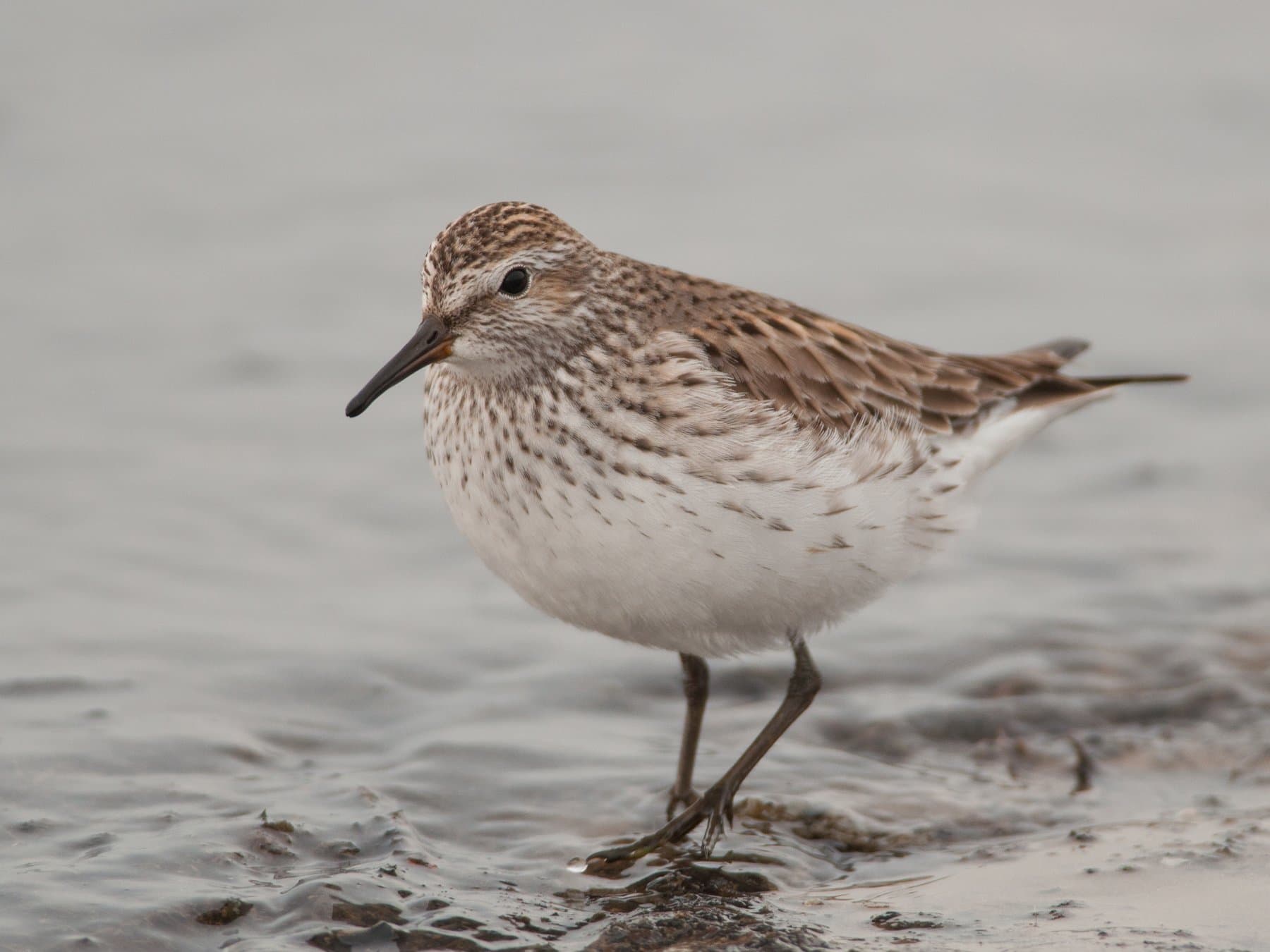
That long wingtip projection is the first thing to check: the primary feathers extend 5–10 mm beyond the tail tip, giving the bird a distinctively tapered, pointed rear end that separates it from most similar "peep" sandpipers at a glance. In flight, the white band across the uppertail coverts — the feature that gives the species its name — flashes conspicuously against the dark upperparts. The overall silhouette is small and elongated, noticeably more streamlined than a Dunlin or Semipalmated Sandpiper.
In breeding plumage, the crown and face are brownish with a pale supercilium. The back and scapulars are dark, with black feather centres and rusty-brown or grey edges creating a spangled, scaled appearance. The breast and flanks are heavily streaked with dark markings that extend well down the sides, while the belly remains white. The bill is medium-length, thin, and dark, with a small but diagnostic reddish-orange or pale yellowish base to the lower mandible — visible at close range in all plumages. The legs are very dark, ranging from blackish to dark olive-brown.
Non-breeding (winter) plumage is considerably plainer: the upperparts become uniform dark grey with black feather centres, the breast turns grey, and the supercilium whitens. The overall impression is a neat, grey-and-white bird. Juvenile plumage, by contrast, is bright and crisp — black-based feathers edged with rich chestnut towards the scapulars and white towards the wing coverts produce a strongly scaly pattern. A white "V" is visible on the back, and the breast is finely streaked.
Males and females are essentially identical in plumage across all seasons. The only reliable difference on the breeding grounds is that males have noticeably larger, more distended throats — a structural adaptation for their unusual aerial song — visible even when males are not actively displaying.
Not sure it’s a White-rumped Sandpiper? Check your photo: Birdfact names the bird and shows the look-alike side by side.
Its size
Adults- Length
- 15–18 cm
- Wingspan
- 40–44 cm
- Weight
- 40–60 g
Its song and calls
The most commonly heard call is a distinctive, high-pitched metallic "tzeep" or "tzeet" — sometimes described as resembling two pebbles scraped against one another, or a very high-pitched squeaky "jeeet." This flight call is often the first indication of the species in a mixed shorebird flock, cutting through the background noise of other waders. Other calls include "prink, prink" or "tzip" outside the breeding range, a repeating "pip, pip, pip…", and a swallow-like twitter produced by flocks in flight. The call is given both in flight and when alarmed on the ground.
On the breeding grounds, males produce one of the most unusual songs of any shorebird. During aerial display flights, the male rises to approximately 30 m above the territory, hovering while extending the neck and distending the throat, and produces a song of low croaks, wiry buzzing, and rattling notes — variously described as resembling the buzz of a running fishing reel, pig oinks punctuated by a typewriter carriage return, or repeated "quo-ick" sounds given three to eight times. The male's enlarged, distended throat is a structural adaptation specifically for producing this outlandish song. Males also call during horizontal "butterfly" flight displays, in which they fly with deep, exaggerated wingbeats.
Females are largely silent. They have only rarely been recorded vocalising and do not participate in song displays. The species is primarily a diurnal vocaliser, calling mainly during daylight hours, though display flights on the breeding grounds can continue through the long Arctic day.
Heard one and not sure? Let the bird song identifier listen.
When and where to see it
OctoberIn season
Most recorded in October
- 1. Mayounder 0.1%
- 2. Lincolnshireunder 0.1%
- 3. Rutlandunder 0.1%
- 4. Eilean Siarunder 0.1%
- 5. Galwayunder 0.1%
Each dot is a county, state or province: the bigger and darker, the larger the bird’s share of that place’s bird records that month. Grey dots: no regular records. The ringed point is the centre of the bird’s records this month; the arrow shows how it moved since last month, and the dashed loop its path through the year. “Arrivals” colours places where it becomes regular this month (orange) or is in its last regular month (grey). GBIF eBird Observation Dataset, 2019–2024. Map data: Natural Earth, US Census Bureau; place centres © OpenStreetMap contributors.
In your area
See when the White-rumped Sandpiper is recorded in your county, state or province.
How often the White-rumped Sandpiper turns up in the UK, Ireland, the United States and Canada through the year, from birdwatchers' records.
United Kingdom
Passage migrant · regularly Jul–Nov · most records in August
Ireland
Passage migrant · regularly Jul–Oct · most records in August
United States
Summer visitor · regularly Apr–Nov · most records in August
Canada
Summer visitor · regularly May–Nov · most records in August
Show as a table
| Month | United Kingdom | Ireland | United States | Canada |
|---|---|---|---|---|
| January | – | – | <0.001% | <0.001% |
| February | 0.003% | – | – | – |
| March | <0.001% | – | <0.001% | – |
| April | – | – | 0.005% (regular) | <0.001% |
| May | <0.001% | – | 0.032% (regular) | 0.014% (regular) |
| June | <0.001% | <0.001% | 0.018% (regular) | 0.016% (regular) |
| July | 0.008% (regular) | 0.004% (regular) | 0.004% (regular) | 0.014% (regular) |
| August | 0.012% (regular) | 0.020% (regular) | 0.035% (regular) | 0.11% (regular) |
| September | 0.005% (regular) | 0.002% | 0.024% (regular) | 0.083% (regular) |
| October | 0.002% (regular) | 0.009% (regular) | 0.014% (regular) | 0.071% (regular) |
| November | 0.002% (regular) | 0.009% | 0.004% (regular) | 0.051% (regular) |
| December | 0.002% | – | <0.001% | 0.001% |
Recorded regularly in
Worldwide: recorded regularly in 54 countries
Countries where it was recorded in at least 3 of the 6 years 2019–2024. Linked countries have their own bird list.
Africa (1)
North America (31)
- Anguilla
- Antigua & Barbuda
- Aruba
- Bahamas
- Barbados
- Belize
- Bermuda
- Canada
- Caribbean Netherlands
- Cayman Islands
- Costa Rica
- Cuba
- Curaçao
- Dominican Republic
- Grenada
- Guadeloupe
- Guatemala
- Honduras
- Martinique
- Mexico
- Montserrat
- Nicaragua
- Panama
- Puerto Rico
- St Kitts & Nevis
- St Lucia
- St Pierre & Miquelon
- Trinidad & Tobago
- Turks & Caicos Islands
- United States
- US Virgin Islands
South America (14)
Antarctica (1)
- Antarctica
Data: EOD – eBird Observation Dataset (Cornell Lab of Ornithology), accessed via GBIF.org, CC BY 4.0. Records from 2019–2024, aggregated and filtered by Birdfact. How these lists are made
Tips for seeing it
At rest, go straight to the rear end: no other small sandpiper of similar size shows wingtips projecting so far beyond the tail. That single feature, combined with the slightly larger and more elongated build compared to a Semipalmated or Least Sandpiper, should narrow the field immediately. At close range, look for the faint orange or yellowish tinge at the base of the lower mandible — present in all plumages and useful when the bird is settled.
In flight, the white uppertail covert patch is unmistakable — broader and brighter than the narrow white sides of the rump seen on some other waders. Listen actively in mixed flocks: the high-pitched metallic "tzeep" cuts through the background noise of other waders and frequently identifies the bird before you've found it visually.
In North America, the best time to look is late May in the Great Plains, when large numbers stage at wetlands such as Cheyenne Bottoms, Kansas, and Quivira National Wildlife Refuge. Southward migration peaks from late August through September. In the UK, the species is a scarce but annual vagrant — most records fall between July and October, with juveniles predominating in autumn. WWT Slimbridge, coastal Norfolk, and Lincolnshire are among the most productive sites. Spring records in Britain are less frequent but do occur, typically in May and June.
Juvenile plumage in autumn is bright and distinctive, with chestnut-edged scapulars and a clean white "V" on the back — often appearing crisper and more colourful than adults at the same season. Non-breeding adults are plainer grey, but the wingtip projection and white uppertail coverts remain diagnostic year-round.
What it eats
Insects dominate the diet on the breeding grounds, with crane flies and beetles particularly important. During migration and winter, the menu shifts towards aquatic invertebrates: marine worms (polychaetes and annelids), ramshorn snails, molluscs, tiny crustaceans including amphipods, midges, flies, leeches, and bloodworms. On the Patagonian wintering grounds, intertidal clams are a key food source.
Although long assumed to be exclusively invertivorous, research has confirmed that seeds and moss also feature in the diet — including seeds of knotweed and various sedges. The species is an opportunistic feeder, adjusting its diet according to season, habitat, and prey availability rather than being locked into a single foraging strategy.
Foraging technique involves probing into mud or shallow water, often inserting the bill completely and deeply, then walking forward to probe again. On tundra, birds push the bill deep into moss and soft vegetation. Surface-picking occurs less frequently. The shift in diet between seasons reflects the species' ability to exploit very different food webs — from the insect-rich Arctic summer to the invertebrate-laden intertidal zones of southern South America — a flexibility that underpins its ability to sustain one of the longest migrations of any shorebird.
Nesting and breeding
Males arrive on the Arctic breeding grounds in early June, immediately claiming territories and beginning to display even while the tundra still carries extensive snow and ice. Territories range from 2.8 to 6 hectares (7–15 acres). The mating system is polygynous: males mate with multiple females, then provide zero parental care. Once all females in a territory have laid their clutches, the male typically departs the area entirely.
Females select nest sites on hummocks or small rises in wet tundra, choosing spots with enough surrounding vegetation to conceal the nest. The female alone builds a cup-shaped depression lined with mosses, grasses, sedges, willow leaves, and lichens. Clutch size is typically four eggs — rarely three. Eggs are buff or pale green (sometimes olive), spotted or blotched with reddish-brown, and average 33.42 × 23.83 mm. Incubation is by the female alone and lasts approximately 22 days. Each egg can take up to 17 hours to hatch.
Chicks are precocial and covered with down at hatching, with a birth mass of approximately 5 g. They can leave the nest as early as 2.5 hours after hatching, with most departing within 17 hours. The female tends and broods the chicks, but the chicks find their own food from the start. Females may move broods up to 2 km to wetter habitats with better foraging conditions. Chicks fledge at approximately 16–17 days, after which they become fully independent. Both sexes are presumed to reach sexual maturity after their first year and are capable of breeding the following June. The entire breeding season, from territory establishment to fledging, is compressed into roughly eight weeks — a necessity given the short Arctic summer.
Behaviour
In flight, the White-rumped Sandpiper is immediately identified by the broad white band across the uppertail coverts, which contrasts sharply with the dark upperparts and tail. The wings are long and pointed — a shape that reflects the species' extraordinary migratory capability — and the overall silhouette is more elongated and tapered than most similar-sized waders.
Flight style is direct and swift, with rapid, shallow wingbeats typical of the Calidris sandpipers. Flocks fly in loose, shifting formations, frequently calling with the characteristic metallic "tzeep" as they move. When flushed from a mudflat or wet field, birds typically rise steeply and circle before settling again nearby.
The long, narrow wing shape is an adaptation for high-endurance, low-drag flight. Accumulating substantial fat reserves at staging sites beforehand is essential — birds can nearly double their body mass before departure, providing the fuel for nonstop transatlantic crossings. This aerodynamic efficiency, combined with the ability to exploit favourable tailwinds, makes the species one of the most capable long-distance fliers among shorebirds of its size.
During breeding display, males perform two distinct aerial modes: a hovering flight at approximately 30 m altitude with neck extended and throat distended for song production, and a horizontal "butterfly" display flight with deep, exaggerated wingbeats. The white uppertail coverts are prominently cocked and displayed during ground courtship as well, functioning as a visual signal.
Lifespan and predators
The oldest recorded White-rumped Sandpiper was at least 7 years old — an individual banded in Quebec in 1972. This figure represents the maximum known lifespan from ringing data rather than a typical expectation. Most individuals in the wild are thought to live between 3 and 7 years, with annual survival rates influenced heavily by the hazards of long-distance migration.
The species faces mortality risks at every stage of its annual cycle. On the breeding grounds, nest predators include jaegers, Peregrine Falcons, and Arctic foxes. During migration, the nonstop transatlantic flights expose birds to exhaustion, adverse weather, and disorientation — storms have been linked to increased vagrancy records in western Europe and the South Shetland Islands. At staging sites, competition for food and disturbance from human activity add further pressure.
The Dunlin — a close relative of similar size — has a recorded maximum lifespan of around 24 years in exceptional cases, though average survival is much lower. That the White-rumped Sandpiper's known maximum sits at just 7 years likely reflects the intensity of its annual cycle: a round trip of over 30,000 km, including nonstop transatlantic crossings, leaves little margin for error. Reaching even that age represents a considerable accumulation of successful migrations, breeding seasons, and overwinter survival on the Patagonian coast.
Conservation
In 2024, the IUCN uplisted the White-rumped Sandpiper from Least Concern to Vulnerable — a significant change that most field guides and online resources have yet to reflect. The current global population is estimated at approximately 1.7 million mature individuals, based on Partners in Flight and PRISM survey data, but this figure masks a troubling trend: an estimated population reduction of around 49% over three generations, though with wide confidence intervals (2.4%–74.6%).
The primary driver of decline is habitat loss along migration routes, particularly wetland drainage and agricultural conversion in the Great Plains. Depletion of underground aquifers in this region reduces surface wetland availability at critical stopover sites — and because the species relies on a small number of key staging areas (such as Cheyenne Bottoms, Kansas) to refuel for long nonstop flights, the loss of even one major site could have disproportionate consequences for the entire population.
Climate change poses a compounding threat. Warming Arctic temperatures are altering breeding habitat structure, shifting migration routes, and affecting the timing and quality of stopover and wintering habitats. The species has already been recorded at the South Shetland Islands near the Antarctic Peninsula — a range expansion linked to changing conditions. Increased human disturbance at staging and wintering sites adds further pressure. Historically, the species was hunted for human consumption; this is now prohibited across its range.
On the breeding grounds, nest predators include jaegers, Peregrine Falcons, and Arctic foxes. Conservation efforts currently focus on wetland protection and restoration at key staging sites, alongside broader advocacy for sustainable water management in the Great Plains.
Similar Species
Baird's Sandpiper is the most similar species and the most likely source of confusion: both show the long primary projection that extends well beyond the tail tip at rest. Baird's is slightly buffer and browner overall, with a scaly rather than streaked breast pattern in breeding plumage, and its call is a low, rolling "krreep" rather than the sharp metallic "tzeep." In non-breeding plumage, Baird's tends to be buffer and less grey. In flight, the White-rumped Sandpiper's white uppertail coverts are diagnostic — Baird's shows no equivalent white patch.
The Dunlin is a common comparison species: in breeding plumage, the Dunlin has a distinctive black belly patch absent in the White-rumped Sandpiper, and its bill droops noticeably at the tip. In non-breeding plumage, the Dunlin is browner and less grey, and lacks the long wingtip projection. The two species are known to hybridise occasionally in northeastern North America.
The Semipalmated Sandpiper is smaller and shorter-winged, with wingtips that do not project beyond the tail at rest — the single most reliable separation feature. Its call is a low, flat "cherk" rather than the White-rumped's high metallic "tzeep." The Least Sandpiper — confirmed as the White-rumped Sandpiper's closest relative by molecular analysis — is smaller still, with yellowish legs (versus dark legs in White-rumped) and a finer, more drooped bill tip.
Courtship & Display
The White-rumped Sandpiper's courtship is among the most elaborate of any small shorebird. Males arrive on the breeding grounds in early June and begin displaying almost immediately, even while snow still covers much of the tundra. Each male courts any female that enters his territory, displaying vigorously for approximately one week per female.
The aerial display is the centrepiece. The male rises to around 30 m above the territory, hovers with neck extended and throat visibly distended, and produces his extraordinary song — a combination of low croaks, wiry buzzing, and rattling notes that has been compared to pig oinks punctuated by a typewriter carriage return. He then drops earthward on upswept wings. The enlarged throat is not merely incidental: it is a structural adaptation evolved specifically for this vocalisation, and is visible even when males are not actively singing.
Ground displays are equally striking. The male raises a single wing towards the female, or performs a more elaborate sequence: opening the wing in a cupped position, cocking the tail to display the white uppertail coverts, running around the female, stamping his feet, and sometimes dragging his wingtips along the ground. A horizontal "butterfly" flight — with deep, exaggerated wingbeats — is also used. The white uppertail covert patch, normally a flight identification feature, thus doubles as a courtship signal on the ground.
The mating system is polygynous — once a female has laid her clutch, the male moves on to court additional females, providing no incubation or chick-rearing. All parental duties fall to the female alone.
Quick facts
- Length
- 15–18 cm
- Wingspan
- 40–44 cm
- Weight
- 40–60 g
- Lifespan
- 3–7 years · oldest recorded 7 years
- Family
- Sandpipers & Snipes
- Migration
- Full migrant
- Global status (IUCN)
- Vulnerable
- World population
- Approximately 1.7 million mature individuals
- Population trend
- Decreasing — estimated population reduction of approximately 49% over three generations (confidence intervals: 2.4%–74.6%). Uplisted from Least Concern to Vulnerable on the IUCN Red List in 2024.
- Scientific name
- Calidris fuscicollis
Sources
14- 1White-rumped sandpiper - Wikipedia Source (opens in a new tab)
- 2White-rumped Sandpiper Species Factsheet - BirdLife International DataZone Source (opens in a new tab)
- 3White-rumped Sandpiper - eBird (Cornell Lab) Source (opens in a new tab)
- 4White-rumped Sandpiper Overview - All About Birds, Cornell Lab of Ornithology Source (opens in a new tab)
- 5White-rumped Sandpiper Identification - All About Birds, Cornell Lab of Ornithology Source (opens in a new tab)
- 6White-rumped Sandpiper Life History - All About Birds, Cornell Lab of Ornithology Source (opens in a new tab)
- 7White-rumped Sandpiper - Audubon Field Guide Source (opens in a new tab)
- 8Calidris fuscicollis (white-rumped sandpiper) - Animal Diversity Web Source (opens in a new tab)
- 9White-rumped Sandpiper - BTO BirdFacts Source (opens in a new tab)
- 10Calidris fuscicollis - IUCN Red List 2024 Assessment (Vulnerable A2b+4b) (2024) Source (opens in a new tab)
- 11Migration and Mass Change of Calidris fuscicollis in North and South America - International Wader Studies Source (opens in a new tab)
- 12White-rumped Sandpiper vocalisations - Xeno-canto Source (opens in a new tab)
- 13White-rumped Sandpiper - South Dakota Birds Source (opens in a new tab)
- 14White-rumped Sandpiper - Wader Quest Source (opens in a new tab)

Checked by
Nathan Cope, founder and editor
Nathan founded Birdfact and leads its writers and contributors in the UK, the US and Canada. He has watched and studied birds for more than ten years, and checks every article and species guide before it’s published.