


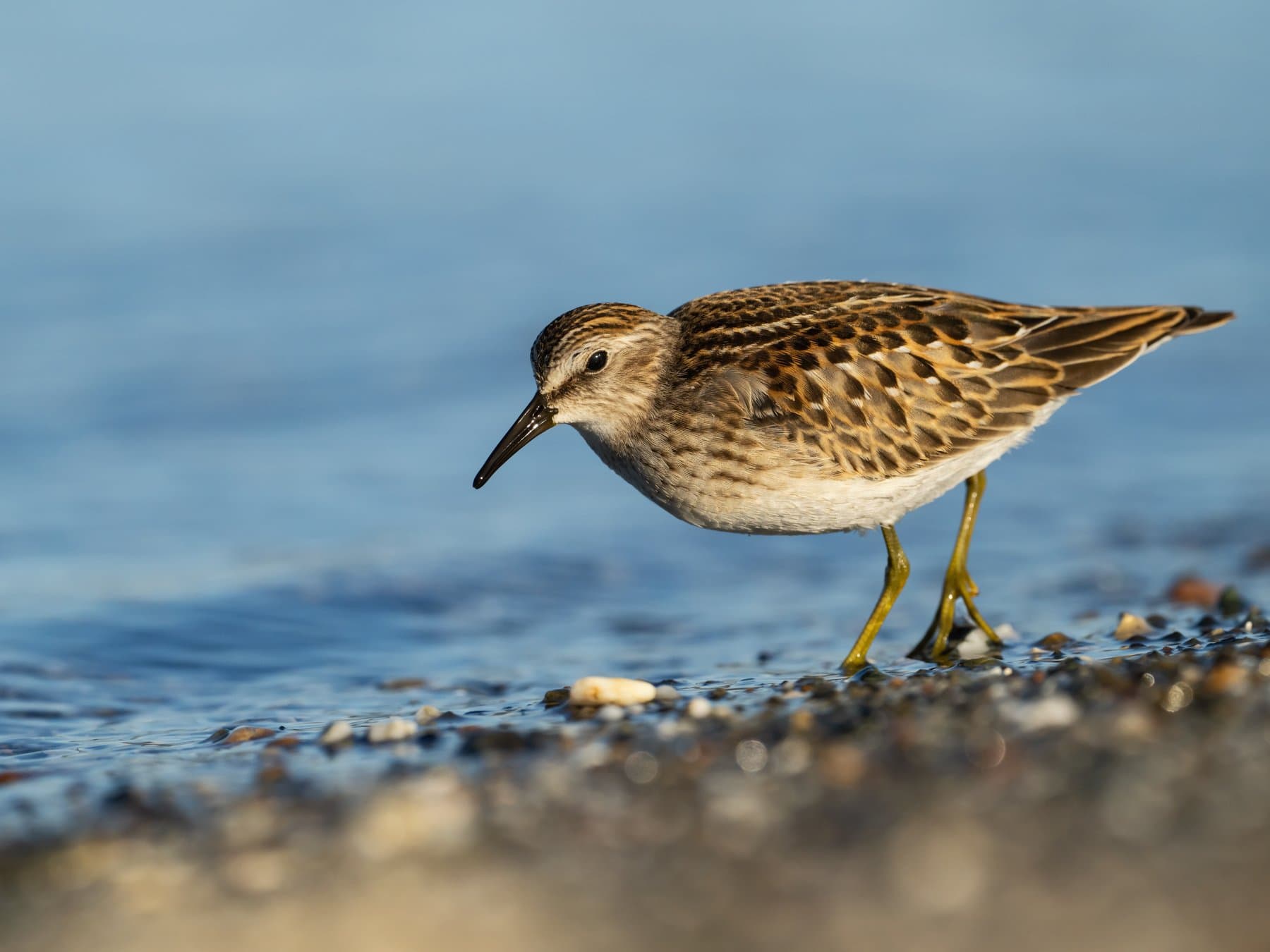
Least Sandpiper
Calidris minutilla
By the Birdfact teamChecked by Nathan Cope
The Least Sandpiper is the world's smallest shorebird — a bird barely larger than a House Sparrow that weighs as little as 17 grams, yet crosses up to 4,000 km of open ocean in a single nonstop flight from New England to South America. Look for the tell-tale yellowish-green legs: no other "peep" sandpiper of similar size shares this feature, making it one of the most reliable field marks in North American shorebirding.
On this page11 sections
How to recognise it
Yellowish-green legs are the single most useful field mark on a Least Sandpiper, immediately separating it from the similarly sized Semipalmated Sandpiper and Western Sandpiper, both of which have black legs. The bill is short, thin, and very slightly decurved at the tip — a fine, needle-like structure that gives the bird a delicate, almost dainty expression.
In breeding plumage, adults are warm brown above with blackish-brown streaking on the crown and hindneck. The mantle feathers are blackish-brown with broad rufous to bright cinnamon edges, creating a vivid scaly pattern. A whitish supercilium is streaked with dark brown, and the lores are very dark. The breast is heavily streaked dark brown, contrasting sharply with the white belly. In flight, a narrow white wingbar is visible, along with white sides to the rump and uppertail bisected by a dark central stripe.
Non-breeding (winter) adults are considerably duller: grey-brown above with pale feather edges, and the underparts are white with a greyish-brown wash on the throat and breast, finely streaked brown. The overall impression is of a small, hunched, brownish bird — easy to overlook among other waders.
Juveniles are the brightest of all plumages. Crisp rufous-edged wing coverts and mantle feathers create vivid rusty tones on the upperparts, and white mantle stripes are particularly prominent. Breast streaking is less heavy than in breeding adults.
Females are slightly larger overall and have noticeably longer bills than males — a dimorphism that allows females to probe deeper into mud and access larger, more deeply buried prey. Both sexes show the same seasonal plumage changes, and the difference in bill length is the most reliable way to distinguish the sexes in the field, though it requires direct comparison. The species forages in a characteristic crouched posture with bent legs, which, combined with its small size and brown coloration, can make it easy to overlook among other shorebirds.
Not sure it’s a Least Sandpiper? Check your photo: Birdfact names the bird and shows the look-alike side by side.
Its size
Adults- Length
- 13–15 cm
- Wingspan
- 26–29 cm
- Weight
- 17–33 g
Its song and calls
The most frequently heard call is a high-pitched, rising "kreep" or "greeep" — a clear, reedy, rolling note that carries well across open wetland. This flight call is given regularly during migration and is one of the most reliable ways to detect the species, particularly when birds are moving overhead at night. When feeding, birds also give a soft, low "prrrt" or chuckling note during close-range interactions.
On the breeding grounds, unpaired males produce three main categories of vocalisation. The first is a series of Rhythmically Repeated Calls used to attract mates and in agonistic interactions with rival males. The second is a sustained aerial song delivered during display flights — a monotonous, single repeated note given continuously as the male circles the territory. The third is a chatter call used in close-range encounters. Research into geographic variation in vocalisations found no differences between geographically separated populations, suggesting little or no vocal learning in this species — an unusual finding among songbirds and waders alike.
Heard one and not sure? Let the bird song identifier listen.
When and where to see it
OctoberLeaving
Most recorded in October
- 1. Texas0.52%
- 2. California0.42%
- 3. Louisiana0.41%
- 4. Oklahoma0.39%
- 5. Mississippi0.37%
Each dot is a county, state or province: the bigger and darker, the larger the bird’s share of that place’s bird records that month. Grey dots: no regular records. The ringed point is the centre of the bird’s records this month; the arrow shows how it moved since last month, and the dashed loop its path through the year. “Arrivals” colours places where it becomes regular this month (orange) or is in its last regular month (grey). GBIF eBird Observation Dataset, 2019–2024. Map data: Natural Earth, US Census Bureau; place centres © OpenStreetMap contributors.
In your area
See when the Least Sandpiper is recorded in your county, state or province.
How often the Least Sandpiper turns up in the United States and Canada through the year, from birdwatchers' records.
United States
Winter visitor · regularly Jul–May · most records in August
Canada
Passage migrant · regularly May–Sep · most records in August
Show as a table
| Month | United States | Canada |
|---|---|---|
| January | 0.15% (regular) | 0.001% |
| February | 0.12% (regular) | <0.001% |
| March | 0.10% (regular) | <0.001% |
| April | 0.14% (regular) | 0.029% |
| May | 0.16% (regular) | 0.17% (regular) |
| June | 0.019% | 0.027% |
| July | 0.28% (regular) | 0.23% (regular) |
| August | 0.59% (regular) | 0.65% (regular) |
| September | 0.33% (regular) | 0.28% (regular) |
| October | 0.17% (regular) | 0.025% |
| November | 0.19% (regular) | 0.005% |
| December | 0.15% (regular) | 0.002% |
Worldwide: recorded regularly in 51 countries
Countries where it was recorded in at least 3 of the 6 years 2019–2024. Linked countries have their own bird list.
Europe (1)
North America (38)
- Anguilla
- Antigua & Barbuda
- Aruba
- Bahamas
- Barbados
- Belize
- Bermuda
- British Virgin Islands
- Canada
- Caribbean Netherlands
- Cayman Islands
- Costa Rica
- Cuba
- Curaçao
- Dominican Republic
- El Salvador
- Grenada
- Guadeloupe
- Guatemala
- Haiti
- Honduras
- Jamaica
- Martinique
- Mexico
- Montserrat
- Nicaragua
- Panama
- Puerto Rico
- Sint Maarten
- St Kitts & Nevis
- St Lucia
- St Martin
- St Pierre & Miquelon
- St Vincent & the Grenadines
- Trinidad & Tobago
- Turks & Caicos Islands
- United States
- US Virgin Islands
Data: EOD – eBird Observation Dataset (Cornell Lab of Ornithology), accessed via GBIF.org, CC BY 4.0. Records from 2019–2024, aggregated and filtered by Birdfact. How these lists are made
Tips for seeing it
The yellowish-green legs are the single most reliable field mark. In any mixed flock of small sandpipers, scan the legs first — if they are yellow-green rather than black, you have a Least Sandpiper. The combination of small size (noticeably smaller than a Dunlin), warm brown upperparts, and that distinctive leg colour is usually enough for a confident identification.
Pay attention to microhabitat. Least Sandpipers consistently favour the upper, drier edges of mudflats and often work partially within fringing vegetation, while Semipalmated and Western Sandpipers tend to feed in wetter, lower zones. If you see a small sandpiper picking at the grass-mud interface rather than in the open mud, it is worth checking carefully.
In North America, the species is widespread and often common during migration from late June through September. Inland sites — flooded fields, sewage treatment ponds, muddy reservoir margins — are productive, as the Least Sandpiper is more tolerant of inland habitats than most other small sandpipers. Spring migration peaks in April and May. The Copper River Delta in Alaska is a spectacular spring staging site.
In the UK, the species is a rare vagrant and any sighting requires careful documentation. Autumn (August–October) is the most likely time, when displaced transatlantic migrants occasionally turn up on western coasts. The Somerset record at Steart Marshes in January 2025 was exceptional in both timing and location. Always check small sandpipers carefully for leg colour, bill shape, and the characteristic hunched posture.
The flight call — a high, rising "kreep" or "greeep" — is distinctive and carries well. Learning this call is one of the best ways to pick the species out of a mixed flock in flight.
What it eats
On the breeding grounds, the Least Sandpiper feeds mainly on the larvae of midges, chironomids, and other flies, supplemented by other small insects. During coastal migration stopovers, the diet shifts toward small crustaceans — particularly amphipods and isopods — as well as small snails, marine worms, and other invertebrates. In spring on the Atlantic Coast, it joins other shorebirds in feeding on the eggs of horseshoe crabs, a rich energy source that fuels the final push to the breeding grounds. Inland migrants eat mostly insects. Seeds of marsh grasses such as smartweed and panic grass also feature in the autumn diet.
The species uses two main foraging techniques: picking prey items from the surface, and probing damp mud with its bill for buried prey. Females, with their longer bills, probe deeper and access larger, more deeply buried prey items than males. This means the two sexes effectively partition the food resource on shared feeding grounds, reducing competition between mates.
A feeding mechanism published in Science in 2008 revealed that while probing damp mud, the sandpiper uses the surface tension of water surrounding a prey item to transport it from the bill tip to the mouth in a stepwise "capillary ratchet" motion. The bird rapidly opens and closes its bill in a tweezering action, moving a water droplet containing the prey toward the mouth in incremental steps — a physical feeding mechanism previously unknown in birds. This mechanism requires no muscular effort beyond the bill movements themselves. It also has a conservation implication: surface pollutants such as oil or detergents that alter water's wetting properties can disrupt the ratchet entirely, potentially rendering affected birds unable to feed efficiently.
Nesting and breeding
Males arrive on the breeding grounds approximately one week before females and immediately begin establishing territories. Egg-laying typically occurs between mid-May and early June. The clutch is almost invariably four eggs — rarely three — pale yellowish-brown with brown spots or blotches, measuring approximately 2.8–3.0 cm × 2.1–2.2 cm.
Both parents share incubation duties over a period of 19–23 days (average around 20 days). The female incubates in the evening and early morning, while the male takes the longer daytime shift. As incubation progresses, the male takes an increasingly large share; in later stages he may do all of the incubating. The female typically deserts the brood before the young fledge — sometimes even before the eggs hatch in late-season clutches. The male usually remains with the chicks until fledging at approximately 14–16 days after hatching.
The male makes several scrapes in the ground within the nesting territory, and the female selects one. He begins the nest by pressing his body into vegetation to form a shallow depression; the female finishes it by smoothing the hollow and adding a sparse lining of dead grass, leaves, and moss, creating a cup approximately 5 cm across and 4 cm deep. Nests are typically sited on slightly drier hummocks or tufts of grass within wet tundra or bog.
The chicks are precocial, leaving the nest within 24 hours of the last egg hatching. They are active and covered with down at hatching, and feed themselves from the start. Nest predators include Common Ravens, crows, gulls, Sandhill Cranes, jaegers, Short-eared Owls, Arctic foxes, and red foxes.
An unusual behaviour documented in this species is brood amalgamation: chicks from different broods may merge into mixed groups, with unrelated adults caring for young that are not their own. Research published in the Canadian Journal of Zoology found this alloparental care to be widespread among calidridine sandpipers, and it is thought to enhance chick survival with little cost to adult fitness.
Behaviour
In flight, the Least Sandpiper appears very small and compact, with relatively short, pointed wings and a fast, direct wingbeat. The flight action is typically rapid and slightly erratic over short distances, with birds often twisting and jinking before dropping back into cover. Over longer distances — particularly during migration — flight becomes more direct and purposeful.
The key features to look for in flight are the narrow white wingbar, visible against the dark upperwing, and the white sides to the rump and uppertail bisected by a dark central stripe. This rump pattern is shared with several other small sandpipers but, combined with the small size and warm brown tones, helps narrow identification. The underwing is pale.
On migration, birds often fly in tight, fast-moving flocks that twist and turn in unison — the classic "peep" flock behaviour. Flocks frequently call in flight, and the high "kreep" call is often the first indication of the species' presence overhead, particularly during nocturnal migration. The species is a long-distance migrant capable of extraordinary sustained flight: eastern populations undertake nonstop transoceanic crossings of up to 4,000 km, one of the longest overwater flights made by any shorebird of this size. Western populations follow a different strategy, making shorter flights with more frequent stopovers through the interior of North America or down the Pacific Coast.
Lifespan and predators
The typical lifespan of a Least Sandpiper in the wild is around 3–5 years, though many birds do not survive their first year. Annual survival rates for adults are relatively high compared to smaller passerines, reflecting the physiological investment required for long-distance migration. The maximum recorded lifespan is 16 years, documented for a female recaptured in Nova Scotia — more than three times the species' typical longevity.
Mortality causes include predation at all stages of the life cycle: eggs and chicks are taken by Common Ravens, crows, gulls, jaegers, Short-eared Owls, Arctic foxes, and red foxes. Adults face exhaustion and starvation during migration, and habitat loss on wintering grounds reduces survival prospects for birds that arrive in poor condition. The nonstop transoceanic flights undertaken by eastern populations represent a particularly high-risk period — birds must depart with sufficient fat reserves to complete a crossing of up to 4,000 km, and adverse weather en route can be fatal. Those that survive the crossing and reach their wintering grounds in good condition have a reasonable chance of returning to breed the following spring.
Conservation
The Least Sandpiper is currently listed as Near Threatened on the IUCN Red List (2016 assessment), having been uplisted from Least Concern as population declines became apparent. BirdLife International estimates 5–15 million mature individuals globally, though a 2012 continental survey by Andres et al. produced a figure of approximately 700,000 birds — widely considered an undercount due to the difficulty of distinguishing the species from other small sandpipers during surveys.
Population trends are not uniform across the range. Western and central Canadian populations appear relatively stable, but eastern North American populations have shown significant declines. Fall migration counts in eastern Canada fell by approximately 3% per year between 1974 and 1991. The Maritime Provinces population declined by 15.8% annually from 1974 to 1998 — a steep and sustained drop. Christmas Bird Count data suggest wintering populations have also declined in some regions.
The primary threats are wetland degradation and destruction along migration routes and on wintering grounds. Because the breeding range is broad and remote, declines are thought to be driven mainly by habitat loss at stopover and wintering sites rather than on the breeding grounds themselves. Climate change poses an additional long-term threat: projections for British Columbia suggest that alpine tundra breeding habitat will contract substantially over the coming century as temperatures rise.
Surface pollutants such as oil or detergents can disrupt the species' capillary ratchet feeding mechanism, potentially preventing efficient foraging. The species is not currently targeted by specific conservation management programmes but benefits from general shorebird habitat protection measures, including the Migratory Bird Treaty Act of 1918, which ended the widespread commercial hunting that had previously affected populations.
Quick facts
- Length
- 13–15 cm
- Wingspan
- 26–29 cm
- Weight
- 17–33 g
- Lifespan
- 3–5 years · oldest recorded 16 years
- Family
- Sandpipers & Snipes
- Migration
- Full migrant
- Global status (IUCN)
- Near Threatened
- World population
- 5,000,000–15,000,000 mature individuals (BirdLife International)
- Population trend
- Decreasing overall, with significant declines in eastern North American populations. Fall migration counts in eastern Canada fell ~3% per year between 1974 and 1991; Maritime Provinces populations declined 15.8% annually from 1974–1998. Western and central Canadian populations appear more stable.
- Scientific name
- Calidris minutilla
Sources
17- 1Least sandpiper - Wikipedia Source (opens in a new tab)
- 2Least Sandpiper Overview - All About Birds, Cornell Lab of Ornithology Source (opens in a new tab)
- 3Least Sandpiper Life History - All About Birds, Cornell Lab of Ornithology Source (opens in a new tab)
- 4Least Sandpiper Identification - All About Birds, Cornell Lab of Ornithology Source (opens in a new tab)
- 5Least Sandpiper - Audubon Field Guide Source (opens in a new tab)
- 6Least Sandpiper - BirdLife International DataZone Source (opens in a new tab)
- 7Least Sandpiper - eBird, Cornell Lab of Ornithology Source (opens in a new tab)
- 8Least Sandpiper - BTO BirdFacts Source (opens in a new tab)
- 9Least Sandpiper - Oiseaux-Birds.com Source (opens in a new tab)
- 10Least Sandpiper - BC Breeding Bird Atlas Source (opens in a new tab)
- 11Least Sandpiper - BirdWeb (Seattle Audubon) Source (opens in a new tab)
- 12Least Sandpiper - Birds of the World (Cornell Lab) Source (opens in a new tab)
- 13Least Sandpiper Sounds - Birds of the World Source (opens in a new tab)
- 14Least Sandpiper longevity - AnAge Database Source (opens in a new tab)
- 15Surface tension transport of prey by feeding shorebirds: the capillary ratchet - PubMed (Science, 2008) (2008) Source (opens in a new tab)
- 16Birdwatch: an unlikely encounter with the least sandpiper in Somerset - The Guardian (2025) Source (opens in a new tab)
- 17Brood amalgamation and alloparental care in the Least Sandpiper - Canadian Journal of Zoology Source (opens in a new tab)

Checked by
Nathan Cope, founder and editor
Nathan founded Birdfact and leads its writers and contributors in the UK, the US and Canada. He has watched and studied birds for more than ten years, and checks every article and species guide before it’s published.