Species Profile
Western Sandpiper
Calidris mauri
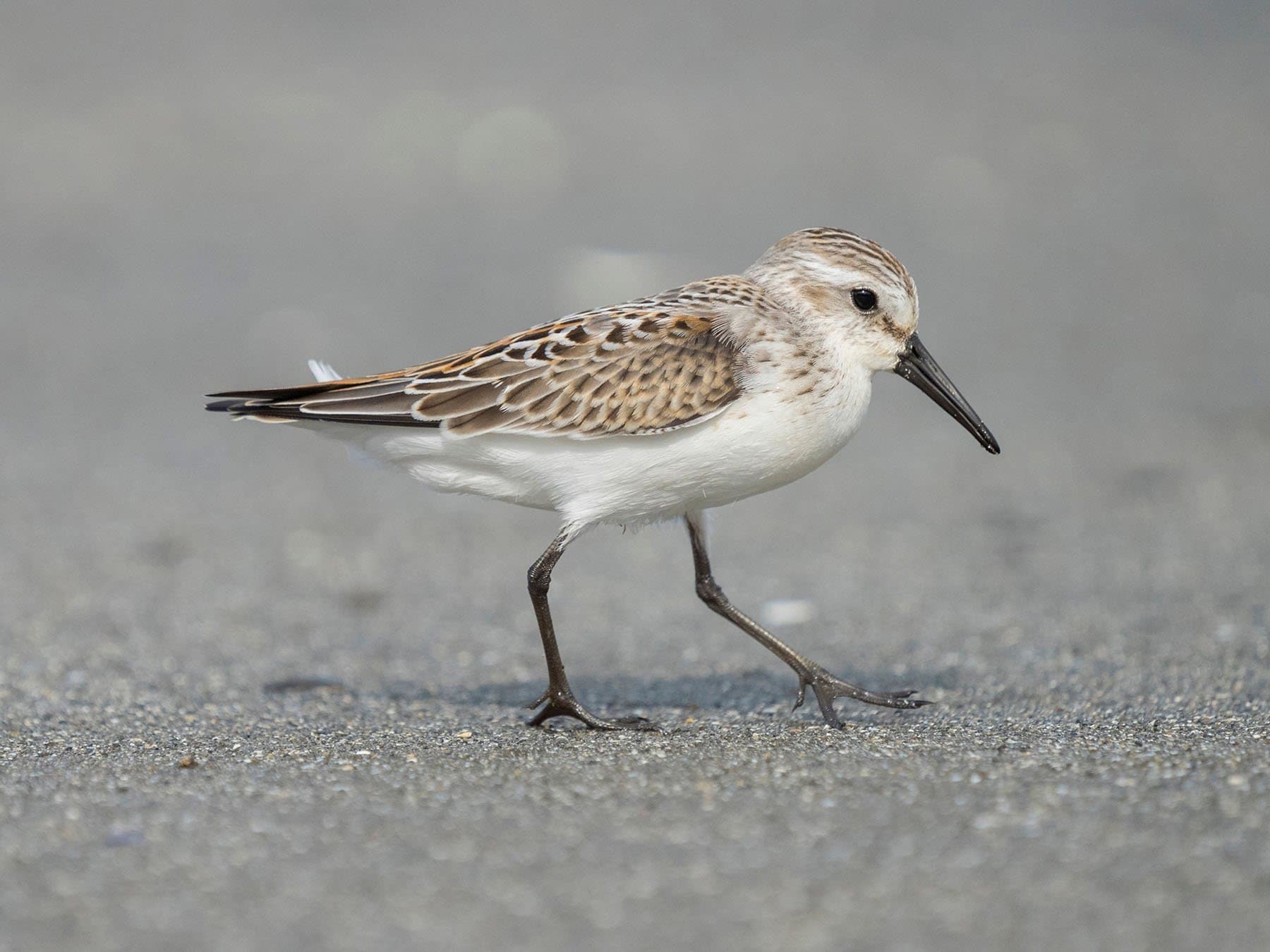
Western Sandpiper walking on a sandy surface, showing brown and white mottled plumage, dark legs, and a long, slightly decurved dark bill.
Quick Facts
Conservation
LCLeast ConcernLifespan
5–9 years
Length
14–17 cm
Weight
22–35 g
Wingspan
35–37 cm
Migration
Long-distance Migrant
A small, portly shorebird with a distinctively long, drooping bill, the Western Sandpiper punches well above its weight in the record books. Despite weighing no more than 35 grams, it completes one of North America's most spectacular migrations — up to 80% of the entire global population of 3.5 million birds funnels through the Copper River Delta in Alaska each spring, creating one of the greatest concentrations of wildlife on the planet.
Think you've spotted a Western Sandpiper?
Upload a photo and we'll confirm it instantly
Confirm with a PhotoAppearance
The Western Sandpiper is a compact, front-heavy shorebird with a proportionally large head, short neck, and long pointed wings that extend noticeably beyond the tail tip at rest. Its most reliable identification feature is the bill: long, thin, and slightly drooped at the tip — longer and more decurved than any other North American "peep" sandpiper except the Dunlin. The bill and legs are black throughout the year.
Breeding plumage, worn from late April through early summer, is the most striking. The crown and ear patch are rich rufous-chestnut, the back and scapulars are a mosaic of black, rufous, gold, and grey, and the white underparts carry heavy dark arrow-shaped streaks across the breast and flanks. Males tend to show brighter chestnut tones above; females are slightly duller. By contrast, non-breeding (winter) adults are plain pale grey above and clean white below, with minimal breast streaking — a transformation so complete that winter birds are frequently confused with the closely related Semipalmated Sandpiper.
Juveniles offer a useful middle ground: they retain crisp gold and rufous feather edges on the back, giving a scaly appearance, and show a distinctive rusty bar along the upper edge of the wing (the lesser coverts). This shoulder bar persists into early autumn when adults have already moulted into grey winter plumage, making it a reliable age-separation feature at key stopover sites.
In flight, look for a narrow white wing bar, a dark central tail stripe, and white outer tail feathers. Like the Semipalmated Sandpiper, the Western Sandpiper has small partially webbed (palmate) toes — visible only at very close range. The species undergoes a five-step annual moult cycle, cycling through prejuvenile, prebasic, first prealternate, definitive prebasic, and definitive prealternate moults.
Identification & Characteristics
Male Colors
- Primary
- Grey
- Secondary
- White
- Beak
- Black
- Legs
- Black
Female Colors
- Primary
- Grey
- Secondary
- White
- Beak
- Black
- Legs
- Black
Male Markings
Long, thin, slightly drooped black bill; rufous-chestnut crown and ear patch in breeding plumage; rusty shoulder bar on juveniles; narrow white wing bar in flight
Tail: Short tail; dark central stripe with white outer rectrices, visible in flight
Female Markings
Slightly duller rufous tones in breeding plumage than male; bill averages approximately 15% longer and more strongly drooped at tip
Tail: As male — dark central stripe with white outer rectrices
Attributes
Understanding Attributes
Rated 0–100 based on research and observation. A score of 50 is average across all bird species. These attributes are relative and don't necessarily indicate superiority.
Habitat & Distribution
Western Sandpipers breed almost exclusively in western Alaska, with the core population centred on the Yukon-Kuskokwim Delta — one of the largest river deltas in the world. The breeding range extends north to the Seward Peninsula, and a small population breeds in eastern Siberia (Chukotka). Two main tundra habitat types are used: drained, heath-covered upland tundra dominated by dwarf birch, willow, crowberry, sedges, cottongrass, and lichens; and low-lying marsh tundra with abundant lakes, streams, and ponds. Nests are placed in dry areas, while foraging occurs in nearby coastal lagoons and tundra pools.
During migration, the species uses river deltas, tidal estuaries with fine mud, sandflats, agricultural fields, flooded lake margins, sod farms, sewage treatment ponds, saltmarshes, and freshwater marshes. The primary migration corridor follows the Pacific Flyway along the western coast of North America, with the Copper River Delta in southern Alaska, San Francisco Bay in California, and the Fraser River Estuary in British Columbia serving as the most important stopover sites. A significant proportion of the population also moves along the Atlantic coast in autumn, and some birds cross through the interior of North America.
Wintering birds occupy coastal mudflats, sandy beaches, tidal estuaries, saltmarshes, salt evaporation ponds, abandoned shrimp farms, mangroves, and cattail marshes from the southern United States south through Central America, the Caribbean, and along both coasts of South America to Peru — and rarely to Chile. Some individuals winter around high-elevation lakes in interior Mexico, with records up to 2,500 metres.
In the United States, the Western Sandpiper is a common to abundant migrant and winter resident along the Pacific and Gulf coasts, and an uncommon to rare migrant on the Atlantic coast and through the interior. Birders in California, Oregon, Washington, and along the Gulf Coast have excellent opportunities to see large flocks during both spring (April–May) and autumn (July–September) migration. In Canada, the Fraser River Estuary in British Columbia is a globally significant stopover, with 14–21% of the entire flyway population stopping regularly — and possibly up to 64% in some years.
In the UK, the Western Sandpiper is classified as a 'Mega' rarity by BirdGuides. Prior to 2021, there were only around ten accepted British records. A summer-plumaged bird at Snettisham RSPB, Norfolk in July 2021 — only the second ever Norfolk record — attracted birders from across the country. Vagrant records have come from Scotland, Devon, Dorset, Hampshire, and Norfolk. Ireland has a handful of accepted records, including one at Tacumshin, Co. Wexford. Elsewhere in Europe, vagrants have been recorded in France, Spain, and other western European countries.
Where to See This Bird
Explore regional guides for locations where this bird has been recorded.
Alaska
Nevada
California
Delaware
Oregon
Washington
British Columbia
Diet
On the breeding grounds in Alaska, Western Sandpipers eat mainly insects and their larvae — midges, craneflies, brine flies, shore flies, and beetles — supplemented by spiders, small crustaceans, and aquatic invertebrates including molluscs and marine worms. These are picked from plant surfaces or water, or probed from shallow mud in pools typically less than 10 cm deep.
During migration and winter, the diet broadens considerably. Key prey items include amphipods, copepods, cumaceans, brine shrimp, polychaete worms, roundworms, small bivalves (amethyst gem clams, Baltic clams, blue mussels), eastern mudsnails, and a range of tiny crustaceans. Inland migrants supplement this with insects and occasional seeds.
Perhaps the most striking dietary discovery of recent decades is the role of biofilm. This thin, frothy layer of diatoms, microbes, organic detritus, and sediment coats the surface of intertidal mudflats and was long overlooked as a food source. Western Sandpipers are among the very few vertebrates known to actively graze on it, skimming or slurping the film from the mud surface. A peer-reviewed study using stable isotope analysis at the Fraser River Estuary in British Columbia estimated that biofilm accounts for 22–59% of the total diet during migratory stopovers, and up to 50% of daily energy needs. This finding fundamentally changed our understanding of shorebird nutrition and highlighted the critical importance of intact intertidal mudflats at Pacific Flyway stopover sites.
Bill length dimorphism between the sexes reduces direct dietary competition. Short-billed males forage more at the surface; longer-billed females probe deeper and access different prey, allowing both sexes to exploit the same mudflat without direct competition for the same food items.
Behaviour
Western Sandpipers are highly gregarious outside the breeding season, forming dense flocks of thousands — sometimes tens of thousands — at key stopover and wintering sites. At high tide, roosting flocks pack tightly onto saltmarshes and beaches, then disperse across exposed mudflats as the tide recedes. Within these flocks, foraging birds move steadily forward, probing and pecking with a characteristic sewing-machine action.
Foraging behaviour is shaped by both sex and social context. Short-billed males predominantly peck or glean prey from the surface, favouring drier or shallower areas of mud. Longer-billed females probe more deeply, accessing buried invertebrates and tending to take larger prey items. When larger Dunlin are present, Western Sandpipers are displaced from the productive tide edge to drier areas of the flat — a competitive interaction that has been well documented at Pacific Flyway stopover sites.
On the breeding grounds, males are strongly territorial, performing aerial display flights and calling persistently from the moment they arrive in late May. Both sexes share incubation duties, but the female typically departs before the chicks fledge, leaving the male to complete all chick-rearing alone — an unusual reversal of typical shorebird parental roles.
Predation pressure during southbound migration is significant. Peregrine Falcons — a major predation risk — arrive at key stopover sites from late July as they return from northern breeding areas, coinciding with peak Western Sandpiper passage. Flocks respond to falcon presence with tight, synchronised aerial manoeuvres, making individual capture difficult.
Calls & Sounds
Sharp and high-pitched, the Western Sandpiper's most commonly heard call — a "jeet", also rendered as "cheep" or "kreep" — carries well across open mudflats and is the primary contact note used throughout the year. This flight call is higher and thinner than the equivalent call of the Semipalmated Sandpiper, a useful distinction when mixed flocks pass overhead. Birds of the World describes the most common loud call on migration and non-breeding grounds as a variable "cheé-rp, cheep!" Flocks in flight produce a collective chattering as multiple individuals call simultaneously.
On the breeding grounds, males are considerably more vocal. The territorial and courtship song is a complex series of trills and buzzy notes delivered during aerial display flights over the breeding territory. During ground courtship displays, males give a distinctive trilling call — described by Holmes (1973) as "brrrt, brrrt" — while approaching females in a hunched posture with drooped, trembling wings. Various alarm, distress, and contact calls are also produced on the breeding grounds.
Unlike some related sandpipers such as the Least Sandpiper and Semipalmated Sandpiper, the Western Sandpiper does not perform a hovering display flight. Females are generally quieter than males throughout the year, though both sexes give the standard flight call. Outside the breeding season, the species is not particularly vocal at rest, but calling increases markedly when flocks take flight or are disturbed by a predator.
Flight
Western Sandpipers are strong, swift fliers with long, pointed wings well suited to sustained long-distance travel. In direct flight, the wingbeats are rapid and fairly shallow, producing a flickering quality typical of small sandpipers. Flocks in flight are highly cohesive, wheeling and banking in tight synchrony — a behaviour that makes individual capture by falcons more difficult and is most dramatic at large coastal stopover sites where thousands of birds move together.
The narrow white wing bar is clearly visible in flight, running along the greater coverts, and the tail pattern — dark central stripe flanked by white outer rectrices — is a useful feature when birds pass overhead. The long bill and relatively large head give the bird a front-heavy silhouette in flight, distinguishing it from the more evenly proportioned Semipalmated Sandpiper.
On the breeding grounds, males perform two distinct aerial display flights — a slow "butterfly flight" and a fast, swooping flight ending with an abrupt upward pull — both accompanied by song (see Courtship and Display for full details). During migration, the species appears to travel in a series of short to moderate flights rather than long overwater crossings, stopping frequently at coastal wetlands to refuel — a strategy that makes the quality of stopover habitat critically important to survival.
Nesting & Breeding
Males arrive on the Alaskan breeding grounds from late May, often contending with snow and ice for several days before the tundra clears. They immediately establish territories of 0.5–3.5 acres, performing display flights and calling persistently. Females arrive shortly after and are initially unreceptive, preferring to feed and rebuild energy reserves after the northward migration. Full details of courtship displays are covered in the courtship and display section.
The species is monogamous, with a strong pair bond throughout the breeding season.
The nest is a shallow scrape in flat, dry tundra, typically beneath a grass tussock or dwarf birch, lined with dry willow and birch leaves, grasses, sedges, and lichens. The interior cup averages about 6.4 cm across and 5.6 cm deep. The clutch typically contains 4 eggs (range 2–5), white to cream or brown and densely spotted with brown, measuring approximately 2.94–3.32 cm long and 2.14–2.35 cm wide.
Both parents share incubation over approximately 21 days (range 20.5–22 days). Most clutches hatch around mid-June. Hatchlings weigh 4.4–5.4 g and are precocial — active and downy, leaving the nest within hours and foraging independently within 24 hours. The female typically departs before fledging, leaving the male to complete chick-rearing alone. Young fledge at 17–21 days. Many first-year birds that winter in Central America do not return to the breeding grounds in their first spring, reaching sexual maturity at around one year old.
Lifespan
The maximum recorded lifespan for a wild Western Sandpiper is 9 years and 2 months, established through a banding record in Kansas (Cornell Lab / USGS Bird Banding Laboratory). Typical lifespan in the wild is estimated at 5–9 years, though annual survival rates mean many birds do not approach this maximum.
Annual survival is influenced heavily by conditions at a small number of key stopover sites. Because so much of the global population concentrates at the Copper River Delta and a handful of other locations, a single adverse event — an oil spill, a severe weather event, or a disease outbreak — could affect survival rates across a significant proportion of the population in a single season.
Predation is a significant mortality source throughout the annual cycle. Peregrine Falcons are the primary aerial predator during migration, with predation pressure increasing steeply from late July as peregrines return from northern breeding areas. On the breeding grounds, Arctic foxes, jaegers, and other tundra predators take eggs and chicks. Many first-year birds that winter in Central America do not return to the breeding grounds in their first spring, suggesting that first-year survival or the energetic cost of the full northward migration is a limiting factor for young birds. Compared to the Wood Sandpiper, which has a maximum recorded age of around 11–12 years, the Western Sandpiper's banding record is somewhat lower, though both species face similar long-distance migration pressures.
Conservation
The Western Sandpiper is listed as Least Concern on the IUCN Red List (2016), with a global population estimated at approximately 3.5 million mature individuals by BirdLife International and Partners in Flight. Despite this large total, the population trend is decreasing, and the species scores 12 out of 20 on the Partners in Flight Continental Concern Score — indicating low but monitored concern.
The single greatest structural vulnerability is the species' extreme dependence on a tiny number of stopover sites. Because nearly 80% of the global population concentrates at the Copper River Delta within a few weeks each spring, any significant habitat degradation there — from an oil spill, pollution event, or sea-level rise — could have population-level consequences in a single season. The Fraser River Estuary in British Columbia is similarly critical, regularly hosting 14–21% of the Pacific Flyway population.
Specific threats include: wetland drainage across Middle America for shrimp farms and agriculture, which reduces wintering habitat; the spread of invasive smooth cordgrass (Spartina alterniflora), which has heavily invaded estuaries in Washington state and California, smothering the intertidal mudflats on which foraging birds depend; oil spills and chemical pollution at coastal stopover sites; and climate change, which threatens intertidal mudflat habitats through sea-level rise, alters Arctic food webs, and is already shifting migration timing. Human disturbance from recreation, aquaculture, and coastal development at key sites adds further pressure.
Conservation responses include the Western Hemisphere Shorebird Reserve Network (WHSRN), which has designated key stopover and wintering sites as reserves, and ongoing population monitoring programmes. Research into biofilm ecology has also highlighted the importance of maintaining the full intertidal gradient at stopover sites — not just the mudflat surface, but the microbial communities that coat it.
Population
Estimated: Approximately 3.5 million mature individuals
Trend: Decreasing
Decreasing. Declining numbers of migrants have been documented at some sites, though population trends are not fully quantified. The species rates 12 out of 20 on the Partners in Flight Continental Concern Score.
Elevation
Sea level to 2,500 m (wintering); breeds at low elevations on coastal and near-coastal tundra
Additional Details
- Family:
- Scolopacidae (Sandpipers & Snipes)
- Predators:
- Peregrine Falcon (primary aerial predator during migration), Merlin, other raptors; Arctic Fox, jaegers, and corvids on breeding grounds
Courtship & Display
Male Western Sandpipers arrive on the Alaskan tundra before females and begin establishing territories immediately, often while snow still covers much of the ground. Territorial advertisement involves two aerial display flights performed repeatedly over the breeding territory: the "butterfly flight", in which the male flies slowly with deep, exaggerated wingbeats while singing, and a fast, low, swooping flight that ends with an abrupt upward pull. Both displays are accompanied by the territorial song — a complex series of trills and buzzy notes that carries across the open tundra.
Ground displays are equally elaborate. When a female is present, the male approaches sideways in a hunched posture: wings drooped and trembling, tail cocked upward, head lowered. He gives a distinctive trilling "brrrt, brrrt" call throughout this approach. Wing-up and tail-up postures are also used. Females are initially unresponsive, preferring to feed, but after several days begin to follow males to potential nest scrapes. The male prepares multiple scrapes across his territory; the female selects one and signals acceptance by crouching and raising her tail, after which copulation occurs.
The pair bond is strong and monogamous throughout the breeding season. Approximately half of returning adults re-pair with their previous season's mate — a level of mate fidelity that is relatively high for a small shorebird. Despite this, up to 8% of chicks may result from extra-pair copulations, suggesting that mate-guarding is imperfect. Once the clutch is complete, both parents share incubation, but the female's investment decreases as hatching approaches, and she typically departs the breeding grounds before the chicks fledge — leaving the male as sole carer for the final days of chick development.
Sex Differences And Ecology
Few shorebirds show as clear a link between physical dimorphism and ecological separation as the Western Sandpiper. Females average approximately 15% longer bills than males — a difference large enough to be visible in the field on well-seen birds. Female bills are also more strongly drooped at the tip, enabling deeper probing into intertidal mud. This allows females to access buried prey items that males cannot reach, reducing direct competition between the sexes on shared foraging grounds.
The ecological consequences extend far beyond the mudflat. Across the wintering range, the sexes are geographically segregated by latitude: males predominate in the northern parts of the wintering range, making up 70–80% of populations in California, while females predominate in the south, with females outnumbering males in Ecuador and other equatorial wintering areas. This latitudinal sex segregation is thought to be driven partly by bill morphology — longer-billed females can exploit the productive, fine-grained intertidal habitats of more southerly estuaries — and partly by the earlier departure of females from the breeding grounds, giving them a head start on the southward journey.
The size difference also extends to body mass: females are slightly heavier than males overall, and depart the breeding grounds earlier, arriving on the wintering grounds ahead of males. This means that at any given wintering site, the sex ratio shifts through the season as males arrive later. The interaction between bill length, foraging niche, migration timing, and wintering latitude makes the Western Sandpiper an unusually well-studied example of how sexual dimorphism can drive large-scale ecological separation within a single species.
Birdwatching Tips
In North America, the best opportunities to see Western Sandpipers come during migration. Spring passage (April–May) along the Pacific coast can be spectacular: the Copper River Delta near Cordova, Alaska hosts millions of birds in a few weeks, and San Francisco Bay and the Fraser River Estuary in British Columbia regularly hold tens of thousands. Autumn passage (July–September) is more protracted, with adults moving first from late June, followed by juveniles from August onwards.
Identification is straightforward in breeding plumage — the rufous-chestnut crown and ear patch, combined with the long, drooped bill, are distinctive. In winter plumage, separating Western from Semipalmated Sandpiper is more challenging. Focus on bill shape: the Western's bill is longer and more noticeably drooped at the tip, especially in females. The Western also tends to look more front-heavy and large-headed. Westerns acquire winter plumage noticeably earlier in autumn than Semipalmated, so a grey-backed peep in August is more likely to be a Western.
Juveniles are easier: look for the rusty bar along the upper edge of the wing (lesser coverts) and the crisp gold-and-rufous feather edges on the back. This rusty shoulder bar is visible at close range and persists into early autumn when adults are already plain grey.
In the UK and Ireland, any small sandpiper with a long, drooped bill among flocks of Dunlin or other peeps deserves careful scrutiny — Western Sandpiper is a genuine 'Mega' rarity with around ten accepted British records prior to 2021. The best chances come in late summer and autumn at coastal wetland reserves such as Snettisham RSPB in Norfolk or Tacumshin in Co. Wexford, Ireland. Check eBird and BirdGuides alerts for any reports.
Did You Know?
- Up to 80% of the entire global Western Sandpiper population — roughly 3 million birds — passes through the Copper River Delta in southern Alaska during a few weeks each spring, making it one of the most concentrated wildlife events on Earth.
- Western Sandpipers are among the very few vertebrates known to graze on biofilm — the thin, frothy layer of diatoms and microbes coating intertidal mudflats. Without intact mudflat surfaces at key stopover sites, this hidden food source disappears entirely.
- Female Western Sandpipers have bills approximately 15% longer than males — a difference that drives the sexes to winter in different countries, with males predominating in California and females outnumbering them in Ecuador.
- Female Western Sandpipers routinely abandon their chicks before fledging, departing south on migration while the male completes all chick-rearing alone. The chicks fledge at just 17–21 days old.
- Despite being the world's most abundant calidrid sandpiper, the Western Sandpiper is one of the rarest birds a British birder can hope to see — classified as a 'Mega' rarity with around ten accepted UK records prior to 2021.
Records & Accolades
Greatest Shorebird Spectacle
~3 million birds at one site
Up to 80% of the global population — roughly 3 million Western Sandpipers — passes through the Copper River Delta, Alaska in a few weeks each spring.
Biofilm Grazer
Up to 59% of migratory diet
One of the very few vertebrates known to graze on intertidal biofilm, which can account for up to 59% of total diet during migratory stopovers.
Bill Dimorphism Champion
15% longer in females
Female bills average 15% longer than males — a difference large enough to drive latitudinal sex segregation across the entire wintering range.
Community Photos
Be the first to share a photo of the Western Sandpiper
Upload a PhotoIdentify Any Bird Instantly
- Upload a photo from your phone or camera
- Get an instant AI identification
- Ask follow-up questions about the bird
Monthly Birds in Your Area
- Personalised for your location
- Seasonal tips and garden advice
- Updated every month with new species