


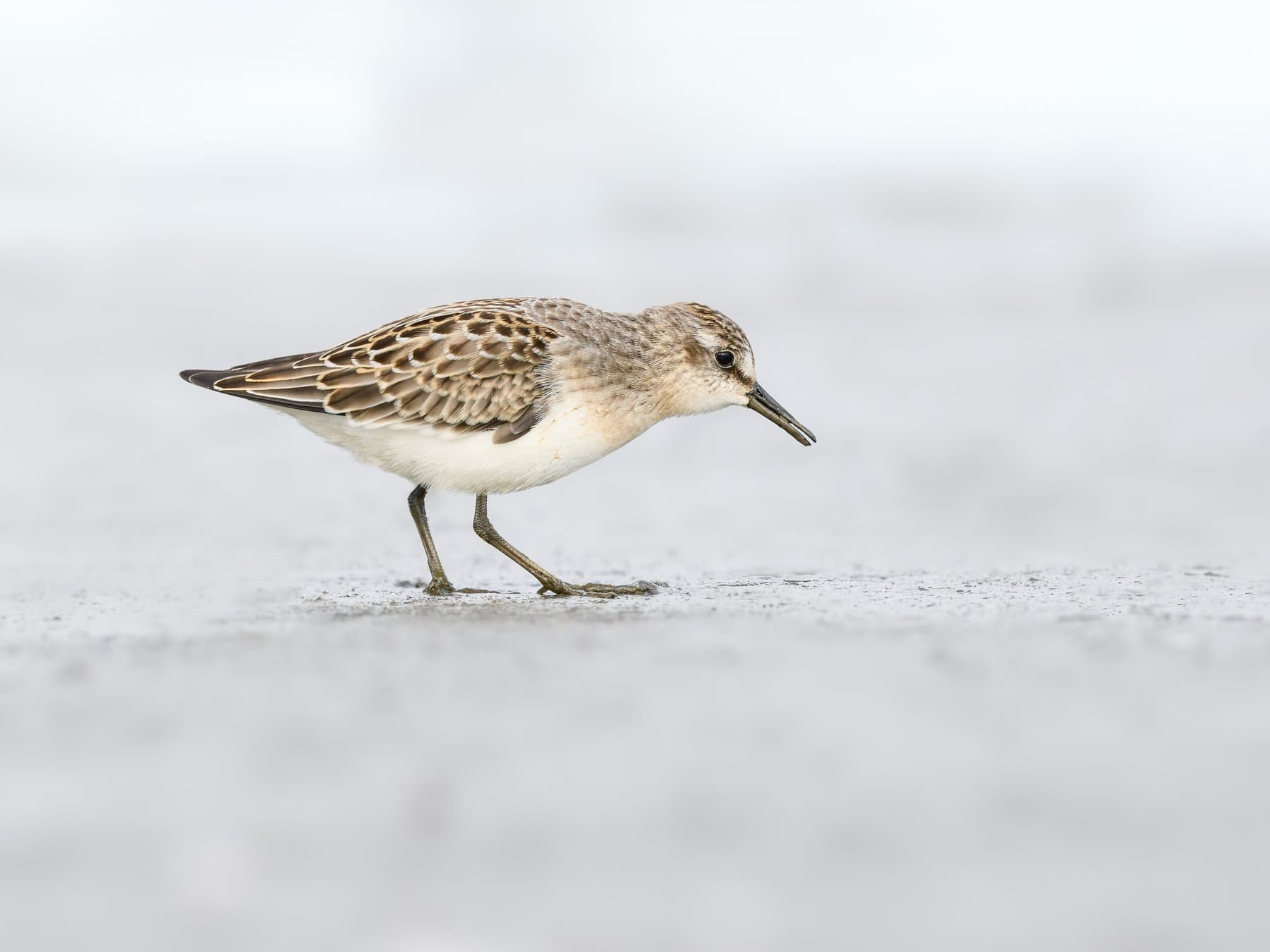
Semipalmated Sandpiper
Calidris pusilla
By the Birdfact teamChecked by Nathan Cope
Barely bigger than a sparrow, the Semipalmated Sandpiper makes one of the most audacious journeys in the bird world: eastern-population birds fly nonstop over the open Atlantic Ocean from eastern Canada to northern South America — more than 3,000 km without a single stop to rest or feed. To power this feat, they must nearly double their body weight at staging areas like the Bay of Fundy, gorging on tiny amphipod shrimp before launching themselves into the sky.
On this page13 sections
How to recognise it
The Semipalmated Sandpiper is a very small, plump shorebird with a short, straight, tubular black bill that appears distinctly blunt at the tip — a useful feature for separating it from similar species in the field. Adults have black legs (occasionally appearing dull grey or greenish in certain lights), dark grey-brown upperparts, and clean white underparts. The head, nape, and breast are stippled and streaked with brown, while the flanks remain white. A pale supercilium runs above a darker eye-stripe, giving the face a clean, well-defined expression.
In breeding plumage, adults are dappled in brown, black, gold, and rufous above, with the warmest tones concentrated on the cap and cheeks. Some individuals show brighter rusty mottling on the back; others remain a more uniform grey-brown. The breast is streaked with brown but the flanks stay clean white. Non-breeding adults are considerably plainer — mousy greyish-brown above and pale below, with only faint streaking on the breast and a weak supercilium. This winter plumage is nearly identical to that of the Western Sandpiper, making identification very challenging.
Juveniles have an attractive, neat scaly pattern on the upperparts, created by pale buff or white feather edges. They typically show a darker cap and a more pronounced eyebrow stripe. Juvenile colouration is variable — usually greyish with some buffy areas, occasionally brighter rufous — but they lack the strong rusty tones seen on juvenile Western and Least Sandpipers. Juvenile legs may appear olive-coloured rather than black. The species' most distinctive feature — the partial webbing between the three front toes that gives it its name — is visible only at extremely close range. In flight, a white wing-stripe is visible, and the dark central tail stripe is bordered by whitish outer tail feathers.
The species moults body feathers twice a year. The change to greyish-brown non-breeding plumage begins on the breeding grounds and completes after arrival on the wintering grounds. Pre-breeding moult occurs on the wintering grounds before spring migration, producing the slightly brighter breeding plumage. Flight feathers are moulted gradually once per year, usually on the wintering grounds, retaining the ability to fly at all times.
Not sure it’s a Semipalmated Sandpiper? Check your photo: Birdfact names the bird and shows the look-alike side by side.
Its size
Adults- Length
- 15–18 cm
- Wingspan
- 35–37 cm
- Weight
- 18–51.5 g
Its song and calls
The most frequently heard call is a short, flat 'cheh', 'chit', or 'churk' — described by experienced observers as less drawn out and less musical than the equivalent calls of the Least or Western Sandpipers. In roosting flocks, a soft 'cher' conveys safety; this switches rapidly to a loud 'churt' when a predator is detected, triggering the entire flock to take flight. Additional calls have been described for nest defence, chick defence, injury feigning, copulation, short-range communication between mates, and calling chicks — the species has a more varied vocal repertoire than its small size might suggest.
The male's display song, given during aerial courtship flights on the breeding grounds, is one of the most distinctive vocalisations in the sandpiper family. Males produce a bizarre pulsating 'vurra-vurra-vurra' sound — widely described as a 'motorboat' — almost continuously while hovering at 5–9 m altitude. This is followed by a series of twittering phrases that sound like sped-up versions of the call notes. Unlike most other calidridine sandpipers, which use a rhythmically repeated call during aerial display, the Semipalmated Sandpiper's motorboat sound is nearly constant throughout the display flight, giving it an unmistakable mechanical quality.
The display song is most frequently heard on the breeding grounds in late May and June, when males are actively establishing territories and attracting mates. Once incubation begins, vocal activity drops sharply. On migration and the wintering grounds, the species is relatively quiet compared to some of its relatives, though flocks produce a constant low-level chatter when feeding. The sensitivity of the bill tips and sharp vision allows birds to forage effectively at night, and nocturnal calling during migration has been documented.
- Recording0:00 / 0:03
Heard one and not sure? Let the bird song identifier listen.
When and where to see it
OctoberPeak season
Most recorded in October
- 1. Lincolnshire0.16%
- 2. Mayounder 0.1%
- 3. Shetland Islandsunder 0.1%
- 4. Kerryunder 0.1%
- 5. Dublinunder 0.1%
Each dot is a county, state or province: the bigger and darker, the larger the bird’s share of that place’s bird records that month. Grey dots: no regular records. The ringed point is the centre of the bird’s records this month; the arrow shows how it moved since last month, and the dashed loop its path through the year. “Arrivals” colours places where it becomes regular this month (orange) or is in its last regular month (grey). GBIF eBird Observation Dataset, 2019–2024. Map data: Natural Earth, US Census Bureau; place centres © OpenStreetMap contributors.
In your area
See when the Semipalmated Sandpiper is recorded in your county, state or province.
How often the Semipalmated Sandpiper turns up in the UK, Ireland, the United States and Canada through the year, from birdwatchers' records.
United Kingdom
Passage migrant · regularly Sep–Oct · most records in October
Ireland
Passage migrant · regularly Sep–Oct · most records in September
United States
Summer visitor · regularly Apr–Oct · most records in August
Canada
Summer visitor · regularly May–Oct · most records in August
Show as a table
| Month | United Kingdom | Ireland | United States | Canada |
|---|---|---|---|---|
| January | <0.001% | – | <0.001% | <0.001% |
| February | – | – | <0.001% | – |
| March | – | – | 0.002% | – |
| April | – | – | 0.031% (regular) | 0.002% |
| May | – | – | 0.096% (regular) | 0.077% (regular) |
| June | – | – | 0.068% (regular) | 0.052% (regular) |
| July | 0.001% | 0.002% | 0.11% (regular) | 0.13% (regular) |
| August | 0.006% | 0.002% | 0.33% (regular) | 0.50% (regular) |
| September | 0.002% (regular) | 0.017% (regular) | 0.16% (regular) | 0.35% (regular) |
| October | 0.007% (regular) | 0.015% (regular) | 0.040% (regular) | 0.063% (regular) |
| November | <0.001% | – | 0.003% | 0.003% |
| December | – | – | <0.001% | <0.001% |
Recorded regularly in
Worldwide: recorded regularly in 53 countries
Countries where it was recorded in at least 3 of the 6 years 2019–2024. Linked countries have their own bird list.
Europe (4)
North America (38)
- Anguilla
- Antigua & Barbuda
- Aruba
- Bahamas
- Barbados
- Belize
- Bermuda
- British Virgin Islands
- Canada
- Caribbean Netherlands
- Cayman Islands
- Costa Rica
- Cuba
- Curaçao
- Dominica
- Dominican Republic
- El Salvador
- Grenada
- Guadeloupe
- Guatemala
- Haiti
- Honduras
- Jamaica
- Martinique
- Mexico
- Montserrat
- Nicaragua
- Panama
- Puerto Rico
- St Kitts & Nevis
- St Lucia
- St Martin
- St Pierre & Miquelon
- St Vincent & the Grenadines
- Trinidad & Tobago
- Turks & Caicos Islands
- United States
- US Virgin Islands
Data: EOD – eBird Observation Dataset (Cornell Lab of Ornithology), accessed via GBIF.org, CC BY 4.0. Records from 2019–2024, aggregated and filtered by Birdfact. How these lists are made
Tips for seeing it
In North America, the best time to see Semipalmated Sandpipers is during migration. In spring (May to early June), Delaware Bay in New Jersey is outstanding — birds gather in enormous numbers to feed on horseshoe crab eggs, and viewing from beaches at Reeds Beach or Kimbles Beach can produce counts in the thousands. Cheyenne Bottoms Wildlife Area in Kansas is the key interior stopover. In autumn (late July to September), the Bay of Fundy in New Brunswick is arguably the finest shorebird spectacle in the hemisphere: visit Mary's Point or Johnson's Mills at low tide, when birds pack the exposed mudflats in dense, swirling flocks.
Separating Semipalmated Sandpiper from its close relatives requires attention to bill shape and structure. The bill is short, straight, and distinctly blunt-tipped — almost tubular in cross-section — which differs from the finer-tipped, slightly drooped bill of the Western Sandpiper and the very fine, needle-like bill of the Least Sandpiper. Leg colour is also useful: Semipalmated and Western Sandpipers have black legs, while Least Sandpiper has yellow-green legs. In winter plumage, separating Semipalmated from Western Sandpiper is genuinely difficult and often requires close views of bill shape.
In the UK and Ireland, the species is a rare but annual vagrant, most likely in autumn between August and October. Coastal wetland reserves with shallow scrapes and exposed mudflats are the most productive sites — Cley Marshes in Norfolk, Titchwell RSPB in Norfolk, and various sites in Cornwall and Devon have all produced records. After Atlantic storms, check any suitable coastal wetland: displaced birds often turn up at sites far from the coast. The blunt-tipped bill and black legs are the key features to look for when assessing a small 'peep' sandpiper in a European context.
At all sites, scan flocks of small sandpipers carefully at low tide when birds are actively feeding. Semipalmated Sandpipers tend to feed in very shallow water — ankle-deep at most — and their rapid, mechanical pecking action is distinctive once learned. The partial toe webbing is visible only at extremely close range, so don't rely on it as a field character.
What it eats
Diet varies considerably across the annual cycle, reflecting the very different food resources available at each stage. On the breeding grounds, the diet consists mainly of insects — particularly chironomid (midge) larvae, tipulid (crane fly) larvae, dolichopodid fly larvae, and other Diptera — along with spiders, snails, seeds, and other small invertebrates. Most prey items measure less than 5 mm long.
During migration, the diet shifts to small crustaceans, aquatic insects, small molluscs, and marine worms. At the Bay of Fundy, the key prey item is Corophium volutator, a tiny amphipod shrimp that lives in dense colonies in intertidal mudflats. Birds can consume thousands of these per day, accumulating fat reserves at a rate that allows them to nearly double their body weight in under two weeks. At Delaware Bay in New Jersey, spring-migrating birds rely heavily on horseshoe crab eggs — an exceptionally energy-rich food source that is critical for fuelling the final leg of northward migration. Females also consume small mammal bones as a supplementary calcium source during egg-laying.
A particularly unusual feeding behaviour documented at the Bay of Fundy is the consumption of 'biofilm' — a gelatinous layer of microalgae, diatoms, and microscopic invertebrates that coats intertidal mudflats. Birds slurp this material directly into the bill, a technique only recently recognised by scientists and not widely documented in other sandpiper species. The nutritional contribution of biofilm to the birds' pre-migration fuel load is still being studied.
On the wintering grounds in South America, the diet consists primarily of small crustaceans, molluscs, polychaete worms, fly larvae, and other aquatic invertebrates. Females, having longer bills than males, take slightly larger prey items on average — a difference that becomes most pronounced between populations with the greatest bill-length divergence.
Nesting and breeding
Males typically arrive on the arctic breeding grounds in late May, a few days before females, and immediately begin establishing and defending territories — often the same patch used in previous years. Territory sizes range from approximately 0.25 to 1 ha. Males claim territory with hovering display flights at 5–9 m altitude, producing a distinctive 'motorboat' vocalisation almost continuously while airborne. When a female shows interest, the two birds chase each other, call, cock their tails, and make paired flights. The mating system is monogamous; some pairs reunite in successive years.
The male excavates up to 10–12 shallow scrapes among sparse vegetation within his territory. The female inspects 2–3 candidates before selecting one, which she then lines with grass, sedge, moss, and leaves of cranberry, willow, or birch. The nest interior cup measures approximately 5.5 cm across and 4.5 cm deep. Nest sites are typically on top of a low mound or ridge, often next to or beneath a small plant, near water.
The female lays 4 eggs (occasionally 3), usually one per day at 24–32 hour intervals. Eggs are pyriform — pointed at the small end, allowing them to fit tightly together in the nest cup — and are white, buff, or olive in ground colour, marked with hazel, cinnamon, or chestnut brown blotches. Egg dimensions are approximately 2.9–3.1 cm long by 2.1–2.2 cm wide. Together, the four eggs weigh almost as much as the female herself.
Both parents incubate, with incubation lasting 19–22 days (typically around 20 days). Incubation does not begin until the clutch is complete, so all four chicks hatch within approximately 24 hours of each other. Chicks are precocial — born with open eyes and nearly adult-sized legs, covered in down, and able to begin foraging within hours of hatching. They are not fed by their parents but are brooded periodically during the first week. The female typically deserts the brood 6–11 days after hatching (in approximately 91% of cases, she leaves first). The male continues to guard and brood the young for a further week or so. Young make short flights at around 14 days and can fly fairly well at 16–19 days. Sexual maturity is reached at 1–2 years old.
Behaviour
In flight, the Semipalmated Sandpiper shows a clear white wing-stripe running along the length of the upperwing — a feature shared with most small calidrid sandpipers and useful for confirming the group in the field. The dark central tail stripe is bordered by whitish outer tail feathers, giving the tail a pale-edged appearance. The underwing is pale. The overall flight silhouette is compact and pointed, with relatively narrow wings and a short tail.
Flight style is fast and direct, with rapid, shallow wingbeats typical of small sandpipers. In large flocks, birds perform spectacular coordinated aerial manoeuvres — wheeling, banking, and compressing into tight formations — a behaviour that makes it difficult for aerial predators such as Peregrine Falcons and Merlins to single out an individual. These murmurations can involve tens of thousands of birds and are one of the most visually arresting sights at Bay of Fundy staging areas.
On migration, the species is capable of extraordinary sustained flight. The transoceanic nonstop flight undertaken by eastern-population birds — over 3,000 km across open ocean — requires not only exceptional fat reserves but also the physiological ability to sustain continuous flapping flight for 60–80 hours or more. Before departure, the birds' flight muscles and heart enlarge relative to body size, while digestive organs shrink, optimising the body for long-distance flight. The display flight on the breeding grounds is quite different: males hover at 5–9 m altitude with rapid, shallow wingbeats, producing the characteristic motorboat vocalisation throughout.
Lifespan and predators
The maximum recorded lifespan for a Semipalmated Sandpiper is 16 years, documented from banding records. Typical lifespan in the wild is estimated at 5–10 years, though annual survival rates for small shorebirds are strongly influenced by conditions at key staging and wintering sites. First-year birds face the highest mortality, particularly during their first long-distance migration, when inexperience and lower fat reserves increase the risk of failing to complete the transoceanic flight.
Annual adult survival rates have not been precisely quantified for this species, but are likely in the range of 60–75%, consistent with other small calidrid sandpipers. Predation by falcons and other raptors is a significant mortality source at staging areas; Peregrine Falcons and Merlins are the primary aerial predators. On the wintering grounds, hunting by humans has historically been a significant source of mortality, particularly in some South American countries where shorebird hunting persists.
Compared to larger shorebirds, the Semipalmated Sandpiper has a relatively short lifespan, but its 16-year maximum is broadly comparable to other small sandpipers. The Dunlin, a similar-sized calidrid, has a recorded maximum of around 24 years, suggesting that longevity potential varies considerably even within the group. Sexual maturity is reached at 1–2 years old; some first-year birds do not migrate north to breed in their first summer, remaining on the wintering grounds instead.
Conservation
The Semipalmated Sandpiper is listed as Near Threatened on the IUCN Red List, with a global population estimated at approximately 2.3 million individuals (Partners in Flight, 2020) — down from historical estimates of up to 3.5 million in the 1980s. The 2025 State of the Birds report designates it an Orange Alert Tipping Point species, meaning it has lost more than 50% of its population in the past 50 years and has shown accelerated declines within the past decade. The species scores 14 out of 20 on the Partners in Flight Continental Concern Score.
The most dramatic evidence of decline comes from the wintering grounds. Surveys of birds in Suriname and French Guiana — once the species' most important wintering area, holding an estimated 1.35 million birds in the mid-1980s — documented a staggering 80% decline by the mid-2000s. This collapse triggered a major international tracking study in which 250 birds were fitted with geolocators, revealing that migratory connectivity is far more complex than expected: some Alaskan birds winter across almost the entire non-breeding range of the species, from Peru to French Guiana.
The principal threats are: illegal and legal hunting on South American wintering grounds; habitat loss and degradation of key coastal wetlands along migration routes and on wintering grounds; extreme dependence on a small number of critical staging areas where disruption of food supply can have population-wide consequences; overharvesting of horseshoe crabs (Limulus polyphemus) at Delaware Bay, which reduces the availability of crab eggs during spring migration; climate change, which is forecast to affect nesting areas through permafrost thaw and vegetation changes, as well as migratory stopover and wintering habitats; and environmental pollutants, including contamination of wetland habitats along migration routes and on wintering grounds.
Conservation measures include the Migratory Bird Treaty Act (1916, USA), which reversed earlier population declines caused by unrestricted market hunting in the late 19th century. Several reserves protect key stopover sites, including the Shepody National Wildlife Area and Johnson's Mills Shorebird Reserve and Interpretive Centre in New Brunswick. The species is listed as a Species of Conservation Concern by the US Fish & Wildlife Service for its central and eastern populations.
Key Stopover Sites
The Semipalmated Sandpiper's dependence on a small number of critical staging areas is one of its defining ecological characteristics — and one of its greatest vulnerabilities. At the Bay of Fundy in New Brunswick, the world's highest tides (up to 16 m) expose vast intertidal mudflats twice daily, creating ideal conditions for the amphipod Corophium volutator, which lives in densities of up to 60,000 individuals per square metre. Birds arriving in late July and August can nearly double their body weight in under two weeks. The Shepody National Wildlife Area and Johnson's Mills Shorebird Reserve protect the most important sections of this coastline, and the site regularly holds flocks exceeding 100,000 birds at peak passage.
Delaware Bay in New Jersey is the critical spring stopover, and its importance hinges on a single event: the May spawning of horseshoe crabs (Limulus polyphemus), which deposit billions of eggs in the sand. These eggs are exceptionally energy-rich, and birds can gain several grams of fat per day feeding on them. Overharvesting of horseshoe crabs for bait and biomedical use has reduced egg availability significantly since the 1980s — with direct, measurable consequences for shorebird body condition and survival rates at departure.
Cheyenne Bottoms Wildlife Area in Kansas and Quill Lakes in Saskatchewan serve as the primary interior staging sites for western-population birds migrating through the Great Plains. These freshwater wetlands provide a very different food base — aquatic insects and small invertebrates rather than marine crustaceans — but are equally critical for birds that do not undertake the transoceanic route. The loss or degradation of any one of these sites could have measurable population-level consequences for the species as a whole.
Courtship & Display
Male Semipalmated Sandpipers begin displaying almost immediately upon arriving on the breeding grounds in late May, before most females have arrived. The aerial display is the centrepiece of territory establishment and mate attraction: males hover at 5–9 m altitude with rapid, shallow wingbeats, producing the distinctive motorboat vocalisation — a pulsating 'vurra-vurra-vurra' — almost continuously throughout the flight. This sound carries far across open tundra and is unlike anything produced by most other calidridine sandpipers during aerial display.
When a female enters a male's territory, a ground-level courtship sequence follows: the two birds chase each other, call, cock their tails, and make short paired flights. Displaying males raise one or both wings and erect the crown feathers before leading females to nest scrapes. The female inspects 2–3 candidates before making her selection — a meaningful choice that gives her control over the nest site's position and microhabitat.
The mating system is monogamous, and some pairs reunite in successive years — a degree of mate fidelity unusual in a species that migrates thousands of kilometres between seasons. Males also show strong site fidelity, often returning to defend the same territory year after year. Once the clutch is complete and incubation begins, aerial display ceases and the male becomes cryptic and quiet, relying on camouflage rather than vocalisation to avoid drawing attention to the nest.
Quick facts
- Length
- 15–18 cm
- Wingspan
- 35–37 cm
- Weight
- 18–51.5 g
- Lifespan
- 5–10 years · oldest recorded 16 years
- Family
- Sandpipers & Snipes
- Migration
- Long-distance Migrant
- Global status (IUCN)
- Near Threatened
- World population
- Approximately 2.3 million individuals (Partners in Flight, 2020)
- Population trend
- Decreasing. The 2025 State of the Birds report lists the species as an Orange Alert Tipping Point species, having lost more than 50% of its population in the past 50 years. Surveys of wintering birds in Suriname and French Guiana documented a nearly 80% decline between the mid-1980s and mid-2000s.
- Scientific name
- Calidris pusilla
Sources
14- 1Semipalmated sandpiper - Wikipedia Source (opens in a new tab)
- 2Semipalmated Sandpiper Calidris pusilla Species Factsheet | BirdLife DataZone Source (opens in a new tab)
- 3Semipalmated Sandpiper - eBird Source (opens in a new tab)
- 4Semipalmated Sandpiper | Audubon Field Guide Source (opens in a new tab)
- 5Semipalmated Sandpiper Overview, All About Birds, Cornell Lab of Ornithology Source (opens in a new tab)
- 6Semipalmated Sandpiper Life History, All About Birds, Cornell Lab of Ornithology Source (opens in a new tab)
- 7Semipalmated Sandpiper Identification, All About Birds, Cornell Lab of Ornithology Source (opens in a new tab)
- 8Semipalmated Sandpiper | BTO BirdFacts Source (opens in a new tab)
- 9Calidris pusilla (semipalmated sandpiper) | Animal Diversity Web Source (opens in a new tab)
- 10Semipalmated sandpiper | Smithsonian's National Zoo Source (opens in a new tab)
- 11Semipalmated Sandpiper - Hinterland Who's Who Source (opens in a new tab)
- 12Unraveling the Mysteries of Migrating Semipalmated Sandpipers | Audubon Source (opens in a new tab)
- 13Semipalmated Sandpiper — Historical Rare Birds Source (opens in a new tab)
- 14Tipping Point Species – State of the Birds 2025 (2025) Source (opens in a new tab)

Checked by
Nathan Cope, founder and editor
Nathan founded Birdfact and leads its writers and contributors in the UK, the US and Canada. He has watched and studied birds for more than ten years, and checks every article and species guide before it’s published.