


Buff-breasted Sandpiper
Calidris subruficollis
By the Birdfact teamChecked by Nathan Cope
Warm buff plumage, a wide-eyed dove-like expression, and a migration that can exceed 41,000 km in a single year — the Buff-breasted Sandpiper is unlike any other North American shorebird. It is the only shorebird on the continent to use a lek mating system, with males performing elaborate balletic displays to competing audiences of females on the Arctic tundra.
On this page13 sections
How to recognise it
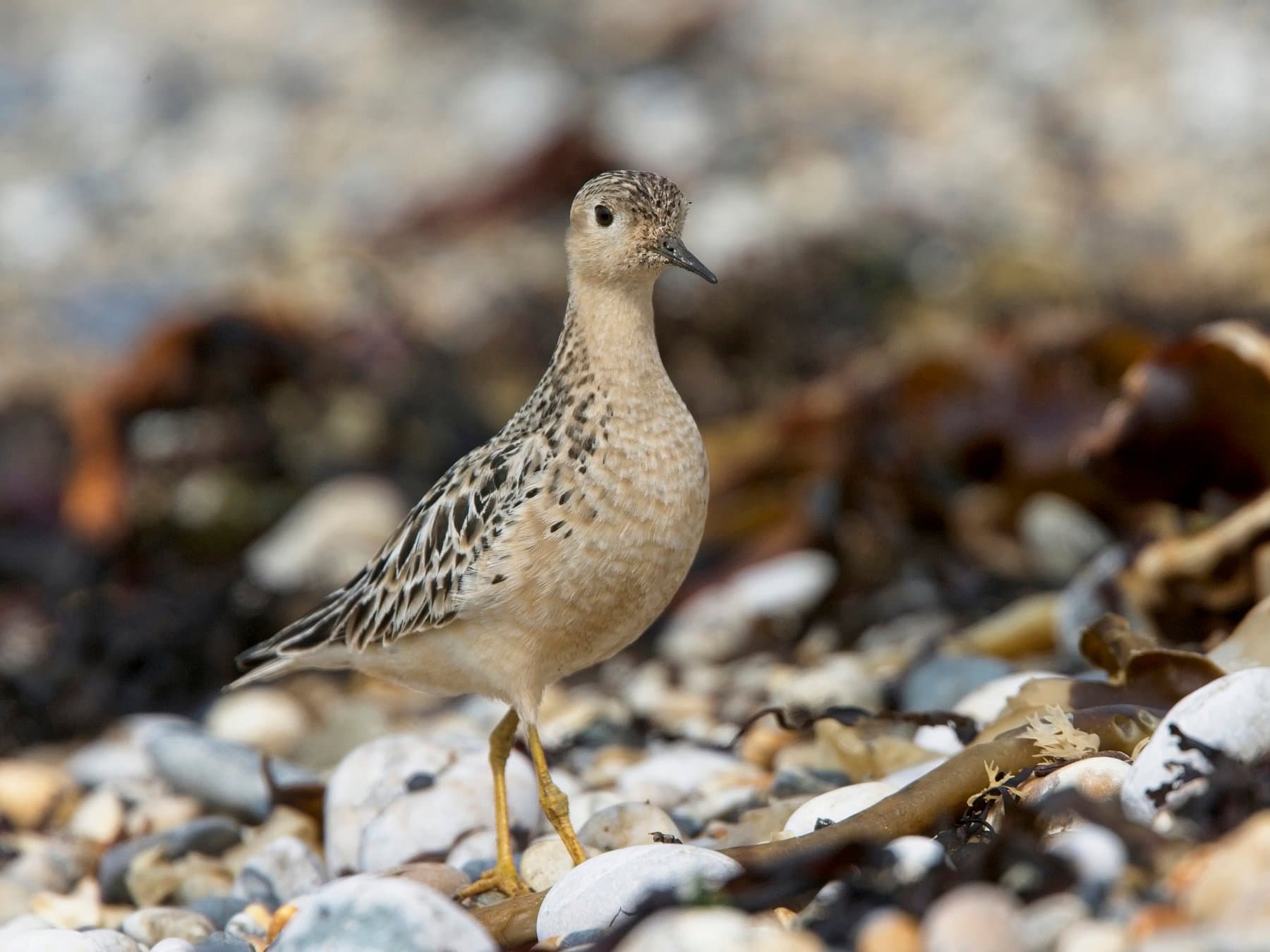
Warm apricot-buff from chin to belly, with large dark eyes set against a pale face — the Buff-breasted Sandpiper is one of the most immediately distinctive of the calidrid sandpipers. This rich tone is consistent across all ages and seasons. The upperparts are brown with dark-centred feathers edged in buff and white, producing a neat scaly or mottled pattern. The crown is finely streaked with black.
The bill is short, slender, and dark brown, with a faint yellowish tinge at the base of the lower mandible. The legs are bright yellow to olive-yellow — a useful field mark at any distance. The eyes are large and dark brown, set against the pale face to create the wide-eyed, gentle expression that birders often describe as dove-like. This combination of buff tones and large dark eyes gives the species an almost tame, approachable quality in the field.
In flight, the underwing is strikingly white with a dark comma-shaped mark at the carpal joint (wrist), contrasting with a buffy bar along the leading edge of the wing. The two central tail feathers are almost entirely dark. Breeding adults show variable small dark-brown spots on the breast and sides.
Non-breeding birds are similar but duller, with buff tones fading to paler whitish-buff through wear and bleaching. There is little to no prealternate moult, so seasonal variation is minimal. Adults undergo a complete prebasic moult on the wintering grounds between October and February.
The species is sexually dimorphic in size — males are noticeably larger than females — but both sexes share identical plumage. Juveniles resemble adults but show a more pronounced scaly appearance, with wider tawny or whitish-buff fringes around rounded dark centres on the back and scapulars. The species is larger than a Semipalmated Sandpiper and smaller than a Red Knot, roughly comparable in size to a Pectoral Sandpiper.
Not sure it’s a Buff-breasted Sandpiper? Check your photo: Birdfact names the bird and shows the look-alike side by side.
Its size
Adults- Length
- 18–20 cm
- Wingspan
- 43–47 cm
- Weight
- 46–78 g
Its song and calls
The Buff-breasted Sandpiper is a quiet bird for most of the year. Its most commonly heard call is a low, flat tik-tik-tik — a series of repeated tick notes likened to the sound of two small stones striking each other. This call is given by birds on the ground and in flight, and is often the first indication of the species' presence. When flushed, the bird gives a short churh call. In flight, it may utter a low growling pr-r-r-reet.
During courtship displays on the lek, males produce rapid clicking sounds — a quiet ticking series used when approaching and courting females. The alarm call is a low trilling noise. The species has no typical song in the conventional sense. Xeno-canto holds 11 foreground recordings of the species, including flight calls and alarm calls, reflecting how infrequently the bird vocalises compared to most shorebirds.
Both sexes are largely silent during migration and on the wintering grounds. The species is most vocal during the breeding season on the Arctic tundra, particularly during lek displays in late May and June. The quietness of migrants is one reason the species can be easy to overlook in the field — birds often move through grassland habitats without drawing attention to themselves through sound.
Heard one and not sure? Let the bird song identifier listen.
When and where to see it
OctoberLeaving
Most recorded in October
- 1. Lincolnshire0.20%
- 2. Clareunder 0.1%
- 3. Gwyneddunder 0.1%
- 4. Cornwallunder 0.1%
- 5. West Sussexunder 0.1%
Each dot is a county, state or province: the bigger and darker, the larger the bird’s share of that place’s bird records that month. Grey dots: no regular records. The ringed point is the centre of the bird’s records this month; the arrow shows how it moved since last month, and the dashed loop its path through the year. “Arrivals” colours places where it becomes regular this month (orange) or is in its last regular month (grey). GBIF eBird Observation Dataset, 2019–2024. Map data: Natural Earth, US Census Bureau; place centres © OpenStreetMap contributors.
In your area
See when the Buff-breasted Sandpiper is recorded in your county, state or province.
How often the Buff-breasted Sandpiper turns up in the UK, Ireland, the United States and Canada through the year, from birdwatchers' records.
United Kingdom
Passage migrant · regularly Aug–Oct · most records in October
Ireland
Passage migrant · regularly Sep–Oct · most records in September
United States
Passage migrant · regularly Apr–Oct · most records in August
Canada
Passage migrant · regularly Jul–Oct · most records in September
Show as a table
| Month | United Kingdom | Ireland | United States | Canada |
|---|---|---|---|---|
| January | – | – | <0.001% | – |
| February | – | – | – | – |
| March | <0.001% | – | <0.001% | – |
| April | <0.001% | – | 0.003% (regular) | – |
| May | <0.001% | <0.001% | 0.001% (regular) | <0.001% |
| June | – | – | <0.001% | <0.001% |
| July | – | – | <0.001% | 0.002% (regular) |
| August | 0.002% (regular) | 0.002% | 0.023% (regular) | 0.013% (regular) |
| September | 0.007% (regular) | 0.030% (regular) | 0.020% (regular) | 0.022% (regular) |
| October | 0.008% (regular) | 0.008% (regular) | 0.002% (regular) | 0.001% (regular) |
| November | – | – | <0.001% | – |
| December | – | – | <0.001% | – |
Recorded regularly in
Worldwide: recorded regularly in 35 countries
Countries where it was recorded in at least 3 of the 6 years 2019–2024. Linked countries have their own bird list.
Africa (1)
North America (14)
Oceania (1)
Data: EOD – eBird Observation Dataset (Cornell Lab of Ornithology), accessed via GBIF.org, CC BY 4.0. Records from 2019–2024, aggregated and filtered by Birdfact. How these lists are made
Tips for seeing it
In North America, the best opportunities to see Buff-breasted Sandpipers come during southbound autumn migration, from late July through September. The species is most reliably found on the Great Plains — the Flint Hills of Kansas and Oklahoma and the Eastern Rainwater Basin of Nebraska are among the most productive sites. Look for short, grazed grassland, sod farms, ploughed fields, and airports rather than mudflats or wetland edges. The species' preference for dry habitats is one of its most useful identification pointers: if you're scanning a mudflat and see a buff-coloured sandpiper, it's probably something else.
In the UK and Ireland, late August to early October is the key window. Most records come from coastal headlands and short-grass sites in England — Suffolk, Cornwall, Lincolnshire, and Northumberland have all produced records — as well as Scotland, Wales, and Northern Ireland. Check grazed coastal fields, airfields, and golf courses rather than estuaries. The species is approachable and often confiding, so close views are possible once a bird is located.
In the field, the uniform warm buff underparts and face are the first thing to notice — no other common shorebird shares this tone. The yellow legs, short dark bill, and large dark eye reinforce the identification. The wide-eyed, gentle expression is distinctive and hard to describe but immediately recognisable once seen. In flight, look for the white underwing with the dark carpal comma. The plover-like run-and-peck foraging style — brisk walking, sudden stops, short dashes — is a useful behavioural clue. The most likely confusion species is the juvenile Pectoral Sandpiper, which shares the scaly brown upperparts but has a sharply demarcated streaked breast-band, greenish-yellow legs, and a longer bill.
What it eats
Insects form the core of the Buff-breasted Sandpiper's diet throughout the year. On the breeding grounds, the menu is dominated by flies — including crane flies and midges — along with beetles, ants, and other insects and their larvae. One of the more surprising dietary records is the species' documented predation on Bombus polaris, the Arctic bumblebee, one of the few bee species found within the Arctic Circle. Buff-breasted Sandpipers will eat the bees directly or feed them to their chicks, making this one of the very few birds known to regularly consume bumblebees.
During migration, the diet broadens considerably. Spiders, isopods (pillbugs), snails, earthworms, and small crustaceans supplement the insect prey. Small quantities of seeds are also consumed — from knotweeds, pondweeds, and spikerushes — though plant material is a minor component of the diet overall.
The foraging technique is one of the species' most distinctive features. Unlike the vast majority of sandpipers, which probe into mud or wet substrate for hidden invertebrates, the Buff-breasted Sandpiper forages entirely by sight in dry, grassy habitats. It uses a run-and-peck technique: walking briskly through short grass, stopping frequently to look and listen, then making a short dash to seize prey from the ground surface or vegetation. It can extract worms or grubs that are partly exposed but does not probe deeply. This behaviour means it is far more likely to be found on a golf course, sod farm, or airport than on a mudflat — an unusual niche among shorebirds.
Nesting and breeding
After mating on the lek, the female selects a nest site on dry, well-drained tundra, often near a creek or river and hidden by sedges. She constructs a shallow scrape — averaging around 9 cm across and 4.5 cm deep — lined with lichens, leaves, moss, sedges, and other plant material. Clutch size is typically four eggs (range 2–5). The eggs are dull white, buff, or olive-buff, heavily blotched with darker brown, with markings concentrated at the larger end. Egg-laying occurs through June.
The female incubates alone for 23–25 days. Chicks are precocial — active and covered in down at hatching — and leave the nest within 24 hours. The female tends the young, but the chicks feed themselves from the outset. Fledging occurs at approximately 16–20 days after hatching. Once the chicks are independent, the female departs the breeding grounds, typically before the males, beginning the long southward migration.
Behaviour
In flight, the Buff-breasted Sandpiper reveals its most striking field mark: the underwing is brilliantly white, contrasting sharply with the warm buff of the body and the dark comma-shaped mark at the carpal joint (wrist). A buffy bar runs along the leading edge of the upper wing. The two central tail feathers are almost entirely dark, flanked by paler outer tail feathers. These features are visible at reasonable range and are particularly useful for confirming identification when a bird is flushed from grassland.
The flight style is direct and fairly swift, with rapid, shallow wingbeats typical of the calidrid sandpipers. The species has a fairly long neck and rounded head, giving it a distinctive silhouette — slightly front-heavy compared to many small waders. The wingtips, when the bird is at rest, are approximately level with the tail tip. Migrants are thought to travel largely at night and in flocks, crossing the Gulf of Mexico or Central America on the southbound journey before continuing through the Caribbean and into South America.
When flushed from short grassland, the bird typically rises steeply, calls briefly, and then settles again a short distance away rather than departing entirely. This relatively confiding flight behaviour makes it easier to relocate than many shorebirds once it has been initially spotted.
Lifespan and predators
Precise lifespan data for the Buff-breasted Sandpiper are limited, reflecting the challenges of studying a species that breeds in remote Arctic locations and winters in South American grasslands. No confirmed maximum longevity record is currently available in the published literature, though ringing studies in North America and geolocator tracking projects have begun to build a clearer picture of individual survival rates.
Like other small calidrid sandpipers, the species likely has a typical lifespan of several years in the wild, with annual survival rates influenced heavily by the hazards of long-distance migration — predation, weather events, and habitat availability at staging areas. Undertaking a round trip of more than 30,000 km twice a year places considerable physiological demands on individuals. A polygynous mating system means males invest heavily in display rather than parental care, potentially exposing them to greater predation risk during the conspicuous lek displays on open tundra. Females, which undertake all incubation and chick-rearing alone, face their own survival pressures during the breeding season. The declining global population suggests that current mortality rates may be exceeding recruitment in at least some parts of the range.
Conservation
The Buff-breasted Sandpiper was uplisted from Near Threatened to Vulnerable on the IUCN Red List in 2024, reflecting a suspected population reduction of 20–49% over three generations (assessed across 2015–2028). The 2025 State of the Birds report lists it as an Orange Alert Tipping Point species. This designation means it has lost more than 50% of its population in the past 50 years and has shown accelerated declines within the past decade. Partners in Flight rates it 15 out of 20 on the Continental Concern Score.
Current population estimates range from 84,000 to 364,000 mature individuals (2022 IUCN assessment), though Partners in Flight's global breeding population estimate is approximately 56,000 individuals (range 35,000–78,000). Historically, populations may have numbered in the hundreds of thousands to millions before commercial hunting decimated them in the late 19th and early 20th centuries. Numbers partially recovered after shorebird hunting was banned under the Migratory Bird Treaty Act in the United States (1918) and in Argentina (1920).
Today's primary threats are habitat loss and agricultural chemicals. Conversion of shortgrass prairies and pampas to intensive agriculture has destroyed critical stopover and wintering habitat — less than 4% of tallgrass prairie remains in North America. Pesticide exposure at migratory staging areas and wintering grounds poses a significant ongoing risk. Oil, gas, and wind energy development threatens breeding and display sites in the Arctic, while climate change is expected to render some current nesting areas unsuitable through sea-level rise and habitat shifts.
The species is listed as Special Concern under Canada's Species at Risk Act (SARA, 2017) and is protected under the Migratory Birds Convention Act. In the United States, it is designated as highly imperiled by the US Shorebird Conservation Plan.
Conservation efforts focus on protecting key grassland stopover sites — particularly the Flint Hills of Kansas, which may serve as a bottleneck for a significant proportion of the global population during migration.
Courtship & Display
The Buff-breasted Sandpiper's lek mating system is the most elaborate courtship behaviour of any North American shorebird. Males arrive on the breeding grounds in late May and immediately establish display territories on dry, raised tundra — ridges, bluffs, and banks near creeks and rivers are favoured. These are "exploded leks": loose groupings of typically 10 or fewer males (rarely up to 20), each holding a territory of up to 8 acres, but all within sight of one another. The arrangement differs from the tight, competitive leks of the Ruff, where males display in close proximity, but the underlying principle — females visiting to assess and select mates — is the same.
Researchers have catalogued at least 17 distinct display postures and behaviours. The most iconic involves a male crouching and slowly raising one wing to expose the gleaming white underwing surface — a visual signal that can be seen from a considerable distance across open tundra. Leaping into the air and fluttering their wings, males also perform a balletic display. When a female approaches and shows interest, the male escalates. He raises and opens both wings simultaneously, raises his bill and head, puffs out his breast, stands on tiptoe, and advances with exaggerated, wind-up toy-like movements. A receptive female signals her acceptance by opening and raising her wings, then turning her back toward the male.
Males are polygynous and may mate with several females in a season. Displaying behaviour has also been observed during migration — not only on the Arctic breeding grounds — suggesting that the drive to display is not strictly tied to the breeding season. After mating, males play no further role: incubation, brooding, and chick-rearing are entirely the female's responsibility.
Taxonomy And Classification
For most of the 20th century, the Buff-breasted Sandpiper stood alone in its own genus — a taxonomic outlier whose unusual looks and behaviour seemed to set it apart from all other sandpipers. Placed in the monotypic genus Tryngites, it was considered distinct from the typical calidrid sandpiper on account of its warm buff plumage, lek mating system, dry-grassland foraging niche, and plover-like run-and-peck feeding technique.
In 2013, molecular phylogenetic studies confirmed that Tryngites subruficollis is nested within Calidris, and the species was formally reclassified as Calidris subruficollis. The reclassification reflects the power of genetic analysis to reveal evolutionary relationships that morphology alone can obscure. Despite the name change, the species retains all the behavioural and ecological characteristics that made it seem anomalous — it simply turns out that these traits evolved within the calidrid lineage rather than in a separate branch.
The species is monotypic — no subspecies are recognised. The specific epithet subruficollis derives from Latin: sub- (somewhat), rufus (red or reddish), and -collis (necked), referring to the warm reddish-buff colouring of the neck and underparts that defines the species.
Quick facts
- Length
- 18–20 cm
- Wingspan
- 43–47 cm
- Weight
- 46–78 g
- Family
- Sandpipers & Snipes
- Migration
- Long-distance Migrant
- Global status (IUCN)
- Vulnerable
- World population
- 84,000–364,000 mature individuals (IUCN 2022); Partners in Flight estimates ~56,000 global breeding individuals
- Population trend
- Declining; listed as Orange Alert Tipping Point species by the 2025 State of the Birds report, having lost more than 50% of its population in the past 50 years with accelerated declines in the past decade
- Scientific name
- Calidris subruficollis
Sources
15- 1Buff-breasted sandpiper - Wikipedia Source (opens in a new tab)
- 2Right of Passage: Help us save the Buff-breasted Sandpiper - BirdLife International Source (opens in a new tab)
- 3Buff-breasted Sandpiper | Audubon Field Guide Source (opens in a new tab)
- 4Buff-breasted Sandpiper Life History, All About Birds, Cornell Lab of Ornithology Source (opens in a new tab)
- 5Buff-breasted Sandpiper Identification, All About Birds, Cornell Lab of Ornithology Source (opens in a new tab)
- 6Buff-breasted Sandpiper - eBird Source (opens in a new tab)
- 7Buff-breasted Sandpiper | BTO BirdFacts Source (opens in a new tab)
- 8Buff-breasted Sandpiper (Calidris subruficollis) :: xeno-canto Source (opens in a new tab)
- 9Buff-breasted Sandpiper - Oiseaux-Birds Source (opens in a new tab)
- 10Buff-breasted Sandpiper | NWT Species at Risk Source (opens in a new tab)
- 11Buff-breasted Sandpiper - BirdWeb (Seattle Audubon) Source (opens in a new tab)
- 12Buff-breasted sandpiper | New Zealand Birds Online Source (opens in a new tab)
- 13Light-level geolocation reveals migration patterns of the Buff-breasted Sandpiper - International Wader Study Group Source (opens in a new tab)
- 14Buff-breasted sandpiper — Grokipedia Source (opens in a new tab)
- 15Tracking Data for Buff-Breasted Sandpipers | U.S. Geological Survey Source (opens in a new tab)

Checked by
Nathan Cope, founder and editor
Nathan founded Birdfact and leads its writers and contributors in the UK, the US and Canada. He has watched and studied birds for more than ten years, and checks every article and species guide before it’s published.