


American Golden-Plover
American Golden Plover · Pluvialis dominica
By the Birdfact teamChecked by Nathan Cope
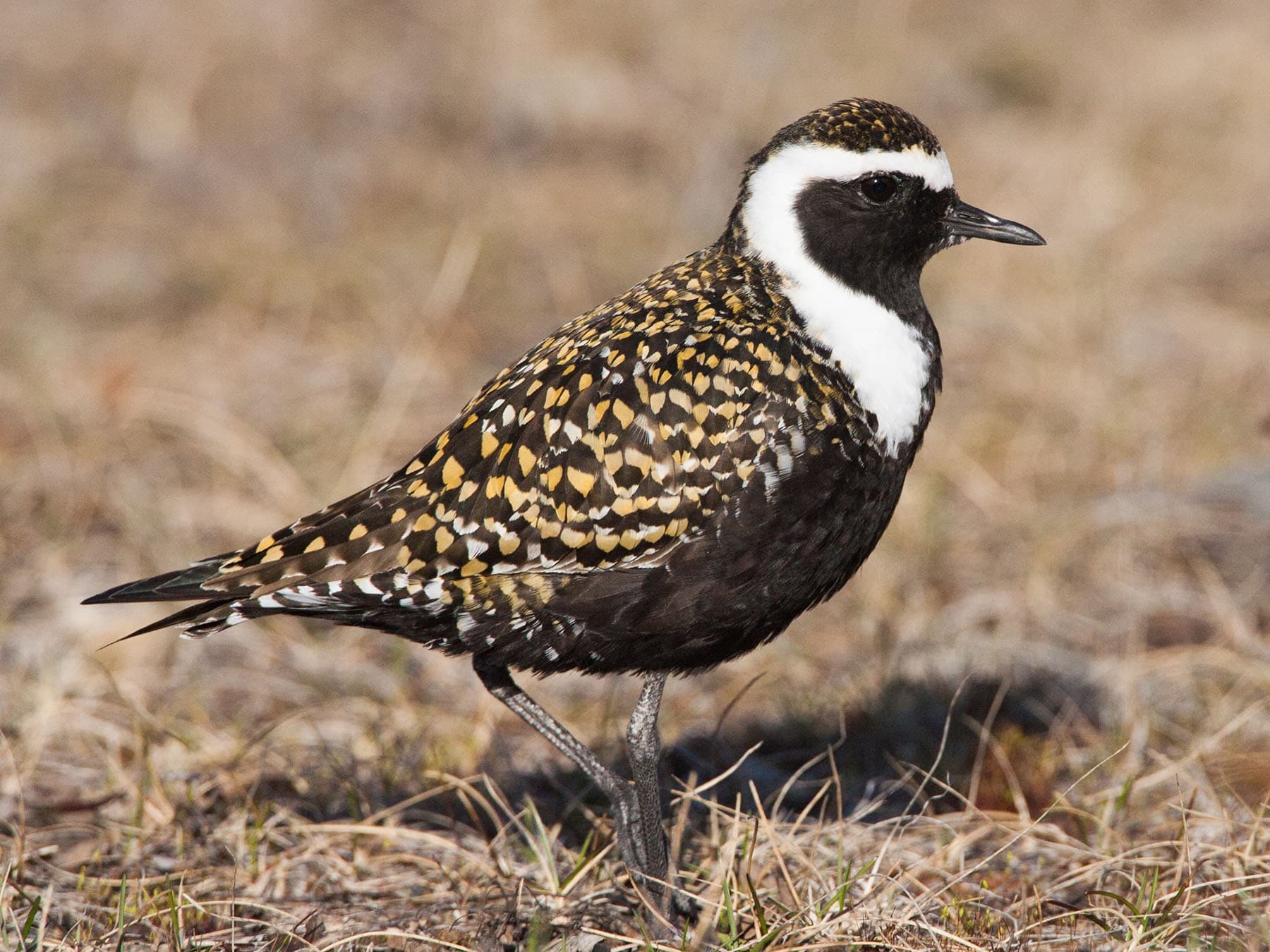
Each autumn, the American Golden-Plover makes one of the most audacious journeys in the bird world — a near-nonstop transoceanic flight of roughly 3,900 km over the open Atlantic, fuelled entirely by fat reserves built up on the Arctic tundra. In breeding plumage, the male is among the most striking shorebirds in North America: jet-black from chin to undertail, with a back spangled in gold, black, and white like hammered jewellery.
On this page14 sections
How to recognise it
The American Golden-Plover is a trim, medium-sized shorebird with a teardrop-shaped body, small rounded head, short slender bill, and long pointed wings that extend noticeably beyond the tail when folded. At 24–28 cm in length, it is larger than a European Robin but noticeably smaller than a Carrion Crow. The legs are relatively long and dark grey; the bill is short and black throughout the year.
Breeding males are among the most striking shorebirds in North America. The face, neck, breast, belly, flanks, and undertail coverts are entirely black — a solid, unbroken black underside that immediately separates this species from both the European Golden-Plover and the Pacific Golden-Plover, both of which retain at least some white on the flanks and undertail. The upperparts — back, wings, and crown — are intricately mottled with black, white, and bright golden-yellow spots, creating a spangled, jewelled effect. A bold white stripe runs from the forehead, over the eye, and down the side of the neck to the breast sides, forming a distinctive scarf or collar that frames the black face.
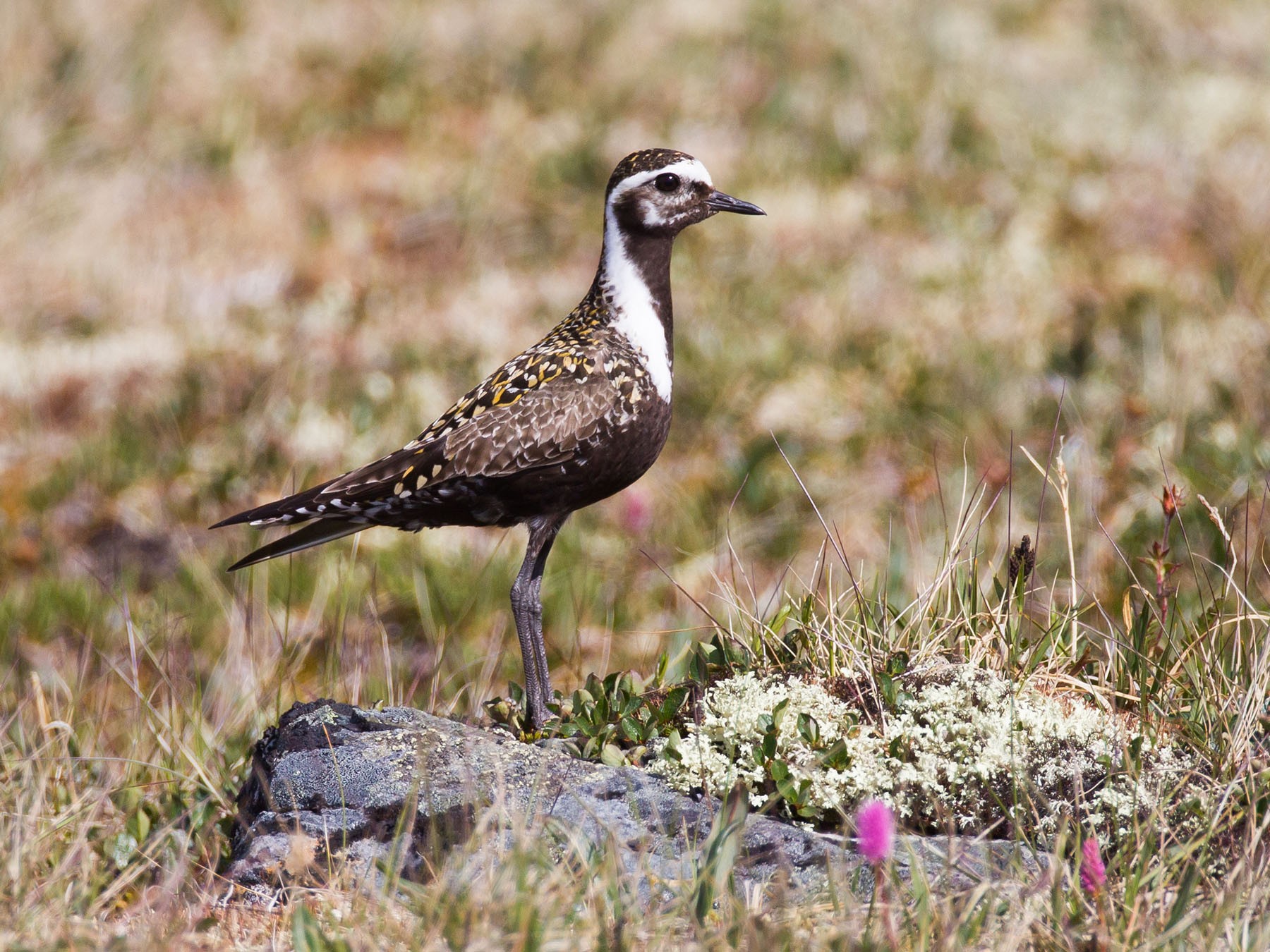
Breeding females share the same pattern but are noticeably duller. The face is pale and mottled rather than solidly black, and the black underparts are often broken by pale feather fringes. In non-breeding plumage, both sexes become subdued: the upperparts turn grey-brown with pale gold and white speckles, the underparts are pale grey-brown, and a whitish supercilium becomes the most prominent facial feature. A dark cap contrasts with this pale eyebrow stripe.
Juveniles resemble non-breeding adults but are crisper and more neatly patterned, with a complete set of fresh, even-aged feathers giving a scaly appearance on the upperparts. The face and neck are washed with buff-yellow. A key identification feature at all ages is the primary projection: four primary feathers extend noticeably beyond the tertials when the wing is folded — longer than in the Pacific Golden-Plover or Grey Plover, and a reliable field mark when the birds are side by side.
Not sure it’s a American Golden-Plover? Check your photo: Birdfact names the bird and shows the look-alike side by side.
Its size
Adults- Length
- 24–28 cm
- Wingspan
- 65–67 cm
- Weight
- 122–194 g
Its song and calls
The most frequently heard call — given in flight, when flushed, and as a contact call throughout the year — is a plaintive, mellow two- or three-syllable whistle. Transcriptions vary: "pleedoo," "quee-lee-la," "tuueee," and "queedle" all attempt to capture the same rising, liquid quality. The call carries well across open habitats and is often the first indication of a bird overhead. Vagrant birds recorded in the UK have given calls consistent with this whistle, and it is the primary tool for picking out an American Golden-Plover from a passing flock of European Golden-Plovers.
On the breeding grounds, the male's display song is a rhythmically repeated short phrase, most often transcribed as "toodlink" or "kt-dlink," delivered during the butterfly display aerial flight. Each repetition rises slightly in pitch at the end. After the display song, the male performs a longer series of trills, which the female often echoes back — a form of duet thought to reinforce pair bonding. The song is described as having four short tones delivered quickly and repetitively, with a clicking quality. It can be distinguished from the Pacific Golden-Plover's display song by the steeper, quicker descent at the end of the display flight.
Alarm calls on the breeding grounds are a sharp "kleep," given when predators approach the nest or chicks — a single, emphatic note that triggers immediate alert behaviour in both parents. The species is highly vocal on its breeding territory, with males using flight songs to advertise territory from great heights during the butterfly display.
Males are considerably more vocal than females throughout the breeding season. In the non-breeding season, the vocabulary simplifies to variations of the "tuueee" or "queedle" whistle, though birds in large flocks produce a continuous low murmur of contact calls.
- Song and calls0:00 / 0:27
Recorded in MB, Canada · June 2010
Heard one and not sure? Let the bird song identifier listen.
When and where to see it
OctoberPeak season
Most recorded in October
- 1. Pembrokeshireunder 0.1%
- 2. Clareunder 0.1%
- 3. Mayounder 0.1%
- 4. Kerryunder 0.1%
- 5. Corkunder 0.1%
Each dot is a county, state or province: the bigger and darker, the larger the bird’s share of that place’s bird records that month. Grey dots: no regular records. The ringed point is the centre of the bird’s records this month; the arrow shows how it moved since last month, and the dashed loop its path through the year. “Arrivals” colours places where it becomes regular this month (orange) or is in its last regular month (grey). GBIF eBird Observation Dataset, 2019–2024. Map data: Natural Earth, US Census Bureau; place centres © OpenStreetMap contributors.
In your area
See when the American Golden-Plover is recorded in your county, state or province.
How often the American Golden-Plover turns up in the UK, Ireland, the United States and Canada through the year, from birdwatchers' records.
United Kingdom
Passage migrant · regularly May–Nov · most records in September
Ireland
Passage migrant · regularly Sep–Nov · most records in October
United States
Passage migrant · regularly Mar–Nov · most records in September
Canada
Summer visitor · regularly May–Nov · most records in September
Show as a table
| Month | United Kingdom | Ireland | United States | Canada |
|---|---|---|---|---|
| January | <0.001% | 0.003% | <0.001% | – |
| February | – | – | <0.001% | – |
| March | – | – | 0.014% (regular) | <0.001% |
| April | <0.001% | 0.002% | 0.021% (regular) | 0.002% |
| May | 0.002% (regular) | <0.001% | 0.006% (regular) | 0.010% (regular) |
| June | 0.007% (regular) | 0.002% | 0.011% (regular) | 0.008% (regular) |
| July | <0.001% | 0.006% | 0.002% | 0.009% (regular) |
| August | 0.003% (regular) | 0.002% | 0.011% (regular) | 0.024% (regular) |
| September | 0.008% (regular) | 0.015% (regular) | 0.040% (regular) | 0.11% (regular) |
| October | 0.005% (regular) | 0.024% (regular) | 0.023% (regular) | 0.066% (regular) |
| November | <0.001% (regular) | 0.003% (regular) | 0.005% (regular) | 0.006% (regular) |
| December | <0.001% | – | 0.001% | <0.001% |
Recorded regularly in
Worldwide: recorded regularly in 52 countries
Countries where it was recorded in at least 3 of the 6 years 2019–2024. Linked countries have their own bird list.
Africa (1)
North America (30)
- Anguilla
- Antigua & Barbuda
- Aruba
- Bahamas
- Barbados
- Belize
- Bermuda
- Canada
- Caribbean Netherlands
- Cayman Islands
- Costa Rica
- Cuba
- Curaçao
- Dominican Republic
- El Salvador
- Grenada
- Guadeloupe
- Guatemala
- Honduras
- Mexico
- Nicaragua
- Panama
- Puerto Rico
- St Martin
- St Pierre & Miquelon
- St Vincent & the Grenadines
- Trinidad & Tobago
- Turks & Caicos Islands
- United States
- US Virgin Islands
Data: EOD – eBird Observation Dataset (Cornell Lab of Ornithology), accessed via GBIF.org, CC BY 4.0. Records from 2019–2024, aggregated and filtered by Birdfact. How these lists are made
Tips for seeing it
In North America, the best opportunities to see American Golden-Plovers come during spring migration (March–May) on the Great Plains and Mississippi Valley. Illinois, Missouri, and Texas are particularly productive, with birds favouring short-grass fields, sod farms, and recently ploughed or harvested agricultural land. Large flocks can gather in these habitats after rain, when earthworms and invertebrates are brought to the surface. In autumn (July–October), the Atlantic seaboard — particularly New England and the Canadian Maritimes — offers chances to see staging adults before their over-ocean departure.
In the UK, the species is a scarce but annual autumn vagrant. The best strategy is to check flocks of European Golden-Plovers and Grey Plovers carefully, particularly after periods of strong westerly winds in September and October. Coastal counties — Cornwall, Norfolk, Suffolk, Kent, and Merseyside — are the most productive, but inland sites in Leicestershire and Rutland have also produced records. Most birds are juveniles in fresh, scaly plumage.
The key identification challenge is separating American Golden-Plover from European and Pacific Golden-Plovers. Focus on three features: primary projection (four primaries extending well beyond the tertials in American, giving a longer-winged look), underwing colour (plain grey-brown in American, lacking the white underwing of European Golden-Plover), and moult timing (American birds in September–October are still in breeding or transitional plumage, not yet moulted). In breeding plumage, the entirely black underside — including flanks and undertail — is diagnostic. The flight call, a plaintive rising whistle transcribed as "pleedoo" or "queedle," is softer and more mellow than the sharper "klee-ee" of the Grey Plover.
Scan open, short-grass habitats with a telescope. Birds often associate with lapwings and European Golden-Plovers in the UK, and a slightly larger, longer-winged bird with a bolder supercilium in a mixed flock is worth investigating closely.
What it eats
American Golden-Plovers are primarily insectivorous, but the precise composition of their diet shifts markedly with season and location. On the Arctic breeding grounds, the bulk of the diet consists of flies (including mosquitoes and midges), beetles and their larvae, wasps, ants, grasshoppers, and caterpillars, supplemented by spiders, snails, and some seeds. In late summer, as birds prepare for their extraordinary transoceanic migration, they actively seek out berries — particularly crowberries and blueberries — which are rich in carbohydrates and help them accumulate the fat reserves needed to sustain a non-stop flight of nearly 4,000 km over open ocean.
During migration, the diet broadens considerably. Birds staging on the Great Plains and Mississippi Valley take earthworms, terrestrial snails, and a wide variety of insects from agricultural fields and grasslands. On coastal stopover sites along the Atlantic seaboard, they also take small crustaceans and molluscs from mudflats and shorelines. Fiddler crabs are recorded as a prey item on some coastal staging areas.
On the South American wintering grounds — the pampas grasslands of Argentina and the campos of Uruguay — the diet returns to a dominance of insects and other invertebrates found in open grassland and agricultural fields.
Foraging is almost entirely visual. The run-stop-peck technique allows birds to cover large areas of open ground efficiently, scanning ahead with their large eyes before striking at prey. American Golden-Plovers forage on tundra, short-grass fields, beaches, and tidal flats, and are notably more of a grassland bird than many shorebirds — often feeding far from any water. Foraging activity peaks during daylight hours but continues into the night, especially during migration.
Nesting and breeding
Males arrive on the Arctic breeding grounds slightly ahead of females in mid-May and immediately begin establishing large territories of 25–125 acres, which they advertise and defend through a combination of aerial song flights and ground displays. The nest is a shallow scrape made by the male using his feet and breast, typically sited on open, stony tundra with sparse vegetation that provides both camouflage and a clear view of the surroundings. The scrape is lined with lichens, grass, leaves of willow and mountain avens, and sometimes small twigs. Nests average about 10 cm across and 4.5 cm deep, and the same scrape may be reused in subsequent years by the same pair or other golden-plovers. Nests built in areas with lichen cover are less likely to be detected by predators.
The clutch is typically four eggs — occasionally three or five — pale buff to cinnamon or white, boldly blotched and spotted with dark brown and black. The camouflage is so effective that eggs are extremely difficult to spot against tundra vegetation. Each egg measures approximately 48 × 33 mm and weighs almost 20% of the female's body weight — a substantial investment per egg.
Incubation lasts 24–27 days and is shared by both parents, with the male taking the day shift and the female incubating at night, each covering roughly 12-hour stints. The species is socially monogamous, though extra-pair copulations occur, and pairs often reunite in subsequent breeding seasons.
Chicks are precocial: covered in down at hatching, they leave the nest within hours and can feed themselves within a day. Both parents tend the young, though males invest more time in chick care than females; in some cases the female departs the breeding grounds before the chicks are fully independent. Fledging occurs at approximately 22–24 days. There is one brood per season, though early nest losses may prompt a re-nesting attempt. Adult females typically leave the breeding grounds before adult males, and both depart several weeks before the juveniles, which migrate entirely independently.
Behaviour
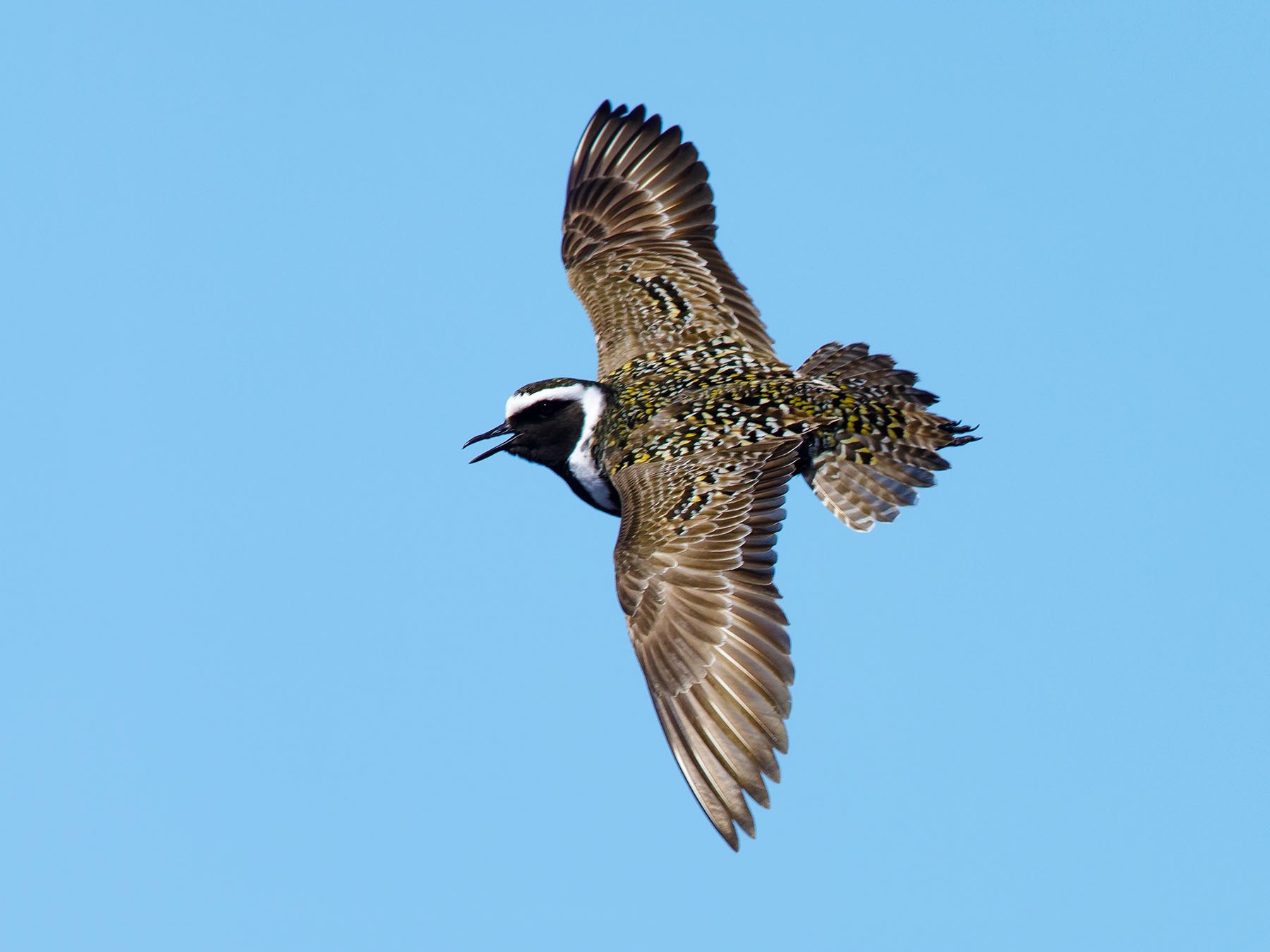
In flight, the American Golden-Plover is swift, direct, and elegant. The wings are long, narrow, and sharply pointed — a silhouette that immediately suggests a high-performance long-distance migrant rather than a dabbling wader. Wingbeats are rapid and regular, with little of the erratic quality seen in smaller waders. Birds in direct migration flight move with purpose, often in loose flocks that stream low over open ground or high over the ocean.
Several features visible in flight help distinguish this species from similar plovers. The underwings are plain grey-brown — there are no black "wingpits" (axillaries) as in the Grey Plover, and no white underwing flash as in the European Golden-Plover. The rump and tail blend with the back, showing no white rump patch — another distinction from the Grey Plover. The overall impression in flight is of a lean, long-winged bird with a relatively small head and a clean, unmarked underwing.
The primary projection — four primaries extending well beyond the tertials — gives the folded wing a distinctly pointed look when birds are perched, and contributes to the attenuated, aerodynamic silhouette in flight. This longer primary projection is one of the most reliable features for separating American from Pacific Golden-Plover in the field.
During the butterfly display on the breeding grounds, males fly to great heights while singing, then flutter and glide back to earth with slow, exaggerated wingbeats or with wings held in an upward V shape. This display flight is quite unlike the direct, purposeful flight of migration and is one of the most conspicuous behaviours on the breeding tundra.
Lifespan and predators
The typical lifespan of an American Golden-Plover in the wild is 8–13 years, with the oldest banding record standing at 13 years. This is broadly comparable to other medium-sized shorebirds: the closely related European Golden-Plover has a similar longevity profile, while larger waders such as the Bar-tailed Godwit can exceed 30 years.
Annual survival rates in shorebirds of this size are typically around 70–80% for adults, meaning that while many birds die in their first year, those that survive to adulthood have a reasonable chance of living for a decade or more. The extraordinary demands of migration — particularly the near-nonstop transoceanic autumn flight — represent a significant mortality risk. Birds that fail to accumulate sufficient fat reserves before departure, or that encounter severe weather over the Atlantic, may not complete the crossing.
Predation is the primary cause of mortality on the breeding grounds, with Arctic foxes, jaegers, and Peregrine Falcons taking eggs, chicks, and adults. On migration and wintering grounds, Peregrine Falcons and Merlins are the main avian predators. Collisions with wind turbines and communication towers pose an increasing risk along migration routes.
Juveniles face the highest mortality, particularly during their first independent transoceanic migration. Those that survive their first year and successfully locate suitable wintering habitat in South America have a substantially improved chance of reaching breeding age. Birds that do reach adulthood may return to the same breeding territory in successive years, and established pairs often reunite for more than one breeding season.
Conservation
The American Golden-Plover is listed as Least Concern on the IUCN Red List, but this classification masks a deeply concerning population trajectory. The global population is estimated at approximately 500,000 individuals — roughly split equally between Alaska and Canada — though some assessments cite a range of 200,000–500,000 mature individuals. The 2025 State of the Birds report lists the species as an Orange Alert Tipping Point species, meaning it has lost more than 50% of its population over the past 50 years and has shown accelerated declines within the past decade. The Smithsonian's National Zoo estimates a 70% decline over the past 40 years. Partners in Flight rates the species 15 out of 20 on the Continental Concern Score.
The most historically significant driver of decline was market hunting. In the 19th and early 20th centuries, American Golden-Plovers were shot in staggering numbers. In one notorious incident near New Orleans, an estimated 48,000 birds were killed in a single day from a flock described as numbering in the millions. The species was so heavily hunted that its population has never fully recovered to pre-hunting levels. Protection came with the Migratory Bird Treaty Act of 1918, which ended legal hunting across most of the western hemisphere.
Today, the primary ongoing threat is habitat loss on the wintering grounds. Loss and degradation of pampas grasslands and campos in Argentina, Uruguay, and Brazil — driven by agricultural intensification and urbanisation — directly reduces the carrying capacity of the wintering range. Climate change poses a further long-term threat: models predict a 64% decrease in suitable Arctic breeding habitat by 2070 as low tundra is lost to taller, denser vegetation. Wind turbines along migration routes pose a collision risk, and pesticide use on agricultural land reduces invertebrate prey availability at stopover sites and on wintering grounds. Hunting continues in parts of the Caribbean and South America.
Courtship & Display
Courtship in the American Golden-Plover is elaborate and multi-staged, combining spectacular aerial performance with precise ground rituals. The male's primary advertisement display — known as the butterfly display or butterfly flight — involves flying to considerable heights above the tundra while delivering a rhythmically repeated "toodlink" song, then descending slowly with exaggerated, fluttering wingbeats or with wings held in a raised V shape. The steep, rapid descent at the end of the flight distinguishes this display from the smoother, softer descent of the Pacific Golden-Plover.
On the ground, males perform "torpedo runs" — charging directly at females with the head lowered and tail raised, wings slightly lifted, while giving trill calls. A male may also approach a female by stretching his body upward and standing motionless, or by racing at her with raised wings. When a female shows interest, the male may fly alongside her in a parallel escort flight. Pairs sometimes sing together on the ground in a form of duet, after which the male performs a scraping display — pressing his breast to the ground and rotating his body as though excavating a nest scrape — which signals readiness to breed.
The species is socially monogamous, and pairs frequently reunite in subsequent breeding seasons. Extra-pair copulations occur, however, suggesting that social monogamy does not preclude genetic promiscuity. Territory establishment precedes pair formation: males arrive on the breeding grounds before females and spend the first days of the season in intense territorial competition, using both aerial song and direct chases to establish boundaries. Territories of 25–125 acres are large by shorebird standards, reflecting the sparse, patchy nature of suitable high-Arctic tundra habitat.
Similar Species Comparison
Three species cause consistent identification challenges: the European Golden-Plover (Pluvialis apricaria), the Pacific Golden-Plover (Pluvialis fulva), and the Grey Plover (Pluvialis squatarola).
vs. European Golden-Plover: The European Golden-Plover is stockier and shorter-winged, with a much shorter primary projection. In breeding plumage, European males always show white on the flanks and undertail coverts — never the entirely black underside of the American. In non-breeding plumage, the European is yellower on the face and breast. In flight, the European shows a white underwing, while the American's underwing is plain grey-brown. The European's flight call — a mellow "ploo" — is similar but subtly different in quality.
vs. Pacific Golden-Plover: This is the most difficult separation. The Pacific is slightly smaller and slimmer, with a shorter primary projection (typically two or three primaries beyond the tertials, versus four in the American). In breeding plumage, the Pacific always shows white on the flanks and undertail coverts. The Pacific moults earlier (August vs. September–October), so autumn birds in transitional plumage can be aged by moult stage. The Pacific's display flight descends more smoothly and softly than the American's steeper drop.
vs. Grey Plover: The Grey Plover is larger and bulkier, with a heavier bill. In breeding plumage, the Grey Plover's black underparts are bordered by white — not the clean black-and-white scarf of the American. In flight, the Grey Plover's diagnostic black axillaries (wingpits) and white rump immediately separate it from the American Golden-Plover at any season.
More photos
3 photos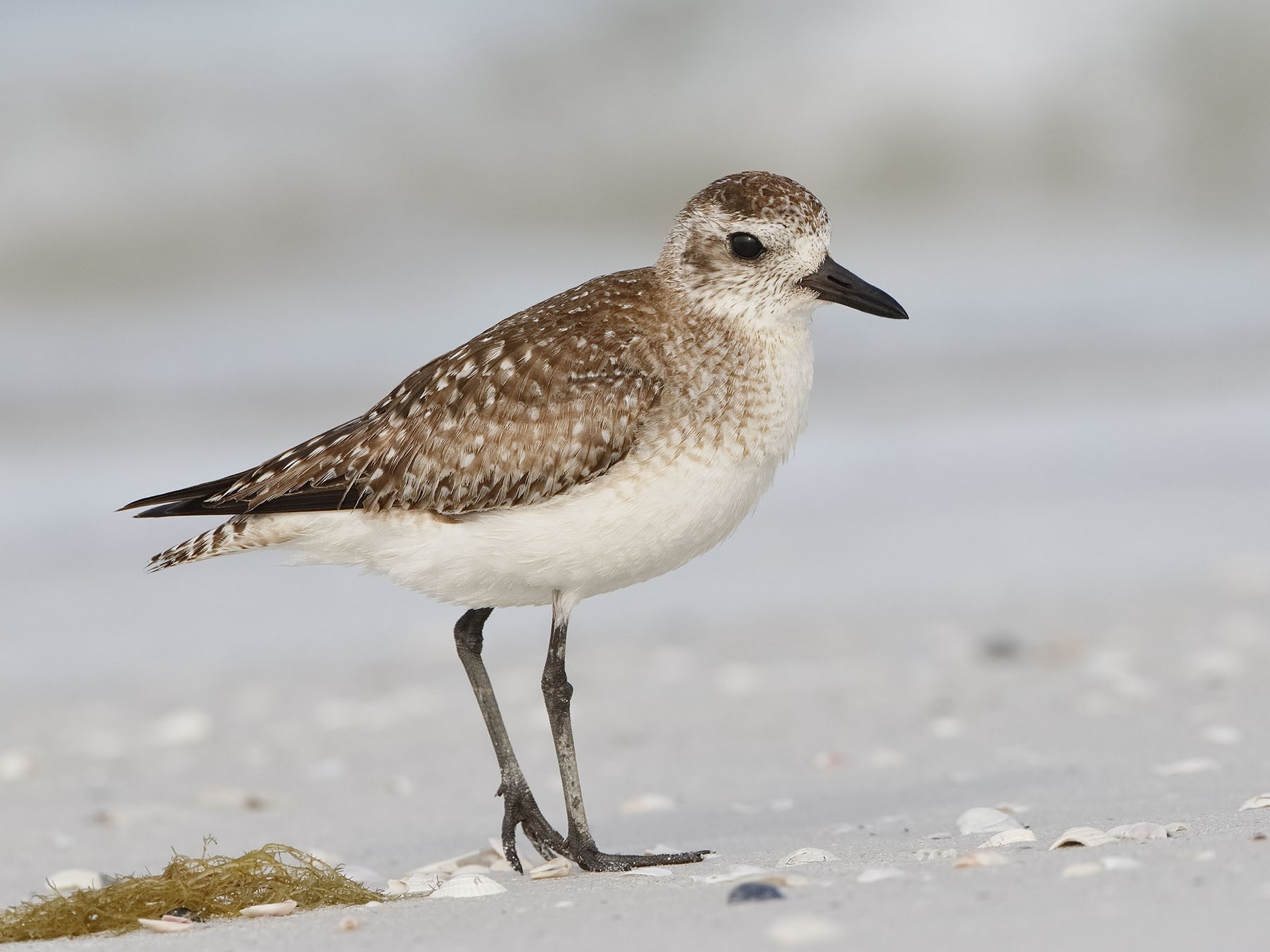
Quick facts
- Length
- 24–28 cm
- Wingspan
- 65–67 cm
- Weight
- 122–194 g
- Lifespan
- 8–13 years · oldest recorded 13 years
- Family
- Plovers & Lapwings
- Migration
- Long-distance Migrant
- Global status (IUCN)
- Least Concern
- World population
- Approximately 500,000 individuals (Partners in Flight; some estimates 200,000–500,000 mature individuals)
- Population trend
- Declining. Listed as an Orange Alert Tipping Point species in the 2025 State of the Birds report, having lost more than 50% of its population in the past 50 years. The Smithsonian's National Zoo estimates a 70% decline over the past 40 years. Partners in Flight Continental Concern Score: 15/20.
- Also called
- American Golden Plover
- Scientific name
- Pluvialis dominica
Sources
12- 1American golden plover - Wikipedia Source (opens in a new tab)
- 2American Golden-Plover Overview - All About Birds, Cornell Lab of Ornithology Source (opens in a new tab)
- 3American Golden-Plover Life History - All About Birds, Cornell Lab of Ornithology Source (opens in a new tab)
- 4American Golden-Plover - eBird Source (opens in a new tab)
- 5American golden plover - Smithsonian's National Zoo Source (opens in a new tab)
- 6American Golden-Plover - Audubon Field Guide Source (opens in a new tab)
- 7American Golden Plover - BirdLife International DataZone Source (opens in a new tab)
- 8American Golden Plover - BTO BirdFacts Source (opens in a new tab)
- 9American Golden Plover - Bird Spot Source (opens in a new tab)
- 10Pluvialis dominica - Animal Diversity Web Source (opens in a new tab)
- 11American Golden Plover - Wildlife Journal Junior (NH PBS) Source (opens in a new tab)
- 12American Golden-Plover - Missouri Department of Conservation Source (opens in a new tab)

Checked by
Nathan Cope, founder and editor
Nathan founded Birdfact and leads its writers and contributors in the UK, the US and Canada. He has watched and studied birds for more than ten years, and checks every article and species guide before it’s published.