Facts · Updated 12 Oct 2026
What Do Magpies Eat? Diet, Chicks and Food Stores
By the Birdfact teamChecked by Nathan Cope
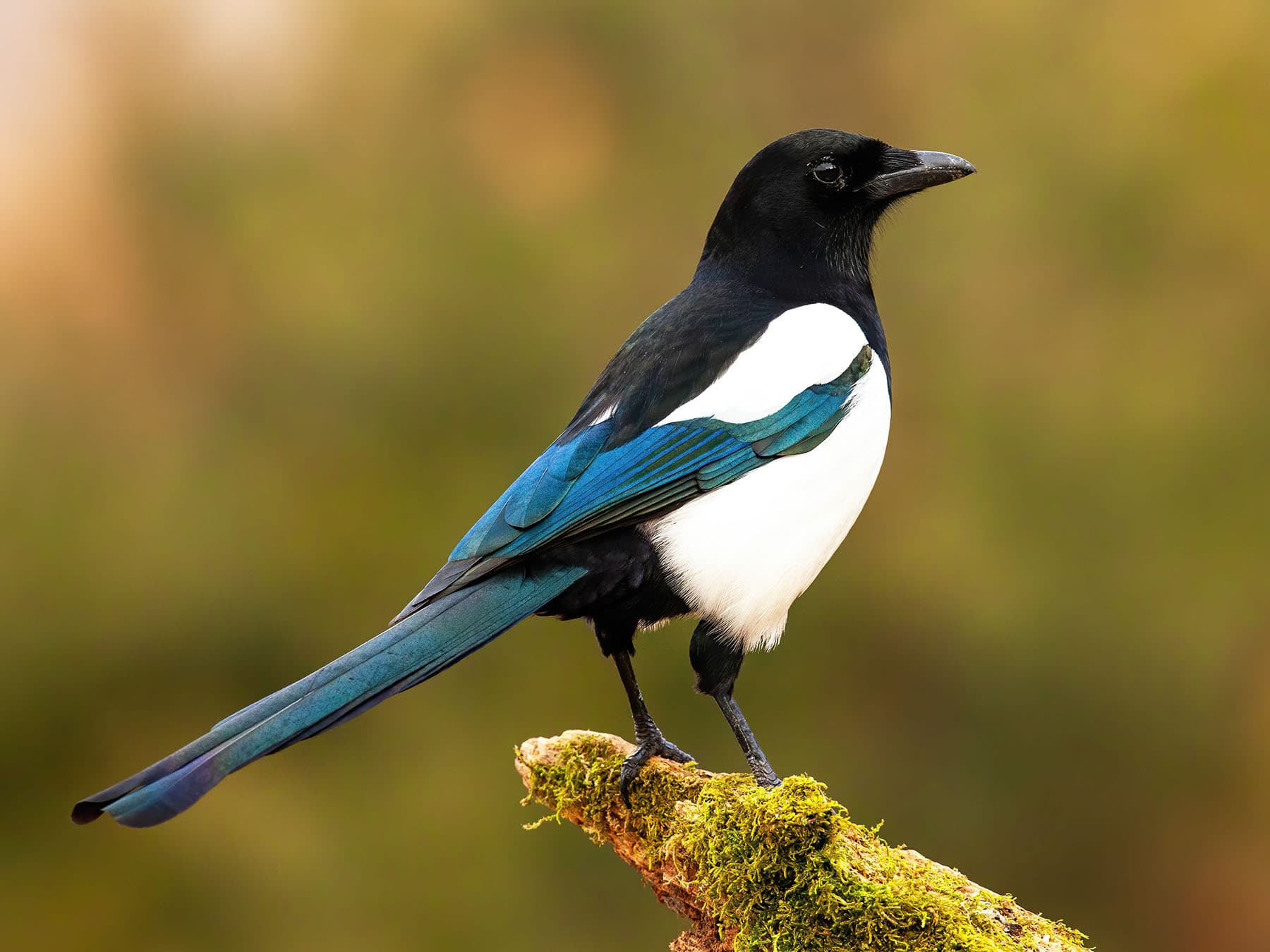
Magpies eat almost anything: mostly beetles and other invertebrates, plus small mammals, carrion, seeds and fruit, and some eggs and nestlings. Their chicks are fed mainly insects and other invertebrates. Magpies hide food and remember where and when they hid it.
On this page9 sections
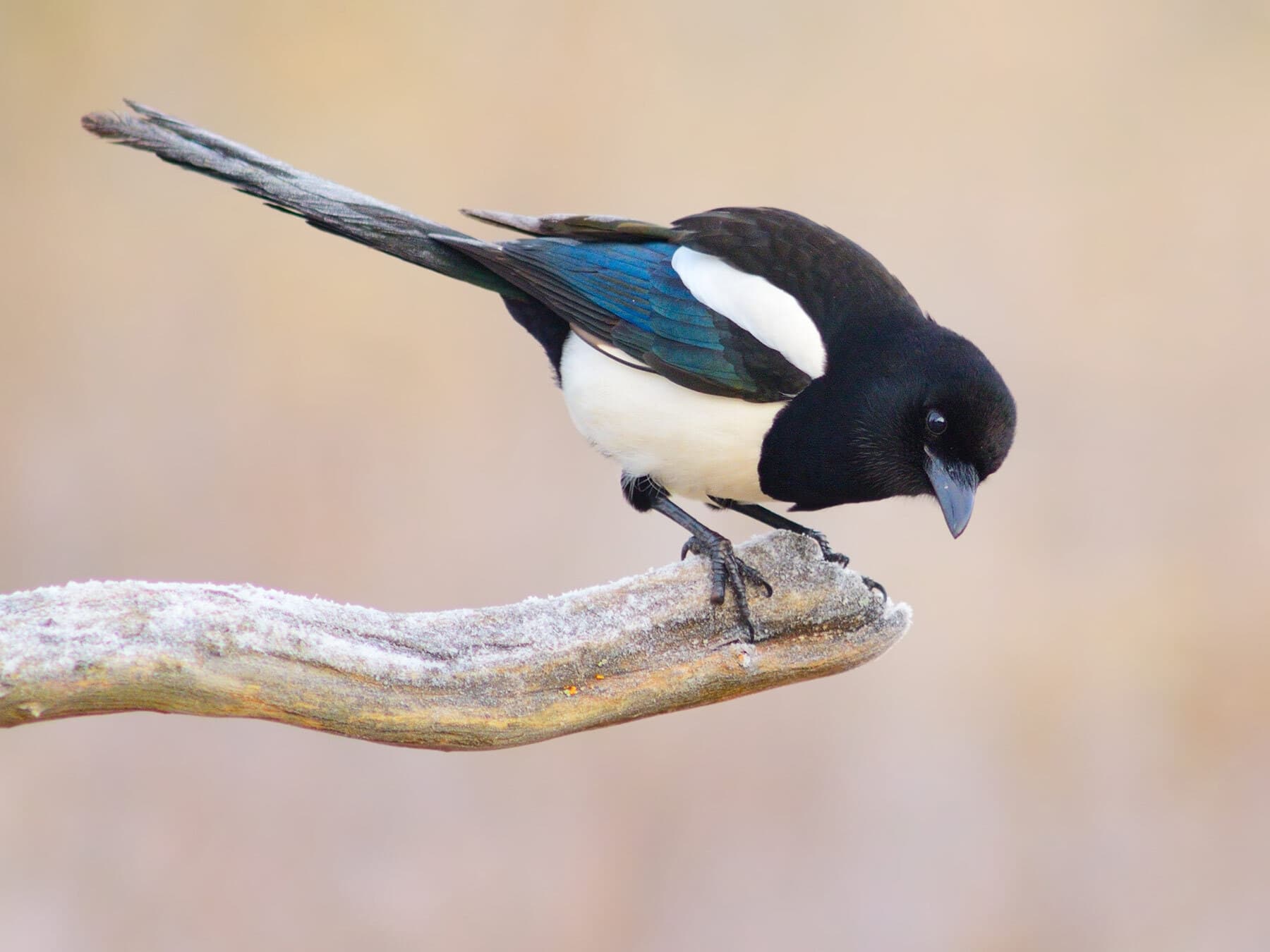
This page is about the Eurasian Magpie, the magpie of Britain and Europe. For the Australian Magpie, a bird of a different family, see the note at the end; for identification, calls and nesting, see the Magpie guide.
What do magpies eat?
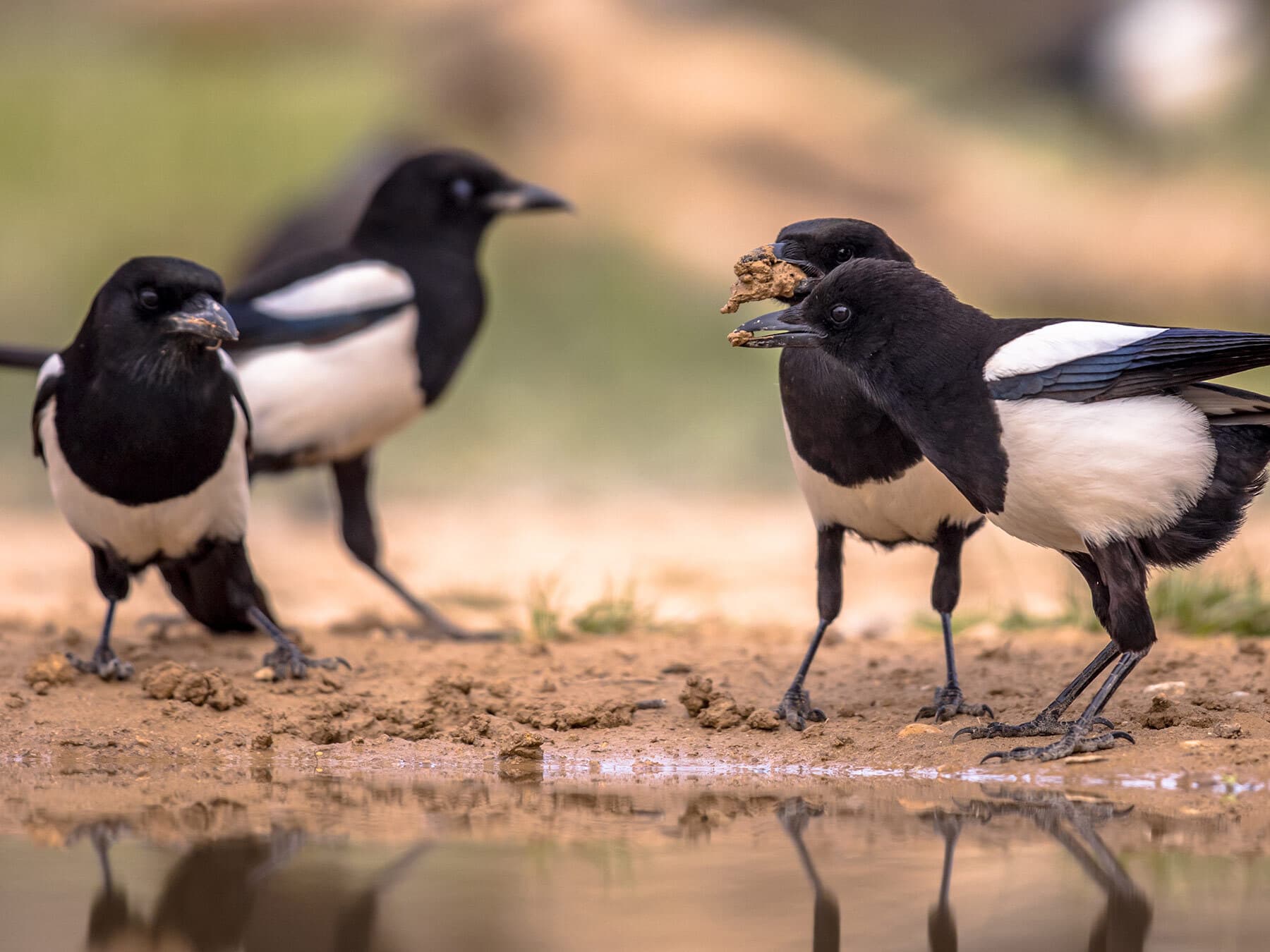
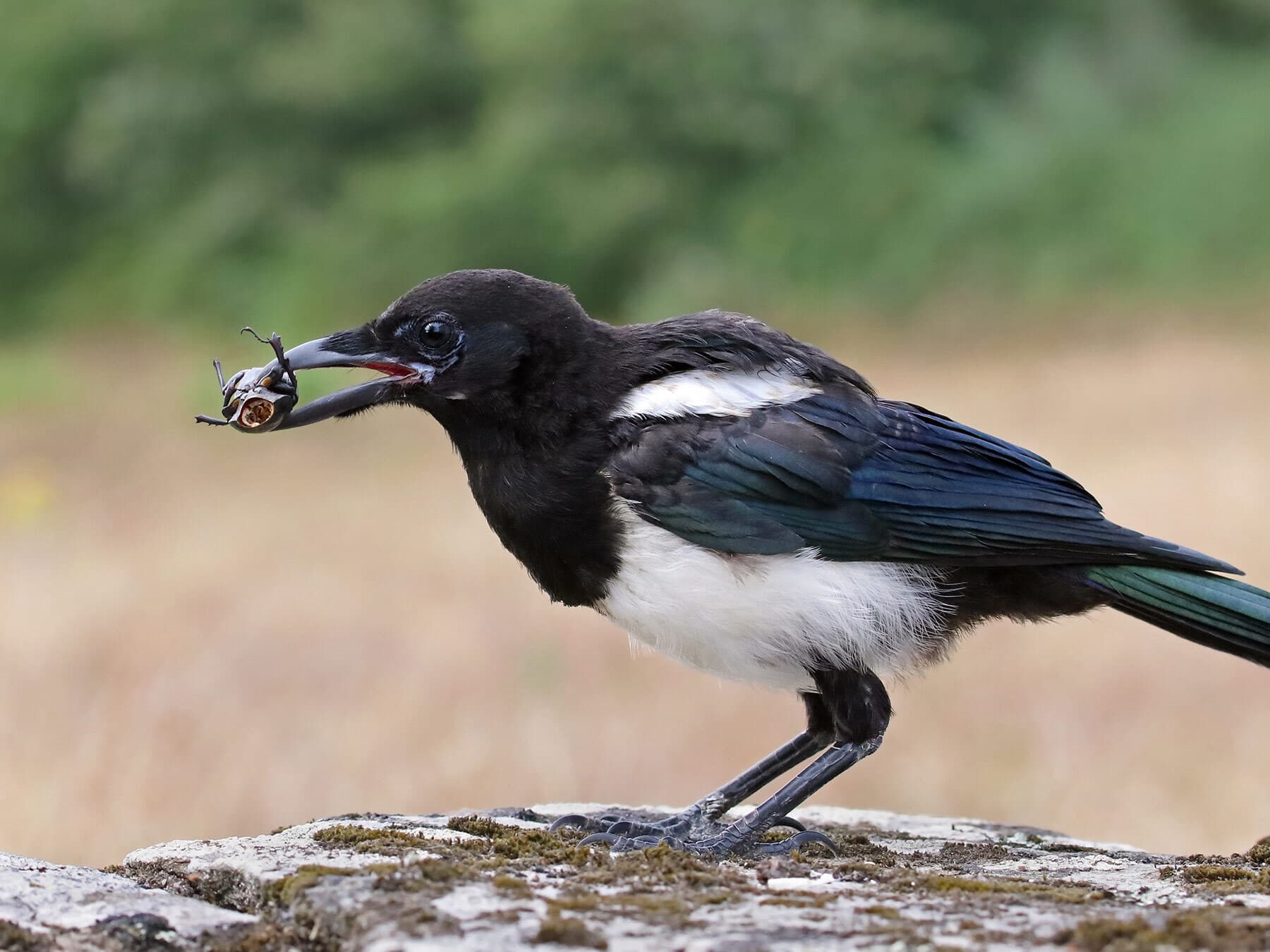
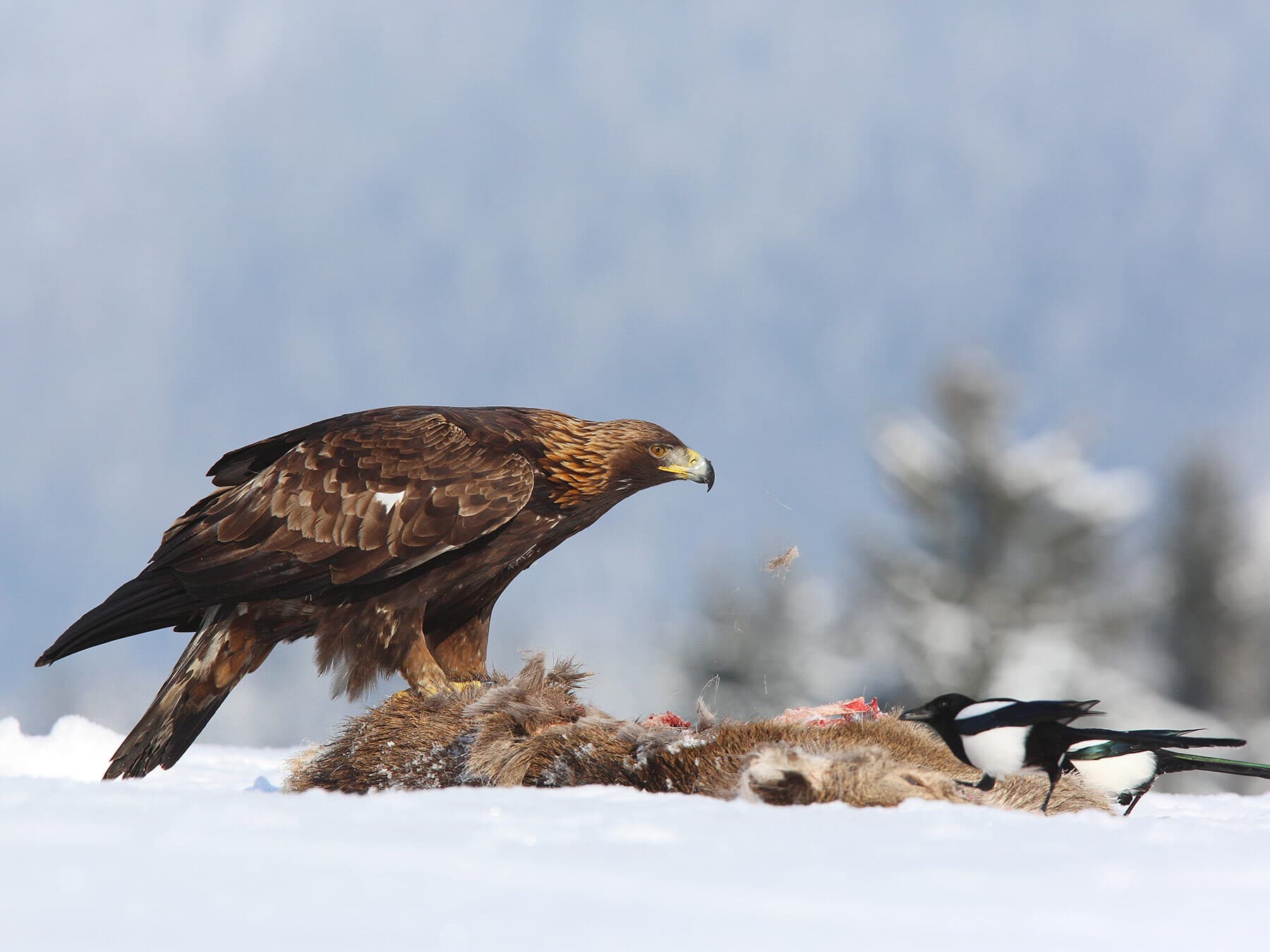
Almost anything they can find or catch. Magpies are omnivores, but chiefly carnivorous scavengers. Their food includes invertebrates, especially beetles, along with small mammals, lizards, frogs, birds' eggs and nestlings, and carrion, and they take seeds, berries and fruit in season. Very occasionally they catch an adult bird.1
Through the year
One British study is from Manchester, where Paul Tatner examined what urban magpies had eaten. Their diet was mostly the small animals of grassland: weevils, click beetles, ground beetles, flies, caterpillars and spiders, with leatherjackets and worms important by weight. Mammals such as field voles and birds such as House Sparrows turned up only now and then. In winter the diet was largely plant material, and magpies may go short of food at that time of year.2
Elsewhere the mix depends on what is about. In farmland in Spain, insects and other arthropods and cereal seeds were the most frequent foods in the breeding season (more than 60%); eggs and birds were eaten only occasionally.1
Food for the chicks
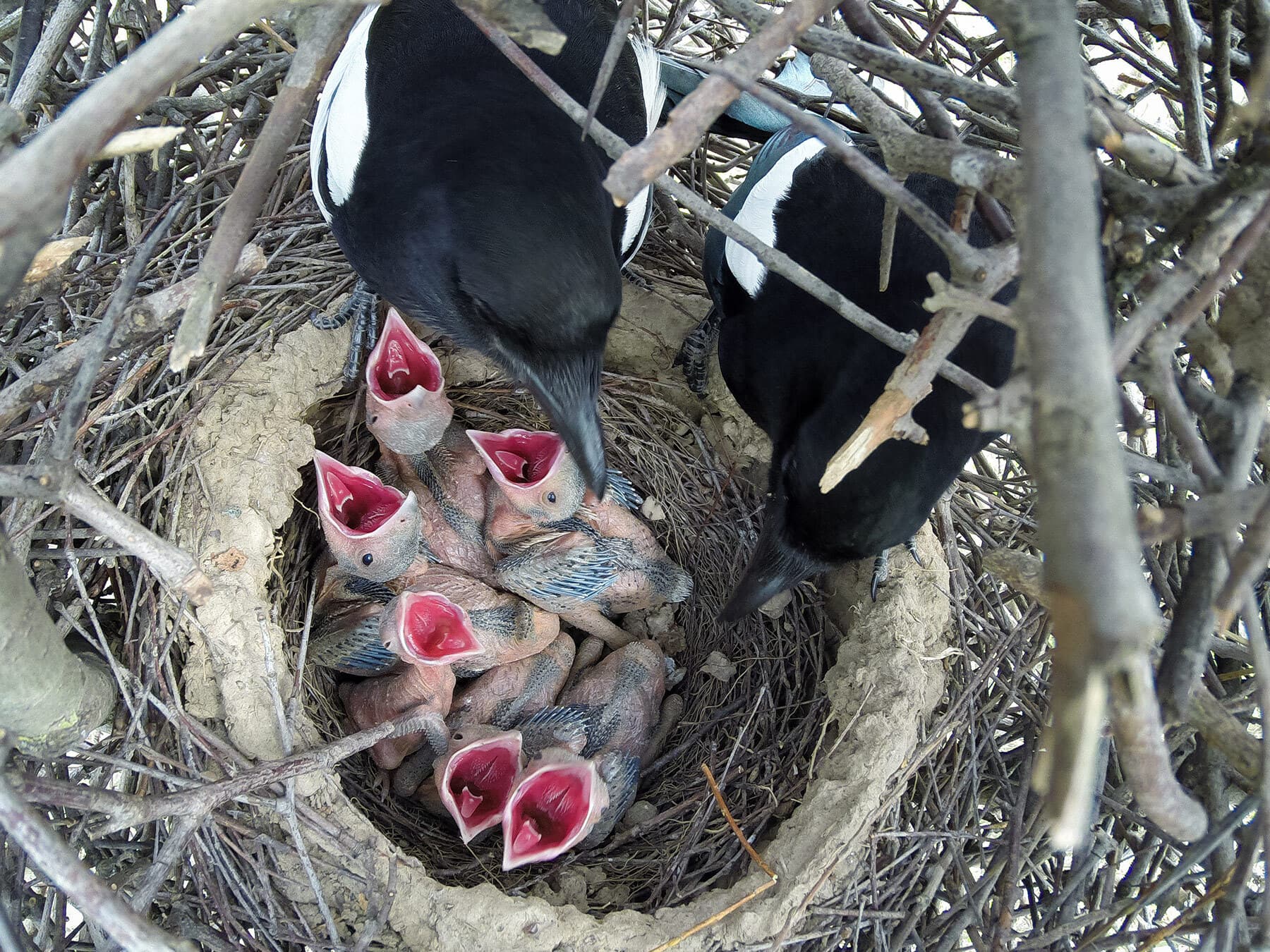
Mostly insects and other invertebrates. In a study around Prague, in which 2,000 food items were collected from the chicks of 27 nests, beetles were the commonest prey in both town and farmland. The parents brought earthworms and caterpillars more often than their numbers in the surroundings would suggest, and town chicks got more human food, such as meat and bread.3 In Manchester too, chicks were fed on the invertebrates that were most plentiful at the time.2
How magpies find food
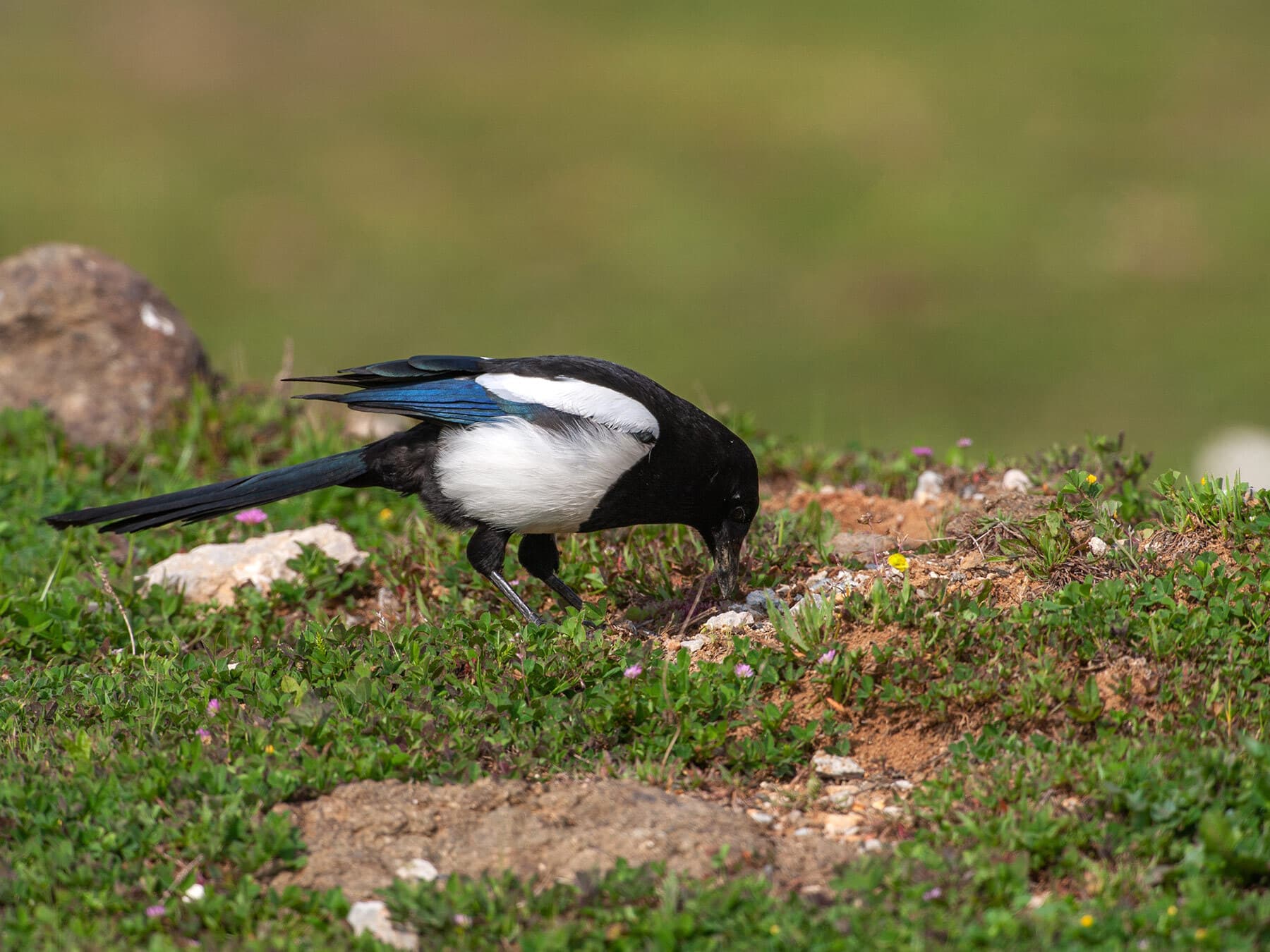
Magpies feed almost entirely on the ground, walking with a strutting gait, tail raised, and hopping sideways to catch prey. Pairs patrol roadsides early in the morning for animals killed overnight, and they perch on cattle and sheep to pick off ticks and other parasites. They also chase other birds to make them drop or bring up food.1
Food stores
Magpies hide food readily and usually come back for it within a few days.1 In an experiment at Newcastle University, magpies remembered which food they had hidden where, and when.4 In a holm-oak plantation in central Spain, magpies cached between 41% and 56% of the trees' yearly acorn crop, one at a time, pushing them into the ground and covering them with stones or leaves, or burying them; each breeding magpie hid between 169 and 1,372 acorns in six weeks, and 0.6% to 2.4% of the cached acorns produced seedlings.5
Do magpies eat other birds?
Yes, sometimes. Magpies take eggs and nestlings from other birds' nests, and on rare occasions catch an adult bird.1 In Manchester, though, birds were a small part of the diet: the summer diets of adults and chicks contained few eggs or nestlings.2
Large national studies have not found that magpies caused the declines of Britain's songbirds. One found that year-to-year changes in the numbers of 23 songbird species were no different at sites with and without magpies.6 Another, of 29 bird populations in England, found no evidence of an effect of magpies and other predators for 22 of them, though it could not rule one out for the other seven.7 The BTO's summary is that magpies taking eggs and chicks does not lower songbird numbers across whole populations.8 The full evidence, study by study: Do magpies kill songbirds?
Gardens
Magpies take food scraps and visit bins, and where they are not persecuted they grow tame, if wary, around picnic sites and city parks.1 No source we read recommends particular foods for them. The RSPB's 2026 feeding advice for garden birds applies to anything you put out: use hanging feeders rather than flat trays or tables, pause seed and peanuts from May to October, and clean feeders and baths every week.9
The Australian Magpie's diet
The Australian Magpie is a different bird, a butcherbird relative of Australia and New Guinea. It eats mainly invertebrates, especially ground insects, with some frogs, lizards, small birds and small mammals, and carrion. It forages in spread-out groups on the ground, and can hear prey under the soil and probe for beetles by sound.10 See the Australian Magpie guide.
Sources
- Kirwan, G. M., Madge, S., Christie, D. A., Perlman, Y. (2025). Eurasian Magpie (Pica pica), version 1.1. Birds of the World (G. M. Kirwan, editor). Cornell Lab of Ornithology. doi:10.2173/bow.eurmag1.01.1
- Tatner, P. (1983). The diet of urban Magpies Pica pica. Ibis 125(1): 90-107. doi:10.1111/j.1474-919x.1983.tb03086.x
- Kryštofková, M., Fousová, P., Exnerová, A. (2011). Nestling diet of the Common Magpie (Pica pica) in urban and agricultural habitats. Ornis Fennica 88(3). doi:10.51812/of.133776
- Zinkivskay, A., Nazir, F., Smulders, T. V. (2009). What-where-when memory in magpies (Pica pica). Animal Cognition 12(1): 119-125. doi:10.1007/s10071-008-0176-x
- Martínez-Baroja, L. et al. (2019). Massive and effective acorn dispersal into agroforestry systems by an overlooked vector, the Eurasian magpie (Pica pica). Ecosphere 10(12): e02989. doi:10.1002/ecs2.2989
- Thomson, D. L., Green, R. E., Gregory, R. D., Baillie, S. R. (1998). The widespread declines of songbirds in rural Britain do not correlate with the spread of their avian predators. Proceedings of the Royal Society B 265(1410): 2057-2062. doi:10.1098/rspb.1998.0540
- Newson, S. E., Rexstad, E. A., Baillie, S. R., Buckland, S. T., Aebischer, N. J. (2010). Population change of avian predators and grey squirrels in England: is there evidence for an impact on avian prey populations? Journal of Applied Ecology 47(2): 244-252. doi:10.1111/j.1365-2664.2010.01771.x
- BTO. Magpie (Pica pica). BTO BirdFacts. Accessed 11 October 2026. Source
- RSPB (2026). Our latest guidance on feeding garden birds. RSPB news. Accessed 11 October 2026. Source
- Russell, E., Rowley, I., Christie, D. A. (2020). Australian Magpie (Gymnorhina tibicen), version 1.0. Birds of the World (J. del Hoyo, A. Elliott, J. Sargatal, D. A. Christie and E. de Juana, editors). Cornell Lab of Ornithology. doi:10.2173/bow.ausmag2.01