Facts · Updated 8 Oct 2026
What Do Blue Tits Eat? Diet and Garden Feeding
By the Birdfact teamChecked by Nathan Cope
Caterpillars, insects and spiders in spring and summer; seeds, berries and sap in autumn and winter. Their chicks are raised on caterpillars, and in gardens peanuts and sunflower seeds are favourites.
On this page9 sections
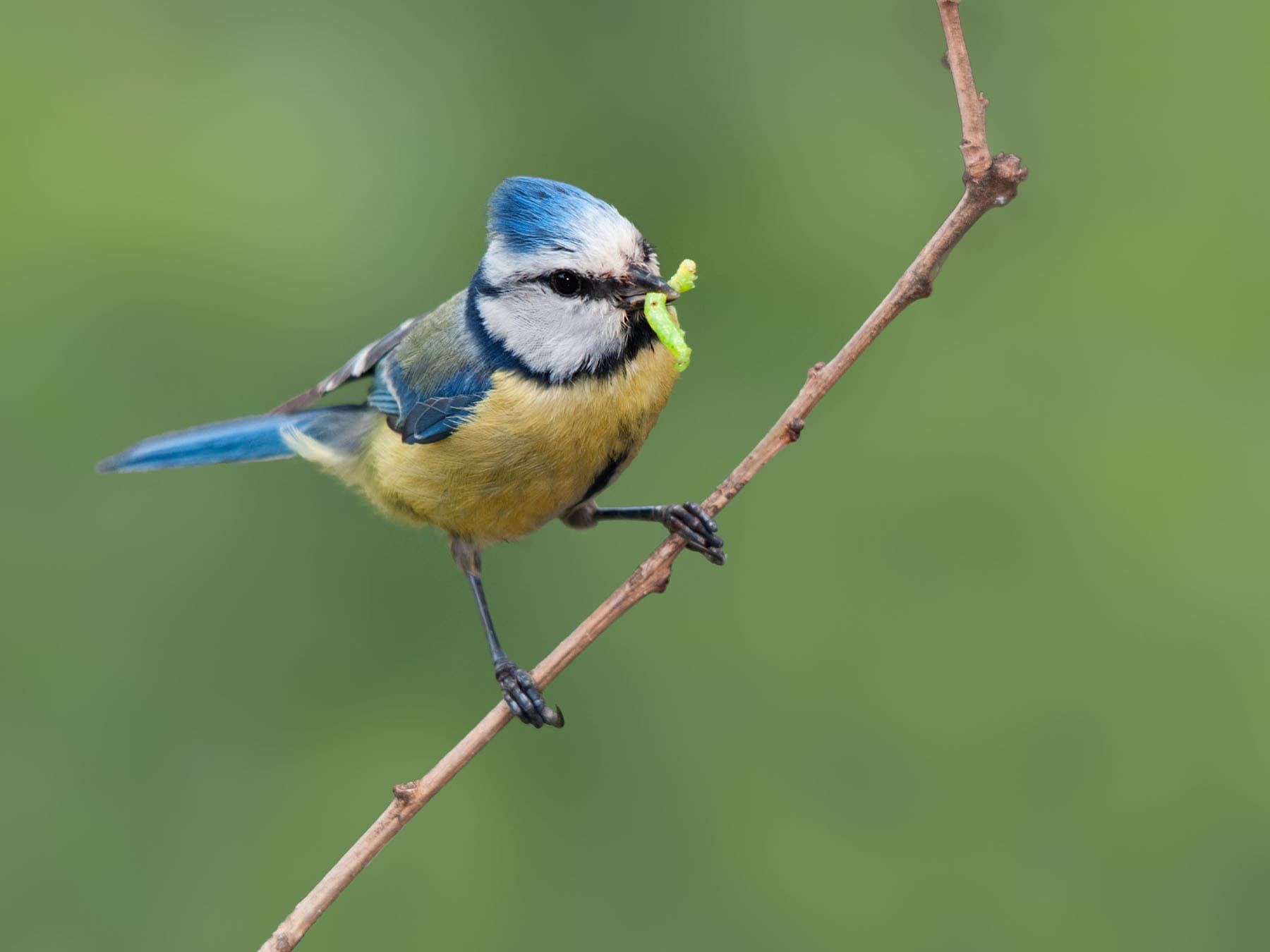
This page covers the Blue Tit's food through the year, what the chicks are fed, how they find and handle food, and how to feed them safely in a garden. For the bird in general, see Blue Tit identification and facts.
What do Blue Tits eat?
Mostly small insects and spiders, especially caterpillars, with seeds and fruit in autumn and winter. Most of their animal prey is about 1 cm long: caterpillars (above all those of tortrix moths), aphids, flies, beetles, bugs, earwigs, springtails, ants, spiders, snails and even ticks.1
Their diet is far more varied than it looks. DNA from the droppings of Blue Tits in Scottish woods before nesting turned up 432 likely food items, most of them rare; moths and butterflies were the commonest and most varied group of prey, and the menu got richer as spring went on.2
Spring and summer: caterpillars
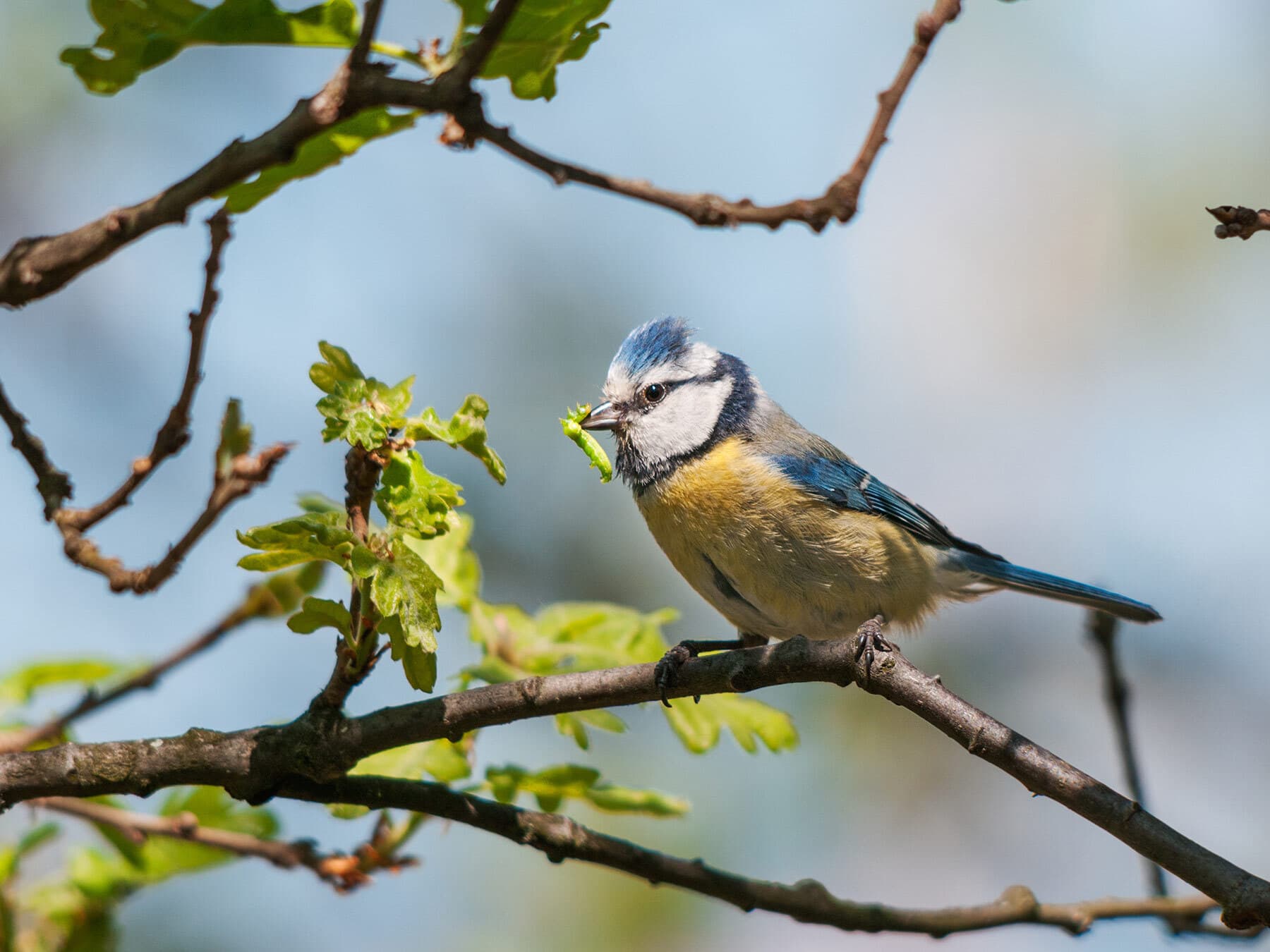
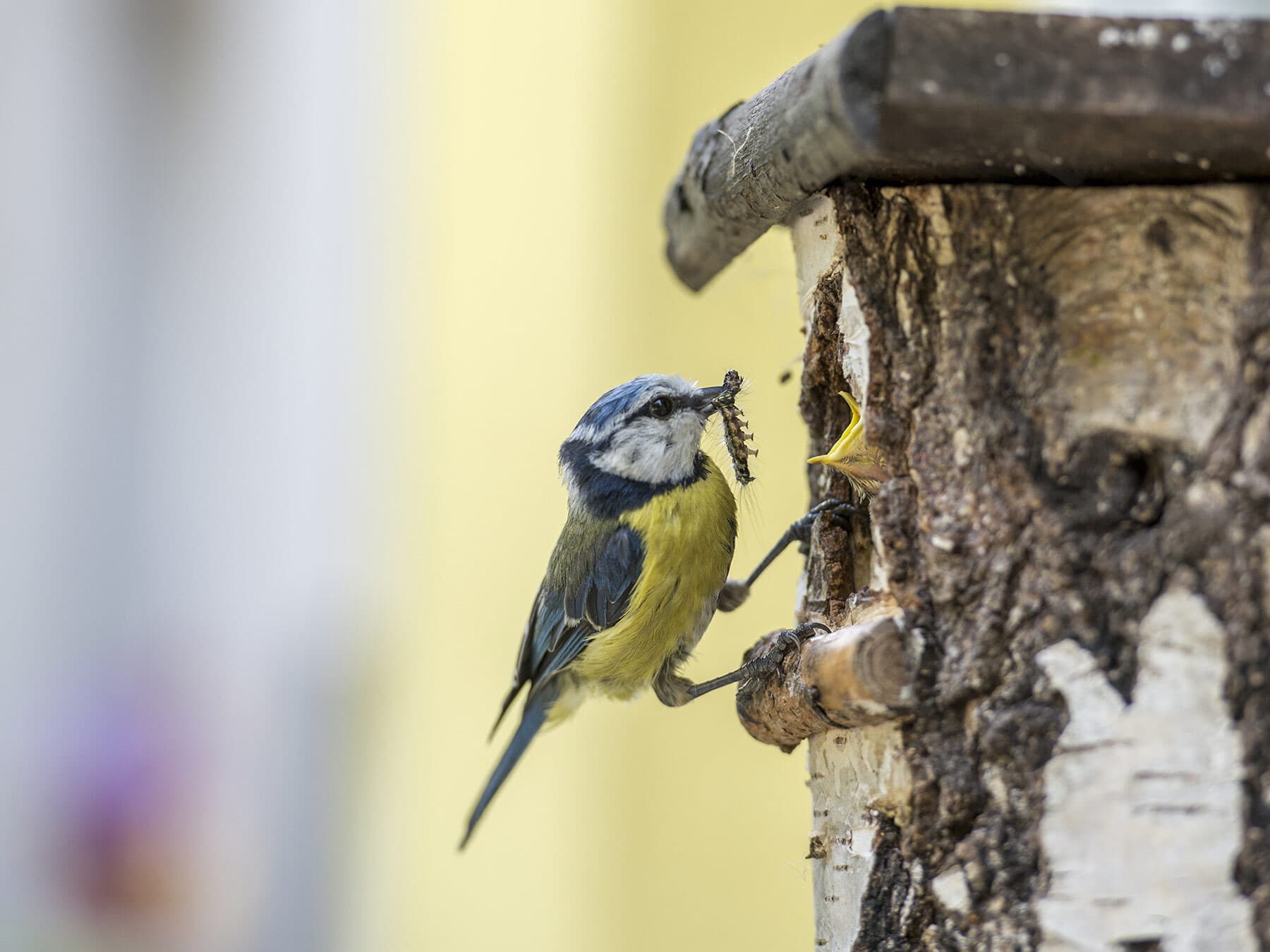
Caterpillars are the key food for nesting Blue Tits. Laying date, clutch size and nesting success are all tied to when leaf-eating caterpillars appear and how many there are. The BTO reckons each chick can eat 100 caterpillars a day, so a brood of ten needs up to 1,000 a day.3
In a study in Białowieża primeval forest in Poland, caterpillars made up about 74% of the nestlings' food.4
What caterpillars do Blue Tits eat?
Mainly the caterpillars of tortrix moths, small moths whose larvae feed on tree leaves in spring, but they take many others.
Autumn and winter: seeds, berries and sap
Outside the breeding season they take many seeds and fruits: seeds of birch, beech, ash, sycamore, pine, spruce and yew, and berries and fruit such as blackberry, elder, hawthorn, apple and pear. They also take sap from birch and sycamore, and in spring nectar from willow, plum, cherry and currant flowers.
How Blue Tits find their food
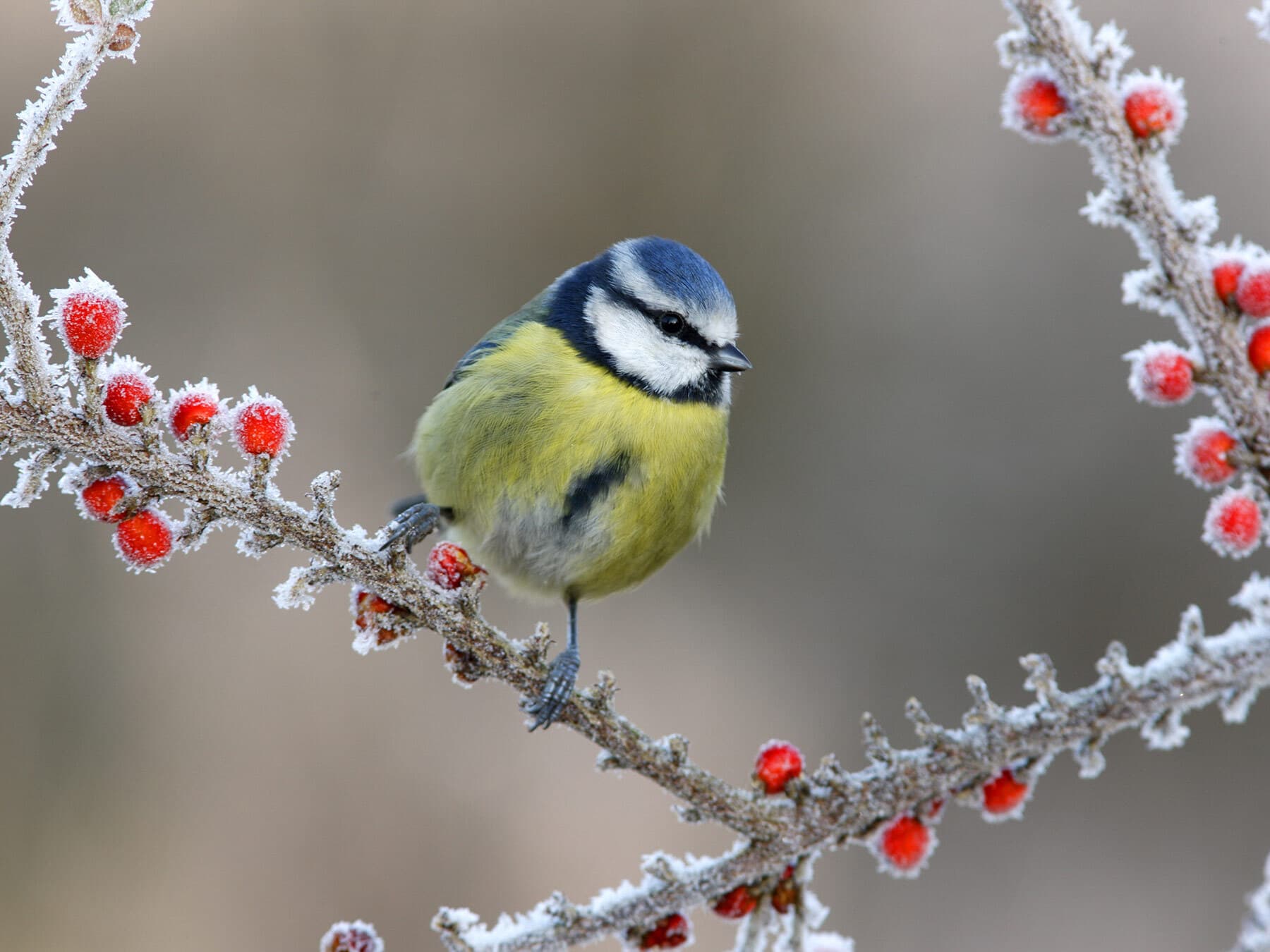
They forage at every height in trees and bushes, searching leaves, buds and thin twigs closely. They often hang by one leg from a slender twig, strip loose bark, find grubs in leaf mines and galls, pick aphids off bushes, tap reed stems for hidden larvae, and hover for a moment at the foliage. They feed on the ground only now and then, and briefly.
A big seed is carried to a branch, held under a foot or wedged in bark, and hammered open with quick blows of the bill.
Favourite foods
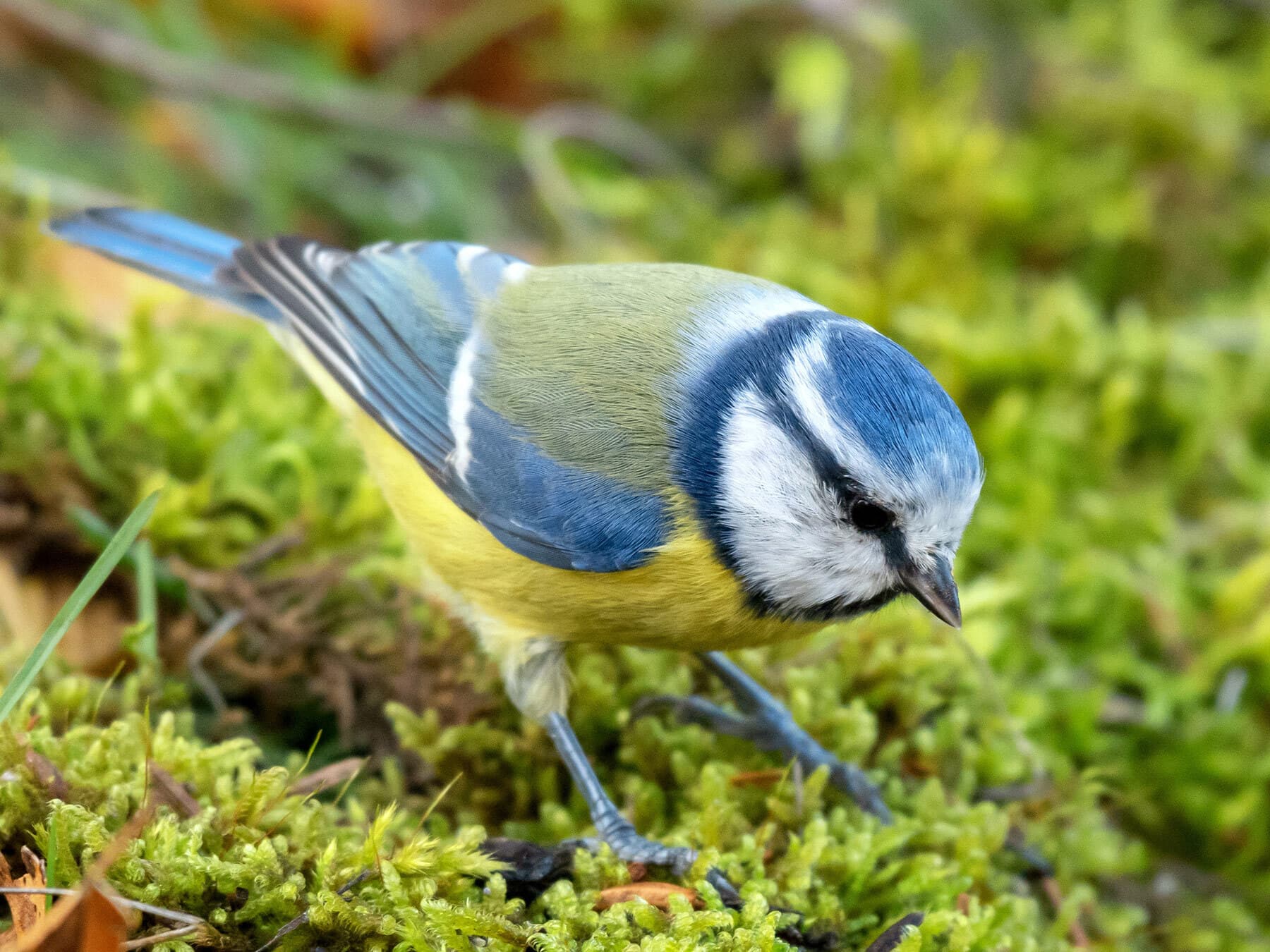
In gardens, peanuts and sunflower seeds. In a study along 220 km of Scotland, peanut was the single commonest item of all, natural or not, in Blue Tit droppings in early spring, garden food was in most samples, and it was still being eaten 1.4 km from the nearest house. Where Blue Tits ate more garden food, they nested at nearly four times the density and laid about 5 days earlier.5
The milk-bottle story
Blue Tits once had a famous taste for cream. Birds opening milk bottles were first reported at Swaythling, near Southampton, in 1921, and by 1947 the habit had been mapped across the UK. It probably started in several places rather than spreading from one, and it spread faster and faster, perhaps as birds learned from each other.6 It seems to have died out with doorstep milk deliveries.
Feeding Blue Tits in your garden
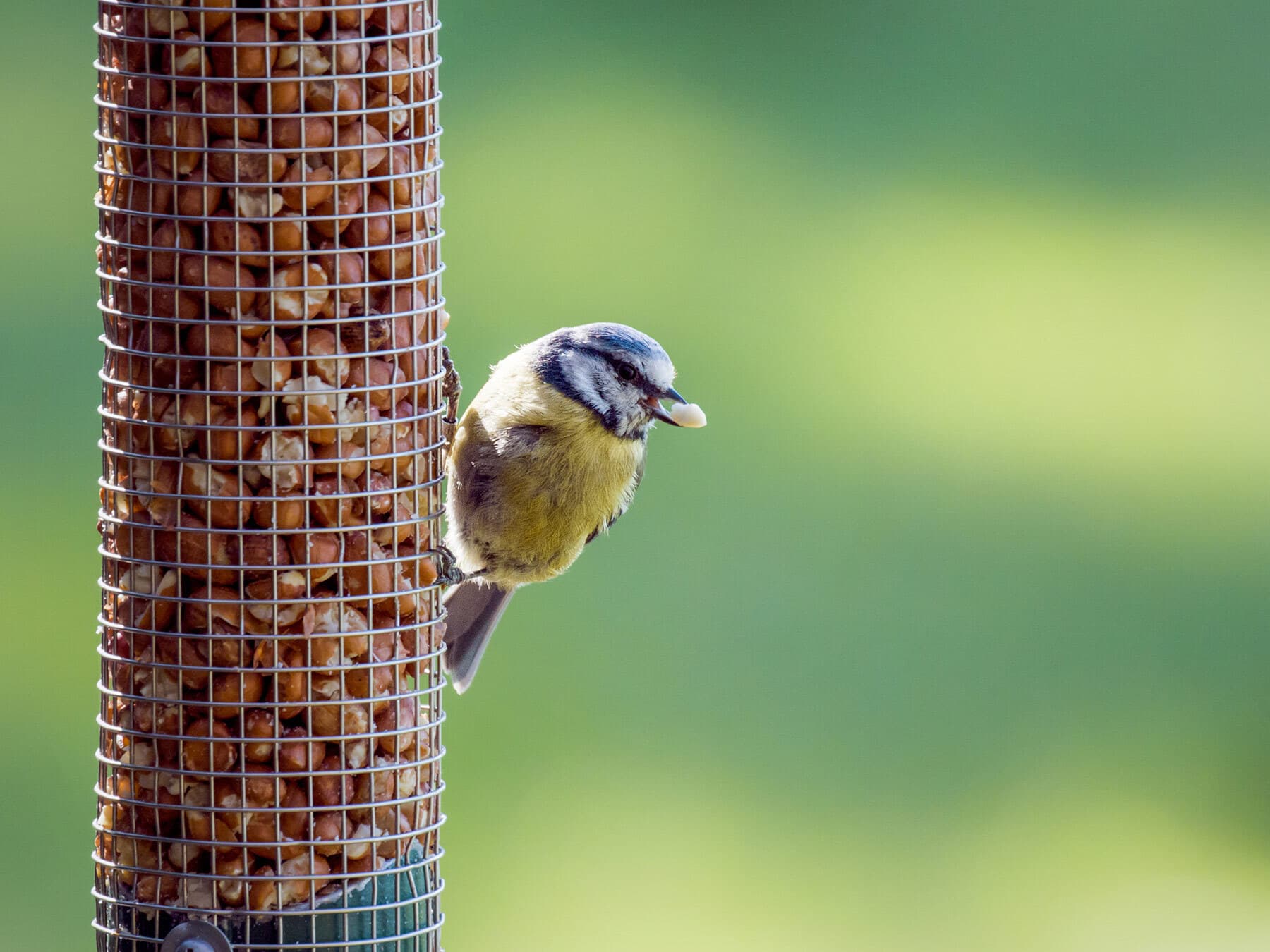
Good foods for tits are sunflower hearts in a hanging seed feeder, peanuts in a hanging mesh feeder and fat balls in a hanging mesh feeder. Never use mesh bags, which can trap birds' feet, and hang feeders a couple of metres from thick cover so small birds can escape a Sparrowhawk.
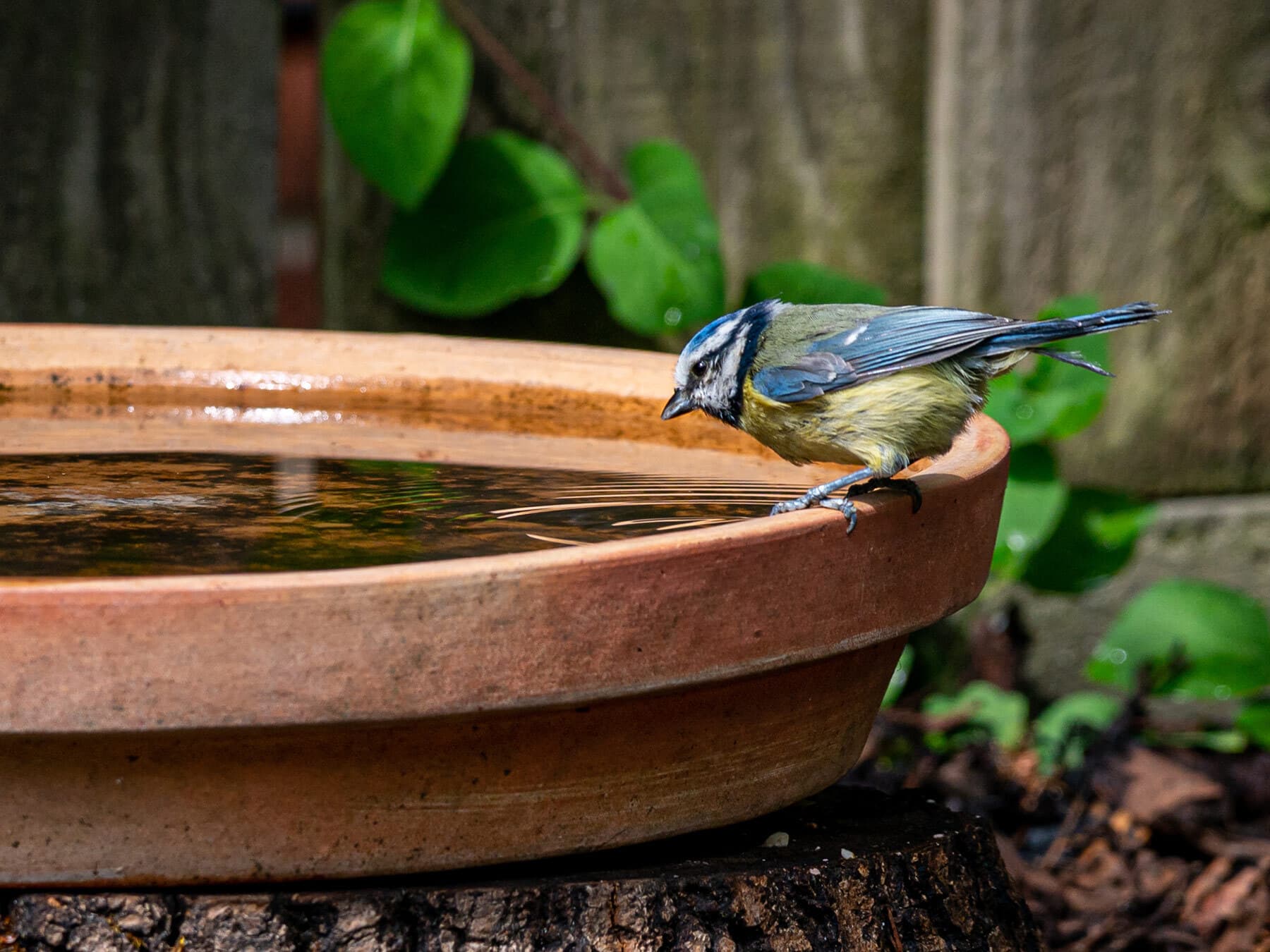
Since July 2026 the RSPB advises feeding with the seasons. From 1 November to 30 April you can offer the full range. From 1 May to 31 October, pause seed and peanuts and offer only small amounts of fat balls, suet or mealworms. Use hanging feeders, not bird tables, trays or window feeders, where disease spreads most easily; clean feeders weekly and change water every day.7
Sources
- Kirwan, G. M., Gosler, A., Clement, P., Christie, D. A., Pyle, P. (2024). Eurasian Blue Tit (Cyanistes caeruleus), version 1.1. Birds of the World (J. del Hoyo, A. Elliott, J. Sargatal, D. A. Christie, E. de Juana and M. G. Smith, editors). Cornell Lab of Ornithology. doi:10.2173/bow.blutit.01.1
- Shutt, J. D., Nicholls, J. A., Trivedi, U. H., Burgess, M. D., Stone, G. N., Hadfield, J. D., Phillimore, A. B. (2020). Gradients in richness and turnover of a forest passerine's diet prior to breeding: a mixed model approach applied to faecal metabarcoding data. Molecular Ecology 29: 1199-1213. doi:10.1111/mec.15394
- McCambridge, H.. A Blue Tit Diary. BTO Masterclass articles. Accessed 7 October 2026. Source
- Wesołowski, T., Rowiński, P. (2014). Do Blue Tits Cyanistes caeruleus synchronize reproduction with caterpillar peaks in a primeval forest?. Bird Study 61: 231-245. doi:10.1080/00063657.2014.899307
- Shutt, J. D., Trivedi, U. H., Nicholls, J. A. (2021). Faecal metabarcoding reveals pervasive long-distance impacts of garden bird feeding. Proceedings of the Royal Society B 288: 20210480. doi:10.1098/rspb.2021.0480
- Lefebvre, L. (1995). The opening of milk bottles by birds: evidence for accelerating learning rates, but against the wave-of-advance model of cultural transmission. Behavioural Processes 34: 43-53. doi:10.1016/0376-6357(94)00051-h
- RSPB (2026). How to help garden birds. RSPB news. Accessed 6 October 2026. Source
- RSPB. How and what to feed your garden birds. RSPB. Accessed 6 October 2026. Source
- BTO. Blue Tit (Cyanistes caeruleus). BTO BirdFacts. Accessed 7 October 2026. Source