Published 23 Oct 2026
Robin Song and Calls: What a Robin Sounds Like
By the Birdfact teamChecked by Nathan Cope
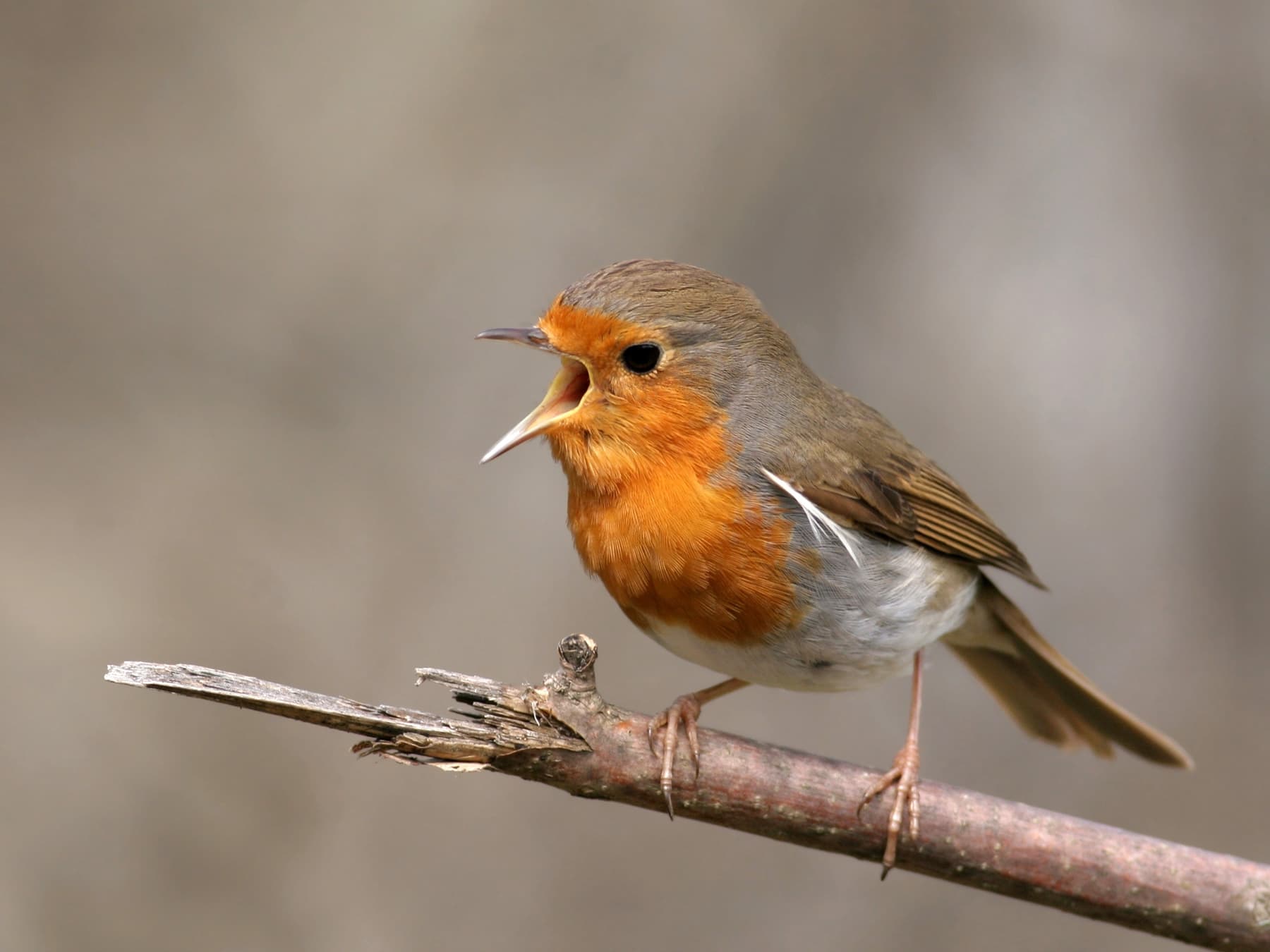
A Robin sings thin, high, silvery phrases of two or three seconds, each one different, with pauses between them. It sings in almost every month: in autumn and winter females sing too, Robins are among the first in the dawn chorus, and in towns they often sing at night. Its best-known call is a short, staccato "tic".
On this page14 sections
- What does a robin sound like?
- How a phrase is built
- A song that rarely repeats
- Why robins sing
- Singing in autumn and winter
- Do female robins sing?
- The singing year
- Early in the dawn chorus
- Why do robins sing at night?
- City robins sound different
- Calls and what they mean
- Young robins and quiet song
- About the recordings
- Sources
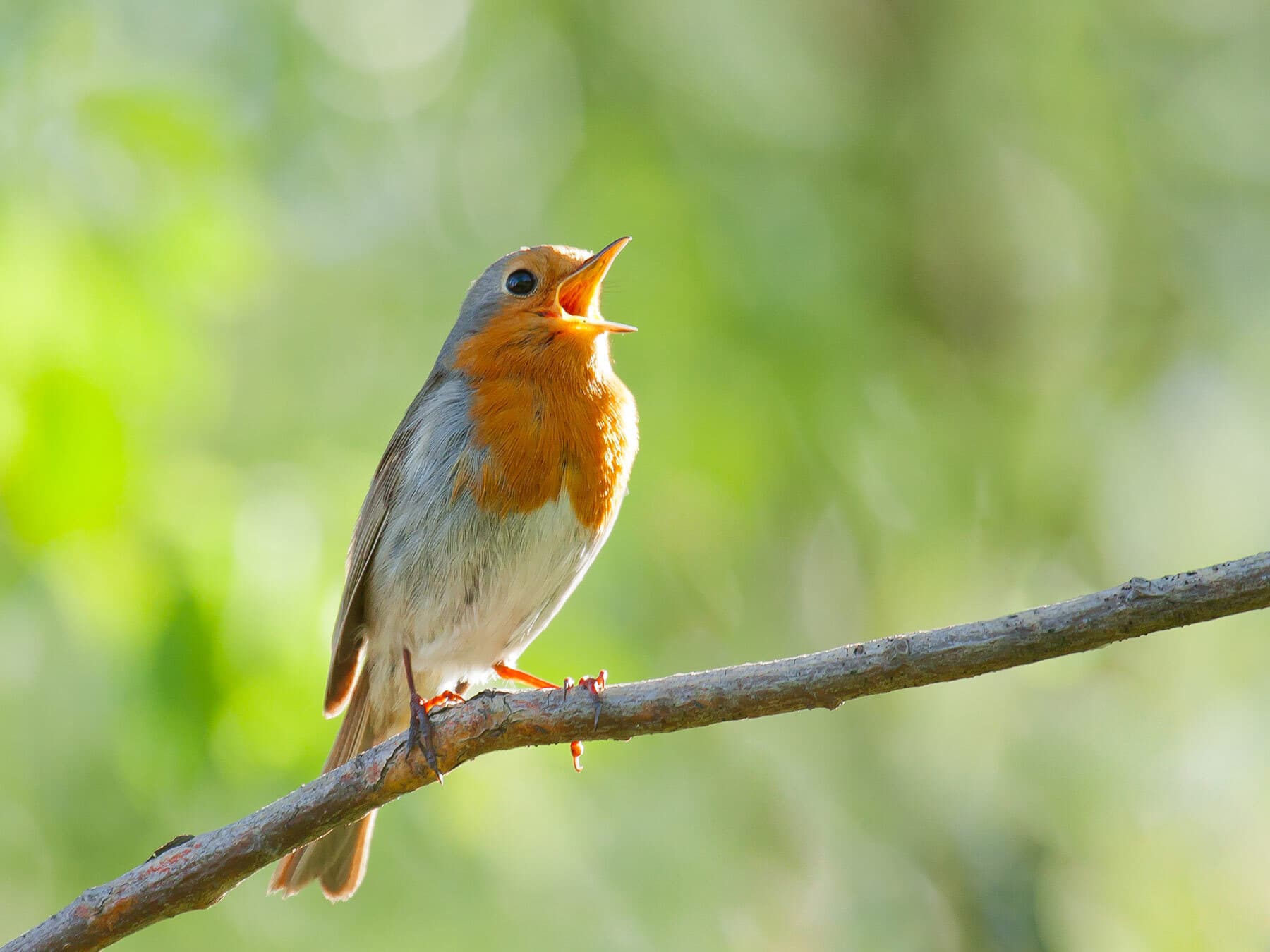
A Robin's song is a run of thin, high, silvery phrases, each a couple of seconds long and each different from the last, with pauses between them. It is a song you can hear in every season: in autumn and winter females sing as well as males, Robins are among the first birds of the dawn chorus, and in towns they often sing at night. Below are British recordings from spring, autumn, winter and after midnight, our spectrograms of what to listen for, and what studies of Robin song have found. For the bird itself, see our Robin guide.
What does a robin sound like?
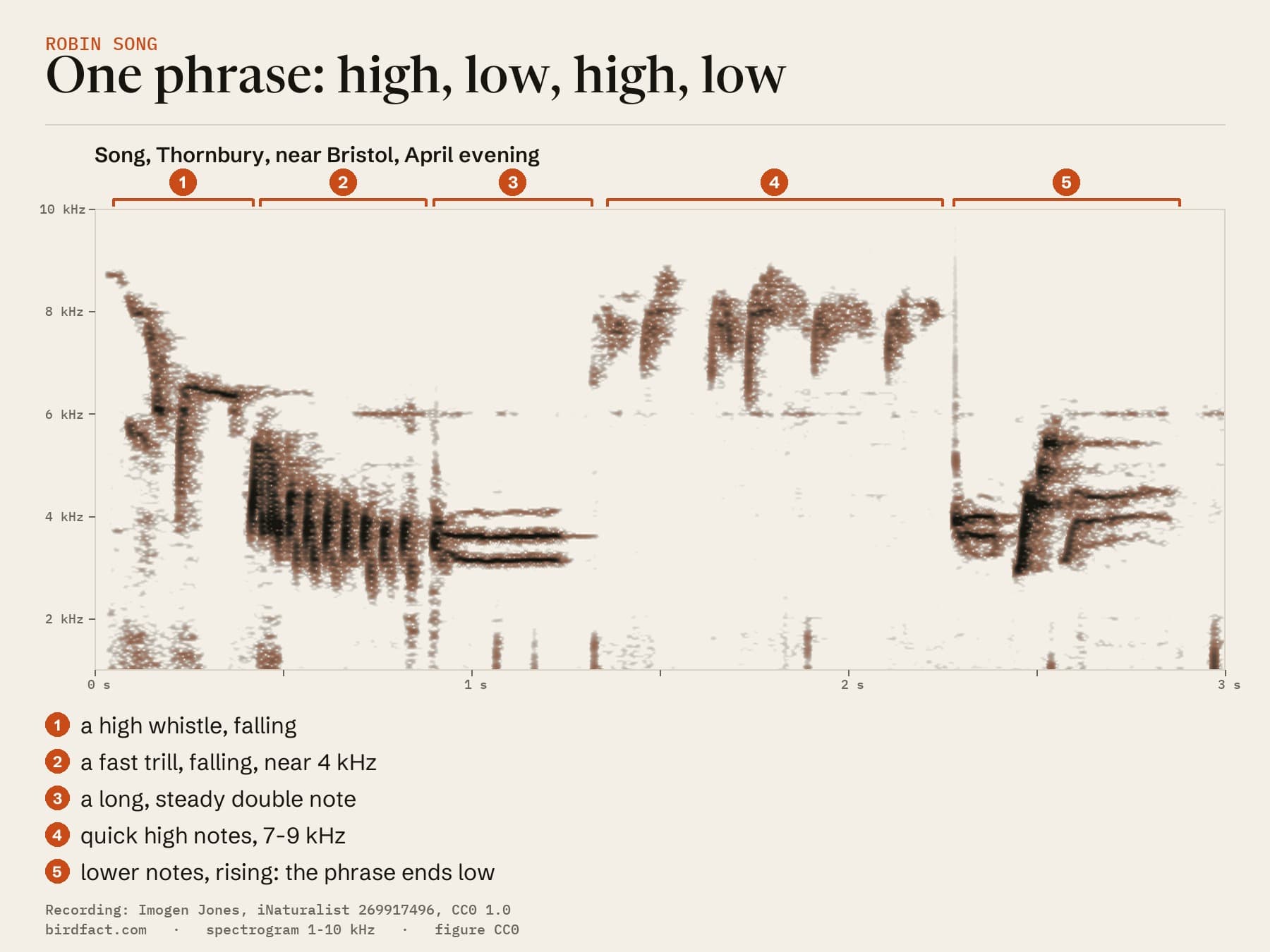
Birds of the World describes high, thin, silvery whistles gathered into phrases that vary a great deal; a typical phrase mixes a quick, sweet warble with a few long notes that fade.1 A French study that measured hundreds of songs in the 1960s found that a phrase lasts about 2.2 seconds on average, that a singing Robin pauses for about 5.8 seconds between phrases, and that the notes span about 1.5 to 12 kHz, three octaves. A Robin in steady song gave six to eight phrases a minute.2
How a phrase is built
A phrase is made of short groups of notes, and most phrases jump between a high band and a low one. In the French study, one group more often than not gave way to a group in the other band, and nine phrases in ten ended on a low group.2 The phrase in our figure fits that pattern: a high falling whistle, a low trill and a long double note, quick high notes, then lower notes to finish.
A song that rarely repeats
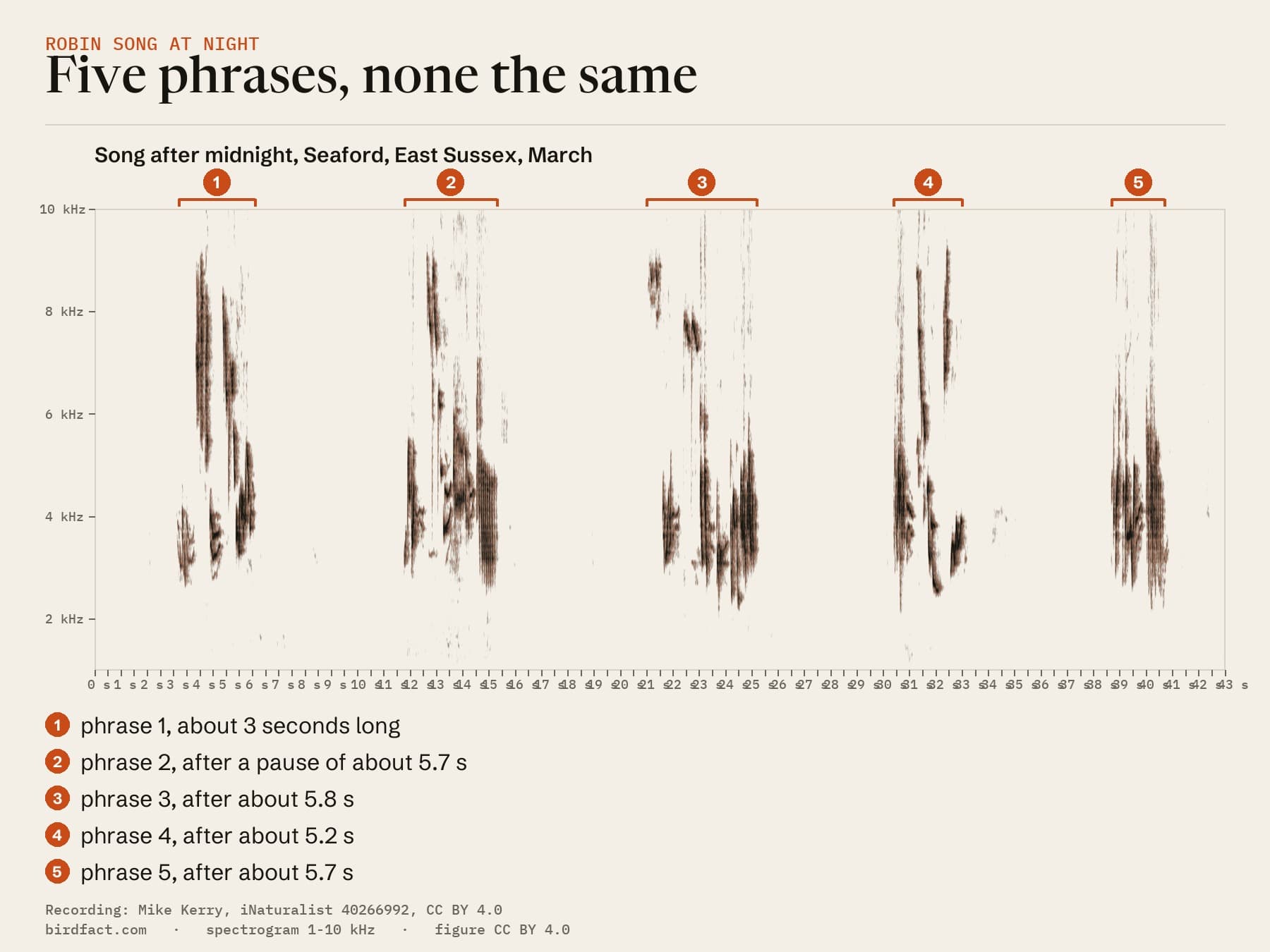
Robins are improvisers. The French study estimated that the species uses about 1,300 different note groups, judged that a single bird has several hundred, and found that a group was only very exceptionally repeated within a phrase.2 A 2025 study of Robins singing in autumn in Leicestershire and Warwickshire put it plainly: every phrase it recorded was unique, within and between birds.3
Our second figure shows 43 seconds of one Robin's song: five phrases, each a different pattern, with pauses of about five to six seconds between them.
Why robins sing
Mostly to hold ground. David Lack's study of Robins, published in 1939, found that owners sing and attack only within their own territory, and that song draws song from other Robins.4 Song works alongside the red breast: territorial males displayed and sang at a silent model Robin, but much more when it came with recorded song.5
In spring, song also guards a mate. Males sang and patrolled more regularly while their females were fertile, and when a male was taken away for 90 minutes, neighbours trespassed and seemed to seek matings with his female; when the males were returned, they at once sang and patrolled more.6 Singing has a cost: in wild and aviary Robins, birds that sang more put on less weight, probably mainly because they ate less.7
When a rival comes close, the song changes. Birds of the World describes song during fights as more strangled and slurred, often repeating the same phrases;1 the French study found fight song sung quietly, with occasional brief loud notes. It also found that a Robin whose territory was intruded on would sometimes copy the intruder's song while the two were still far apart, and stopped once they faced each other; the author read this as a way of naming the rival, though he had no direct proof.2
Singing in autumn and winter
Unlike many birds, Robins defend their territories all year and sing in autumn.8 In autumn and winter both males and females hold territories and sing to defend them.9 Lack found that some females held autumn territories with fighting and song, and that once a pair had formed, female song was rare.4
Birds of the World describes the autumn and winter song, which comes from both sexes, as quieter than spring song,1 with longer phrases and a more melancholy tone. Many writers call it plaintive, though we found no study that measured the difference.
Hormones help explain it. Free-living females have raised testosterone in winter, and in captive females testosterone switched on song, though not territorial aggression.10 In males, blocking testosterone affected the defence of a spring breeding territory but not of a winter one, and did not significantly reduce singing in either season.11

Do female robins sing?
Yes, in autumn and winter. In a 2025 field experiment, when an intruder was simulated, female and male Robins raised their vocal performance to the same degree, whatever the intruder's sex, though females sang shorter songs.9 An earlier study found male song more complex and less repetitive than female song.12 In spring, almost all song comes from males.1
The singing year
Early in the dawn chorus
Robins are among the first birds to sing at dawn. In forests in Finland, Germany and Spain, Robins and Blackbirds were the earliest natural singers of the five species studied,14 and in a Berlin forest Robins sang first of the ten species analysed.15 Sound recorders in Nantes, France, in May picked up a dawn peak in Robin song about 40 minutes before sunrise, and a smaller peak about 20 minutes after sunset.16
Light at night can pull the dawn song earlier, though not everywhere: in that study across Finland, Germany and Spain, Robins at street-lit forest sites did not sing earlier than at dark ones.14 When researchers switched lights on and off through the night in dark forest, the effect on dawn song was strongest in the Robin of the species tested,17 and around Saint-Nazaire, France, Robins sang earlier where artificial light was brighter.18 Beside Berlin's Tegel airport, Robins sang earlier where daytime noise was higher: the biggest shift of any species there.15
Why do robins sing at night?
If you hear a bird singing in the dark in a British town, it is most likely a Robin; the Nightingale is not the only night singer, and with its decline you are more likely to hear others.19 Robins often sing near street lights,13 but light may not be the main reason.
In a study across Sheffield between April and June, researchers visited 121 places by day and again at night. Robins sang by day at 67 of them and at night at 18 of those, and at one more place only at night, beside constant traffic. Daytime noise was about 10 decibels higher where Robins also sang at night, and it predicted night song better than light did; several night singers were in very dark places. The authors suggest Robins in noisy places may use the quieter night to sing, or sing at night to spend less of their singing time against the noise.20
Not every population does it. When Robins on street-lit territories were played song at night, most Welsh Robins answered, while Irish Robins rarely did, though both answered equally by day.21

City robins sound different
A 2026 study compared 59 Robins in Edinburgh with 54 in the woods of Midlothian in late winter. City songs had a higher lowest note, which stayed high all day while country birds' fell, a narrower range of pitch, and fewer notes per song. The authors sorted the songs into three rough types; the commonest, which they called "up-downs", alternates high and low notes and made up 63% of songs.22
Robins singing in noisier places in autumn in the English Midlands did much the same: fewer notes per phrase, longer notes and a higher lowest pitch.3 In an experiment, male Robins answering recorded song with added noise raised their lowest notes and sang shorter, simpler songs.23 In quiet conditions, Robins sing more low notes when a rival intrudes; under wind-turbine noise they did not.24
Calls and what they mean
Birds of the World lists these calls, among others:1
| Call | What it sounds like | When you hear it |
|---|---|---|
| Tic | A short, staccato "tic", repeated irregularly; when the bird is more excited, a fast, crackling run ("tic, tic, tikeritititit") | Excitement, often while defending a territory |
| Tswiiii | Thin | Contact and alarm |
| Tsiiip | High, sharp and thin | Alarm |
| Siii | High and piercing | Aggression |
| Seep | A high, hissing "seep" or "sweezeezeez" | A female being fed by her mate; a similar call when mating |
| Sip | Soft and sibilant | From migrants passing over at night |
The tic is given almost all year. The French study measured it: a click of 30 to 40 milliseconds, high at 8 to 10 kHz, given singly or two to four a second, with a flick of the tail and wings. It was most frequent in autumn, often when a bird of another species stayed in the territory. The study's thin alarm call was quite different: up to a second long, very high and hard to place, given by both parents once the chicks had hatched, especially when a person came near the nest. Played back to Robins attacking a loudspeaker, it usually stopped the attack, and the birds froze.2
In spring, a breeding female begs from her mate with far-carrying "seep" calls like a fledgling's; neighbouring males respond to them, presumably hoping to mate with her.25
Young robins and quiet song
In the French study, a young Robin's first song was very quiet, with notes not yet arranged into groups, and fairly often held rough copies of other birds' songs, most often the Chaffinch's. By October, young birds' song drew full territorial replies from adults.2 Birds of the World says full song only rarely includes mimicry, but subsong, a quiet, rambling warble given by both sexes, includes more.1
About the recordings
All six recordings on this page were made in Britain and are shared under open licences (CC0 or CC BY 4.0), which we read at the source. Each was identified as a Robin by at least three iNaturalist users, and we checked each one on a spectrogram. The figures are our own spectrograms of two of the recordings. For the Robin's place in folklore, see what robins mean; for another British songbird, see Blackbird song.
Sources
- Kirwan, G. M., Collar, N., Goodman, D. D. (2025). European Robin (Erithacus rubecula), version 1.1. Birds of the World (G. M. Kirwan and B. K. Keeney, editors). Cornell Lab of Ornithology. doi:10.2173/bow.eurrob1.01.1
- J. C. Bremond (1968). Recherches sur la sémantique et les éléments vecteurs d'information dans les signaux acoustiques du Rouge-gorge (Erithacus rubecula L.). Revue d'Écologie (La Terre et la Vie)(2): 109-220. Accessed 23 October 2026. Source
- Connor Proudfoot, William H J Norton (2025). Non-breeding European robins adjust their song in noisy environments. Behavioral Ecology 36(4): araf070. doi:10.1093/beheco/araf070
- David Lack (1939). The Behaviour of the Robin. Part I. The Life-history, with special reference to Aggressive Behaviour, Sexual Behaviour, and Territory. Part II. A Partial Analysis of Aggressive and Recognitional Behaviour. Proceedings of the Zoological Society of London A109(2-3): 169-219. doi:10.1111/j.1096-3642.1939.tb03362.x
- David F. Chantrey, Lance Workman (1984). Song and plumage effects on aggressive display by the European Robin Erithacus rubecula. Ibis 126(3): 366-371. doi:10.1111/j.1474-919x.1984.tb00257.x
- Joseph A. Tobias, Nathalie Seddon (2000). Territoriality as a paternity guard in the European robin, Erithacus rubecula. Animal Behaviour 60(2): 165-173. doi:10.1006/anbe.2000.1442
- Robert J. Thomas, Arthur R. Goldsmith, Innes C. Cuthill, Helena Lidgate, Selene Burdett Proctor, Delia Cosgrove (2003). The trade-off between singing and mass gain in a daytime-singing bird, the European robin. Behaviour 140(3): 387-404. doi:10.1163/156853903321826693
- Mey Duek (2025). Ask an RSPB expert: your November questions answered. RSPB. Accessed 23 October 2026. Source
- Julie Bosca, Guy Jacquin, Chloris Maury, Antje Bakker, Manfred Gahr, Thierry Aubin, Fanny Rybak, Laurent Nagle, Nicole Geberzahn (2025). Vocal performance in birdsong is an aggressive signal in both females and males: experimental evidence from a field study in European robins. Proceedings of the Royal Society B 292(2053): 20251042. doi:10.1098/rspb.2025.1042
- Eva Kriner, Hubert Schwabl (1991). Control of Winter Song and Territorial Aggression of Female Robins (Erithacus rubecula) by Testosterone. Ethology 87(1-2): 37-44. doi:10.1111/j.1439-0310.1991.tb01186.x
- Hubert Schwabl, Eva Kriner (1991). Territorial aggression and song of male European robins (Erithacus rubecula) in autumn and spring: Effects of antiandrogen treatment. Hormones and Behavior 25(2): 180-194. doi:10.1016/0018-506x(91)90049-n
- A. Rus Hoelzel (1986). Song characteristics and response to playback of male and female Robins Erithacus rubecula. Ibis 128(1): 115-127. doi:10.1111/j.1474-919x.1986.tb02098.x
- RSPB. Robin. RSPB Bird A-Z. Accessed 25 September 2026. Source
- Arnaud Da Silva, Bart Kempenaers (2017). Singing from North to South: Latitudinal variation in timing of dawn singing under natural and artificial light conditions. Journal of Animal Ecology 86(6): 1286-1297. doi:10.1111/1365-2656.12739
- Davide M. Dominoni, Stefan Greif, Erwin Nemeth, Henrik Brumm (2016). Airport noise predicts song timing of European birds. Ecology and Evolution 6(17): 6151-6159. doi:10.1002/ece3.2357
- Laurent Godet, Samuel Challéat, Kévin Barré (2026). Part-night lighting fails to restore natural song rhythms in urban European Robins. Environmental Pollution 396: 127837. doi:10.1016/j.envpol.2026.127837
- Arnaud Da Silva, Mihai Valcu, Bart Kempenaers (2016). Behavioural plasticity in the onset of dawn song under intermittent experimental night lighting. Animal Behaviour 117: 155-165. doi:10.1016/j.anbehav.2016.05.001
- Laurent Godet, Abel Prampart, Yasmine Benhamadi, Vincent Lostanlen, Pierre Aumond (2025). Temporal shift in Eurasian Blackbird Turdus merula and European Robin Erithacus rubecula song under urban pressures. Bird Study 72(4): 346-358. doi:10.1080/00063657.2025.2513543
- BTO. Identifying Nightingale and other night singers. BTO bird ID videos. Accessed 23 October 2026. Source
- Fuller, R.A., Warren, P.H., Gaston, K.J. (2007). Daytime noise predicts nocturnal singing in urban robins. Biology Letters 3(4): 368-370. doi:10.1098/rsbl.2007.0134
- Robert J. Thomas, Ed J. A. Drewitt, David J. Kelly, Nicola M. Marples, Stuart Semple (2003). Nocturnal playbacks reveal hidden differences in singing behaviour between populations of Robin Erithacus rubecula. Bird Study 50(1): 84-87. doi:10.1080/00063650309461295
- Marzia Golini, Matthew Bell (2026). The Effects of Anthrophony on Song Traits in European Robins (Erithacus rubecula). Ecology and Evolution 16(2): e73018. doi:10.1002/ece3.73018
- Heather McMullen, Rouven Schmidt, Hansjoerg P. Kunc (2014). Anthropogenic noise affects vocal interactions. Behavioural Processes 103: 125-128. doi:10.1016/j.beproc.2013.12.001
- Mieke C. Zwart, Jonathon C. Dunn, Philip J.K. McGowan, Mark J. Whittingham (2016). Wind farm noise suppresses territorial defense behavior in a songbird. Behavioral Ecology 27(1): 101-108. doi:10.1093/beheco/arv128
- Joseph A. Tobias (2002). Female begging in European robins: do neighbors eavesdrop for extrapair copulations? Behavioral Ecology 13(5): 637-642. doi:10.1093/beheco/13.5.637