Published 23 Oct 2026
Robin Meaning: What Robins Symbolise in Folklore
By the Birdfact teamChecked by Nathan Cope
Today many people see a robin as a sign that a loved one who has died is near, but the saying "When robins appear, loved ones are near" is modern: the earliest printing we found is from 2018. Older British folklore read a robin at the window as a warning of death, and the most widespread belief we found was that harming a robin brings bad luck.
On this page12 sections
What does it mean when a robin appears? It depends on who you ask, and when. Today many people in Britain see a robin as a sign that someone they have lost is close. That idea is comforting, and it is new: the earliest printing of "When robins appear, loved ones are near" that we could find is from 2018. Older British folklore read a robin's visit the other way, as a warning of death. And the most widespread belief we found is simpler: a robin is a bird you must never harm.
This page sets out what people in Britain and Ireland have believed about robins, where and when each belief was written down, and what the bird itself does. For the bird, see our Robin guide; for robins on cards and the Christmas legends, see why robins are associated with Christmas.
When robins appear, loved ones are near
The saying is everywhere now, on ornaments and memorial gifts, and many people find real comfort in it. We wanted to know how old it is. The earliest printing we found is an advertisement in the TV listings magazine What's on TV for 13 October 2018, selling a robin figurine under the heading "When robins appear, loved ones are near" as a way to "honour the everlasting memory of a treasured loved one".1
We found no earlier printing in the books, magazines and newspapers digitised on archive.org, and the phrase is too rare to register in Google's Ngram data up to 2022; we could not search the British Newspaper Archive, HathiTrust or Google Books. None of the printings we found names an author. The saying follows the same pattern as "feathers appear when angels are near". That does not make the feeling any less real. It does suggest that the robin as a visitor from a loved one is a modern belief, and the older records point the other way.
Omens at the window
In parts of 19th-century Britain a robin at the window, or in the house, was a bad sign. In 1829 John Trotter Brockett was told that around Heworth, near Newcastle, the robin "is looked upon as a bird of bad omen", and that in Northumberland and Scotland it was "considered the harbinger of death".2 William Henderson recorded in 1879 that in Northamptonshire a robin "is said to tap three times at the window of a dying person's room", and that in Scotland its song was thought to bode ill to a sick person who heard it. In Suffolk, he wrote, an old woman was dismayed when a robin came "weeping, weeping" to her door, and told of two times it had warned of a death.3
In Devon, Sarah Hewett wrote in 1900 that a robin sitting near a window "uttering a plaintive weep" foretold sickness and death, and that if one flew into a bedroom, "death is near at hand". She printed the story of a woman who told her, in 1891, that a robin had flown in and sat calling before the deaths of her grandmother in 1848 and her father in 1851, and that another had followed her about the garden at Dawlish the evening before her husband died in 1884. "Can you wonder at my having a dread of a visit from a robin," she asked.4
A bird not to be harmed
The belief we found in the most places, from Cornwall and Devon to Yorkshire, Scotland and Ireland, is that harming a robin brings bad luck. Walter Gregor wrote in 1881 that in the north-east of Scotland "It was accounted very unlucky to harm a robin, or to catch one".5 In the west of Scotland, James Napier wrote in 1879, there was "a popular saying that the robin had a drop of God's blood" in its veins, so to hurt one "was a sin", and "Boys did not dare to harry a robin's nest".6
The punishments were specific. Charles Swainson, gathering records in 1886, found that in Scotland and Yorkshire the cow of a man who killed a robin would give "bloody milk", and that in Suffolk the killer's hands would tremble; he added, from Chambers's Book of Days, that "a broken leg will follow the taking of a robin's eggs".7 Near Dartmoor, Henderson recorded, a little boy was heard to say that taking a robin's nest would break all the crockery in the house, and a Cornish rhyme he printed warned:3
Who hurts the robin or the wren
Will never prosper, sea or land.
Robin and wren were often paired: "The robin and the wren / Are God Almighty's cock and hen", ran a rhyme Henderson printed,3 and in north-east Scotland, Gregor wrote, "the wren was styled the robin's wife".5 In Ireland, Lady Wilde wrote in 1887, "Whoever kills a robin redbreast will never have good luck ...".8
Why the robin's breast is red
Several legends explain the red breast, some of them tying it to an act of mercy. In Ireland, Lady Wilde recorded a tradition "current amongst the people" that the robin plucked the sharpest thorn from Christ's brow on the cross and was stained red with his blood; she called it "God's own bird, sacred and holy".8 Henderson gives the thorn story from Brittany.3
A Welsh version was published in 1853 by a correspondent who had it from an old Carmarthenshire nurse: the robin carries "a drop of water to quench the flame" of hell, and its scorched feathers give it the name Bron-rhuddyn, which the writer glossed as "breast-burnt".9 On Guernsey, an old island woman said the robin was the first to bring fire to the island.7 The story of a robin fanning the fire in the stable at Bethlehem, often called ancient, is much newer: the earliest version we found is from the 1960s; see robins and Christmas.
Covering the dead
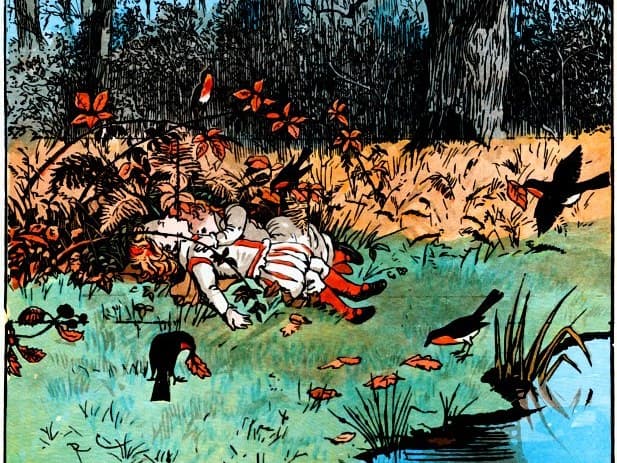
Since at least 1579 English writers have told of a robin covering the unburied dead. The idea is in Thomas Lupton's book of curiosities of 1579,10 and in the 1596 edition of a book of "diuers secrets": "The Robin-red-brest if he find a man or woman dead" will cover the face with moss.11 It is best known from the ballad of the Children in the Wood, entered for printing in 1595,12 in which two abandoned children die and "Robin-red-breast painfully / Did cover them with leaves".13
Poets took it up. Michael Drayton wrote in 1604 of the little redbreast covering a dead man's eye with moss, and so teaching charity;14 John Webster's dirge of 1612 begins "Call for the Robin-Red-brest and the wren";15 and in Shakespeare's Cymbeline, Arviragus says that "the ruddock would, / With charitable bill" bring flowers to a grave, "Yea, and furr'd moss besides, when flowers are none".16 Robert Herrick asked a robin to cover him "With leaves and moss-work".17
David Lack, who studied robins in life and in literature, found no sign of the idea in British folklore outside the ballad, and pointed out that moss and leaves are what robins build their nests with.10
Weather signs
Some beliefs read the robin as a forecast. In south-east Ireland, Swainson recorded, a robin entering a house meant snow or frost, and a Suffolk rhyme ran "If the robin sings in the bush, / Then the weather will be coarse".7 In north-east Scotland, Gregor wrote, a redbreast near the house early in autumn meant an early and severe winter; his own explanation was practical: "The bird comes where food and shelter are sure."5
Rhymes and poems
The first four verses of "Who killed Cock Robin?" are in Tommy Thumb's Pretty Song Book of about 1744, which the Opies called the earliest known book of nursery rhymes.18 The winter rhyme "The North Wind Doth Blow" came later; see robins and Christmas. William Blake's "A Robin redbreast in a cage / Puts all Heaven in a rage", from "Auguries of Innocence", was first printed in 1863.19
Names in Irish, Gaelic and Welsh
In Irish the robin is the spideog,20 and in Scottish Gaelic the brù-dhearg.21 The Welsh name in the 1853 legend, Bron-rhuddyn, was glossed by its writer as "breast-burnt".9 Older English dialect names include ruddock (Shakespeare's word, used in the North), reddock in Dorset and Bob Robin around Stirling.7
Is a robin a sign from heaven?
None of the old British and Irish records we read calls the robin a messenger from the dead. They make it a holy bird, and a bird of omen whose visits were feared more than welcomed. The nearest the old books come to a heavenly messenger is a legend from Brittany, which Swainson printed in 1886: Christ tells the robin that it shall be "the Bird of God," the bearer of good tidings.7 The idea of a robin sent by someone who has died is the modern one described at the top of this page. If a robin that comes close brings comfort, that comfort is real; the records we found suggest only that this meaning is newer than the old ones.
Why they come so close
Much robin lore starts with a real habit. Robins come close to people who turn up food: a robin will follow someone digging for the worms and grubs a spade brings up, just as it follows pheasants and moles. Robins keep territories all year, females a separate one in winter, so the same bird turns up in the same garden day after day, and in autumn and winter females sing as well as males.22 A robin that seems to follow you is usually doing exactly that. See our Robin guide for its song, food and habits.
The American Robin
This page is about the European Robin of Britain and Ireland. In North America, "robin" means the American Robin, a different bird, a thrush about twice the size that shares only the orange breast; see American Robin vs European Robin.23
Sources
- The Bradford Exchange (2018). Advertisement: 'A Love So Dear' sculpted robin figurine. What's on TV, 13 October 2018. Accessed 23 October 2026. Source
- John Trotter Brockett (1829). A Glossary of North Country Words, in Use. Emerson Charnley, Newcastle upon Tyne. Accessed 23 October 2026. Source
- William Henderson (1879). Notes on the Folk-Lore of the Northern Counties of England and the Borders. W. Satchell, Peyton and Co. for the Folk-Lore Society, London. Accessed 23 October 2026. Source
- Sarah Hewett (1900). Nummits and Crummits: Devonshire customs, characteristics, and folk-lore. Thomas Burleigh, London. Accessed 23 October 2026. Source
- Walter Gregor (1881). Notes on the Folk-Lore of the North-East of Scotland. Elliot Stock for the Folk-Lore Society, London. Accessed 23 October 2026. Source
- James Napier (1879). Folk Lore: or, superstitious beliefs in the west of Scotland within this century. Alex. Gardner, Paisley. Accessed 23 October 2026. Source
- Charles Swainson (1886). The Folk Lore and Provincial Names of British Birds. Elliot Stock for the Folk Lore Society, London. Accessed 23 October 2026. Source
- Lady Wilde (1887). Ancient Legends, Mystic Charms, and Superstitions of Ireland. Ticknor and Co., Boston. Accessed 23 October 2026. Source
- R. P. (1853). Welsh Legend of the Redbreast. Notes and Queries 7(179): 328. Accessed 23 October 2026. Source
- David Lack (1950). Robin Redbreast. Clarendon Press, Oxford.
- Thomas Johnson (translator) (1596). Cornucopiæ, or diuers secrets. William Barley, London. Accessed 23 October 2026. Source
- Henry B. Wheatley (1886). Reliques of Ancient English Poetry by Thomas Percy, edited by Henry B. Wheatley, vol. III. Swan Sonnenschein, Lebas, & Lowrey, London. Accessed 23 October 2026. Source
- Thomas Percy (1765). Reliques of Ancient English Poetry, vol. 3. Accessed 23 October 2026. Source
- Michael Drayton (1604). The Owle. Accessed 23 October 2026. Source
- John Webster (1612). The White Divel. Nicholas Okes for Thomas Archer, London. Accessed 23 October 2026. Source
- William Shakespeare (1866). Cymbeline, Act IV, scene ii. The Works of William Shakespeare, ed. W. G. Clark and W. Aldis Wright (the Globe edition). Macmillan and Co., Cambridge and London. Accessed 23 October 2026. Source
- Robert Herrick. To Robin Redbreast. The Hesperides & Noble Numbers, ed. Alfred W. Pollard. Accessed 23 October 2026. Source
- Iona Opie, Peter Opie (1951). The Oxford Dictionary of Nursery Rhymes. Clarendon Press, Oxford.
- Alexander Gilchrist (1863). Life of William Blake, "Pictor Ignotus", vol. II. Macmillan and Co., London and Cambridge. Accessed 23 October 2026. Source
- P. W. Joyce (1869). The Origin and History of Irish Names of Places.
- Edward Dwelly (1911). The Illustrated Gaelic Dictionary.
- Kirwan, G. M., Collar, N., Goodman, D. D. (2025). European Robin (Erithacus rubecula), version 1.1. Birds of the World (G. M. Kirwan and B. K. Keeney, editors). Cornell Lab of Ornithology. doi:10.2173/bow.eurrob1.01.1
- Kaufman, K. (2019). Ask Kenn Kaufman: Are American Robins Really Robins? Audubon Magazine. Accessed 6 October 2026. Source