Facts · Updated 8 Oct 2026
House Sparrow Nesting: Nests, Eggs, Chicks and Nest Boxes
By the Birdfact teamChecked by Nathan Cope
House Sparrows nest in holes in buildings and boxes, in small colonies. In Britain they lay 4 or 5 eggs, first on average in mid-May, and raise two or three broods a year.
On this page9 sections
This page covers the House Sparrow's nesting year: when and where they nest, the nest and eggs, the chicks, and the right nest box. For the chicks and fledglings in more detail, see baby sparrows; for the bird in general, House Sparrow.
When do House Sparrows nest?
In Britain the first clutch is laid on average on 14 May, anywhere from late March to mid-July, and pairs typically raise two or three broods, exceptionally four.1 Nest-building is busiest from February to May.
The season starts early: in autumn birds choose a hole, take some nest material in and roost there through the winter, and males display at it. Between broods a pair often lays again in the same nest, typically about 8 days after the young leave or a nest fails. A pair that loses nests may try many times in a season.2
Where do House Sparrows nest?
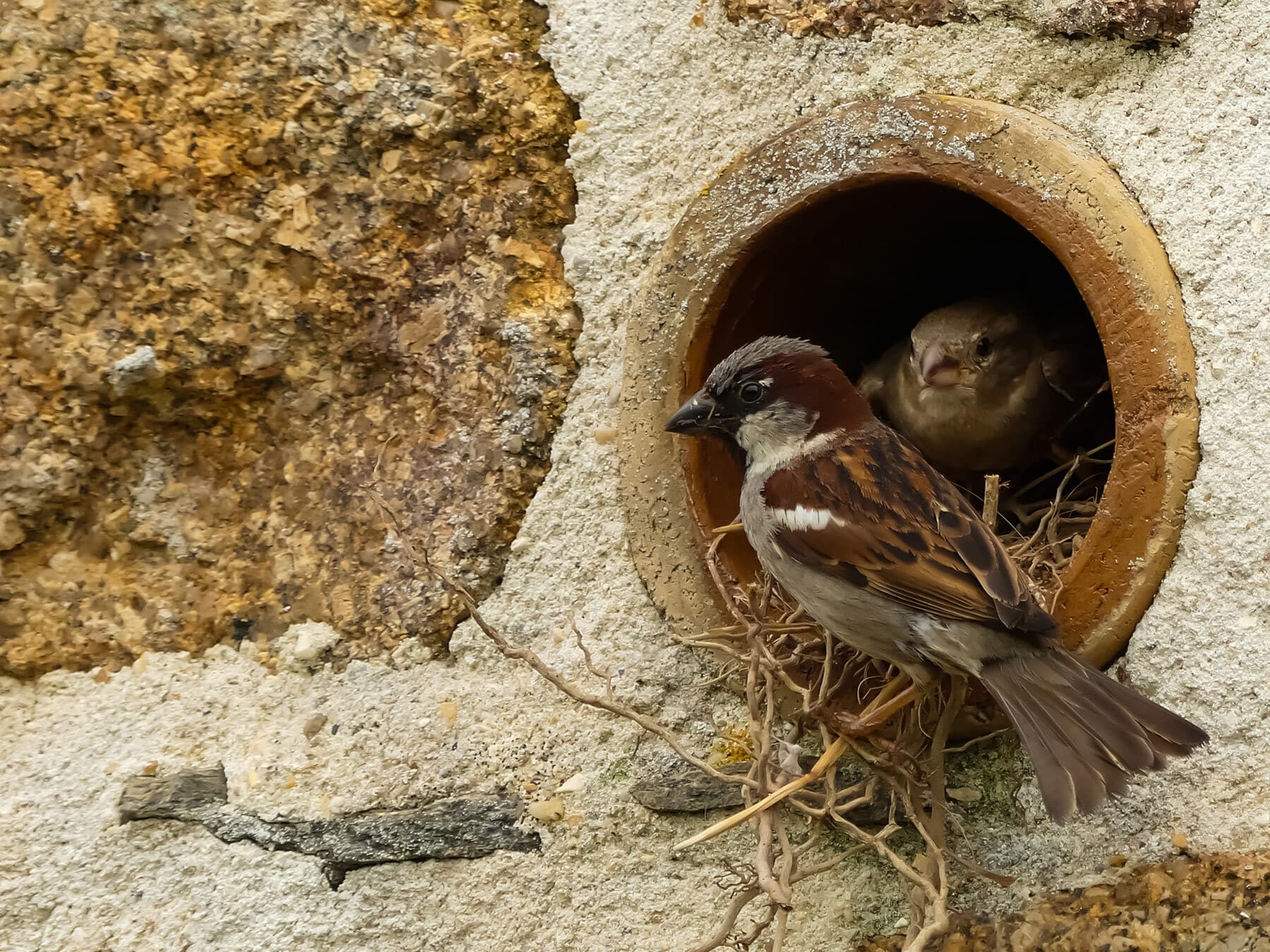
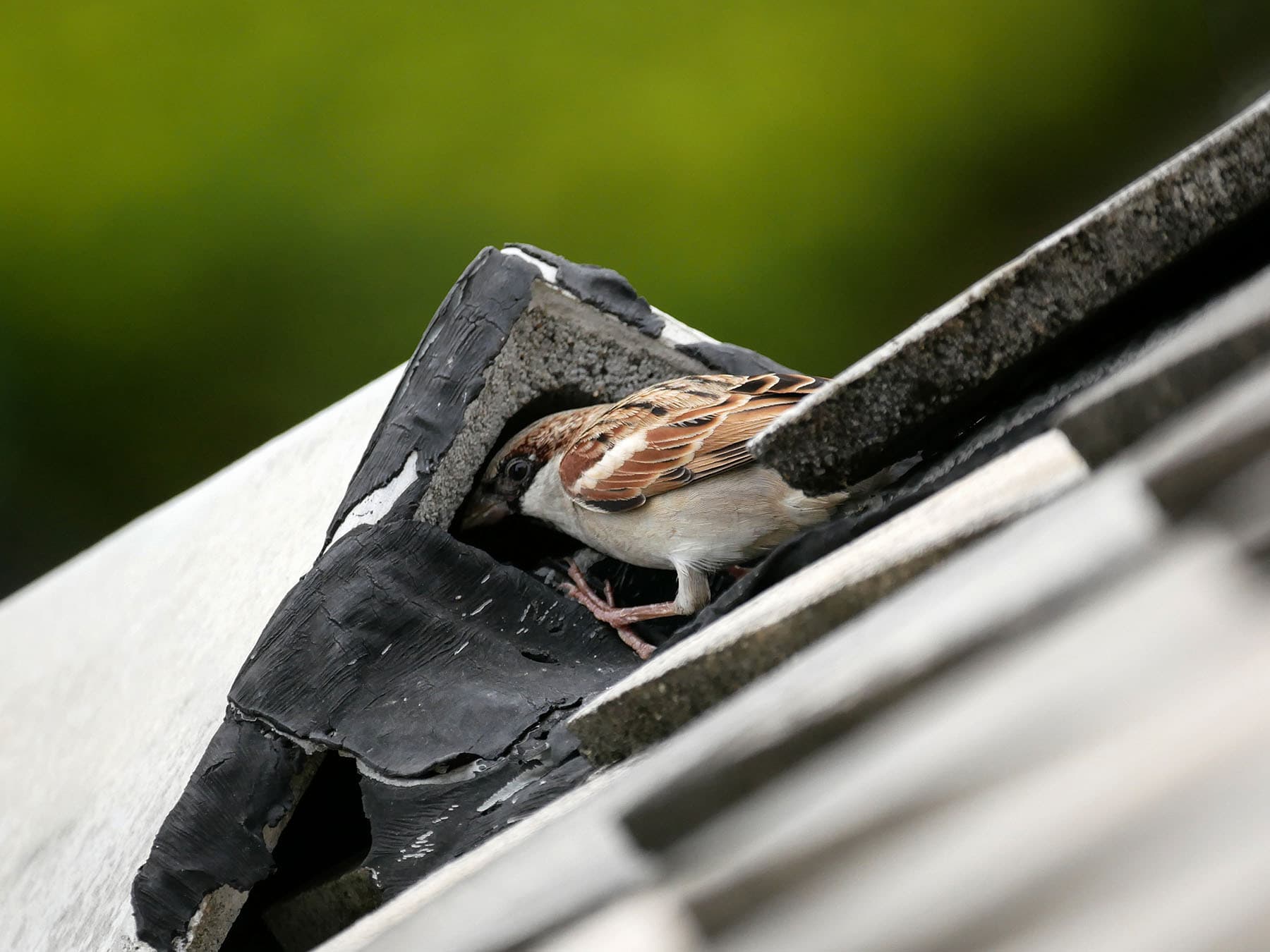
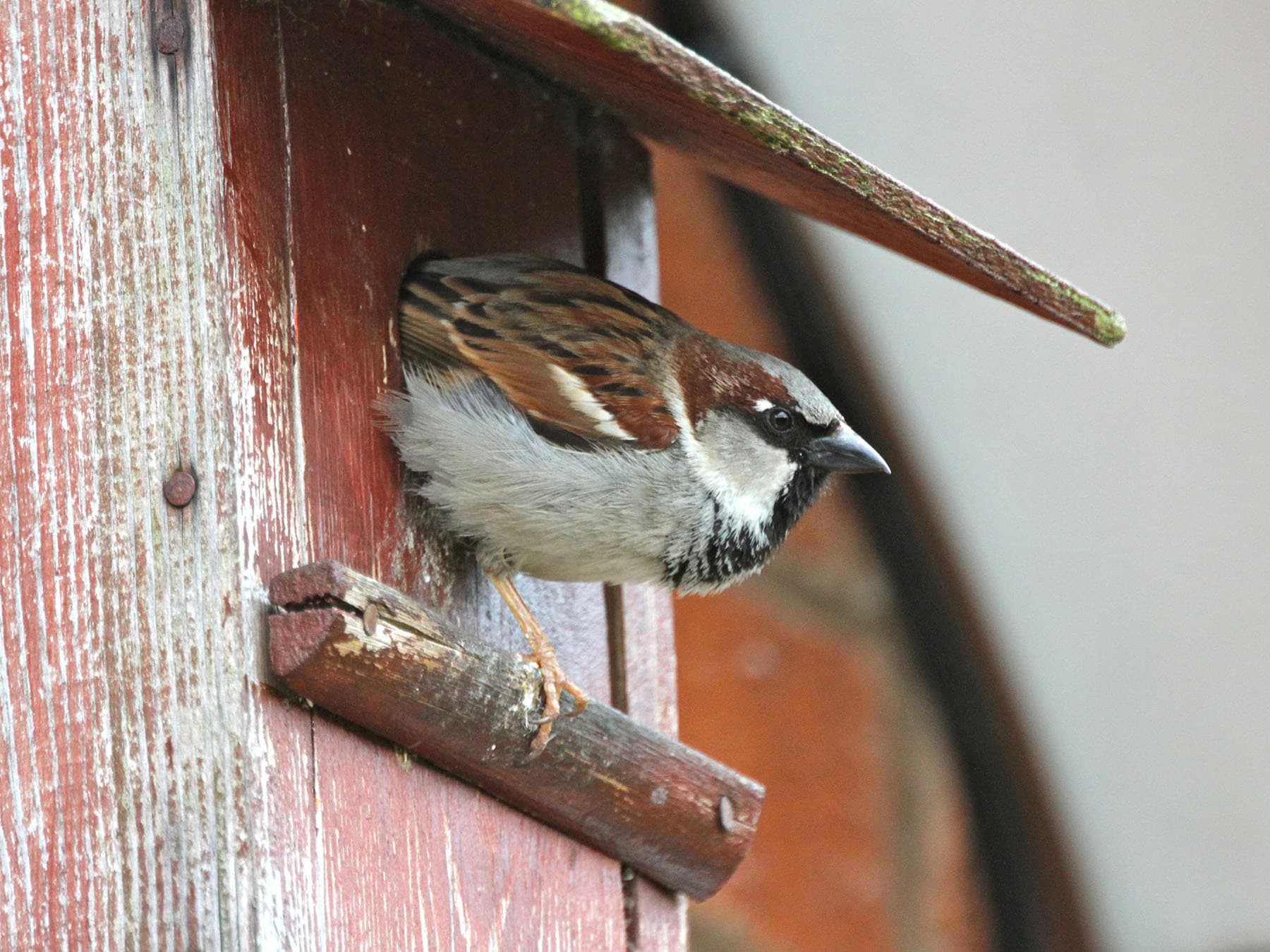
In holes and crevices, nearly always close to people: in buildings and walls, in gutters and nest boxes, and in holes in trees. Where there are no holes they build in creepers on walls, in hedges or in dense trees.2 In North America they also use streetlights, shop signs and traffic-light fittings.
Most nests are at roof or rafter height, 3 to 6 m (10 to 20 ft) up. House Sparrows nest in small colonies, and neighbouring nests can share walls. They are famously unfussy: pairs have nested on moving machinery and vehicles, following them to feed their young, and once 640 m (2,100 ft) below ground in an English coal mine.
The nest
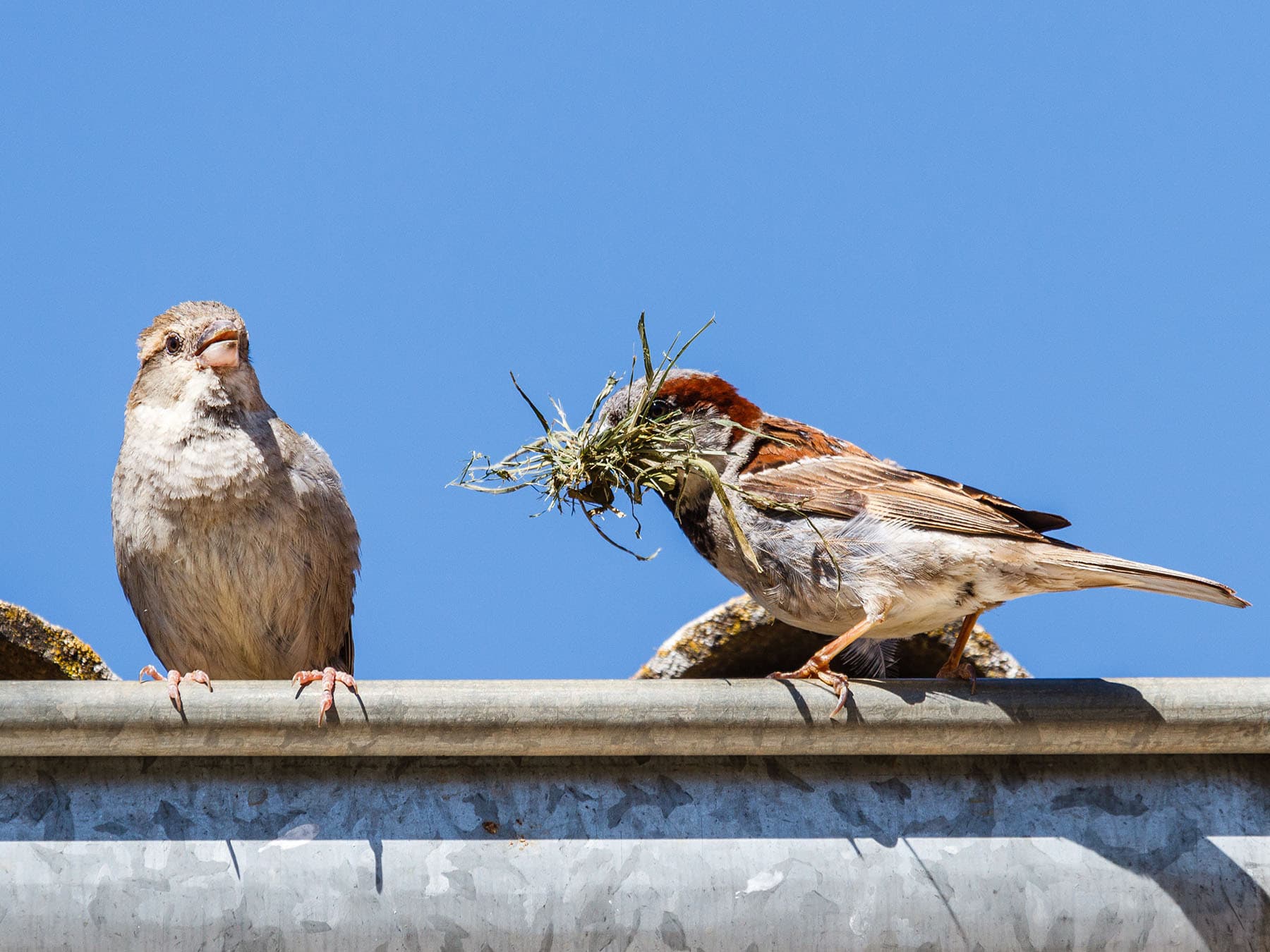
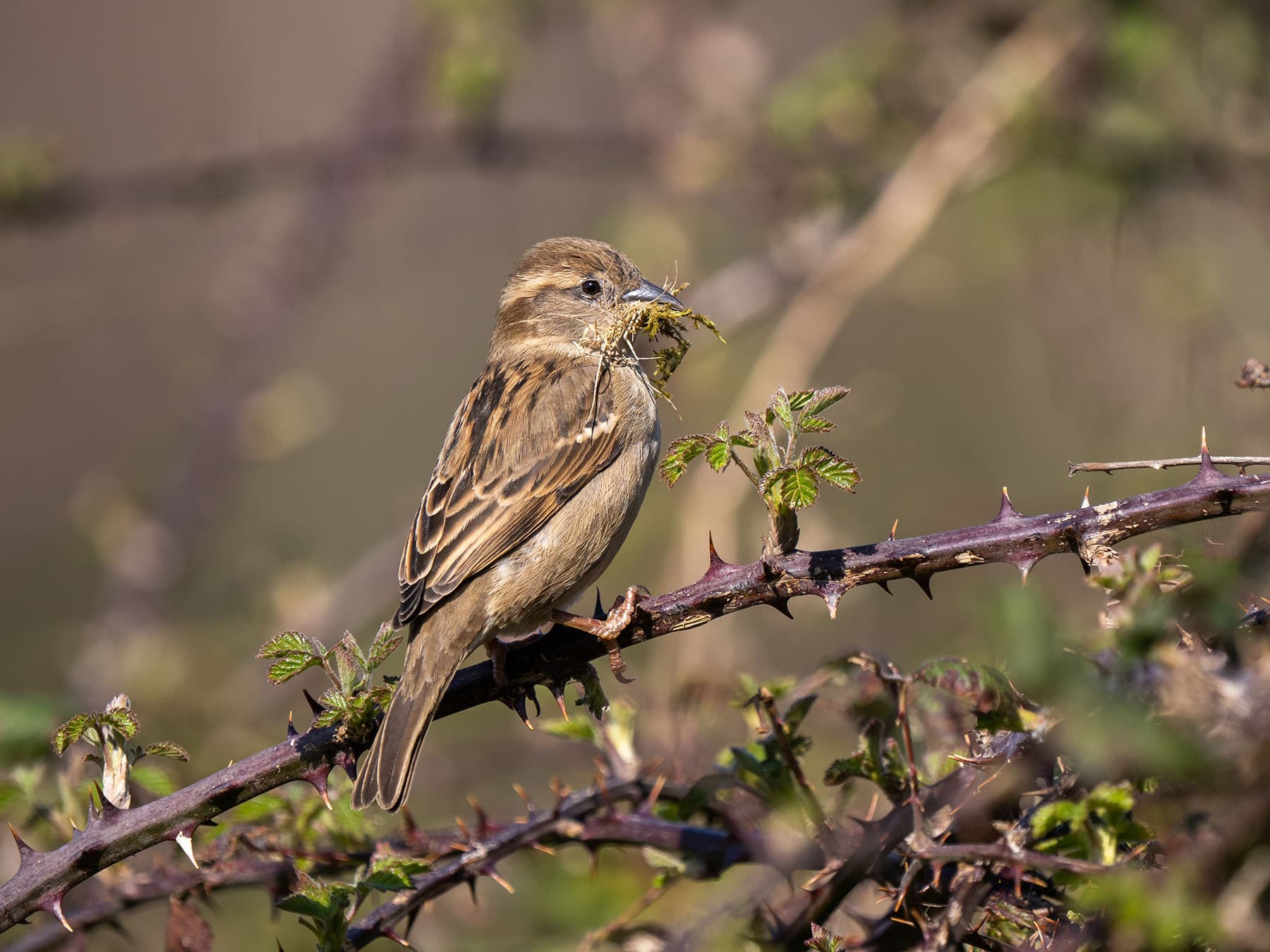
An untidy mass of dried grass and other plants, coarse outside and finer inside, lined with feathers and often with string and paper. In a hole it fills the space and may be roofed over; built in a tree it is a domed ball 30 to 40 cm (12 to 16 in) across with an entrance at the side.
The male starts building, often before he has a mate; once paired, the female joins in, especially with the lining. Nests are reused for later broods and in later years.
Eggs
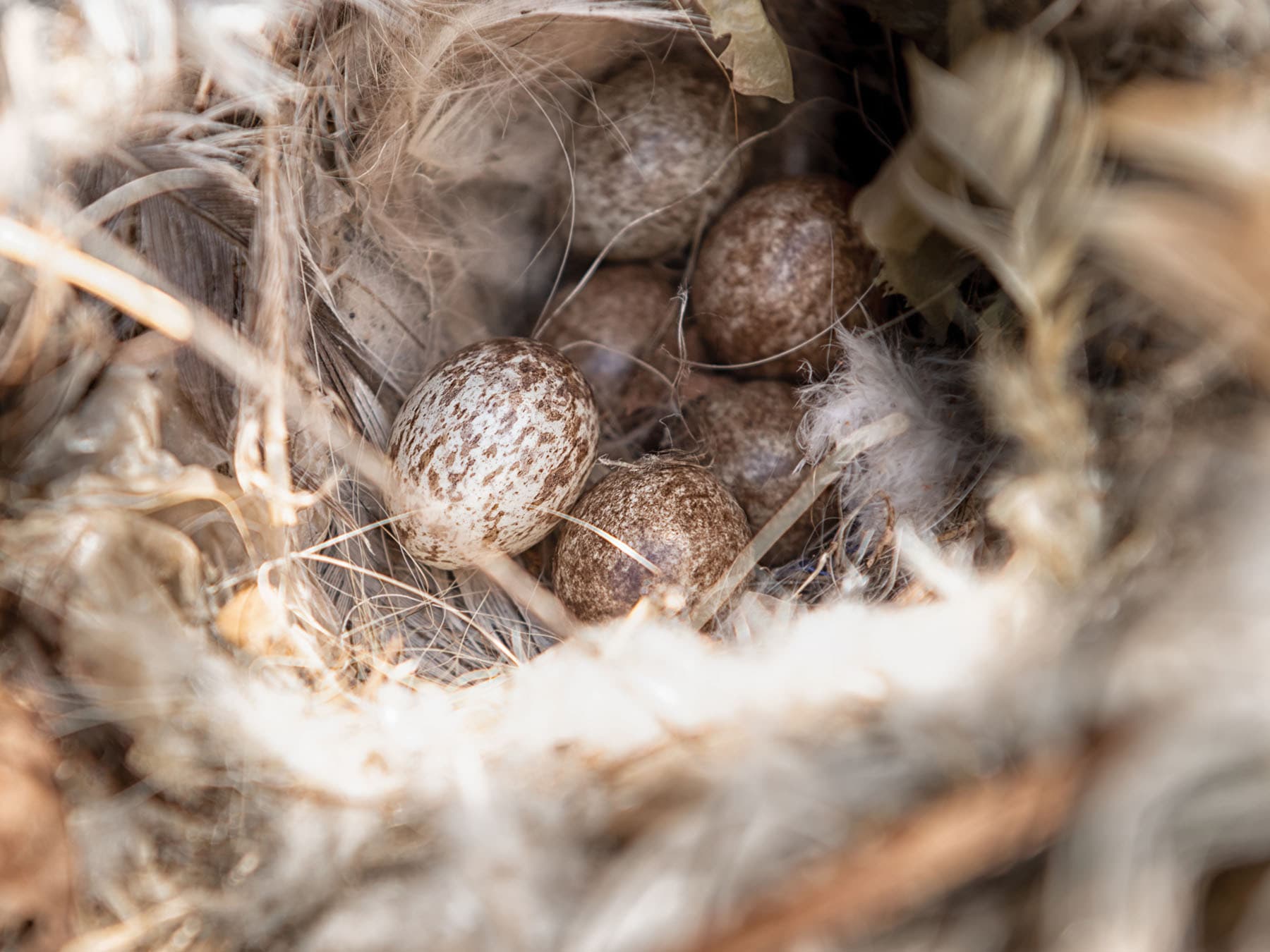
A clutch is typically 4 or 5 eggs, sometimes as few as 2 or as many as 7. Each egg is about 22 by 16 mm (0.9 by 0.6 in) and weighs 2.9 g (0.1 oz).1 They are white to greenish or bluish white, dotted and spotted with grey or brown, usually most thickly round the broad end, and the last egg of a clutch is often less heavily marked. The female lays one a day, in the morning.
Incubation and hatching
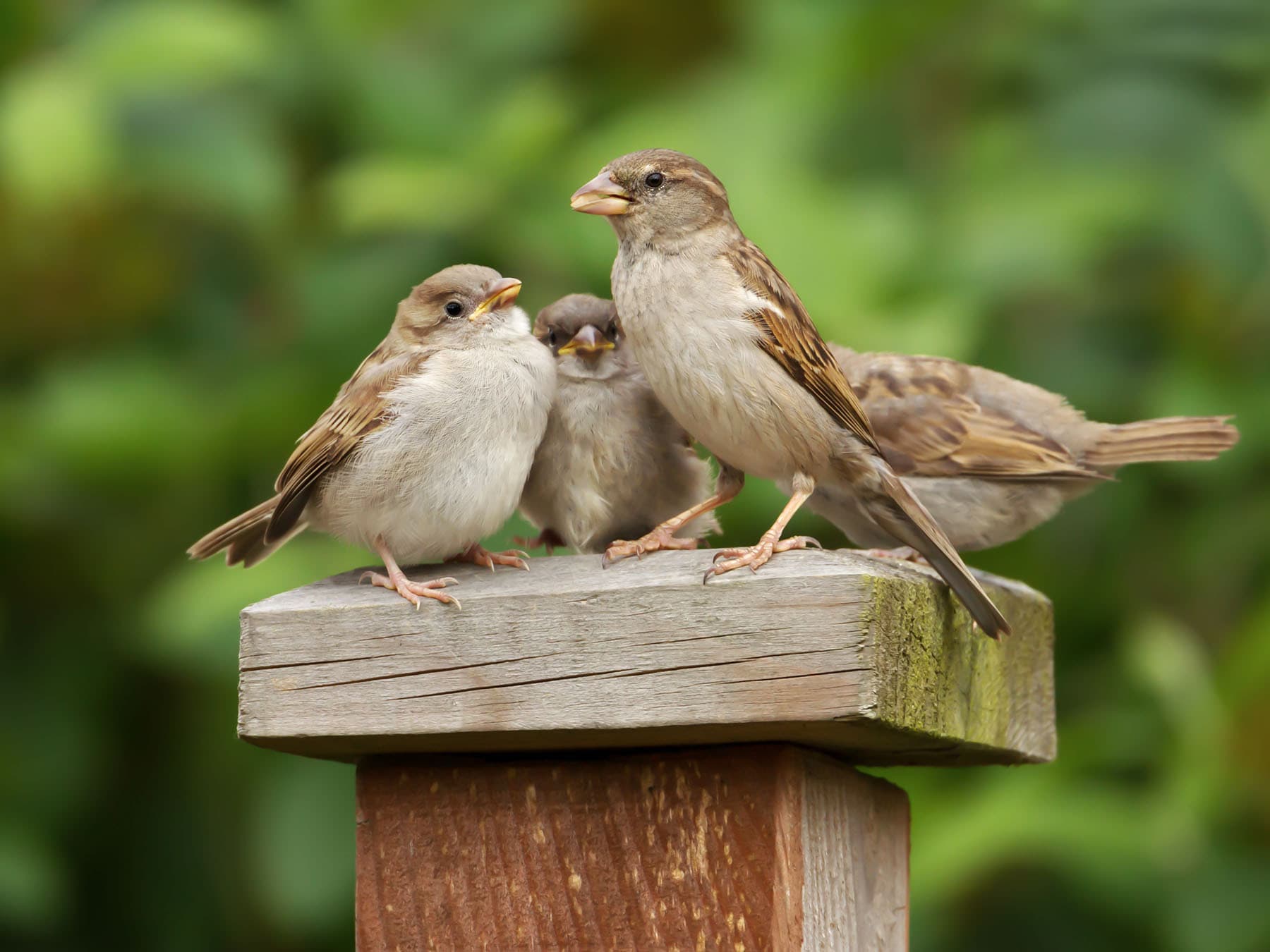
The eggs hatch after 12 to 15 days. Incubation usually starts with the second-last egg, so the chicks hatch on different days. Both parents take turns on the eggs: the female, who has the brood patch, sits more at first, and the male's share grows as hatching nears.2
Chicks and fledging
Both parents feed the chicks, mostly on insects, and carry away their droppings. The young leave the nest at about 15 days old, usually able to fly. More: baby sparrows.
Nest boxes
Choose a small hole-fronted box with a 32 mm (1.25 in) entrance, the size the BTO recommends for all small hole-nesting birds.3 House Sparrows like company, so put up several boxes together, or, as the RSPB suggests, get your street to put boxes up at the same time. Keep sparrow boxes away from boxes for other birds, especially from House Martin colonies, and leave off the perch.4
Nests and the law
In England and Wales it is an offence intentionally to take, damage or destroy the nest of any wild bird while it is in use or being built; in Scotland the offence also covers doing so recklessly, and interfering with the nest.5 In Northern Ireland it covers doing so intentionally or recklessly.6 If sparrows are nesting in your roof, wait until they have finished before any repairs.
Sources
- BTO. House Sparrow (Passer domesticus). BTO BirdFacts. Accessed 7 October 2026. Source
- Lowther, P. E., Cink, C. L. (2020). House Sparrow (Passer domesticus), version 1.0. Birds of the World (S. M. Billerman, ed.). Cornell Lab of Ornithology. doi:10.2173/bow.houspa.01
- BTO. Buying a nest box. Accessed 7 October 2026. Source
- RSPB. Our ultimate guide to nestboxes. Accessed 7 October 2026. Source
- UK Parliament (1981). Wildlife and Countryside Act 1981, section 1. Accessed 7 October 2026. Source
- UK Government (1985). The Wildlife (Northern Ireland) Order 1985, article 4. Accessed 7 October 2026. Source
- National Audubon Society (text: Kaufman, Lives of North American Birds). House Sparrow. Audubon Guide to North American Birds. Accessed 7 October 2026. Source
- RSPB. House Sparrow. RSPB Birds and wildlife. Accessed 7 October 2026. Source
- Cornell Lab of Ornithology. House Sparrow identification. All About Birds. Accessed 7 October 2026. Source