Published 7 Oct 2026
Goldfinch Symbolism: The Goldfinch in Art, Faith and Folklore
By the Birdfact teamChecked by Nathan Cope
In Christian art the Goldfinch stands for Christ's Passion, and it appears in hundreds of devotional pictures, Raphael's Madonna of the Goldfinch among them. Here is what it meant, where those meanings come from, the story of Fabritius's The Goldfinch, and the history behind a charm of Goldfinches.
On this page9 sections
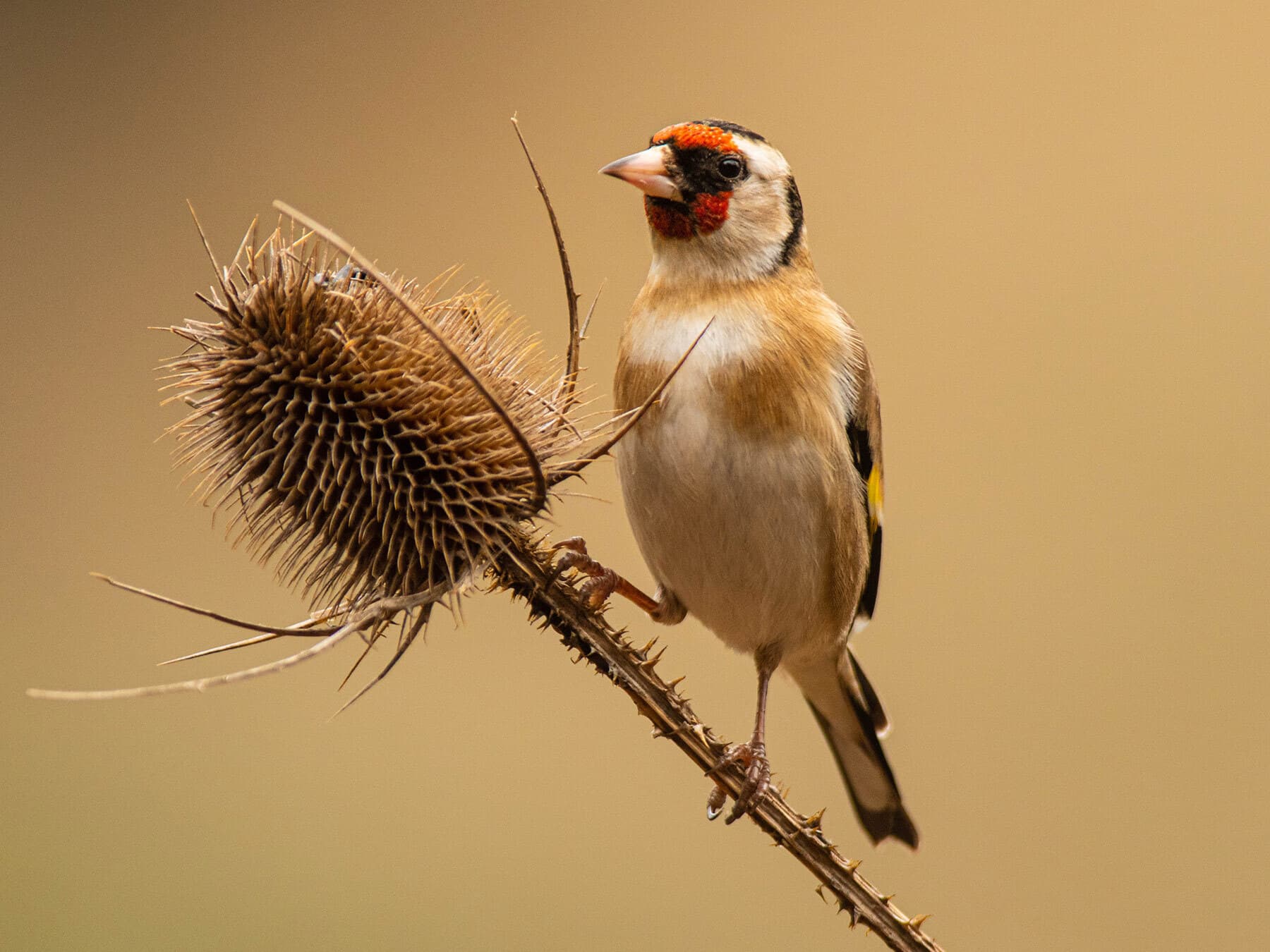
What the European Goldfinch has meant to people: in Christian art, in a famous Dutch painting, in the cage-bird trade and in the words we use for it. Every meaning here is one that a museum, a scholar or an old text records; none is a claim about what a Goldfinch means for you. For the bird itself, see European Goldfinch identification, song and facts.
In North America, "goldfinch" usually means the American Goldfinch, the state bird of Iowa, New Jersey and Washington, a different bird with its own folklore: see American Goldfinch.
What does the Goldfinch symbolise?
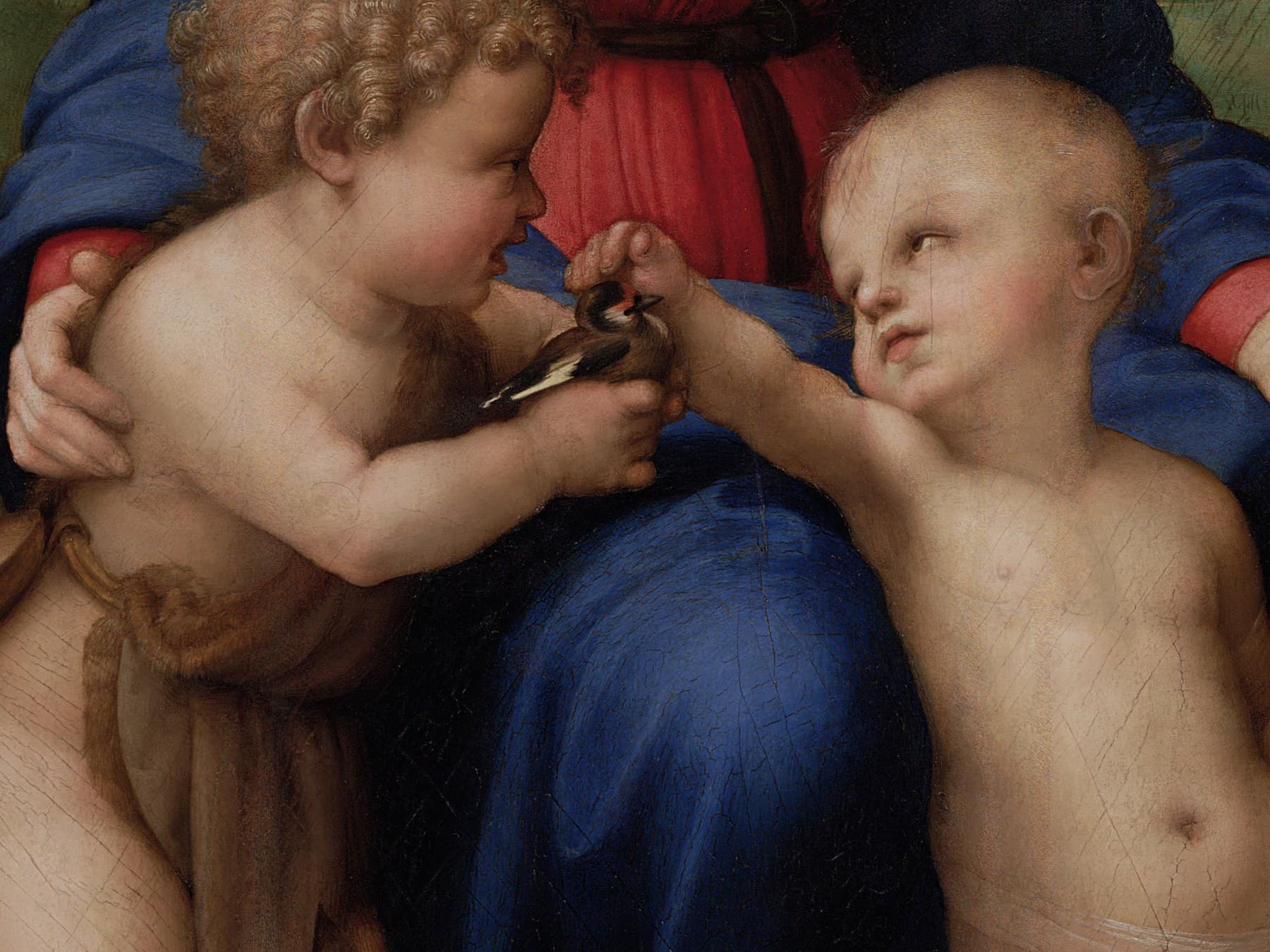
In European religious art, above all in Italian paintings of the Madonna and Child, the Goldfinch often stands for Christ's Passion: his suffering and death on the cross. Museums also read it as a sign of the soul, of the Resurrection, and of protection against the plague, and sometimes as nothing more than a child's pet bird.1
The American ornithologist Herbert Friedmann made the classic study of it in 1946, The Symbolic Goldfinch. He found the bird in 486 devotional works of art, by 254 artists, 214 of them Italian.2
Why the Goldfinch? Thistles and thorns
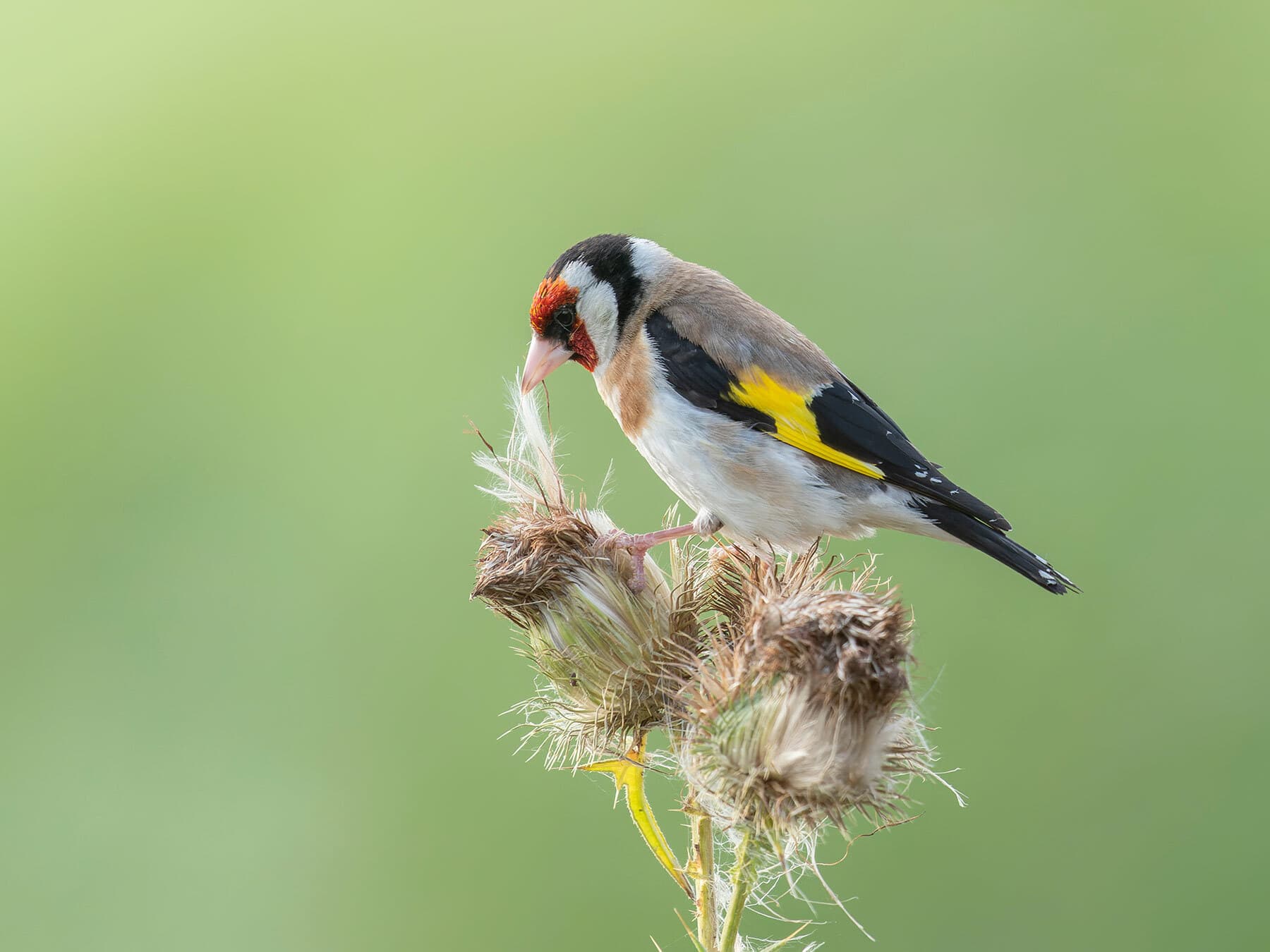
Museums give two explanations for the link with the Passion. One is the bird's food: the Goldfinch was thought to feed on thistles and thorns, and so was associated with the crown of thorns that Christ wore at the crucifixion; a Goldfinch in the Christ Child's hand foretold his suffering.3
The other is a legend, which the National Gallery gives as the reason. On the road to Calvary, it says, a small bird flew down and pulled a thorn from Christ's crown and was splashed with his blood, which explains its red face; the story is told of the Goldfinch and also of the Robin. No museum we consulted dates the legend, so it is best called simply a legend.
The soul, the Resurrection and the plague
Since ancient Egypt, religious art had shown the soul as a small bird, and the Fitzwilliam Museum suggests that a Goldfinch in the Christ Child's hands could remind viewers that their souls were in the hands of God. A non-biblical story popular in the Middle Ages, in which the child Jesus brought clay birds to life, meant the bird could also be seen as a sign of the Resurrection.1
After the plagues of the fourteenth century, the Goldfinch also took on a meaning of healing. Since classical times, a mythical bird, the charadrius, was believed to draw disease out of a sick person who looked it in the eye, and the charadrius was sometimes painted as a Goldfinch.2
Raphael's Madonna of the Goldfinch
The best-known example is Raphael's Madonna del Cardellino, the Madonna of the Goldfinch, in the Uffizi in Florence. Painted before February 1506, apparently for the wedding of Lorenzo Nasi and Sandra Canigiani, it shows the young John the Baptist holding out a Goldfinch for the infant Christ to stroke, a hint of the sacrifice to come. In 1547 a landslide destroyed the Nasi house and broke the painting into seventeen pieces.4 After ten years of restoration, it went back on show in 2008.5
Raphael was far from alone. In the National Gallery in London, Federico Barocci's Madonna of the Cat shows the young John the Baptist teasing the household cat with a Goldfinch, which the gallery calls a traditional symbol of the Passion.6
Fabritius's The Goldfinch
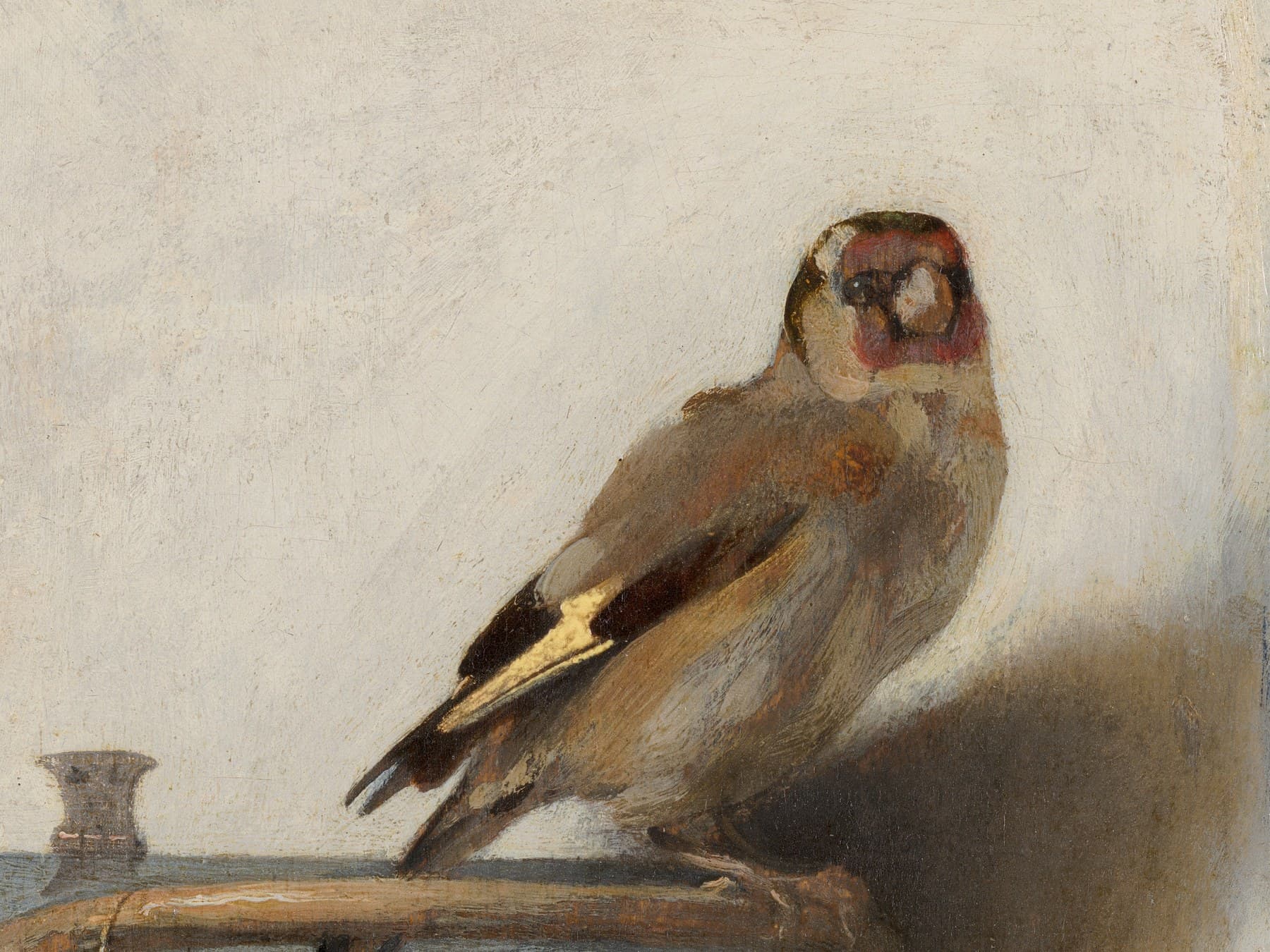
Another famous Goldfinch painting is not set in any obviously symbolic scene.7 Carel Fabritius painted The Goldfinch in 1654: a small panel, 33.5 by 22.8 cm, showing a Goldfinch chained to its feeding box against a whitewashed wall. Goldfinches were popular pets in the seventeenth century, partly because they could be taught to draw up water in a thimble-sized bucket on a chain, which gave them the Dutch nickname puttertje, "water-drawer". Fabritius was killed later that year, aged 32, when a gunpowder store exploded in Delft. The painting is in the Mauritshuis in The Hague.8
It is also the painting at the heart of Donna Tartt's novel The Goldfinch, which won the 2014 Pulitzer Prize for Fiction.9 In the book, a boy rescues the painting from an explosion at the Metropolitan Museum of Art, and it shadows the rest of his life.10
Goldfinches as cage birds
In Britain too, Goldfinches were prized cage birds, often given a small bucket and chain to draw up their water. In Victorian Sussex they were caught in clap-nets in great numbers: one estimate from 1860 put the catch near Worthing at about 1,154 dozen birds a year, nearly all males. William Borrer's Birds of Sussex (1891) passed on a report that around Brighton they had become comparatively scarce, partly because birds were taken before or during the breeding season.11
Protection followed. Under the Wild Birds Protection Acts, counties could protect particular species, and Goldfinches were among them, for example in Shropshire from 1904.12 In 1908 the RSPB appointed an inspector to investigate the caged-bird trade.13 Today Goldfinches are common in Britain again; their numbers have more than doubled since 1995, a rise the BTO links to better survival helped by garden food. (See conservation.) In North Africa, trapping for the cage-bird trade has driven steep declines in recent decades.14
A charm of Goldfinches, and other words
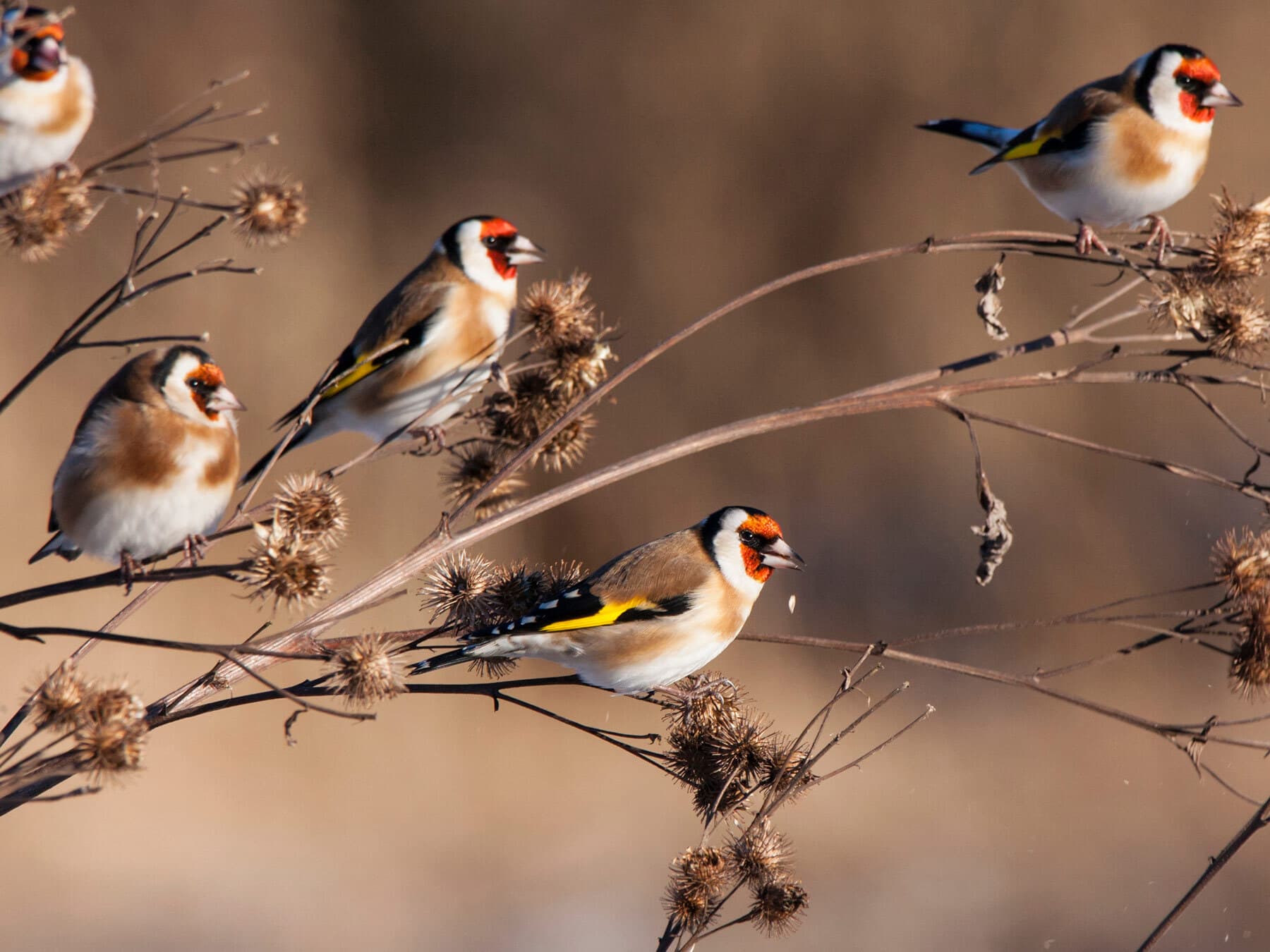
A flock of Goldfinches is a charm. The term is old: the Boke of Saint Albans, printed in 1486, lists "a Cherme of Goldefynches" among its names for groups of animals.15
The name goldfinch goes back to Old English, goldfinc; Old English also had þistel-twige, a name for a goldfinch or another bird that eats thistle-down.16 Thistles run through the bird's names elsewhere too: the scientific name Carduelis comes from the Latin carduus, thistle, as does the Italian cardellino, and the French chardonneret comes from chardon, thistle. The German Stieglitz, borrowed from Slavic, imitates its call. English folk names include Redhead and Thistle Finch.
Questions
What does a Goldfinch symbolise in Christianity?
Often Christ's Passion, linked to the thistles it eats and to a legend of a bird pulling a thorn from his crown; also the soul and the Resurrection. See what the Goldfinch symbolises.
Why is the Goldfinch in so many paintings of the Madonna and Child?
Museums read it as a sign of Christ's future suffering, and it was also a familiar child's pet. Herbert Friedmann found it in 486 devotional works of art. See Raphael's Madonna of the Goldfinch.
Why is a group of Goldfinches called a charm?
The term goes back at least to 1486, when the Boke of Saint Albans listed "a Cherme of Goldefynches" among its names for groups of animals. See a charm of Goldfinches.
What is The Goldfinch painting?
A small 1654 painting of a chained pet Goldfinch by Carel Fabritius, now in the Mauritshuis, and the painting at the heart of Donna Tartt's novel. See Fabritius's The Goldfinch.
What does a Goldfinch sound like?
A quick, tinkling call and a fast, liquid song. See Goldfinch song and calls.
Sources
- The Fitzwilliam Museum. The goldfinch. Fitzwilliam Museum, Signs and symbols. Accessed 7 October 2026. Source
- BirdLife International (2008). The Goldfinch in Renaissance art. BirdLife Data Zone. Accessed 7 October 2026. Source
- Victoria and Albert Museum. Virgin and Child (statue), about 1340-50, A.98-1911. V&A Collections. Accessed 7 October 2026. Source
- Gallerie degli Uffizi. Mary, Christ and the young John the Baptist, known as the Madonna of the Goldfinch. Uffizi Galleries. Accessed 7 October 2026. Source
- Reuters (2008). Technology helps restore Raphael masterpiece. NBC News (Reuters). Accessed 7 October 2026. Source
- The National Gallery. Federico Barocci, The Madonna of the Cat (La Madonna del Gatto). National Gallery, London. Accessed 7 October 2026. Source
- CODART. The Goldfinch. CODART Canon. Accessed 7 October 2026. Source
- Mauritshuis. Carel Fabritius, The Goldfinch (inv. 605). Mauritshuis, The Hague. Accessed 7 October 2026. Source
- The Pulitzer Prizes (2014). Donna Tartt, The Goldfinch: 2014 Pulitzer Prize in Fiction. pulitzer.org. Accessed 7 October 2026. Source
- Lewis, I. (2019). Carel Fabritius: pupil of Rembrandt, painter of 'The Goldfinch'. Art UK. Accessed 7 October 2026. Source
- Borrer, W. (1891). The Birds of Sussex. R. H. Porter, London. Accessed 7 October 2026. Source
- The London Gazette (1904). Wild Birds Protection Acts, 1880 to 1902: County of Salop order. The London Gazette, issue 27670, 26 April 1904. Accessed 7 October 2026. Source
- RSPB. Our history. RSPB. Accessed 7 October 2026. Source
- Khelifa, R., Zebsa, R., Amari, H., Mellal, M. K., Bensouilah, S., Laouar, A., Mahdjoub, H. (2017). Unravelling the drastic range retraction of an emblematic songbird of North Africa: potential threats to Afro-Palearctic migratory birds. Scientific Reports 7: 1092. doi:10.1038/s41598-017-01103-w
- Berners, J. (1486). The Boke of Saint Albans (facsimile, with an introduction by William Blades, 1881). Project Gutenberg ebook 71266. Accessed 7 October 2026. Source
- Bosworth, J., Toller, T. N.. An Anglo-Saxon Dictionary: gold-finc; þistel-twige. Bosworth-Toller (online). Accessed 7 October 2026. Source
- Friedmann, H. (1946). The Symbolic Goldfinch: Its History and Significance in European Devotional Art. Pantheon Books (Bollingen Series 7), Washington DC. Accessed 7 October 2026.
- The National Gallery. Carel Fabritius. National Gallery, London. Accessed 7 October 2026. Source
- Treccani. cardello. Vocabolario Treccani. Accessed 7 October 2026. Source
- Larousse. chardonneret. Dictionnaire Larousse. Accessed 7 October 2026. Source
- DWDS. Stieglitz. Digitales Wörterbuch der deutschen Sprache. Accessed 7 October 2026. Source
- BTO. Goldfinch (Carduelis carduelis). BTO BirdFacts. Accessed 7 October 2026. Source
- State of New Jersey, Washington State Legislature, Iowa Legislature. State symbols: the American (eastern/willow) goldfinch. nj.gov; RCW 1.20.040; Iowa Official Register. Accessed 7 October 2026. Source
- The National Gallery. Carel Fabritius. National Gallery, London. Accessed 7 October 2026. Source