Published 9 Oct 2026
Goldcrest Song and Calls: What a Goldcrest Sounds Like
By the Birdfact teamChecked by Nathan Cope
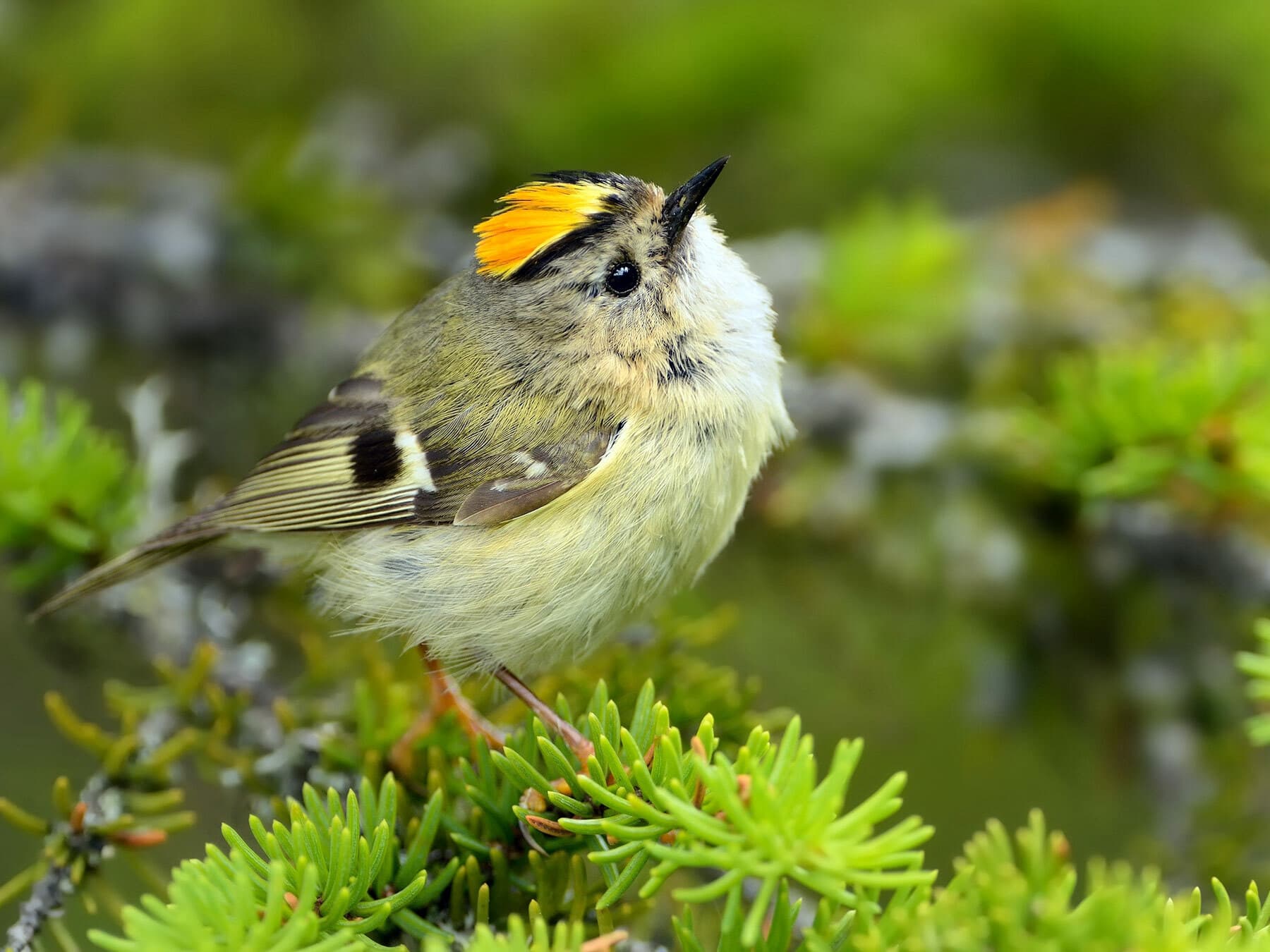
A Goldcrest's song is a very high, thin run of notes rocking between a higher and a lower pitch, ending in a short flourish; the calls are thin and high. Listen to recordings from Britain, see them as spectrograms, learn to tell a Firecrest by ear, and find out why many older birdwatchers can no longer hear it.
On this page10 sections
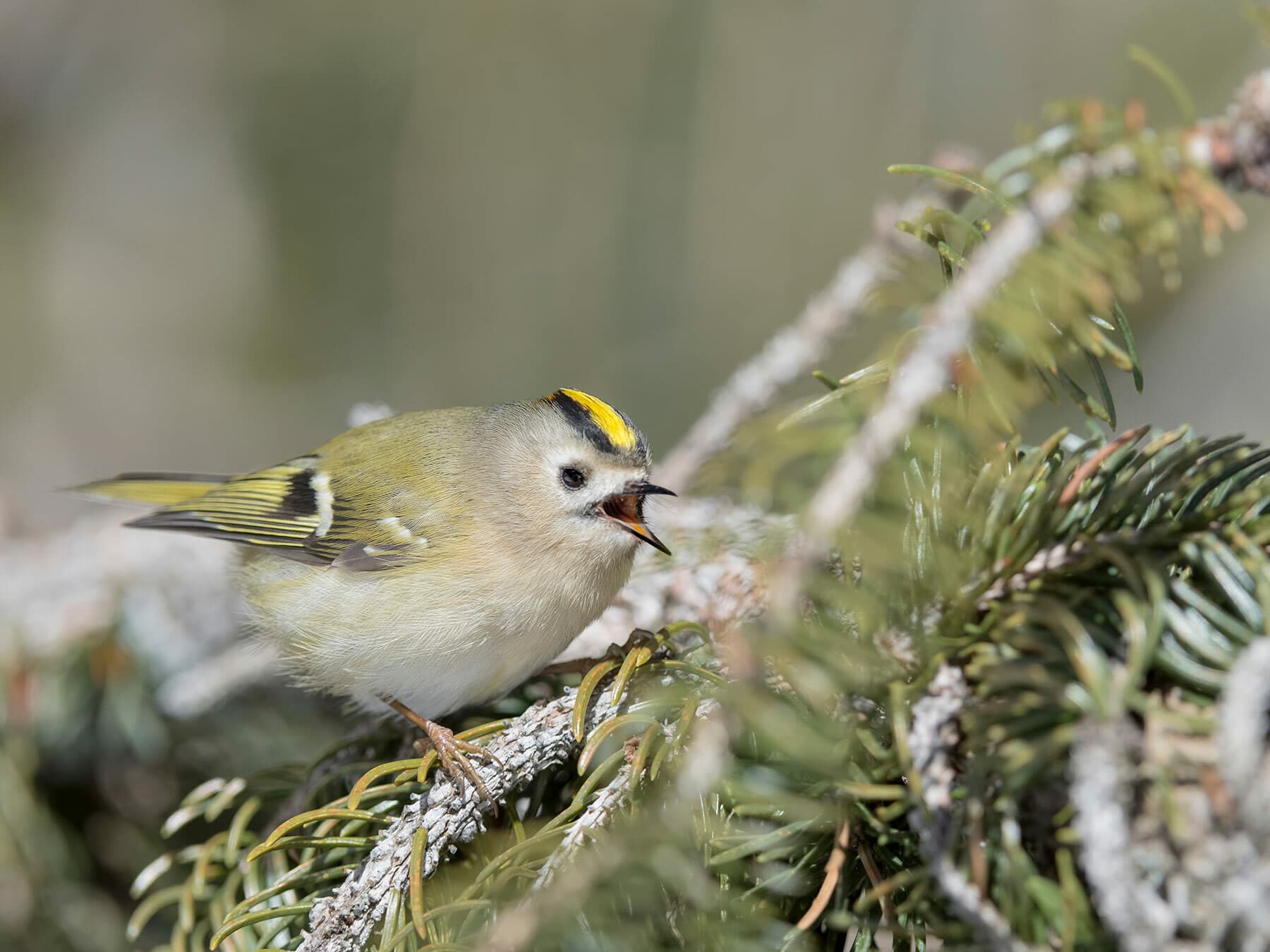
What a Goldcrest sounds like, with songs and calls recorded in Britain and drawn as spectrograms: how the song is built, the calls, how to tell a Goldcrest from a Firecrest by ear, and why some people can no longer hear it. For the bird itself, see Goldcrest identification, size and facts.
What does a Goldcrest sound like?
Very high and thin. The song is a run of notes that rock between a higher and a lower pitch, over and over, and it ends in a short flourish.1 The BTO's Bird Table magazine likens it to a "squeaky wheel".2 The calls are high-pitched and usually quiet.
In the recording below, made in London by someone who saw the bird at close range, it sings three songs, each lasting a few seconds.
How the song is built
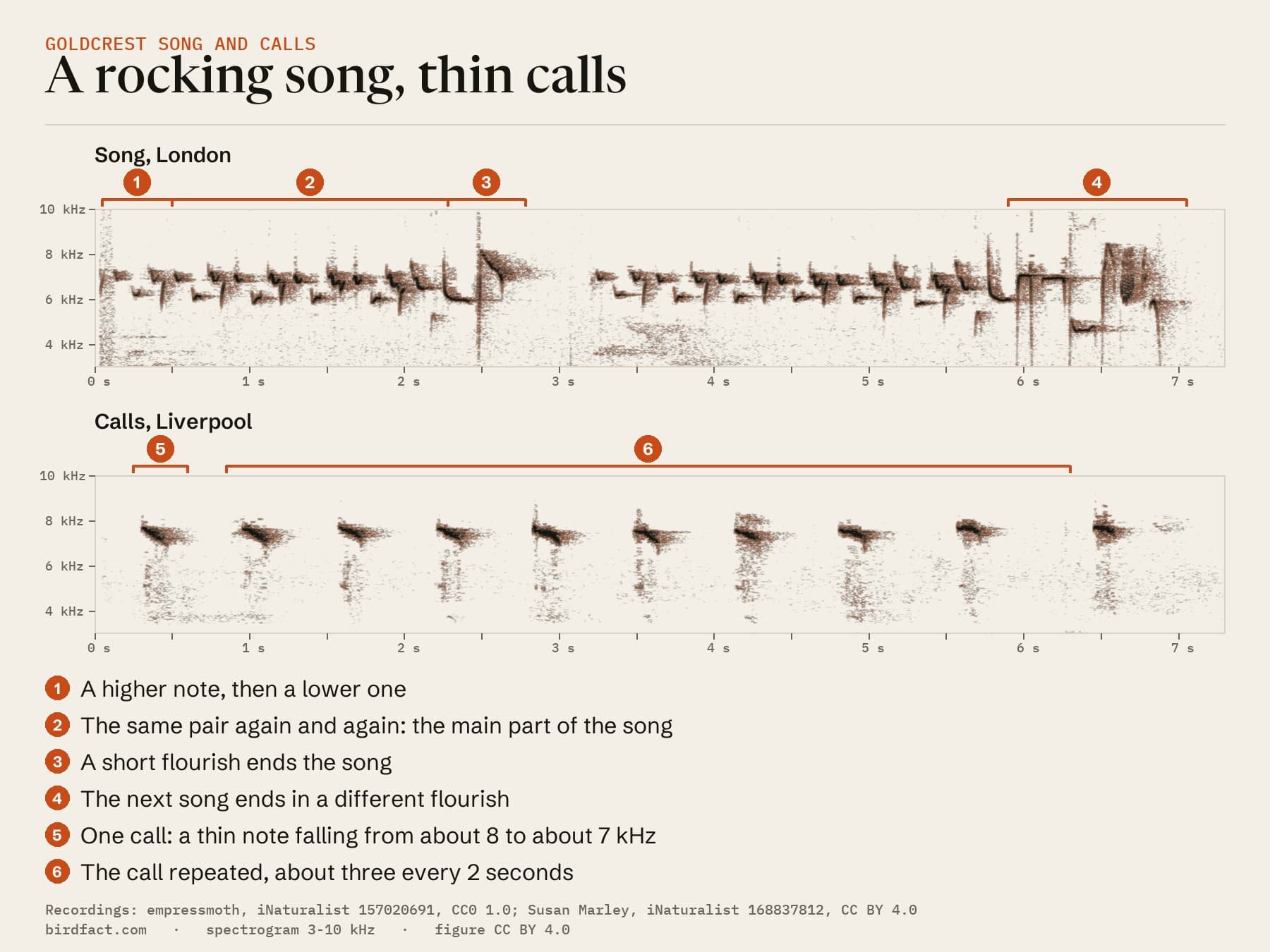
Each song has two parts.3 The main part is the rocking run of higher and lower notes; in the London recording it lasts about 2 to 2.5 seconds, and the whole song, flourish included, about 3 to 4 seconds. The flourish is a short, quick ending that rises to about 8 kHz.
The flourish is where the variety is. The main part is much the same from bird to bird: all Goldcrests in north-west Europe, British birds included, share a single song type.4 But each male has a repertoire of up to 28 different endings.1 You can see it in the figure: the second London song ends quite differently from the first. The Edinburgh song below ends in a buzzy, trilled stretch.
Both parts carry the message. In playback experiments in southern Germany, male Goldcrests approached either part played on its own as if it were their own song. Two things mattered: the song's pitch range and the switching between higher and lower notes. Changing the rhythm made little difference, and the birds even came to songs played backwards, but shifting the whole song up or down in pitch, or removing the switching, weakened their response.3
Song after song
A singing Goldcrest repeats itself. In the recording below from a London cemetery, it sings seven songs in 46 seconds, on average one every 6 or 7 seconds, each about 2.5 to 3 seconds long, most ending in a flourish that climbs to about 8 kHz.
Calls
The usual calls are high-pitched and quiet, sometimes louder: Birds of the World writes them "seeeh" and "zick".1 In the recording below from a Liverpool park, each call is a single thin note falling from about 8 to about 7 kHz, repeated about three times every 2 seconds.
Goldcrests and Firecrests can tell each other's calls apart, not just their songs: in playback experiments each species distinguished its own calls from the other's.5 For birdwatchers, the calls are harder. A Coal Tit, often in the same conifers, has a thin "sisisi" call much like a Goldcrest's high notes.6
Goldcrest or Firecrest by ear
The Firecrest, the Goldcrest's close relative, has a song of similar quality, the BTO's Bird Table magazine notes.2 Listen for the shape. A Firecrest's song is a run of high, whistled notes that rises in pitch and grows louder, in a crescendo.7 It does not rock back and forth: Bird Table describes it as repeating the same note, without the Goldcrest's cycle. In the New Forest recording below, the Firecrest's notes climb from about 7 kHz to about 8 kHz over about 2.5 seconds.
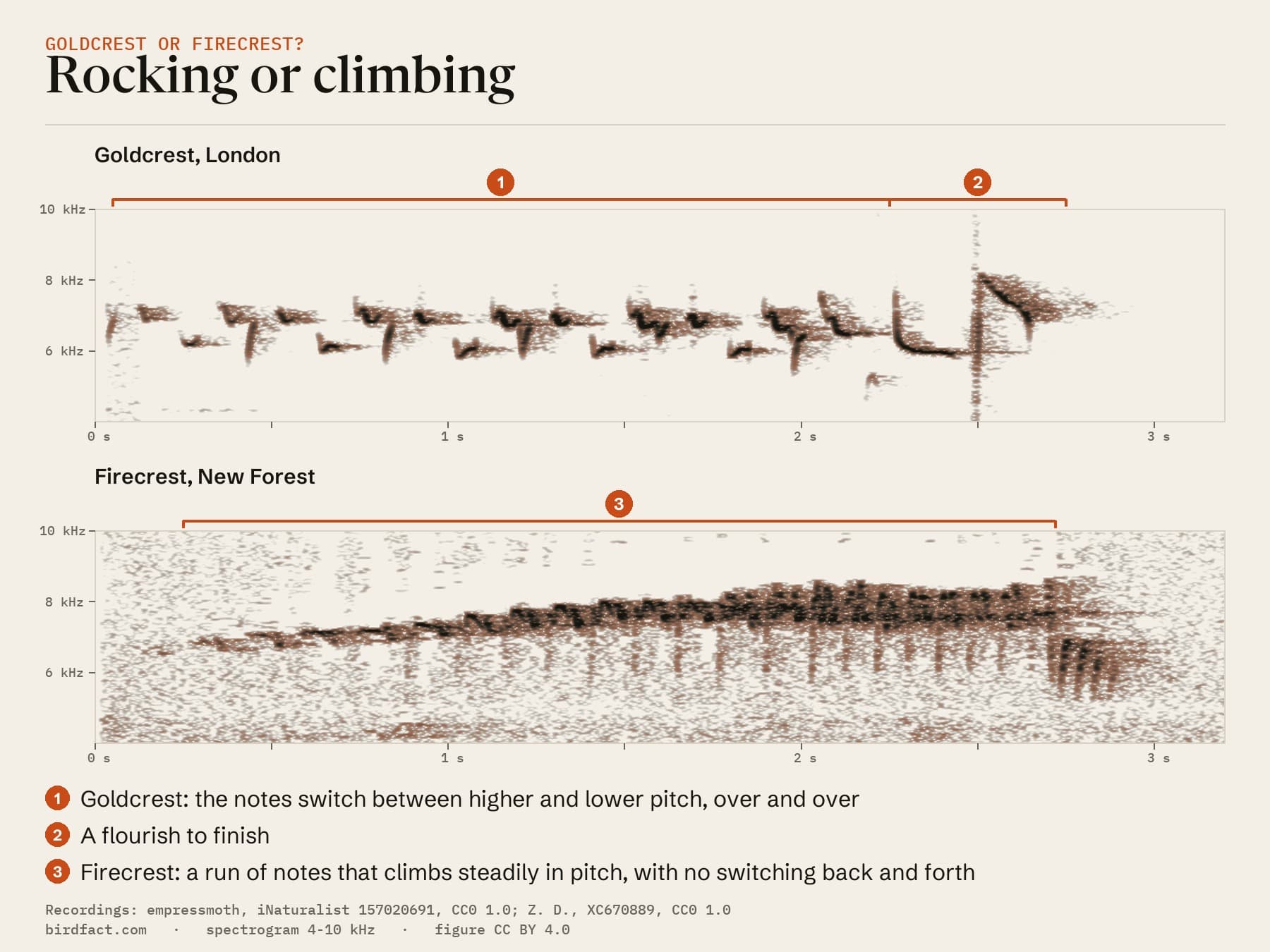
The birds hear the difference the same way. In Becker's experiments the switching between higher and lower notes was the key feature by which the two species told their songs apart: as the pitch gap between the higher and lower notes shrank, Goldcrests responded less and Firecrests more.3 Mistakes happen. In two areas of Spain where one species was much rarer than the other, Becker found males of the rarer species singing both species' songs, or mixed songs; he put it down to faulty imprinting, the birds having learned the commoner species' song.5 More on telling them apart: Goldcrest or Firecrest?
How high is the song?
Very high. Goldcrest song typically reaches up to about 8 kHz, as do the songs of the Treecreeper and the Grasshopper Warbler.8 In our recordings the rocking notes sit at about 6 to 7 kHz and the flourish climbs to about 8 kHz.
Hearing a Goldcrest as you get older
As we age, the highest sounds are the first part of our hearing to go, and many older birdwatchers say they can no longer hear Goldcrests.2
A survey published in 2014 put numbers on it. John Tucker asked birders the question "Can you hear Goldcrest song?", and 1,056 replied, with their age and sex. Among the 799 men, 83% could hear it: 96% of those in their 40s and younger, falling to 53% of those in their 80s; the model that fitted best had the decline beginning at about the age of 42. Among the 257 women, 89% could hear it, and the survey found no sign of a decline with age. The respondents were birders who volunteered, not a random sample of the public.8
It matters for bird surveys too. In the same letter, written with the BTO's Andy Musgrove, the authors noted that, on partial information, Breeding Bird Survey volunteers are getting older, but judged the effect on Goldcrest trends was probably relatively small, and said volunteers would be able to record from 2014 whether they detected birds by song, call or sight.8
Song across the range
Across the species' whole range, from the Atlantic islands to Japan, Goldcrest song varies a great deal, with distinct regional dialects.1 Island birds go furthest. On the Azores, each island has up to six song types and a single male sings up to three, while in north-west Europe there is just one. When Azorean dialect songs were played to Goldcrests in Germany and the Czech Republic, none of the 18 dialect songs tested drew a notable territorial response from the males there.4 On the Canary Islands the common song type starts with a rapid trill instead of the rocking notes, though one dialect, in the Anaga Mountains of Tenerife, still rocks between higher and lower notes like the song of mainland Europe.9
Counting Goldcrests by ear
Automatic recorders can help track how many Goldcrests there are. In the Romincka Forest in Poland, recorders at 30 points picked up more than 33,000 songs from Goldcrests and Firecrests, and song activity at the recorders rose and fell with observers' counts. Goldcrests sang most where there were more conifers, especially spruce, and more kinds of tree.10
Sources
- Martens, J., Päckert, M. (2020). Goldcrest (Regulus regulus), version 1.0. Birds of the World (J. del Hoyo, A. Elliott, J. Sargatal, D. A. Christie and E. de Juana, editors). Cornell Lab of Ornithology. doi:10.2173/bow.goldcr1.01
- Risely, K. (2014). Goldcrest: species focus. Bird Table 78 (BTO Garden BirdWatch magazine), Summer 2014, pp. 18-19. Accessed 9 October 2026. Source
- Becker, P. H. (1976). Artkennzeichnende Gesangsmerkmale bei Winter- und Sommergoldhähnchen (Regulus regulus, R. ignicapillus). Zeitschrift für Tierpsychologie 42: 411-437. doi:10.1111/j.1439-0310.1976.tb00978.x
- Päckert, M., Martens, J. (2004). Song dialects on the Atlantic islands: goldcrests of the Azores (Regulus regulus azoricus, R. r. sanctae-mariae, R. r. inermis). Journal für Ornithologie 145: 23-30. doi:10.1007/s10336-003-0003-8
- Becker, P. H. (1977). Verhalten auf Lautäußerungen der Zwillingsart, interspezifische Territorialität und Habitatansprüche von Winter- und Sommergoldhähnchen (Regulus regulus, R. ignicapillus). Journal für Ornithologie 118: 233-260. doi:10.1007/BF01643534
- Gosler, A., Clement, P. (2023). Coal Tit (Periparus ater), version 1.1. Birds of the World (B. K. Keeney and S. M. Billerman, editors). Cornell Lab of Ornithology. doi:10.2173/bow.coatit2.01.1
- Martens, J., Päckert, M. (2020). Common Firecrest (Regulus ignicapilla), version 1.0. Birds of the World (J. del Hoyo, A. Elliott, J. Sargatal, D. A. Christie and E. de Juana, editors). Cornell Lab of Ornithology. doi:10.2173/bow.firecr1.01
- Tucker, J., Musgrove, A., Reese, A. (2014). The ability to hear Goldcrest song and the implications for bird surveys. British Birds 107: 232-233. Accessed 9 October 2026. Source
- Päckert, M. (2006). Song dialects as diagnostic characters: acoustic differentiation of the Canary Island Goldcrest subspecies Regulus regulus teneriffae Seebohm 1883 and R. r. ellenthalerae Päckert et al. 2006. Zootaxa 1325. doi:10.11646/zootaxa.1325.1.7
- Kustusch, K., Cząstkiewicz, D., Wuczyński, A. (2026). Assessing abundance and habitat preferences of Goldcrest Regulus regulus and Firecrest Regulus ignicapilla using passive acoustic monitoring and point-count surveys in temperate forest ecosystem in Poland. Ornis Fennica 102: 96-109. doi:10.51812/of.154841
- iNaturalist and xeno-canto contributors. Recordings of Goldcrests and a Firecrest used on the song page. iNaturalist; xeno-canto. Accessed 9 October 2026. Source