Identification · Updated 9 Oct 2026
Goldcrest vs Firecrest: How to Tell Them Apart
By the Birdfact teamChecked by Nathan Cope
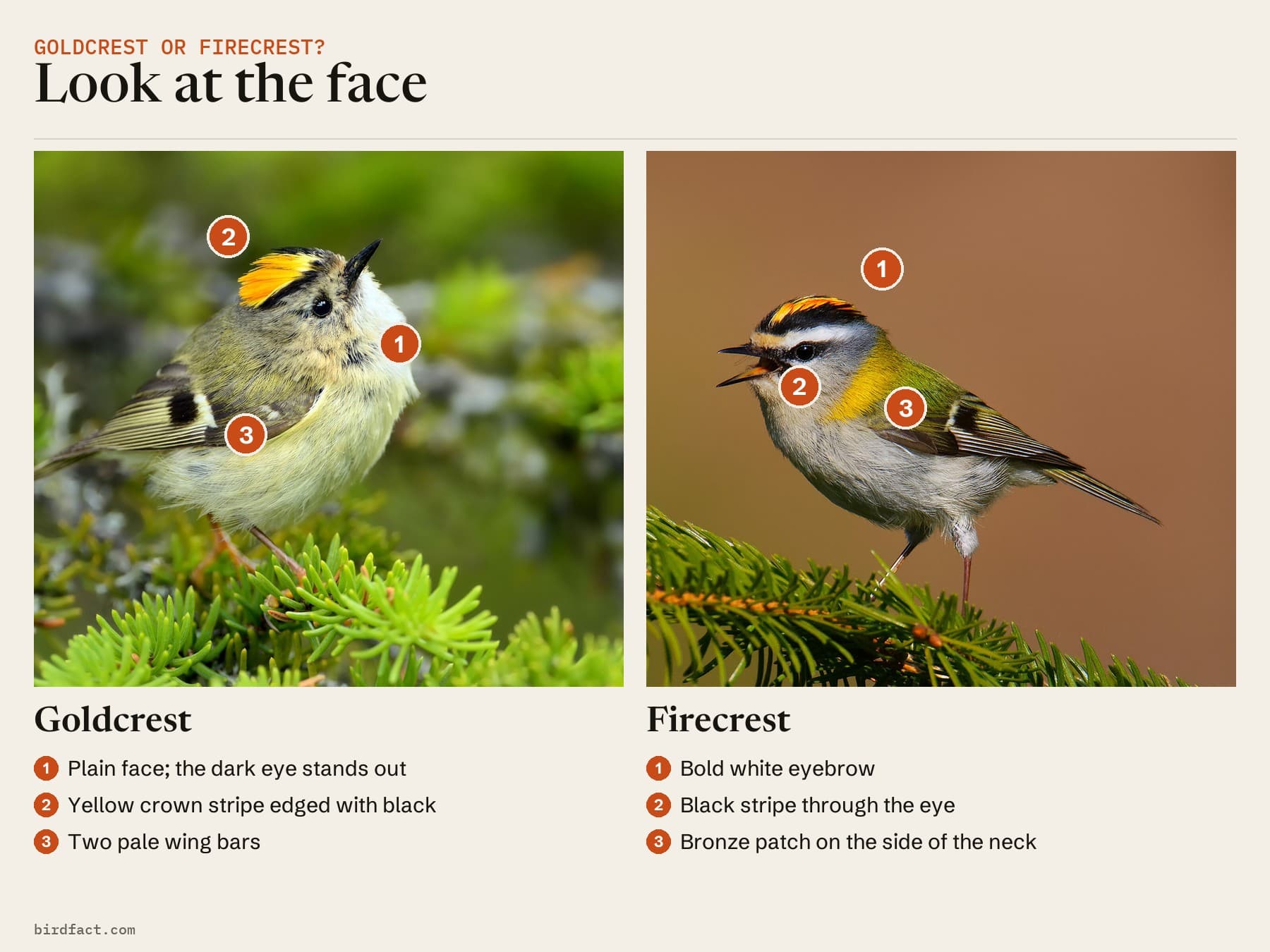
Look at the face: a Firecrest has a bold white eyebrow, a black stripe through the eye and a bronze patch on the side of the neck; a Goldcrest's face is plain, so its dark eye stands out. Both are about 9 cm long and the UK's smallest birds; the Firecrest is far scarcer.
On this page11 sections
The quick answer
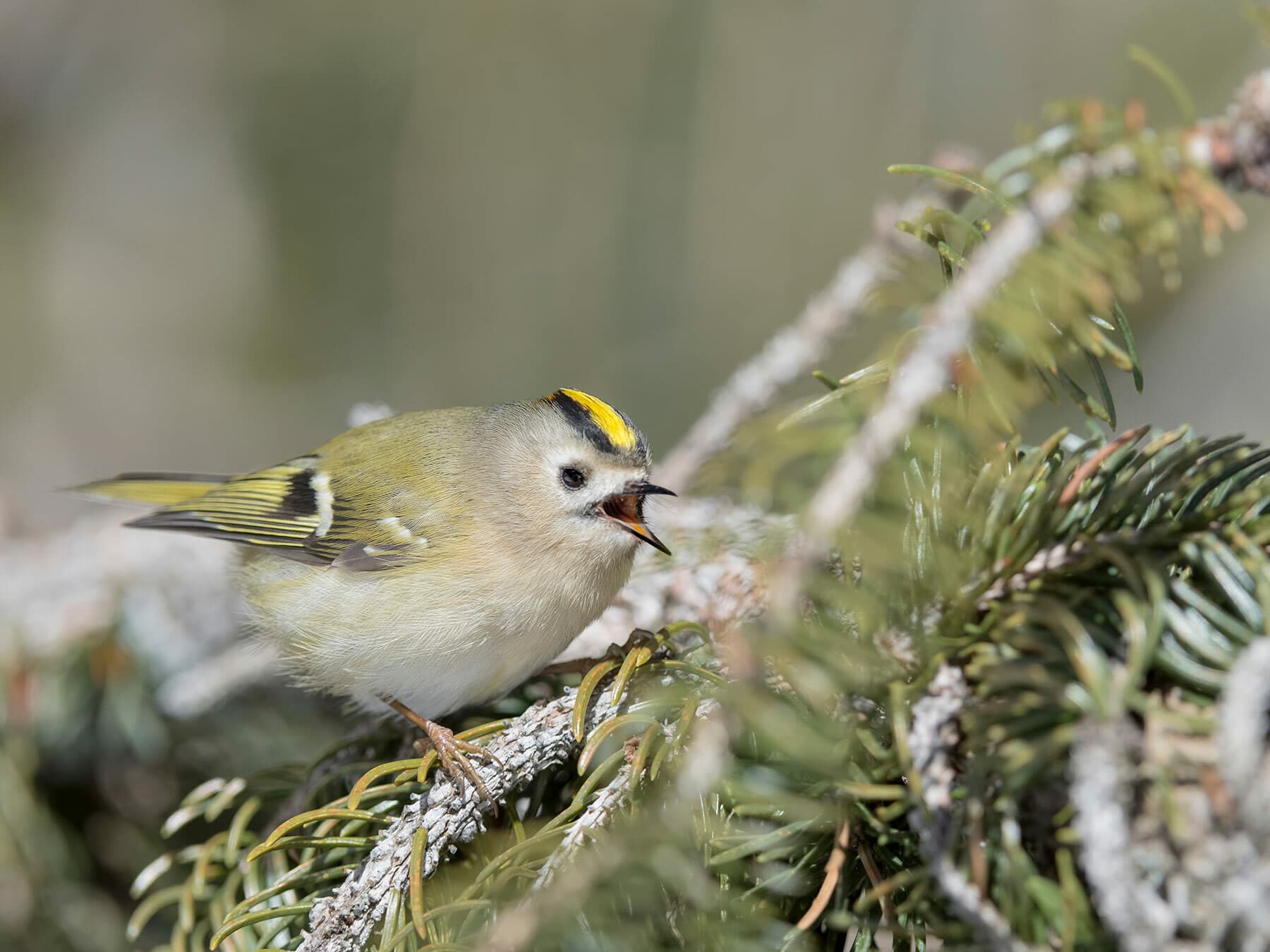
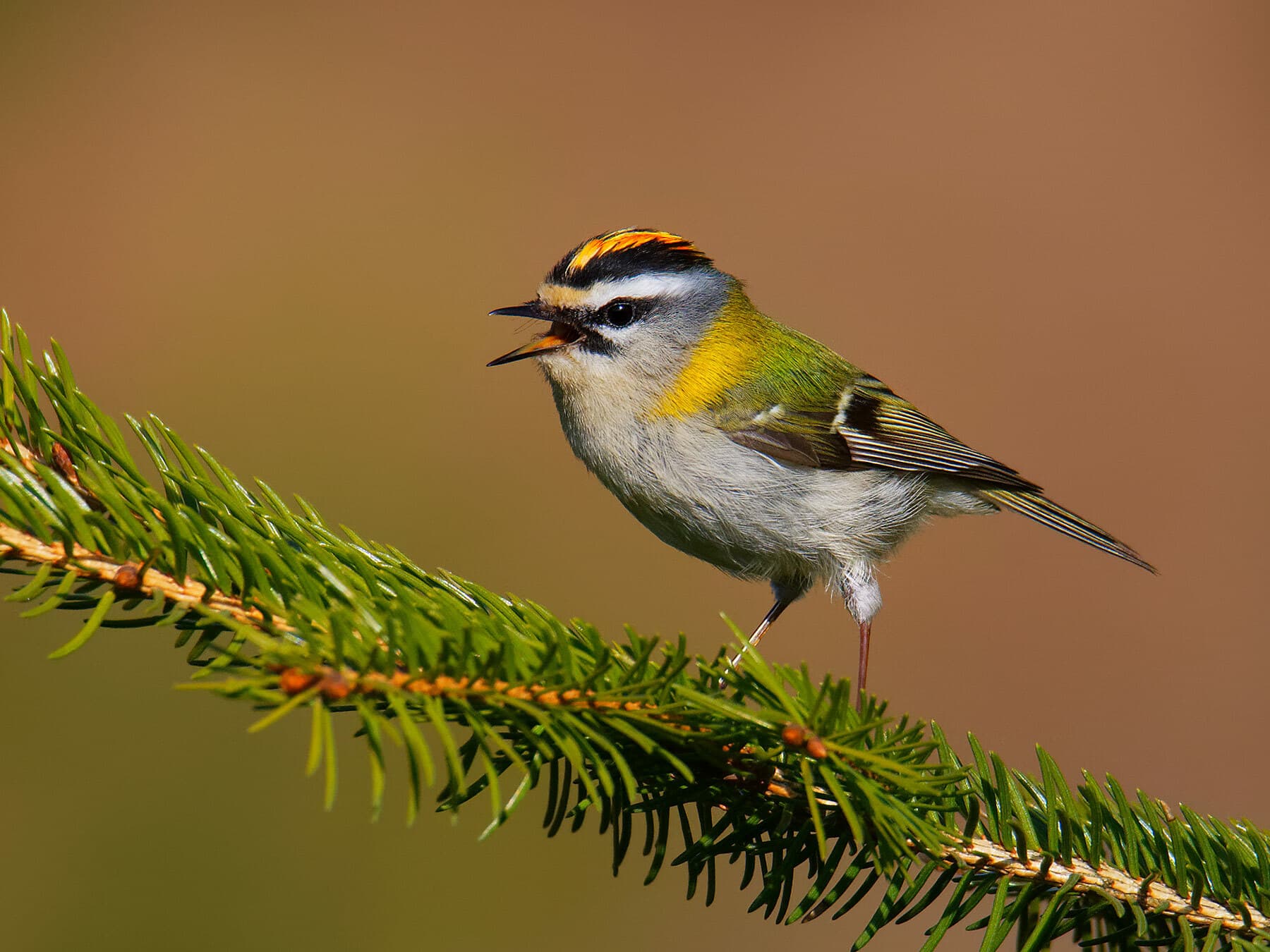
Look at the face. A Firecrest has a bold white eyebrow, a black stripe through the eye and a bronze patch on the side of the neck.1 A Goldcrest's face is plain, with a pale ring around the large dark eye, which makes the eye stand out.2
A long look is not needed: a brief view of the face settles it, even on a bird high in a treetop.3
The face and crown
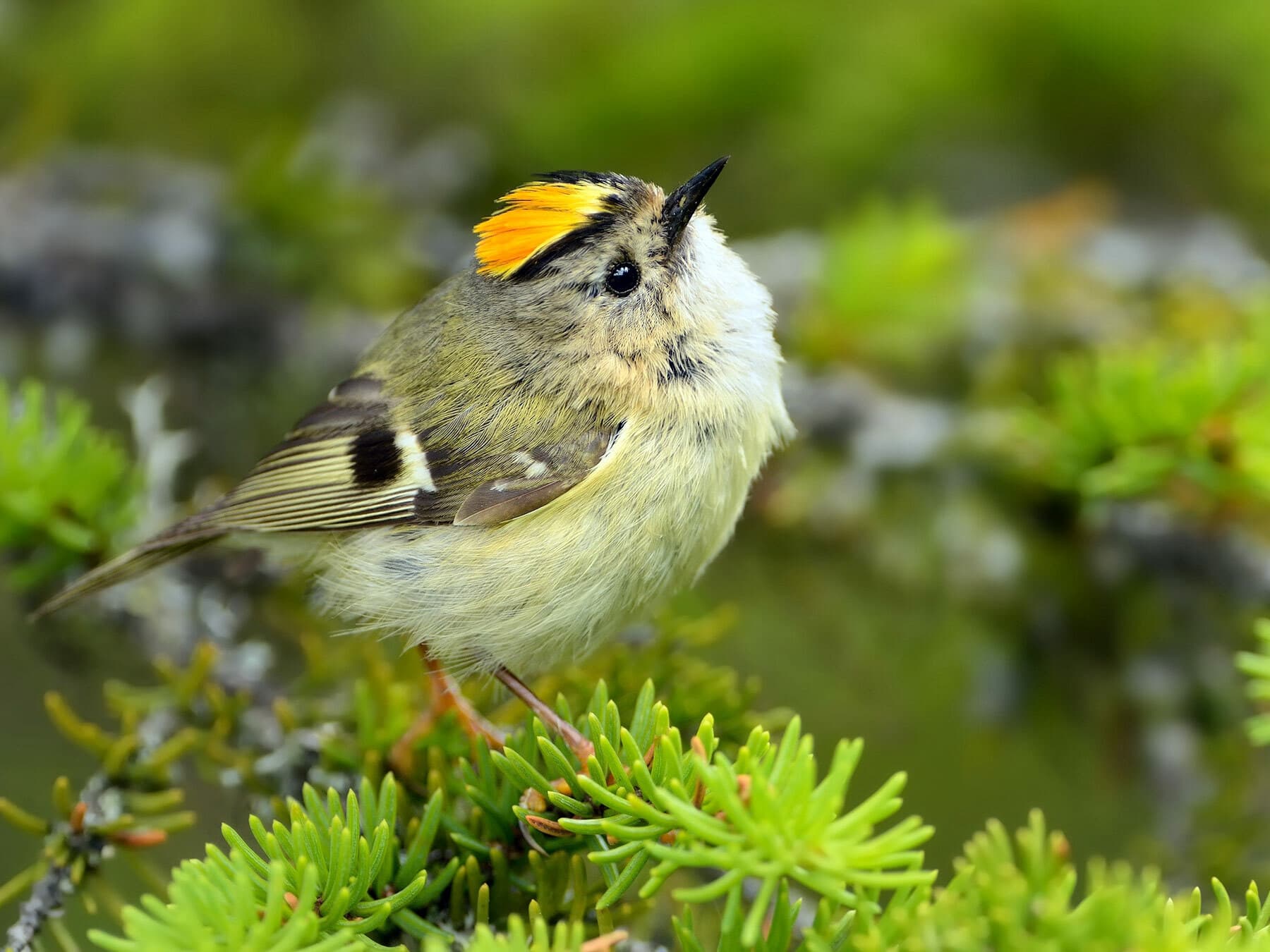
Goldcrest: a plain face, the dark eye ringed with pale, and a short dark line below the bill. The crown stripe is yellow, edged with black, with orange in the middle on males.4
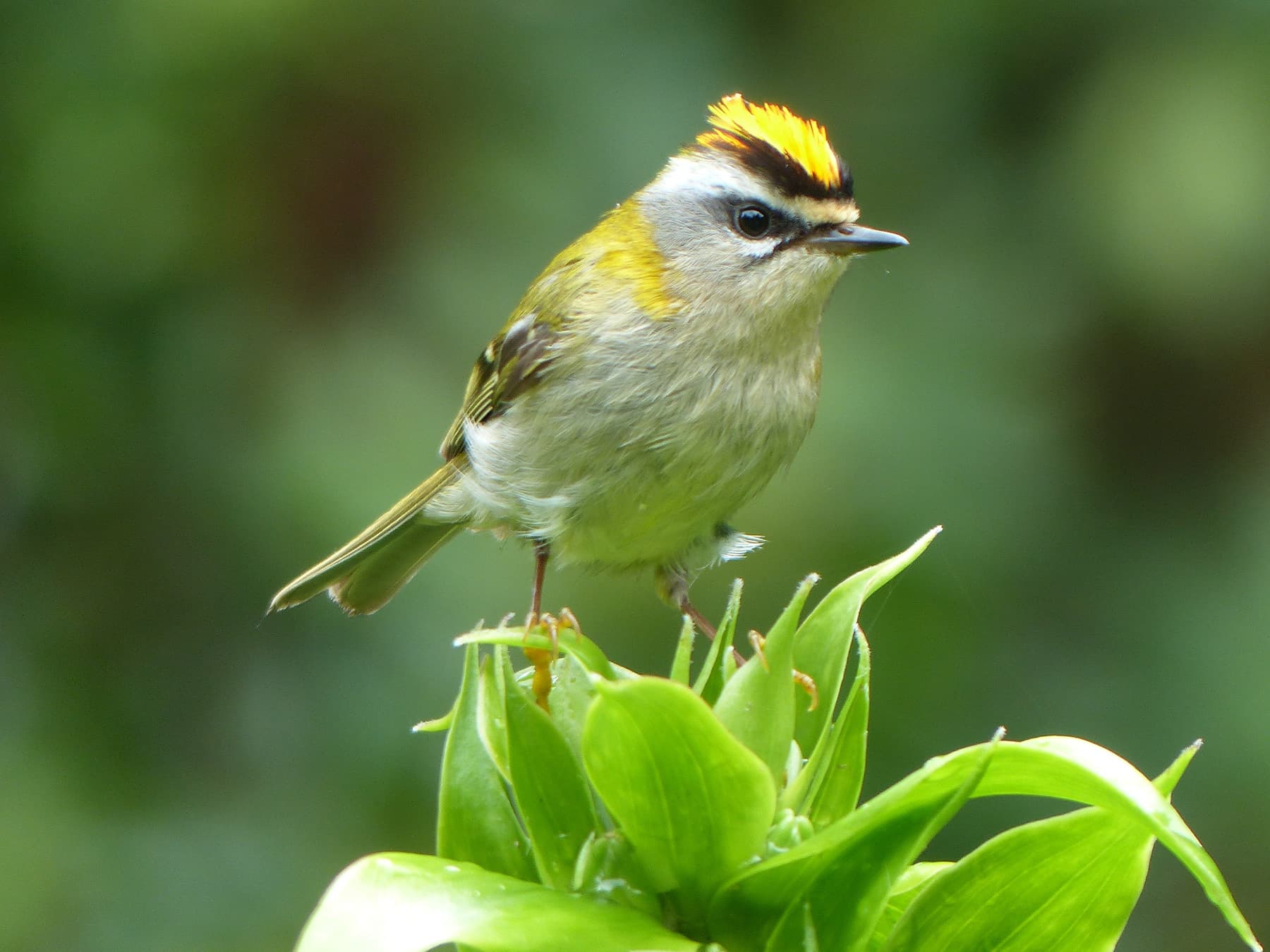
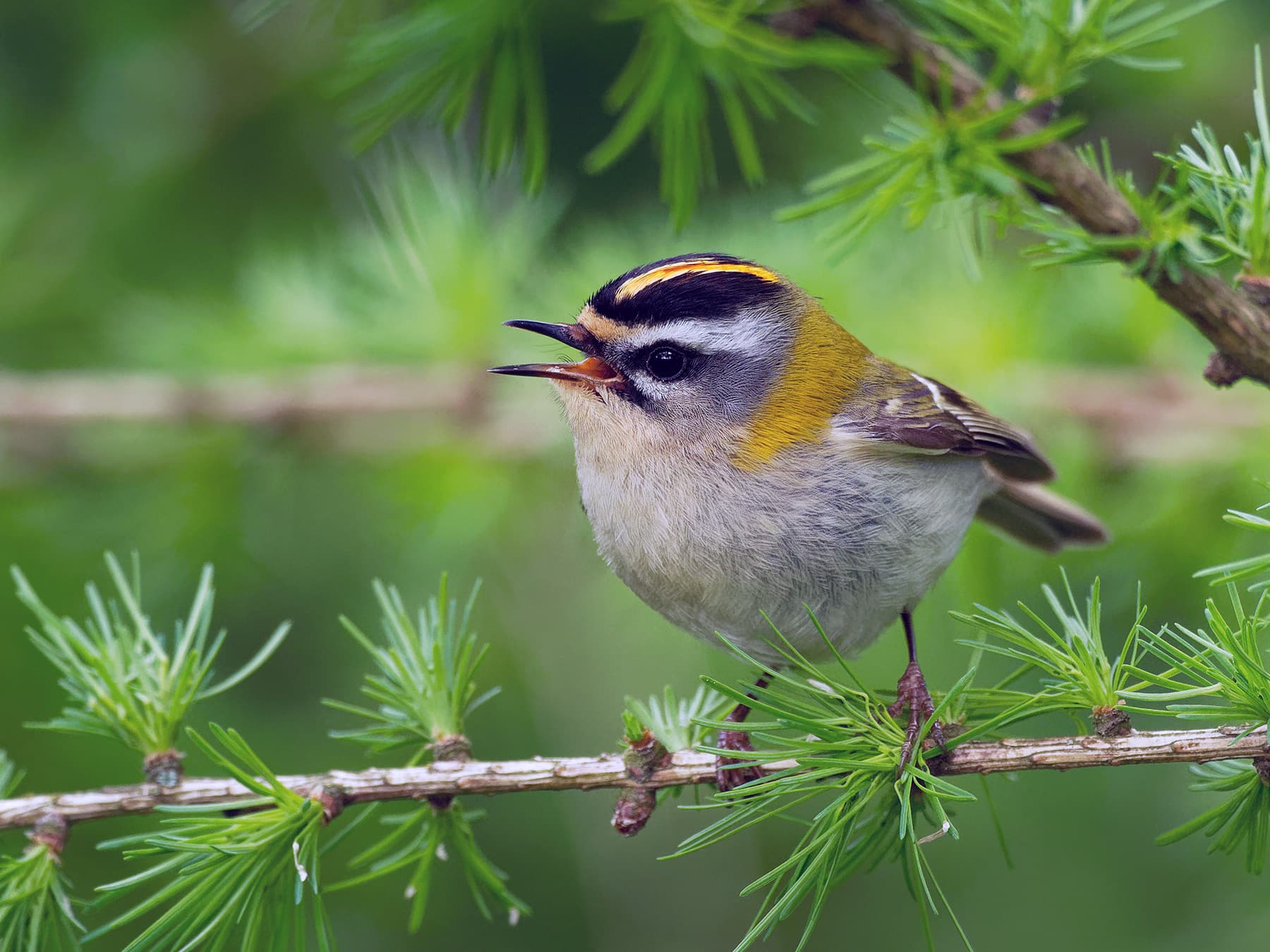
Firecrest: a white eyebrow over a black eye-stripe that runs to the bill, a white crescent under the eye and a grey cheek. The black sides of the crown are broad and meet on the forehead. Males have deep orange in the crown, females little or none.5 The RSPB describes the female's crown stripe as yellow.
Plumage
A Firecrest looks brighter and cleaner: a brighter green back and a whiter belly, according to the RSPB, with a creamy throat and that bronze patch on the side of the neck. A Goldcrest is duller and less colourful. Both have two white wing bars, but on a Goldcrest the black patch behind them is broader and stands out more.
Young birds
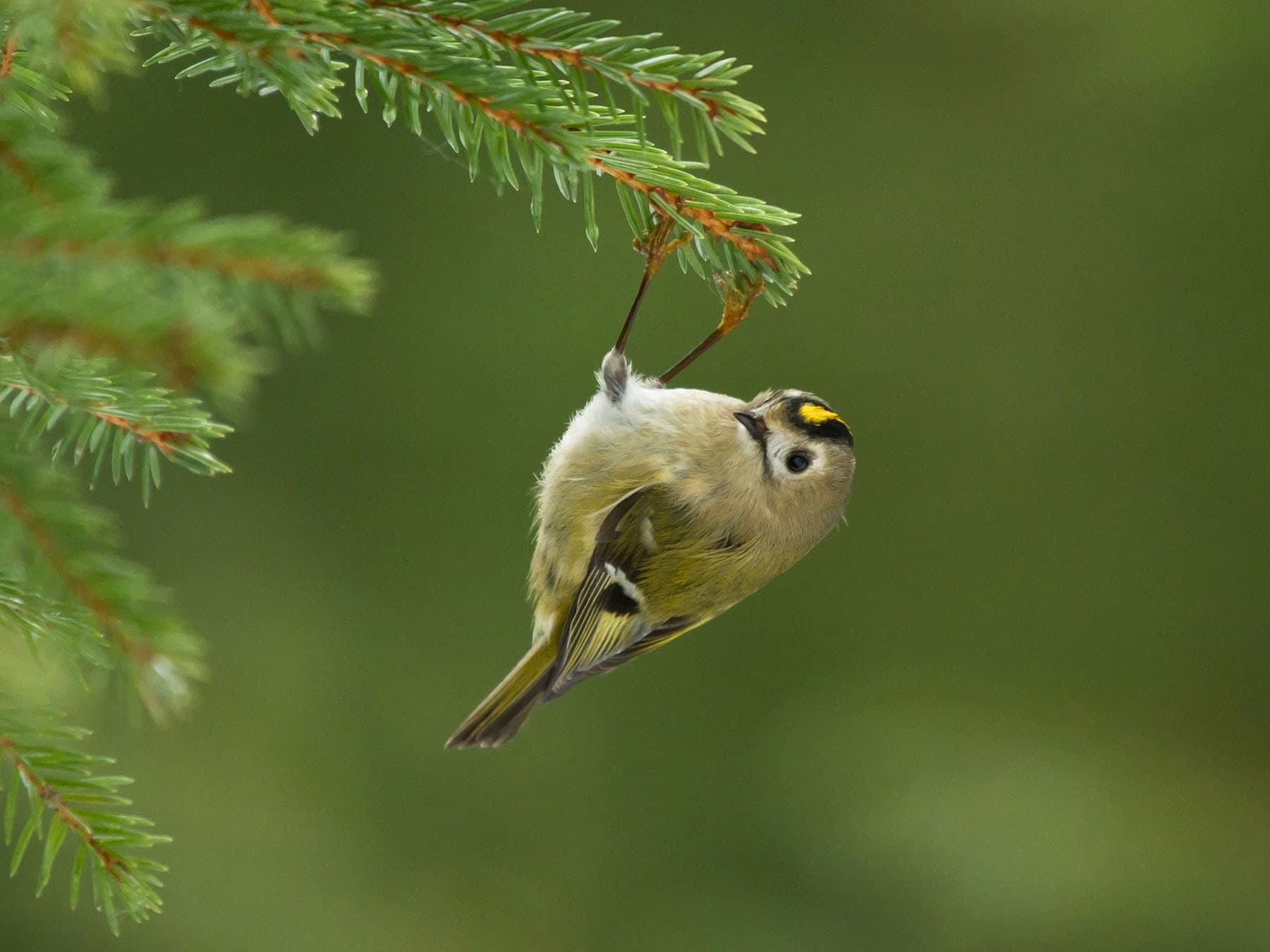
Young birds of both species have no coloured crown. A young Firecrest already shows a weak eye-stripe and eyebrow, enough to tell it from a young Goldcrest, whose face is plain.
Size
There is almost nothing in it. BTO ringers' records put adult Goldcrests at 5.3 g and Firecrests at 5.4 g on average, and young birds the other way round.6, 7 Both are about 9 cm long, though the RSPB describes the Firecrest as slightly larger, about 10 cm.1 Together they are the UK's smallest birds.
Song and calls
Both sing very high. A Goldcrest's song is a repeated cycle of notes, rising and falling, that ends in a short flourish. A Firecrest's is a run of thin notes that rises in pitch and builds in a crescendo.5 The BTO's Bird Table magazine puts it simply: the Firecrest repeats the same note, without the Goldcrest's cycle.
Both give thin, high calls. Hear both songs, with spectrograms: Goldcrest song and calls.
Habitat and feeding
Goldcrests are tied to conifers, across their range especially spruce and fir. Firecrests like conifers too, but unlike Goldcrests they are fairly common in mixed and broadleaved woods with only a few conifers,5 and the RSPB notes they come down into scrub and bushes more often.
They feed differently too. A Goldcrest searches dense foliage and the undersides of branches. A Firecrest works the tops of branches and leaves, avoids dense foliage, often hovers for long periods and takes larger prey.
Nests
Both hang a three-layered cup of moss, lichen, feathers and spiders' silk in the twigs. Across their ranges, a Firecrest's has fewer, larger feathers, up to about 700 against a Goldcrest's 2,500, and less lichen outside, and it hangs 9 to 18 m up, against 4 to 14 m for a Goldcrest's. Where there are no conifers, Firecrests also nest in ivy or broadleaved trees. While the female Firecrest incubates, the male feeds her.
Where to see them in the UK
Goldcrests are found almost everywhere there are trees, all year. Firecrests first bred in Britain in 1962, in Hampshire, and have since spread: they now breed across much of the south, east and centre of England, and in Wales.7 Most breed in the south-east and east, between Hampshire and Norfolk, with big local populations in places such as the New Forest. In winter they are found more widely, mostly near the coast; in Ireland they occur only on passage.
Which is rarer?
The Firecrest, by far. The UK had about 790,000 Goldcrest territories in 2016, against about 2,000 for the Firecrest in 2017, though the BTO notes a suggestion that there could be over 4,000 pairs. Firecrests are increasing fast: up 334% in ten years on the Breeding Bird Survey's squares.8
The Firecrest is on Schedule 1 of the Wildlife and Countryside Act,7 so it has extra protection: in England and Wales it is an offence, intentionally or recklessly, to disturb one while it is building a nest or at a nest with eggs or young, or to disturb its dependent young, without a licence.9 Both are on the UK Green List.
Sources
- RSPB. Firecrest. RSPB Birds A-Z. Accessed 9 October 2026. Source
- RSPB. Goldcrest. RSPB Birds A-Z. Accessed 9 October 2026. Source
- Risely, K. (2014). Goldcrest: species focus. Bird Table 78 (BTO Garden BirdWatch magazine), Summer 2014, pp. 18-19. Accessed 9 October 2026. Source
- Martens, J., Päckert, M. (2020). Goldcrest (Regulus regulus), version 1.0. Birds of the World (J. del Hoyo, A. Elliott, J. Sargatal, D. A. Christie and E. de Juana, editors). Cornell Lab of Ornithology. doi:10.2173/bow.goldcr1.01
- Martens, J., Päckert, M. (2020). Common Firecrest (Regulus ignicapilla), version 1.0. Birds of the World (J. del Hoyo, A. Elliott, J. Sargatal, D. A. Christie and E. de Juana, editors). Cornell Lab of Ornithology. doi:10.2173/bow.firecr1.01
- BTO. Goldcrest (Regulus regulus). BTO BirdFacts. Accessed 9 October 2026. Source
- BTO. Firecrest (Regulus ignicapilla). BTO BirdFacts. Accessed 9 October 2026. Source
- Heywood, J. J. N., Massimino, D., Baker, L., Balmer, D. E. et al. (2026). The Breeding Bird Survey 2025. BTO Research Report 802. British Trust for Ornithology, Thetford. Accessed 9 October 2026. Source
- UK Parliament (1981). Wildlife and Countryside Act 1981, section 1. Accessed 7 October 2026. Source