Facts · Updated 11 Oct 2026
Do House Finches Mate for Life? Pairs and Courtship
By the Birdfact teamChecked by Nathan Cope
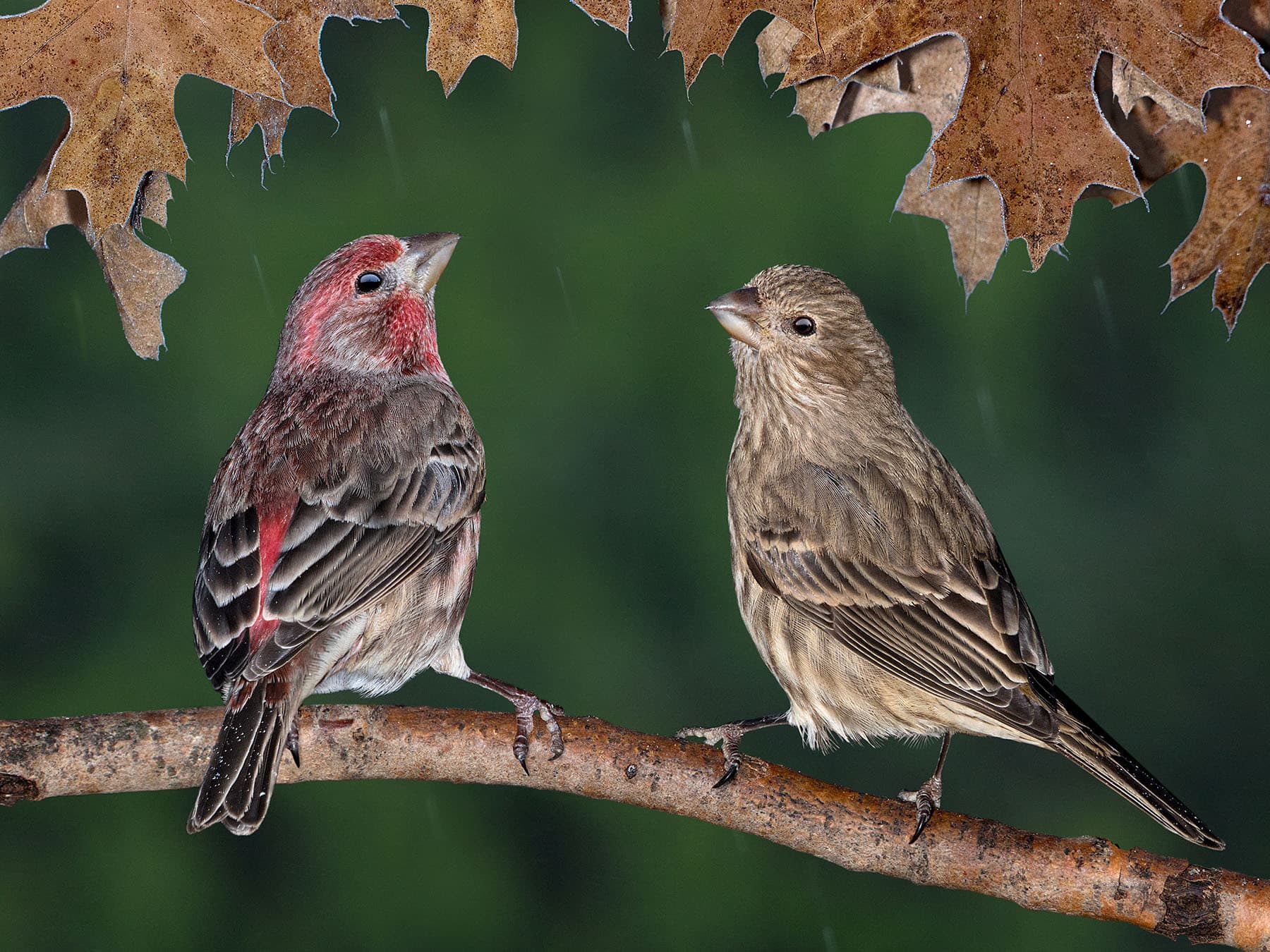
House Finches are socially monogamous, and pairs often stay together from year to year, but not always for life: some switch partners, even within a season, more often after a failed nest. Males court with a singing display flight and by feeding the female, and in Michigan studies females preferred colorful males.
On this page11 sections
Do House Finches mate for life? How pairs form, how the male courts and feeds the female, why females choose red males, and how often pairs split. For the bird itself, see House Finch identification, song and facts.
Do House Finches mate for life?
Not exactly. House Finches are socially monogamous: one male and one female pair up and raise their young together, and pairs often stay together through the year and nest together again the next spring. But they do not always stay together for life, and some switch partners within a season.1
The longest-lasting pair known from a long study in western Montana nested together for 7 seasons. In eastern Michigan, about 10% of birds changed mates during a season, almost always after the female abandoned a nest; about 93% of pairs stayed together after losing a nest to a predator, and every pair stayed together after a successful nest. In Arizona, of 33 females followed for 2 to 4 years, 70% nested with one male in two or more seasons.
How pairs form
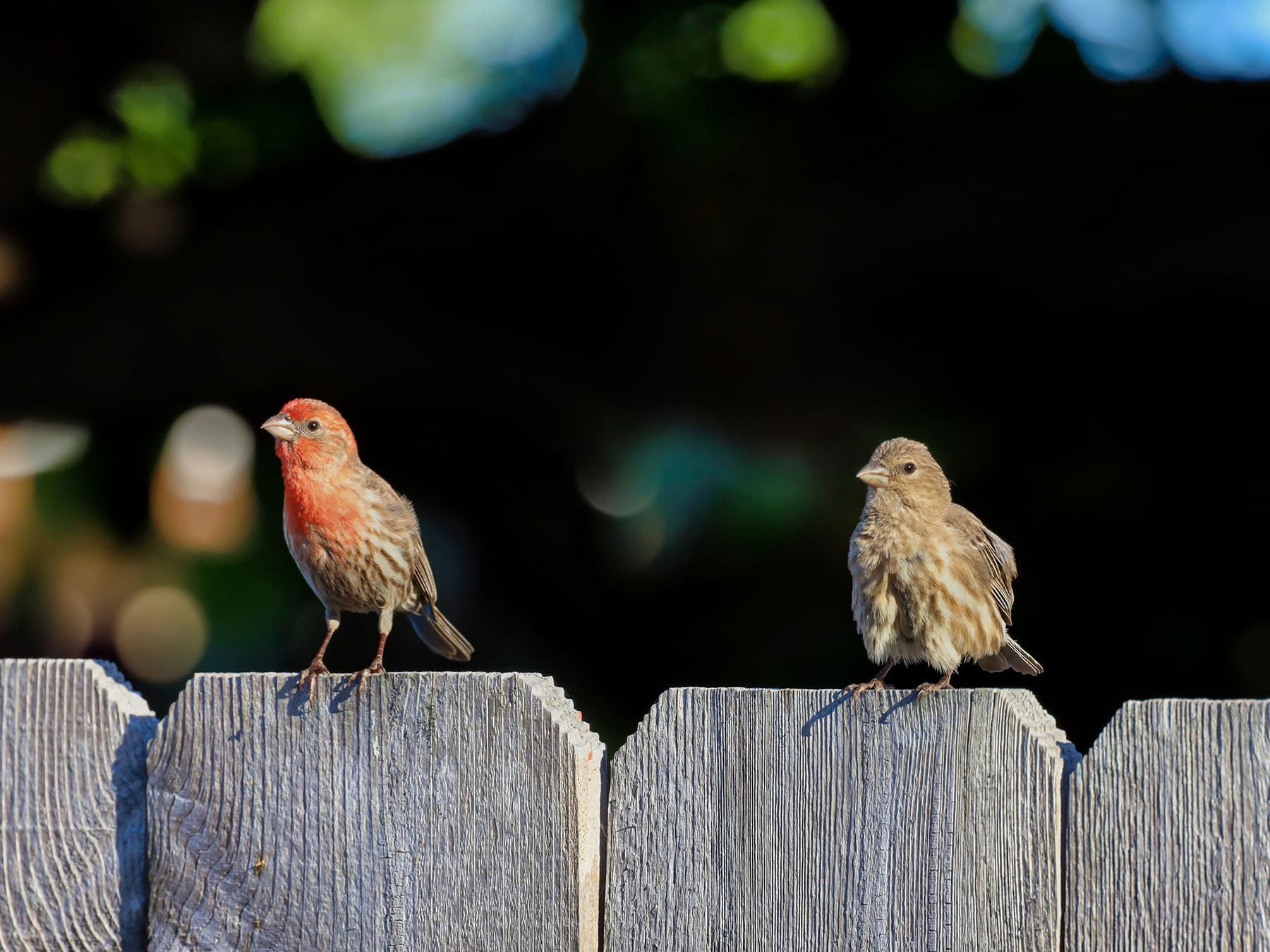
Pairs form in the winter flocks2, from January to March, as particular males and females spend more and more time together. Pairs that already exist often stay together in the flock.
In the Sonoran Desert, pairing has been seen to take an unusual form. In January and February, groups of 10 to 15 House Finches of both sexes gather in a circle on top of a saguaro cactus, facing in, for up to 20 minutes at a time. Every so often a male and a female fly off together, the male often singing, and later arrivals move into the inner circle. Similar gatherings happen on utility poles and roofs farther north.1
Courtship
Males sing before and after they pair. Early in the season the male makes a "butterfly flight": he climbs slowly, with slow wingbeats, to 65-100 ft (20-30 m) and glides back down to a perch, singing loudly the whole time.
Close to a female, a courting male hops nearer and nearer with his wings drooped, swaying from side to side, his tail raised so that his red rump shows above his crown. He often holds a piece of nest material in his bill, and sings a song with a buzzy note. Several males may display to one unpaired female at once.
Courtship feeding
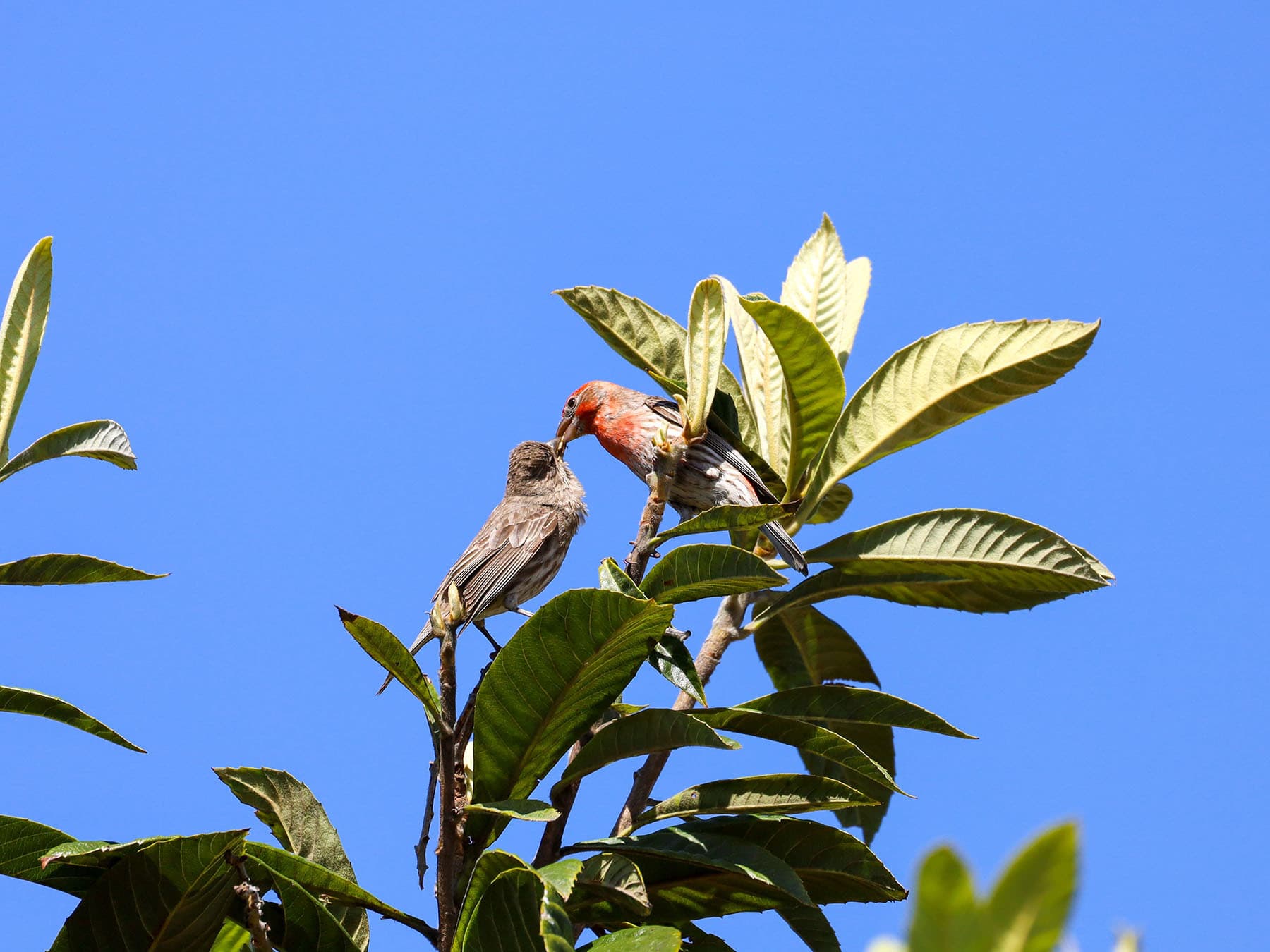
After a few weeks as a pair, the birds begin "billing": one leans over and gently pecks at its partner's closed bill, with a soft twittering call.1 Billing turns into courtship feeding. The female begs, fluttering her drooped wings with her head tilted up, and the male goes through the motions of bringing up food before he finally feeds her.2
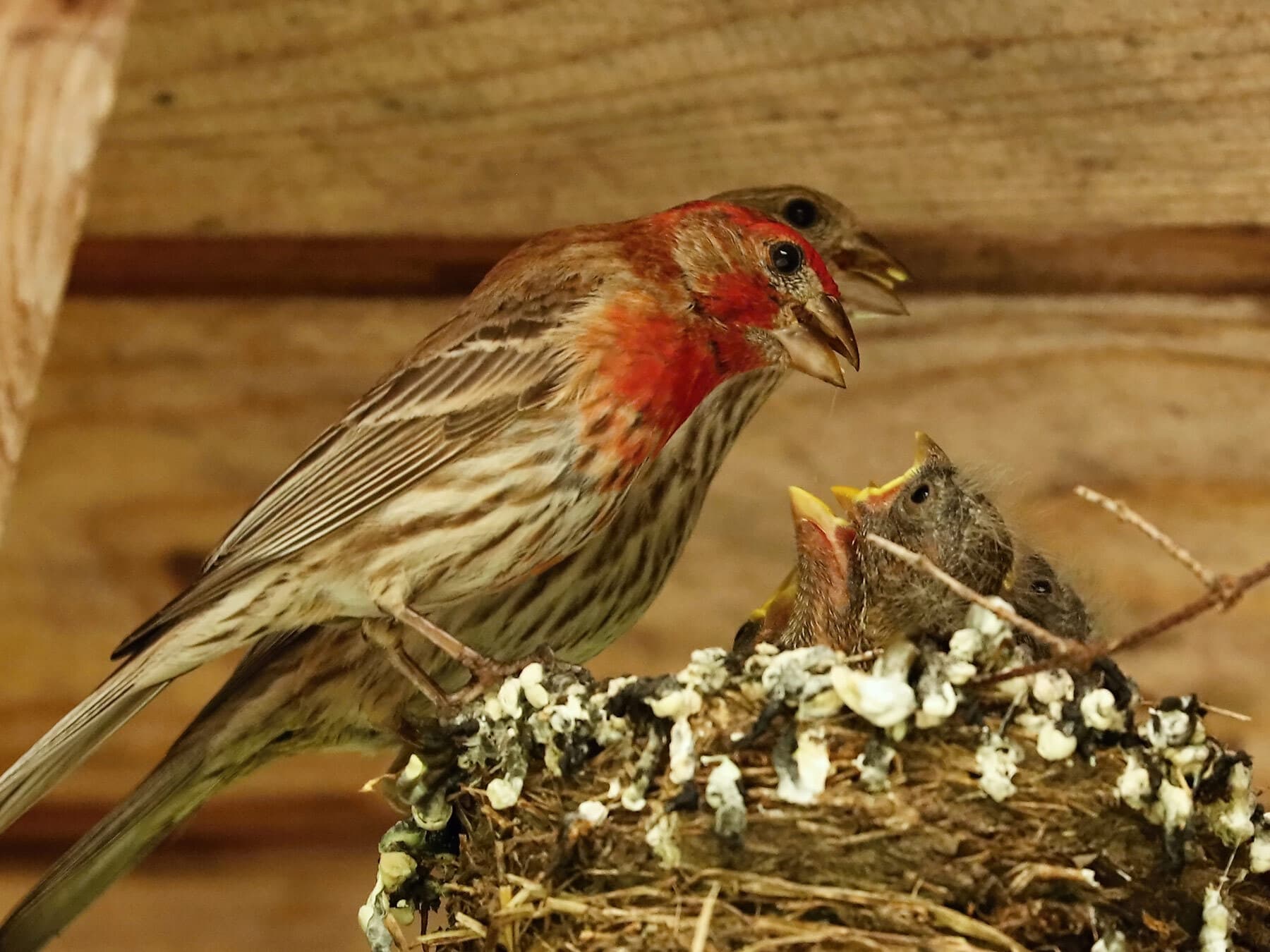
It starts weeks before nesting and goes on through the nesting cycle. While the female incubates, the male often feeds her on and off the nest (though many Arizona and Montana males did not), and she may beg loudly if he is late. In Arizona, courtship feeding started again within days of a nest being lost.
Why female House Finches choose red males
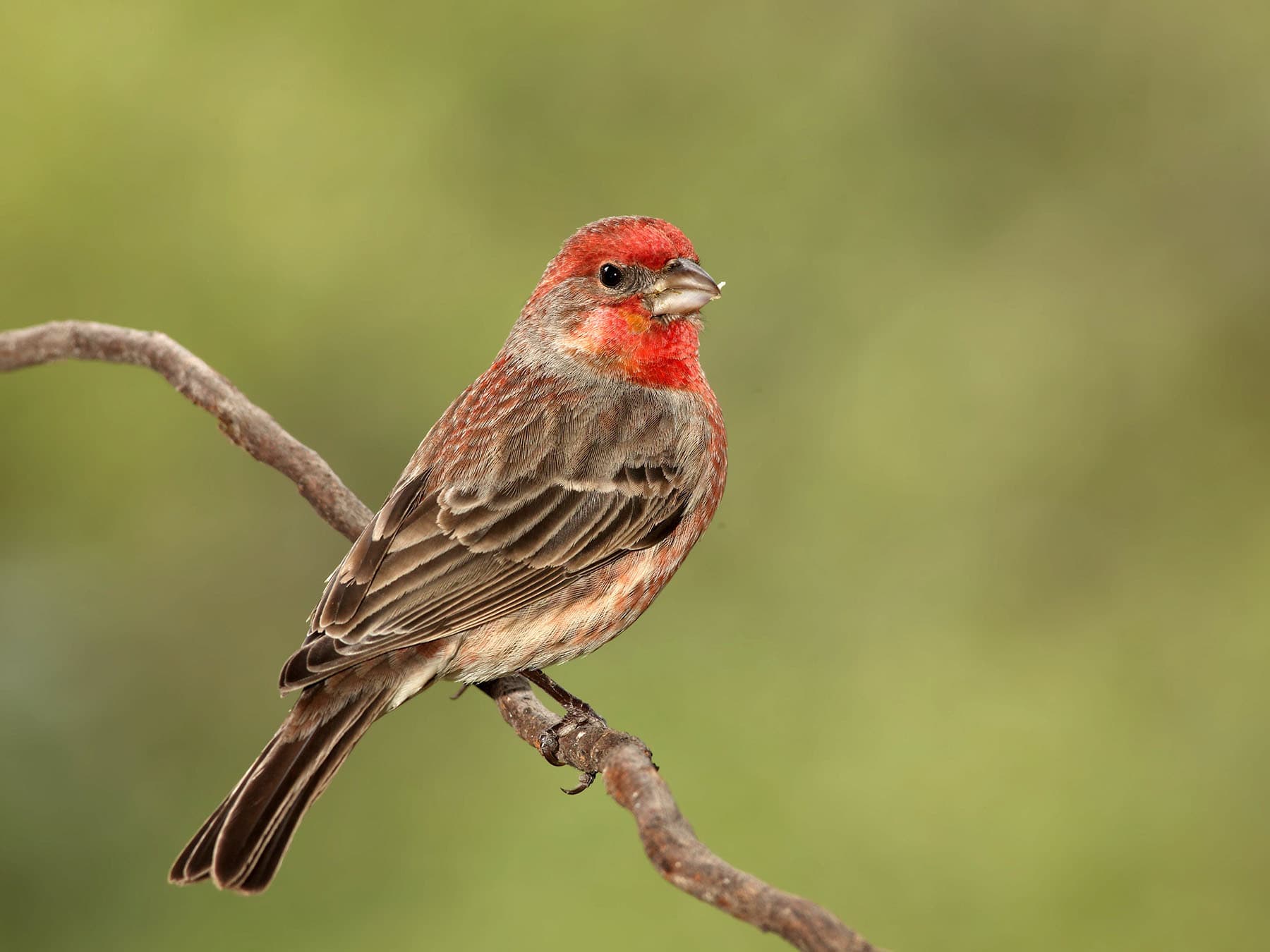
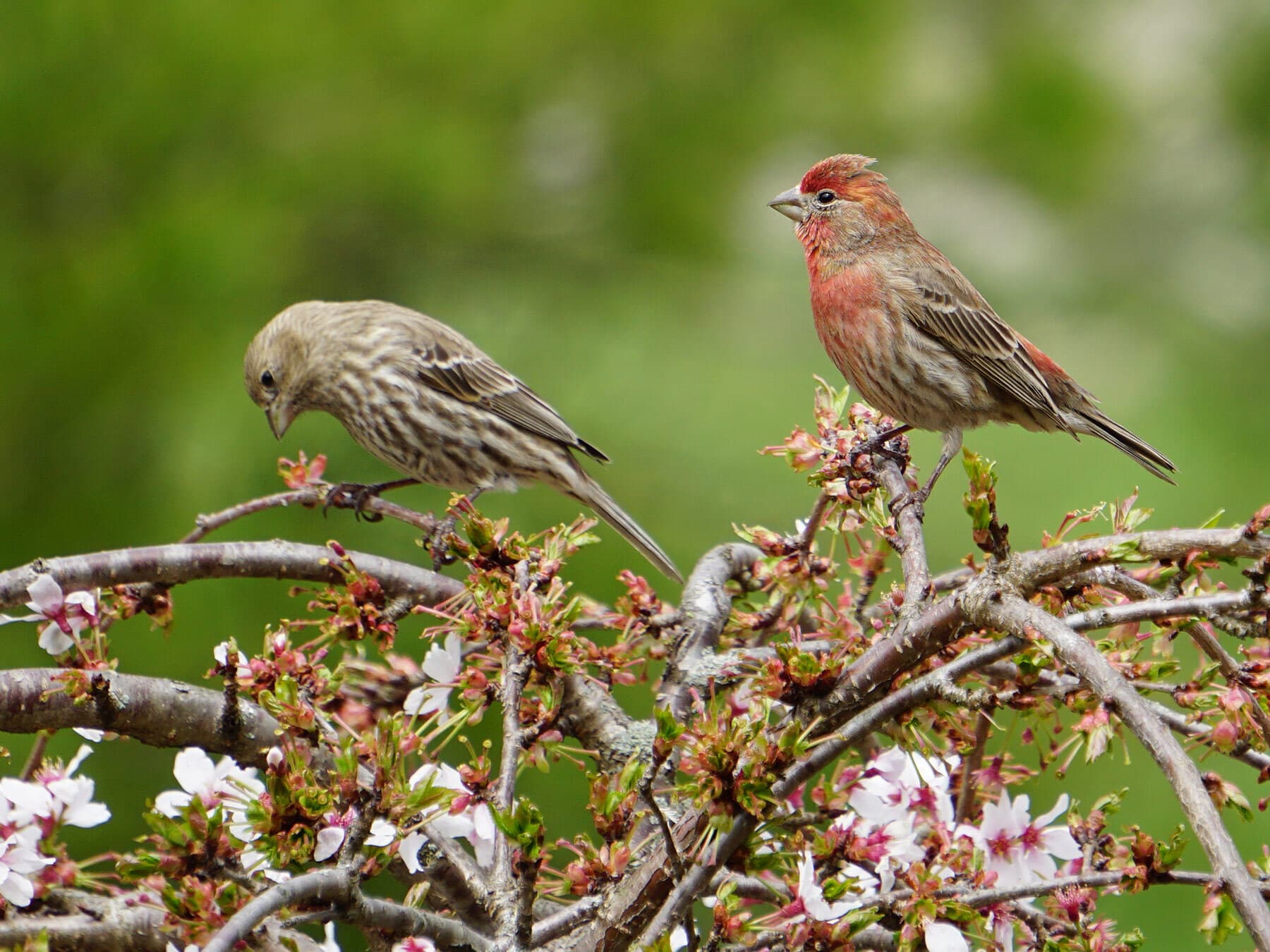
In Michigan, females preferred colorful males. In field experiments there, Geoffrey Hill brightened some males' plumage, lightened others and left others as they were: the brightened males paired sooner and more often.3 Among natural males, the redder ones were more attentive at the nest and more likely to survive the winter.
A male gets his red from carotenoid pigments in the food he eats while molting, which is why Hill called his color an indicator of male quality: All About Birds suggests a red male may be the more capable mate at feeding nestlings.2 The link varies between populations, seasons and the ages of the birds, though. More: why some males are orange or yellow.
Guarding a mate
From nest building until the eggs are laid, the two birds stay close and guard each other, the male especially. Paired birds are rarely seen apart in this time. In one study, males near their own mate attacked other females rather than courting them, but displayed to them once their mate was more than 50 ft (15 m) away; and females always attacked their male after seeing him display to another female.1
Extra-pair young
Some young have a different father. DNA tests in several studies have found that 6-10% of young House Finches are fathered by a male other than their mother's mate. In Michigan, 10 of 119 chicks (8.4%), in 5 nests, had another father, while every chick's mother was the female at the nest.
Not every male finds a mate
Most House Finch populations that have been counted have more males than females, so many males go unpaired: up to 36% of adult males in southeast Michigan and 62% in eastern Alabama. In a few Montana pairs, a second male stays close to the pair, but only one male feeds the female and young.
Splitting up
Pairs are more likely to split after a nest fails, especially one the female abandons. In Michigan most mate changes came after the female abandoned a nest, and some birds change partners between years: in Arizona, 37% of 40 males followed for two years had a new mate the second year. In Alabama, pairs that stayed together from one year to the next started nesting 11 days earlier on average than new pairs.
Families
House Finch families stay together only for a few weeks. The young follow their parents for about 2.5 to 3 weeks after leaving the nest, fed mostly by the male, then join flocks of other young birds. Flocks of juveniles wander widely in late summer and fall. More: House Finch nests, eggs and young.
Sources
- Badyaev, A. V., Belloni, V., Hill, G. E. (2020). House Finch (Haemorhous mexicanus), version 1.0. Birds of the World (A. F. Poole, editor). Cornell Lab of Ornithology. doi:10.2173/bow.houfin.01
- Cornell Lab of Ornithology. House Finch: Overview, Identification and Life History. All About Birds. Accessed October 11, 2026. Source
- Hill, G. E. (1991). Plumage coloration is a sexually selected indicator of male quality. Nature 350: 337-339. doi:10.1038/350337a0
- Hill, G. E. (1992). Proximate basis of variation in carotenoid pigmentation in male House Finches. The Auk 109: 1-12. doi:10.2307/4088262