


Western Tanager
Louisiana Tanager · Piranga ludoviciana
By the Birdfact teamChecked by Nathan Cope
On this page13 sections
How to recognise it
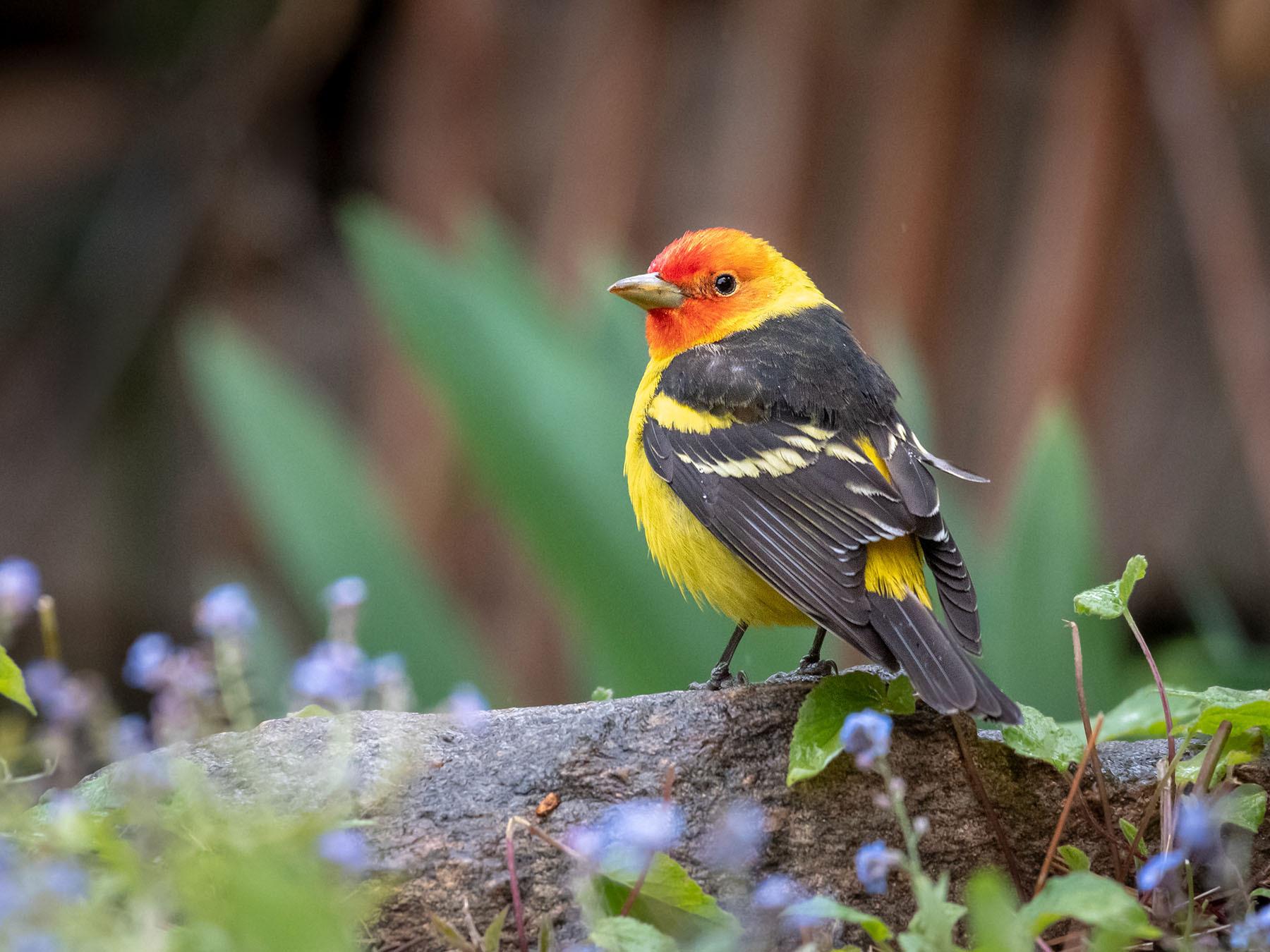
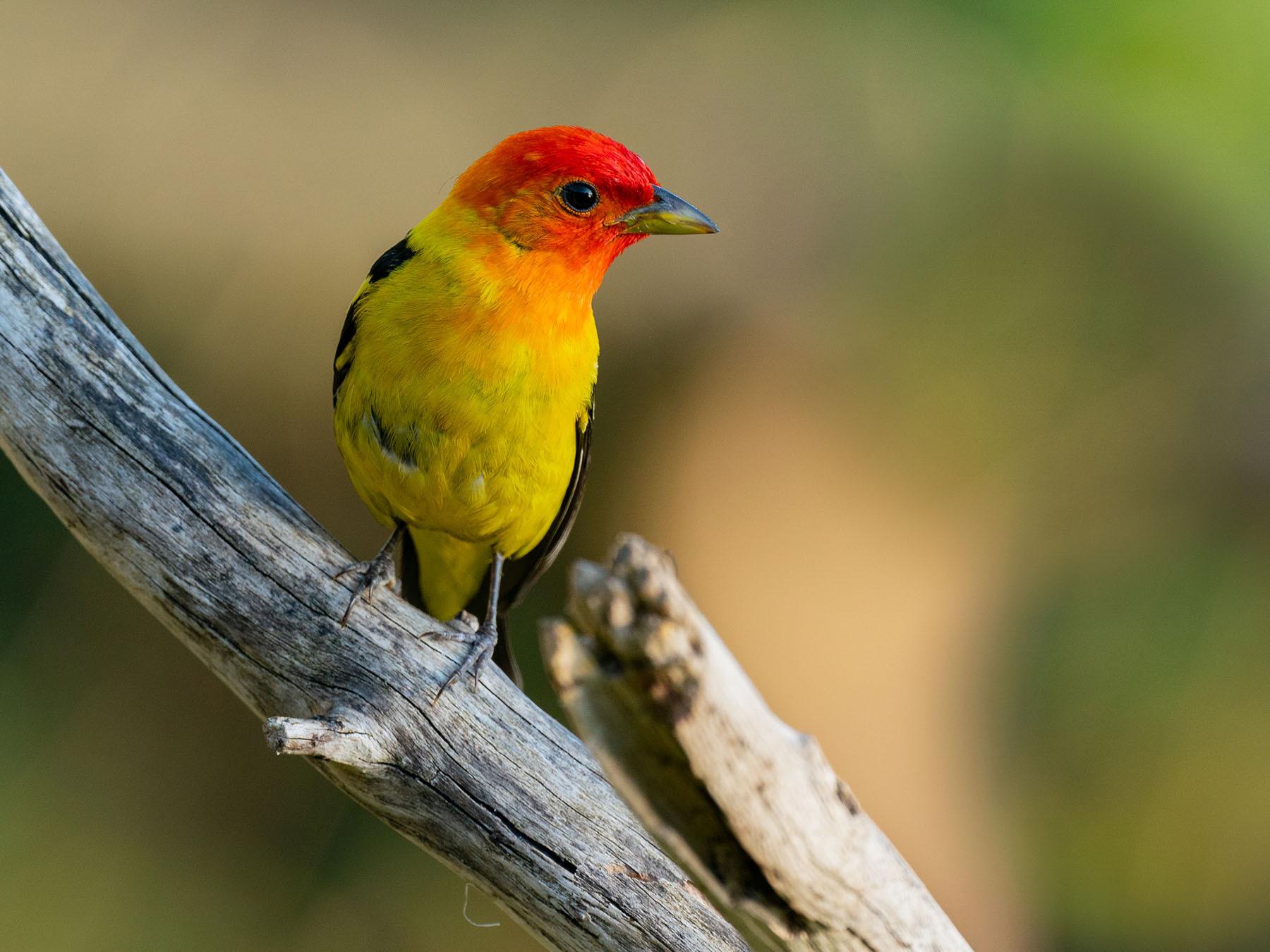
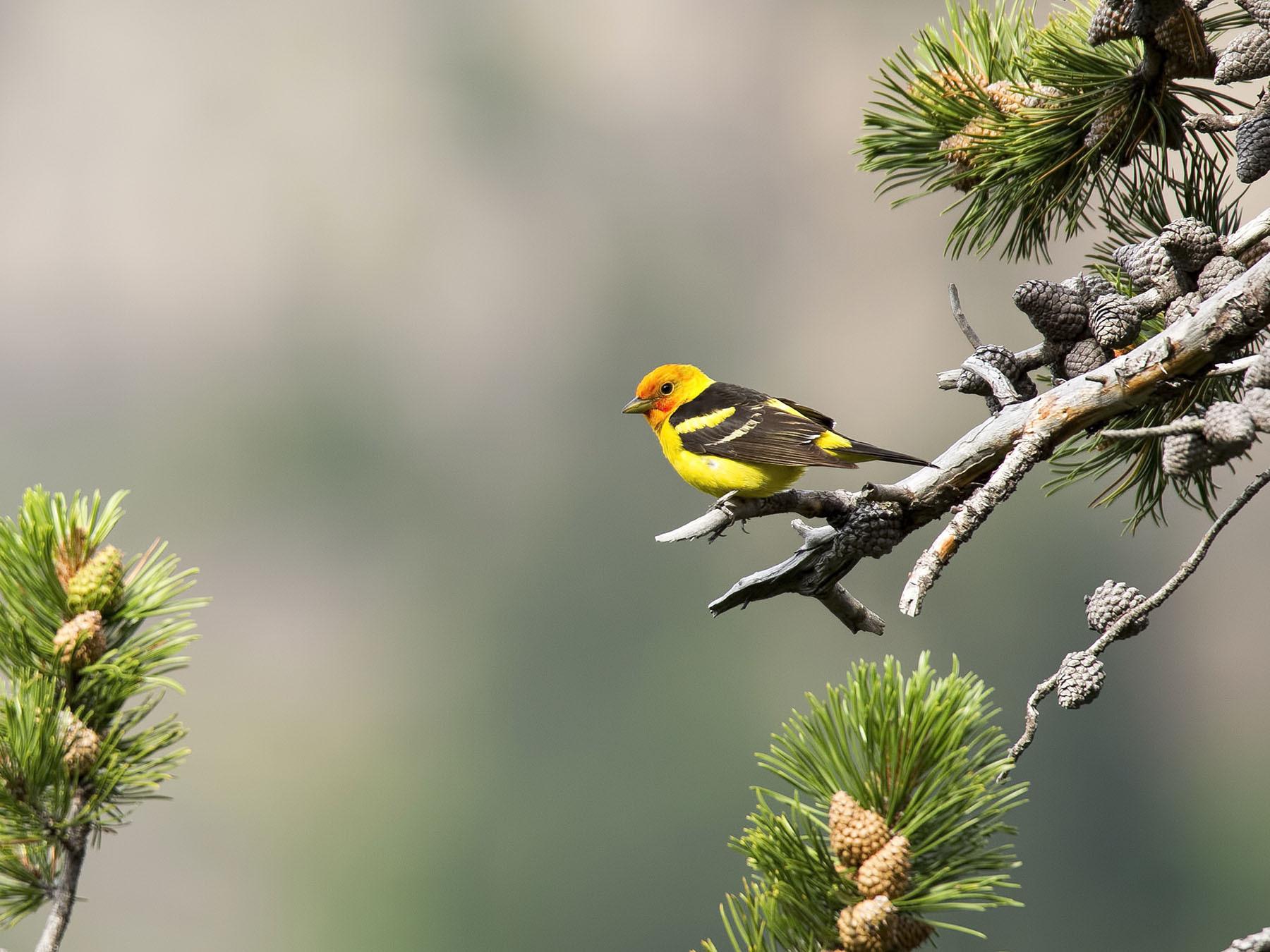
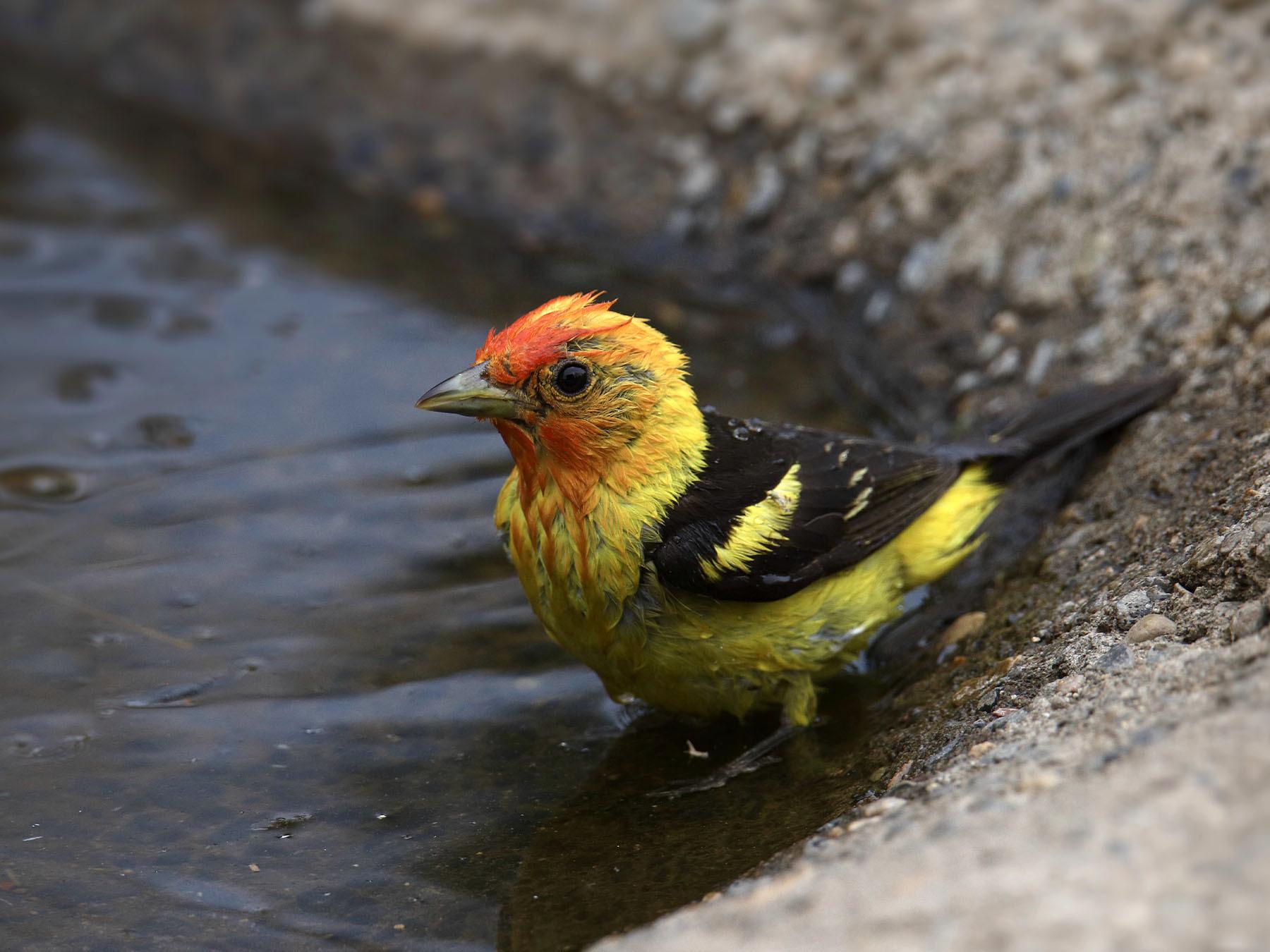
A breeding male Western Tanager is hard to mistake: a red or orange-red head on a bright yellow body, with a black back, black wings and a black tail. If you have just seen a yellow bird with black wings and a red head in a western forest or a yard in May, this is very likely it. One wing bar is yellow, the other white, and the bill is short and thick.
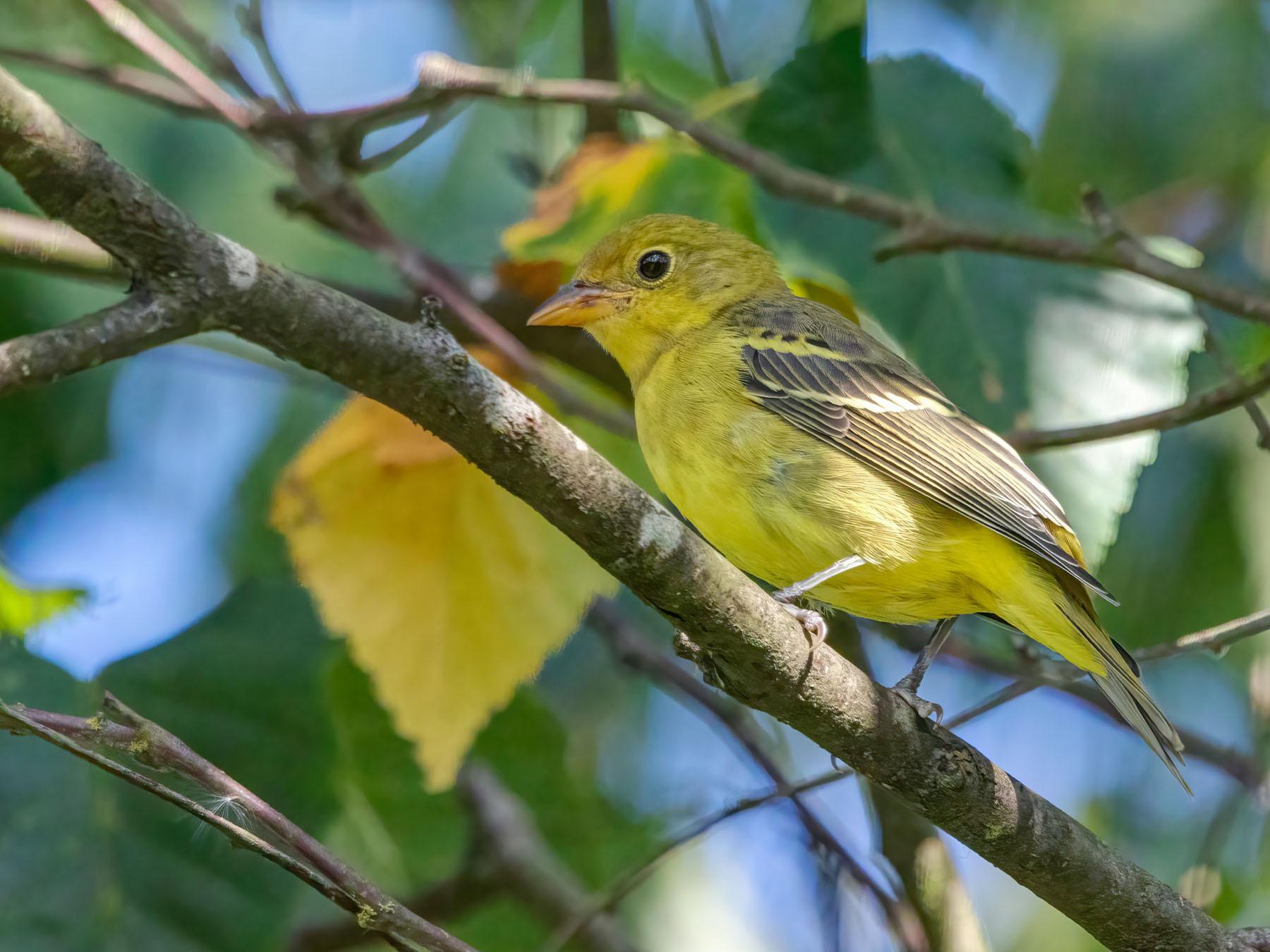
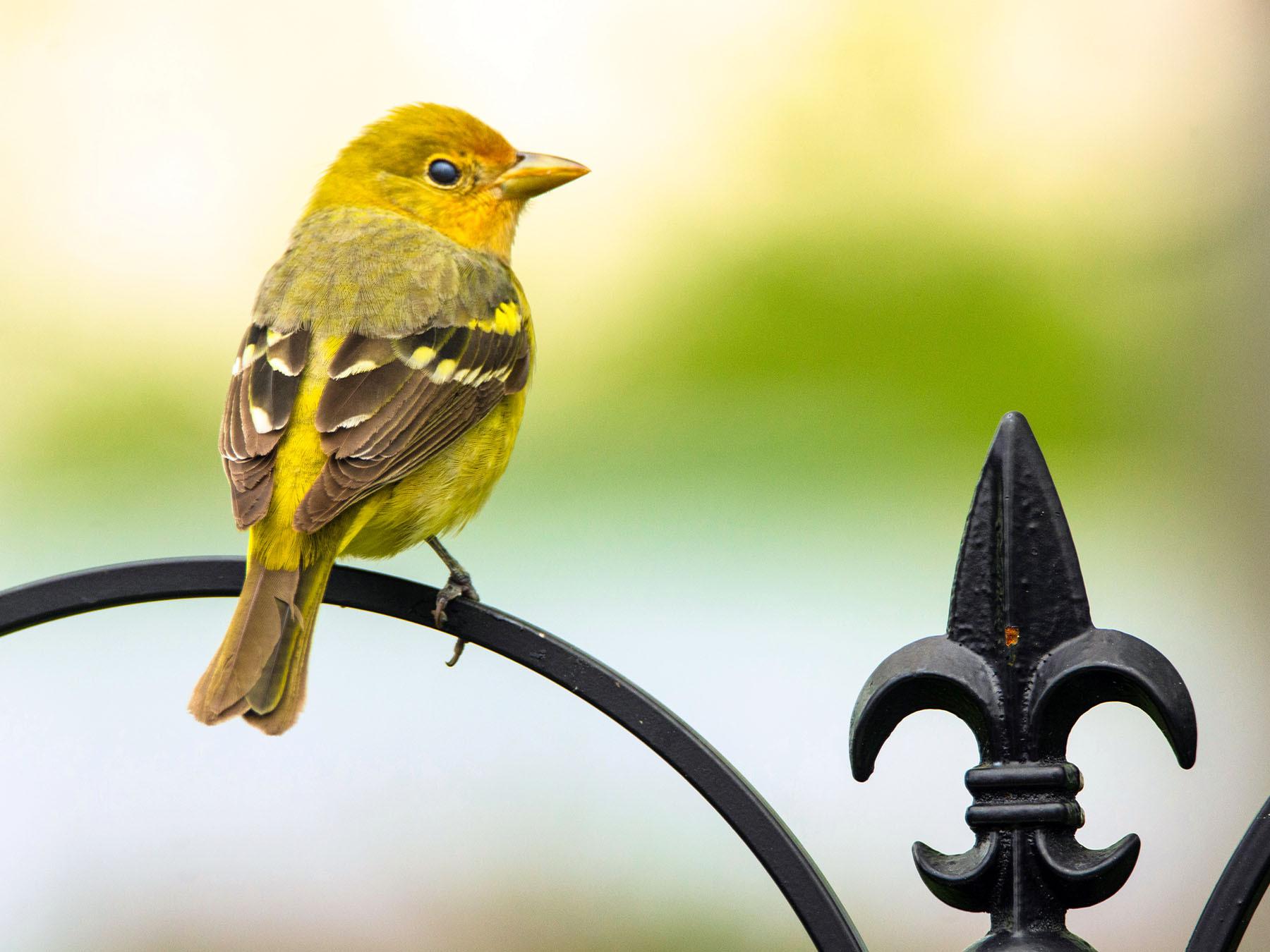
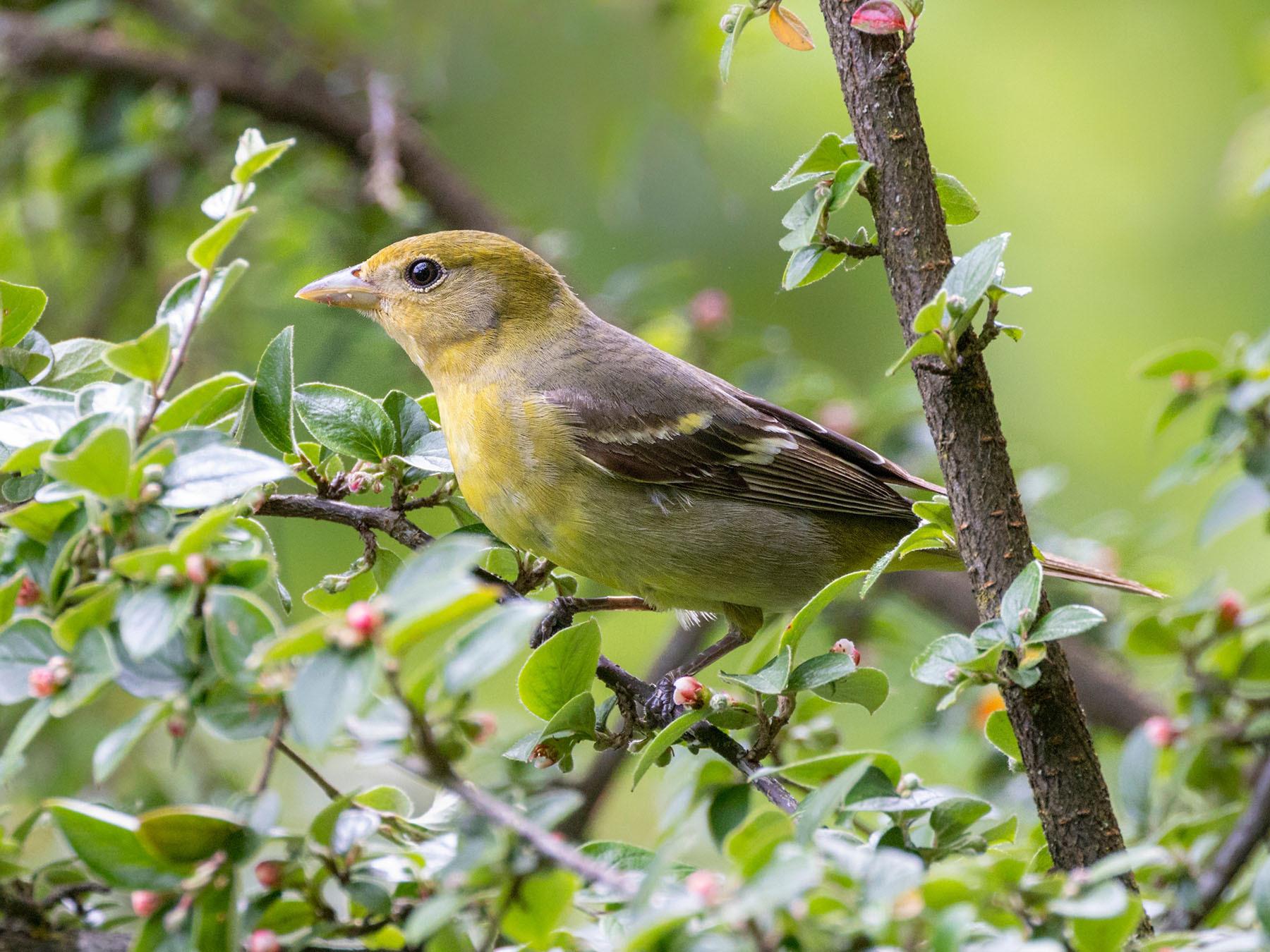
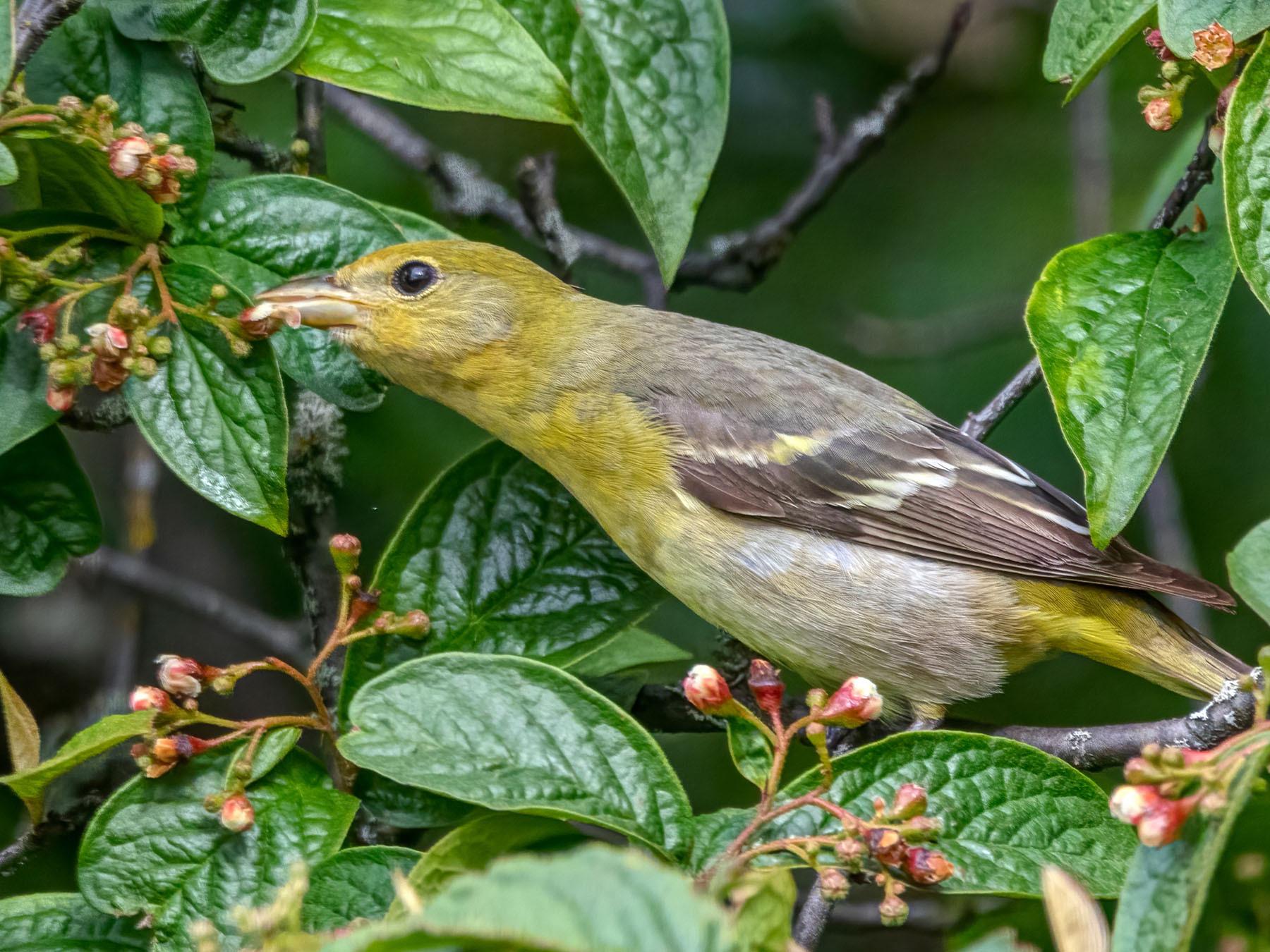
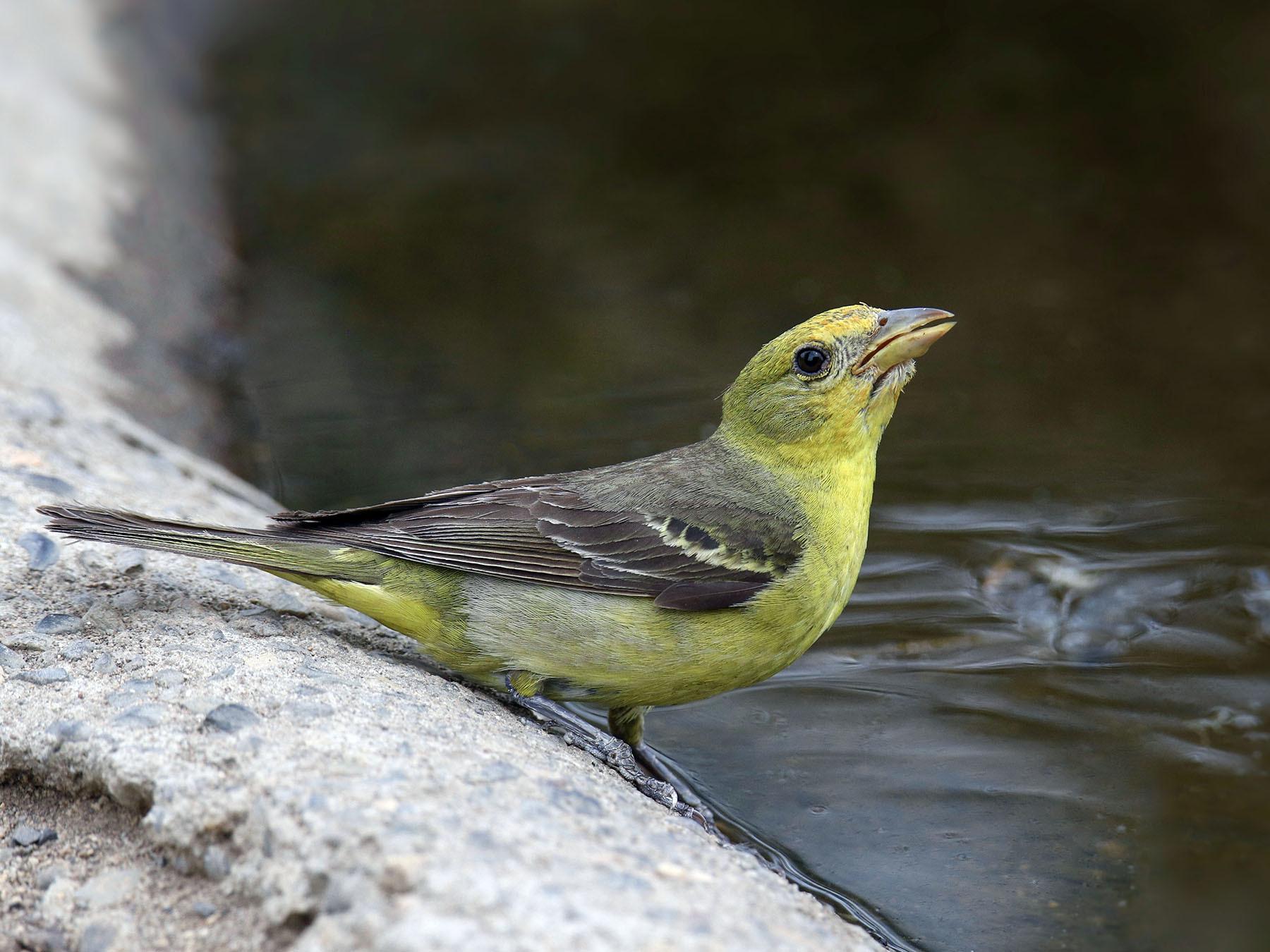
Females and young birds are the ones that take a second look. They are dull yellow to grayish, with an olive-gray back and two pale wing bars on dark wings. Those bars and the thick bill are the best clues.
Size and shape
Western Tanagers are 6.3 to 7.5 inches (16-19 cm) long, with a wingspan of about 11 to 12 inches (28-30 cm), and weigh 0.8 to 1.3 ounces (24-36 g). That is smaller than an American Robin, larger than a sparrow and a good deal stockier than a warbler. The bill is short and thick-based, and the tail is of medium length.
Males, females and young
Males differ a lot. On some the red stops at the forehead and throat, on others it fills most of the head, and it runs from pale orange to deep scarlet. After the molt in late summer he looks duller: olive and dusky feather tips cover the black back and the yellow, and at most a wash of red stays on the face. The head turns red again in a partial molt on the wintering grounds, between February and April.
A first-spring male looks like an adult but duller. The red is paler, often orange-toned, and covers less of the head, the back has olive edges that look scaly, and the wings and tail are browner.
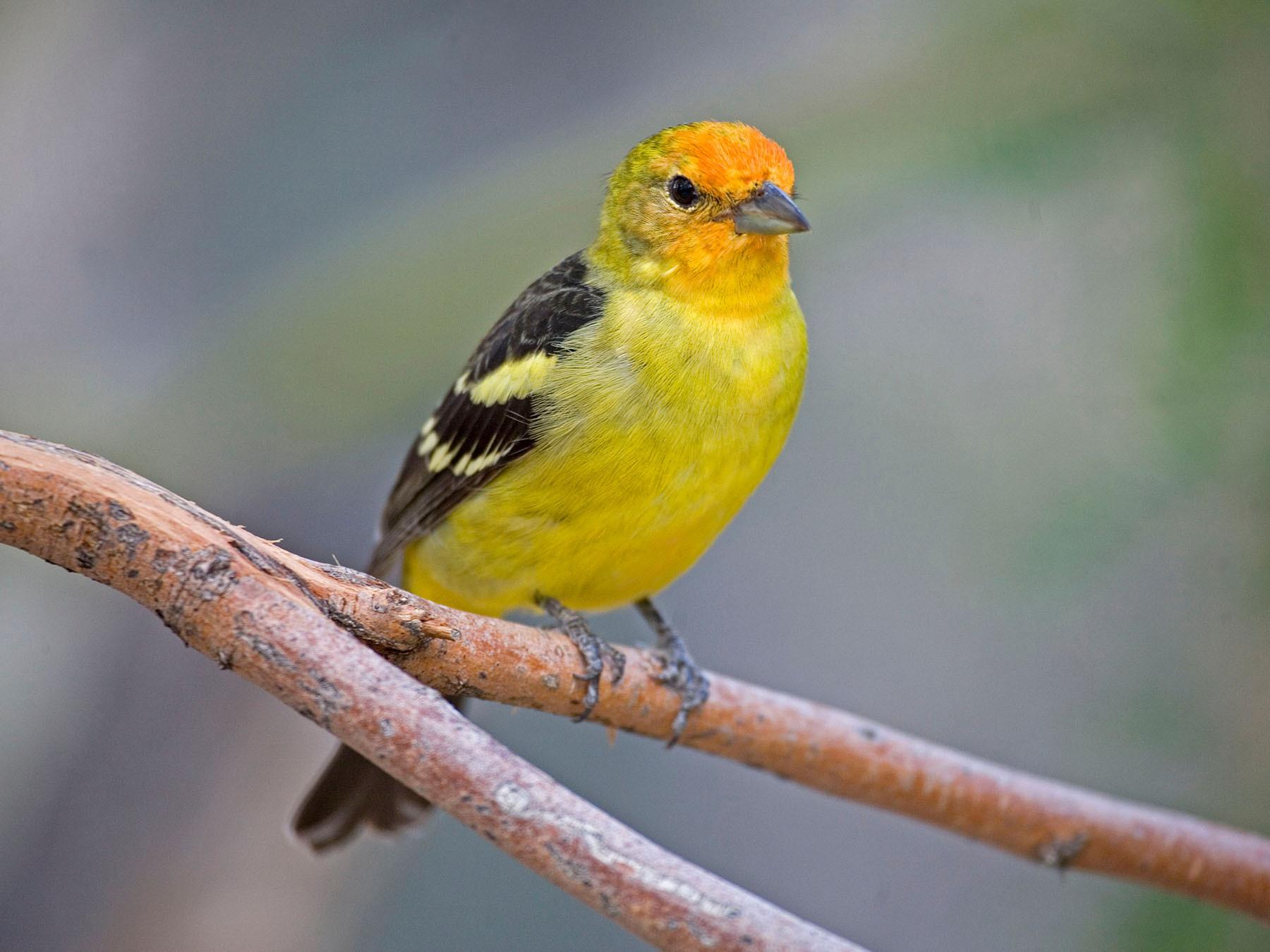
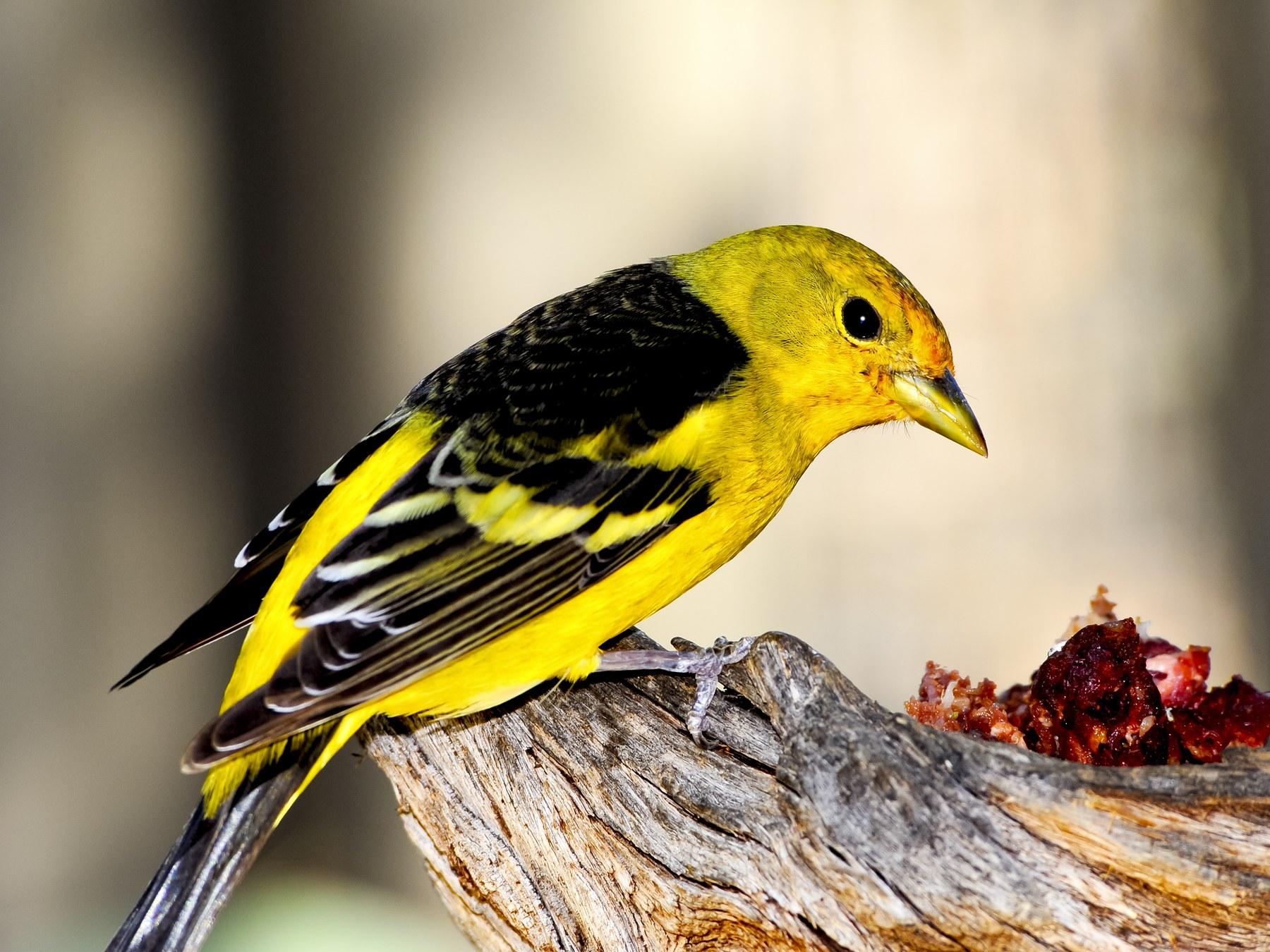
Females appear to come in two broad types. Yellow birds are bright yellow below; gray birds are much paler, at the extreme grayish white with yellow only under the tail. The reason was still unknown in 1999.1 Both have an olive-green head, a grayer back, a yellower rump and two pale wing bars, and bright females sometimes show a red tinge on the front of the head.
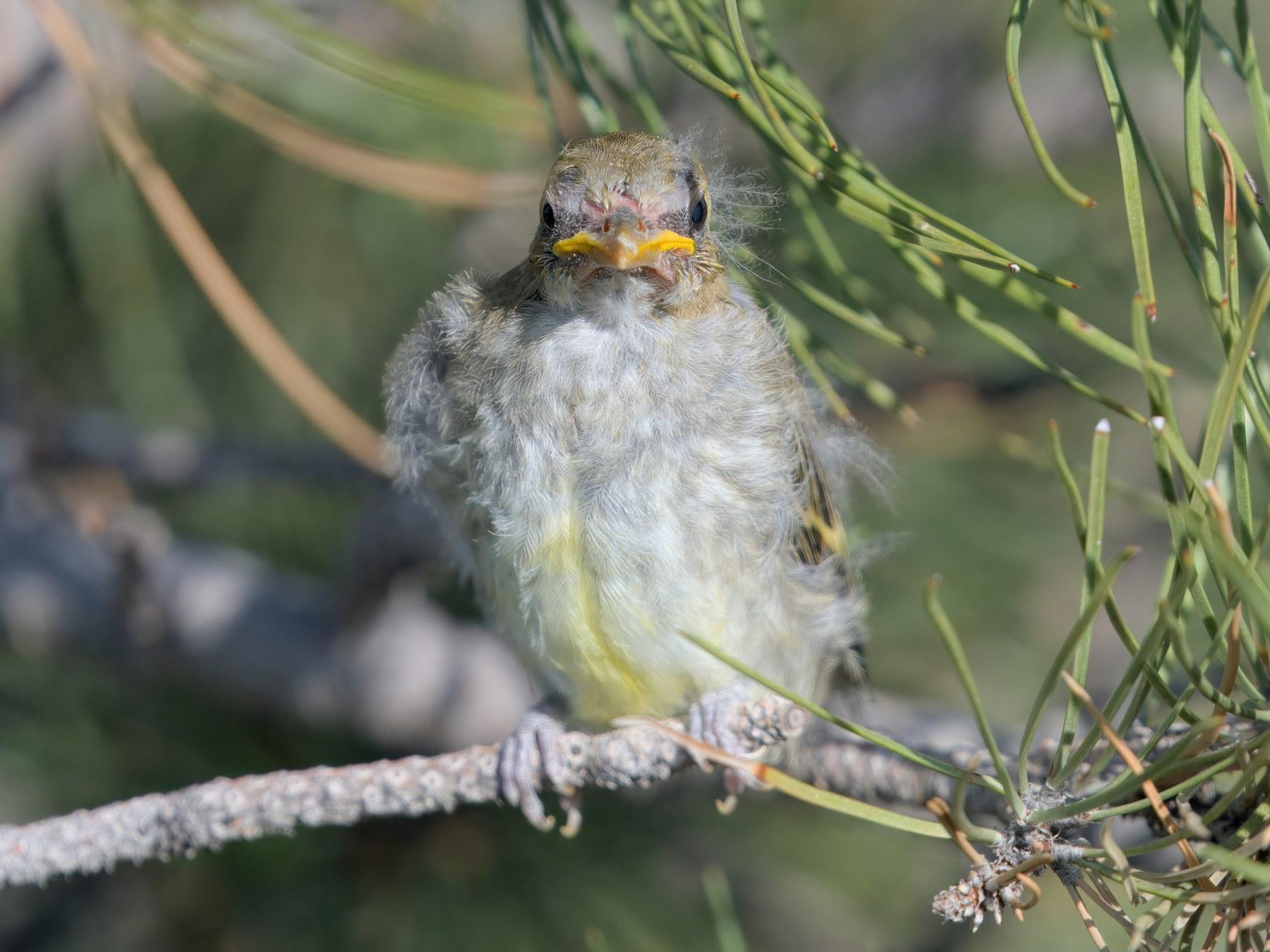
Juveniles look alike whatever their sex: olive-brown above, with two dull yellow wing bars and streaks or spots on a buffy throat, breast and flanks. By fall the streaks have gone and young birds look like adult females, the males brighter and greener-backed, the females the dullest of all.
Identification: similar birds
No other North American bird looks quite like an adult male. Females and young are harder, and the wing bars do most of the work.
Scarlet Tanager. The female is olive-yellow with darker wings. Among fall young, fewer than 2% show a wing bar.1 A breeding male is red with black wings, and after breeding he turns olive-yellow but keeps his black wings and tail.
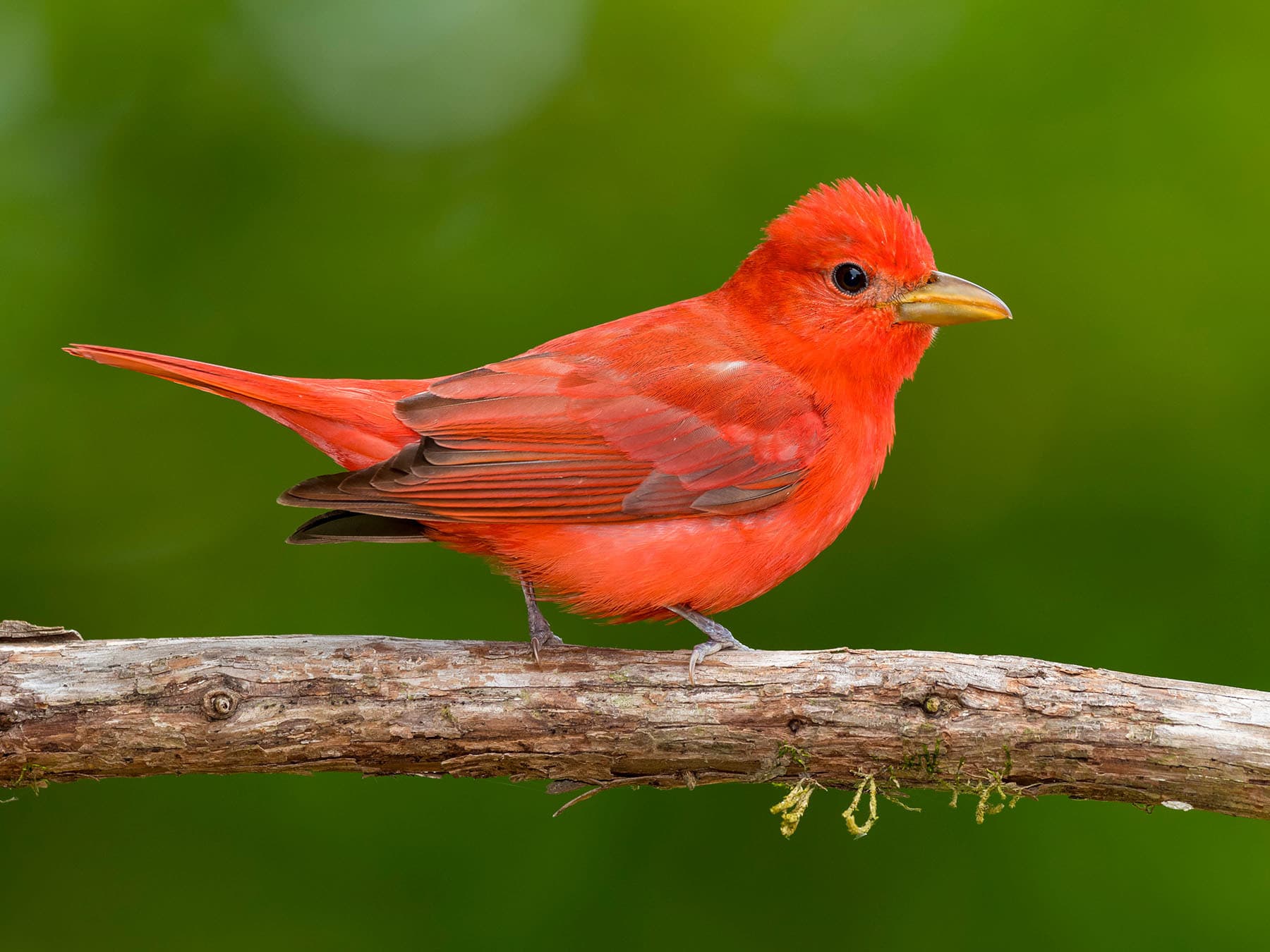
Summer Tanager. The female is yellowish, with plain wings and no bars, and she has a larger, paler bill. Males are red all over.
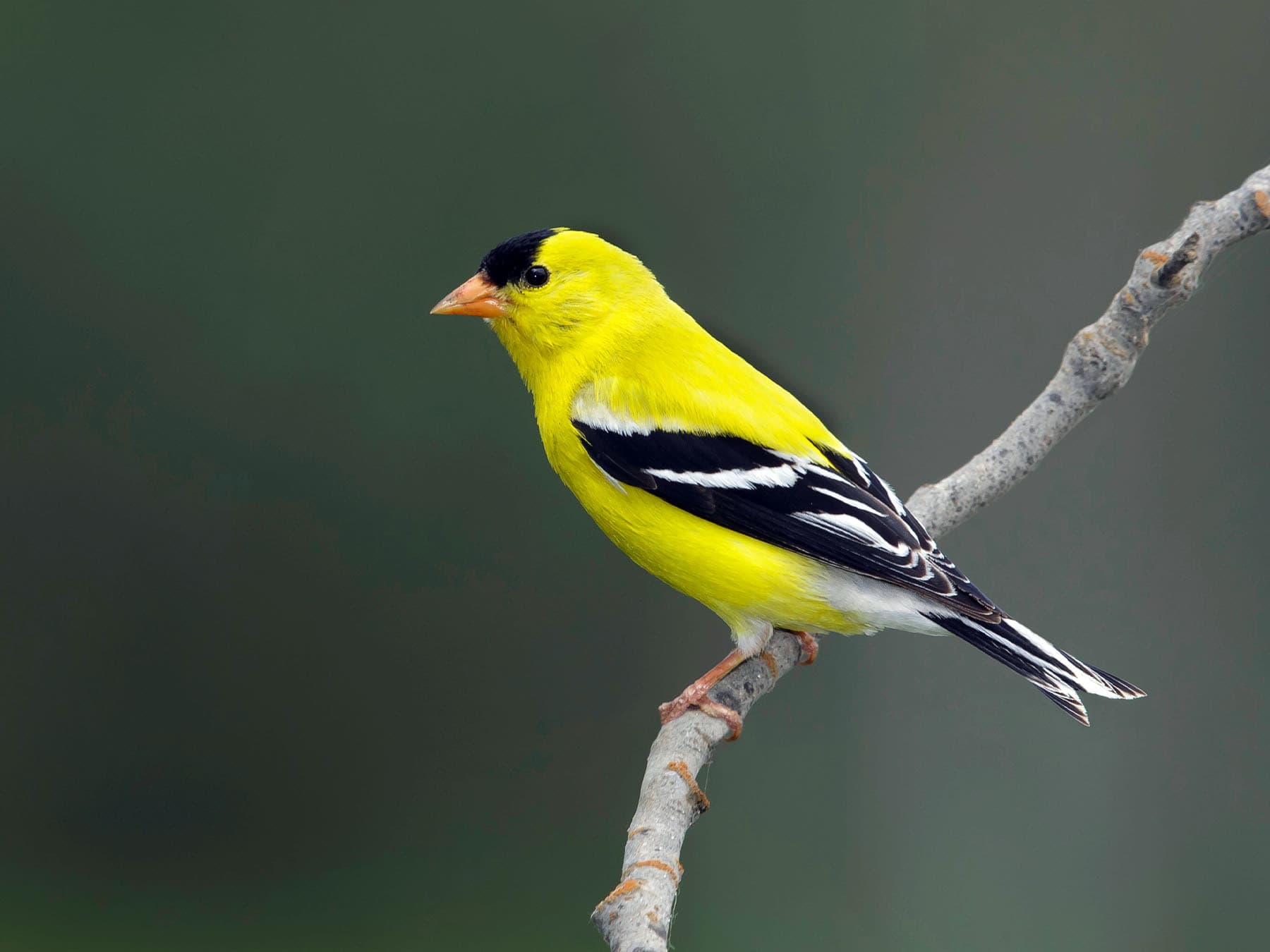
American Goldfinch. Much smaller, 4.3 to 5.1 inches (11-13 cm), with a short conical bill. A summer male has a black forehead, not a red head.
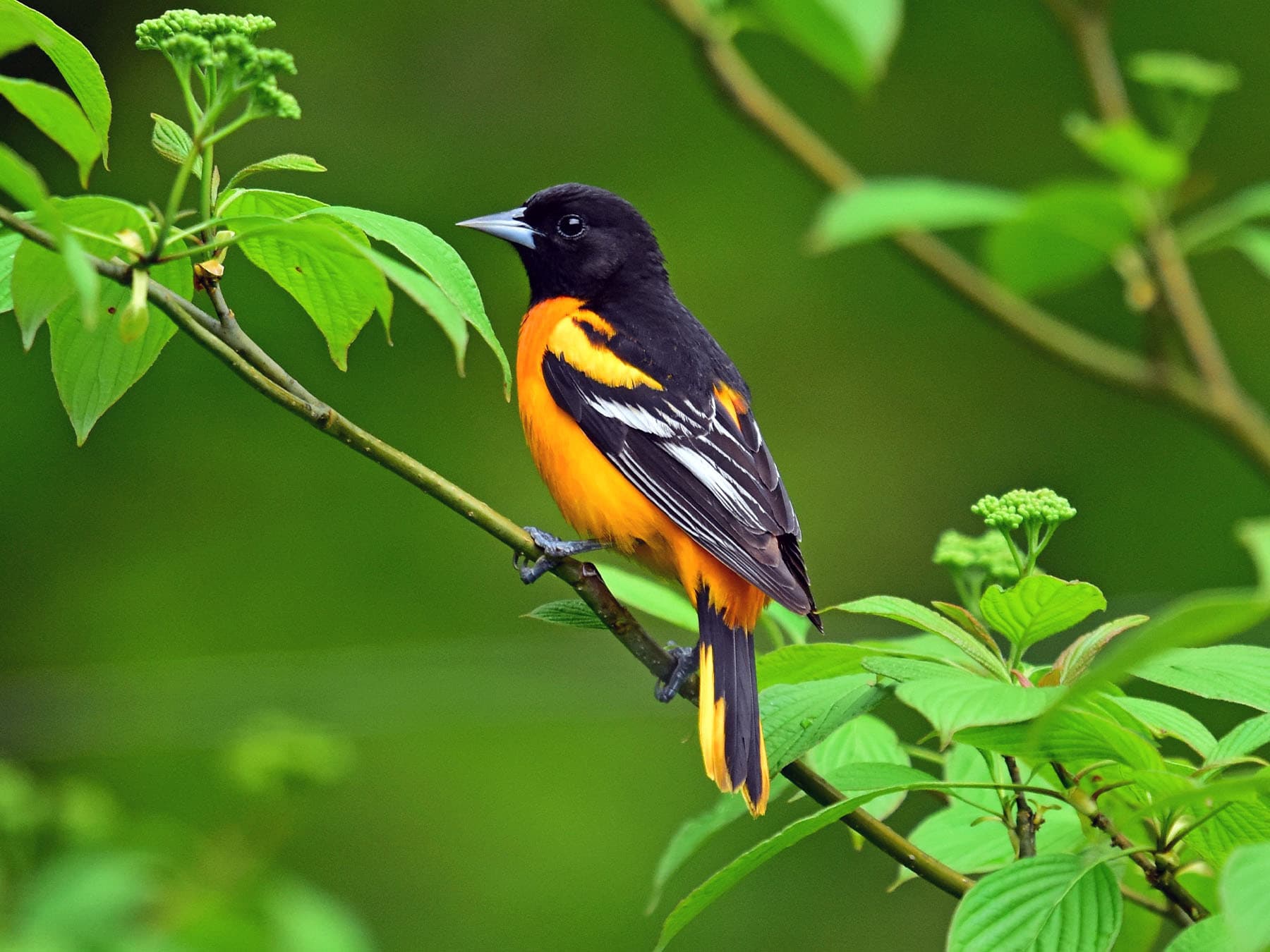
Orioles. Female Baltimore, Bullock's and Hooded Orioles can look much like a female tanager. Check the bill: orioles have long, sharply pointed bills, tanagers shorter, stouter ones. A female Bullock's Oriole also has a yellowish-orange head and tail and a whitish belly, and a female Hooded Oriole is slimmer, with a long rounded tail.
Flame-colored Tanager. A bird of Mexico and Central America, rare in southeast Arizona, with a streaked back, a dark bill, a dark border to the cheek and large white tail corners. It hybridizes with Western Tanagers there, so odd birds are not always one or the other.
Hepatic Tanager. Has a gray cheek and a dark bill and no wing bars; the male is a dull brick red and the female olive-yellow.
Not sure it’s a Western Tanager? Check your photo: Birdfact names the bird and shows the look-alike side by side.
Its size
Adults- Length
- 16–19 cm
- Wingspan
- 28–30 cm
- Weight
- 24–36 g
Its song and calls
The song is a short run of hoarse, burry phrases that rise and fall, about 2.5 seconds long. It sounds like an American Robin with a sore throat: lower, rougher and shorter, usually with 3 to 6 phrases. A male usually gives 4 or 5 songs a minute.
The call you hear most is a dry, chuckling pit-ick or pit-er-ick of two or three notes, much like a Summer Tanager's. A bird can repeat it in long chains, sometimes a few hundred notes. Birds close together use a soft wit or few, parents give a loud, rolled fu-ri-bi near fledglings, and fledglings give a chi-wee almost nonstop.
Females sing too, a shorter, more hurried and less tidy song, mostly after the eggs hatch and near the nest or fledglings. In a study of 22 males, each used about 7 note types on average, combined in different orders.2
Song season
Males sing from the day they arrive through summer, most of all in the early morning, and they fall quieter during incubation and pick up again once the eggs hatch. Singing dates run from 10 May to 14 August at Edmonton, Alberta, and from 28 May to 26 July in the Sandia Mountains of New Mexico.1
- Song0:00 / 0:17
Recorded in Colorado, United States · June 2025
- Calls0:00 / 0:10
Recorded in California, United States · January 2025
Heard one and not sure? Let the bird song identifier listen.
When and where to see it
Western Tanagers breed across western North America, north to the southern Northwest Territories and northern British Columbia and south to northern Baja California, Arizona, New Mexico and west Texas. The eastern edge runs through the Black Hills, northwest Nebraska and central Colorado. No other tanager breeds as far north: they reach about 60 degrees north, and birds up there may get only about two months on their breeding grounds.
In summer they live in open conifer and mixed woods, above all Douglas-fir, ponderosa pine and lodgepole pine, and also in aspen, oak, pinyon-juniper and streamside woods. They favor open stands and edges: clearings, burns and forest beside meadows and lakes, and sometimes parks and gardens. Most are found from about 1,600 feet (500 m) up to 10,000 feet (3,050 m), mainly above 7,500 feet (2,300 m) in the Southwest, but almost down to sea level on the Pacific coast.
Spotting tips
For such a bright bird, a Western Tanager is hard to see: it moves slowly in the shade of the canopy. Listen for the pit-er-ick call and the hoarse song, then scan the upper branches. Spring migration is the easy time. In May they can turn up almost anywhere, in orchards, suburban yards, parks and desert oases.
Migration and winter range
Every population migrates, at night and probably high up. Birds travel alone, in pairs or in loose groups, rarely of 30 or more. Spring migrants peak in mid-May in Oregon and the Colorado lowlands, and most birds reach their breeding grounds by early May in California and by late May or early June elsewhere. Arrival at Fortine, Montana, averaged 20 May over 44 years.1
They leave early. Fall migration starts in late July or August across most of the range, though the first birds can appear in low parts of southern Arizona and southern California by the first half of July. Spring migrants can still be on the move in mid-June, so the seasons nearly meet.
They winter from Mexico to Costa Rica, mostly in the highlands and on the Pacific slope, and rarely to western Panama, in pine-oak woods, forest edge and partly open country. A small number winter in coastal southern California, mainly among planted trees in towns, a habit that arose with urbanization.3 About 75 a year were reported in sources from 1981 to 1996, often at flowering eucalyptus.1 Small numbers also stray to eastern North America every year, mostly in fall and early winter, and a few spend the winter on the Gulf and Atlantic coasts.
Molt migration
Western Tanagers split the fall journey in two. Most adults leave the breeding grounds before they have done much molting and stop to molt in the Sierra Madre, the southern Rockies and the monsoon region of Mexico, where summer storms bring a flush of food, before going on; young birds instead move to nearby mountains and molt first, which spares them a long trip in their fluffy juvenile plumage.4
There may be exceptions. Five adults collected in San Diego County in August 2017 and 2018 were all in body molt and two were replacing flight feathers; the authors think it most likely, though not certain, that they had stopped to molt there, which had not been known.3
What it eats
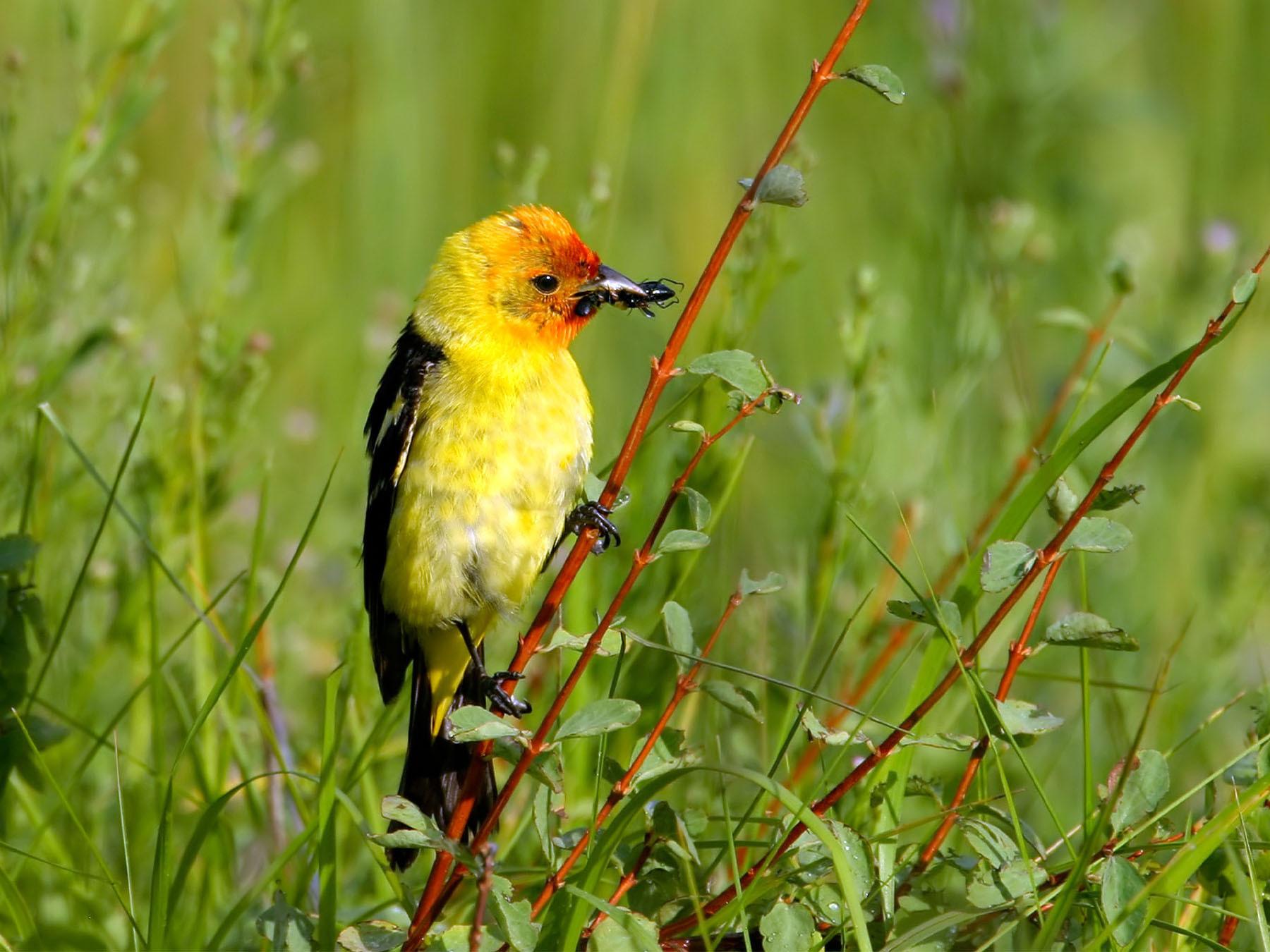
Western Tanagers eat mostly insects in the breeding season, especially wasps and ants. Beetles, cicadas, stinkbugs, termites, grasshoppers, dragonflies, crane flies, sawflies and caterpillars are taken too. They also take fruit, more of it in fall and winter: mulberries, elderberries, serviceberries, blackberries, hawthorn and wild cherries.
The classic study of their diet dates from 1907. Of 46 California stomachs from April to September, over 82% of the contents was insects and nearly 18% fruit, and wasps and ants made up 56%, reaching 75% in August.5 Some foods digest faster than others, so such shares are only a guide. Dragonflies are prepared before eating: off come the wings, and sometimes the head and legs.
How they feed
They move slowly along branches and through foliage high in trees, picking off insects, and they also sit still, scanning with small turns of the head, then fly out to snatch an insect in midair. The mix varies. In the Sierra Nevada they spent about 47% of their foraging time picking insects off surfaces and about 40% sallying into the air,6 while in Douglas-fir and ponderosa pine forest in British Columbia 93% of 162 observations were gleaning.7 They also visit flowers, probably for nectar and the insects there, and wintering birds in California take both at eucalyptus.
Feeders and yards
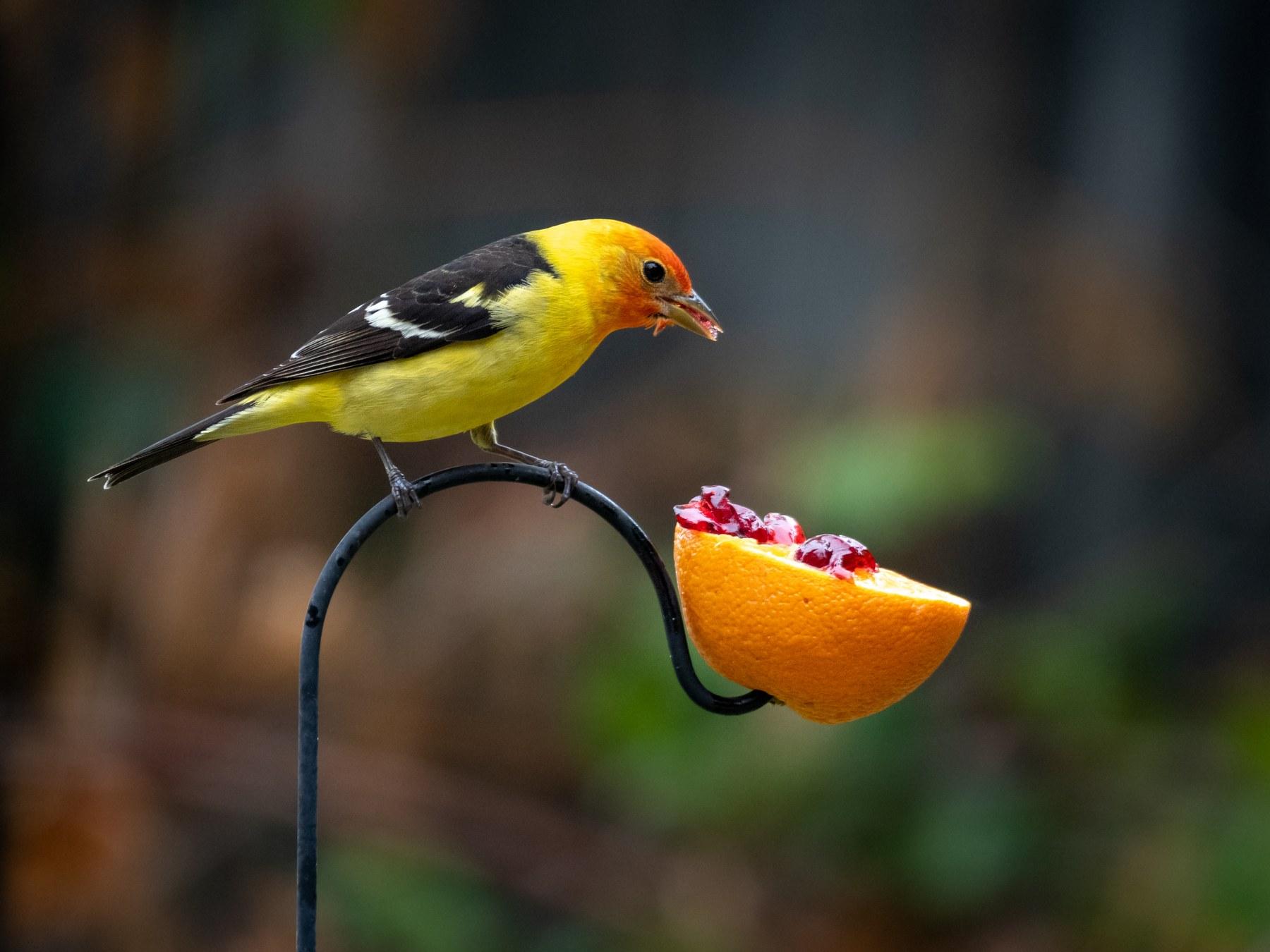
Western Tanagers come to feeders for fruit: cut oranges, other fresh fruit and dried fruit. They do not usually eat seeds, though winter strays have fed on mixed seed, and Florida winterers often visit feeders. A bird bath or moving water may help in a wooded yard. They seldom drink, perhaps because their food holds enough water, but they do bathe.
Diet and the red head
The red on a male's head very likely comes from his food. The pigment is rhodoxanthin, rare in birds and the only red pigment in those feathers.8 He cannot make it himself and presumably gets it from insects that take it from plants. The Scarlet, Summer and Hepatic Tanagers are thought to make their red from yellow pigments in their food, so the Western Tanager reaches the same color by another route: in the hand, its red and a Scarlet Tanager's look the same.1, 8
Nesting and breeding
The female alone builds the nest, in at least 4 or 5 days, with the male close by. It is a flat, loose bowl of twigs, coarse grass and rootlets, with bark or moss worked in, and a small cup lined with fine roots, hair and soft plant fiber.
It usually sits in a conifer, out on a horizontal branch or fork. Height and tree both vary with the forest. British Columbia nests ran from 8 to 75 feet (2.4-23 m) up, most at 21 to 36 feet (6.4-11 m), and 55% of 43 were in Douglas-fir;1 54 of 58 in Boulder County, Colorado, were in ponderosa pine;9 and in northeast New Mexico 98% were in pinyon pine, about 18 feet (5.4 m) up on average.1
Eggs and young
Eggs are laid from May to July, from early May in the Southwest to mid-June in the northeast of the range. There are usually 4, sometimes 3 or 5, pale blue to bluish green and speckled with brown, often in a ring at the big end. The female incubates them for about 13 days, and the male sometimes brings her food and stays close when she is off the nest.
Both parents feed the young, the male bringing large prey such as dragonflies, and the young leave the nest after about 11 to 15 days. Fledglings call almost nonstop on their first day or two, then go quiet and wait to be fed, and they stay with a parent for at least two weeks. Pairs are not known to raise more than one brood a year, and later nests are probably replacements, up to at least three attempts in a season.
Cowbirds and nest losses
How often Brown-headed Cowbirds lay in tanager nests varies widely: 2 of 39 nests in British Columbia,1 7 of 17 in Boulder County,9 and 40 of 56 in pinyon-juniper woods in northeast New Mexico, where parasitized nests fledged 0.9 young tanagers each, against 2.4 at nests without cowbirds, and tanagers almost always accepted the eggs.1
Predators are the main cause of nest failure, and jays are thought to be important. In west-central Idaho in 1994-96 about 45% of 54 nests were lost to them.10 Success can swing widely from year to year: in Boulder County it went from 11% in 2000 to 75% in 2001.9
Behaviour
A male claims his territory by singing almost without a break, much of it along the edges, and both sexes see off intruders, though the chases are mild. One odd display, seen only a few times, has a male tumbling down past a female, flashing yellow and black; whether it is courtship is not known. Flight is strong and swift, and a tanager can hover for a few seconds.
Outside the breeding season they usually travel alone or in small groups and often join mixed flocks, in winter with warblers and other birds. Rivalry with the Flame-colored Tanager can turn physical: in southeast Arizona in 1985 neighboring birds of the two species fought over three days, locked together in the air and tumbling to the ground.11 Other meetings are friendlier. In California in 2007 a male Summer Tanager helped a female Western raise young that were probably, not certainly, hybrids.12
Lifespan and predators
The oldest Western Tanager on the US Bird Banding Laboratory's list was at least 6 years 11 months old: a male banded in Nevada in 1965 and caught and released in Oregon in 1971.13 Birds of the World gives a banded male of at least 7 years 11 months, from a 1987 list, but that record is not on today's banding list.1
In Idaho in the 1990s, 16 of 64 marked birds came back in a later year.10 A return rate counts any bird that moved elsewhere as lost. Sharp-shinned and Cooper's Hawks take adults.
Conservation
The Western Tanager is listed as Least Concern on the IUCN Red List. Partners in Flight estimates about 15 million birds, for around 2010, and gives it a Continental Concern Score of 9 out of 20.14
The North American Breeding Bird Survey shows a significant rise of 0.67% a year from 1966 to 2025 (95% credible interval 0.41 to 0.92, 1,069 routes).15 The index fell to a low around 1979-82, then climbed to its highest level in 2025, up about 65%; the steepest significant rises are in Utah (2.5% a year), Colorado and Idaho (1.5%), with no clear trend in Oregon or California.15
Conservation: forests, fire and fruit growers
Its close ties to interior Douglas-fir forest mean the way those forests are managed matters, but it is not dependent on old forest, though it seems to favor it in places. It copes with selective logging better than clear-cutting. Project Tanager found that it breeds nearly as readily in small patches as in large ones, with a slight lean toward larger patches and a tendency to avoid small ones in the southern mountains.16
Fire cuts both ways. It appears to do well after low-severity fire and poorly after severe fire, though results vary.17 In western Montana it became significantly more common where a wildfire killed under 20% of the trees, and fell, though not significantly, where it killed over 80%.18
Fruit growers once treated it as a pest. In one southern California cherry orchard in 1896, birds were shot and poisoned by the hundred.19 Birds of the World says it occasionally caused local damage to cultivated cherries, and that by 1999 shooting was a smaller threat than it had been.1
Similar birds
Often mistaken for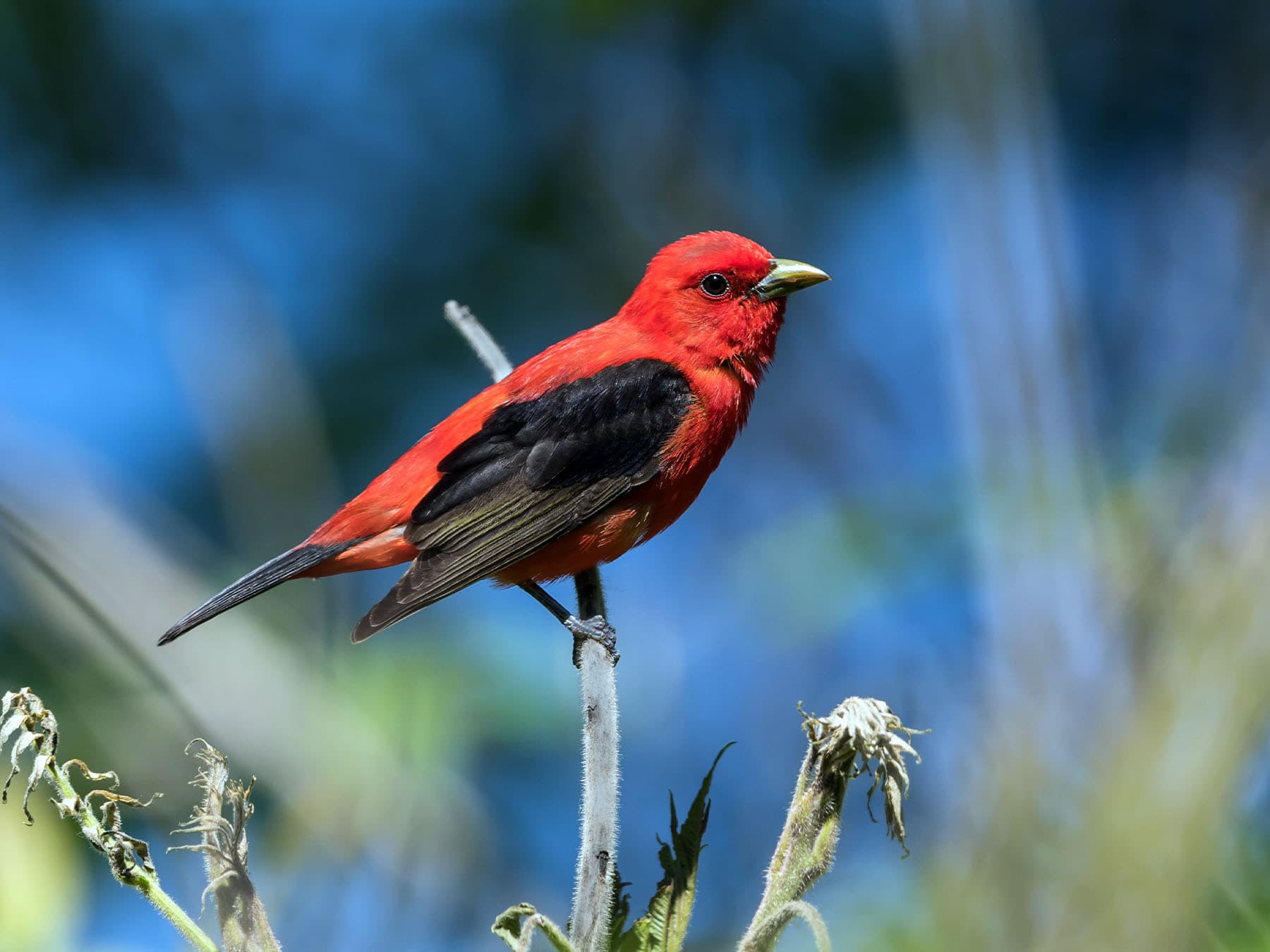
Quick facts
- Length
- 16–19 cm
- Wingspan
- 28–30 cm
- Weight
- 24–36 g
- Lifespan
- oldest recorded at least 6 years 11 months
- Family
- Cardinals & Grosbeaks
- Migration
- Full migrant
- Global status (IUCN)
- Least Concern
- World population
- About 15 million (Partners in Flight)
- Population trend
- Common and increasing
- Also called
- Louisiana Tanager
- Scientific name
- Piranga ludoviciana
Questions
3Are Western Tanagers rare?
No. They are common in western conifer forests in summer, though easy to miss in the treetops, and any bird in the East is a scarce stray. See where and when.
Is a Western Tanager a finch?
No, and despite its name it is not a true tanager either. It belongs to the cardinal family, and its closest relative is the Flame-colored Tanager, not the Scarlet Tanager that replaces it in the East.
Do Western Tanagers mate for life?
We found no evidence either way. A pair holds its territory together through the summer and they seem to be monogamous, but Birds of the World's account, written in 1999, cites no genetic study and no evidence that pairs last from year to year.
Sources
36- 1Hudon, J. (2020). Western Tanager (Piranga ludoviciana), version 1.0. Birds of the World (A. F. Poole and F. B. Gill, editors). Cornell Lab of Ornithology. doi:10.2173/bow.westan.01 (opens in a new tab)
- 2Shy, E. (1984). Sympatry and allopatry of song in North American tanagers. Behavioral Ecology and Sociobiology 15: 189-195. doi:10.1007/BF00292974 (opens in a new tab)
- 3Unitt, P., Hargrove, L. and Clark, K. B. (2020). Overlap of molt and fall migration of the Western Tanager and Warbling Vireo in southern California. Western Birds 51: 59-64. doi:10.21199/WB51.1.5 (opens in a new tab)
- 4Butler, L. K., Donahue, M. G. and Rohwer, S. (2002). Molt-migration in Western Tanagers (Piranga ludoviciana): age effects, aerodynamics, and conservation implications. The Auk 119: 1010-1023. doi:10.1093/auk/119.4.1010 (opens in a new tab)
- 5Beal, F. E. L. (1907). Birds of California in relation to the fruit industry. Part 1. U.S. Biological Survey Bulletin 30. Accessed 6 November 2026.
- 6Airola, D. A. and Barrett, R. H. (1985). Foraging and habitat relationships of insect-gleaning birds in a Sierra Nevada mixed-conifer forest. The Condor 87: 205-216. doi:10.2307/1366884 (opens in a new tab)
- 7Morgan, K. H., Savard, J. P. L. and Wetmore, S. P. (1991). Foraging behaviour of forest birds of the dry interior Douglas-fir, ponderosa pine forests of British Columbia. Canadian Wildlife Service, Pacific and Yukon Region. Accessed 6 November 2026.
- 8Hudon, J. (1991). Unusual carotenoid use by the Western Tanager (Piranga ludoviciana) and its evolutionary implications. Canadian Journal of Zoology 69: 2311-2320. doi:10.1139/z91-325 (opens in a new tab)
- 9Fischer, K. N., Prather, J. W. and Cruz, A. (2002). Nest site characteristics and reproductive success of the Western Tanager (Piranga ludoviciana) on the Colorado Front Range. Western North American Naturalist 62: 479-483. Accessed 6 November 2026.
- 10Hovis, J. C., Evans, D. M., Bednarz, J. C. and Davis, C. R. (1997). The effects of forest landscape modification and management on Neotropical migratory songbird populations in west-central Idaho: 1996 annual report. Arkansas State University, Jonesboro. Accessed 6 November 2026.
- 11Morse, R. J. and Monson, G. (1985). Flame-colored Tanager in Arizona. American Birds 39: 843-844. Accessed 6 November 2026.
- 12Pandolfino, E. R., Risser, P. and Risser, L. (2010). First evidence suggesting hybridization between the Summer Tanager and Western Tanager. Western Birds 41: 181-183. doi:10.21199/wb41.3.5 (opens in a new tab)
- 13USGS Bird Banding Laboratory. Longevity records of North American birds. USGS Eastern Ecological Science Center, Bird Banding Laboratory. Accessed 6 November 2026. Source (opens in a new tab)
- 14Partners in Flight (2024). Avian Conservation Assessment Database and Population Estimates Database. Bird Conservancy of the Rockies. Accessed 6 November 2026. Source (opens in a new tab)
- 15Hostetler, J. A. et al. (2026). The North American Breeding Bird Survey, Analysis Results 1966-2025. U.S. Geological Survey data release. doi:10.5066/P1OSNSFC (opens in a new tab)
- 16Rosenberg, K. V., Dhondt, A. A. and Lowe, J. D. (1996). Lessons from the landscape. BirdScope 10: 13. Accessed 6 November 2026.
- 17Meyer, R. (2006). Piranga ludoviciana. Fire Effects Information System, USDA Forest Service, Rocky Mountain Research Station. doi:10.2737/FEIS-species-review-PILU (opens in a new tab)
- 18Smucker, K. M., Hutto, R. L. and Steele, B. M. (2005). Changes in bird abundance after wildfire: importance of fire severity and time since fire. Ecological Applications 15: 1535-1549. doi:10.1890/04-1353 (opens in a new tab)
- 19Bent, A. C. (1958). Life histories of North American blackbirds, orioles, tanagers, and allies. United States National Museum Bulletin 211. doi:10.5479/si.03629236.211.1 (opens in a new tab)
- 20Cornell Lab of Ornithology. Western Tanager. All About Birds. Accessed 6 November 2026. Source (opens in a new tab)
- 21National Audubon Society. Western Tanager. Guide to North American Birds. Accessed 6 November 2026. Source (opens in a new tab)
- 22Boles, J.. Piranga ludoviciana (western tanager). Animal Diversity Web, University of Michigan Museum of Zoology. Accessed 6 November 2026. Source (opens in a new tab)
- 23Burns, K. J. (1998). Molecular phylogenetics of the genus Piranga: implications for biogeography and the evolution of morphology and behavior. The Auk 115: 621-634. doi:10.2307/4089411 (opens in a new tab)
- 24Klimkiewicz, M. K. and Futcher, A. G. (1987). Longevity records of North American birds: Coerebinae through Estrildidae. Journal of Field Ornithology 58: 318-333. Accessed 6 November 2026.
- 25BirdLife International (2025). Species factsheet: Western Tanager Piranga ludoviciana. BirdLife DataZone. Accessed 6 November 2026. Source (opens in a new tab)
- 26AviList Core Team (2025). AviList: The Global Avian Checklist, v2025b. AviList. doi:10.2173/avilist.v2025b (opens in a new tab)
- 27Lewis and Clark Trust. Western Tanager. Lewis and Clark Research. Accessed 6 November 2026. Source (opens in a new tab)
- 28National Audubon Society. Louisiana Tanager and Scarlet Tanager, plate 354. John James Audubon's Birds of America. Accessed 6 November 2026. Source (opens in a new tab)
- 29Estupiñan, D. L. and Zamorano, A. (2026). First record of Western Tanager (Piranga ludoviciana) for Colombia. Ornitología Colombiana 29: 32-34. doi:10.59517/oc.e651 (opens in a new tab)
- 30Cornell Lab of Ornithology. Scarlet Tanager identification. All About Birds. Accessed 6 November 2026. Source (opens in a new tab)
- 31Cornell Lab of Ornithology. Summer Tanager identification. All About Birds. Accessed 6 November 2026. Source (opens in a new tab)
- 32Cornell Lab of Ornithology. Hepatic Tanager identification. All About Birds. Accessed 6 November 2026. Source (opens in a new tab)
- 33Cornell Lab of Ornithology. Bullock's Oriole identification. All About Birds. Accessed 6 November 2026. Source (opens in a new tab)
- 34Cornell Lab of Ornithology. Hooded Oriole identification. All About Birds. Accessed 6 November 2026. Source (opens in a new tab)
- 35Cornell Lab of Ornithology. Baltimore Oriole identification. All About Birds. Accessed 6 November 2026. Source (opens in a new tab)
- 36Cornell Lab of Ornithology. American Goldfinch identification. All About Birds. Accessed 6 November 2026. Source (opens in a new tab)

Checked by
Nathan Cope, founder and editor
Nathan founded Birdfact and leads its writers and contributors in the UK, the US and Canada. He has watched and studied birds for more than ten years, and checks every article and species guide before it’s published.