Species Profile
Western Meadowlark
Sturnella neglecta
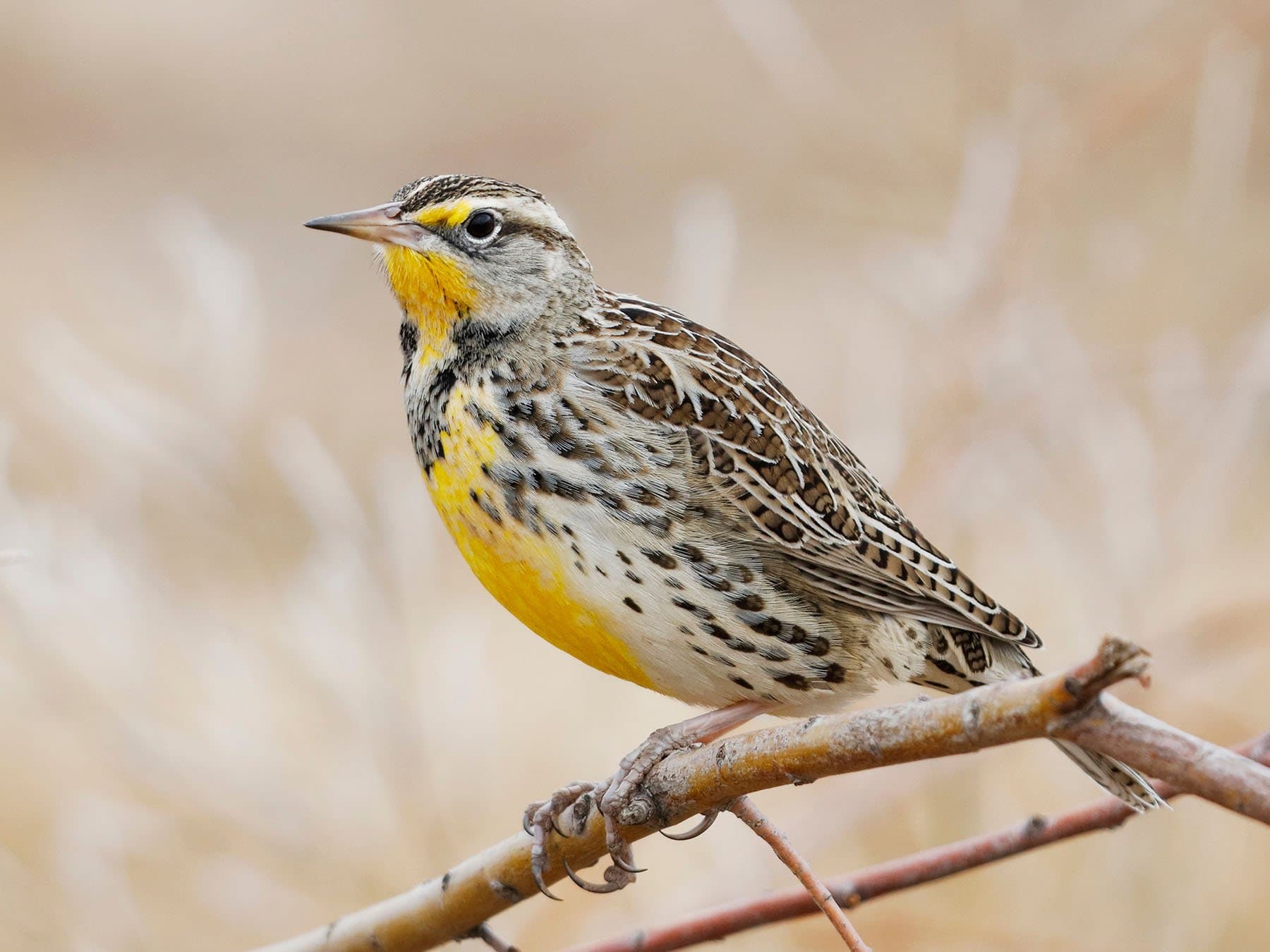
Western Meadowlark perched on a branch, showing its bright yellow breast with a black V, streaked brown back, and pointed beak.
Quick Facts
Conservation
LCLeast ConcernLifespan
3–6 years
Length
16–26 cm
Weight
88–116 g
Wingspan
36–41 cm
Migration
Partial migrant
Perched on a fence post with its bill tilted skyward, the Western Meadowlark delivers one of the most celebrated songs on the North American continent — a rich, bubbling, flute-like melody that carries across open grasslands for hundreds of metres. That brilliant yellow breast, slashed with a bold black "V," makes it unmistakable. It is the state bird of six US states, yet its populations have fallen by roughly 37% since 1966.
Think you've spotted a Western Meadowlark?
Upload a photo and we'll confirm it instantly
Confirm with a PhotoAppearance
The Western Meadowlark is a chunky, robin-sized bird built for life at ground level. It has a flat head, a long slender bill, a round-shouldered posture, and a short, stiff, spiky tail — a silhouette that birders sometimes affectionately call a "thunderchunk." The wings are rounded and relatively short for the bird's bulk.
In breeding plumage, the underparts are brilliant yellow with a bold black "V"-shaped band across the breast — one of the most instantly recognisable field marks of any North American bird. The flanks are white, broadly streaked with dusky black. The upperparts are intricately patterned in buffs, browns, and black streaks and bars, providing superb camouflage in grassland. The crown is dark with a pale median stripe; a white supercilium runs above a dark eye-line. Crucially, the malar (moustache) stripe is yellow — a key distinction from the Eastern Meadowlark, which has a white malar stripe. The bill is long, pointed, and slate- to clay-coloured. The legs are long and pinkish. The outer tail feathers are white, most visible during takeoff and landing.
In non-breeding plumage, fresh buff-tipped feathers partially veil the bright colours. The yellow dulls, the black "V" appears brownish and less contrasting, and the head pattern becomes more subdued. By early spring, feather tips wear away to reveal the full breeding colours — no moult required, just abrasion.
Juveniles have paler, washed-out yellow underparts, less flank streaking, pinkish bills, and lack the black chest "V" entirely. The head pattern is less defined. Females are very similar to males in pattern but are noticeably smaller and slightly duller overall: the black "V" is less bold, the yellow is slightly less vivid, and the head markings are less strongly defined. Size is the most reliable field distinction between the sexes in the hand.
Identification & Characteristics
Male Colors
- Primary
- Yellow
- Secondary
- Brown
- Beak
- Grey
- Legs
- Pink
Female Colors
- Primary
- Yellow
- Secondary
- Brown
- Beak
- Grey
- Legs
- Pink
Male Markings
Bold black "V"-shaped breast band on brilliant yellow underparts; white outer tail feathers; yellow malar stripe; white supercilium; intricately streaked brown and buff upperparts
Tail: Short, stiff, and spiky; outer tail feathers white, conspicuous in flight during takeoff and landing
Female Markings
Similar to male but smaller and slightly duller; black breast "V" less bold; yellow less vivid; head markings less strongly defined
Tail: Short, stiff, and spiky; outer tail feathers white, conspicuous in flight
Attributes
Understanding Attributes
Rated 0–100 based on research and observation. A score of 50 is average across all bird species. These attributes are relative and don't necessarily indicate superiority.
Habitat & Distribution
Western Meadowlarks are quintessential open-country birds. Native prairies, mixed-grass and shortgrass prairies, pastures, meadows, abandoned weedy fields, and rangeland are their core habitats. They also use agricultural lands converted to perennial grasses, weedy cropland borders, roadsides, and irrigated farmland. They avoid wooded edges and areas with heavy shrub cover entirely.
The breeding range extends from southwestern Canada — British Columbia, Alberta, Saskatchewan, and Manitoba — south through the western and central United States to northern Mexico. It covers the Great Plains states (North Dakota, South Dakota, Nebraska, Kansas), the Rocky Mountain states (Montana, Wyoming, Colorado, Idaho, Utah, Nevada, Oregon), and extends east to Michigan and parts of the Midwest. Year-round resident populations occur throughout much of the western and south-central US, including California, Oregon, Nevada, Utah, Colorado, New Mexico, Kansas, Nebraska, and South Dakota. Northern populations are migratory, wintering in the southern US and northern Mexico.
In winter, the range expands eastward, with birds appearing in agricultural fields across the southern US including parts of Missouri and Arkansas. Vagrant records exist from many eastern states including Florida, Georgia, the Carolinas, Virginia, New York, and Massachusetts — and even Alaska. Where the range overlaps with the Eastern Meadowlark across the Midwest, the Western species tends to occupy higher, drier, shorter-grass habitats.
The species occurs from sea level up to approximately 3,000 m (10,000 ft) in mountain meadows. In Canada, birders in the Prairie Provinces — particularly Alberta, Saskatchewan, and Manitoba — have excellent opportunities to find breeding birds from May through August in native grasslands and pastures. In the US, the species is widespread and often easy to find across the Great Plains and the West; roadsides through Montana, Wyoming, and the Dakotas can produce multiple singing males per kilometre in spring.
The Western Meadowlark was introduced to the Hawaiian island of Kauai in 1931 to help control insects, and established successfully — the only Hawaiian island where it did so, for reasons explained in the Did You Know section below.
Where to See This Bird
Explore regional guides for locations where this bird has been recorded.
Montana
Idaho
Nebraska
Kansas
Nevada
New Mexico
North Dakota
California
Colorado
Oklahoma
Utah
Oregon
South Dakota
Washington
Wyoming
Alberta
Manitoba
Saskatchewan
Diet
The Western Meadowlark's diet shifts sharply with the seasons. In late spring and summer, insects dominate — particularly beetles (including weevils and wireworms), grasshoppers, crickets, caterpillars (especially cutworms), ants, and true bugs. Spiders, snails, and sowbugs are also taken. In winter and early spring, grain and weed seeds make up the bulk of the diet, with seeds and waste grain accounting for roughly one-third of the annual intake overall.
Foraging takes place on the ground or in low vegetation. The gaping technique — inserting the closed bill into soil or grass clumps and forcing it open — gives the meadowlark access to prey that most other grassland birds simply cannot reach. The jaw-opening muscles are unusually well developed for this purpose, and the bird's eyes are positioned to look forward when the bill is open, allowing it to see directly into the hole it has just created.
In winter, birds often forage in loose flocks, working across stubble fields and nearly bare ground. During hard winters, Western Meadowlarks have been recorded feeding at carcasses such as roadkill — an opportunistic behaviour rarely noted in field guides. Occasionally, birds will take the eggs of other grassland species. Autumn is when weed seeds become especially important, bridging the gap between the insect-rich summer and the grain-dependent winter months.
Behaviour
Western Meadowlarks spend most of their time on the ground, walking with a deliberate stride through grass and stubble. They are not particularly gregarious during the breeding season — males hold territories of 2 to 13 hectares, which they defend vigorously through song and aerial pursuit flights that can last up to three minutes. Outside the breeding season, birds gather in loose flocks to forage on stubble fields and bare ground, sometimes associating with Horned Larks and longspurs.
Males arrive on breeding grounds up to a month before females and spend this time advertising their presence from prominent perches — fence posts, power lines, shrubs, and telephone poles. Song is the primary territorial weapon, and a male may sing so persistently through a spring morning that he can be heard through closed car windows from hundreds of metres away.
The species is notably sensitive to human disturbance during incubation. Approach a nest too closely and the female will slip off and walk away through the grass rather than flush, making nests extremely difficult to find. If disturbance is repeated, the pair will abandon the nest entirely.
Western Meadowlarks use a distinctive feeding technique called "gaping" or "open-bill probing": the bird inserts its closed bill into soil, bark, grass clumps, or beneath dirt clods and manure piles, then forces the bill open using unusually powerful jaw-opening muscles. This creates a small excavation that exposes hidden insects and seeds inaccessible to most other birds. In 1914, California grain growers commissioned one of the earliest scientific diet studies of any North American bird specifically to determine whether the meadowlark was a pest — the study concluded that its consumption of crop-damaging insects far outweighed any grain it ate.
Calls & Sounds
The Western Meadowlark's song is a rich, flute-like, gurgling melody — a seemingly complex jumble of bubbling, warbling notes that typically descends the scale over approximately 1–2 seconds (mean 1.46 seconds), with a frequency range of 0.6–5.5 kHz. It is often described as "watery" or "liquid," and is widely regarded as one of the most musical songs produced by any North American bird. The song typically ends with three descending notes.
Each male has a repertoire of approximately 7–12 distinct song types — a notably smaller repertoire than the Eastern Meadowlark, which has 50–100 variations. Despite the smaller repertoire, the Western's individual songs are considerably more complex in structure. Males sing persistently from prominent perches — fence posts, shrubs, power lines, telephone poles — especially in spring and early summer. They also perform a "flight song" during aerial displays. Males begin singing on the breeding grounds before females arrive and continue through the breeding season.
The most commonly heard call is a low, throaty "took," "chook," or "chupp" — a bell-like note used during courtship and territorial encounters. This contrasts sharply with the sharp, buzzy "dzzhrrt" call of the Eastern Meadowlark, and is one of the cleaner ways to distinguish the two species by ear when song is not being given. A dry rattle is also produced. Females are less vocal but give chattering calls; both sexes use various chips and alarm notes.
Song is the primary mechanism by which Western and Eastern Meadowlarks recognise their own species. Even where their ranges broadly overlap across the Midwest, the two species rarely interbreed — each responds only to its own song. In a remarkable exception documented near Springfield, Illinois, one male Western Meadowlark was found to have a "bivalent" repertoire of five Western songs and two Eastern songs, a rare case of cross-species vocal learning in a hybrid-zone individual.
Flight
In flight, the Western Meadowlark is immediately recognisable by its distinctive wingbeat pattern: short, stiff, quail-like bursts of rapid wingbeats alternating with brief glides, the wings held below the horizontal during the glide phase. This creates a characteristic "flap-flap-flap-glide" rhythm that is quite unlike the undulating flight of woodpeckers or the sustained flapping of most blackbirds. The bird typically flies low over the grass, rarely gaining much height except when crossing open ground between perches.
The white outer tail feathers flash conspicuously during takeoff and landing — a useful identification feature at distance, particularly when the bird is flushed from cover and the yellow breast is not visible. The rounded wing shape is apparent in flight, contributing to the somewhat laboured, heavy impression despite the bird's modest size.
During territorial and courtship displays, males perform "pursuit flights" — sustained aerial chases after rival males or prospective mates that can last up to three minutes. Males also deliver a "flight song" during aerial display, singing while in the air above their territory. These flight displays are most frequent in the early weeks after arrival on the breeding grounds, before nesting begins in earnest.
Migration occurs during the daytime, with birds travelling in small loose flocks. Northern populations move south and east in autumn between August and November, returning north between February and May. Birds at high elevations descend to lower ground in winter rather than undertaking long-distance latitudinal migration — a partial altitudinal migration that keeps some individuals within a relatively small geographic area year-round.
Nesting & Breeding
The breeding season runs from approximately February into late August, varying by latitude. In Montana, nesting occurs from the second week of May to the first week of August, with egg dates near Fortine ranging from 30 April to 23 June. Males are polygynous — a successful male typically mates with two females simultaneously, though monogamy also occurs.
The nest is built solely by the female, typically within 6–8 days of her arrival on the breeding grounds. She places it on the ground in a small depression or hollow — often a cow footprint — well concealed in dense grass. The finished structure ranges from a simple grass-lined cup to a fully domed construction with a waterproof grass roof and a side entrance, measuring 18–20 cm across with a cup 10–13 cm wide and 5–8 cm deep. Narrow "runways" or trails through the surrounding grass lead to the entrance, and the female always approaches on foot rather than flying directly in, to avoid drawing attention.
Clutch size is typically 5–6 eggs (range 3–7). The eggs are white, profusely spotted with brown, rust, and lavender, especially at the larger end, and measure approximately 28 × 21 mm. Eggs are laid at daily intervals, with incubation beginning after the last egg is laid. The female incubates alone for 13–16 days. Chicks hatch over 1–2 days; they are altricial — nearly naked, with eyes closed until day 4.
Both parents feed nestlings, though the female does more, with the male typically bringing food to the nest entrance for her to distribute. The young fledge at 10–12 days but cannot sustain flight until around 21 days. Parental care continues for at least two weeks after fledging. Two broods per year are attempted. Nests are frequently parasitised by Brown-headed Cowbirds (Molothrus ater), and are also vulnerable to destruction by mowing operations — a significant source of nest failure across agricultural landscapes.
Lifespan
Wild Western Meadowlarks typically live 3–6 years, with the oldest banded individual on record reaching at least 6 years and 6 months. The species reaches sexual maturity at around one year of age, with most birds attempting to breed in their first spring. Captive individuals have been recorded living up to 10 years, suggesting that the pressures of wild life — predation, weather, and habitat quality — are the primary constraints on longevity.
Nest predation is a major source of mortality, with ground nests vulnerable to a wide range of mammalian predators including foxes, coyotes, skunks, and raccoons. Brown-headed Cowbird parasitism reduces reproductive success without directly killing adults. Mowing of hay and alfalfa fields during the nesting season destroys nests and kills incubating females and chicks directly — a significant and underappreciated source of mortality in agricultural landscapes.
Adults face predation from raptors, particularly Northern Harriers, which hunt low over grassland in the same habitats the meadowlark occupies. Pesticide exposure — both direct poisoning and indirect reduction of insect prey — is an increasingly recognised mortality factor. Compared to other members of the Icteridae family, the Western Meadowlark's maximum recorded lifespan is modest: the Common Grackle, for instance, has been recorded living over 23 years in the wild. The meadowlark's ground-nesting lifestyle and open-country habits expose it to a broader range of predators throughout its life.
Conservation
The Western Meadowlark is listed as Least Concern on the IUCN Red List (2018), with a global population estimated at approximately 100 million individuals (Partners in Flight, 2020). Despite this, the trajectory is troubling: North American Breeding Bird Survey data show a decline of approximately 0.9% per year between 1966 and 2019, amounting to a cumulative loss of around 37% over that period. The species is part of a broader grassland bird crisis — grassland birds as a group have declined by more than 40% since 1970.
The primary driver is habitat loss. Conversion of native grasslands for housing and intensive agriculture has eliminated vast areas of suitable nesting habitat. Tilling and early haying operations destroy nests, fledglings, and adults directly. Pesticide use — particularly neonicotinoids — kills meadowlarks directly, poisons their insect food supply, and reduces overall prey abundance. Fire suppression alters native grassland structure, while invasive plant species degrade habitat quality. Climate change adds further pressure through drought, unseasonal heat waves, and extreme wildfires that affect nesting success.
In Oregon, the species is listed as Sensitive-Critical on the state's Sensitive Species List, reflecting particularly sharp declines in the Willamette Valley. Partners in Flight rates the Western Meadowlark 10 out of 20 on the Continental Concern Score — relatively low concern at the continental scale, but the downward trend is consistent and long-running.
Conservation actions include the American Bird Conservancy's grassland habitat enhancement programme, which has improved over 400,000 acres from North Dakota to Mexico. Advocacy for bird-friendly Farm Bill measures — particularly the Conservation Reserve Program, which pays farmers to convert cropland to perennial grass cover — is considered one of the most effective tools available. Campaigns against dangerous pesticides and support for prescribed burning to maintain grassland structure are also priorities.
Population
Estimated: Approximately 100 million individuals (Partners in Flight, 2020)
Trend: Decreasing
Declining approximately 0.9% per year since 1966; cumulative decline of ~37% between 1966 and 2019 (North American Breeding Bird Survey)
Elevation
Sea level to approximately 3,000 m (10,000 ft) in mountain meadows
Additional Details
- Family:
- Icteridae (New World Blackbirds)
- Egg size:
- Approximately 28 × 21 mm
- Predators:
- Northern Harrier, other raptors; ground predators (fox, coyote, skunk, raccoon) at nest
- Parasitism:
- Frequently parasitised by Brown-headed Cowbird (Molothrus ater)
- State bird:
- State bird of Kansas, Montana, Nebraska, North Dakota, Oregon, and Wyoming (six states)
- Subspecies:
- Two subspecies recognised: S. n. neglecta (nominate, most of range) and S. n. confluenta (Pacific coast populations, slightly darker)
- Clutch size:
- 5–6 eggs (range 3–7)
- Diet summary:
- Insects (beetles, grasshoppers, crickets, caterpillars, ants) in summer; grain and weed seeds in winter; seeds ~one-third of annual diet
- Feeding times:
- Primarily diurnal; most active foraging in morning and late afternoon
- Major threats:
- Grassland habitat loss, intensive agriculture, early haying, pesticides (especially neonicotinoids), fire suppression, invasive plants, climate change
- Mating system:
- Polygynous (typically 2 females per male); monogamy also occurs
- Primary calls:
- Low, throaty 'took', 'chook', or 'chupp'; dry rattle
- Social habits:
- Solitary or in pairs during breeding season; loose flocks in winter
- Egg appearance:
- White, profusely spotted with brown, rust, and lavender, especially at the larger end
- Territory size:
- 2–13 hectares
- Breeding season:
- February to late August (varies by latitude); Montana egg dates April 30 to June 23
- Foraging method:
- Ground foraging; gaping (open-bill probing) to expose hidden insects and seeds
- Nestling period:
- 10–12 days to fledging; sustained flight from ~21 days
- Song repertoire:
- 7–12 distinct song types per male; frequency range 0.6–5.5 kHz; mean song duration 1.46 seconds
- Average lifespan:
- 3–6 years typical; maximum recorded 6 years 6 months (wild banding record)
- Daily activities:
- Ground foraging by day; males sing persistently from perches in spring mornings
- Introduced range:
- Successfully established on Kauai, Hawaii (introduced 1931); failed introductions on other Hawaiian islands and New Zealand (1860s)
- Migration timing:
- Autumn migration August–November; spring return February–May
- Nesting location:
- On the ground in a small depression or hollow, concealed in dense grass; often domed with side entrance
- Number of broods:
- Two per year attempted
- Incubation period:
- 13–16 days (female only)
- Nest construction:
- Built by female alone within 6–8 days; grass cup to fully domed structure with waterproof grass roof, 18–20 cm across
- Conservation efforts:
- ABC grassland habitat enhancement (400,000+ acres); Conservation Reserve Program (Farm Bill); prescribed burning; pesticide reduction campaigns
Courtship & Display
Male Western Meadowlarks arrive on the breeding grounds up to a month before females, spending this time establishing territories through song and aerial pursuit flights. Once females arrive, courtship intensifies into a series of elaborate visual displays that make full use of the male's striking plumage.
The primary courtship display involves the male facing the female directly, puffing out his chest feathers to maximise the black "V" and brilliant yellow breast, pointing his bill straight upward, spreading his tail widely to expose the white outer feathers, and flicking his wings rapidly. The posture is designed to show off every element of his breeding plumage simultaneously. Males also perform song flights — rising into the air above their territory while delivering the full song, then descending back to a perch.
Western Meadowlarks are typically polygynous: a successful male mates with two females simultaneously, maintaining separate territories for each. He defends a primary territory of 2–13 hectares against rival males through song and, when necessary, direct pursuit. Territorial boundaries are often stable across seasons, with experienced males returning to the same territories in successive years.
Females exercise mate choice and appear to prefer males with larger territories and more complex song repertoires. Once a pair bond is established, the female begins nest construction within days. The male's role during incubation is largely vocal — he continues to sing from perches near both nests — but he becomes more actively involved in feeding once chicks hatch, bringing food to the nest entrance for the female to distribute to nestlings.
Cultural Significance
Few North American birds carry as much symbolic weight as the Western Meadowlark. Its status as the official state bird of six states — Kansas (1937), Montana (1931), Nebraska (1929), North Dakota (1947), Oregon (1927), and Wyoming (1927) — reflects how deeply embedded it is in the cultural identity of the American West and Great Plains. No other bird shares this distinction at such scale; only the Northern Cardinal, state bird of seven states, surpasses it.
The species' scientific name carries its own cultural narrative. Meriwether Lewis first documented the bird during the Lewis and Clark Expedition in June 1805, noting carefully that its song, bill shape, and tail differed from the Eastern Meadowlark he knew from the East. His observation was ignored for nearly four decades. When John James Audubon formally described the species in 1844, he named it Sturnella neglecta — "the neglected starling-like bird" — as a direct rebuke to the ornithological community that had overlooked Lewis's field notes.
The meadowlark's song has long been celebrated in American literature and music as the sound of the open prairie. Its flute-like, gurgling melody carries across grasslands with a clarity that early settlers found both beautiful and orienting — a sound that meant open country, space, and the West. In Oregon, the bird's cultural status was reaffirmed as recently as 2017, when a state legislature debate over its designation prompted a representative to play its song over the House microphone — a moment that ended in a compromise rather than a demotion, preserving the meadowlark's place in Oregon's official symbolism.
Birdwatching Tips
The Western Meadowlark's song is usually the first clue to its presence — a rich, gurgling, flute-like melody that carries far across open country. Learn the song before you go, and you will find birds you would otherwise walk past. Males sing persistently from fence posts, power lines, and shrubs, especially in the two hours after dawn in spring and early summer, making them straightforward to locate once you know what to listen for.
In the US and Canada, the best time to look is April through July across the Great Plains and Rocky Mountain states. Roadsides through Montana, Wyoming, North Dakota, and Kansas are particularly productive — slow down and scan fence lines. In California, Oregon, and Nevada, resident birds are present year-round. In winter, look for flocks in stubble fields and short-grass agricultural areas across the southern US; birds are less vocal then but can be numerous.
Separating Western from Eastern Meadowlark is one of the classic identification challenges of North American birding. The song is the most reliable distinction: the Western's song is a complex, bubbling, descending melody, while the Eastern's is a simpler series of clear, plaintive whistles. On a perched bird, look for the yellow malar (moustache) stripe — white in the Eastern. The Western also tends to show more white in the tail and slightly paler, more streaked upperparts, but these are subtle. In areas of overlap across the Midwest, habitat can help: Western Meadowlarks prefer shorter, drier, higher-elevation grassland.
In flight, the Western Meadowlark's white outer tail feathers flash conspicuously. The flight style itself — short, stiff wingbeats alternating with brief glides, low over the grass — is distinctive and quite unlike most other open-country birds of similar size.
Did You Know?
- The Western Meadowlark is the state bird of six US states — Kansas, Montana, Nebraska, North Dakota, Oregon, and Wyoming — making it the joint second most popular state bird in America, tied with the Northern Cardinal (seven states). During a 2017 Oregon Legislature debate, a state representative played the meadowlark's song on his smartphone over the House microphone to argue for its status; the result was a compromise designating it the state songbird while the osprey became the state raptor.
- The species name neglecta — Latin for "overlooked" — tells a story of scientific neglect. Meriwether Lewis first noted the bird in June 1805, observing that its tail, bill shape, and song differed from the Eastern Meadowlark. But subsequent explorers ignored his observation entirely. When John James Audubon formally described it as a new species in 1844, he named it neglecta in pointed reference to how thoroughly it had been overlooked.
- The Western Meadowlark was introduced to the Hawaiian island of Kauai in 1931 and established successfully — but only on Kauai. The reason: Kauai is the only main Hawaiian island without the small Indian mongoose, the predator that caused failed introductions on every other island. The population remains established on Kauai today.
- In 1914, California grain growers commissioned one of the earliest scientific diet studies of any North American bird specifically to determine whether the meadowlark was a pest. The study found that its consumption of crop-damaging insects — weevils, wireworms, cutworms, and grasshoppers — far outweighed any grain it ate, effectively clearing its name.
- The oldest recorded wild Western Meadowlark was at least 6 years and 6 months old, identified through banding records. The species reaches sexual maturity at around one year of age, and typical wild birds live 3–6 years.
Records & Accolades
State Songbird
6 US States
Official state bird of Kansas, Montana, Nebraska, North Dakota, Oregon, and Wyoming — the joint second most popular state bird in America.
Grassland Icon
100 million individuals
One of the most abundant grassland birds in North America, with an estimated global population of approximately 100 million individuals.
Complex Songster
7–12 song types
Each male holds a repertoire of 7–12 distinct song types, delivered across a frequency range of 0.6–5.5 kHz — audible hundreds of metres away.
Island Colonist
Kauai, Hawaii (est. 1931)
The only introduced Western Meadowlark population to establish successfully in Hawaii — on the one island without the Indian mongoose.
Community Photos
Be the first to share a photo of the Western Meadowlark
Upload a PhotoIdentify Any Bird Instantly
- Upload a photo from your phone or camera
- Get an instant AI identification
- Ask follow-up questions about the bird
Monthly Birds in Your Area
- Personalised for your location
- Seasonal tips and garden advice
- Updated every month with new species