


Pileated Woodpecker
Log-cock, Wood-hen · Dryocopus pileatus
By the Birdfact teamChecked by Nathan Cope
On this page15 sections
How to recognise it
What do Pileated Woodpeckers look like?
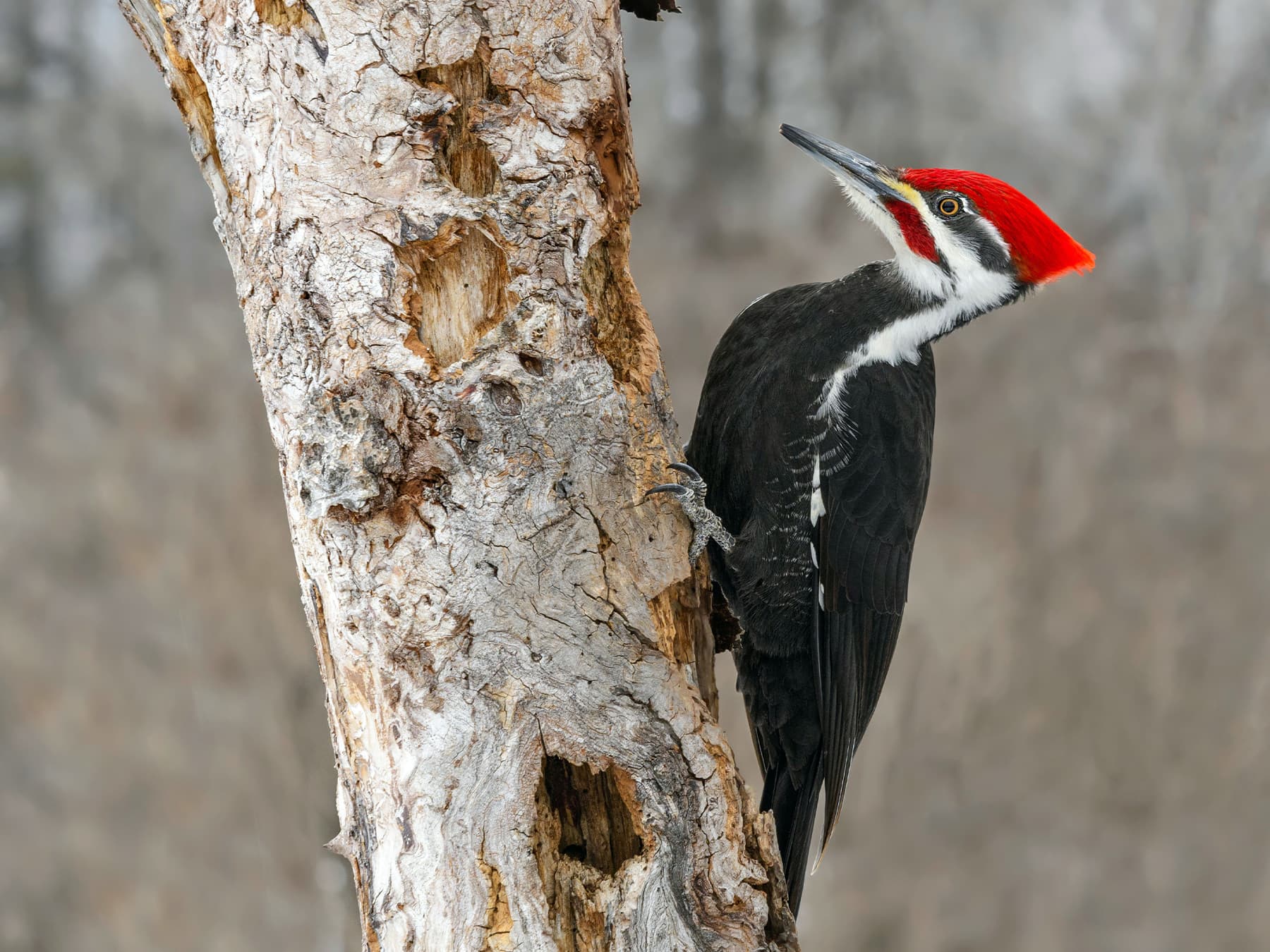
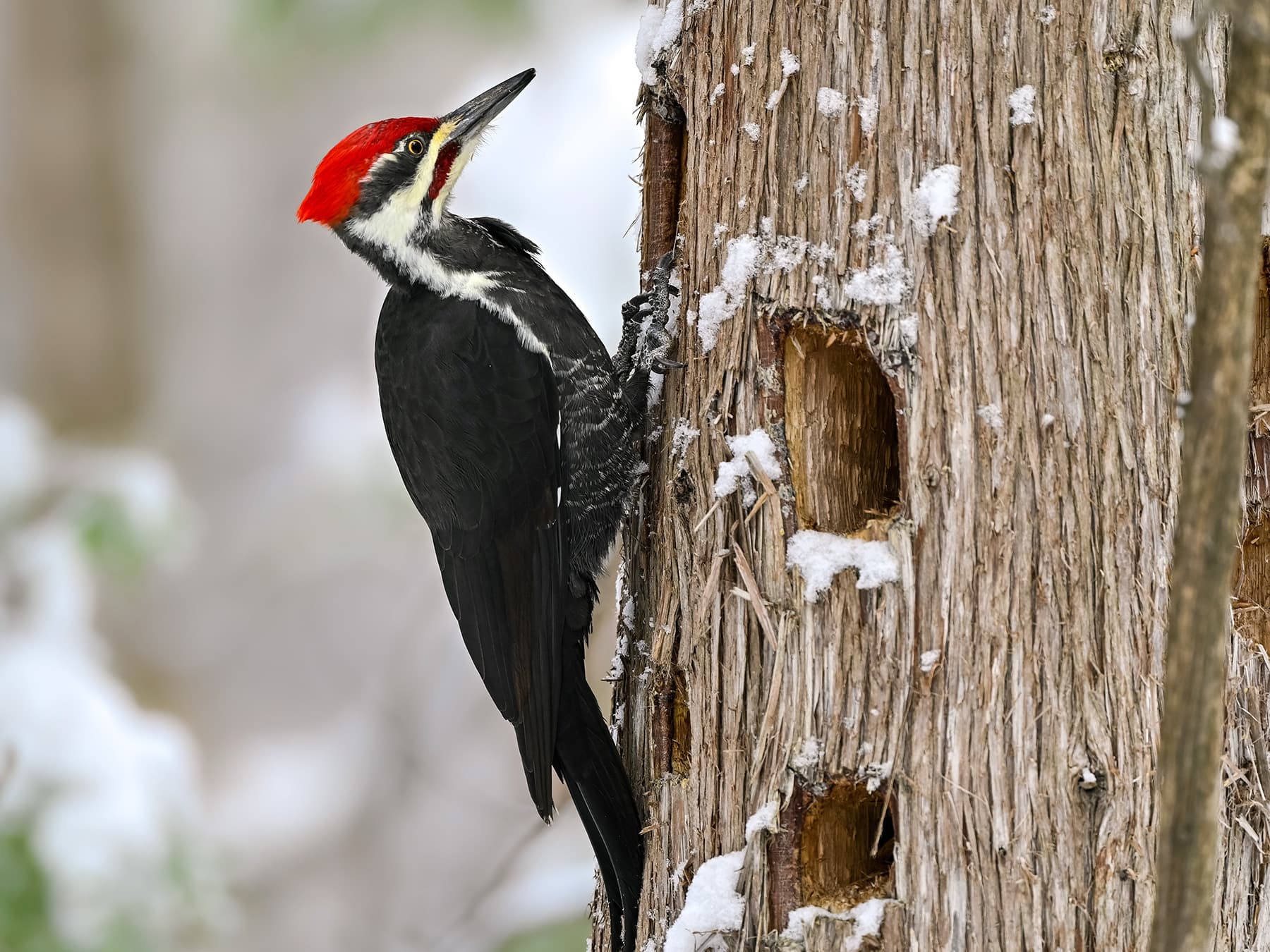
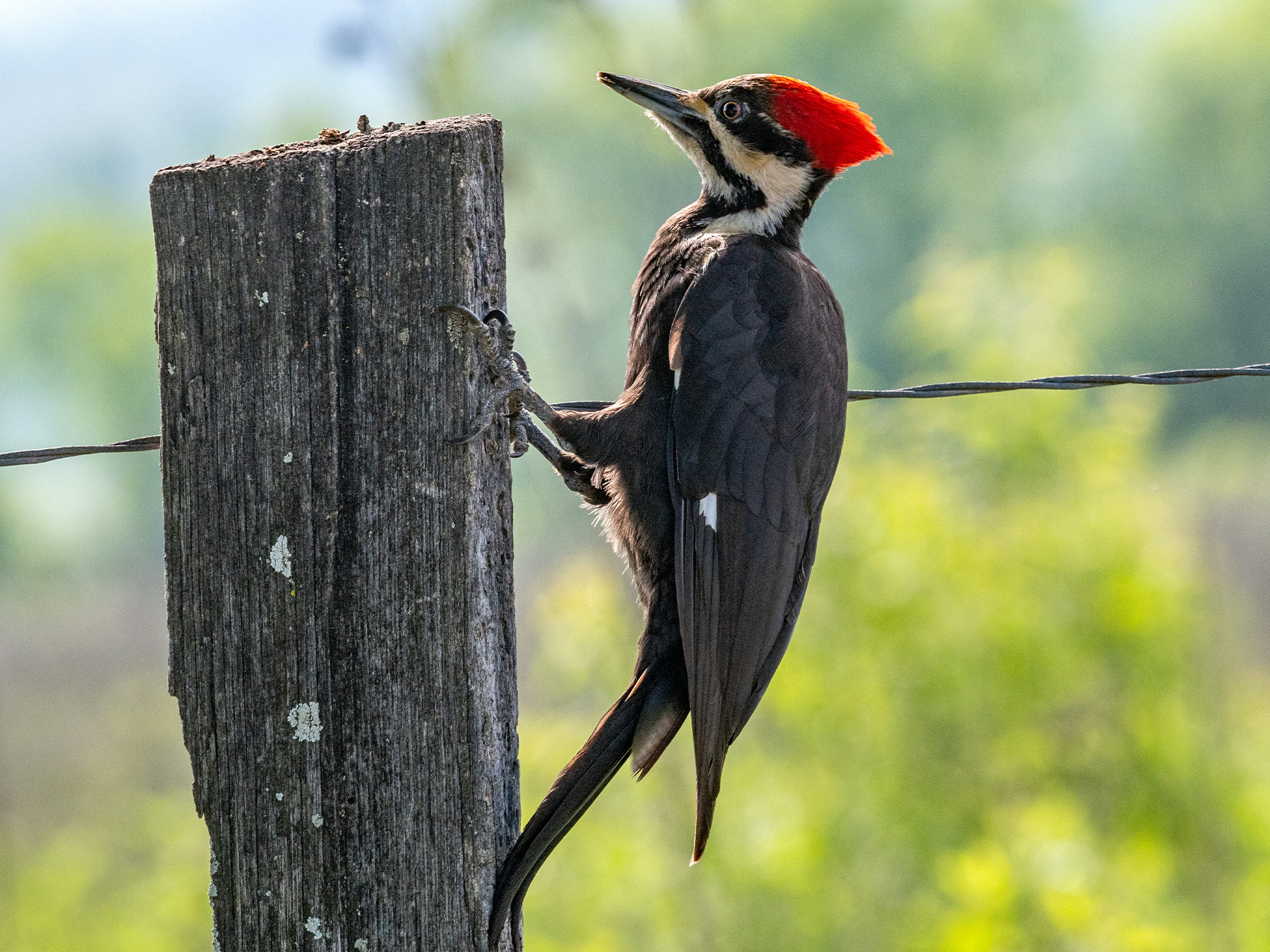
Pileated Woodpeckers are not built to blend in. These striking black, white, and red birds are highly visible in their forest habitat. Their large, powerful feet are set well forward on their bodies and complete with two forward and two backward-facing toes for grip and support. They also have a long, dagger-like bill for drilling into wood in search of food.
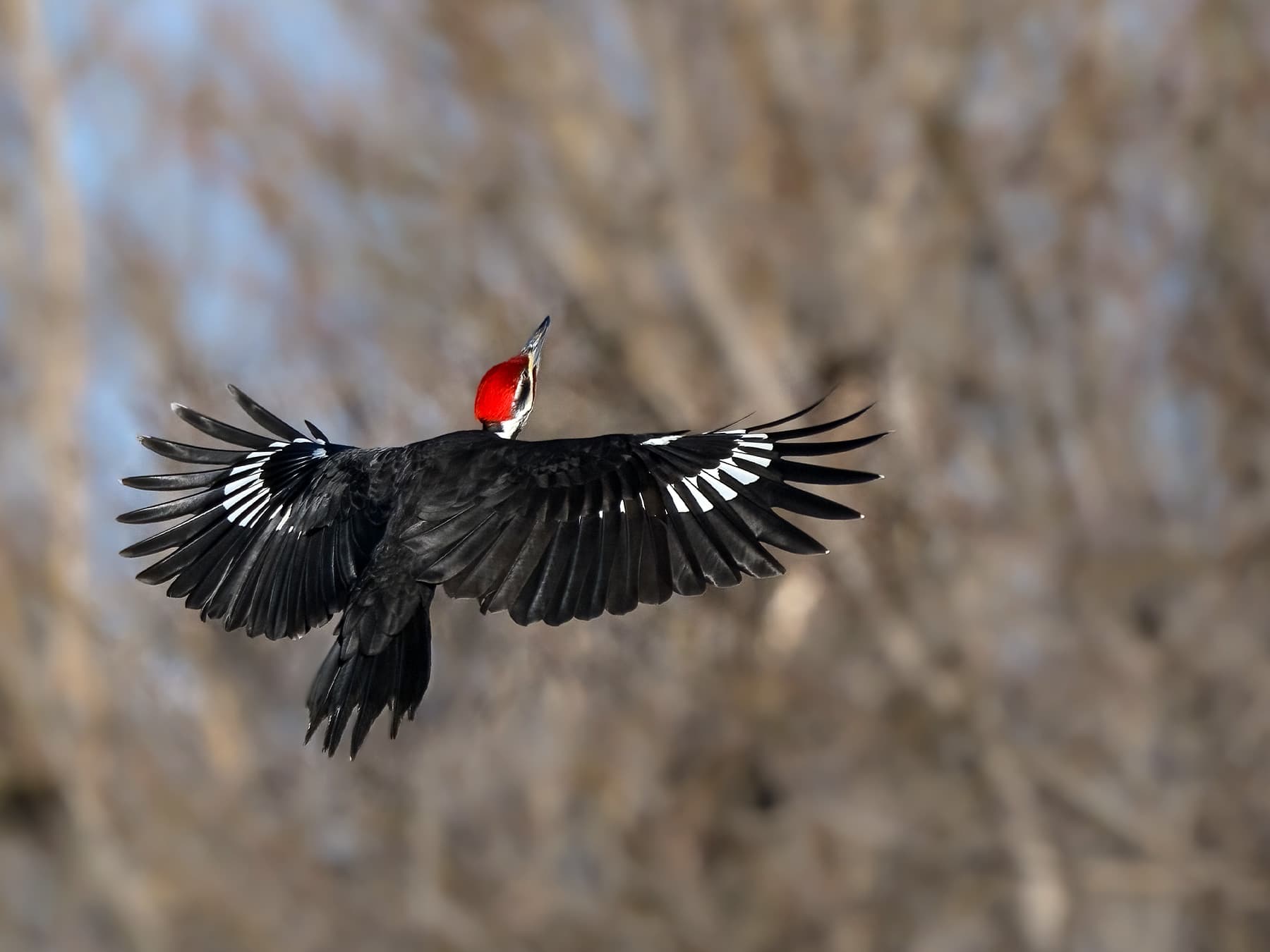
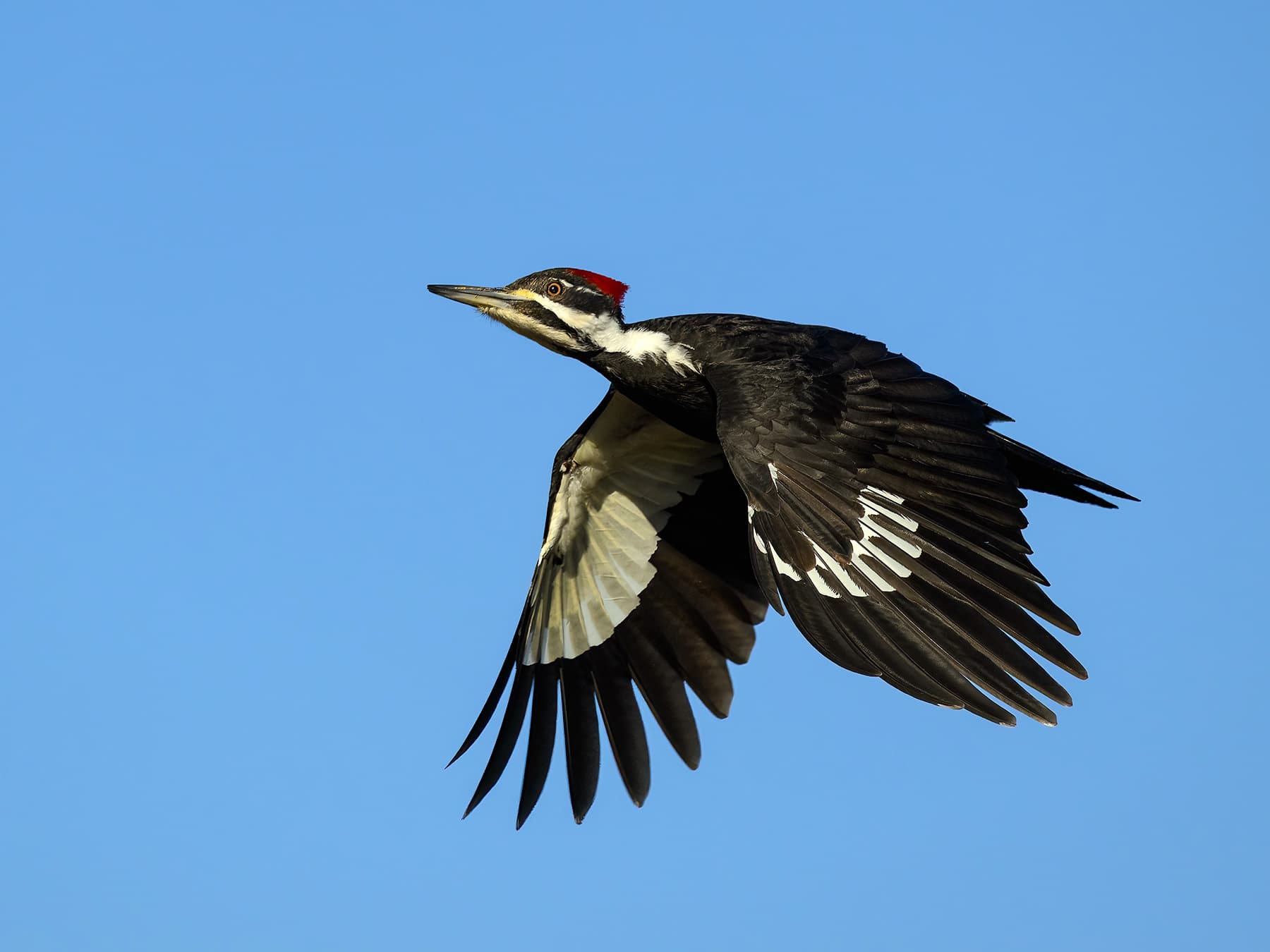
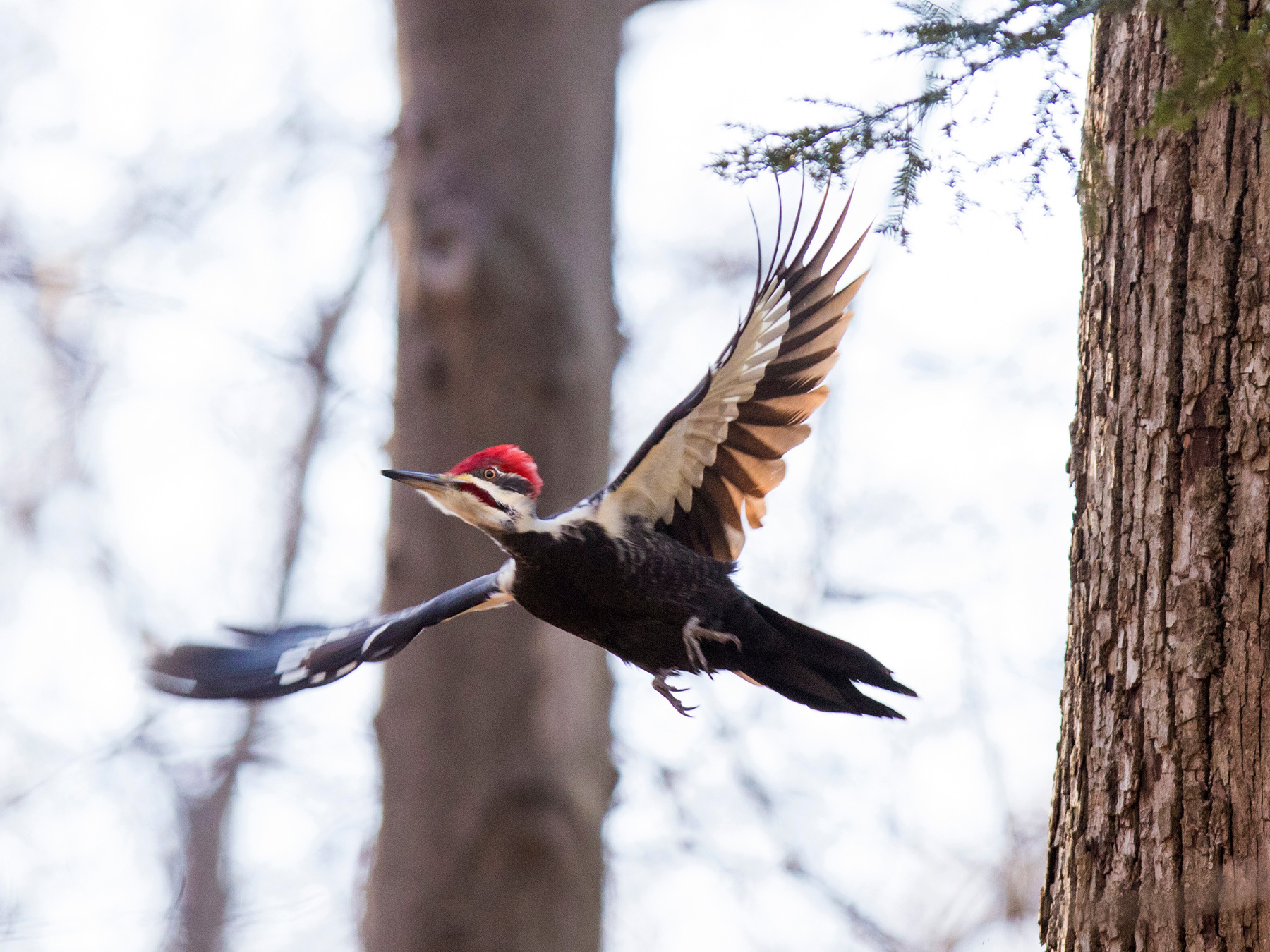
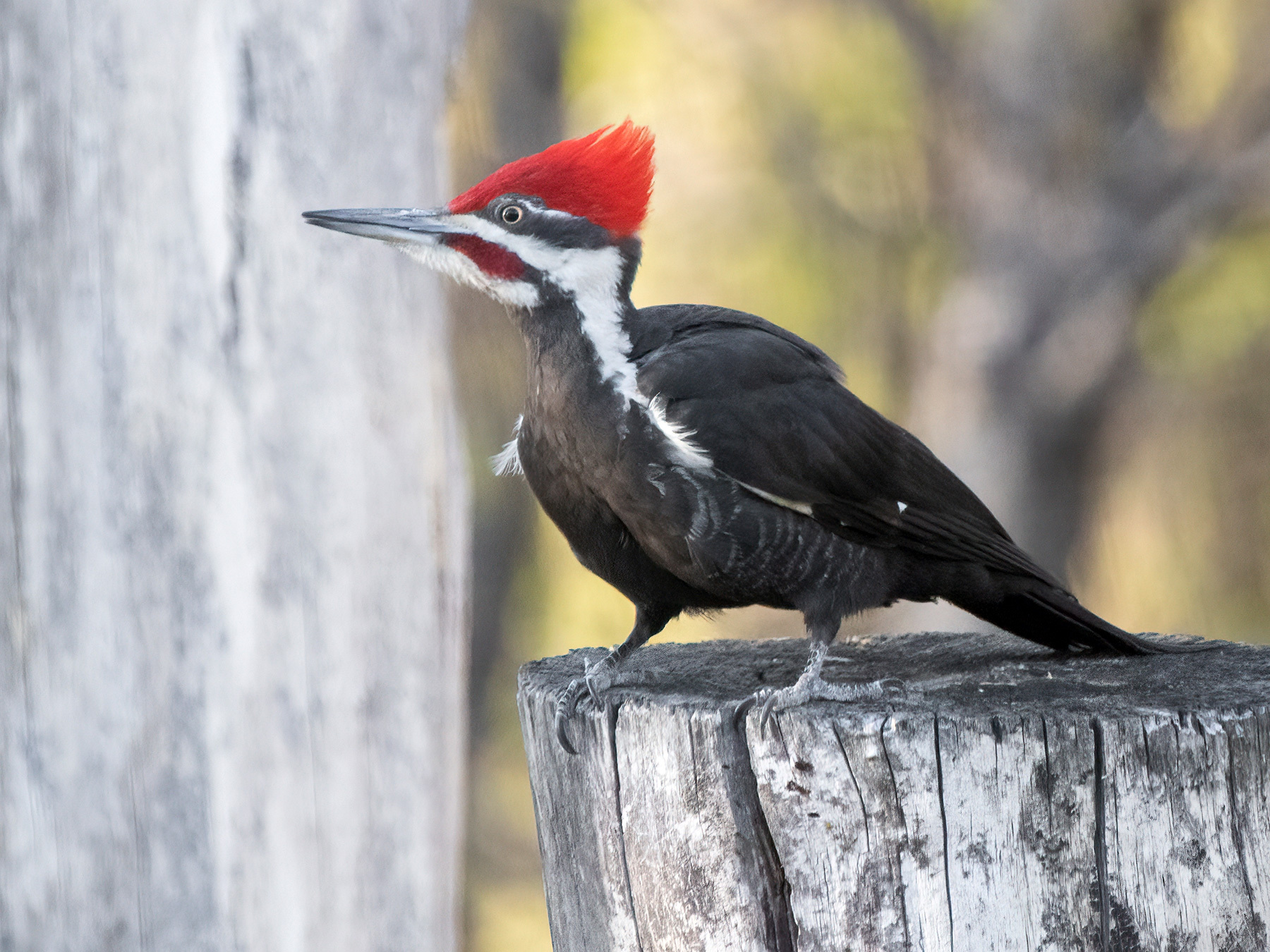
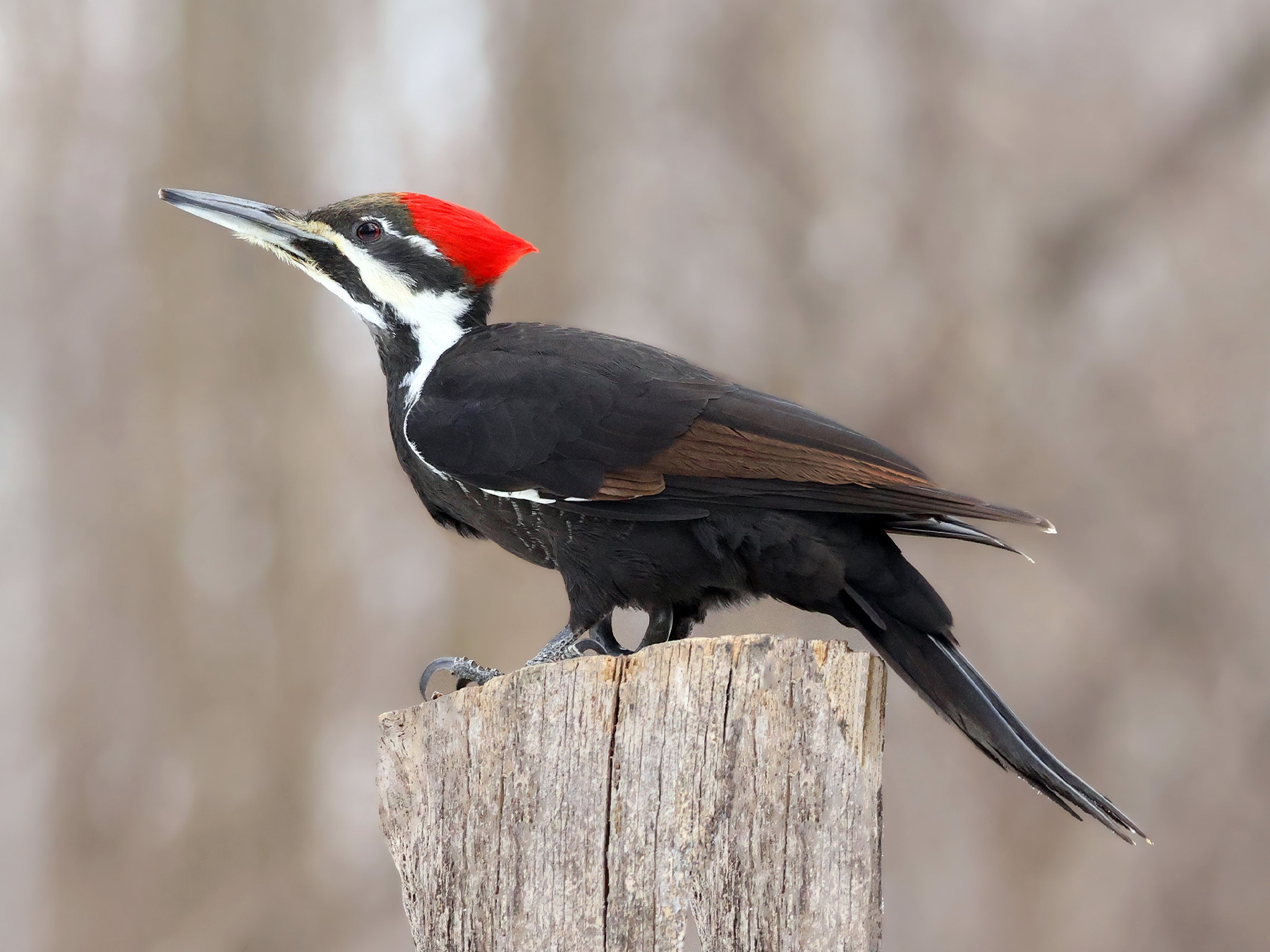
They are mostly black, with a fine white stripe above each eye and another that runs from the base of the bill to the side of the face and then down to the shoulder area. They also have a white chin and bold white markings above and below each wing. A bright red crest that can be raised at will is perhaps their most striking feature.
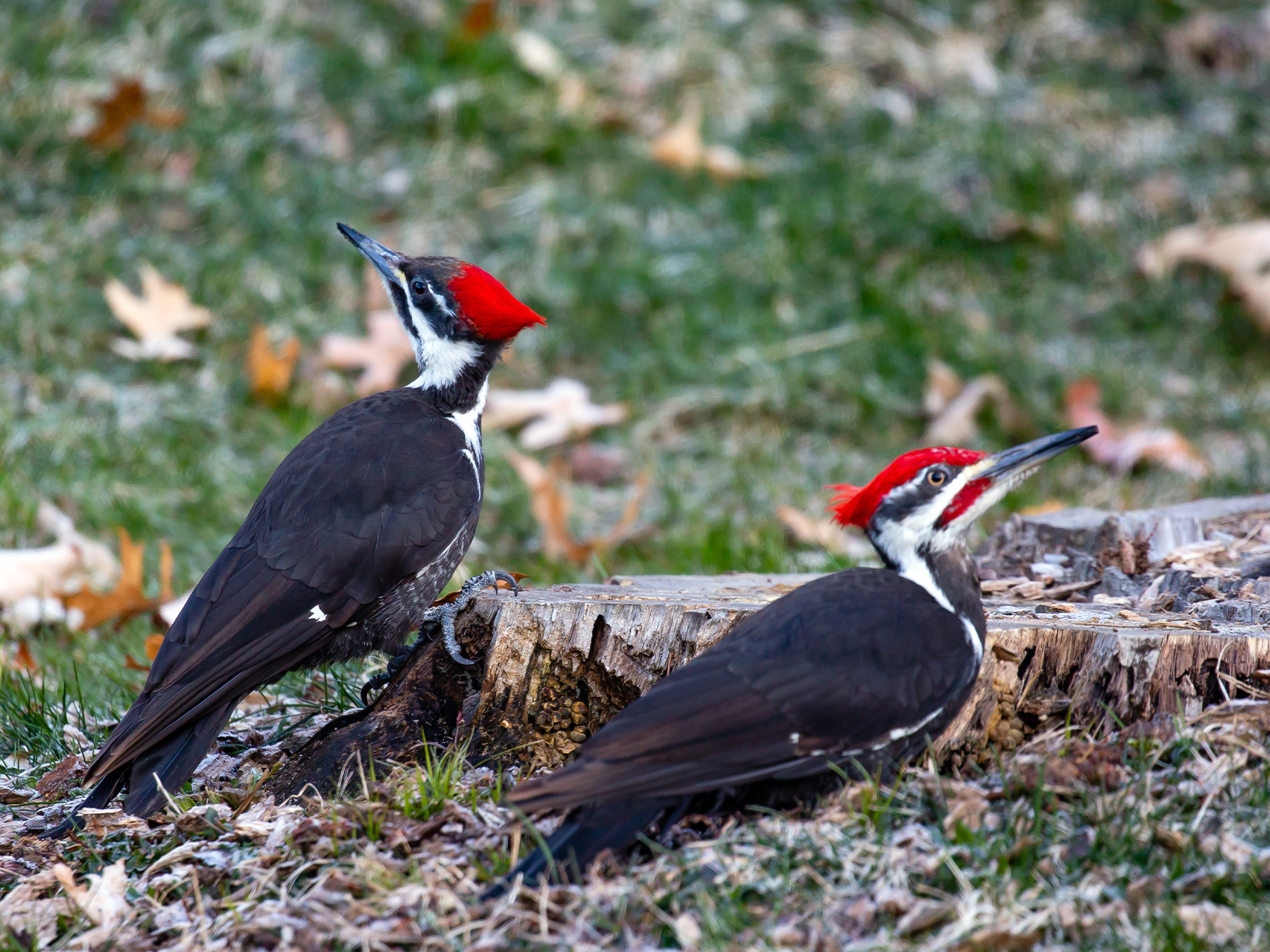
Female Pileated Woodpeckers look very similar to males, although there is a key difference between their facial plumages. Females have a black mustache stripe, while males have a red one. You can learn much more about females and how they differ from males in this in-depth guide.
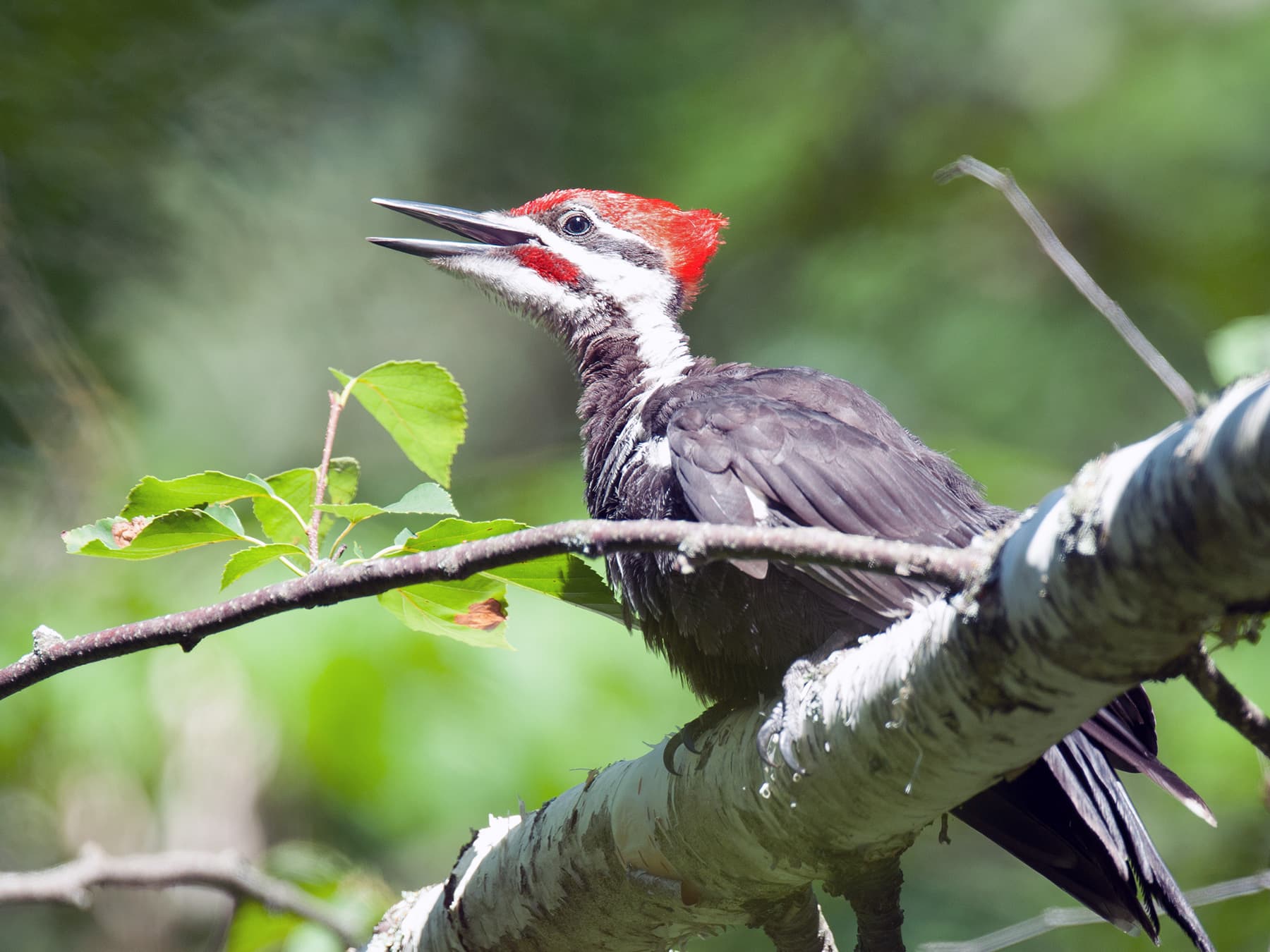
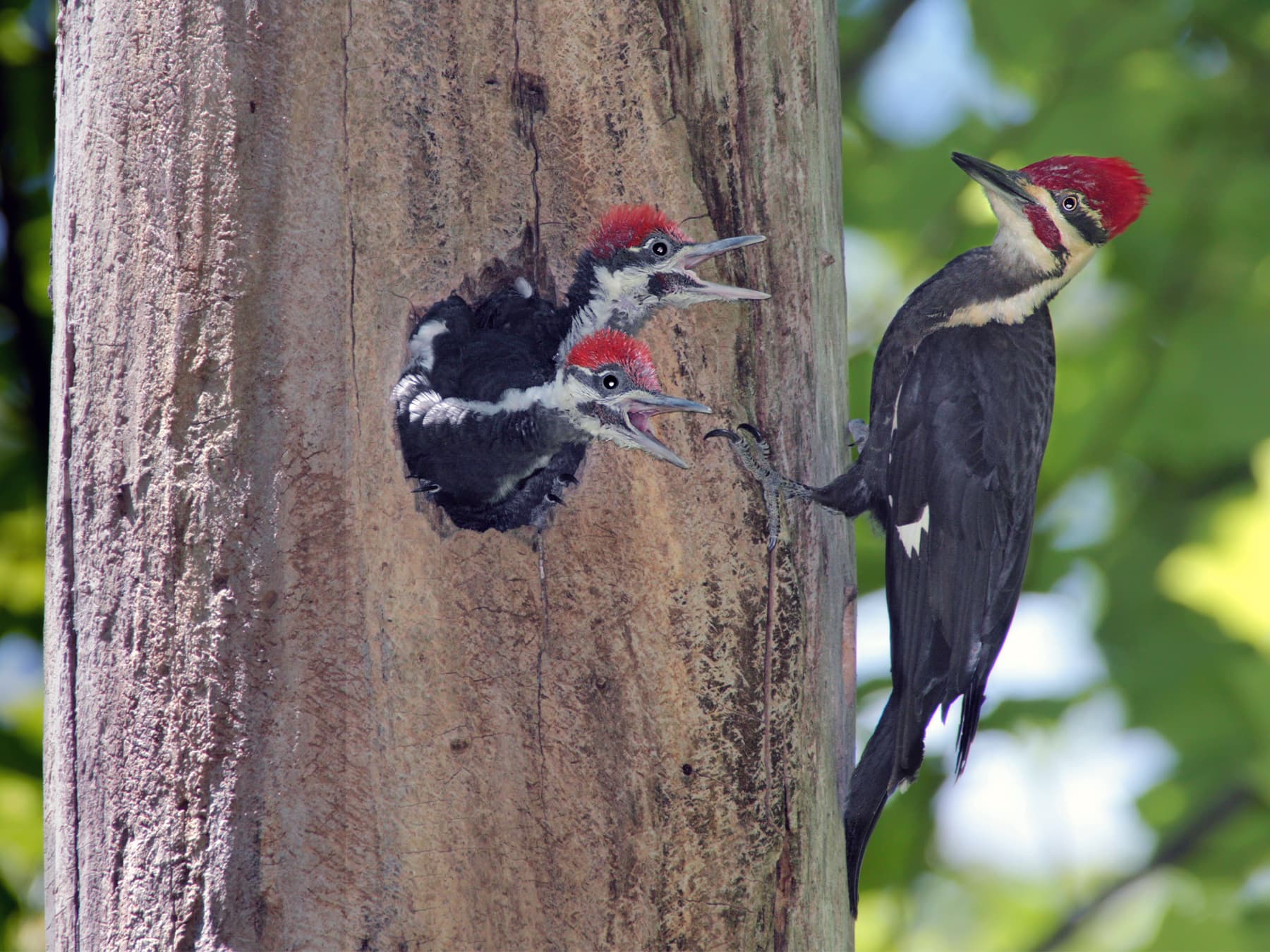
Juvenile Pileated Woodpeckers have very similar colors to their parents. However, they have a smaller crest, darker eyes, and they are generally smaller.
Pileated Woodpeckers are difficult to mistake for any other bird. The Ivory-billed Woodpecker was larger but similar in appearance, although sadly, that species is likely to be extinct.
How big are Pileated Woodpeckers?
Likened to the size of a crow, Pileated Woodpeckers are large, robust birds.
Length
Adults measure approximately 16 to 19 inches or 40 to 49 centimeters in length.
Weight
These birds have an average weight of about 10 ounces or 275 grams, although the largest specimens can reach over 12½ ounces or 350 grams.
Wingspan
Pileated Woodpeckers have an impressive 26 to 29-inch (66 - 76 cm) wingspan.
Its size
Adults- Length
- 40–49 cm
- Wingspan
- 66–75 cm
- Weight
- 250–350 g
Its song and calls
What sound does a Pileated Woodpecker make?
Pileated Woodpeckers are very loud, vocal birds that call and drum on hollow wood to communicate with their mate or discourage intruders. Their typical call is a cackling or clucking ‘yuk-yuk-yuk.’
- Call0:00 / 0:04
Recorded in Minnesota, United States · August 2010
- Drumming0:00 / 1:31
Recorded in Minnesota, United States · May 2015
When and where to see it
OctoberIn season
Most recorded in October
- 1. West Virginia1.6%
- 2. Arkansas1.3%
- 3. Virginia1.2%
- 4. Florida1.1%
- 5. Georgia1.1%
Each dot is a county, state or province: the bigger and darker, the larger the bird’s share of that place’s bird records that month. Grey dots: no regular records. The ringed point is the centre of the bird’s records this month; the arrow shows how it moved since last month, and the dashed loop its path through the year. “Arrivals” colours places where it becomes regular this month (orange) or is in its last regular month (grey). GBIF eBird Observation Dataset, 2019–2024. Map data: Natural Earth, US Census Bureau; place centres © OpenStreetMap contributors.
In your area
See when the Pileated Woodpecker is recorded in your county, state or province.
How often the Pileated Woodpecker turns up in the United States and Canada through the year, from birdwatchers' records.
United States
Resident · all year · most records in September
Canada
Resident · all year · most records in February
Show as a table
| Month | United States | Canada |
|---|---|---|
| January | 0.43% (regular) | 0.67% (regular) |
| February | 0.45% (regular) | 0.73% (regular) |
| March | 0.48% (regular) | 0.62% (regular) |
| April | 0.48% (regular) | 0.48% (regular) |
| May | 0.42% (regular) | 0.34% (regular) |
| June | 0.38% (regular) | 0.33% (regular) |
| July | 0.32% (regular) | 0.27% (regular) |
| August | 0.42% (regular) | 0.35% (regular) |
| September | 0.59% (regular) | 0.47% (regular) |
| October | 0.50% (regular) | 0.44% (regular) |
| November | 0.43% (regular) | 0.51% (regular) |
| December | 0.47% (regular) | 0.62% (regular) |
Worldwide: recorded regularly in 2 countries
Countries where it was recorded in at least 3 of the 6 years 2019–2024. Linked countries have their own bird list.
North America (2)
Data: EOD – eBird Observation Dataset (Cornell Lab of Ornithology), accessed via GBIF.org, CC BY 4.0. Records from 2019–2024, aggregated and filtered by Birdfact. How these lists are made
What is the habitat of a Pileated Woodpecker?
Pileated Woodpeckers prefer mature forest habitats, particularly where snags are plentiful. They can be found in deciduous, coniferous, or evergreen forests, and they also live in many established suburban areas.
What is the range of a Pileated Woodpecker?
Pileated Woodpeckers are restricted to North America, where they occur widely in the United States and Canada. They are most widespread in the east of the United States, although their range also extends across the southern half of Canada and south along the West Coast to Central California.
Where do Pileated Woodpeckers live?
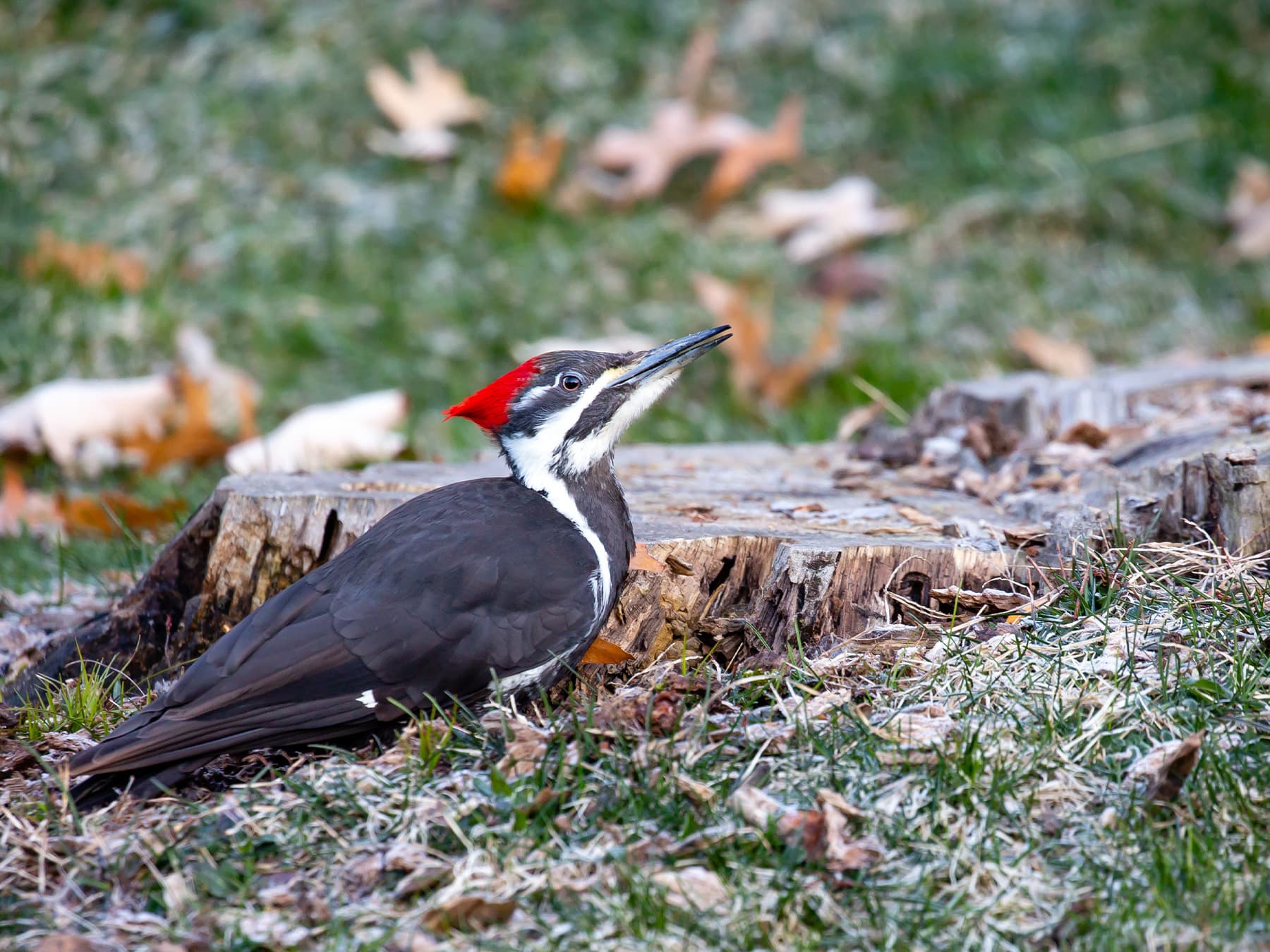
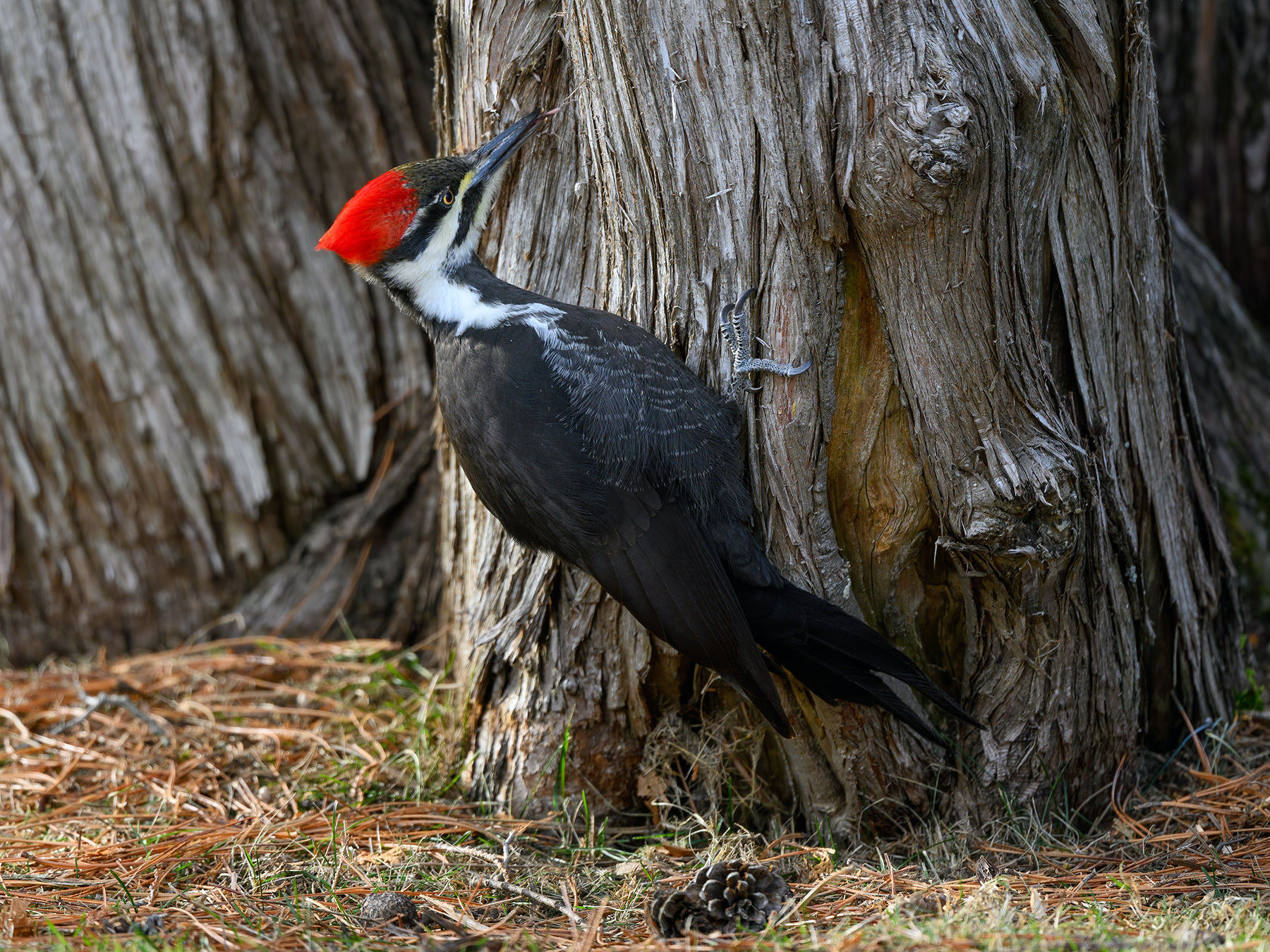
Pileated Woodpeckers are built for life on tree trunks, especially large, dead trees. However, they frequently descend to the ground to search for food in fallen logs and stumps.
How rare are Pileated Woodpeckers?
Pileated Woodpeckers are pretty common in suitable habitats. However, they are territorial, and pairs may occupy areas of hundreds of acres, so you’re not likely to see them in large numbers.
Where can you see Pileated Woodpeckers in the US?
Pileated Woodpeckers are most numerous in the east of the United States, from Florida in the Southeast to New England in the Northeast. They extend inland to eastern Texas and north to the Upper Midwest, avoiding the open Great Plains Region.
Although less common, birdwatchers can also spot these large and impressive woodpeckers west of the Rocky Mountains in Washington, Oregon, and California.
Where can you see Pileated Woodpeckers in Canada?
Pileated Woodpeckers are widespread in the south of Canada. They occur from British Columbia to the Maritime Provinces but avoid the prairies of Alberta, Saskatchewan, and Manitoba.
Migration
Do Pileated Woodpeckers migrate?
Pileated Woodpeckers do not migrate. Pairs will remain in the same areas throughout the year, so bird watchers can spot these birds in any month in their range.
Are Pileated Woodpeckers native to the US?
Pileated Woodpeckers are native to the United States. Apart from Canada to the north, they occur nowhere else.
Tips for seeing it
- Listen for loud drumming or their loud 'cuk-cuk-cuk' call
- Look for large, rectangular holes in dead trees
- Scan mature forests with large trees
- Be patient, as they can be shy and elusive
- In the US, check forest edges near suburban areas
What it eats
What do Pileated Woodpeckers eat?
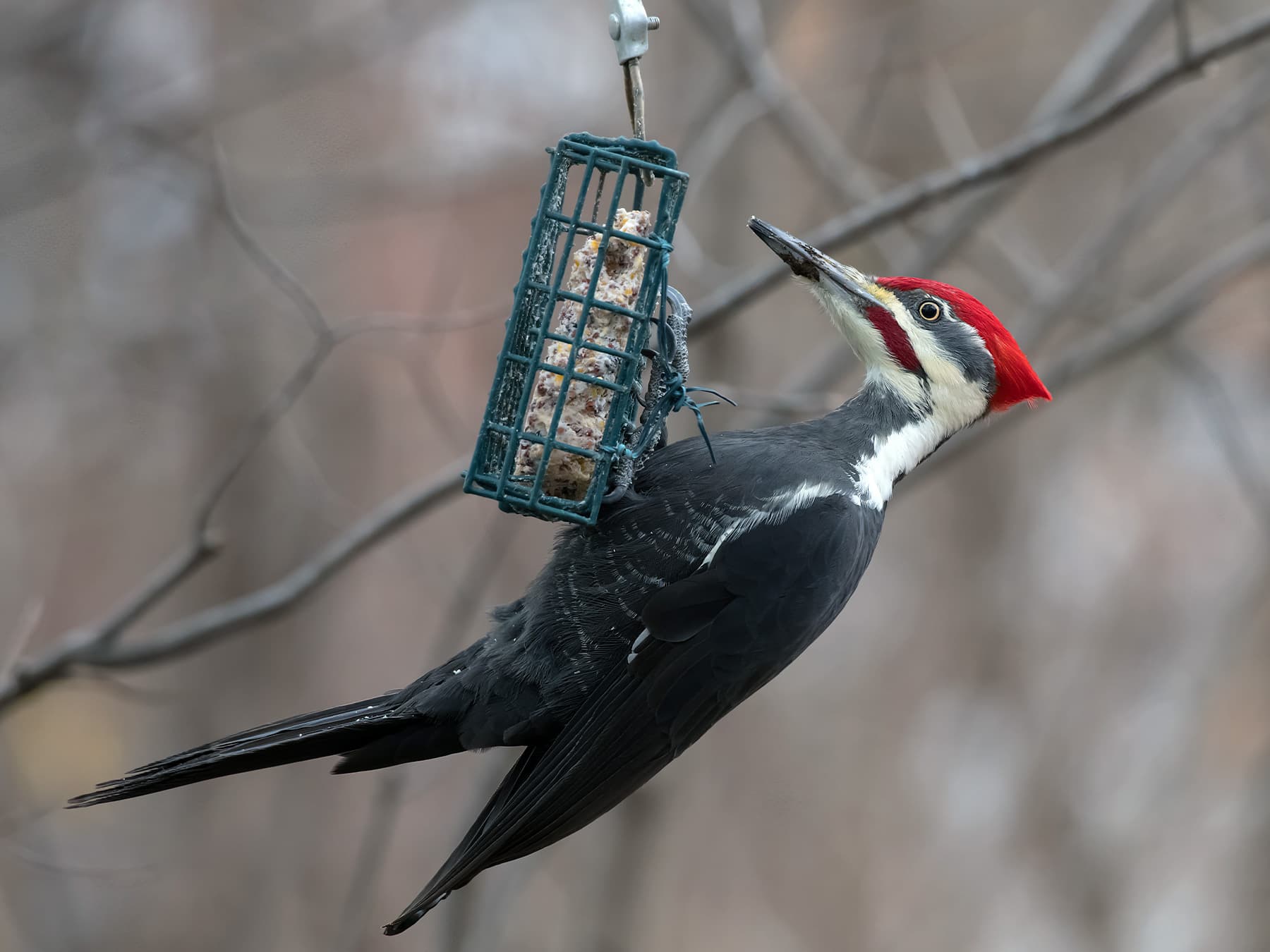
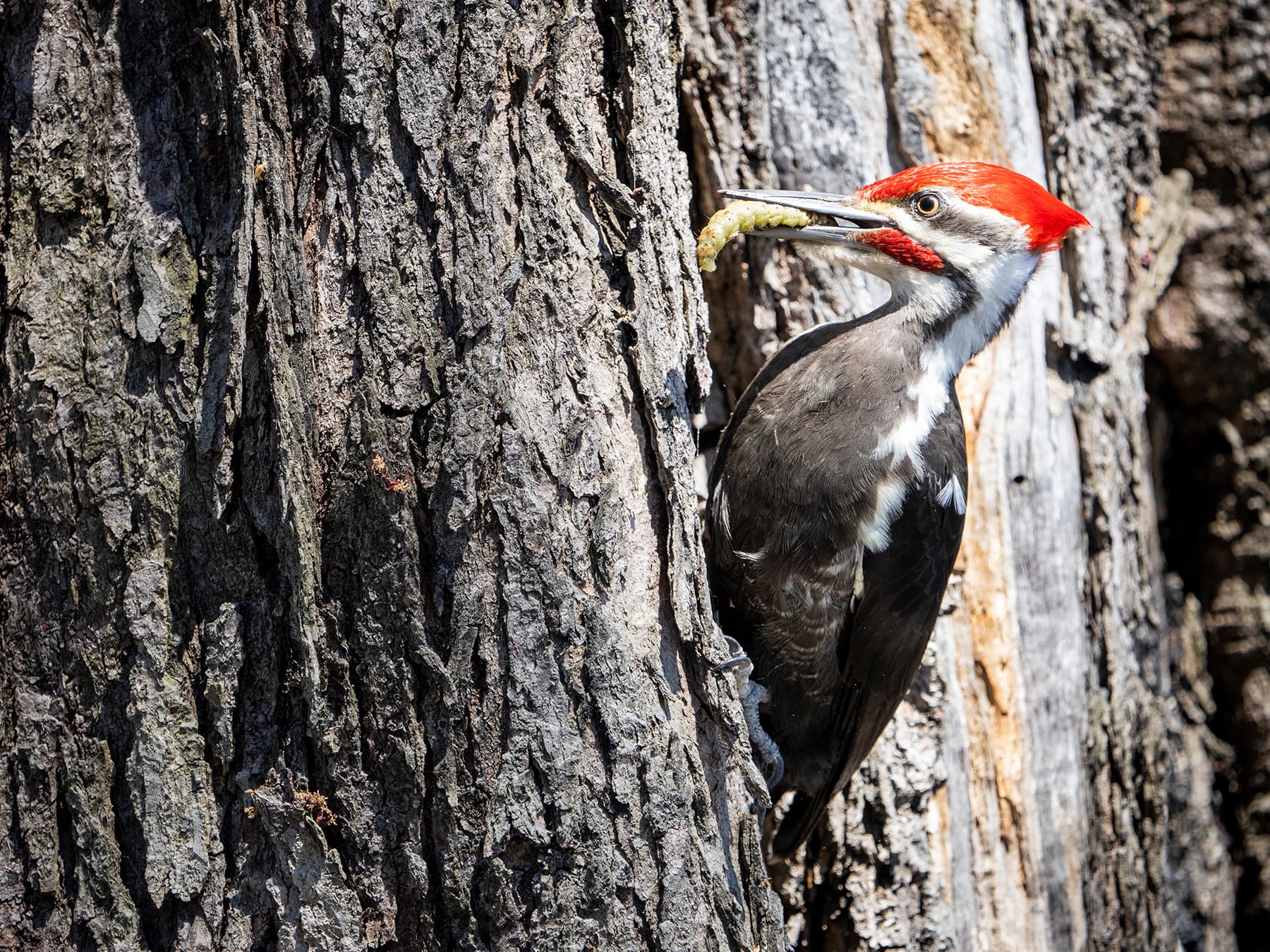
Pileated Woodpeckers are primarily insectivorous. They find their food by drilling into logs and tree trunks for carpenter ants and the grubs of beetles that tunnel into wood. They will also eat plant foods like berries and nuts, and they also visit large suet feeders for a free meal.
Check out our detailed guide to learn more about the Pileated Woodpecker’s diet and feeding behavior.
What do Pileated Woodpecker chicks eat?
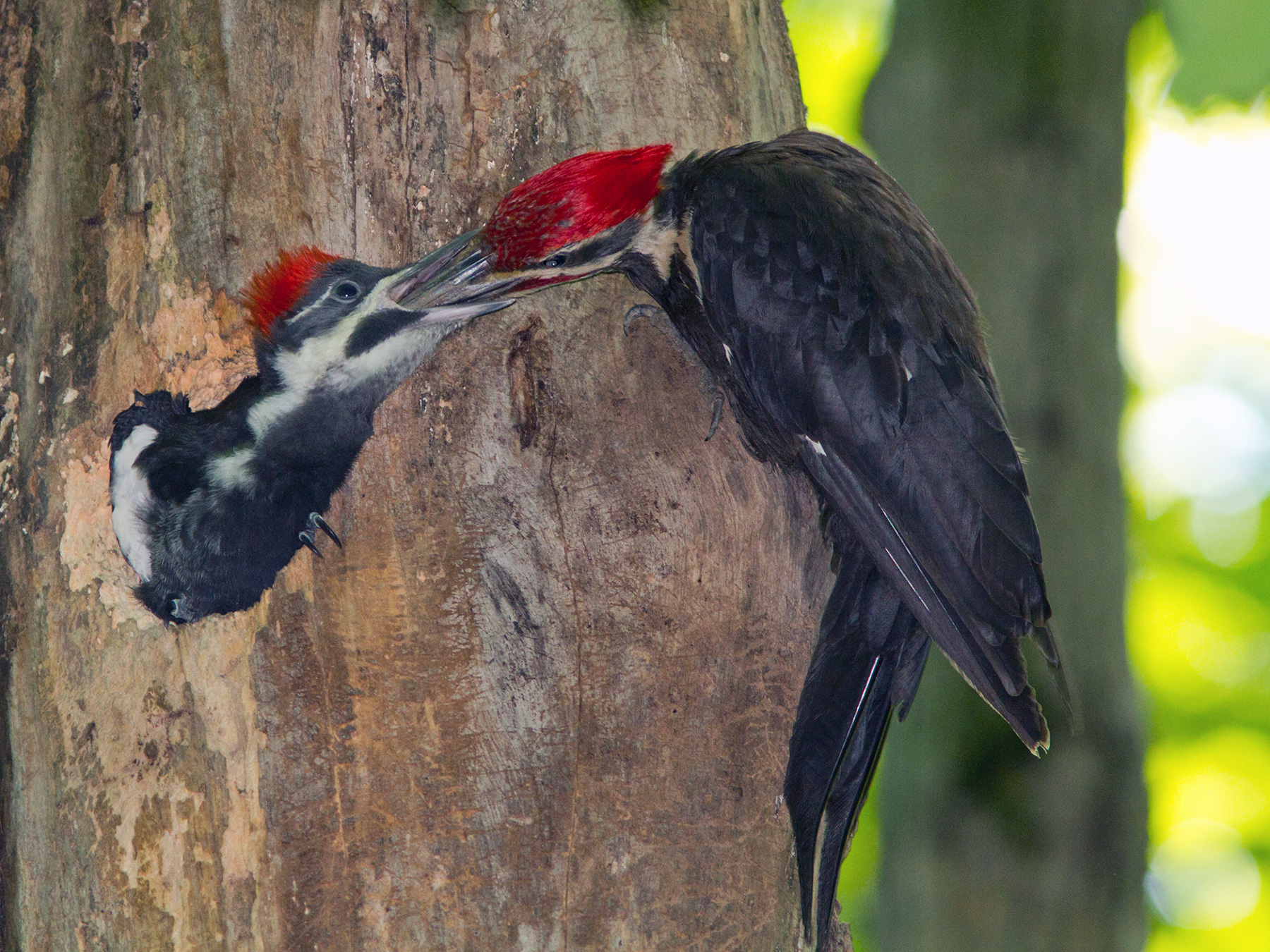
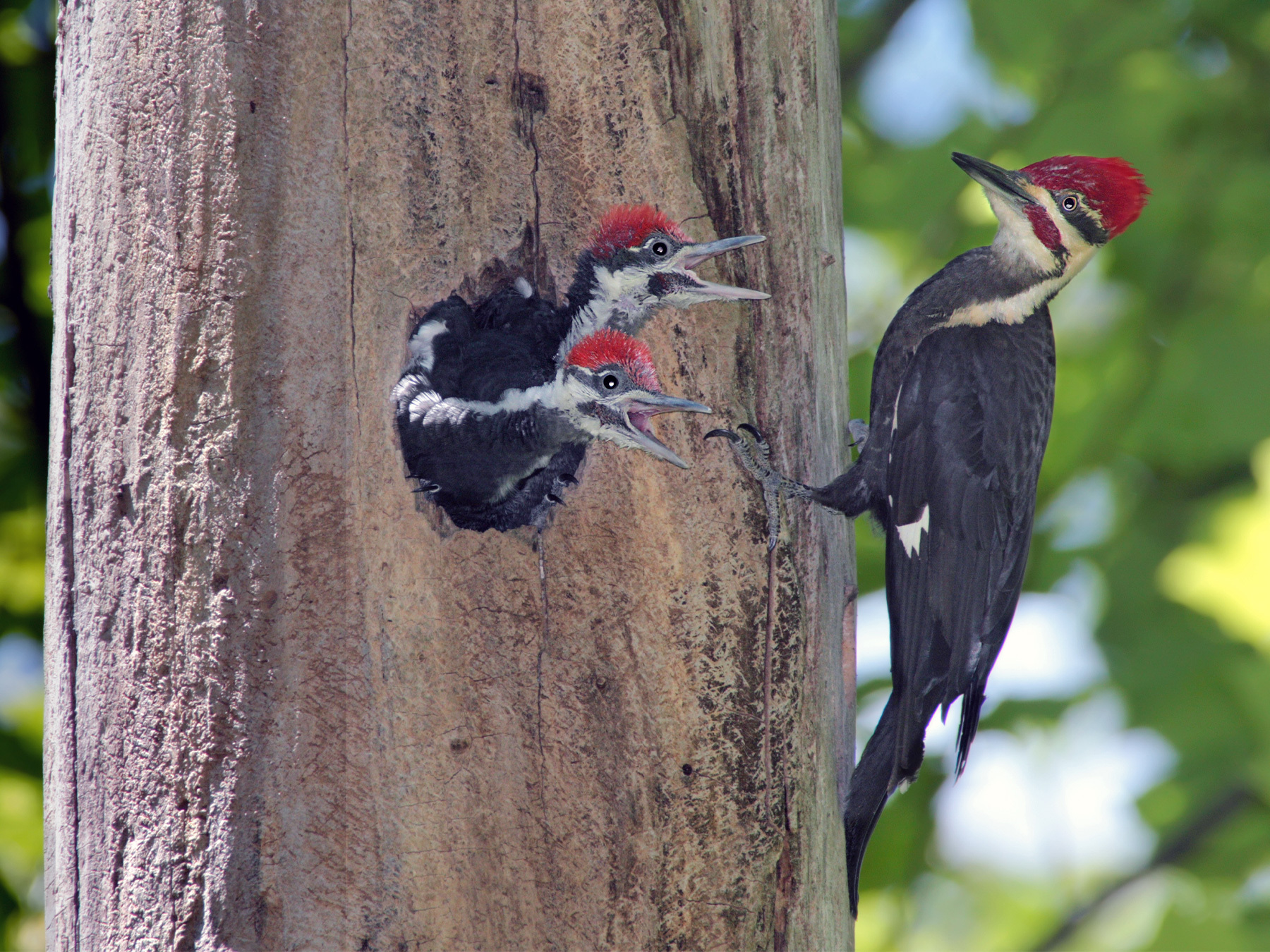
Both Pileated Woodpecker parents feed their chicks by regurgitating insects into their mouths. The young birds depend on their parents for many months after fledging the nest.
Nesting and breeding
Where do Pileated Woodpeckers nest?
Pileated Woodpeckers are cavity nesters that excavate their own two-foot-deep nest chambers in large dead or partially decaying trees. They will use a variety of tree species for nesting, sometimes choosing a site over 150 feet above the ground.
Both partners work at pecking out the nest, and the process can take several weeks. These birds nest in the same area or even tree each year, but they don’t reuse old nest cavities.
When do Pileated Woodpeckers nest?
Pileated Woodpeckers nest in spring and summer. Their eggs hatch after about two weeks, and their young spend a further four weeks in the nest before fledging. These birds produce a single brood each year.
What do Pileated Woodpecker eggs look like?
Pileated Woodpeckers usually lay four eggs, although larger and smaller clutches are known. Their plain white eggs measure about 33 millimeters long and 25 millimeters wide.
Do Pileated Woodpeckers mate for life?
Pileated Woodpeckers form stable, long-term bonds, and pairs stick together all through the year. These birds pair for life, although they will accept a new partner if their mate dies.
Behaviour
Are Pileated Woodpeckers aggressive?
Pileated Woodpeckers are territorial birds, although they are not highly aggressive. Conflict with other members of their species is most likely in the nesting season, when they may pursue each other and even fight with their wings and bills.
Where do Pileated Woodpeckers sleep at night?
Pileated Woodpeckers drill out their own roosting cavities with several entrances in dead, hollow trees.
Lifespan and predators
How long do Pileated Woodpeckers live?
Pileated Woodpeckers can live for nearly thirteen years, although most will have a much shorter lifespan.
What are the predators of Pileated Woodpeckers?
Adult Pileated Woodpeckers are most vulnerable to large birds of prey like the Northern Goshawk and Great Horned Owl. Mustelid mammals like martens and weasels also prey on their eggs and chicks.
Are Pileated Woodpeckers protected?
Pileated Woodpeckers are protected in both the United States and Canada.
Are Pileated Woodpeckers endangered?
Pileated Woodpeckers are a ‘Least Concern’ species on the IUCN Red List, and their numbers are thought to be increasing.
Conservation
While currently listed as Least Concern, Pileated Woodpeckers face threats from habitat loss due to deforestation and urban development.
Conservation efforts focus on preserving mature forests and maintaining dead trees essential for nesting and foraging.
Similar birds
Often mistaken for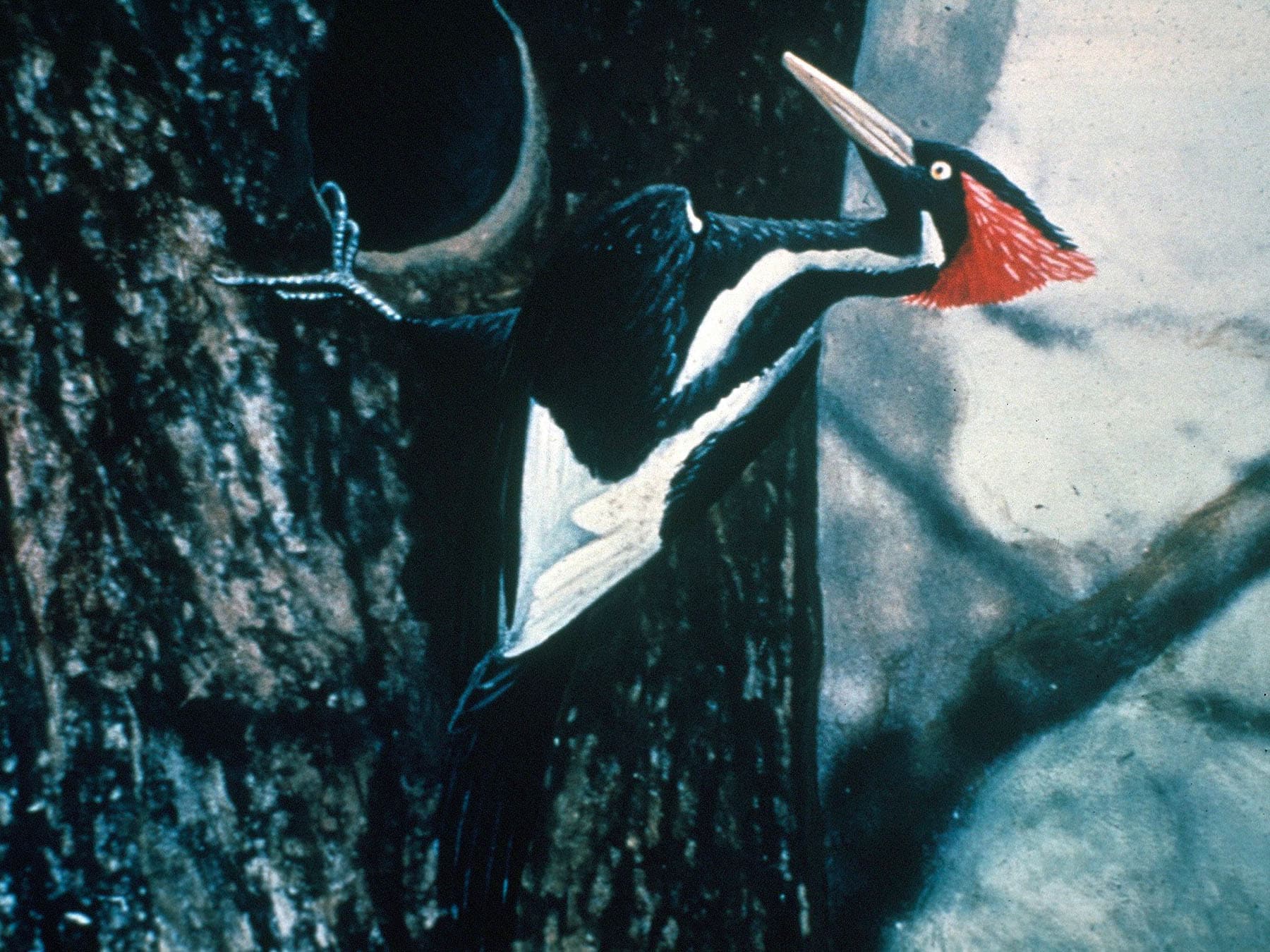
More photos
8 photos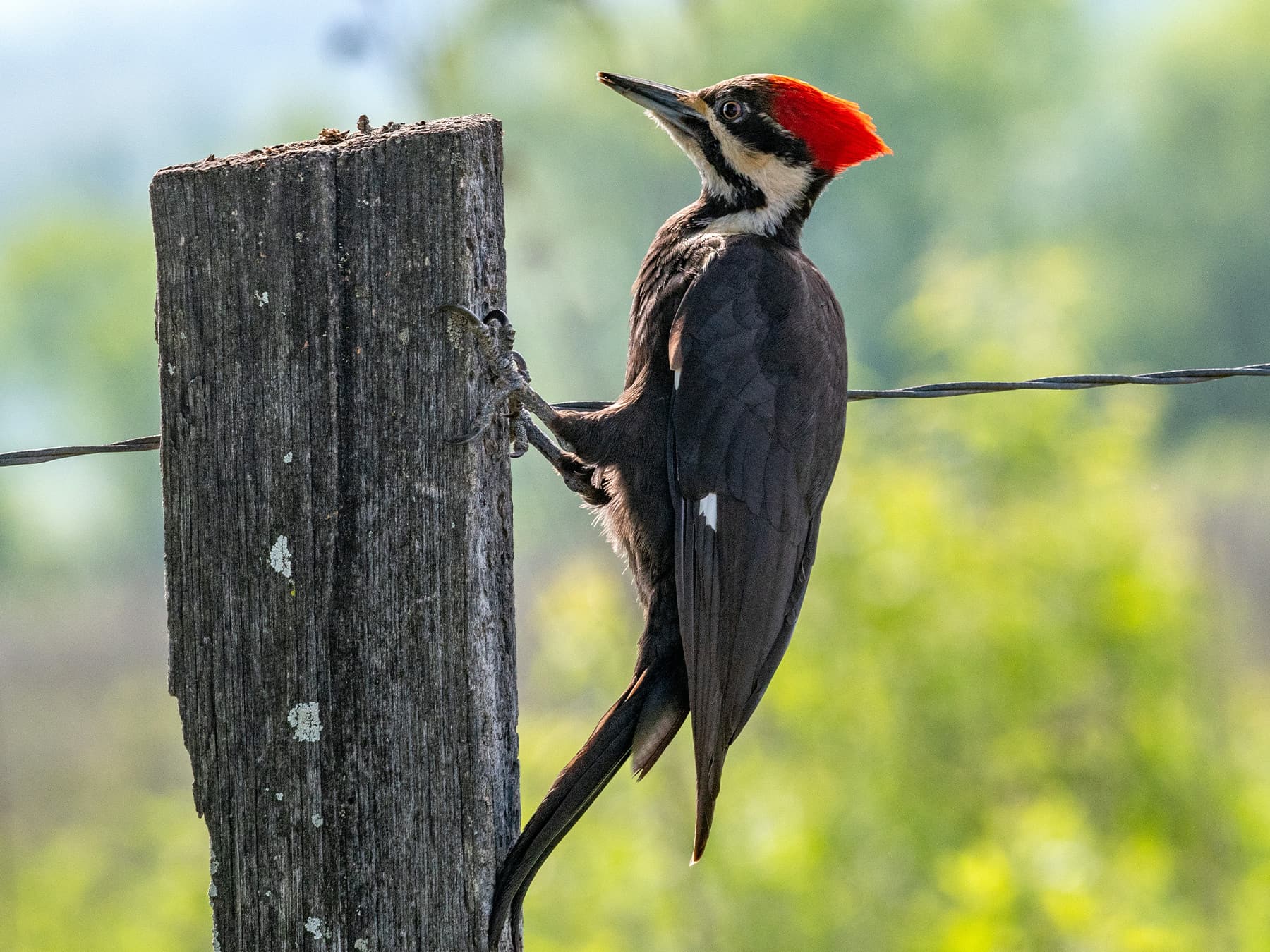 Female Pileated Woodpecker
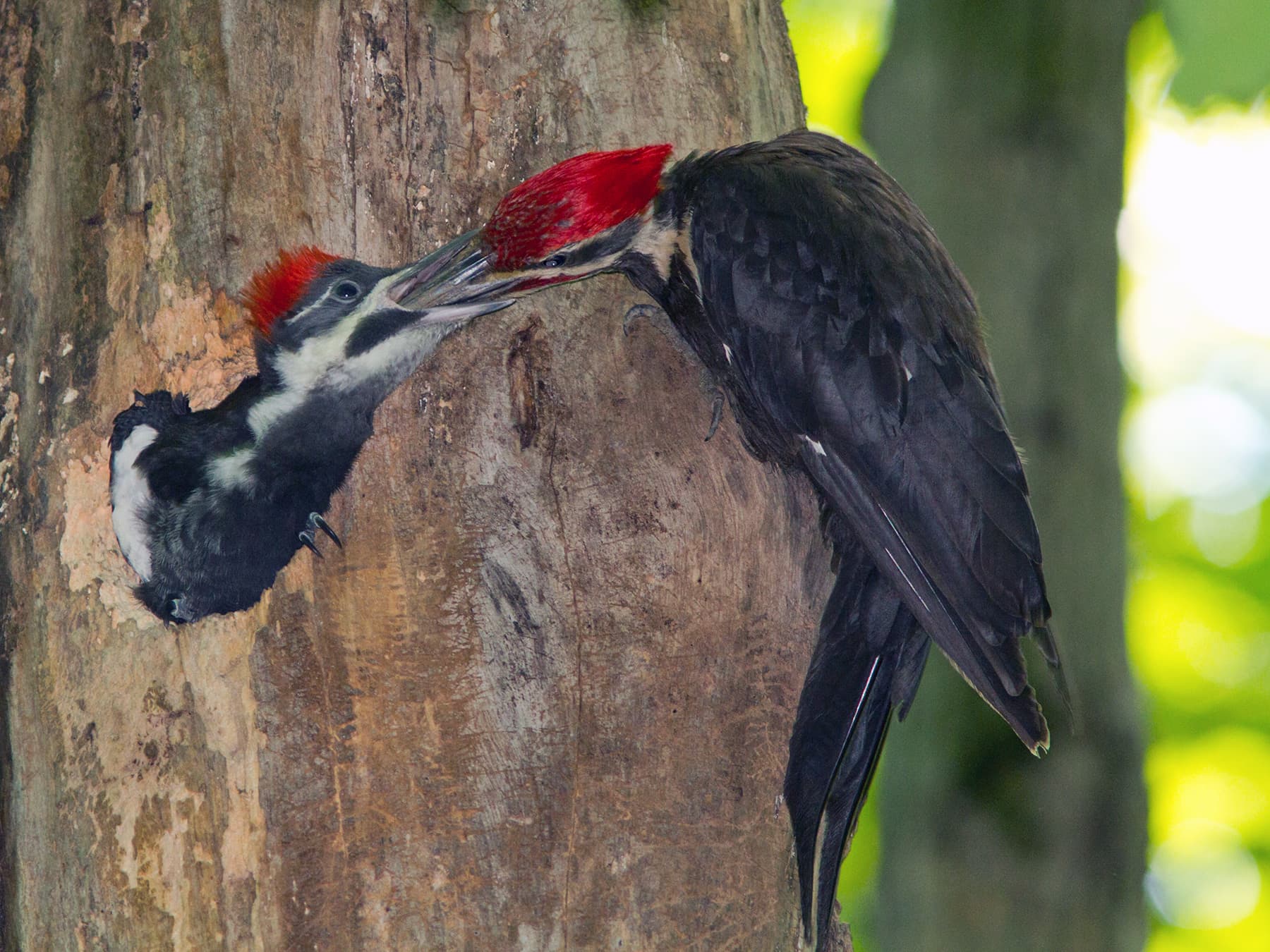 Pileated Woodpecker at the nest hole feeding his young
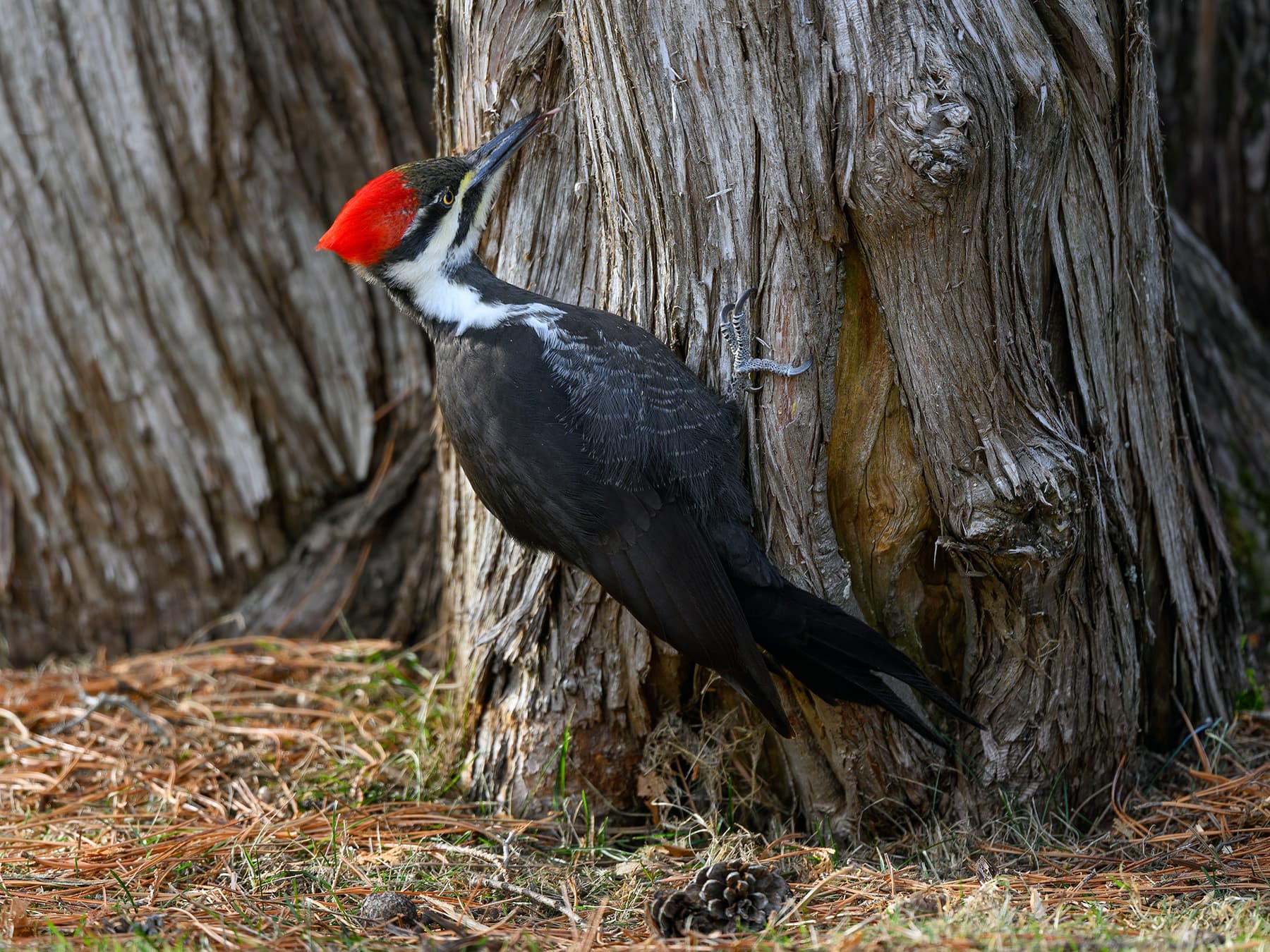 Female Pileated Woodpecker at the base of a tree trunk foraging
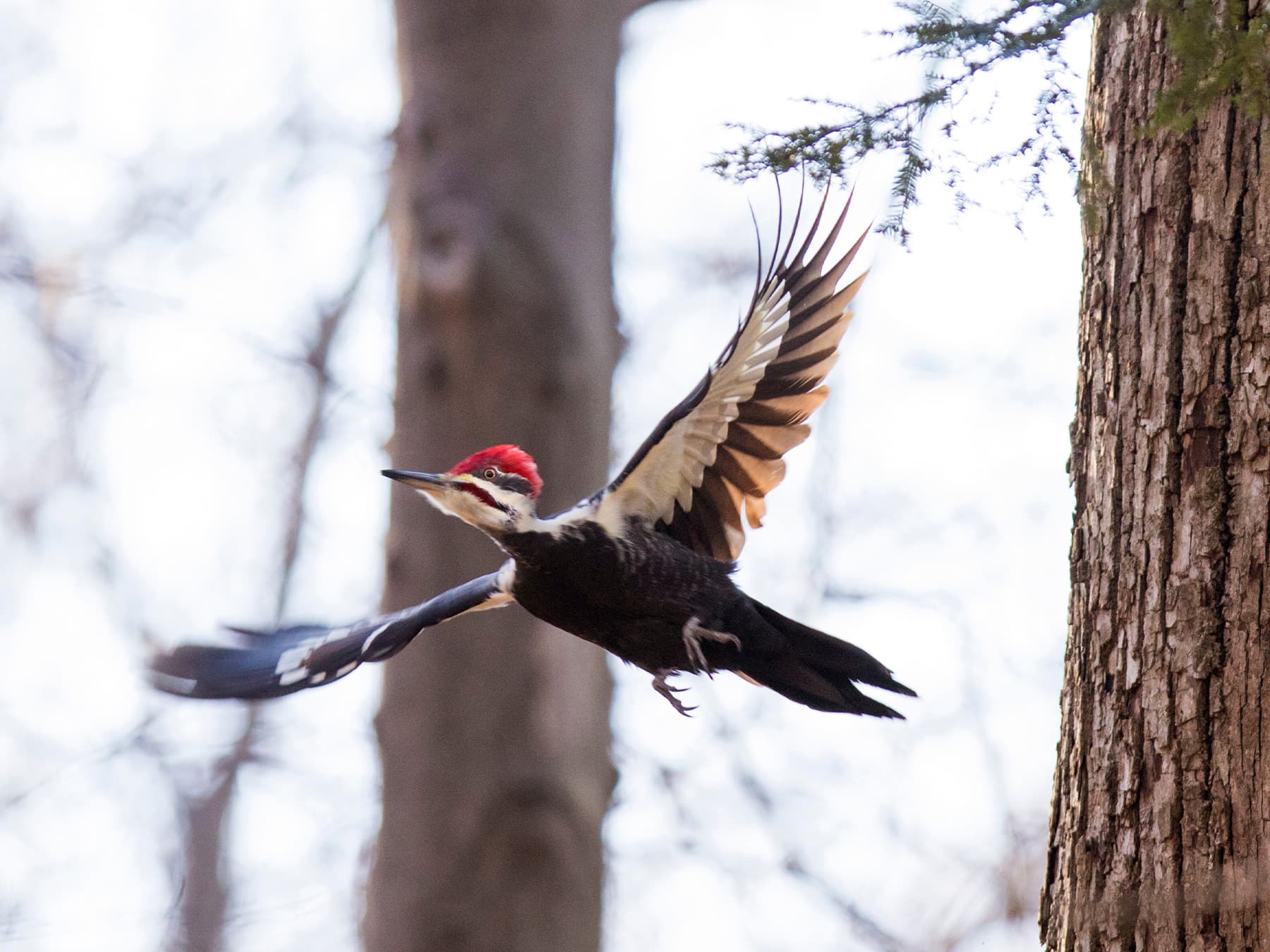 Pileated Woodpecker in-flight in woodland
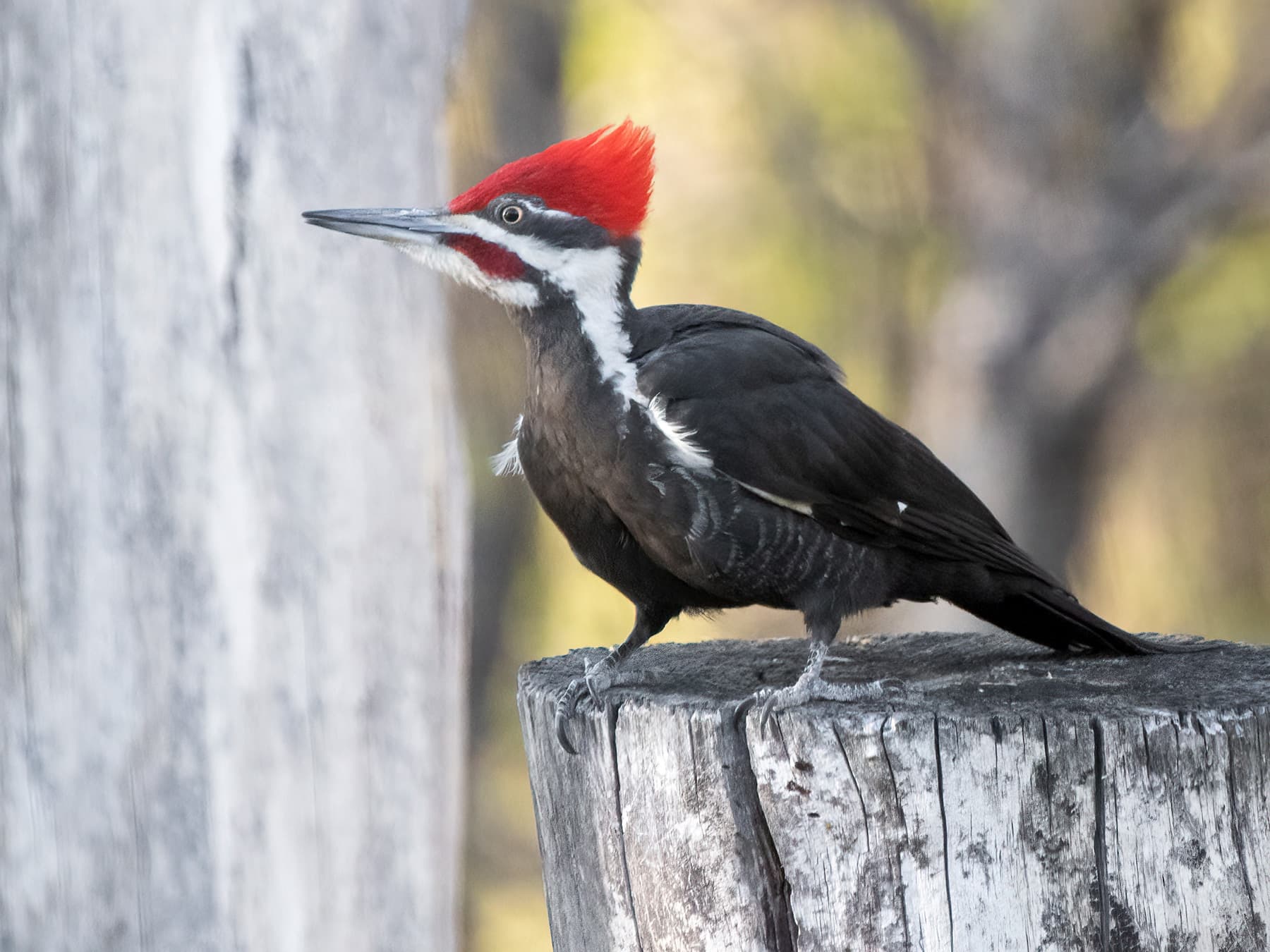 Pileated Woodpecker Male
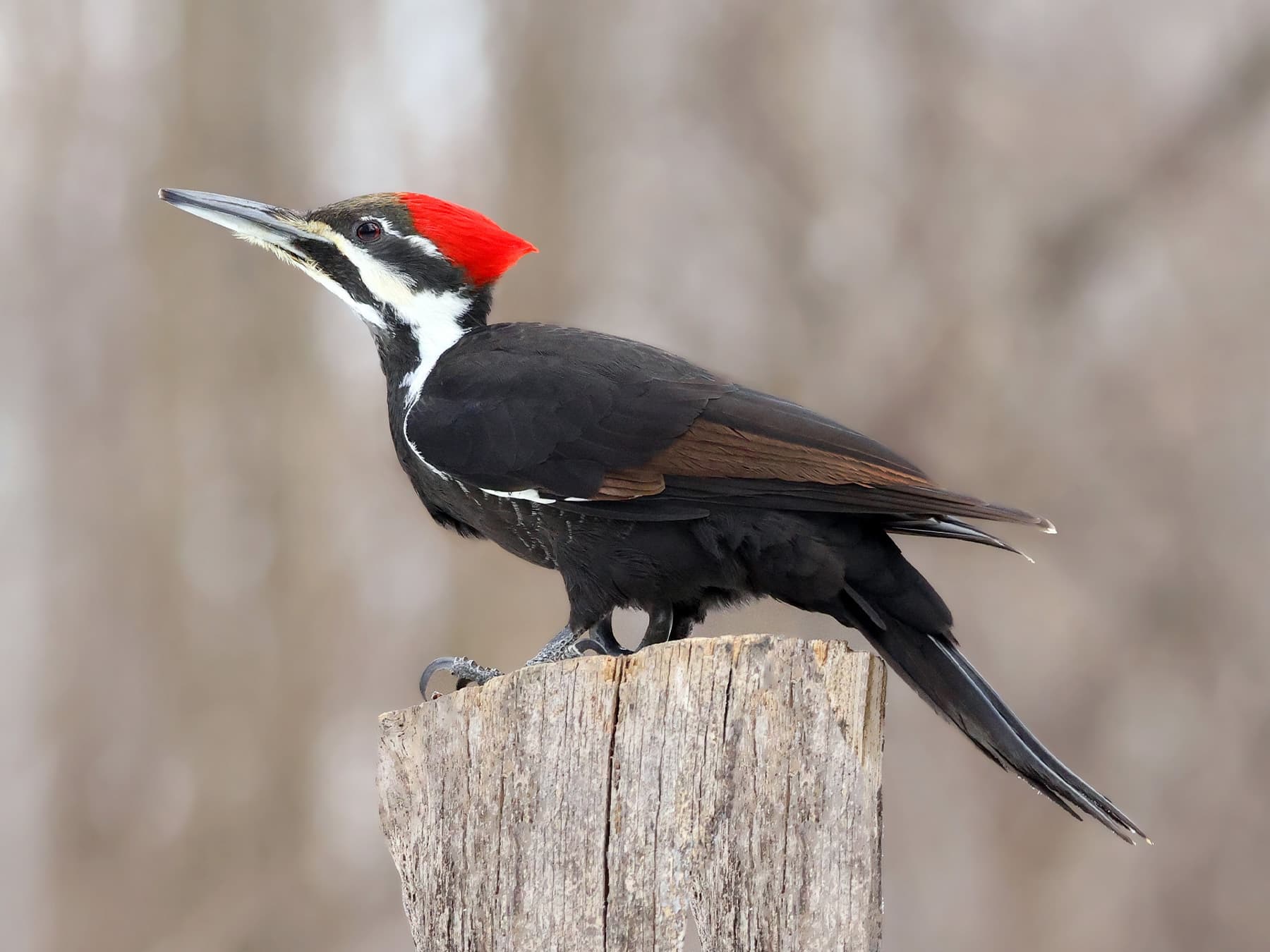 Pileated Woodpecker Female
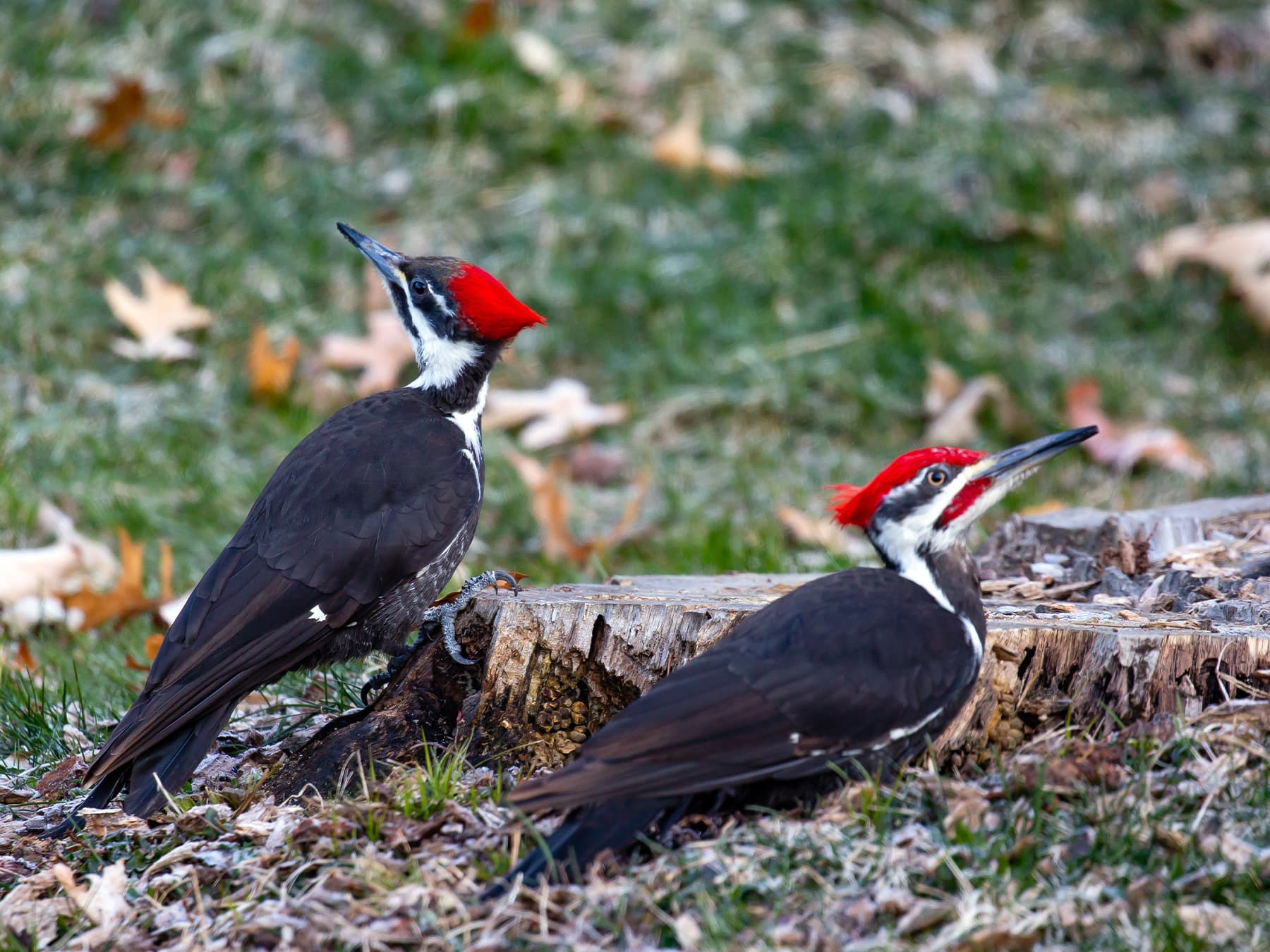 Pileated Woodpeckers, Female (left) and Male (right)
 Pileated Woodpecker at the nest hole feeding his young
Pileated Woodpecker guides
3 guidesQuick facts
- Length
- 40–49 cm
- Wingspan
- 66–75 cm
- Weight
- 250–350 g
- Lifespan
- 9–12 years · oldest recorded 13 years
- Family
- Woodpeckers
- Migration
- Resident
- Global status (IUCN)
- Least Concern
- World population
- 2,600,000 mature individuals
- Population trend
- Increasing
- Also called
- Log-cock, Wood-hen
- Scientific name
- Dryocopus pileatus
Questions
8What attracts Pileated Woodpeckers?
Pileated Woodpeckers are most attracted to large snags (standing dead trees), so consider leaving these in place wherever it’s safe to do so. Homeowners with a suitable tree in their yard can also attract a breeding pair by putting up a nest box.
What trees do Pileated Woodpeckers prefer?
Pileated Woodpeckers prefer larger trees, especially with a wide trunk diameter. They look for trees that are dead or dying, harbor tasty insects, and are soft enough to drill into.
Do Pileated Woodpeckers harm trees?
Pileated Woodpeckers can cause a lot of damage to small trees, sometimes causing them to snap over. However, they only feed on trees that are already dead or infested with wood-boring insects.
Do Pileated Woodpeckers go to bird feeders?
Pileated Woodpeckers are occasional visitors at backyard bird feeders. The ideal feeder design for these large birds is a suet feeder with a bottom board long enough to brace their tail against, although they will eat from a platform feeder too.
Do Pileated Woodpeckers make square holes?
Pileated Woodpeckers often dig rectangular holes in tree trunks. These excavations are good clues to look out for when searching for these impressive birds.
What time of day are Pileated Woodpeckers active?
Pileated Woodpeckers are strictly diurnal. They seem to enjoy their rest, often arriving at their roost long before sunset.
Do Pileated Woodpeckers eat squirrels?
Pileated Woodpeckers do not eat squirrels. However, these two tree-dwellers do find themselves in competition for food from time to time. Their interactions can get pretty heated, but the squirrel usually comes out on top.
Why are Pileated Woodpeckers important?
Pileated Woodpeckers are important for forest ecology because the roost and nest holes they excavate provide a cozy home for many other bird and animal species. These birds drill out a new nest cavity for each brood, creating many opportunities for other cavity nesters that aren’t equipped with such a powerful bill.
Sources
4- 1BirdLife International. 2016. Hylatomus pileatus. The IUCN Red List of Threatened Species 2016: e.T22681363A92903232. Source (opens in a new tab)
- 2Breeding Bird Survey and/or Christmas Bird Count: Butcher an. (2007)
- 3Partners in Flight (2022) Source (opens in a new tab)
- 4BBL - Longevity Records of North American Birds Source (opens in a new tab)

Checked by
Nathan Cope, founder and editor
Nathan founded Birdfact and leads its writers and contributors in the UK, the US and Canada. He has watched and studied birds for more than ten years, and checks every article and species guide before it’s published.