


Loggerhead Shrike
Butcherbird · Lanius ludovicianus
By the Birdfact teamChecked by Nathan Cope
On this page13 sections
How to recognise it
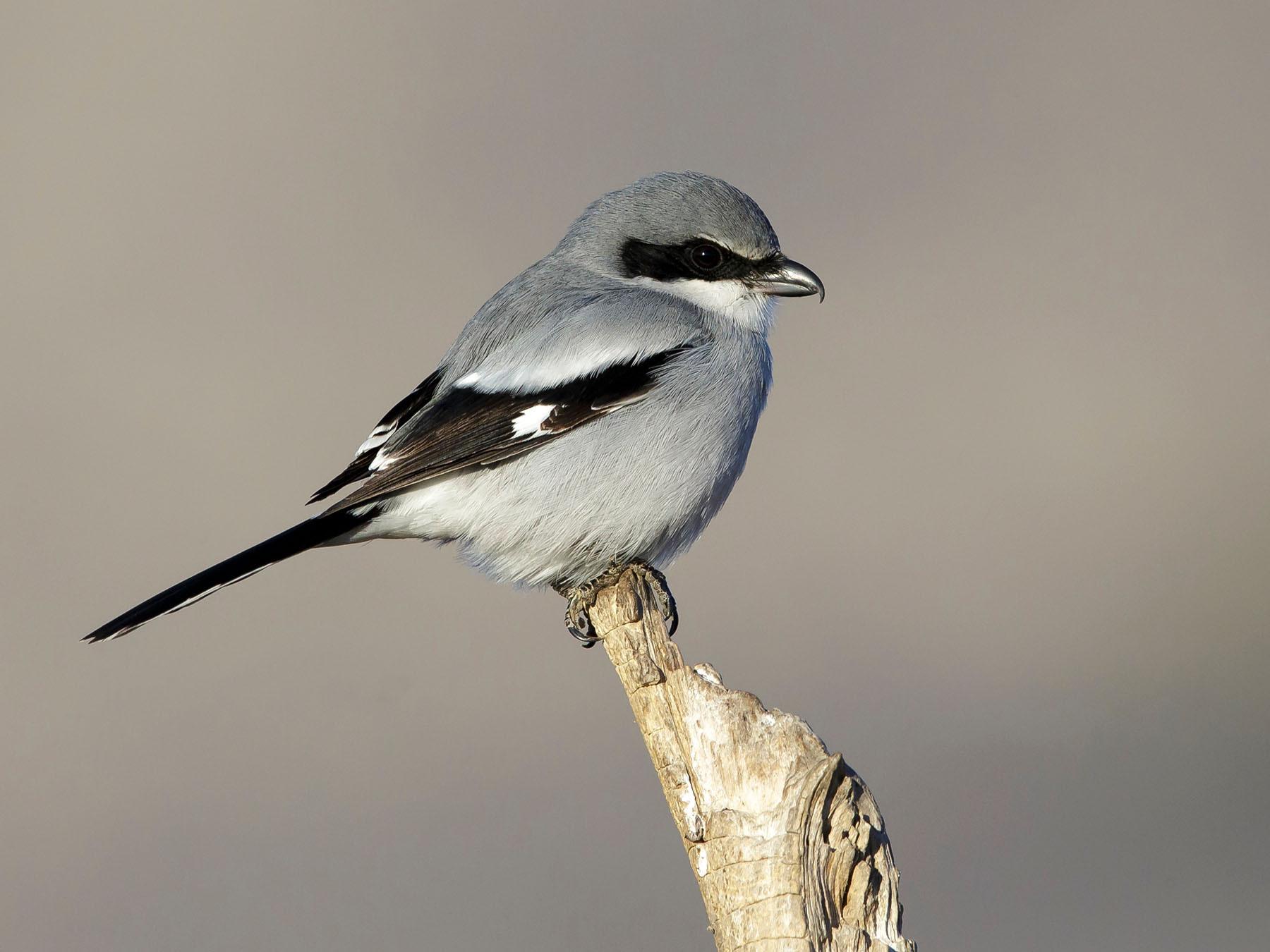
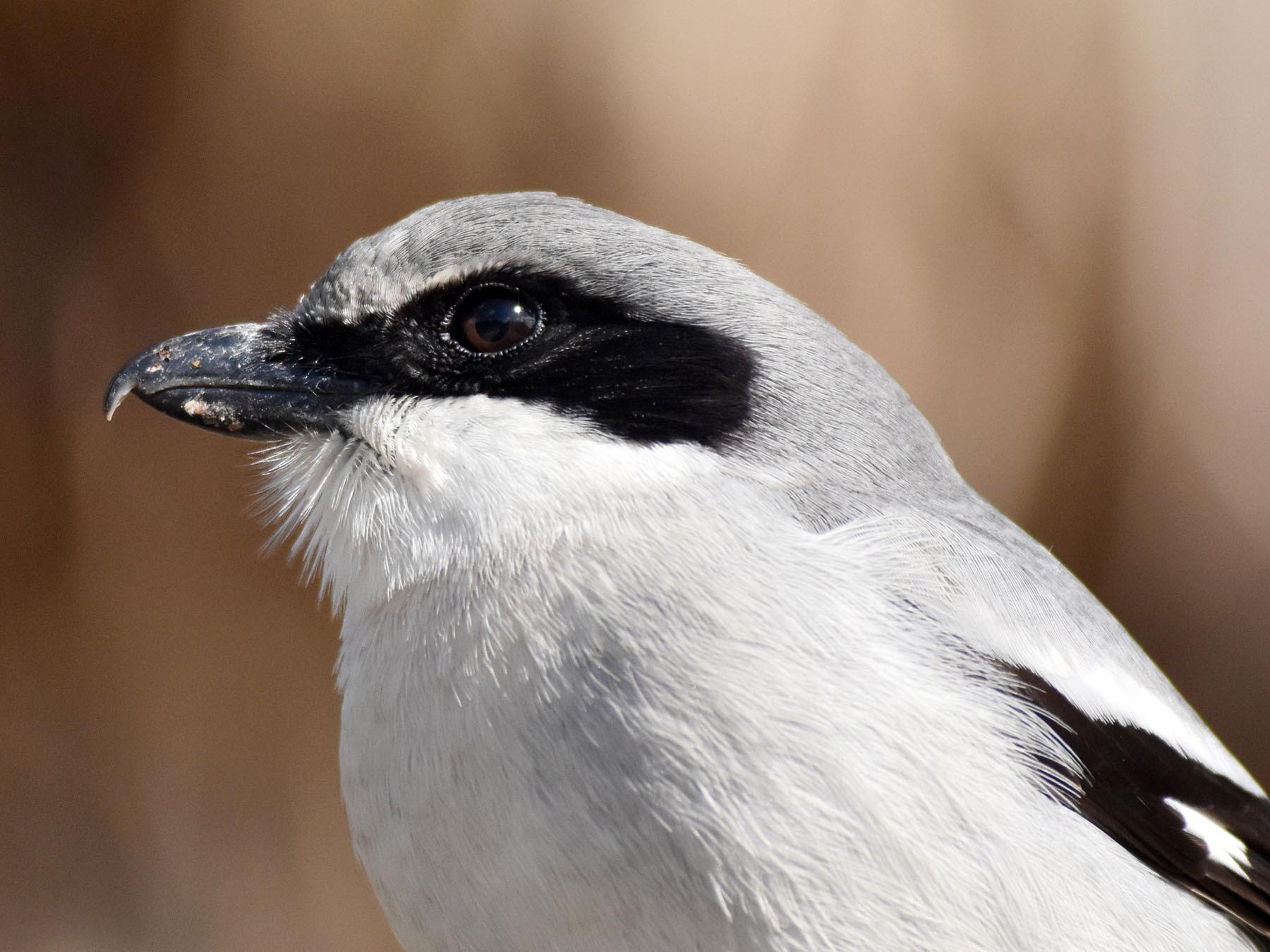
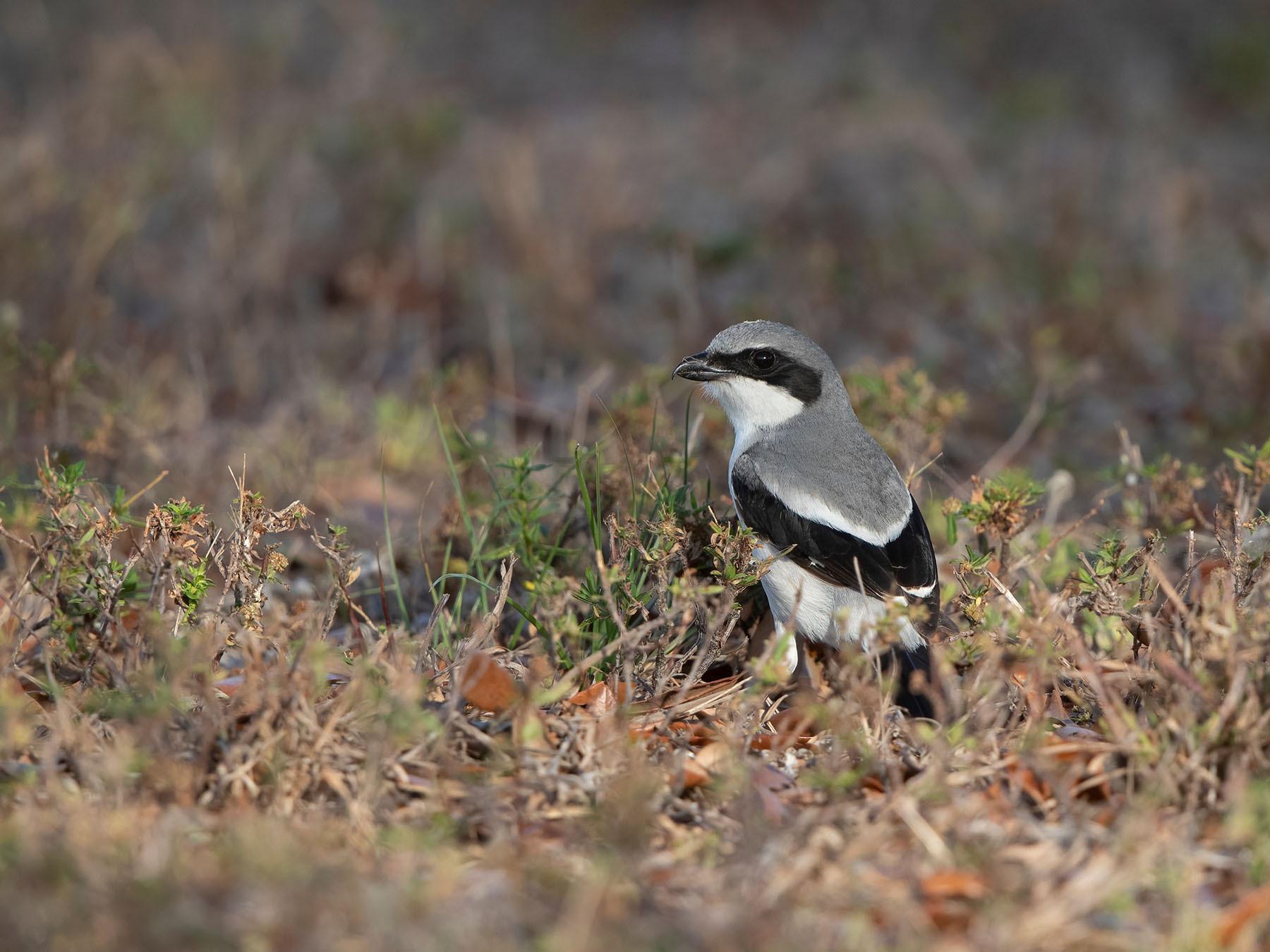
Look for a big-headed gray bird sitting level on an exposed perch, such as a fence, a wire or the top of a bush. A broad black mask runs through the eye and joins across the forehead just above the short, stout, hooked black bill. The bird is gray above and white below, sometimes with faint barring on the chest, and its wings and tail are black. At rest, a small white spot shows at the base of the primaries.
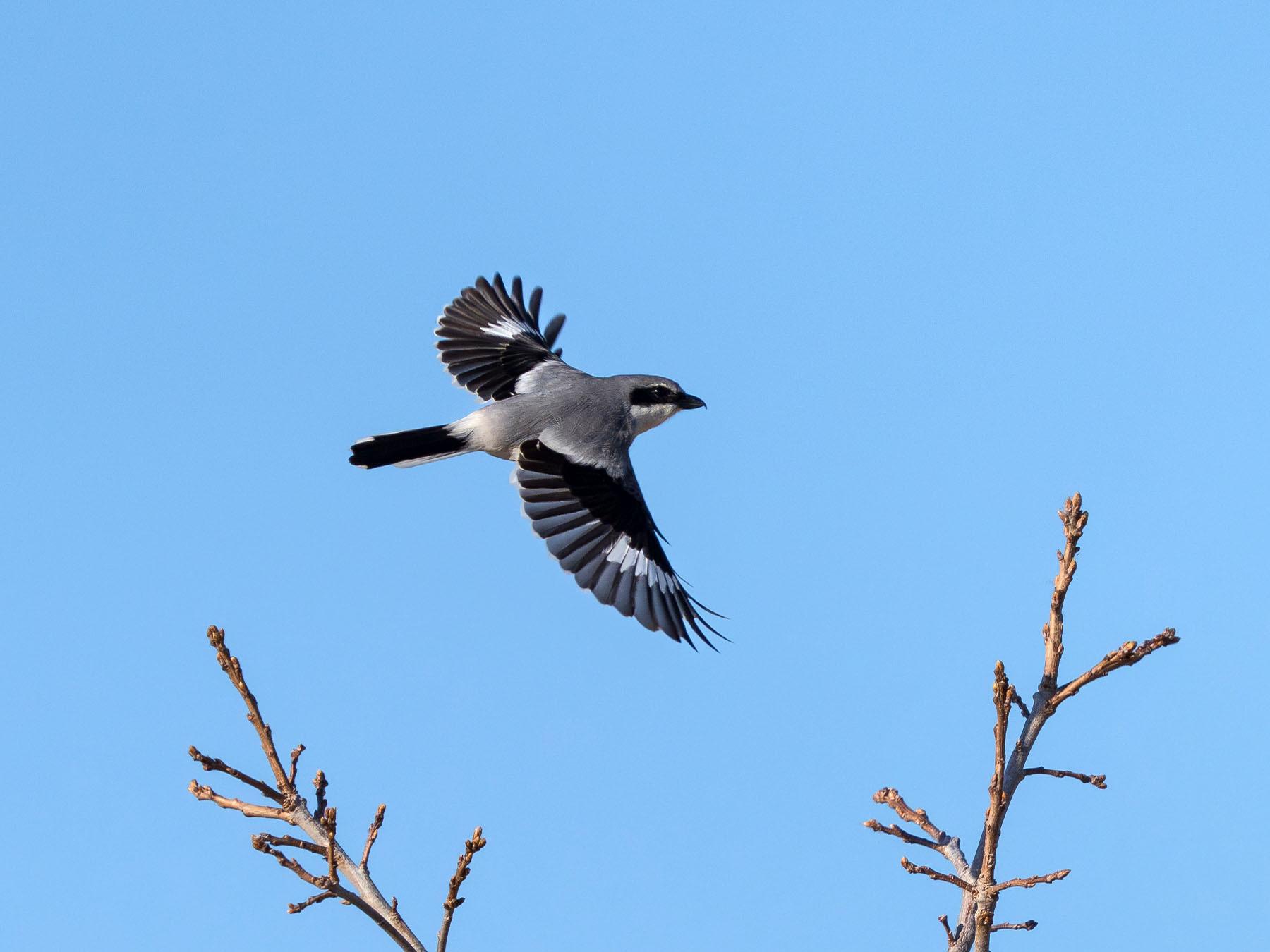
In flight it looks quite different. The white wing patches flash, and together with the pale rump and the white edges and tips of the black tail they make a striking pattern. It usually flies low over the ground, with bursts of fast wingbeats, then swoops up to land. Like an American Kestrel, it sometimes hovers while hunting.
Birds vary a little across the range. They are paler gray above in the north and darker in the south, and darkest of all on San Clemente Island off southern California. Birds of the interior West have white rumps, while eastern birds' rumps are pale to medium gray. The legs and feet are black and the eye dark brown.
Size and weight
It is 8.3–9.4 in (21–24 cm) long, with a wingspan of 11.8–13 in (30–33 cm), and weighs 1.6–1.8 oz (45–51 g)1: about robin-sized, but a little smaller and slimmer than an American Robin.
Male, female and young birds
Males and females look alike. Males average a little larger, and females tend to have browner primaries, but neither difference is much use in the field.
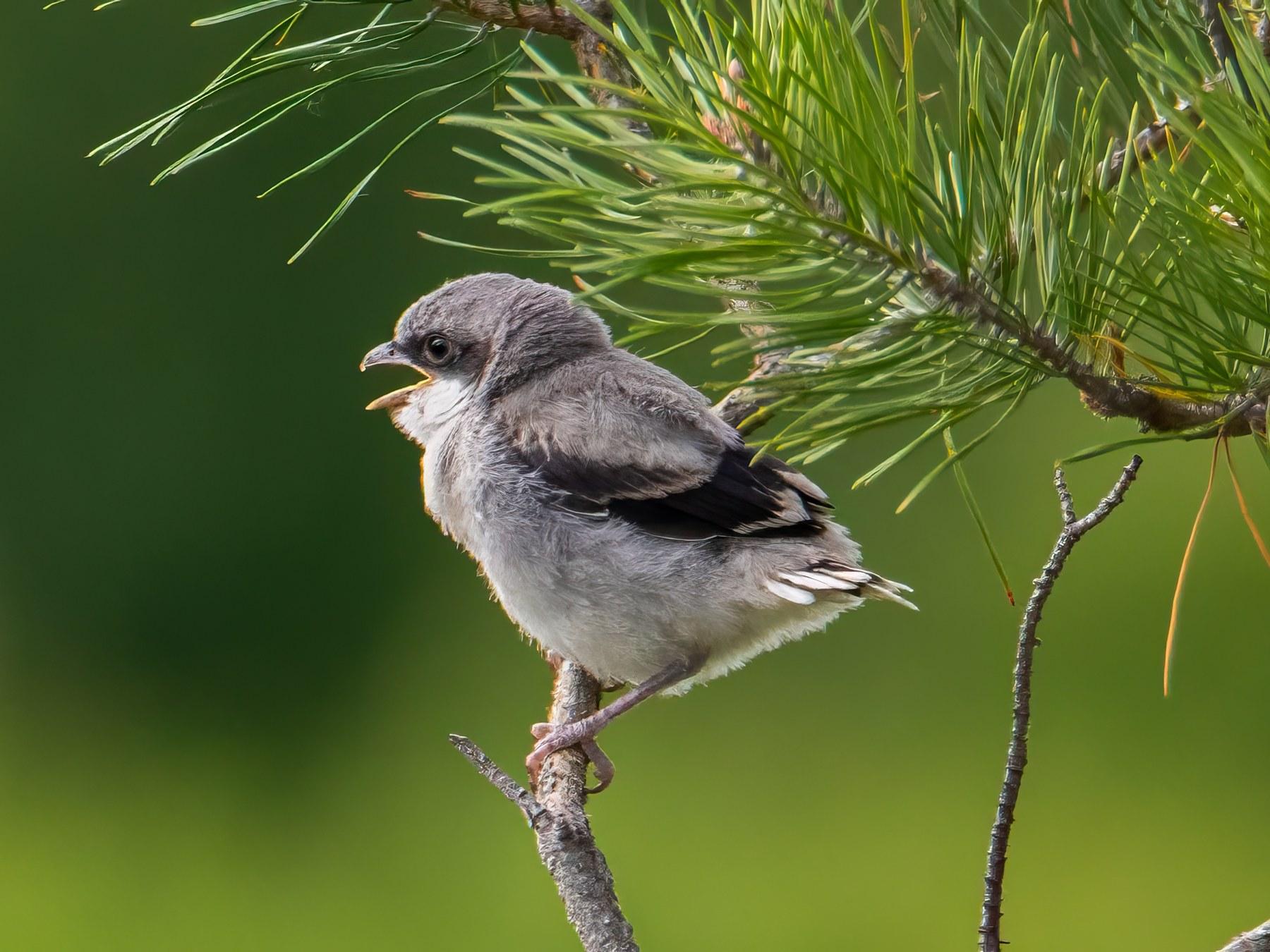
Young birds, seen mainly from May to October, are duller and drabber than adults. They are washed brown or smoky gray, with scaly buff fringes on the upperparts, two faint buffy wing bars, a brownish mask and fine barring below. The bill is grayish or pinkish at the base, and the swollen yellow gape at the corners of the mouth can last for months, sometimes into early November. By their first winter young birds look like adults, apart from some retained brownish feathers on the wing, the primary coverts.
Adults molt all their feathers once a year, mainly from July to November, and apparently have no spring molt. Young birds have a partial molt in their first summer and fall. Migrants of any age can pause their molt for the journey and finish it on the wintering grounds.2, 3
Identification: similar birds
At a glance a Northern Mockingbird can look like a shrike. But a mockingbird has only a thin dark line through the eye instead of a broad black mask, and it lacks the shrike's black wings and big hooked black bill. It sits less horizontally, and its flight is less direct, without the shrike's bursts of fast wingbeats. Next to a mockingbird, a shrike looks bigger-headed and thicker-necked.
The Northern Shrike is the closest lookalike. The two breed in different places but can share ground in winter. A Northern Shrike is about a quarter larger and paler gray, with a narrower mask that thins and is paler in front of the eye and usually does not cross the forehead above the bill. It also has whitish tufts over the nostrils, more barring below and, in winter, a pale base to the lower bill. First-winter Northern Shrikes are still brownish, while young Loggerheads look like adults by then.
Not sure it’s a Loggerhead Shrike? Check your photo: Birdfact names the bird and shows the look-alike side by side.
Its size
Adults- Length
- 21–24 cm
- Wingspan
- 30–33 cm
- Weight
- 45–51 g
Its song and calls
Its voice has not been well studied, and its song is generally quiet. The song is a series of notes, usually in pairs, ranging from buzzy and harsh to musical. Each song type is repeated several times, and both sexes sing. Calls are buzzy, harsh, metallic or nasal.
A common call is a run of 4 to 10 or more harsh notes that fade away. A "bzeek, bzeek" is aimed at a rival shrike or a bird predator. As a predator approaches, the male gives a sharp two-note whistle that turns into a buzzing call, and he slips into cover when it is almost overhead. Mainly against predators in the air, males give a rasping "aak-aak-aak". Females also click the bill rapidly to make a staccato clucking when they defend the nest; males have not been seen doing this.
It seems to be most vocal while breeding and defending the nest and much quieter at other times, and it sings most in the early morning and on sunny days. Captive young raised without adults produced all the usual notes but never strung them into the adults' rhythmic song.4
- Song phrases0:00 / 0:13
Recorded in Arizona, United States · May 2022
- Harsh calls0:00 / 0:10
Recorded in Florida, United States · October 2022
Heard one and not sure? Let the bird song identifier listen.
When and where to see it
The Loggerhead Shrike breeds from the southern Canadian Prairies, in southeast Alberta, southwest Saskatchewan and the far southwest of Manitoba, across most of the lower 48 states and on through Mexico. It is missing from high mountains and now from most of the Northeast, and only a few sites in southern Ontario and southwest Quebec still hold breeding birds.
In the East it is now patchy. It is most widespread on the Atlantic coastal plain from North Carolina to Georgia, in the lower Mississippi Valley and in Florida. In the West it nests in Washington and Oregon east of the Cascades, through the Great Basin and most of California, where it has become uncommon to rare in many coastal areas, and on five of the Channel Islands. It nests from sea level to about 9,800 ft (3,000 m) from California south through Baja California. In southern British Columbia it turns up only very rarely and has never been found breeding.
Look for it in open country with short vegetation and scattered shrubs or small trees: grassland and pasture, shrub-steppe, desert scrub and washes, open pinyon-juniper, savanna and farmland with hedgerows. It needs lookout perches, so scan fence lines and the wires and poles along mowed roadsides. It avoids forest and dense chaparral.
It also lives in some towns, using golf courses, cemeteries and other open urban ground. In Horry County, South Carolina, resident town shrikes studied from 2019 to 2022 had year-round home ranges averaging about 6 acres (2.5 ha).5
Migration and winter
It is a partial migrant. Nearly all birds that breed north of about 40°N migrate, as do birds from places where snow lies for long, while most southern breeders stay all year. In winter, mainly November to February, it is found through the breeding range except the north. It largely leaves Canada and the northern states from Washington to the Great Lakes and the Northeast, and spreads along Mexico's Atlantic slope, rarely as far as Chiapas.
Birds head north from March, peaking in early April, and reach the breeding range by mid-May. The move south begins in early to mid-August, and birds are settled for the winter by late October or early November.
Much is still unknown, because no shrike has been tracked over a long distance. Banding recoveries from 1923 to 1983 suggest that eastern birds winter about 560 miles (900 km) due south, while prairie birds may travel up to about 2,090 miles (3,360 km) to Texas or Mexico.4 In a 2004–2008 study of 916 wintering shrikes, feather isotopes marked 456 as migrants, from 34% in the eastern states to 79% in the western US and eastern Mexico.6
Tips for seeing it
What it eats
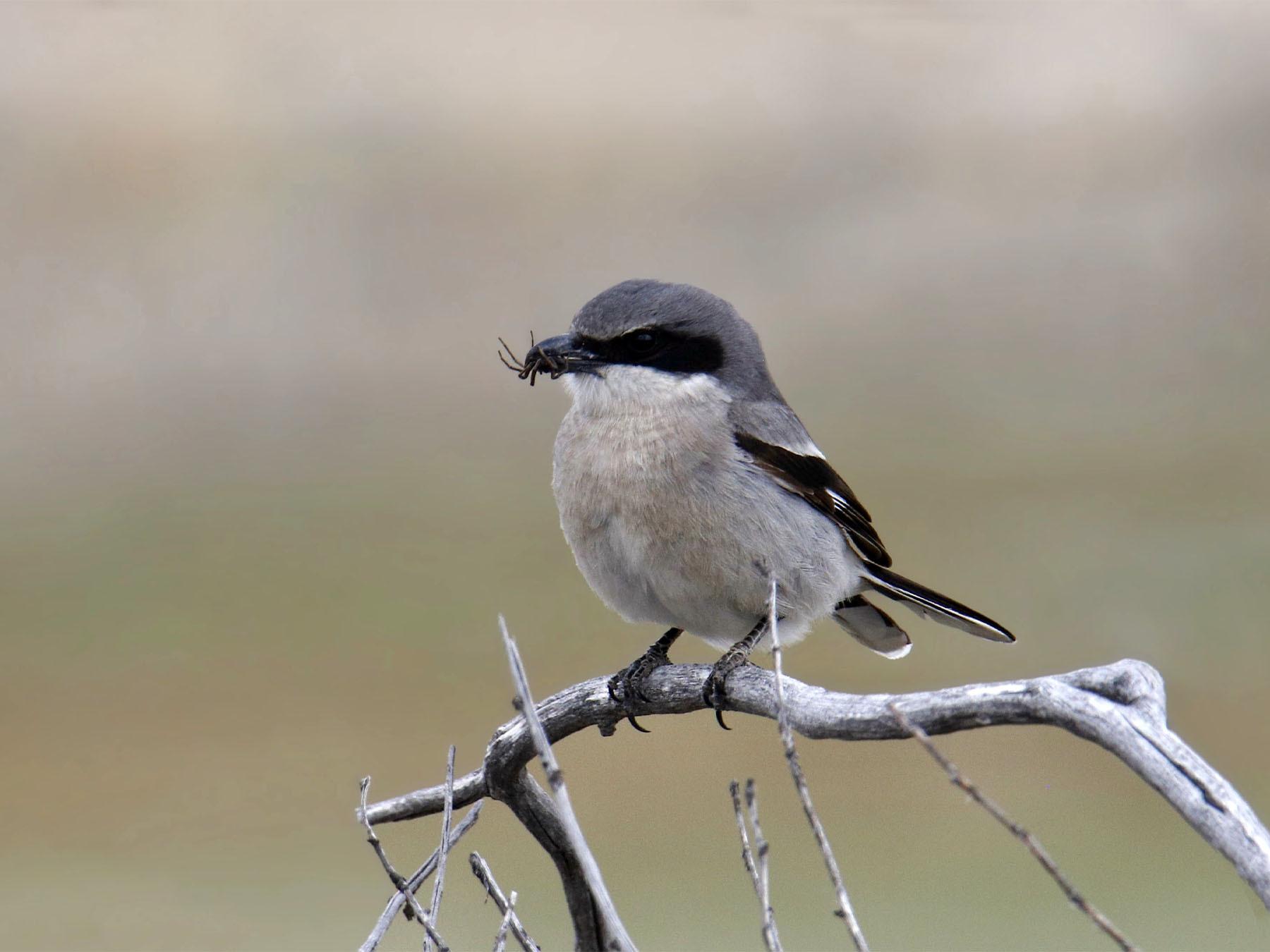
It eats mainly large insects, especially grasshoppers, crickets and beetles, along with other arthropods, lizards, snakes, frogs, small mammals such as mice and voles, and small birds. Insects make up most of the diet in summer, and vertebrates matter more in winter. It also eats roadkill and other carrion.
Old figures give a sense of the balance. A 1912 federal food study put insects at 68% of the diet in the eastern US and 83% in the western US, with vertebrates at 28% and 12%, and later studies found that outside the breeding season vertebrates can make up as much as 76%.4
The prey list is long. Reviews and reports record at least 43 kinds of lizard, snake and turtle, among them at least two rattlesnake species and cottonmouths, as well as 10 species of frogs and salamanders, and even bats.4
The largest prey on record is the Scaled Quail, almost four times a shrike's mean weight. In January 2016, on one ranch in Coahuila, Mexico, one shrike was found feeding on a freshly killed quail and a different shrike was seen making a kill. The authors suggest prey was scarce after a dry year and a very cold winter.7
How it kills and stores food
A shrike has a songbird's perching feet, not a raptor's talons. It hunts by sitting and waiting on a perch and dropping onto prey it spots by sight. It kills vertebrates with a precise bite to the back of the neck, and the tooth-like point on its upper bill probably helps it reach the spinal cord between the neck bones. High-speed video showed mice dispatched with a rapid twisting shake, 6 to 17 times a second.4 In a California study, birds with longer, narrower bills and longer hooks bit less hard, not harder.8
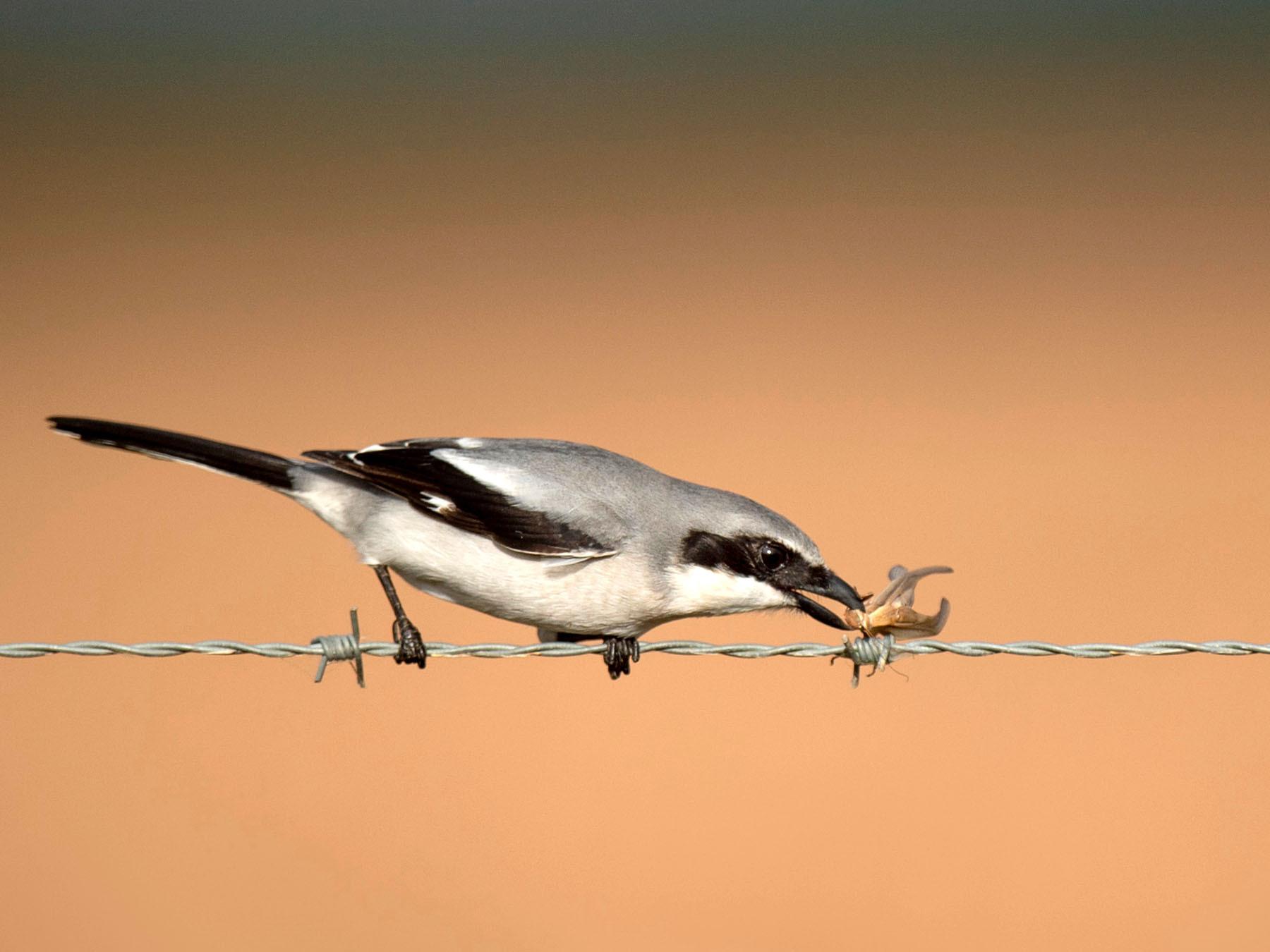
Then comes the habit it is famous for. It impales prey on thorns, barbed wire and other sharp points, or wedges it into a fork. This holds the prey while the shrike, which lacks strong feet, tears it into pieces, and it lets the bird keep a store of food, or larder, especially when food is short in winter or the demands of breeding are high. A larder may also help a male attract a mate.
Impaling also helps with prey that is unpleasant to eat. Monarch butterflies and eastern narrow-mouthed toads may hang for up to three days before the shrike eats them, presumably while their toxins break down. In Florida it leaves lubber grasshoppers for a day or two, then eats the head and abdomen and drops the thorax, which holds the poison glands.
Young birds learn the skill in stages. They dab at objects at 20–25 days old, wedge prey at 28–30 days and first impale at 33–35 days, reaching adult precision within two months.4 In a 1972 study, hand-reared birds denied anything to impale on until they were 75 days old or more ignored thorny branches offered later, and parents did not seem to teach impaling to their young.9
A larder can be large. Near one nest in Sacramento County, California, in the spring of 2024, when voles were unusually plentiful, more than 100 rodents, mostly California voles, were found impaled on a barbed-wire fence, one of the largest caches documented.10
Nesting and breeding
It is one of the first perching birds to nest each year: from March in the south, such as mid-March in south-central Florida, and from May or June in the north and at altitude. Pairs are mainly monogamous, though some females leave after the first brood to raise a second with another male. In courtship the male feeds the female, and he keeps bringing her food through incubation and brooding.
The nest is a bulky open cup of twigs, rootlets, plant stems and strips of bark, lined with soft plant down, feathers, fur or string. It is well hidden below the crown of a small to medium shrub or small tree, usually a thorny one, which probably helps protect it from predators; brush piles and tumbleweeds are used too. Both birds gather material, but the female does most of the building, which takes 6–11 days. Average nest heights in different studies run from about 2.6 ft (0.8 m) in Idaho up to about 8 ft (2.5 m) in Ontario.4
Plastic finds its way in. In 24 monitored nests in Ontario and Indiana, more than 20% held plastic, and three Ontario fledglings were found tangled in it.11
Eggs and young
The eggs are grayish buff with darker marks near the large end. In museum records from 1872 to 1989, clutches averaged 5.4 eggs (1–9), most often 5 or 6. Clutches are larger to the north and west, from 4.1 eggs in central Mexico and 4.4–4.8 in Florida to 6.1–6.4 in Manitoba, Oregon and Colorado.4
Only the female incubates, for about 16 days (15–17) in Florida, California, Oregon and Colorado and 18 days in central Mexico, while the male brings her food. The eggs hatch over 24–36 hours, and the female broods the chicks for their first 4–5 days while both parents feed them. The young have their feathers by about day 15 and fledge at 17–21 days. Birds of the World says there are no data on how long the parents go on feeding them after that, though in similar-sized shrikes such as the Red-backed Shrike it is about 2–3 weeks;4 the Audubon field guide gives 3–4 weeks.1
Pairs raise one or two broods, and how many try a second varies widely: none of 89 pairs in southern Idaho did, against 96% of pairs in south-central Florida.4 Most birds breed in their first spring.
Across 19 studies and 2,340 nests, 56% of nests fledged at least one young. Results range from 11–44% a year in central New Mexico and 26% in southeast Illinois to 78–89% in Ontario.4 Predators cause most failures, but weather matters too: in southeast Alberta, fewer nests survived in cool, wet weather, and in 1993, 11 of 44 failed nests were lost to weather, desertion or starvation rather than to predators.12 Losses go on after fledging, and in Indiana 46% of 86 fledglings died in their first week.4
The Brown-headed Cowbird rarely lays in its nests: 3 of 261 nests in southwest Iowa and 2 of 1,661 in Manitoba were parasitized, and shrikes chase cowbirds near the nest.4
Behaviour
Outside the pair it is largely solitary and does not form flocks. Resident pairs in Florida and South Carolina hold their territories all year, while in California pairs split after breeding and each bird defends its own winter territory. Neighbors settle boundary disputes with displays, bowing and fluttering their wings to flash the white patches, and only rarely fight.
It spends most of the day on a perch: about 80% of its time in an Arkansas winter study, and in California's Central Valley in winter shrikes were perched in 89% of observations. Its territories are larger than those of other insect-eating songbirds its size, probably because of how it hunts: in different studies, from about 11 acres (4.6 ha) in Missouri to 33 acres (13.4 ha) in Alberta and 84 acres (34 ha) on San Clemente Island.4 The town shrikes in South Carolina used smaller home ranges than rural birds.5
When hunting on the ground or mobbing, it often half-opens its wings to flash the white patches. What this does is not known; it may startle prey. In a captive breeding facility on San Clemente Island, 19 of 57 birds filmed attacking live prey from 2011 to 2024 flashed their wings at some point, and the researchers concluded that it helps capture, possibly by making prey move or freeze.13
It seems to win most encounters with other birds, chasing kingbirds, meadowlarks, mockingbirds and thrashers, though Northern Mockingbirds, Crested Caracaras and Burrowing Owls steal from its larders.4 On the ground it hops and does not walk, and it sunbathes lying flat on its belly with its wings spread.
Lifespan and predators
The oldest known wild Loggerhead Shrike was at least 11 years 9 months old: a male banded as a nestling in California in June 1998 and caught and released alive there in March 2010.14 It came from the San Clemente Island population.4 No source we read gives a typical lifespan. In southeast Alberta, yearly adult survival over two years was 38% for males and 27% for females, though birds that move away make such figures uncertain.4
Nest raiders in different studies include snakes, among them bullsnakes, as well as Black-billed Magpies, raccoons, Crested Caracaras, feral cats and weasels. On San Clemente Island, cats, island foxes and Common Ravens caused 44% of nest failures.4 When a hawk or falcon that hunts birds shows up, adults take cover in plants. Predators are a major cause of death for young birds, but probably not for adults.
Conservation
The Loggerhead Shrike is listed as Near Threatened on the IUCN Red List, in its 2020 assessment.15 Partners in Flight estimates about 7 million birds as of around 2010, about 4.6 million of them in the US and Canada,16 and survey counts have fallen further since.
On the North American Breeding Bird Survey, numbers fell by about 2.5% a year from 1966 to 2025, a clear decline, and by about 2.3% a year over the last ten of those years.17 The survey's index dropped from 3.22 birds a route in 1966 to 0.73 in 2025, about 77% lower.17 The falls appear steepest in the Midwest, the Southeast and Ontario, though the survey's estimates there are its least reliable, while the interior West, such as the Great Basin, shows no clear change.17
Its range has shrunk, most of all in the Northeast. It no longer breeds in the Maritimes and probably not in New England, appears to have gone from Wisconsin, and is very rare to absent in Pennsylvania and New York; a recent Quebec atlas confirmed a single breeding pair. On the northern Great Plains the range has pulled back south by as much as about 125 miles (200 km), and in Florida, breeding was confirmed in only half as many atlas blocks in 2011–2016 as in 1986–1991.4
Clearing of eastern forests in the mid-1800s may have let it spread north and east by the early 1900s; it was first recorded in southern Ontario in 1860 and in New England in 1868. Later, tractors, bigger fields with fewer hedgerows and the return of forest cut its open habitat.4 A 1997 review notes that, in parts of its range, contraction since the 1940s happened at the same time as forest regrowth, pasture loss and intensive row-crop farming.18
Population and decline
What mainly drives its decline across the range is not clear, and the main reviews say so.4, 19, 20 Loss of open habitat is clearly part of it, yet much habitat that looks suitable stays empty.4 In Canada, the national status report puts the declines down mainly to the loss of suitable grassland.21
Shrikes in farmland carry pesticide residues, and the decline coincided with pesticide use in the mid-1900s, but clear evidence of an effect on numbers is still lacking.4 In Illinois, levels of DDE in eggs fell by 79% between 1971–1972 and 1995–1996 while numbers kept falling, and the author suggests that organochlorine pesticides are likely not driving the state's current decline.22
Hunting from roadside perches puts shrikes in the way of traffic. In a small Virginia study, vehicles were the second most common cause of the deaths seen in fall and winter, after predation, and traffic could be a major factor in the decline, given how much roads and vehicles have multiplied since the 1940s.4 West Nile virus has killed eastern shrikes, both captive birds and wild nestlings.23, 24 It was found in 50% of dead shrikes tested in Texas, and climate change may now be a key factor too.4
Legal status
In the United States the Loggerhead Shrike is on the federal list of birds protected under the Migratory Bird Treaty Act.25 The Act makes it unlawful to pursue, hunt, take, capture, kill or possess such birds, among other acts, except as its regulations permit.26 The species as a whole has no Endangered Species Act listing, but one island race, the San Clemente loggerhead shrike, found only on San Clemente Island, California, has been listed as Endangered since 1977.27 The federal five-year review in 2025 recommended no change to its status and counted 52 potential breeders in 2025, down from 63 in 2020.28 Two mainland races, the migrant and prairie loggerhead shrikes, are federal Species of Concern, which is not a listing under the Act.29
In Canada the Migratory Birds Convention Act, 1994 protects it.30 Under the Species at Risk Act, the Eastern subspecies is listed as Endangered and the Prairie subspecies as Threatened,31 the same categories COSEWIC gave them in 2014.21 The State of Canada's Birds puts the Prairie population at about 55,000 birds and the Eastern population at 50 or fewer.32
In eastern Canada and on San Clemente Island, recovery work includes breeding birds in captivity and releasing them.4, 28 In Ontario, 564 captive-raised juveniles were released from 2004 to 2010, and from 2005 to 2011 returning birds were confirmed 27 times.33 We did not find the species on Mexico's list of protected wildlife, NOM-059 (2010, as modified in 2019).34
Names and relatives
For all its hunting, the Loggerhead Shrike is a songbird, not a bird of prey. It is one of about thirty true shrikes, the family Laniidae, small predators that hunt from perches and impale prey, and one of only two native to North America. The other, the Northern Shrike, is its closest relative; their breeding ranges do not overlap, and there is no evidence that they interbreed.
The name loggerhead refers to its head, which is big for its body; the word also means blockhead. Impaling lies behind both the genus name, Lanius, from the Latin for butcher, and the old popular name butcherbird. It is not to be confused with the butcherbirds of Australia and New Guinea, which share the name. The scientific name goes back to Brisson, who described the bird in 1760 from a specimen said to come from French Louisiane, a region reaching from the Great Lakes down to the Gulf of Mexico; Linnaeus adopted the name in 1766.
How many subspecies there are is disputed: AviList lists seven, while Birds of the World follows a list of eleven and says many are likely not separable in the field.35, 4 Eastern birds are called migrans in the US system and by AviList, but in Canada they are treated as an unnamed Eastern subspecies. Genetic work on 381 samples found San Clemente Island shrikes distinct from mainland and other island birds and supports their race, mearnsi, as valid.36
Similar birds
Often mistaken for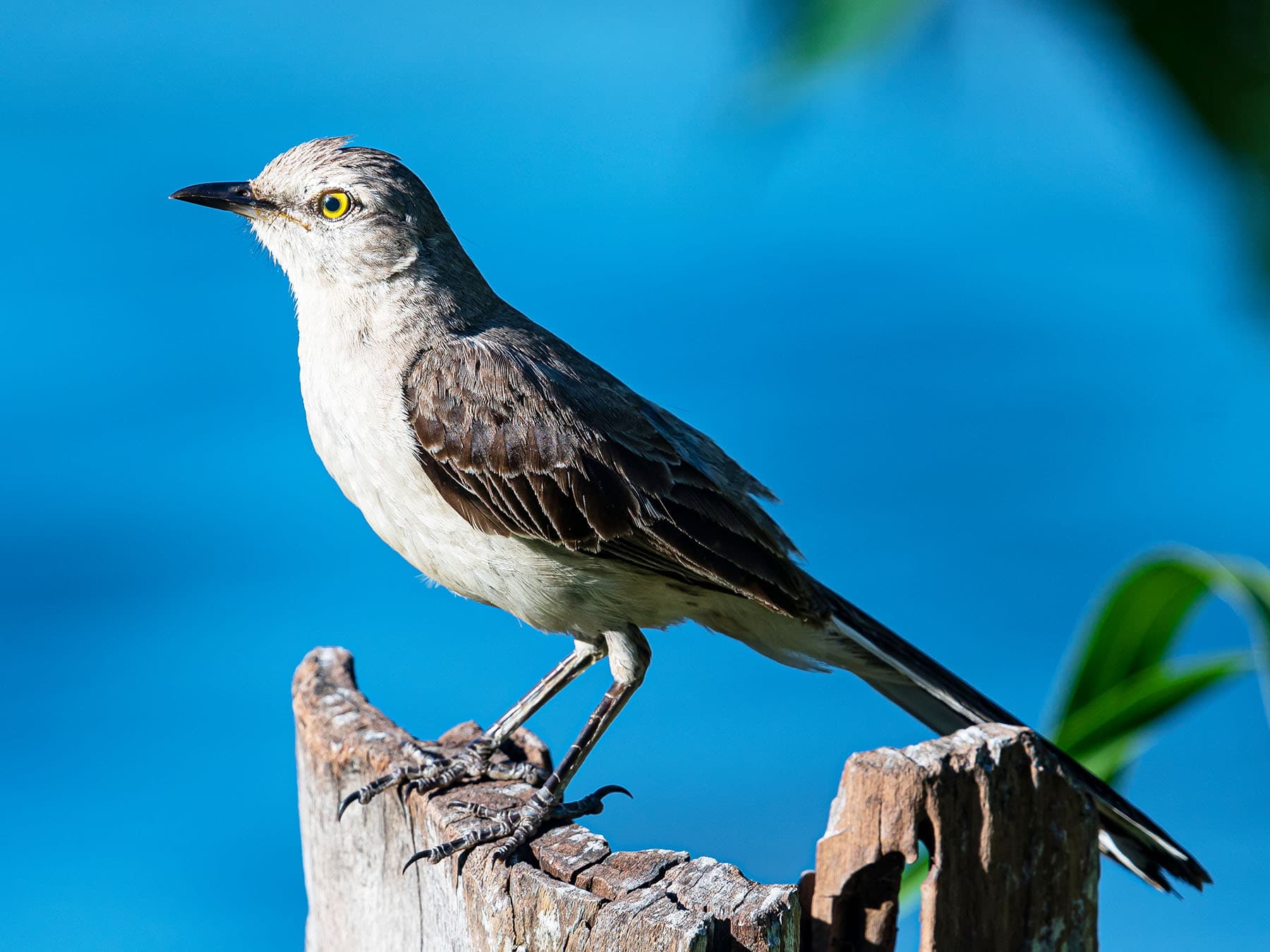
Quick facts
- Length
- 21–24 cm
- Wingspan
- 30–33 cm
- Weight
- 45–51 g
- Lifespan
- oldest recorded 11 years 9 months
- Family
- Shrikes
- Migration
- Partial migrant
- Global status (IUCN)
- Near Threatened
- World population
- About 7 million (Partners in Flight, around 2010)
- Population trend
- A steep, long-term decline: the Breeding Bird Survey shows a fall of about 2.5% a year since 1966, roughly three-quarters of its numbers, and the last ten years are still falling
- Also called
- Butcherbird
- Scientific name
- Lanius ludovicianus
Sources
45- 1National Audubon Society and Kaufman, K.. Loggerhead Shrike. Audubon Guide to North American Birds. Accessed 20 November 2026. Source (opens in a new tab)
- 2Chabot, Amy A., Hobson, Keith A., Craig, Susan and Lougheed, Stephen C. (2017). Moult in the Loggerhead Shrike Lanius ludovicianus is influenced by sex, latitude and migration. Ibis 160(2): 301-312. doi:10.1111/ibi.12551 (opens in a new tab)
- 3Pérez, Guillermo E. and Hobson, Keith A. (2006). Isotopic Evaluation of Interrupted Molt in Northern Breeding Populations of the Loggerhead Shrike. The Condor 108(4): 877-886. doi:10.1093/condor/108.4.877 (opens in a new tab)
- 4Yosef, R. and Pandolfino, E. R. (2026). Loggerhead Shrike (Lanius ludovicianus), version 2.0. Birds of the World (B. K. Keeney and P. Pyle, editors). Cornell Lab of Ornithology. doi:10.2173/bow.logshr.02 (opens in a new tab)
- 5Maddox, Katie and Hill, Christopher (2024). Use of space by urban Loggerhead Shrikes (Lanius ludovicianus) as a window into habitat suitability. Journal of Field Ornithology 95(2). doi:10.5751/jfo-00458-950206 (opens in a new tab)
- 6Chabot, Amy A. et al. (2018). Migratory connectivity in the Loggerhead Shrike (Lanius ludovicianus). Ecology and Evolution 8(22): 10662-10672. doi:10.1002/ece3.4415 (opens in a new tab)
- 7Peña-Peniche, Alexander, Canizales-Bañuelos, José Ángel and Ruvalcaba-Ortega, Irene (2023). The Loggerhead Shrike (Lanius ludovicianus) goes big game hunting. The Wilson Journal of Ornithology 135(4): 589-593. doi:10.1676/23-00053 (opens in a new tab)
- 8Sustaita, Diego and Rubega, Margaret A. (2014). The anatomy of a shrike bite: bill shape and bite performance in Loggerhead Shrikes. Biological Journal of the Linnean Society 112(3): 485-498. doi:10.1111/bij.12298 (opens in a new tab)
- 9Smith, Susan M. (1972). The Ontogeny of Impaling Behaviour in the Loggerhead Shrike, Lanius Ludovicianus L. Behaviour 42(3-4): 232-246. doi:10.1163/156853972x00284 (opens in a new tab)
- 10Conard, Chris (2026). Loggerhead Shrikes Produce a Large Prey Cache in Response to High Vole Abundance. Central Valley Birds 28(4): 132-135. doi:10.64555/5dxd1907 (opens in a new tab)
- 11Hudecki, Jane, Wheeler, Hazel and Chabot, Amy (2020). Evidence and impact of plastic use by the Loggerhead Shrike (Lanius ludovicianus). The Wilson Journal of Ornithology 132(3): 729-733. doi:10.1676/19-83 (opens in a new tab)
- 12Collister, Douglas M. and Wilson, Scott (2007). Contributions of Weather and Predation to Reduced Breeding Success in a Threatened Northern Loggerhead Shrike Population. Avian Conservation and Ecology 2(2). doi:10.5751/ace-00193-020211 (opens in a new tab)
- 13Mora, Y A et al. (2024). The Effect of Wing-Flashing Behavior on Prey Capture Performance of San Clemente Loggerhead Shrikes. Integrative Organismal Biology 7(1). doi:10.1093/iob/obae042 (opens in a new tab)
- 14USGS Bird Banding Laboratory. Longevity records, AOU 6220 (current and historical tables). U.S. Geological Survey, Eastern Ecological Science Center. Accessed 20 November 2026. Source (opens in a new tab)
- 15BirdLife International (2020). Lanius ludovicianus. The IUCN Red List of Threatened Species 2020 (via GBIF's copy of the IUCN checklist). IUCN Red List / GBIF. Accessed 20 November 2026. Source (opens in a new tab)
- 16Partners in Flight (2024). Avian Conservation Assessment Database, Global (version 2024.05.23). Partners in Flight. Accessed 20 November 2026. Source (opens in a new tab)
- 17Hostetler, J. A. et al. (2026). The North American Breeding Bird Survey, Analysis Results 1966 - 2025. U.S. Geological Survey. doi:10.5066/P1OSNSFC (opens in a new tab)
- 18Cade, Tom J. and Woods, Christopher P. (1997). Changes in Distribution and Abundance of the Loggerhead Shrike. Conservation Biology 11(1): 21-31. doi:10.1046/j.1523-1739.1997.95279.x (opens in a new tab)
- 19NatureServe. Lanius ludovicianus, Loggerhead Shrike (ELEMENT_GLOBAL.2.104527). NatureServe Explorer. Accessed 20 November 2026. Source (opens in a new tab)
- 20Vermillion, William G., DeMaso, Stephen J. and Parr, Mark W. (2024). Loggerhead Shrike (Lanius ludovicianus) in the Gulf Coast Joint Venture Region, USA: Status, Habitat Delivery, and Monitoring. European Journal of Ecology 10: 25-29. doi:10.17161/eurojecol.v10i.23243 (opens in a new tab)
- 21COSEWIC (2014). COSEWIC Assessment and Status Report on the Loggerhead Shrike Lanius ludovicianus in Canada. Government of Canada, Species at Risk Public Registry (Internet Archive copy). Accessed 20 November 2026. Source (opens in a new tab)
- 22Herkert, James R. (2004). Organochlorine Pesticides are not Implicated in the Decline of the Loggerhead Shrike. The Condor 106(3): 702-705. doi:10.1093/condor/106.3.702 (opens in a new tab)
- 23Bertelsen, Mads F. et al. (2004). West Nile Virus Infection in the Eastern Loggerhead Shrike (Lanius ludovicianus migrans): Pathology, Epidemiology, and Immunization. Journal of Wildlife Diseases 40(3): 538-542. doi:10.7589/0090-3558-40.3.538 (opens in a new tab)
- 24Lindgren, Cory J. et al. (2009). West Nile Virus as a Cause of Death Among Endangered Eastern Loggerhead Shrikes, Lanius ludovicianus migrans, in West St. Paul, Manitoba. The Canadian Field-Naturalist 123(1): 7. doi:10.22621/cfn.v123i1.669 (opens in a new tab)
- 25U.S. Fish and Wildlife Service (2023). 50 CFR 10.13, List of Migratory Birds. Electronic Code of Federal Regulations (version of 2026-11-18). Accessed 20 November 2026. Source (opens in a new tab)
- 26United States Congress (1918). 16 U.S.C. 703, Taking, killing, or possessing migratory birds unlawful. United States Code (Cornell LII copy). Accessed 20 November 2026. Source (opens in a new tab)
- 27U.S. Fish and Wildlife Service (2026). 50 CFR 17.11, Endangered and threatened wildlife. Electronic Code of Federal Regulations (version of 2026-11-18). Accessed 20 November 2026. Source (opens in a new tab)
- 28U.S. Fish and Wildlife Service, Carlsbad Fish and Wildlife Office (2025). San Clemente Loggerhead Shrike (Lanius ludovicianus mearnsi) 5-Year Review. U.S. Fish and Wildlife Service. Accessed 20 November 2026. Source (opens in a new tab)
- 29U.S. Fish and Wildlife Service. ECOS species reports for Lanius (pull report and species pages 5142, 3639, 8833, 2654). Environmental Conservation Online System. Accessed 20 November 2026. Source (opens in a new tab)
- 30Parliament of Canada (1994). Migratory Birds Convention Act, 1994 (S.C. 1994, c. 22). Justice Laws Website (current to 2026-10-29). Accessed 20 November 2026. Source (opens in a new tab)
- 31Parliament of Canada (2002). Species at Risk Act (S.C. 2002, c. 29), Schedule 1. Justice Laws Website (current to 2026-10-29). Accessed 20 November 2026. Source (opens in a new tab)
- 32Environment and Climate Change Canada and Birds Canada. The State of Canada's Birds - Loggerhead Shrike. NatureCounts, Birds Canada. Accessed 20 November 2026. Source (opens in a new tab)
- 33Lagios, E. L. et al. (2014). Recruitment of juvenile, captive-reared eastern loggerhead shrikes Lanius ludovicianus migrans into the wild population in Canada. Oryx 49(2): 321-328. doi:10.1017/s0030605313000690 (opens in a new tab)
- 34SEMARNAT (2010). NOM-059-SEMARNAT-2010, Anexo Normativo III (and the 14 Nov 2019 modification). Diario Oficial de la Federación. Accessed 20 November 2026. Source (opens in a new tab)
- 35AviList Core Team (2026). AviList: The Global Avian Checklist, v2025b. AviList. doi:10.2173/avilist.v2025b (opens in a new tab)
- 36Rutledge, L.Y., Coxon, A. and White, B.N. (2017). Genetic assessment of the San Clemente Island loggerhead shrike reveals evidence of historical gene flow with Santa Catalina Island. Global Ecology and Conservation 11: 42-52. doi:10.1016/j.gecco.2017.04.002 (opens in a new tab)
- 37Cornell Lab of Ornithology. Loggerhead Shrike: Overview, Identification and Life History. All About Birds. Accessed 20 November 2026. Source (opens in a new tab)
- 38Farnsworth, G. et al. (2020). Northern Mockingbird (Mimus polyglottos), version 1.0: Identification. Birds of the World. Cornell Lab of Ornithology. doi:10.2173/bow.normoc.01 (opens in a new tab)
- 39Paruk, J. D. et al. (2020). Northern Shrike (Lanius borealis), version 1.0: Identification. Birds of the World. Cornell Lab of Ornithology. doi:10.2173/bow.norshr4.01 (opens in a new tab)
- 40U.S. Fish and Wildlife Service. Species profile: Prairie Loggerhead Shrike (Lanius ludovicianus excubitorides), life history. Environmental Conservation Online System. Accessed 20 November 2026. Source (opens in a new tab)
- 41Environment and Climate Change Canada. Birds protected in Canada under the Migratory Birds Convention Act, 1994 (partial list). Government of Canada (Internet Archive copy of 4 Oct 2026). Accessed 20 November 2026. Source (opens in a new tab)
- 42Worm, Alexander J. and Boves, Than J. (2019). Bringing Home the Bacon: A Lanius ludovicianus (Loggerhead Shrike) Caches an Anthropogenic Food Item in an Urban Environment. Southeastern Naturalist 18(4). doi:10.1656/058.018.0412 (opens in a new tab)
- 43BURTON, KENNETH M. (1999). Use of Barbed Wire by Loggerhead Shrikes (Lanius ludovicianus) to Manipulate Nest Materials. The American Midland Naturalist 142(1): 198-199. doi:10.1674/0003-0031(1999)142[0198:uobwbl]2.0.co;2 (opens in a new tab)
- 44Soto Rojas, Octavio et al. (2024). BREEDING BIOLOGY OF THE LOGGERHEAD SHRIKE LANIUS LUDOVICIANUS IN CENTRAL MEXICO. Ornitología Neotropical 35(1). doi:10.58843/ornneo.v35i1.1209 (opens in a new tab)
- 45CHABOT, AMY A., BIRD, DAVID M. and TITMAN, RODGER D. (2001). BREEDING BIOLOGY AND NESTING SUCCESS OF LOGGERHEAD SHRIKES IN ONTARIO. The Wilson Bulletin 113(3): 285-289. doi:10.1676/0043-5643(2001)113[0285:bbanso]2.0.co;2 (opens in a new tab)

Checked by
Nathan Cope, founder and editor
Nathan founded Birdfact and leads its writers and contributors in the UK, the US and Canada. He has watched and studied birds for more than ten years, and checks every article and species guide before it’s published.