


Canada Jay
Gray Jay, Whiskey Jack, Camp Robber · Perisoreus canadensis
By the Birdfact teamChecked by Nathan Cope
On this page14 sections
How to recognise it
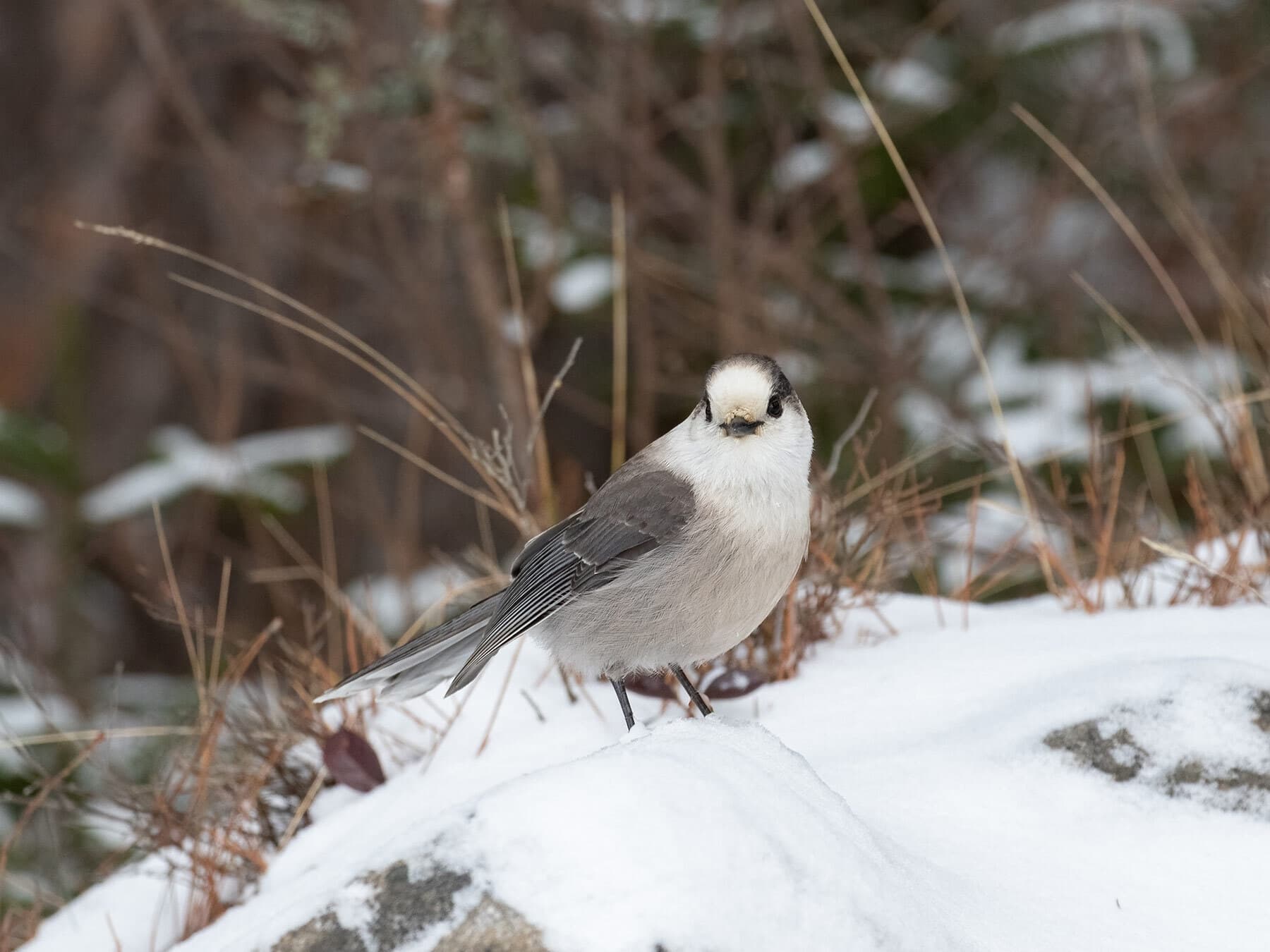
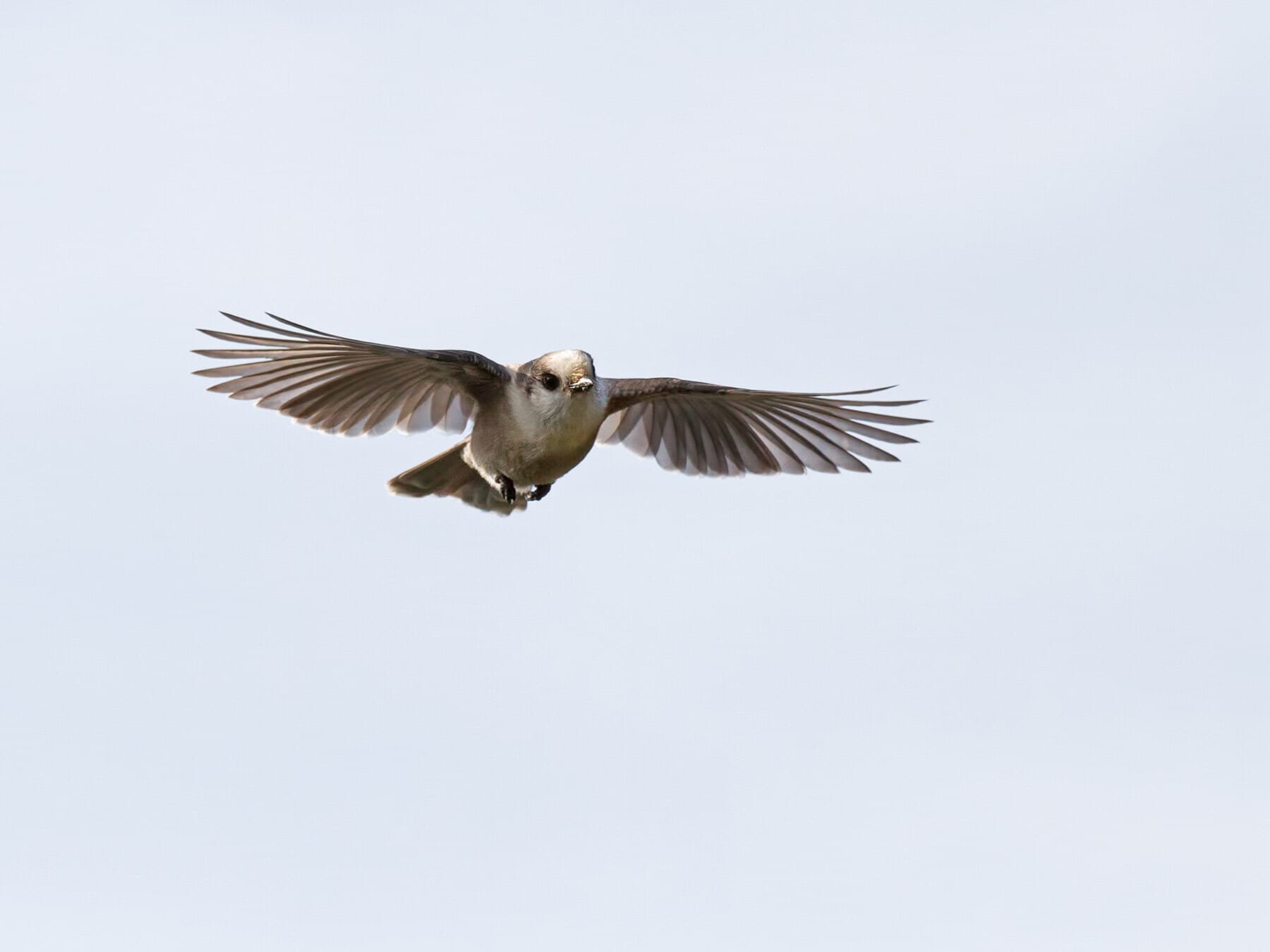
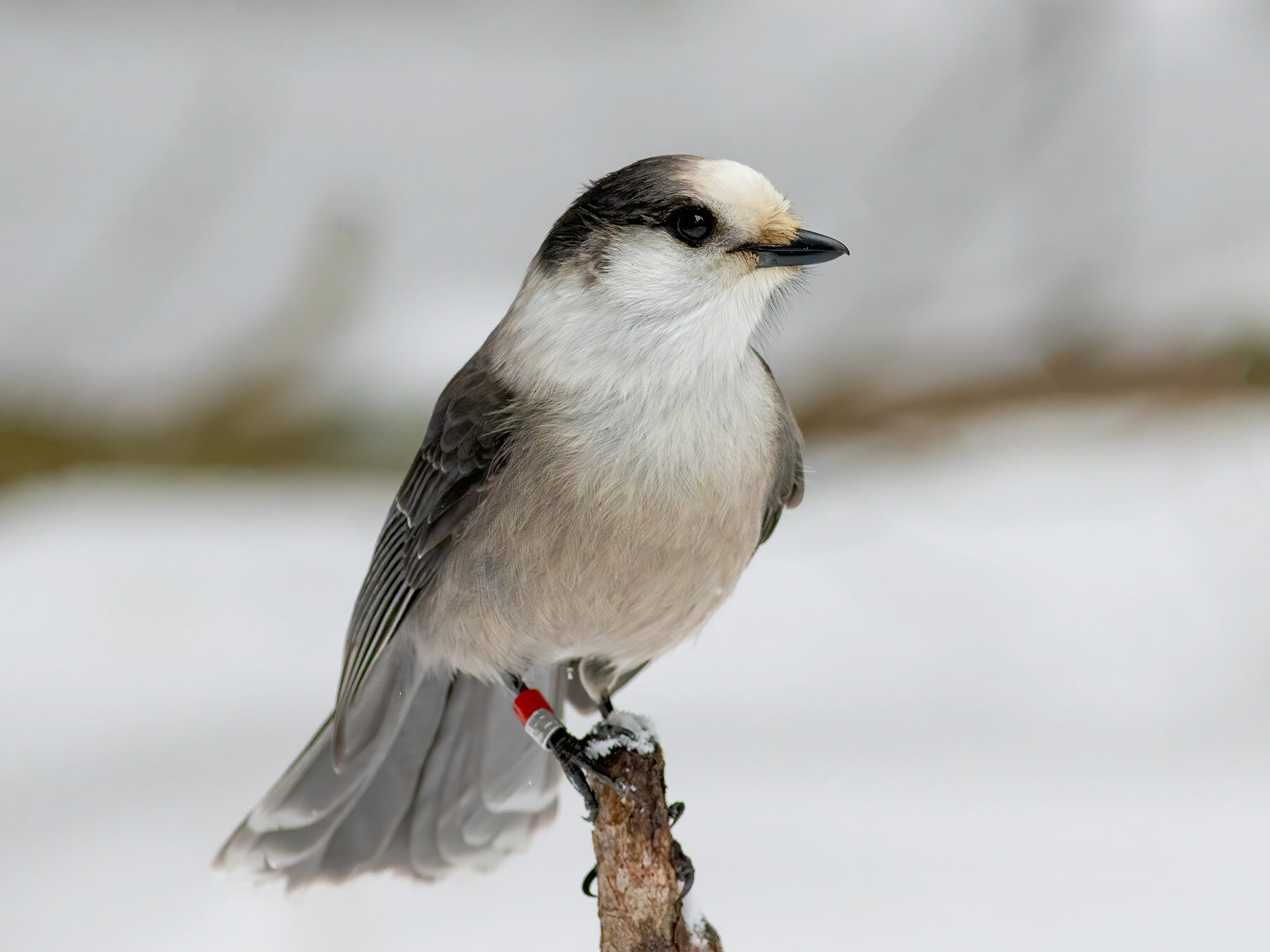
The Canada Jay is a fluffy, gray jay of the northern forests, with a long tail, a tiny black bill and no crest. Look for the white forehead, face and throat and the dark cap or patch on the back of the head; the rest of the bird is gray, darker above and paler below. Its feathers are long and loose, so it often looks puffed up, and feathers even cover its nostrils, which makes the bill look shorter still.
Until 2018 its official name in North America was Gray Jay.1 Many people still call it the whiskey jack, and campers and hikers know it as the camp robber, for the food it takes from them. Males and females look alike.
Size
A Canada Jay is about 10-13 in (25-33 cm) long, with a wingspan of about 17-18 in (43-46 cm), and weighs about 2.0-3.0 oz (58-84 g): a little smaller than a Blue Jay or Steller's Jay and bigger than an American Robin. Field guides differ a little on its length, so the range here spans them. Males average heavier than females.
Juveniles and young birds
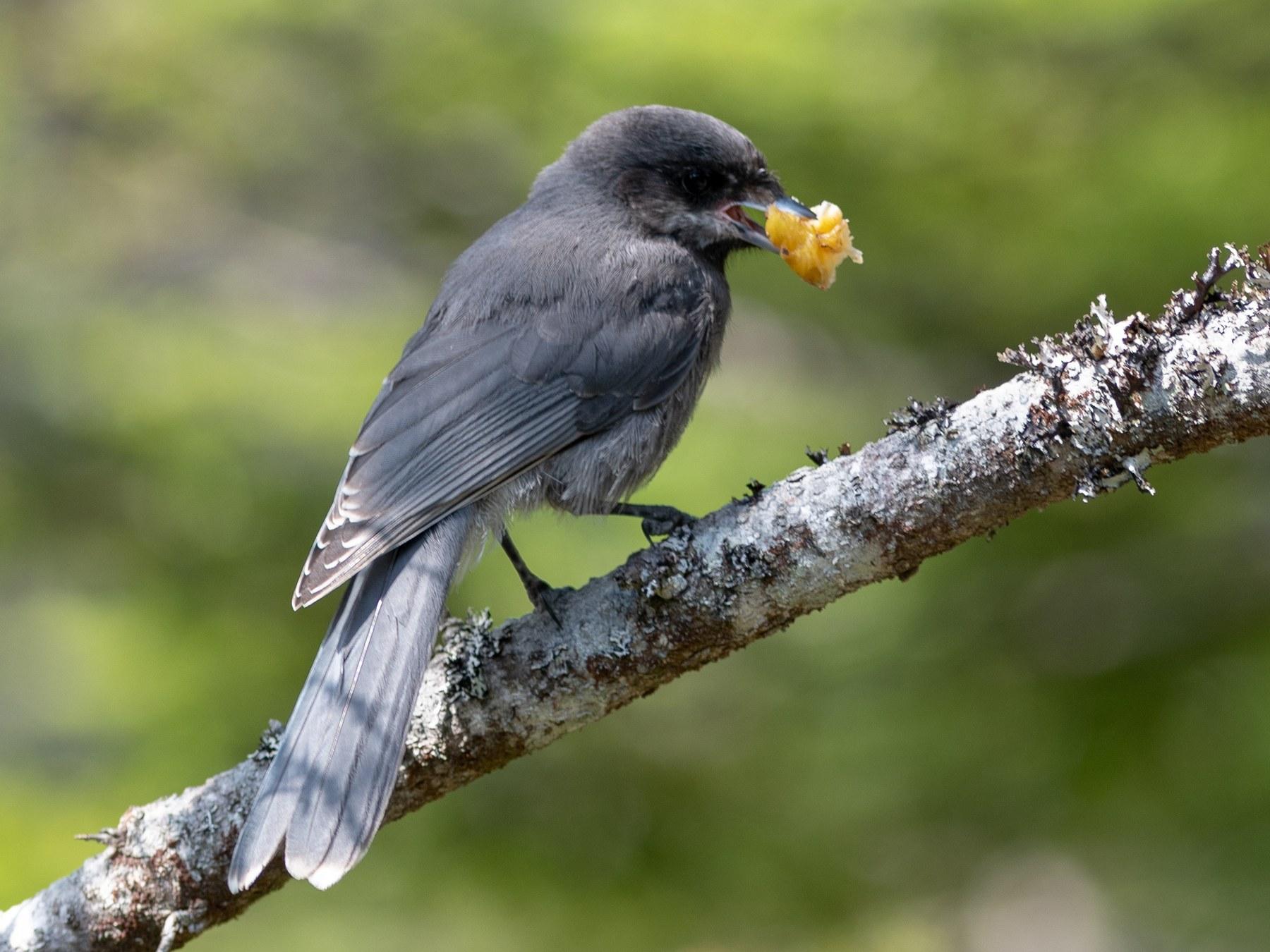
Young Canada Jays in their first summer look like a different bird: sooty dark gray all over, with none of the adult's white face. Many show a paler gray mustache or a whitish streak under the eye, and pale corners to the mouth where the bill meets the face. The bill is pale when they leave the nest and turns black over the summer. They wear this plumage from about May to August, then molt into an adult-like plumage by late summer or early fall. Young birds in the Rocky Mountains are paler gray, and young coastal birds browner.
Plumage across the range
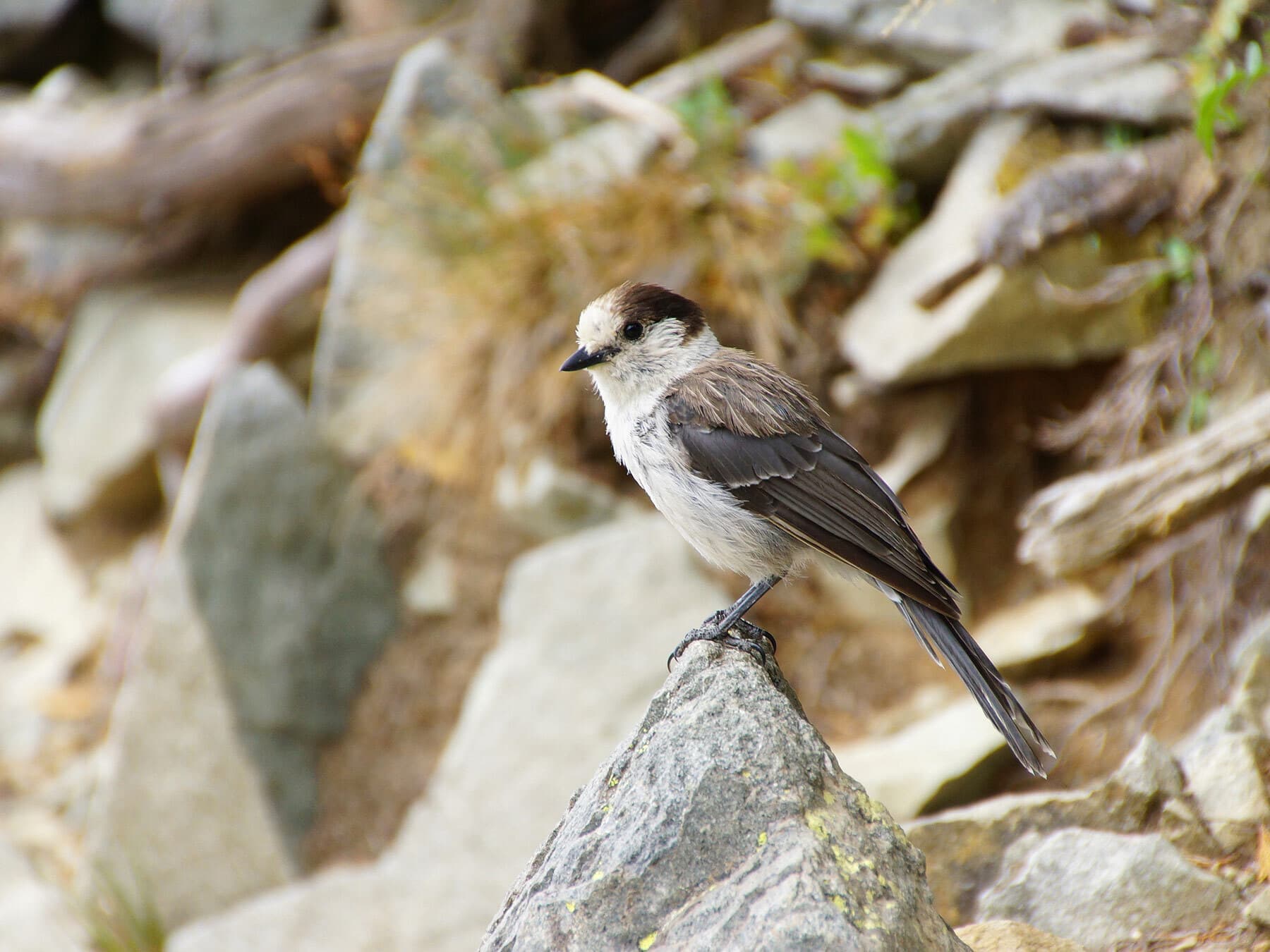
Canada Jays look different from one region to another, and birders often sort them into three groups. Boreal birds, across Canada, Alaska and the northern states, show the clearest contrast between the white face and dark nape; the darkest of all live in Newfoundland and northeastern Canada. Rocky Mountain birds are the palest, with heads that look almost all white, gray only at the very back. Pacific birds of the Cascades and Coast Ranges are browner, with more dark on the head, a pale breast and fine white streaks on the back; they were once treated as a separate species, whose two races were called the Oregon Jay and the Gray Jay, until 1944.2
Checklists name eight or nine subspecies, though experts do not agree on how many can really be told apart. A genetic study of 205 birds from 50 places found four lineages: one right across the boreal forest and three in the western mountains, in Colorado, the northern Rockies and the Pacific Northwest.3

Identification: similar birds
A Canada Jay is hard to mistake for anything else in its range. In the western mountains, the one bird of similar size and colors is Clark's Nutcracker, which has an all-gray head, a long, spike-like bill, a shorter tail and black wings with white patches, and is louder and more obvious. At a distance, a young or female Pine Grosbeak perched on a spruce top can look like one, but it is smaller and small-headed, with a yellowish or reddish wash.
Other jays are easy to tell apart: a Blue Jay is blue with a crest, and a Steller's Jay is dark blue and black with a tall crest.
Not sure it’s a Canada Jay? Check your photo: Birdfact names the bird and shows the look-alike side by side.
Its size
Adults- Length
- 25–33 cm
- Wingspan
- 43–46 cm
- Weight
- 58–84 g
Its song and calls
For a member of the crow family the Canada Jay is quiet, and you often notice it only when it glides silently in to see what you are doing. It does have many calls. Its best-known call is a clear, two-part whistle that drops in pitch, written whee-oo or whee-ah; one bird, often a male, uses it to call its mate to follow. Pairs and family groups keep in touch with a single repeated note as they fly to and from food, and a loud, harsh, rapid chatter goes with mobbing a predator on the ground. It also gives chuck notes, screams and soft twittering.
Its song is a whisper song: soft, musical notes and quiet clicks, often lasting half a minute to a minute, sung by a bird sitting quietly with its feathers fluffed. It can be heard in any month.
Canada Jays are good mimics. Most of the birds they copy are predators: Red-tailed, Broad-winged and Rough-legged Hawks, Merlins and Northern Pygmy-Owls, and nest robbers such as Blue Jays and American Crows. Copying a predator may warn other jays or confuse the predator itself. In Algonquin Park, Ontario, the long-term observer there heard no imitations of Merlins before the early 2000s but more since, perhaps as Merlins returned to the area.2
- Whistled calls0:00 / 0:11
Recorded in British Columbia, Canada · July 2025
- Rapid calls0:00 / 0:32
Recorded in Newfoundland, Canada · August 2025
Heard one and not sure? Let the bird song identifier listen.
When and where to see it
Canada Jays live in the boreal and mountain conifer forests of northern North America, from the tree line in Alaska and northern Canada south to the northern Great Lakes states and northern New England, and through the western mountains to Arizona, New Mexico and northern California. They are found in all 13 Canadian provinces and territories.
In the lower 48 states look for them in the Adirondacks of New York, northern New Hampshire, Vermont's Northeastern Highlands, northern Maine, Michigan's Upper Peninsula and Isle Royale, northern Wisconsin, northeastern Minnesota, and the Black Hills of South Dakota; and in the West in the Rocky Mountains, the Cascades and the coastal forests of Washington, Oregon and northern California. They are missing from the Sierra Nevada.
They are birds of spruce above all: black spruce bogs in the East, spruce, fir and lodgepole pine in the western mountains, where they live high up, from about 8,500 ft (2,600 m) to tree line in Colorado.2 The easiest way to see one is to stop for lunch on a trail or at a campsite in the right forest: curious jays often find you.

Do they migrate?
No. Canada Jays stay on the same territory all year, through the coldest northern winters. Of 178 banded birds found again, out of 3,567 banded up to 1990, 94% were in the same or the next block of about 10 minutes of latitude and longitude, up to nine years later.2
In some falls, though, groups move south in irruptions, seen along the north shores of the Gulf of St. Lawrence and Lake Superior. In the only flight where ages were checked, on Lake Superior's north shore in 2010, at least 90 of 120 birds banded were young of the year. Large flights reached southern Ontario in 1839-40 and 1905-06 and roughly once every 20 years since.2 In the western mountains a few move downhill in winter.
Tips for seeing it
What it eats
Canada Jays eat almost anything: insects and spiders, berries, mushrooms, carrion, the eggs and chicks of other birds, small mammals, and frogs, and tadpoles and young salamanders caught by wading in shallow water. Blueberries and other forest-floor berries are the main plant food; they do not take seeds from cones. In the stomachs of 67 birds from Ontario, Quebec and elsewhere, 82% held insects or other small invertebrates, 76% berry seeds and 31% the fur or bones of small mammals, which turned up in 14 of the 18 birds taken in December to February.2
They find food by watching from a series of perches, each a short flight from the last, then dropping onto whatever they see. They snap insects out of the air, scavenge at kills left by wolves and hunters, and have been seen landing on a live moose to eat the ticks on its back. They often take eggs and nestlings and are major predators of tree nests in the boreal forest.2 They occasionally chase small birds and have rarely caught one. Instead of hammering hard or frozen food as a Blue Jay does, they tear pieces off by twisting and tugging, and they carry heavy items in their feet, which few songbirds do: in one study, food heavier than about a third of the bird's weight went to the feet.2
Storing food for winter
Storing food is how a Canada Jay survives. All year it works pieces of food around in its mouth, coating them with sticky saliva from salivary glands as big as a woodpecker's, which a 1961 study knew from no songbirds outside this genus (the Siberian Jay has them too),4 and glues them behind flakes of bark, under lichens, among conifer needles or in forks of branches. A single jay makes thousands of these stores: in Alaska in summer, birds made more than 1,000 in a 17-hour day and spent over 95% of the day storing food.2 They find them again months later, probably by memory, and live on them through the winter.
Stored food matters for nesting too. When researchers fed breeding pairs dyed food before the female began incubating, the dye showed up in the nestlings more than 40 days later, so food stored in winter can go to the young.2 A study of the DNA in their droppings found that in Algonquin Park about 39% of the food items in adults' winter diet, and 29% of nestlings' items, probably came from stores.5
Feeders and handouts
Where they live, Canada Jays visit feeders, taking black-oil and hulled sunflower seed, peanuts, suet, fruit and mealworms from tube, hopper, platform and suet feeders or from the ground. They also learn quickly to take food from people, which earned them the name camp robber, and many will land on an outstretched hand.
Nesting and breeding
Canada Jays nest remarkably early, in late winter, when the forest is still deep in snow and the lakes are frozen. Building can start in early February. In a long study in Algonquin Park, Ontario, first eggs were laid from 22 February, on average about 23 March; in Alaska, on Anticosti Island in Quebec and high in Colorado's mountains laying starts in April. Eggs have been incubated at air temperatures as low as -22 F (-30 C).2
The male chooses the site, usually in a spruce or fir and close against the trunk, often on the south side of a tree near a bog or clearing, and usually fairly low, about 15-20 ft (4.5-6 m) up on average, though some are much higher.2 Both birds build, the male doing more at first: a bulky cup of twigs held together with caterpillar cocoons, filled out with bark strips and lichens and lined with feathers and fur. Building takes about three weeks.
Eggs, incubation and nestlings
The female lays 2-5 pale greenish-white or gray eggs, finely spotted with olive or rusty brown; three is usual. Only she incubates, for about 18-19 days, while the male brings her food. She sits on the eggs almost all the time, and in a snowstorm she spreads her wings a little and stands up every so often to shake the snow off. Both parents feed the young, which leave the nest at about 22-24 days old; in Algonquin Park that is before most migrant birds have returned. A pair raises one brood a year and nests again only if it loses its eggs early.
The young leave home
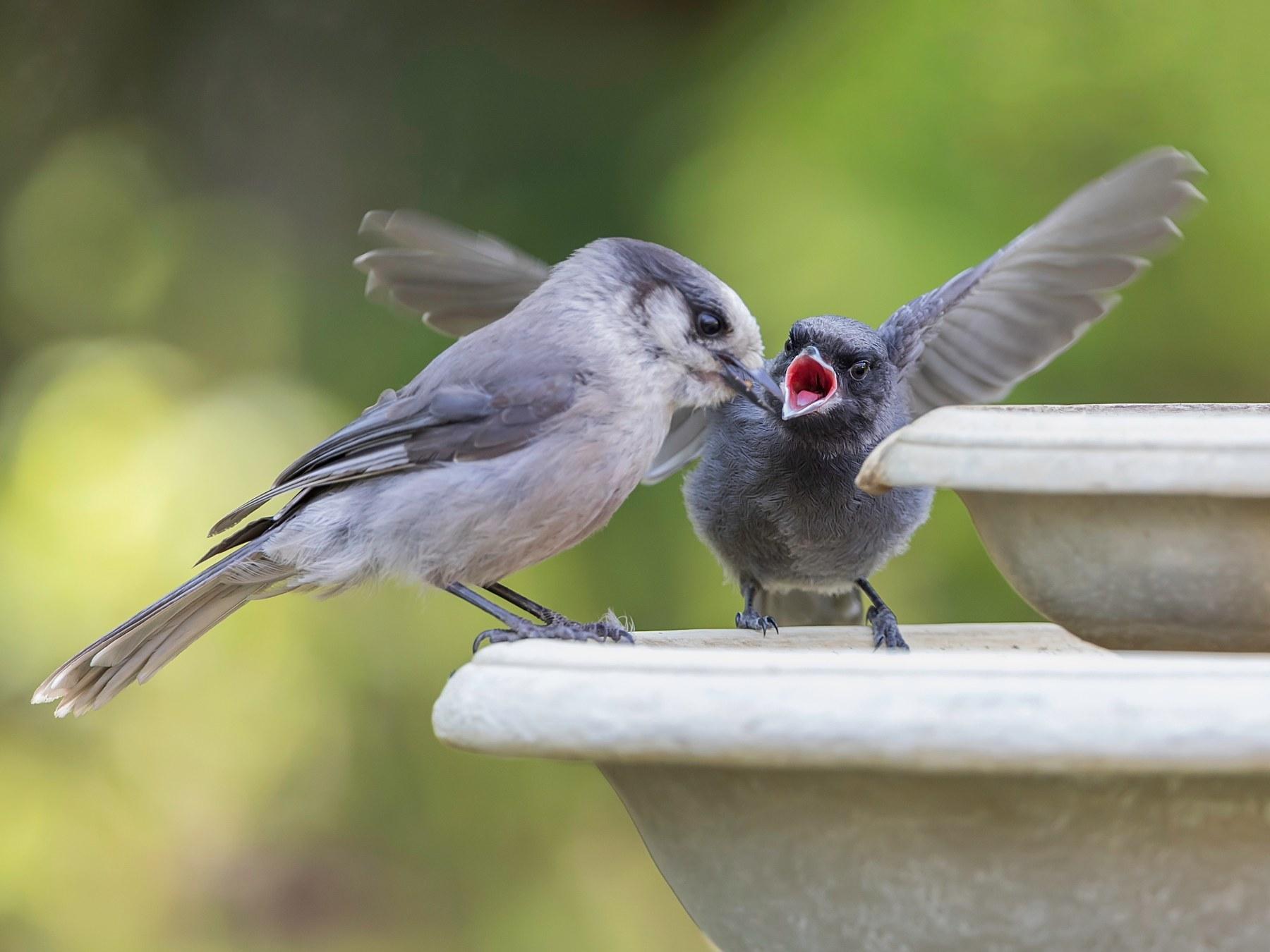
About six weeks after hatching the family begins to travel together. Then, in June, when the young are about two months old, they fight among themselves, and the dominant one, usually a male, drives its brothers and sisters off the home territory. It stays with its parents through the winter. The others try to join an unrelated pair, usually one whose own nest failed, in Algonquin Park some were found up to 7 miles (11 km) away.6, 2 It is a hard start: radio-tracking there estimated that 84% of the young that stayed home survived their first summer, but only about 45% of those driven out.7
A young bird that stays over winter is chased away from the nest the next spring and does not feed the nestlings, but once they fledge it may help to feed them.2, 8 Researchers think keeping helpers away from the nest means fewer visits that could lead a red squirrel or other predator to it.2
Behaviour
Canada Jays are famous for their curiosity. They glide in silently to watch hikers, skiers and campers, follow people along trails, and will take food from a hand. They are not born tame, though: each bird has to learn that people and their food are worth approaching.
Pairs stay together year-round and usually for life, and they defend large permanent territories, roughly 60 to 320 acres (23 to 130 ha) depending on the area.2 Outside the nesting season a pair often has one or two young birds with it. Their flight is slow and quiet, a series of swoops and glides with the wings held below the horizontal, but they can fly fast and twist away when a hawk attacks. They hop on the ground, sunbathe on sheltered perches even in freezing weather, and roost close to the trunk of a dense spruce or fir.
Blue Jays often try to steal their stores, and a Canada Jay will often take its food back and hide it somewhere else. Smaller songbirds, from robins and thrushes to kinglets and vireos, often mob Canada Jays, which do take eggs and chicks.
Lifespan and predators
The oldest known Canada Jay was at least 17 years old, and a bird that survives its first year can live well over a decade. The oldest on the North American banding list was at least 17 years old: banded in Colorado in August 1985, it was caught and released alive there in August 2002.9 Long-term studies in Ontario have followed birds to the same kind of age: one female in Algonquin Park is known to have bred from age 1 to 16, and breeding adults there and in Quebec lost only about a fifth of their number each year, twice as many in summer as in winter.2
The first year is far harder, as the young birds driven from home show (see The young leave home).
Predators and other dangers
Northern Goshawks, Red-tailed Hawks, Peregrine Falcons, Merlins and owls take adult Canada Jays, and red squirrels take nestlings. When a hawk appears, jays warn each other with soft whistles; a predator on the ground gets loud chatters, screams and copies of predator calls as the jays mob it. Young jays learn which animals to fear by watching the adults react.
People cause losses too. Curious jays are easily caught in traps set for fur-bearing animals. Normal trap densities may spare most birds, but in an Ontario experiment with ten times the usual trapping, 292 were killed in the first fall and winter.2 Large clearcuts leave them nowhere to store food or nest, though partial cutting seems to affect them little.
Conservation
The Canada Jay is listed as Least Concern worldwide.10 Partners in Flight puts the population at about 27 million, all in the US and Canada (an estimate for about 2010), and rates it of low conservation concern, 9 out of 20 on its Continental Concern Score.11 Most of its range lies far north, where roadside surveys are few, so the North American Breeding Bird Survey covers it poorly.2 That survey shows a slow decline since 1966: -0.69% a year survey-wide, just short of statistical significance (95% credible interval -1.75 to 0.01), and -0.76% a year in the US, which is significant. The fall has quickened: from 2015 to 2025 it was -2.28% a year survey-wide, and the survey's yearly index was at its lowest in 2024 and 2025, about a fifth below 2015. Long-term declines are significant in places including Nova Scotia, New Brunswick and the Northern Rockies, and on the few survey routes in Wisconsin, at the southern edge of the range, birds have fallen steeply since 1995.12
Climate change and population
The southern edge of the range is where the trouble shows. In Algonquin Park, Ontario, Canada Jays have been studied since the 1960s, and many territories there have been empty since the 1970s.2 Researchers found that breeding started later and success fell after warm falls, especially when a cold late winter followed, and suggested that warmth spoils the food the jays store for late winter.13 Later work there has backed the idea: a 40-year analysis of 718 nests found smaller broods and fewer successful nests after falls with many freeze-thaw days, though such days had not become more frequent over the study.14 Territories with fewer conifers were abandoned fastest, and in experiments stored food kept best on spruce and pine.15 Food is limiting there: in a two-year experiment, pairs given extra food before nesting laid earlier and had bigger broods, and the Algonquin population fell by more than half in three decades.16
Across Canada, home to about 22 million Canada Jays, more than four-fifths of the world's total, the Breeding Bird Survey shows a 22% loss since 1970, which Birds Canada still rates as little change with low confidence, and the Christmas Bird Count a 75% fall, which may partly reflect the range shifting north away from count circles; in the Maritimes the loss is 55%.17
As the climate warms, the boreal forest is expected to move north, and the Canada Jay may spread north with it while losing ground at its southern edge and on lower mountain slopes. In the West, outbreaks of mountain pine beetle, which cold winters once held back, are killing large areas of lodgepole pine forest that the jays use, which may cost them habitat.2
Legal status
In the US the Canada Jay is on the federal list of birds protected under the Migratory Bird Treaty Act,18 which bars killing, capturing, selling or transporting protected birds, including their parts, nests and eggs, without authorization.19 Like other jays, it is covered through the 1936 migratory bird convention with Mexico, as amended in 1972.20 No federal depredation order covers it.21 It is not listed under the Endangered Species Act.22 New York, where it lives only in mature spruce forest in the Adirondacks, treats it as a high-priority species of greatest conservation need, though it is not legally listed there.22
In Canada the crow family, jays included, is not covered by the Migratory Birds Convention Act, 1994, so protection comes from provincial and territorial law.23 In Ontario, for example, it is an offense to hunt or trap wild birds that are not game birds, or to destroy, take or possess their nests or eggs.24
More photos
2 photos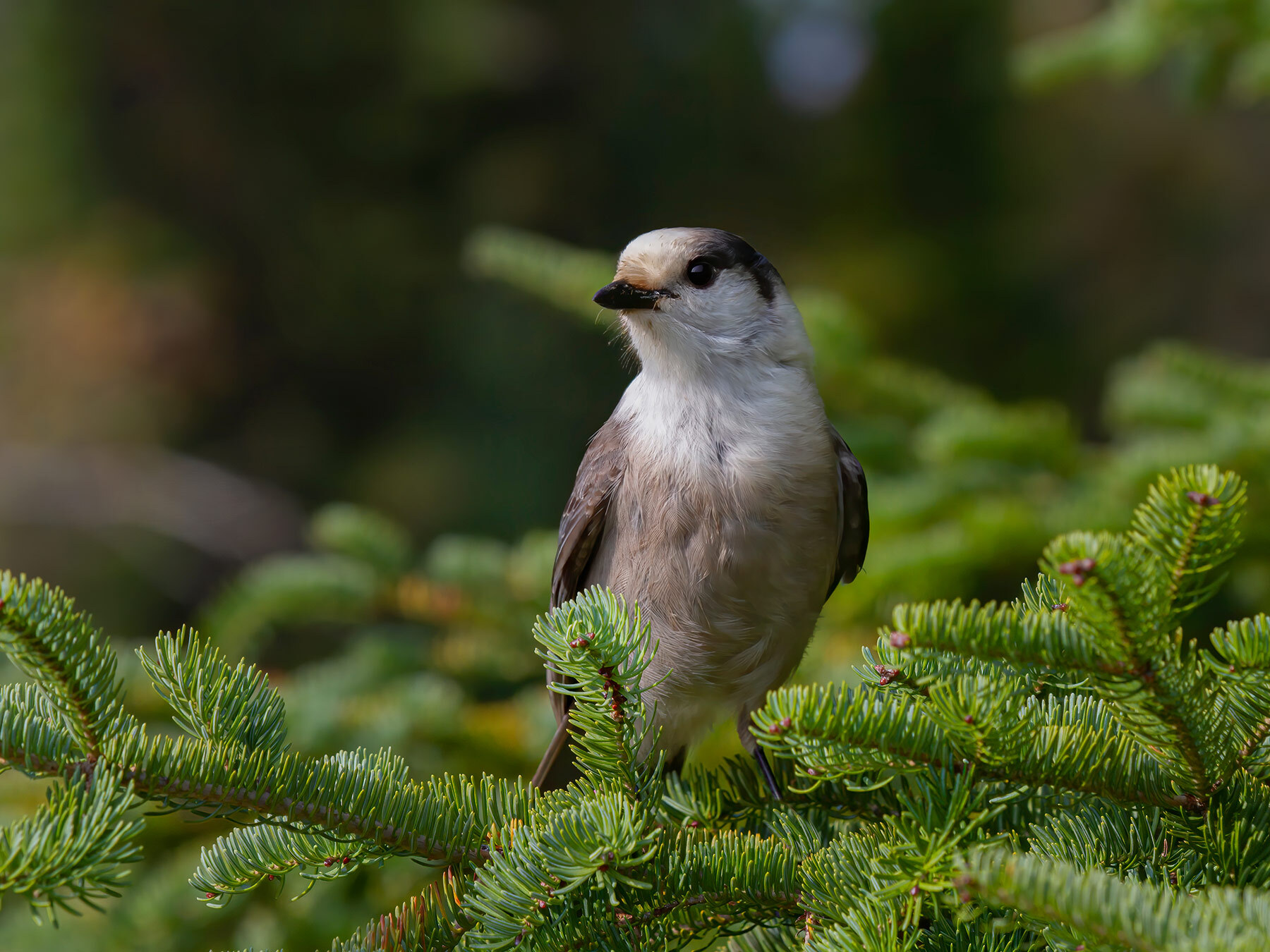
Canada Jay guides
1 guidesQuick facts
- Length
- 25–33 cm
- Wingspan
- 43–46 cm
- Weight
- 58–84 g
- Lifespan
- oldest recorded 17 years
- Family
- Crows & Jays
- Migration
- Resident
- Global status (IUCN)
- Least Concern
- World population
- 27,000,000 (Partners in Flight, about 2010)
- Population trend
- A slight long-term decline on the Breeding Bird Survey, not statistically significant survey-wide but significant in the US; steeper since 2015 (about -2.3% a year, significant); declines at the southern edge of the range
- Also called
- Gray Jay, Whiskey Jack, Camp Robber
- Scientific name
- Perisoreus canadensis
Questions
3Is the Canada Jay the same as the Gray Jay?
Yes. It was the Canada Jay in the first two American Ornithologists' Union checklists, in 1886 and 1895. In 1957 the AOU chose Gray Jay, which until then had been the name of one western race, and in 2018 the American Ornithological Society brought back Canada Jay after a proposal by Canadian and US ornithologists.1
Why is it called a whiskey jack?
Is the Canada Jay the national bird of Canada?
Not officially. Canadian Geographic recommended it as the national bird in 2016, after a two-year project with nearly 50,000 votes.27 It had come third in the popular vote, and the federal government did not adopt it.1 A Senate bill to make the Canada Jay the national bird passed the Senate on June 11, 2026, and in November 2026 was waiting for the House of Commons.25 Read more in our guide to the national bird of Canada.
Sources
31- 1Strickland, D. et al. (2017). Proposal 2018-B-2: Restore Canada Jay as the English name of Perisoreus canadensis. American Ornithological Society, North American Classification Committee. Accessed 12 November 2026. Source (opens in a new tab)
- 2Strickland, D. and Ouellet, H. R. (2020). Canada Jay (Perisoreus canadensis), version 1.0. Birds of the World (P. G. Rodewald, editor). Cornell Lab of Ornithology. doi:10.2173/bow.gryjay.01 (opens in a new tab)
- 3van Els, P., Cicero, C. and Klicka, J. (2012). High latitudes and high genetic diversity: phylogeography of a widespread boreal bird, the gray jay (Perisoreus canadensis). Molecular Phylogenetics and Evolution 63: 456-465. doi:10.1016/j.ympev.2012.01.019 (opens in a new tab)
- 4Bock, W. J. (1961). Salivary glands in the gray jays (Perisoreus). The Auk 78: 355-365. doi:10.2307/4082273 (opens in a new tab)
- 5Sutton, A. O. et al. (2024). Fecal DNA metabarcoding helps characterize the Canada jay's diet and confirms its reliance on stored food for winter survival and breeding. PLOS ONE 19: e0300583. doi:10.1371/journal.pone.0300583 (opens in a new tab)
- 6Strickland, D. (1991). Juvenile dispersal in Gray Jays: dominant brood member expels siblings from natal territory. Canadian Journal of Zoology 69: 2935-2945. doi:10.1139/z91-414 (opens in a new tab)
- 7Fuirst, M. et al. (2024). Survival throughout the annual cycle of first year Canada Jays in the context of sibling competition, expulsion, and adoption. Ornithology 141: ukae013. doi:10.1093/ornithology/ukae013 (opens in a new tab)
- 8Waite, T. A. and Strickland, D. (1997). Cooperative breeding in Gray Jays: philopatric offspring provision juvenile siblings. The Condor 99: 523-525. doi:10.2307/1369960 (opens in a new tab)
- 9USGS Bird Banding Laboratory. Longevity records of North American birds: Canada Jay. USGS Patuxent Wildlife Research Center. Accessed 12 November 2026. Source (opens in a new tab)
- 10BirdLife International (2018). Perisoreus canadensis. The IUCN Red List of Threatened Species 2018. doi:10.2305/IUCN.UK.2018-2.RLTS.T22705783A130380194.en (opens in a new tab)
- 11Partners in Flight (2024). Avian Conservation Assessment Database, version 2024.05.23 (global). Bird Conservancy of the Rockies. Accessed 12 November 2026. Source (opens in a new tab)
- 12Hostetler, J. A. et al. (2026). The North American Breeding Bird Survey, Analysis Results 1966 - 2025. U.S. Geological Survey. doi:10.5066/P1OSNSFC (opens in a new tab)
- 13Waite, T. A. and Strickland, D. (2006). Climate change and the demographic demise of a hoarding bird living on the edge. Proceedings of the Royal Society B 273: 2809-2813. doi:10.1098/rspb.2006.3667 (opens in a new tab)
- 14Sutton, A. O. et al. (2019). Autumn freeze-thaw events carry over to depress late-winter reproductive performance in Canada jays. Royal Society Open Science 6: 181754. doi:10.1098/rsos.181754 (opens in a new tab)
- 15Strickland, D., Kielstra, B. and Norris, D. R. (2011). Experimental evidence for a novel mechanism driving variation in habitat quality in a food-caching bird. Oecologia 167: 943-950. doi:10.1007/s00442-011-2040-y (opens in a new tab)
- 16Derbyshire, R., Strickland, D. and Norris, D. R. (2015). Experimental evidence and 43 years of monitoring data show that food limits reproduction in a food-caching passerine. Ecology 96: 3005-3015. doi:10.1890/15-0191.1 (opens in a new tab)
- 17Birds Canada and Environment and Climate Change Canada. Canada Jay. The State of Canada's Birds (NatureCounts). Accessed 12 November 2026. Source (opens in a new tab)
- 18U.S. Fish and Wildlife Service (2023). 50 CFR 10.13, List of Birds Protected by the Migratory Bird Treaty Act. Electronic Code of Federal Regulations. Accessed 12 November 2026. Source (opens in a new tab)
- 19U.S. Fish and Wildlife Service. Migratory Bird Treaty Act of 1918. U.S. Fish and Wildlife Service (archived page, 2024). Accessed 12 November 2026. Source (opens in a new tab)
- 20U.S. Fish and Wildlife Service (2013). General Provisions; Revised List of Migratory Birds (final rule), 78 FR 65844. Federal Register. Accessed 12 November 2026. Source (opens in a new tab)
- 21U.S. Fish and Wildlife Service (2022). 50 CFR 21.100, Depredation permits. Electronic Code of Federal Regulations. Accessed 12 November 2026. Source (opens in a new tab)
- 22New York State Department of Environmental Conservation (2024). Species Status Assessment: Canada jay. New York State Wildlife Action Plan 2025. Accessed 12 November 2026. Source (opens in a new tab)
- 23Environment and Climate Change Canada. Birds protected in Canada. Government of Canada. Accessed 12 November 2026. Source (opens in a new tab)
- 24Legislative Assembly of Ontario (1997). Fish and Wildlife Conservation Act, 1997, S.O. 1997, c. 41. Ontario e-Laws. Accessed 12 November 2026. Source (opens in a new tab)
- 25Parliament of Canada (2026). Bill S-221, An Act to provide for the recognition of the Canada jay as the national bird of Canada (National Bird of Canada Act), 45th Parliament, 1st Session. LEGISinfo. Accessed 12 November 2026. Source (opens in a new tab)
- 26Zarankin, J. (2021). Oh Canada jay! The story behind an icon-in-the-making. Canadian Geographic. Accessed 12 November 2026. Source (opens in a new tab)
- 27Walker, N. (2016). Meet our national bird: the gray jay. Canadian Geographic. Accessed 12 November 2026. Source (opens in a new tab)
- 28Cornell Lab of Ornithology. Canada Jay: overview, identification, life history, sounds and similar species. All About Birds. Accessed 12 November 2026. Source (opens in a new tab)
- 29National Audubon Society. Canada Jay (Perisoreus canadensis). Guide to North American Birds. Accessed 12 November 2026. Source (opens in a new tab)
- 30Cornell Lab of Ornithology and Birds Canada. Common Feeder Birds: Canada Jay. Project FeederWatch. Accessed 12 November 2026. Source (opens in a new tab)
- 31AviList Core Team (2025). AviList: The Global Avian Checklist, v2025b. AviList. doi:10.2173/avilist.v2025b (opens in a new tab)

Checked by
Nathan Cope, founder and editor
Nathan founded Birdfact and leads its writers and contributors in the UK, the US and Canada. He has watched and studied birds for more than ten years, and checks every article and species guide before it’s published.