


California Towhee
Brown Towhee · Melozone crissalis
By the Birdfact teamChecked by Nathan Cope
On this page13 sections
How to recognise it
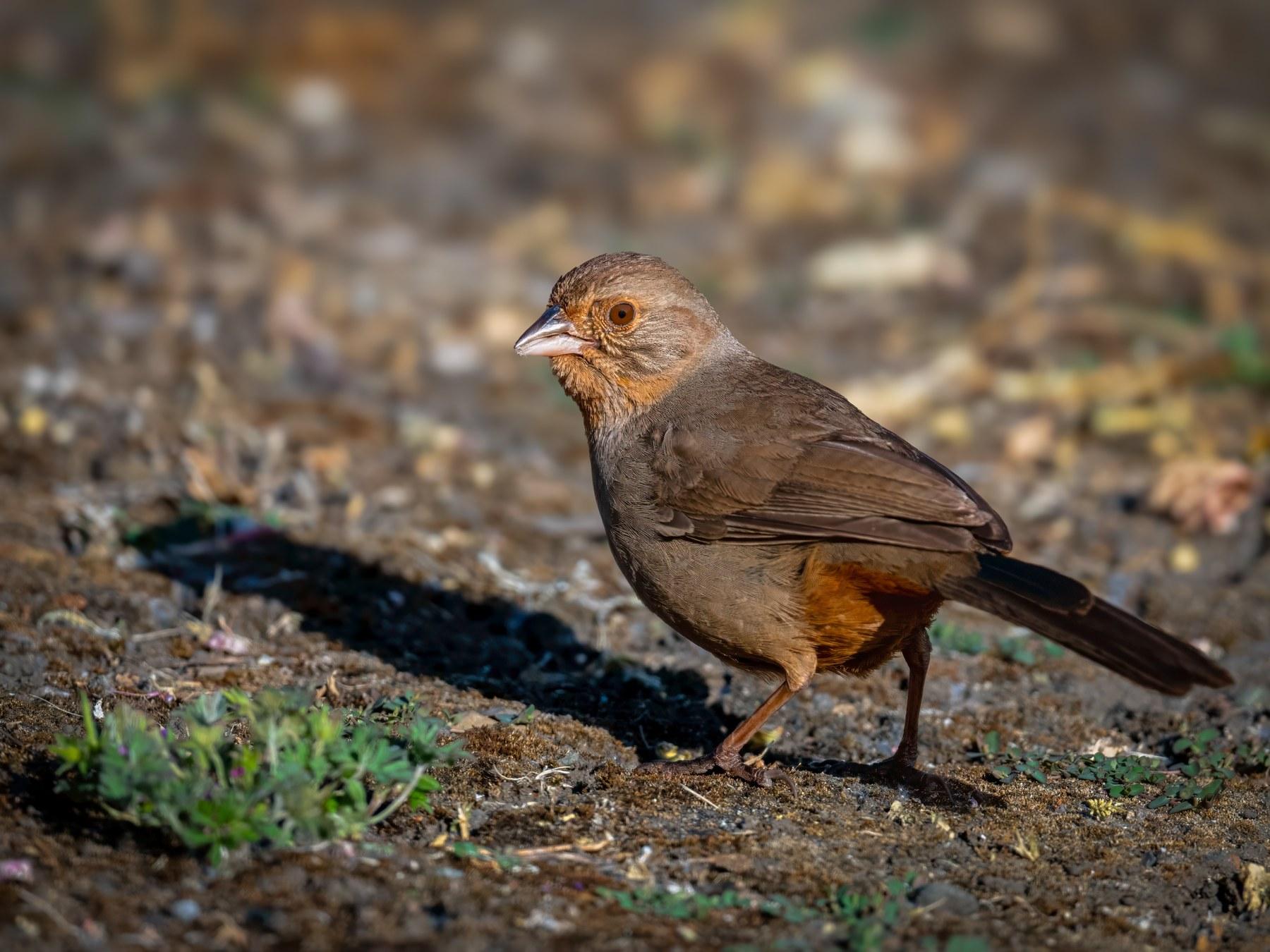
Look for a long-tailed bird of the ground that is gray-brown almost all over, its crown only a shade warmer than its back. Two marks to check: a cinnamon-buff throat with fine dark streaks, and a plain cinnamon patch under the tail. A broken ring of dark spots borders the throat, but the spots do not join into a single spot in the middle of the breast.
Closer up, a buff eye-ring shows best below the eye, the breast is a paler gray and the center of the belly is whitish. It hops or runs on the ground and keeps close to cover. Over short distances its flight looks jerky and labored.
Color varies a little across the range. Coastal birds of northern California are rich brown above with a deep chestnut crown, inland birds are the palest, and southern California birds are the darkest. In the Cape region of Baja California birds have a rufous crown patch, a pale buff throat and a whitish belly, and some show a dark spot in the center of the breast. Five subspecies are recognized, and birds get smaller from north to south.
Size and shape
It is a large sparrow, 8.3–9.8 in (21–25 cm) long, with a wingspan of about 11.4 in (29 cm), and it weighs 1.3–2.4 oz (37–67 g). That makes it a little bigger than a Spotted Towhee and a little smaller than an American Robin. The wings are short and rounded, and the bill is short and thick for cracking seeds.
Males are slightly larger than females. Weight also falls from north to south: in samples measured for a 1951 study, breeding birds averaged about 1.9–2.0 oz (54–57 g) in coastal northern California but only about 1.4 oz (40–41 g) in the Cape region.1
Male, female and young
Males and females look the same in every plumage, so a pair cannot be told apart by color.
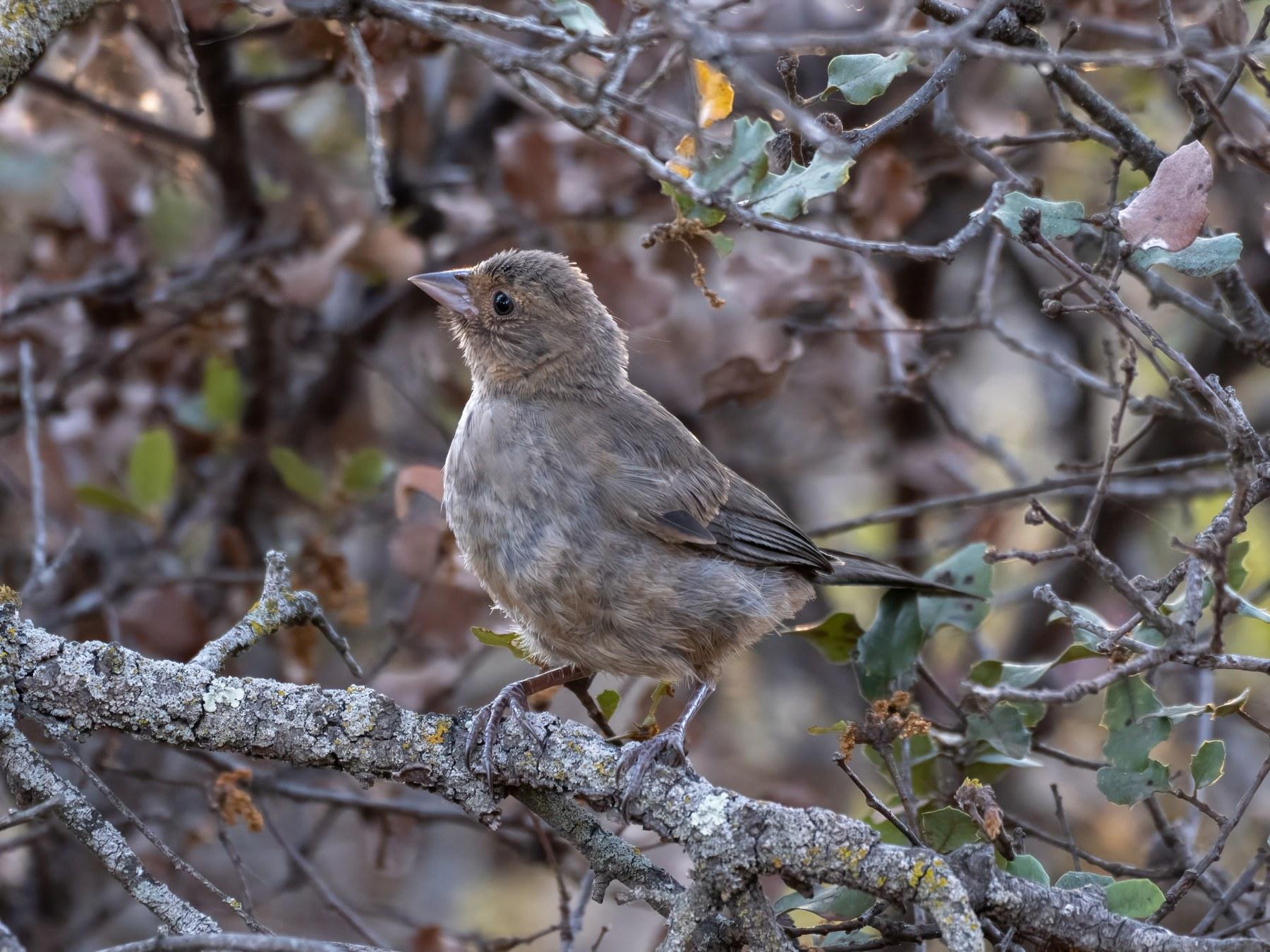
Juveniles, the young of the year, are seen from May to September. They look like adults with soft streaks across the underparts, a poorly marked cap, a paler throat and a brownish belly, and they often show pale buff wing-bars. Their backs are plain, as is usual among the brown towhees; young Spotted Towhees are streaked above as well as below.
After a partial molt between June and November, young birds look like adults. In the hand, worn, pointed tail feathers can still give them away, though the differences can be subtle.
Identification: similar birds
The Canyon Towhee is the closest lookalike. It has a rufous crown, a dark spot in the center of the breast and paler, grayer upperparts, and its throat and undertail are buff rather than cinnamon. Its call is a rough shedup. The two barely meet, since the Canyon Towhee lives east of the Colorado River.
An Abert's Towhee has a black face around a very pale bill, pinkish-brown underparts and a dark rusty undertail, and it lives in low desert. A Spotted Towhee has a dark hood, rufous sides, a white belly, white spots on the wings and shoulders and white corners to the tail.
A California Thrasher shares the plain brown plumage and rich buff undertail, but it is much bigger, up to about 12.6 in (32 cm), with a long, curved blackish bill instead of a short, thick one.
Not sure it’s a California Towhee? Check your photo: Birdfact names the bird and shows the look-alike side by side.
Its size
Adults- Length
- 21–25 cm
- Wingspan
- 29 cm
- Weight
- 37–67 g
Its song and calls
The sound you will hear most is a loud, sharp, metallic chip or chink, given by both sexes through the year. It keeps a pair in touch and may also serve as a warning, a challenge or a protest. A bird may repeat it up to 30 times a minute for as long as 25 minutes.
The song is built from the same metallic chips, run together faster and faster into a trill that sometimes ends in a short warble. It is mostly the song of a male without a mate. In one observational study, singing took up 47% of an unmated male's time but only 0.09% of a mated male's, and a male almost stops singing once he has paired.1
It sings early in the year and early in the day. A 1938 account found it singing from as early as February 3, before most other Californian birds, and it is among the first voices each morning. Each morning, too, mated males patrol the edges of their territories, calling loudly from high perches.1
Pair duets and other calls
Mated pairs have a squealing duet: a run of squeaky notes ending in a chatter, given as the two come together. Both sexes give the same three-part squeal. In the breeding season pairs duet about three times an hour on average.2 About 95% of squeals are given in duets, and a duet does not end until the two birds are within about 3 ft (1 m) of each other.1
Duets are aimed at other towhees as well as at the mate. A study of marked birds, using playback and removal experiments, found that they peak while chicks are being raised and are low when the female is most fertile, and that no single existing explanation accounts for them.3
The squeal sounds the same as the Canyon Towhee's but unlike the laughing duet of Abert's Towhee. Other calls include a fast tsink near the nest that makes the young freeze, a soft tssp between mates hidden in cover, a shriek when a bird is handled or chased by a hawk, and a rapid cut-cut-cut during fights.
- Chip calls0:00 / 0:30
Recorded in California, United States · September 2012
- Chip calls0:00 / 0:48
Recorded in California, United States · May 2020
- Chip calls, heard not seen0:00 / 0:12
Recorded in California, United States · September 2020
Heard one and not sure? Let the bird song identifier listen.
When and where to see it
It lives from southwest and south-central Oregon south through most of California to the southern tip of Baja California. It is largely missing from the floor of the southern Central Valley.
Its main habitats are chaparral and coastal sage scrub, followed by streamside thickets. It is a bird of edges, needing dense cover next to open ground, so it also lives in oak woodland, on farmsteads and in yards and parks. Unlike the Canyon Towhee it is often found in suburban gardens and city parks, as observers noted early in the 1900s, and it is one of California's commonest and best-known birds.
It is most common from sea level up to the foothills at about 5,000 ft (1,525 m), and nests up to about 6,200 ft (1,890 m) in southern California. The highest record is 7,790 ft (2,375 m), at Yosemite.
Look for it feeding in the open on roads, paths and lawns, close to cover. In point counts published in 1997 and 1999, it was found at 79% of stations in San Diego County and at 94% of points in a study of coastal sage scrub in southern California.1
Do they migrate?
No. It is a permanent resident that rarely moves far from where it nests, though some birds shift a little upslope after breeding or move downhill when snow falls.
Banded birds show how settled it is: they were caught again in the same place for up to 7 years and held the same territory for up to 5. Its range has changed little, but it has adapted well to farmsteads, suburbs and towns, and it has been recorded around Klamath Falls, Oregon, only since 1972.1
Tips for seeing it
What it eats
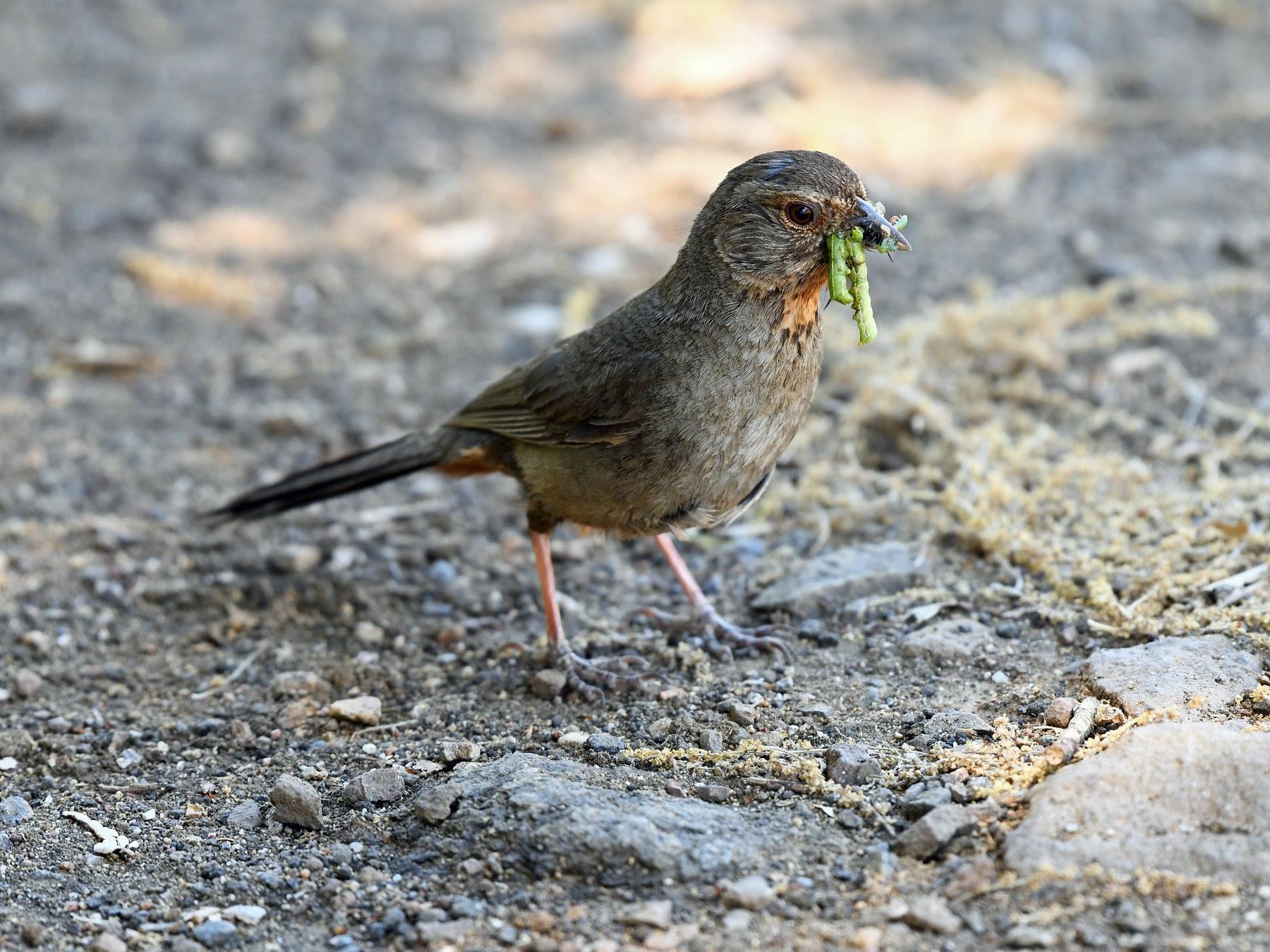
It eats mainly seeds and other plant food, with some insects, probably most when it has young to feed. Foods on record include the seeds of pigweed, knotweed, alfilaria and wild oats; miner's lettuce, acorns, and the berries of elderberry, coffeeberry and poison oak; and grasshoppers, crickets, beetles, caterpillars, spiders, millipedes and snails. Now and then it takes garden peas, lettuce and orchard fruit.
It feeds mostly on the ground, pecking at the surface and scratching in leaf litter with both feet at once, a move called the double-scratch. It also strips seeds from grass stems with its bill. Berries are eaten where they grow, the bird perching beside them or hovering for a moment to pull them off rather than carrying them away.
The only known diet study used stomachs collected in California in the early 1900s. In 383 adults, food was 86% plant and 14% animal: 51% weed seeds, 28% grain such as oats, barley and wheat, and 4% fruit. Weed seeds made up 84% of the food in December but only about 20% in June, and the 16 nestlings in the study had been fed almost entirely on animal food: all of it for the youngest, and 92–95% for older chicks.1
In oak-pine woodland, a 1981 study found flowers made up 32% of the diet, seeds 21% and oak catkins 16%, the catkins mattering most in early spring. More than 70% of its foraging there was on the ground.1
Feeding them in your yard
Scatter seed on the ground or put it on a tray, rather than in a hanging feeder, to suit a bird that feeds on the ground. Include millet, which many other yard birds pass over.4
Nesting and breeding
In the US it breeds from mid-February to late August, judging from egg and mating dates, and most nests are built in April and May. In Baja California breeding can run as late as October or November, and the southernmost birds appear to breed mostly after rain.
The nest is an open cup in a shrub, small tree or vine, rarely on the ground. A 1968 account put most nests 4–12 ft (1.2–3.7 m) up and some above 35 ft (10.7 m), but height depends on the habitat. Only the female builds, with the male following close behind. She weaves an outer cup of grass, stems and dried flowers, sometimes with plastic ribbon, and lines it with animal hair, strips of bark and plant down. A nest is about 8 in (20 cm) across and 1.5 in (3.8 cm) deep.
Average nest heights were 1.9 ft (0.59 m) in coastal sage scrub (64 nests), 5.6 ft (1.70 m) at the San Joaquin Experimental Range (89 nests) and 10.2 ft (3.1 m) in oak woodland at Hastings Reservation in Monterey County (46 nests).1 At the San Joaquin site, 52% of nests were in shrubs and 45% in trees, mostly interior live oak and wedgeleaf ceanothus.1
Eggs and young
A clutch is 2–5 eggs, usually 3 or 4. The eggs are pale bluish or creamy white, with sparse dark brown to purplish-black spots and blotches, mostly toward the larger end. Clutches averaged 3.69 eggs in 32 coastal sage scrub nests and 3.3 eggs per attempt at Hastings in 2002–2006.1
The female incubates alone for 11–12 days, sitting for about 45 minutes in every hour. In the isolated Argus Mountains population, incubation can last up to 14 days.
The chicks hatch nearly naked, with sparse gray down, and both parents feed them, almost entirely on animal food at first. The young leave the nest at 6–12 days, before they can fly: as early as 6–8 days in coastal sage scrub and at 10–11 days in oak woodland.1
Fledglings hide in cover near the nest while both parents feed them, and at Hastings they fed themselves at 3–4 weeks. They stay with their parents for several weeks, up to about six weeks in an Argus Mountains study unless the parents nest again.1
A pair raises one or two broods a year: usually one at Hastings, with at least two reported elsewhere in California.1 Young birds can breed the spring after they hatch.
Nest predators and cowbirds
Nest failure, mostly to predators, appears to be a dominant pressure on the species. In one study in coastal sage scrub, 91% of nests failed, largely to predators.1 At Hastings in 2002–2006, by contrast, predators took 21% of nests and pairs fledged 2.0 young per attempt on average; over the five seasons, the most productive female fledged 18 young with three different partners.1
The California Scrub-Jay is probably the main nest predator in oak-pine woodland. Brown-headed Cowbirds lay eggs in its nests, but it appears to be a rare host. In one Madera County study, second nesting attempts were parasitized more often (82%) than first ones (23%), and towhees can raise cowbird young.1
Behaviour
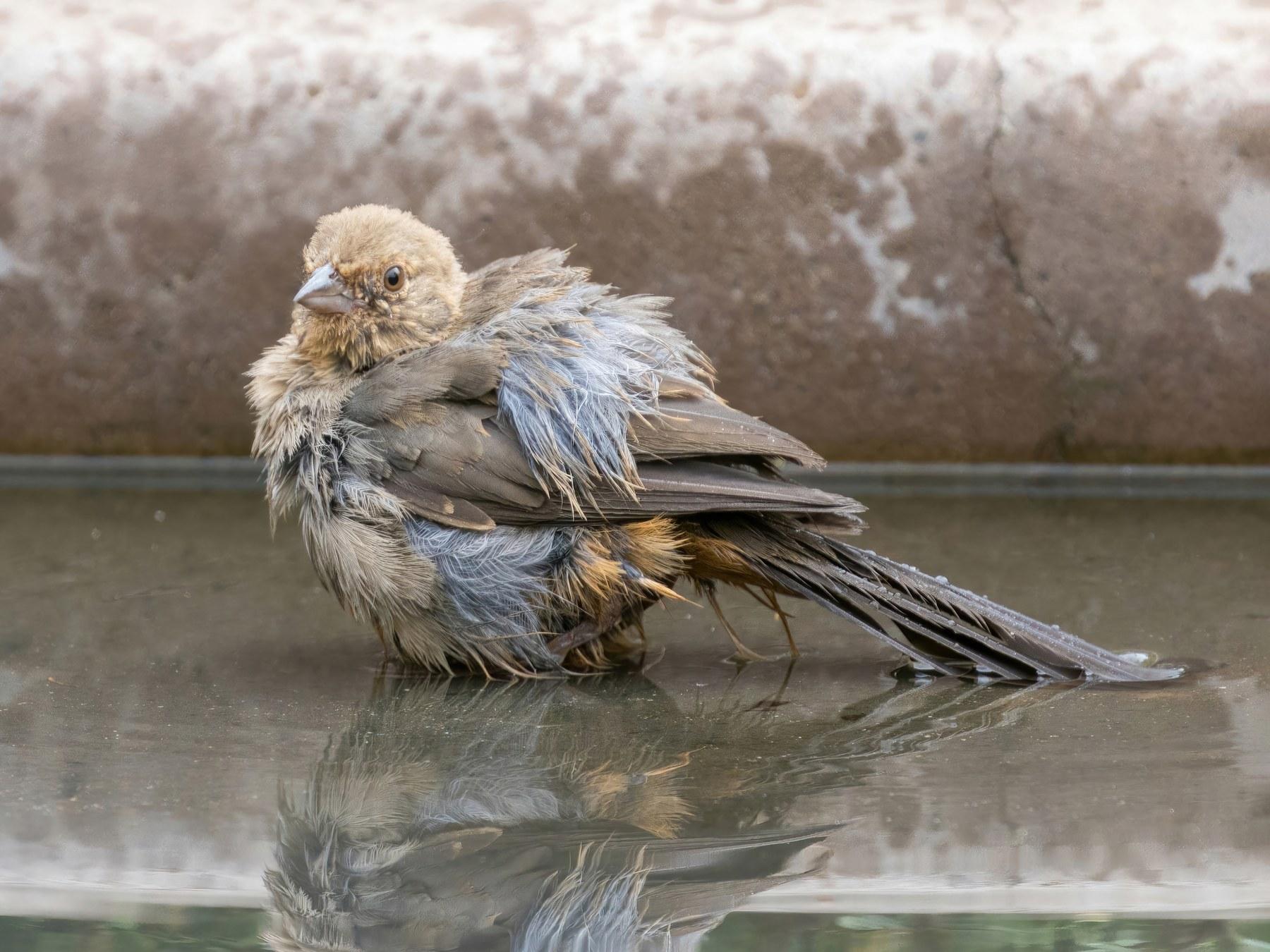
It often attacks its own reflection in windows, mirrors and car hubcaps, over and over again. Both males and females do it in spring, and the habit was being described as shadow-boxing by 1916.1
Males and females both defend their territory in spring and again in late summer, and fights can draw blood. In playback tests, the two sexes answered intruders with similar aggression.3
In fall and winter neighboring pairs often feed together peacefully, though a 1957 study at Hastings saw apparent winter territories defended several times.5 It is not a flocking bird: usually only a pair or a family is seen together.
Pairs keep close. Mates are often 1–20 ft (0.3–6 m) apart, though they can spend long spells farther apart, especially while the female incubates. In one study of breeding pairs, mates were within sight or earshot of each other 42% of the time on average.1 Radio-tagged birds at Hastings used home ranges averaging 2.1 acres (0.83 ha).1
It joins in mobbing predators. A female disturbed at the nest calls, her mate arrives, and their protests draw in neighboring towhees and other birds. In playback experiments, parents did not recognize their own chicks' distress calls but went toward calls coming from near their young.6
Lifespan and predators
The oldest on record was at least 12 years 10 months old: a male banded as a young bird in California in July 1973 and caught and released alive there in April 1986.7
We found no source that gives a typical lifespan or a yearly survival rate. Of 432 birds banded at Hastings in 1937–1948, 184 were known to have survived one year and none eight years, which are counts rather than survival rates.1
Predators and other dangers
Red-tailed and Cooper's Hawks, coyotes, rattlesnakes, gopher snakes and a bullfrog have been recorded taking towhees or their young, though first-hand accounts are few.1 It is often killed by cars, because it is drawn to roadside plants and flies slowly.
Conservation
It is rated Least Concern on the IUCN Red List (BirdLife International, 2022).8 Partners in Flight puts the population at about 7.5 million breeding-age birds worldwide and 5.2 million in the US and Canada, all of them in the US, from survey data averaged around 2010. It gives the species a concern score of 11 out of 20, which means relatively low concern.9
Over the long run its numbers look steady. The North American Breeding Bird Survey shows no significant change in the US from 1968 to 2025 (−0.14% a year, 95% credible interval −0.59 to +0.34), and none over 2015–2025.10 There was a significant fall of 1.47% a year between 1995 and 2015, and over 1995–2025 the trend is still a significant fall, of 0.72% a year. California holds 152 of the survey's 159 routes, and no region shows a significant long-term change.10
It appears generally able to cope with the loss of natural habitat, partly because it makes flexible use of non-native plants. A study in coastal southern California classed it as insensitive to habitat edges and to fragmentation from development. Separately, fire suppression may harm it.1
Conservation: the Argus Mountains population
A small, isolated population lives in the Argus Mountains of Inyo County, in dense thickets of willow and desert olive around springs in the Mojave Desert. It numbered 72–138 birds in 1978–1979 and fewer than 200 in 1987. Four surveys from 1998 to 2011 estimated 640–741 adults, with 729 in 2011. Part of the rise after 1994 likely reflects changes in survey methods, but birds were also found in places not occupied before, which points to a real increase.11
These birds have been named as a separate subspecies, eremophilus (desert-loving), the Inyo California Towhee. Birds of the World's review of the subspecies finds that fresh specimens do not support the claimed differences and treats the birds as part of the nominate race, and the current world checklist does not list the subspecies.1, 12
Similar birds
Often mistaken for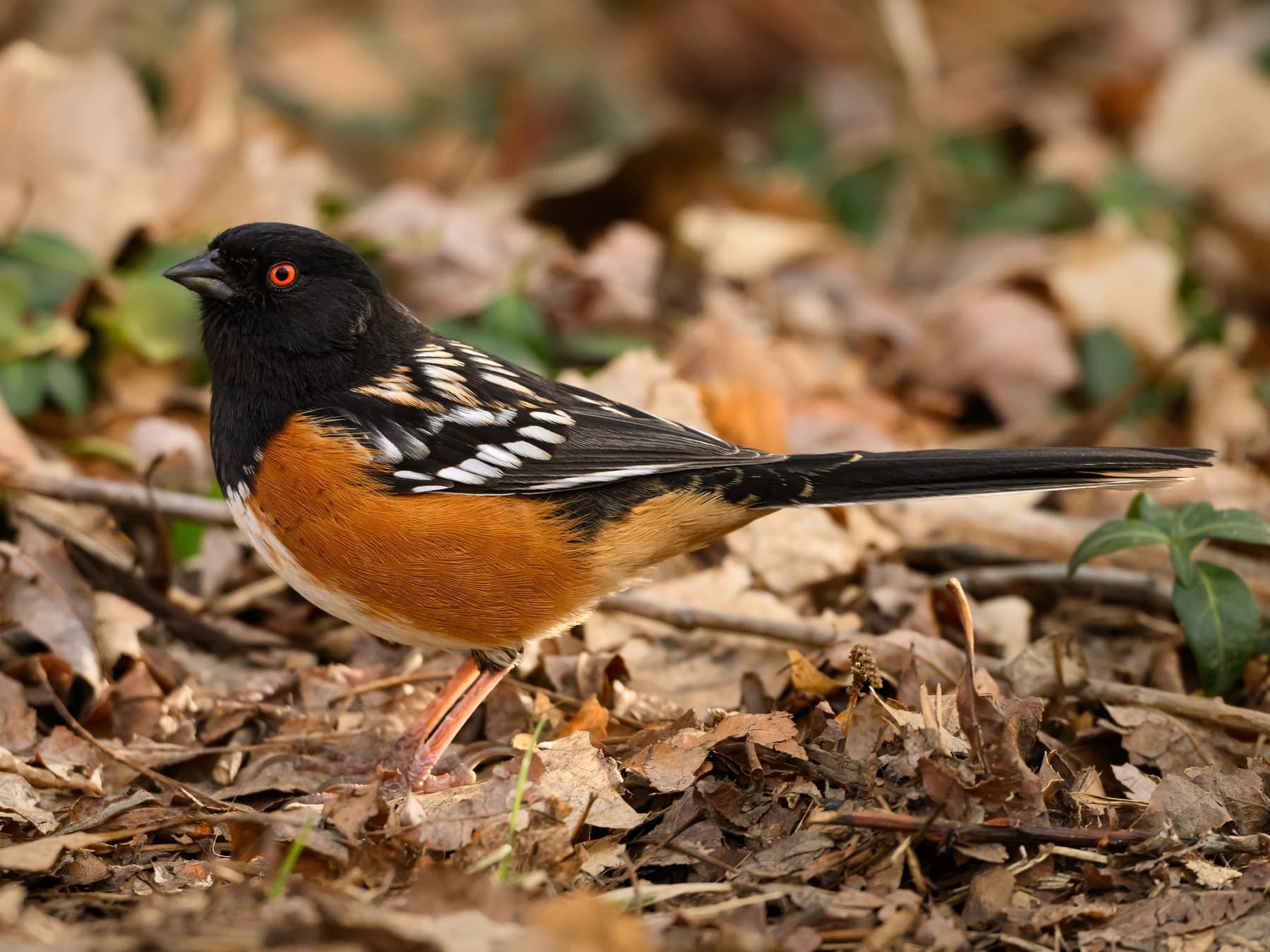
Quick facts
- Length
- 21–25 cm
- Wingspan
- 29 cm
- Weight
- 37–67 g
- Lifespan
- oldest recorded 12 years 10 months
- Family
- New World Sparrows
- Migration
- Resident
- Global status (IUCN)
- Least Concern
- World population
- About 7.5 million breeding-age birds worldwide, 5.2 million in the US and Canada, all in the US (Partners in Flight, survey data around 2010)
- Population trend
- Stable over the long term: the Breeding Bird Survey shows no significant change in the US since 1968 or over 2015-2025, though numbers fell significantly between 1995 and 2015 and the 1995-2025 trend is still a significant fall
- Also called
- Brown Towhee
- Scientific name
- Melozone crissalis
Questions
3Why was it called the Brown Towhee?
For many years the Canyon Towhee and this bird were lumped as a single species, the Brown Towhee. A 1988 study of allozymes and measurements found the two distinct,16 and the American Ornithologists' Union split them in 1989 and dropped the old name.1 Later work on mitochondrial DNA also found the two distinct, and showed that its closest relative is Abert's Towhee, not the Canyon Towhee.17
Is it a sparrow?
Do they mate for life?
Apparently, yes. Pairs stay together all year. In one study of banded birds, mates bred together through all five years of the study and no pair was seen to split between seasons, though 42% of nests held young fathered by another male and 26% of all chicks were extra-pair.1 When ten mated males were removed in an experiment, nine of the widowed females had new mates within a week, five of them within a day.1
Sources
30- 1Benedict, L. et al. (2024). California Towhee (Melozone crissalis), version 1.1. Birds of the World (A. F. Poole and S. M. Billerman, editors). Cornell Lab of Ornithology. doi:10.2173/bow.caltow.01.1 (opens in a new tab)
- 2Benedict, L. and McEntee, J. P. (2008). Context, Structural Variability and Distinctiveness of California Towhee (Pipilo crissalis) Vocal Duets. Ethology 115(1): 77-86. doi:10.1111/j.1439-0310.2008.01583.x (opens in a new tab)
- 3Benedict, L. (2010). California towhee vocal duets are multi-functional signals for multiple receivers. Behaviour 147(8): 953-978. doi:10.1163/000579510x498633 (opens in a new tab)
- 4Cornell Lab of Ornithology. California Towhee. All About Birds. Accessed 20 November 2026. Source (opens in a new tab)
- 5Davis, J. (1957). Comparative Foraging Behavior of the Spotted and Brown Towhees. The Auk 74(2): 129-166. doi:10.2307/4081708 (opens in a new tab)
- 6Benedict, L. (2007). Offspring Discrimination Without Recognition: California Towhee Responses to Chick Distress Calls. The Condor 109(1): 79-87. doi:10.1093/condor/109.1.79 (opens in a new tab)
- 7USGS Bird Banding Laboratory. Longevity Records of North American Birds (current table, AOU 5911). USGS Bird Banding Laboratory. Accessed 20 November 2026. Source (opens in a new tab)
- 8BirdLife International (2022). Melozone crissalis. The IUCN Red List of Threatened Species 2022 (via the GBIF IUCN Red List checklist). GBIF dataset 19491596-35ae-4a91-9a98-85cf505f1bd3. Accessed 20 November 2026. Source (opens in a new tab)
- 9Partners in Flight (2024). Avian Conservation Assessment Database, version 2024.05.23 (global). Partners in Flight / Bird Conservancy of the Rockies. Accessed 20 November 2026. Source (opens in a new tab)
- 10Hostetler, J. A. et al. (2026). The North American Breeding Bird Survey, Analysis Results 1966 - 2025. U.S. Geological Survey data release. doi:10.5066/P1OSNSFC (opens in a new tab)
- 11U.S. Fish and Wildlife Service (2013). Endangered and Threatened Wildlife and Plants; 12-Month Finding on a Petition and Proposed Rule To Remove the Inyo California Towhee (Pipilo crissalis eremophilus = Melozone crissalis eremophilus) From the Federal List of Endangered and Threatened Wildlife (78 FR 65938). Federal Register, 4 November 2013. Accessed 20 November 2026. Source (opens in a new tab)
- 12AviList Core Team (2025). AviList: The Global Avian Checklist, v2025b. AviList. Accessed 20 November 2026. Source (opens in a new tab)
- 13U.S. Fish and Wildlife Service. 50 CFR 10.13 List of Migratory Birds. Electronic Code of Federal Regulations (version of 2026-11-17). Accessed 20 November 2026. Source (opens in a new tab)
- 14U.S. Fish and Wildlife Service. 50 CFR 10.12 Definitions. Electronic Code of Federal Regulations (version of 2026-11-17). Accessed 20 November 2026. Source (opens in a new tab)
- 15SEMARNAT. NOM-059-SEMARNAT-2010 (DOF 30/12/2010). Diario Oficial de la Federacion. Accessed 20 November 2026.
- 16Zink, R. M. (1988). Evolution of Brown Towhees: Allozymes, Morphometrics and Species Limits. The Condor 90(1): 72-82. doi:10.2307/1368435 (opens in a new tab)
- 17Zink, R. M. and Dittmann, D. L. (1991). Evolution of Brown Towhees: Mitochondrial DNA Evidence. The Condor 93(1): 98-105. doi:10.2307/1368611 (opens in a new tab)
- 18DaCosta, J. M., Spellman, G. M., Escalante, P. and Klicka, J. (2009). A molecular systematic revision of two historically problematic songbird clades: Aimophila and Pipilo. Journal of Avian Biology 40(2): 206-216. doi:10.1111/j.1600-048x.2009.04514.x (opens in a new tab)
- 19National Audubon Society. California Towhee. Guide to North American Birds. Accessed 20 November 2026. Source (opens in a new tab)
- 20Marshall, J. T., Jr. (1964). Voice in Communication and Relationships among Brown Towhees. The Condor 66(5): 345-356. doi:10.2307/1365427 (opens in a new tab)
- 21Tobias, J. A. et al. (2022). AVONET: morphological, ecological and geographical data for all birds. Ecology Letters 25: 581-597. Accessed 20 November 2026. Source (opens in a new tab)
- 22Jobling, J. A.. Key to Scientific Names: crissalis. Birds of the World, Cornell Lab of Ornithology. Accessed 20 November 2026. Source (opens in a new tab)
- 23Jobling, J. A.. Key to Scientific Names: eremophilus. Birds of the World, Cornell Lab of Ornithology. Accessed 20 November 2026. Source (opens in a new tab)
- 24Johnson, R. R., Haight, L. T., Klass, R. and Provost, K. L. (2025). Canyon Towhee (Melozone fusca), version 2.0. Birds of the World (N. D. Sly, editor). Cornell Lab of Ornithology. doi:10.2173/bow.cantow.02 (opens in a new tab)
- 25Tweit, R. C. and Finch, D. M. (2026). Abert's Towhee (Melozone aberti), version 1.1. Birds of the World (A. F. Poole and F. B. Gill, editors). Cornell Lab of Ornithology. doi:10.2173/bow.abetow.01.1 (opens in a new tab)
- 26Bartos Smith, S. and Greenlaw, J. S. (2026). Spotted Towhee (Pipilo maculatus), version 1.1. Birds of the World (P. G. Rodewald, editor). Cornell Lab of Ornithology. doi:10.2173/bow.spotow.01.1 (opens in a new tab)
- 27Cody, M. L. (2020). California Thrasher (Toxostoma redivivum), version 1.0. Birds of the World (A. F. Poole, editor). Cornell Lab of Ornithology. doi:10.2173/bow.calthr.01 (opens in a new tab)
- 28Jongsma, J.. XC110260 California Towhee (call). xeno-canto. Accessed 20 November 2026. Source (opens in a new tab)
- 29Dutza K.. iNaturalist observation 47060064, sound 94910. iNaturalist. Accessed 20 November 2026. Source (opens in a new tab)
- 30Zinogre. iNaturalist observation 61236417, sound 139529. iNaturalist. Accessed 20 November 2026. Source (opens in a new tab)

Checked by
Nathan Cope, founder and editor
Nathan founded Birdfact and leads its writers and contributors in the UK, the US and Canada. He has watched and studied birds for more than ten years, and checks every article and species guide before it’s published.