


Boat-tailed Grackle
Quiscalus major
By the Birdfact teamChecked by Nathan Cope
On this page15 sections
How to recognise it
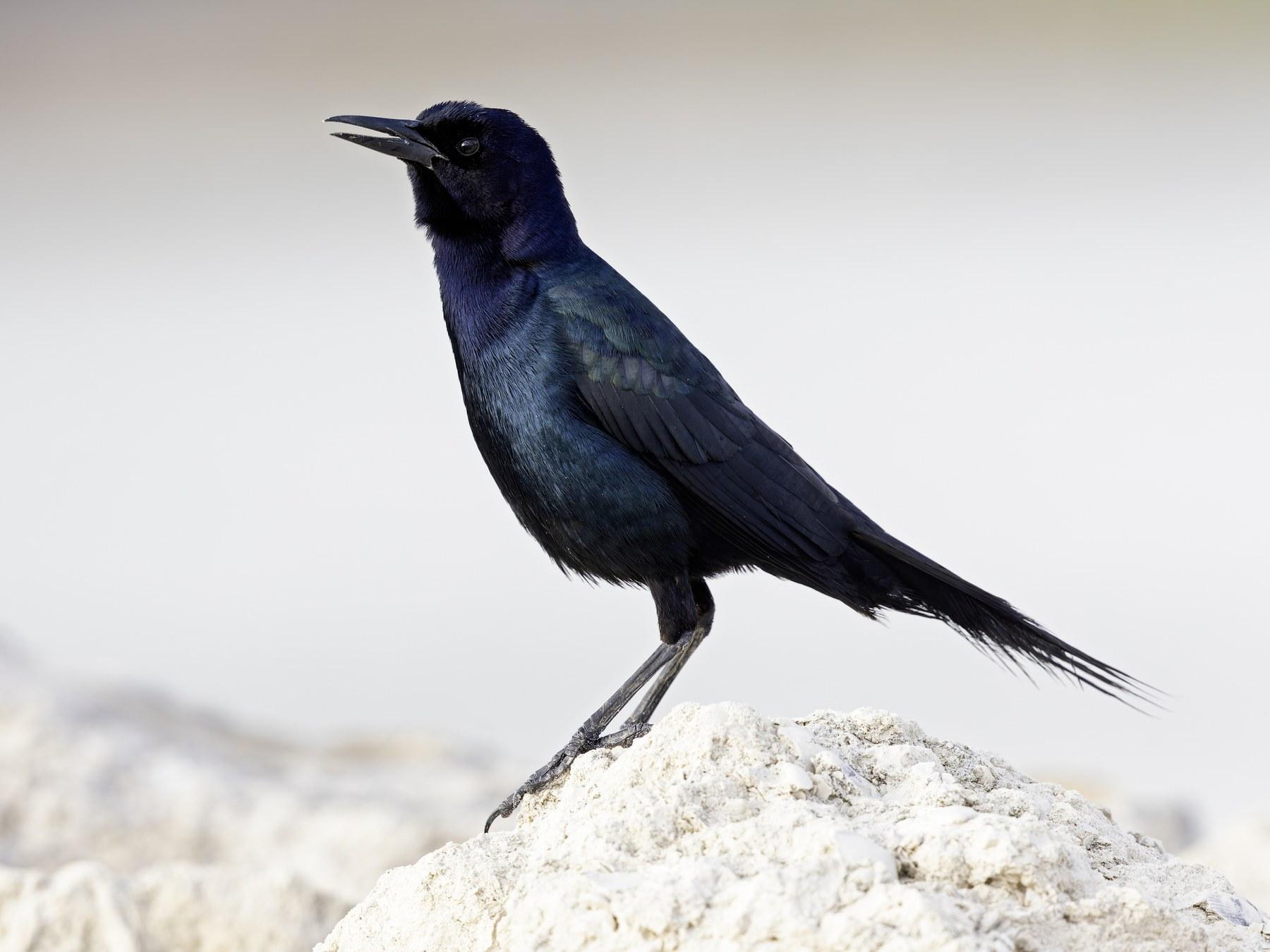
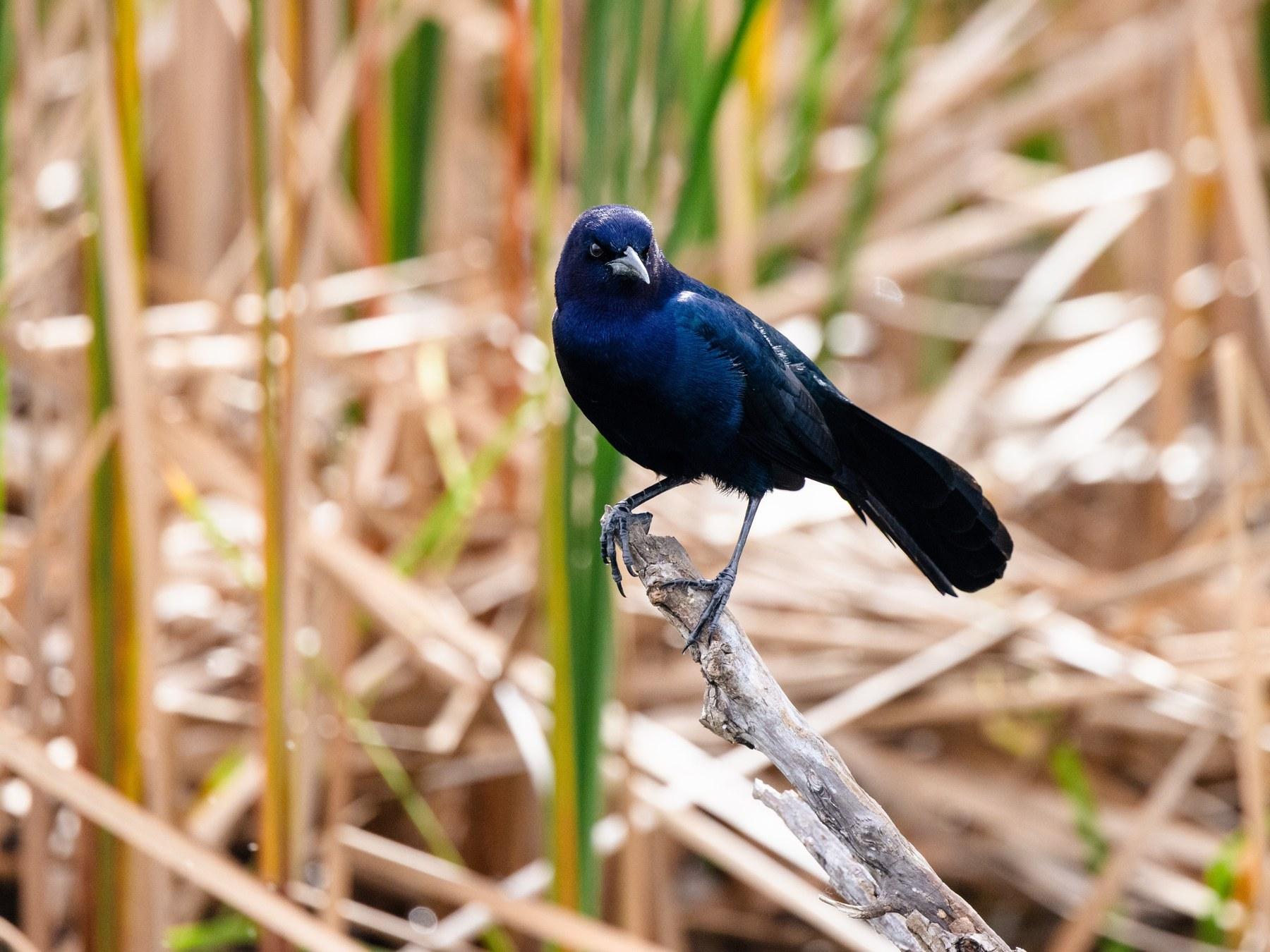
The Boat-tailed Grackle is a large, long-legged blackbird with a very long tail, found along the Atlantic and Gulf coasts and across much of Florida. Grackles are New World blackbirds, relatives of orioles and meadowlarks, not crows. The adult male is glossy blue-black, with a violet-blue sheen on the head, greener gloss on the wings and tail, and a long, graduated tail that he holds folded into a deep V, like the keel of a boat. The female is brown and about half his size, and looks so different that a casual observer could take her for another species.
Both sexes have a long, narrow bill that curves down a little at the tip, black legs and a rounded crown. The eye varies from place to place, from pale yellow on the Atlantic coast to dark brown in peninsular Florida and on the western Gulf coast, and where the range of this grackle meets that of the Great-tailed Grackle it is one of the marks that tell them apart.
Size and weight
The sexes need separate figures. Measured males, caught in South Carolina from March to June, are 15.2-16.7 in (38.5-42.4 cm) long, with a wingspan of 20.9-23.5 in (53.2-59.8 cm), and weigh 5.4-8.4 oz (154-239 g), averaging 7.3 oz (206.5 g). Females are 10.1-11.6 in (25.6-29.5 cm) long, with a wingspan of 15.0-17.1 in (38.0-43.4 cm), and weigh 3.3-5.2 oz (93-147 g), averaging 3.9 oz (111.2 g), so a male is nearly twice as heavy. The weights come from 143 males and 86 females; the lengths and wingspans come from only six males and three females.1
A male is larger than a Common Grackle, and his tail alone is about two-fifths of his length.
Male, female and young birds
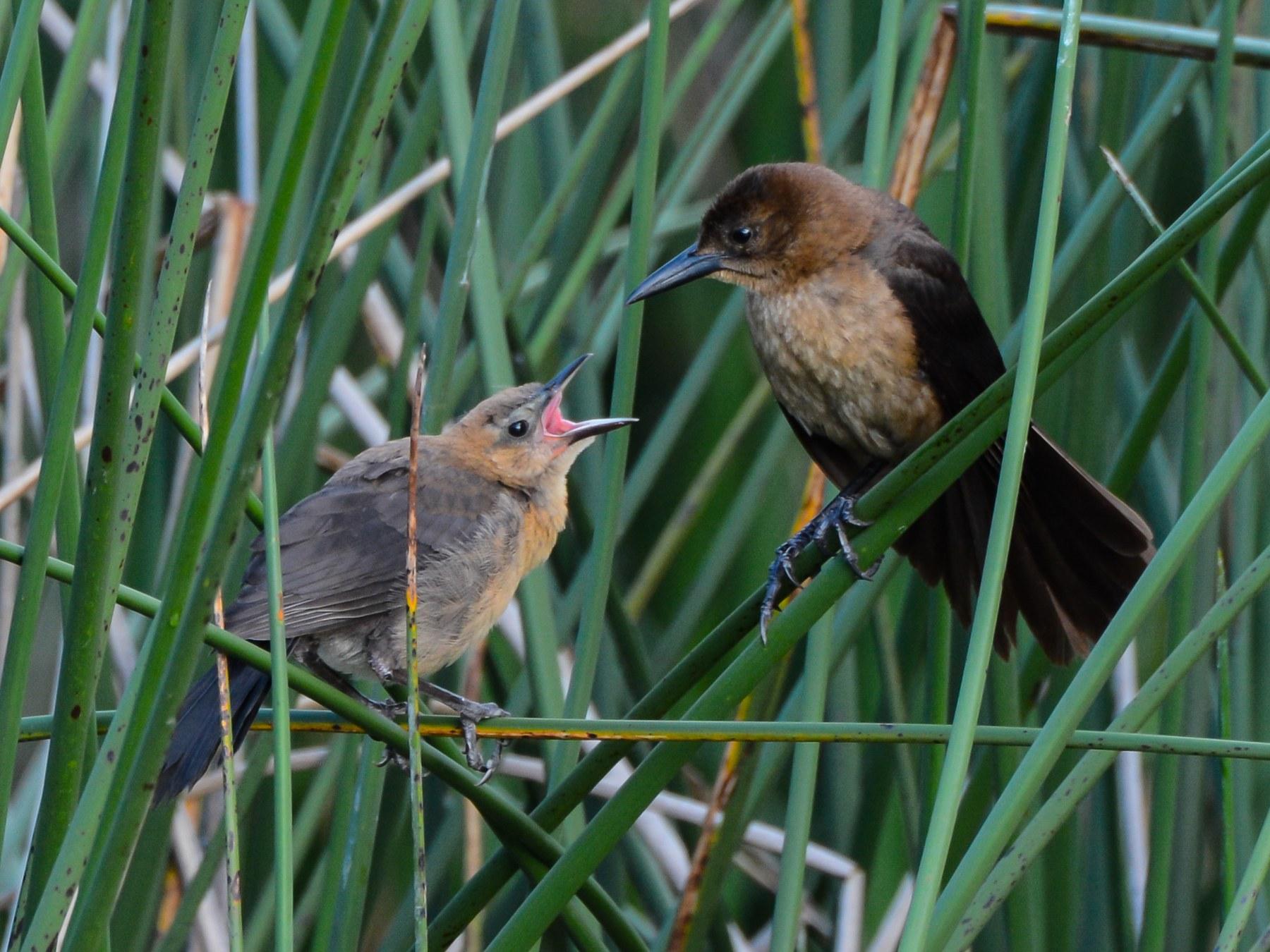
The adult female is brown above, with darker wings and tail, a clay-colored throat and a cinnamon breast. A pale line over the eye, a darker cheek and a pale “mustache” line give her face a subtle pattern. Her tail is much shorter than a male's, about 5 in (128 mm) against his 6.8 in (172 mm).
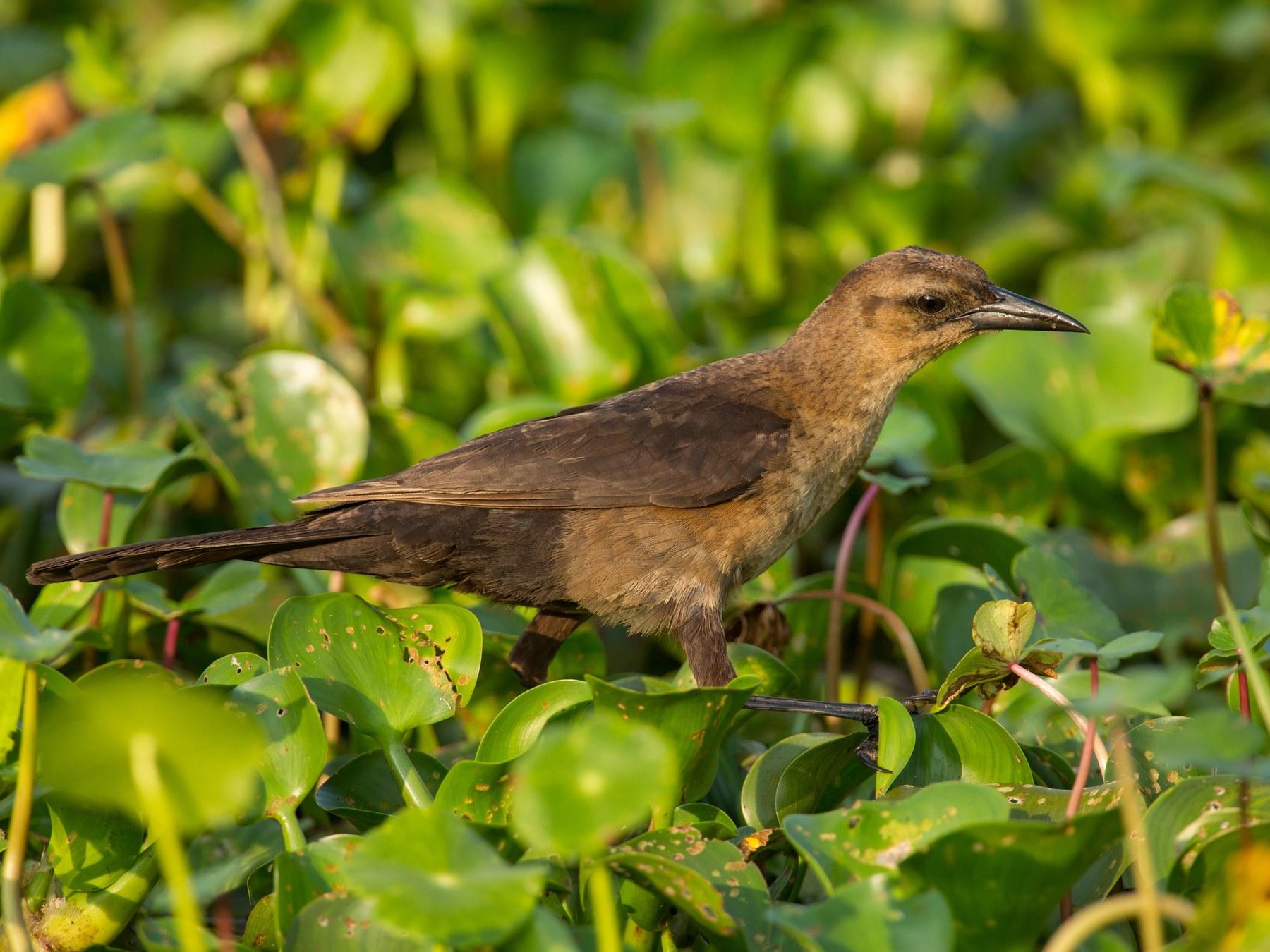
A young male does not turn black at once. In his first fall and winter he is a mix of brown and black feathers, dark above with a green gloss and duller below, with a tail still too short and narrow to form the deep keel, and he is fully adult after his second fall's molt. A fledgling in June to August is dusky brown above with faint streaking and buffy below, with a short tail and dark eyes; the sexes look alike, though the feathers that grow last on a young male are darker.
Eye color changes with age. In a South Carolina study, both sexes had brown eyes in their first year, which turned pearl gray; males had buff-yellow eyes in their second year and ocher or chamois ones at the start of their third; females were slower, and 7 of 12 known-age females were still gray-eyed in the middle of their third year, though some had yellow eyes in their second.1
Identification: telling grackles apart
The Great-tailed Grackle is the close lookalike, and the two meet only on the Gulf coast plain of southwestern Louisiana and southeastern Texas, where the Great-tailed has spread in recent times. Compared with a Great-tailed, a Boat-tailed is a bit shorter-tailed and rounder-headed. Measurements from a 1961 study put a Boat-tailed male's wing 6.8% shorter, his tail 16.0% shorter and his bill 6.6% narrower than a Great-tailed male's, and his gloss tends to be less purple behind and more greenish blue.1 The eye is a key mark: adult Great-tailed Grackles have yellow eyes everywhere, bright in males and less intense in females, while a Boat-tailed adult's eye varies a great deal but is never a bright yellow. Young Great-tailed Grackles have dark eyes too, so a dark eye settles nothing for a young bird.2 In the breeding season the displays and voices differ as well, and a Boat-tailed male fluffs his head feathers more in display.
Females are the hard case. Apart from eye color in some populations, the field marks are generally not reliable for telling a female from a female Great-tailed, though a Boat-tailed female is less glossy above and paler brown below.
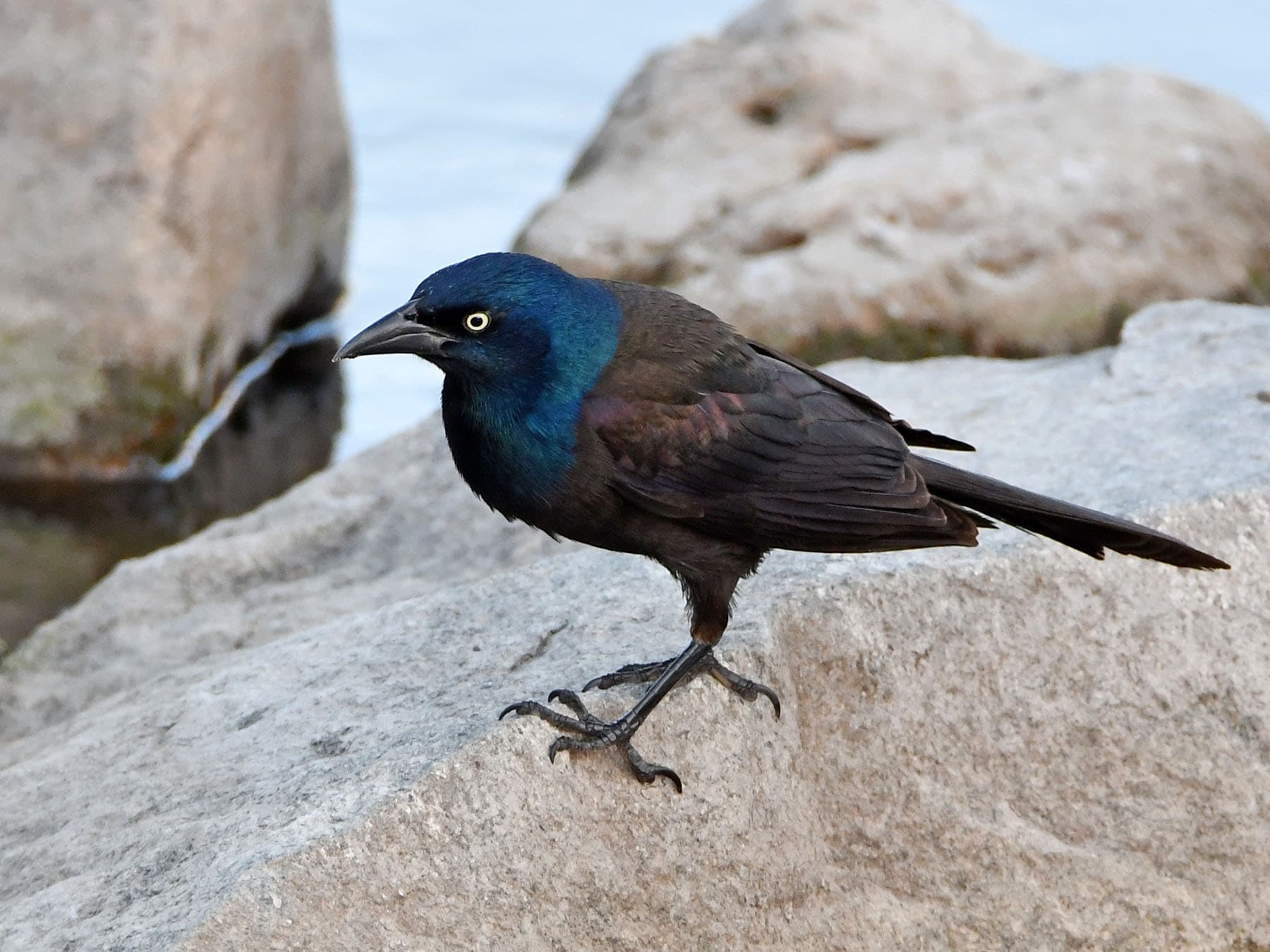
The eye also varies within this grackle. Adults on the Atlantic coast north of northern Florida and on the coast of Alabama and southeastern Mississippi have pale eyes, from straw to yellowish; adults across peninsular Florida and from southwestern Mississippi west to Texas have dark ones. On the Atlantic coast there is no Great-tailed to confuse it with, and the likelier mix-up is with a Common Grackle, which is smaller and has a shorter tail, although its male also holds the tail in a keel in spring.
Not sure it’s a Boat-tailed Grackle? Check your photo: Birdfact names the bird and shows the look-alike side by side.
Its size
Adults- Length
- 26–42 cm
- Wingspan
- 38–60 cm
- Weight
- 93–239 g
Its song and calls
The male's song is a run of harsh notes, written "jeeb-jeeb-jeeb" and stressed on the second syllable, then a low, rising, guttural roll, then more notes. It goes with his ruff-out display, and the roll goes with a flip of the wings and a snap of the bill. The song is continuous rather than a set pattern, and a male has a repertoire of at least ten syllables. Females sing only rarely, early in the nesting season.1
The calls are many. In sexual contexts a male gives a plaintive, whimpering “cheat”, and he gives slurred calls, harsh notes that rise or fall in bouts of up to eight. Both sexes give a “clack” to sound the alarm or mob a predator, and a “chut” when about to fly or in flight. A female chatters on her way to and from the nest and screams when she dives at a snake or a person near the nest. Males also rattle their wing feathers in flight, mostly in disputes near colonies.
Males sing most of the year except at the peak of the molt, before dawn in the roost and again in the evening, when males gather in groups to display from open perches before roosting. In a playback study, colony males answered the songs of their own colony more strongly than songs from colonies 2.5-8 mi (4-13 km) away, which suggests that each colony's males sound a little different.3
Our player has two recordings labeled as calls: a male on a lamp post in Florida (April 2023) and a bird at Wrightsville Beach, North Carolina (May 2025).
- Calls0:00 / 0:19
Recorded in Florida, United States · April 2023
- Call notes0:00 / 0:05
Recorded in North Carolina, United States · May 2025
Heard one and not sure? Let the bird song identifier listen.
When and where to see it
November
Here all year
The year across North America
Choose a place on the map to see its year, or find yours.
Most recorded in November
Up to 1.7% of a place’s bird records that monthHere in other months
How this map is made
Each county, state or province is shaded by the Boat-tailed Grackle’s share of all the bird records there that month: the darker, the larger the share. A place with only a trace of records in a month is left unshaded. Shades compare places on this map with each other, not one bird with another. Records: GBIF eBird Observation Dataset, 2019–2024. Map: Natural Earth; place centres © OpenStreetMap contributors.
How often the Boat-tailed Grackle turns up in the United States through the year, from birdwatchers' records.
United States
Resident · all year · most records in February
Show as a table
| Month | United States |
|---|---|
| January | 0.20% (regular) |
| February | 0.22% (regular) |
| March | 0.20% (regular) |
| April | 0.16% (regular) |
| May | 0.094% (regular) |
| June | 0.12% (regular) |
| July | 0.096% (regular) |
| August | 0.088% (regular) |
| September | 0.089% (regular) |
| October | 0.15% (regular) |
| November | 0.15% (regular) |
| December | 0.17% (regular) |
Worldwide: recorded regularly in 2 countries
Countries where it was recorded in at least 3 of the 6 years 2019–2024. Linked countries have their own bird list.
North America (2)
- Bahamas
- United States
Data: EOD – eBird Observation Dataset (Cornell Lab of Ornithology), accessed via GBIF.org, CC BY 4.0. Records from 2019–2024, aggregated and filtered by Birdfact. How these lists are made
This is a bird of salt, brackish and freshwater marshes and the open ground around them. It lives all year from Long Island, New York, down the Atlantic coast to Florida and around the Gulf coast to southeastern Texas, and across most of the Florida peninsula, where it nests up to 62 mi (100 km) from the coast. Elsewhere it is rarely found more than about 31 mi (50 km) from tidewater. Along the Atlantic coast the breeding range is patchy from Long Island to Maryland and more or less continuous from Virginia to southeastern Florida; on the Gulf coast it is irregular from southwestern Florida to southeastern Texas, and it is absent from the Florida Keys. A 1978 study of museum and collected birds found gaps in the breeding range of about 34 mi (55 km) on Florida's east coast, more than 137 mi (220 km) in northwestern Florida and about 39 mi (62 km) on the Mississippi mainland.4
Look along marsh edges, around boat launches and parks, on roadside wires and in the parking lots of beach-town fast-food restaurants. It feeds in city streets, plazas, fields, stockyards and on open beaches, and it nests wherever there is shelter from ground predators near water. Four subspecies are recognized: a pale-eyed one on the Atlantic coast (torreyi), a dark-eyed one in peninsular Florida (westoni), a pale-eyed one on the coast of Alabama and southeastern Mississippi (alabamensis) and a dark-eyed one from southwestern Mississippi west to Texas (major).4
How its range has changed
The Boat-tailed Grackle has crept north along the Atlantic coast for more than a century. In 1913 it was breeding on islands off Virginia's Eastern Shore as far north as Accomac County, and a Virginia ornithologist wrote that it seemed to be extending its range northward each season.5 A nest with eggs was found near Milford, Delaware, on 5 May 1933, and a report published in 1935 found it "obviously nesting" at Sinepuxent Beach, Maryland.6 New York's first confirmed breeding was in 1981, when an adult female was seen feeding young on Black Banks Hassock on 23 June and another at Jamaica Bay on 18-19 July; Birds of the World dates it a year later, and has the bird in New Jersey by 1952.7, 1 The northernmost breeding site in the 2014 handbook text is Shinnecock on Long Island (1994), and since 1986 a few birds have spent winters in Connecticut and Rhode Island, the farthest north.1 Connecticut has since had a handful of confirmed colonies, and the bird is scarce to uncommon there.8
Inland it has spread where large lakes offer the right habitat: it is apparently increasing around freshwater lakes in northwestern Florida, and by 2004 it nested near Fitzgerald, Georgia, 124 mi (200 km) from the Gulf coast. Around Houston and Galveston, Texas, it appears to have declined since the 1880s, perhaps replaced by the Great-tailed.1 A 2023 modeling study using records from citizen-science projects for 1970-1979 and 2010-2019 matched a range that has stayed largely stable apart from the northeastern coast, while the Great-tailed Grackle moved into drier, more urban places farther from natural water.9
Do they migrate?
Mostly not. Of 316 banded birds recovered since 1930, only 4% were found outside the ten-minute block of latitude and longitude where they were banded, and the longest recorded move was a second-year male banded at Charleston, South Carolina, and recovered 257 mi (413 km) south-southwest at Daytona Beach, Florida. Some birds that breed north of the Carolinas withdraw south in winter, depending on how hard the winter is, and winter from coastal Virginia to central Florida; flocks pass Cape May Point, New Jersey, between 24 September and 21 November. A few wander far to the north: there are sight records from Nova Scotia, and most records north of Connecticut are probably linked to hurricanes.1 Our grackle migration guide looks at how the other grackles move.
Tips for seeing it
What it eats
Almost anything. This is an opportunistic omnivore that eats crayfish, crabs and other crustaceans, snails and mussels, insects and spiders, small fish, frogs and lizards, grain, fruit and tubers, and the scraps people leave. In 25 stomachs taken between Jacksonville and Titusville, Florida, from November to February, crayfish and other crustaceans made up 35% of the volume and were found in 60% of the birds, followed by tubers (21%), fruit (17%) and snails (13%); in 37 breeding-season stomachs from Savannah, Georgia, to Titusville, crustaceans made up 39% and land arthropods 29%.1 A federal survey of 116 stomachs from Florida, Georgia and Texas, published in 1900 as a preliminary study, found 60.2% plant food, with grain, nearly all of it corn, 46.8% of the total, and 15.6% crustaceans; some of the Texas birds may have been Great-tailed Grackles.10
How it feeds
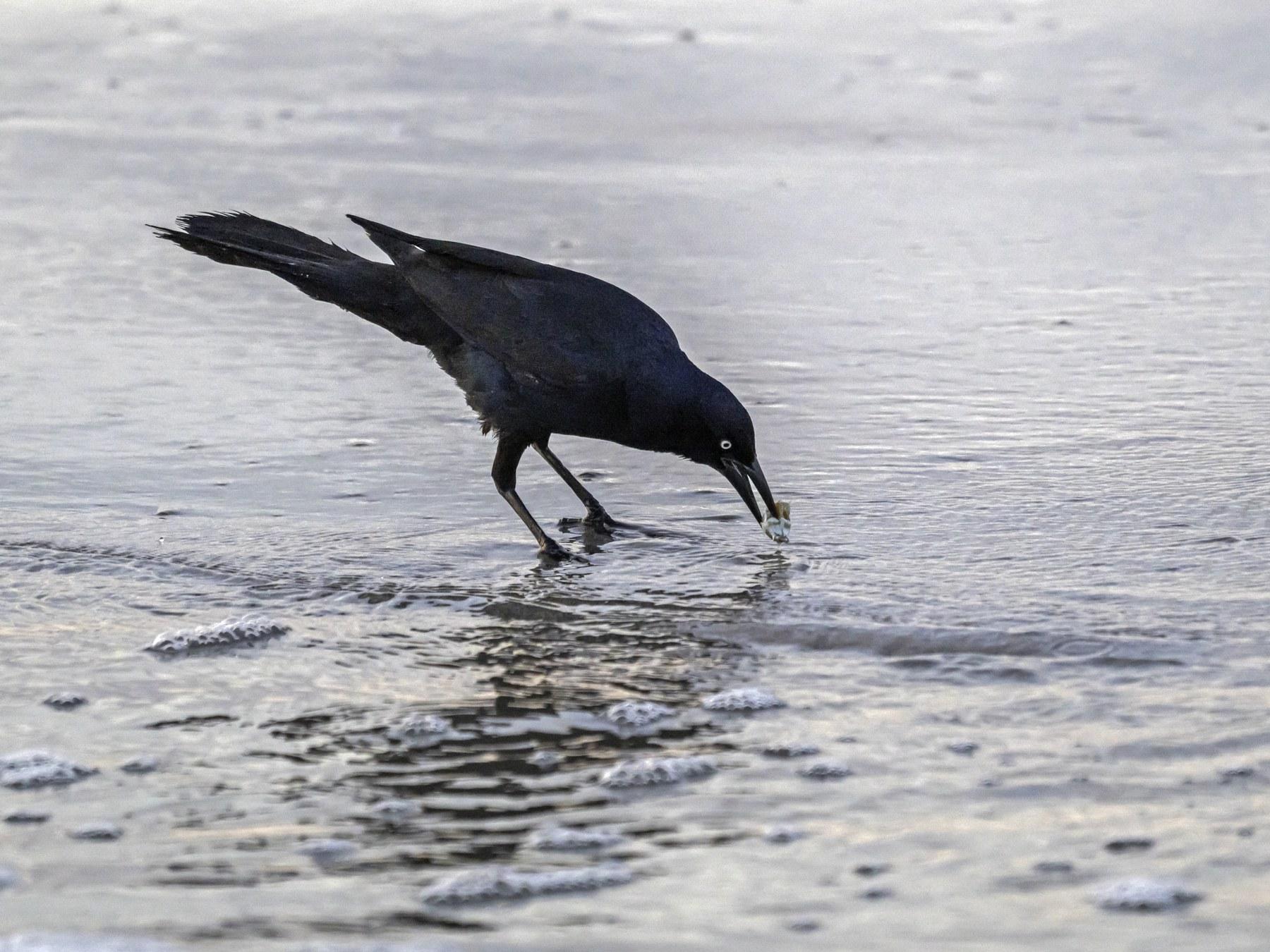
It walks slowly across open ground or shallow water, pecking and probing, turning over debris, stones and shells, and often pushing its closed bill into mud and opening it to "gape" a hole. In water it may stand still, tilt its head to look below the surface with one eye and then plunge its head in, and it may even dive in, sometimes immersing everything but the tail tip. It forces open or hammers the operculum, the "door", of an apple snail, lifts lily pads to find prey on their undersides and carries mollusks to the shore. Dunking food in water is common in South Carolina and infrequent in some parts of Florida, and may be learned.1
Piracy is common. At dumps it steals food from its own kind and from other birds, and at Lake Okeechobee, Florida, grackles snatched crayfish from Glossy Ibises as the ibises flew up.1, 6 It also takes the eggs and young of other birds in some places and not in others: in Louisiana it took nestlings of its own species and of Red-winged Blackbirds and, in one heron and ibis colony, destroyed eggs, but it was not seen doing so in the Carolinas.1 In a Virginia study with nest cameras at American Oystercatcher nests, Boat-tailed Grackles were the species most often seen entering the camera's view, in 22.7% of 211 intrusions, but the Fish Crow was the main egg thief, and the grackles took a single egg in three cases.11, 1
Rice growers at the southern edge of the rice belt, from central Louisiana to central Texas, have lost grain to it, mostly while the seed is sprouting; since combine harvesting began in the 1950s there has been little loss of harvested grain, and its damage is minor beside the Red-winged Blackbird's.1
Feeders and towns
It lives alongside people. It eats sunflower seeds, sorghum, millet, corn and other seed at feeders, particularly platform feeders.12 On feeding shelves, birds took soft foods such as cooked rice and bread first, then sunflower seeds, small dog-food pellets, cracked corn, whole corn, sorghum, millet and wheat, in that order, and they often dip soft foods such as bread, rice and dog food in water first.1 It scavenges at dumps and in parking lots, and where people feed it it can become remarkably tame.
Nesting and breeding
Females nest together in colonies, usually in marsh plants over water or in trees near it, and the female builds, incubates and feeds the young alone. In South Carolina the females begin visiting nesting areas in late February, about a month before the first egg. At Charleston the first egg averaged 29 March across six years (20 March to 4 April), with the older females laying first and the second-year females about two weeks later, and the last eggs averaged 19 June.1 In central Florida a first egg was found on 1 March, and in Florida a few birds nest in the fall: they nested in November at Orlando in 1956, 1959 and 1960 and fledged young each year, and in a South Carolina study half of a colony's clutches were complete within 12-16 days of the first.1
The nest and colony site
A colony site has to be free of ground predators and above flood level. Most are on small islands or narrow peninsulas of emergent plants such as cattail and saw grass, often with alligators present, or in bushes and trees such as wax myrtle and live oak near water, in parking lots and on traffic islands. In a South Carolina impoundment, colonies held 96% of 1,354 nests, a colony being five or more nests no more than 41 ft (12.5 m) apart.13 Sites are used year after year, some for as long as ten years, and if storms flatten a marsh island the females move to trees.1
The female builds alone, in about eight days in South Carolina cattails. She starts with a platform of coarse grass or Spanish moss, weaves an outer cup around the supporting stems, packs an inner cup of wet mud and debris, and lines it with pine needles and fine grass. Grass makes up most of the nest, with wool, cotton, newspaper, cellophane, plastic, twine and feathers worked in, and females often steal material from neighboring nests. Marsh nests sit about 20-25 in (50-62 cm) above the water; tree nests are higher, around 12-13 ft (3.7-4.1 m) up in live oaks and wax myrtles.1
Eggs and young
The eggs are light blue with brown and black scrawls, thickest at the large end. A clutch averages 2.73 eggs (2,465 nests in Florida and South Carolina), with a range of 1-5, and three is the usual number. One egg is laid each morning, and the female alone incubates them for about 13 days, only two-thirds of the time expected for a bird of her size.1 The young hatch together or over as much as four days, and the female feeds them. They leave the nest at about 13 days.13 That is early: nestling weights level off at only 54.8% of adult weight in males and 65.3% in females, and the legs are near full size but the flight feathers are still growing.14, 1
Fledglings grasp the vegetation as they leave, sit tight for a week or more while their flight feathers grow, and cannot fly well for several weeks. They beg for 3-4 weeks after leaving the nest, and the female feeds them alone as a rule. In broods of three that raised some young, 52% of third-hatched chicks fledged against 90-93% of the first two. There is one brood a year; a female whose nest was destroyed by a snake laid again six days later, and renesting is probably rare.1
Nest losses and neighbors
About six nests in ten raise at least one young. In seven years in South Carolina cattail marshes, 60.8% of 1,264 nests did, and in four seasons in central Florida, 60.5% of 605.1, 15 Among 2,202 eggs and young lost in one South Carolina marsh, predation accounted for 33.6%, starvation 26.4%, abandonment 14.1%, failure to hatch 9.4% and collapsed nest supports 7.7%, and basking alligators that climbed into a colony knocked some nests down; solitary females raised young at 37% of nests against 63% in colonies, and success varied between colonies in half of the years but not with colony size.13
Other birds nest among them. In a South Carolina impoundment more Least Bitterns nested in grackle colonies than in the same area of marsh elsewhere, and in one of two years the bitterns that did so raised more young.16 Common Grackles, Red-winged Blackbirds and Common Moorhens also nest in colonies of this bird.
Behaviour
It walks more than it hops, with its tail cocked, and flies directly at about 28 mph (45 km/h), gliding with the wing tips curled up. It bathes all year, standing belly-deep in shallow water and flicking water over its back, and it sometimes sunbathes with one wing spread and the tail fanned. Anting is rarely reported, but on Sullivan's Island, South Carolina, birds were seen at it on 13 days in June and July, in groups of up to 16.1
It is sociable all year. Adult males flock together outside the breeding season and the sexes mostly stay apart, meeting at roosts. Birds roost together in tall marsh grass all year: one January roost in South Carolina held about 3,500 birds, and at another, of about 4,000, all were in within 19 minutes of sunset. Boat-tailed Grackles perch on foraging cattle and follow flocks of Great Egrets and White Ibises, apparently to take the apple snails they disturb.1
Social life: colonies, harems and rank
The mating system is unusual for a North American songbird, harem polygyny, as in the oropendolas of the tropics. Females nest in colonies, dominant males defend them, and a few high-ranking males do most of the mating at the colony. Ranks last for years and depend on age: in a study of males at seven colonies, one alpha male kept a colony for four years or more, and the ages of the males in two queues indicated that a male waits six or more years to become an alpha, and that most die before they get a colony.17
Alpha males do not father most of the young. In a study of colonies, alpha males did more than 70% of the copulations, but DNA fingerprinting indicated they sired less than 40% of the nestlings, and at least half of the females had a brood fertilized by more than one male.18
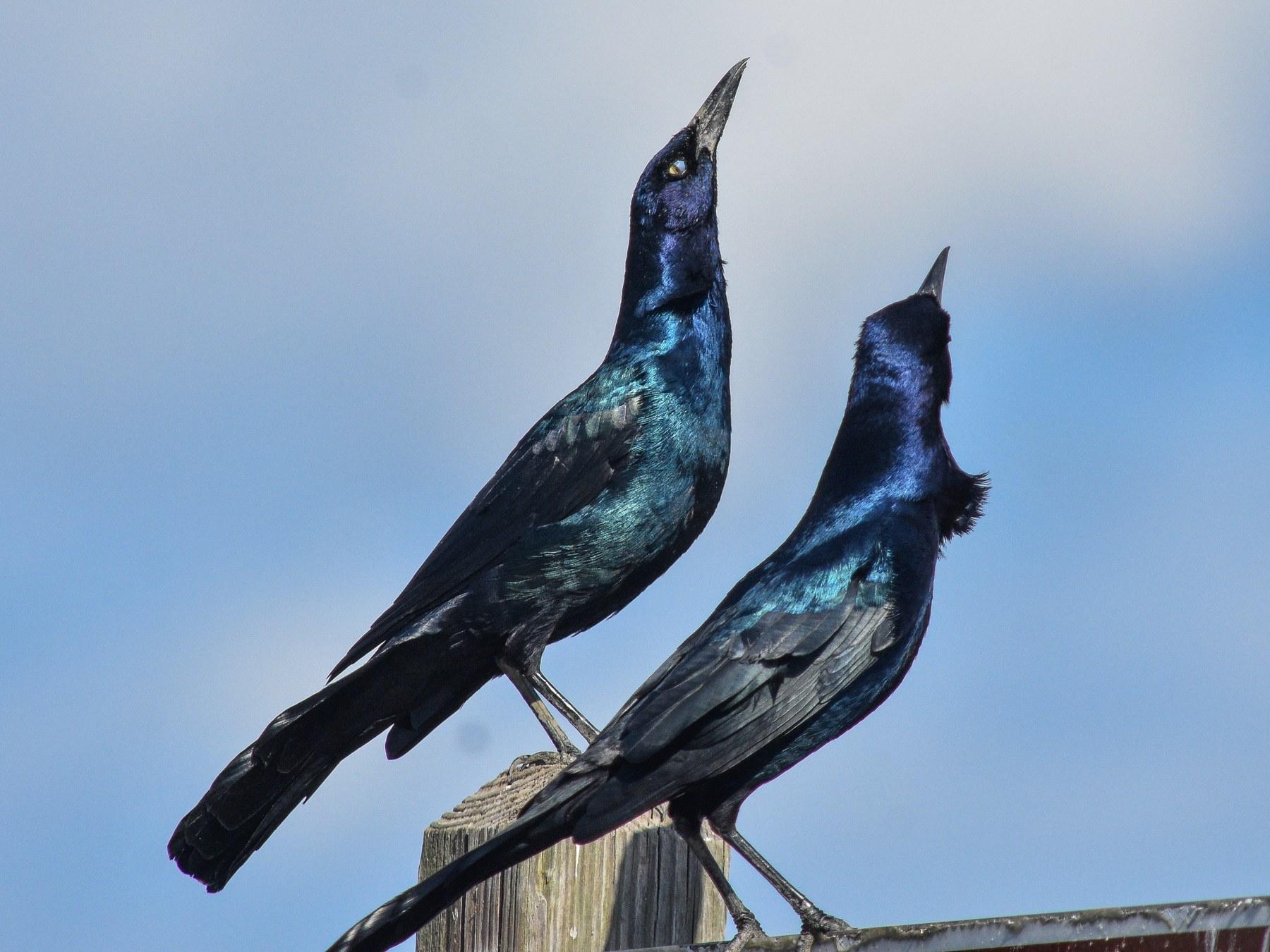
Males perform in pairs, and sometimes in groups of up to seven, taking turns. In the ruff-out display they erect their head and body feathers, fan the tail, drop and then raise and quiver the wings, and sing. In the bill-up display, given by both sexes all year, the bird points its bill skyward for as long as 20 seconds. Males also fight breast to breast; in Florida, two locked together for at least 25 minutes, 20 of them half under water.1
Males mob avian predators within 330 ft (100 m) of the colony and strike them on the back, most often a Great Blue Heron, then a Fish Crow, a Common Moorhen or a Red-shouldered Hawk. Females mob far less often. Near a nest with young, both sexes dive at a person within 10 ft (3 m); between 5% and 10% of females and 15% to 20% of alpha males hit heads with their feet, and in one colony of 20-30 females just one female did, the same bird in each of four years.1
Lifespan and predators
The oldest on the US banding record was a female at least 13 years 1 month old: she was banded as a young bird, too young to fly, in South Carolina on 26 April 1990 and caught alive there by a bander on 5 May 2003.19 In a South Carolina study, birds past their first year survived from one year to the next at a rate of 86.0% for males and 69.2% for females, and Birds of the World has no first-year estimate.1
Predators and other dangers
Most of what is known concerns the nest, where yellow rat snakes, rats, ants and Purple Gallinules take eggs and young, and an 1834 account has alligators taking nearly fledged chicks. Little is known about what kills independent birds. Cars often kill them in South Carolina and Florida, mostly young of the year; an attack by a Sharp-shinned Hawk at a roost has been seen; and growths on the legs and toes, which may follow infected fowl-pox or scaly-leg-mite lesions, were found on 64% of adult males examined in the hand in South Carolina.1 Pesticide poisoning is suspected in South Carolina, and in central Florida 11 nestlings over two years were believed killed by poisoned food. Hurricane Hugo, which struck Charleston in 1989 with winds of 124 mph (200 km/h), did not change male survival.1
Conservation
The IUCN rates the Boat-tailed Grackle Least Concern, assessed in 2025, and NatureServe ranks it G5 globally.20, 21 The Breeding Bird Survey, which meets this bird only on roadside routes within a narrow coastal range, shows no clear change across 201 routes: -0.47% a year from 1966 to 2025, with a 95% credible interval from -1.33 to +0.39, which spans zero, and the survey's top credibility rating.22 The 1995-2025 window shows a decline, at -1.32% a year (-2.35 to -0.02, just excluding zero), and Florida carries it: 87 of the 201 routes are there, and Florida's own 1995-2025 trend is -2.13 (-3.30 to -0.95). Texas (+5.71, credibility 2, 13 routes) and North Carolina (+3.46, credibility 3, 16 routes) have risen over the long term, and New Jersey's rise rests on few routes. The latest ten-year window, 2015-2025, does not show a decline (+1.25, -1.48 to +5.06, which spans zero). The survey's index peaked in 1986, was lowest in 2017 and in 2025 stood a little above that low.22
Partners in Flight puts the population at about 2.2 million birds, all in the United States, for a population year of about 2010, and does not put it on its Watch List.23 Birds of the World calls it a bird with no population at risk, but says it probably deserves closer monitoring than the other grackles get, because the range is small and tied to the coast and to freshwater marsh, and notes that coastal development often alters the places where nests cluster; in South Carolina, impoundments along the coast, many held for waterfowl, make prime nesting ground and need managing. The highest single-site count was an estimated 97,000 birds at Lake Apopka, Florida, on 18 July 2004.1
Legal status
The Boat-tailed Grackle is on the federal list of species covered by the Migratory Bird Treaty Act, so it is unlawful to take, possess, transport, sell or buy the bird, its feathers, nests or eggs except under a permit or as the regulations allow, and it has no Endangered Species Act listing.24, 25, 26 It is also one of the species named in a federal order for blackbirds, cowbirds, crows, grackles and magpies. Under it, no federal permit is needed to control these birds where they cause serious injury to crops or livestock feed, a health hazard or structural damage, or to protect certain listed species; each year nonlethal methods must be tried before any lethal control, an annual report filed and state law followed.27 A finder may take a sick, injured or orphaned bird straight to a permitted rehabilitator or a licensed veterinarian without a permit.28 It does not breed in Canada, and Canada's migratory bird list leaves out grackles.23, 29
Names and history
Louis Vieillot named the bird Quiscalus major, the large grackle, in 1819, and New Orleans, Louisiana, was later fixed as its type locality.30 The English name fits the tail, folded into a deep V like a boat's keel; in 1913 a Virginia ornithologist compared the tail in flight to a boat's rudder. In South Carolina and Virginia it was long known as the jackdaw.5, 31, 6
The 1973 split
Until 1973 the Boat-tailed and Great-tailed Grackles were treated as one species.32 Earlier writers had argued from voice and form that there were two. The field evidence came from the Texas and Louisiana coast, where Robert Selander and Donald Giller found in 1959-60 that the two live side by side without interbreeding, in different habitats (this one in coastal marsh, the other in farmland and other man-made habitats) and with different displays and voices.33 Birds of the World reports some hybrids where they meet but little introgression, and one field guide says there is no interbreeding at all.1, 2 A 2026 genomic study found no sign of mixing between the two species and suggested that any hybrids where they meet are infertile or rare.34 Their mitochondrial DNA differs by only 1.6%, a distance typical of extremely closely related species.35
The 2026 study also found that in the Boat-tailed Grackle, geographic breaks and not eye color divide the genetic variation, and a 2025 thesis scanned the genomes of 41 Louisiana, Mississippi and Alabama birds for the genes behind pale and dark eyes and flagged candidate genes.34, 36
Similar birds
Often mistaken for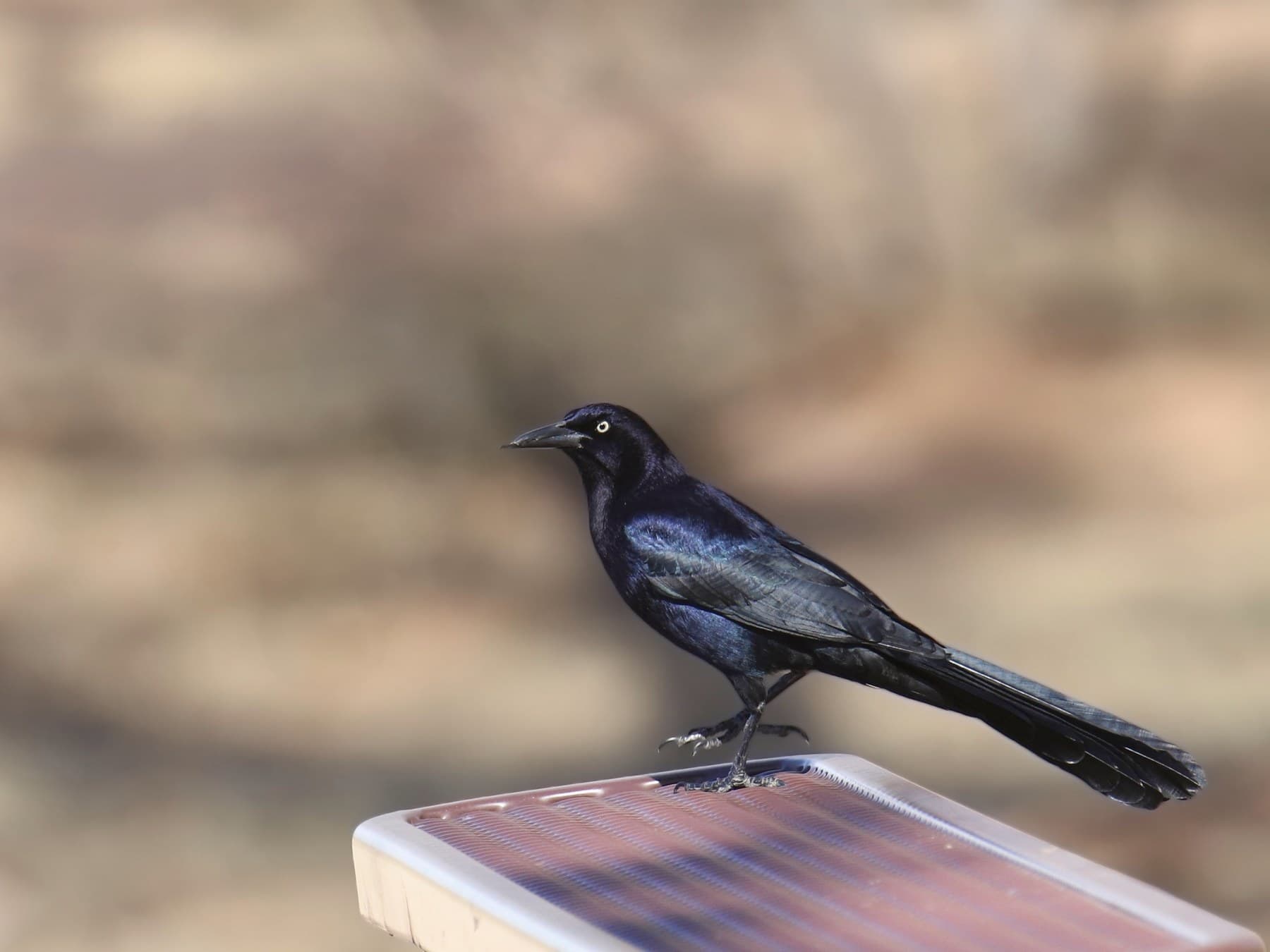
Quick facts
- Length
- 26–42 cm
- Wingspan
- 38–60 cm
- Weight
- 93–239 g
- Lifespan
- oldest recorded 13 years 1 month
- Family
- New World Blackbirds
- Migration
- Partial migrant
- Global status (IUCN)
- Least Concern
- World population
- About 2.2 million (Partners in Flight, around 2010)
- Population trend
- No clear change in Breeding Bird Survey counts since 1966; they fell from the mid-1990s to the mid-2010s, mostly in Florida, and show no clear direction since
- Scientific name
- Quiscalus major
Questions
4Is a Boat-tailed Grackle a crow?
No. It is a New World blackbird, in the same family as orioles, meadowlarks and cowbirds, and not a member of the crow family.
Are Boat-tailed Grackles invasive?
No. It is a native American bird, known to science since 1819. Its breeding range has crept north along the Atlantic coast since the early 1900s, and it has moved inland where lakes offer marsh, but it has stayed in warm, wet places.
Is it good to have grackles around the house?
It depends on what you want. Where people feed it, it takes sunflower seed and other seed from platform feeders and can become remarkably tame; near homes, its noise, droppings and habit of eating pet food draw complaints.1
Are Boat-tailed Grackles aggressive?
Around a colony they can be: males fight each other and mob predators, and both sexes dive at people who come within about 10 ft (3 m) of a nest with young, though few strike.
Sources
38- 1Post, W., Poston, J. P. and Bancroft, G. T. (2020). Boat-tailed Grackle (Quiscalus major), version 1.0. Birds of the World (A. F. Poole, editor). Cornell Lab of Ornithology. doi:10.2173/bow.botgra.01 (opens in a new tab)
- 2National Audubon Society. Boat-tailed Grackle. Guide to North American Birds. Accessed 17 November 2026. Source (opens in a new tab)
- 3Melman, D. and Searcy, W. A. (1999). Microgeographic song discrimination in a nonterritorial passerine, the Boat-tailed Grackle. The Condor 101(4): 845-848. doi:10.2307/1370073 (opens in a new tab)
- 4Stevenson, H. M. (1978). The populations of Boat-tailed Grackles in the southeastern United States. Proceedings of the Biological Society of Washington 91(1): 27-51. doi:10.5281/zenodo.13647604 (opens in a new tab)
- 5Bailey, H. H. (1913). The Birds of Virginia. Lynchburg, Virginia: J. P. Bell (Internet Archive scan cu31924090251632, OCR). Accessed 17 November 2026. Source (opens in a new tab)
- 6Sprunt, A., Jr. (1958). Florida and Eastern Boat-tailed Grackle accounts, in Life Histories of North American Blackbirds, Orioles, Tanagers, and Allies (A. C. Bent). U.S. National Museum Bulletin 211. doi:10.5479/si.03629236.211.1 (opens in a new tab)
- 7Federation of New York State Bird Clubs (1981). Regional reports and the NYSARC annual report. The Kingbird 31(4): (Fall 1981). Accessed 17 November 2026. Source (opens in a new tab)
- 8Connecticut Audubon Society. Boat-tailed Grackle. Connecticut Audubon Society bird guide. Accessed 17 November 2026. Source (opens in a new tab)
- 9Summers, J., Lukas, D., Logan, C. J. and Chen, N. (2023). The role of climate change and niche shifts in divergent range dynamics of a sister-species pair. Peer Community Journal 3: e23. doi:10.24072/pcjournal.248 (opens in a new tab)
- 10Beal, F. E. L. (1900). Food of the Bobolink, Blackbirds, and Grackles. U.S. Department of Agriculture, Division of Biological Survey, Bulletin 13. doi:10.5962/bhl.title.62939 (opens in a new tab)
- 11Denmon, P., Watts, B. D. and Smith, F. M. (2013). Investigating American Oystercatcher nest failure on Fisherman Island National Wildlife Refuge, Virginia, USA. Waterbirds 36(2): 156-165. doi:10.1675/063.036.0205 (opens in a new tab)
- 12Cornell Lab of Ornithology. Boat-tailed Grackle. All About Birds. Accessed 17 November 2026. Source (opens in a new tab)
- 13Post, W. (1998). Advantages of coloniality in female Boat-tailed Grackles. The Wilson Bulletin 110(4): 489-496. doi:10.5281/zenodo.16477997 (opens in a new tab)
- 14Bancroft, G. T. (1984). Growth and sexual dimorphism of the Boat-tailed Grackle. The Condor 86(4): 423-432. doi:10.2307/1366822 (opens in a new tab)
- 15Bancroft, G. T. (1986). Nesting success and mortality of the Boat-tailed Grackle. The Auk 103(1): 86-99. doi:10.1093/auk/103.1.86 (opens in a new tab)
- 16Post, W. and Seals, C. A. (1993). Nesting associations of Least Bitterns and Boat-tailed Grackles. The Condor 95(1): 139-144. doi:10.2307/1369395 (opens in a new tab)
- 17Poston, J. P. (1997). Dominance, access to colonies, and queues for mating opportunities by male boat-tailed grackles. Behavioral Ecology and Sociobiology 41(2): 89-98. doi:10.1007/s002650050368 (opens in a new tab)
- 18Poston, J. P. (1999). Male rank, female breeding synchrony, and patterns of paternity in the boat-tailed grackle. Behavioral Ecology 10(4): 444-451. doi:10.1093/beheco/10.4.444 (opens in a new tab)
- 19USGS Bird Banding Laboratory. Longevity records of North American birds: Boat-tailed Grackle (AOU 5130). Bird Banding Laboratory, Bander Portal longevity tables. Accessed 17 November 2026. Source (opens in a new tab)
- 20BirdLife International (2025). Quiscalus major. The IUCN Red List of Threatened Species 2025: e.T22724311A136662294. doi:10.2305/IUCN.UK.2025-2.RLTS.T22724311A136662294.en (opens in a new tab)
- 21NatureServe. Quiscalus major: Boat-tailed Grackle. NatureServe Explorer. Accessed 17 November 2026. Source (opens in a new tab)
- 22Hostetler, J. A. et al. (2026). The North American Breeding Bird Survey, Analysis Results 1966-2025. U.S. Geological Survey data release. doi:10.5066/P1OSNSFC (opens in a new tab)
- 23Partners in Flight (2024). Avian Conservation Assessment Database, version 2024.05.23 (global). Partners in Flight. Accessed 17 November 2026. Source (opens in a new tab)
- 24U.S. Fish and Wildlife Service (2026). 50 CFR 10.13: List of Birds Protected by the Migratory Bird Treaty Act. Electronic Code of Federal Regulations. Accessed 17 November 2026. Source (opens in a new tab)
- 25U.S. Fish and Wildlife Service (2026). 50 CFR 21.10: Permit requirement. Electronic Code of Federal Regulations. Accessed 17 November 2026. Source (opens in a new tab)
- 26U.S. Fish and Wildlife Service. Environmental Conservation Online System: species report for Quiscalus. ECOS. Accessed 17 November 2026. Source (opens in a new tab)
- 27U.S. Fish and Wildlife Service (2026). 50 CFR 21.150: Depredation order for blackbirds, cowbirds, crows, grackles, and magpies. Electronic Code of Federal Regulations. Accessed 17 November 2026. Source (opens in a new tab)
- 28U.S. Fish and Wildlife Service (2026). 50 CFR 21.76: Migratory bird rehabilitation permits. Electronic Code of Federal Regulations. Accessed 17 November 2026. Source (opens in a new tab)
- 29Environment and Climate Change Canada. Birds protected in Canada under the Migratory Birds Convention Act, 1994. Government of Canada. Accessed 17 November 2026. Source (opens in a new tab)
- 30AviList Core Team (2026). AviList: The Global Avian Checklist, v2025b. AviList. doi:10.2173/avilist.v2025b (opens in a new tab)
- 31Wayne, A. T. (1910). Birds of South Carolina. Charleston Museum (Internet Archive scan birdsofsouthcaro00wayn, OCR). Accessed 17 November 2026. Source (opens in a new tab)
- 32Carolina Bird Club (1973). Changes in Nomenclature (Roundtable). The Chat 37(2), June 1973. Accessed 17 November 2026. Source (opens in a new tab)
- 33Selander, R. K. and Giller, D. R. (1961). Analysis of sympatry of Great-tailed and Boat-tailed Grackles. The Condor 63(1): 29-86. doi:10.2307/1365420 (opens in a new tab)
- 34Corbett, E. C., Brumfield, R. T. and Faircloth, B. C. (2026). Phylogenetic relationships, hybridization, and genetic structuring in "Cassidix" grackles. Ornithology 143(4): 1-18. doi:10.1093/ornithology/ukag028 (opens in a new tab)
- 35Avise, J. C. and Zink, R. M. (1988). Molecular genetic divergence between avian sibling species: King and Clapper Rails, Long-billed and Short-billed Dowitchers, Boat-tailed and Great-tailed Grackles, and Tufted and Black-crested Titmice. The Auk 105(3): 516-528. doi:10.1093/auk/105.3.516 (opens in a new tab)
- 36Corbett, E. C. (2025). Avian eye color, phylogeography, and the genetics of iris variation in grackles (Quiscalus). Ph.D. dissertation, Louisiana State University. Accessed 17 November 2026. Source (opens in a new tab)
- 37Peer, B. D. and Bollinger, E. K. (2020). Common Grackle (Quiscalus quiscula), version 1.0. Birds of the World (A. F. Poole and F. B. Gill, editors). Cornell Lab of Ornithology. doi:10.2173/bow.comgra.01 (opens in a new tab)
- 38Cornell Lab of Ornithology. Common Grackle. All About Birds. Accessed 17 November 2026. Source (opens in a new tab)

Checked by
Nathan Cope, founder and editor
Nathan founded Birdfact and leads its writers and contributors in the UK, the US and Canada. He has watched and studied birds for more than ten years, and checks every article and species guide before it’s published.