Published 8 Oct 2026
Wren Song and Calls: What a Wren Sounds Like
By the Birdfact teamChecked by Nathan Cope
A Wren's song is a loud, fast run of high notes and trills, usually 4 to 6 seconds long. Listen to songs recorded in Britain, see them drawn as spectrograms, and find out how many songs one Wren sings and how neighbours share them.
On this page10 sections
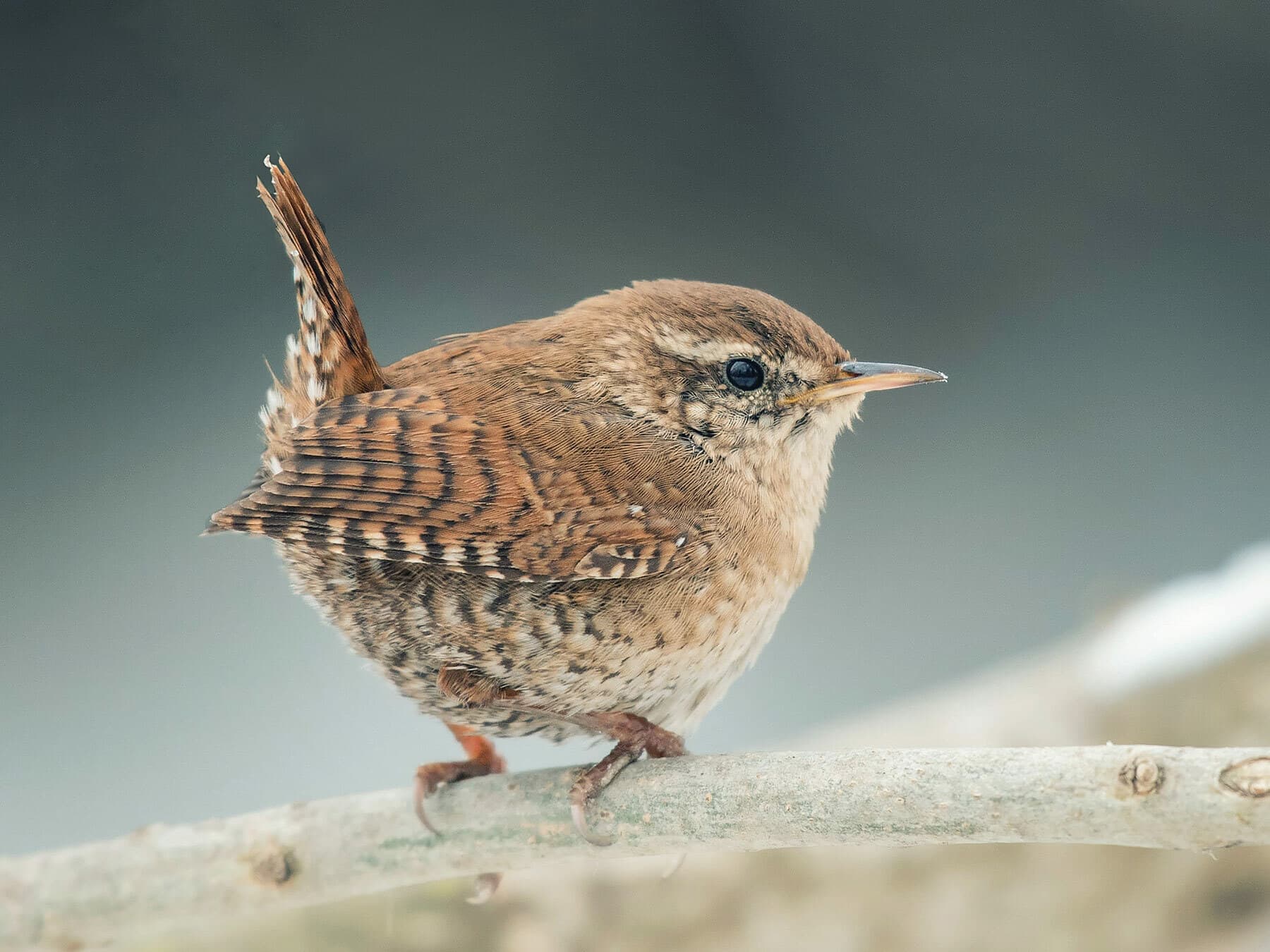
What a Wren sounds like, with songs recorded in Britain and drawn as spectrograms: the song and its parts, how many songs one Wren sings, local dialects, when Wrens sing, and the calls. For the bird itself, see Wren identification, song and facts.
What does a Wren sound like?
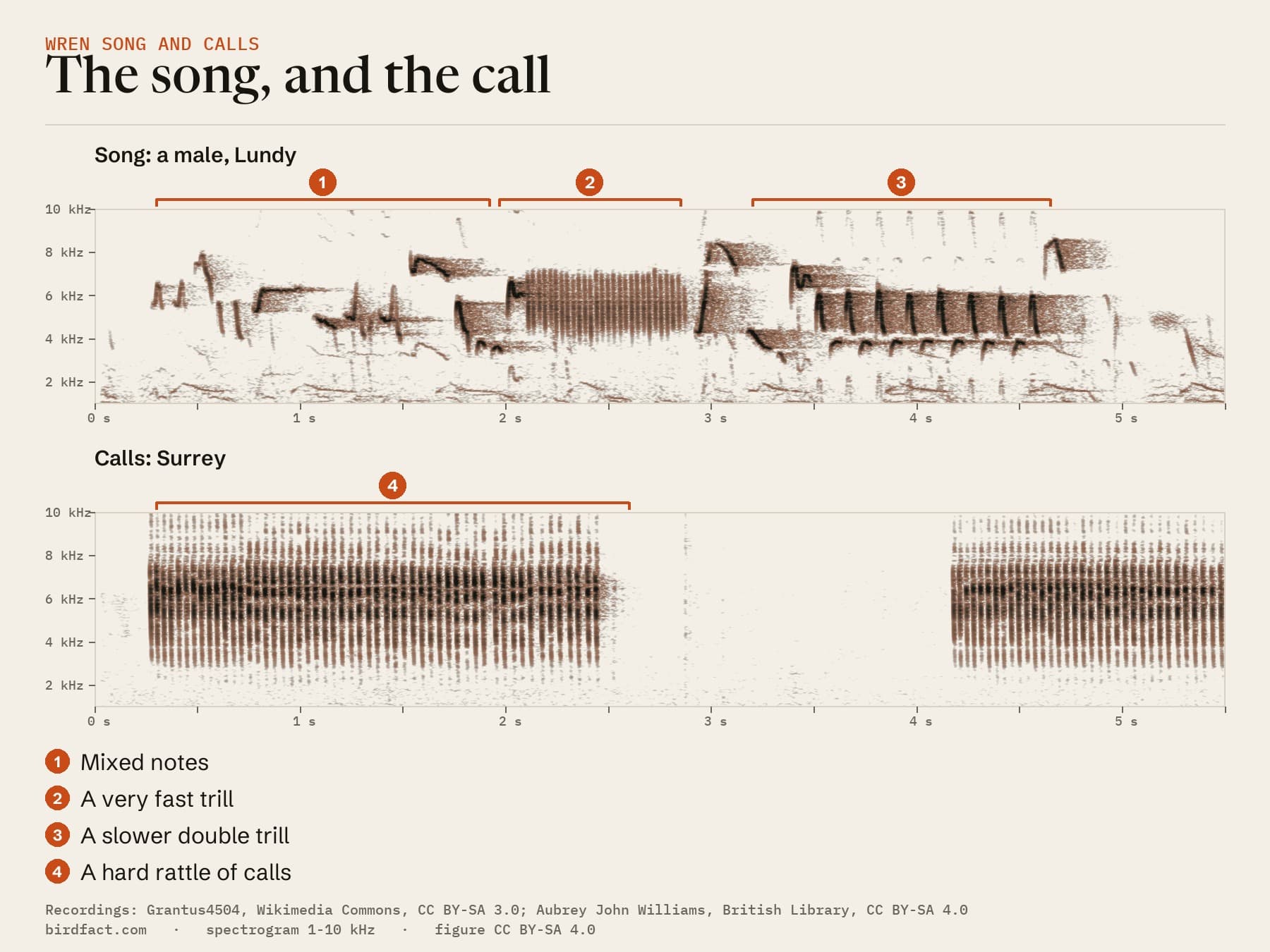
A Wren's song is remarkably loud for such a small bird: a run of high notes that ends in a trill.1 Birds of the World describes it as long and complex: tinkling trill after tinkling trill, for seconds on end.2 All About Birds gives a song as usually 4 to 6 seconds long;3 the two songs drawn on this page last about 3.6 and 4.5 seconds. In the recording below, a male on Lundy sings the same song three times, the third after a pause.
A song in parts
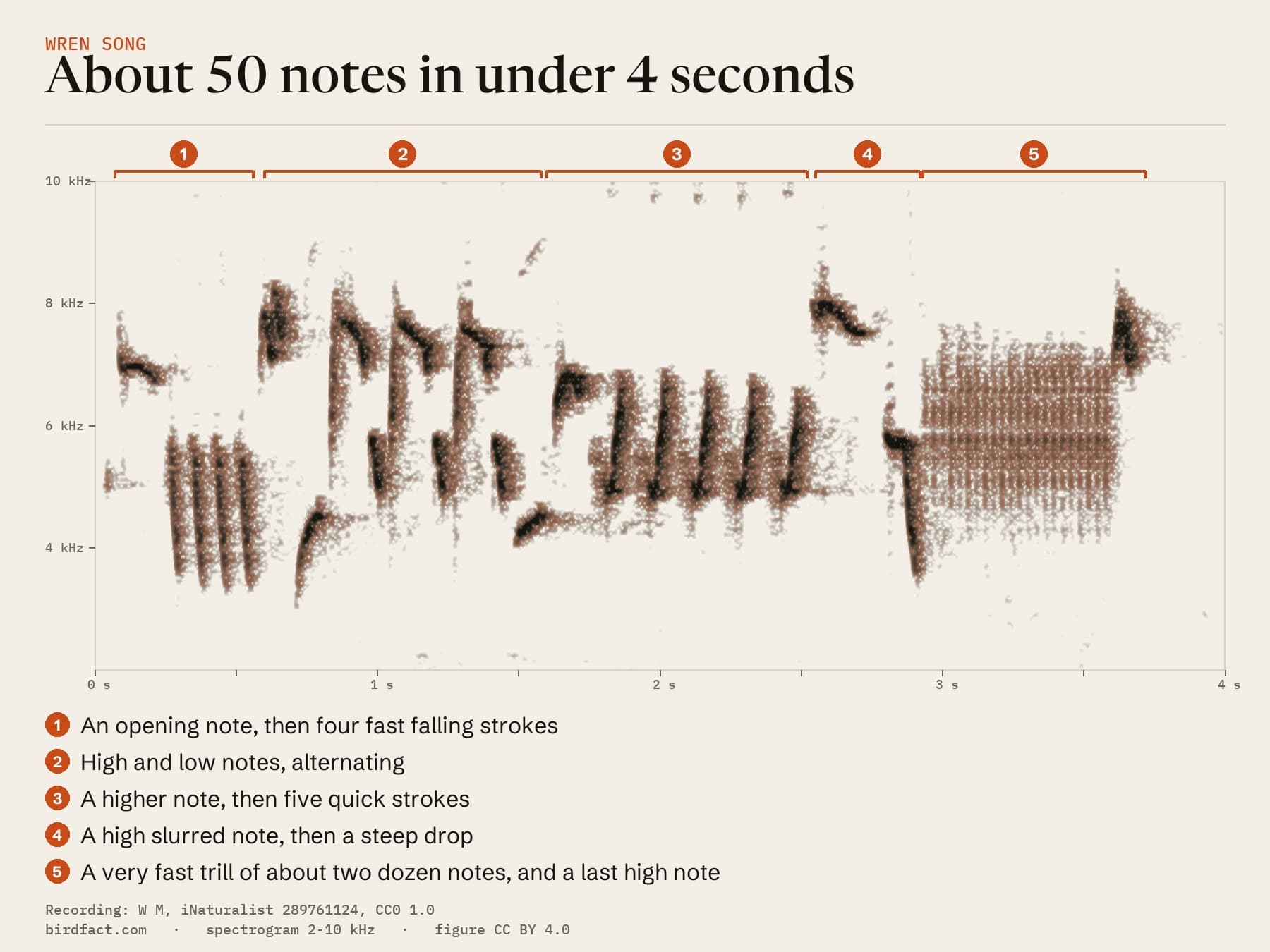
The RSPB likens the song to a flurry of high-pitched machine-gun fire, and says that more than 100 notes can be packed into a few seconds of trills, shrills and rattles.4 The figure below takes one song, recorded in Sheffield, and numbers its parts. We count about 50 separate notes in its 3.6 seconds; the closing trill alone holds about two dozen, packed into about 0.7 seconds.
One bird, several songs
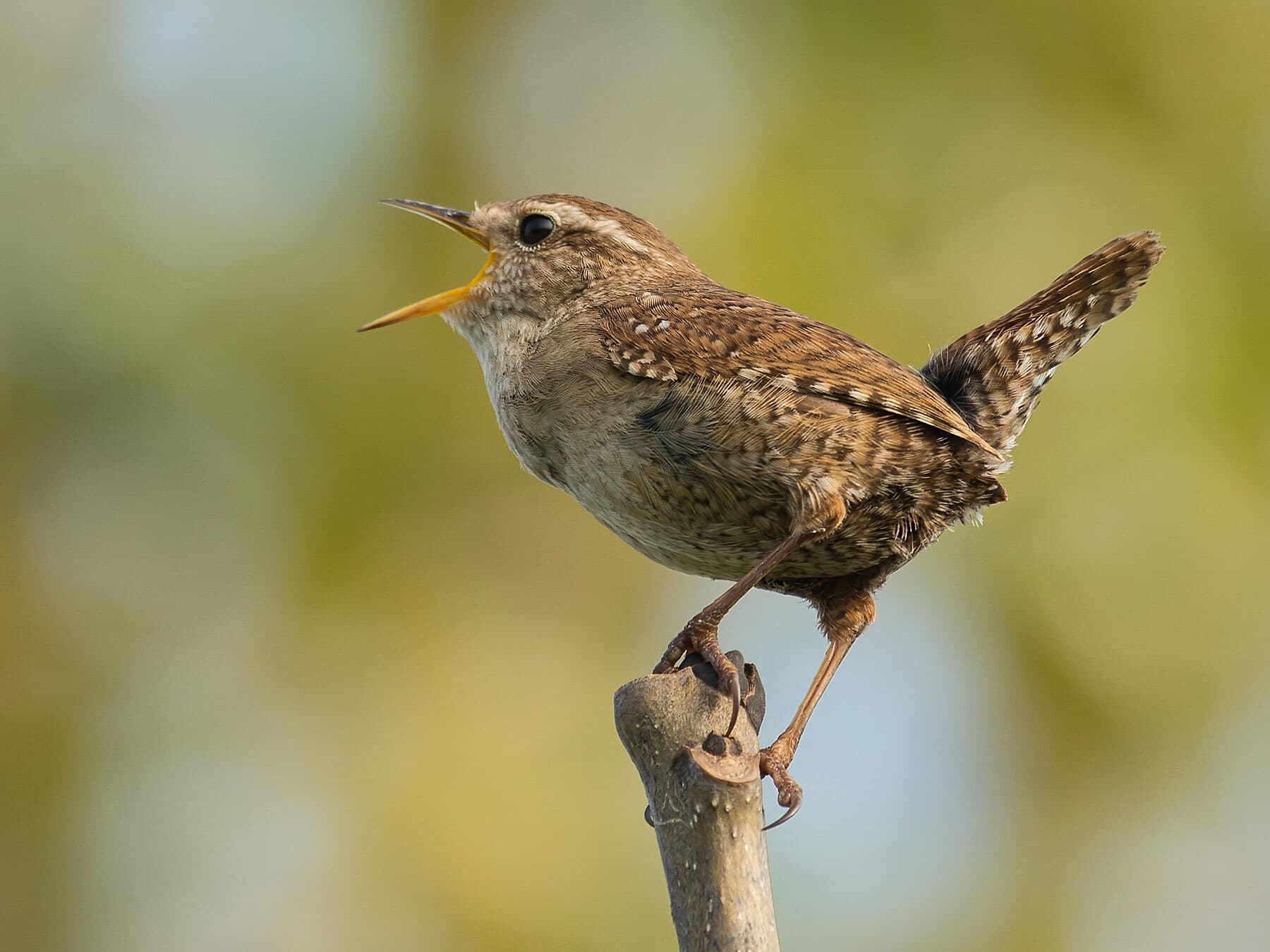
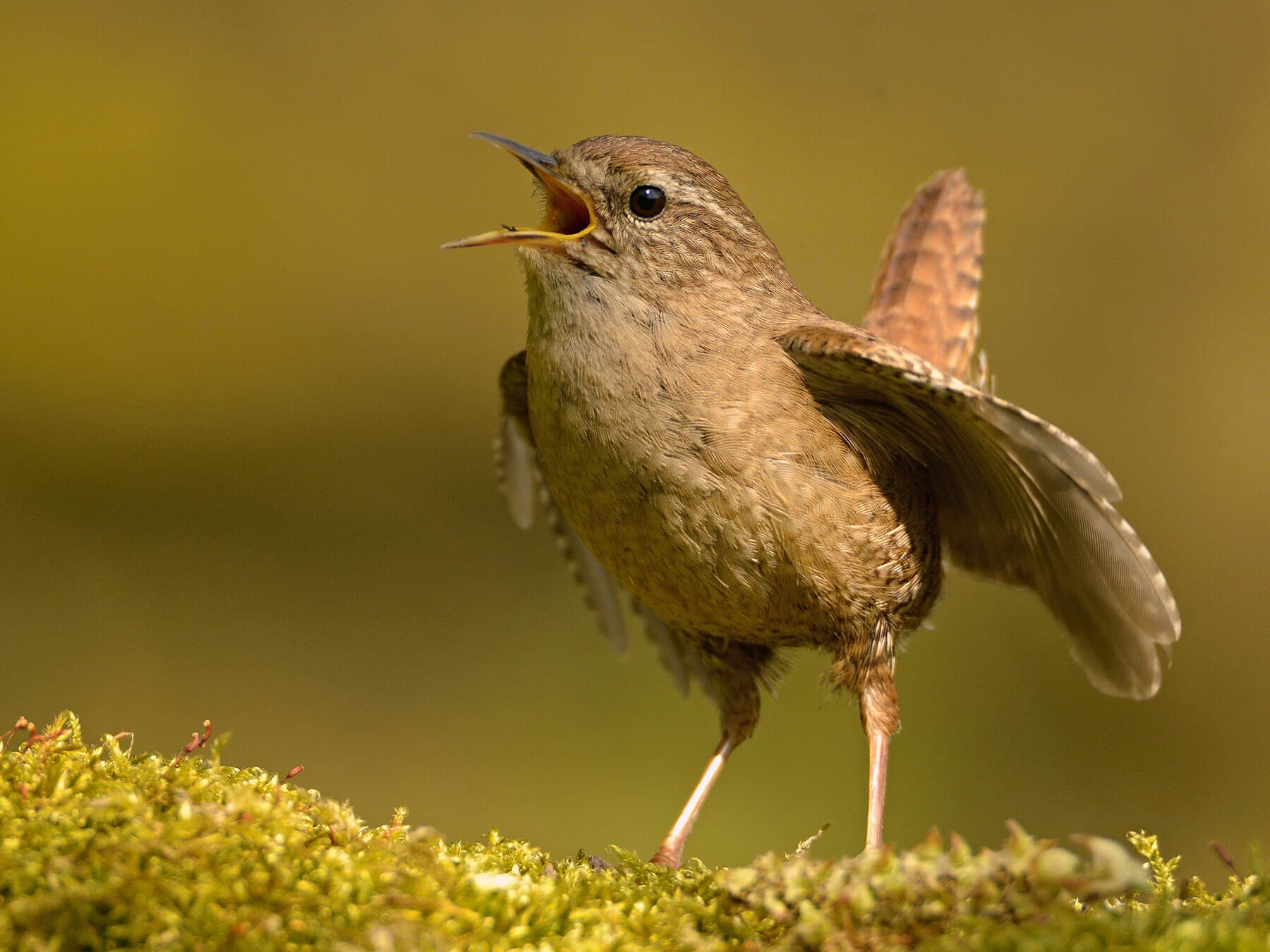
A Wren does not have just one song. In a study at Wraysbury Lakes in Berkshire, 13 males between them sang 15 different songs, or song types, and each male had three to six.5 The Lundy bird above sings one of its songs three times. The Wakefield Wren below sings a different song: it opens with one two-part note repeated over and over before its trills.
Wren dialects
Neighbouring males share many of their songs, and that can give an area its own dialect. At Wraysbury the Wrens on two banks of a lake, 200 m apart across open water, sang different sets: three song types were heard all round, but six were found only on the east bank and six only on the west, so any male could be placed on his bank by his songs.5
A later study of Wren song networks found that neighbouring males share many songs and can tell their group's songs from unfamiliar ones, that each male still has his own acoustic signature, and that groups of neighbours keep their vocal traditions going over the years.6 On remote islands, the BTO notes, Wren songs differ slightly from those of mainland birds.7
When they sing
Wrens sing all year round, from dawn to dusk, and are heard best from March to May, in the breeding season. Dawn song seems to help hold a territory. In a playback study, males that had heard a simulated intruder sang more before sunrise the next day; singing at dusk was generally very low, and in spring males started earlier at dawn and sang more songs at dawn than in autumn.8
Young Wrens begin to sing in July of the year they hatch, and two adults have been reported singing hard at an adder.2
Calls
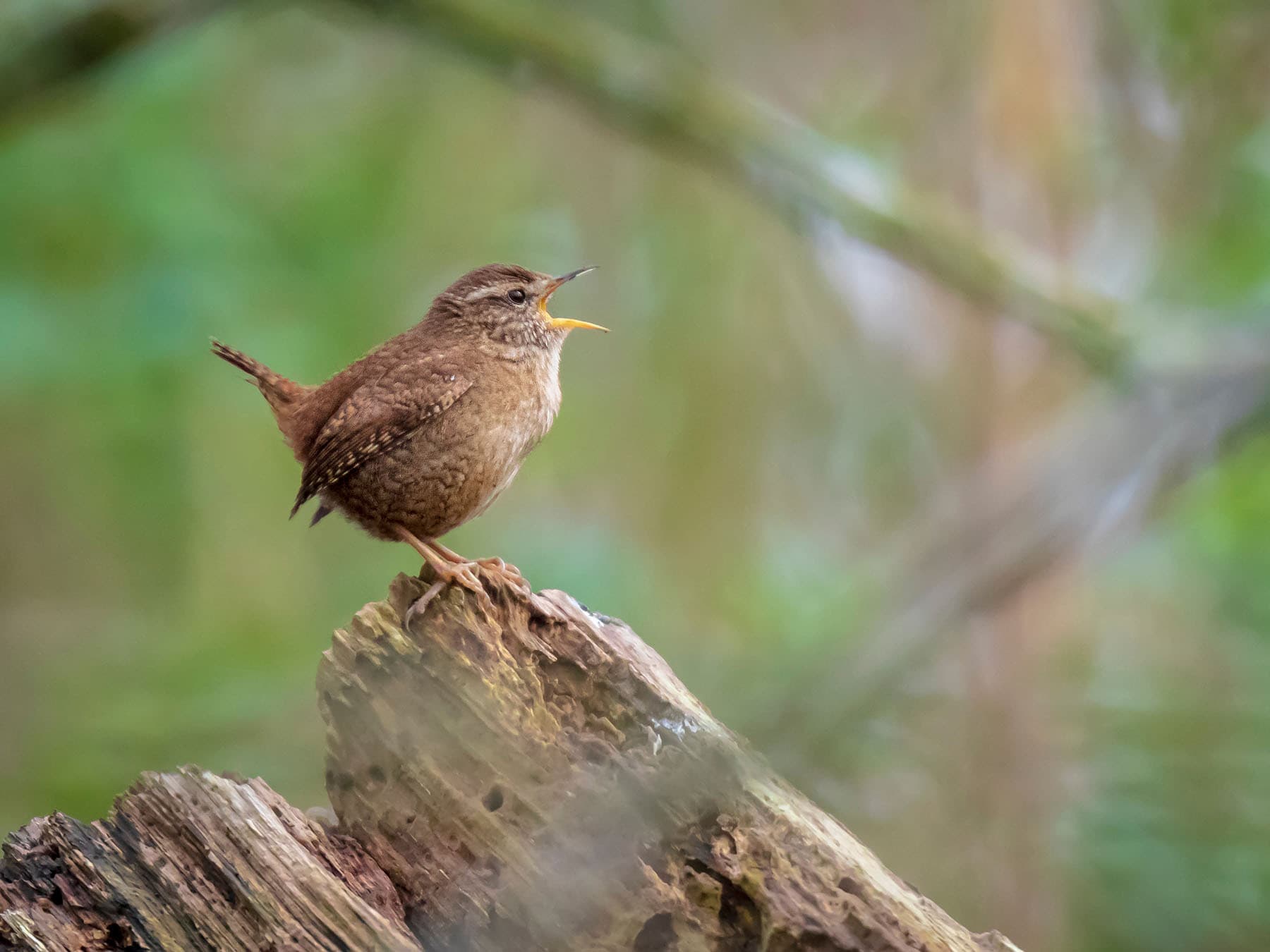
The call is a loud "tic-tic-tic", which the BTO describes as the scolding alarm call; a Wren is often heard before it is seen.7 Wrens also give sharp "tac" notes and loud churrs. In the lower panel of the first figure on this page, the calls form hard rattles that cover a broad band of pitches, with no tune.
European and American Wrens
Until recently, the Winter Wren and the Pacific Wren of North America were counted as the same species as ours. Birds of the World notes that the three can hardly be told apart except by their songs, and that European Wrens sing differently from the two American species.2
A recording from 1970
From the British Library's wildlife sound archive: the song of a male Wren at Loch Garten, Speyside, in 1970. Listen for the same pattern of mixed notes and trills.
About these recordings
All five recordings were made in Britain and shared under Creative Commons terms (the Sheffield recording is dedicated to the public domain); each was checked on a spectrogram before use. The Lundy singer is described as a male by its recordist and the Loch Garten singer by the British Library's catalogue; the Wakefield bird was photographed singing; the Sheffield song was identified from the recording by iNaturalist users. The two figures were drawn by Birdfact from these recordings.
Sources
- RSPB. Wren. RSPB Birds A-Z. Accessed 8 October 2026. Source
- Kroodsma, D. E., Brewer, D., Christie, D. A., Marks, J. S. (2020). Eurasian Wren (Troglodytes troglodytes), version 1.0. Birds of the World (J. del Hoyo, A. Elliott, J. Sargatal, D. A. Christie and E. de Juana, editors). Cornell Lab of Ornithology. doi:10.2173/bow.winwre4.01
- Cornell Lab of Ornithology. Eurasian Wren: Life History and Identification. All About Birds. Accessed 8 October 2026. Source
- RSPB. Sounds of... Parks and Gardens. RSPB. Accessed 8 October 2026. Source
- Catchpole, C. K., Rowell, A. (1993). Song sharing and local dialects in a population of the European Wren Troglodytes troglodytes. Behaviour 125(1-2): 67-78. doi:10.1163/156853993x00191
- Camacho-Schlenker, S. (2011). Etude des réseaux de communication acoustique chez un oiseau chanteur forestier, le Troglodyte mignon (Troglodytes troglodytes). PhD thesis, Université Paris-Sud. Accessed 8 October 2026. Source
- BTO. Wren (Troglodytes troglodytes). BTO BirdFacts. Accessed 8 October 2026. Source
- Erne, N., Amrhein, V. (2008). Long-term influence of simulated territorial intrusions on dawn and dusk singing in the Winter Wren: spring versus autumn. Journal of Ornithology 149(4): 479-486. doi:10.1007/s10336-008-0288-8
- Wikimedia Commons, British Library and iNaturalist contributors. Recordings of Wrens used on the song page. Wikimedia Commons; British Library; iNaturalist. Accessed 8 October 2026. Source