Species Profile
Pacific Wren
Troglodytes pacificus
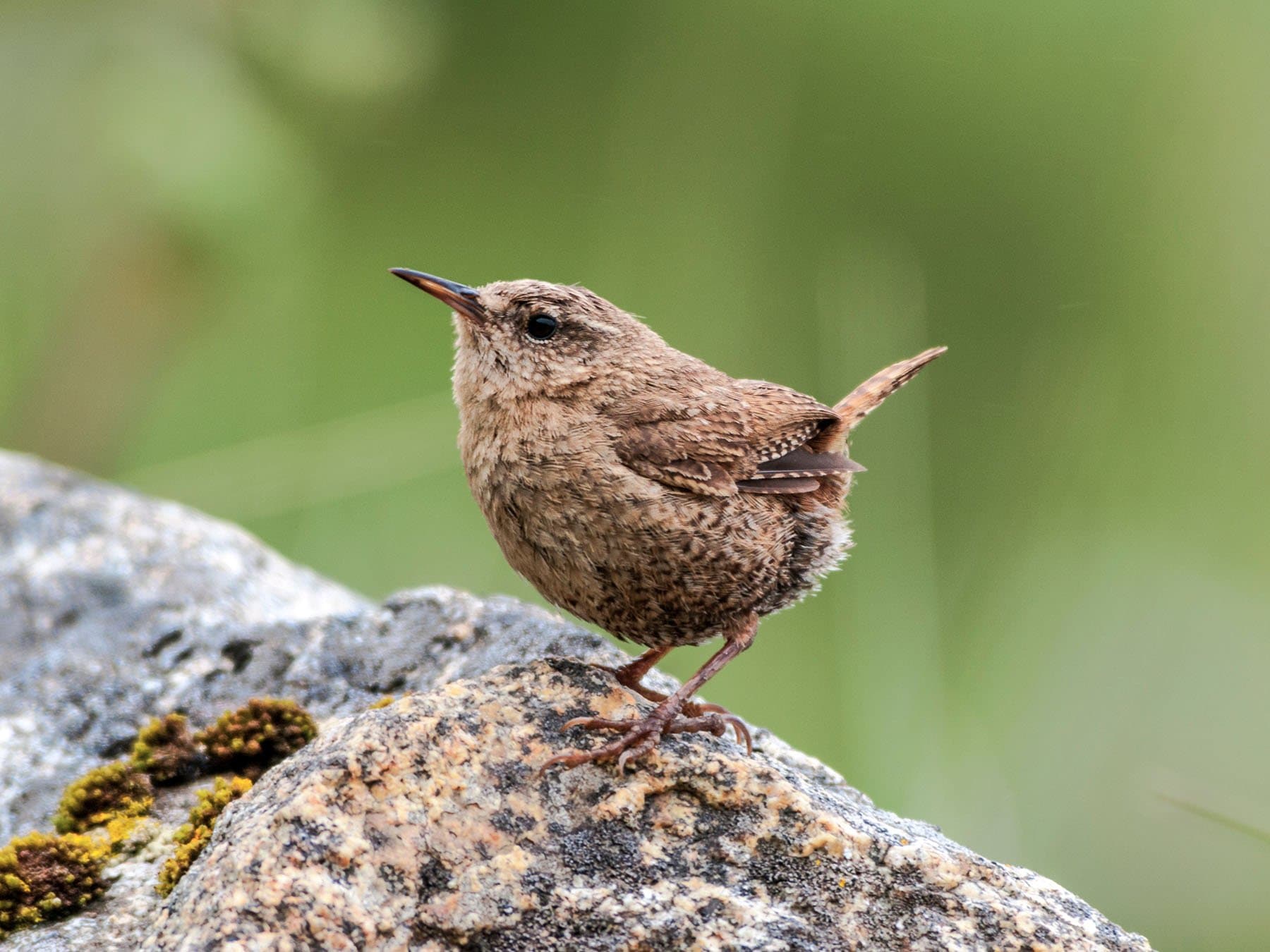
Pacific Wren perched on a mossy rock, showing brown plumage, a short tail, and a slender bill, with a blurred green background.
Quick Facts
Conservation
LCLeast ConcernLifespan
2–5 years
Length
8–12 cm
Weight
8–12 g
Wingspan
12–16 cm
Migration
Partial migrant
Barely the size of a ping-pong ball, the Pacific Wren punches so far above its weight acoustically that ornithologist Donald Kroodsma formally described its song as the "pinnacle of song complexity" among North American songbirds — a single male can deliver up to 36 notes per second and maintain a repertoire of 30 distinct song types. This tiny, dark-brown bird of the Pacific coast's old-growth forests was only recognised as a species in its own right in 2010, having been lumped with the Eurasian Wren and Winter Wren for over a century.
Also known as: Winter Wren
Think you've spotted a Pacific Wren?
Upload a photo and we'll confirm it instantly
Confirm with a PhotoAppearance
The Pacific Wren is one of the smallest wrens in North America — a compact, round-bodied bird that looks, at first glance, like a dark brown ball of feathers with a tail. That tail is short and stubby, and almost always held cocked upright at a sharp angle, giving the bird a permanently alert, jaunty posture. Total length runs from 8 to 12 cm, with a wingspan of 12–16 cm and a weight of just 8–12 g.
The upperparts are rich rufous-brown, with the wing coverts showing darker barring. The primaries and secondaries are brown with blackish bars, and the short chestnut-brown tail is distinctly barred with dark. On the underparts, the upper breast is pale brown, while the belly and flanks are warmer brown with prominent dark barring — a pattern that helps the bird disappear against the dappled light of a forest floor. The face is brown with a pale buff supercilium (eyebrow stripe) that is indistinct but visible, and a small white crescent sits below the dark brown eye. The forehead, crown, and nape are brown with fine darker barring. The chin and throat are pale brown.
The bill is thin and pointed — ideal for probing bark crevices — and pale brownish with a paler base. Legs and feet are pale brown. Sexes are identical in plumage; there is no sexual dimorphism. The species is noticeably darker and smaller than the House Wren, and typically richer golden-brown on the chest than the very similar Winter Wren — the most reliable visual distinction where the two species approach each other.
Juveniles resemble adults but show slightly less distinct barring on the flanks and a warmer, more uniform reddish-brown tone overall. Populations on the Pribilof Islands, Alaska, are an exception to the typical appearance: they are larger than mainland birds and tend to be paler, lacking the rusty tones of the nominate subspecies — an adaptation to their open, treeless island environment.
Identification & Characteristics
Colors
- Primary
- Rufous
- Secondary
- Brown
- Beak
- Brown
- Legs
- Pink
Markings
Short, stubby tail almost always held cocked upright; rich rufous-brown upperparts with dark barring; pale buff supercilium; small white crescent below eye; dark-barred flanks and belly.
Tail: Short, chestnut-brown, distinctly barred with dark; almost always held cocked upright at a sharp angle.
Attributes
Understanding Attributes
Rated 0–100 based on research and observation. A score of 50 is average across all bird species. These attributes are relative and don't necessarily indicate superiority.
Habitat & Distribution
The Pacific Wren is a bird of moist, dense coniferous forest — specifically old-growth and mature stands of Sitka spruce, western red cedar, Douglas-fir, and western hemlock. Within these forests, it is the structure of the forest floor that matters most: fallen logs, coarse woody debris, upturned root systems, and rotting stumps are all critical features used for both foraging and nesting. In the Pacific Northwest, the species' breeding distribution broadly tracks salmon-bearing streams, which support the richest forest floor invertebrate communities.
The breeding range runs along the Pacific coast from the southern coast of Alaska — including the Aleutian and Pribilof Islands — south through British Columbia, Washington, Oregon, and California as far as Monterey. Inland, the range extends east through southwestern Yukon, western Alberta, central Montana, and into the Black Hills of South Dakota, with an isolated breeding population in central Arizona. In Washington, birds breed as high as 6,000 feet (1,830 m) on Mount Rainier; in the Sierra Nevada, the species occurs from sea level up to 3,700 m elevation.
For US birders, the Pacific Wren is most reliably encountered in the old-growth forests of the Olympic Peninsula and the Cascades in Washington, the Coast Range and Cascades in Oregon, and the redwood and mixed conifer forests of northern California. In Alaska, it is a widespread resident from the Panhandle to the Aleutians. Canadian birders will find it throughout coastal British Columbia and the interior wet belt.
During the non-breeding season, birds from interior and high-elevation populations move to lower elevations and use a wider range of habitats: scrub oak, pinyon-juniper woodland, deciduous riparian forest, logged areas, and occasionally parks and gardens with brush piles. Island populations on the Aleutians and Pribilofs live in open, treeless habitats year-round — a striking contrast to the dense forest associations of mainland birds.
Where to See This Bird
Explore regional guides for locations where this bird has been recorded.
Maryland
Maine
New Jersey
Alaska
North Carolina
New Hampshire
Oregon
Tennessee
Virginia
Vermont
Washington
British Columbia
New Brunswick
Nova Scotia
Ontario
Prince Edward Island
Quebec
Diet
The Pacific Wren is almost entirely insectivorous, foraging very low in dense vegetation or directly on the ground, inspecting every crevice, crack, and surface within reach. A stomach-contents study from British Columbia gave a precise breakdown of prey: beetles dominated at 66% of contents, followed by spiders (51%), moth and butterfly caterpillars (30%), mites and ticks (23%), bees, wasps, and ants (22%), flies (14%), pseudoscorpions (11%), millipedes (10%), and harvestmen (10%). The diversity of that list reflects the bird's methodical, opportunistic approach to foraging.
Along the Pacific coast, amphipods (small crustaceans found in the intertidal zone and along stream margins) are also taken regularly. Small vertebrates occasionally feature in the diet — small fish, tadpoles, and small frogs have all been recorded. During the non-breeding season, the diet broadens slightly: berries including juniper berries are sometimes consumed, and large insect pupae are taken in winter when active invertebrates are scarce.
Foraging technique involves slow, deliberate hopping along the ground or just above it, picking prey off surfaces, probing decaying bark, and investigating upturned root systems. The bird can also cling to tree trunks to inspect bark fissures. In the Pacific Northwest, the salmon-run association is particularly notable: Pacific Wrens gather near streams in autumn to exploit the dense concentrations of flies, beetles, and other invertebrates drawn to salmon carcasses — a seasonal food bonanza that can significantly supplement the diet at a time when other food sources are declining.
Behaviour
The Pacific Wren is a bird of the forest floor and the lowest strata of dense vegetation — rarely seen more than 2 m above the ground. It moves with a characteristic nervous energy, hopping and creeping through tangles of roots, fallen logs, and upturned stumps with the quick, jerky movements of a mouse. When alarmed, it freezes, then dives into the nearest crevice. When relaxed, it bobs and flicks its cocked tail almost continuously.
Males are strongly territorial and polygynous. A single male may hold a territory and mate simultaneously with more than one female, defending his patch vigorously through song rather than direct physical confrontation. Territory boundaries are maintained year-round, though territories tend to contract during the non-breeding season. Males sing from prominent perches in the understory — fallen logs, low branches, exposed roots — and will sing throughout the day during the breeding season, not just at dawn.
One of the most striking behaviours is communal winter roosting. Pacific Wrens pile into nest boxes, tree cavities, and dense tangles to conserve warmth during cold weather. In one documented case in western Washington, 31 individual birds were found roosting together in a single nest box — a record that illustrates just how sociable these otherwise solitary-seeming birds can become when temperatures drop.
The Pacific Wren can cling to vertical tree trunks and probe bark in a manner reminiscent of a Brown Creeper. In the Pacific Northwest, birds are known to congregate near streams during salmon runs, exploiting the surge of insects attracted to decomposing salmon carcasses — an opportunistic feeding strategy that connects this tiny forest bird to one of the region's most iconic wildlife events.
Calls & Sounds
The Pacific Wren's song is, by any measure, extraordinary. Ornithologist Donald Kroodsma described it in a 1980 paper in The Condor as the "pinnacle of song complexity" among North American songbirds, and Charles Hartshorne (1973) identified it as the bird with the longest definitively reiterated song pattern on the continent. A single male can deliver up to 36 notes per second — more than twice the rate of the Winter Wren — and string together as many as 50 different phrases in a single song bout lasting 5–10 seconds. Individual males maintain a repertoire of up to 21–30 distinct, uniquely organised, and repeatable song types, each with its own internal structure.
The song has five different possible introductions, each of which can be followed by a variety of song types, giving the male an enormous combinatorial palette. When singing, the male holds his tail upright and his entire body visibly shakes with the effort — the physical exertion of producing such a rapid, sustained output is visible even at a distance. Males sing most actively in the morning but continue throughout the day during the breeding season, and in coastal and lowland areas sing irregularly but frequently through winter as well.
The call notes are sharp and explosive: a loud "kit!" or "kit-kit!" (also rendered as "timp," "chek-chek," or "kep-kep"), used as both alarm and contact calls. Females are not known to sing. The call notes are the most reliable way to distinguish Pacific Wren from Winter Wren in the field — higher and sharper in the Pacific Wren.
Research conducted at Pacific Rim National Park Reserve in British Columbia found that Pacific Wrens adapt their song length in the presence of anthropogenic noise — shortening songs near highways and areas of heavy ocean surf to reduce acoustic masking. This behavioural flexibility in the face of human-caused noise pollution adds a modern conservation dimension to the species' already remarkable vocal biology.
Flight
The Pacific Wren flies low and fast, typically covering short distances between patches of dense cover rather than making sustained open-air crossings. Its flight style is direct and whirring — rapid, shallow wingbeats producing a buzzing quality reminiscent of a large bumblebee — with little of the undulating pattern seen in many small passerines. The short, rounded wings are adapted for manoeuvrability in dense forest rather than long-distance travel, and the bird rarely rises above the shrub layer except when crossing open ground.
In flight, the cocked tail is usually lowered, making the bird appear even more compact and bullet-shaped than when perched. The overall impression is of something moving very quickly and very purposefully between two points of cover, with minimal time spent in the open. Migratory movements are largely nocturnal, which is why the species is rarely observed in active migration despite populations in interior western Canada and the northern Rockies undertaking genuine seasonal movements.
Altitudinal migration — moving downslope rather than long distances north-to-south — is the dominant movement pattern for most populations. Birds breeding at high elevations in the Cascades, Sierra Nevada, and Rockies descend to lower valleys and foothills after the breeding season, particularly in years of heavy snowfall. This vertical movement can cover several hundred metres of elevation change but rarely involves the sustained long-distance flight that characterises true migratory species.
Nesting & Breeding
The breeding season opens in mid-April, with first clutches laid from late April to mid-May. Second and sometimes third broods may be attempted into mid-to-late July, depending on latitude and elevation. The mating system is polygynous: a single male may simultaneously hold a territory and mate with more than one female, a strategy that is possible because the male's role in incubation is nil — he builds the nests and sings, but the female does all the incubating.
Courtship is elaborate. The male perches near the female with wings half-opened and fluttering, tail cocked and swinging from side to side, singing at close range. He then leads her on a tour of the several domed "cock nests" he has already built within his territory, becoming increasingly animated near each one — entering and exiting repeatedly, singing loudly — until the female enters one herself. That is her choice made. She then lines the selected nest with feathers and animal hair; the male's structure provides the outer shell.
Nests are domed and globular, sometimes reaching the size of a football, built from moss, bark strips, twigs, rootlets, and grass gathered close to the nest site for camouflage. Nest sites are almost always close to the ground — typically below 1.8 m (6 ft), though occasionally up to 7 m. Favoured locations include cavities among upturned roots of fallen trees, holes in rotten stumps, old woodpecker holes, rock crevices, streambank holes, and clumps of hanging moss.
Clutch size ranges from 1–9 eggs, typically 5–6. Eggs are white with small pale to reddish-brown spots concentrated toward the larger end, measuring 1.5–1.9 cm long by 1.2–1.4 cm wide. The female incubates alone for 14–17 days (averaging approximately 16.5 days in Idaho studies). Nestlings hatch naked with only a few straggly down feathers and are fed by both parents. Young fledge 15–19 days after hatching. Idaho nest survival data show 100% of nests surviving through egg-laying, 91% through incubation, and 61% through the nestling period — predation by red squirrels is a significant cause of nest failure.
Lifespan
The typical lifespan of a Pacific Wren in the wild is 2–5 years, reflecting the high annual mortality rates common to small passerines. The oldest individual on record, documented through banding data, survived 6 years and 6 months — a considerable achievement for a bird of this size. For comparison, the closely related Eurasian Wren has a similar typical lifespan, with most birds not surviving beyond their second or third year.
The primary causes of mortality include predation, severe winter weather, and nest failure. Cold winters are particularly dangerous: Pacific Wrens have limited fat reserves and must feed almost continuously during short winter days to maintain body temperature. Island populations — particularly those on St George Island and in parts of Alaska — have experienced significant population crashes following severe winters. Communal roosting is a direct behavioural response to this thermal challenge, allowing birds to pool body heat and reduce individual energy expenditure overnight.
Nest predation by red squirrels is a significant source of mortality during the breeding season, accounting for a meaningful proportion of the 39% nest failure rate recorded during the nestling period in Idaho studies. Breeding success also declines at higher elevations, where shorter seasons and more unpredictable weather reduce the number of successful nesting attempts per year. Despite these pressures, the species maintains a stable to slightly declining global population, suggesting that adult survival rates are sufficient to sustain numbers across most of the range.
Conservation
The Pacific Wren is listed as Least Concern on the IUCN Red List, with a global population estimated at approximately 7.5 million mature individuals (Partners in Flight, 2019). That headline figure, however, masks meaningful regional declines. Partners in Flight data show an average rate of decline of 0.6% per year between 1970 and 2017. Populations in northwestern California's Douglas-fir forests have declined by an estimated 47% from historic levels. Some regional populations in Washington and British Columbia show decreasing trends, and Breeding Bird Survey data from Washington recorded a decline of 5.6% per year between 1982 and 1991.
The primary threat is the logging and removal of old-growth and mature coniferous forest. Pacific Wrens depend on the structural complexity of old-growth forest floors — fallen logs, snags, downed woody debris, and upturned root systems — for both nesting and foraging. Simplified, managed forests lack these features. Population density is measurably lower near forest edges, and fragmentation compounds the effect. Urban development displaces birds from breeding territories, with return rates to urban nest sites as low as 0% in the greater Seattle area.
Severe winters cause significant mortality in Alaska and island populations — St George Island and Vancouver Island populations have both experienced documented winter crashes. Climate change projections from Audubon Society models suggest an 85% loss of the species' current summer range by 2080, forcing populations progressively northward. Competition from Bewick's Wren in urban and edge habitats also affects Pacific Wren numbers in some areas.
Partners in Flight rates the species 11 out of 20 on the Continental Concern Score, indicating low overall conservation concern, but designates it a focal species for western Oregon and Washington, where it is used as an indicator of complex forest floor condition in coniferous forest management assessments.
Population
Estimated: Approximately 7.5 million mature individuals (Partners in Flight, 2019)
Trend: Decreasing
Moderate decline — an average rate of 0.6% per year between 1970 and 2017 (Partners in Flight, 2019). Broadly stable in North American BBS data 1966–2019, but regional populations in Washington, British Columbia, and northwestern California show decreasing trends. Northwestern California Douglas-fir forest populations estimated to have declined 47% from historic levels.
Elevation
Sea level to 3,700 metres
Additional Details
- Predators:
- Natural predators include red squirrels (a significant cause of nest failure), domestic cats, small raptors, and corvids. Severe winter weather is also a major mortality factor, particularly for island and Alaskan populations.
Courtship & Display
The Pacific Wren's courtship is an elaborate, multi-stage performance built around the male's extraordinary vocal abilities and his role as a prolific nest-builder. Before a female arrives on his territory, the male constructs several domed "cock nests" — unlined structures of moss, bark, twigs, rootlets, and grass, positioned close to the ground and camouflaged with locally gathered plant material. These are not decoys but genuine demonstrations of nest-building competence, and the female's assessment of them is a central part of mate choice.
When a female enters his territory, the male perches near her with wings half-opened and fluttering, tail cocked and swinging from side to side, singing at close range. He then leads her on a tour of his nests, becoming increasingly animated near each one — entering and exiting repeatedly, singing loudly — until the female enters one herself. Her entry signals her choice. She then lines the selected nest with feathers and animal hair, completing the structure the male began.
Because the male is polygynous, this courtship sequence may be repeated with more than one female within the same territory during the same breeding season. The male's investment in building multiple nests is therefore not wasted effort — each nest is a potential home for a different mate. The female, once she has chosen and lined her nest, takes sole responsibility for incubation, while the male continues to sing, defend the territory, and potentially court additional females. Both parents contribute to feeding the nestlings after hatching.
Subspecies & Variation
The Pacific Wren is currently recognised as having five subspecies, though some authorities have proposed as many as 14 based on morphological variation across the species' island and mainland populations. The nominate subspecies, T. p. pacificus, occurs throughout the mainland distribution from Alaska south to California and east through the interior mountain ranges. Its type locality is Simiahmoo, Puget Sound, Washington, where the species was first formally described by Spencer Fullerton Baird in 1864.
The most distinctive subspecies are those inhabiting the remote islands off the Alaskan coastline. Birds on the Pribilof Islands (T. p. alascensis) are noticeably larger than mainland birds and significantly paler, lacking the rich rusty tones of the nominate form. This paler, larger morphology is consistent with Bergmann's Rule (larger body size in colder climates) and with the open, treeless habitat these birds occupy — where the dark, cryptic colouration of a forest-floor bird would offer less camouflage advantage. Aleutian Island populations show similar trends toward larger body size.
The 2010 species split that elevated the Pacific Wren to full species status was driven by a combination of genetic analysis and bioacoustic research — the songs of Pacific, Winter, and Eurasian Wrens are measurably different in structure, tempo, and complexity, and the three forms show no evidence of interbreeding where their ranges approach each other. Molecular clock analysis places the divergence of the Pacific Wren lineage from the Eurasian Wren at approximately 4.3 million years ago, predating the Pleistocene glaciations that shaped much of the current distribution of North American birds.
Birdwatching Tips
The Pacific Wren is far more often heard than seen. The single most effective strategy is to stand still in suitable habitat — old-growth or mature coniferous forest with fallen logs and dense understory — and listen. The song is unmistakable: a long, rapid cascade of ringing trills lasting 5–10 seconds, disproportionately loud for such a small bird. Once you hear it, follow the sound patiently; males often sing from low, exposed perches on fallen logs or root masses.
In the US Pacific Northwest, the Olympic Peninsula's Hoh Rain Forest and the old-growth trails of Mount Rainier National Park are among the most reliable sites. In Oregon, the Coast Range old-growth and the Cascades offer good habitat. In northern California, the redwood parks of Humboldt and Del Norte counties hold good populations. In Alaska, the species is widespread in the Panhandle and along the coast; on the Aleutian and Pribilof Islands, look for it in open, rocky habitats rather than forest. In British Columbia, the wet interior forests and coastal old-growth are productive.
The best time to look is during the breeding season (April–July), when males sing persistently throughout the day. In winter, birds are quieter but still present in coastal and lowland areas; check brush piles, dense tangles, and stream margins. Early morning is most productive, but unlike many songbirds, Pacific Wrens will sing at any hour during the breeding season.
Distinguishing the Pacific Wren from the very similar Winter Wren (where ranges approach in the Rockies) is best done by ear: the Pacific Wren's song is faster and longer, and its call note — a sharp, explosive "kit!" or "kit-kit!" — is higher and sharper than the Winter Wren's. Visually, the Pacific Wren tends to be richer golden-brown on the chest, but the difference is subtle and unreliable in the field without direct comparison.
Did You Know?
- The Pacific Wren can deliver up to 36 notes per second and maintains a repertoire of up to 30 distinct song types — ornithologist Donald Kroodsma formally described it as the "pinnacle of song complexity" among North American songbirds in a 1980 paper in The Condor.
- In western Washington, 31 individual Pacific Wrens were found roosting together in a single nest box during cold weather — a communal warmth-sharing strategy that reveals a surprisingly social side to an otherwise solitary-seeming bird.
- The Pacific Wren was only recognised as a distinct species in 2010, when genetic and bioacoustic research confirmed it was reproductively isolated from both the Winter Wren of eastern North America and the Eurasian Wren of Europe. Molecular clock analysis suggests the Pacific Wren and Eurasian Wren last shared a common ancestor approximately 4.3 million years ago.
- In the Pacific Northwest, Pacific Wrens congregate near streams during salmon runs to exploit the surge of insects attracted to decomposing salmon carcasses — an insectivorous forest bird benefiting indirectly from one of the region's great wildlife spectacles.
- A 1999 US postage stamp in the Pacific Coast Rain Forest series depicted a bird labelled "winter wren (Troglodytes troglodytes)" — a bird subsequently reclassified as the Pacific Wren (Troglodytes pacificus). Rudyard Kipling's narrator in "The White Seal" story from The Jungle Book is Limmershin, described as a "winter wren" — now understood to be the Pacific Wren, given the story's Pacific Coast setting.
Records & Accolades
Song Complexity Champion
Up to 36 notes per second
Formally described by ornithologist Donald Kroodsma as the 'pinnacle of song complexity' among North American songbirds, with individual males maintaining up to 30 distinct song types.
Communal Roosting Record
31 birds in one nest box
In western Washington, 31 individual Pacific Wrens were documented roosting together in a single nest box during cold weather — an extraordinary example of communal warmth-sharing.
Community Photos
Be the first to share a photo of the Pacific Wren
Upload a PhotoIdentify Any Bird Instantly
- Upload a photo from your phone or camera
- Get an instant AI identification
- Ask follow-up questions about the bird
Monthly Birds in Your Area
- Personalised for your location
- Seasonal tips and garden advice
- Updated every month with new species