


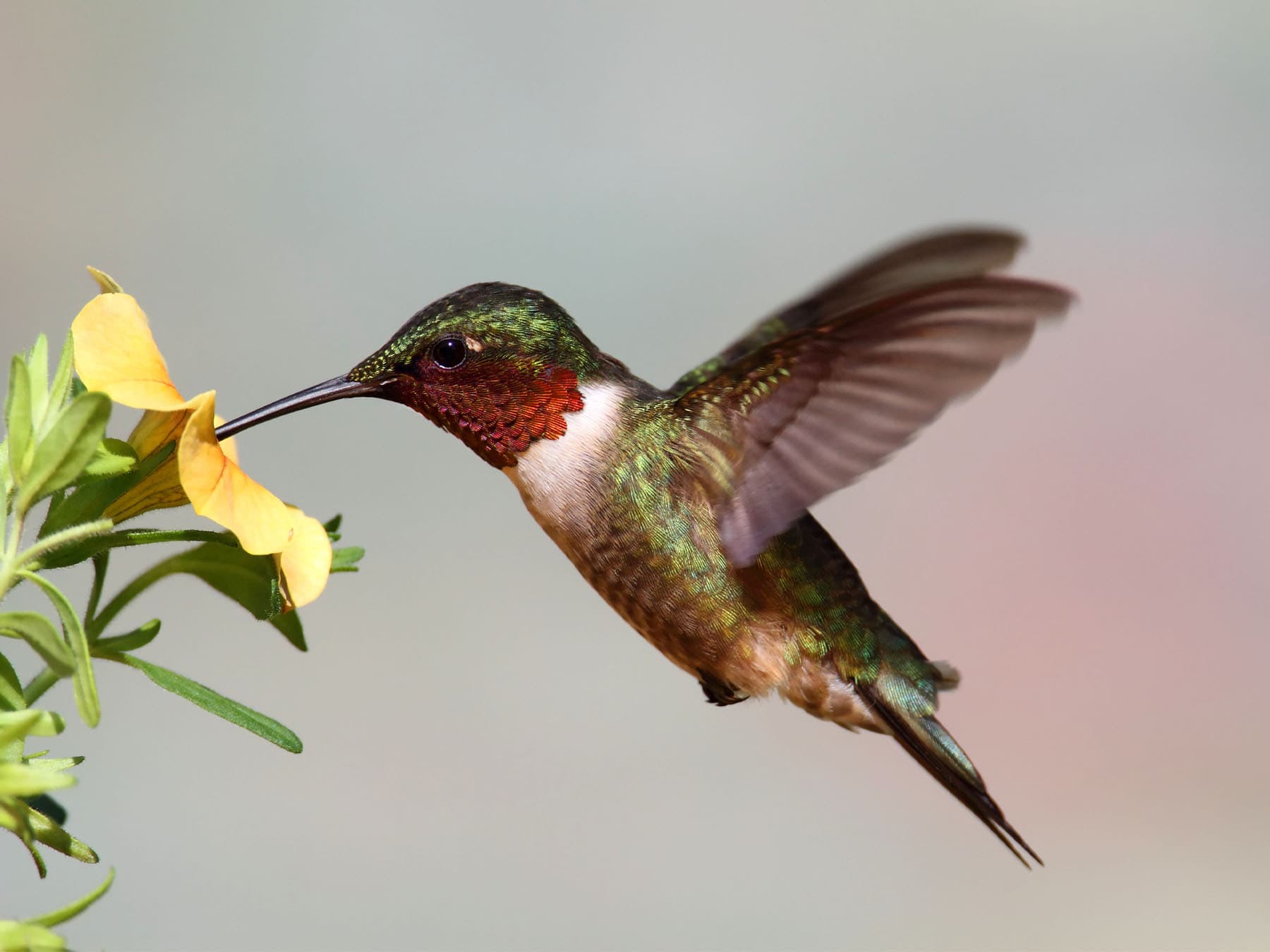
Ruby-throated Hummingbird
Ruby-throat, Ruby-throated Hummer · Archilochus colubris
By the Birdfact teamChecked by Nathan Cope
On this page11 sections
How to recognise it
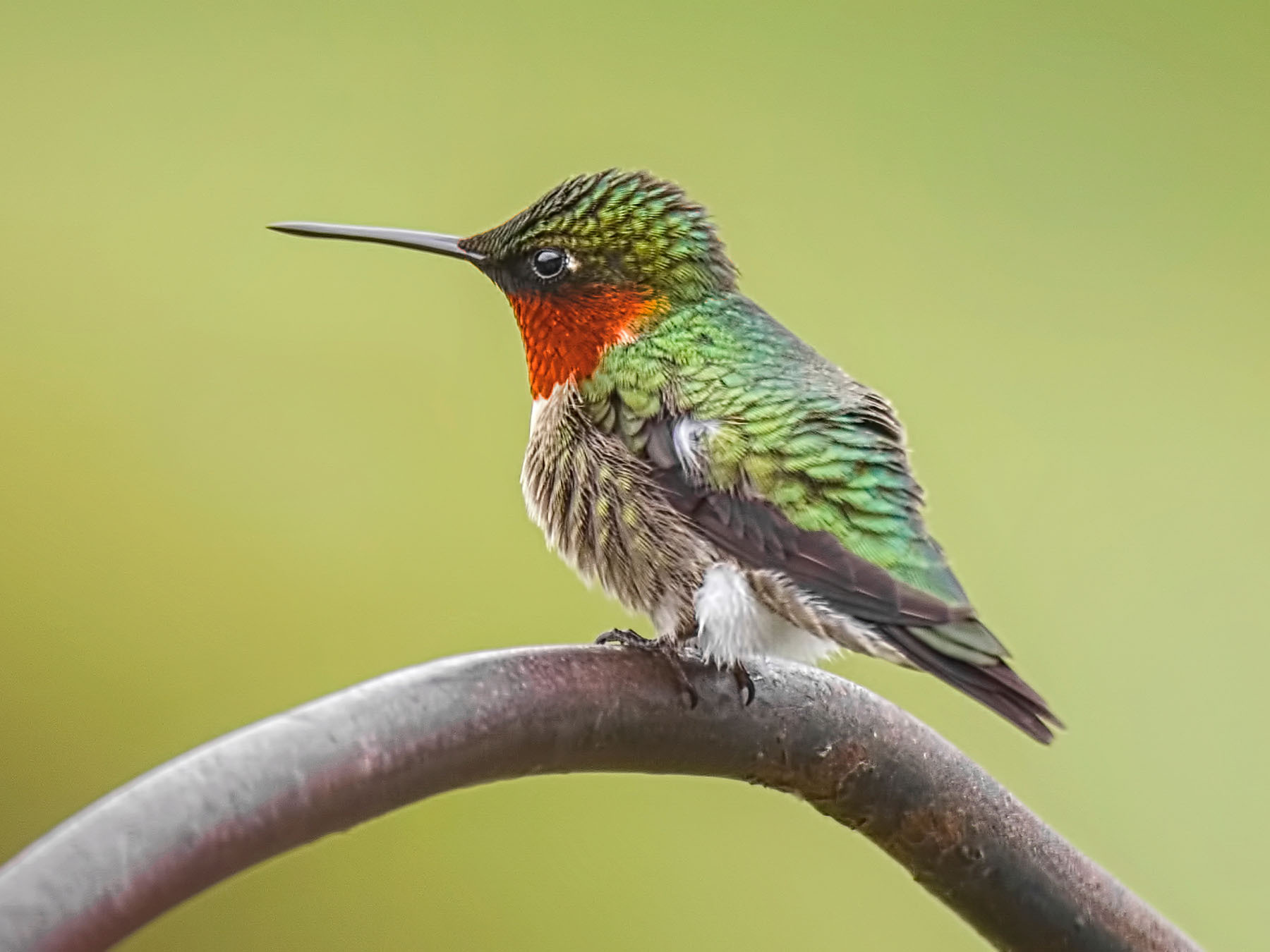
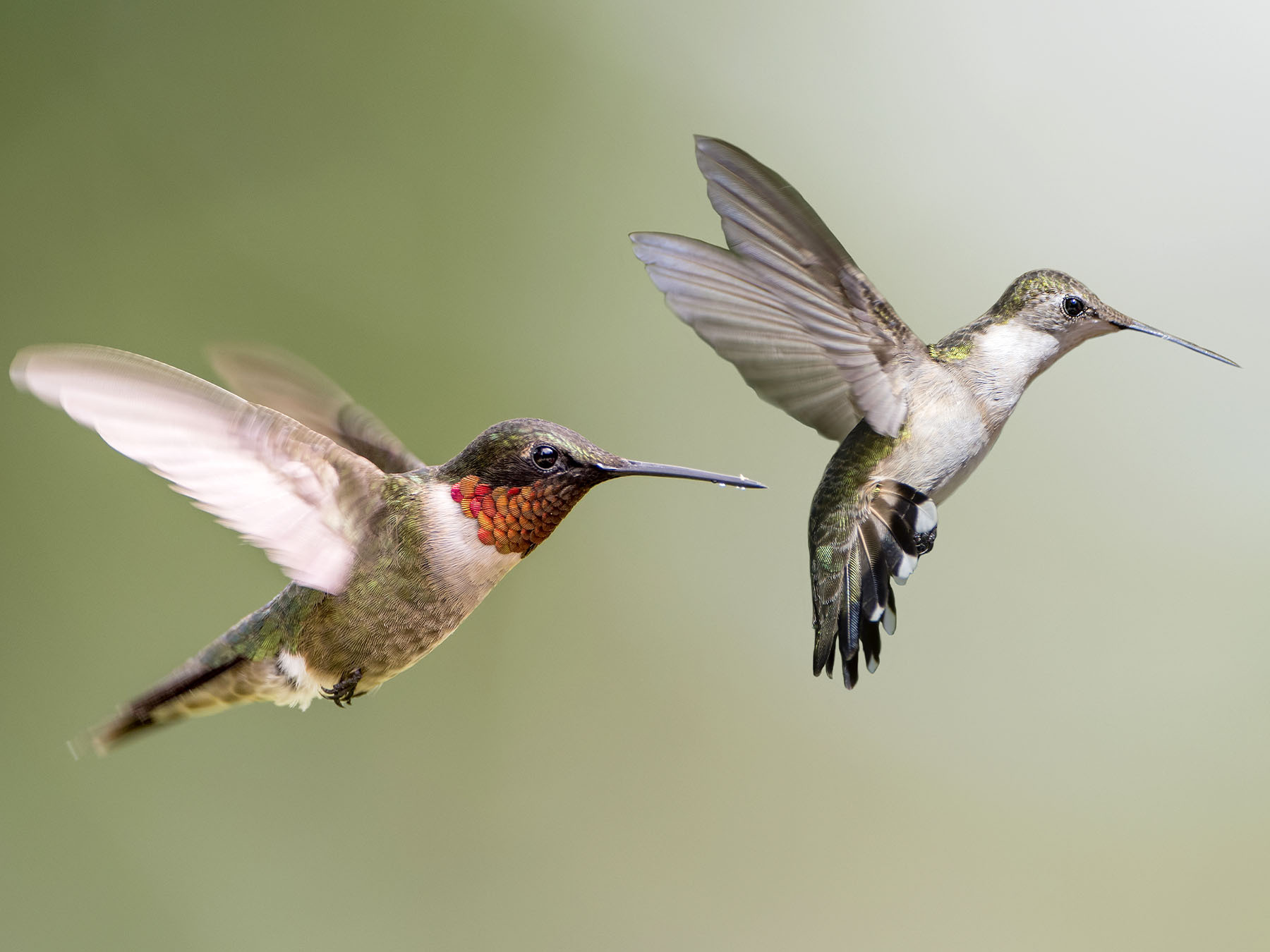
The Ruby-throated Hummingbird is a tiny, iridescent green bird with a slender black bill and a forked tail. Males display a brilliant ruby-red throat patch, which can appear black in poor light.
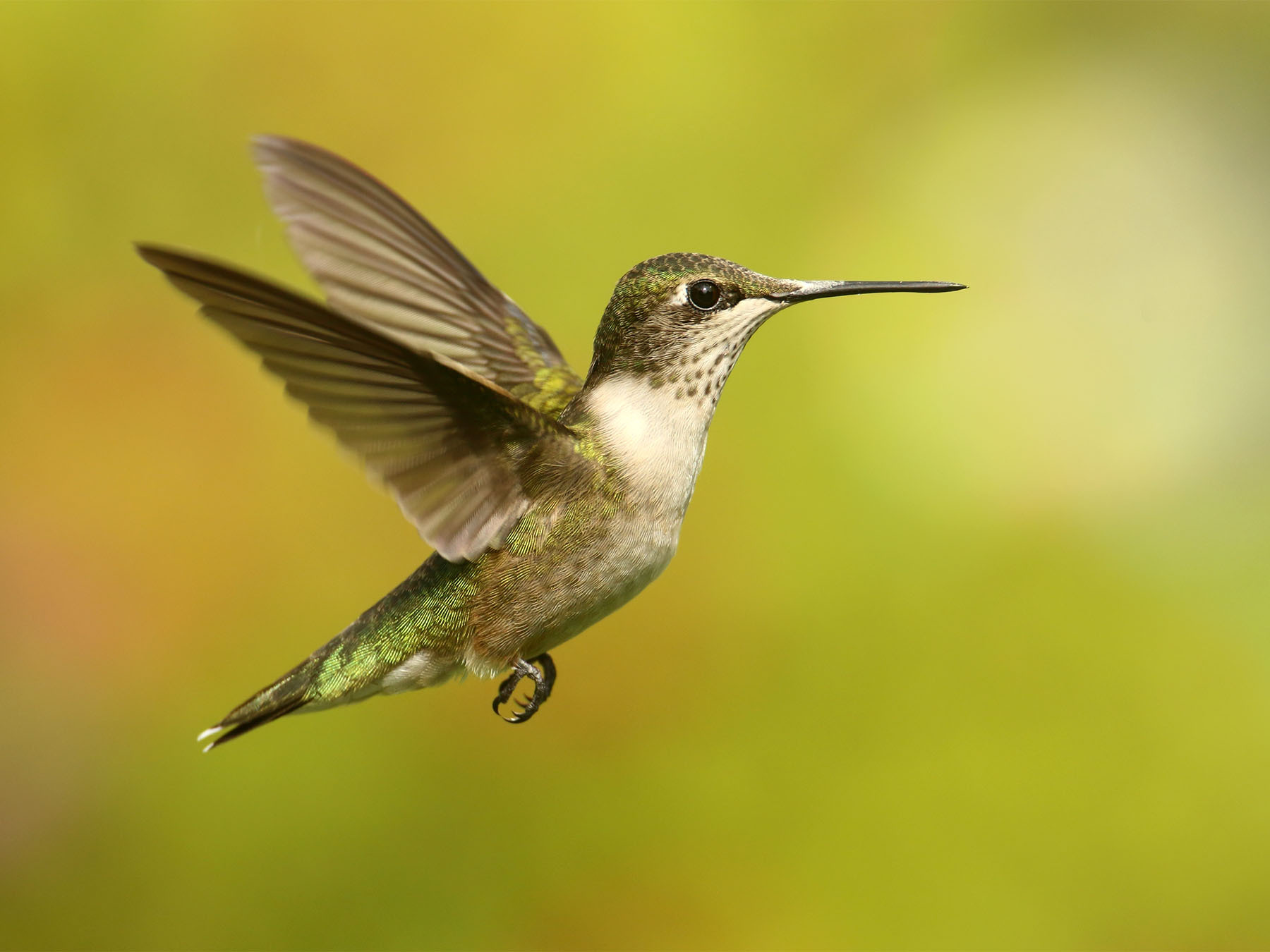
Females and juveniles lack the red throat, instead showing a white throat and underparts. Both sexes have grayish-white flanks and a slightly darker forked tail with white tips on the outer feathers.
Its size
Adults- Length
- 7–9 cm
- Wingspan
- 8–11 cm
- Weight
- 2–6 g
Its song and calls
Ruby-throated Hummingbirds produce a variety of high-pitched chirps, squeaks, and twitters. Their vocalizations include a soft 'chee-dit' when feeding and a more aggressive 'tik-tik-tik' when defending territory.
The rapid beating of their wings creates a distinctive humming sound, which gives hummingbirds their name.
- Call0:00 / 1:05
Recorded in Minnesota, United States · September 2012
When and where to see it
OctoberLeaving
Most recorded in October
- 1. Louisiana0.97%
- 2. Texas0.82%
- 3. Alabama0.80%
- 4. Mississippi0.79%
- 5. Georgia0.57%
Each dot is a county, state or province: the bigger and darker, the larger the bird’s share of that place’s bird records that month. Grey dots: no regular records. The ringed point is the centre of the bird’s records this month; the arrow shows how it moved since last month, and the dashed loop its path through the year. “Arrivals” colours places where it becomes regular this month (orange) or is in its last regular month (grey). GBIF eBird Observation Dataset, 2019–2024. Map data: Natural Earth, US Census Bureau; place centres © OpenStreetMap contributors.
In your area
See when the Ruby-throated Hummingbird is recorded in your county, state or province.
How often the Ruby-throated Hummingbird turns up in the United States and Canada through the year, from birdwatchers' records.
United States
Summer visitor · regularly Apr–Oct · most records in August
Canada
Summer visitor · regularly May–Sep · most records in August
Show as a table
| Month | United States | Canada |
|---|---|---|
| January | 0.030% | – |
| February | 0.028% | – |
| March | 0.055% | <0.001% |
| April | 0.22% (regular) | 0.003% |
| May | 0.49% (regular) | 0.41% (regular) |
| June | 0.54% (regular) | 0.46% (regular) |
| July | 0.77% (regular) | 0.60% (regular) |
| August | 1.2% (regular) | 1.0% (regular) |
| September | 1.00% (regular) | 0.47% (regular) |
| October | 0.18% (regular) | 0.011% |
| November | 0.044% | <0.001% |
| December | 0.033% | <0.001% |
Worldwide: recorded regularly in 14 countries
Countries where it was recorded in at least 3 of the 6 years 2019–2024. Linked countries have their own bird list.
North America (14)
- Bahamas
- Belize
- Bermuda
- Canada
- Costa Rica
- Cuba
- El Salvador
- Guatemala
- Honduras
- Mexico
- Nicaragua
- Panama
- St Pierre & Miquelon
- United States
Data: EOD – eBird Observation Dataset (Cornell Lab of Ornithology), accessed via GBIF.org, CC BY 4.0. Records from 2019–2024, aggregated and filtered by Birdfact. How these lists are made
Tips for seeing it
- Look for them near nectar-rich flowers or hummingbird feeders
- Listen for their high-pitched squeaks and the distinctive hum of their wings
- Observe their hovering behavior and rapid darting movements
- In the eastern United States, watch for them from spring to early fall
What it eats
Ruby-throated Hummingbirds primarily feed on nectar from flowers, using their long bills and specialized tongues. They also consume small insects and spiders for protein, often catching them in mid-air or plucking them from vegetation.
These birds require frequent feeding due to their high metabolism.
Nesting and breeding
Breeding occurs from late spring to early summer. Males perform elaborate courtship displays, flying in U-shaped patterns to attract females.
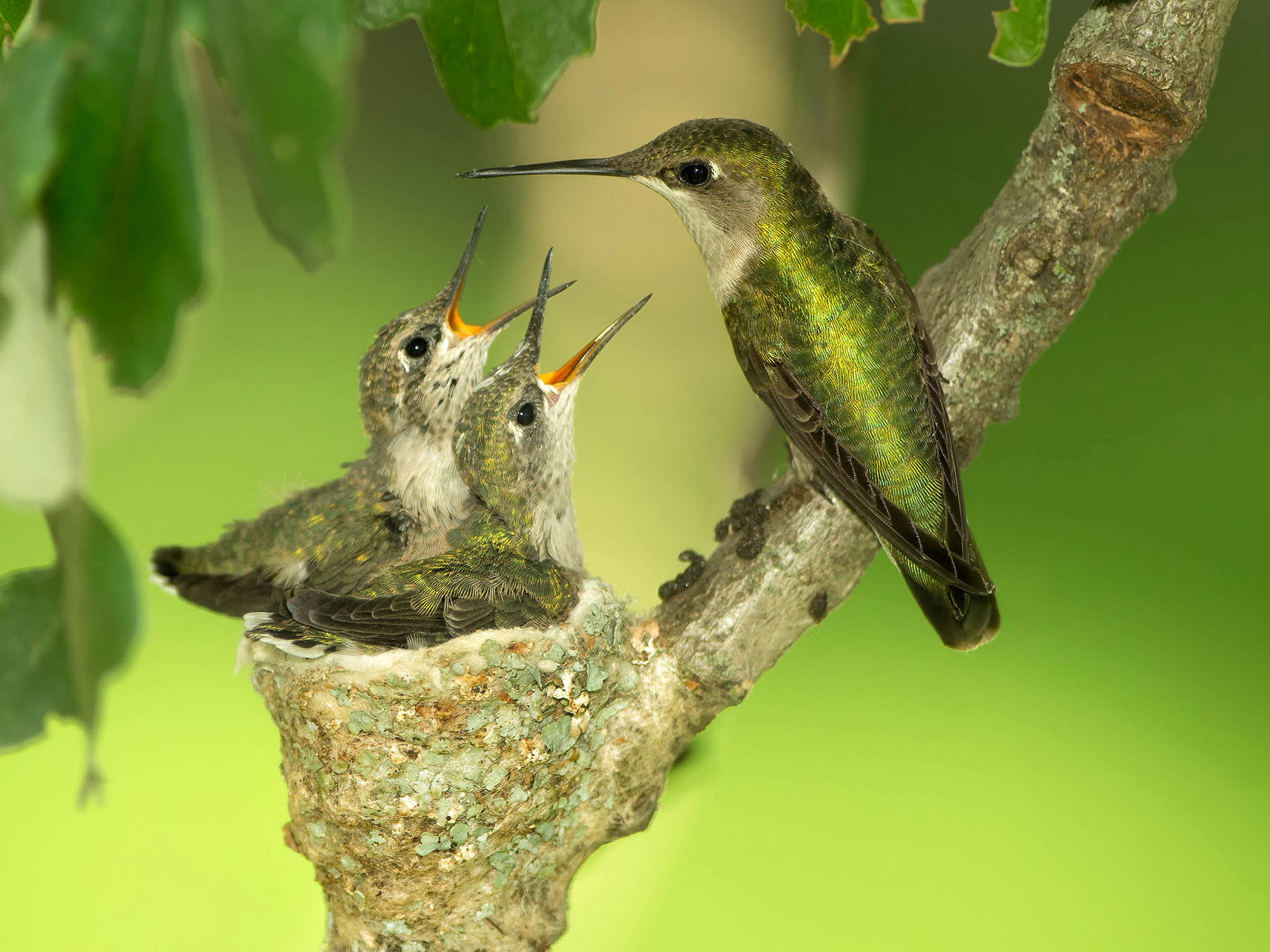
Females construct tiny, cup-shaped nests using plant fibers, spider silk, and lichen on slender tree branches. They typically lay two white, pea-sized eggs.
Incubation lasts about 12-14 days, and nestlings fledge after 18-22 days. Females may raise two broods per season, with males playing no role in nesting or chick-rearing.
Behaviour
Ruby-throated Hummingbirds are known for their incredible flying abilities, including hovering and flying backwards. They are solitary and fiercely territorial, often seen chasing away other hummingbirds or even larger birds from feeding areas.
These birds have a high metabolism and must feed frequently, visiting up to 1,000 flowers daily.
Conservation
While currently listed as Least Concern, Ruby-throated Hummingbirds face threats from habitat loss and climate change.
Conservation efforts focus on preserving nectar corridors along migration routes and encouraging the planting of native flowering plants in gardens and urban areas.
More photos
5 photos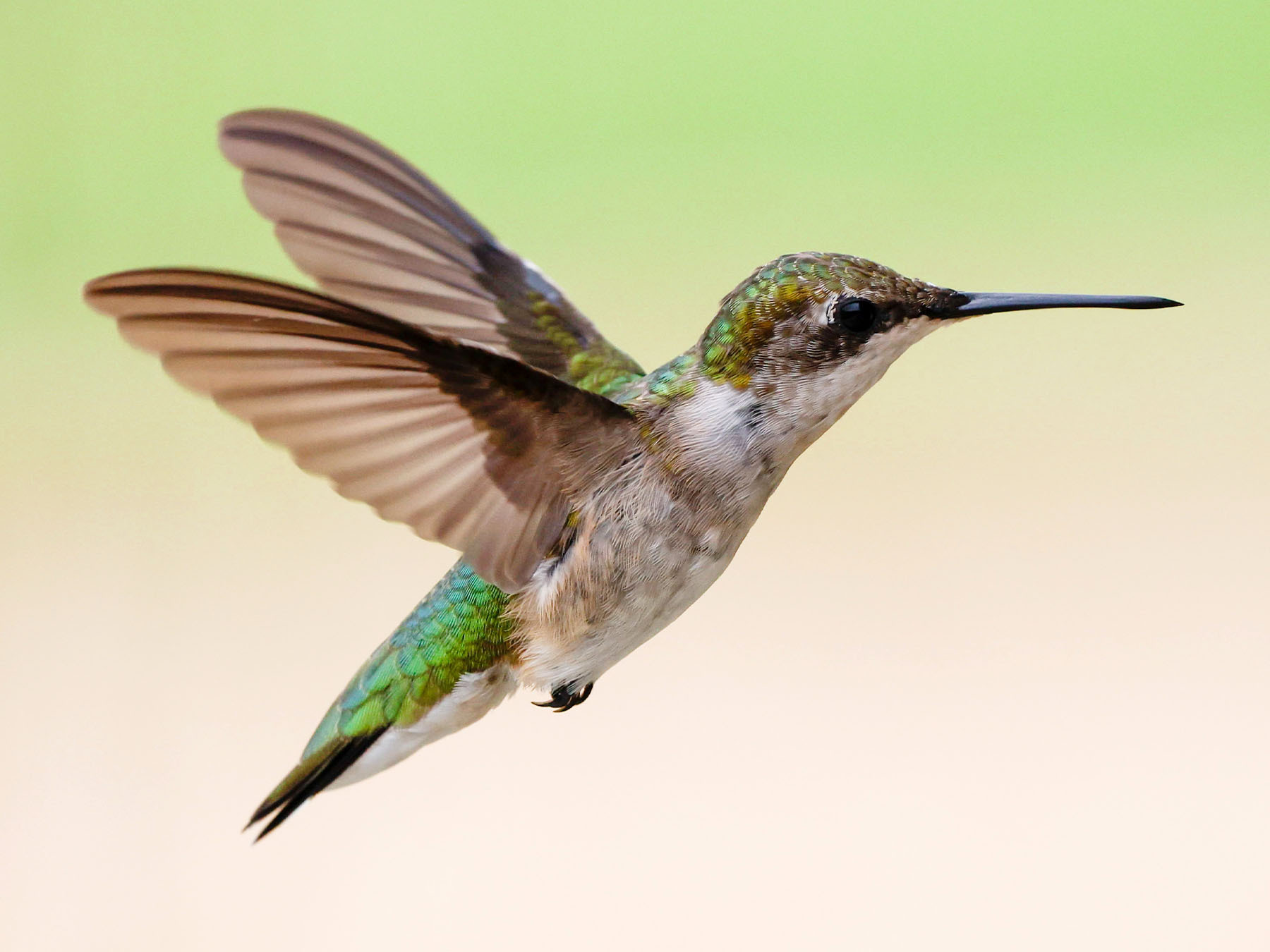
Quick facts
- Length
- 7–9 cm
- Wingspan
- 8–11 cm
- Weight
- 2–6 g
- Lifespan
- 3–5 years · oldest recorded 9.1 years
- Family
- Hummingbirds
- Migration
- Long-distance Migrant
- Global status (IUCN)
- Least Concern
- World population
- 36,000,000 mature individuals
- Population trend
- The population has been increasing over the last five decades
- Also called
- Ruby-throat, Ruby-throated Hummer
- Scientific name
- Archilochus colubris
Sources
4- Conservation statusBirdLife International. 2021. Archilochus colubris. The IUCN Red List of Threatened Species 2021: e.T22688193A186910664. Source (opens in a new tab)
- Population trendPartners in Flight; Rosenberg et al. (2019)
- Population estimatePartners in Flight (2019) Source (opens in a new tab)
- Max lifespanLongevity Records Of North American Birds. Version 2023.1 Source (opens in a new tab)

Checked by
Nathan Cope, founder and editor
Nathan founded Birdfact and leads its writers and contributors in the UK, the US and Canada. He has watched and studied birds for more than ten years, and checks every article and species guide before it’s published.