Published 27 Oct 2026
Turkey Sounds: Gobbles, Yelps, Clucks and Putts
By the Birdfact teamChecked by Nathan Cope
The gobble is the male's call, given mostly from March to June to draw hens and warn rival males. Both sexes also yelp, cluck, purr and putt, and a turkey that putts has seen something it does not trust. Recordings and spectrograms below.
On this page15 sections
The sounds wild turkeys make, from the gobble to the quiet purring of a feeding flock, with recordings and spectrograms (pictures of sound). For the bird itself, see the Wild Turkey guide; for telling toms from hens, see male vs female turkeys.
What does a turkey sound like?
The sound everyone knows is the gobble: a loud, fast, gurgling call given by males, mostly in spring. But turkeys of both sexes talk to each other all year, with yelps, clucks, purrs and sharp alarm putts.1 One state wildlife guide puts the total at 28 distinct sounds.2
A flock feeding quietly purrs and clucks, and a turkey that senses a predator putts.1 Turkeys are noisiest around their roost trees at dawn and dusk3, with soft tree yelps before they fly down and cackles as they leave the roost or fly up to it.14
The gobble
The gobble is closely related to, and may be the turkey's version of, the crowing call of other gamebirds, the call a rooster makes. It does two jobs: it draws hens to the male from a distance and warns off rival males.1
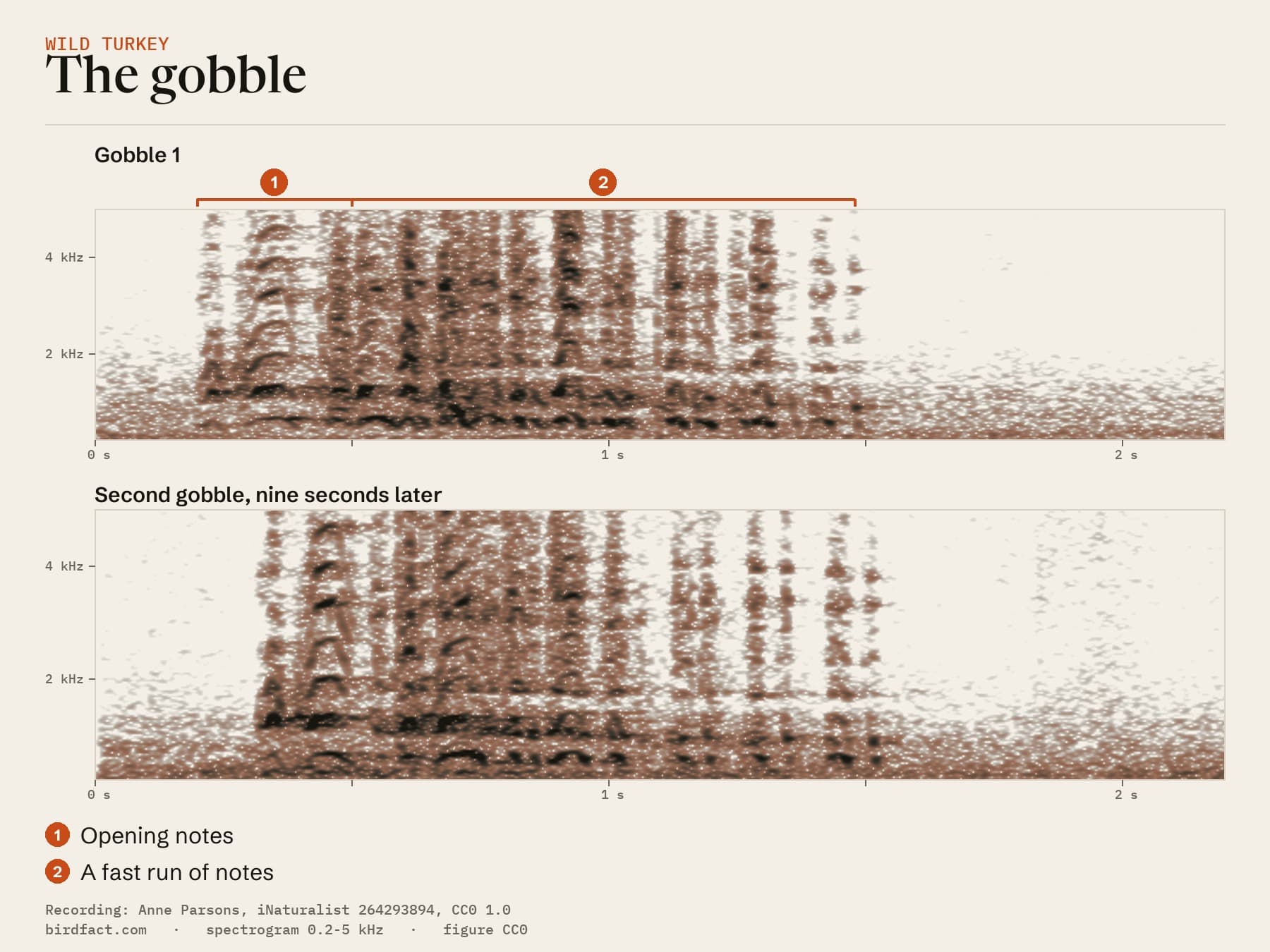
It is a loud, broad sound with a base pitch of about 625 Hz. Measured in Florida turkeys, it spans about 400 to 4,500 Hz, with the most energy around 1,600 and 3,500 Hz, and the gobbles of the western Merriam's, Gould's and Rio Grande turkeys can be told apart by how they begin.1 The two gobbles in the figure below, recorded in California, each last about 1.2 seconds: a few opening notes, then a fast run of notes that fills the spectrogram from below 1 kHz to above 4 kHz.
Why do turkeys gobble?
To be heard. A gobble tells hens where a male is and tells other males to keep away, and it is most effective from a roost tree, less so from the ground. One male's gobble sets off others almost like a reflex, a tenth of a second or more later (100 to 800 milliseconds), and it can start a chain of gobbles from groups some way off.1
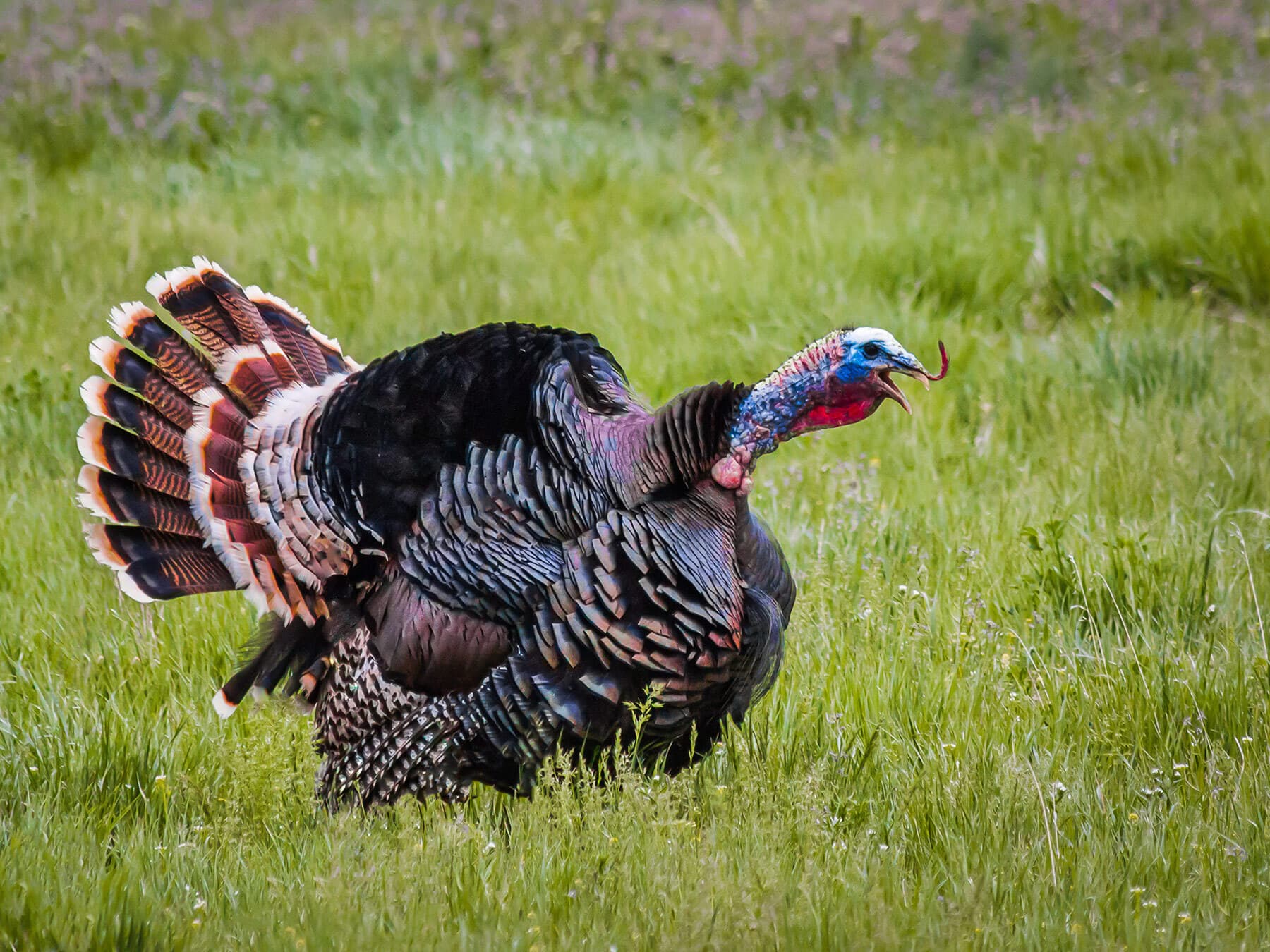
Males also "shock gobble" at sudden loud noises: a car door slamming, a dog barking, a coyote howling or a Barred Owl calling.1 So a tom may answer sounds that have nothing to do with turkeys.
When turkeys gobble
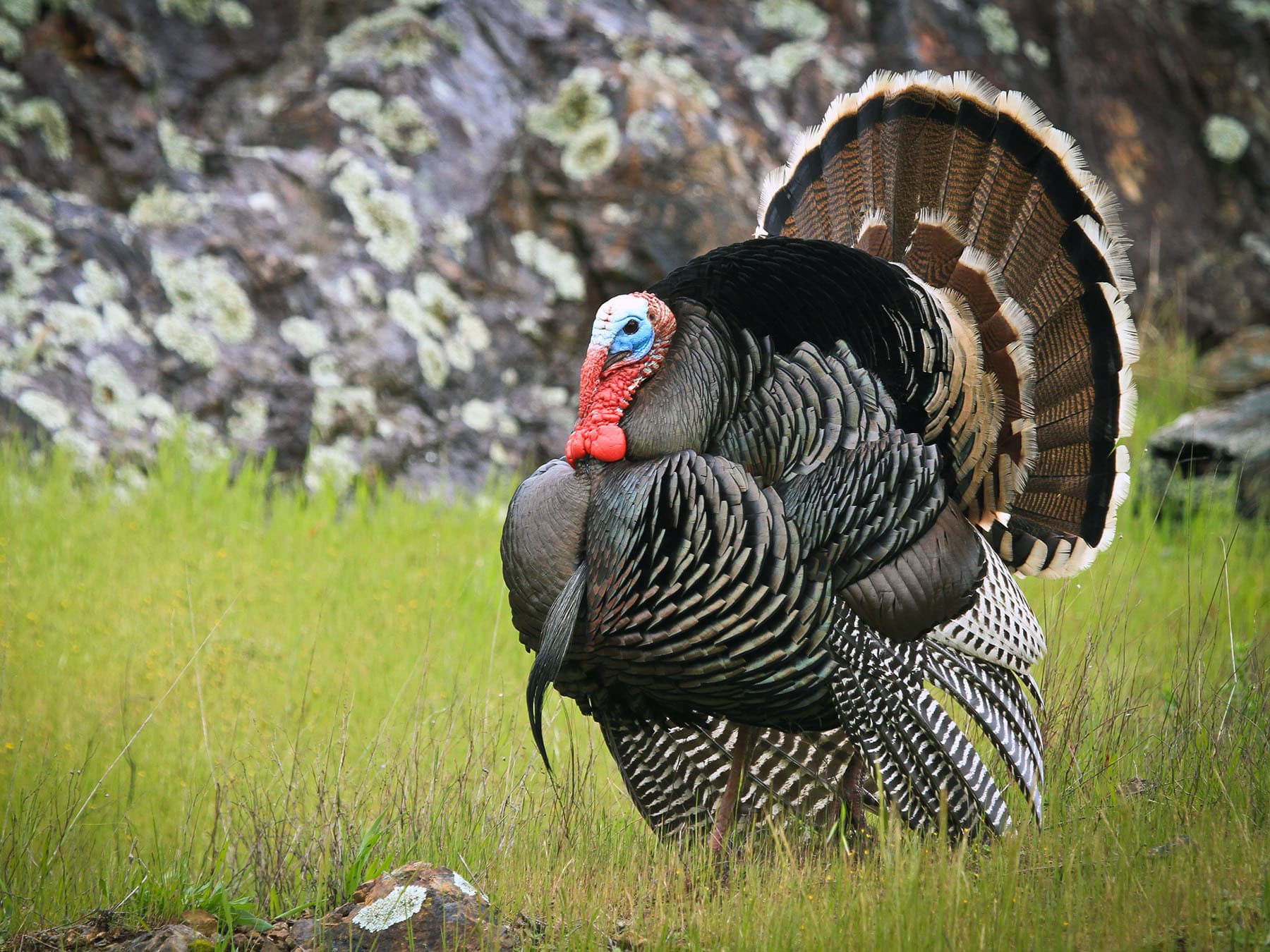
Gobbling peaks from March to June, the breeding season; experiments on gobbling found it takes the least sound to set a male off at that time of year. A tom may gobble with no prompting at all, but the strut usually follows the sight of a hen: tail fanned, wings lowered, feathers puffed out.1
Most gobbling happens early in the morning, from the roost. In South Carolina, where 45 recording units picked up 68,426 gobbles, at least 72% came from 30 minutes before sunrise to 60 minutes after it.5 In Georgia, 78% came within 2 hours of sunrise.6 Merriam's turkeys in Colorado and New Mexico gobbled more in the morning than the evening, more on the roost than off it, and more when no hens were with them.7
Whether toms gobble more once hens start sitting on eggs, a long-standing idea, is unsettled. Studies in South Carolina and Mississippi found no such pattern8, 9; in North Carolina, across 63,456 recorded gobbles and 420 nests, gobbling fell after incubation began in some regions and years and stayed high in others.10 Other studies did find a peak near nesting: in Georgia the year's single peak fell at the peak of nest starts in 3 of 4 cases6, and Merriam's turkeys had a second peak close to peak incubation in Colorado and New Mexico7 and in the Black Hills of South Dakota.11 In Iowa, part of the late-April dip in gobbling that is usually put down to nesting was caused by hunters.12
Hunting matters, though not always the same way. In the Black Hills, birds in a hunted population gobbled less in early-morning surveys than birds in an unhunted one11, and in Iowa hunters' presence cut gobbling counts12; but in Colorado and New Mexico adult Merriam's males gobbled more during the hunting season than before or after it.7 The weather studies disagree too: one across the Southeast found rain, wind and heat cut gobbling and rising air pressure raised it13, while one in Georgia found more gobbling on windier days.6
Gobbling starts young. In young turkeys raised by people, the first gobbles came in the 11th week; at that age both sexes may gobble when excited, but females gradually stop and males go on.1 In the study of Merriam's turkeys in Colorado and New Mexico, young males seldom gobbled, and 77% of their gobbling came when no adult males were around.7
How far a gobble carries
A gobble is often said to carry a mile, but we found no measurement behind that figure.14 The one hearing test we found played a recorded gobble from about 20 feet (6 m) up in a Georgia forest, with nothing between the speaker and the listener: the researcher could still hear it and tell it was a gobble at 750 feet (228 m), the farthest distance tested, so a gobble carries at least that far. Its pitch and loudness suit long distances, and calling from a perch helps it carry.6
Yelps
The yelp is an everyday call of turkeys of both sexes: a run of usually 5 to 10 notes, keow-keow-keow. A hen's plain yelp sits around 1,000 Hz (from 500 to 1,700 Hz), and a male's is a little lower. Oddly, no one is quite sure what the plain yelp is for. Turkeys give it on the ground and sometimes in flight.1
There are several kinds:
- Tree yelp: 4 to 6 softer, more muffled and nasal notes, given on the roost before flying down, in every season.
- Lost yelp: a long run of 10 to 20 notes, and up to 45, from birds trying to regroup a scattered flock; it carries.
- Assembly yelp: the hen's loud, raspy call to gather her poults, about 900 Hz and very variable. Poults learn it fast: they can pick out their mother's call within their first 2 days.1
We found no openly licensed recording in which we could be sure the call was a yelp, so there is no yelp clip on this page.
Clucks and purrs
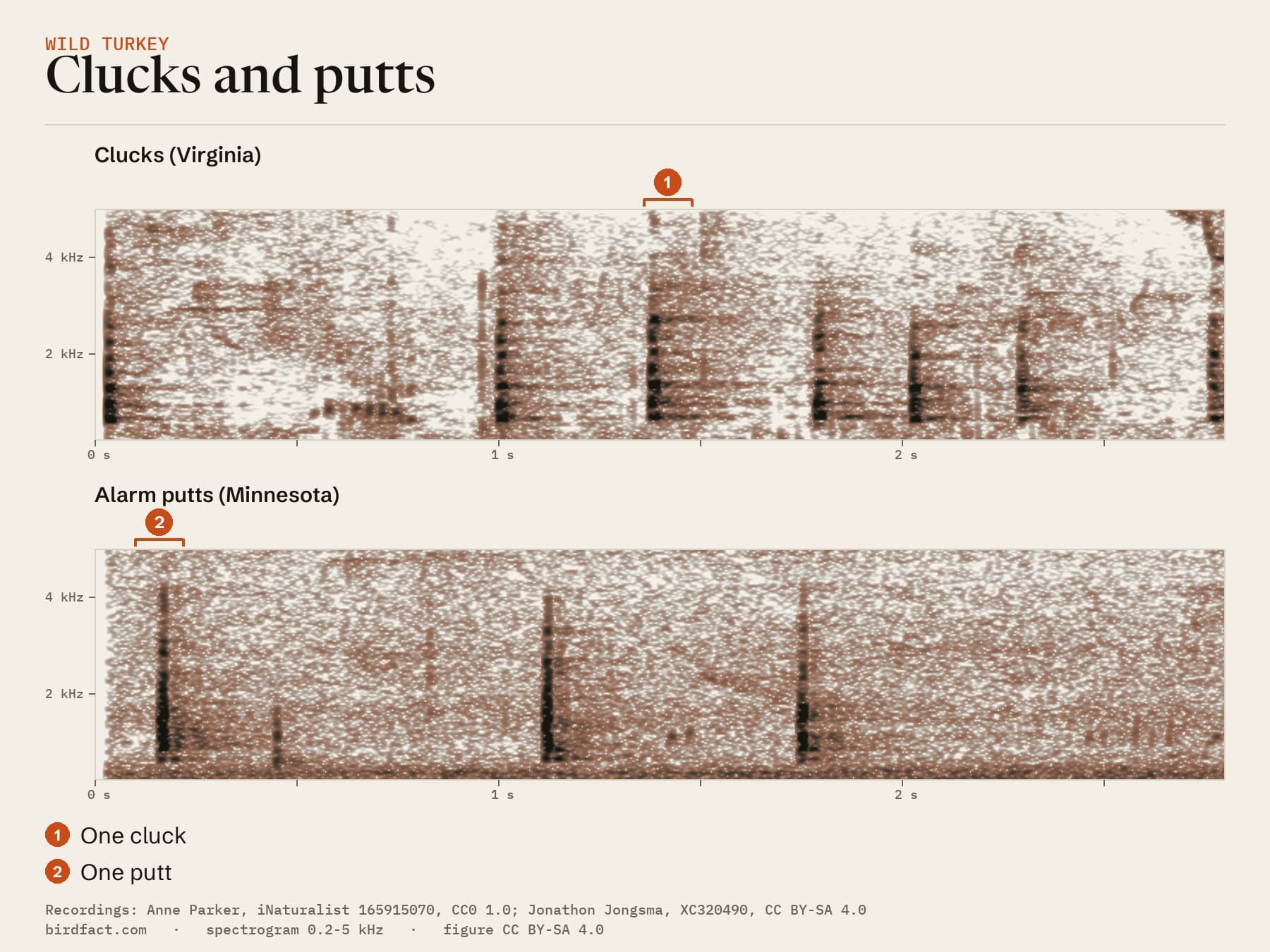
Clucks are short, sharp notes, given one at a time or two or three very close together (about 0.04 seconds apart), by both sexes all year; a hen's cluck is around 1,300 Hz.1 A cluck is a turkey getting another bird's attention. Loud, sharp clucks mixed with yelps, called cutting, come from turkeys that are excited, not alarmed.4
The purr is a soft, almost continuous rolling note from a flock moving and feeding undisturbed, which keeps the birds spaced out. A hen's purr in fall lasts 0.15 to 0.20 seconds, at 700 to 1,400 Hz. Turkeys also have a quiet feeding call for especially good food.1 In the recording below, a turkey clucks as it walks, with quiet purrs in between.
Putts: the alarm call
The putt is a single, sharp, explosive note, and it means danger. Turkeys of both sexes and all ages putt, all year, when they sense a predator on the ground: a male's putt runs from 400 to 1,500 Hz, a female's from 500 to 2,000 Hz. A separate call, the predator alarm, is the most clipped of all, about 0.02 seconds long, and warns the flock that a predator is close.1
Cackles and fly-down calls
The cackle is a burst of irregular notes, from 1,000 to 4,000 Hz, that turkeys give when they fly down from the roost, flap across a stream or flutter over a fence. Sources count the notes differently: 10 to 151, or 3 to 10, rising in pitch toward the end.4 Together with tree yelps, it is the sound of a flock leaving its roost at first light. More on roosting and flight: can wild turkeys fly?
Fighting talk
When a purr grows louder and breaks up into a rattle, or trill, it is the last warning before a fight. In domestic turkeys, high-ranking males also settle rank with threat cooing, standing tall with the head up and the dewlap, the loose skin under the throat, on show.1
Strutting: the chump and the hum
A strutting tom makes sounds without calling. First comes a short "chump", about 0.08 seconds long and above 1,000 Hz; then a deep hum below 60 Hz while his tail feathers shiver. The hum is what people call drumming, and how it is made is still not fully understood. The quills of his lowered wings rattle audibly as he struts. He usually struts on the ground in front of a hen, and sometimes on a roost limb.1 Turkey hunters call the pair of sounds the "spit and drum".15
Sounds of young turkeys
Turkeys call before they hatch: chicks peep inside the egg and at hatching, and the hen answers with yelps. The purr is the commonest call of poults (young turkeys) of any age. At about 7 weeks they start to whistle: 3 or 4 high, plaintive notes, usually given 15 minutes or more after a predator has scattered a brood. The whistle later drops in pitch to become the kee-kee, usually three notes over about two seconds; a kee-kee followed by a yelp is the kee-kee run, the call of a lost young turkey.14 More on the first weeks: wild turkey nesting.
Hen and tom sounds
Hens and toms share most calls: both yelp, cluck, purr, putt and cackle, and the male's yelps and putts are a little lower. The gobble, the strutting chump and hum, and threat cooing belong to the males; the assembly yelp and the calls to hatching chicks belong to the hens.1 Hens do not normally gobble.14 How else to tell them apart: male vs female turkeys.
About the recordings
The recordings on this page come from iNaturalist and xeno-canto, where people share wildlife recordings under Creative Commons licenses. We chose them from the 126 Wild Turkey recordings whose licenses allow our use (120 research-grade sounds on iNaturalist, 6 on xeno-canto), after drawing spectrograms of each, and used only clips from birds the recordist saw or photographed. Each clip's credit says where and when it was made, and what the recordist wrote. The spectrograms are drawn from the same recordings.
Sources
- McRoberts, J. T., Wallace, M. C., Eaton, S. W. (2020). Wild Turkey (Meleagris gallopavo), version 1.0. Birds of the World (A. F. Poole, editor). Cornell Lab of Ornithology. doi:10.2173/bow.wiltur.01
- Indiana Department of Natural Resources. Turkey terms and turkey talk (turkey ID graphic, March/April 2021). Indiana DNR Fish & Wildlife. Accessed 26 October 2026. Source
- New York State Department of Environmental Conservation. Wild Turkey. NYSDEC. Accessed 26 October 2026. Source
- National Wild Turkey Federation. The sounds of the wild turkey. NWTF. Accessed 27 October 2026. Source
- Wightman, P. H., Kilgo, J. C., Vukovich, M., Cantrell, J. R., Ruth, C. R., Cohen, B. S., Chamberlain, M. J., Collier, B. A. (2019). Gobbling chronology of eastern wild turkeys in South Carolina. The Journal of Wildlife Management 83(2): 325-333. doi:10.1002/jwmg.21600
- Colbert, D. S. (2013). Breeding season gobbling chronology in hunted and non-hunted populations of eastern wild turkey (Meleagris gallopavo silvestris) in southwestern Georgia. MS thesis, University of Georgia. Accessed 27 October 2026. Source
- Hoffman, R. W. (1990). Chronology of gobbling and nesting activities of Merriam's wild turkeys. Wildlife Society Bulletin S1 (1990): 25-31. doi:10.1002/j.2328-5540.1990.tb00178.x
- Chamberlain, M. J., Wightman, P. H., Cohen, B. S., Collier, B. A. (2018). Gobbling activity of eastern wild turkeys relative to male movements and female nesting phenology in South Carolina. Wildlife Society Bulletin 42(4): 632-642. doi:10.1002/wsb.932
- Miller, D. A., Hurst, G. A., Leopold, B. D. (1997). Chronology of wild turkey nesting, gobbling, and hunting in Mississippi. The Journal of Wildlife Management 61(3): 840-845. doi:10.2307/3802192
- Moscicki, D. J., Pacifici, K., Kreh, C. D., Plumpton, H. M., Collier, B. A., Moorman, C. E. (2025). Geographical variation in male eastern wild turkey gobbling activity relative to female nesting chronology. Wildlife Society Bulletin 49(S1): e1627. doi:10.1002/wsb.1627
- Lehman, C. P., Flake, L. D., Rumble, M. A., Thompson, D. J. (2005). Gobbling of Merriam's turkeys in relation to nesting and occurrence of hunting in the Black Hills, South Dakota. Wildlife Society Bulletin S1 (2005): 343-349. doi:10.1002/j.2328-5540.2005.tb00329.x
- Kienzler, J. M., Little, T. W., Fuller, W. A. (1995). Effects of weather, incubation, and hunting on gobbling activity in wild turkeys. Wildlife Society Bulletin S1 (1995): 61-67. doi:10.1002/j.2328-5540.1995.tb00213.x
- Wightman, P. H., Martin, J. A., Kilgo, J. C., Rushton, E., Collier, B. A., Chamberlain, M. J. (2022). Influence of weather on gobbling activity of male wild turkeys. Ecology and Evolution 12(6): e9018. doi:10.1002/ece3.9018
- Pelc, C. What's got dewlaps and wattles? (OutdoorIllinois, May 2007, pp. 24-25). Illinois Department of Natural Resources. Accessed 27 October 2026. Source
- Eriksen, B. Hen fight; An unusual strutter (Ask Dr. Tom). National Wild Turkey Federation. Accessed 27 October 2026. Source