Published 27 Oct 2026
Male vs Female Turkeys: Toms, Hens, Jakes and Jennies
By the Birdfact teamChecked by Nathan Cope
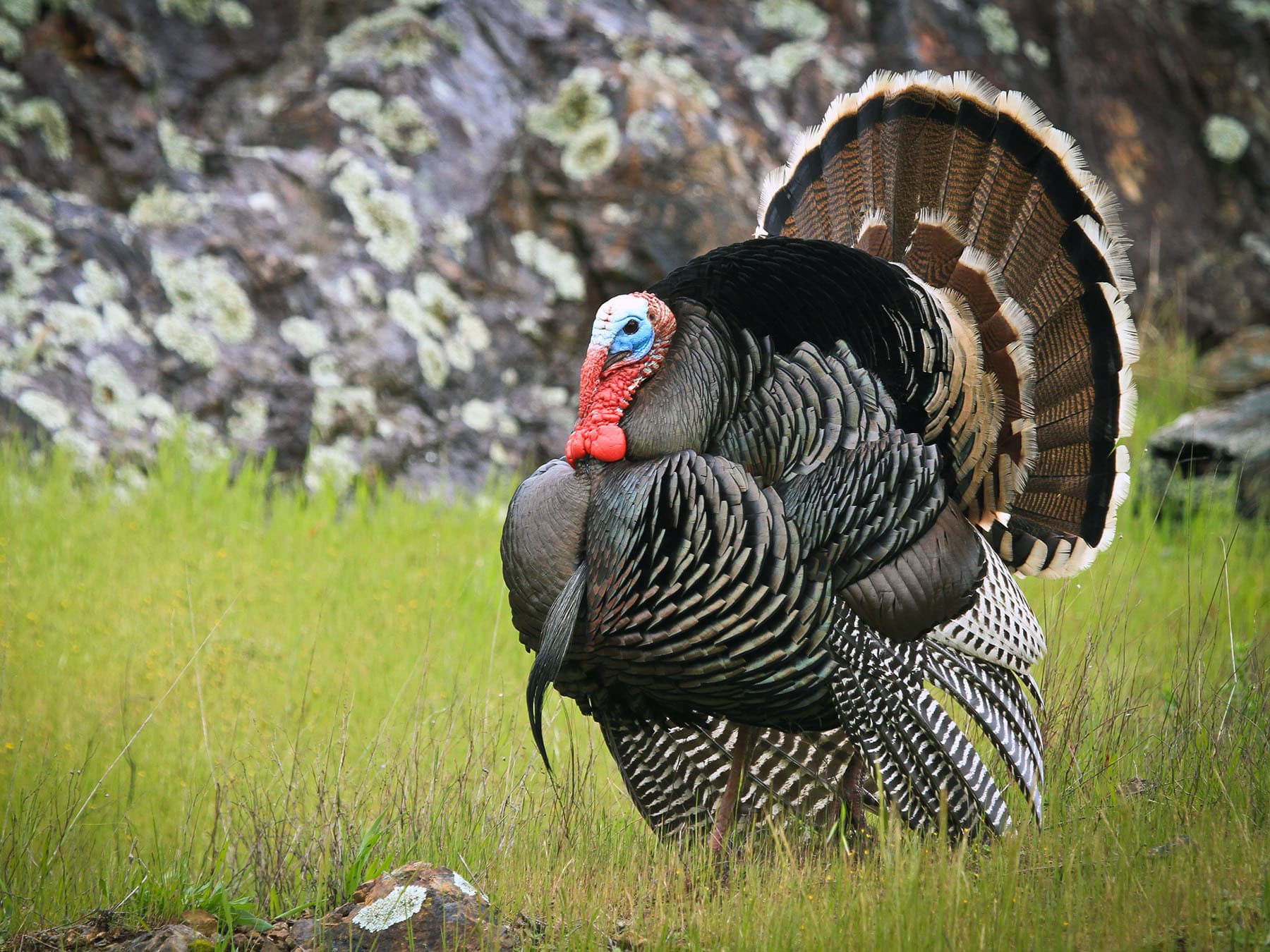
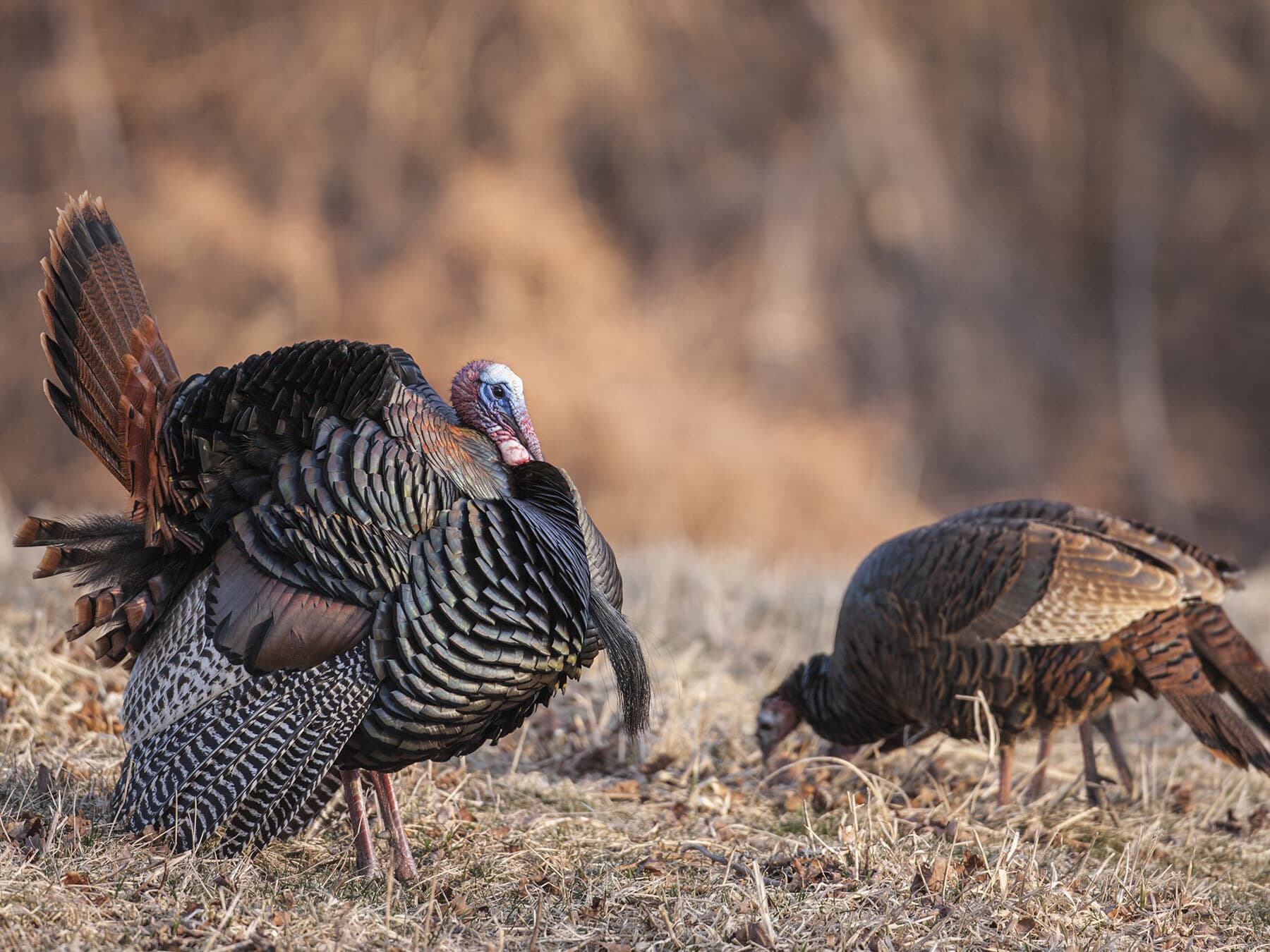
Toms are bigger and darker, with black-tipped breast feathers, a bare red, white and blue head, a beard and spurs. Hens are smaller and browner, with buff-tipped breast feathers and a blue-gray, partly feathered head; some hens grow a thin beard.
On this page14 sections
- Male vs female turkeys at a glance
- What are male and female turkeys called?
- Size and weight
- Feathers: the breast tells you
- The head: snood, wattle and caruncles
- What is the snood for?
- The beard
- Can female turkeys have beards?
- Spurs
- Jakes and jennies: young turkeys
- Poults
- Behavior: who gobbles and who struts
- Tracks and droppings
- Sources
How to tell a tom from a hen, and a young turkey from an old one: size, feathers, the bare head and its snood, beards, spurs, behavior and even droppings. For the bird itself, see the Wild Turkey guide.
Male vs female turkeys at a glance
The quickest test is the breast feathers: black-tipped on a male, brown or buff-tipped on a female.1 The table sums up the rest; each line is explained below.
| Tom (male) | Hen (female) | |
|---|---|---|
| Size | About 48 in long, 15-25 lb | About 36 in long, 8-12 lb |
| Breast feathers | Black tips: the breast looks black | Brown or buff tips: the breast looks rusty |
| Body | Darker, with a strong bronze and green sheen | Browner and duller, with less sheen |
| Head | Bare; red, white and blue; long snood in spring | Blue-gray, with short feathers up the back of the head |
| Beard | Usually; 6 in or more on adults | Some hens; thin and often kinked |
| Spurs | Almost all males | Very rare (under 1%) |
| Behavior | Gobbles, struts and drums | Yelps, clucks and purrs; does not normally gobble |
| Droppings | J-shaped | Spiral |
What are male and female turkeys called?
A male turkey is a tom or gobbler, and a female a hen. A young male is a jake and a young female a jenny (or jennie); chicks of either sex are poults.2
Size and weight
Toms are much bigger. An adult tom is about 48 inches long and weighs 15 to 25 pounds; a hen is about 36 inches long and weighs 8 to 12 pounds.3 Standing, a male is about 40 inches tall and a female about 30 by one set of measurements4, though New York's wildlife agency puts mature males at about 2.5 feet.5 Size starts to tell early: a male multiplies his weight about 120 times in his first year, and after that year a female is about half the size of a male.4

Feathers: the breast tells you
Look at the breast and sides. A tom's body feathers are glossy dark brown with jet-black tips, wide and flared at the end, so his breast looks black; in sunlight the gloss shifts through bronze, green, purple and red. A hen's feathers are duller and narrower, with brown, buff or rusty tips, so she looks brown.4 Hens have some sheen too, but much less than toms.6
The same test works on young birds. A young turkey with any black-tipped breast feathers is a male.7

The head: snood, wattle and caruncles
A tom's head and neck are bare. The skin is covered in bumps (caruncles), with a fleshy flap over the bill, the snood, and a loose flap under the throat, the wattle or dewlap. In the breeding season, February to June, the colors are at their most vivid: the snood grows long, the crown turns white and bright blue rings the eye and cheek, with red on the neck. A displaying tom's head can switch between red, white and blue in moments, with his mood, and when a male loses a fight his snood shrinks.4
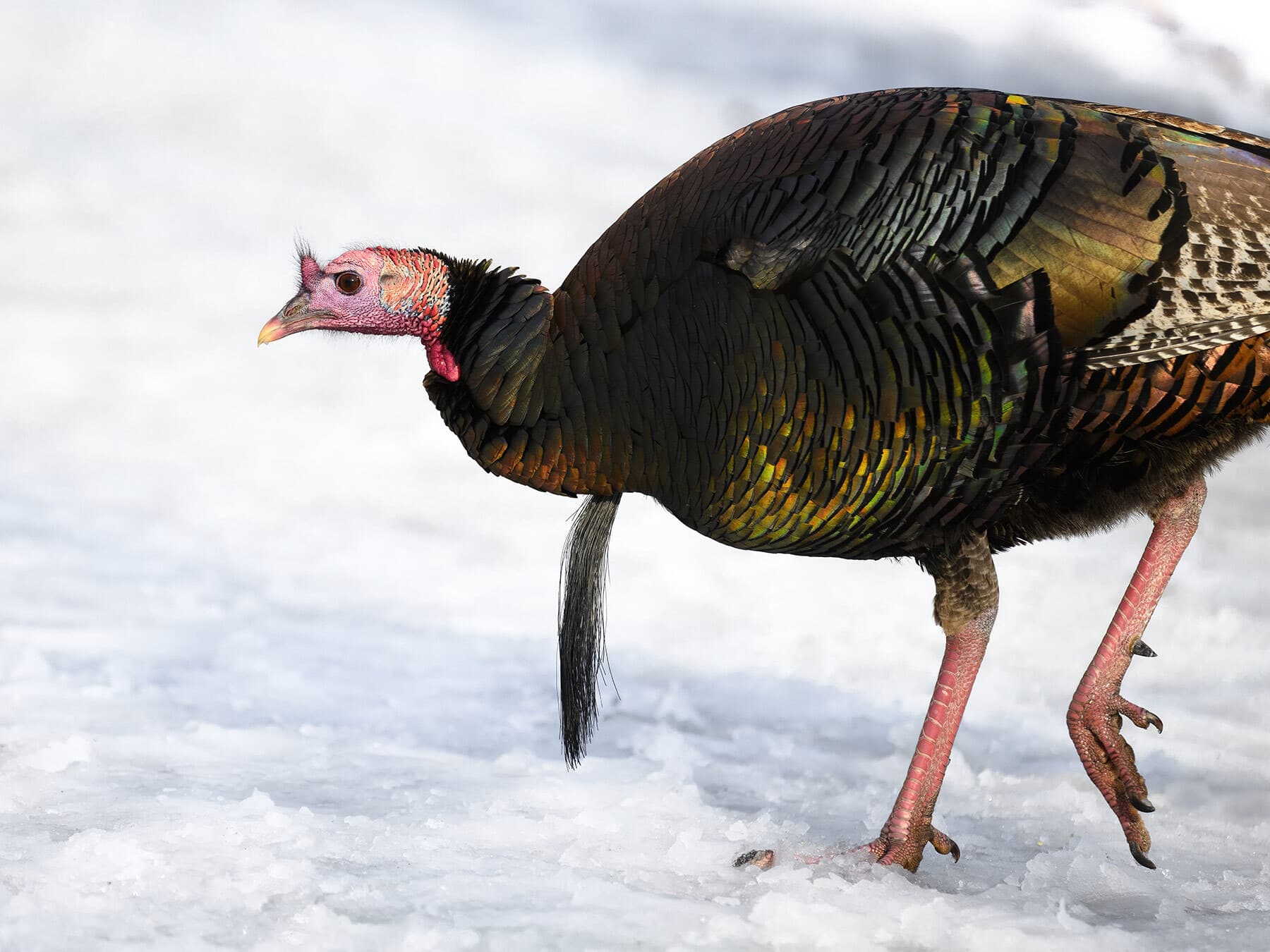
A hen's head is a duller blue-gray, with short feathers up the back of the head and neck.6 Toms' heads are more muted in fall too.7
The blue is a structural color, made by the way fine collagen fibers in the skin scatter light, not by pigment.8 Exactly how a turkey switches its skin from red to white or blue is still not known in detail, according to work on farm turkeys' skin.9 The bare head is not only for show: when researchers covered male turkeys' heads and necks as if they were feathered, the birds ran hotter at 95°F (35°C), so the bare skin helps them shed heat.10

What is the snood for?
It is a signal, read by both sexes. Hens use the length of a male's snood in choosing a mate, and in free-living turkeys, males with longer snoods carried fewer coccidian parasites and were in better condition. Rival males read it too: in trials between captive males, the male with the relatively longer snood tended to win, and trials with artificial males showed toms size up a rival's snood on its own.11
The beard
The beard is the brush of coarse, hair-like fibers hanging from the middle of a turkey's breast. Toms usually have one, and it grows longer and fuller with age; some birds have two or more, and a few none.4 From hunters' records, the NWTF reports beards of nearly 23 inches and one turkey with 13 beards.12
In males the beard grows 4 to 5 inches (100-125 mm) a year, but the tip wears, so from the second year on it seldom gets longer than about 10 inches (250 mm).4 By a common hunters' rule of thumb, a jake's beard is under 6 inches and an adult tom's 6 inches or more.7 Why turkeys have beards at all is not known.12
Can female turkeys have beards?
Yes, some do. A hen's beard is thinner than a tom's and often kinked.6 How many hens have one depends on whom you ask and where: published figures run from about 5% to 21%.
Beards do not seem to stop hens breeding: on a South Texas ranch in 1968, bearded hens were no less likely than beardless ones to have poults, and their broods were no smaller.13
Spurs
Spurs are the bony, horn-covered points on the back of a tom's legs. Almost all males have them.1 They start to grow in the first winter and keep growing for life, to an inch and a half (38 mm) or more by about seven years old, and record spurs are well over 2 inches (50 mm). A few males grow more than one on a leg.4
Spurs help to age a tom. A young male's spurs are short and rounded, under half an inch; an adult's are longer and pointed.157 Spurs under an inch (25 mm) are typical of 2-year-olds and longer ones of birds 3 or older, though breaks and wear blur the line.4
Hens with spurs are very rare, about 1% or less: of 1,515 hens banded in New Jersey, only 5 had spurs, from a quarter to half an inch long.514
Jakes and jennies: young turkeys
In their first year, young males (jakes) look like duller toms, with narrower, rounder breast feathers that are only weakly glossy, shorter tails, and usually some brown down on the head through the first winter. Young females (jennies) look like small, dull hens.4
Three clues help to age a turkey in the hand or a photo:
- The tail fan. A young bird's fan is uneven, because its middle 4 to 6 tail feathers grow longer than the rest after the first partial molt; by the second year the fan is smooth and rounded.16
- The outer wing feathers. A young bird's two outermost primaries (numbers 9 and 10) are pointed, with the white bars stopping short of the tip; an adult's are rounded and barred to the tip.1 This test is not foolproof: some young turkeys replace those feathers early.17
- Beard and spurs on males, as above.
Poults
Poults look the same in both sexes: speckled brown, with downy heads until they are about 10 weeks old.4 They grow fast: under 5 to 6 inches tall in the first week, about 6 to 10 inches (the size of a Blue Jay) at 2 to 5 weeks, and 10 to 12 inches (crow-sized) at 6 to 8 weeks.6 Young males start to show by their first fall, when most of the down on the head goes and the skin starts turning blue; some brown down usually stays through the winter.4 More: wild turkey nesting.
Behavior: who gobbles and who struts
Toms gobble and strut: tail fanned upright, wings lowered until the flight feathers drag, body feathers puffed up, while they make a low drumming sound.4 Hens yelp, cluck and purr, and do not normally gobble.16 A hen can strut, though: hens have been filmed strutting at each other with loud "challenge purring" in fights over rank, a response to a strong stimulus.18 More on the calls: turkey sounds.
Some toms court as a team. In a study of wild turkeys in California, males typically paired up to display, and the partners were brothers or half brothers. Only the dominant male of each team fathered young: about 7 offspring each over the six-year study, against fewer than one for a male displaying alone. The helper gains too, through the genes he shares with his brother, worth about 1.7 offspring.19
Toms play no part in raising the young, and in summer they typically keep away from the hens. Outside the breeding season, males and females mostly live in separate flocks.64 More on flocks: what is a group of turkeys called?

Tracks and droppings
Sources
- New Jersey Division of Fish and Wildlife. Sexing, aging, and measuring wild turkeys. NJ DEP Fish & Wildlife. Accessed 27 October 2026. Source
- Indiana Department of Natural Resources. Turkey terms and turkey talk (turkey ID graphic, March/April 2021). Indiana DNR Fish & Wildlife. Accessed 26 October 2026. Source
- Connecticut Department of Energy and Environmental Protection. Wild Turkey (fact sheet, rev. 11/2016). CT DEEP Wildlife Division. Accessed 26 October 2026. Source
- McRoberts, J. T., Wallace, M. C., Eaton, S. W. (2020). Wild Turkey (Meleagris gallopavo), version 1.0. Birds of the World (A. F. Poole, editor). Cornell Lab of Ornithology. doi:10.2173/bow.wiltur.01
- New York State Department of Environmental Conservation. Wild Turkey. NYSDEC. Accessed 26 October 2026. Source
- Tennessee Wildlife Resources Agency. Wild Turkey Identification 101. TWRA. Accessed 27 October 2026. Source
- Illinois Natural History Survey. Wild Turkeys & Their Sign. Hunt Illinois (INHS, University of Illinois). Accessed 27 October 2026. Source
- Prum, R. O., Torres, R. H. (2003). Structural colouration of avian skin: convergent evolution of coherently scattering dermal collagen arrays. Journal of Experimental Biology 206(14): 2409-2429. doi:10.1242/jeb.00431
- Oh, J.-W., Chung, W.-J., Heo, K. et al. (2014). Biomimetic virus-based colourimetric sensors. Nature Communications 5: 3043. doi:10.1038/ncomms4043
- Buchholz, R. (1996). Thermoregulatory role of the unfeathered head and neck in male wild turkeys. The Auk 113(2): 310-318. doi:10.2307/4088897
- Buchholz, R. (1997). Male dominance and variation in fleshy head ornamentation in wild turkeys. Journal of Avian Biology 28(3): 223. doi:10.2307/3676973
- Stankowski, S. Bearded wonders. National Wild Turkey Federation. Accessed 27 October 2026. Source
- Beasom, S. L. (1970). Productivity of bearded wild turkey hens in South Texas. The Journal of Wildlife Management 34(1): 183. doi:10.2307/3799507
- Eriksen, B. Ask Dr. Tom: can hens grow spurs? National Wild Turkey Federation. Accessed 27 October 2026. Source
- Missouri Department of Conservation. Turkey: how to Telecheck. MDC. Accessed 27 October 2026. Source
- Pelc, C. What's got dewlaps and wattles? (OutdoorIllinois, May 2007, pp. 24-25). Illinois Department of Natural Resources. Accessed 27 October 2026. Source
- Schmutz, J. A., Hoffman, R. W. (1991). Variable first prebasic molt in Rio Grande and Merriam's wild turkeys. The Wilson Bulletin 103(2): 295-300. Accessed 27 October 2026. Source
- Eriksen, B. Hen fight; An unusual strutter (Ask Dr. Tom). National Wild Turkey Federation. Accessed 27 October 2026. Source
- Krakauer, A. H. (2005). Kin selection and cooperative courtship in wild turkeys. Nature 434(7029): 69-72. doi:10.1038/nature03325