


Wild Turkey
Eastern Wild Turkey · Meleagris gallopavo
By the Birdfact teamChecked by Nathan Cope
On this page12 sections
How to recognise it
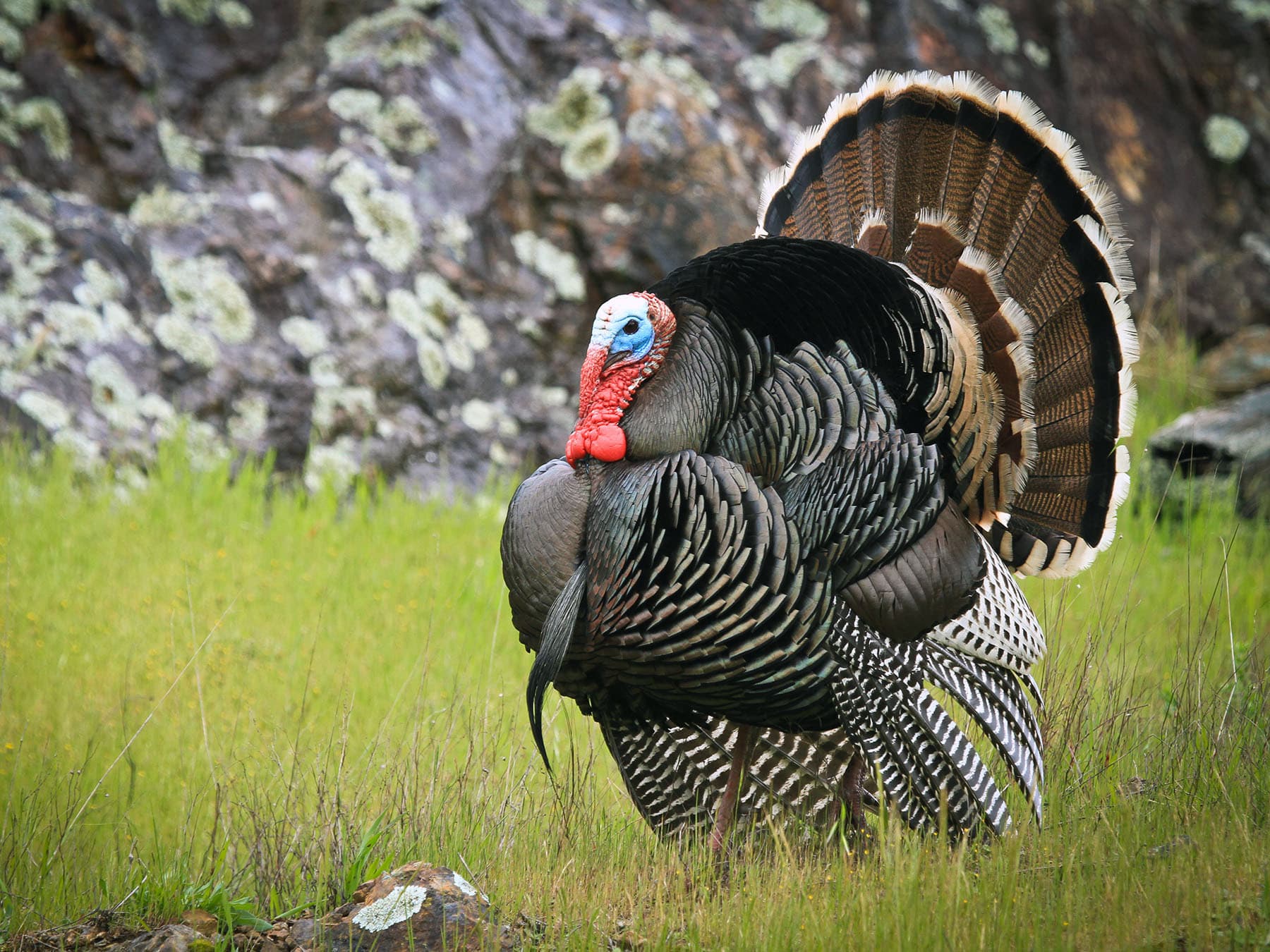
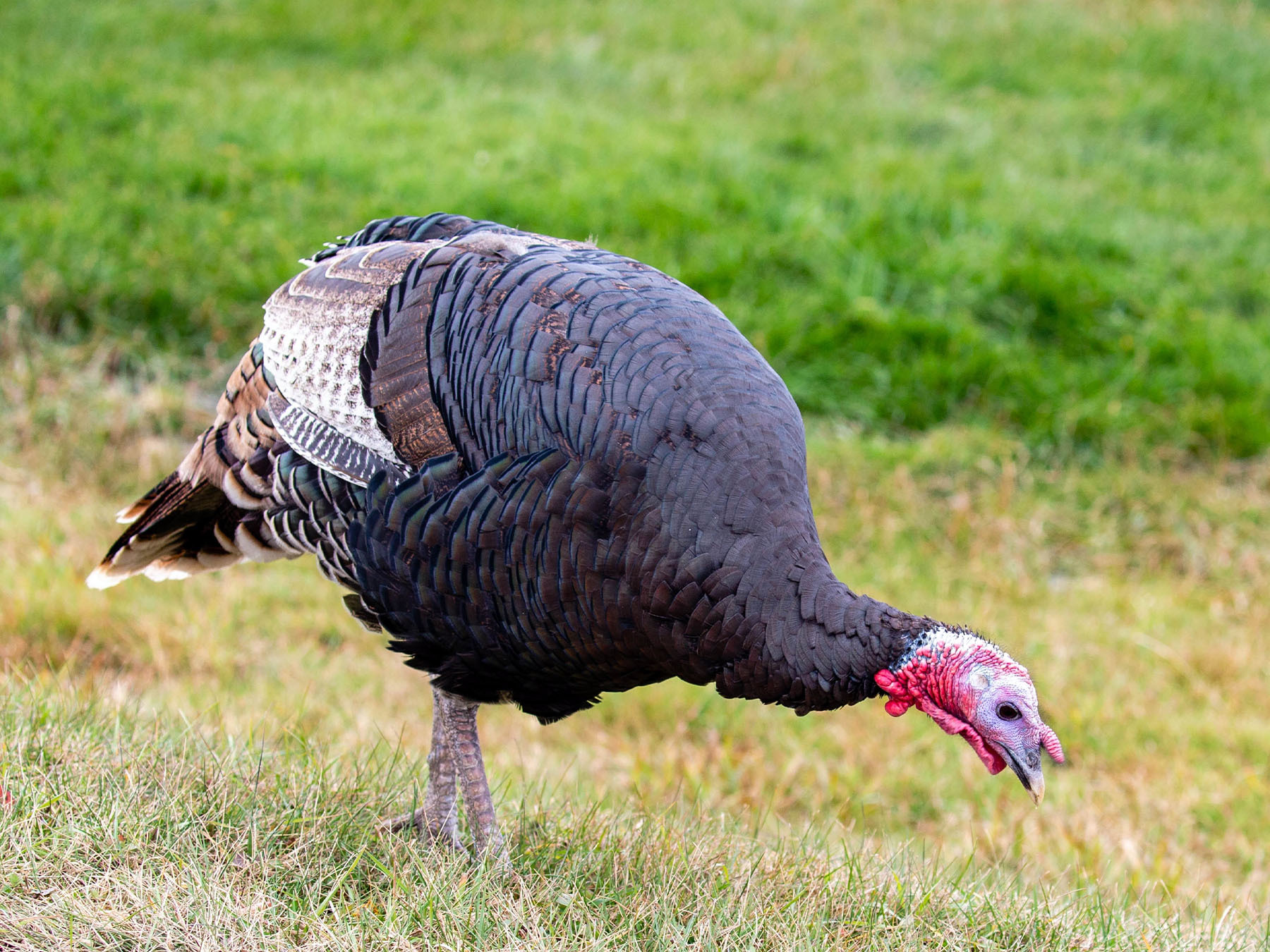
The Wild Turkey is a large, ground-dwelling bird with dark iridescent plumage. Males (toms) are larger and more colorful, with feathers that show bronze, green, and copper sheen.
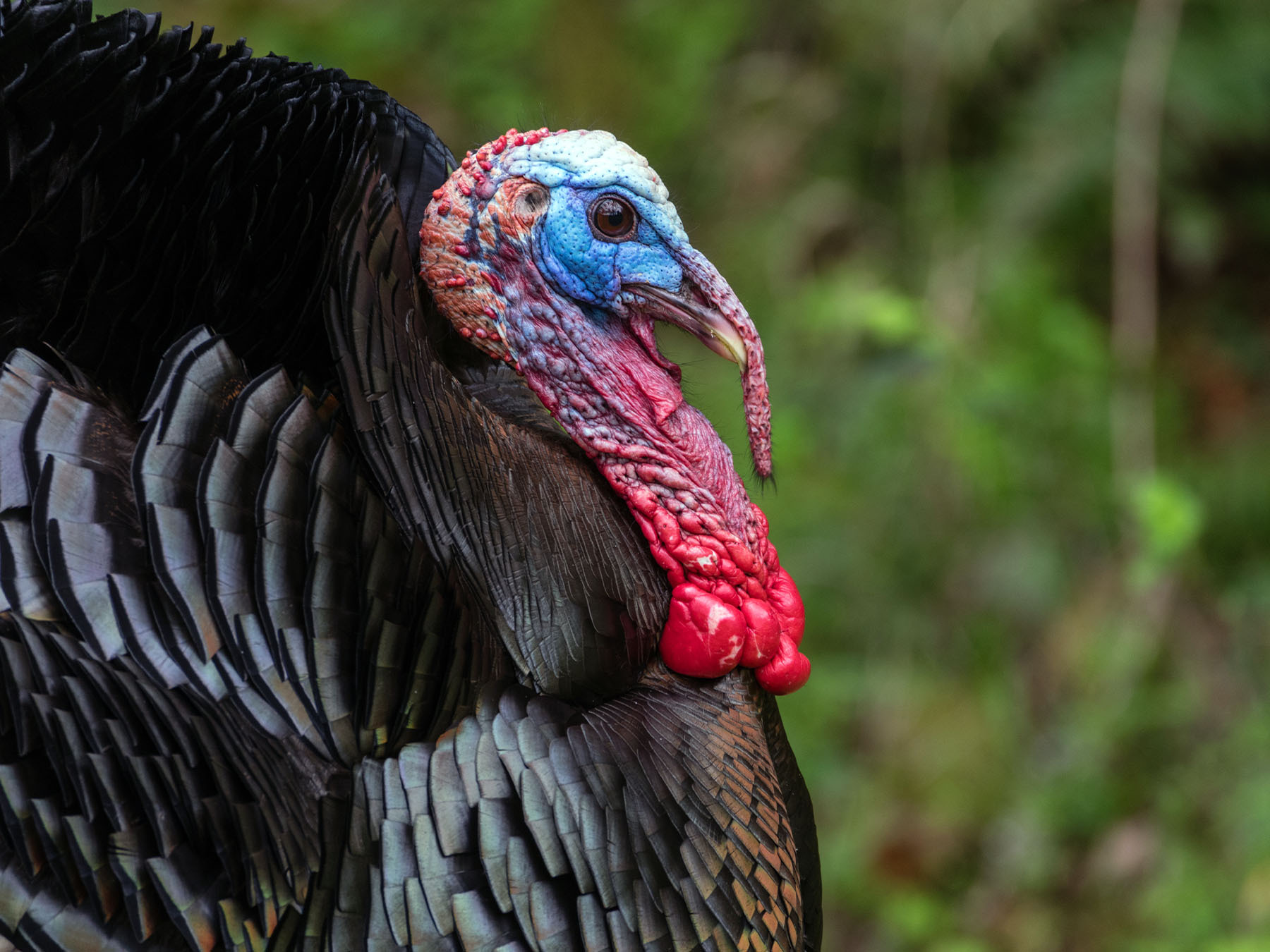
They have a distinctive bare, bumpy head with fleshy protrusions, including a snood (above the beak) and wattles on the neck. Most males have a beard-like tuft of bristles on their chest.
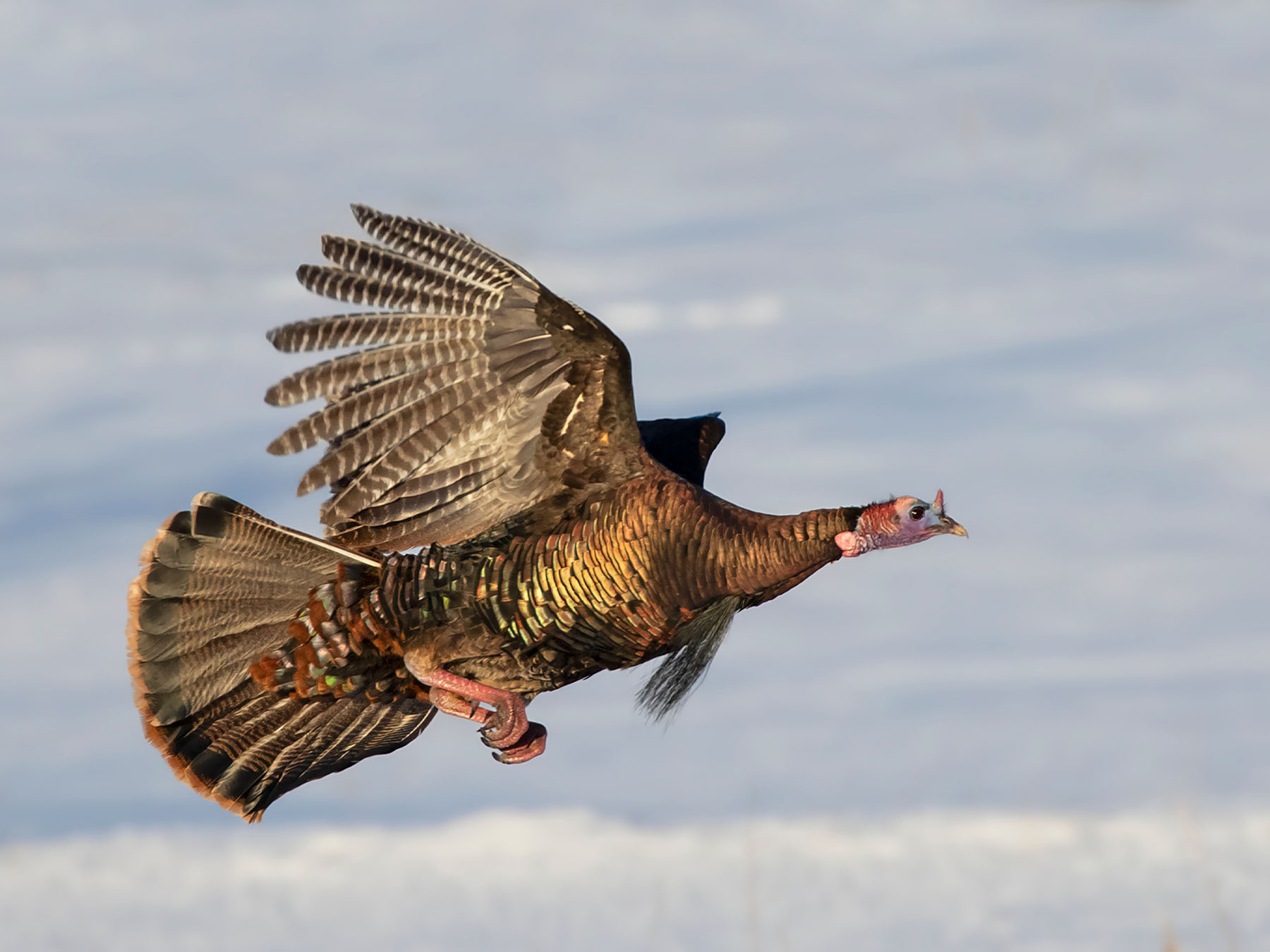
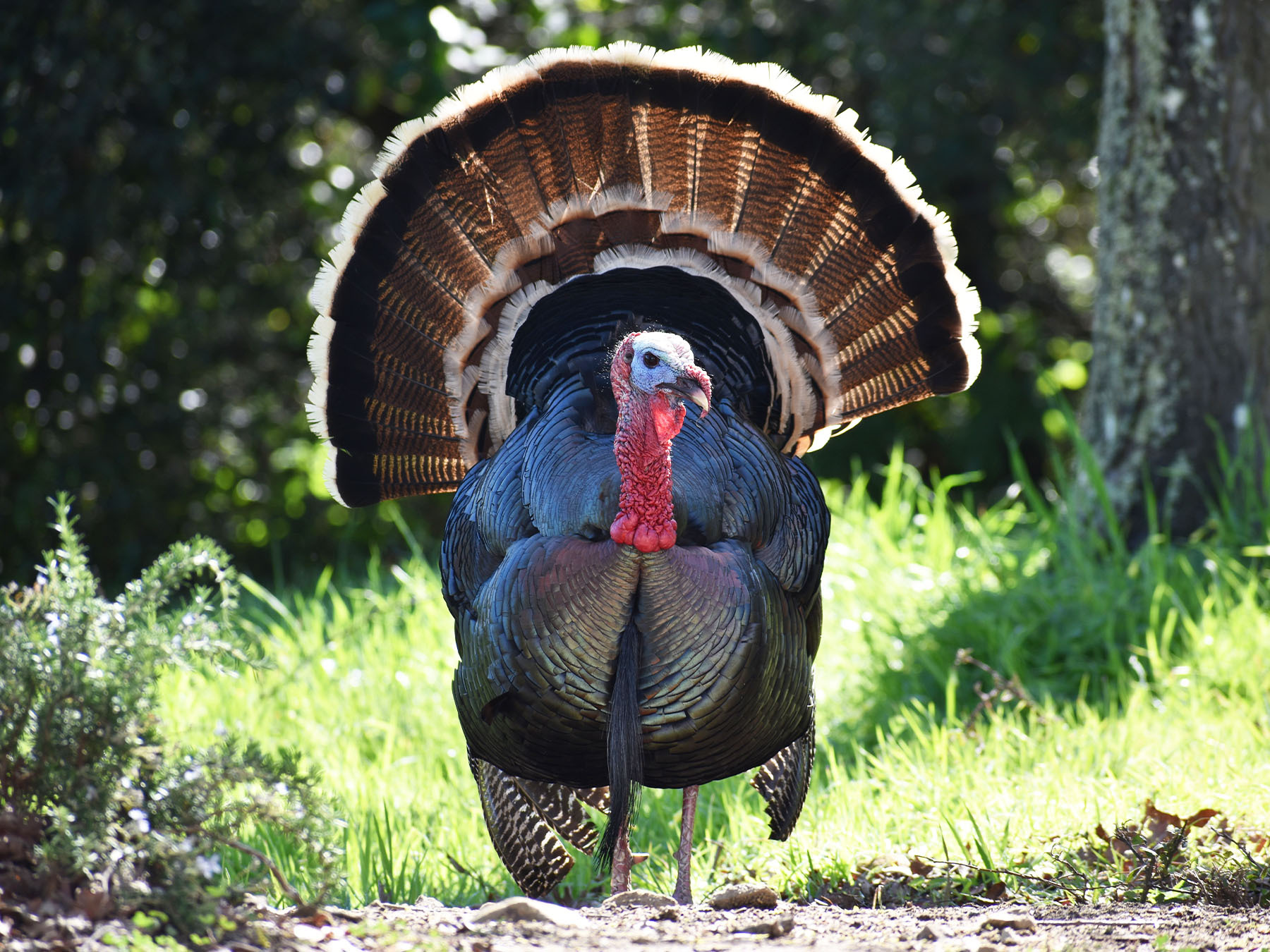
Females (hens) are smaller with more muted brown feathers and usually lack the chest beard, though some may have one. Both sexes have strong legs for running, broad wings for quick takeoff, and fan-shaped tails that can be spread wide. The males often have spurs on their legs.
Its size
Adults- Length
- 100–125 cm
- Wingspan
- 125–144 cm
- Weight
- 2500–10800 g
Its song and calls
Wild Turkeys are known for their distinctive vocalizations. Males produce a loud, resonant 'gobble' that can be heard up to a mile away.
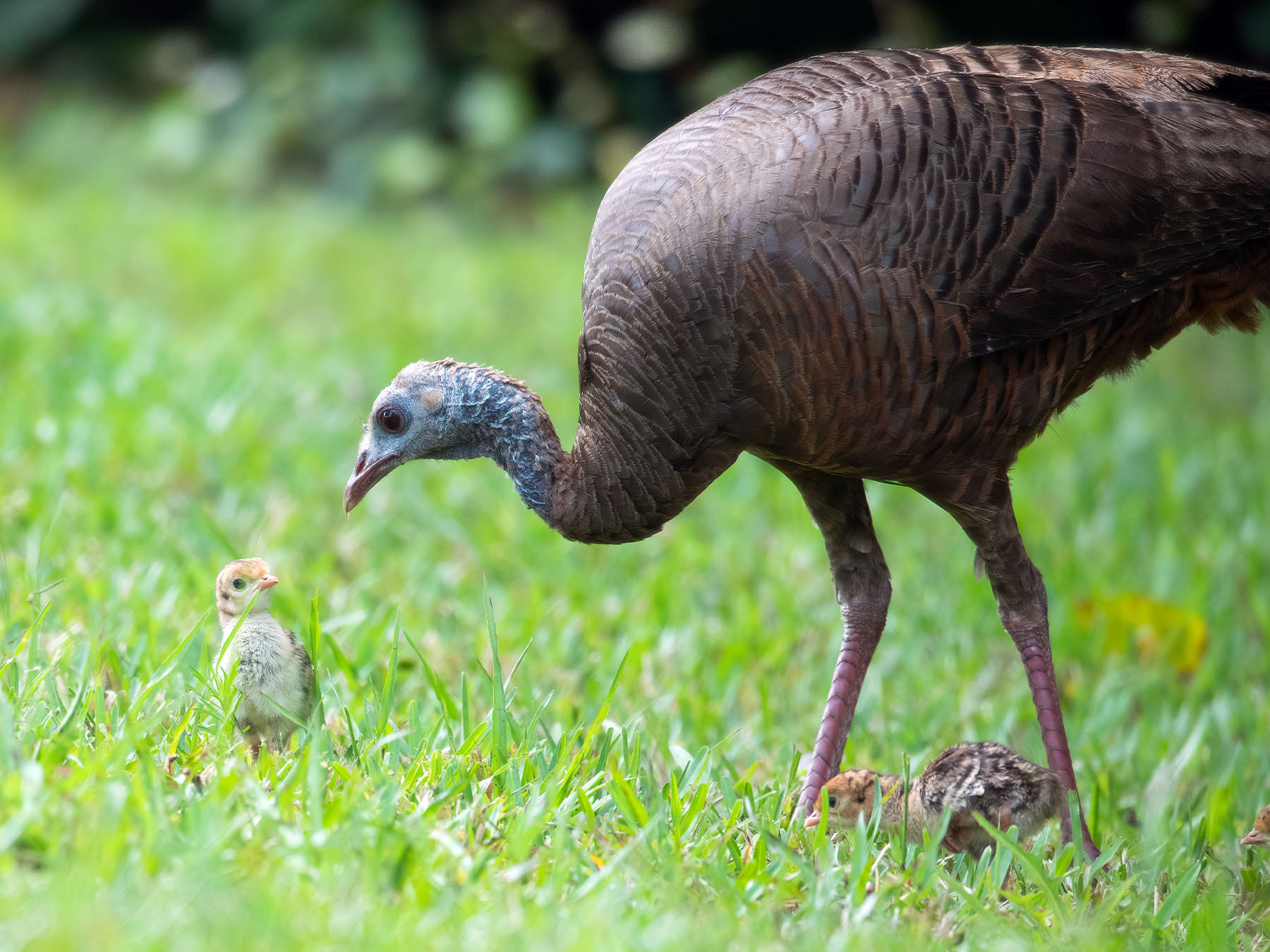
Hens make a variety of calls, including clucks, putts, and yelps, often to communicate with their young. When alarmed, turkeys emit a sharp 'putt' sound.
- Song0:00 / 2:53
Recorded in Minnesota, United States · June 2013
- Call0:00 / 0:29
Recorded in Minnesota, United States · May 2013
When and where to see it
OctoberIn season
Most recorded in October
- 1. South Dakota0.90%
- 2. Wisconsin0.56%
- 3. New Hampshire0.56%
- 4. Maine0.51%
- 5. Nebraska0.43%
Each dot is a county, state or province: the bigger and darker, the larger the bird’s share of that place’s bird records that month. Grey dots: no regular records. The ringed point is the centre of the bird’s records this month; the arrow shows how it moved since last month, and the dashed loop its path through the year. “Arrivals” colours places where it becomes regular this month (orange) or is in its last regular month (grey). GBIF eBird Observation Dataset, 2019–2024. Map data: Natural Earth, US Census Bureau; place centres © OpenStreetMap contributors.
In your area
See when the Wild Turkey is recorded in your county, state or province.
How often the Wild Turkey turns up in the United States and Canada through the year, from birdwatchers' records.
United States
Resident · all year · most records in April
Canada
Resident · all year · most records in January
Show as a table
| Month | United States | Canada |
|---|---|---|
| January | 0.18% (regular) | 0.37% (regular) |
| February | 0.19% (regular) | 0.37% (regular) |
| March | 0.25% (regular) | 0.29% (regular) |
| April | 0.31% (regular) | 0.25% (regular) |
| May | 0.26% (regular) | 0.21% (regular) |
| June | 0.23% (regular) | 0.13% (regular) |
| July | 0.21% (regular) | 0.11% (regular) |
| August | 0.21% (regular) | 0.11% (regular) |
| September | 0.20% (regular) | 0.12% (regular) |
| October | 0.17% (regular) | 0.13% (regular) |
| November | 0.16% (regular) | 0.16% (regular) |
| December | 0.18% (regular) | 0.31% (regular) |
Worldwide: recorded regularly in 11 countries
Countries where it was recorded in at least 3 of the 6 years 2019–2024. Linked countries have their own bird list.
North America (6)
- Canada
- Cuba
- Dominican Republic
- Mexico
- Puerto Rico
- United States
Oceania (3)
- Australia
- New Caledonia
- New Zealand
Data: EOD – eBird Observation Dataset (Cornell Lab of Ornithology), accessed via GBIF.org, CC BY 4.0. Records from 2019–2024, aggregated and filtered by Birdfact. How these lists are made
Tips for seeing it
- Look for Wild Turkeys in open woodlands and field edges, especially in the early morning or late afternoon.
- Listen for their distinctive gobbling calls, particularly during spring breeding season.
- Scan for large, dark shapes on the ground or roosting in trees at dusk.
- In the US, visit wildlife management areas or national forests known for turkey populations.
What it eats
Wild Turkeys are omnivorous, primarily feeding on nuts, seeds, berries, insects, and small vertebrates.
They forage by scratching the forest floor, consuming acorns, hickory nuts, grasshoppers, and occasional snakes or lizards. In agricultural areas, they may feed on crops like corn and wheat.
Nesting and breeding
Breeding season for Wild Turkeys typically begins in early spring. Males perform elaborate courtship displays, gobbling loudly and fanning their tails to attract females.
Hens construct simple nests on the ground, usually in dense vegetation or near fallen logs. They lay 10-14 eggs, which are pale and speckled with reddish-brown spots.
Incubation lasts about 28 days, with chicks leaving the nest within 24 hours of hatching. Young turkeys, or poults, can fly short distances after about two weeks and roost in trees with their mother by four weeks of age.
Behaviour
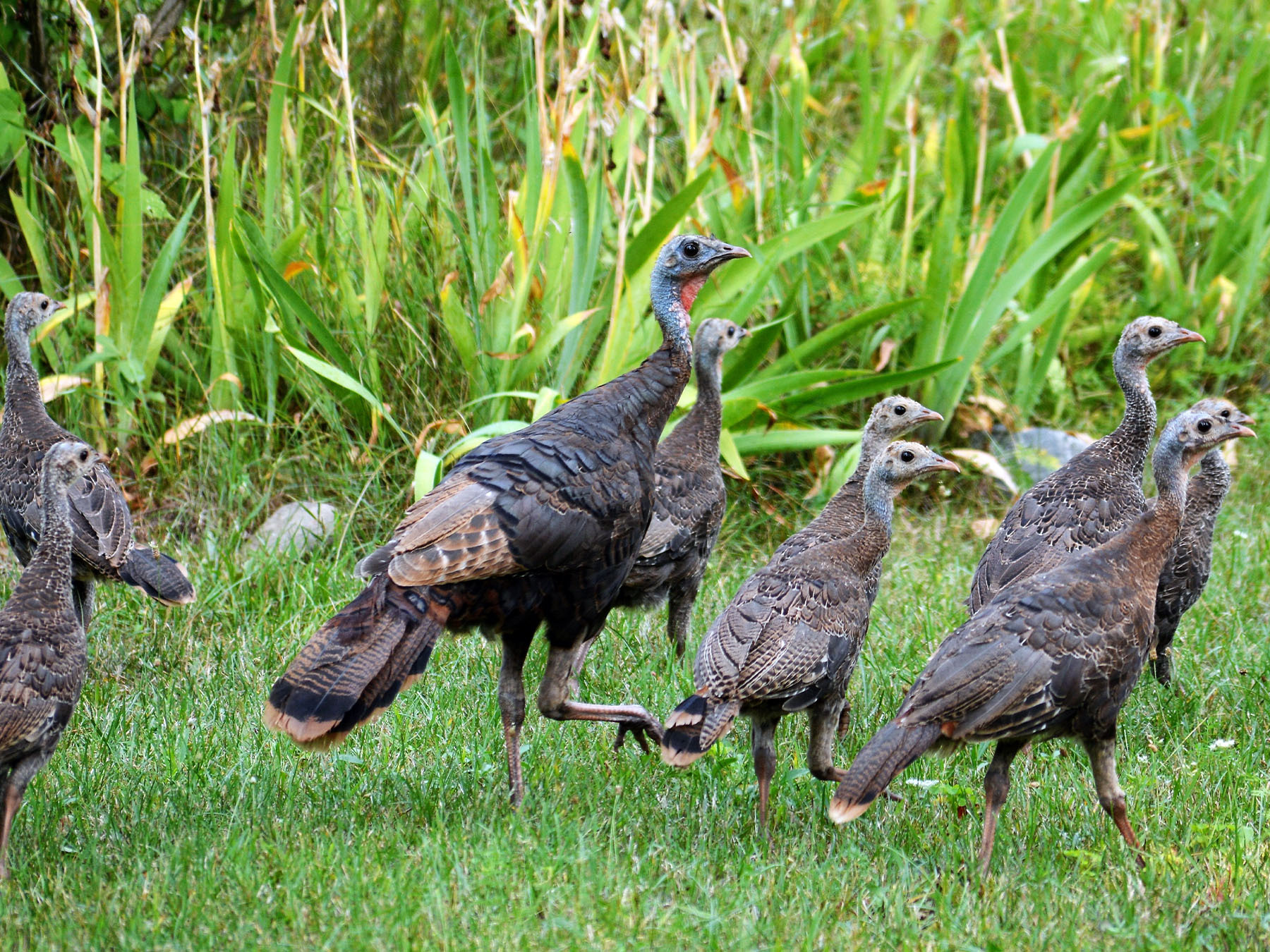
Wild Turkeys are highly social, often forming flocks of 15 to 30 birds. They forage on the ground, scratching with their feet to uncover food.
During the breeding season, males engage in elaborate courtship displays, fanning their tails and strutting to attract females.
Conservation
While once near extinction due to overhunting and habitat loss, Wild Turkey populations have rebounded significantly thanks to conservation efforts.
Current challenges include habitat fragmentation and local overpopulation in some urban areas, requiring ongoing management.
More photos
7 photos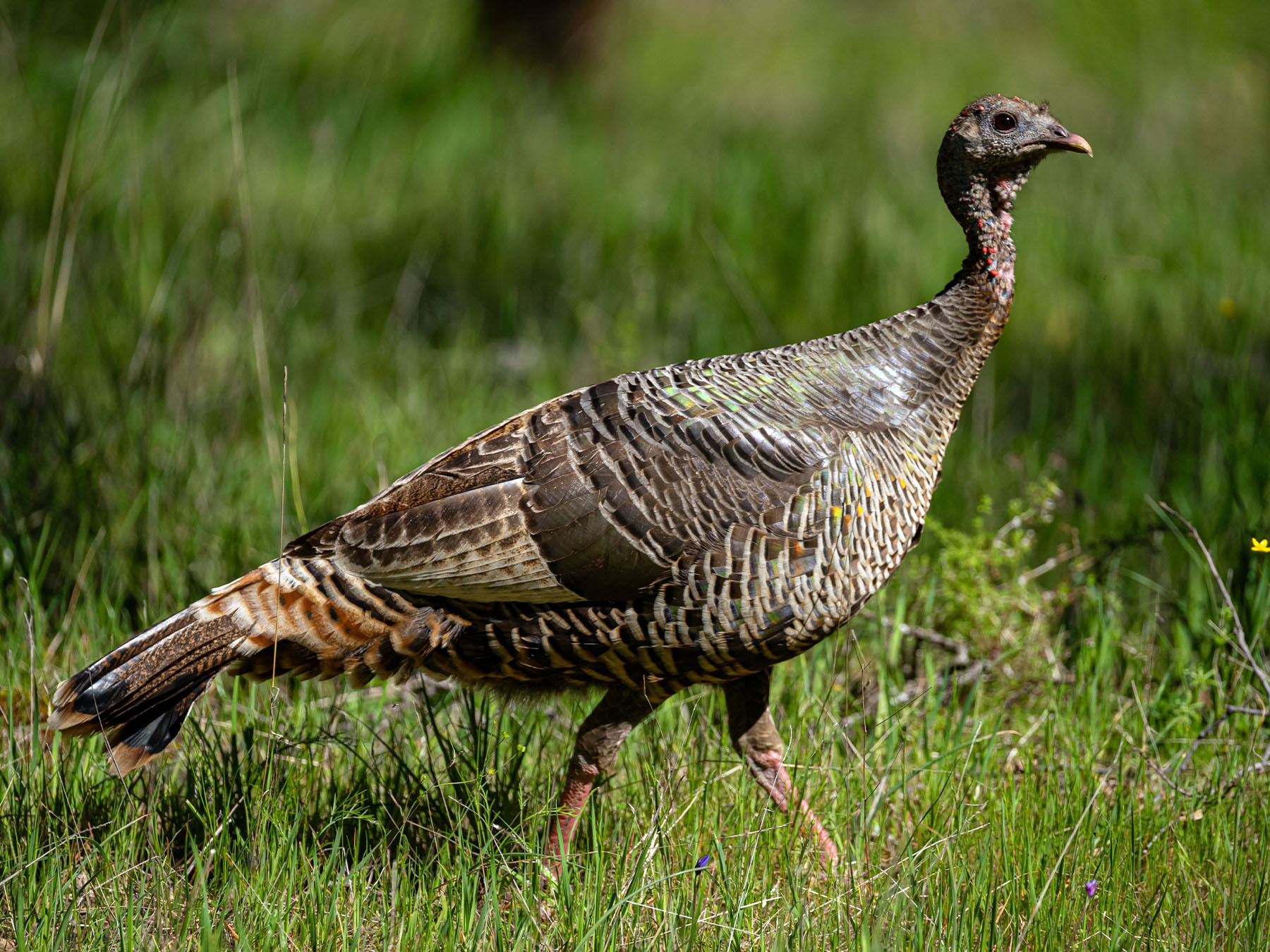
Wild Turkey guides
4 guidesQuick facts
- Length
- 100–125 cm
- Wingspan
- 125–144 cm
- Weight
- 2500–10800 g
- Lifespan
- 3–5 years · oldest recorded 13 years
- Family
- Pheasants & Grouse
- Migration
- Resident
- Global status (IUCN)
- Least Concern
- World population
- 6,900,000 mature individuals
- Population trend
- Increasing
- Also called
- Eastern Wild Turkey
- Scientific name
- Meleagris gallopavo
Sources
4- 1BirdLife International. 2018. Meleagris gallopavo. The IUCN Red List of Threatened Species 2018: e.T22679525A132051953. Source (opens in a new tab)
- 218700% increase over 40 years, equating to a 270% increase per decade; data from Breeding Bird Survey and/or Christmas Bird Count: Butcher and Niven 2007
- 3Partners in Flight (2019) Source (opens in a new tab)
- 4Carey and Judge, Longevity Records: Life Spans of Mammals, Birds, Amphibians, Reptiles, and Fish (2000) Source (opens in a new tab)

Checked by
Nathan Cope, founder and editor
Nathan founded Birdfact and leads its writers and contributors in the UK, the US and Canada. He has watched and studied birds for more than ten years, and checks every article and species guide before it’s published.