Published 8 Oct 2026
Song Sparrow Song and Calls: What a Song Sparrow Sounds Like
By the Birdfact teamChecked by Nathan Cope
A Song Sparrow's song opens with a few loud, well-spaced notes and runs into buzzes and trills over 2 to 4 seconds. Most males sing 5 to 13 different songs, learned as youngsters, and switch between them. Listen to the recordings and see the songs as spectrograms.
On this page11 sections
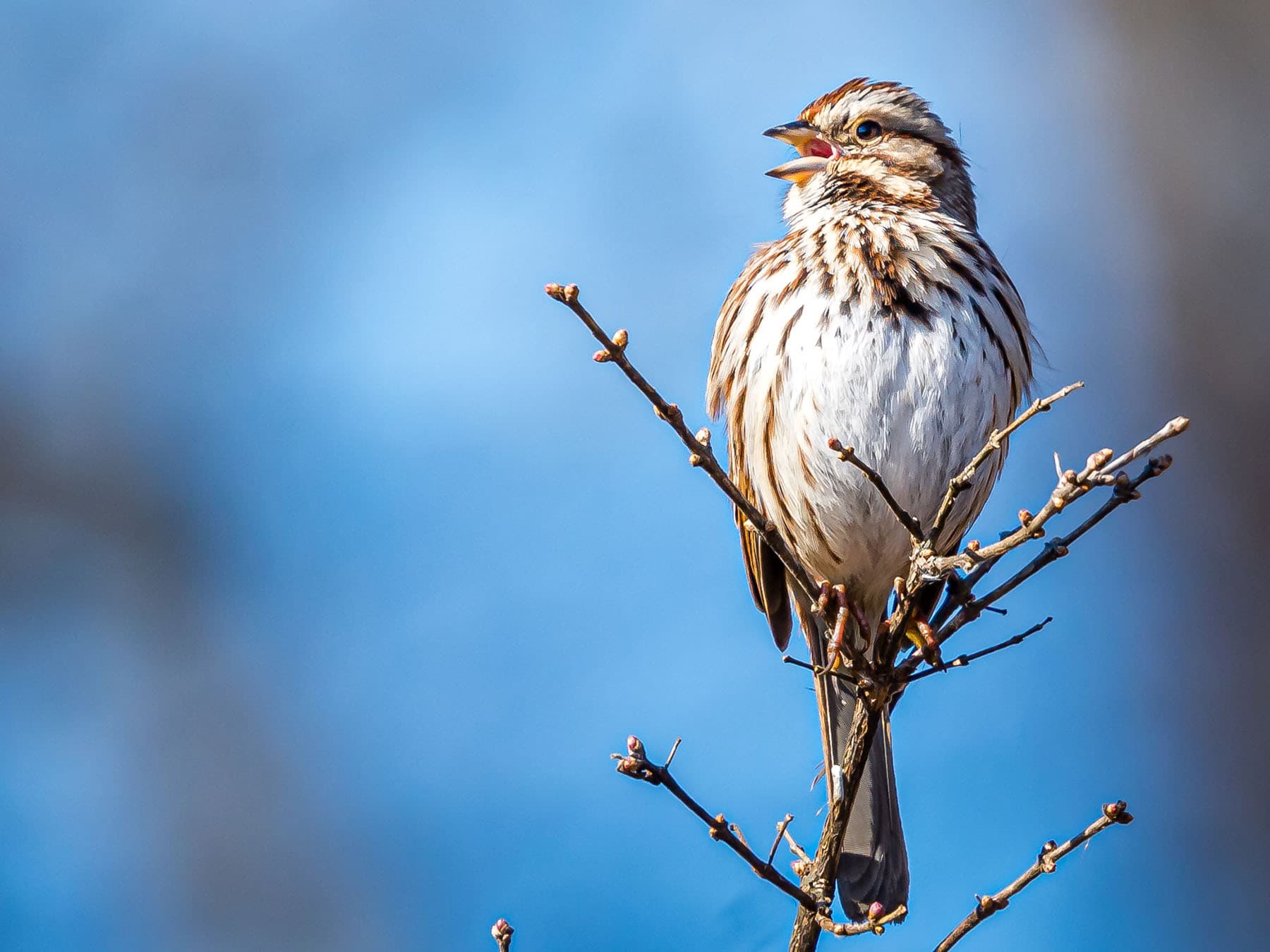
What a Song Sparrow sounds like, with recordings and spectrograms: the song and how to recognize it, why each male sings several different songs, how young birds learn them, and the calls. For the bird itself, see Song Sparrow identification, song and facts.
What does a Song Sparrow sound like?
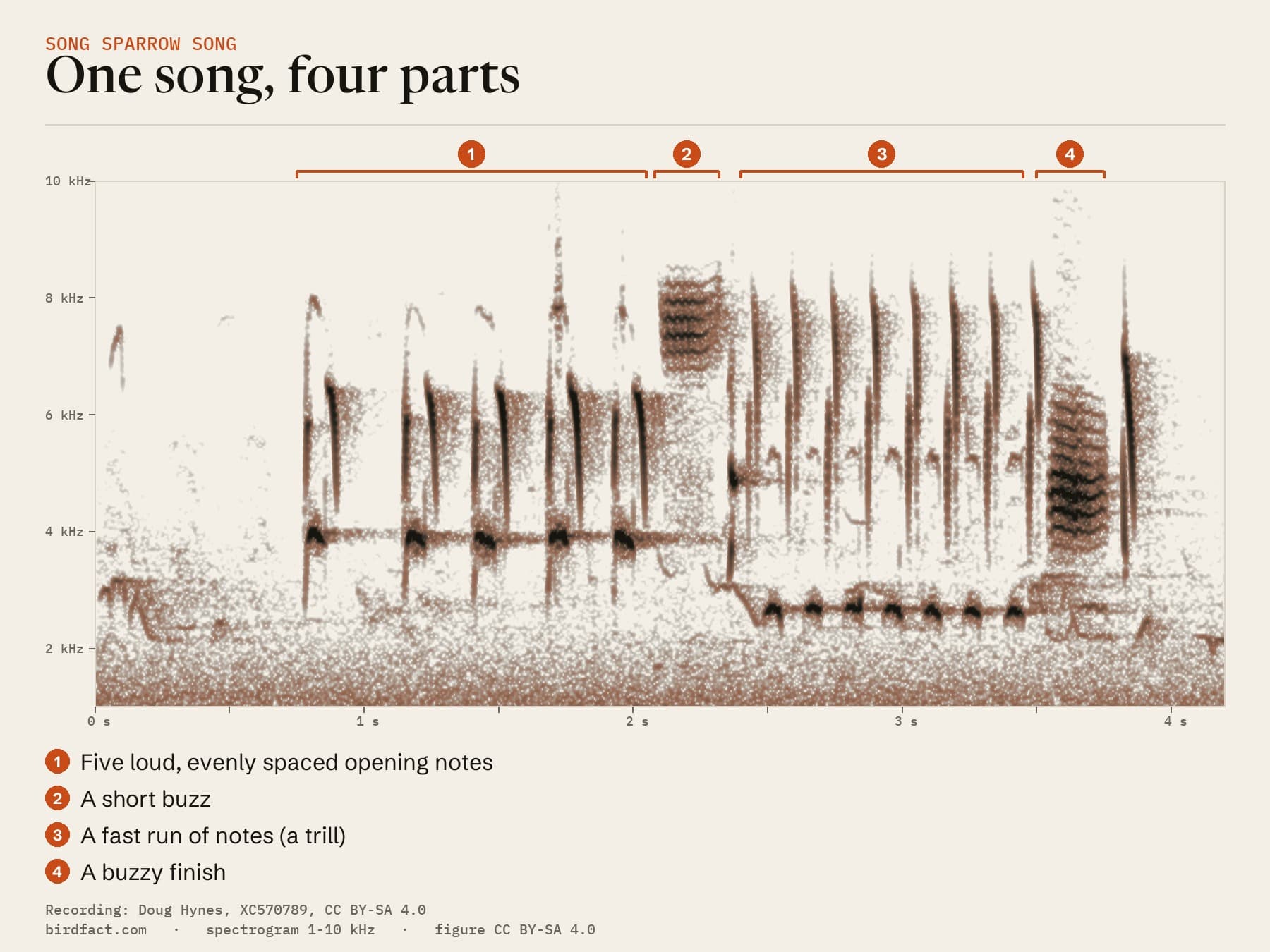
A bright, busy song that usually starts with a few loud, well-spaced notes and then runs on into buzzes and trills, all in about 2 to 4 seconds. Males sing it from an open perch.1 In much of the range you can hear it in any month.
A song is made of 2 to 6 parts, or phrases, most often 3 or 4. The opening phrase is a few clear, separate notes; the phrases after it are buzzes, trills (fast runs of the same note) or more complex notes, often speeding up or slowing down. The overall effect is cheery and rhythmic, though some notes are harsh.2
How to recognize the song
Listen for the start: a few loud, evenly spaced notes, then a jumble of buzzes and trills. Then listen to what comes next: a Song Sparrow sings the same song several times in a row, then switches to a different one (see below).
Songs also change from place to place, so the Song Sparrows you hear on a trip may not sound quite like the ones at home. In the East, young males usually build their songs from pieces of several tutors' songs and rarely share whole songs with their neighbors; in the West, neighbors often share complete songs.
People have long put words to it. In his journal for June 22, 1856, Henry David Thoreau noted what Ricketson had told him: that at New Bedford, Massachusetts, people said the Song Sparrow sings "Maids, maids, maids,—hang on your tea-kettle-ettle-ettle-ettle-ettle."3
One bird, many songs
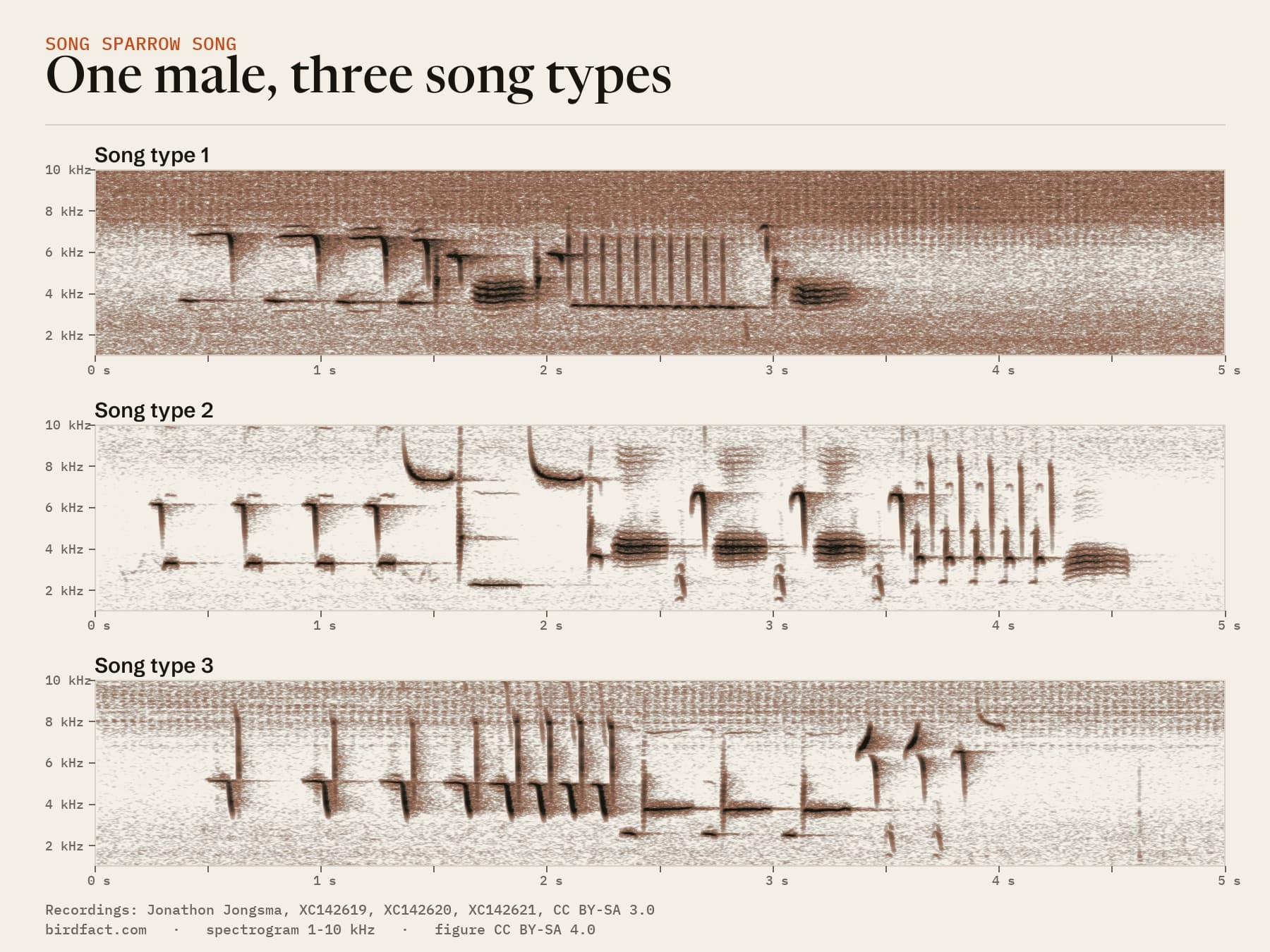
Each male has a repertoire of about 5 to 13 different songs, called song types. He sings one type 5 to 15 times in a row, then switches to another, most often without a pause. Within a type, the end of the song varies a little from one rendition to the next.
The three recordings below are all one male, on his territory in Michigan's Porcupine Mountains in July 2013. The recordist played back the first type, and the male then sang his second and third.
How young males learn to sing
Song Sparrows learn their songs. A young male starts with a quiet, rambling warble, called subsong, as early as 2 to 3 weeks old, and works through several stages of practice before his songs settle into their adult form. Males raised without hearing adults sing produce abnormal songs, and other Song Sparrows respond less to them.
In a classic laboratory study, young males began copying songs at 22 days old on average and did most of their learning over the next 40 days, though a few picked up a song as late as 200 days. Given Song Sparrow and Swamp Sparrow songs to copy, they strongly preferred their own species'.4 Later work found the learning window is longer than that: in birds brought into the lab at 2 to 3 months old, about 30% of their final songs were shaped by songs they heard afterward, and 8% were learned there from scratch. The songs a young male hears in his first spring may be critical.5
Once a male is a year old, his repertoire is fixed for life. Song Sparrows rarely copy other species, though there are exceptions: one bird in San Francisco sang White-crowned Sparrow song.
Adults sing quietly too. The recording below is an adult's quiet, rambling song, which its recordist logged as subsong and which seems to include an imitation of a Pine Siskin call.
Why it matters how well a male learned
Female Song Sparrows listen closely. In one experiment, females responded more strongly to songs that a male had learned well, with more copied than invented material and more accurate copies, than to songs learned poorly.6 In a Pennsylvania study, females, and territorial males too, reacted more strongly to local songs than to songs recorded in New York.7
Whether a bigger repertoire wins a male more is less clear. On Mandarte Island in British Columbia, males with the largest repertoires held their territories longest and raised more young.2 In a laboratory study, females gave more courtship displays to larger repertoires, yet no link turned up between repertoire size and a male's age, dominance, territory size, settling date, wing length or weight.8
Neighbors, song matching and soft song
Song is also how neighbors talk to each other. In a study in Washington, young males learned most of their songs from 3 or 4 neighbors after leaving home, and neighbors ended up sharing 20 to 40% of their song types. Males can tell a neighbor's song from a stranger's: they answer a stranger's song, or a recording of their own, with the same song type, a move called matching that tends to escalate a dispute.
Close disputes can turn quiet. Rival males often face each other and sing soft, low-volume songs, and soft song is a threat: in an experiment, territorial males approached closer, wing-waved more and sang more soft song themselves in response to soft song than to loud song.9
Song also holds a territory. When researchers took males off their territories, the territories were taken over less often if loudspeakers played song there in the males' absence.
When they sing
Through much of the range you can hear Song Sparrows singing in any month. Singing peaks just before and during the breeding season and picks up again for a few weeks after the fall molt.
How much a male sings depends on his situation. In Margaret Morse Nice's Ohio study, unmated males sang 180-200 songs an hour, while mated males sang far less. One male whose mate had disappeared sang 2,305 songs in 15 hours.
Song Sparrows sing mostly by day, starting 16 to 49 minutes before sunrise on clear mornings, but a male may sing one to three songs in the dark in the breeding season. They sing from perches up to about 13 ft (4 m) up: a bush, small tree, fence, boulder or roof, and sometimes in flight.
Do female Song Sparrows sing?
Rarely. Only 11 of 200 breeding females in Nice's Ohio study, and 12 of 140 in British Columbia, were heard singing, mostly in spring disputes with other females. Their songs are usually simpler than a male's. On Mandarte Island, a few females' sharp nest call develops into something close to normal song in spring. More: male vs female Song Sparrows.
Calls
Alarm: a sharp chip. Both sexes give a sharp chip, written "tchunk", "tchip" or "chip", when alarmed or anxious, for example when a person or a predator comes near the nest.1 On Mandarte Island a higher "tik" was given when hawks flew over, and the lower "tchunk" at people and other dangers near a nest or fledglings.
Contact: a soft "tsip". Young birds and subordinate birds give a soft, high "tsip" or "sst", especially near birds that hold territories.
Female calls. A female gives a harsh chatter, up to about 6 seconds long, at her mate during nest building or at a rival female; a sharp twitter, "chi-chi-chi-chit-chit-chit", as she leaves the nest; and a nasal, trilled "ee-ee-ee" around mating.
Young birds. Nestlings beg with "see-see" and "tit-tit-tit" notes, and recently fledged young give a location call, "eep". The young develop their calls one by one: food calls from the first day and the scream at about a week.
Why is it called the Song Sparrow?
For its song. The scientific name says the same: Melospiza is Greek for "song finch", and melodia means singing. Alexander Wilson, who named the bird in 1810, called it the first singing bird of spring.
Sources
- Cornell Lab of Ornithology. Song Sparrow: Overview, Identification, Life History and Sounds. All About Birds. Accessed October 7, 2026. Source
- Arcese, P., Sogge, M. K., Marr, A. B., Patten, M. A. (2020). Song Sparrow (Melospiza melodia), version 1.0. Birds of the World (A. F. Poole and F. B. Gill, editors). Cornell Lab of Ornithology. doi:10.2173/bow.sonspa.01
- Thoreau, H. D. (1906). The Journal of Henry David Thoreau, vol. 8 (entry for 22 June 1856). B. Torrey and F. H. Allen, editors. Houghton Mifflin. Accessed October 7, 2026. Source
- Marler, P., Peters, S. (1987). A sensitive period for song acquisition in the song sparrow, Melospiza melodia: a case of age-limited learning. Ethology 76: 89-100. doi:10.1111/j.1439-0310.1987.tb00675.x
- Nulty, B., Burt, J. M., Akçay, Ç., Templeton, C. N., Campbell, S. E., Beecher, M. D. (2010). Song learning in song sparrows: relative importance of autumn vs. spring tutoring. Ethology 116: 653-661. doi:10.1111/j.1439-0310.2010.01782.x
- Nowicki, S., Searcy, W. A., Peters, S. (2002). Quality of song learning affects female response to male bird song. Proceedings of the Royal Society B 269: 1949-1954. doi:10.1098/rspb.2002.2124
- Searcy, W. A., Nowicki, S., Hughes, M. (1997). The response of male and female Song Sparrows to geographic variation in song. The Condor 99: 651-657. doi:10.2307/1370477
- Searcy, W. A., McArthur, P. D., Yasukawa, K. (1985). Song repertoire size and male quality in song sparrows. The Condor 87: 222-228. doi:10.2307/1366886
- Templeton, C. N., Akçay, Ç., Campbell, S. E., Beecher, M. D. (2012). Soft song is a reliable signal of aggressive intent in song sparrows. Behavioral Ecology and Sociobiology 66: 1503-1509. doi:10.1007/s00265-012-1405-5
- xeno-canto contributors. Song Sparrow recordings used on the song page. xeno-canto. Accessed October 7, 2026. Source