Facts · Updated 9 Oct 2026
Red Kite Nesting: Nests, Eggs and Young
By the Birdfact teamChecked by Nathan Cope
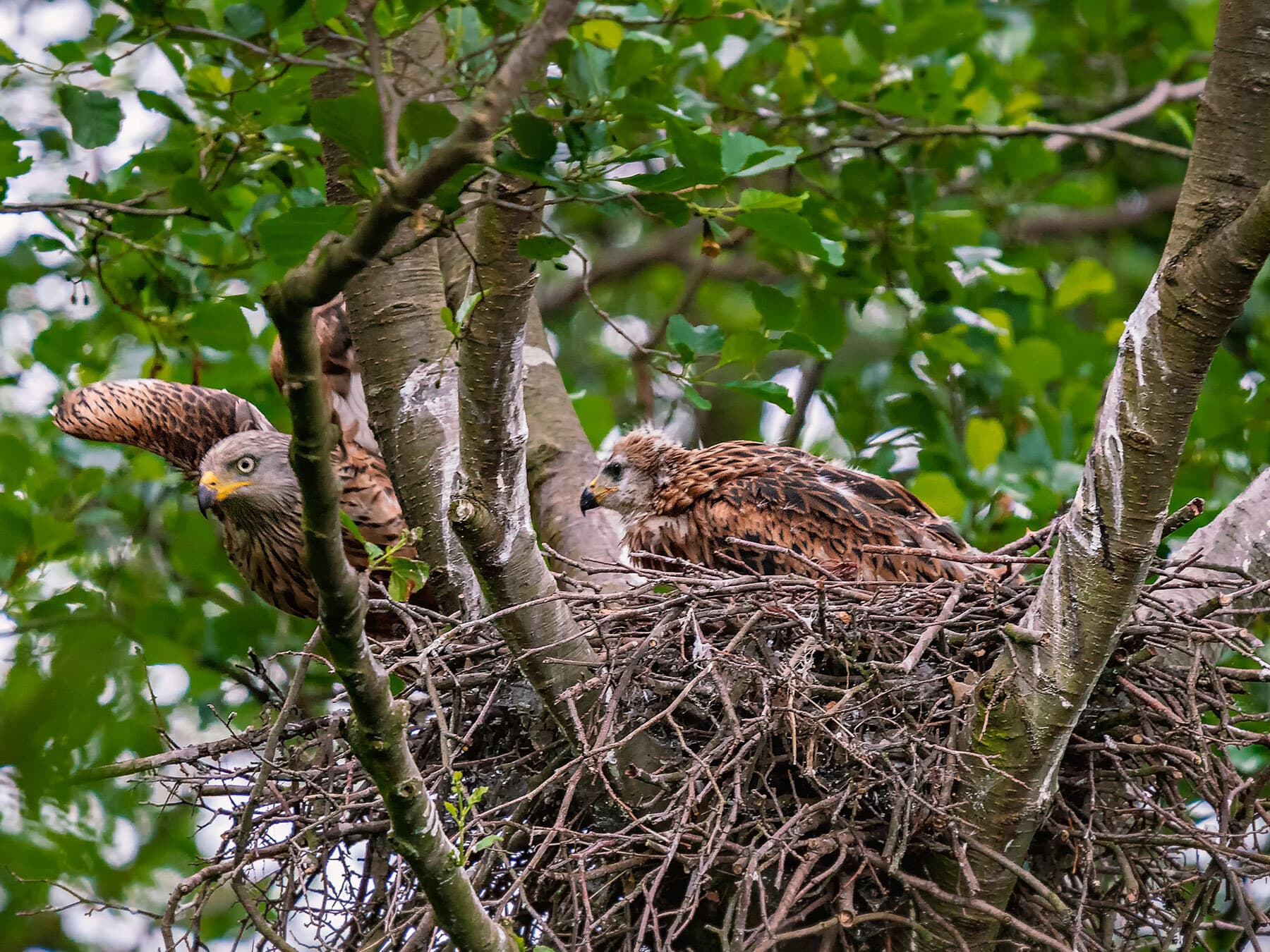
Red Kites build a platform of sticks in a tree, lined with wool and often decorated with rags, plastic and other finds. They lay two or three eggs, occasionally four, between March and May across their range; the female incubates for 31-32 days and the young stay in the nest for 50-60 days.
On this page10 sections
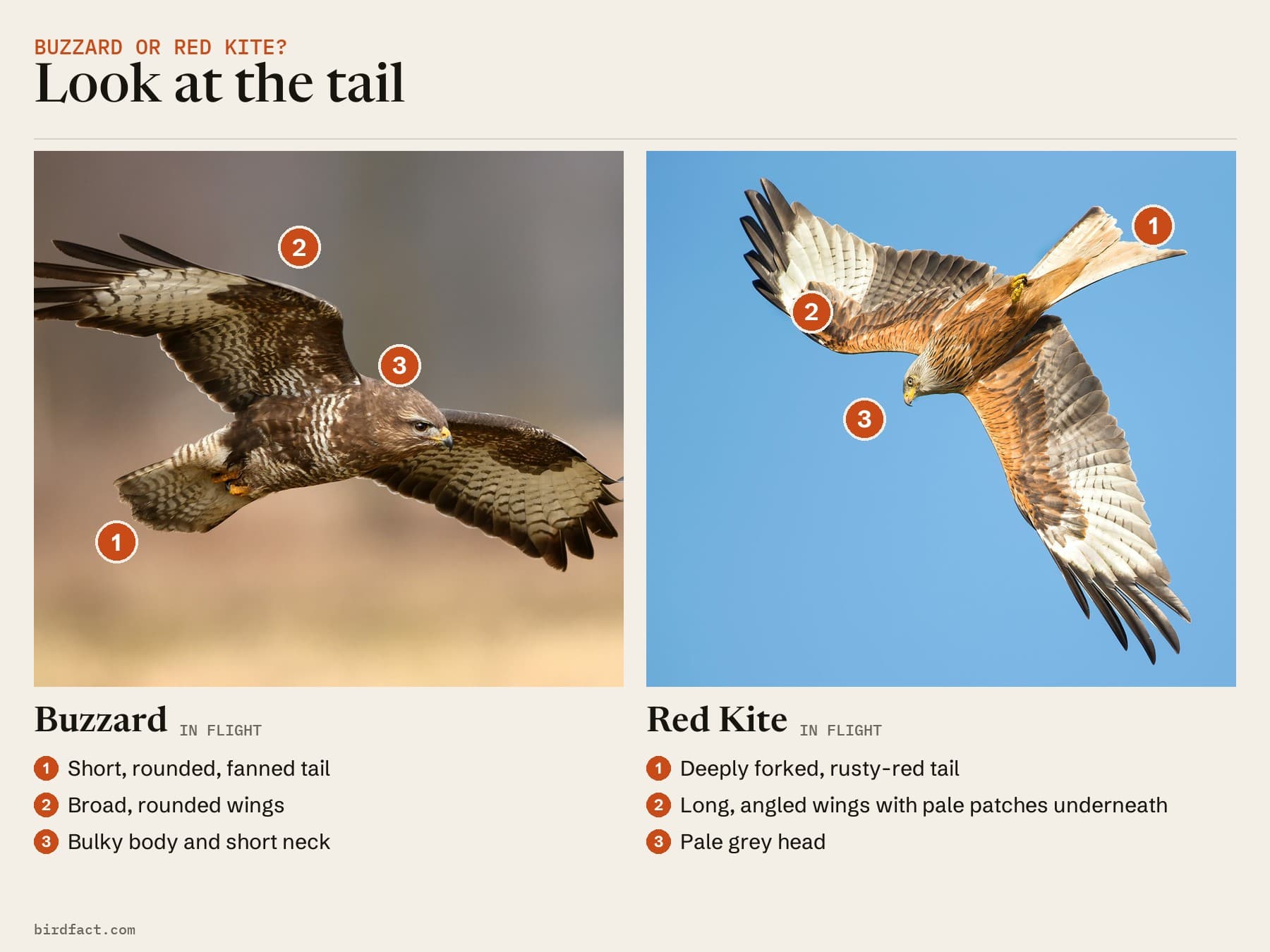
Everything about Red Kite nests: where and when they nest, the nest and its odd decorations, eggs, chicks and young kites, and the law. For the bird itself, see Red Kite identification and facts.
Where do Red Kites nest?
When do Red Kites nest?
Across their range, eggs are laid between March and May.1 Add a month of incubation and up to two months in the nest, and the last young leave their nests in summer.
The nest
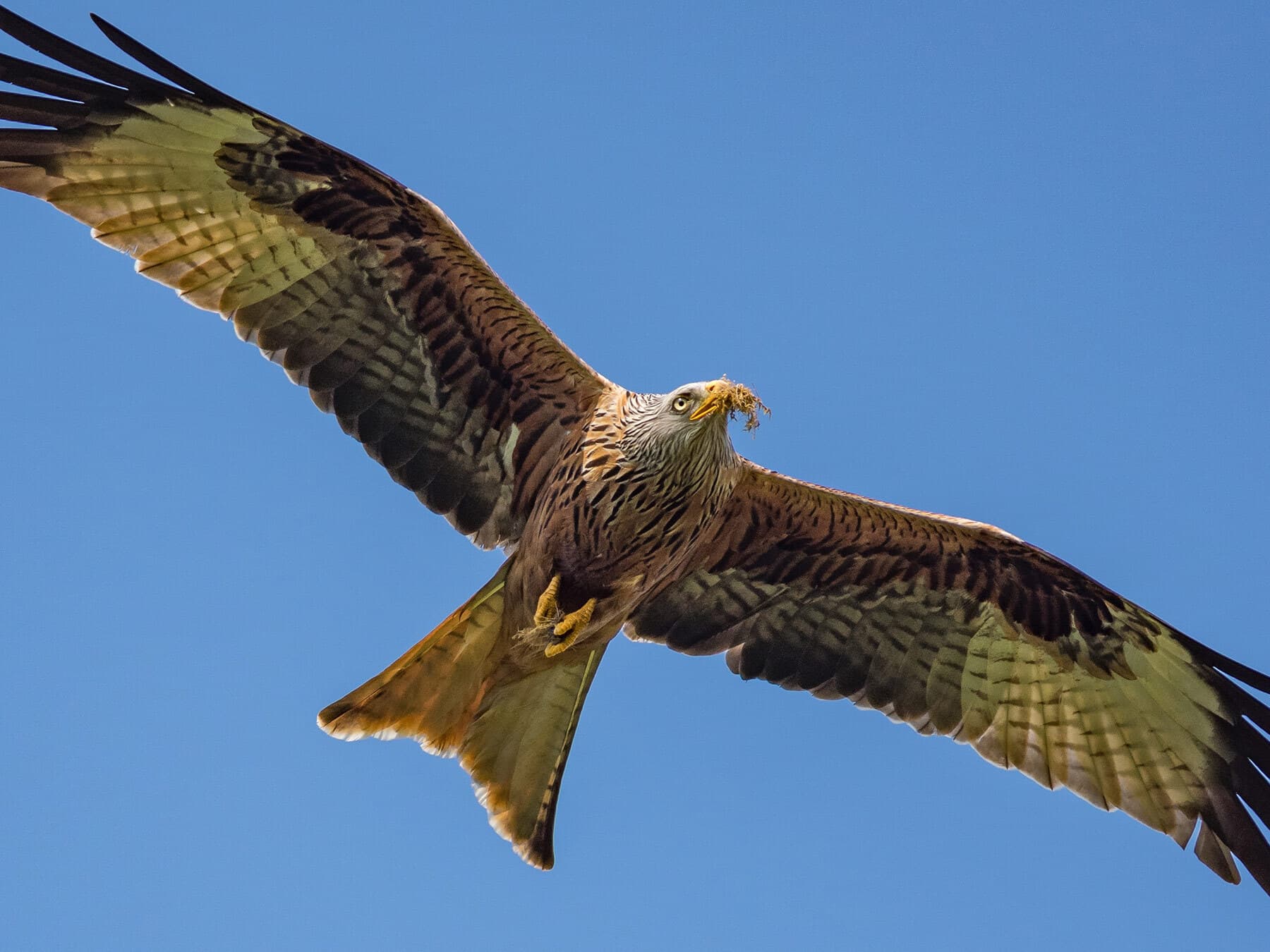
The nest is a platform of sticks, normally lined with wool, and often with rags or plastic worked in. A pair usually has several nests, reusing one each year or switching between them. The Woodland Trust describes kites as monogamous, with pairs returning to the same nests each season and adding new material.3 The Chilterns Conservation Board says pairs usually keep the same mate year after year, though "divorces" are not unheard of.4
Kites collect objects that catch their eye. The RSPB lists gloves, novelty sunglasses and cuddly toys found in nests, and one Scottish kite that lined its nest with underwear left on a bank by skinny-dippers. The habit is old enough to be in Shakespeare: in The Winter's Tale, Autolycus warns "when the kite builds, look to lesser linen".5
Eggs
A clutch is usually two or three eggs. The BTO gives two as typical, with one to three recorded.6 Birds of the World, looking across the range, gives one to four, laid three days apart. The eggs are about 57 by 45 mm and weigh about 63 g.6
The kites released in England and Scotland laid larger clutches, averaging 2.9 and 3.0 eggs in their early years.7
Incubation
The female does nearly all the incubating, starting with the first egg, and each egg takes 31-32 days to hatch. The BTO notes that the male occasionally takes a turn. While she sits, the male brings food.
Baby Red Kites
The chicks hatch in buff down, which is replaced by a second, reddish-tinged down. The female broods and feeds them, and the male brings most of the food. They stay in the nest for 50-60 days. In a study in southern Spain, young kites left the nest at about 55 days old on average.8
Young kites after fledging
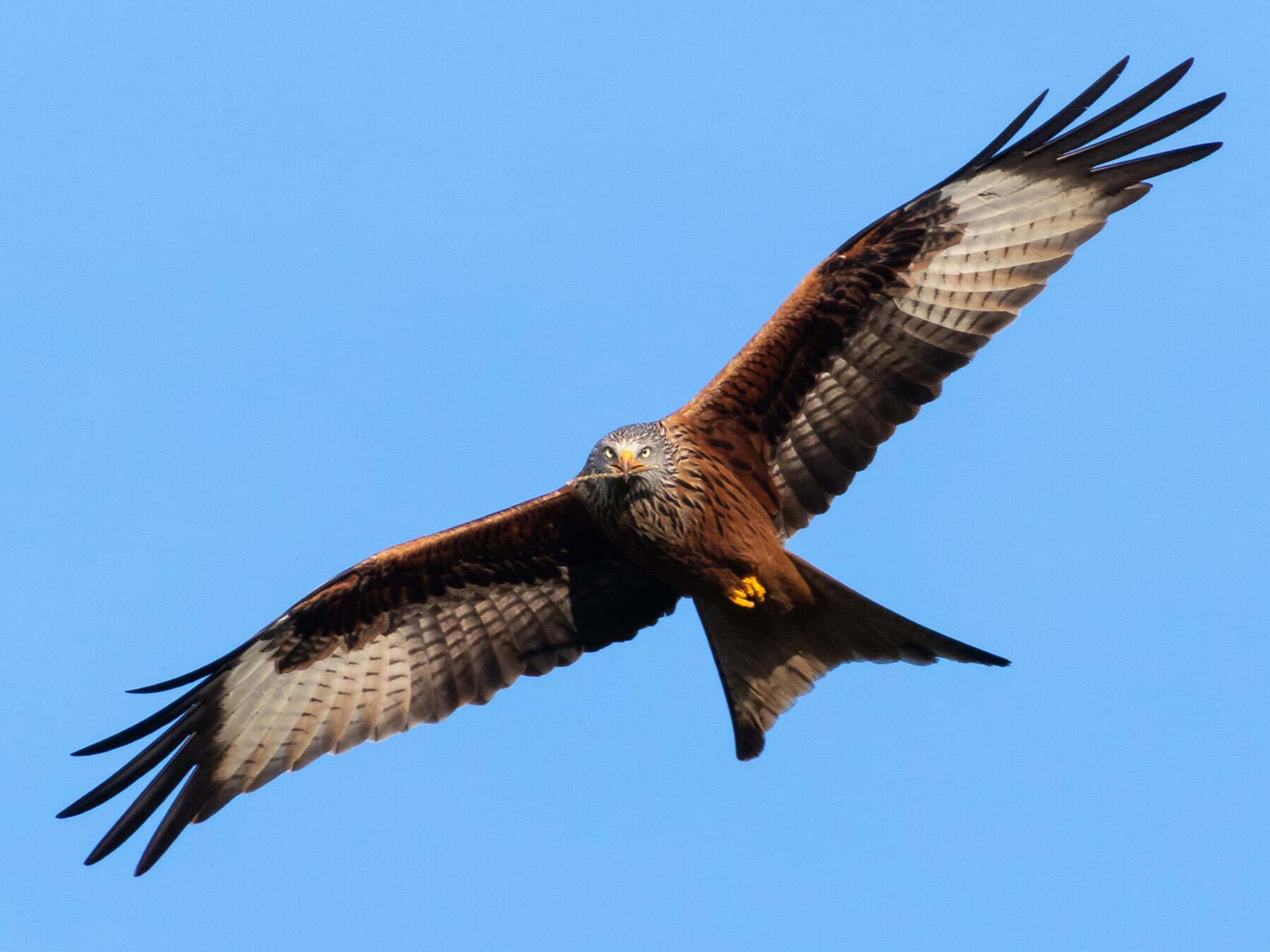
After leaving the nest, young kites are fed by their parents for at least two to three weeks more. In the Spanish study they stayed near the nest for about 26 days on average, and hardly hunted at all before they became independent.8
Most pairs raise one or two young, very occasionally three. In their early years the reintroduced pairs fledged 1.9 young per pair in England and 1.6 in Scotland. A young kite has a paler body, a darker head and a less rusty tail than its parents. In some areas young kites are wing-tagged in June, so you may see one with a coloured tag.
Age at first breeding
Typically at two years old. The reintroduced kites in England and Scotland first bred at an average age of between 1.7 and 2.6 years.
Red Kite nests and the law
The Red Kite is on Schedule 1 of the Wildlife and Countryside Act in Great Britain, and of the Wildlife (Northern Ireland) Order. In England, Wales and Scotland it is an offence, intentionally or recklessly, to disturb a kite while it is building a nest or is at a nest with eggs or young, or to disturb its dependent young, and in Scotland it is also an offence to harass a Red Kite at any time.9 In Northern Ireland the same disturbance at the nest is an offence for any wild bird.10 Work at a nest, such as surveys or ringing, needs a licence.
Sources
- David, T. S., Orta, J., Christie, D. A., Garcia, E. (2021). Red Kite (Milvus milvus), version 1.1. Birds of the World (S. M. Billerman, editor). Cornell Lab of Ornithology. doi:10.2173/bow.redkit1.01.1
- RSPB. Red Kite. RSPB Birds A-Z. Accessed 9 October 2026. Source
- Woodland Trust. Red kite (Milvus milvus). Woodland Trust, Animals. Accessed 9 October 2026. Source
- Chilterns Conservation Board. Red kites. Chilterns National Landscape. Accessed 9 October 2026. Source
- Shakespeare, W. (1623). The Winter's Tale. Project Gutenberg eBook 1539. Accessed 9 October 2026. Source
- BTO. Red Kite (Milvus milvus). BTO BirdFacts. Accessed 9 October 2026. Source
- Evans, I. M., Summers, R. W., O'Toole, L., Orr-Ewing, D. C., Evans, R., Snell, N., Smith, J. (1999). Evaluating the success of translocating Red Kites Milvus milvus to the UK. Bird Study 46: 129-144. doi:10.1080/00063659909461125
- Bustamante, J. (1993). Post-fledging dependence period and development of flight and hunting behaviour in the Red Kite Milvus milvus. Bird Study 40: 181-188. doi:10.1080/00063659309477181
- UK Parliament (1981). Wildlife and Countryside Act 1981, section 1, Schedule 1 and Schedule 1A. Accessed 9 October 2026. Source
- UK (1985). The Wildlife (Northern Ireland) Order 1985, article 4 and Schedule 1. Accessed 9 October 2026. Source